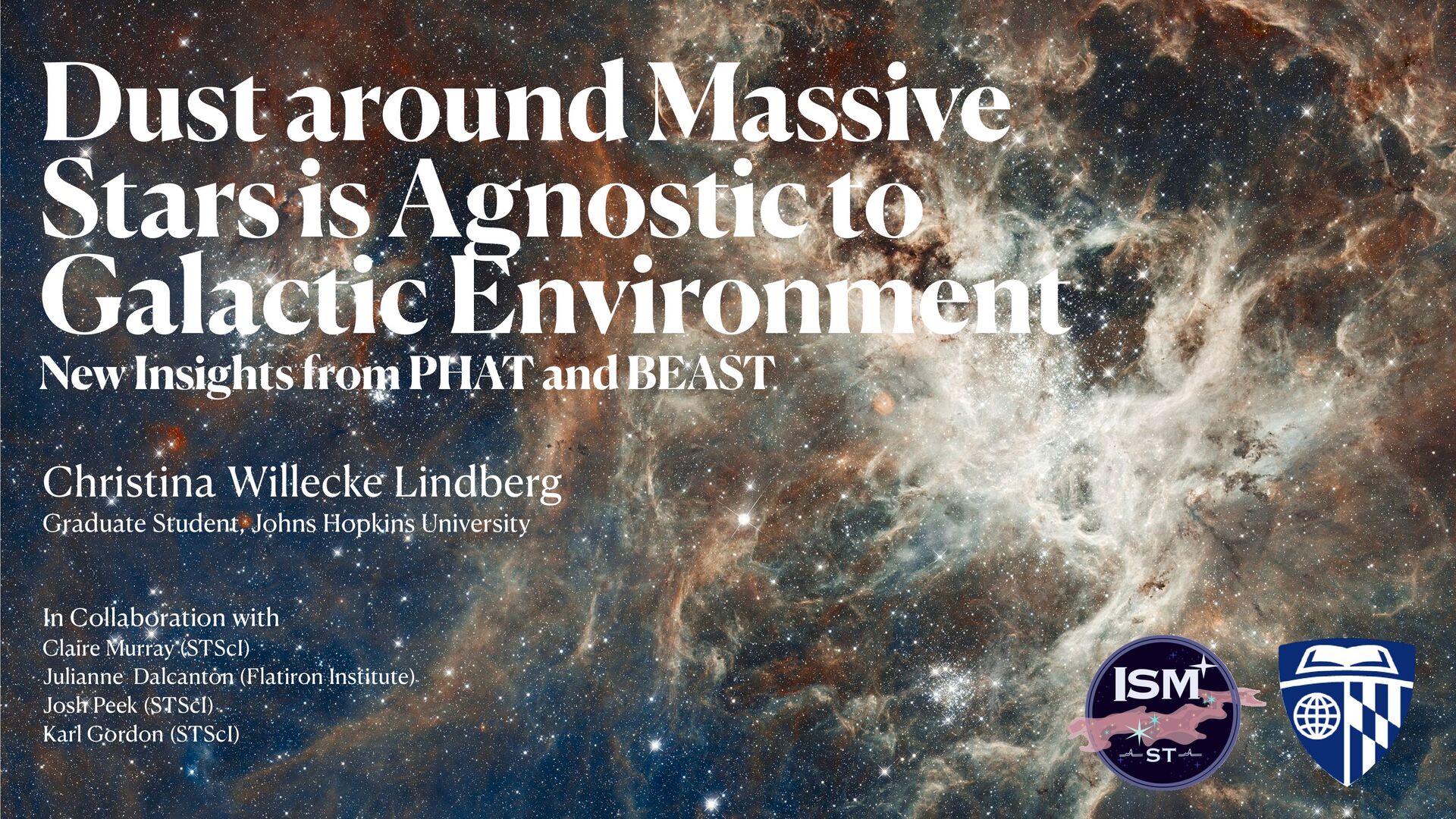
Insights from PHAT and BEAST Christina Willecke Lindberg Graduate Student, Johns Hopkins University In Collaboration with Claire Murray (STScI) Julianne Dalcanton (Flatiron Institute) Josh Peek (STScI) Karl Gordon (STScI)
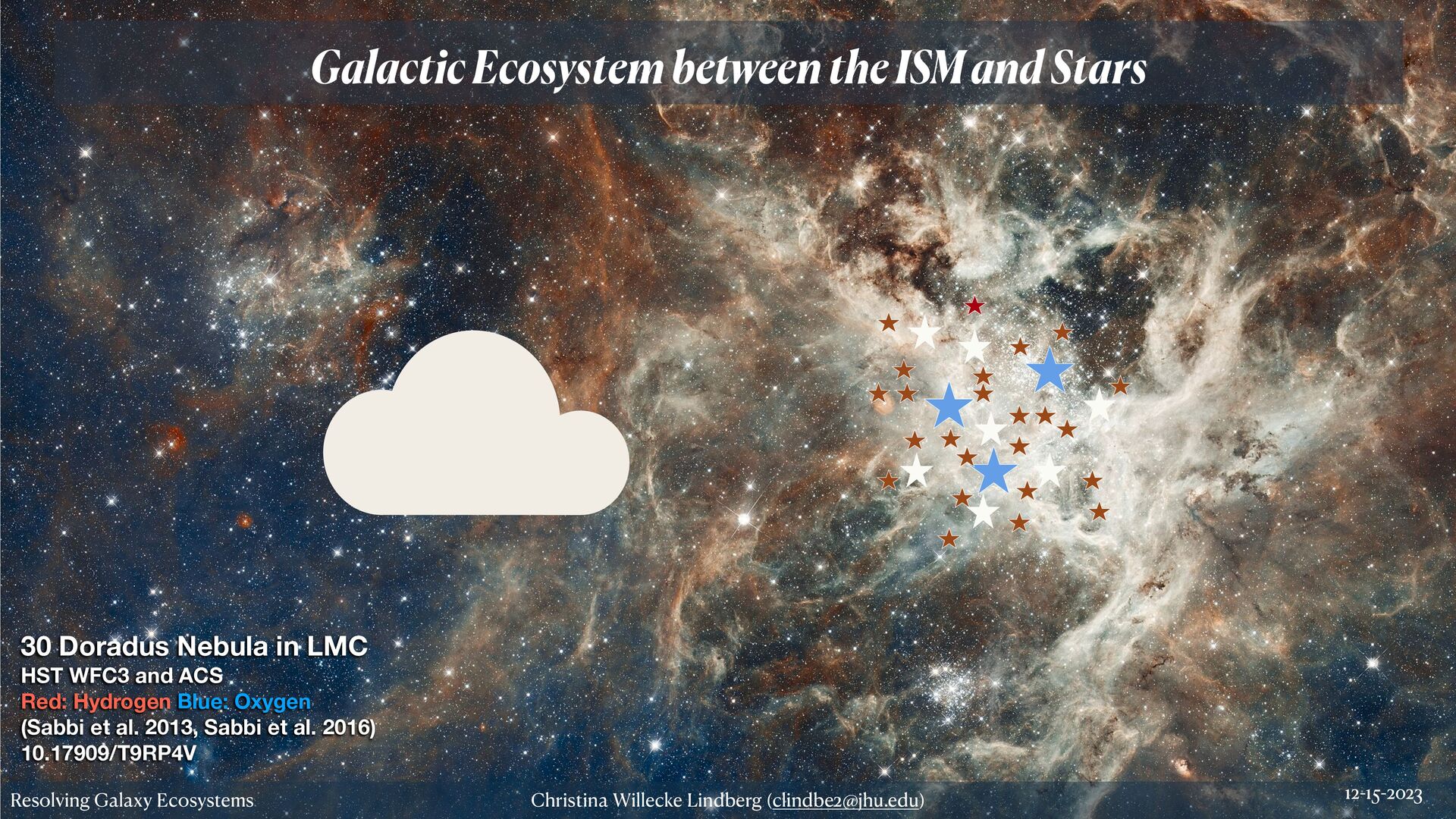
WFC3 and ACS Red: Hydrogen Blue: Oxygen (Sabbi et al. 2013, Sabbi et al. 2016) 10.17909/T9RP4V Galactic Ecosystem between the ISM and Stars Christina Willecke Lindberg ([email protected])
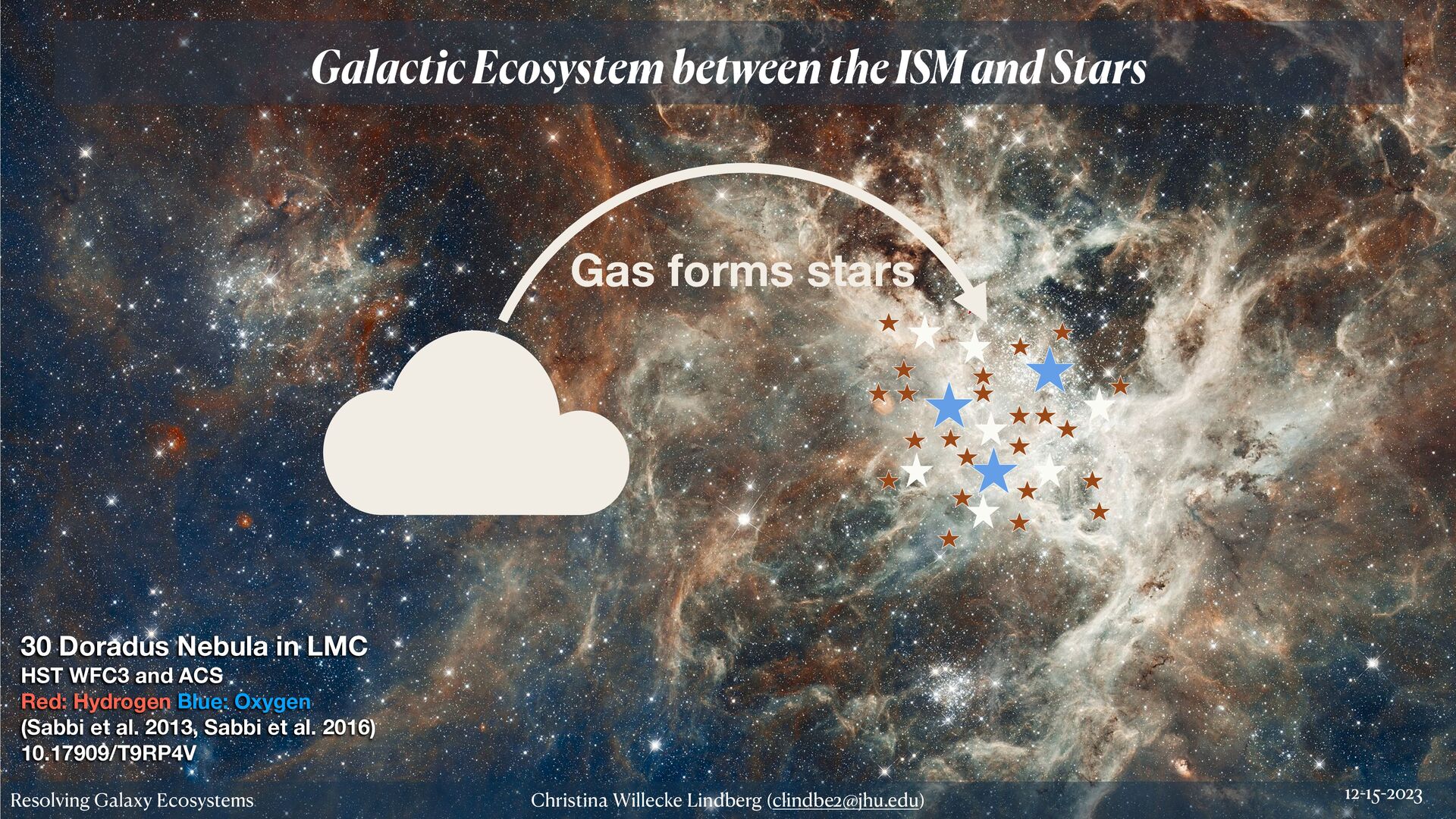
WFC3 and ACS Red: Hydrogen Blue: Oxygen (Sabbi et al. 2013, Sabbi et al. 2016) 10.17909/T9RP4V Gas forms stars Galactic Ecosystem between the ISM and Stars Christina Willecke Lindberg ([email protected])
Nebula in LMC HST WFC3 and ACS Red: Hydrogen Blue: Oxygen (Sabbi et al. 2013, Sabbi et al. 2016) 10.17909/T9RP4V Gas forms stars Galactic Ecosystem between the ISM and Stars Feedback destroys ISM
Nebula in LMC HST WFC3 and ACS Red: Hydrogen Blue: Oxygen (Sabbi et al. 2013, Sabbi et al. 2016) 10.17909/T9RP4V Gas forms stars Feedback compresses ISM Galactic Ecosystem between the ISM and Stars Feedback destroys ISM
Nebula in LMC HST WFC3 and ACS Red: Hydrogen Blue: Oxygen (Sabbi et al. 2013, Sabbi et al. 2016) 10.17909/T9RP4V Gas forms stars Feedback compresses ISM Galactic Ecosystem between the ISM and Stars Feedback destroys ISM Density of ISM around massive stars
Nebula in LMC HST WFC3 and ACS Red: Hydrogen Blue: Oxygen (Sabbi et al. 2013, Sabbi et al. 2016) 10.17909/T9RP4V Gas forms stars Feedback compresses ISM Galactic Ecosystem between the ISM and Stars Feedback destroys ISM Where are massive stars located in galaxies, and what sort of environment are they in? Density of ISM around massive stars
Milky Way • Resolved stars • Limited range in environments • Unresolved stars • Broad range in environments ESA/Webb, NASA & CSA, J. Lee and the PHANGS-JWST Team. Acknowledgement: J. Schmidt ESA/Gaia/DPAC, CC BY-SA 3.0 IGO
Milky Way • Resolved stars • Limited range in environments • Unresolved stars • Broad range in environments Andromeda Galaxy (M31) ESA/Webb, NASA & CSA, J. Lee and the PHANGS-JWST Team. Acknowledgement: J. Schmidt ESA/Gaia/DPAC, CC BY-SA 3.0 IGO - Andromeda Galaxy M32 M33
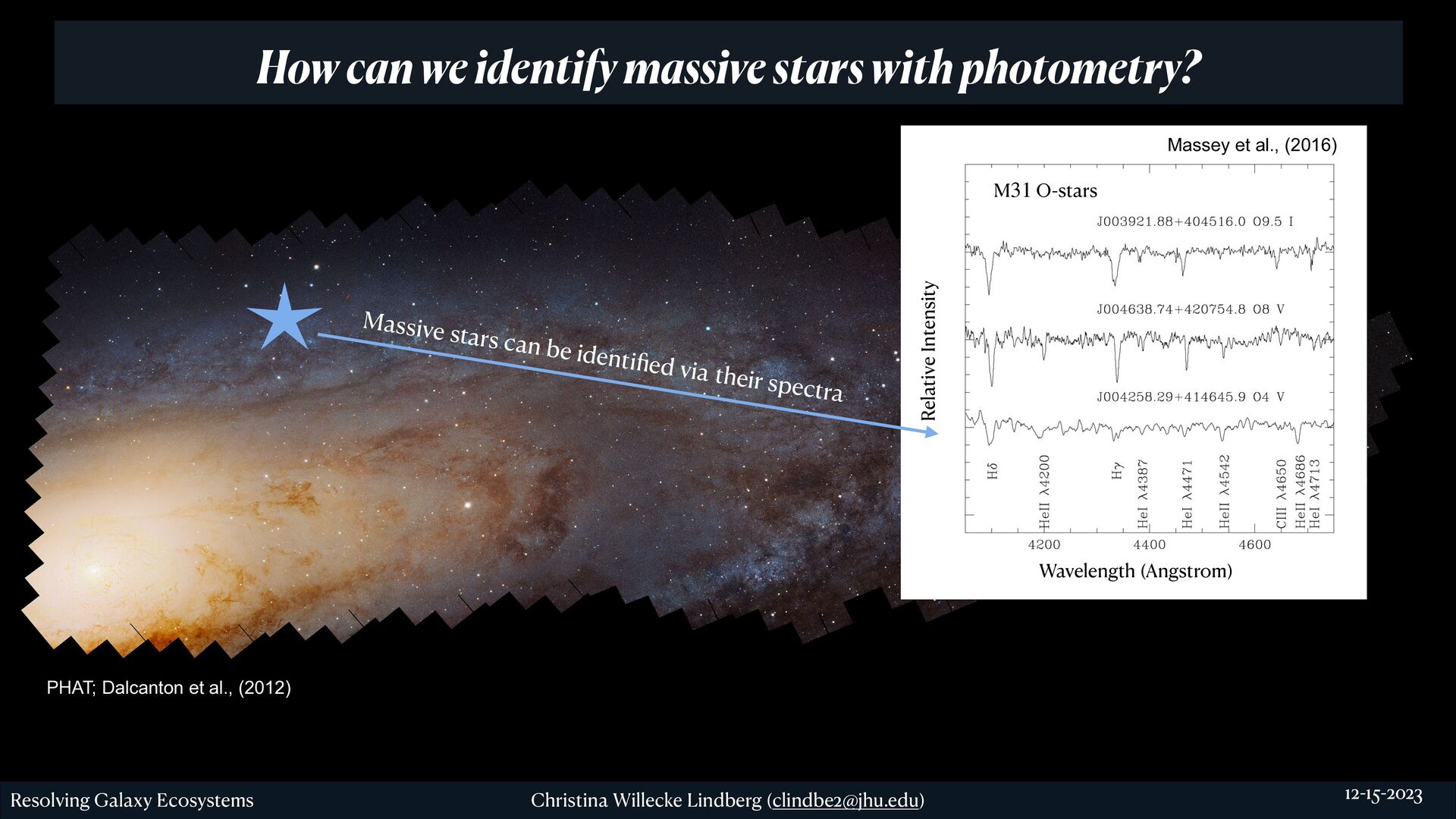
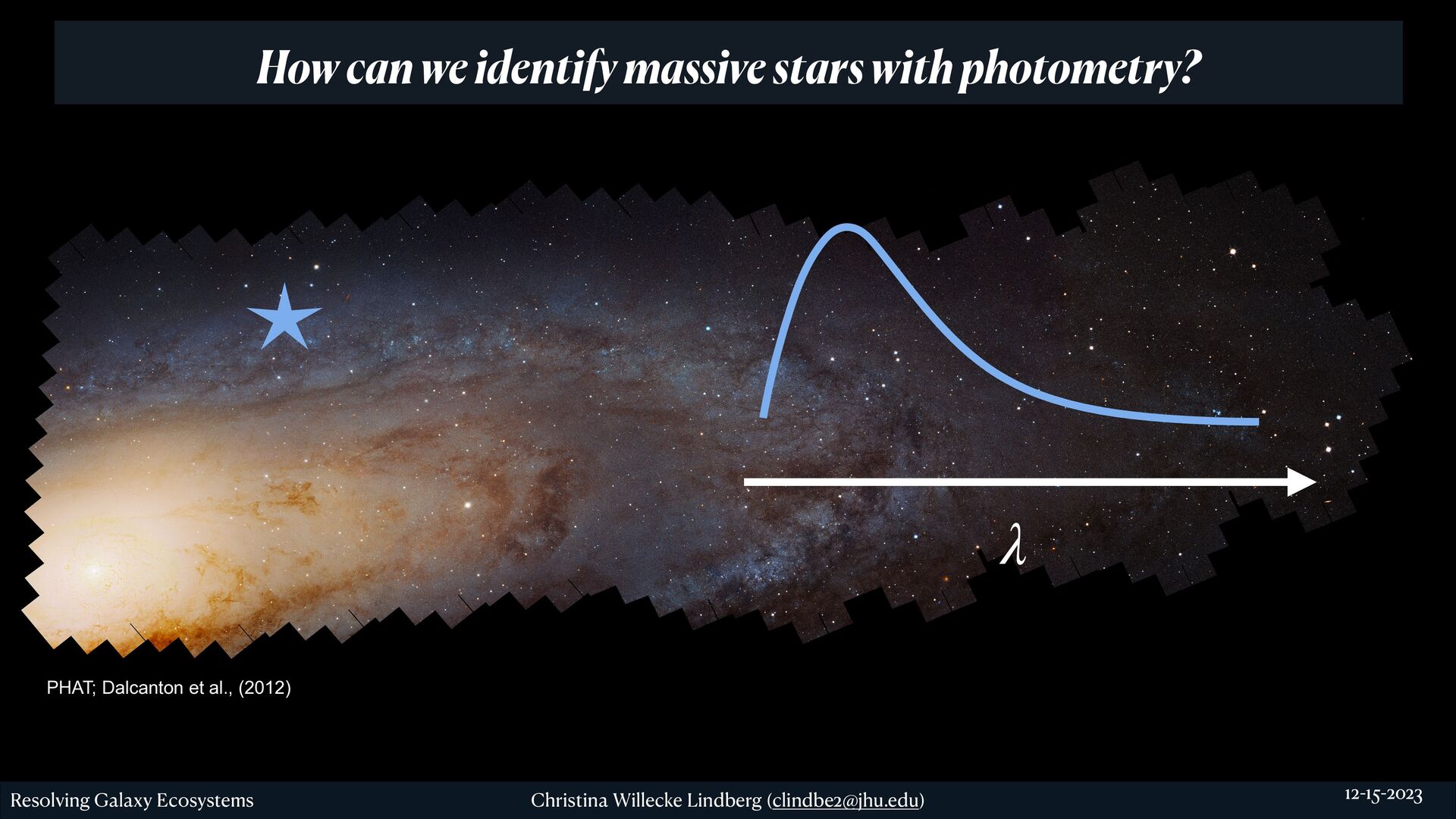
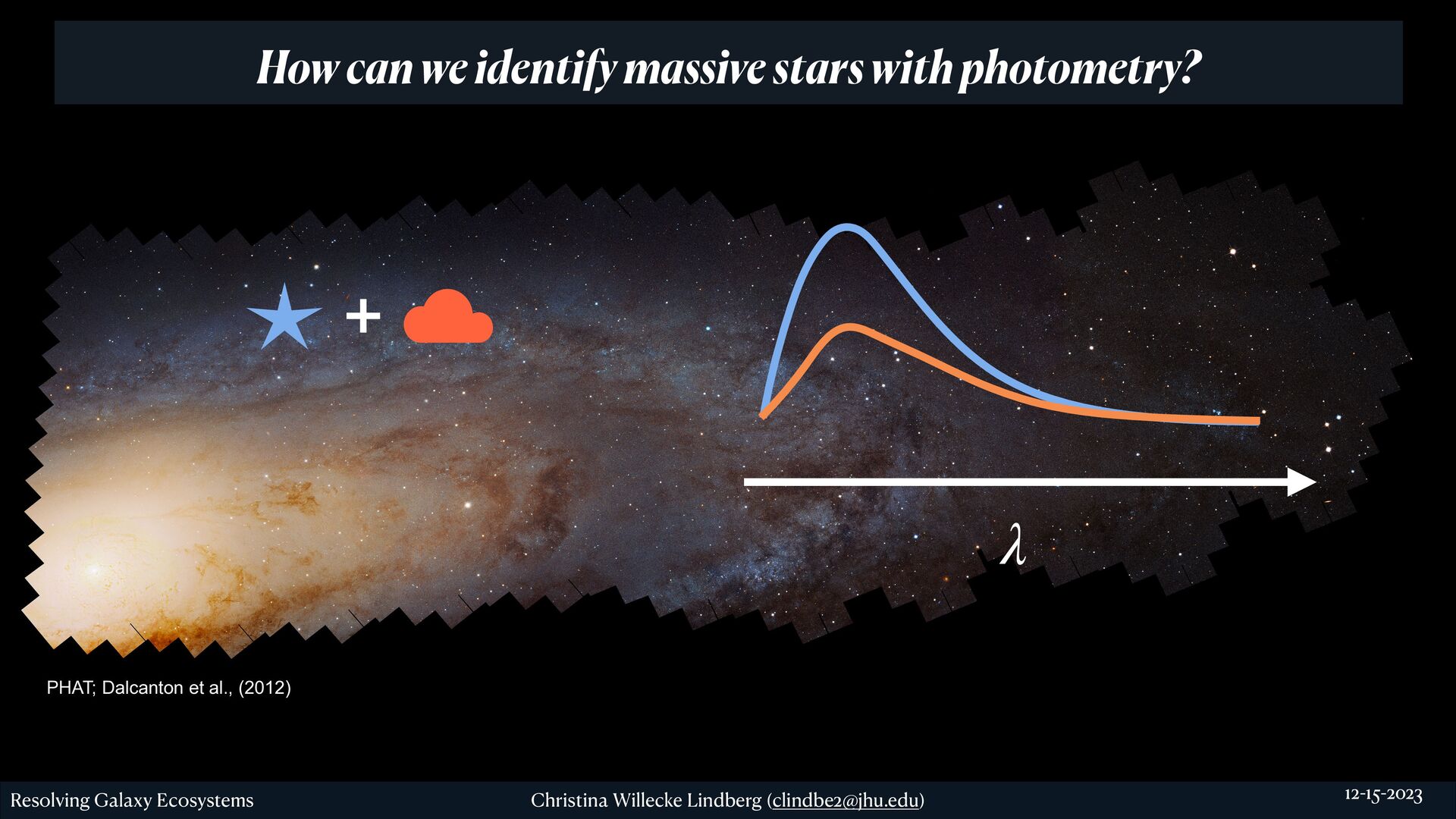
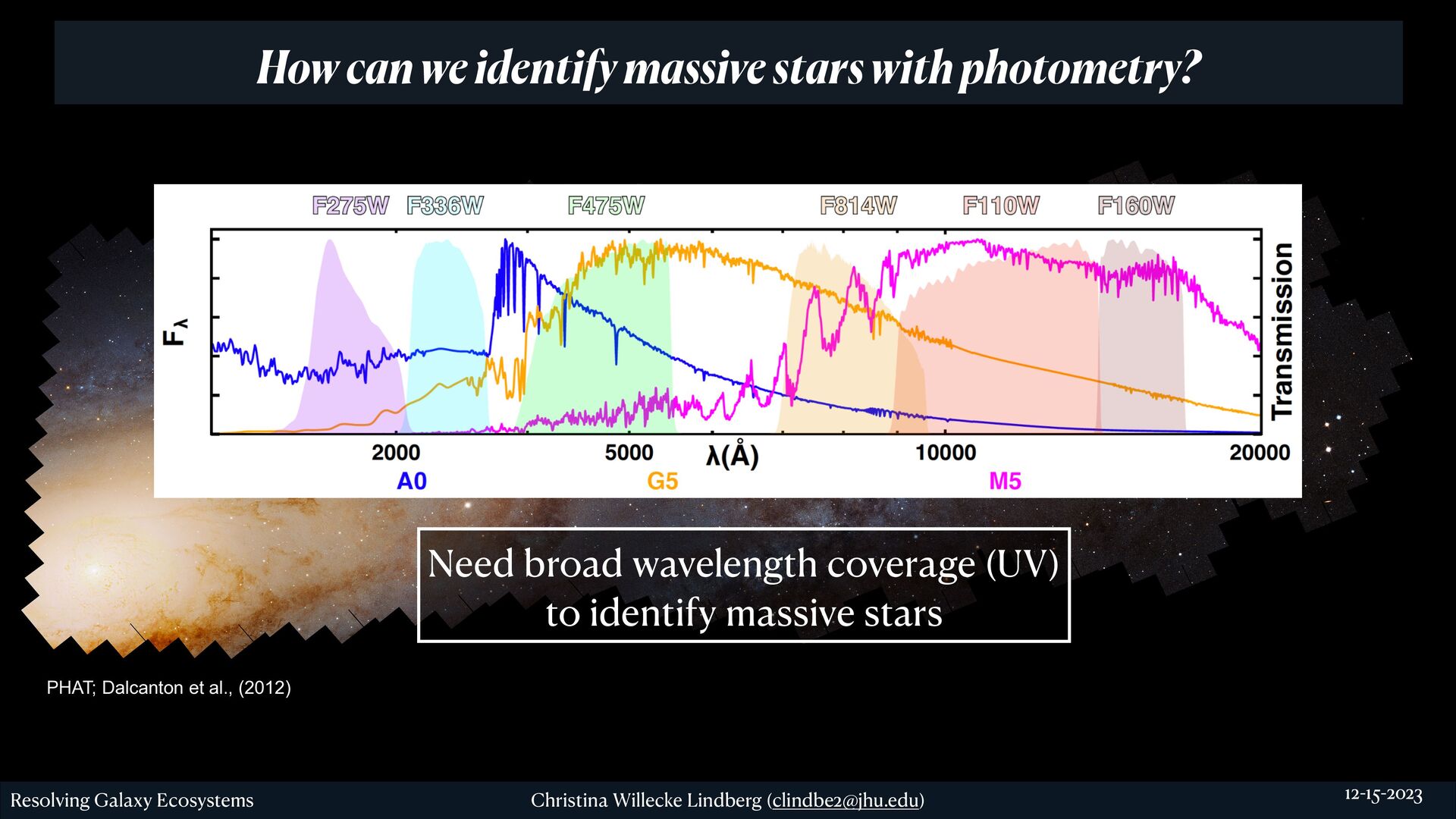
we identify massive stars with photometry? PHAT; Dalcanton et al., (2012) Andromeda Galaxy (M ) Fact Sheet • ~ kpc away • Can resolve individual stars • Inclined by ~ • Largest galaxy in Local Group • Panchromatic Hubble Andromeda Treasury (PHAT) • 1/3 of galaxy disk • NUV-VIS-NIR coverage • +100 million stars 31 750 70o
et al., (2012) Resolving Galaxy Ecosystems 12-15-2023 Christina Willecke Lindberg ([email protected]) Relative Intensity Wavelength (Angstrom) M O-stars 31 Massey et al., (2016) Massive stars can be identi fi ed via their spectra
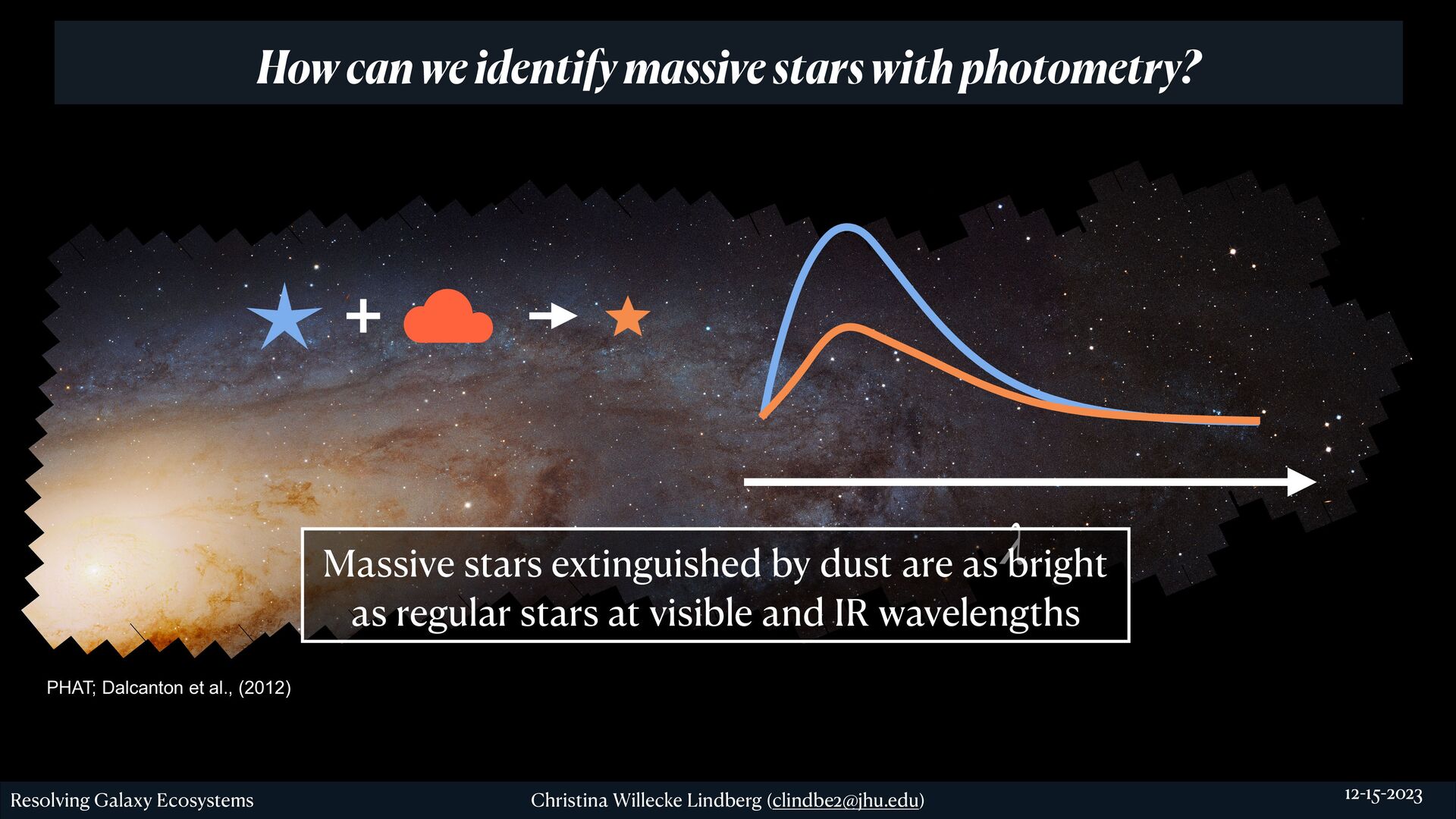
et al., (2012) Resolving Galaxy Ecosystems 12-15-2023 Christina Willecke Lindberg ([email protected]) λ Massive stars extinguished by dust are as bright as regular stars at visible and IR wavelengths
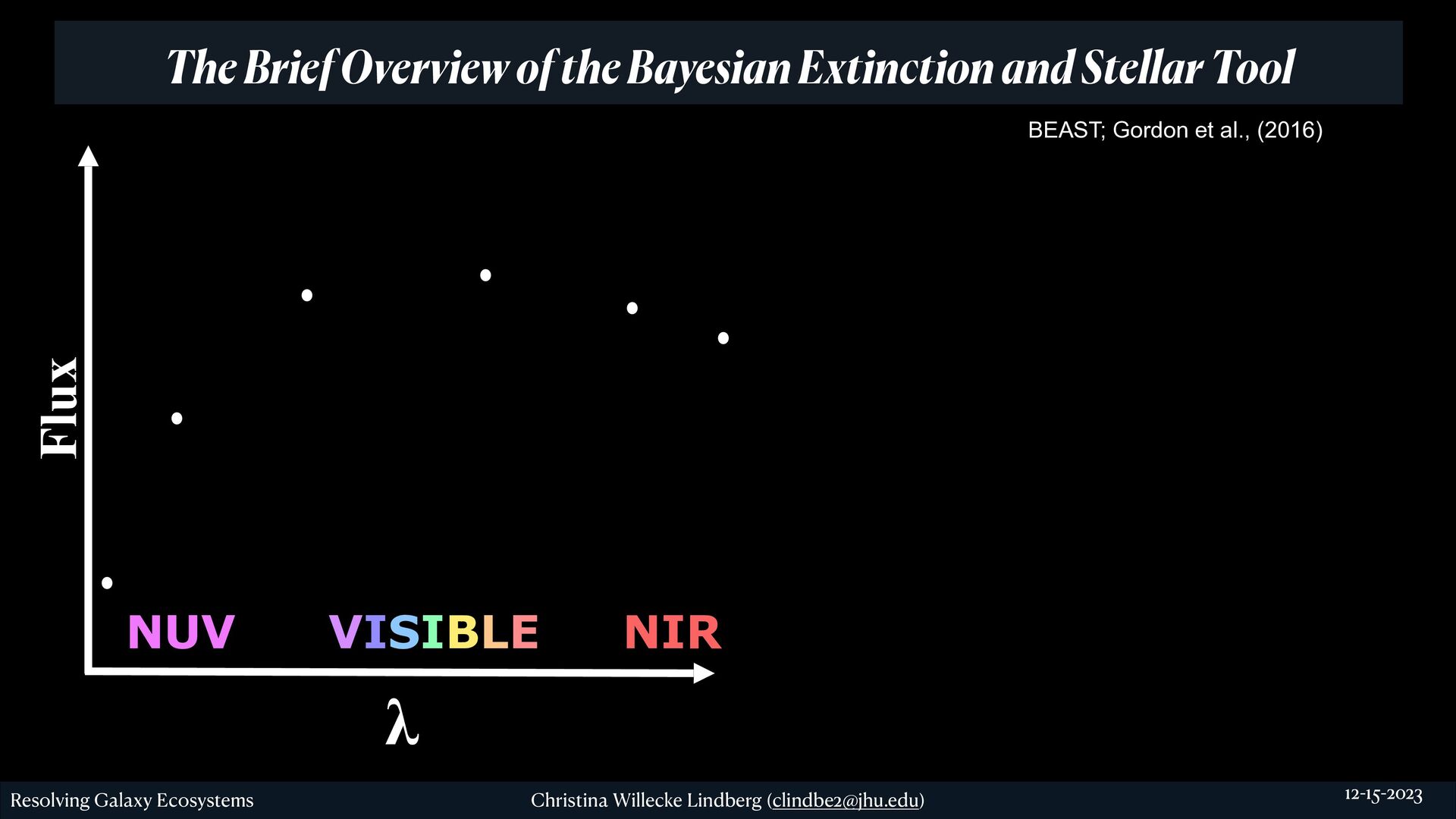
Overview of the Bayesian Extinction and Stellar Tool λ VISIBLE Flux NIR NUV 1. Fit spectral energy distribution (SED) with stellar model STELLAR MODEL [initial mass, age, metallicity] BEAST; Gordon et al., (2016)
Overview of the Bayesian Extinction and Stellar Tool STELLAR MODEL [initial mass, age, metallicity] + DUST MODEL [extinction (AV), grain size (RV), extinction curve] 2. Apply extinction effects to stellar SED λ VISIBLE Flux NIR NUV BEAST; Gordon et al., (2016)
Overview of the Bayesian Extinction and Stellar Tool STELLAR MODEL [initial mass, age, metallicity] + DUST MODEL [extinction (AV), grain size (RV), extinction curve] λ VISIBLE Flux NIR NUV BEAST; Gordon et al., (2016) Priors
Overview of the Bayesian Extinction and Stellar Tool BEAST; Gordon et al., (2016) STELLAR MODEL [initial mass, age, metallicity] + DUST MODEL [extinction (AV), grain size (RV), extinction curve] λ VISIBLE Flux NIR NUV Marginalize 6D posterior to get 1D posteriors for each model parameter Priors
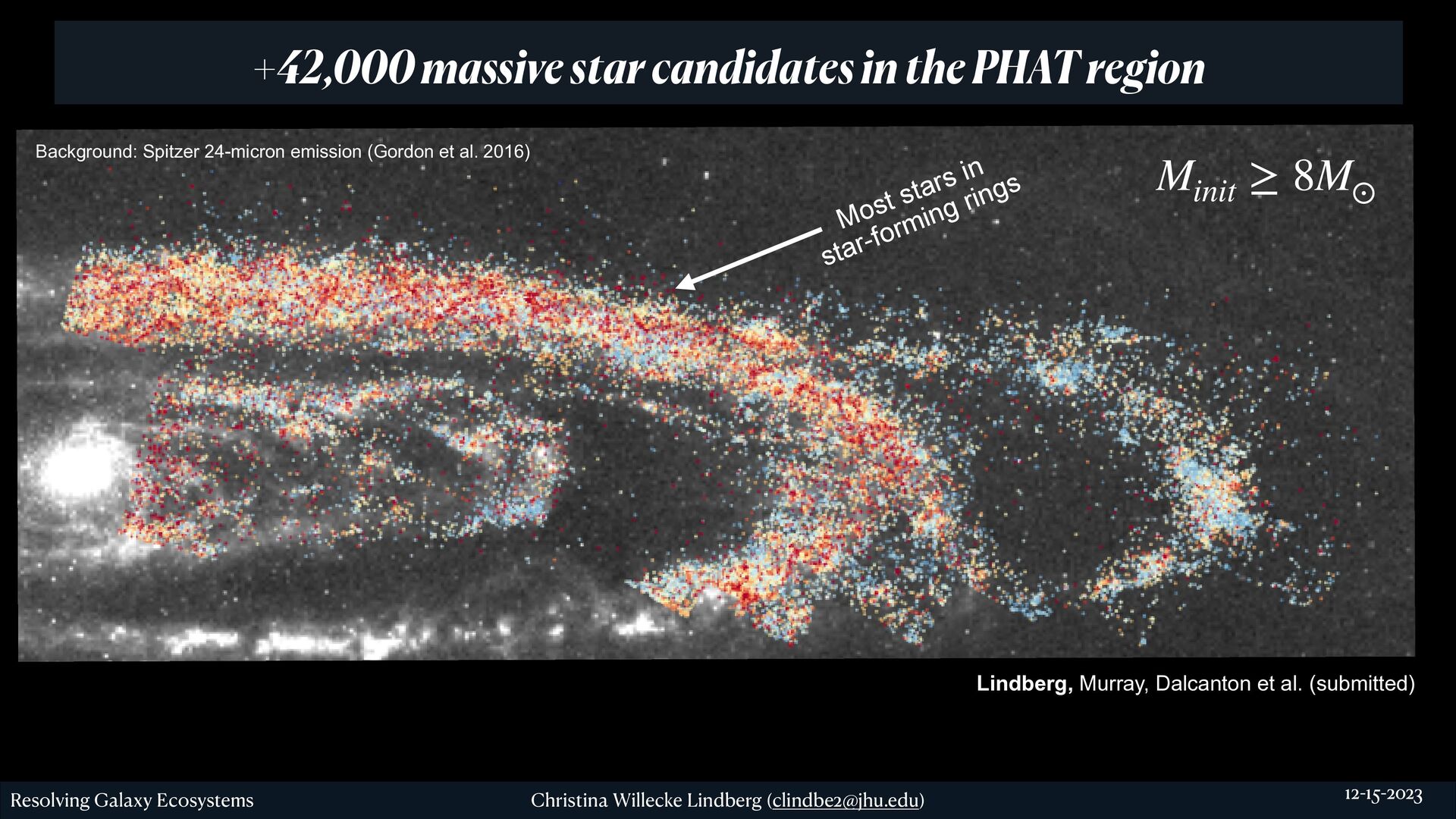
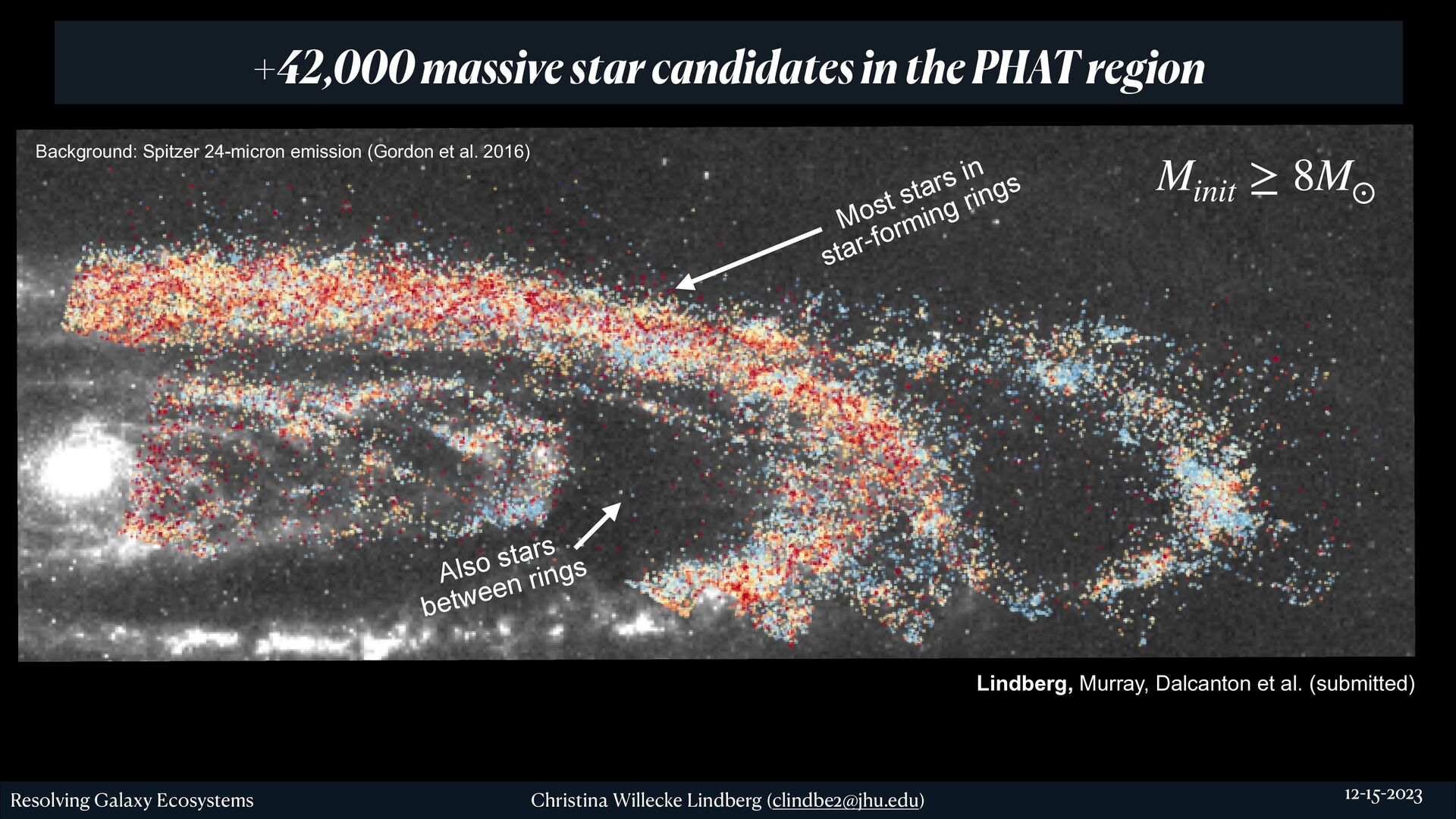
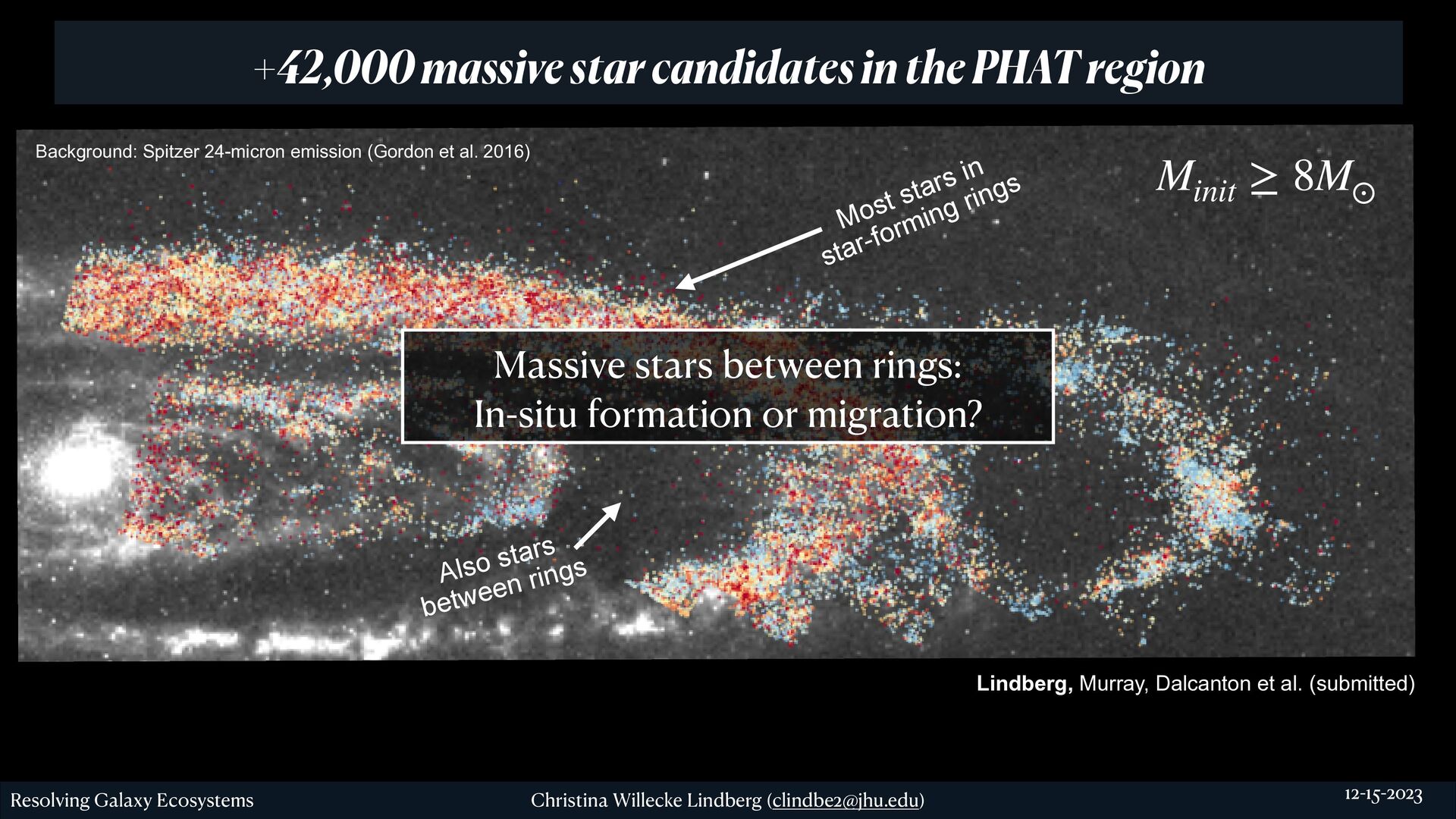
star candidates in the PHAT region Minit ≥ 8M⊙ Lindberg, Murray, Dalcanton et al. (submitted) Background: Spitzer 24-micron emission (Gordon et al. 2016)
8M⊙ Resolving Galaxy Ecosystems 12-15-2023 Christina Willecke Lindberg ([email protected]) Most stars in star-forming rings Lindberg, Murray, Dalcanton et al. (submitted) Also stars between rings Background: Spitzer 24-micron emission (Gordon et al. 2016)
8M⊙ Resolving Galaxy Ecosystems 12-15-2023 Christina Willecke Lindberg ([email protected]) Most stars in star-forming rings Also stars between rings Background: Spitzer 24-micron emission (Gordon et al. 2016) Massive stars between rings: In-situ formation or migration? Lindberg, Murray, Dalcanton et al. (submitted)
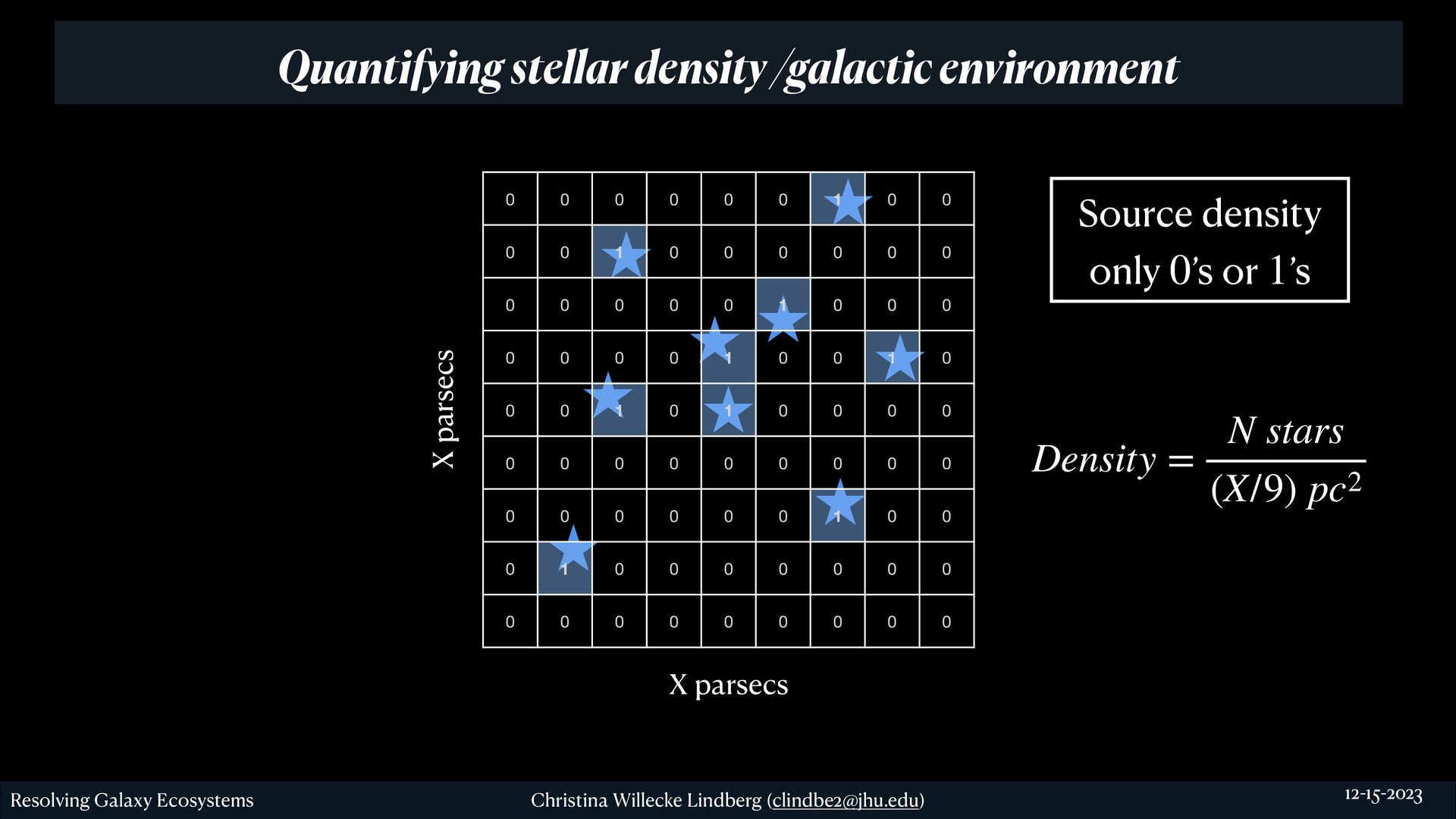
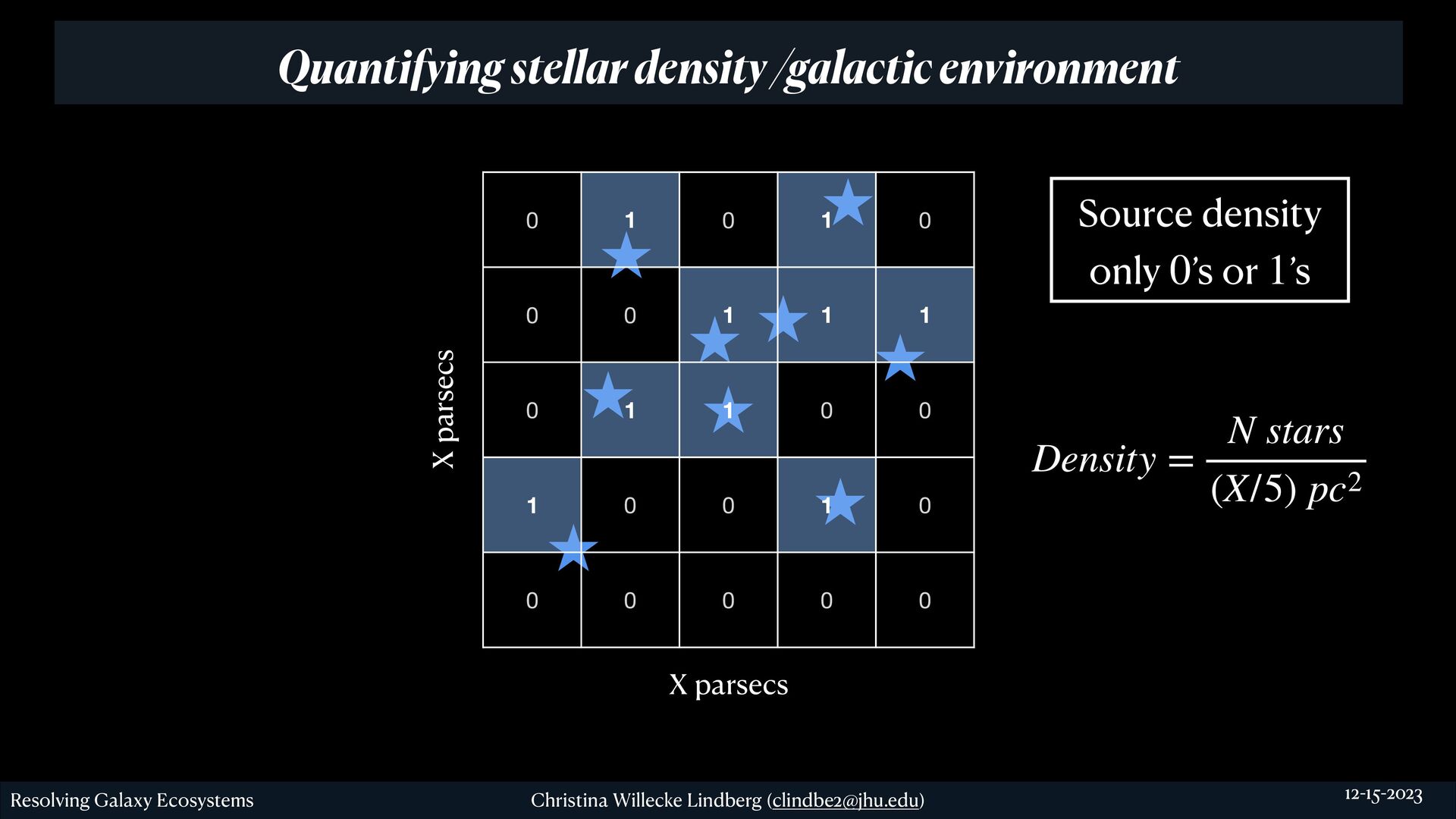
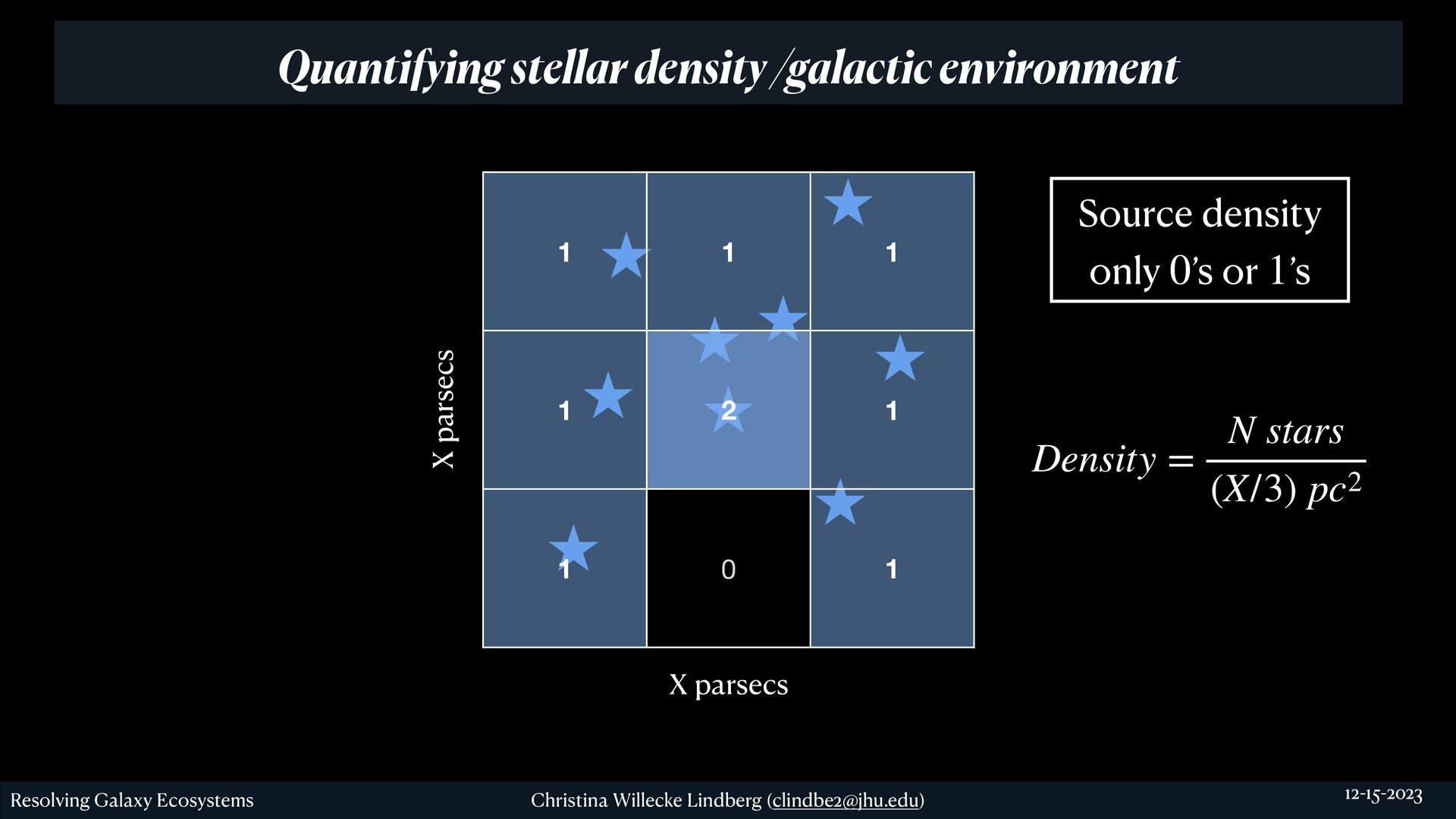
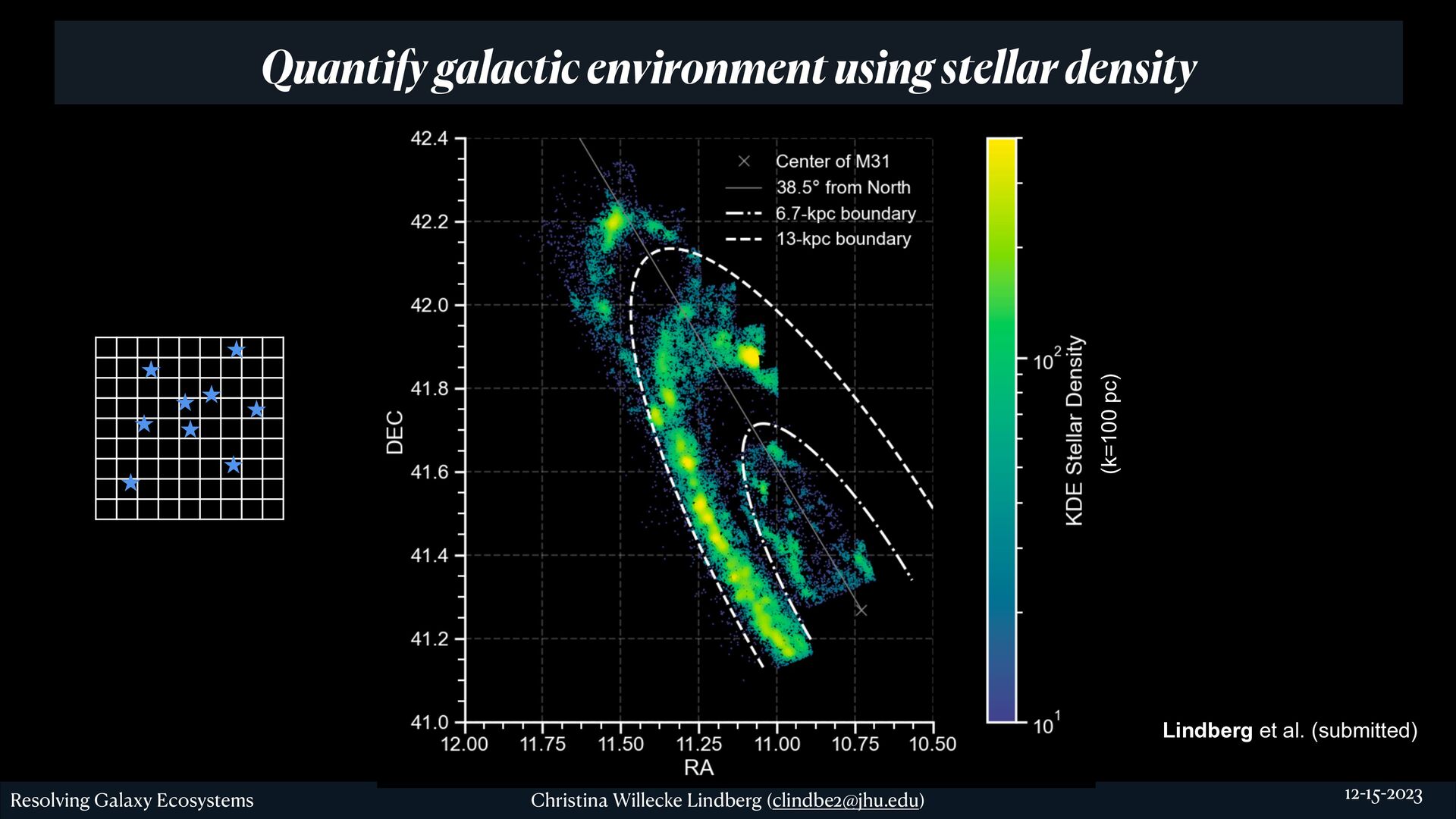
stellar density /galactic environment Resolving Galaxy Ecosystems 12-15-2023 Christina Willecke Lindberg ([email protected]) Source density only ’s or ’s 0 1 X parsecs X parsecs Density = N stars (X/3) pc2
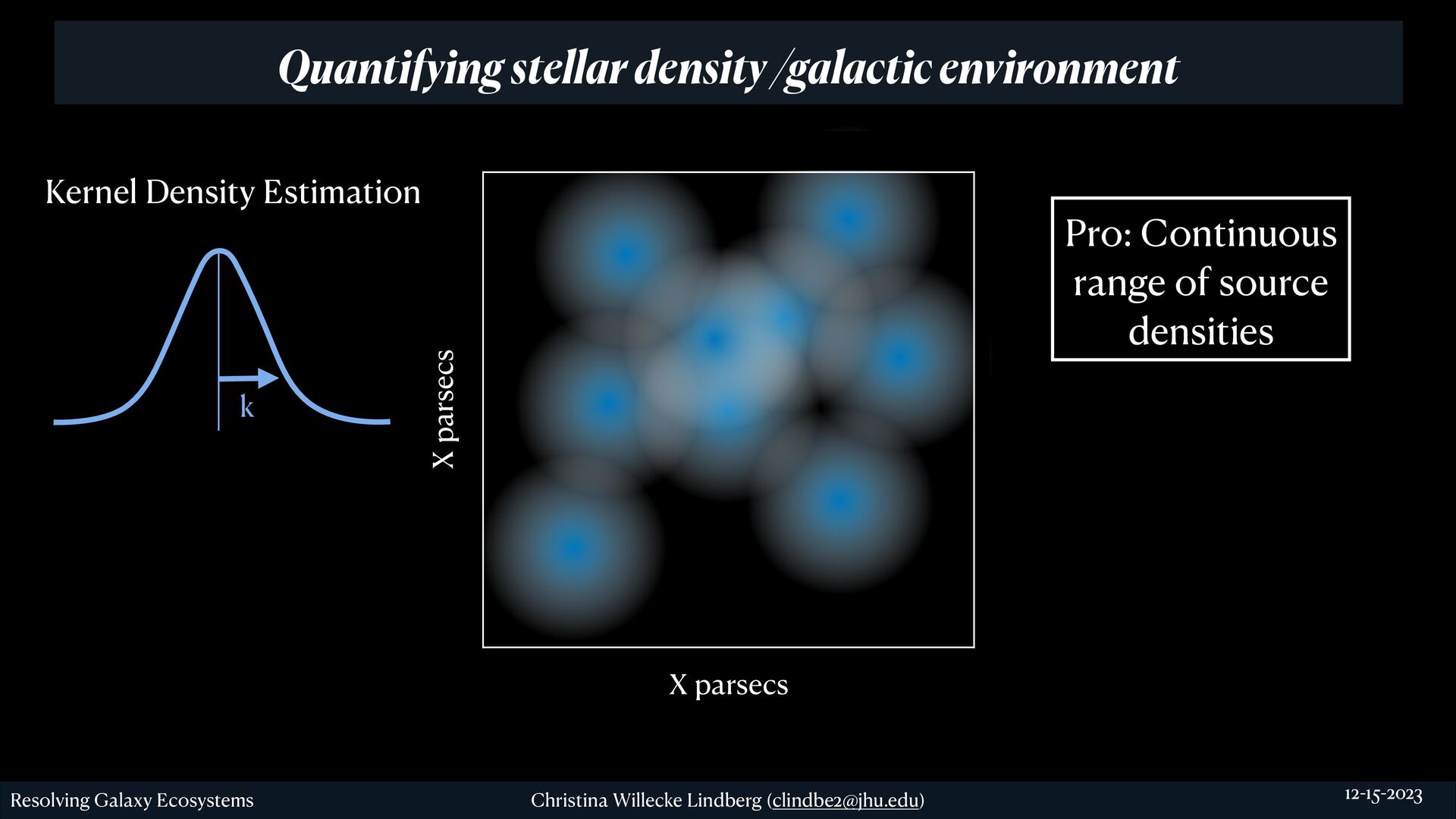
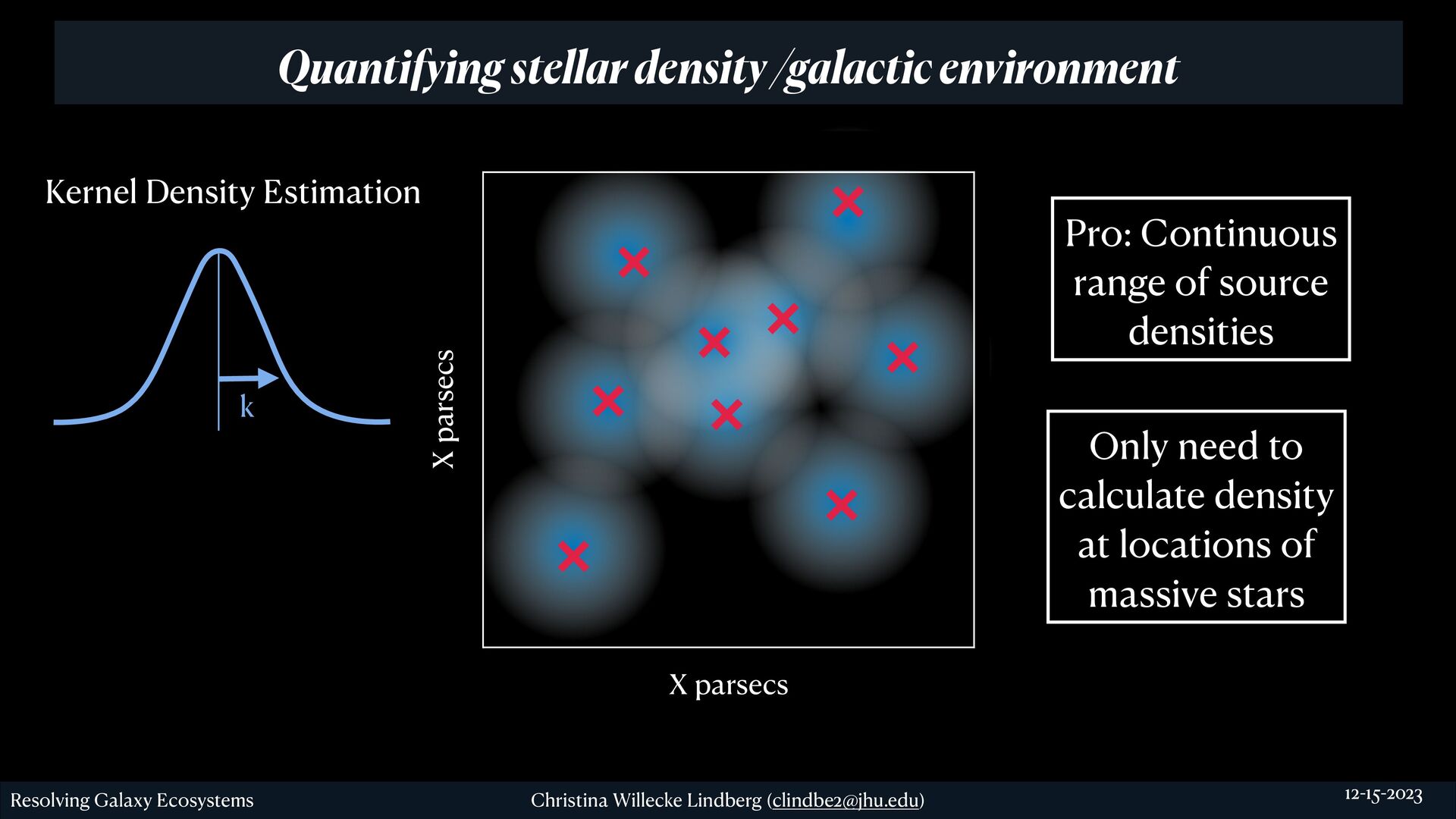
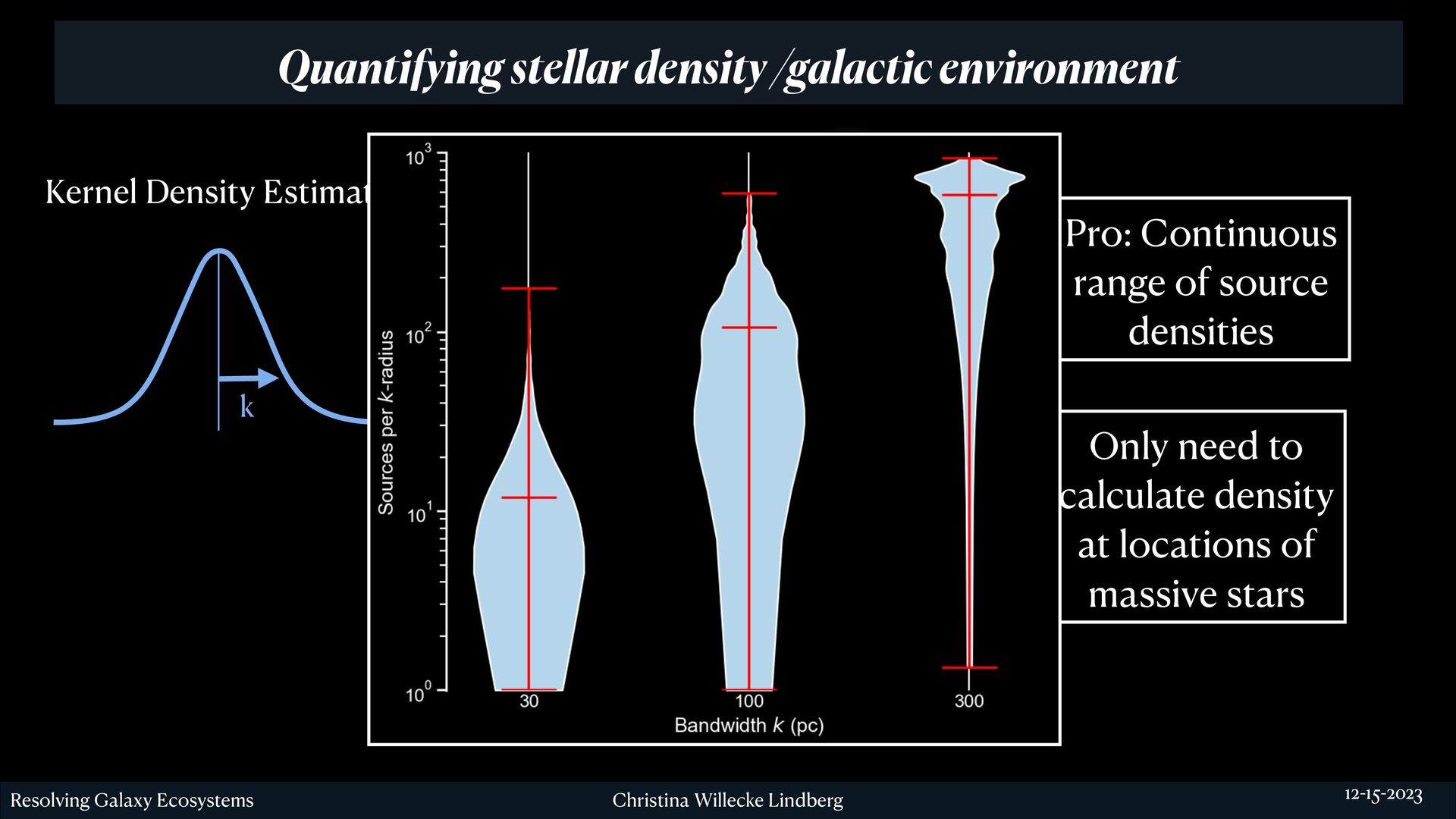
Willecke Lindberg ([email protected]) X parsecs X parsecs k Kernel Density Estimation Pro: Continuous range of source densities Only need to calculate density at locations of massive stars
Ecosystems 12-15-2023 X parsecs X parsecs k Kernel Density Estimation Pro: Continuous range of source densities Only need to calculate density at locations of massive stars
([email protected]) Theoretical LOS Av of Runaway Massive Stars across Stellar Densities 25-pc Dust Content (RGB-derived) Av Line-of-Sight (runaway stars) 25-pc Dust Content (RGB-derived) Lindberg et al. (submitted) 25-pc Av (RGB-derived)
Av of Massive Stars across Stellar Densities 25-pc Dust Content (RGB-derived) Av Line-of-Sight (BEAST-derived) Lindberg et al. (submitted) . 0.5-pc Av Line-of-Sight (BEAST-derived)
Av of Massive Stars across Stellar Densities 25-pc Dust Content (RGB-derived) Av Line-of-Sight (BEAST-derived) Lindberg et al. (submitted) . 0.5-pc Av Line-of-Sight (BEAST-derived)
Av of Massive Stars across Stellar Densities 25-pc Dust Content (RGB-derived) 0.5-pc Av Line-of-Sight (BEAST-derived) Lindberg et al. (submitted) 25-pc Av (RGB-derived)
Av of Massive Stars across Stellar Densities 25-pc Dust Content (RGB-derived) Av Line-of-Sight (BEAST-derived) Gap in dense regions: Effect of pre- supernovae or cumulative feedback? Lindberg et al. (submitted) 0.5-pc Av Line-of-Sight (BEAST-derived) 25-pc Av (RGB-derived)
Av of Massive Stars across Stellar Densities 25-pc Dust Content (RGB-derived) Av Line-of-Sight (BEAST-derived) Dust in sparse regions: Massive stars located in ISM not resolvable at 25-pc Evidence of in-situ formation? Lindberg et al. (submitted) Gap in dense regions: Effect of pre- supernovae or cumulative feedback? 0.5-pc Av Line-of-Sight (BEAST-derived) 25-pc Av (RGB-derived)
Av of Massive Stars across Stellar Densities 25-pc Dust Content (RGB-derived) Av Line-of-Sight (BEAST-derived) Dust in sparse regions: Massive stars located in ISM not resolvable at 25-pc Evidence of in-situ formation? Lindberg et al. (submitted) Need follow-up observations to con fi rm in-situ formation! Gap in dense regions: Effect of pre- supernovae or cumulative feedback? 0.5-pc Av Line-of-Sight (BEAST-derived) 25-pc Av (RGB-derived)
et al. (2024) https://arxiv.org/abs/2401.10991 1. Identified over 42,000 main-sequence massive star candidates in the PHAT region of M31 using broadband photometry (Dalcanton+12) characterized by the BEAST (Gordon+16), available at https:// archive.stsci.edu/hlsp/phathighmass. 2. At 25-pc resolution, Av is correlated with galactic environment 3. At ~0.5-pc resolution, line-of-sight Av is not correlated with galactic environment and remains constant across all disk environments 4. Discrepancy between the two measurements indicates that massive stars in sparse environments are not runaway stars, but likely formed in situ from ISM structures unresolved at 25-pc 5. Future: Study can be repeated for any galaxies with broad photometric coverage (i.e. SMC/LMC, M33, etc.) Resolving Galaxy Ecosystems 12-15-2023 Christina Willecke Lindberg ([email protected]) 25-pc Dust Content (RGB-derived) Av Line-of-Sight (BEAST-derived) Thank you!


 christinawlindberg
 csswizardry
 ipullrank
 jacobtomlinson
 shpigford
 3n
3n
 chrisshort
 keavy
keavy
 codingconduct
 aemeredith
 katarinadahlin
 jonoalderson
 bkeepers
![Christina Willecke Lindberg ([email protected]) Resolving Galaxy Ecosystems 12-15-2023 30 Doradus](https://files.speakerdeck.com/presentations/7faecbf04b094664be47da9abb6b5948/slide_3.jpg)
![Christina Willecke Lindberg ([email protected]) Resolving Galaxy Ecosystems 12-15-2023 30 Doradus](https://files.speakerdeck.com/presentations/7faecbf04b094664be47da9abb6b5948/slide_4.jpg)
![Christina Willecke Lindberg ([email protected]) Resolving Galaxy Ecosystems 12-15-2023 30 Doradus](https://files.speakerdeck.com/presentations/7faecbf04b094664be47da9abb6b5948/slide_5.jpg)
![Christina Willecke Lindberg ([email protected]) Resolving Galaxy Ecosystems 12-15-2023 30 Doradus](https://files.speakerdeck.com/presentations/7faecbf04b094664be47da9abb6b5948/slide_6.jpg)
![Christina Willecke Lindberg ([email protected]) Resolving Galaxy Ecosystems 12-15-2023 Extragalactic Galaxies](https://files.speakerdeck.com/presentations/7faecbf04b094664be47da9abb6b5948/slide_7.jpg)
![Christina Willecke Lindberg ([email protected]) Resolving Galaxy Ecosystems 12-15-2023 Extragalactic Galaxies](https://files.speakerdeck.com/presentations/7faecbf04b094664be47da9abb6b5948/slide_8.jpg)
![Resolving Galaxy Ecosystems 12-15-2023 Christina Willecke Lindberg ([email protected]) How can](https://files.speakerdeck.com/presentations/7faecbf04b094664be47da9abb6b5948/slide_9.jpg)
![Resolving Galaxy Ecosystems 12-15-2023 Christina Willecke Lindberg ([email protected]) The Brief](https://files.speakerdeck.com/presentations/7faecbf04b094664be47da9abb6b5948/slide_16.jpg)
![Resolving Galaxy Ecosystems 12-15-2023 Christina Willecke Lindberg ([email protected]) The Brief](https://files.speakerdeck.com/presentations/7faecbf04b094664be47da9abb6b5948/slide_17.jpg)
![Resolving Galaxy Ecosystems 12-15-2023 Christina Willecke Lindberg ([email protected]) The Brief](https://files.speakerdeck.com/presentations/7faecbf04b094664be47da9abb6b5948/slide_18.jpg)
![Resolving Galaxy Ecosystems 12-15-2023 Christina Willecke Lindberg ([email protected]) The Brief](https://files.speakerdeck.com/presentations/7faecbf04b094664be47da9abb6b5948/slide_19.jpg)
![Resolving Galaxy Ecosystems 12-15-2023 Christina Willecke Lindberg ([email protected]) +42,000 massive](https://files.speakerdeck.com/presentations/7faecbf04b094664be47da9abb6b5948/slide_20.jpg)

![Quantifying stellar density /galactic environment Christina Willecke Lindberg ([email protected]) Resolving](https://files.speakerdeck.com/presentations/7faecbf04b094664be47da9abb6b5948/slide_25.jpg)

![Resolving Galaxy Ecosystems 12-15-2023 Christina Willecke Lindberg ([email protected]) Multi-scale ISM](https://files.speakerdeck.com/presentations/7faecbf04b094664be47da9abb6b5948/slide_35.jpg)
![Resolving Galaxy Ecosystems 12-15-2023 Christina Willecke Lindberg ([email protected]) 25-pc Av](https://files.speakerdeck.com/presentations/7faecbf04b094664be47da9abb6b5948/slide_36.jpg)

![Resolving Galaxy Ecosystems 12-15-2023 Christina Willecke Lindberg ([email protected]) Measured LOS](https://files.speakerdeck.com/presentations/7faecbf04b094664be47da9abb6b5948/slide_38.jpg)
![Resolving Galaxy Ecosystems 12-15-2023 Christina Willecke Lindberg ([email protected]) Measured LOS](https://files.speakerdeck.com/presentations/7faecbf04b094664be47da9abb6b5948/slide_39.jpg)
![Resolving Galaxy Ecosystems 12-15-2023 Christina Willecke Lindberg ([email protected]) Measured LOS](https://files.speakerdeck.com/presentations/7faecbf04b094664be47da9abb6b5948/slide_40.jpg)
![Resolving Galaxy Ecosystems 12-15-2023 Christina Willecke Lindberg ([email protected]) Measured LOS](https://files.speakerdeck.com/presentations/7faecbf04b094664be47da9abb6b5948/slide_41.jpg)
![Resolving Galaxy Ecosystems 12-15-2023 Christina Willecke Lindberg ([email protected]) Measured LOS](https://files.speakerdeck.com/presentations/7faecbf04b094664be47da9abb6b5948/slide_42.jpg)
![Resolving Galaxy Ecosystems 12-15-2023 Christina Willecke Lindberg ([email protected]) Measured LOS](https://files.speakerdeck.com/presentations/7faecbf04b094664be47da9abb6b5948/slide_43.jpg)
