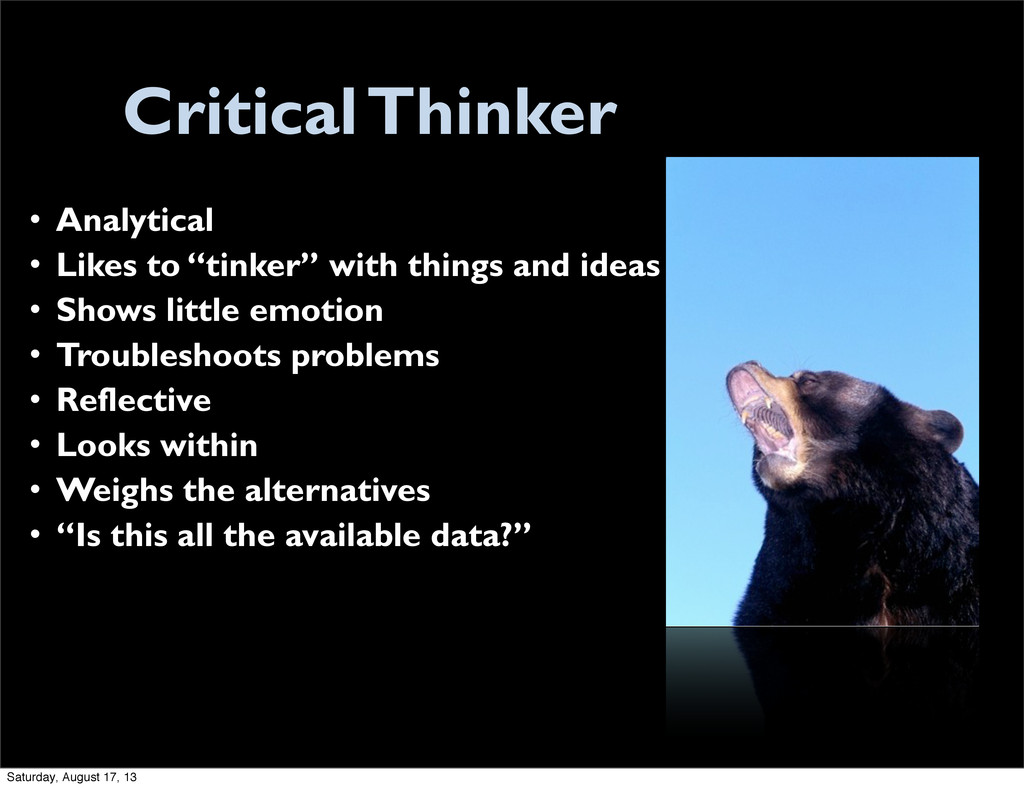
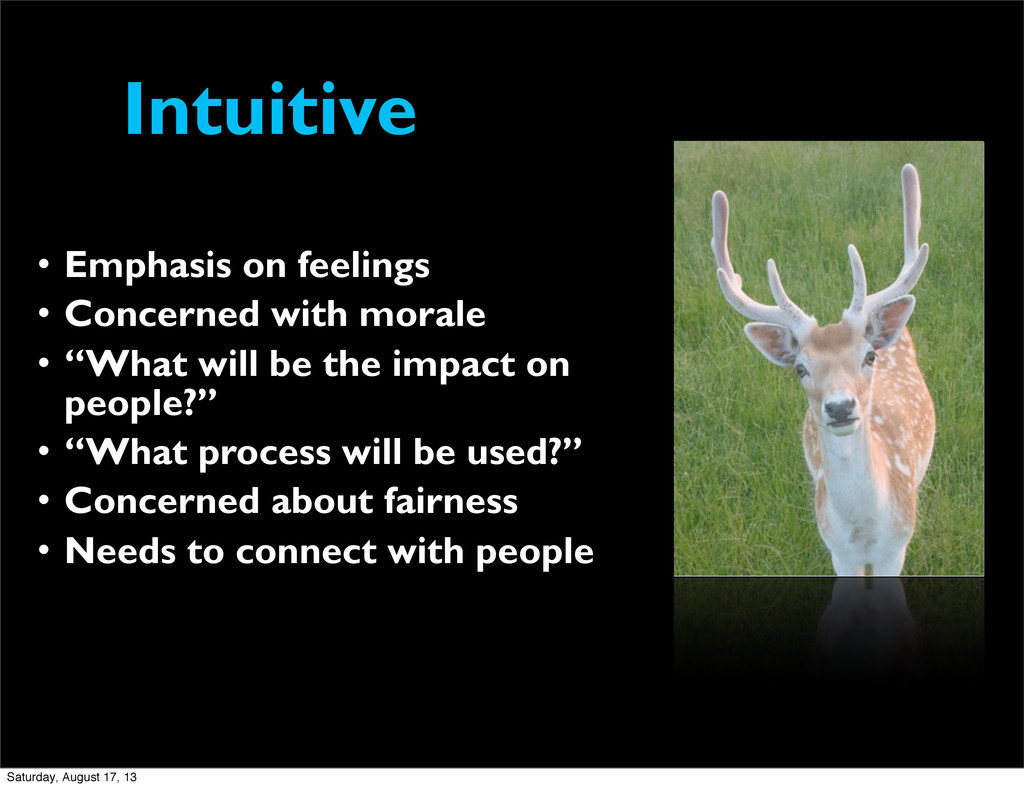
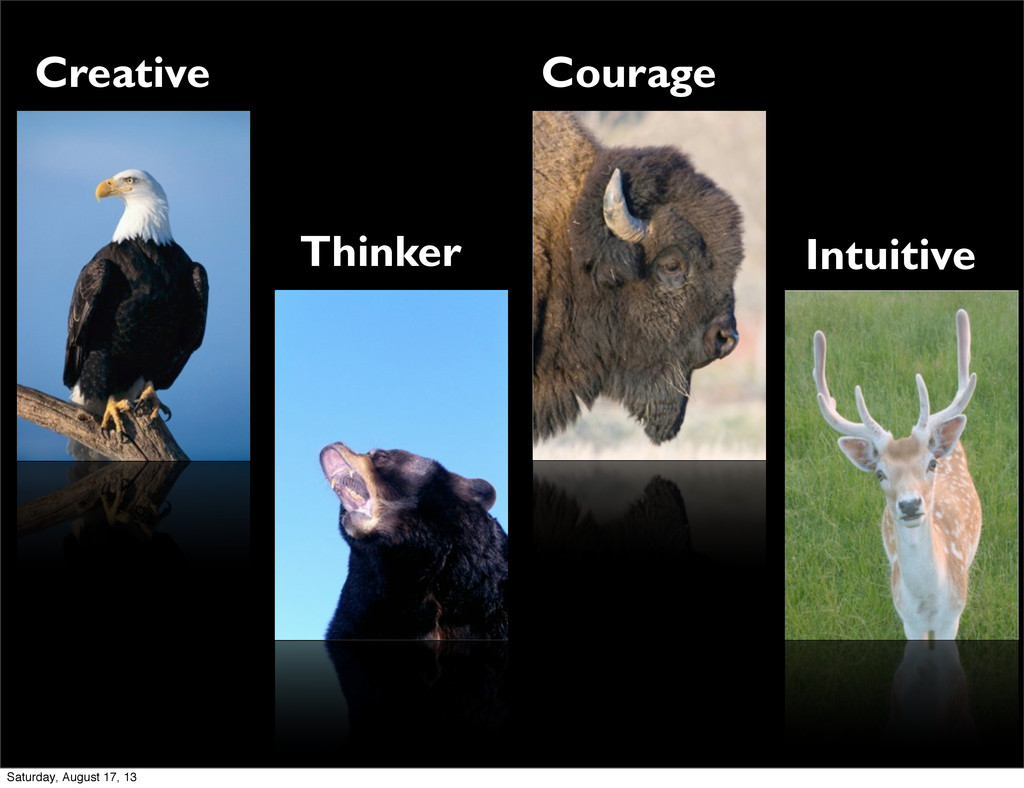
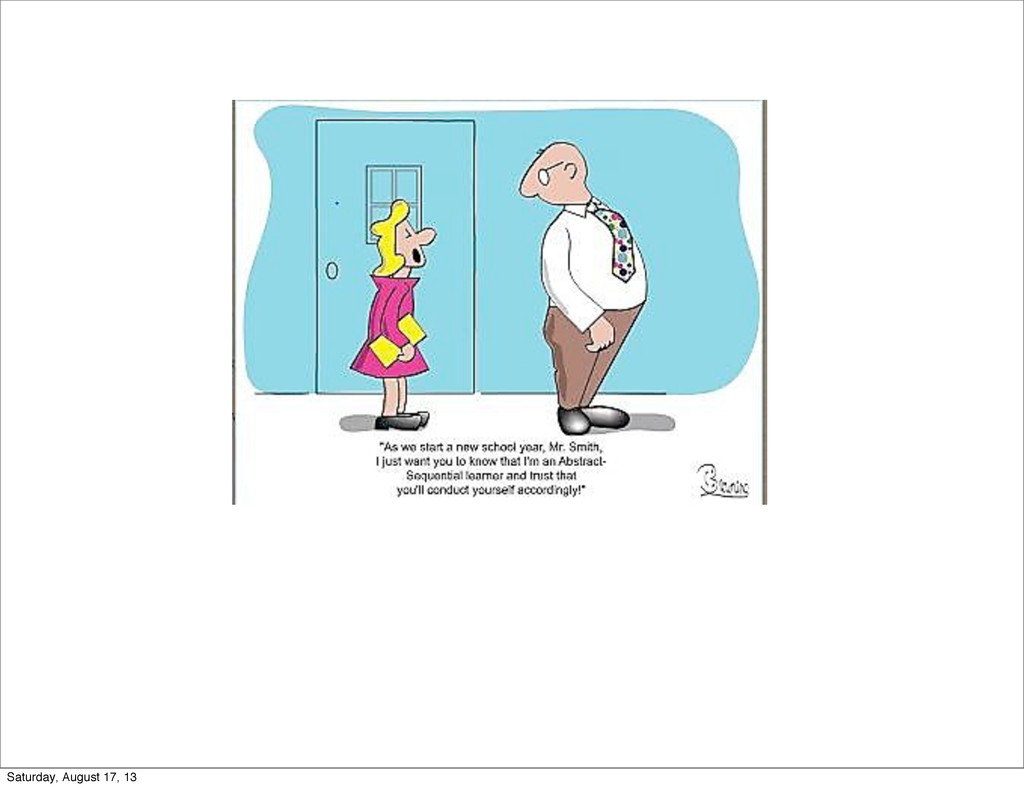
and ideas • Shows little emotion • Troubleshoots problems • Reflective • Looks within • Weighs the alternatives • “Is this all the available data?” Saturday, August 17, 13
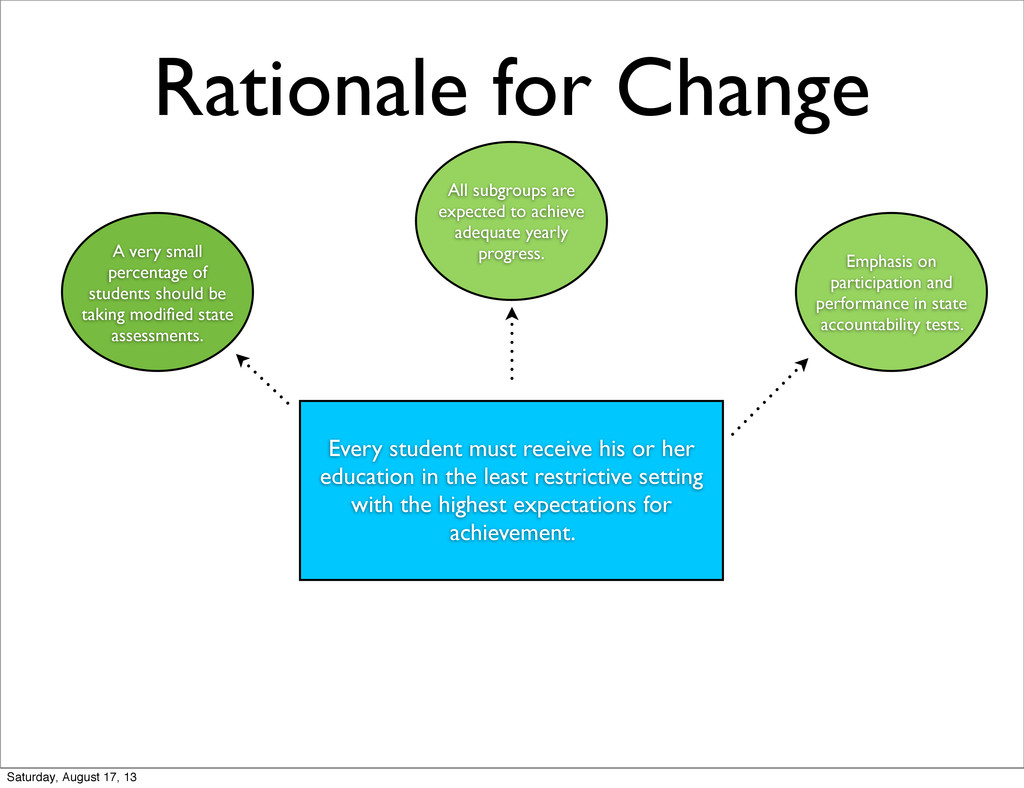
education in the least restrictive setting with the highest expectations for achievement. Emphasis on participation and performance in state accountability tests. All subgroups are expected to achieve adequate yearly progress. A very small percentage of students should be taking modified state assessments. Saturday, August 17, 13
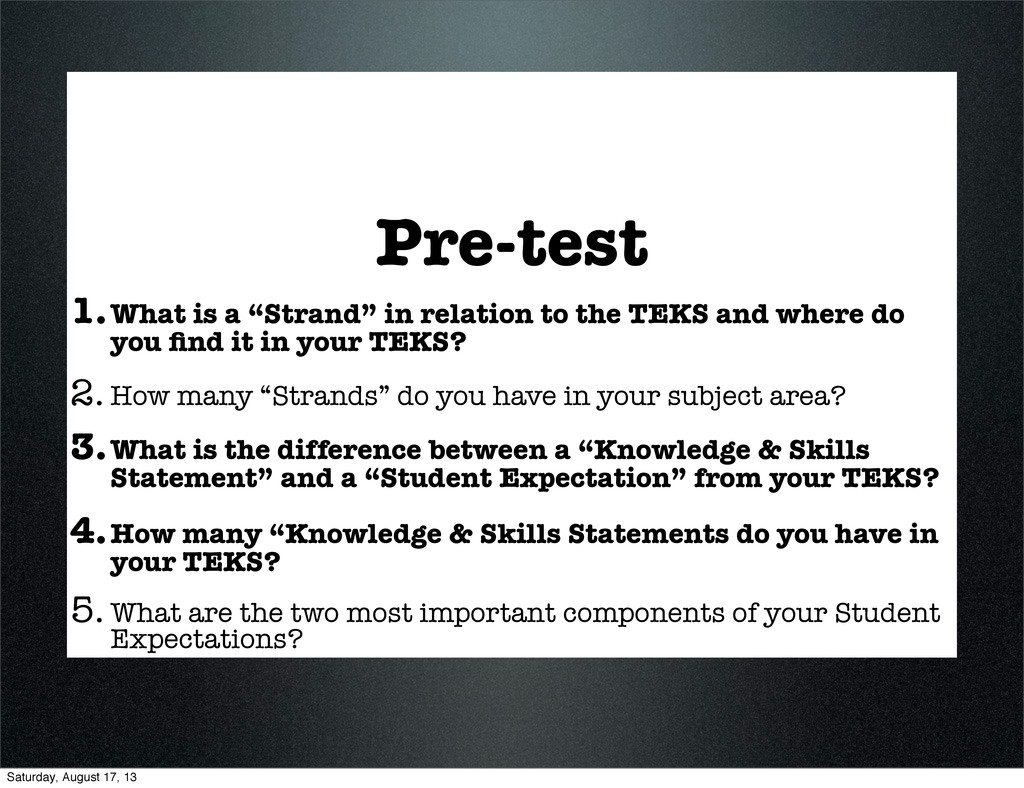
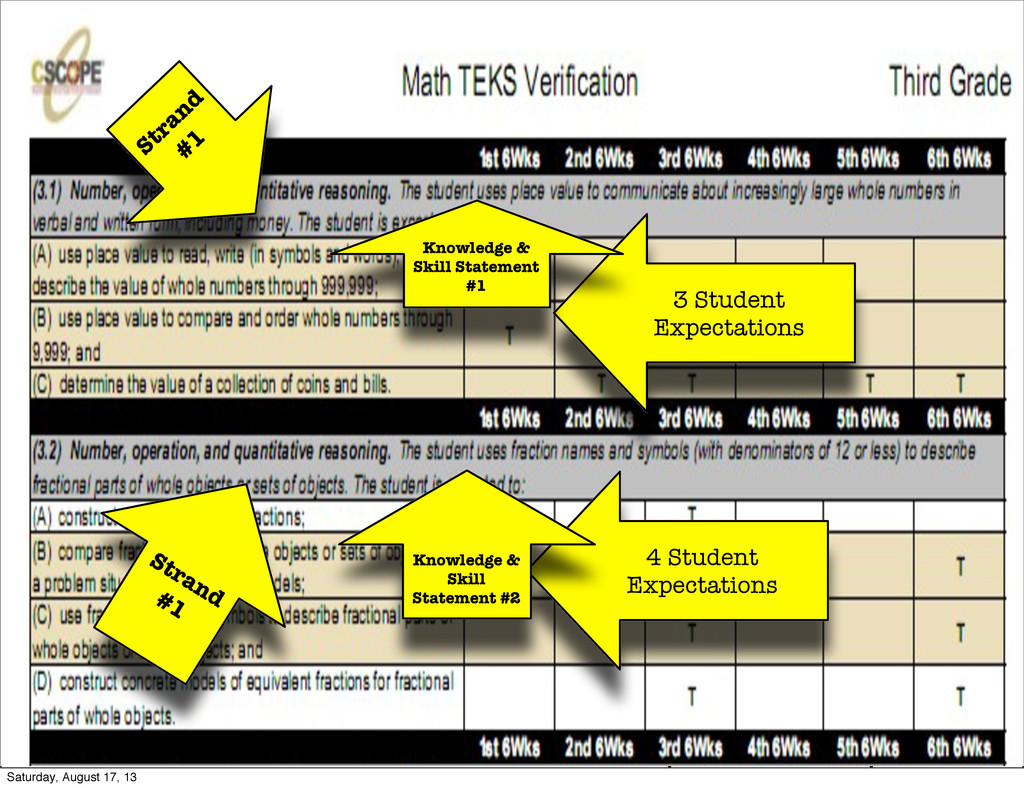
and where do you find it in your TEKS? 2. How many “Strands” do you have in your subject area? 3.What is the difference between a “Knowledge & Skills Statement” and a “Student Expectation” from your TEKS? 4.How many “Knowledge & Skills Statements do you have in your TEKS? 5. What are the two most important components of your Student Expectations? Saturday, August 17, 13
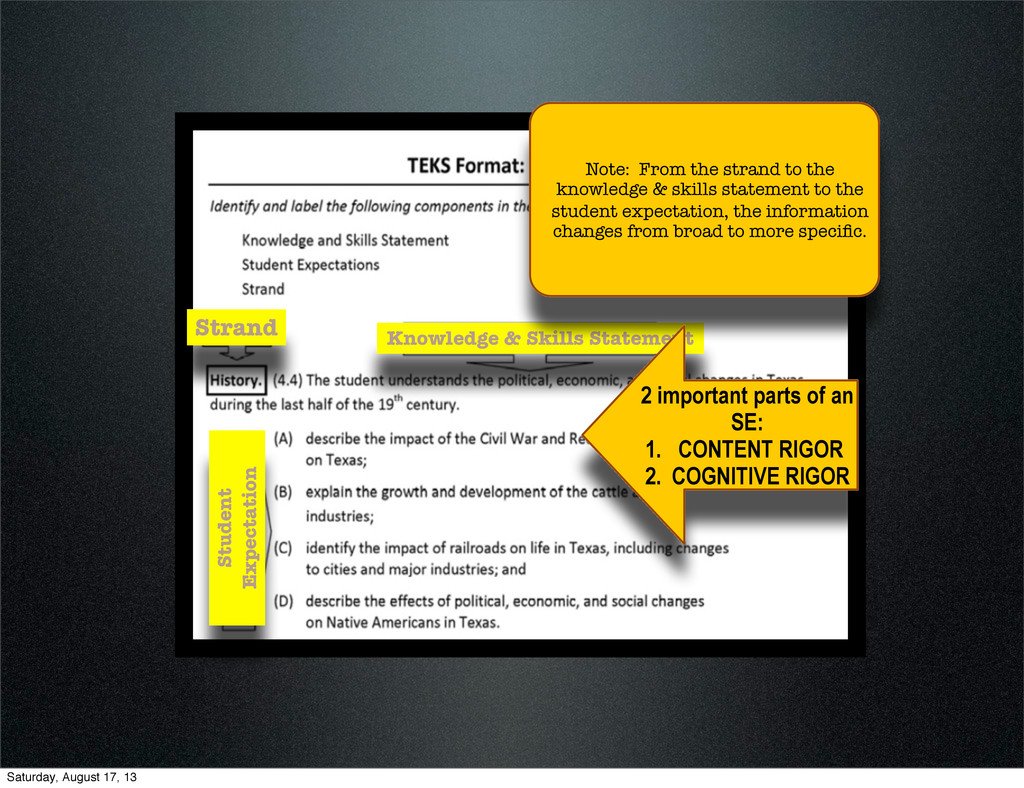
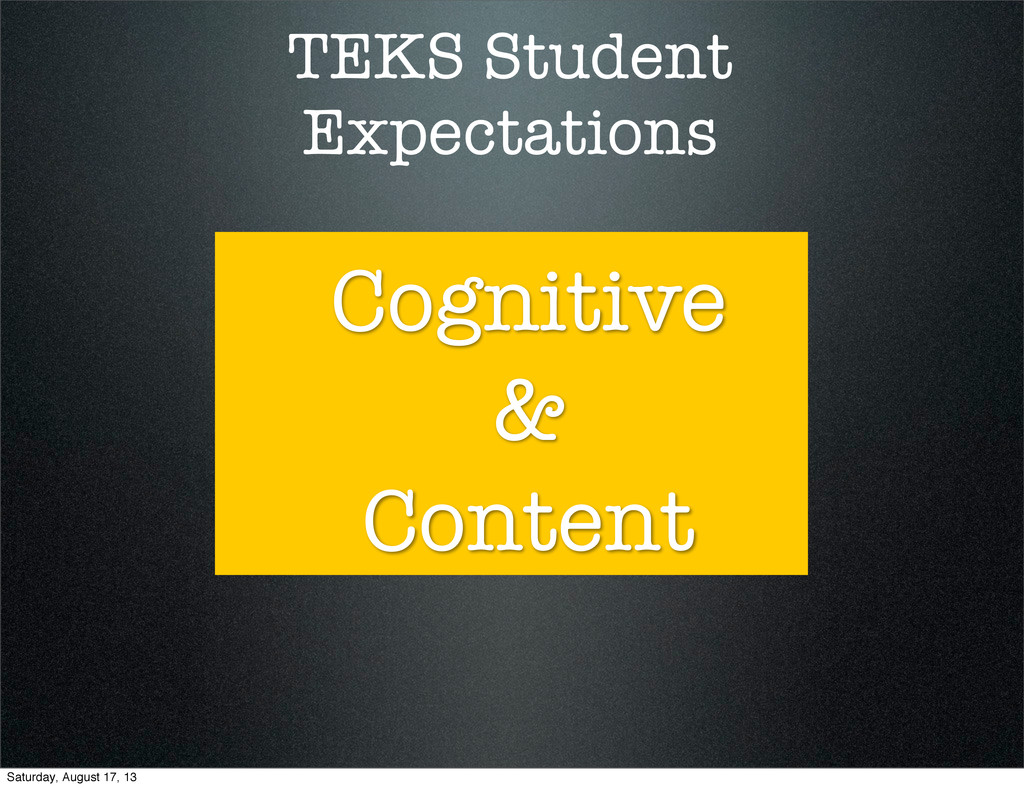
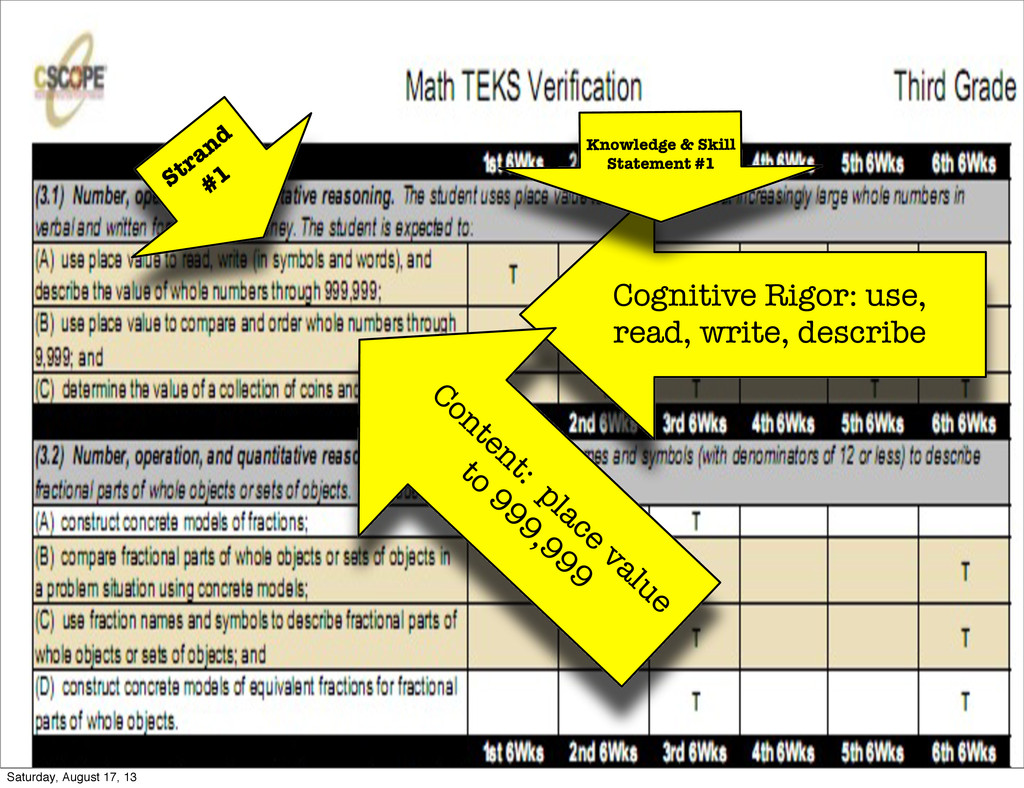
strand to the knowledge & skills statement to the student expectation, the information changes from broad to more specific. 2 important parts of an SE: 1. CONTENT RIGOR 2. COGNITIVE RIGOR Saturday, August 17, 13
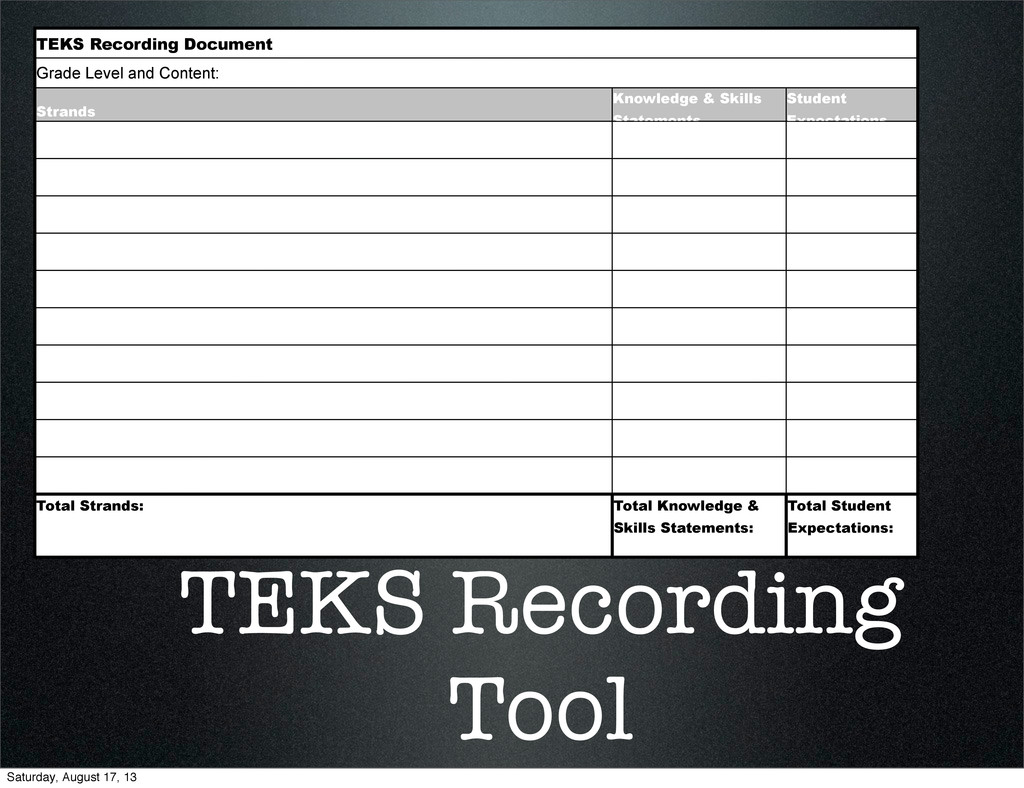
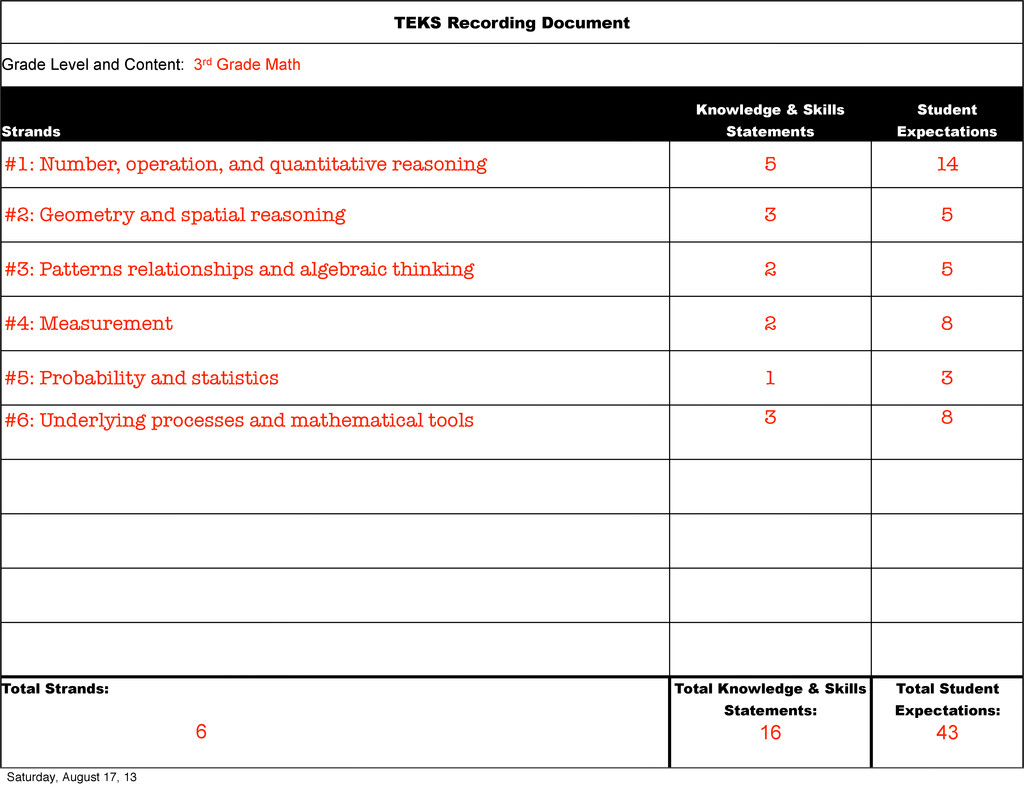
Recording Document Grade Level and Content: Grade Level and Content: Grade Level and Content: Strands Knowledge & Skills Statements Student Expectations Total Strands: Total Knowledge & Skills Statements: Total Student Expectations: Saturday, August 17, 13
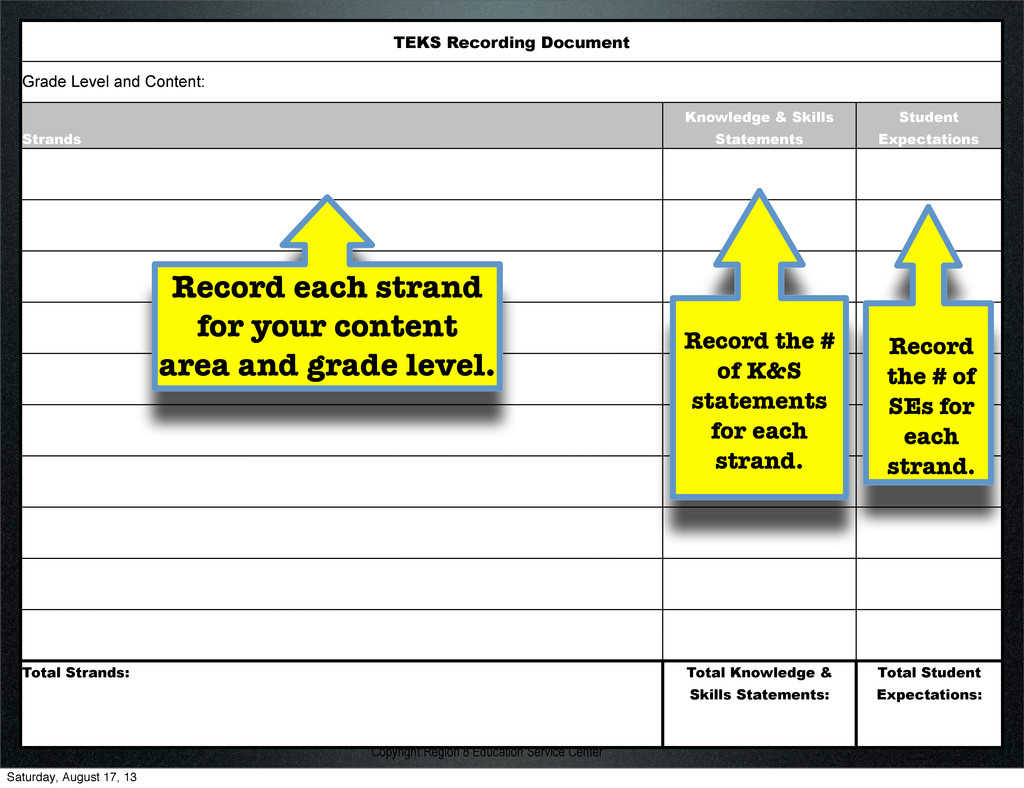
Level and Content: Grade Level and Content: Grade Level and Content: Strands Knowledge & Skills Statements Student Expectations Total Strands: Total Knowledge & Skills Statements: Total Student Expectations: Record each strand for your content area and grade level. Record the # of K&S statements for each strand. Record the # of SEs for each strand. Copyright Region 8 Education Service Center Saturday, August 17, 13
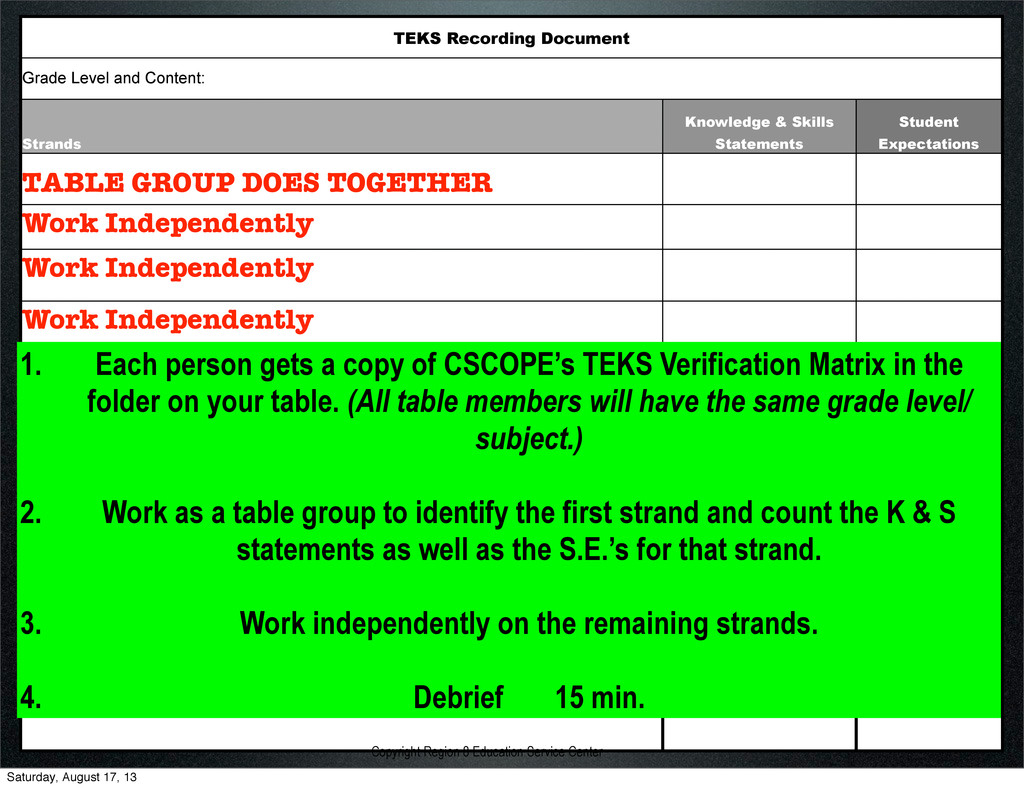
Level and Content: Grade Level and Content: Grade Level and Content: Strands Knowledge & Skills Statements Student Expectations TABLE GROUP DOES TOGETHER Work Independently Work Independently Work Independently Work Independently Total Strands: Total Knowledge & Skills Statements: Total Student Expectations: Copyright Region 8 Education Service Center 1. Each person gets a copy of CSCOPE’s TEKS Verification Matrix in the folder on your table. (All table members will have the same grade level/ subject.) 2. Work as a table group to identify the first strand and count the K & S statements as well as the S.E.’s for that strand. 3. Work independently on the remaining strands. 4. Debrief 15 min. Saturday, August 17, 13
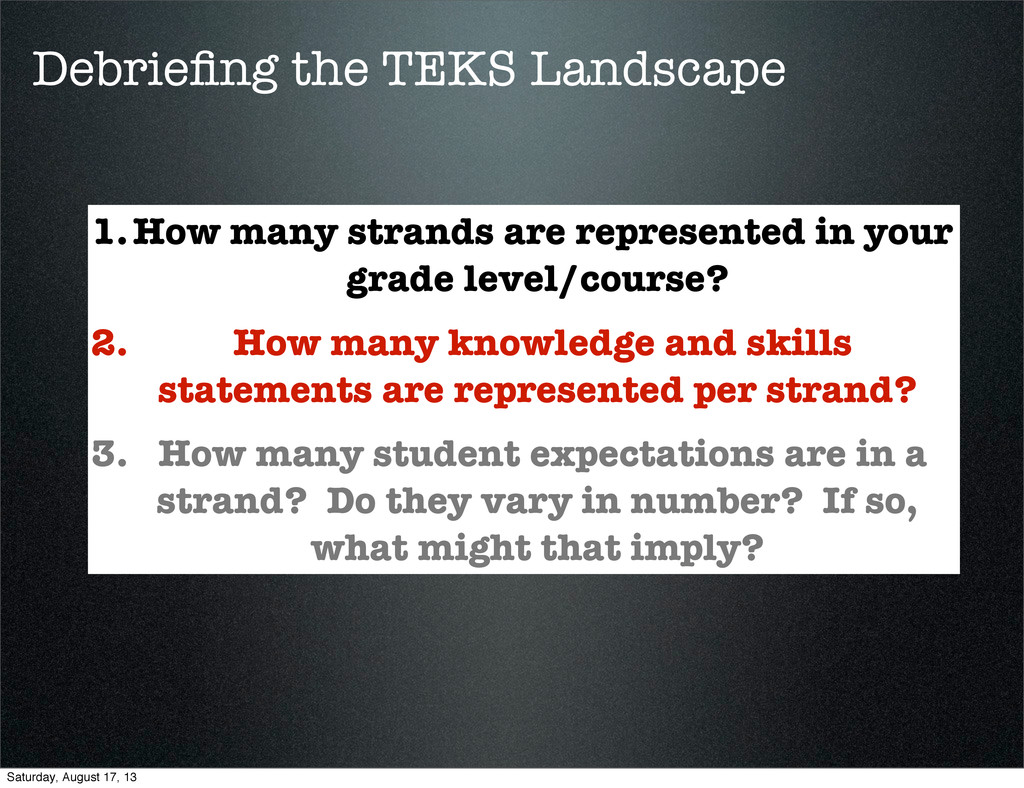
your grade level/course? 2. How many knowledge and skills statements are represented per strand? 3. How many student expectations are in a strand? Do they vary in number? If so, what might that imply? Saturday, August 17, 13
standards… …but the truth is that most teachers have not had the opportunity to TRULY deconstruct, unpack, and understand their standards. Saturday, August 17, 13
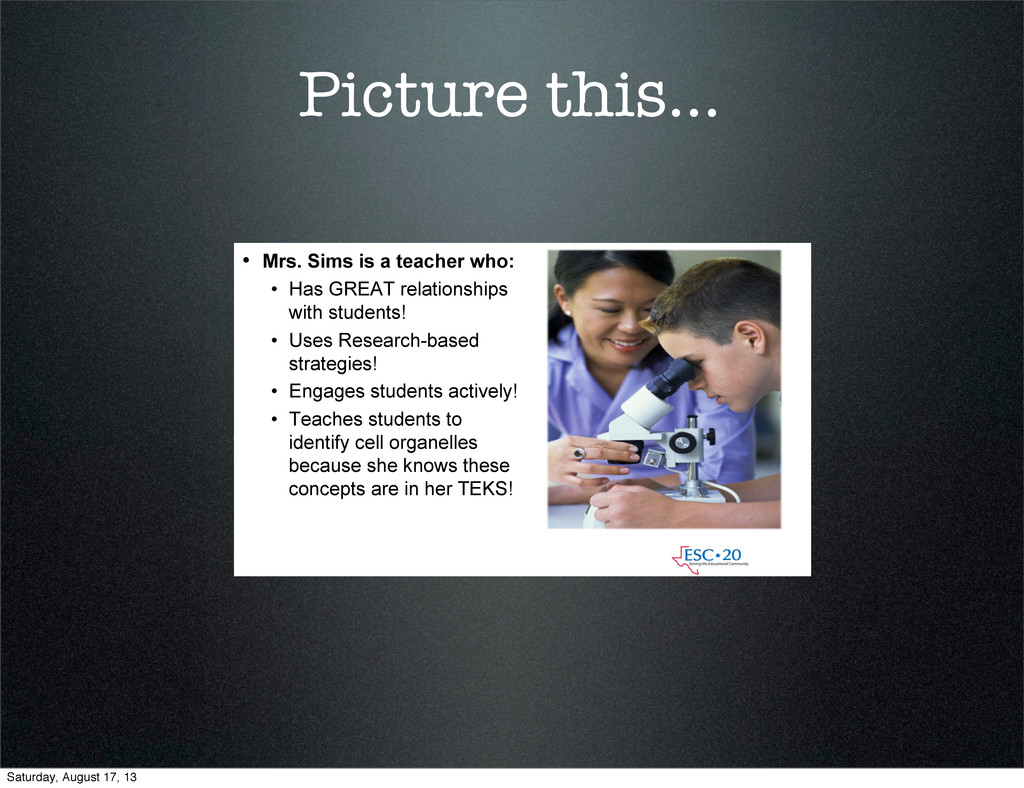
who: • Has GREAT relationships with students! • Uses Research-based strategies! • Engages students actively! • Teaches students to identify cell organelles because she knows these concepts are in her TEKS! Saturday, August 17, 13
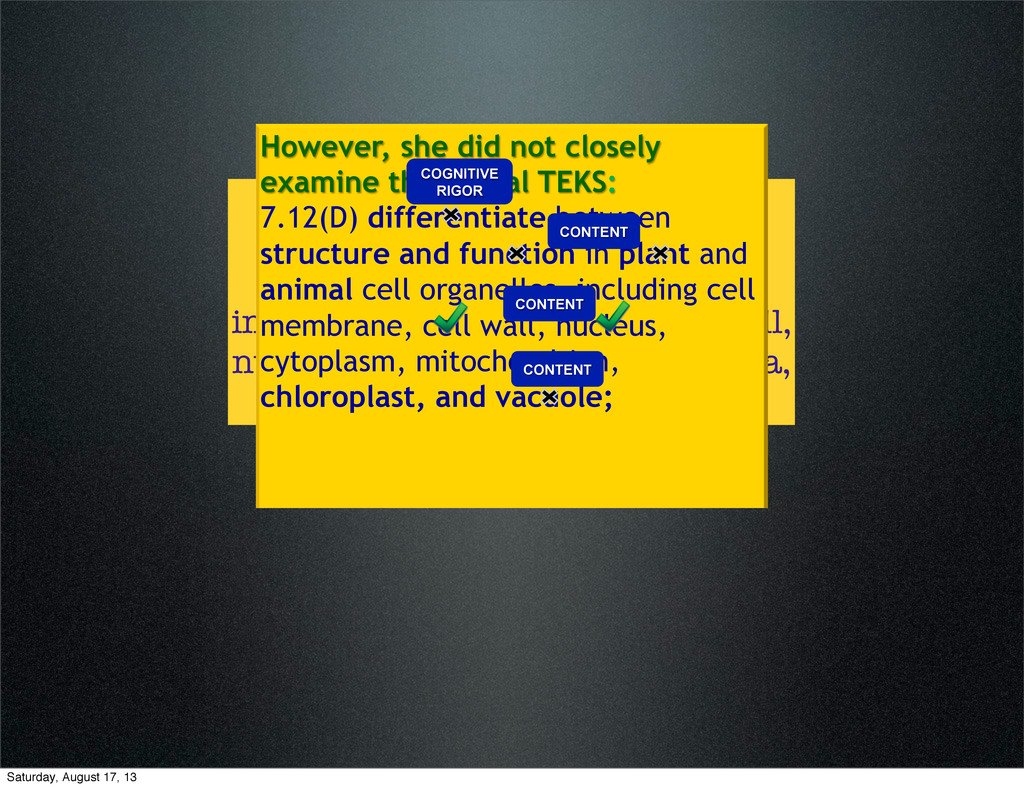
animal cell organelles; including cell membrane, cell wall, nucleus, cytoplasm, mitochondria, chloroplast, and vacuole; However, she did not closely examine the actual TEKS: 7.12(D) differentiate between structure and function in plant and animal cell organelles, including cell membrane, cell wall, nucleus, cytoplasm, mitochondrion, chloroplast, and vacuole; CONTENT COGNITIVE RIGOR CONTENT CONTENT Saturday, August 17, 13
not UNDERSTAND and TEACH TO the cognitive and content rigor of their standards as they prepare students for STAAR! Cognitive and Content Rigor Rigor Tab Saturday, August 17, 13
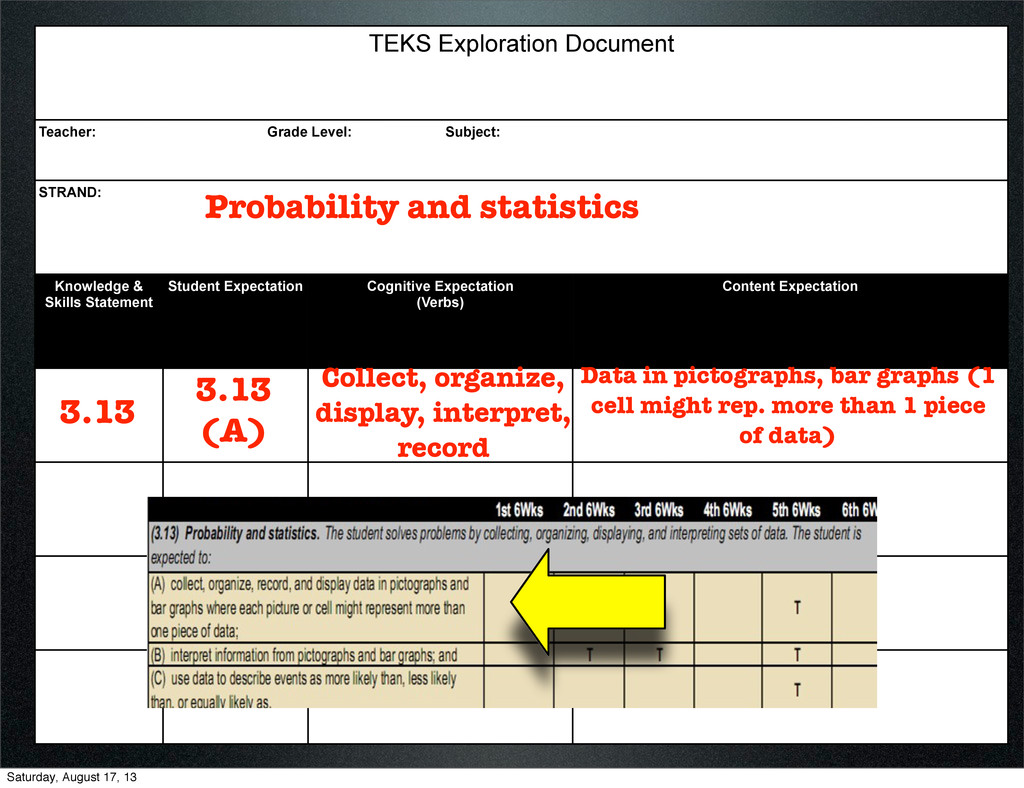
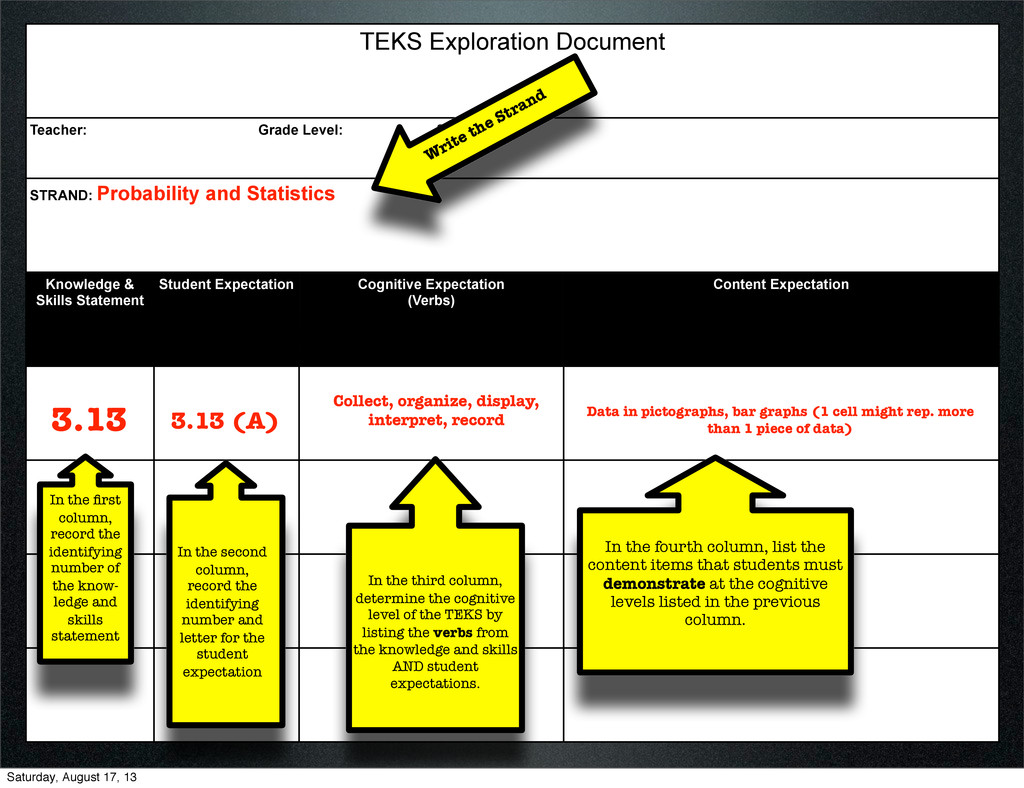
Exploration Document Teacher: Grade Level: Subject: Teacher: Grade Level: Subject: Teacher: Grade Level: Subject: Teacher: Grade Level: Subject: STRAND: Probability and Statistics STRAND: Probability and Statistics STRAND: Probability and Statistics STRAND: Probability and Statistics Knowledge & Skills Statement Student Expectation Cognitive Expectation (Verbs) Content Expectation In the first column, record the identifying number of the know- ledge and skills statement In the second column, record the identifying number and letter for the student expectation In the third column, determine the cognitive level of the TEKS by listing the verbs from the knowledge and skills AND student expectations. In the fourth column, list the content items that students must demonstrate at the cognitive levels listed in the previous column. Data in pictographs, bar graphs (1 cell might rep. more than 1 piece of data) 3.13 (A) 3.13 Collect, organize, display, interpret, record Write the Strand Saturday, August 17, 13
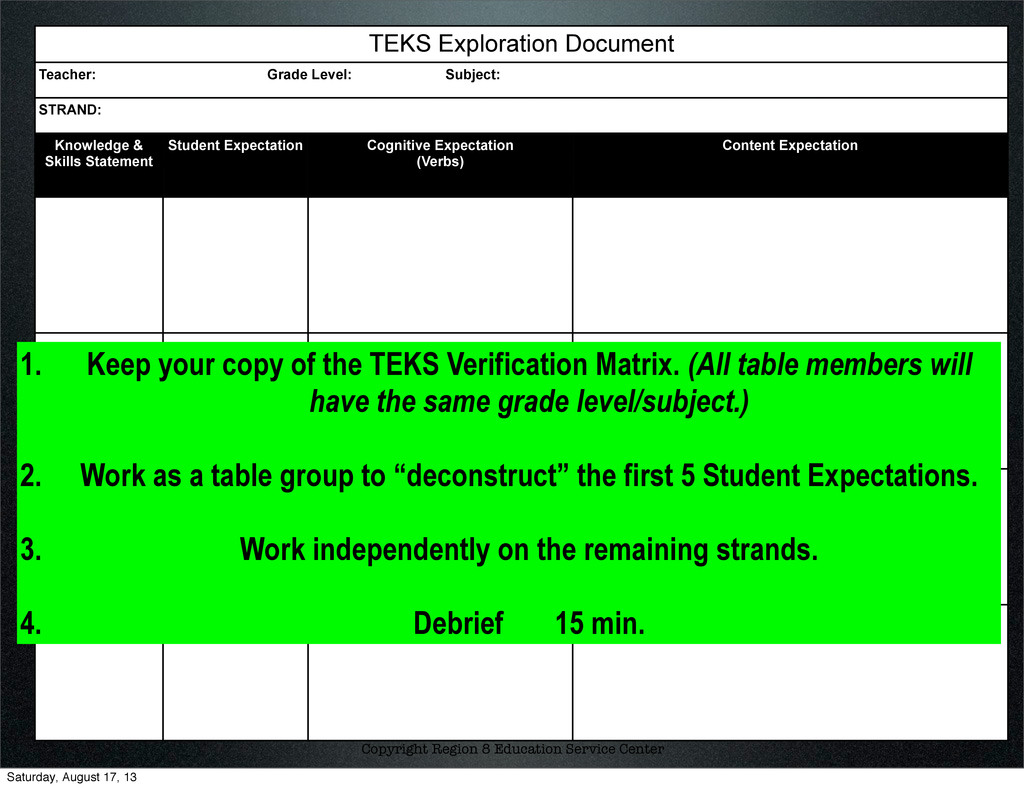
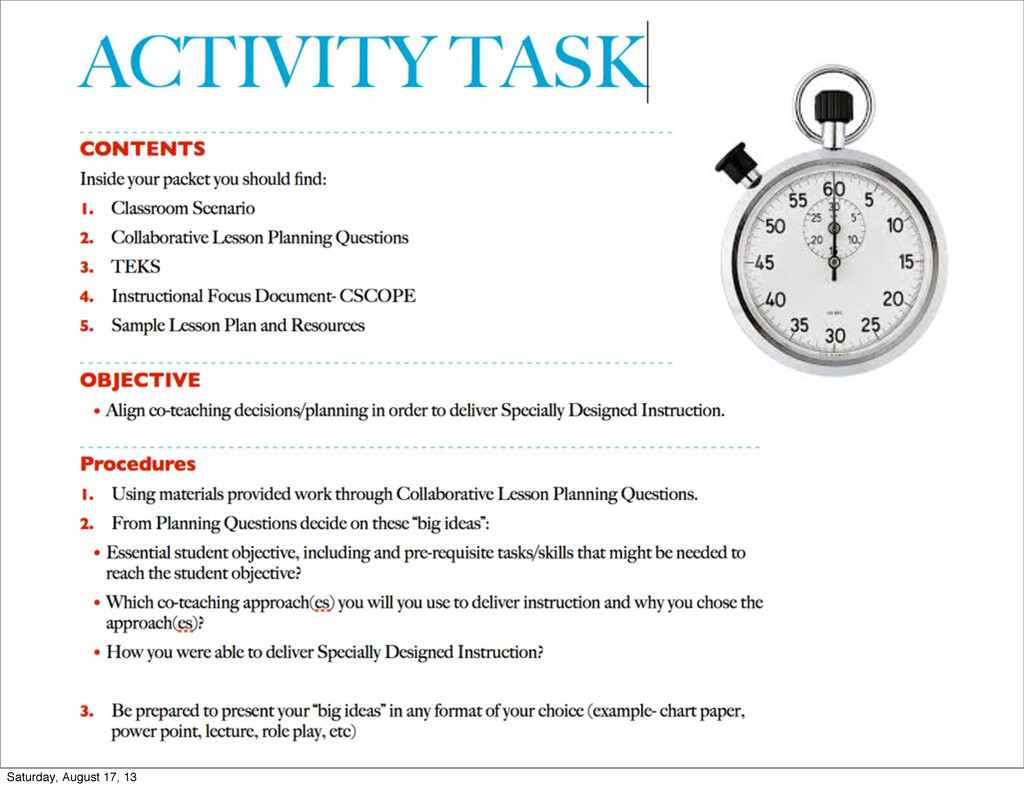
Exploration Document Teacher: Grade Level: Subject: Teacher: Grade Level: Subject: Teacher: Grade Level: Subject: Teacher: Grade Level: Subject: STRAND: STRAND: STRAND: STRAND: Knowledge & Skills Statement Student Expectation Cognitive Expectation (Verbs) Content Expectation Copyright Region 8 Education Service Center 1. Keep your copy of the TEKS Verification Matrix. (All table members will have the same grade level/subject.) 2. Work as a table group to “deconstruct” the first 5 Student Expectations. 3. Work independently on the remaining strands. 4. Debrief 15 min. Saturday, August 17, 13
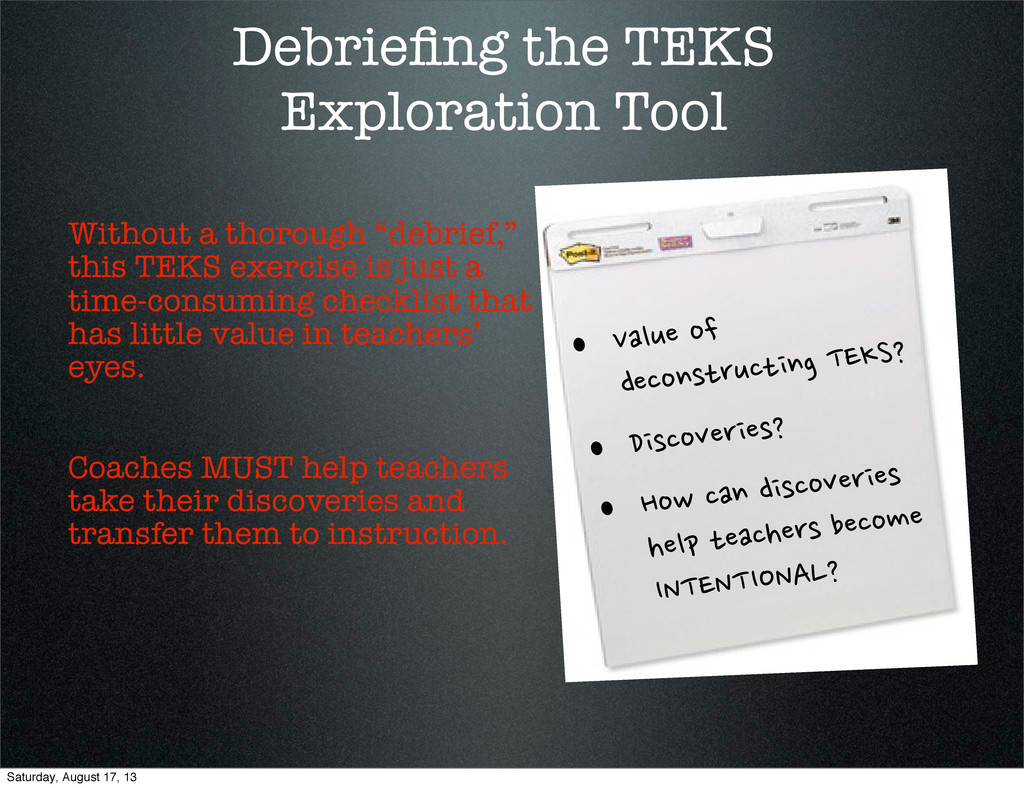
TEKS exercise is just a time-consuming checklist that has little value in teachers’ eyes. Coaches MUST help teachers take their discoveries and transfer them to instruction. • Value
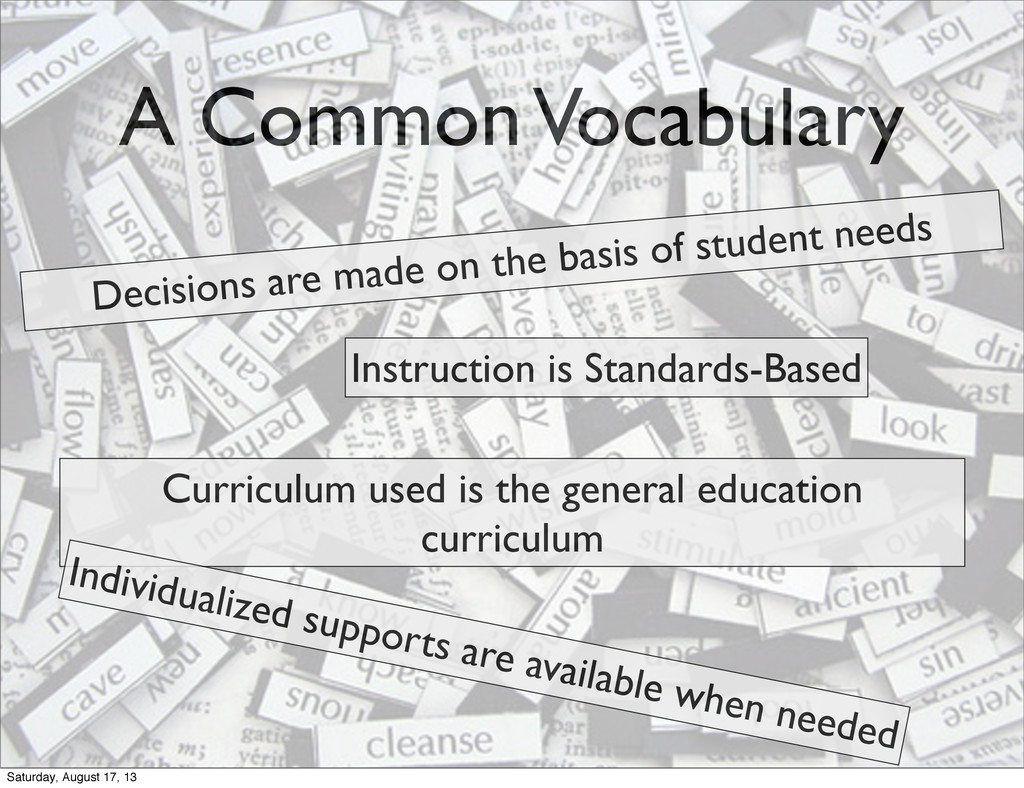
general education curriculum Individualized supports are available when needed Decisions are made on the basis of student needs Saturday, August 17, 13
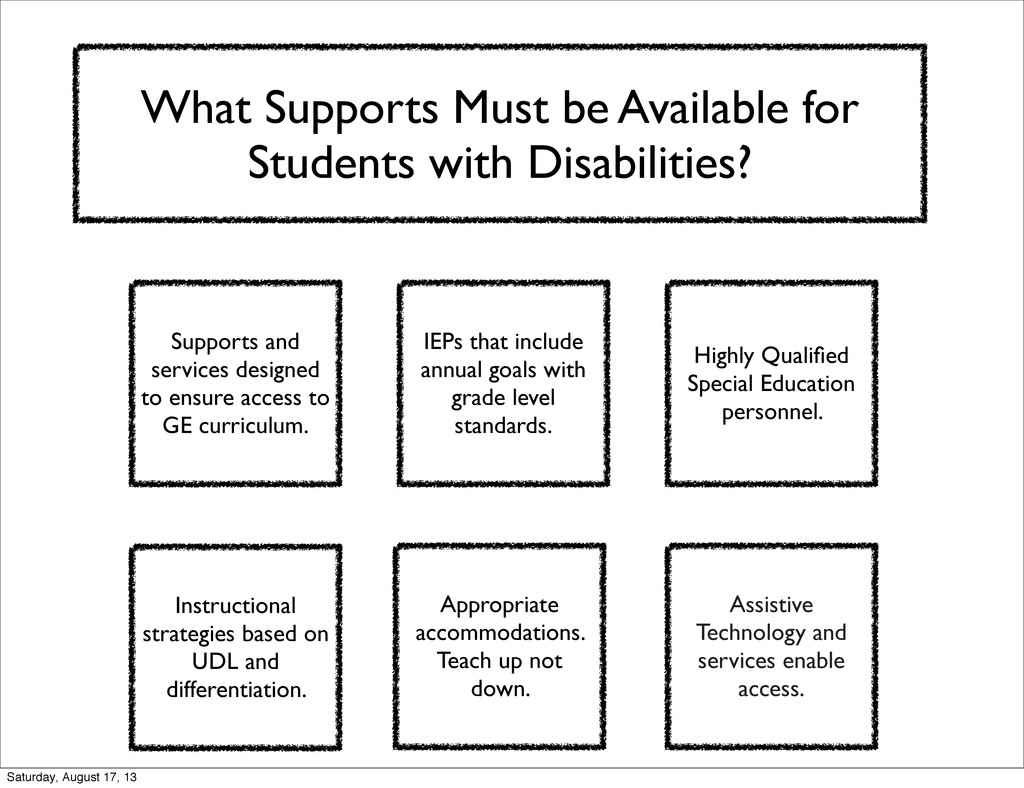
and services designed to ensure access to GE curriculum. Instructional strategies based on UDL and differentiation. IEPs that include annual goals with grade level standards. Appropriate accommodations. Teach up not down. Assistive Technology and services enable access. Highly Qualified Special Education personnel. Saturday, August 17, 13
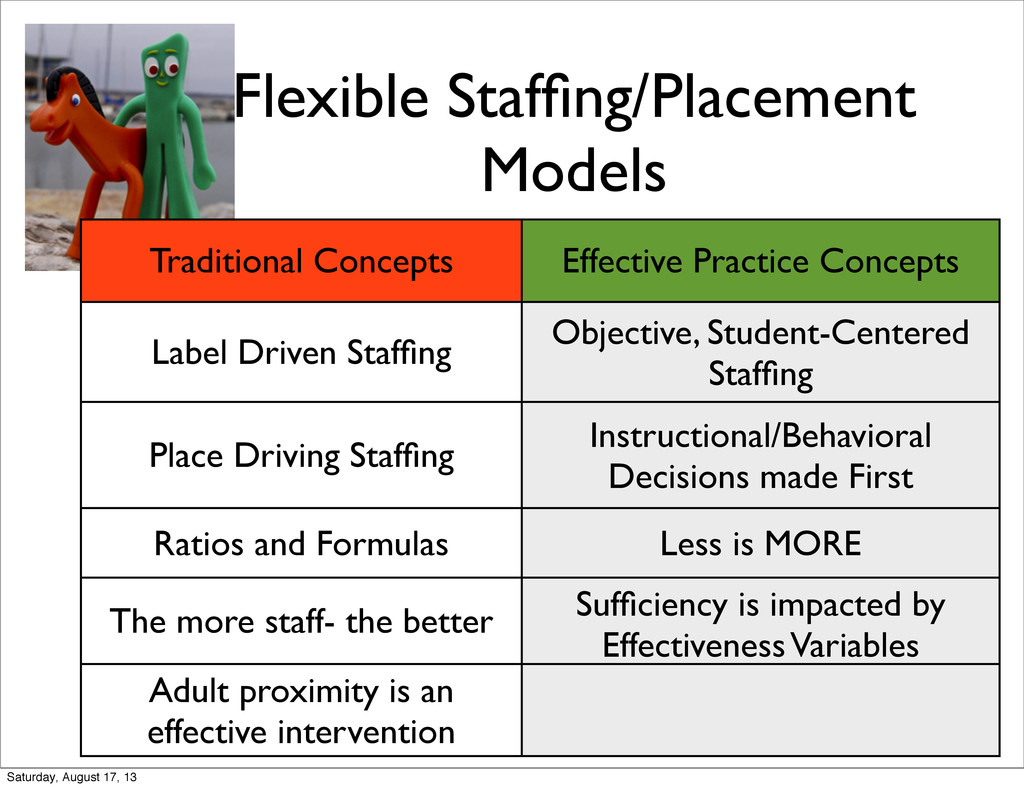
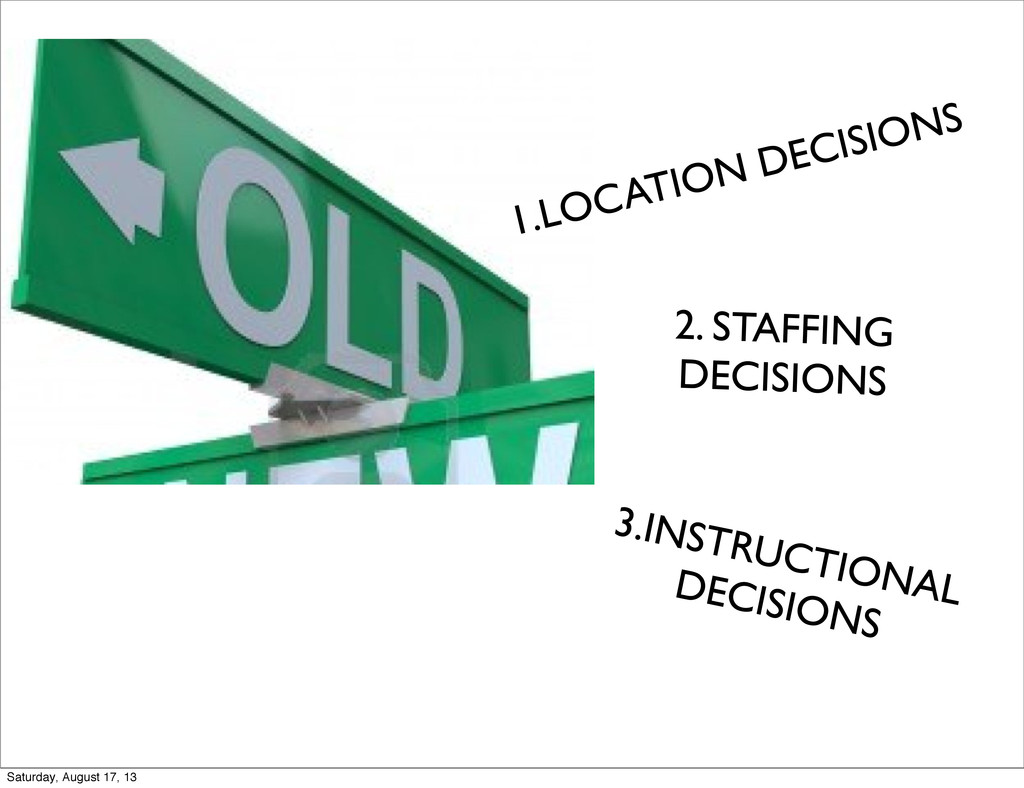
Staffing Objective, Student-Centered Staffing Place Driving Staffing Instructional/Behavioral Decisions made First Ratios and Formulas Less is MORE The more staff- the better Sufficiency is impacted by Effectiveness Variables Adult proximity is an effective intervention Saturday, August 17, 13
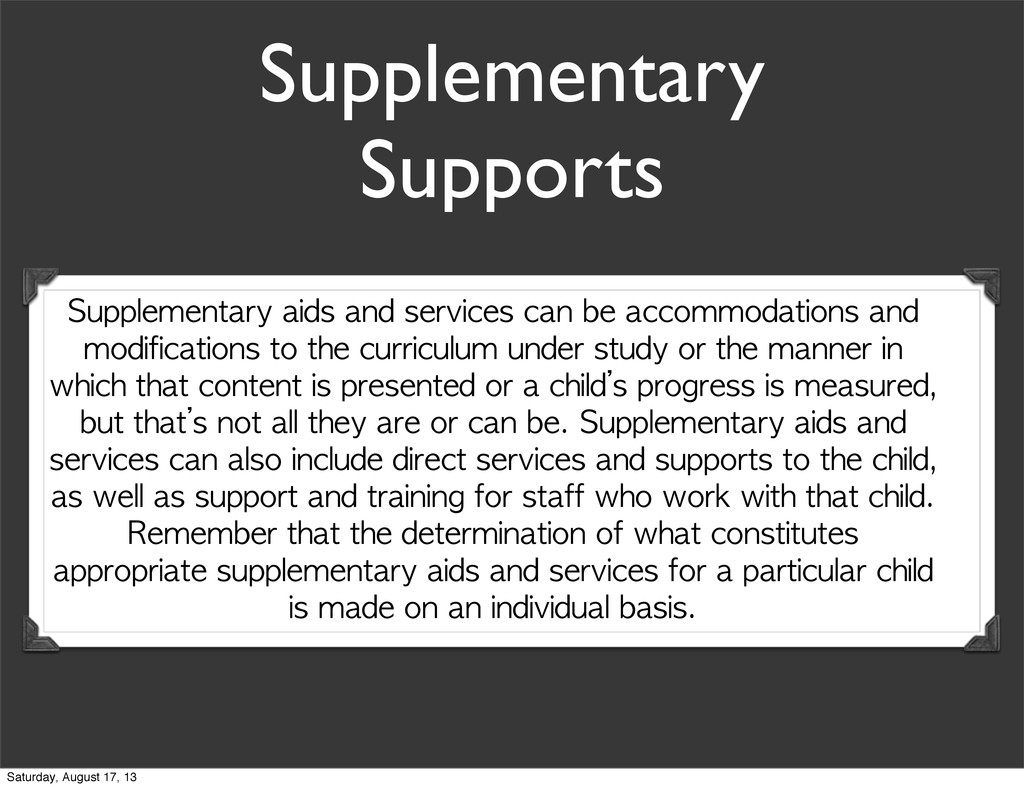
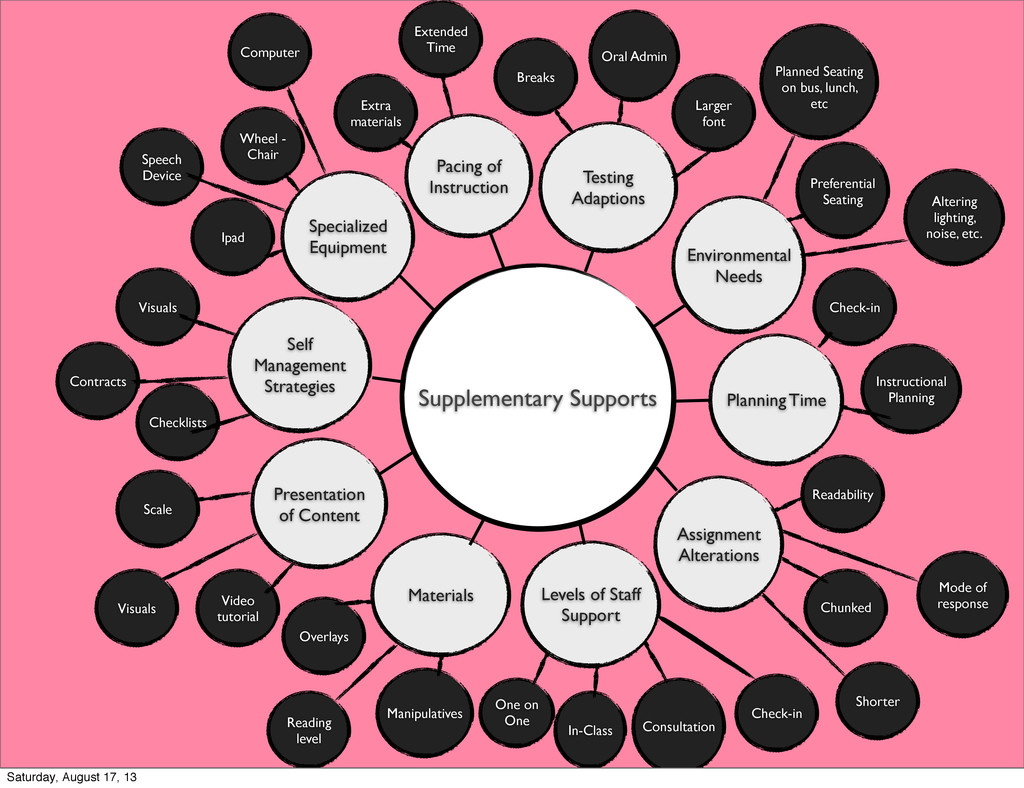
modifications to the curriculum under study or the manner in which that content is presented or a child’s progress is measured, but that’s not all they are or can be. Supplementary aids and services can also include direct services and supports to the child, as well as support and training for staff who work with that child. Remember that the determination of what constitutes appropriate supplementary aids and services for a particular child is made on an individual basis. Saturday, August 17, 13
lunch, etc Altering lighting, noise, etc. Levels of Staff Support Consultation In-Class One on One Planning Time Specialized Equipment Pacing of Instruction Materials Presentation of Content Assignment Alterations Self Management Strategies Testing Adaptions Shorter Chunked Readability Mode of response Breaks Extended Time Extra materials Computer Ipad Wheel - Chair Speech Device Checklists Visuals Contracts Scale Visuals Video tutorial Overlays Manipulatives Reading level Larger font Oral Admin Check-in Instructional Planning Check-in Saturday, August 17, 13
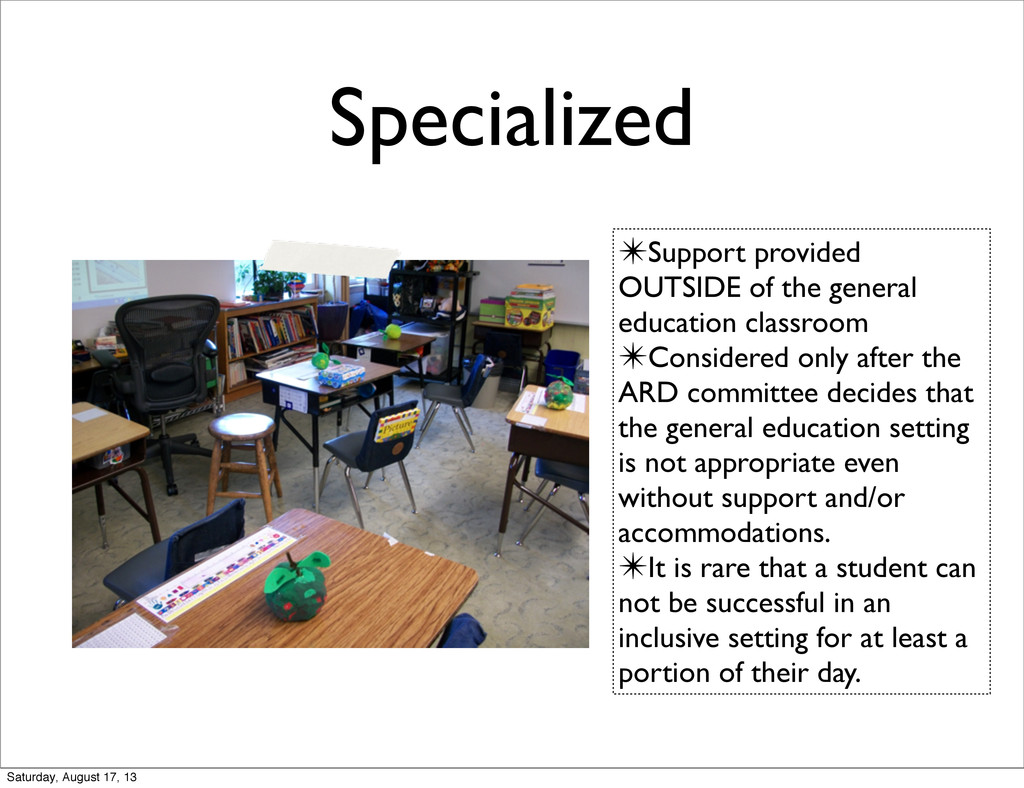
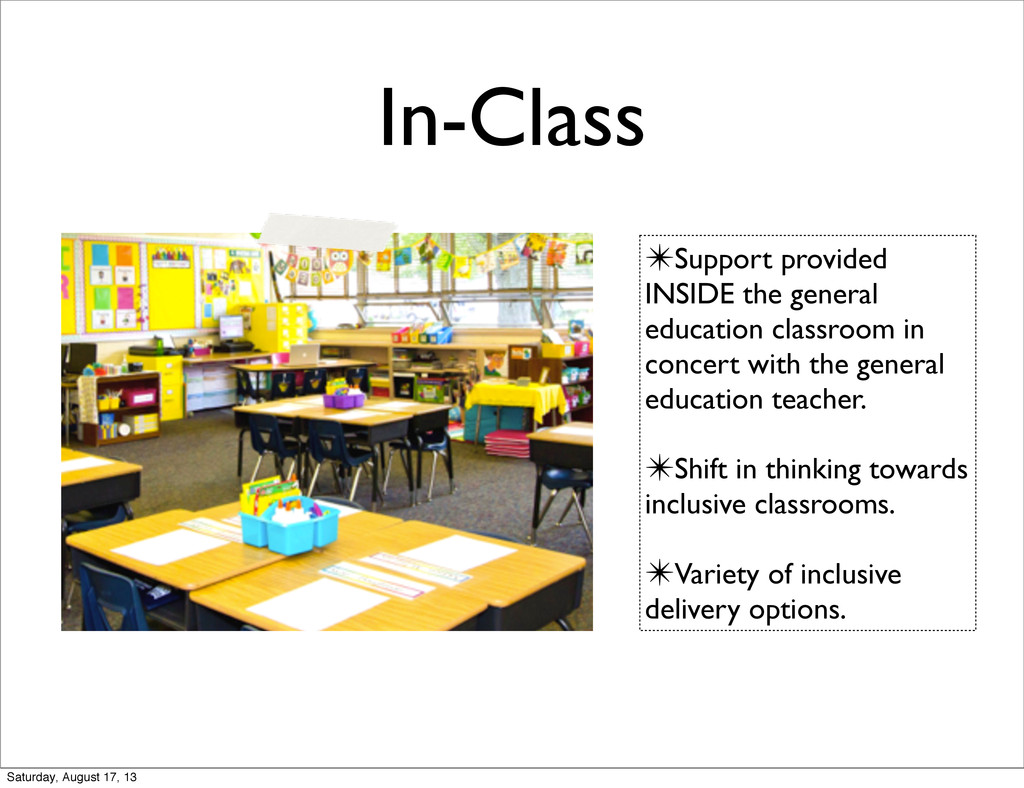
only after the ARD committee decides that the general education setting is not appropriate even without support and/or accommodations. ✴It is rare that a student can not be successful in an inclusive setting for at least a portion of their day. Saturday, August 17, 13
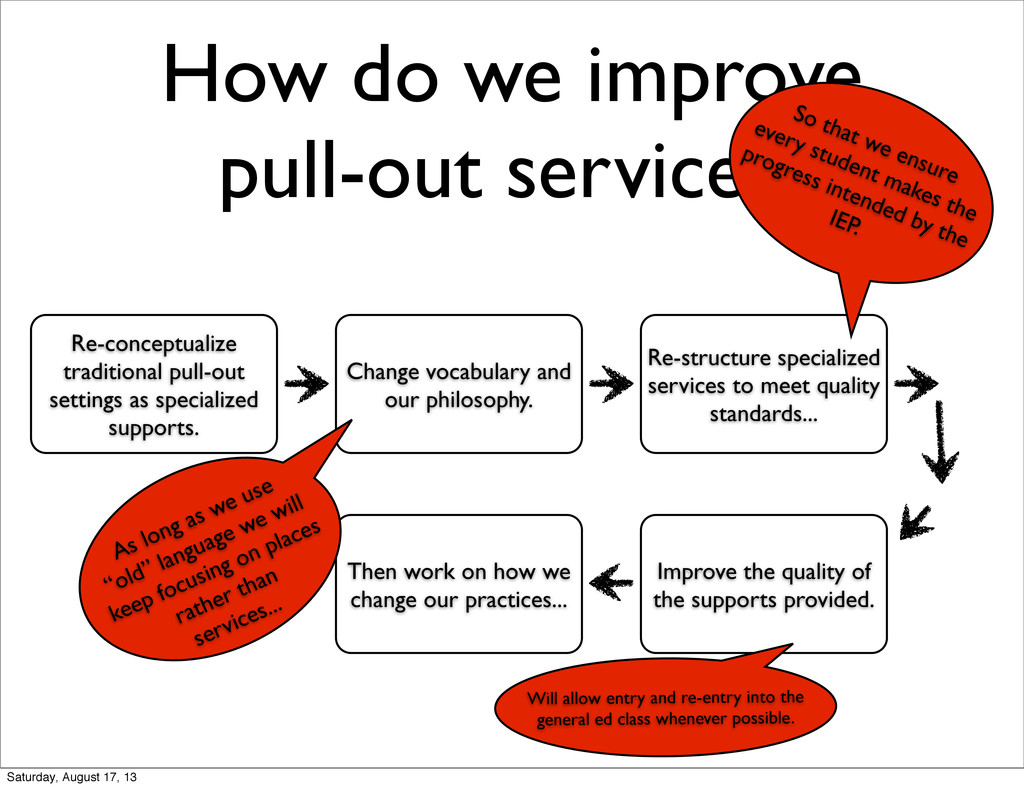
as specialized supports. Change vocabulary and our philosophy. Re-structure specialized services to meet quality standards... Improve the quality of the supports provided. Then work on how we change our practices... As long as we use “old” language we will keep focusing on places rather than services... So that we ensure every student makes the progress intended by the IEP. Will allow entry and re-entry into the general ed class whenever possible. Saturday, August 17, 13
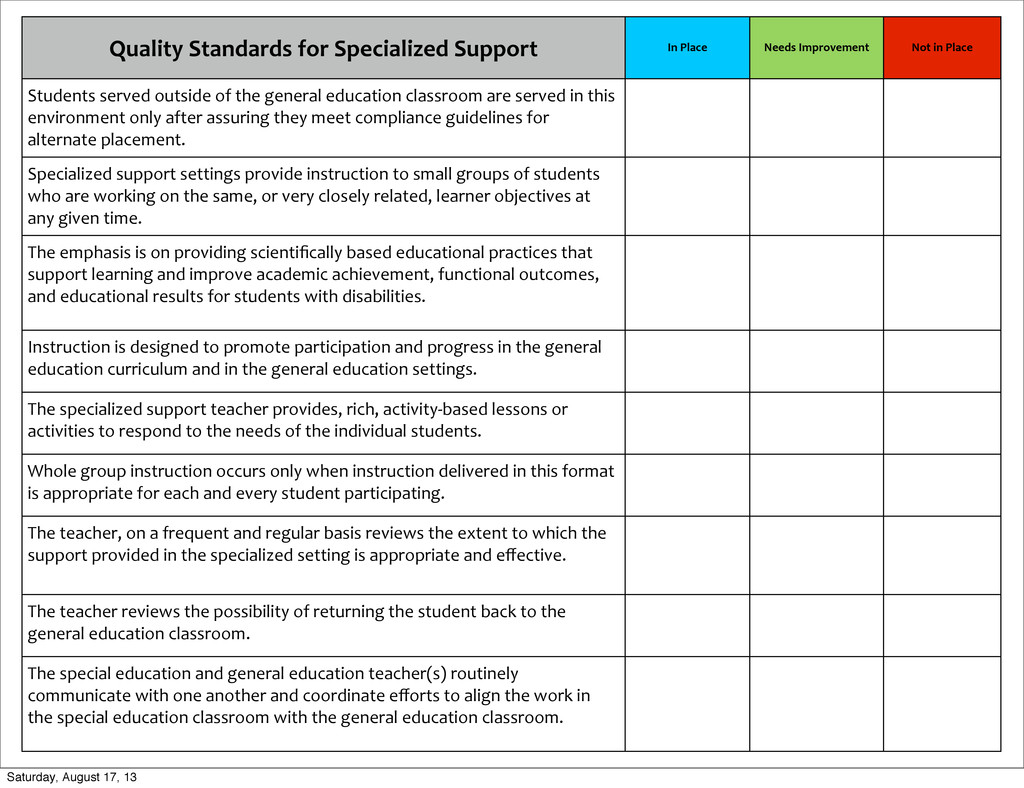
in Place Students served outside of the general education classroom are served in this environment only after assuring they meet compliance guidelines for alternate placement. Specialized support settings provide instruction to small groups of students who are working on the same, or very closely related, learner objectives at any given time. The emphasis is on providing scientifically based educational practices that support learning and improve academic achievement, functional outcomes, and educational results for students with disabilities. Instruction is designed to promote participation and progress in the general education curriculum and in the general education settings. The specialized support teacher provides, rich, activity-‐based lessons or activities to respond to the needs of the individual students. Whole group instruction occurs only when instruction delivered in this format is appropriate for each and every student participating. The teacher, on a frequent and regular basis reviews the extent to which the support provided in the specialized setting is appropriate and effective. The teacher reviews the possibility of returning the student back to the general education classroom. The special education and general education teacher(s) routinely communicate with one another and coordinate efforts to align the work in the special education classroom with the general education classroom. Saturday, August 17, 13
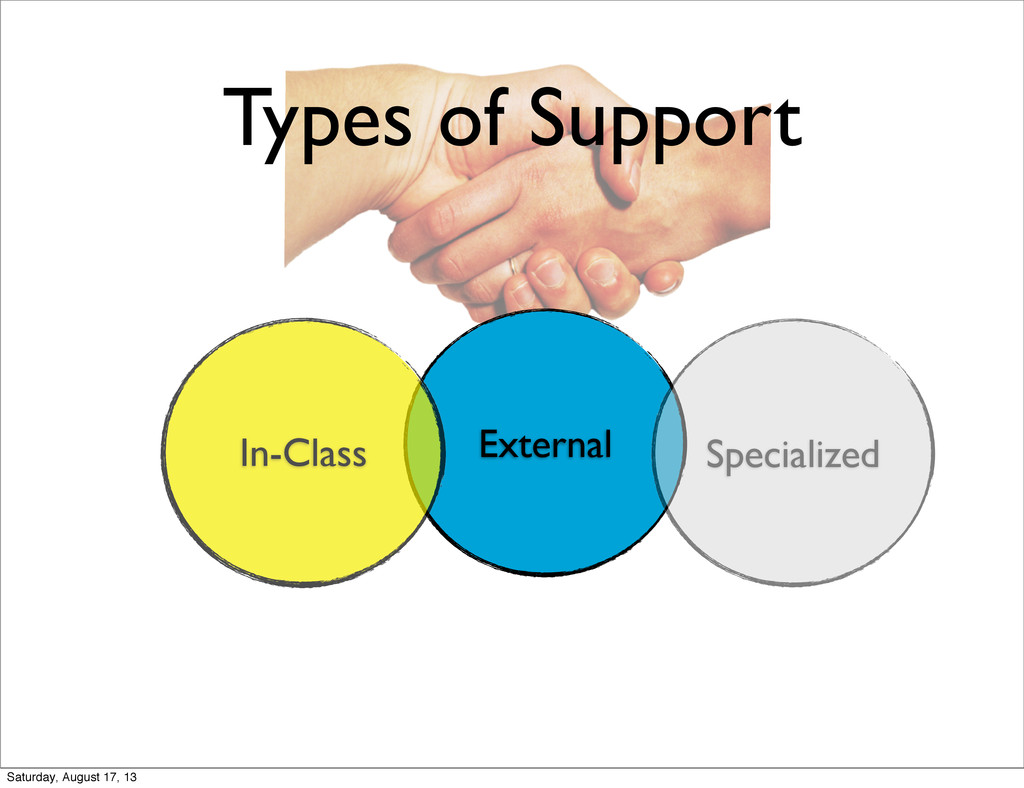
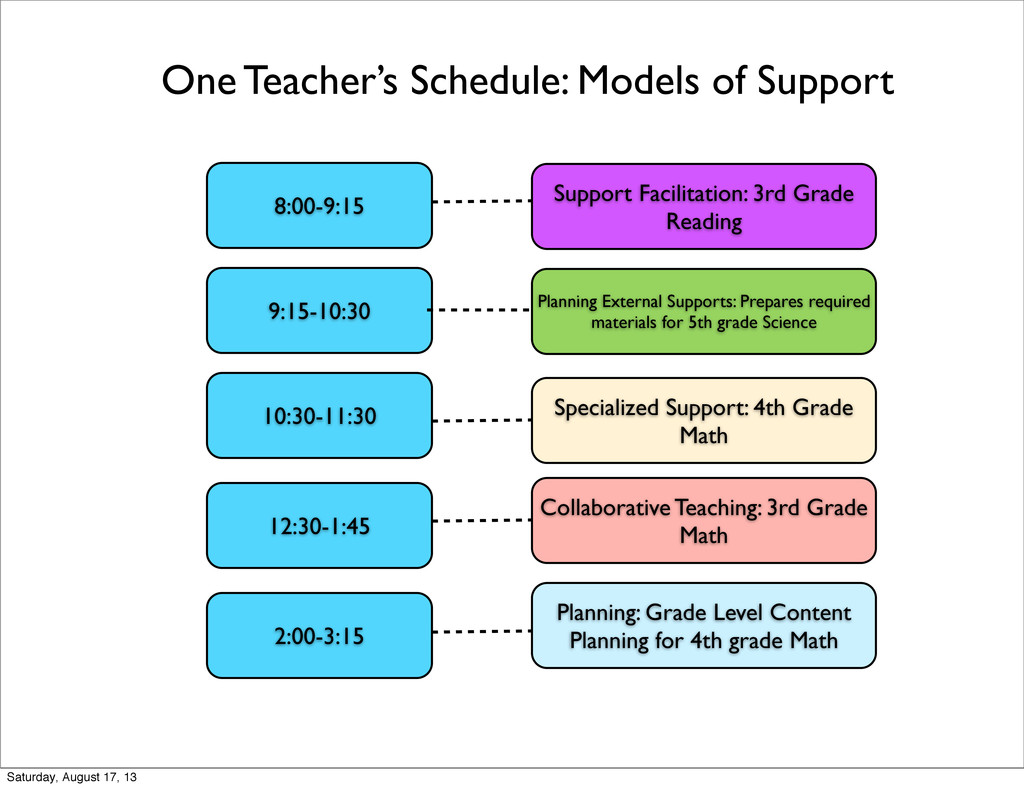
Planning External Supports: Prepares required materials for 5th grade Science Specialized Support: 4th Grade Math Collaborative Teaching: 3rd Grade Math Planning: Grade Level Content Planning for 4th grade Math One Teacher’s Schedule: Models of Support Saturday, August 17, 13
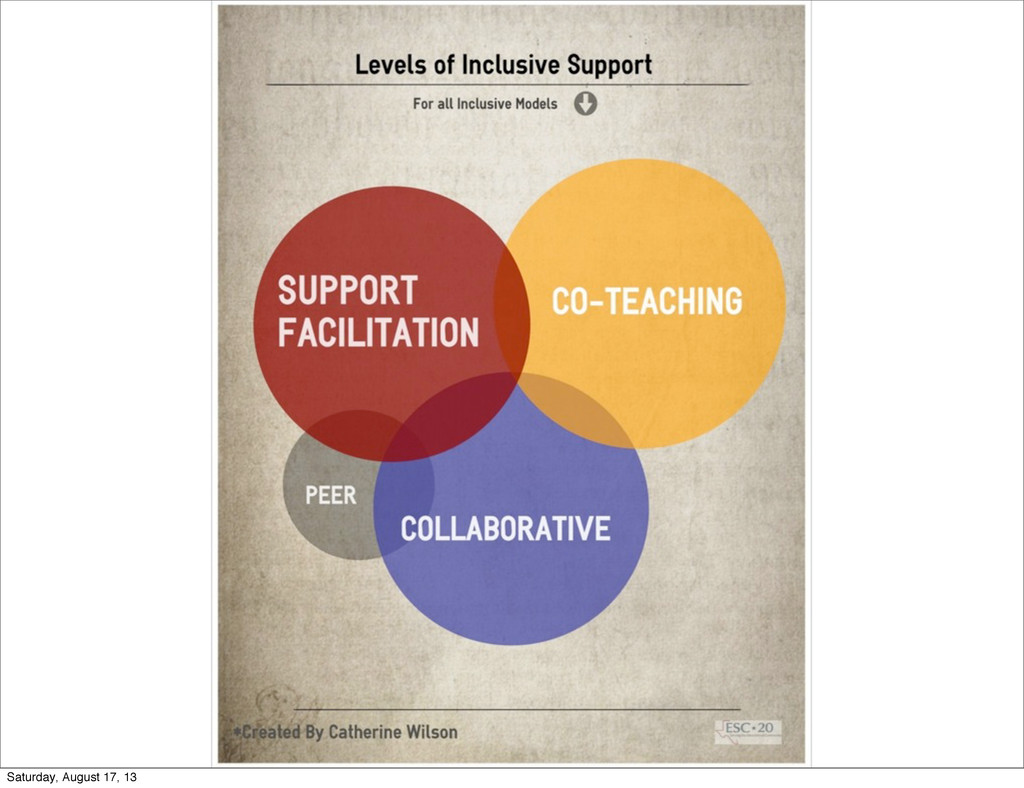
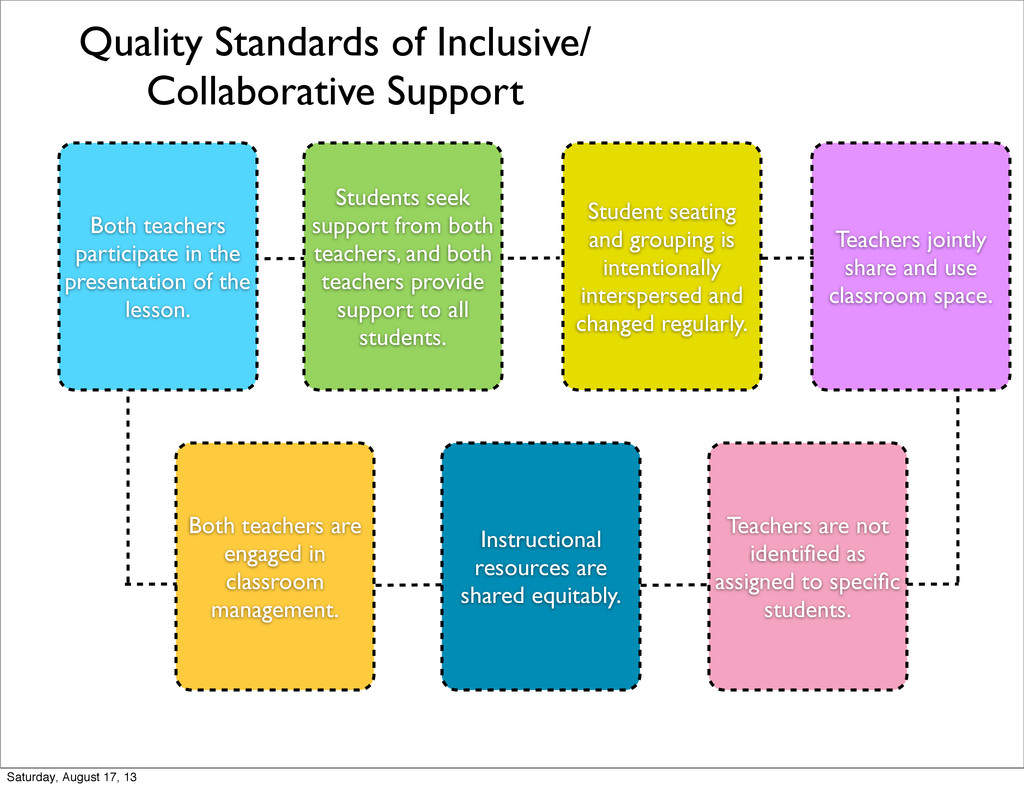
seek support from both teachers, and both teachers provide support to all students. Teachers are not identified as assigned to specific students. Both teachers are engaged in classroom management. Teachers jointly share and use classroom space. Instructional resources are shared equitably. Student seating and grouping is intentionally interspersed and changed regularly. Quality Standards of Inclusive/ Collaborative Support Saturday, August 17, 13
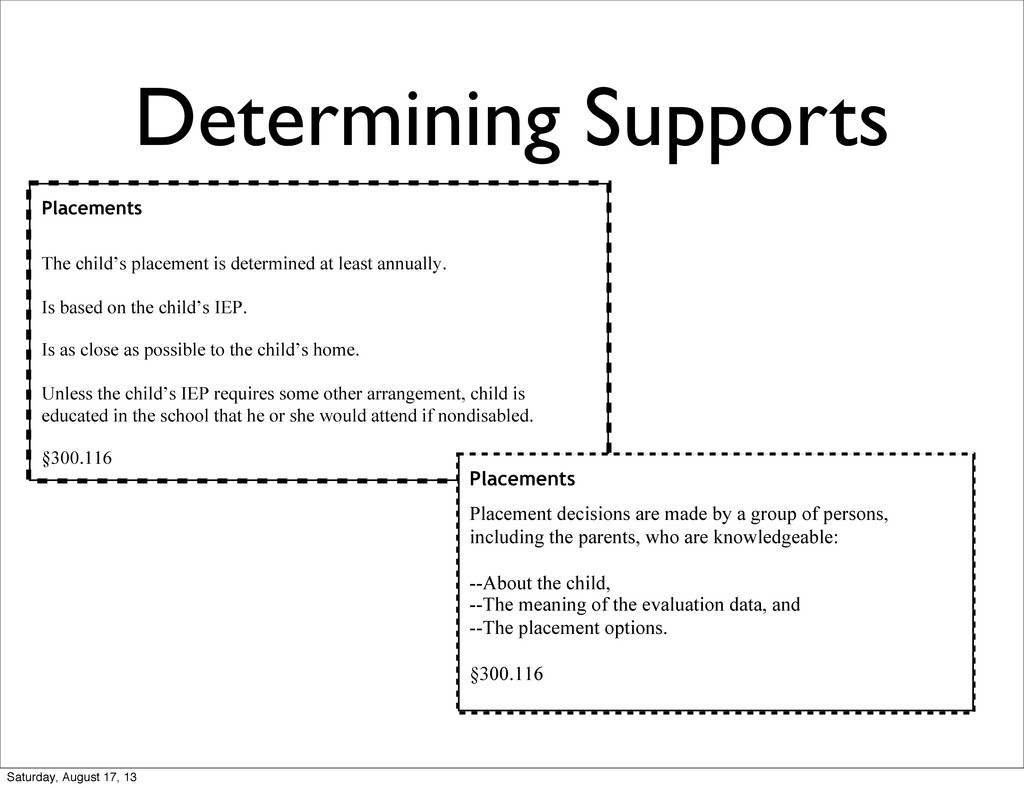
least annually. Is based on the child’s IEP. Is as close as possible to the child’s home. Unless the child’s IEP requires some other arrangement, child is educated in the school that he or she would attend if nondisabled. §300.116 ! Placements Placement decisions are made by a group of persons, including the parents, who are knowledgeable: --About the child, --The meaning of the evaluation data, and --The placement options. §300.116 Saturday, August 17, 13
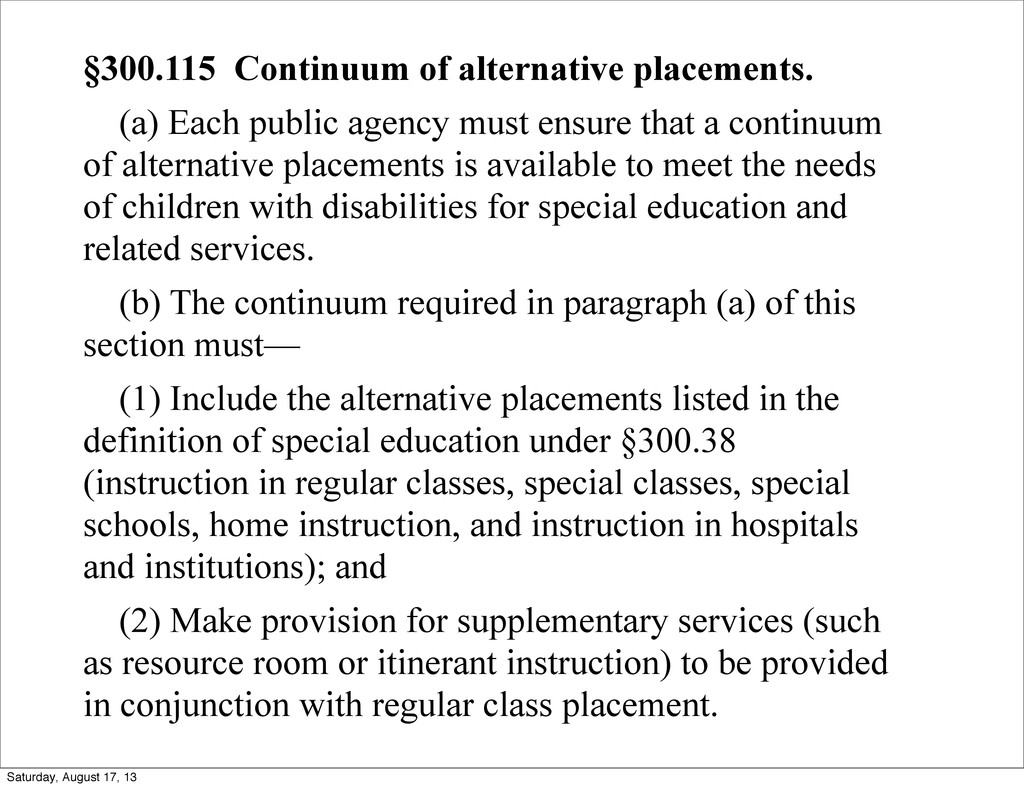
ensure that a continuum of alternative placements is available to meet the needs of children with disabilities for special education and related services. (b) The continuum required in paragraph (a) of this section must— (1) Include the alternative placements listed in the definition of special education under §300.38 (instruction in regular classes, special classes, special schools, home instruction, and instruction in hospitals and institutions); and (2) Make provision for supplementary services (such as resource room or itinerant instruction) to be provided in conjunction with regular class placement. Saturday, August 17, 13
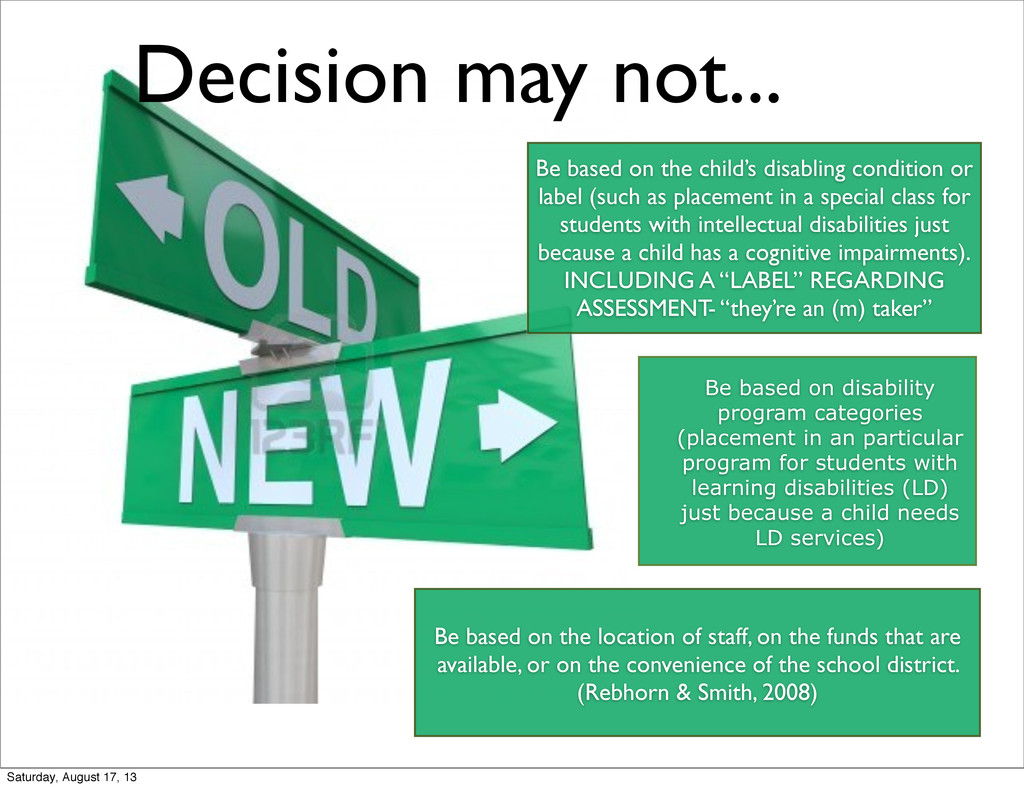
or label (such as placement in a special class for students with intellectual disabilities just because a child has a cognitive impairments). INCLUDING A “LABEL” REGARDING ASSESSMENT- “they’re an (m) taker” Be based on disability program categories (placement in an particular program for students with learning disabilities (LD) just because a child needs LD services) Be based on the location of staff, on the funds that are available, or on the convenience of the school district. (Rebhorn & Smith, 2008) Saturday, August 17, 13
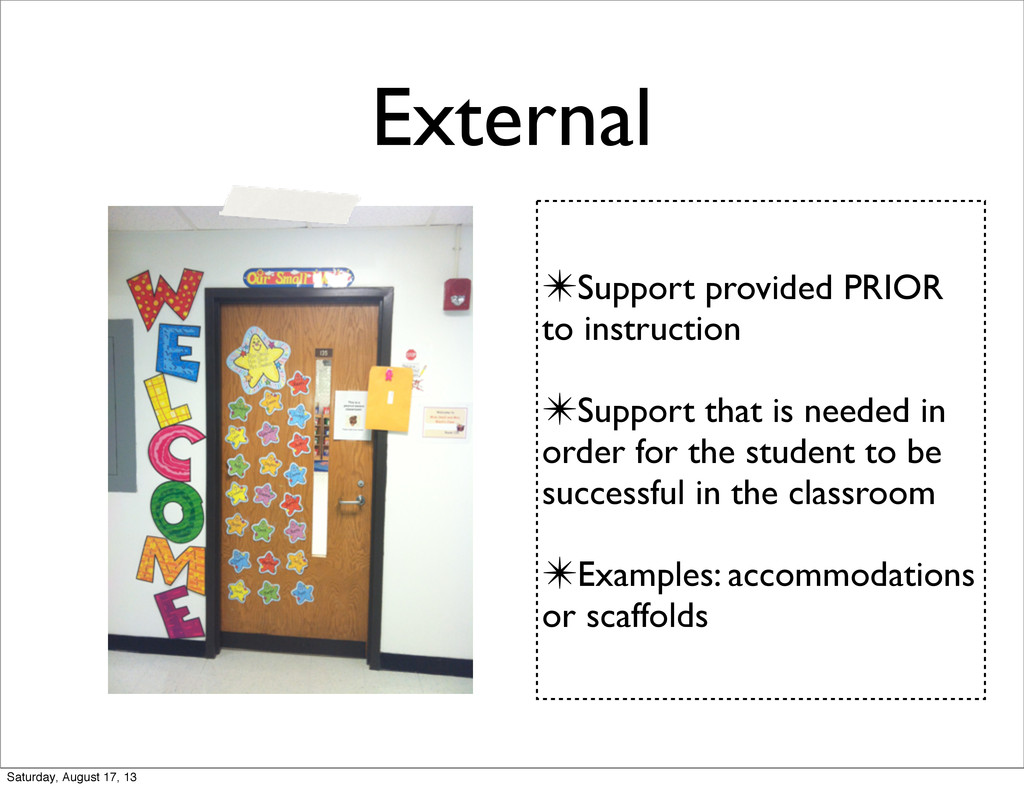
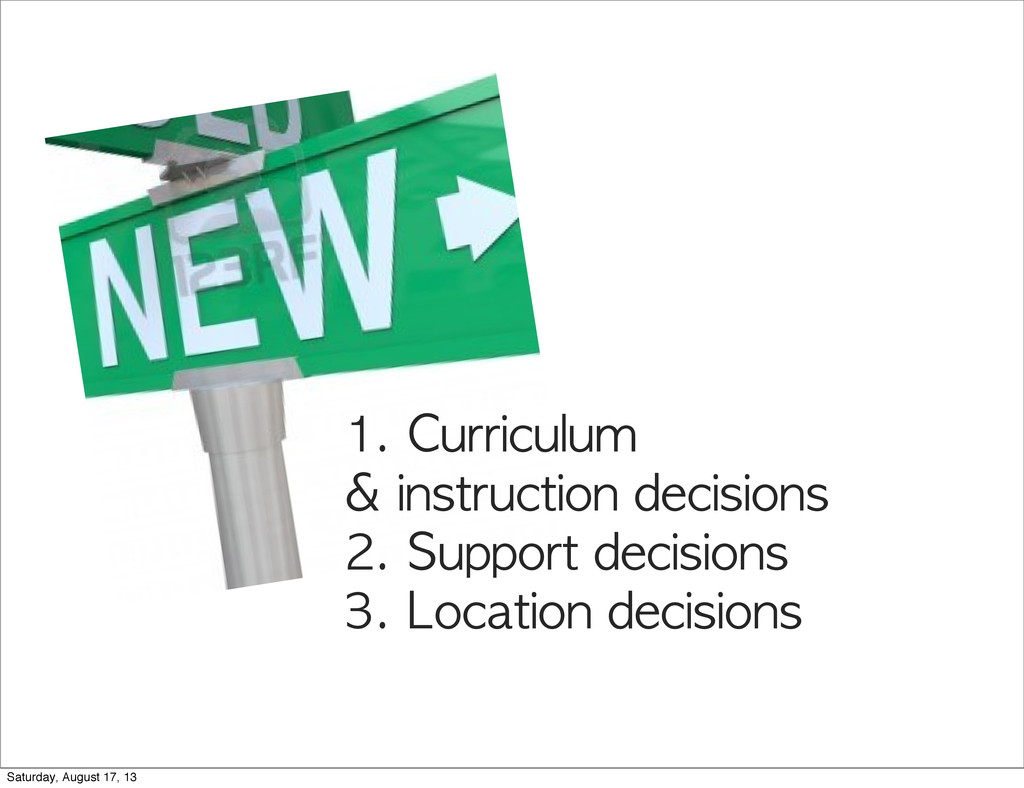
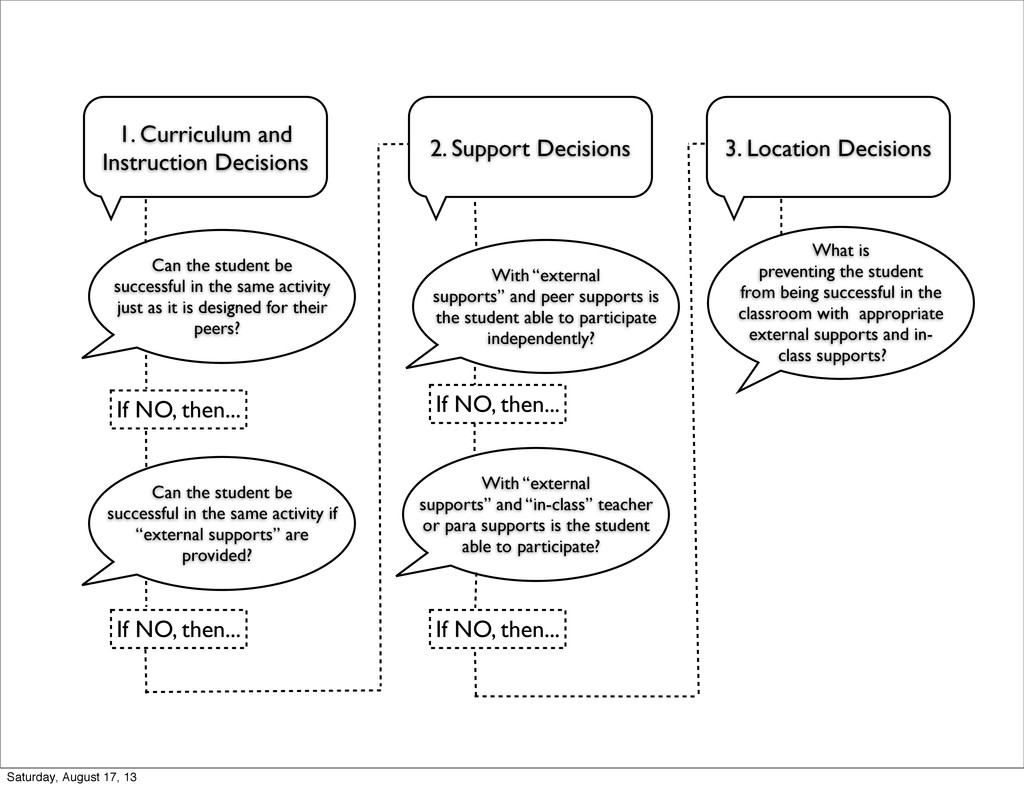
then... Can the student be successful in the same activity just as it is designed for their peers? Can the student be successful in the same activity if “external supports” are provided? With “external supports” and peer supports is the student able to participate independently? With “external supports” and “in-class” teacher or para supports is the student able to participate? What is preventing the student from being successful in the classroom with appropriate external supports and in- class supports? 2. Support Decisions 3. Location Decisions If NO, then... If NO, then... Saturday, August 17, 13
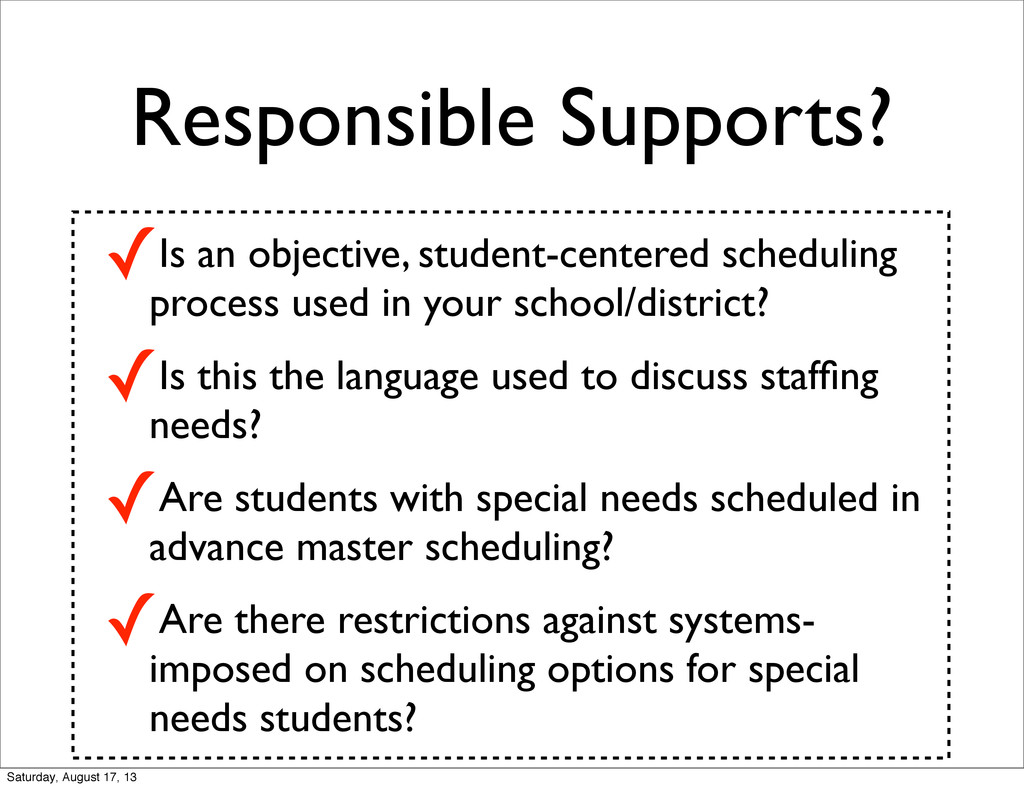
your school/district? ✓Is this the language used to discuss staffing needs? ✓Are students with special needs scheduled in advance master scheduling? ✓Are there restrictions against systems- imposed on scheduling options for special needs students? Saturday, August 17, 13
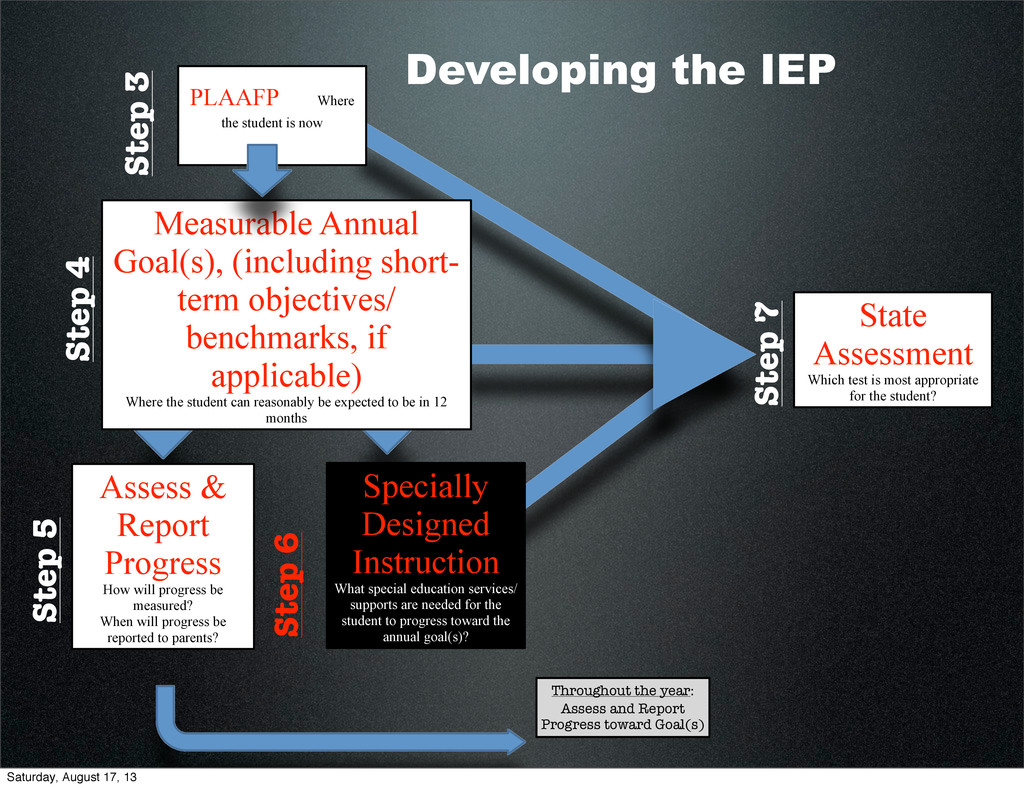
short- term objectives/ benchmarks, if applicable) Where the student can reasonably be expected to be in 12 months Assess & Report Progress How will progress be measured? When will progress be reported to parents? Specially Designed Instruction What special education services/ supports are needed for the student to progress toward the annual goal(s)? State Assessment Which test is most appropriate for the student? Step 3 Step 4 Step 5 Step 6 Step 7 Throughout the year: Assess and Report Progress toward Goal(s) Developing the IEP Saturday, August 17, 13
statement of the special education and related services and supplementary aids and services, based on peer- reviewed research to the extent practicable, to be provided to the child, or on behalf of the child… • 34 CFR §300.320 (a)(4) Saturday, August 17, 13
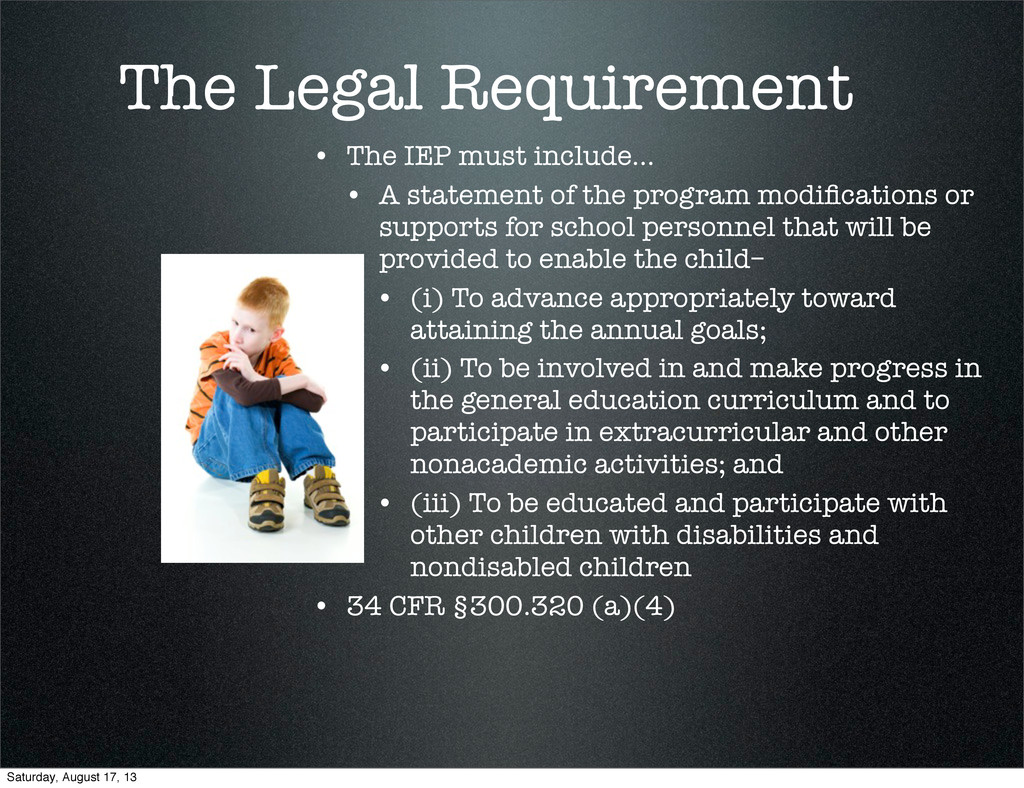
statement of the program modifications or supports for school personnel that will be provided to enable the child– • (i) To advance appropriately toward attaining the annual goals; • (ii) To be involved in and make progress in the general education curriculum and to participate in extracurricular and other nonacademic activities; and • (iii) To be educated and participate with other children with disabilities and nondisabled children • 34 CFR §300.320 (a)(4) Saturday, August 17, 13
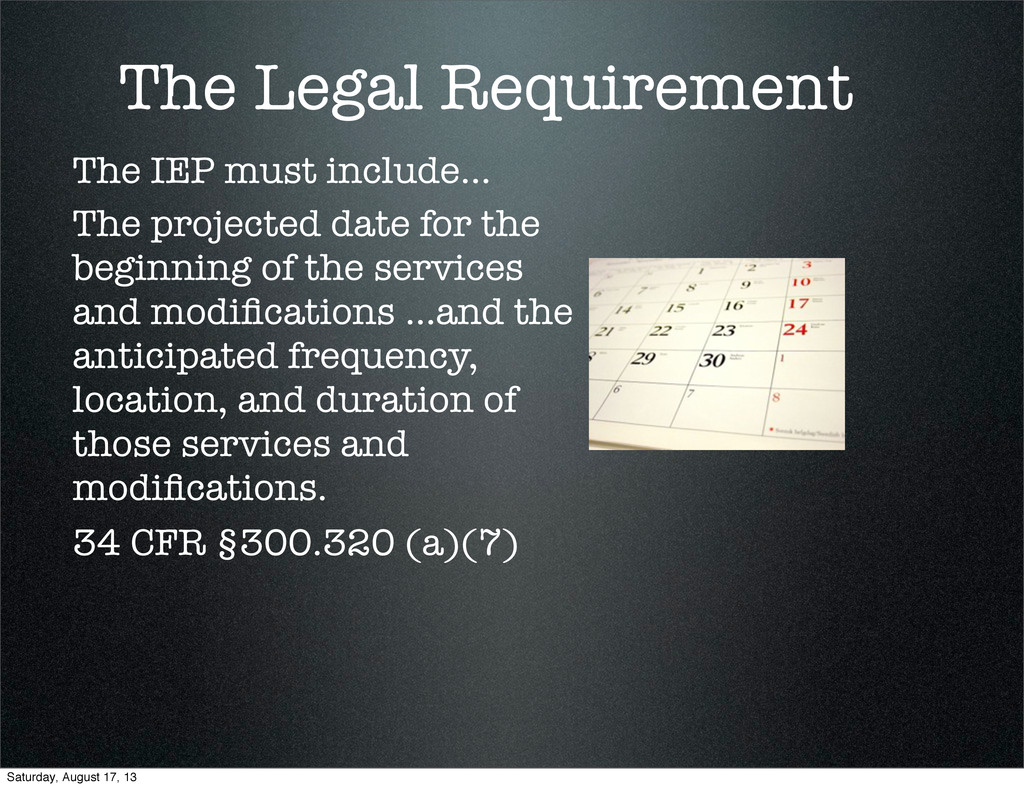
for the beginning of the services and modifications …and the anticipated frequency, location, and duration of those services and modifications. 34 CFR §300.320 (a)(7) Saturday, August 17, 13
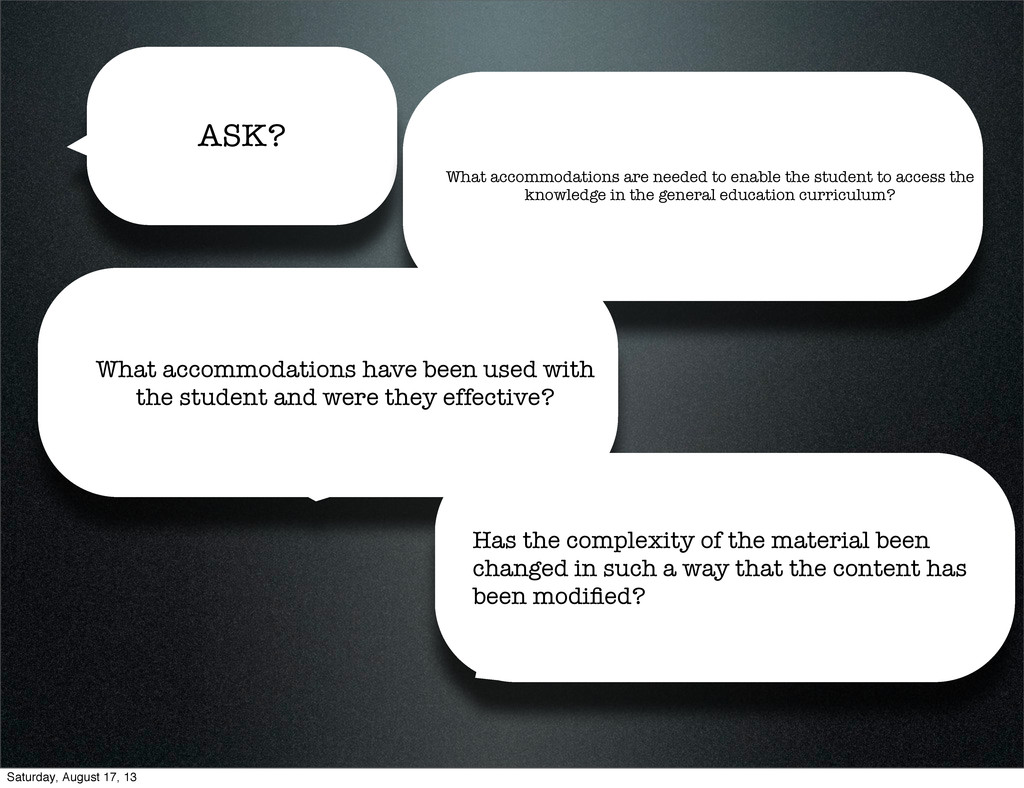
access the knowledge in the general education curriculum? What accommodations have been used with the student and were they effective? Has the complexity of the material been changed in such a way that the content has been modified? Saturday, August 17, 13
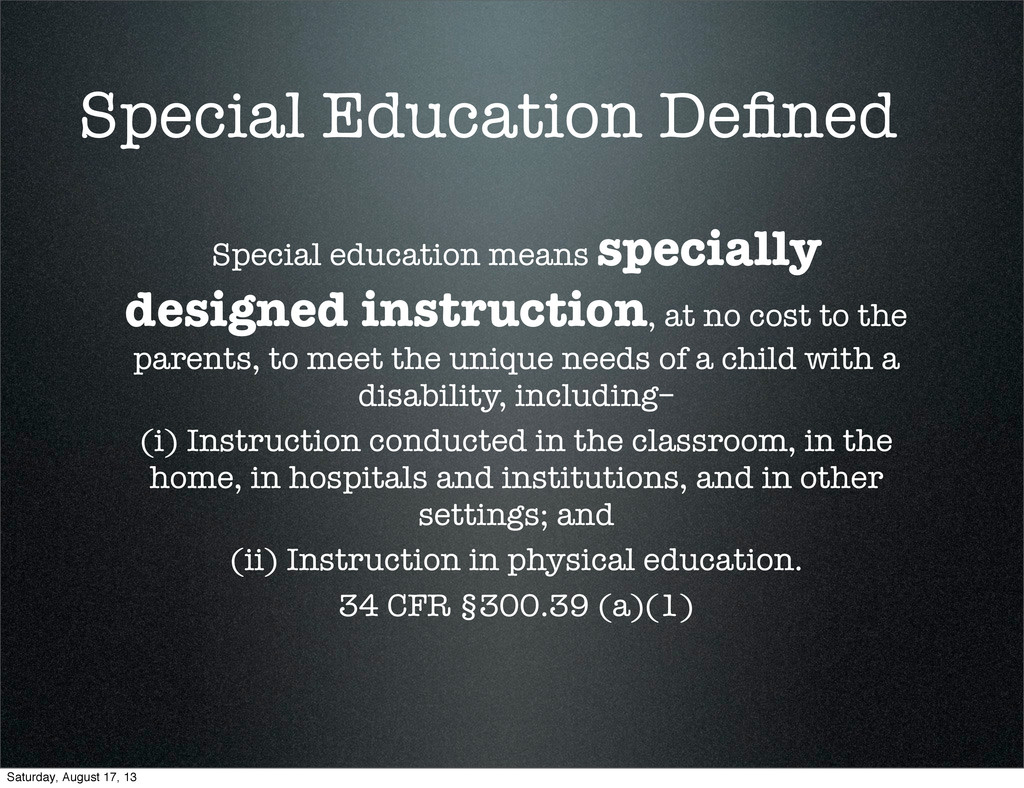
no cost to the parents, to meet the unique needs of a child with a disability, including– (i) Instruction conducted in the classroom, in the home, in hospitals and institutions, and in other settings; and (ii) Instruction in physical education. 34 CFR §300.39 (a)(1) Saturday, August 17, 13
or even eliminate the effects of student’s disability • Do not reduce learning expectations • Modifications • Practices and procedures that change the nature of the task or skill Saturday, August 17, 13
student is familiar and comfortable using accommodation on a statewide assessment • Not necessarily used every day Independently • Only applicable to some accommodations (e.g., applies to use of a calculator but not to an oral administration) Effectively • Accommodation meets student needs as evidenced by scores and observations with or without accommodation use Saturday, August 17, 13
include information about the amount of services that will be provided to the child, so that the level of the agency's commitment of resources will be clear to parents and other IEP Team members. The amount of time to be committed to each of the various services provided must be appropriate to the specific service, and clearly stated in the IEP in a manner that can be understood by all involved in the development and implementation of the IEP.” Federal Register, Vol. 71, No. 156, page 46667 Saturday, August 17, 13
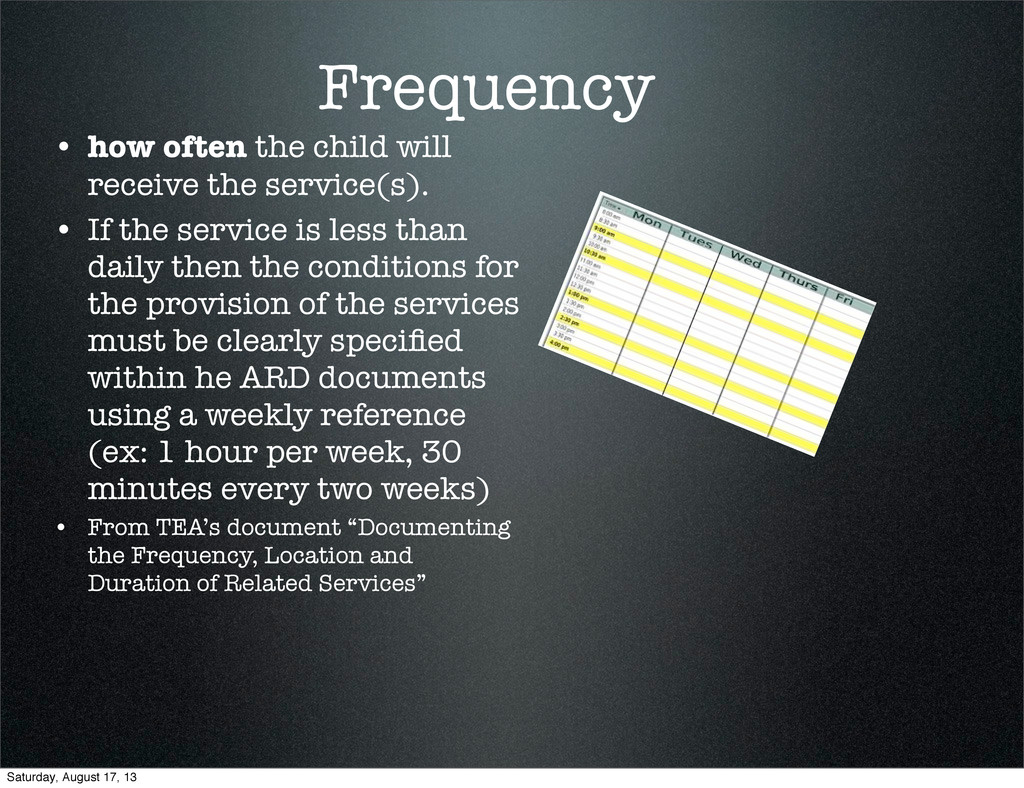
• If the service is less than daily then the conditions for the provision of the services must be clearly specified within he ARD documents using a weekly reference (ex: 1 hour per week, 30 minutes every two weeks) • From TEA’s document “Documenting the Frequency, Location and Duration of Related Services” Saturday, August 17, 13
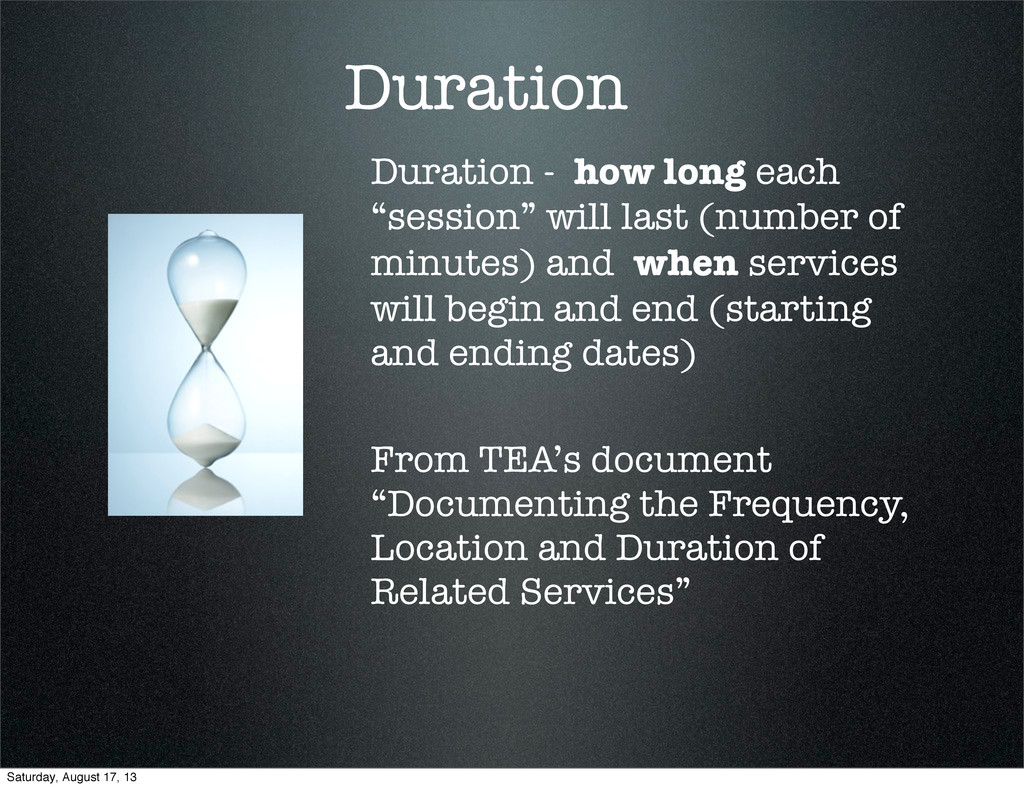
of minutes) and when services will begin and end (starting and ending dates) From TEA’s document “Documenting the Frequency, Location and Duration of Related Services” Saturday, August 17, 13
general education classroom or another setting such as a special education resource room) From TEA’s document “Documenting the Frequency, Location and Duration of Related Services” Saturday, August 17, 13
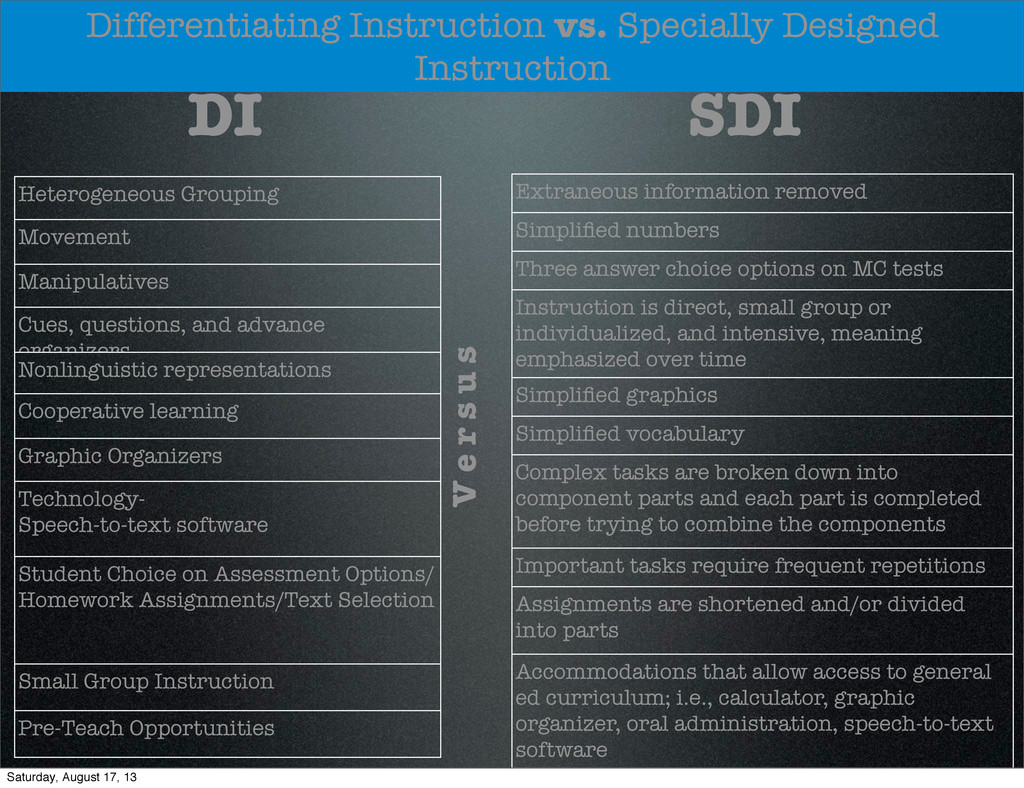
representations Cooperative learning Graphic Organizers Technology- Speech-to-text software Student Choice on Assessment Options/ Homework Assignments/Text Selection Small Group Instruction Pre-Teach Opportunities Extraneous information removed Simplified numbers Three answer choice options on MC tests Instruction is direct, small group or individualized, and intensive, meaning emphasized over time Simplified graphics Simplified vocabulary Complex tasks are broken down into component parts and each part is completed before trying to combine the components Important tasks require frequent repetitions Assignments are shortened and/or divided into parts Accommodations that allow access to general ed curriculum; i.e., calculator, graphic organizer, oral administration, speech-to-text software Differentiating Instruction vs. Specially Designed Instruction V e r s u s DI SDI Saturday, August 17, 13
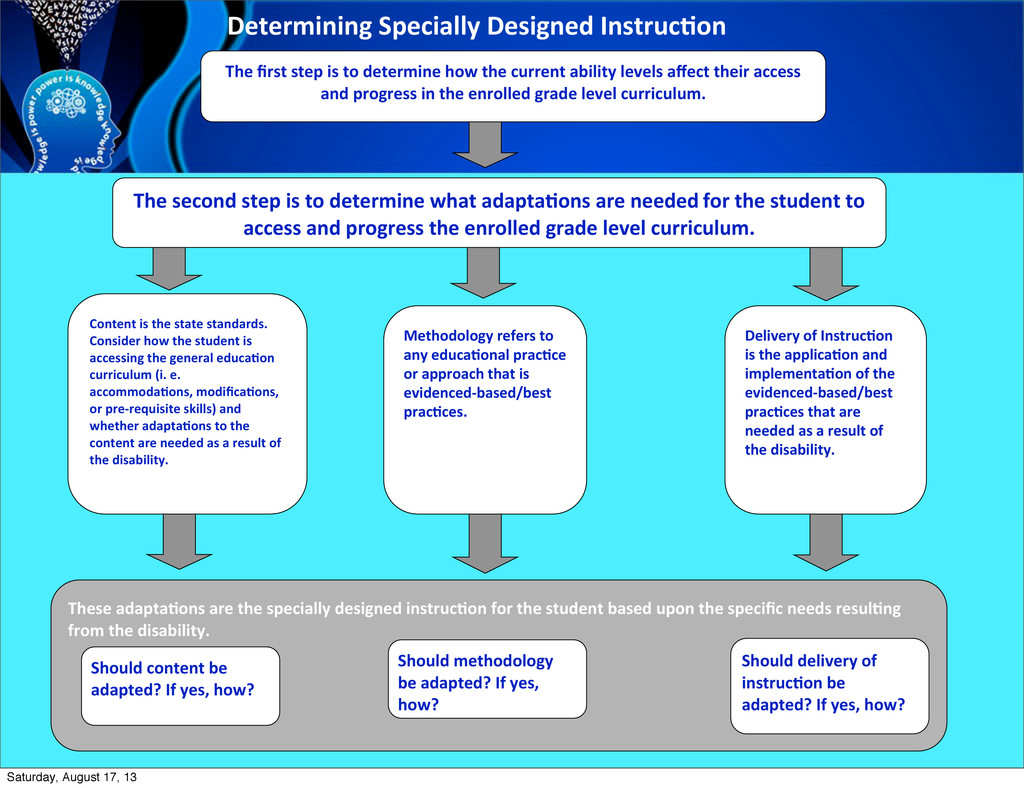
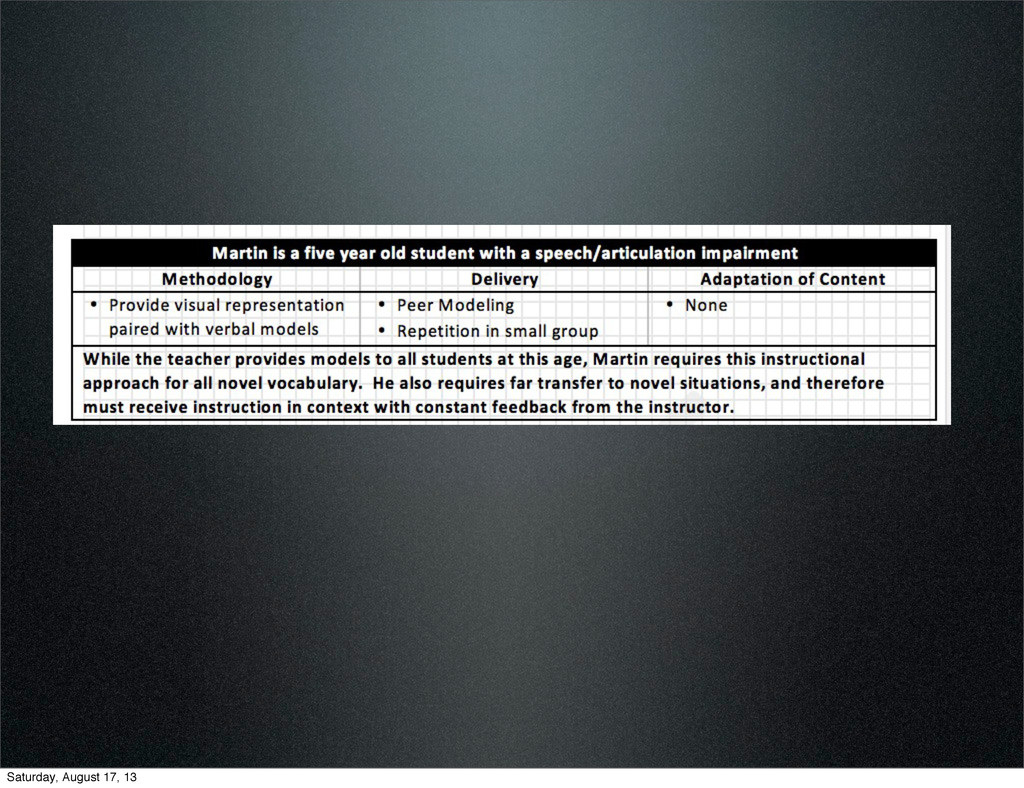
based upon the specific needs resul*ng from the disability. The first step is to determine how the current ability levels affect their access and progress in the enrolled grade level curriculum. The second step is to determine what adapta*ons are needed for the student to access and progress the enrolled grade level curriculum. Content is the state standards. Consider how the student is accessing the general educa*on curriculum (i. e. accommoda*ons, modifica*ons, or pre-‐requisite skills) and whether adapta*ons to the content are needed as a result of the disability. Methodology refers to any educa*onal prac*ce or approach that is evidenced-‐based/best prac*ces. Delivery of Instruc*on is the applica*on and implementa*on of the evidenced-‐based/best prac*ces that are needed as a result of the disability. Should content be adapted? If yes, how? Should delivery of instruc*on be adapted? If yes, how? Should methodology be adapted? If yes, how? Determining Specially Designed Instruc*on Saturday, August 17, 13
match to the student’s pre-requisite skills? • Is there additional instruction required prior to the beginning of the lesson? • What strategies are embedded in the IEP that will be helpful for this type of learning activity? Pre- Instruction Saturday, August 17, 13
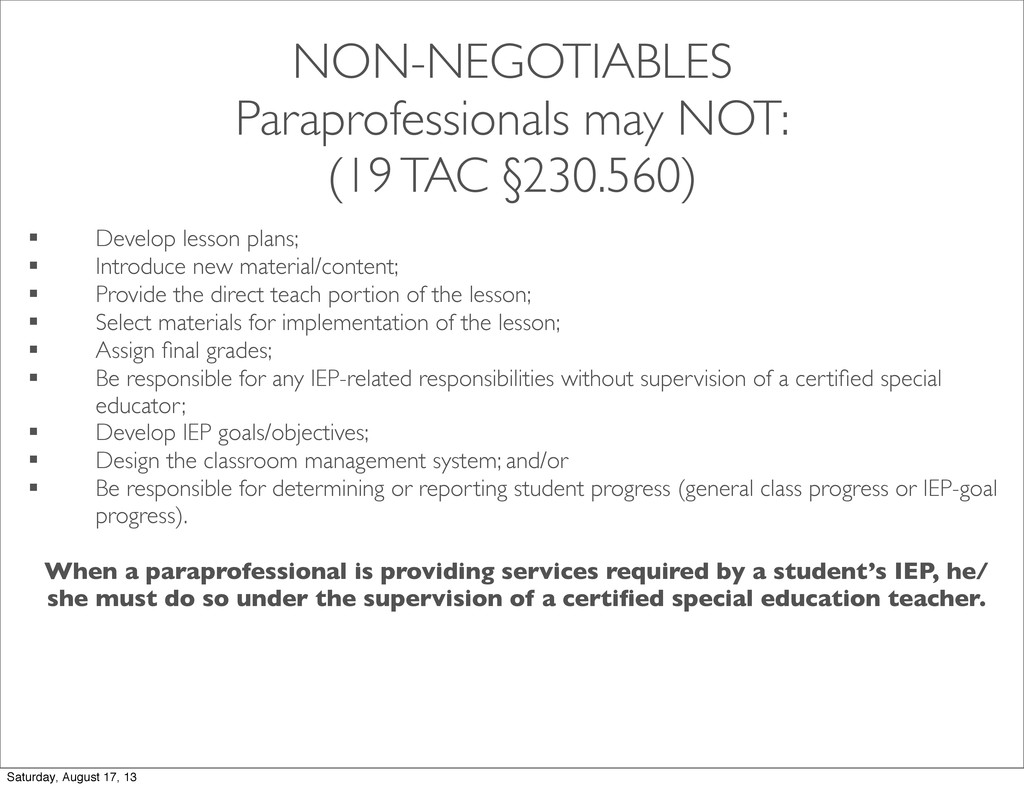
plans; § Introduce new material/content; § Provide the direct teach portion of the lesson; § Select materials for implementation of the lesson; § Assign final grades; § Be responsible for any IEP-related responsibilities without supervision of a certified special educator; § Develop IEP goals/objectives; § Design the classroom management system; and/or § Be responsible for determining or reporting student progress (general class progress or IEP-goal progress). When a paraprofessional is providing services required by a student’s IEP, he/ she must do so under the supervision of a certified special education teacher. Saturday, August 17, 13
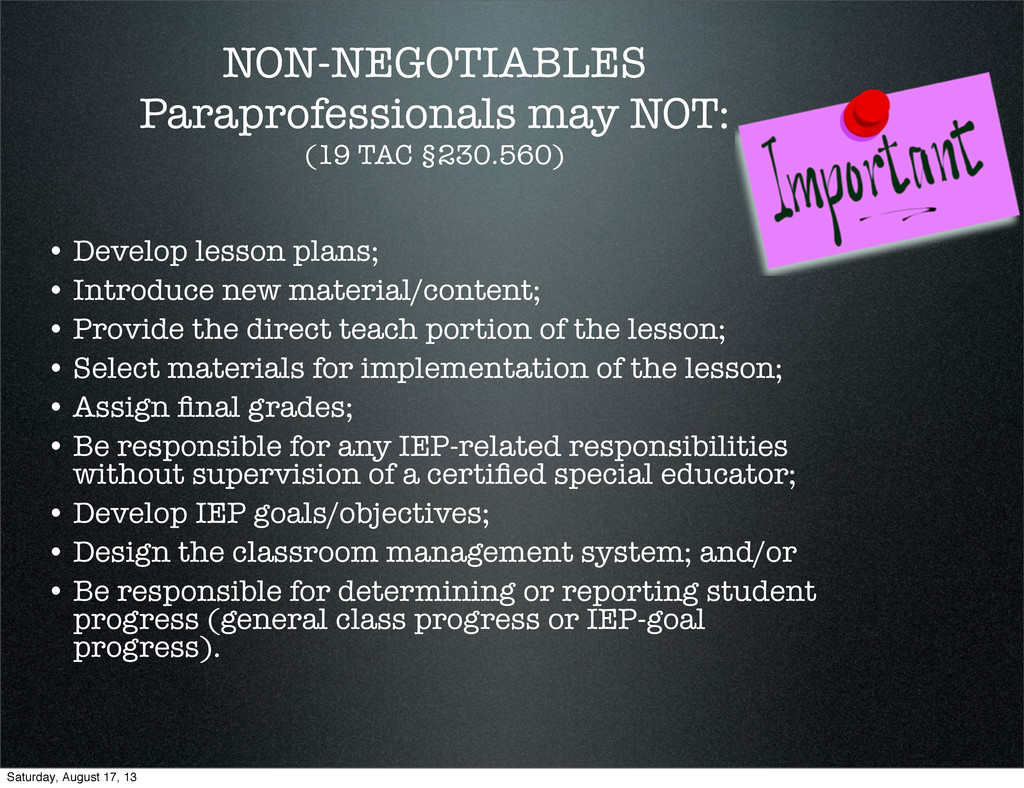
plans; • Introduce new material/content; • Provide the direct teach portion of the lesson; • Select materials for implementation of the lesson; • Assign final grades; • Be responsible for any IEP-related responsibilities without supervision of a certified special educator; • Develop IEP goals/objectives; • Design the classroom management system; and/or • Be responsible for determining or reporting student progress (general class progress or IEP-goal progress). Saturday, August 17, 13
place paraprofessionals assigned to specific high need students into classrooms where other students will also benefit. • Paraprofessional cannot provide direct initial instruction, but can re-teach and reinforce the skills previously taught, make curriculum accommodations (under the direction of the general or special education teacher), and provide support with daily assignments. Saturday, August 17, 13
by giving reminders to stay on task and redirecting students. • Paraprofessional may also assist with behavior interventions but must be CPI certified when working with students in which physical restraints may be involved. • It is important to discuss the roles and responsibilities of the paraprofessional with them and each teacher they work with. The paraprofessional’s role could be different in each classroom. Saturday, August 17, 13
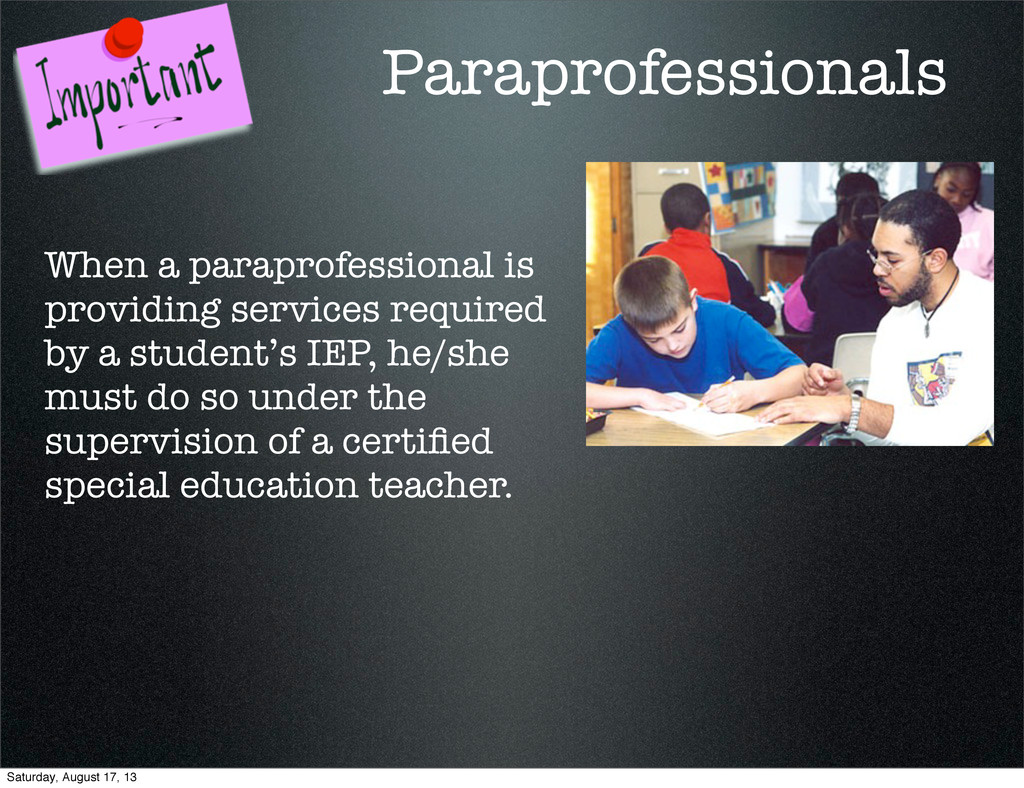
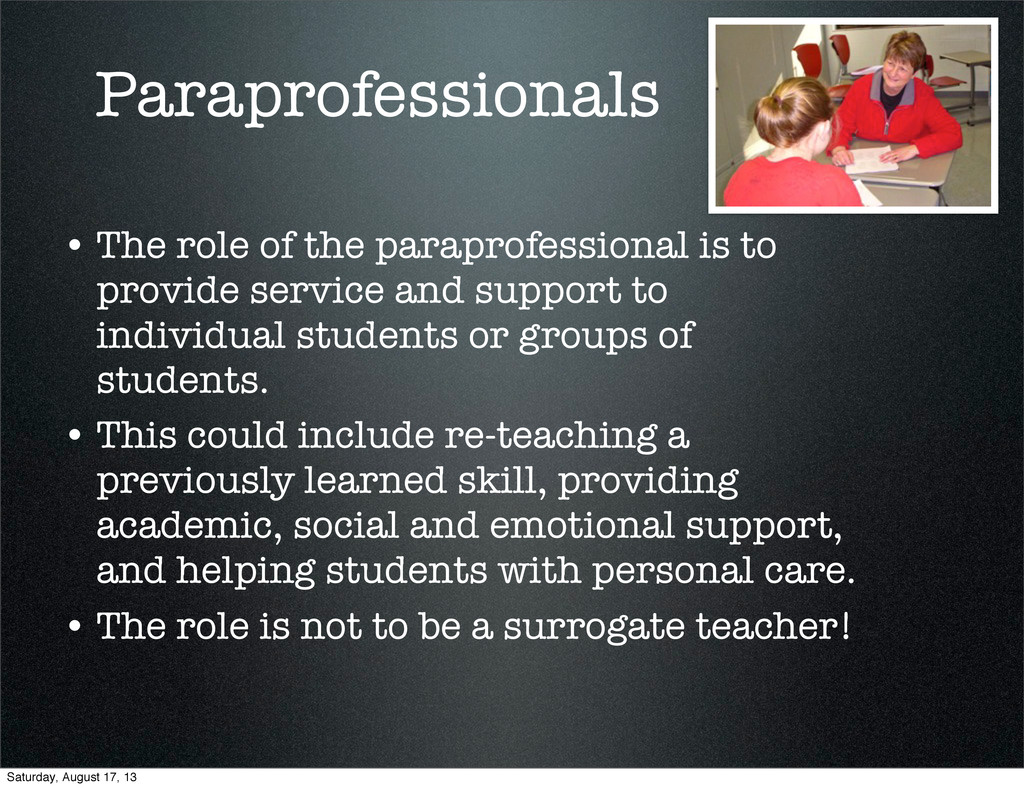
service and support to individual students or groups of students. • This could include re-teaching a previously learned skill, providing academic, social and emotional support, and helping students with personal care. • The role is not to be a surrogate teacher! Saturday, August 17, 13
• This can take place during the lesson • Progress Monitoring for IEP Goals • Multiple data sources should be used for a holistic view • There is still a place for observational data Saturday, August 17, 13
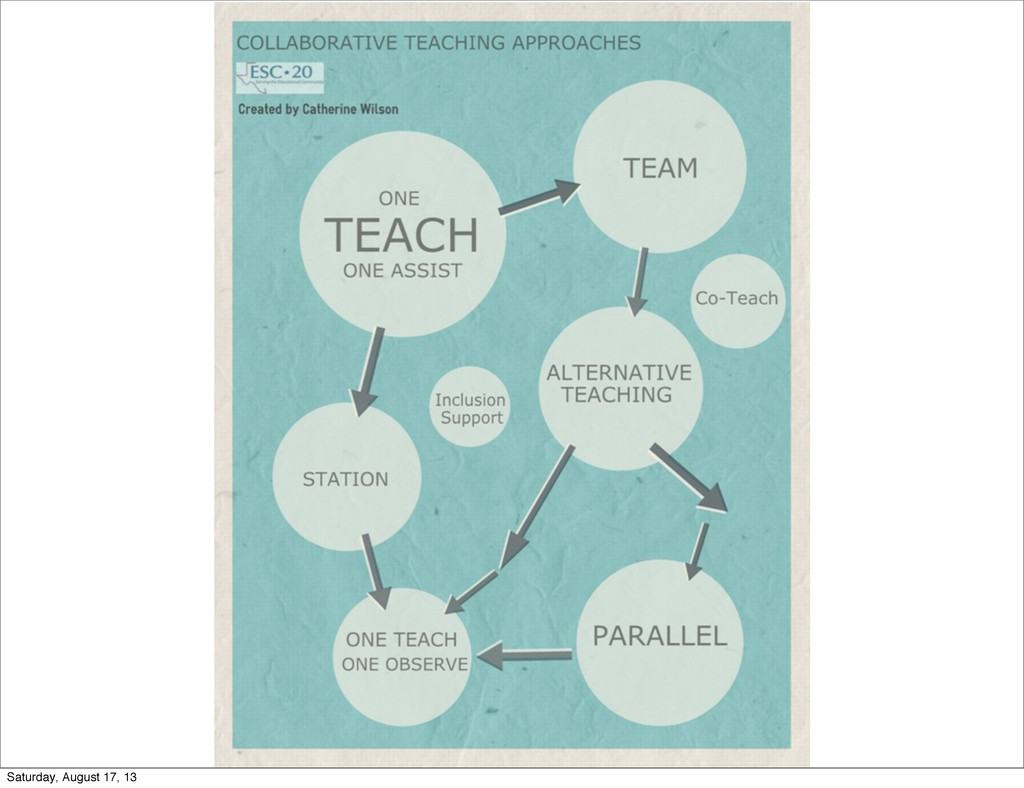
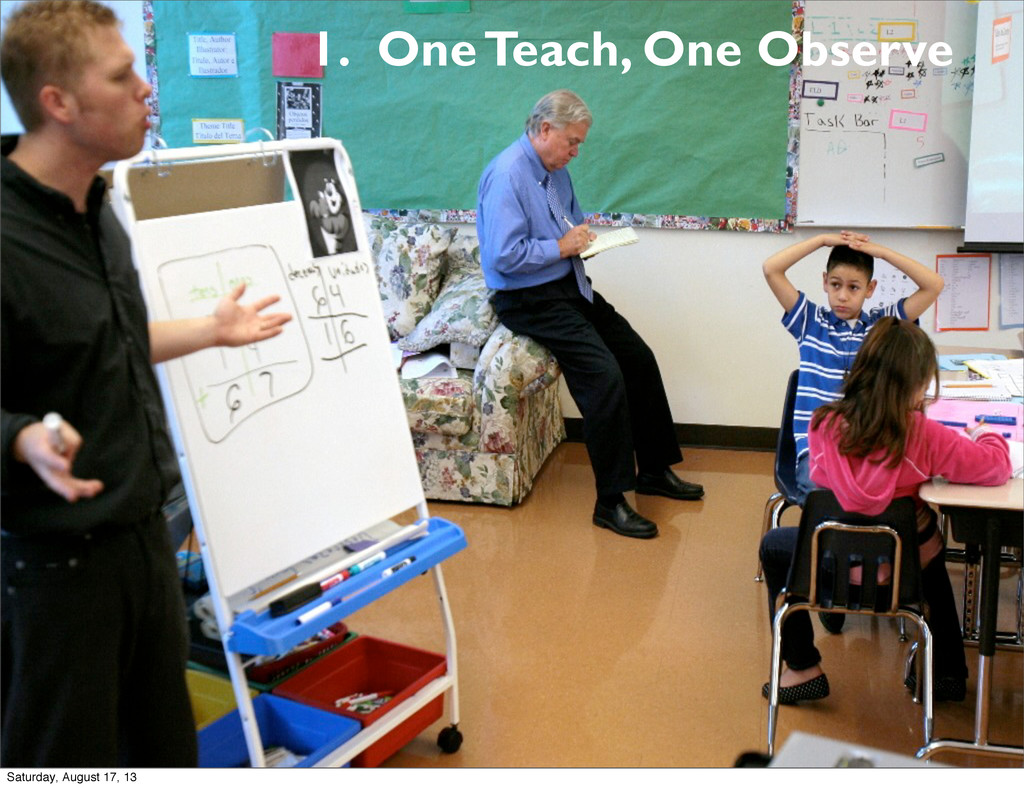
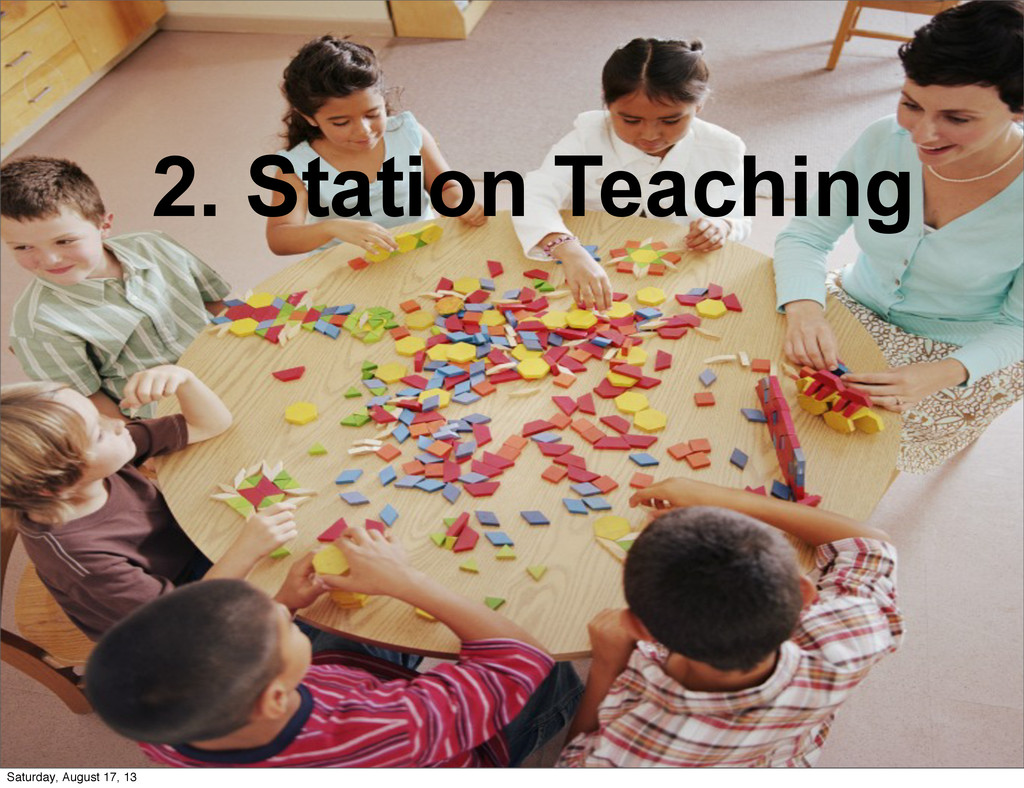
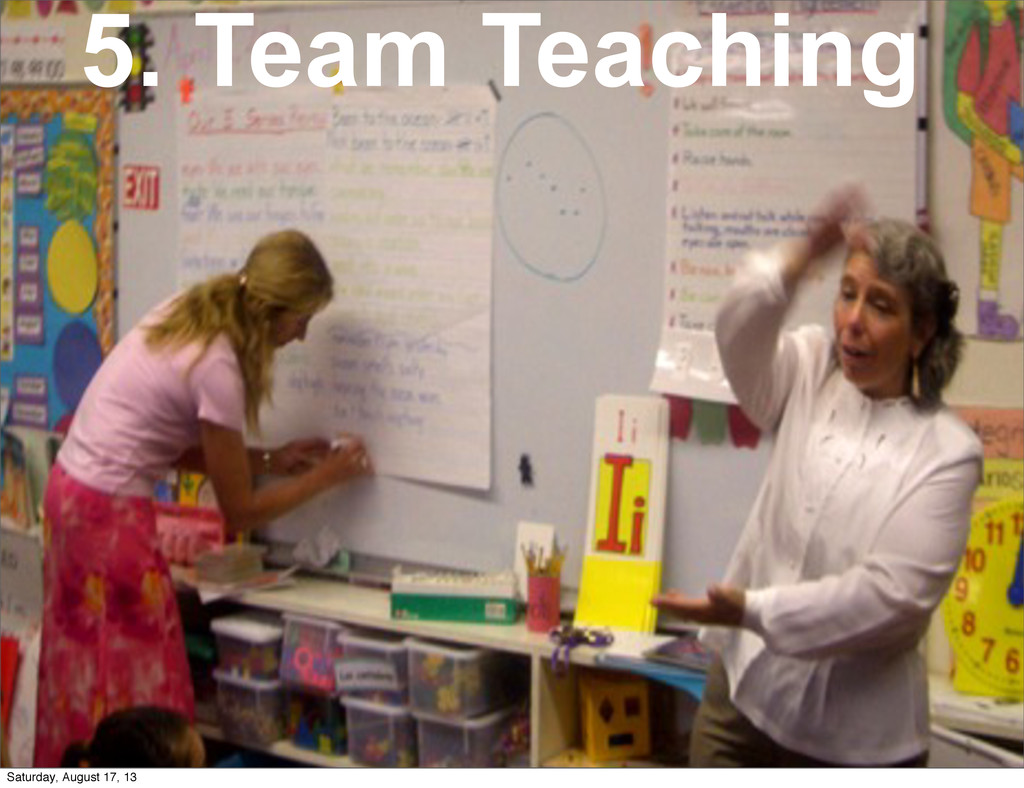
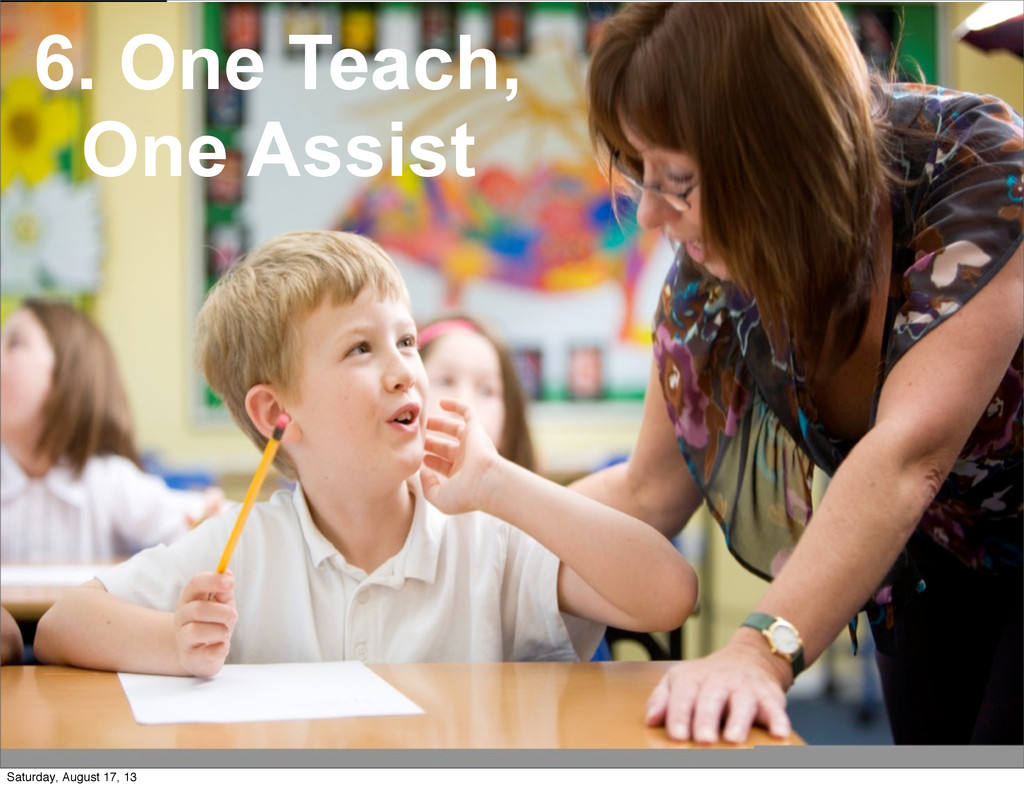
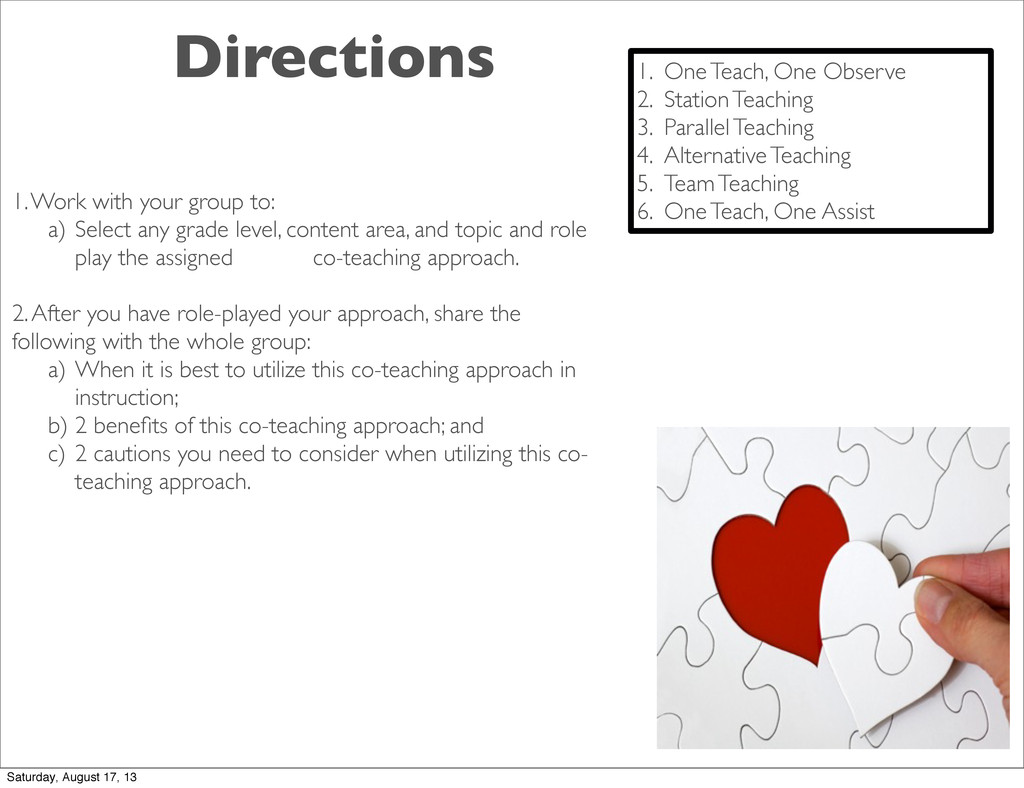
grade level, content area, and topic and role play the assigned co-teaching approach. 2. After you have role-played your approach, share the following with the whole group: a) When it is best to utilize this co-teaching approach in instruction; b) 2 benefits of this co-teaching approach; and c) 2 cautions you need to consider when utilizing this co- teaching approach. 1. One Teach, One Observe 2. Station Teaching 3. Parallel Teaching 4. Alternative Teaching 5. Team Teaching 6. One Teach, One Assist Saturday, August 17, 13
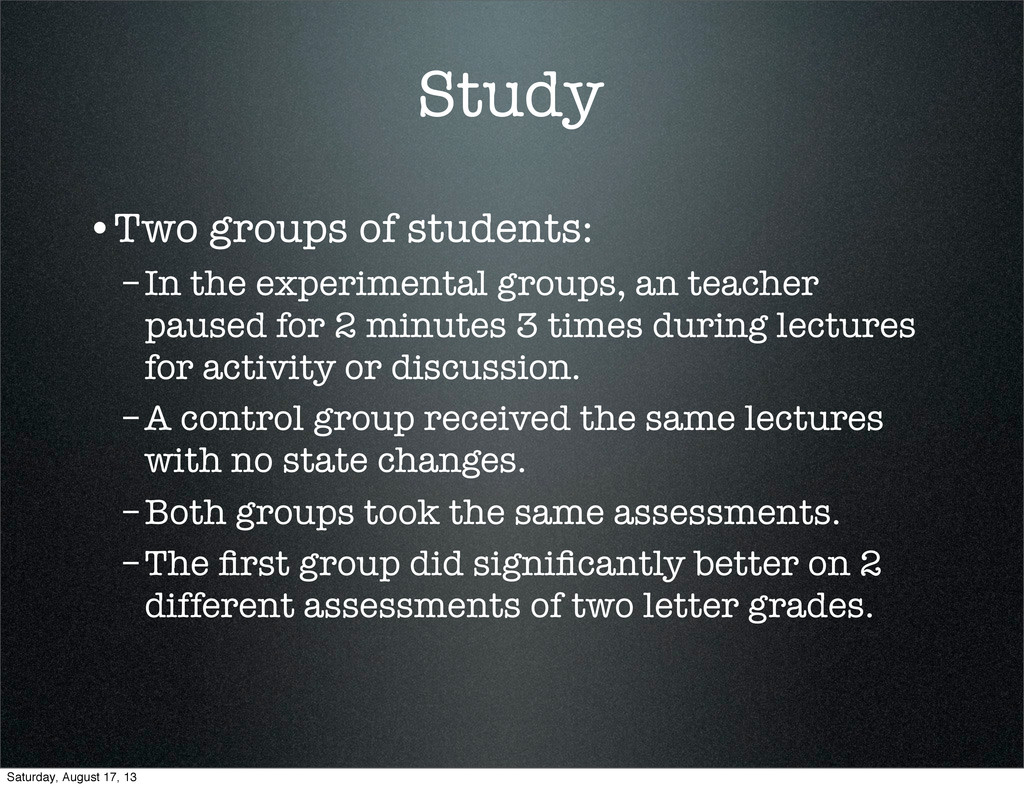
teacher paused for 2 minutes 3 times during lectures for activity or discussion. –A control group received the same lectures with no state changes. –Both groups took the same assessments. –The first group did significantly better on 2 different assessments of two letter grades. Saturday, August 17, 13
• Project-Based Instruction • Inquiry-Based Learning • Drama • Simulations • Labs • Service Learning • Writing Workshops How many elastic structures do you already use in your classroom? Are there others you might add? Saturday, August 17, 13
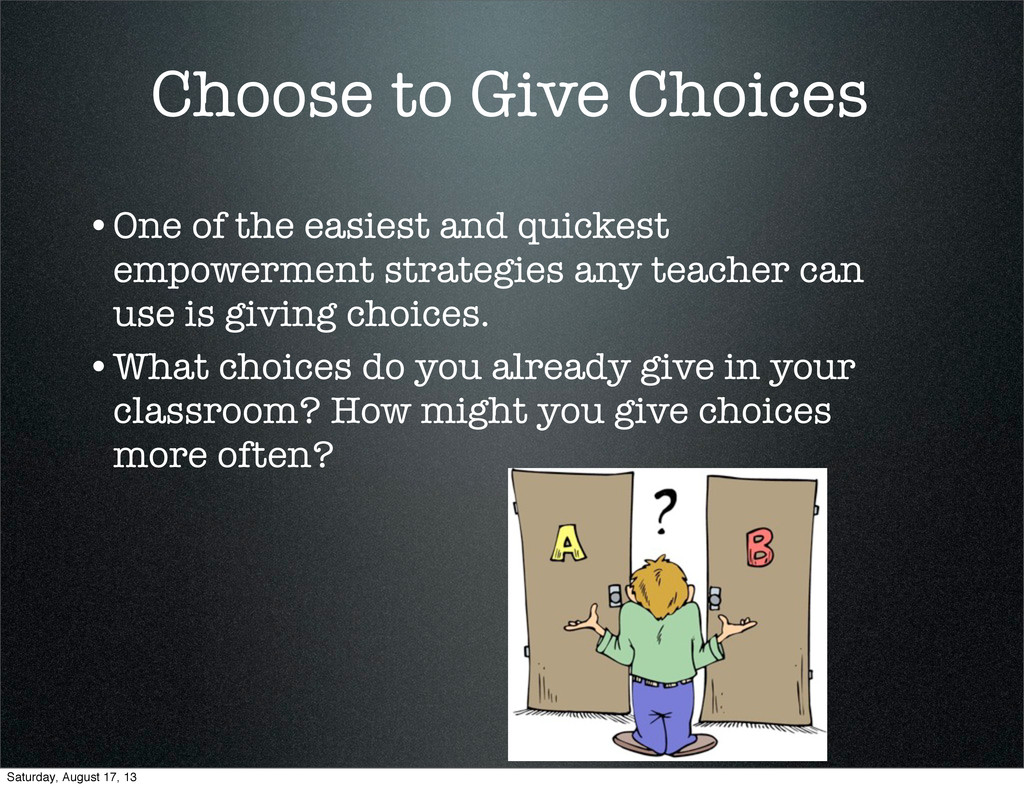
empowerment strategies any teacher can use is giving choices. •What choices do you already give in your classroom? How might you give choices more often? Saturday, August 17, 13
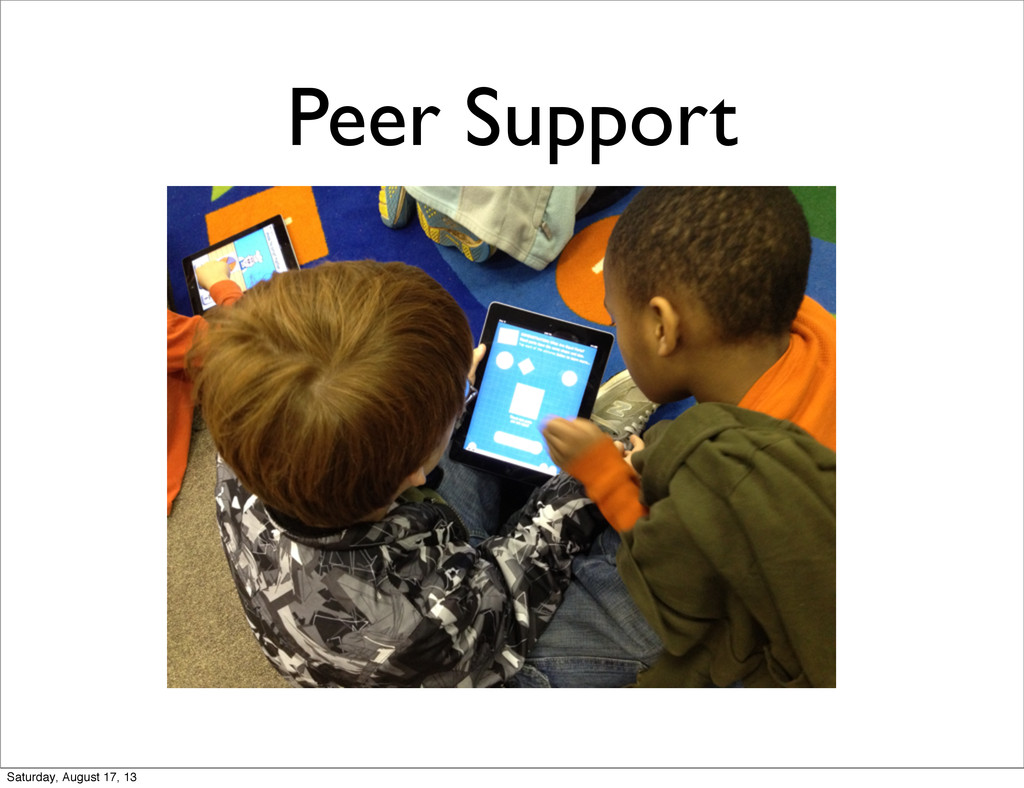
to strengthen social relationships, learn about and from each other, and get and give support. •This may lead to the development of friendships. •When students with a disability have a robust network of friends they are also usually supported by teachers who value and cultivate student collaboration and interaction. Saturday, August 17, 13
regularly for all students? •What “baseline” supports can be found in every classroom in your building? •How would a visitor to your school know that tall teachers were committed to serving all students? Questions S.O.S. Saturday, August 17, 13
support? (“I don’t know. We’ve never tried that.”) •You disable somebody when you do something for him that he can do for himself. •Fade support when it is appropriate. •When help is no longer needed move away – chair and all. Saturday, August 17, 13
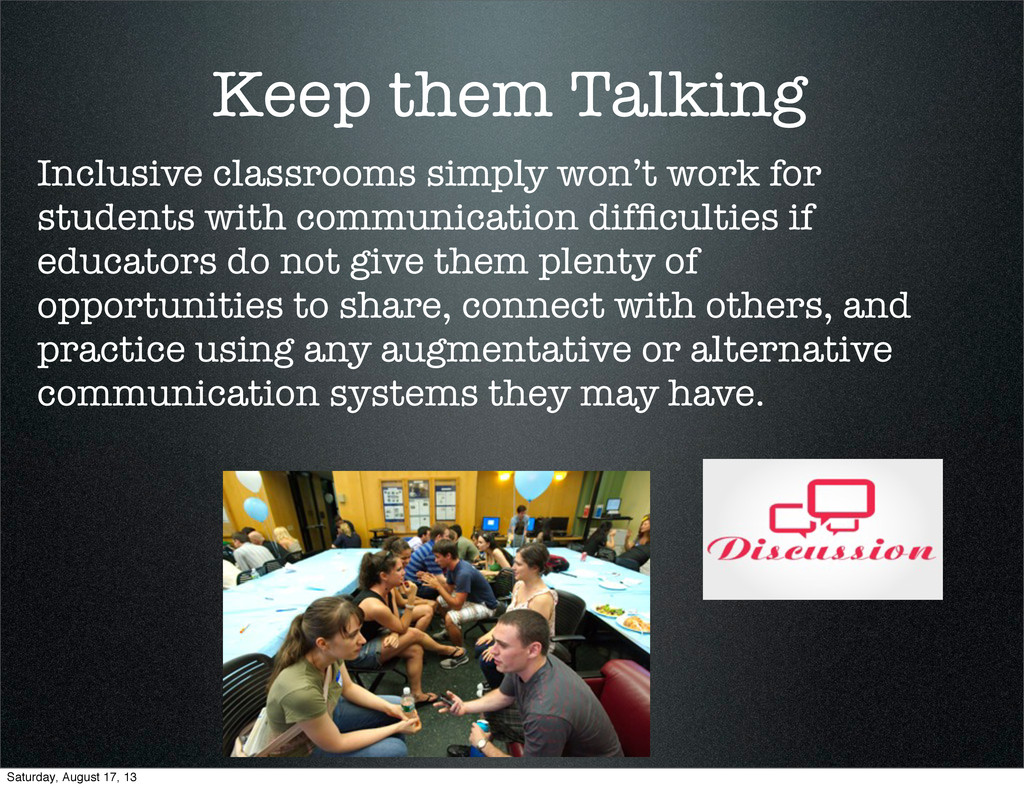
with communication difficulties if educators do not give them plenty of opportunities to share, connect with others, and practice using any augmentative or alternative communication systems they may have. Saturday, August 17, 13
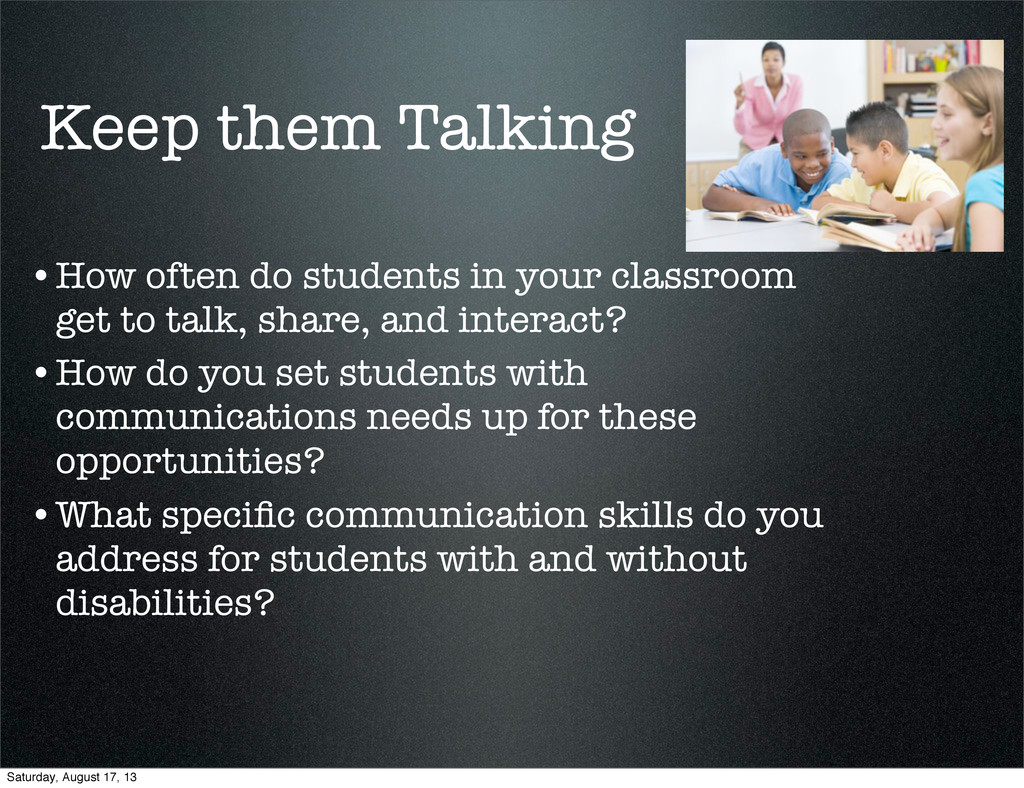
get to talk, share, and interact? •How do you set students with communications needs up for these opportunities? •What specific communication skills do you address for students with and without disabilities? Saturday, August 17, 13
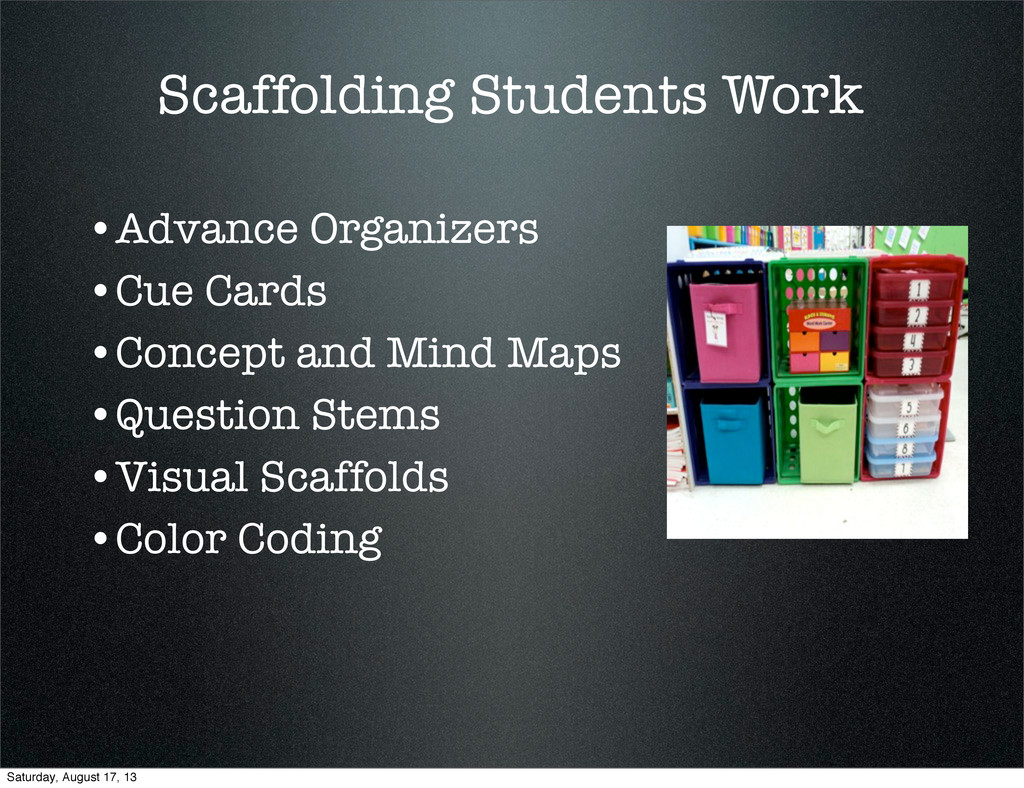
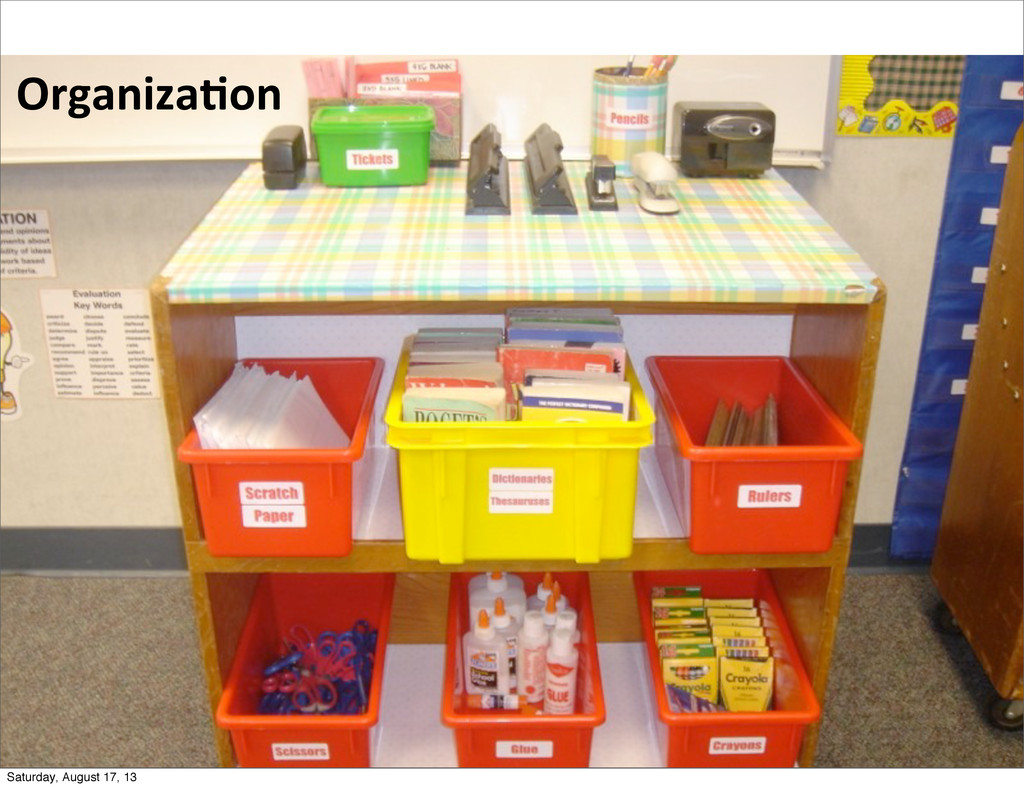
labeled folder for easy access and understanding Keep a folder/basket/tray in an agreed upon location ◦Purpose: • To put modified work for teacher or student to access • For students to return work for SE teacher to view and/or grade • For teacher to put work samples to view and grade or give input into grading & for documentation Saturday, August 17, 13
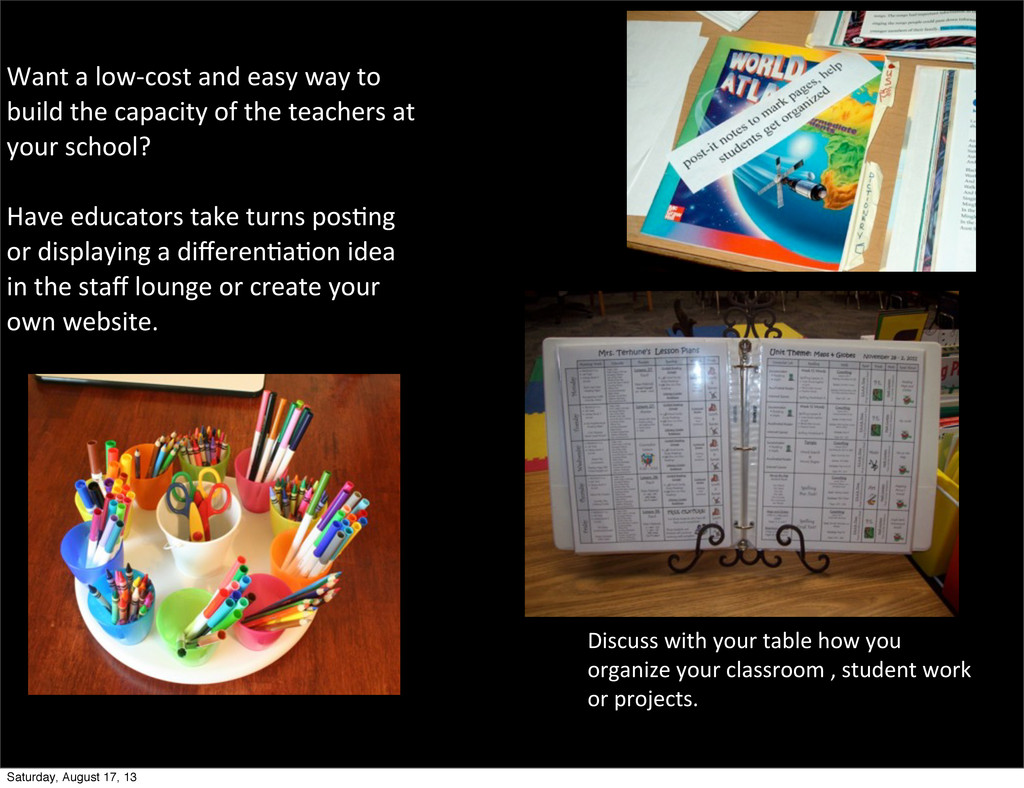
, student work or projects. Want a low-‐cost and easy way to build the capacity of the teachers at your school? Have educators take turns pos:ng or displaying a differen:a:on idea in the staff lounge or create your own website. Saturday, August 17, 13
can students sit down in this school? • Other sensory-safe spaces include • Comfortable rugs • Music/headphones • Colored pencils/markers/drawing pads • Clay or other manipulatives • Directions for deep breathing • Plants • Fish tanks Saturday, August 17, 13


 cwilson
 holman
 coloredviolet
 honnibal
 popppiees
 jnunemaker
 deanohume
 wayneb77
 schroneko
 lemiorhan
 katiecoart
 helenjbeal
 davidcarrasco