Share
Embed
Артём Акуляков «F# for Data Analysis»
Вводный доклад об инструментах для анализа данных в .NET и F# в частности.
DotNetRu
November 18, 2017
Transcript
88 slides
-
я - dotnet, python, js, go - ( ), data
analysis, ml - fintech стартап, senior engineer -
data analysis - math and computer science - состоит -
очистка - трансформация - дополнение - фильтрация - моделирование - кластеризация - поиск корреляций - проверка гипотез - ... - … rocket sience -
data analysis не всегда rocket sience - проект на поддержку
без описания структуры данных - расследование по логам - сложная аналитика - ... -
f# let rec map func lst = match lst with
| [] -> [] | head :: tail -> func head :: map func tail let myList = [1;3;5] let newList = map (fun x -> x + 1) myList -
f# - functional-first programming language - компилируемый & интерпретируемый -
dotnet - linux, osx, win, + - монады, матан и вся страшная жесть - хорош для data analysis -
data analysis 1. доступ к данным 2. визуализация 3. манипулирование
данными 4. интеграция(?) -
1 доступ к данным FSharp.Data & FSharp.Data.TypeProviders - sql db
- web & files - json - xml - csv - html - world bank - twitter - ... -
FSharp.Data open FSharp.Data type GitHub = JsonProvider<"https://api.github.com/repos/dotnet/coreclr/issues"> let topRecentlyUpdatedIssues =
GitHub.GetSamples() |> Seq.sortBy (fun x -> x.UpdatedAt) |> Seq.truncate 5 -
FSharp.Data open FSharp.Data type GitHub = JsonProvider<"https://api.github.com/repos/dotnet/coreclr/issues"> let topRecentlyUpdatedIssues =
GitHub.GetSamples() |> Seq.sortBy (fun x -> x.UpdatedAt) |> Seq.truncate 5 -
FSharp.Data open FSharp.Data type GitHub = JsonProvider<"https://api.github.com/repos/dotnet/coreclr/issues"> let topRecentlyUpdatedIssues =
GitHub.GetSamples() |> Seq.sortBy (fun x -> x.UpdatedAt) |> Seq.truncate 5 -
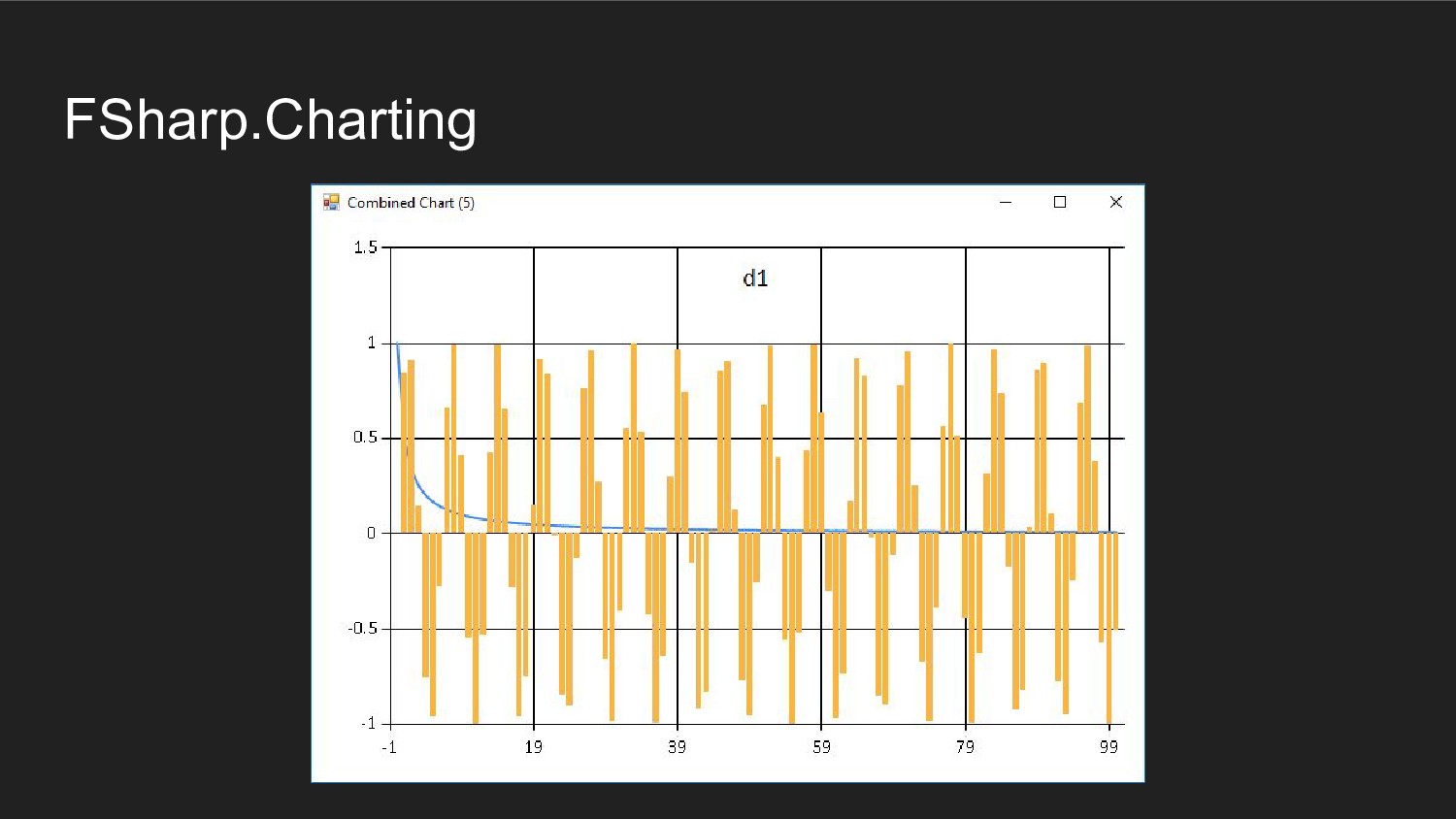
FSharp.Charting open FSharp.Charting open System let d1 = [for x
in 0 .. 100 -> (x, 1.0 / (float x + 1.) )] let d2 = [for x in 0 .. 100 -> (x, Math.Sin(float(x)))] Chart.Rows [ Chart.Line(d1,Name="d1",Title="d1") Chart.Column(d2,Name="d2",Title="d2") ] -
FSharp.Charting open FSharp.Charting open System let d1 = [for x
in 0 .. 100 -> (x, 1.0 / (float x + 1.) )] let d2 = [for x in 0 .. 100 -> (x, Math.Sin(float(x)))] Chart.Rows [ Chart.Line(d1,Name="d1",Title="d1") Chart.Column(d2,Name="d2",Title="d2") ] -
FSharp.Charting open FSharp.Charting open System let d1 = [for x
in 0 .. 100 -> (x, 1.0 / (float x + 1.) )] let d2 = [for x in 0 .. 100 -> (x, Math.Sin(float(x)))] Chart.Rows [ Chart.Line(d1,Name="d1",Title="d1") Chart.Column(d2,Name="d2",Title="d2") ] -
FSharp.Charting open FSharp.Charting open System let d1 = [for x
in 0 .. 100 -> (x, 1.0 / (float x + 1.) )] let d2 = [for x in 0 .. 100 -> (x, Math.Sin(float(x)))] Chart.Combine [ Chart.Line(d1,Name="d1",Title="d1") Chart.Column(d2,Name="d2",Title="d2") ] -
Deedle - аналог pandas из мира python - недо-Excel на
стероидах - приправа из статистики -
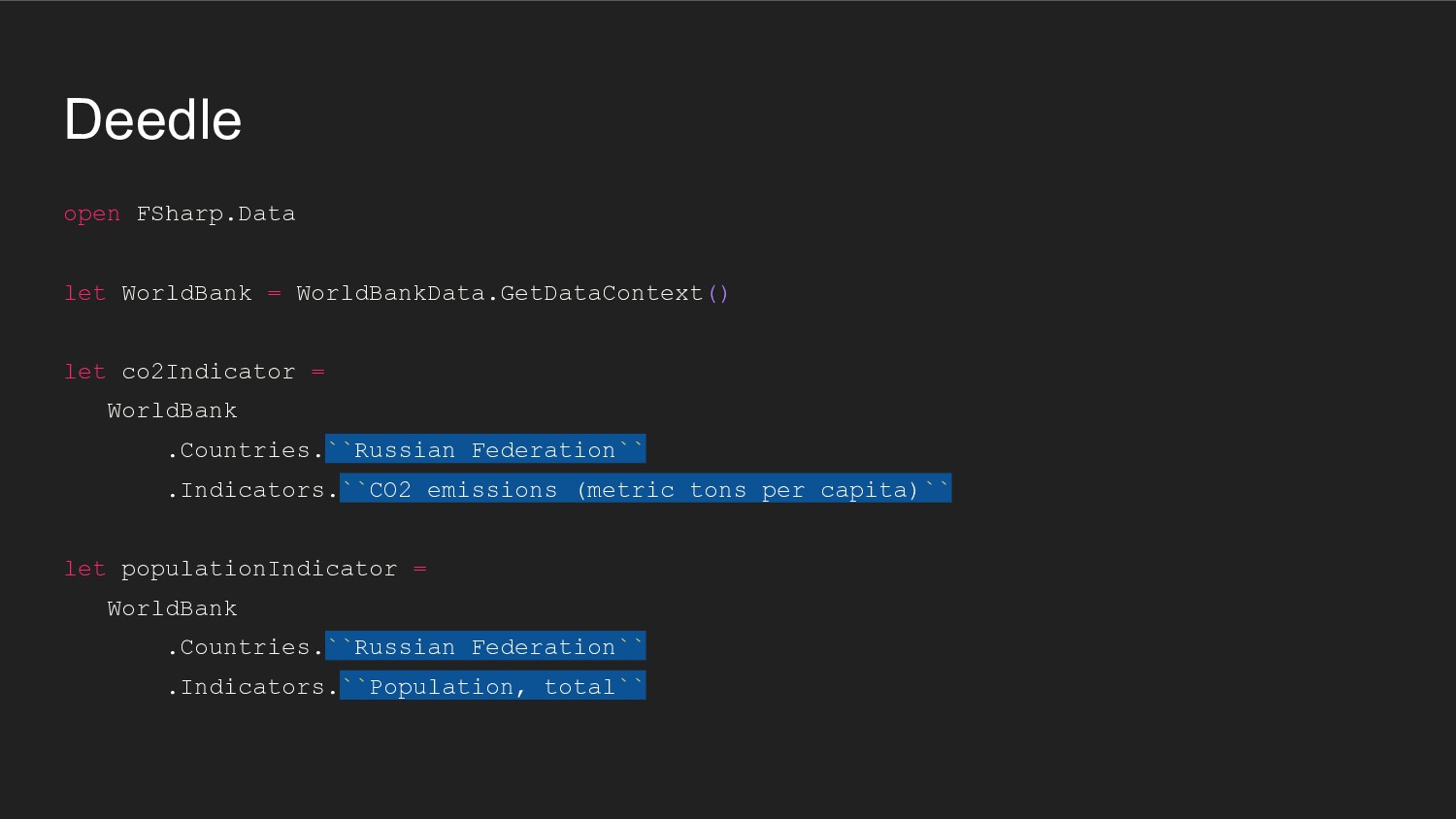
Deedle open FSharp.Data let WorldBank = WorldBankData.GetDataContext() let co2Indicator =
WorldBank .Countries.``Russian Federation`` .Indicators.``CO2 emissions (metric tons per capita)`` let populationIndicator = WorldBank .Countries.``Russian Federation`` .Indicators.``Population, total`` -
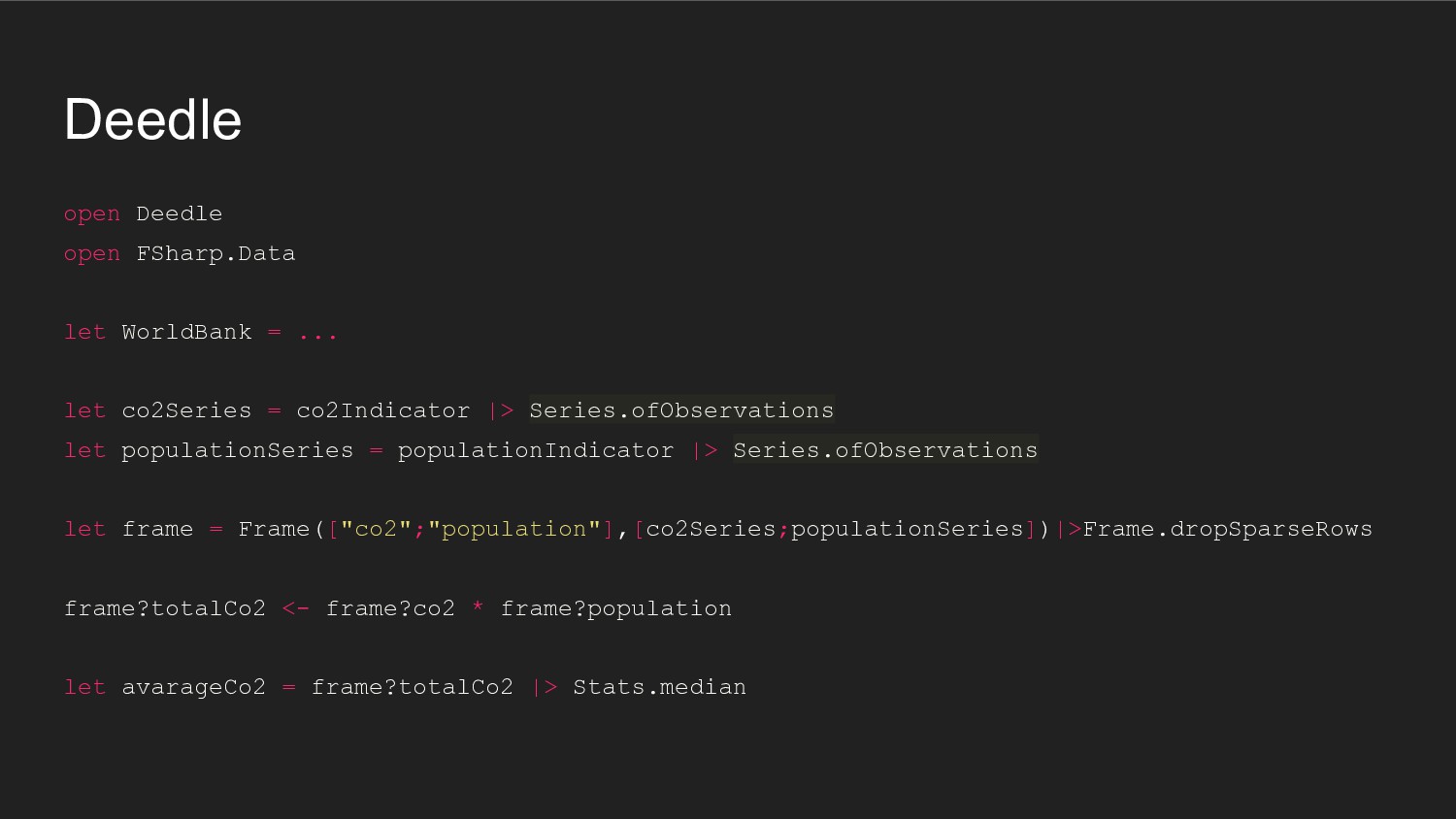
Deedle open Deedle open FSharp.Data let WorldBank = ... let
co2Series = co2Indicator |> Series.ofObservations let populationSeries = populationIndicator |> Series.ofObservations let frame = Frame(["co2";"population"],[co2Series;populationSeries])|>Frame.dropSparseRows frame?totalCo2 <- frame?co2 * frame?population let avarageCo2 = frame?totalCo2 |> Stats.median -
Math.Net - матричные вычисления - статистика - решение систем уравнений
- регрессия - ... -
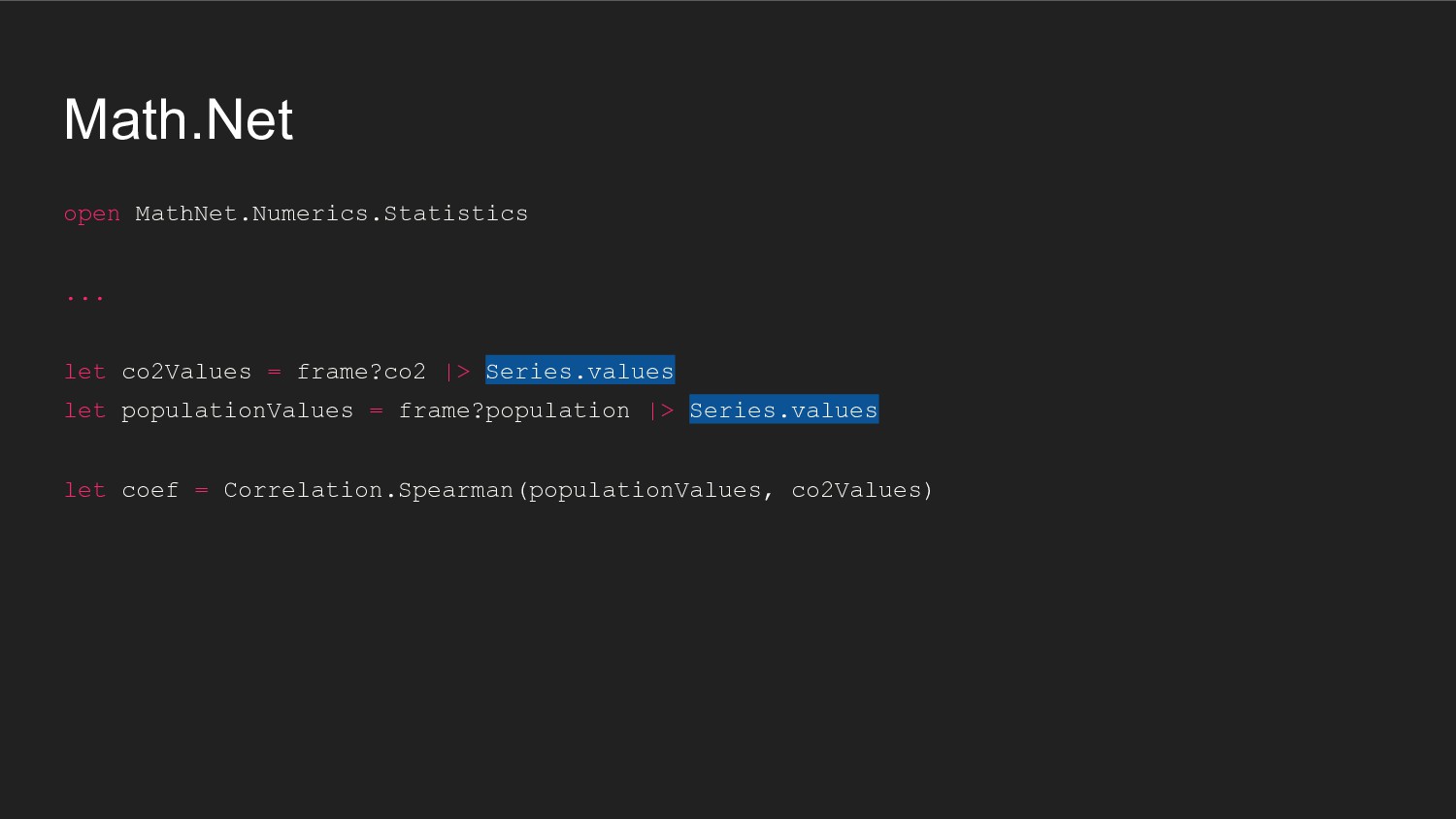
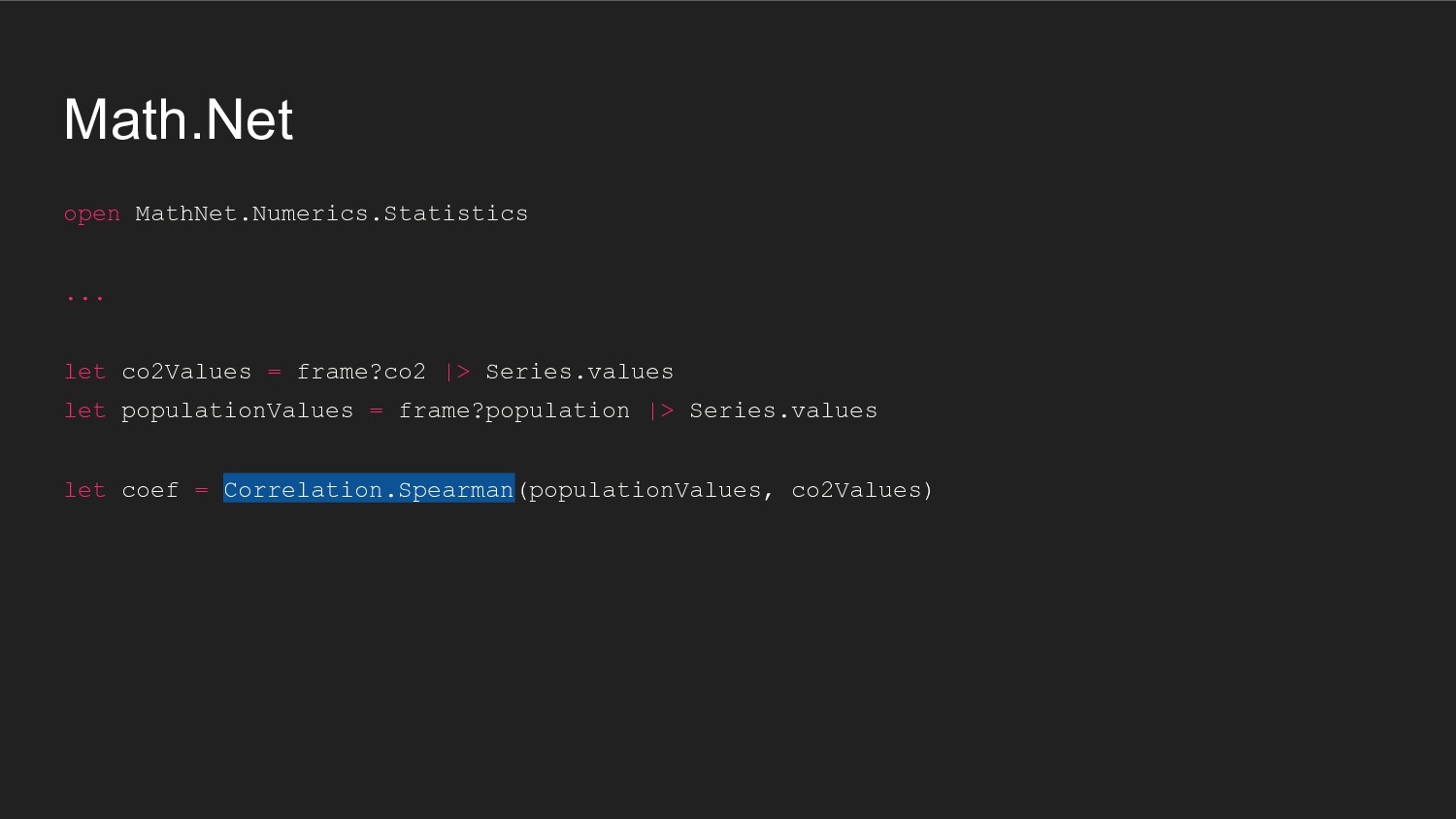
Math.Net open MathNet.Numerics.Statistics ... let co2Values = frame?co2 |> Series.values
let populationValues = frame?population |> Series.values let coef = Correlation.Spearman(populationValues, co2Values) -
Math.Net open MathNet.Numerics.Statistics ... let co2Values = frame?co2 |> Series.values
let populationValues = frame?population |> Series.values let coef = Correlation.Spearman(populationValues, co2Values) -
Math.Net open MathNet.Numerics.Statistics ... let co2Values = frame?co2 |> Series.values
let populationValues = frame?population |> Series.values let coef = Correlation.Spearman(populationValues, co2Values) -
Math.Net open MathNet.Numerics.Statistics ... let co2Values = frame?co2 |> Series.values
let populationValues = frame?population |> Series.values let coef = Correlation.Spearman(populationValues, co2Values) ?> -0.2756916996 -
3 манипулирование данными - repl & ( ) - Deedle
- Math.Net - R Provider -
R Provider - удобно получать и обрабатывать данные с f#
- удобно делать расчеты и визуализацию с R -
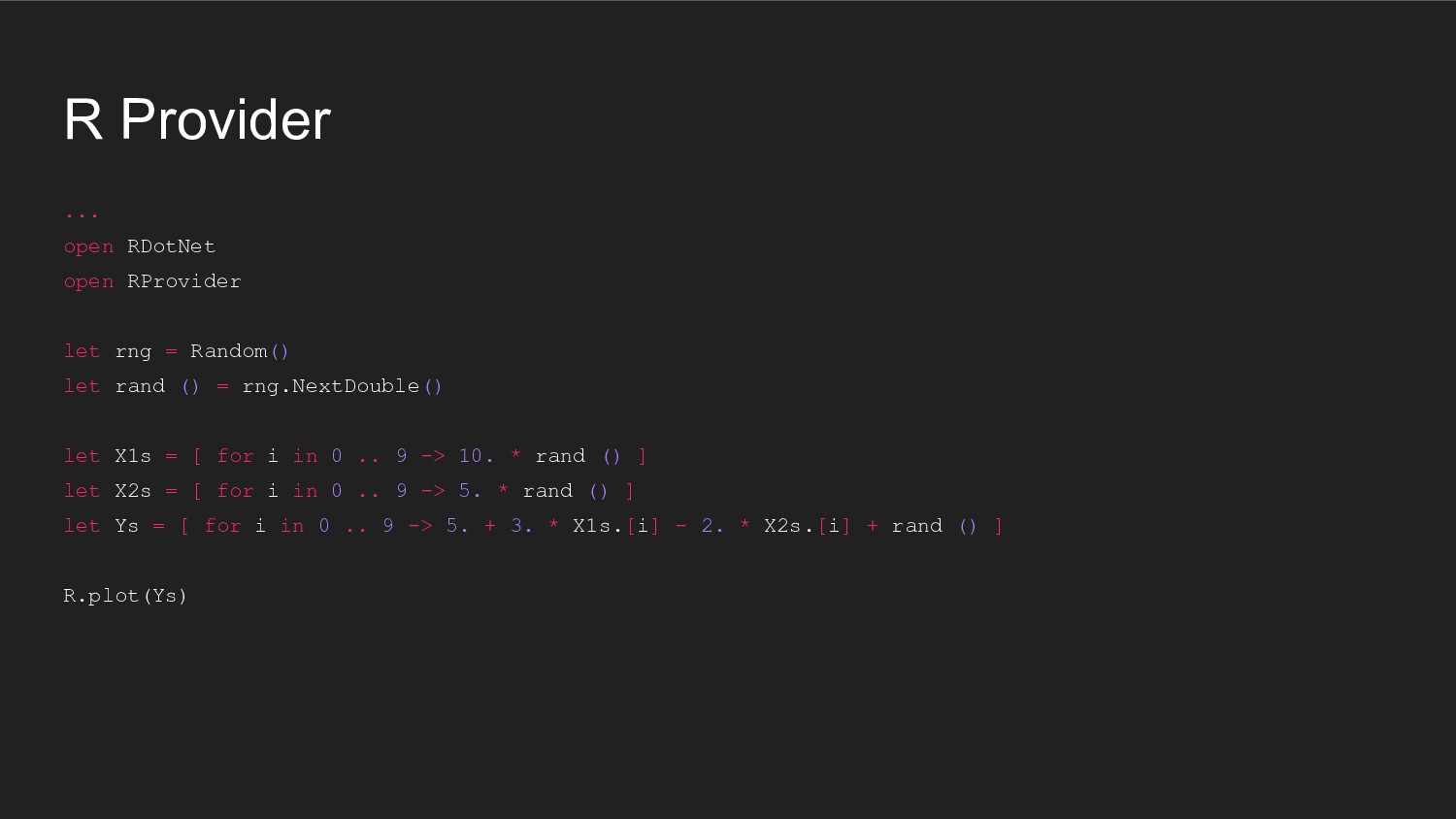
R Provider ... open RDotNet open RProvider let rng =
Random() let rand () = rng.NextDouble() let X1s = [ for i in 0 .. 9 -> 10. * rand () ] let X2s = [ for i in 0 .. 9 -> 5. * rand () ] let Ys = [ for i in 0 .. 9 -> 5. + 3. * X1s.[i] - 2. * X2s.[i] + rand () ] R.plot(Ys) -
R Provider ... open RDotNet open RProvider let rng =
Random() let rand () = rng.NextDouble() let X1s = [ for i in 0 .. 9 -> 10. * rand () ] let X2s = [ for i in 0 .. 9 -> 5. * rand () ] let Ys = [ for i in 0 .. 9 -> 5. + 3. * X1s.[i] - 2. * X2s.[i] + rand () ] R.plot(Ys) -
R Provider ... open RDotNet open RProvider let rng =
Random() let rand () = rng.NextDouble() let X1s = [ for i in 0 .. 9 -> 10. * rand () ] let X2s = [ for i in 0 .. 9 -> 5. * rand () ] let Ys = [ for i in 0 .. 9 -> 5. + 3. * X1s.[i] - 2. * X2s.[i] + rand () ] R.plot(Ys) -
R Provider ... open RDotNet open RProvider let rng =
Random() let rand () = rng.NextDouble() let X1s = [ for i in 0 .. 9 -> 10. * rand () ] let X2s = [ for i in 0 .. 9 -> 5. * rand () ] let Ys = [ for i in 0 .. 9 -> 5. + 3. * X1s.[i] - 2. * X2s.[i] + rand () ] R.plot(Ys) -
R Provider ... let ds = namedParams ["Y", box Ys;"X1",
box X1s;"X2", box X2s;] |> R.data_frame let result = R.lm(formula = "Y~X1+X2", data = ds) -
R Provider ... let ds = namedParams ["Y", box Ys;"X1",
box X1s;"X2", box X2s;] |> R.data_frame let result = R.lm(formula = "Y~X1+X2", data = ds) -
R Provider ... let ds = namedParams ["Y", box Ys;"X1",
box X1s;"X2", box X2s;] |> R.data_frame let result = R.lm(formula = "Y~X1+X2", data = ds) -
R Provider ... let ds = namedParams ["Y", box Ys;"X1",
box X1s;"X2", box X2s;] |> R.data_frame let result = R.lm(formula = "Y~X1+X2", data = ds) ?> Coefficients: (Intercept) X1 X2 5.444 2.988 -1.926 -
R Provider ... let Ys = [ for i in
0 .. 9 -> 5. + 3. * X1s.[i] - 2. * X2s.[i] + rand () ] ... ?> Coefficients: (Intercept) X1 X2 5.444 2.988 -1.926 -
3 манипулирование данными - repl & ( ) - Deedle
- Math.Net - R Provider - {m}brace -
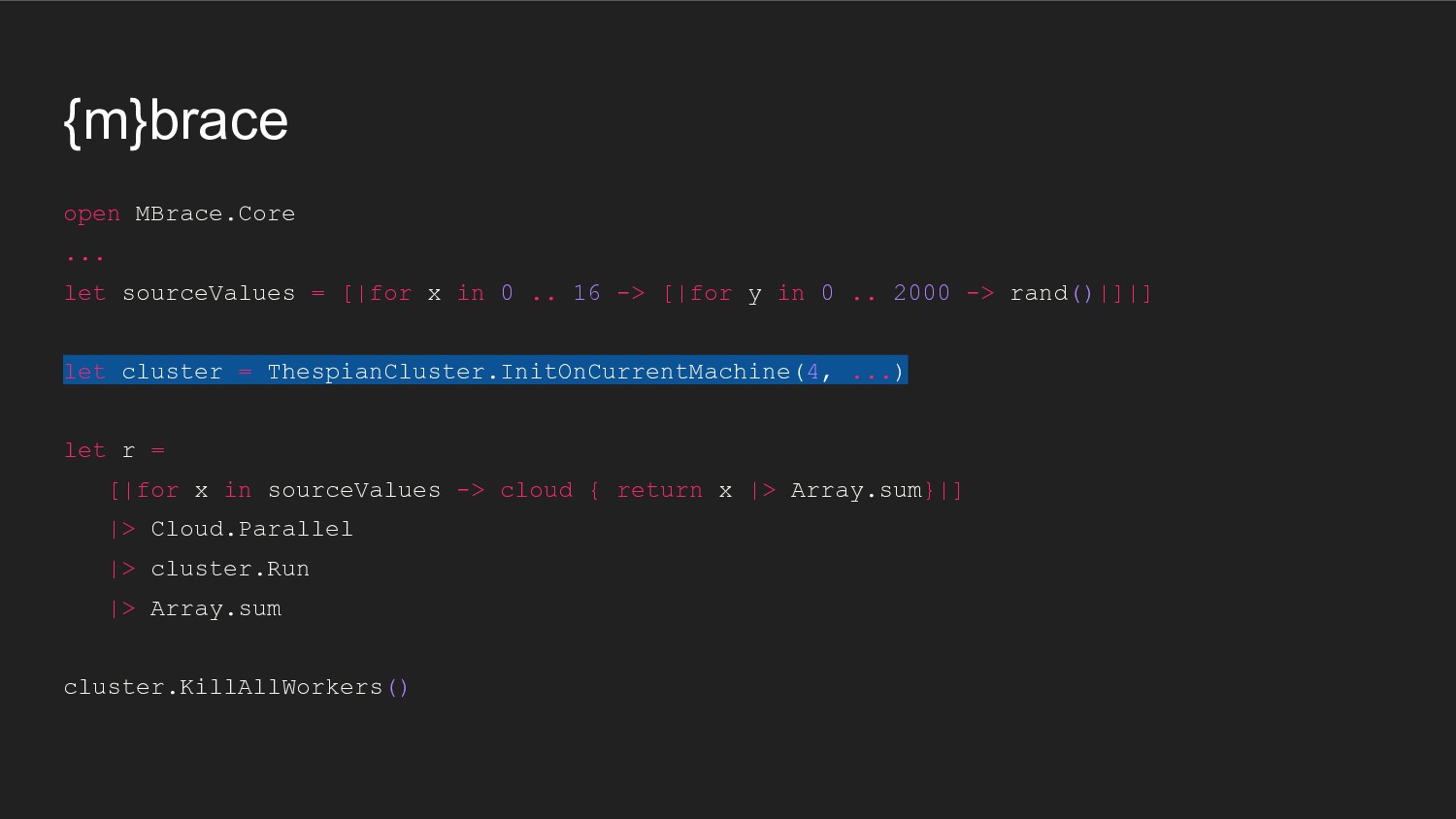
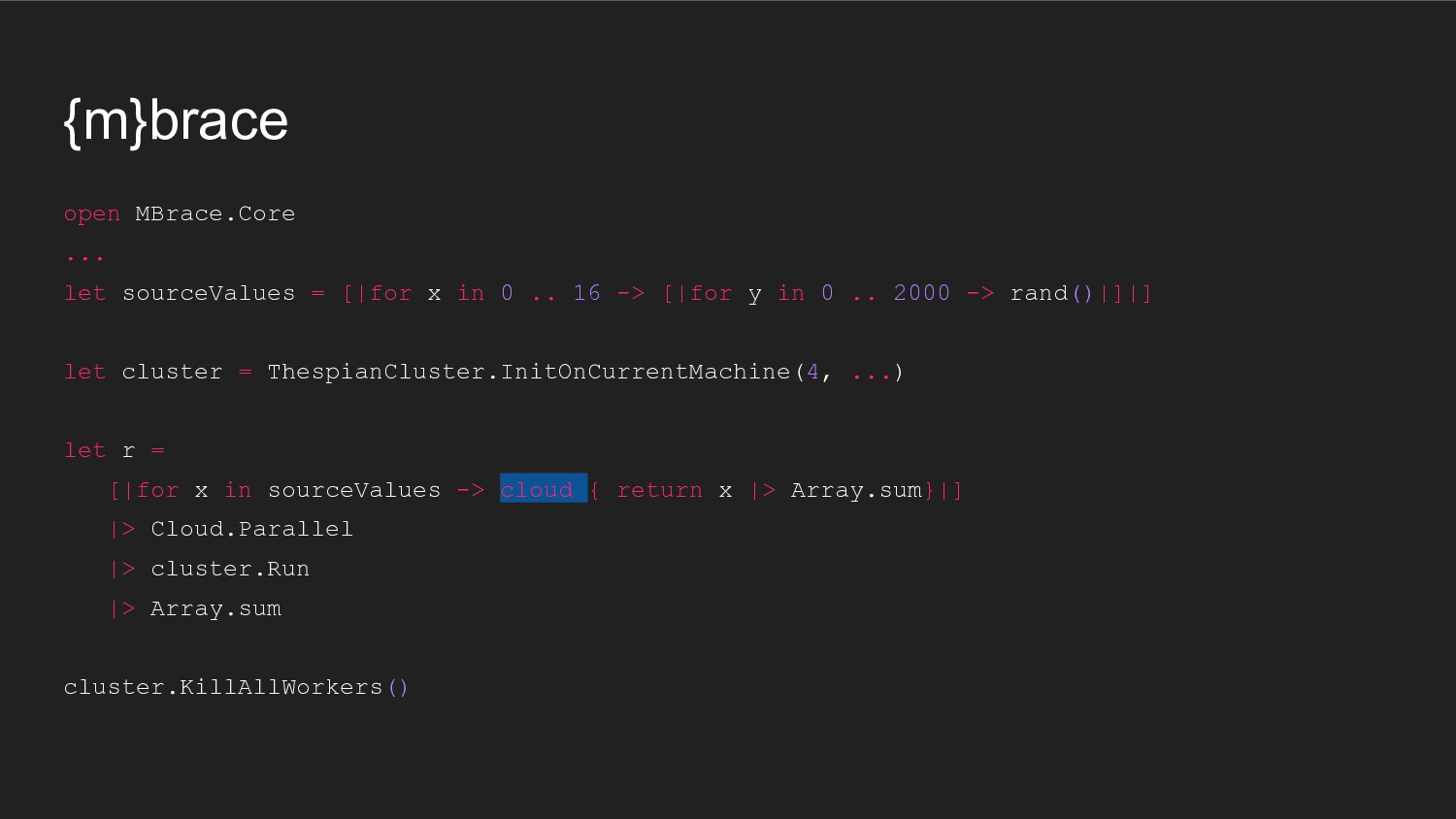
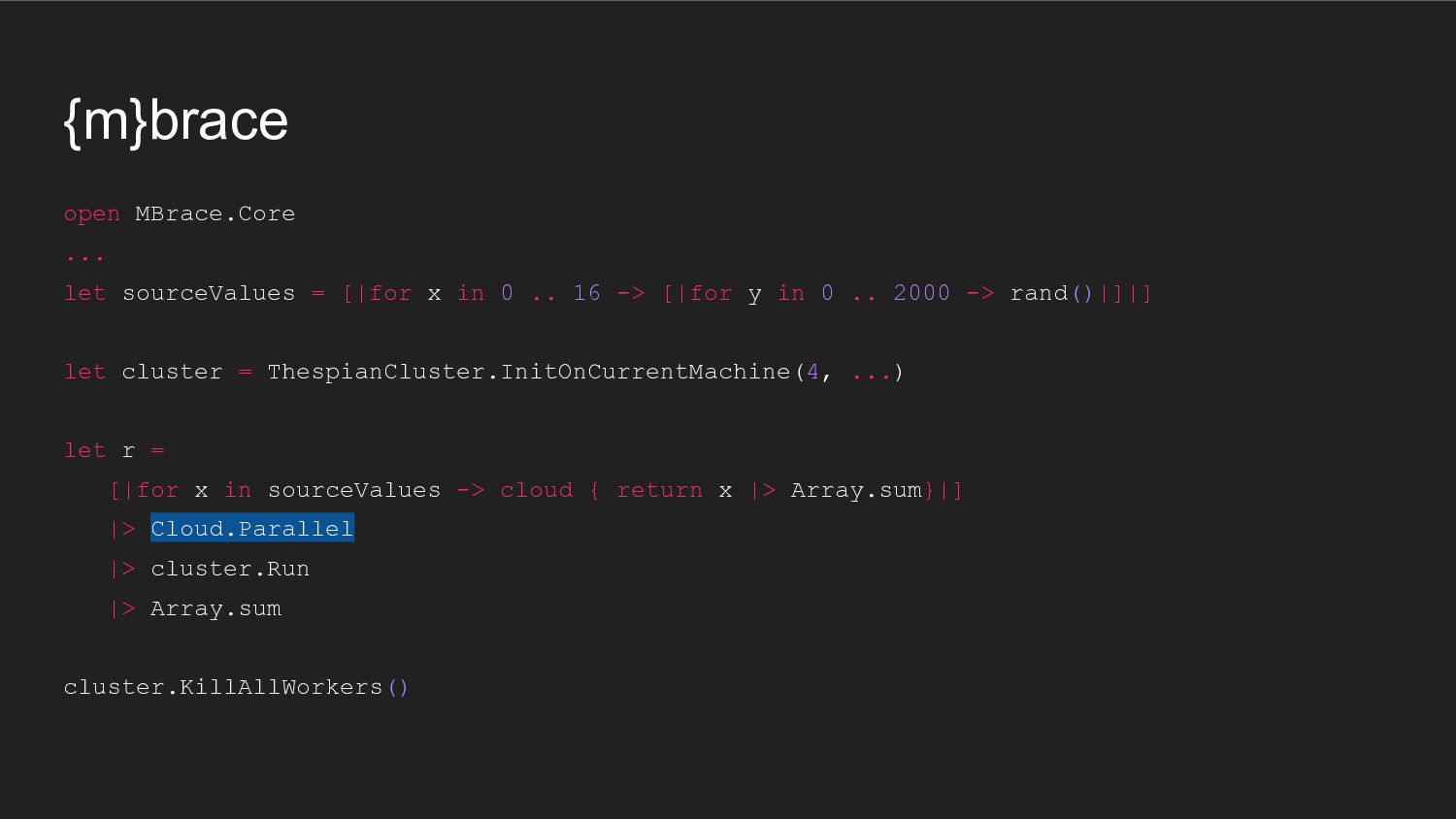
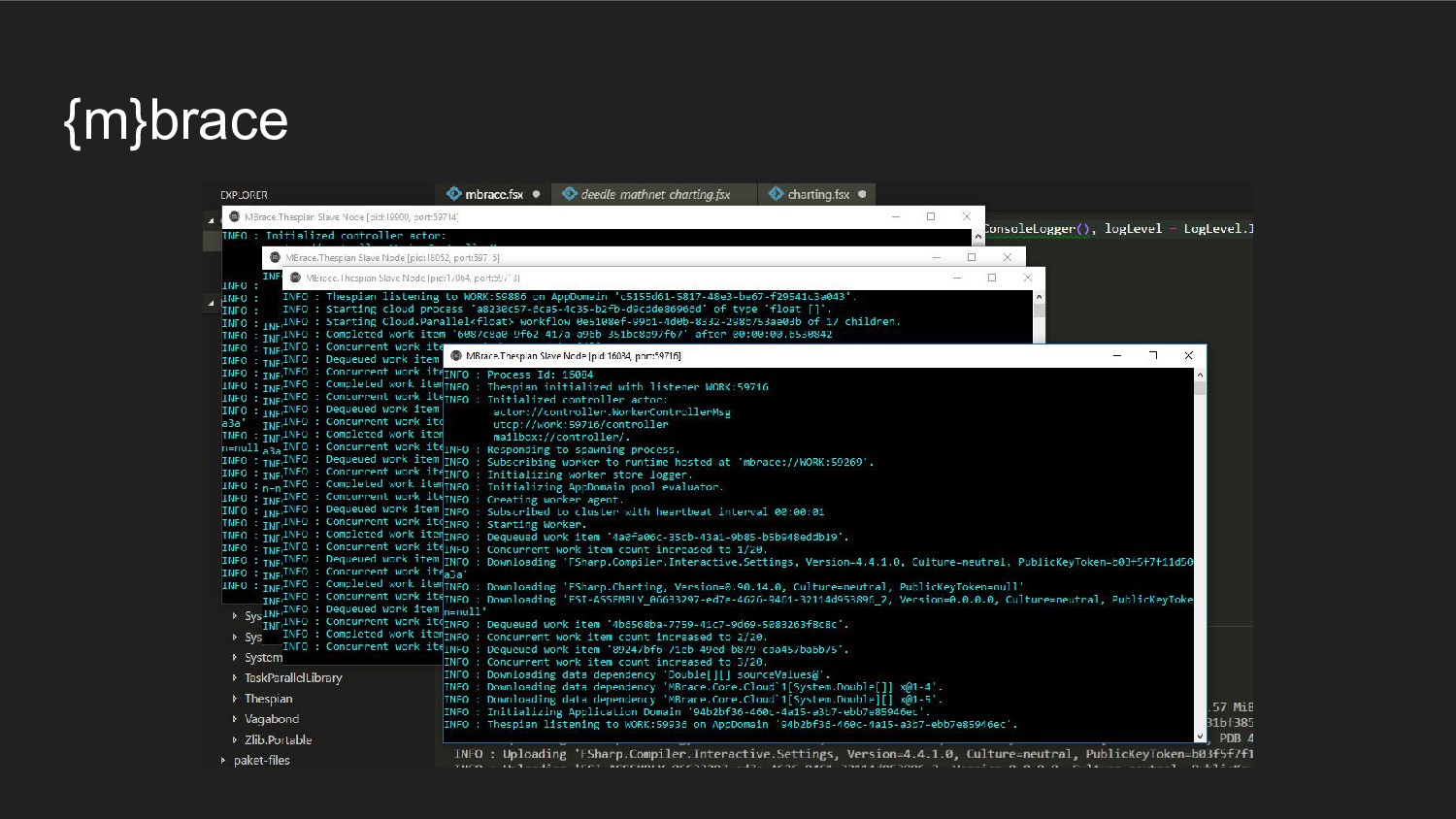
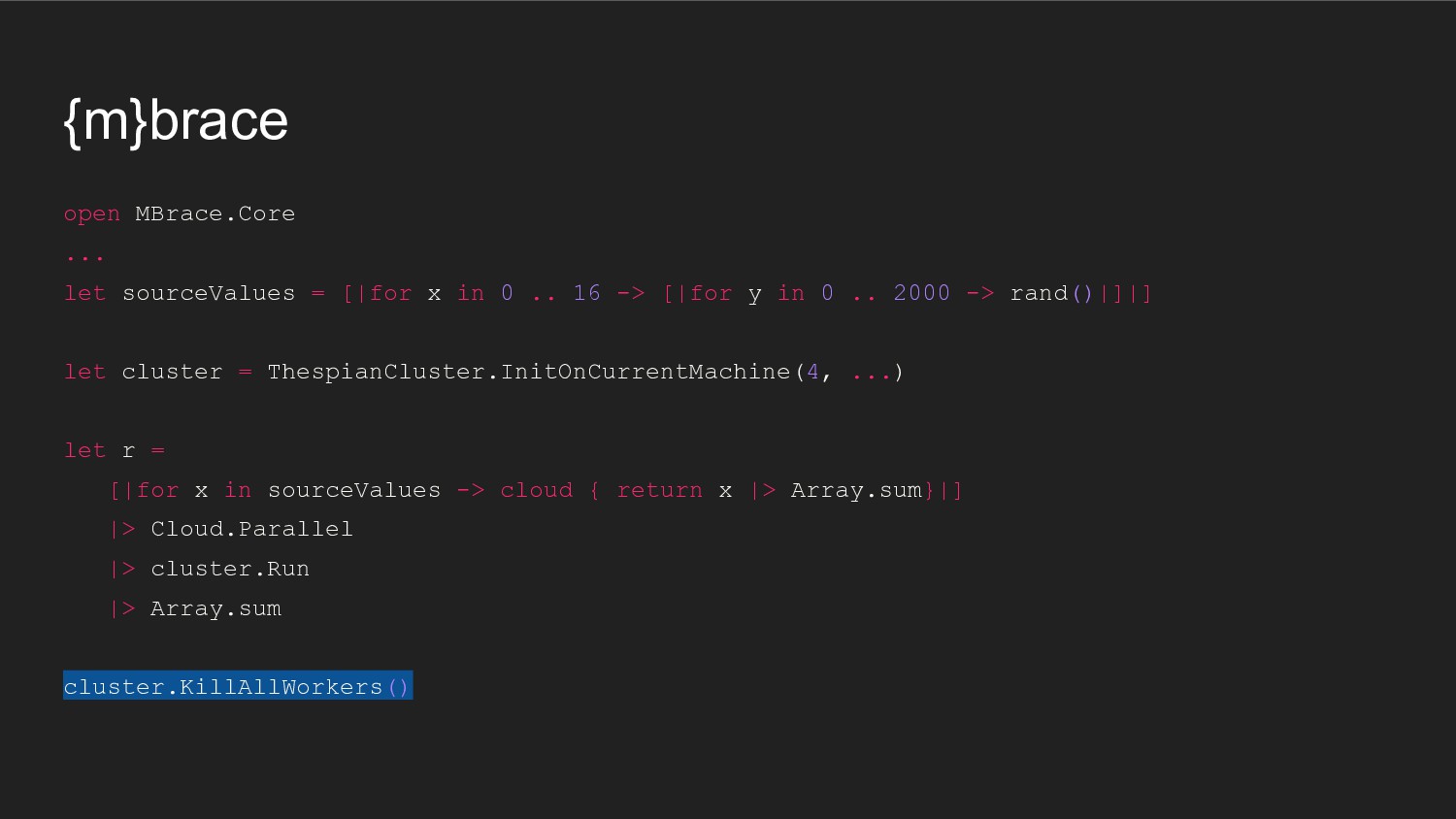
{m}brace open MBrace.Core ... let sourceValues = [|for x in
0 .. 16 -> [|for y in 0 .. 2000 -> rand()|]|] let cluster = ThespianCluster.InitOnCurrentMachine(4, ...) let r = [|for x in sourceValues -> cloud { return x |> Array.sum}|] |> Cloud.Parallel |> cluster.Run |> Array.sum cluster.KillAllWorkers() -
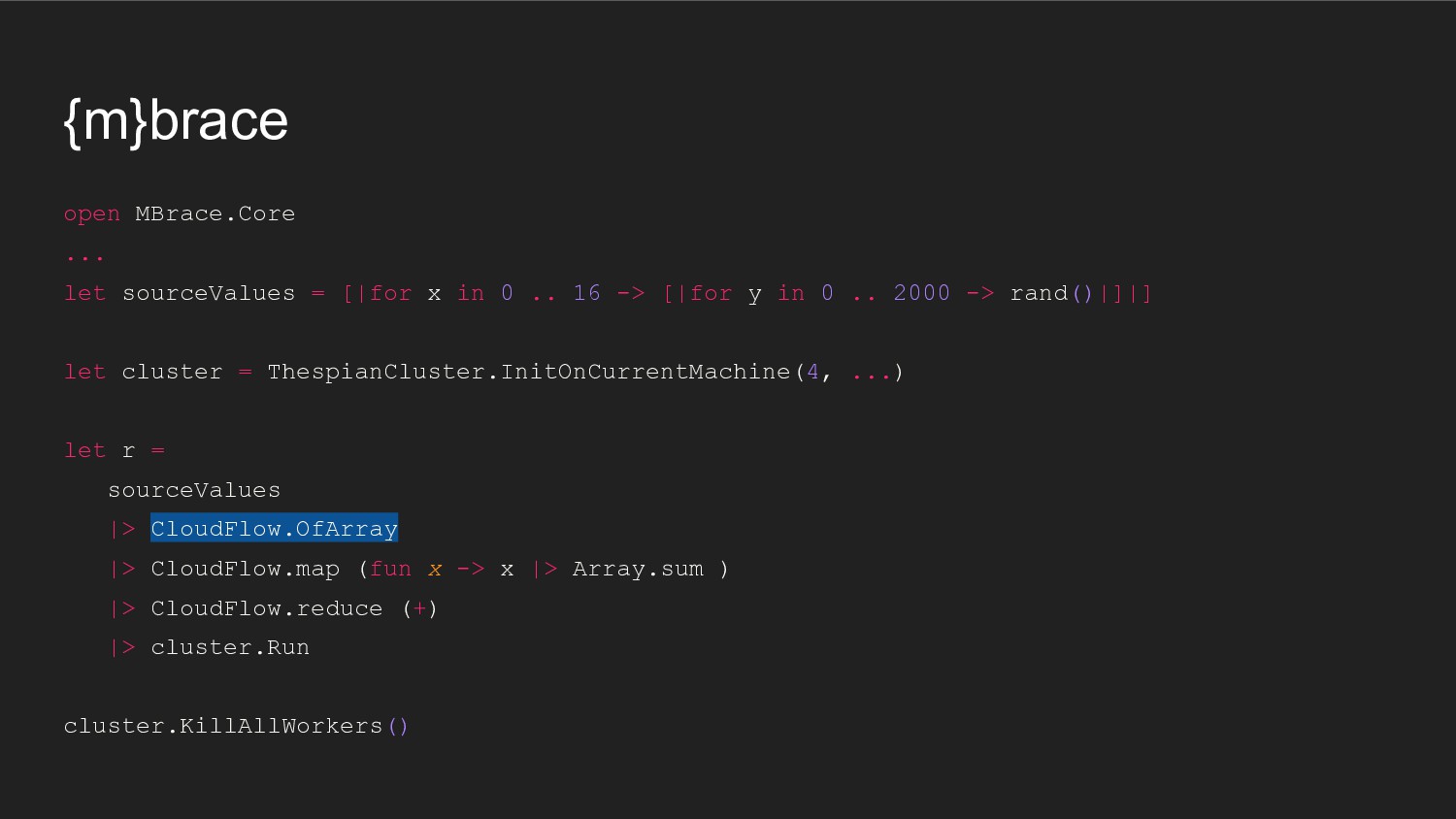
{m}brace open MBrace.Core ... let sourceValues = [|for x in
0 .. 16 -> [|for y in 0 .. 2000 -> rand()|]|] let cluster = ThespianCluster.InitOnCurrentMachine(4, ...) let r = sourceValues |> CloudFlow.OfArray |> CloudFlow.map (fun x -> x |> Array.sum ) |> CloudFlow.reduce (+) |> cluster.Run cluster.KillAllWorkers() -
3 манипулирование данными - repl & ( ) - Deedle
- Math.Net - R Provider - {m}brace -
3 манипулирование данными - repl & ( ) - Deedle
- Math.Net - R Provider - {m}brace - Accord.Net Framework - numl - encog - Hype - ML от MS - AForge.Net - ... -
почитать - http://fsharp.org/ - https://fslab.org/ - http://fsharp.github.io/FSharp.Data/ - http://bluemountaincapital.github.io/Deedle/ -
http://bluemountaincapital.github.io/FSharpRProvider/ - https://numerics.mathdotnet.com/ - https://tahahachana.github.io/XPlot/ - https://fslab.org/FSharp.Charting/ - http://accord-framework.net - http://numl.net/