Copyright 2014 EMC Corporation. All rights reserved. Module: Introduction to Information Storage Upon completion of this module, you should be able to: • Define data and information • Describe types of data • Describe the evolution of storage architecture • Describe the core elements of a data center • List the key characteristics of a data center • Provide an overview of virtualization and cloud computing Module: Introduction to Information Storage
Copyright 2014 EMC Corporation. All rights reserved. Why Information Storage and Management? • Information is the knowledge derived from data • Growth of digital information has resulted in information explosion • We live in an on-command, on-demand world – We need information when and where required • Increasing dependency on fast and reliable access to information • Businesses seek to store, protect, optimize, and leverage the information – To gain competitive advantage – To derive new business opportunity Module: Introduction to Information Storage
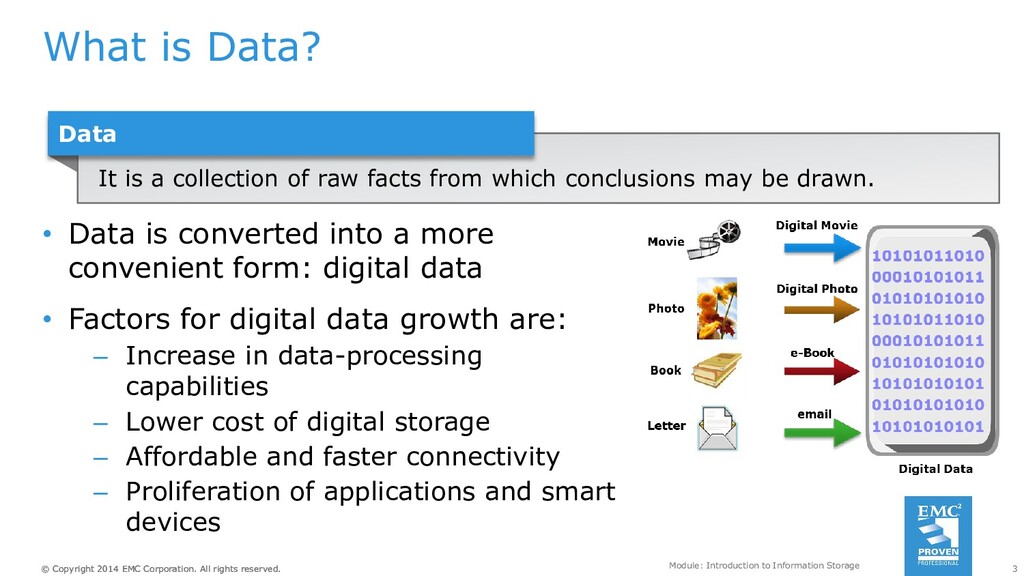
Copyright 2014 EMC Corporation. All rights reserved. What is Data? • Data is converted into a more convenient form: digital data • Factors for digital data growth are: – Increase in data-processing capabilities – Lower cost of digital storage – Affordable and faster connectivity – Proliferation of applications and smart devices Module: Introduction to Information Storage It is a collection of raw facts from which conclusions may be drawn. Data
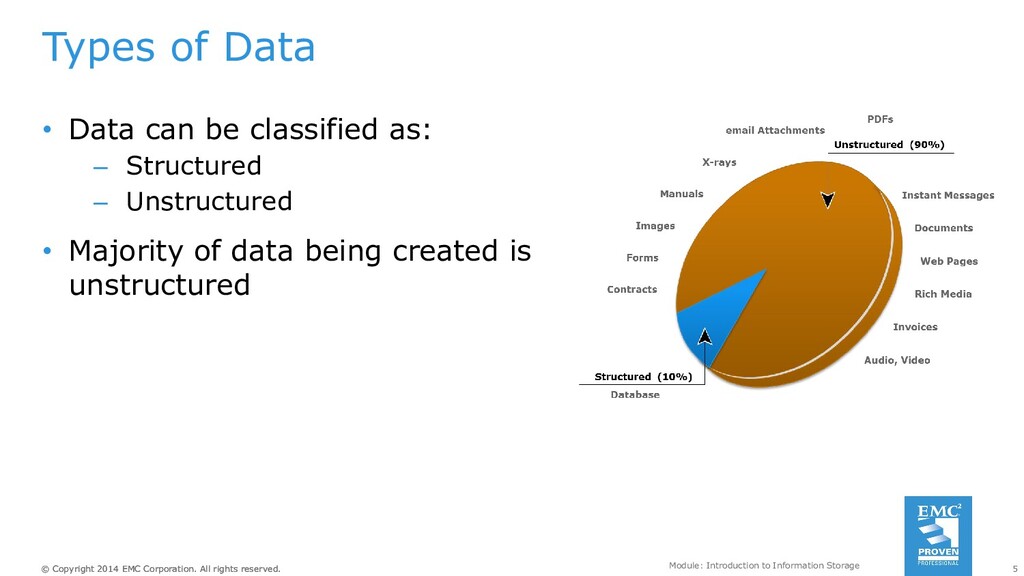
Copyright 2014 EMC Corporation. All rights reserved. Types of Data • Data can be classified as: – Structured – Unstructured • Majority of data being created is unstructured Module: Introduction to Information Storage
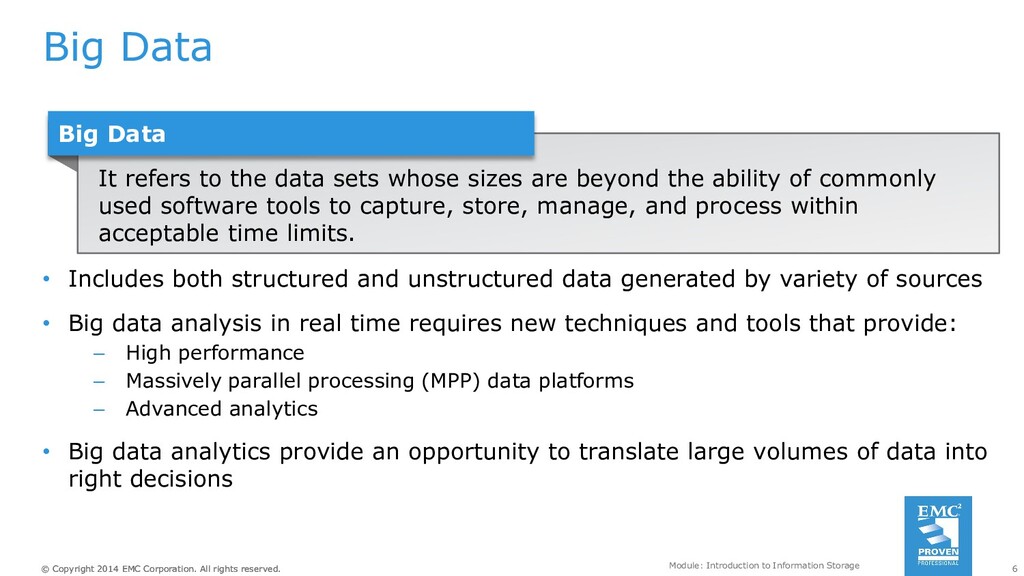
Copyright 2014 EMC Corporation. All rights reserved. Big Data • Includes both structured and unstructured data generated by variety of sources • Big data analysis in real time requires new techniques and tools that provide: – High performance – Massively parallel processing (MPP) data platforms – Advanced analytics • Big data analytics provide an opportunity to translate large volumes of data into right decisions Module: Introduction to Information Storage It refers to the data sets whose sizes are beyond the ability of commonly used software tools to capture, store, manage, and process within acceptable time limits. Big Data
Copyright 2014 EMC Corporation. All rights reserved. Storage • Stores data created by individuals and organizations – Provides access to data for further processing • Examples of storage devices are: – Media card in a cell phone or digital camera – DVDs, CD-ROMs – Disk drives – Disk arrays – Tapes Module: Introduction to Information Storage
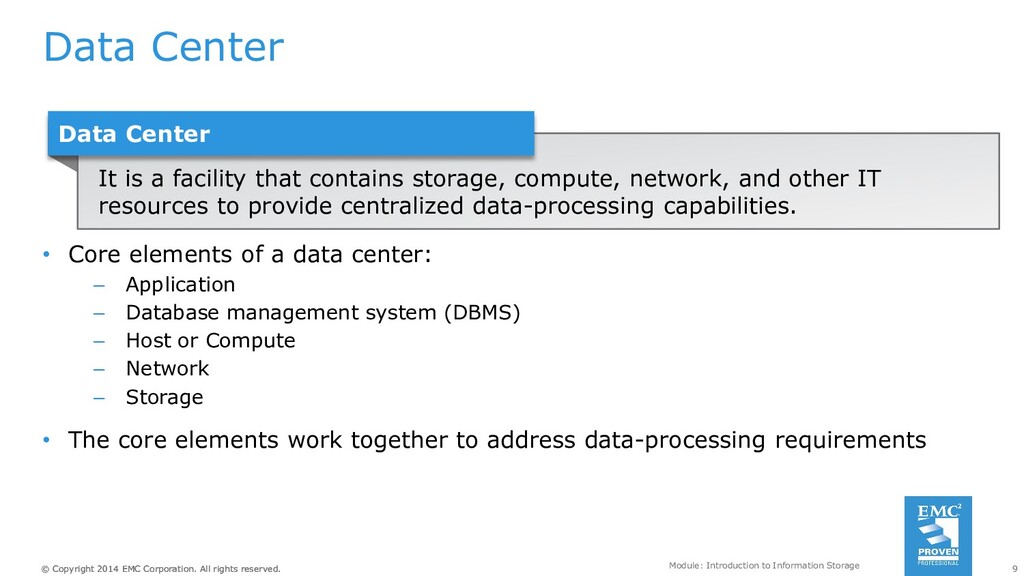
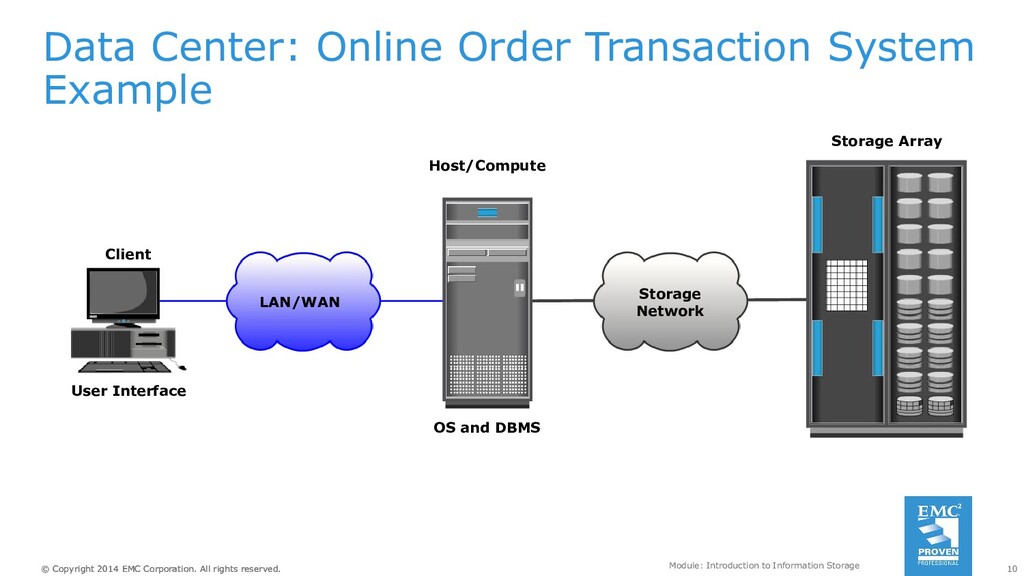
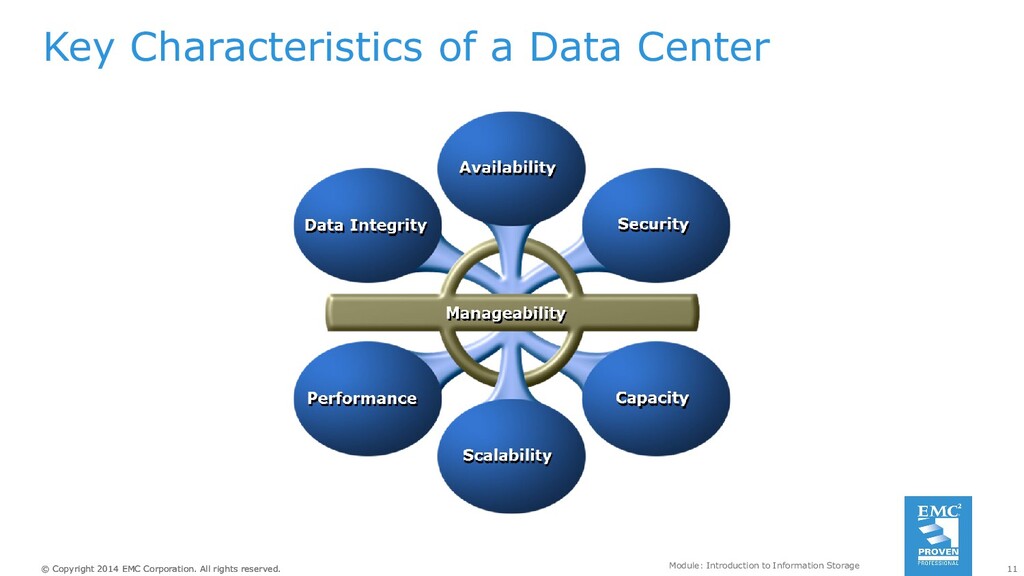
Copyright 2014 EMC Corporation. All rights reserved. Data Center • Core elements of a data center: – Application – Database management system (DBMS) – Host or Compute – Network – Storage • The core elements work together to address data-processing requirements Module: Introduction to Information Storage It is a facility that contains storage, compute, network, and other IT resources to provide centralized data-processing capabilities. Data Center
Copyright 2014 EMC Corporation. All rights reserved. Data Center: Online Order Transaction System Example Module: Introduction to Information Storage LAN/WAN Storage Network Client User Interface Host/Compute OS and DBMS Storage Array
Copyright 2014 EMC Corporation. All rights reserved. Managing Data Center • Key management activities include – Monitoring • Continuous process of gathering information on various elements and services running in a data center – Reporting • Details on resource performance, capacity, and utilization – Provisioning • Configuration and allocation of resources to meet the capacity, availability, performance, and security requirements • Virtualization and cloud computing have changed the way data center infrastructure resources are provisioned and managed Module: Introduction to Information Storage
Copyright 2014 EMC Corporation. All rights reserved. Virtualization: An Overview • Virtualization is a technique of abstracting physical resources and making them appear as logical resources – For example partitioning of raw disks • Pools physical resources and provides an aggregated view of physical resource capabilities • Virtual resources can be created from pooled physical resources – Improves utilization of physical IT resources Module: Introduction to Information Storage
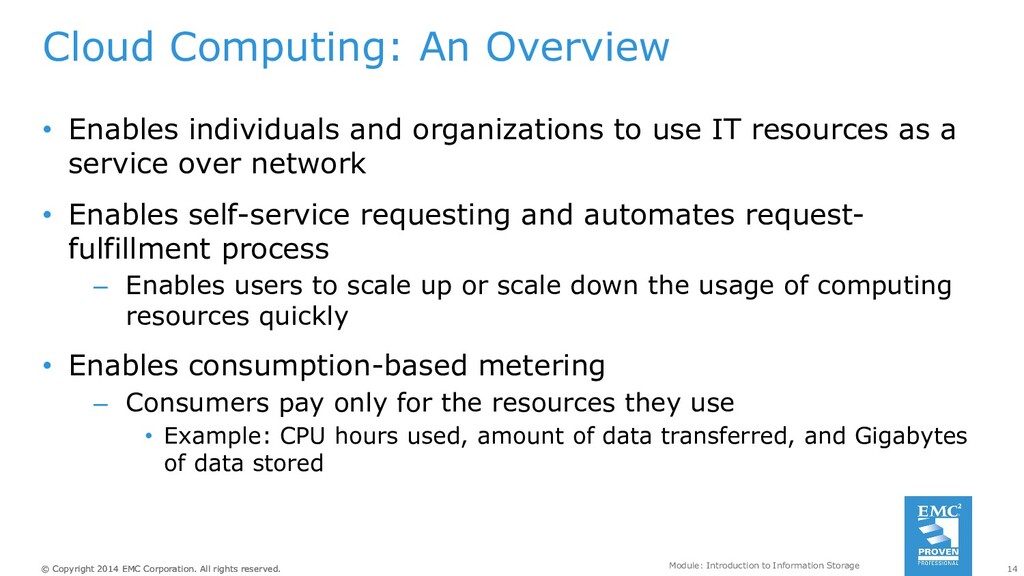
Copyright 2014 EMC Corporation. All rights reserved. Cloud Computing: An Overview • Enables individuals and organizations to use IT resources as a service over network • Enables self-service requesting and automates request- fulfillment process – Enables users to scale up or scale down the usage of computing resources quickly • Enables consumption-based metering – Consumers pay only for the resources they use • Example: CPU hours used, amount of data transferred, and Gigabytes of data stored Module: Introduction to Information Storage
Copyright 2014 EMC Corporation. All rights reserved. Module Summary Key points covered in this module: • Data and information • Types of data • Big data • Evolution of storage architecture • Core elements of data center • Key characteristics of data center • Virtualization and cloud computing Module: Introduction to Information Storage


 y0hgi
 kworkdev
 shogo4131
 codmoninc
 recruitengineers
 namiki64
 gogutan
 pfn
 jtakeda
 rfdnxbro
 stomk
 maimyyym
 konakalab
 malarkey
 lara
 sachag
 lemiorhan
 samtorres
 bluesmoon
 thirion
 eitanlees
 nwiizo
 mayunak
 jacobtomlinson