Upgrade to Pro — share decks privately, control downloads, hide ads and more …

Flexible PCB for beginners

Sponsored · Your Podcast. Everywhere. Effortlessly. Share. Educate. Inspire. Entertain. You do you. We'll handle the rest. →
Avatar for Elephantech Inc. Elephantech Inc.
June 14, 2018
25

Flexible PCB for beginners

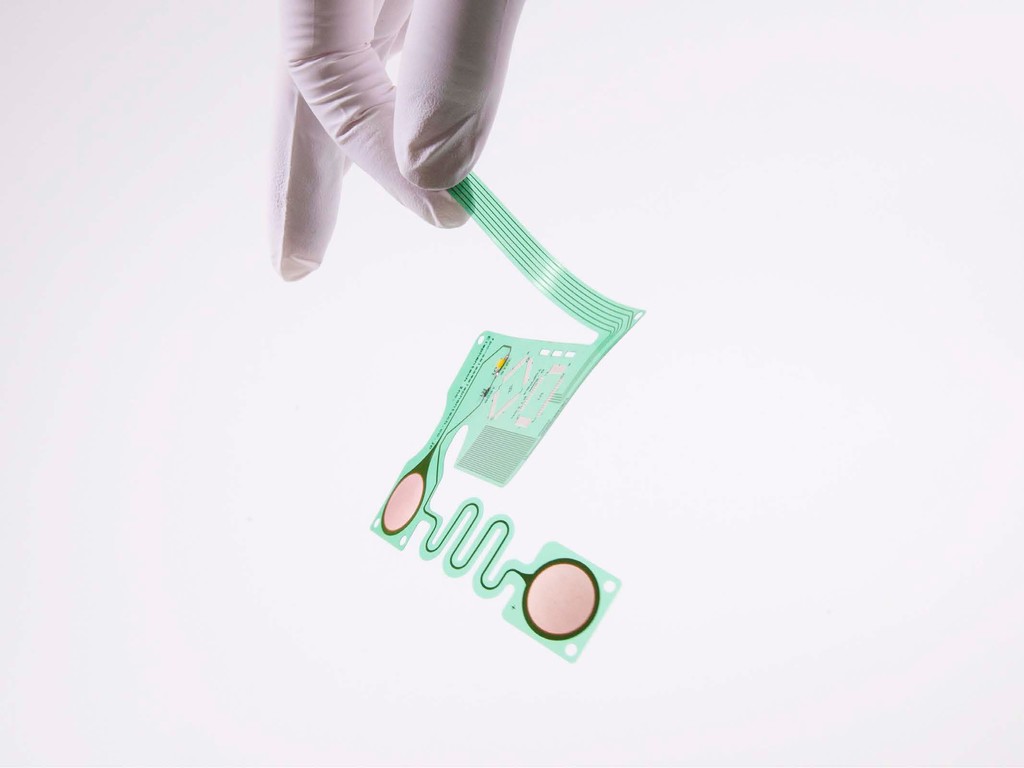
Introduces flex PCB for those who have never used flex PCB.

Its contents range from basic knowledge to case studies or tips of board design. While this presentation features P-Flex™️, the flexible PCB manufactured with ink-jet printing by Elephantech, the contents are written for all flexible PCB users.

Avatar for Elephantech Inc.

Elephantech Inc.

June 14, 2018

Transcript

  1. The purpose of this slide By the end of this

    slide, you will know… • how to effectively use flexible PCB • be able to "design (to a degree) a flexible PCB • To have the idea of a flexible PCB spring to mind the next time you build a PCB.
  2. This slide is addressed to: • Those who have used

    PCB before but have no experience with flexible PCB • Although this was written so that you may understand its contents without having experience in designing a PCB, we will not cover general topics such as circuit and board design.
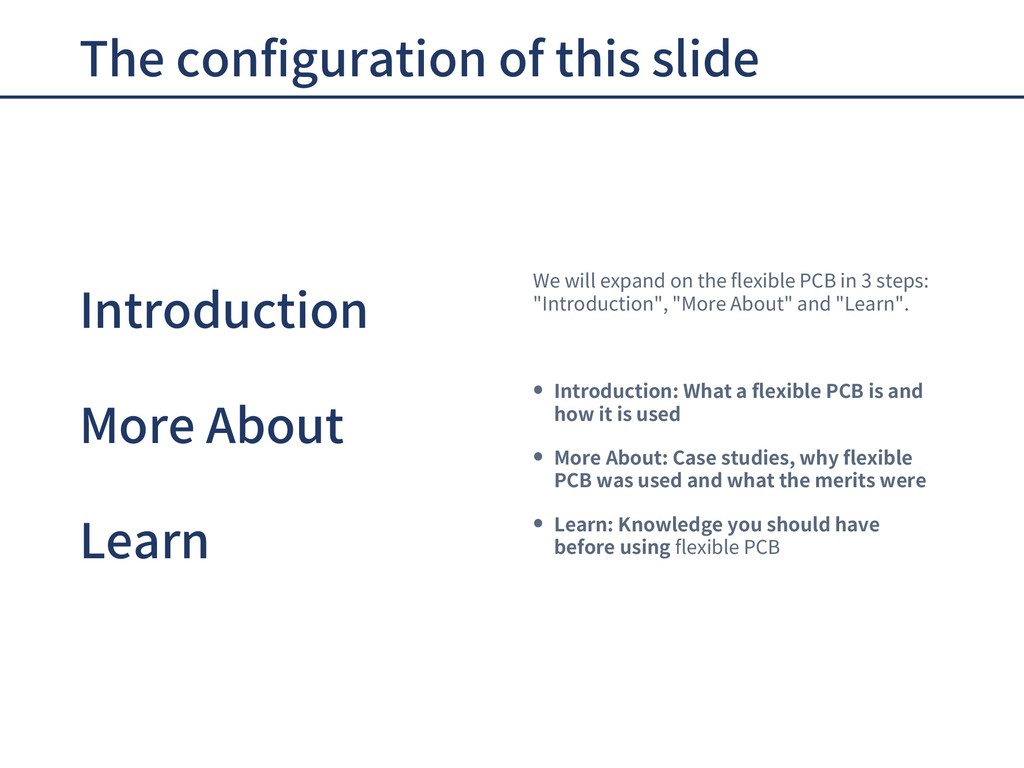
  3. The configuration of this slide We will expand on the

    flexible PCB in 3 steps: "Introduction", "More About" and "Learn". • Introduction: What a flexible PCB is and how it is used • More About: Case studies, why flexible PCB was used and what the merits were • Learn: Knowledge you should have before using flexible PCB Introduction More About Learn
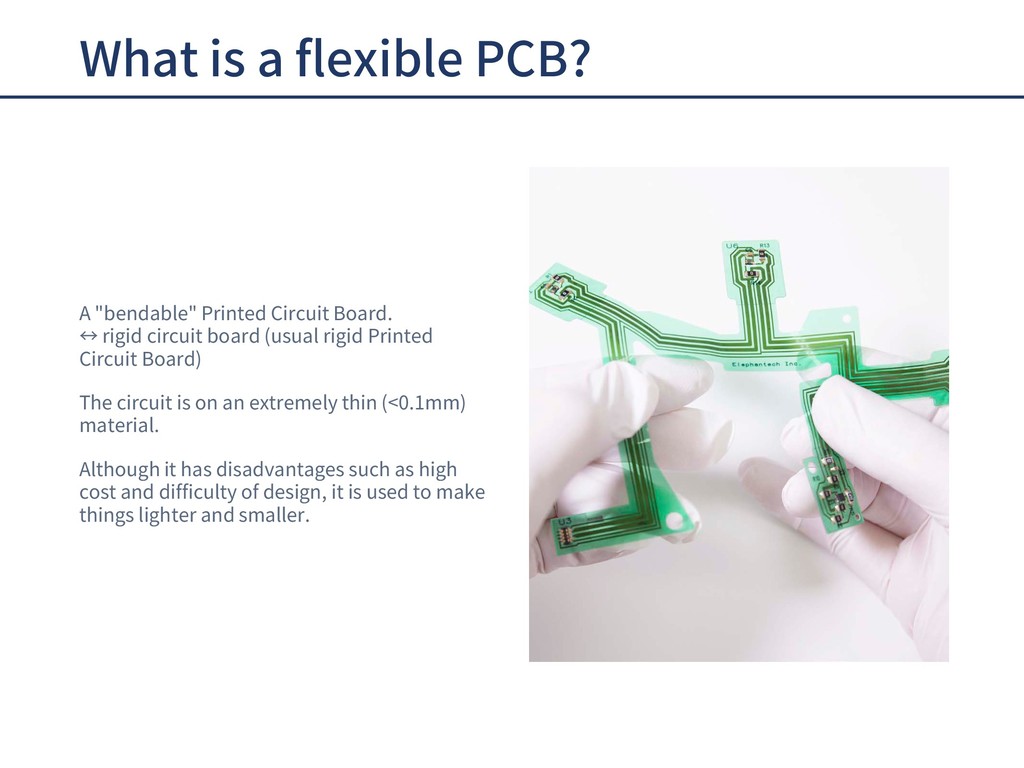
  4. What is a flexible PCB? A "bendable" Printed Circuit Board.

    ↔ rigid circuit board (usual rigid Printed Circuit Board) The circuit is on an extremely thin (<0.1mm) material. Although it has disadvantages such as high cost and difficulty of design, it is used to make things lighter and smaller.
  5. Advantages of flexible PCB The largest advantage is that it

    is "bendable". The fact that it is bendable means that not only can it be of use in moving sections but it can also be used in designing circuit boards that fit specific enclosures. It has another advantage in that it is both thiner and lighter than rigid circuit boards. We will touch on the wiring later, but its strength in simplifying the assembly process is another reason why it is adopted. ✓ Bendable, fits the enclosure ✓ Reduces size and weight ✓ Simplification of the wiring
  6. Main usages • Moving parts such as hinges and robot

    joints • Automotive wire harnesses • IoT equipment / wearable devices Because the flexible PCB also has weaknesses, it is mainly used in cases where its advantages far outweigh its disadvantages. Moving parts in machines obviously need flexibility, and the merit of weight reduction is large for automobiles and aircrafts. Recently, it has been used in IoT equipment and wearable devices to reduce bulk.
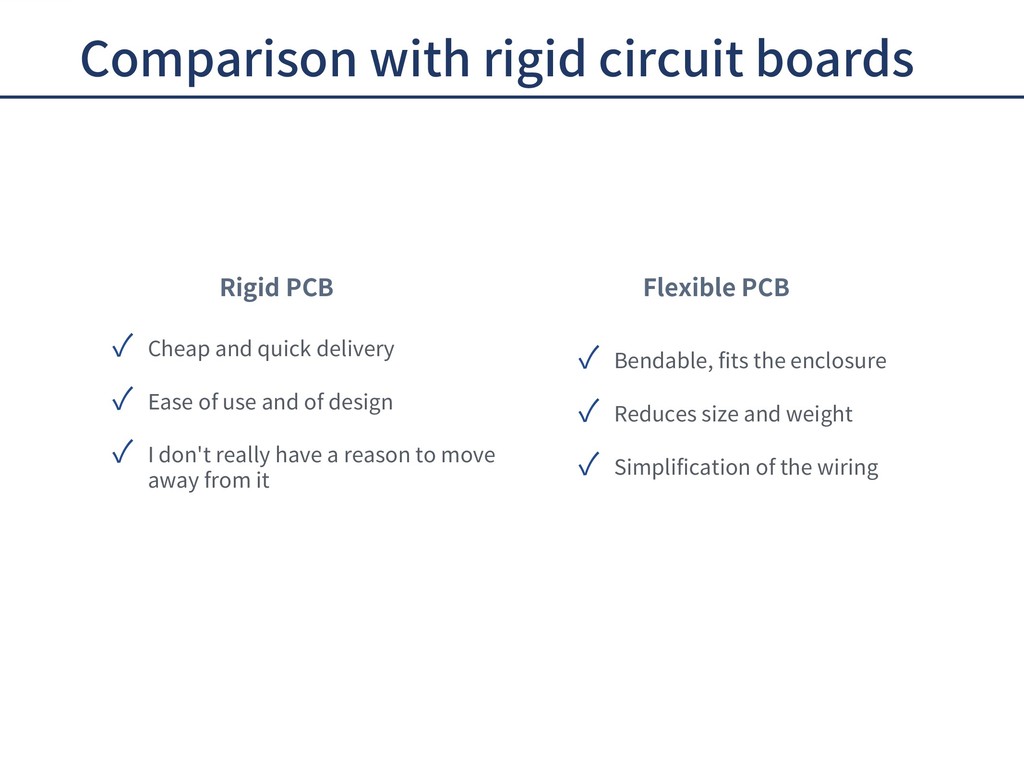
  7. Comparison with rigid circuit boards ✓ Cheap and quick delivery

    ✓ Ease of use and of design ✓ I don't really have a reason to move away from it ✓ Bendable, fits the enclosure ✓ Reduces size and weight ✓ Simplification of the wiring Rigid PCB Flexible PCB
  8. "Well, maybe Rigid PCB is just fine..." To be perfectly

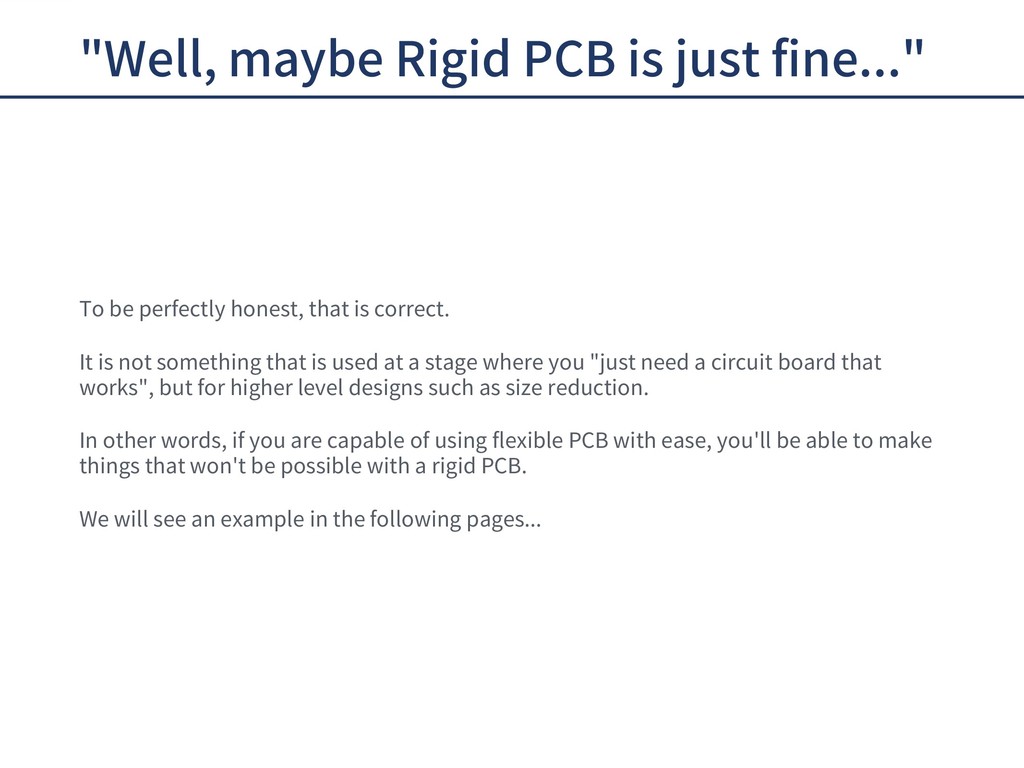
    honest, that is correct. It is not something that is used at a stage where you "just need a circuit board that works", but for higher level designs such as size reduction. In other words, if you are capable of using flexible PCB with ease, you'll be able to make things that won't be possible with a rigid PCB. We will see an example in the following pages...
  9. Case 1: Wearable device A glove type device that controls

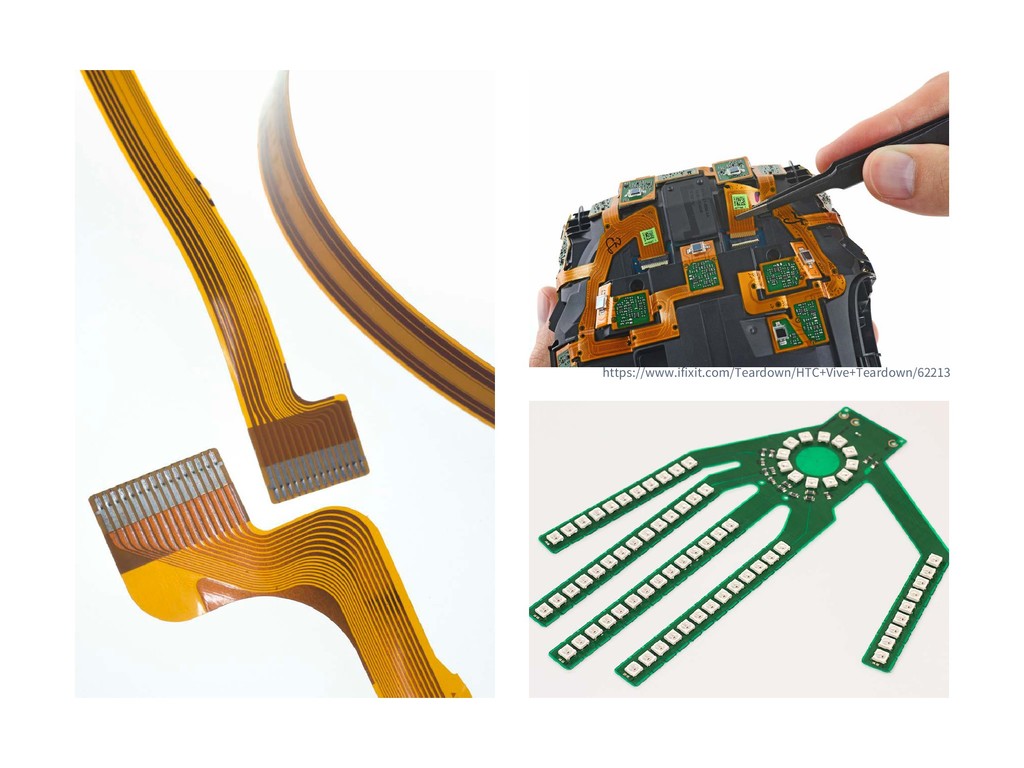
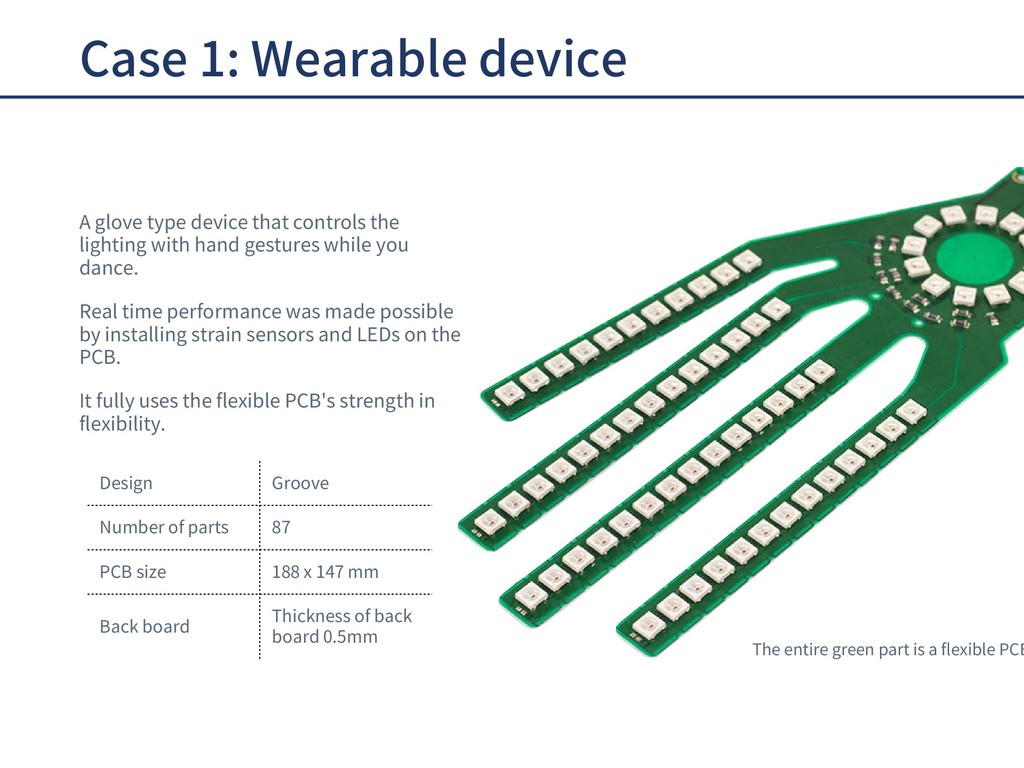
    the lighting with hand gestures while you dance. Real time performance was made possible by installing strain sensors and LEDs on the PCB. It fully uses the flexible PCB's strength in flexibility. Design Groove Number of parts 87 PCB size 188 x 147 mm Back board Thickness of back board 0.5mm The entire green part is a flexible PCB
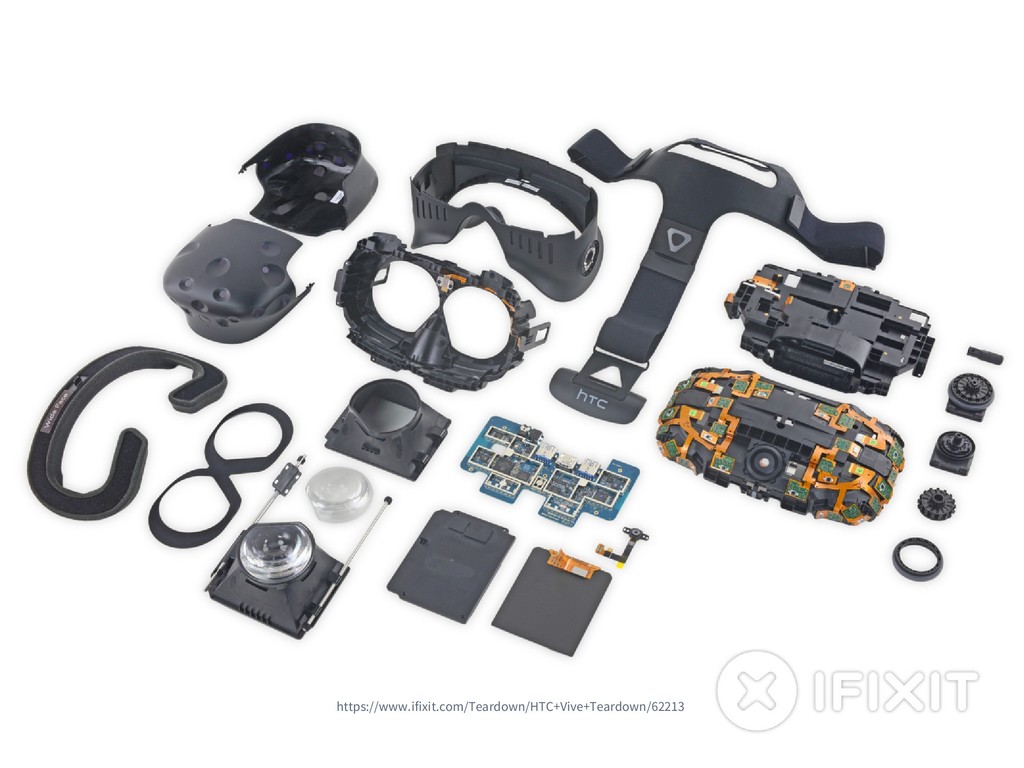
  10. Case 2: Head-mounted display A head-mounted display from HTC. These

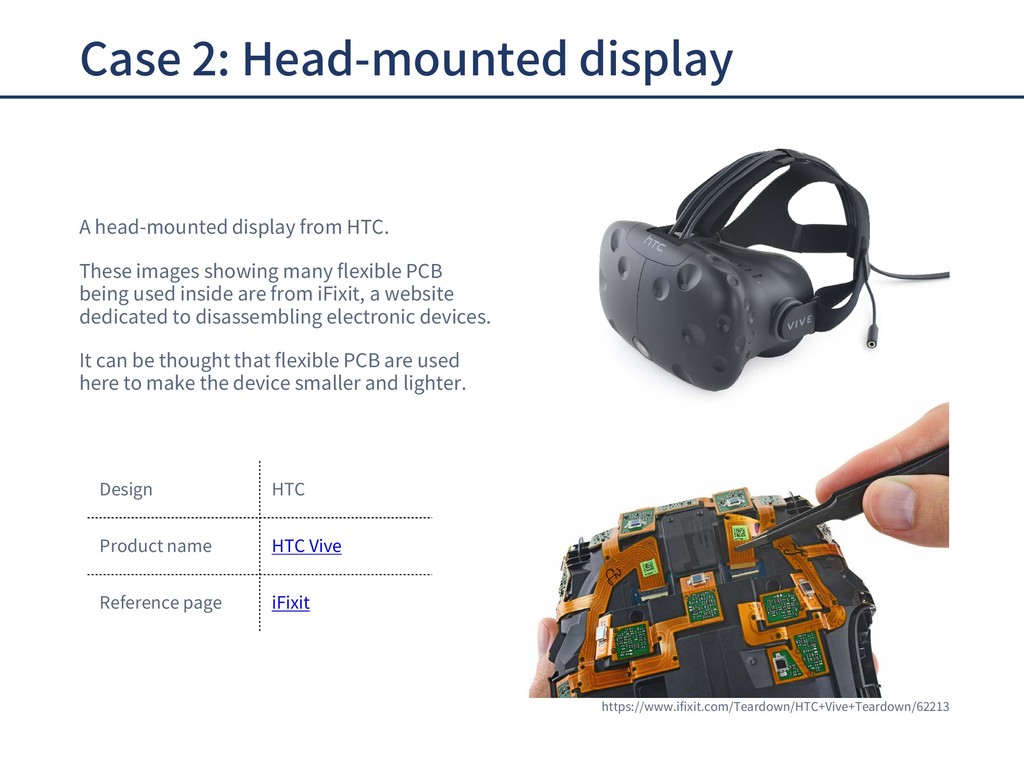
    images showing many flexible PCB being used inside are from iFixit, a website dedicated to disassembling electronic devices. It can be thought that flexible PCB are used here to make the device smaller and lighter. Design HTC Product name HTC Vive Reference page iFixit https://www.ifixit.com/Teardown/HTC+Vive+Teardown/62213
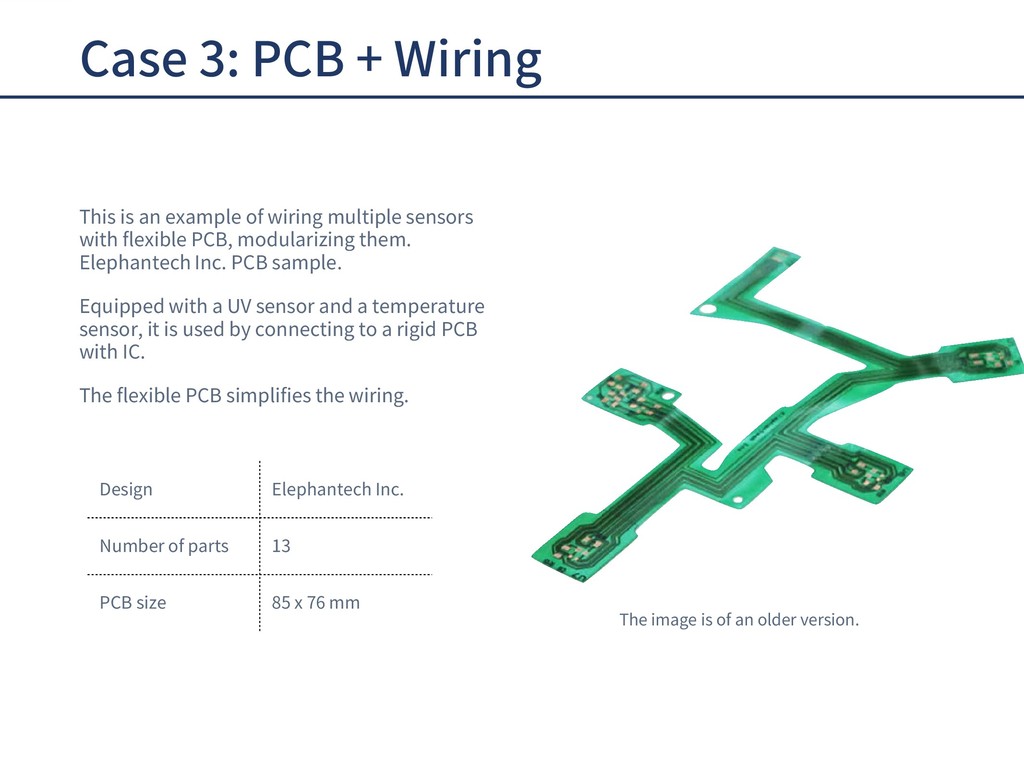
  11. Case 3: PCB + Wiring This is an example of

    wiring multiple sensors with flexible PCB, modularizing them. Elephantech Inc. PCB sample. Equipped with a UV sensor and a temperature sensor, it is used by connecting to a rigid PCB with IC. The flexible PCB simplifies the wiring. Design Elephantech Inc. Number of parts 13 PCB size 85 x 76 mm The image is of an older version.
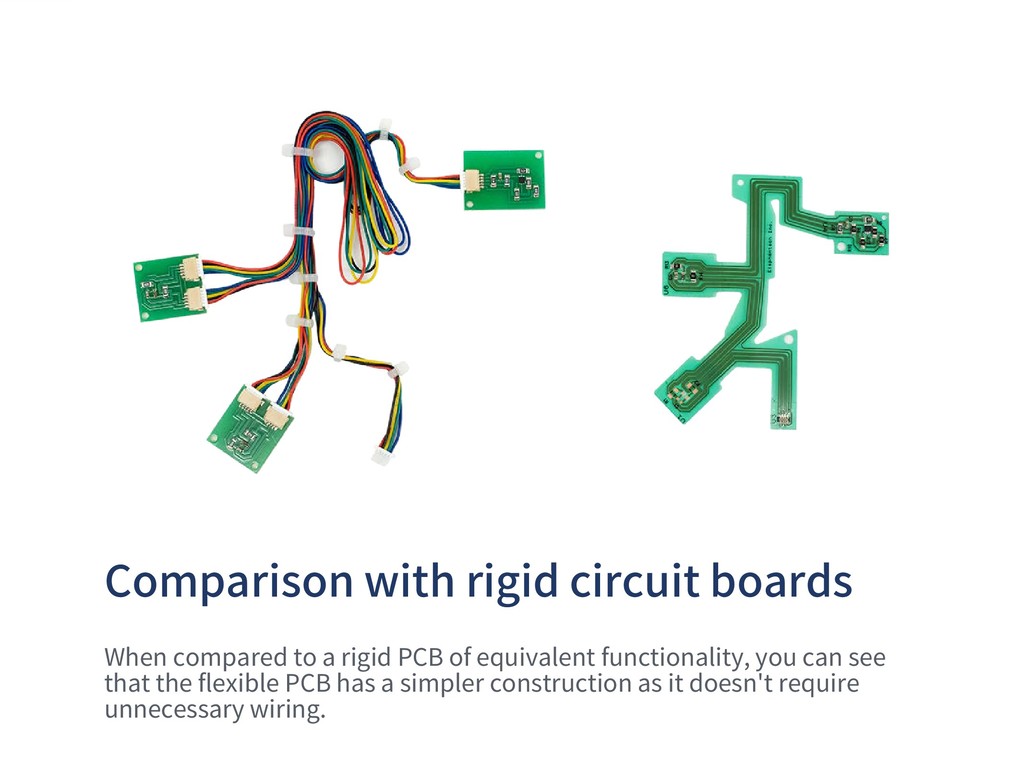
  12. When compared to a rigid PCB of equivalent functionality, you

    can see that the flexible PCB has a simpler construction as it doesn't require unnecessary wiring. Comparison with rigid circuit boards
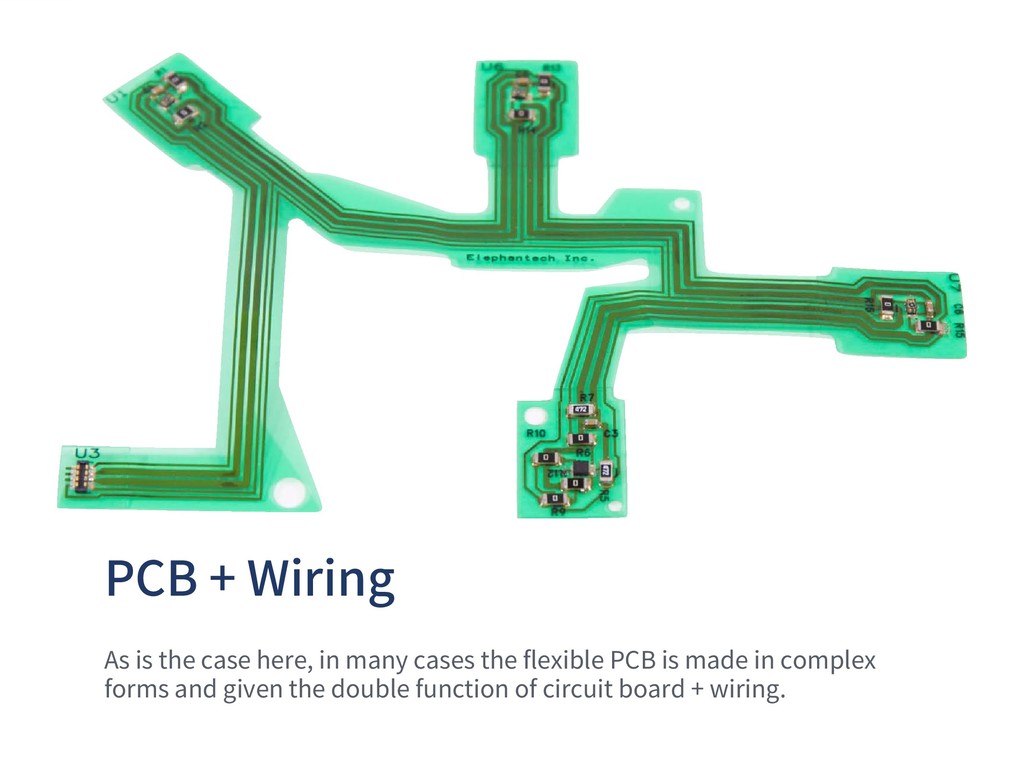
  13. PCB + Wiring As is the case here, in many

    cases the flexible PCB is made in complex forms and given the double function of circuit board + wiring.
  14. 3 learning points Durability Design Connector There are 3 things

    you need to learn about before using flexible PCB. • Durability: it is not as if you can continue bending it over and over again. We will see just how much you can bend it. • Design: it is specifically designed as to prevent problems from bending. • Connector: we will look at the connectors used in connecting the flexible PCB to a rigid PCB.
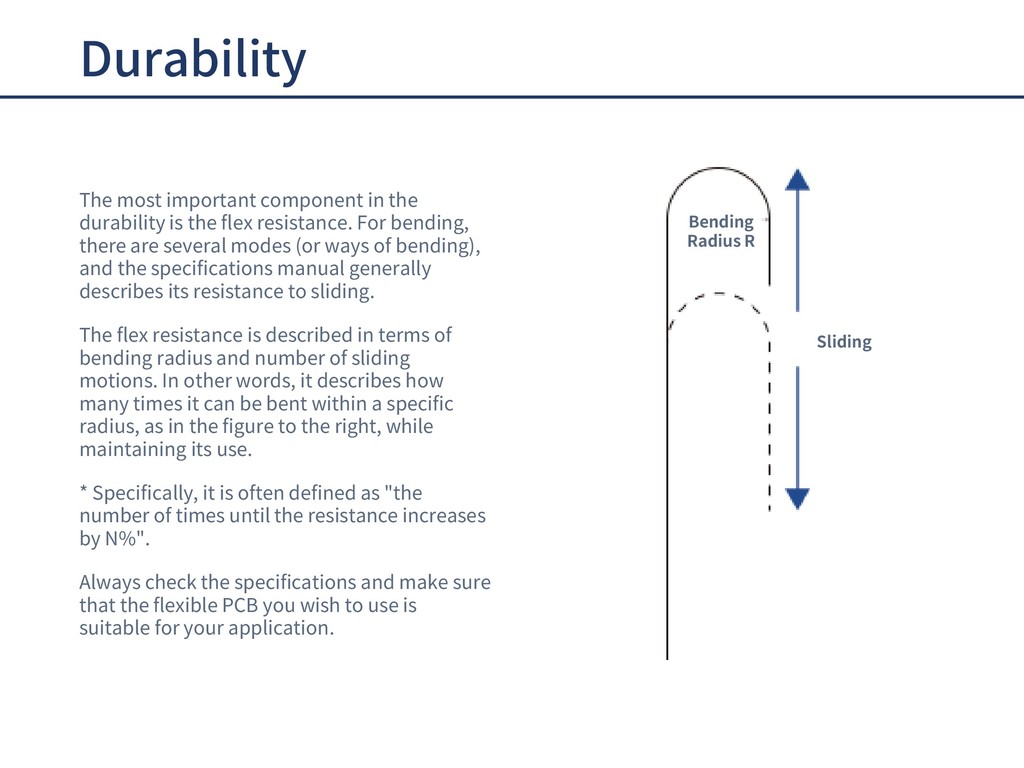
  15. Durability The most important component in the durability is the

    flex resistance. For bending, there are several modes (or ways of bending), and the specifications manual generally describes its resistance to sliding. The flex resistance is described in terms of bending radius and number of sliding motions. In other words, it describes how many times it can be bent within a specific radius, as in the figure to the right, while maintaining its use. * Specifically, it is often defined as "the number of times until the resistance increases by N%". Always check the specifications and make sure that the flexible PCB you wish to use is suitable for your application. Sliding Bending Radius R
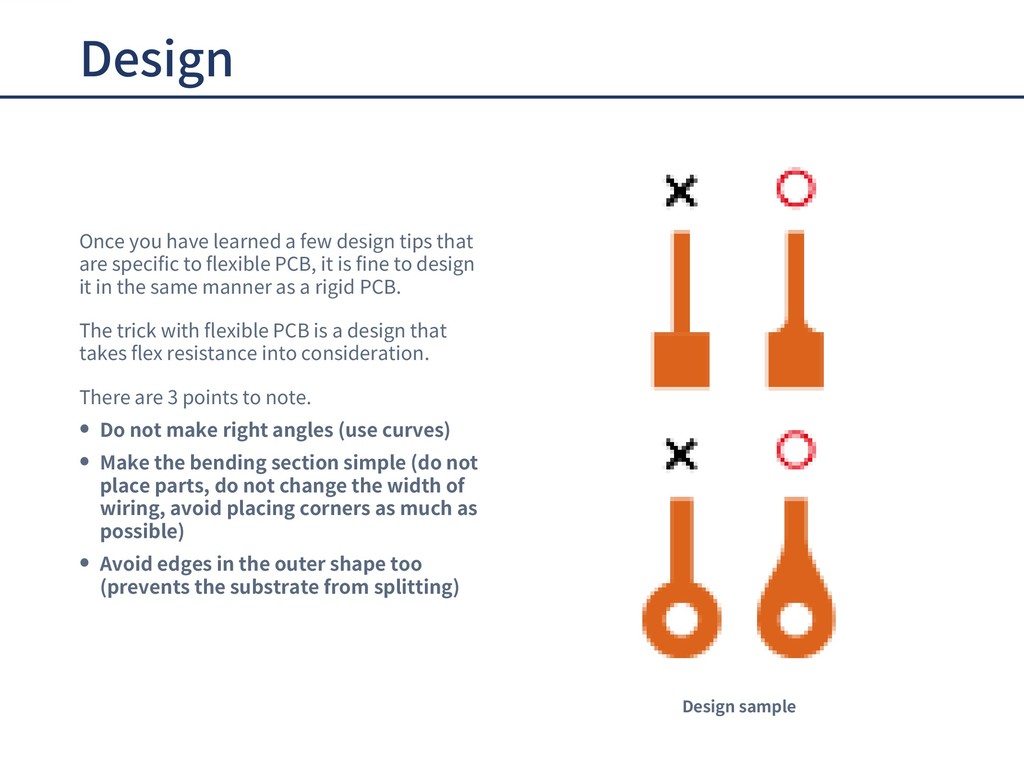
  16. Design Once you have learned a few design tips that

    are specific to flexible PCB, it is fine to design it in the same manner as a rigid PCB. The trick with flexible PCB is a design that takes flex resistance into consideration. There are 3 points to note. • Do not make right angles (use curves) • Make the bending section simple (do not place parts, do not change the width of wiring, avoid placing corners as much as possible) • Avoid edges in the outer shape too (prevents the substrate from splitting) Design sample
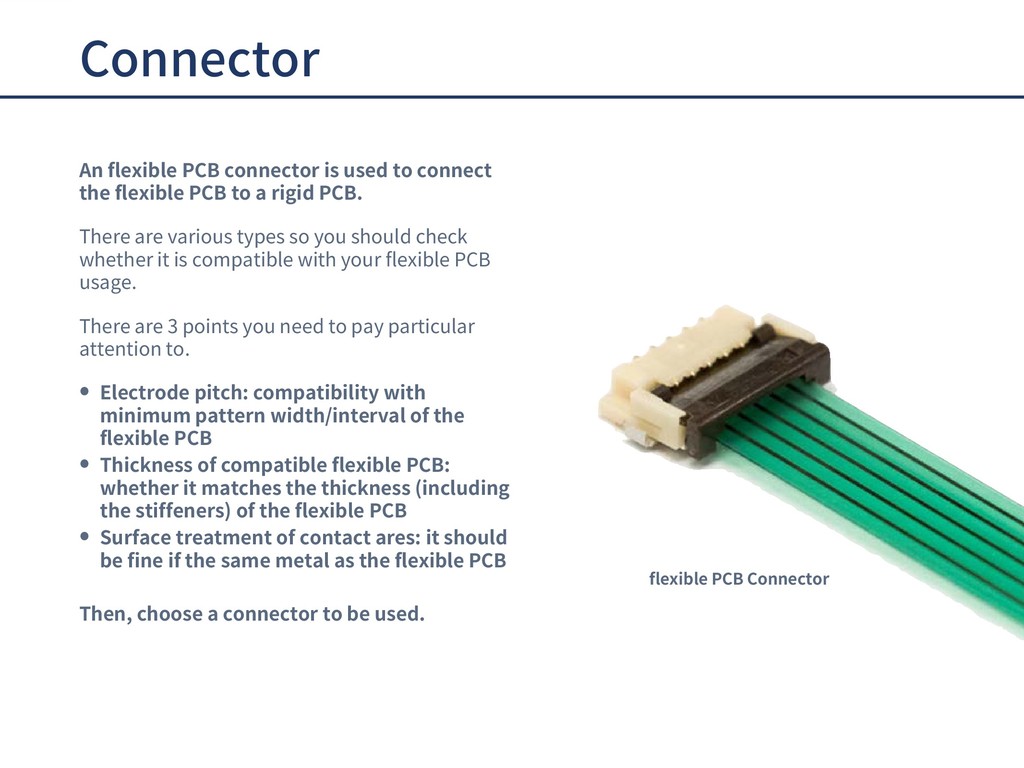
  17. Connector An flexible PCB connector is used to connect the

    flexible PCB to a rigid PCB. There are various types so you should check whether it is compatible with your flexible PCB usage. There are 3 points you need to pay particular attention to. • Electrode pitch: compatibility with minimum pattern width/interval of the flexible PCB • Thickness of compatible flexible PCB: whether it matches the thickness (including the stiffeners) of the flexible PCB • Surface treatment of contact ares: it should be fine if the same metal as the flexible PCB Then, choose a connector to be used. flexible PCB Connector
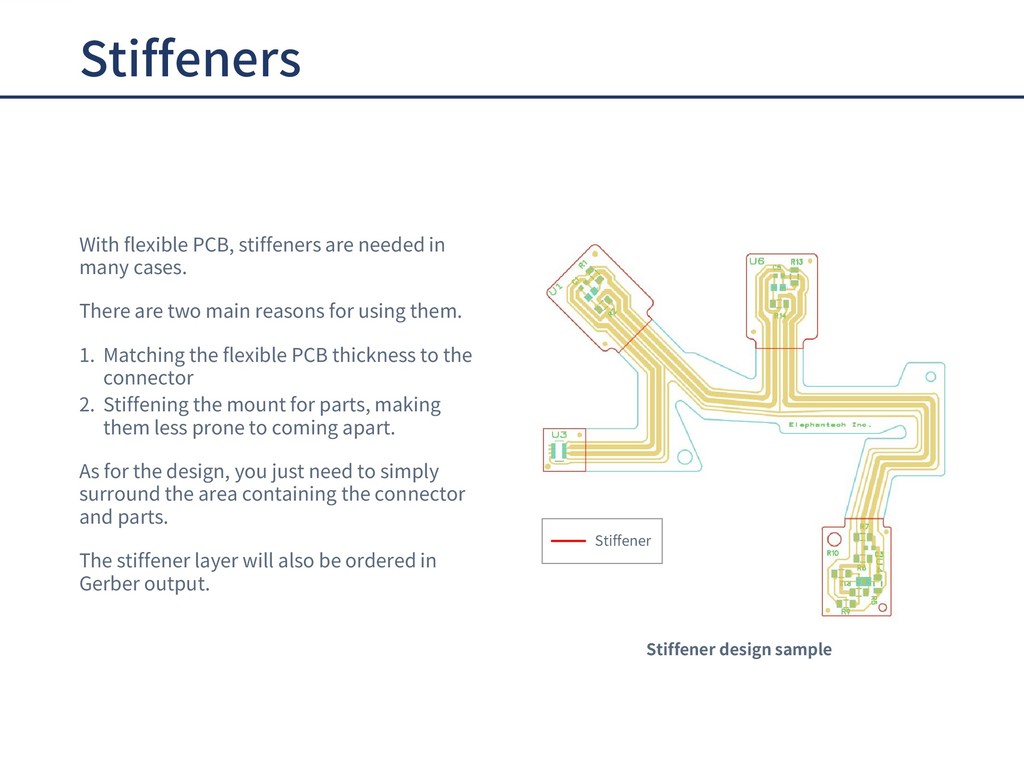
  18. Stiffeners With flexible PCB, stiffeners are needed in many cases.

    There are two main reasons for using them. 1. Matching the flexible PCB thickness to the connector 2. Stiffening the mount for parts, making them less prone to coming apart. As for the design, you just need to simply surround the area containing the connector and parts. The stiffener layer will also be ordered in Gerber output. Stiffener design sample Stiffener
  19. Summary We looked at flexible PCB in 3 steps: "Introduction",

    "More About" and "Learn". We will quickly review this slide in 3 points. • Flexible PCB (flexible PCB) can be bent, allows for reduction in weight and size, and simplifies the wiring • There are disadvantages too when compared to rigid circuit boards, but it is possible to make things that wouldn't be possible with a rigid PCB • It is recommended that you learn about flex resistance, design, connectors and stiffeners for specific knowledge of flexible PCB (this isn't difficult)