Upgrade to Pro
— share decks privately, control downloads, hide ads and more …
Speaker Deck
Sign up for free
Menu
Search
Features
All features
Private URLs
Password Protection
Custom URLS
Scheduled publishing
Remove Branding
Restrict embedding
Deck Collections
Notes
Features
All features
Private URLs
Password Protection
Custom URLS
Scheduled publishing
Remove Branding
Restrict embedding
Deck Collections
Notes
Explore
Featured decks
Featured speakers
Programming
Technology
Storyboards
Explore
Featured decks
Featured speakers
Programming
Technology
Storyboards
Pricing
Search
Sign in
Sign up for free
Elix, CBI2026, Oral Presentation, Synthesizer: ...
Search
Elix
November 11, 2026
Technology
0
0
Share
Embed
Copy iframe code
Copy JS code
Copy link
Start on current slide
Elix, CBI2026, Oral Presentation, Synthesizer: Extending Vina-GPU with Core-Constrained and Covalent Docking
Elix
November 11, 2026
More Decks by Elix
See All by Elix
Elix, CBI2026, Oral Presentation, Synthesizer: Directed Chemical Compound Structure Generation and Optimization Driven by Forward Synthesis
elix
0
0
Elix, CBI2026, Oral Presentation, Democratizing Computational Drug Discovery: An Agentic Assistant with Executable Expert Skills
elix
0
0
Elix,第42回メディシナルケミストリーシンポジウム,ランチョンセミナー,標的タンパク分解誘導薬開発へのAI活⽤:新たなMolecular Glue Degrader創出に向けて
elix
0
170
Elix,CBI2025,スポンサードセッション,タンパク-タンパク複合体情報を活用した構造生成:TRIM21の新たなリガンド探索に向けて
elix
0
58
Elix, CBI2025,ランチョンセミナー,標的タンパク分解誘導薬開発へのAI活用:新たなMolecular Glue Degrader創出に向けて
elix
0
130
kMoL: An Open-source Machine and Federated Learning Library for Drug Discovery
elix
0
87
SynthFormer: A Customizable Framework for Virtual Synthesis-Based Molecule Generation, Elix, CBI2024
elix
0
210
Optimization of Generator Reward Function Settings for Non-covalent KRAS Inhibitors, Elix, CBI2024
elix
0
430
Open Molecule Generator: A Multipurpose Molecule LLM, Elix, CBI2024
elix
0
240
Other Decks in Technology
See All in Technology
視野はAIに、視座は人に / ai-for-breadth-humans-for-perspective
nkzn
6
3.2k
超⼩型・多⾔語検索モデル Bekko Embedding
hotchpotch
1
140
AWS構成から考えるWebセキュリティ ― WordPressの構築経験から考える公開範囲と更新運用【JAWS FESTA 2026 in AKITA】
cscengineer
PRO
2
390
Content Mapper APIの応用例~CSS Modules、言語ファイル~
uhyo
2
630
Active Directory と Entra ID のむむむな関係
murachiakira
PRO
4
1.7k
In-Context Learning再入門。ICLの勾配降下的解釈の研究動向を追ってみる。
dai08srhg
1
770
属人化したISMS運用をGitHubとAIで仕組み化した1年間の記録
sioncojp
4
1.8k
「いつか使う」の「いつか」は来ない 〜AI駆動開発における「作らない」判断について〜
ikki0006
0
180
生成AI時代のIAMのマニアックな話
takuros
6
2.8k
[JAWS Festa 2026]一番いい仕事は、請求書に現れない / jawsfesta2026
sh_fk2
2
420
Claude Codeで作ったアプリを安全に公開する/Built with Claude Japan 2026
yoshidashingo
0
220
並列度を下げたら速くなった — go build の重複コンパイルを実測で見る
tomoaki25
2
1k
Featured
See All Featured
Understanding Cognitive Biases in Performance Measurement
bluesmoon
32
3.1k
Keith and Marios Guide to Fast Websites
keithpitt
413
23k
HDC tutorial
michielstock
2
1k
Noah Learner - AI + Me: how we built a GSC Bulk Export data pipeline
techseoconnect
PRO
0
480
Designing Dashboards & Data Visualisations in Web Apps
destraynor
232
55k
Statistics for Hackers
jakevdp
799
230k
Accessibility Awareness
sabderemane
1
290
SEO for Brand Visibility & Recognition
aleyda
0
4.9k
Ethics towards AI in product and experience design
skipperchong
2
460
My Coaching Mixtape
mlcsv
0
380
Building Applications with DynamoDB
mza
96
7.3k
Introduction to Domain-Driven Design and Collaborative software design
baasie
1
1.1k
Transcript
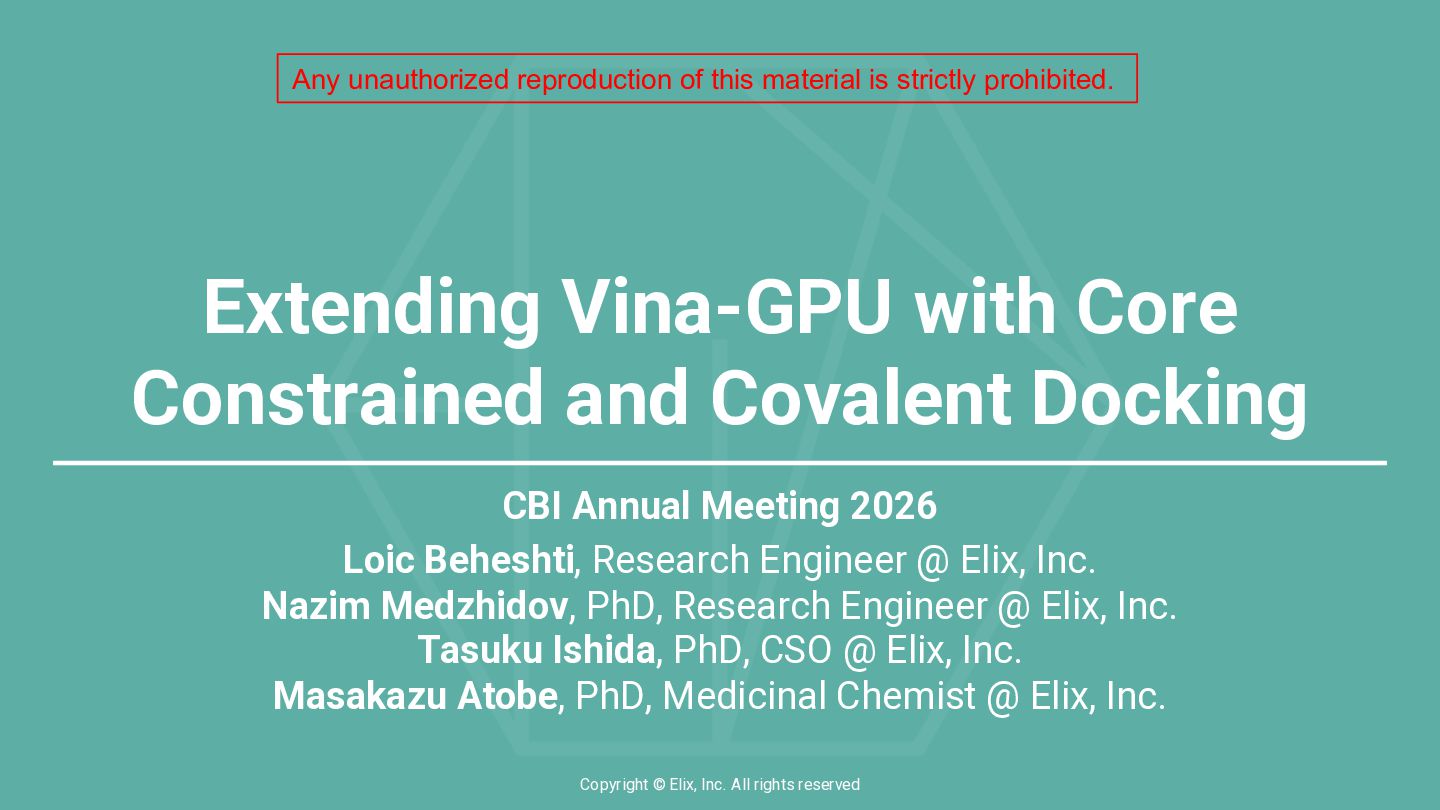
Any unauthorized reproduction of this material is strictly prohibited. Extending
Vina-GPU with Core Constrained and Covalent Docking CBI Annual Meeting 2026 Loic Beheshti, Research Engineer @ Elix, Inc. Nazim Medzhidov, PhD, Research Engineer @ Elix, Inc. Tasuku Ishida, PhD, CSO @ Elix, Inc. Masakazu Atobe, PhD, Medicinal Chemist @ Elix, Inc. Copyright © Elix, Inc. All rights reserved
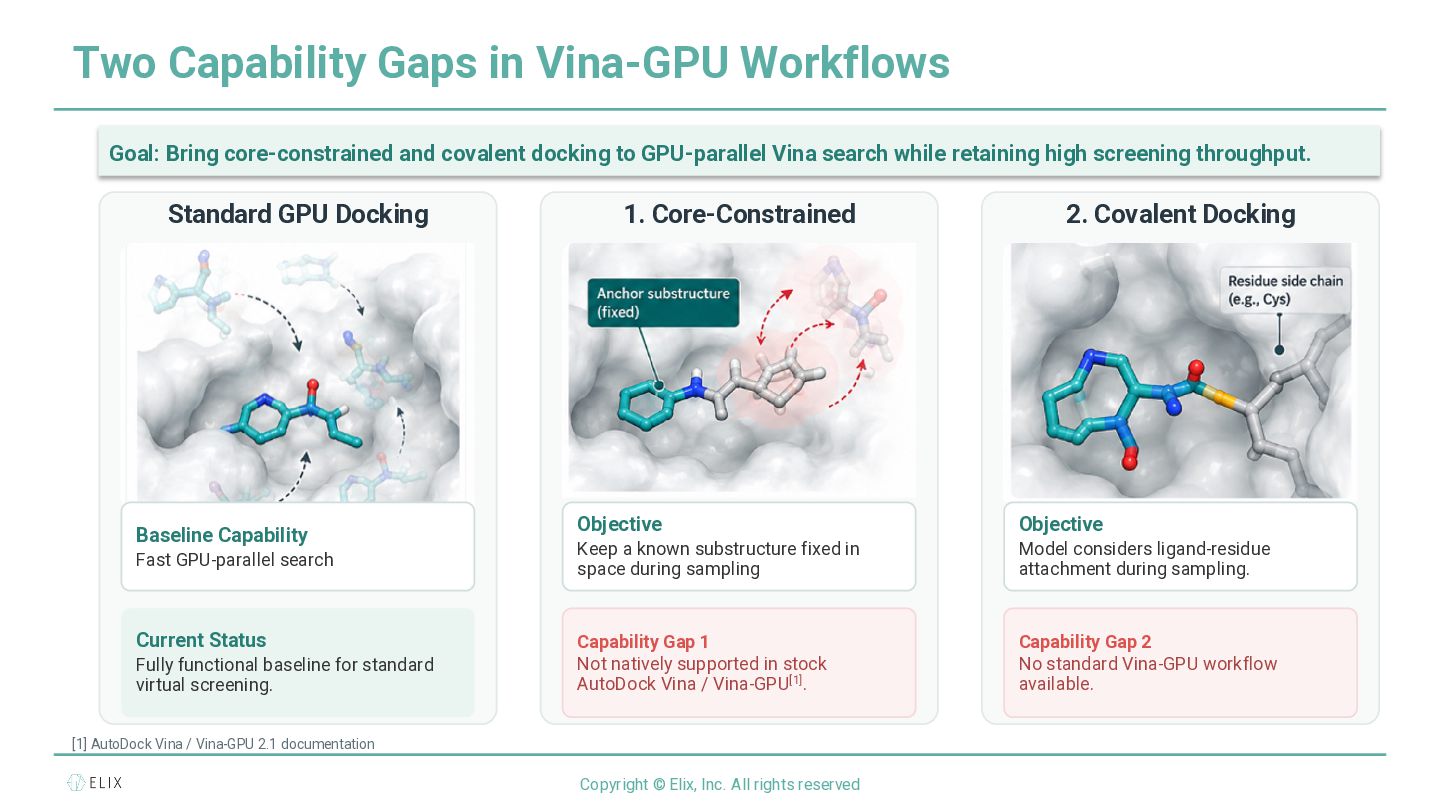
Two Capability Gaps in Vina-GPU Workflows Goal: Bring core-constrained and
covalent docking to GPU-parallel Vina search while retaining high screening throughput. Standard GPU Docking Baseline Capability Fast GPU-parallel search Current Status Fully functional baseline for standard virtual screening. 1. Core-Constrained 2. Covalent Docking Objective Objective Keep a known substructure fixed in space during sampling Model considers ligand-residue attachment during sampling. Capability Gap 1 Not natively supported in stock AutoDock Vina / Vina-GPU[1]. Capability Gap 2 No standard Vina-GPU workflow available. [1] AutoDock Vina / Vina-GPU 2.1 documentation Copyright © Elix, Inc. All rights reserved
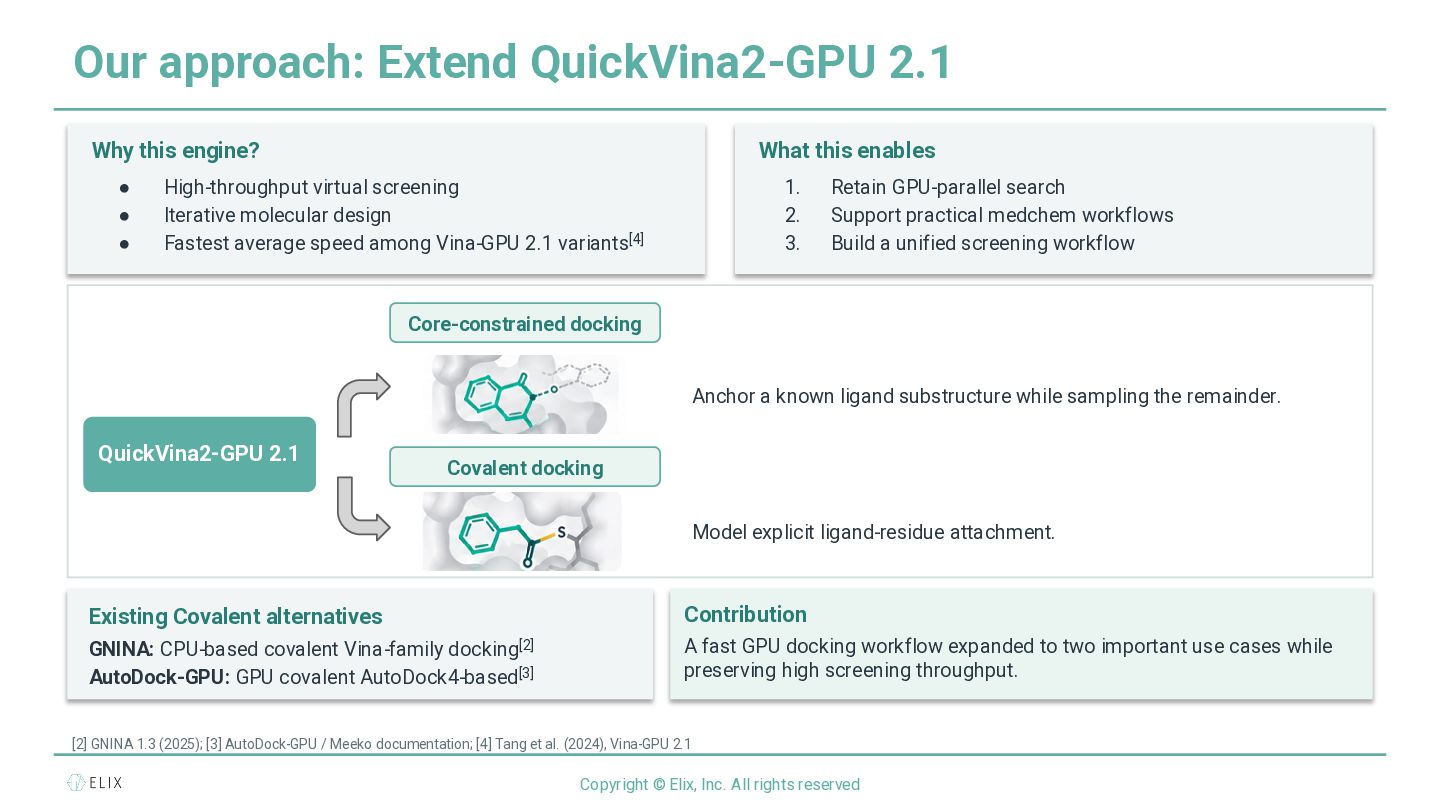
Our approach: Extend QuickVina2-GPU 2.1 Why this engine? • •
• What this enables High-throughput virtual screening Iterative molecular design Fastest average speed among Vina-GPU 2.1 variants[4] 1. 2. 3. Retain GPU-parallel search Support practical medchem workflows Build a unified screening workflow Core-constrained docking Anchor a known ligand substructure while sampling the remainder. QuickVina2-GPU 2.1 Covalent docking Model explicit ligand-residue attachment. Existing Covalent alternatives Contribution GNINA: CPU-based covalent Vina-family docking[2] AutoDock-GPU: GPU covalent AutoDock4-based[3] A fast GPU docking workflow expanded to two important use cases while preserving high screening throughput. [2] GNINA 1.3 (2025); [3] AutoDock-GPU / Meeko documentation; [4] Tang et al. (2024), Vina-GPU 2.1 Copyright © Elix, Inc. All rights reserved
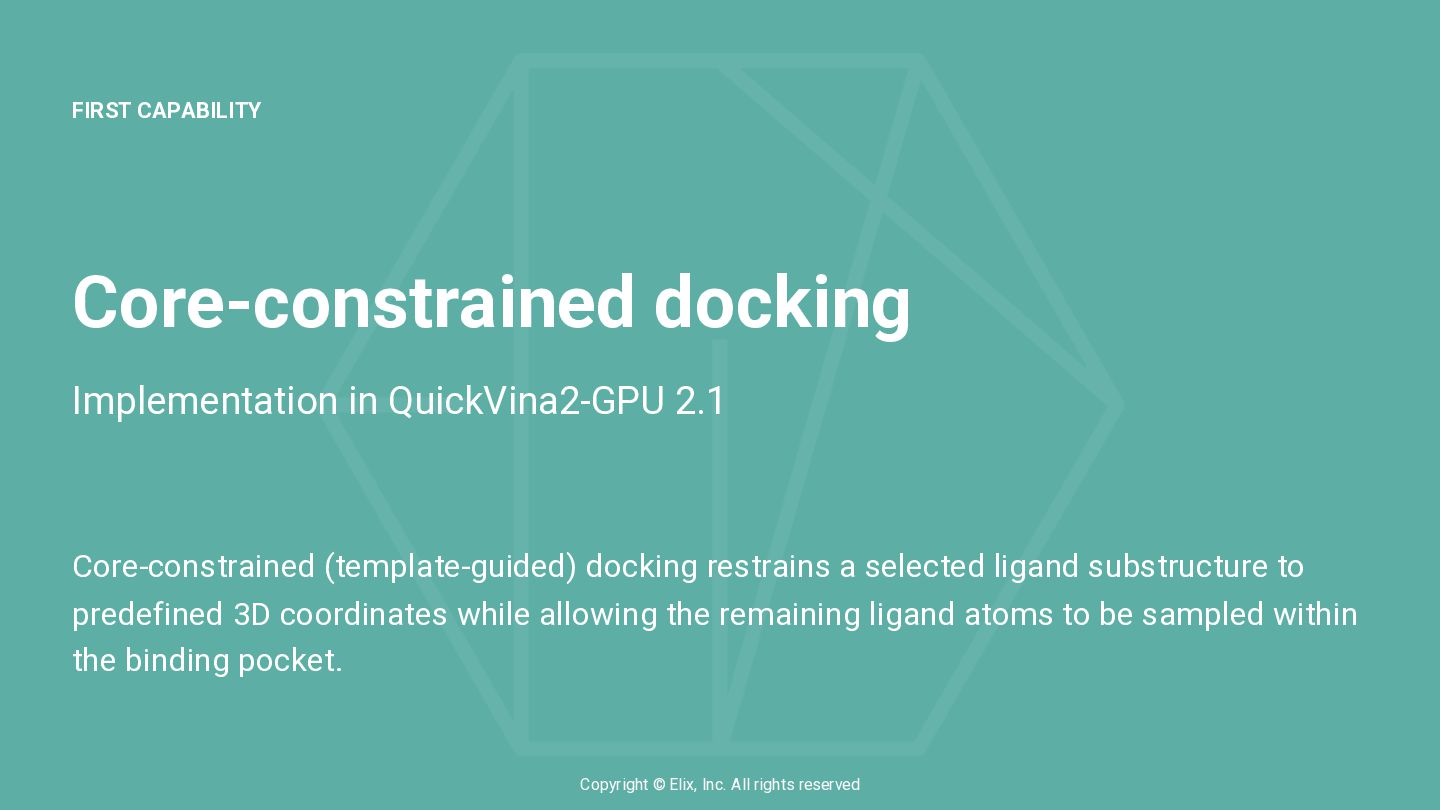
FIRST CAPABILITY Core-constrained docking Implementation in QuickVina2-GPU 2.1 Core-constrained (template-guided)
docking restrains a selected ligand substructure to predefined 3D coordinates while allowing the remaining ligand atoms to be sampled within the binding pocket. Copyright © Elix, Inc. All rights reserved
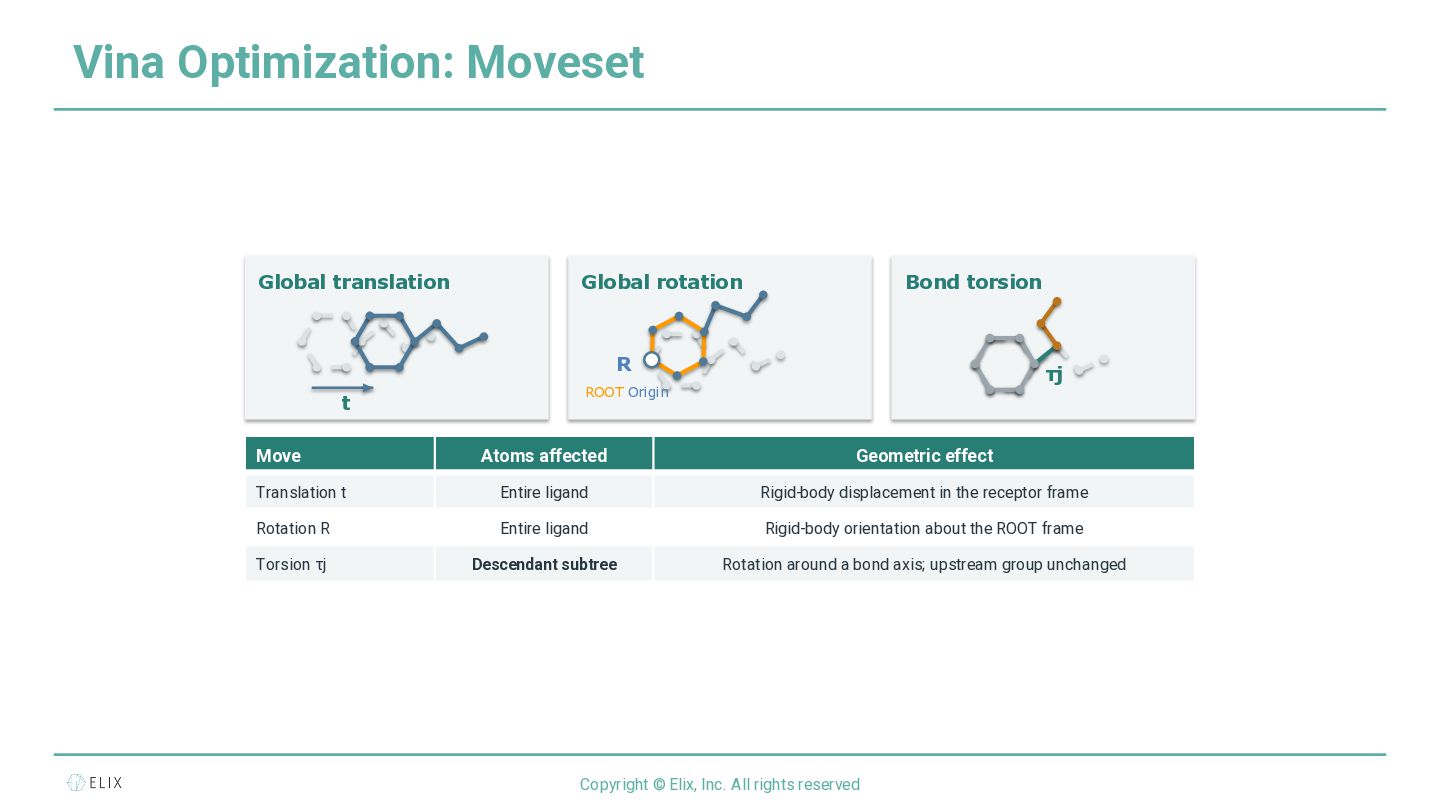
Vina Optimization: Moveset Global translation Global rotation Bond torsion R
t Move τj ROOT Origin Atoms affected Geometric effect Translation t Entire ligand Rigid-body displacement in the receptor frame Rotation R Entire ligand Rigid-body orientation about the ROOT frame Torsion τj Descendant subtree Rotation around a bond axis; upstream group unchanged Copyright © Elix, Inc. All rights reserved
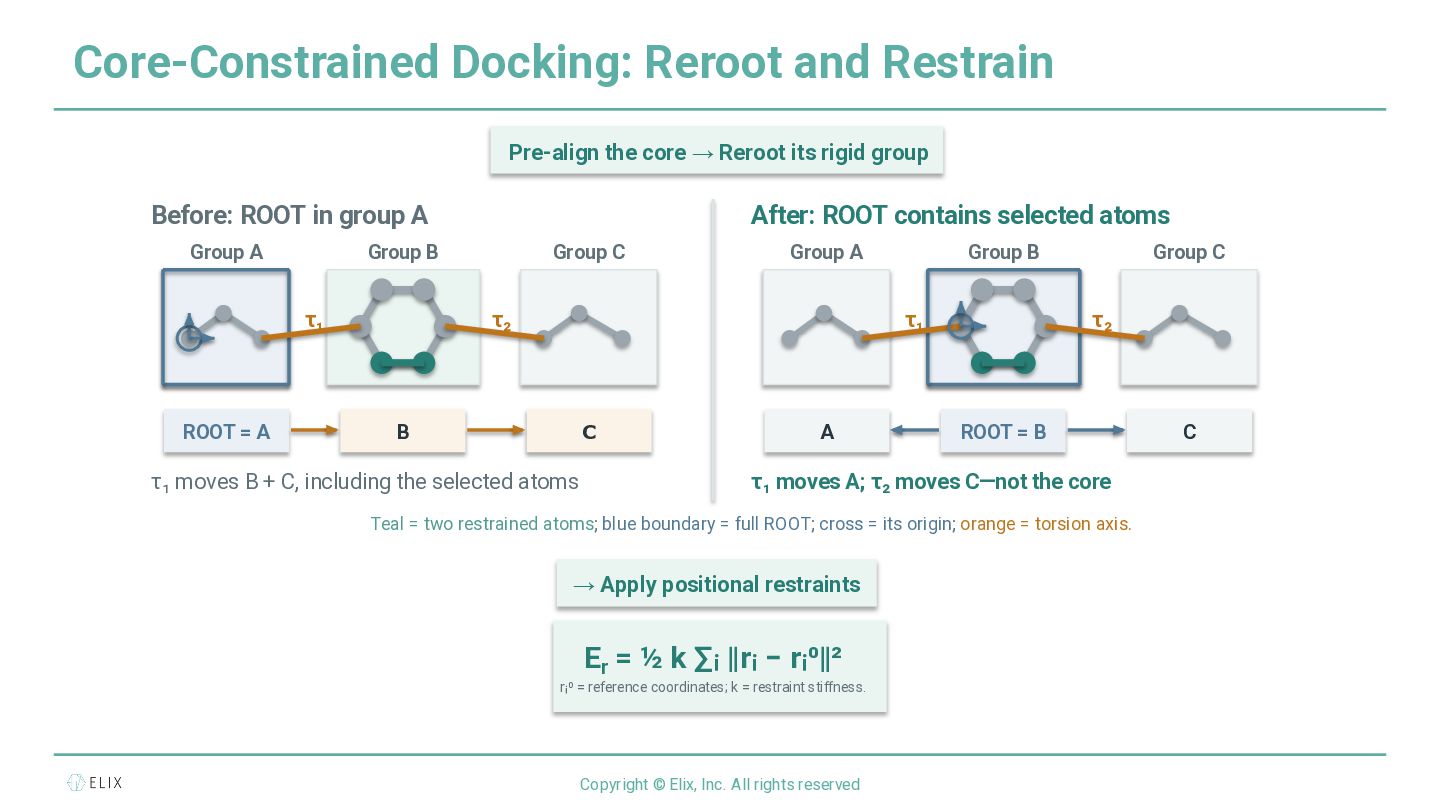
Core-Constrained Docking: Reroot and Restrain Pre-align the core → Reroot
its rigid group Before: ROOT in group A Group A Group B τ₁ ROOT = A After: ROOT contains selected atoms Group C Group A τ₂ Group B τ₁ C B τ₁ moves B + C, including the selected atoms A Group C τ₂ ROOT = B τ₁ moves A; τ₂ moves C—not the core Teal = two restrained atoms; blue boundary = full ROOT; cross = its origin; orange = torsion axis. → Apply positional restraints Er = ½ k ∑ᵢ ‖rᵢ − rᵢ⁰‖² rᵢ⁰ = reference coordinates; k = restraint stiffness. Copyright © Elix, Inc. All rights reserved C
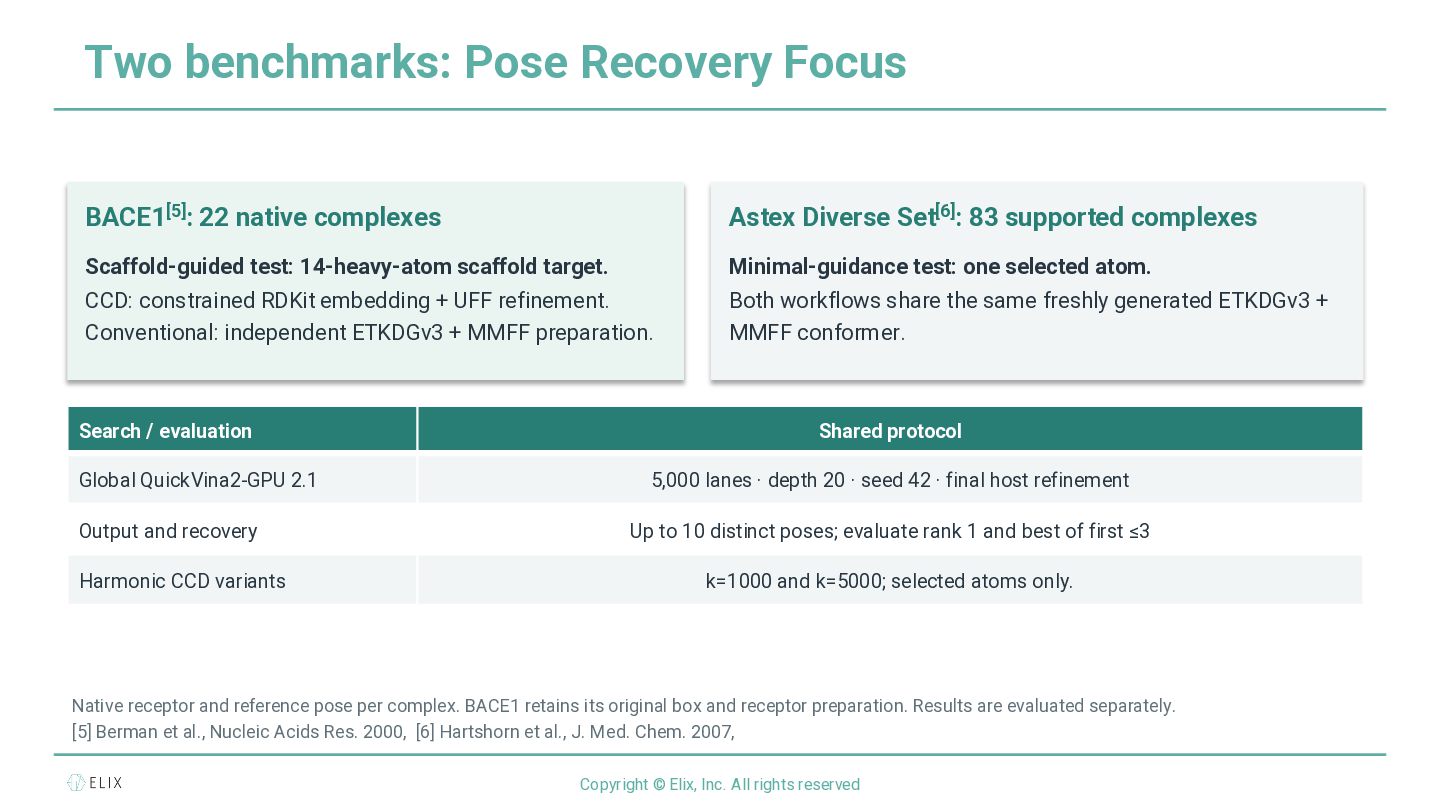
Two benchmarks: Pose Recovery Focus BACE1[5]: 22 native complexes Astex
Diverse Set[6]: 83 supported complexes Scaffold-guided test: 14-heavy-atom scaffold target. Minimal-guidance test: one selected atom. CCD: constrained RDKit embedding + UFF refinement. Conventional: independent ETKDGv3 + MMFF preparation. Both workflows share the same freshly generated ETKDGv3 + MMFF conformer. Search / evaluation Global QuickVina2-GPU 2.1 Output and recovery Harmonic CCD variants Shared protocol 5,000 lanes · depth 20 · seed 42 · final host refinement Up to 10 distinct poses; evaluate rank 1 and best of first ≤3 k=1000 and k=5000; selected atoms only. Native receptor and reference pose per complex. BACE1 retains its original box and receptor preparation. Results are evaluated separately. [5] Berman et al., Nucleic Acids Res. 2000, [6] Hartshorn et al., J. Med. Chem. 2007, Copyright © Elix, Inc. All rights reserved
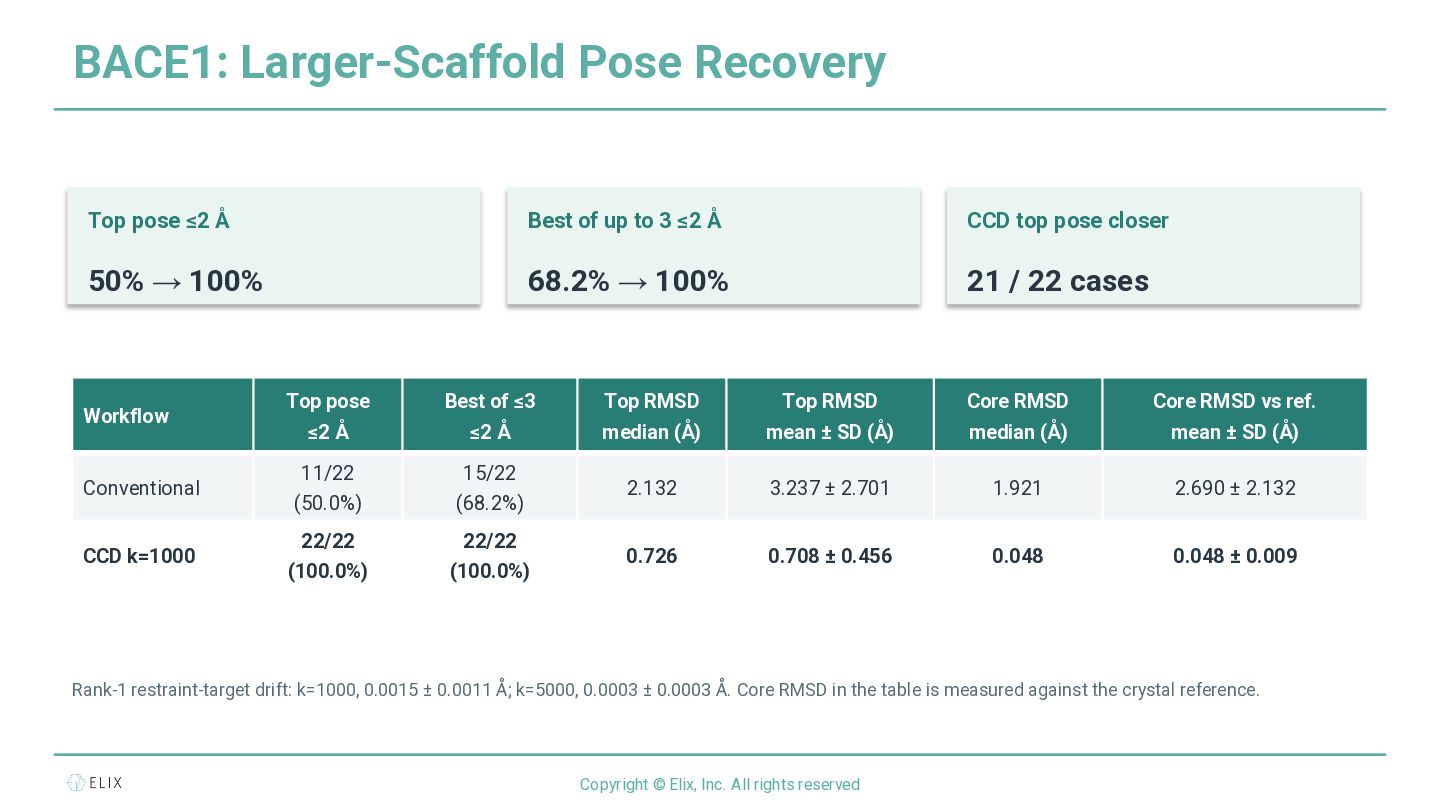
BACE1: Larger-Scaffold Pose Recovery Top pose ≤2 Å Best of
up to 3 ≤2 Å CCD top pose closer 50% → 100% 68.2% → 100% 21 / 22 cases Workflow Conventional CCD k=1000 Top pose Best of ≤3 Top RMSD Top RMSD Core RMSD Core RMSD vs ref. ≤2 Å ≤2 Å median (Å) mean ± SD (Å) median (Å) mean ± SD (Å) 11/22 (50.0%) 15/22 (68.2%) 2.132 3.237 ± 2.701 1.921 2.690 ± 2.132 22/22 22/22 (100.0%) (100.0%) 0.726 0.708 ± 0.456 0.048 0.048 ± 0.009 Rank-1 restraint-target drift: k=1000, 0.0015 ± 0.0011 Å; k=5000, 0.0003 ± 0.0003 Å. Core RMSD in the table is measured against the crystal reference. Copyright © Elix, Inc. All rights reserved
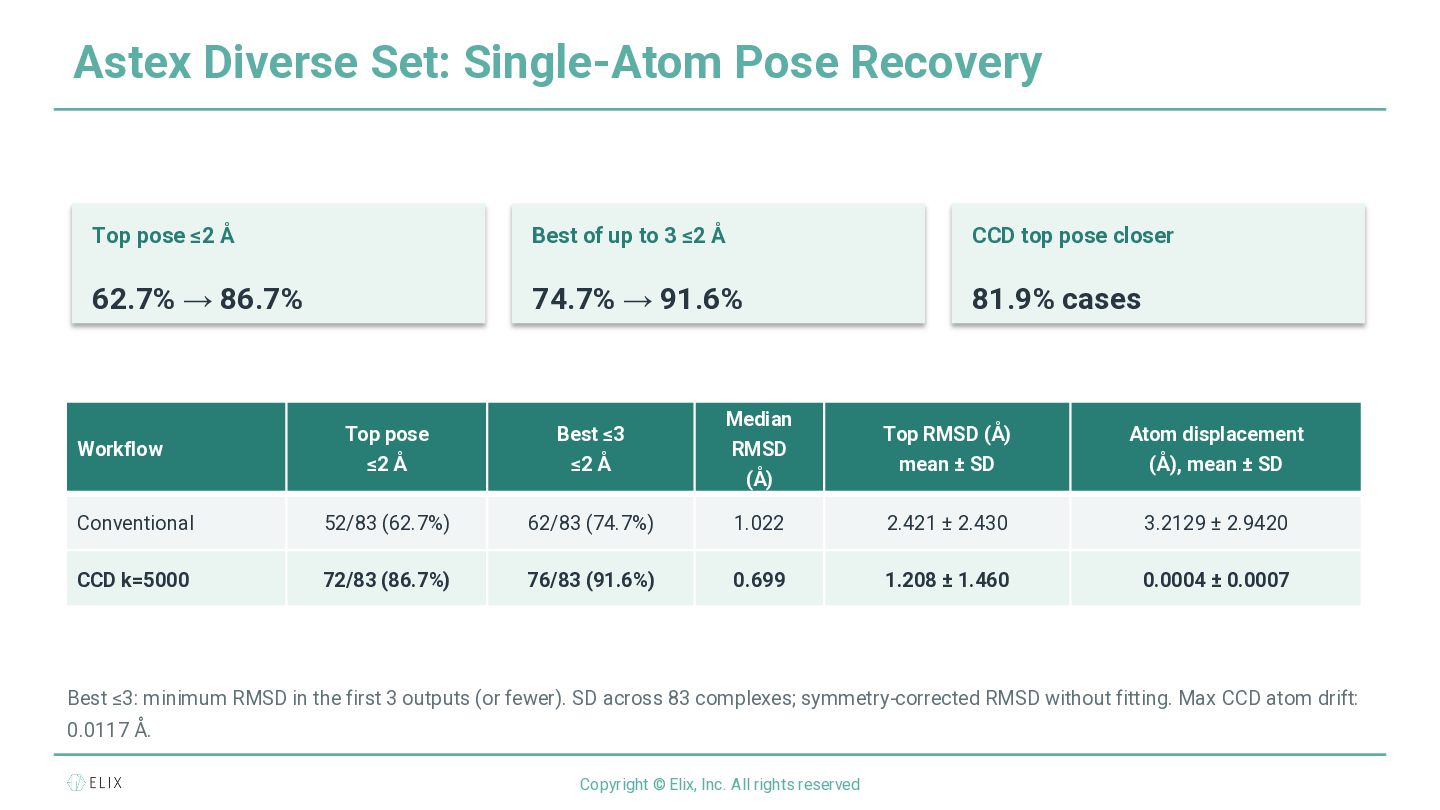
Astex Diverse Set: Single-Atom Pose Recovery Top pose ≤2 Å
Best of up to 3 ≤2 Å CCD top pose closer 62.7% → 86.7% 74.7% → 91.6% 81.9% cases Median Top pose Best ≤3 ≤2 Å ≤2 Å RMSD (Å) Conventional 52/83 (62.7%) 62/83 (74.7%) CCD k=5000 72/83 (86.7%) 76/83 (91.6%) Workflow Top RMSD (Å) Atom displacement mean ± SD (Å), mean ± SD 1.022 2.421 ± 2.430 3.2129 ± 2.9420 0.699 1.208 ± 1.460 0.0004 ± 0.0007 Best ≤3: minimum RMSD in the first 3 outputs (or fewer). SD across 83 complexes; symmetry-corrected RMSD without fitting. Max CCD atom drift: 0.0117 Å. Copyright © Elix, Inc. All rights reserved
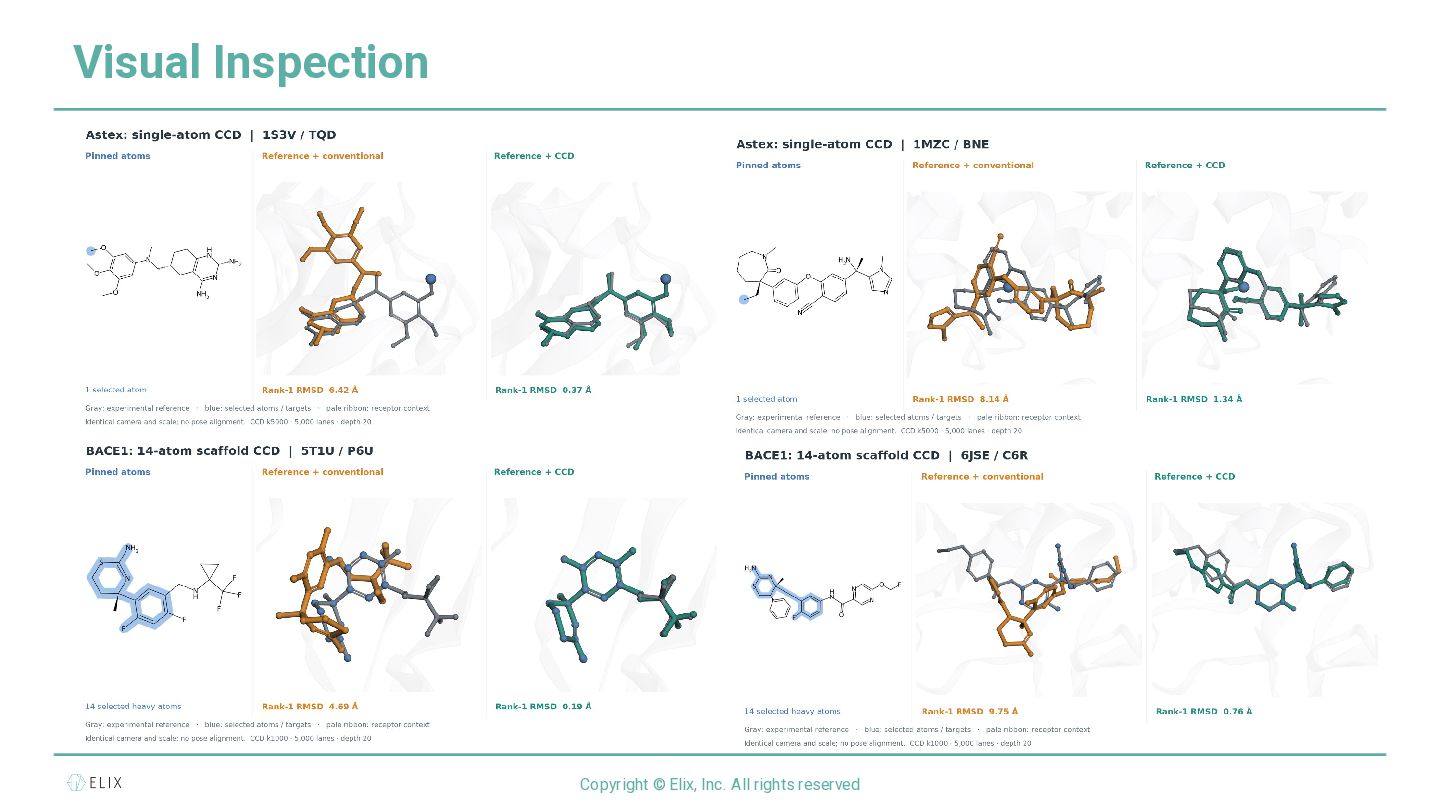
Visual Inspection Copyright © Elix, Inc. All rights reserved
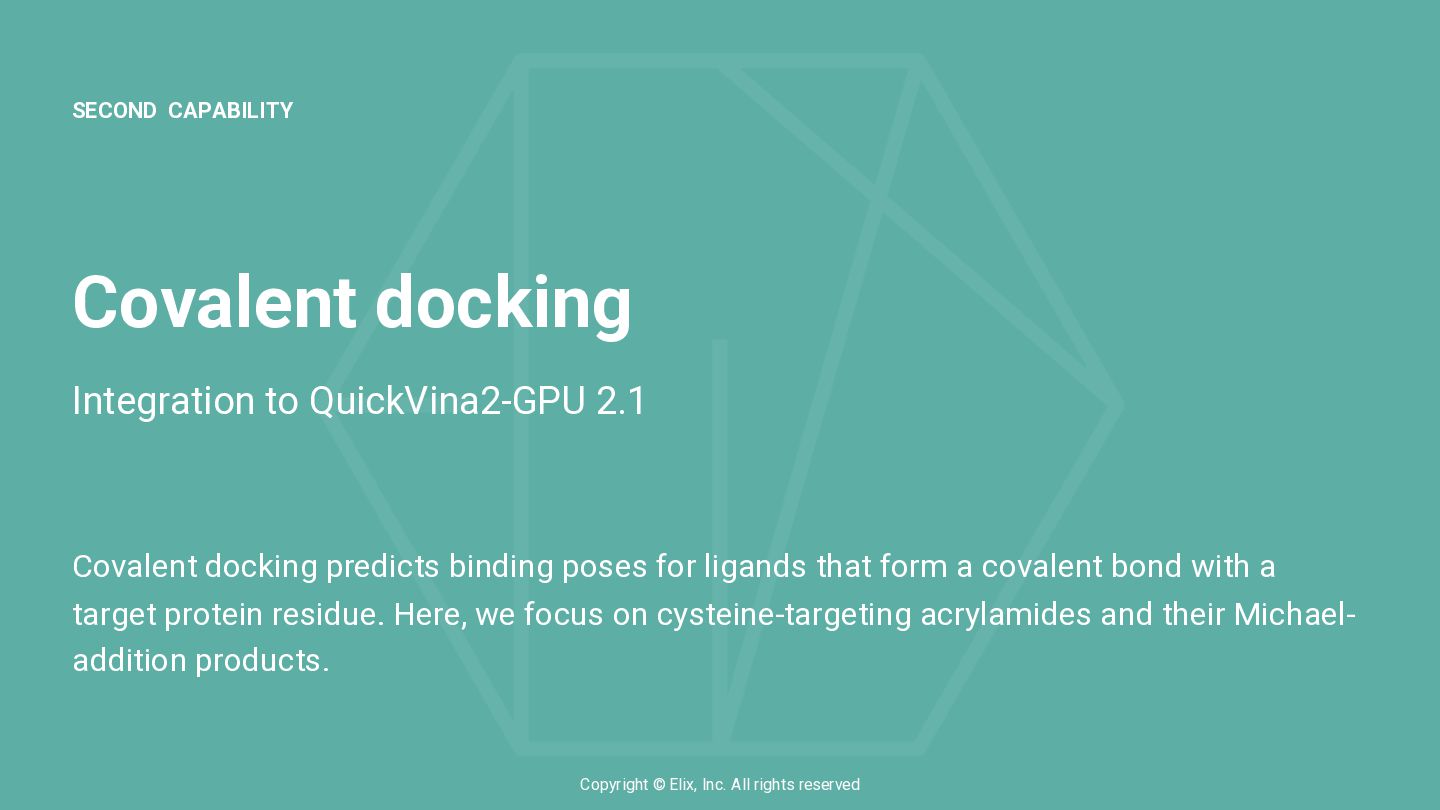
SECOND CAPABILITY Covalent docking Integration to QuickVina2-GPU 2.1 Covalent docking
predicts binding poses for ligands that form a covalent bond with a target protein residue. Here, we focus on cysteine-targeting acrylamides and their Michaeladdition products. Copyright © Elix, Inc. All rights reserved
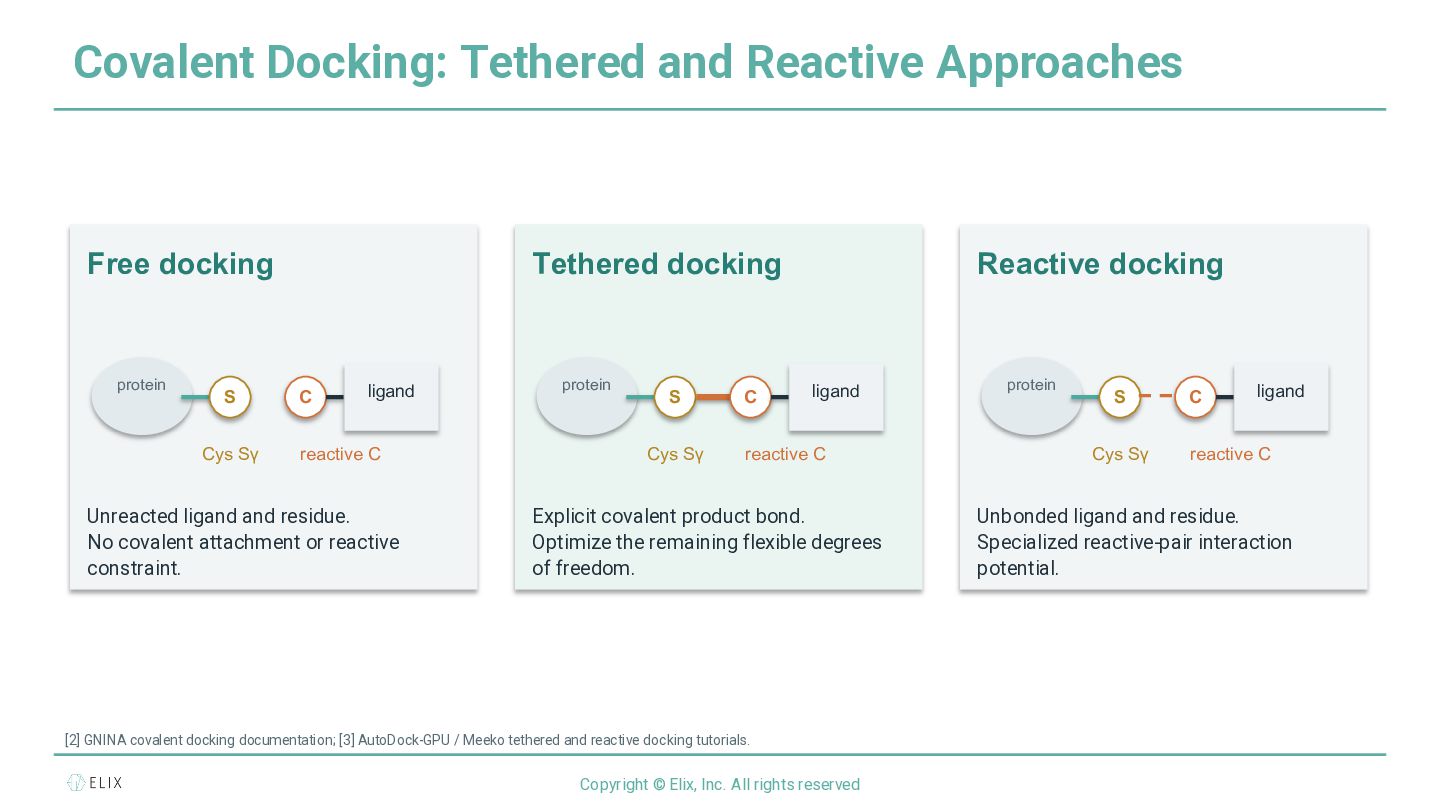
Covalent Docking: Tethered and Reactive Approaches Free docking protein S
Cys Sγ Tethered docking C ligand reactive C Unreacted ligand and residue. No covalent attachment or reactive constraint. protein S Cys Sγ C Reactive docking ligand reactive C Explicit covalent product bond. Optimize the remaining flexible degrees of freedom. [2] GNINA covalent docking documentation; [3] AutoDock-GPU / Meeko tethered and reactive docking tutorials. Copyright © Elix, Inc. All rights reserved protein S Cys Sγ C ligand reactive C Unbonded ligand and residue. Specialized reactive-pair interaction potential.
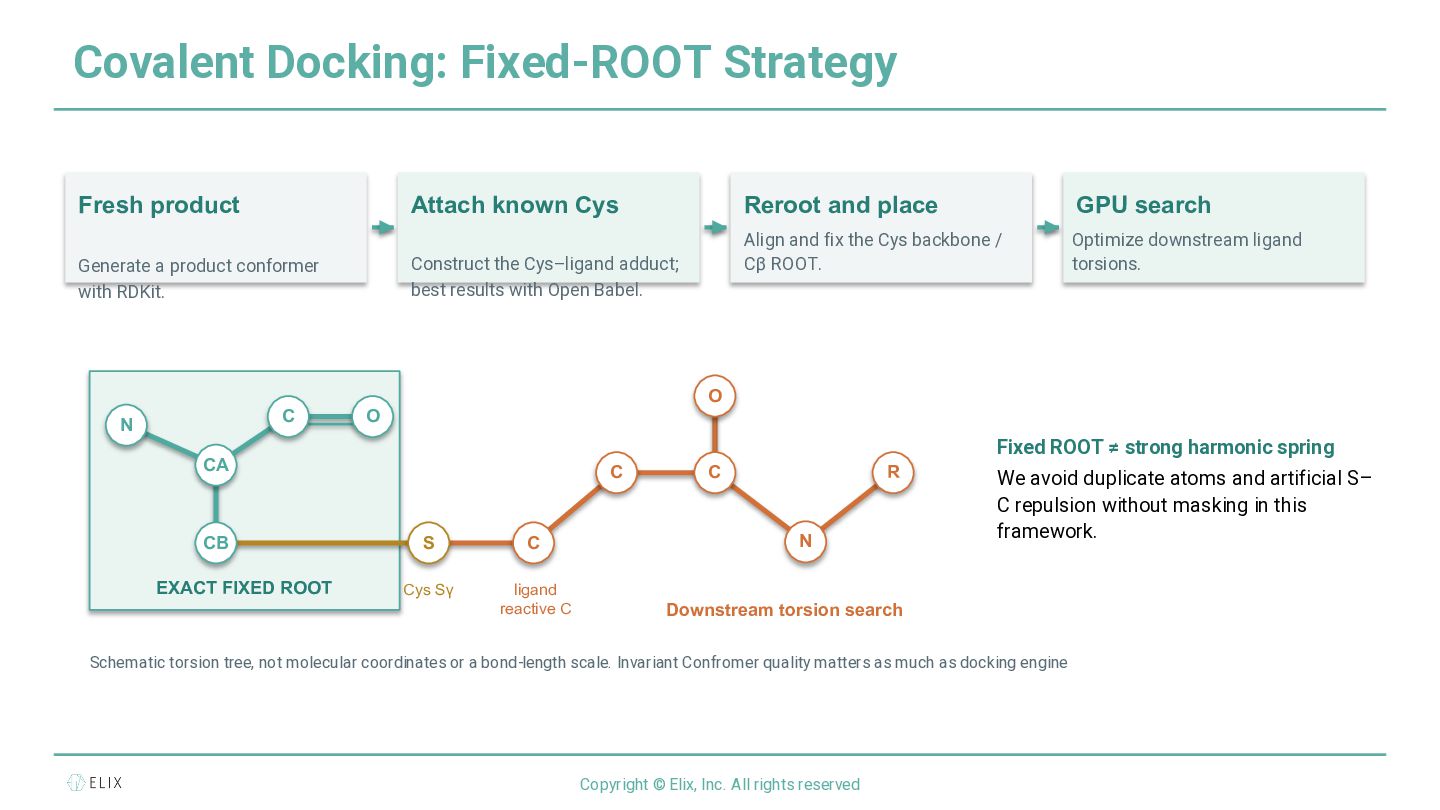
Covalent Docking: Fixed-ROOT Strategy Fresh product Attach known Cys Generate
a product conformer with RDKit. Construct the Cys–ligand adduct; best results with Open Babel. Reroot and place GPU search Align and fix the Cys backbone / Cβ ROOT. Optimize downstream ligand torsions. O C N O Fixed ROOT ≠ strong harmonic spring CA CB EXACT FIXED ROOT C S C Cys Sγ ligand reactive C C R N We avoid duplicate atoms and artificial S– C repulsion without masking in this framework. Downstream torsion search Schematic torsion tree, not molecular coordinates or a bond-length scale. Invariant Confromer quality matters as much as docking engine Copyright © Elix, Inc. All rights reserved
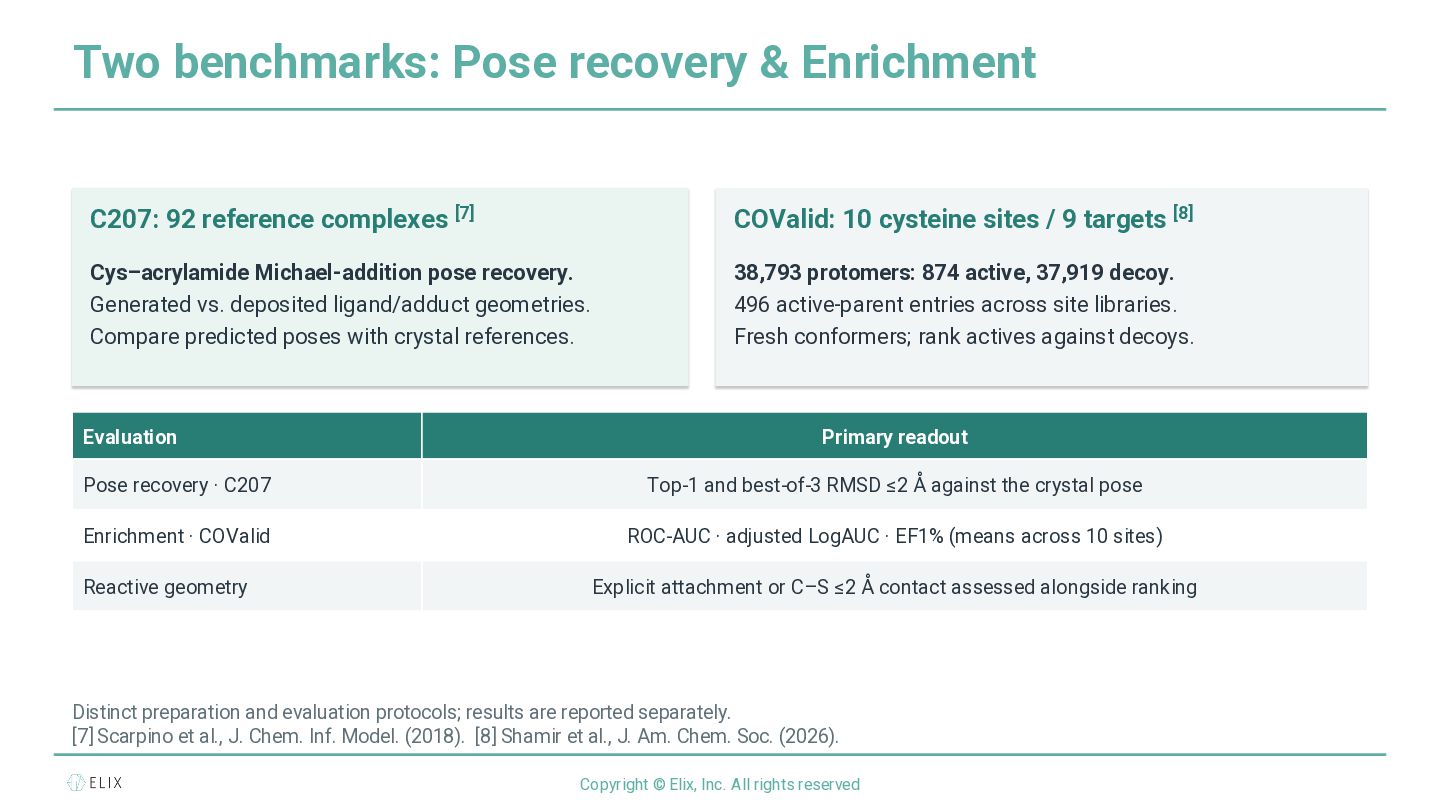
Two benchmarks: Pose recovery & Enrichment C207: 92 reference complexes
[7] COValid: 10 cysteine sites / 9 targets [8] Cys–acrylamide Michael-addition pose recovery. Generated vs. deposited ligand/adduct geometries. Compare predicted poses with crystal references. 38,793 protomers: 874 active, 37,919 decoy. 496 active-parent entries across site libraries. Fresh conformers; rank actives against decoys. Evaluation Primary readout Pose recovery · C207 Top-1 and best-of-3 RMSD ≤2 Å against the crystal pose Enrichment · COValid ROC-AUC · adjusted LogAUC · EF1% (means across 10 sites) Reactive geometry Explicit attachment or C–S ≤2 Å contact assessed alongside ranking Distinct preparation and evaluation protocols; results are reported separately. [7] Scarpino et al., J. Chem. Inf. Model. (2018). [8] Shamir et al., J. Am. Chem. Soc. (2026). Copyright © Elix, Inc. All rights reserved
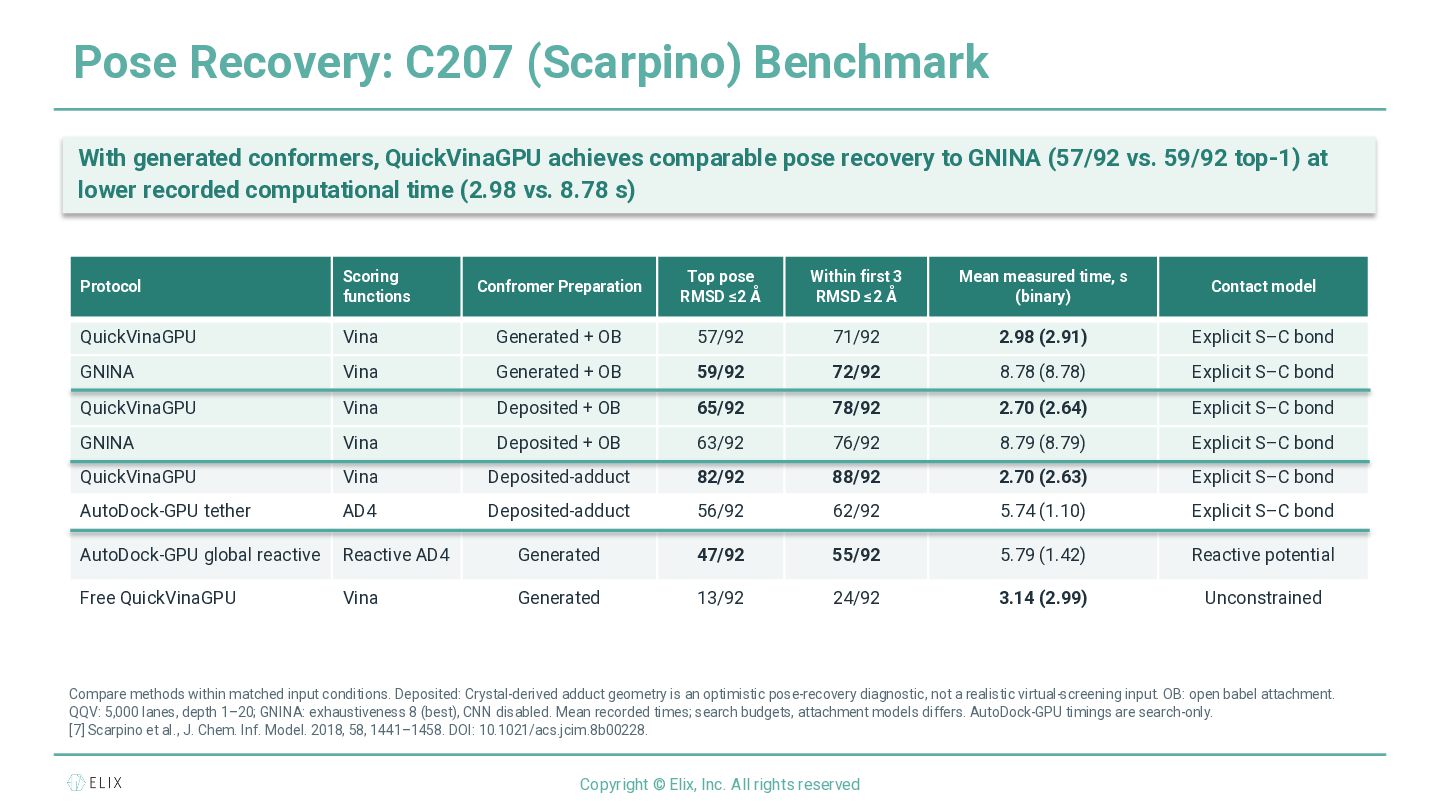
Pose Recovery: C207 (Scarpino) Benchmark With generated conformers, QuickVinaGPU achieves
comparable pose recovery to GNINA (57/92 vs. 59/92 top-1) at lower recorded computational time (2.98 vs. 8.78 s) Protocol Scoring functions Confromer Preparation Top pose RMSD ≤2 Å Within first 3 RMSD ≤2 Å Mean measured time, s (binary) Contact model QuickVinaGPU Vina Generated + OB 57/92 71/92 2.98 (2.91) Explicit S–C bond GNINA Vina Generated + OB 59/92 72/92 8.78 (8.78) Explicit S–C bond QuickVinaGPU Vina Deposited + OB 65/92 78/92 2.70 (2.64) Explicit S–C bond GNINA Vina Deposited + OB 63/92 76/92 8.79 (8.79) Explicit S–C bond QuickVinaGPU Vina Deposited-adduct 82/92 88/92 2.70 (2.63) Explicit S–C bond AutoDock-GPU tether AD4 Deposited-adduct 56/92 62/92 5.74 (1.10) Explicit S–C bond AutoDock-GPU global reactive Reactive AD4 Generated 47/92 55/92 5.79 (1.42) Reactive potential Free QuickVinaGPU Vina Generated 13/92 24/92 3.14 (2.99) Unconstrained Compare methods within matched input conditions. Deposited: Crystal-derived adduct geometry is an optimistic pose-recovery diagnostic, not a realistic virtual-screening input. OB: open babel attachment. QQV: 5,000 lanes, depth 1–20; GNINA: exhaustiveness 8 (best), CNN disabled. Mean recorded times; search budgets, attachment models differs. AutoDock-GPU timings are search-only. [7] Scarpino et al., J. Chem. Inf. Model. 2018, 58, 1441–1458. DOI: 10.1021/acs.jcim.8b00228. Copyright © Elix, Inc. All rights reserved
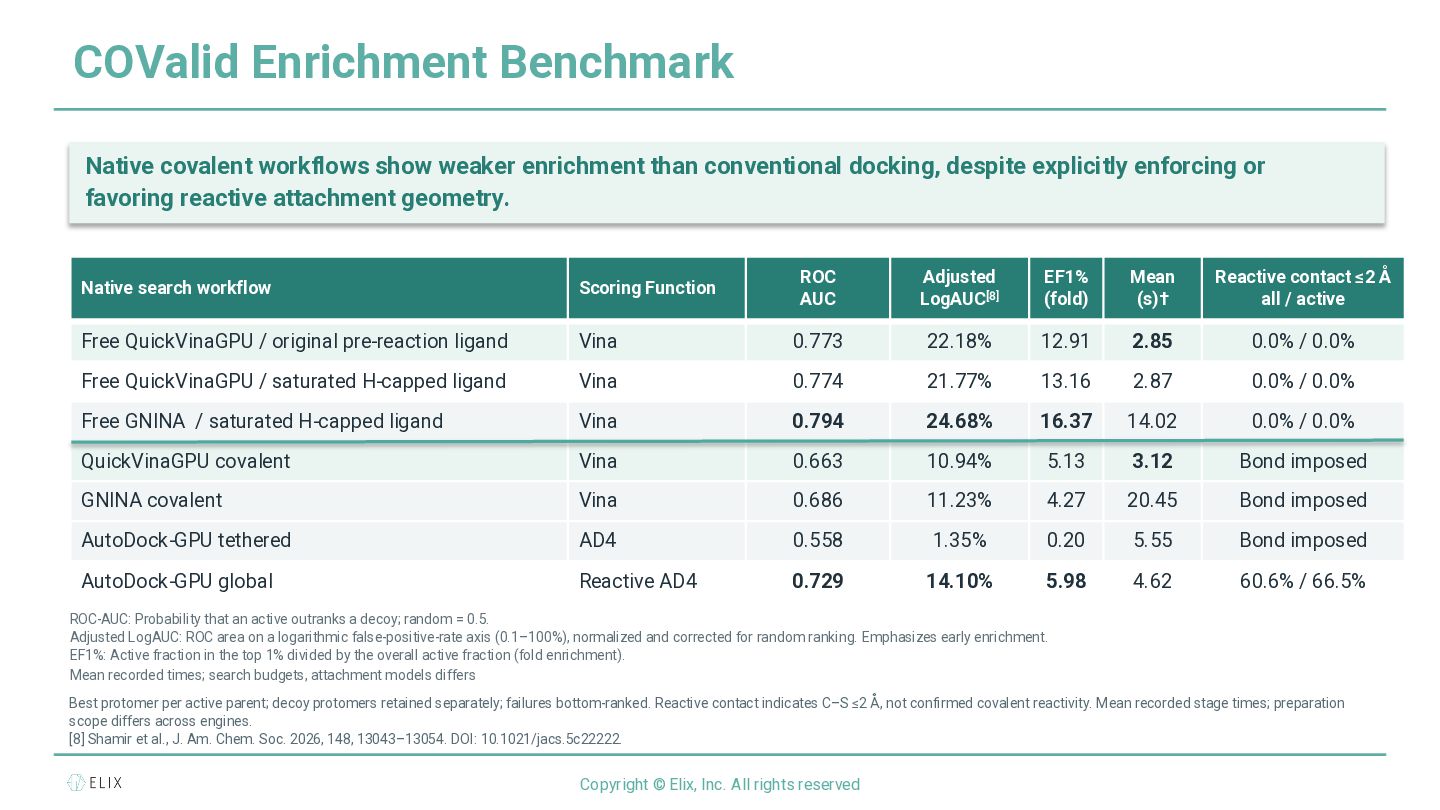
COValid Enrichment Benchmark Native covalent workflows show weaker enrichment than
conventional docking, despite explicitly enforcing or favoring reactive attachment geometry. Native search workflow Scoring Function ROC AUC Adjusted LogAUC[8] EF1% (fold) Mean (s)† Reactive contact ≤2 Å all / active Free QuickVinaGPU / original pre-reaction ligand Vina 0.773 22.18% 12.91 2.85 0.0% / 0.0% Free QuickVinaGPU / saturated H-capped ligand Vina 0.774 21.77% 13.16 2.87 0.0% / 0.0% Free GNINA / saturated H-capped ligand Vina 0.794 24.68% 16.37 14.02 0.0% / 0.0% QuickVinaGPU covalent Vina 0.663 10.94% 5.13 3.12 Bond imposed GNINA covalent Vina 0.686 11.23% 4.27 20.45 Bond imposed AutoDock-GPU tethered AD4 0.558 1.35% 0.20 5.55 Bond imposed AutoDock-GPU global Reactive AD4 0.729 14.10% 5.98 4.62 60.6% / 66.5% ROC-AUC: Probability that an active outranks a decoy; random = 0.5. Adjusted LogAUC: ROC area on a logarithmic false-positive-rate axis (0.1–100%), normalized and corrected for random ranking. Emphasizes early enrichment. EF1%: Active fraction in the top 1% divided by the overall active fraction (fold enrichment). Mean recorded times; search budgets, attachment models differs Best protomer per active parent; decoy protomers retained separately; failures bottom-ranked. Reactive contact indicates C–S ≤2 Å, not confirmed covalent reactivity. Mean recorded stage times; preparation scope differs across engines. [8] Shamir et al., J. Am. Chem. Soc. 2026, 148, 13043–13054. DOI: 10.1021/jacs.5c22222. Copyright © Elix, Inc. All rights reserved
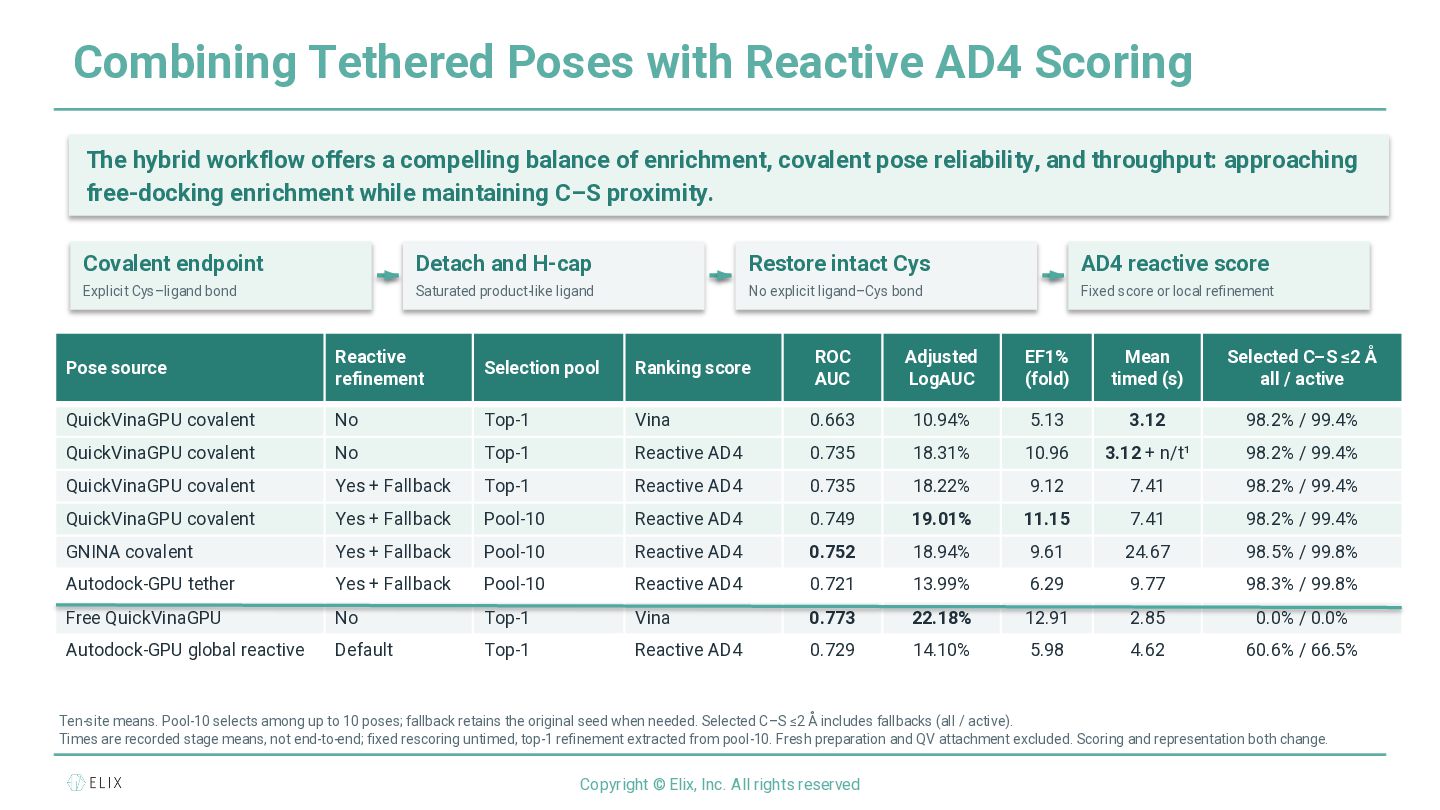
Combining Tethered Poses with Reactive AD4 Scoring The hybrid workflow
offers a compelling balance of enrichment, covalent pose reliability, and throughput: approaching free-docking enrichment while maintaining C–S proximity. Covalent endpoint Detach and H-cap Restore intact Cys AD4 reactive score Explicit Cys–ligand bond Saturated product-like ligand No explicit ligand–Cys bond Fixed score or local refinement Pose source Reactive refinement Selection pool Ranking score ROC AUC Adjusted LogAUC EF1% (fold) Mean timed (s) Selected C–S ≤2 Å all / active QuickVinaGPU covalent No Top-1 Vina 0.663 10.94% 5.13 3.12 98.2% / 99.4% QuickVinaGPU covalent No Top-1 Reactive AD4 0.735 18.31% 10.96 3.12 + n/t¹ 98.2% / 99.4% QuickVinaGPU covalent Yes + Fallback Top-1 Reactive AD4 0.735 18.22% 9.12 7.41 98.2% / 99.4% QuickVinaGPU covalent Yes + Fallback Pool-10 Reactive AD4 0.749 19.01% 11.15 7.41 98.2% / 99.4% GNINA covalent Yes + Fallback Pool-10 Reactive AD4 0.752 18.94% 9.61 24.67 98.5% / 99.8% Autodock-GPU tether Yes + Fallback Pool-10 Reactive AD4 0.721 13.99% 6.29 9.77 98.3% / 99.8% Free QuickVinaGPU No Top-1 Vina 0.773 22.18% 12.91 2.85 0.0% / 0.0% Autodock-GPU global reactive Default Top-1 Reactive AD4 0.729 14.10% 5.98 4.62 60.6% / 66.5% Ten-site means. Pool-10 selects among up to 10 poses; fallback retains the original seed when needed. Selected C–S ≤2 Å includes fallbacks (all / active). Times are recorded stage means, not end-to-end; fixed rescoring untimed, top-1 refinement extracted from pool-10. Fresh preparation and QV attachment excluded. Scoring and representation both change. Copyright © Elix, Inc. All rights reserved
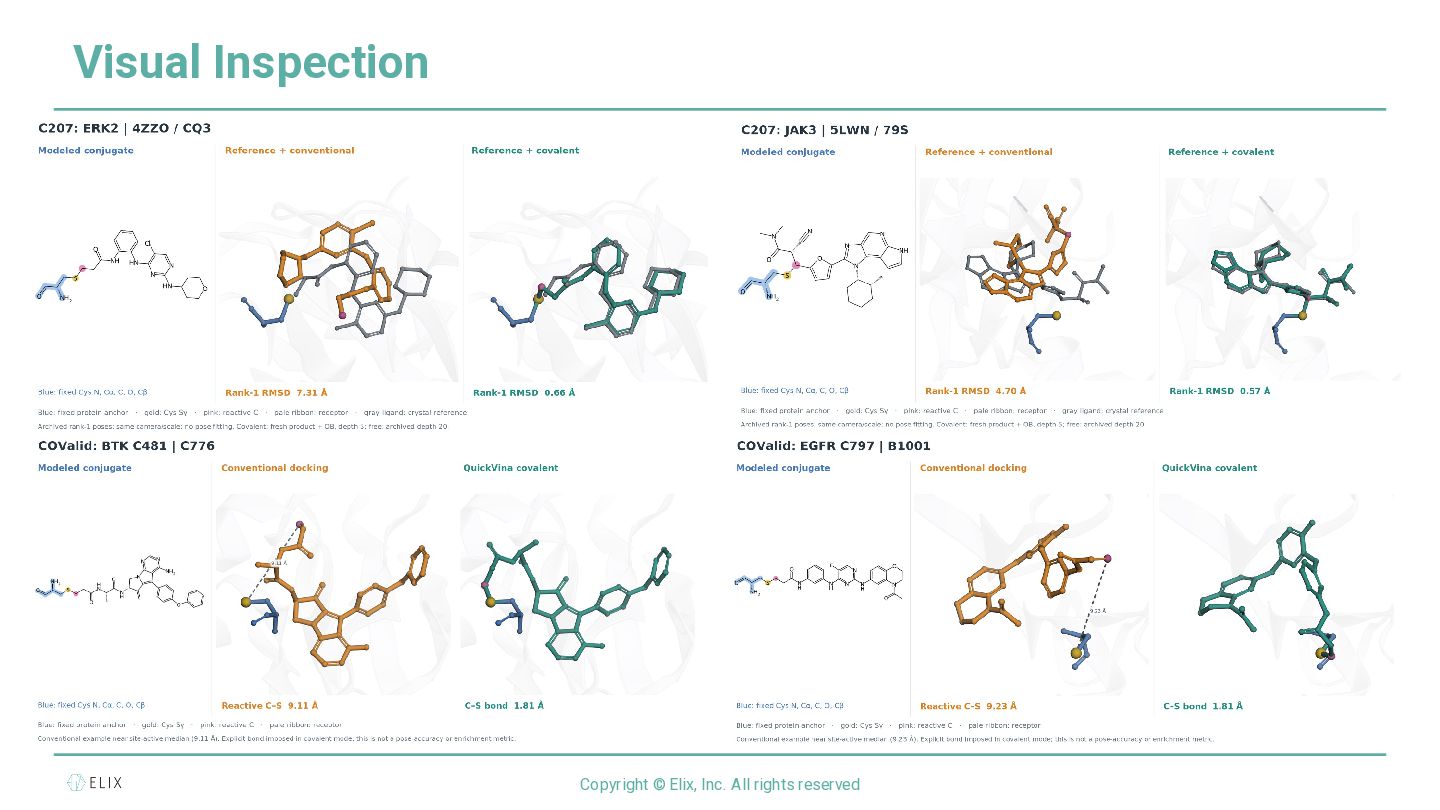
Visual Inspection Copyright © Elix, Inc. All rights reserved
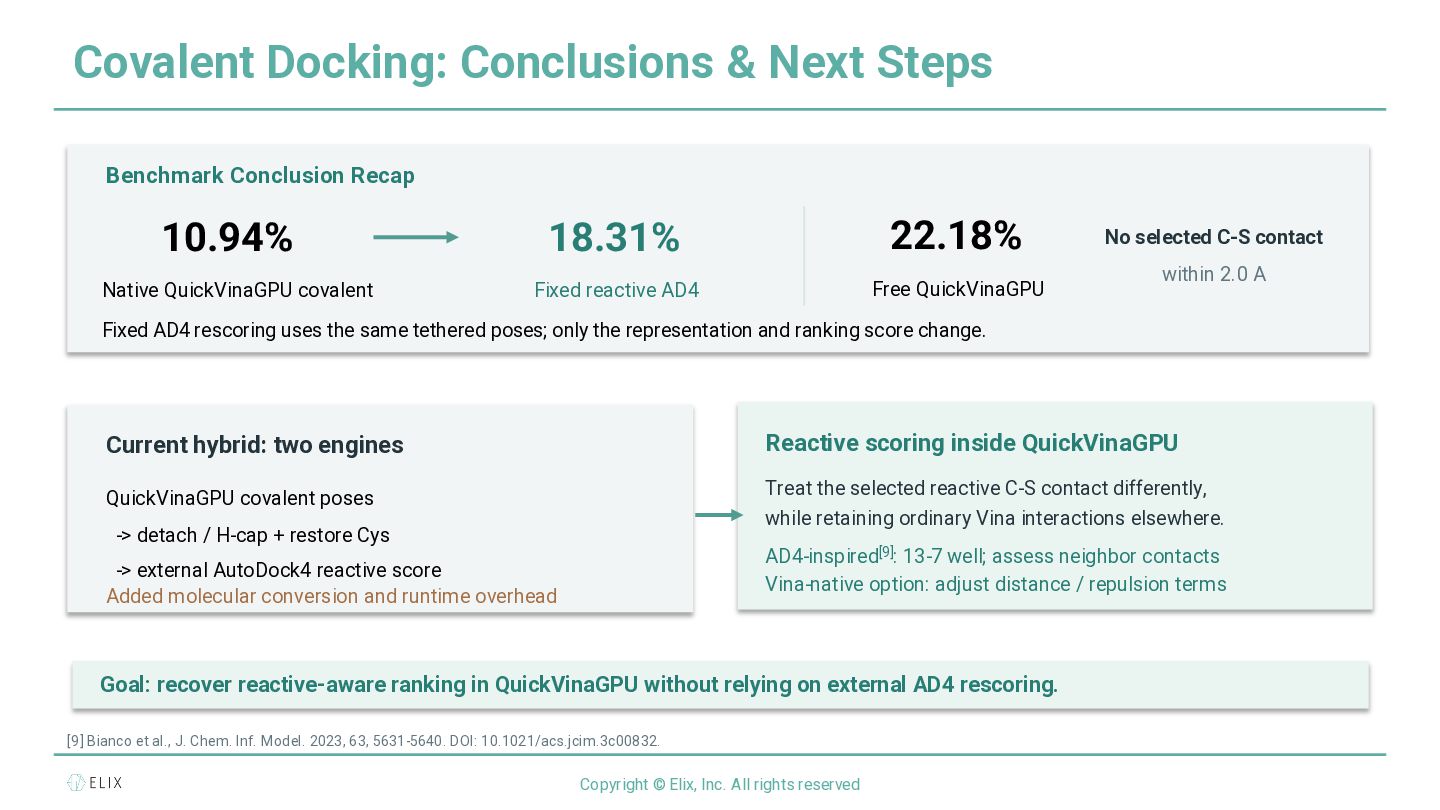
Covalent Docking: Conclusions & Next Steps Benchmark Conclusion Recap 10.94%
18.31% 22.18% Native QuickVinaGPU covalent Fixed reactive AD4 Free QuickVinaGPU No selected C-S contact within 2.0 A Fixed AD4 rescoring uses the same tethered poses; only the representation and ranking score change. Reactive scoring inside QuickVinaGPU Current hybrid: two engines Treat the selected reactive C-S contact differently, QuickVinaGPU covalent poses while retaining ordinary Vina interactions elsewhere. -> detach / H-cap + restore Cys AD4-inspired[9]: 13-7 well; assess neighbor contacts Vina-native option: adjust distance / repulsion terms -> external AutoDock4 reactive score Added molecular conversion and runtime overhead Goal: recover reactive-aware ranking in QuickVinaGPU without relying on external AD4 rescoring. [9] Bianco et al., J. Chem. Inf. Model. 2023, 63, 5631-5640. DOI: 10.1021/acs.jcim.3c00832. Copyright © Elix, Inc. All rights reserved
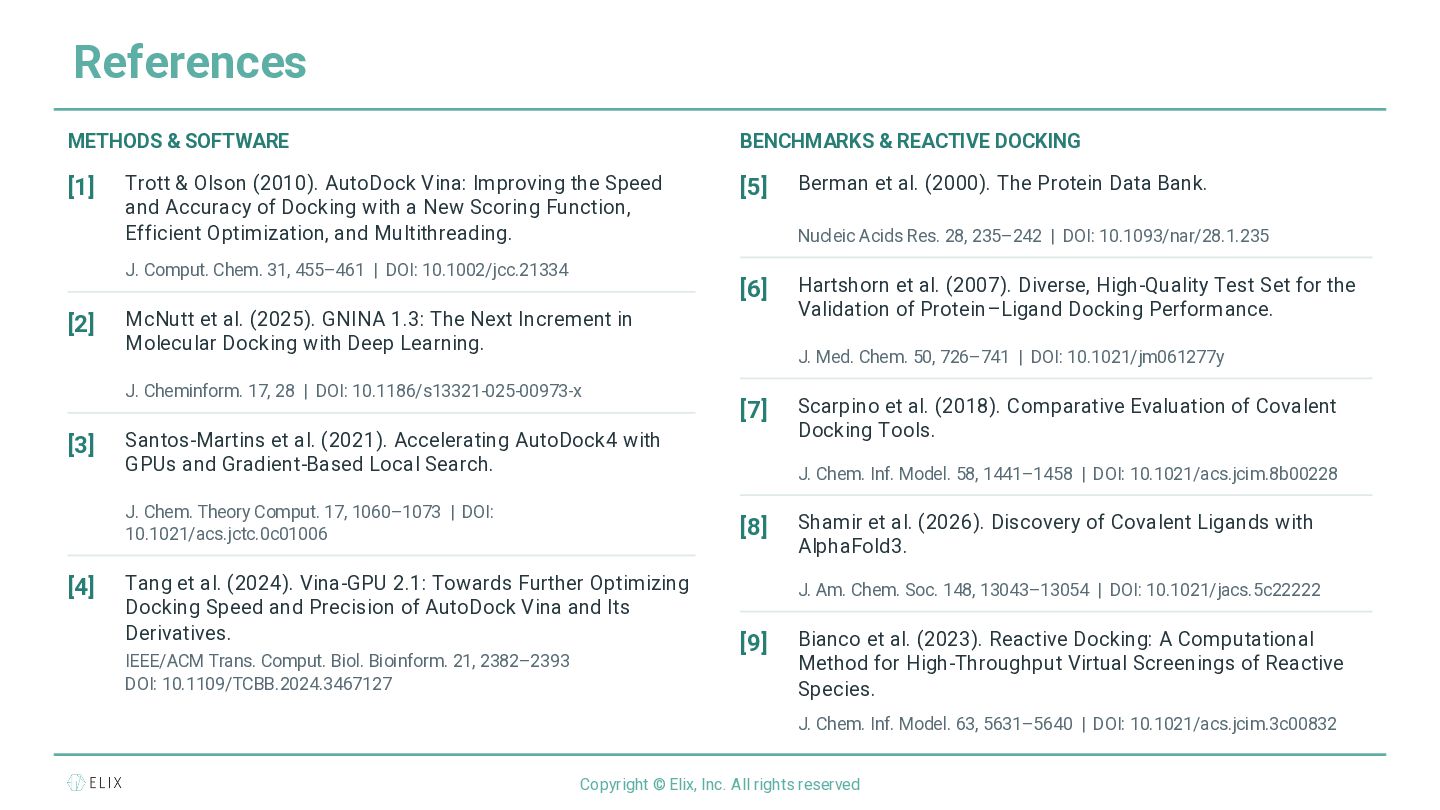
References METHODS & SOFTWARE [1] BENCHMARKS & REACTIVE DOCKING Trott
& Olson (2010). AutoDock Vina: Improving the Speed and Accuracy of Docking with a New Scoring Function, Efficient Optimization, and Multithreading. J. Comput. Chem. 31, 455–461 | DOI: 10.1002/jcc.21334 [2] McNutt et al. (2025). GNINA 1.3: The Next Increment in Molecular Docking with Deep Learning. [4] [7] IEEE/ACM Trans. Comput. Biol. Bioinform. 21, 2382–2393 DOI: 10.1109/TCBB.2024.3467127 Scarpino et al. (2018). Comparative Evaluation of Covalent Docking Tools. J. Chem. Inf. Model. 58, 1441–1458 | DOI: 10.1021/acs.jcim.8b00228 [8] Tang et al. (2024). Vina-GPU 2.1: Towards Further Optimizing Docking Speed and Precision of AutoDock Vina and Its Derivatives. Hartshorn et al. (2007). Diverse, High-Quality Test Set for the Validation of Protein–Ligand Docking Performance. J. Med. Chem. 50, 726–741 | DOI: 10.1021/jm061277y Santos-Martins et al. (2021). Accelerating AutoDock4 with GPUs and Gradient-Based Local Search. J. Chem. Theory Comput. 17, 1060–1073 | DOI: 10.1021/acs.jctc.0c01006 Berman et al. (2000). The Protein Data Bank. Nucleic Acids Res. 28, 235–242 | DOI: 10.1093/nar/28.1.235 [6] J. Cheminform. 17, 28 | DOI: 10.1186/s13321-025-00973-x [3] [5] Shamir et al. (2026). Discovery of Covalent Ligands with AlphaFold3. J. Am. Chem. Soc. 148, 13043–13054 | DOI: 10.1021/jacs.5c22222 [9] Bianco et al. (2023). Reactive Docking: A Computational Method for High-Throughput Virtual Screenings of Reactive Species. J. Chem. Inf. Model. 63, 5631–5640 | DOI: 10.1021/acs.jcim.3c00832 Copyright © Elix, Inc. All rights reserved


 elix
 nkzn
 hotchpotch
 cscengineer
 uhyo
 murachiakira
 dai08srhg
 sioncojp
 ikki0006
 takuros
 sh_fk2
 yoshidashingo
 tomoaki25
 bluesmoon
 keithpitt
 michielstock
 techseoconnect
 destraynor
 jakevdp
 sabderemane
 aleyda
 skipperchong
 mlcsv
 mza
 baasie