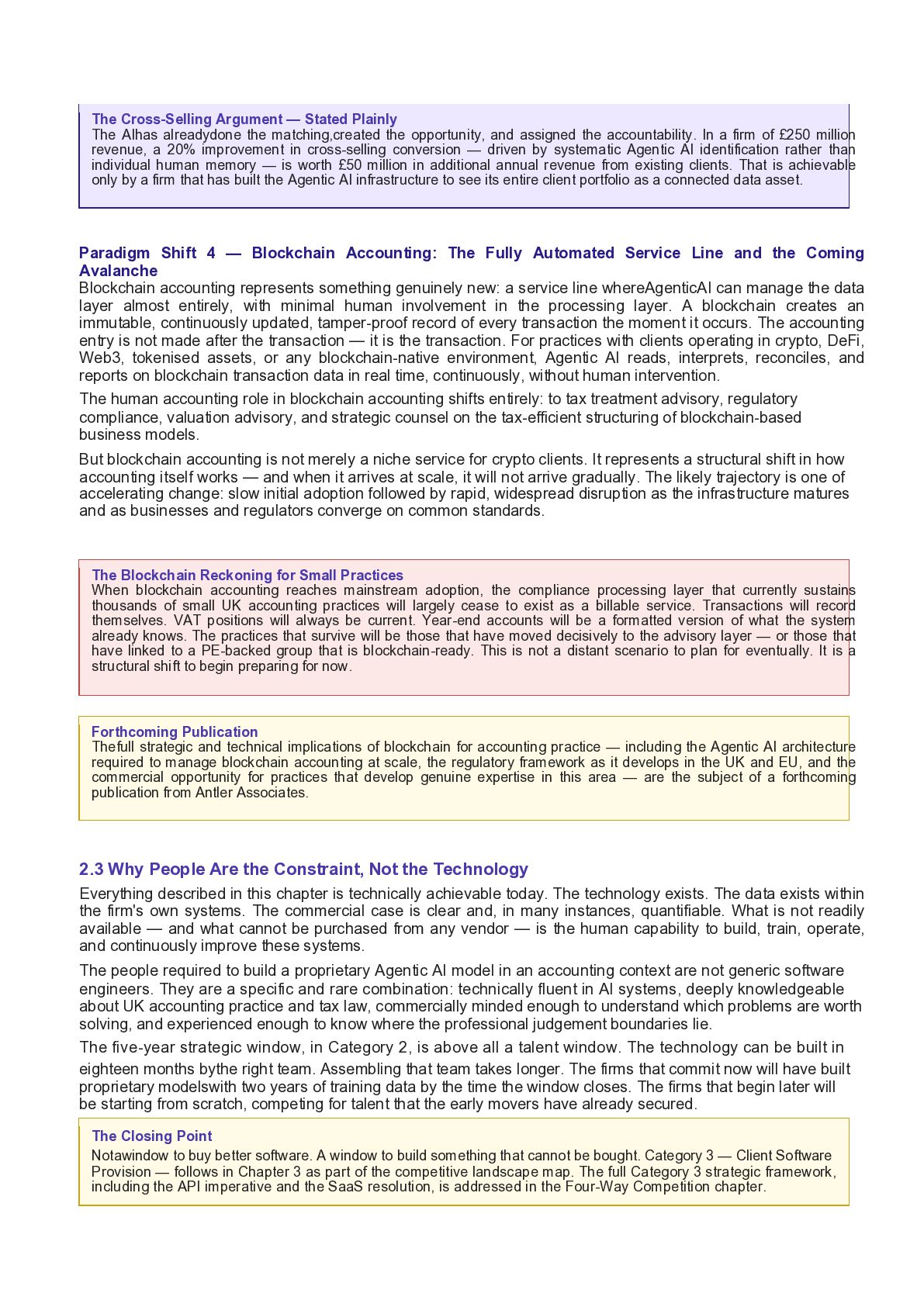
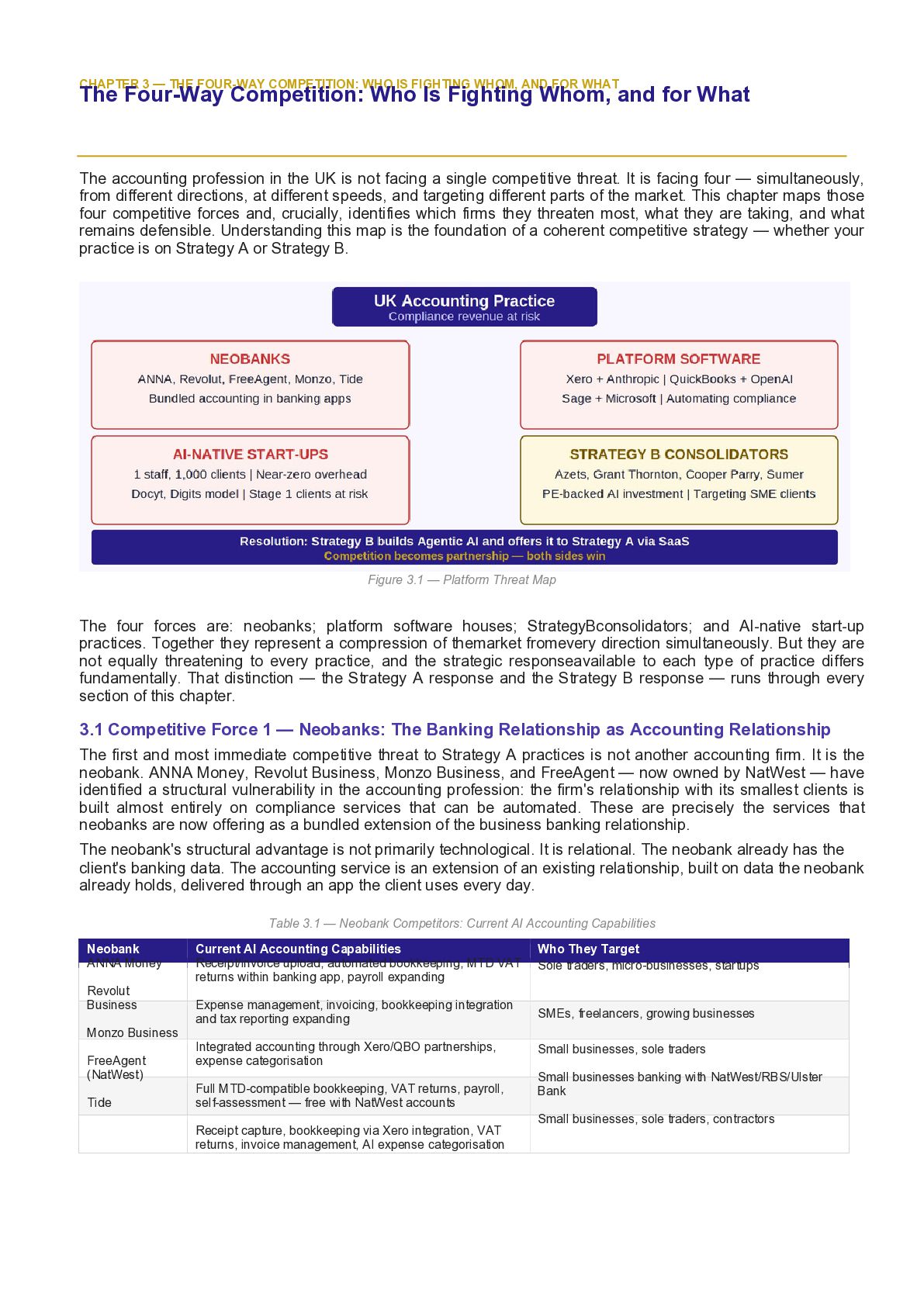
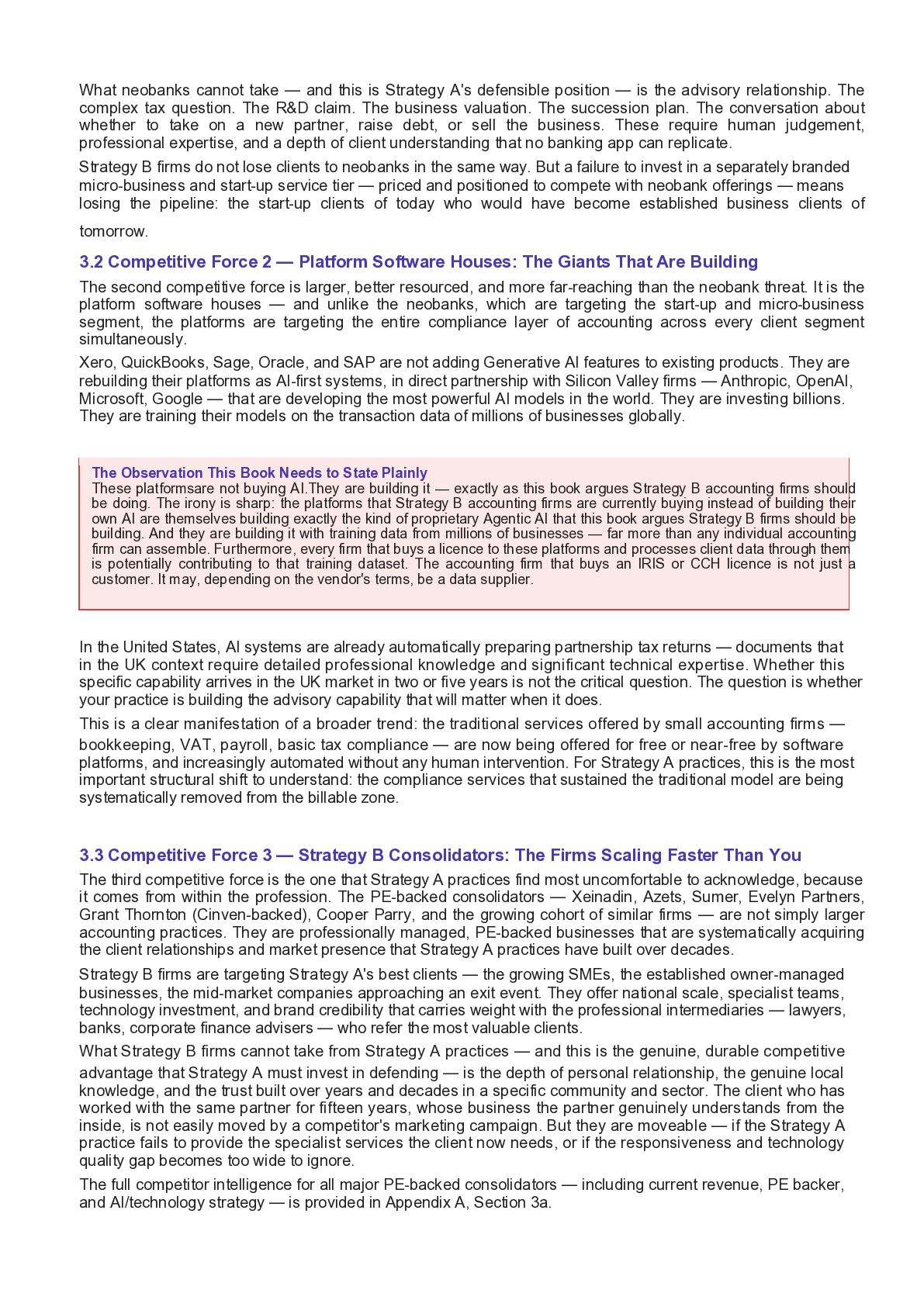
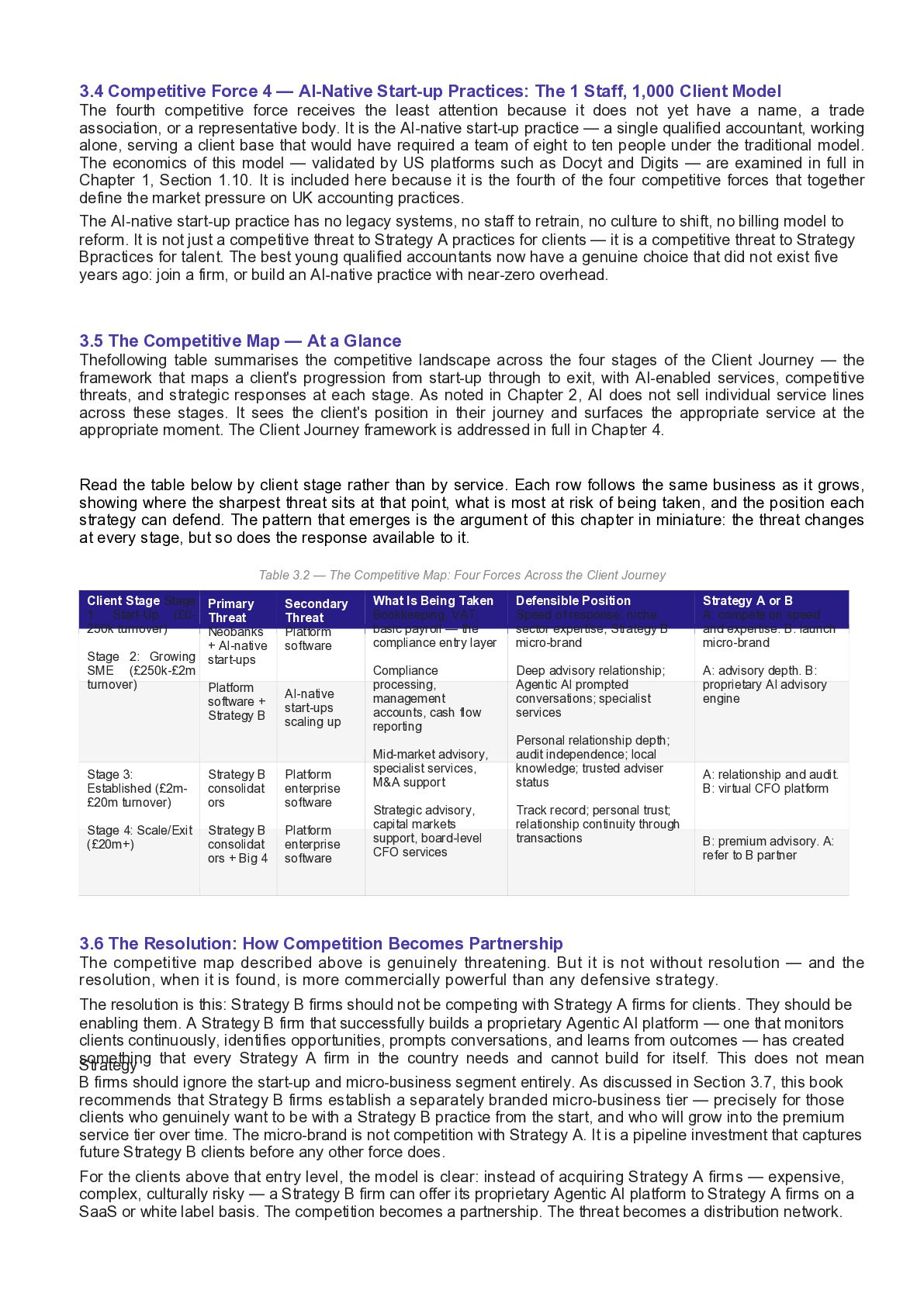
defensible position — is the advisory relationship. The complex tax question. The R&D claim. The business valuation. The succession plan. The conversation about whether to take on a new partner, raise debt, or sell the business. These require human judgement, professional expertise, and a depth of client understanding that no banking app can replicate. Strategy B firms do not lose clients to neobanks in the same way. But a failure to invest in a separately branded micro-business and start-up service tier — priced and positioned to compete with neobank offerings — means losing the pipeline: the start-up clients of today who would have become established business clients of tomorrow. 3.2 Competitive Force 2 — Platform Software Houses: The Giants That Are Building The second competitive force is larger, better resourced, and more far-reaching than the neobank threat. It is the platform software houses — and unlike the neobanks, which are targeting the start-up and micro-business segment, the platforms are targeting the entire compliance layer of accounting across every client segment simultaneously. Xero, QuickBooks, Sage, Oracle, and SAP are not adding Generative AI features to existing products. They are rebuilding their platforms as AI-first systems, in direct partnership with Silicon Valley firms — Anthropic, OpenAI, Microsoft, Google — that are developing the most powerful AI models in the world. They are investing billions. They are training their models on the transaction data of millions of businesses globally. The Observation This Book Needs to State Plainly These platformsare not buying AI.They are building it — exactly as this book argues Strategy B accounting firms should be doing. The irony is sharp: the platforms that Strategy B accounting firms are currently buying instead of building their own AI are themselves building exactly the kind of proprietary Agentic AI that this book argues Strategy B firms should be building. And they are building it with training data from millions of businesses — far more than any individual accounting firm can assemble. Furthermore, every firm that buys a licence to these platforms and processes client data through them is potentially contributing to that training dataset. The accounting firm that buys an IRIS or CCH licence is not just a customer. It may, depending on the vendor's terms, be a data supplier. In the United States, AI systems are already automatically preparing partnership tax returns — documents that in the UK context require detailed professional knowledge and significant technical expertise. Whether this specific capability arrives in the UK market in two or five years is not the critical question. The question is whether your practice is building the advisory capability that will matter when it does. This is a clear manifestation of a broader trend: the traditional services offered by small accounting firms — bookkeeping, VAT, payroll, basic tax compliance — are now being offered for free or near-free by software platforms, and increasingly automated without any human intervention. For Strategy A practices, this is the most important structural shift to understand: the compliance services that sustained the traditional model are being systematically removed from the billable zone. 3.3 Competitive Force 3 — Strategy B Consolidators: The Firms Scaling Faster Than You The third competitive force is the one that Strategy A practices find most uncomfortable to acknowledge, because it comes from within the profession. The PE-backed consolidators — Xeinadin, Azets, Sumer, Evelyn Partners, Grant Thornton (Cinven-backed), Cooper Parry, and the growing cohort of similar firms — are not simply larger accounting practices. They are professionally managed, PE-backed businesses that are systematically acquiring the client relationships and market presence that Strategy A practices have built over decades. Strategy B firms are targeting Strategy A's best clients — the growing SMEs, the established owner-managed businesses, the mid-market companies approaching an exit event. They offer national scale, specialist teams, technology investment, and brand credibility that carries weight with the professional intermediaries — lawyers, banks, corporate finance advisers — who refer the most valuable clients. What Strategy B firms cannot take from Strategy A practices — and this is the genuine, durable competitive advantage that Strategy A must invest in defending — is the depth of personal relationship, the genuine local knowledge, and the trust built over years and decades in a specific community and sector. The client who has worked with the same partner for fifteen years, whose business the partner genuinely understands from the inside, is not easily moved by a competitor's marketing campaign. But they are moveable — if the Strategy A practice fails to provide the specialist services the client now needs, or if the responsiveness and technology quality gap becomes too wide to ignore. The full competitor intelligence for all major PE-backed consolidators — including current revenue, PE backer, and AI/technology strategy — is provided in Appendix A, Section 3a.


 freshbookstree
 thoeni
 marktimemedia
 twada
 matthewcrist
 konakalab
 aleyda
 iamctodd
 akihiro_kokubo
 tmiket
 katarinadahlin
 cassininazir
 jonoalderson