½ hours per session • Meet on Sunday Evenings 7:00 with a hard stop at 8:30pm • Generally, each session will begin with a presentation followed by a Question & Answer period • Participation and questions are highly encouraged throughout each session. 3
although there is no single application. • Courtship is not specifically mandated in Scripture. • There is not a specific set of guidelines — each situation may be different. • No set of guidelines will lead to a perfect courtship. • A successful courtship may only lead to friendship. 5
the opposite sex • Courtship—one man, one woman working with their parents and/or other spiritual leaders to discern if they are life partners • Engagement—a couple and parents agree the couple should be life partners and are now entering a period to finalize preparations for marriage • Marriage—the consummation of the courtship as the couple commit to spend their lives together • Note: Older couples or different parental situations could lead to others being involved. Principle: seek wise counsel and protection. 6
“my” pleasure and entertainment – self-satisfaction: – Can have a more physical focus – Can lead to increased temptation – Can result in increased tension – Can lead to switching many partners over time – rehearsing divorce? • The increasing divorce rate indicates something may be wrong with this kind of “dating” as preparation for marriage. 7
limited commitment – Starts with physical appearance (Genesis 6:2) – Spiritual and, maybe, marriage responsibilities are faced later – Promotes physical and emotional involvement • When physical intimacy develops before spiritual intimacy, a cloud of guilt results between each one and the Lord. Physical involvement at this level leads to guilt and mistrust in marriage. • This harms communication and fellowship and can limit the couple’s further spiritual growth and intimacy. – There is a struggle to keep the original emotional feelings intact as the ‘romance’ wears off. • The real personality of each is unknown to the other • There can be a breakdown in communication and the feeling that each is a stranger to the other. • A coldness can develop between the couple and the roots of bitterness develop. • Feelings of guilt bring self-condemnation 8
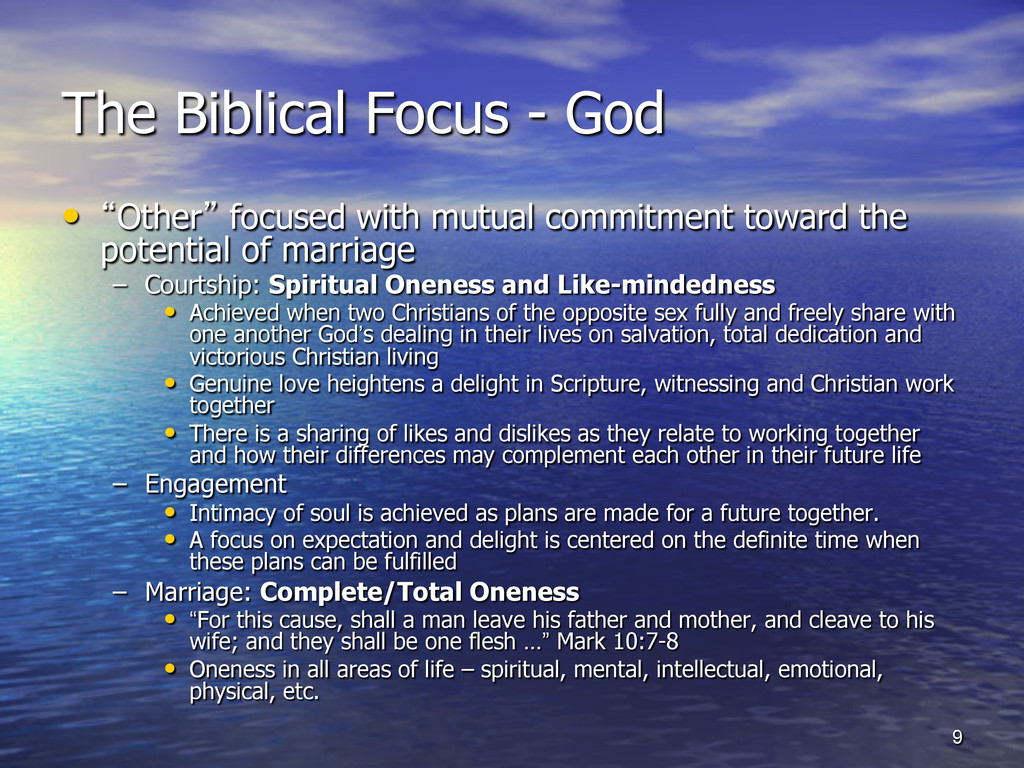
commitment toward the potential of marriage – Courtship: Spiritual Oneness and Like-mindedness • Achieved when two Christians of the opposite sex fully and freely share with one another God’s dealing in their lives on salvation, total dedication and victorious Christian living • Genuine love heightens a delight in Scripture, witnessing and Christian work together • There is a sharing of likes and dislikes as they relate to working together and how their differences may complement each other in their future life – Engagement • Intimacy of soul is achieved as plans are made for a future together. • A focus on expectation and delight is centered on the definite time when these plans can be fulfilled – Marriage: Complete/Total Oneness • “For this cause, shall a man leave his father and mother, and cleave to his wife; and they shall be one flesh …” Mark 10:7-8 • Oneness in all areas of life – spiritual, mental, intellectual, emotional, physical, etc. 9
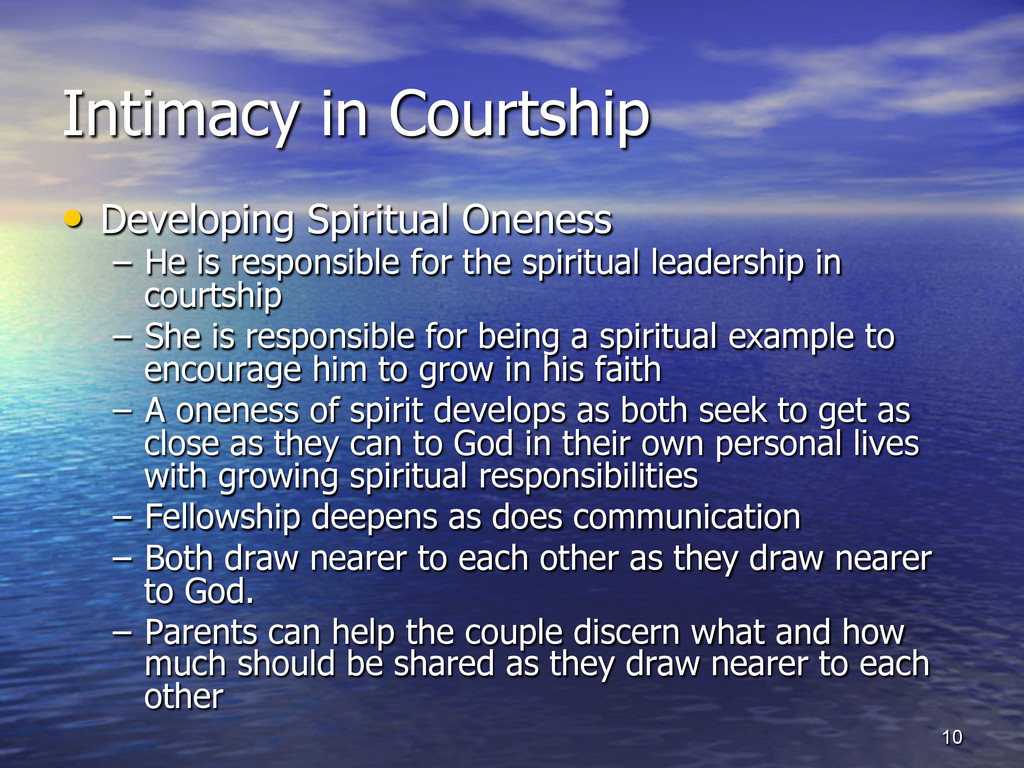
responsible for the spiritual leadership in courtship – She is responsible for being a spiritual example to encourage him to grow in his faith – A oneness of spirit develops as both seek to get as close as they can to God in their own personal lives with growing spiritual responsibilities – Fellowship deepens as does communication – Both draw nearer to each other as they draw nearer to God. – Parents can help the couple discern what and how much should be shared as they draw nearer to each other 10
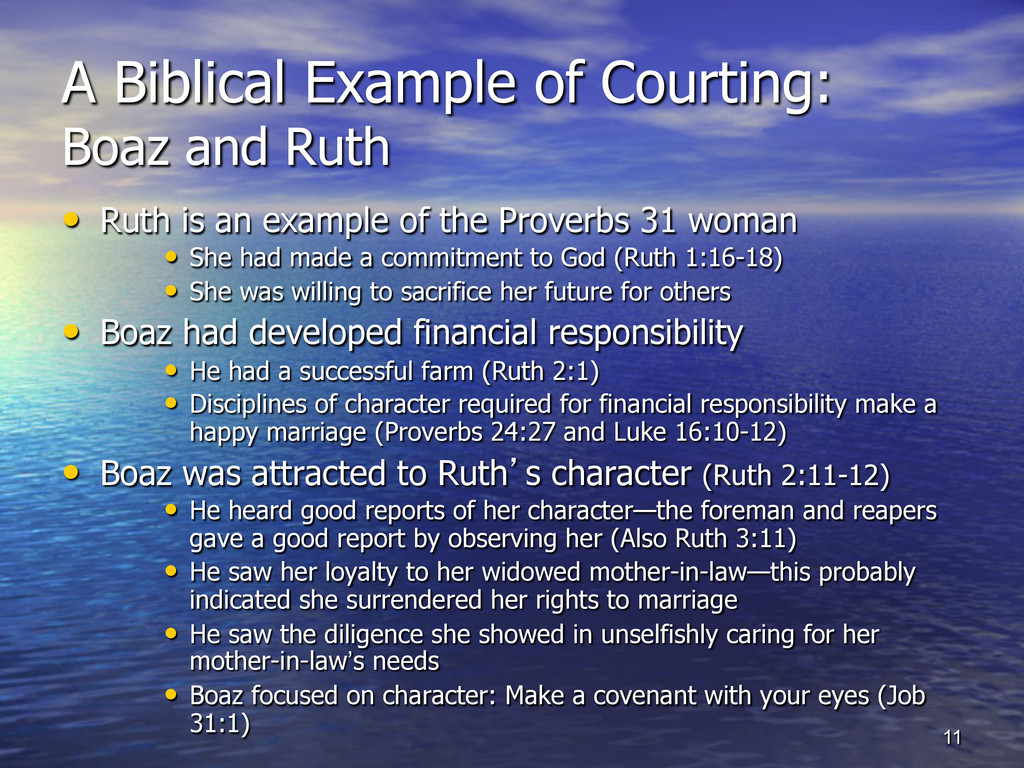
is an example of the Proverbs 31 woman • She had made a commitment to God (Ruth 1:16-18) • She was willing to sacrifice her future for others • Boaz had developed financial responsibility • He had a successful farm (Ruth 2:1) • Disciplines of character required for financial responsibility make a happy marriage (Proverbs 24:27 and Luke 16:10-12) • Boaz was attracted to Ruth’s character (Ruth 2:11-12) • He heard good reports of her character—the foreman and reapers gave a good report by observing her (Also Ruth 3:11) • He saw her loyalty to her widowed mother-in-law—this probably indicated she surrendered her rights to marriage • He saw the diligence she showed in unselfishly caring for her mother-in-law’s needs • Boaz focused on character: Make a covenant with your eyes (Job 31:1) 11
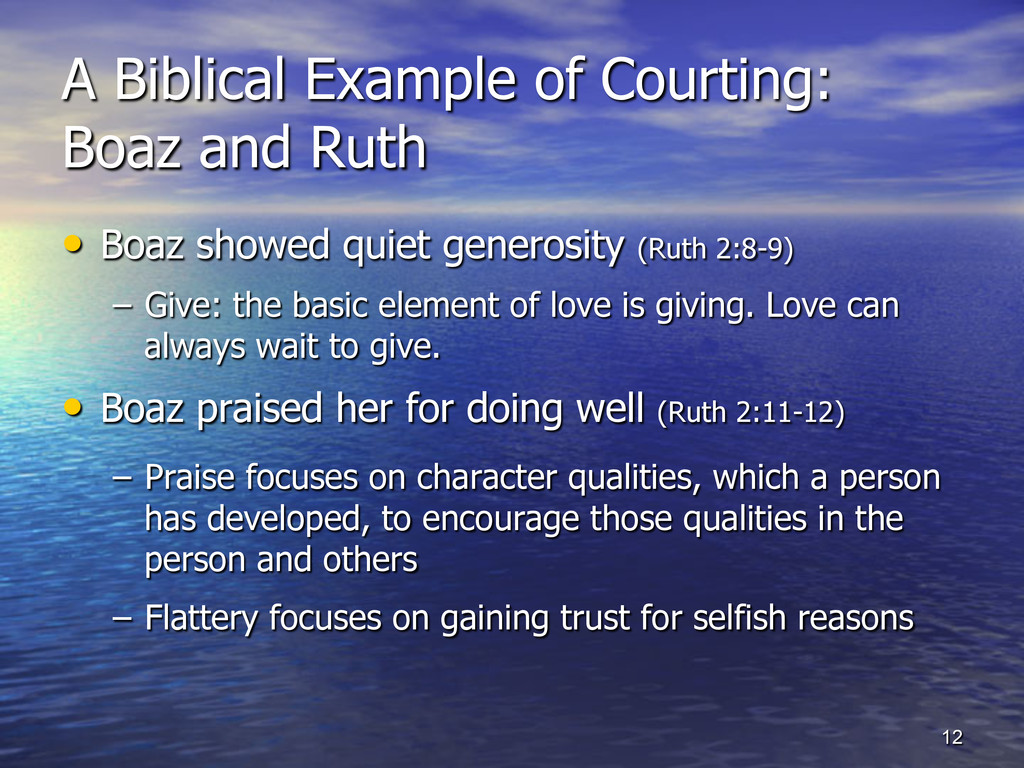
showed quiet generosity (Ruth 2:8-9) – Give: the basic element of love is giving. Love can always wait to give. • Boaz praised her for doing well (Ruth 2:11-12) – Praise focuses on character qualities, which a person has developed, to encourage those qualities in the person and others – Flattery focuses on gaining trust for selfish reasons 12
recognized marriage responsibilities (Ruth 3:12-13) – These can drive God’s timing – Be decisive • Boaz and Ruth worked through their authorities (Ruth 3:1-5; 4:1-12) – The parents are the typical authority (Exodus 22:17; Eph 6:2-3) • Full approval first (Ruth 4:1-10) – Avoid all appearance of evil (1 Thess 5:22) • Marriage (Ruth 4:13) 13
make me a match!” Parents are not Yentas. – The Lord should be the matchmaker (Genesis 24:12-27) – But, parents know their children and can discern wrong motives, readiness for marriage, timing, and character flaws of both • A sure path to marriage – A successful outcome is not defined by marriage: discerning God’s life partner is – It’s better to end a courtship early when it’s apparent to either person this is not the life partner or the right timing 14
Growing Christian—prepared to be a spiritual leader • Spiritually mature, in the Word daily, committed to prayer, delights in worship, solves problems biblically, serves others, etc. • Not perfect, but willing to grow and change. – Financial responsibility and industriousness – able to support a wife and children – Under authority – Godly character in place – Self control – Morally pure – Parents think he’s ready, if not, why not? – Parents approve of the young lady, if not, why not? 15
Growing Christian—prepared to be a spiritual support and encouragement • Spiritually mature, in the Word daily, committed to prayer, delights in worship, solves problems biblically, serves others, etc. • Not perfect, but willing to grow and change. – Prepared to be a homemaker – Under authority – Godly character in place – Morally pure – Self control – Parents think she’s ready, if not why? – Parents approve the young man, if not why? 16
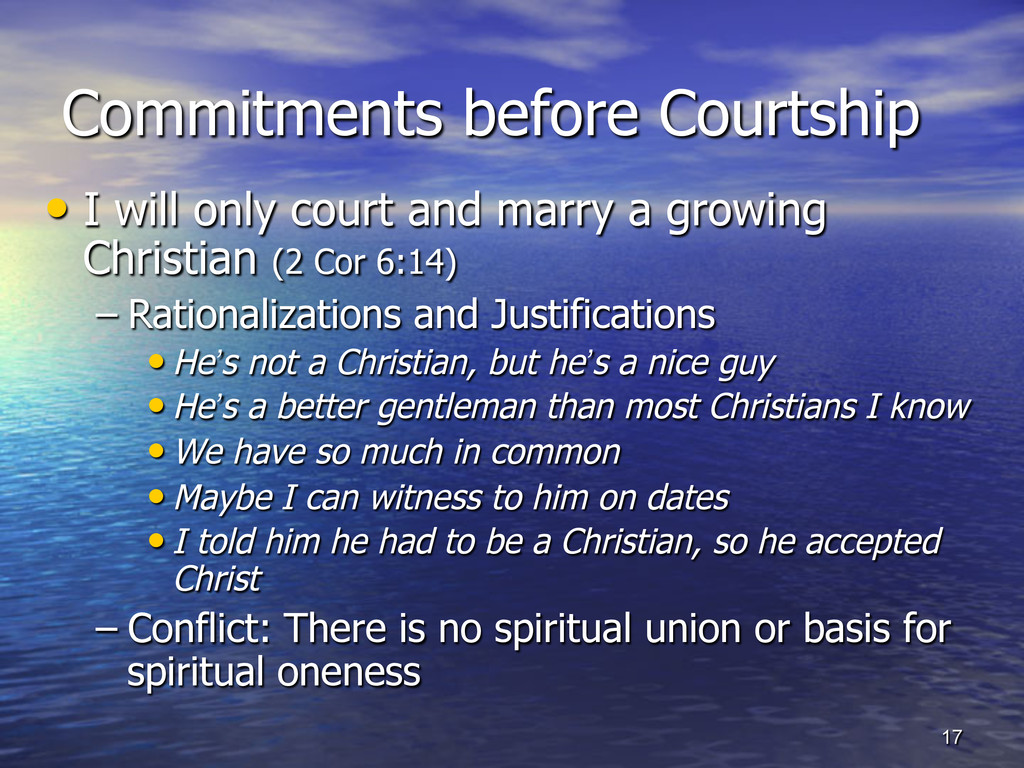
growing Christian (2 Cor 6:14) – Rationalizations and Justifications • He’s not a Christian, but he’s a nice guy • He’s a better gentleman than most Christians I know • We have so much in common • Maybe I can witness to him on dates • I told him he had to be a Christian, so he accepted Christ – Conflict: There is no spiritual union or basis for spiritual oneness 17
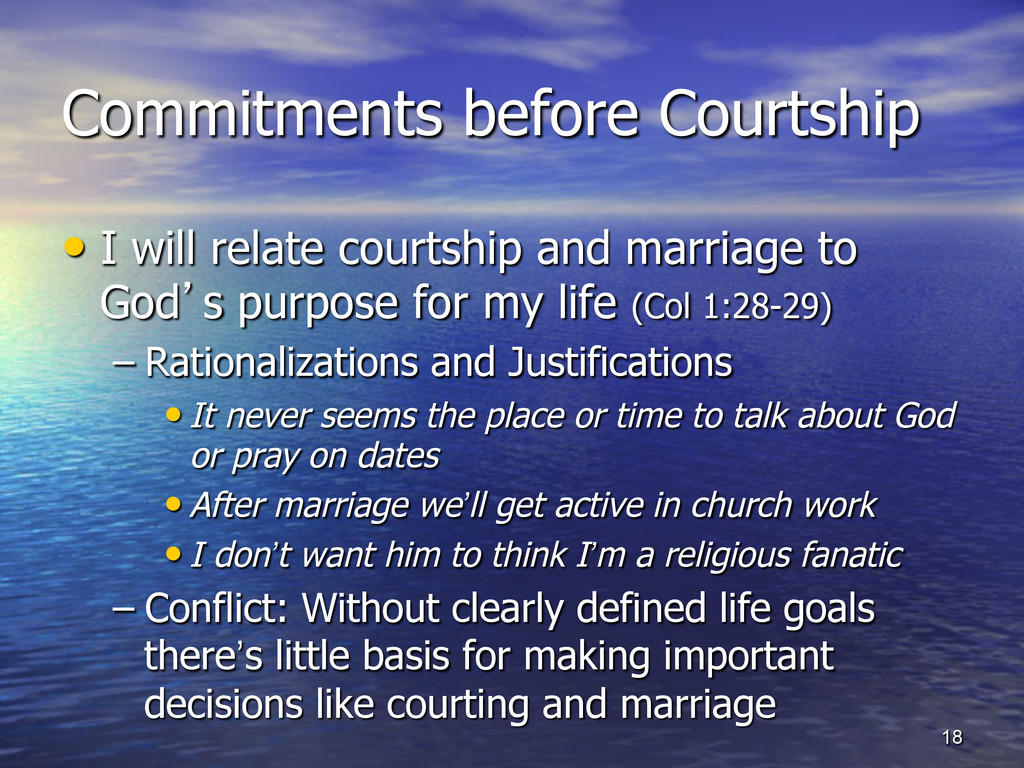
God’s purpose for my life (Col 1:28-29) – Rationalizations and Justifications • It never seems the place or time to talk about God or pray on dates • After marriage we’ll get active in church work • I don’t want him to think I’m a religious fanatic – Conflict: Without clearly defined life goals there’s little basis for making important decisions like courting and marriage 18
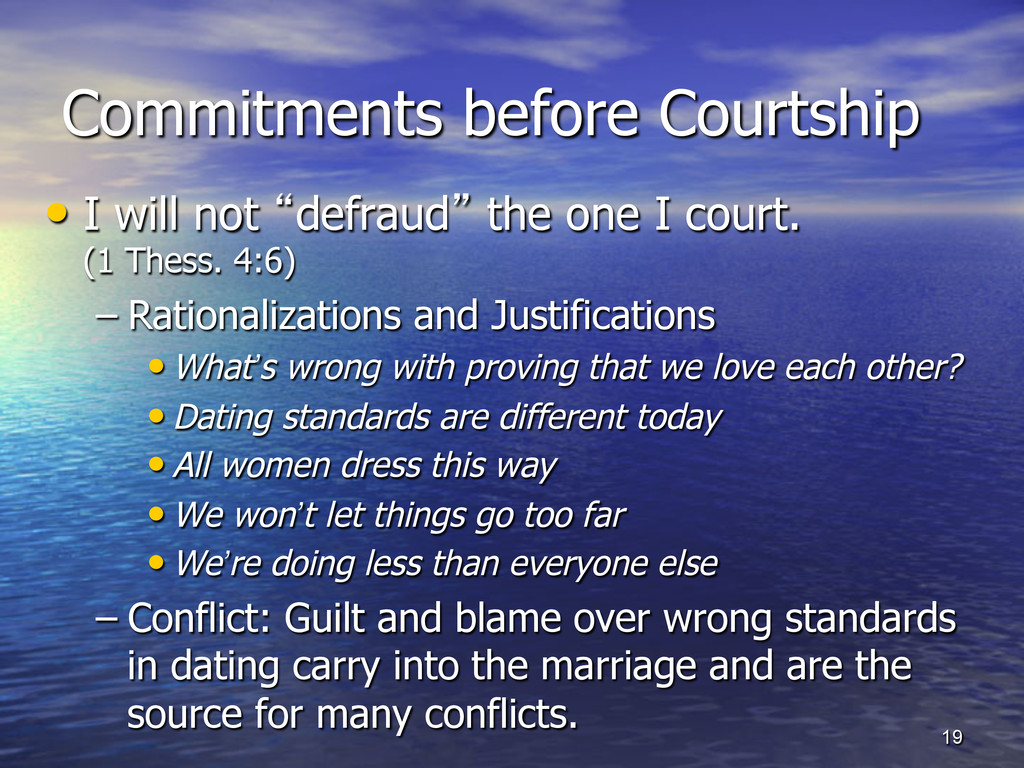
court. (1 Thess. 4:6) – Rationalizations and Justifications • What’s wrong with proving that we love each other? • Dating standards are different today • All women dress this way • We won’t let things go too far • We’re doing less than everyone else – Conflict: Guilt and blame over wrong standards in dating carry into the marriage and are the source for many conflicts. 19
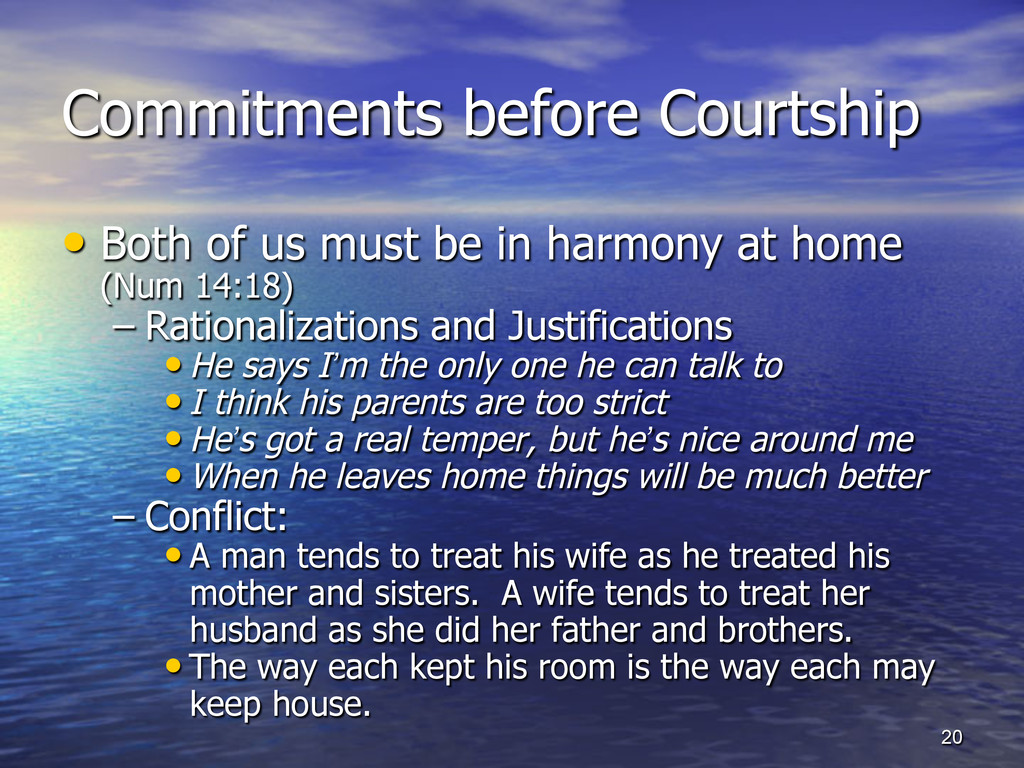
at home (Num 14:18) – Rationalizations and Justifications • He says I’m the only one he can talk to • I think his parents are too strict • He’s got a real temper, but he’s nice around me • When he leaves home things will be much better – Conflict: • A man tends to treat his wife as he treated his mother and sisters. A wife tends to treat her husband as she did her father and brothers. • The way each kept his room is the way each may keep house. 20
our marriage (Gen 29:20) – Rationalizations and Justifications • We’re old enough to make our own decisions • We’ll manage somehow – Conflict: • Dangerous stress is added to the marriage. • Impatience is a sign of self-love or immaturity since love is always patient and kind. “Lust can’t wait to get, love can’t wait to give.” (1 Cor 13) 21
court and marry (1 Cor 7:32, Matt 6:33, Lam 3:24-40) – Rationalizations and Justifications • I want to get married when I want • I’m unwilling to spend my life single • People will think badly of me if I’m not married – Conflict: Essential training and experience are lost when the responsibilities of a premature marriage crowd out Christian ministry. 22
I can be content in Christ alone (Phil 4:19) – God will bring the right life partner into your life at the right time OR – He will give you the strength to serve Him without a life partner - single. 23
more than ourselves • Courting makes use of the authorities that God has put in in our lives—primarily parents, but can also include family, church leaders and others—for protection and wise counsel • Courting helps avoid the appearance of evil and protection from temptation • The focus is on glorifying God 24
Parents – Role of Daughter’s Parents – The courting process – Questions about courting, for example: • How does a couple get to courting when they don’t know each other well enough? • When do the parents know the couple can start courting? 25


 gbfc
 jnunemaker
 codingconduct
 jeffersonlam
 mayunak
 axbom
 hannesfritz
 addyosmani
 nonsquared
 marcelosomers
 jonoalderson
 kastner