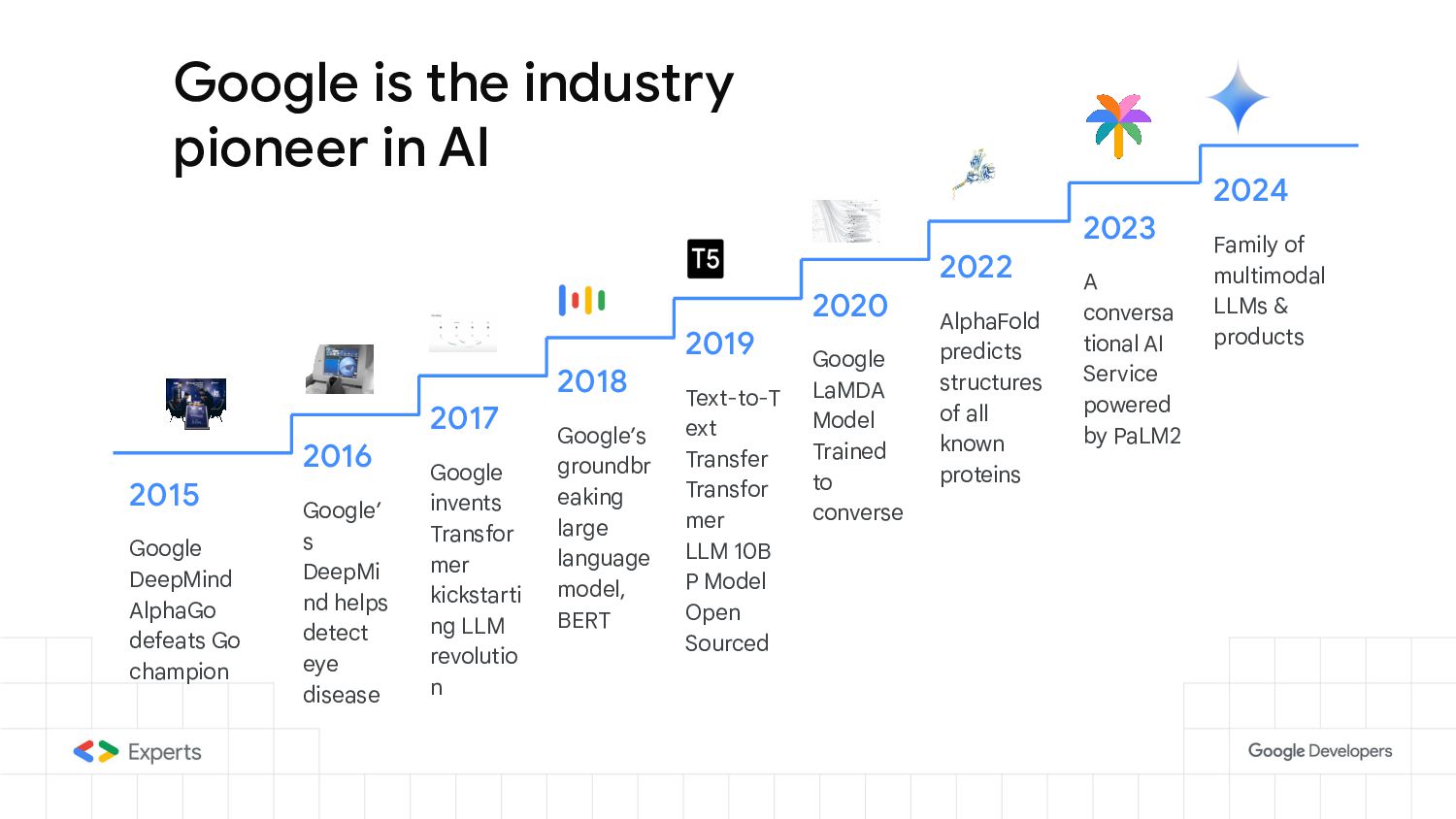
AlphaGo defeats Go champion 2016 Google’ s DeepMi nd helps detect eye disease 2017 Google invents Transfor mer kickstarti ng LLM revolutio n 2018 Google’s groundbr eaking large language model, BERT 2019 Text-to-T ext Transfer Transfor mer LLM 10B P Model Open Sourced 2020 Google LaMDA Model Trained to converse 2022 AlphaFold predicts structures of all known proteins 2023 A conversa tional AI Service powered by PaLM2 2024 Family of multimodal LLMs & products
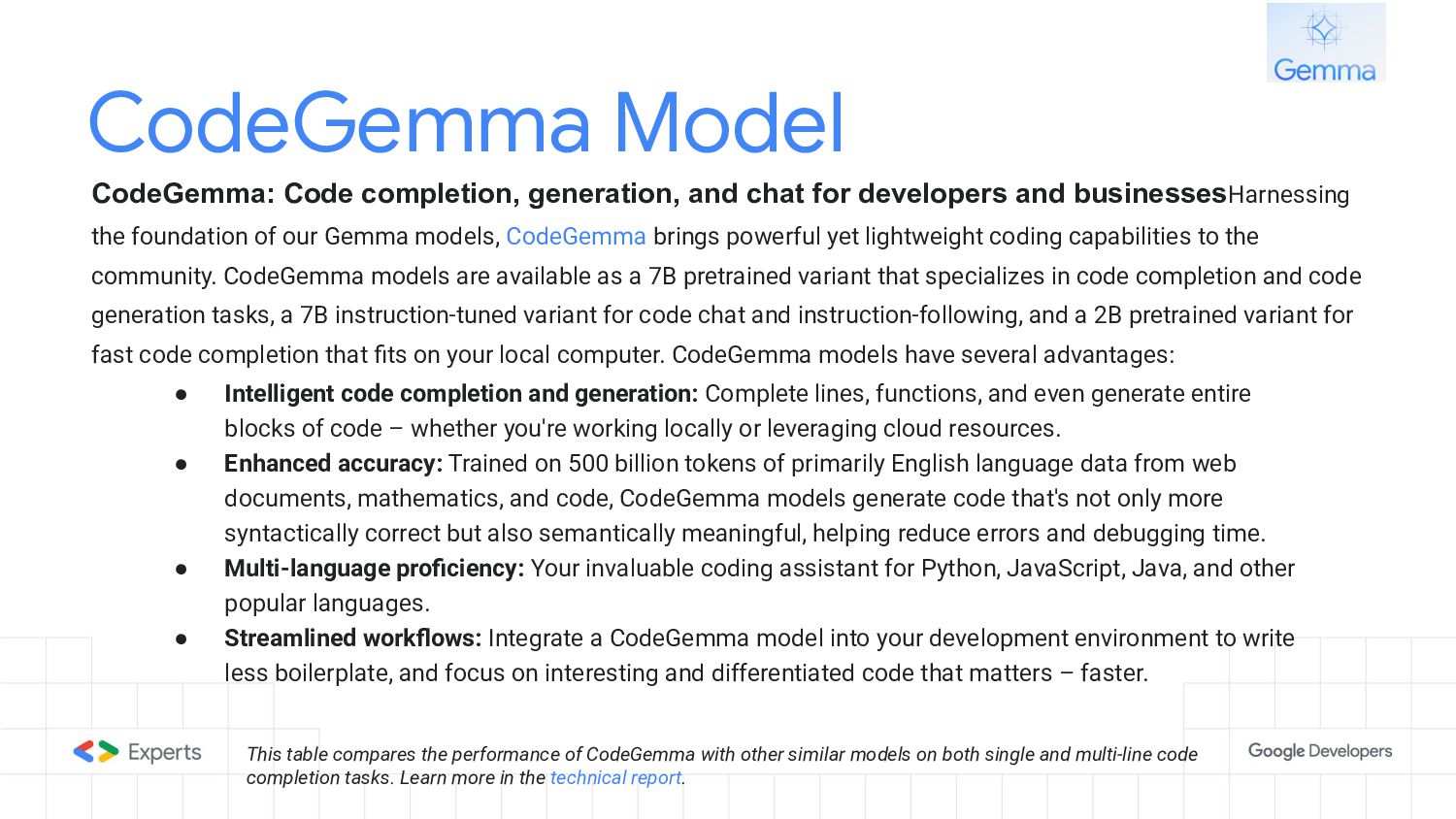
and businessesHarnessing the foundation of our Gemma models, CodeGemma brings powerful yet lightweight coding capabilities to the community. CodeGemma models are available as a 7B pretrained variant that specializes in code completion and code generation tasks, a 7B instruction-tuned variant for code chat and instruction-following, and a 2B pretrained variant for fast code completion that fits on your local computer. CodeGemma models have several advantages: • Intelligent code completion and generation: Complete lines, functions, and even generate entire blocks of code – whether you're working locally or leveraging cloud resources. • Enhanced accuracy: Trained on 500 billion tokens of primarily English language data from web documents, mathematics, and code, CodeGemma models generate code that's not only more syntactically correct but also semantically meaningful, helping reduce errors and debugging time. • Multi-language proficiency: Your invaluable coding assistant for Python, JavaScript, Java, and other popular languages. • Streamlined workflows: Integrate a CodeGemma model into your development environment to write less boilerplate, and focus on interesting and differentiated code that matters – faster. This table compares the performance of CodeGemma with other similar models on both single and multi-line code completion tasks. Learn more in the technical report.
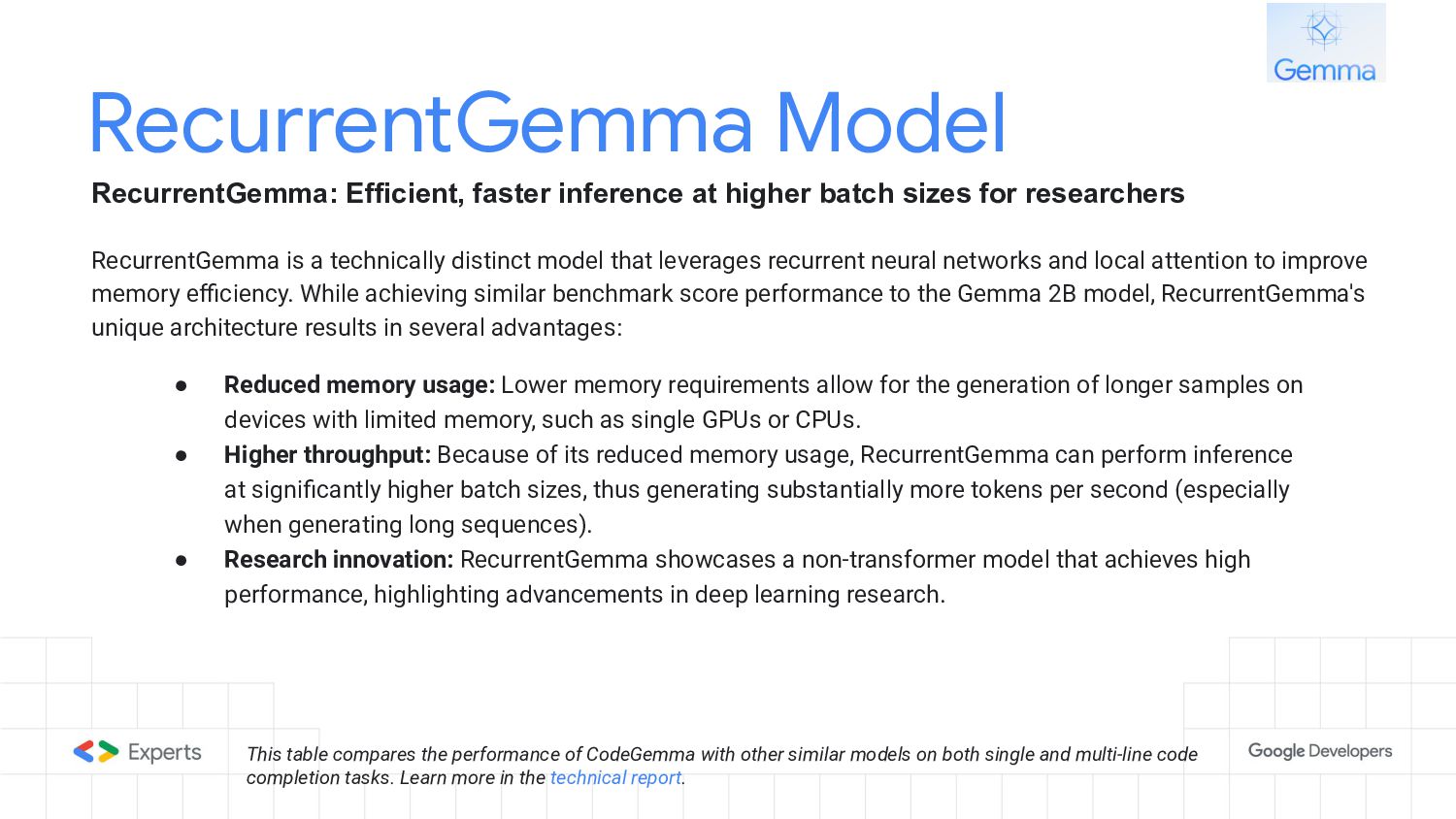
for researchers RecurrentGemma is a technically distinct model that leverages recurrent neural networks and local attention to improve memory efficiency. While achieving similar benchmark score performance to the Gemma 2B model, RecurrentGemma's unique architecture results in several advantages: • Reduced memory usage: Lower memory requirements allow for the generation of longer samples on devices with limited memory, such as single GPUs or CPUs. • Higher throughput: Because of its reduced memory usage, RecurrentGemma can perform inference at significantly higher batch sizes, thus generating substantially more tokens per second (especially when generating long sequences). • Research innovation: RecurrentGemma showcases a non-transformer model that achieves high performance, highlighting advancements in deep learning research. This table compares the performance of CodeGemma with other similar models on both single and multi-line code completion tasks. Learn more in the technical report.
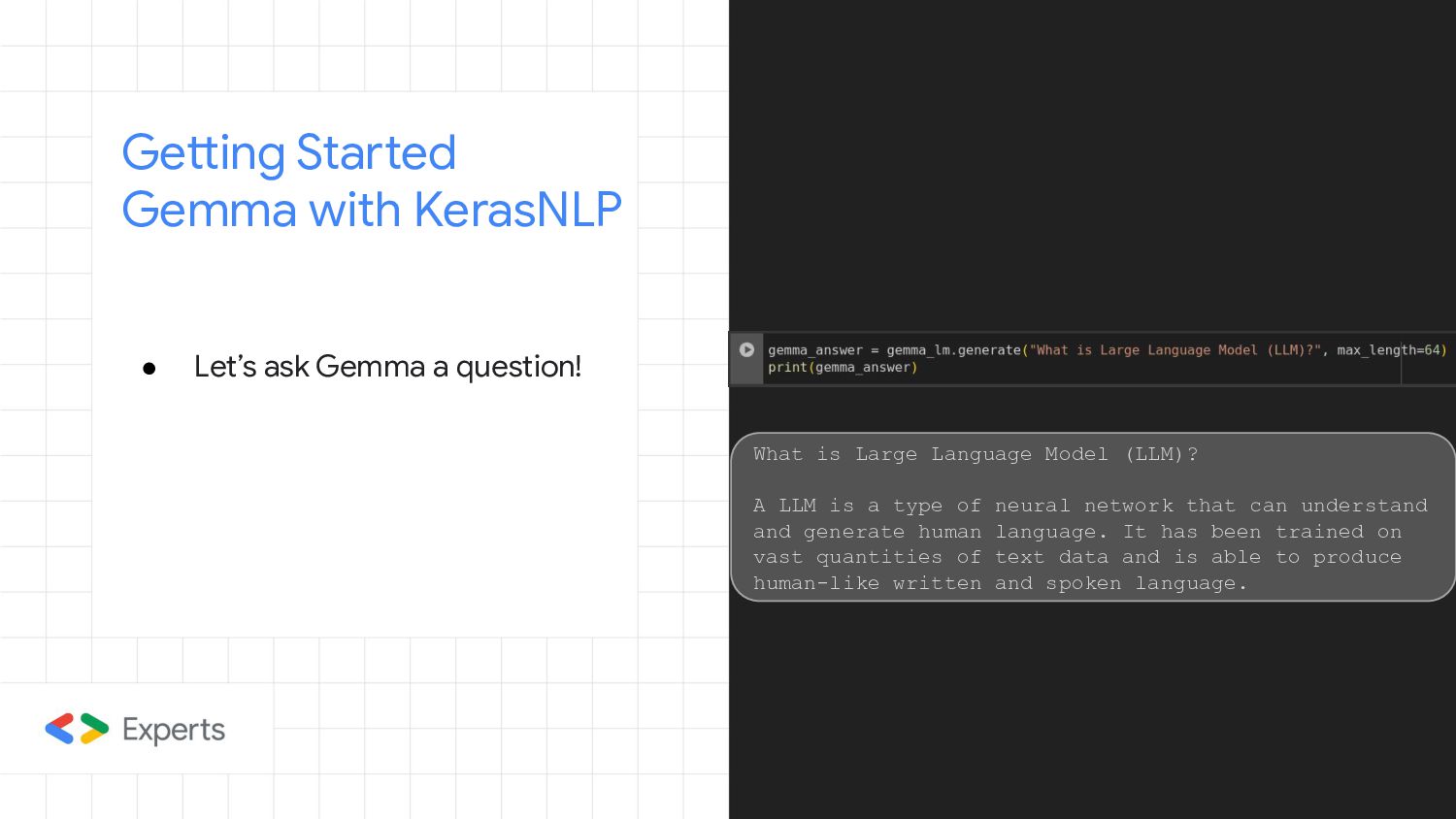
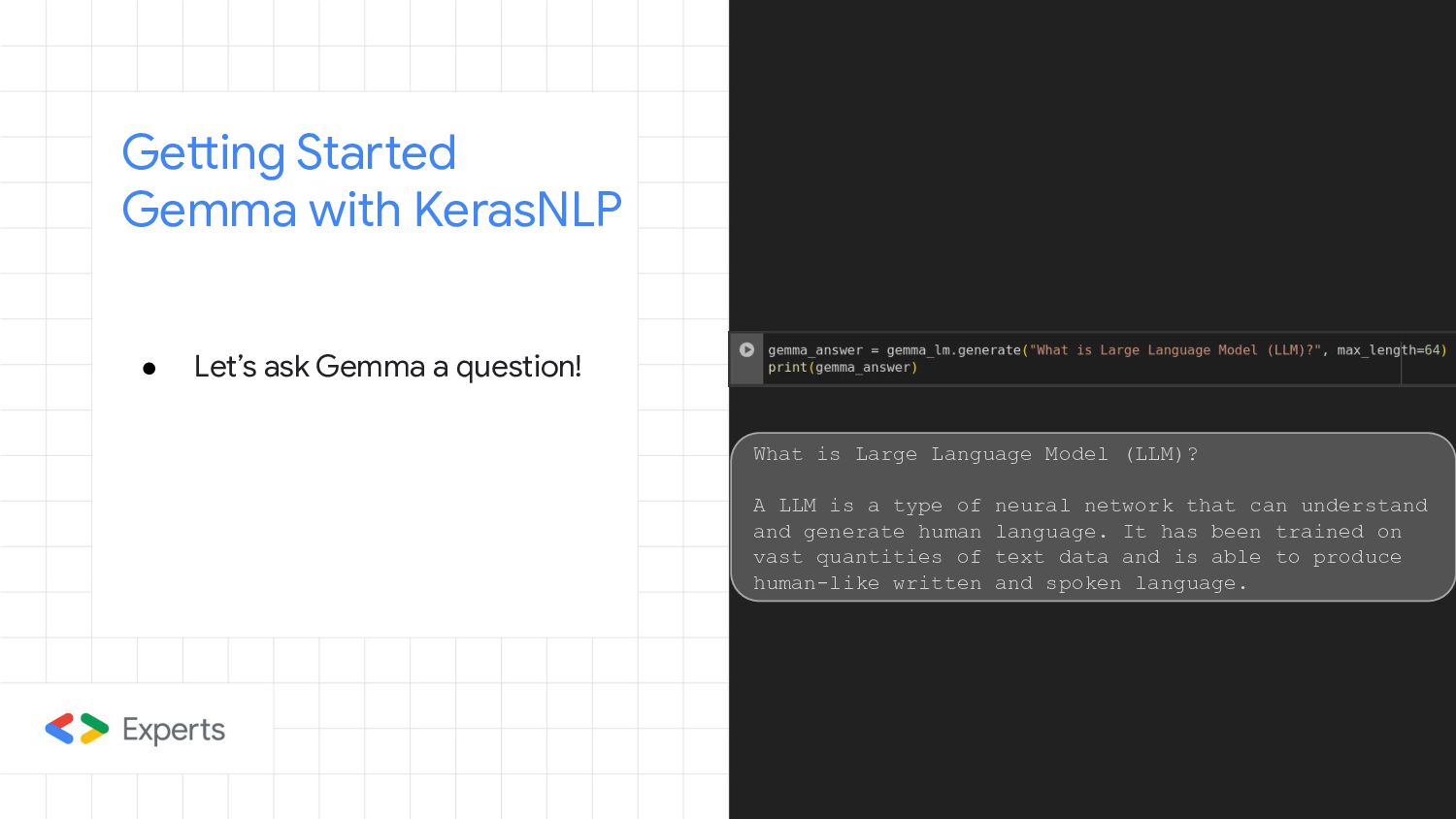
KerasNLP What is Large Language Model (LLM)? A LLM is a type of neural network that can understand and generate human language. It has been trained on vast quantities of text data and is able to produce human-like written and spoken language.
KerasNLP What is Large Language Model (LLM)? A LLM is a type of neural network that can understand and generate human language. It has been trained on vast quantities of text data and is able to produce human-like written and spoken language.
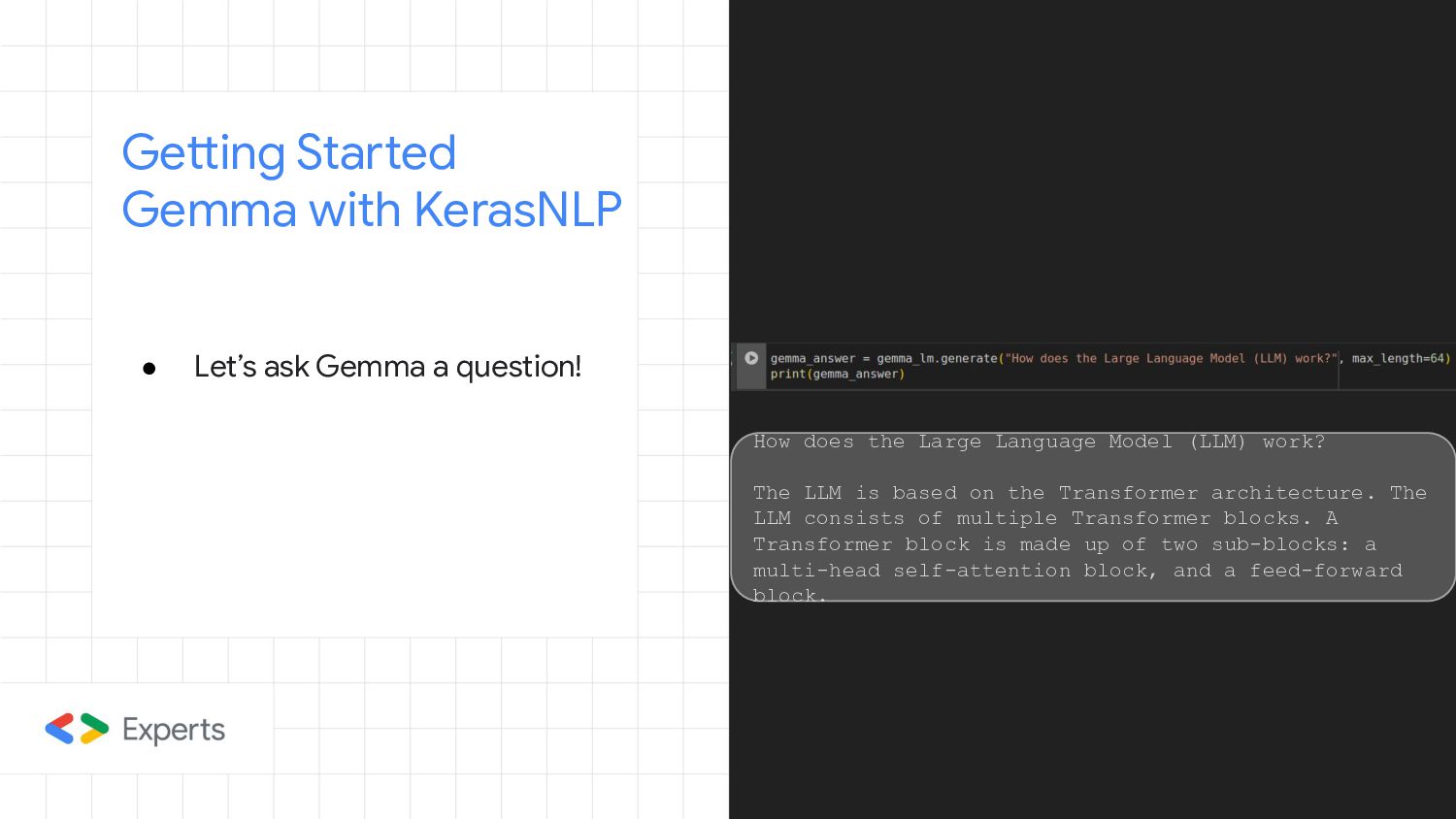
KerasNLP How does the Large Language Model (LLM) work? The LLM is based on the Transformer architecture. The LLM consists of multiple Transformer blocks. A Transformer block is made up of two sub-blocks: a multi-head self-attention block, and a feed-forward block.
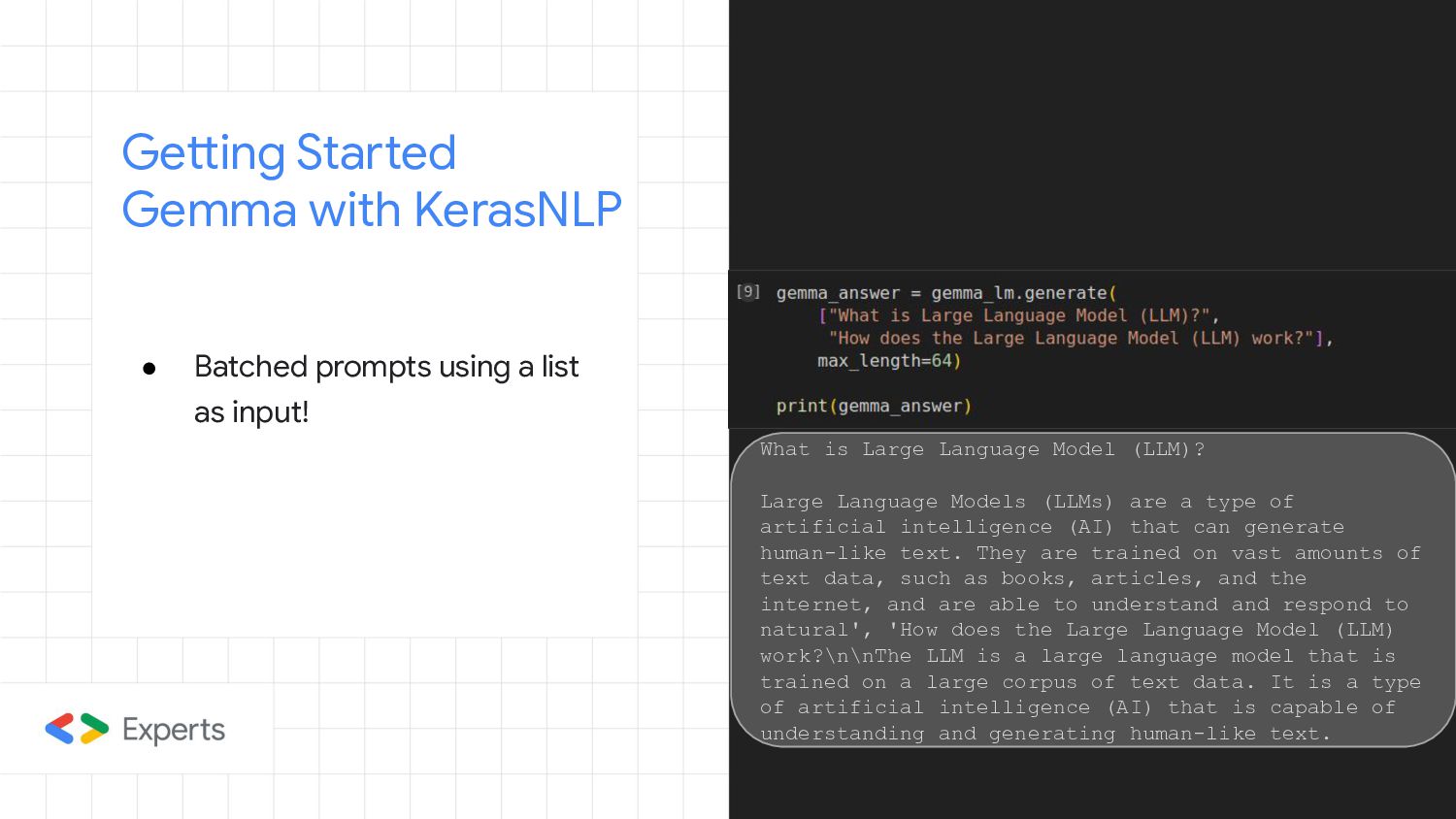
Gemma with KerasNLP What is Large Language Model (LLM)? Large Language Models (LLMs) are a type of artificial intelligence (AI) that can generate human-like text. They are trained on vast amounts of text data, such as books, articles, and the internet, and are able to understand and respond to natural', 'How does the Large Language Model (LLM) work?\n\nThe LLM is a large language model that is trained on a large corpus of text data. It is a type of artificial intelligence (AI) that is capable of understanding and generating human-like text.


 gdglahore
 ichirokano2
 gonta
gonta
 florets1
 yutobara
 uyuki234
 ryu1013
 palkan
 satoshi256kbyte
 sylph01
 minodriven
 neuecc
 hannesfritz
 tmiket
 cassininazir
 codingconduct
 twada
twada
 chriscoyier
 kimpetersen
 watany
 smashingmag
 popppiees