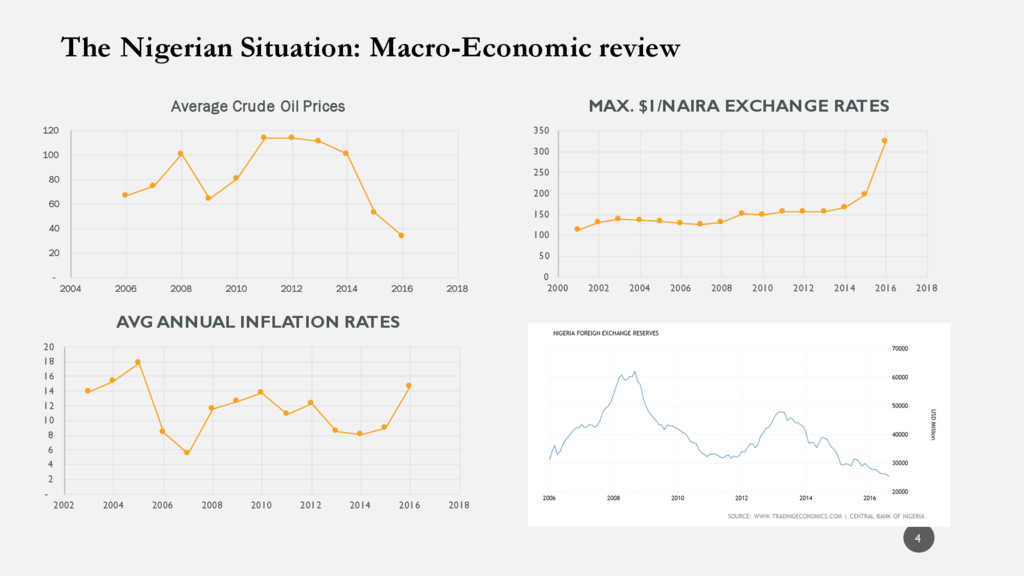
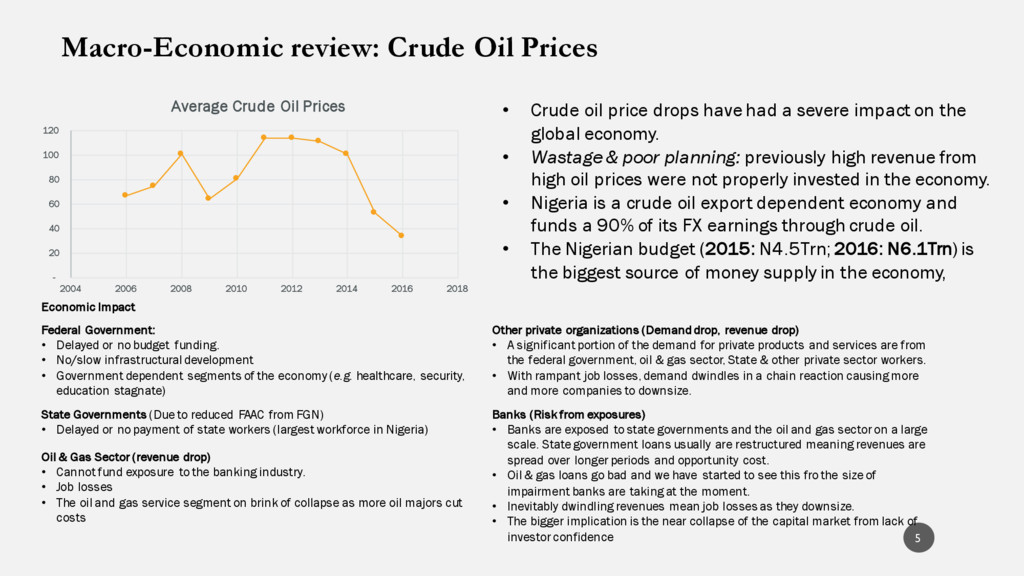
80 100 120 2004 2006 2008 2010 2012 2014 2016 2018 Average Crude Oil Prices • Crude oil price drops have had a severe impact on the global economy. • Wastage & poor planning: previously high revenue from high oil prices were not properly invested in the economy. • Nigeria is a crude oil export dependent economy and funds a 90% of its FX earnings through crude oil. • The Nigerian budget (2015: N4.5Trn; 2016: N6.1Trn) is the biggest source of money supply in the economy, Economic Impact Federal Government: • Delayed or no budget funding. • No/slow infrastructural development • Government dependent segments of the economy (e.g. healthcare, security, education stagnate) Other private organizations (Demand drop, revenue drop) • A significant portion of the demand for private products and services are from the federal government, oil & gas sector, State & other private sector workers. • With rampant job losses, demand dwindles in a chain reaction causing more and more companies to downsize. State Governments (Due to reduced FAAC from FGN) • Delayed or no payment of state workers (largest workforce in Nigeria) Banks (Risk from exposures) • Banks are exposed to state governments and the oil and gas sector on a large scale. State government loans usually are restructured meaning revenues are spread over longer periods and opportunity cost. • Oil & gas loans go bad and we have started to see this fro the size of impairment banks are taking at the moment. • Inevitably dwindling revenues mean job losses as they downsize. • The bigger implication is the near collapse of the capital market from lack of investor confidence Oil & Gas Sector (revenue drop) • Cannot fund exposure to the banking industry. • Job losses • The oil and gas service segment on brink of collapse as more oil majors cut costs
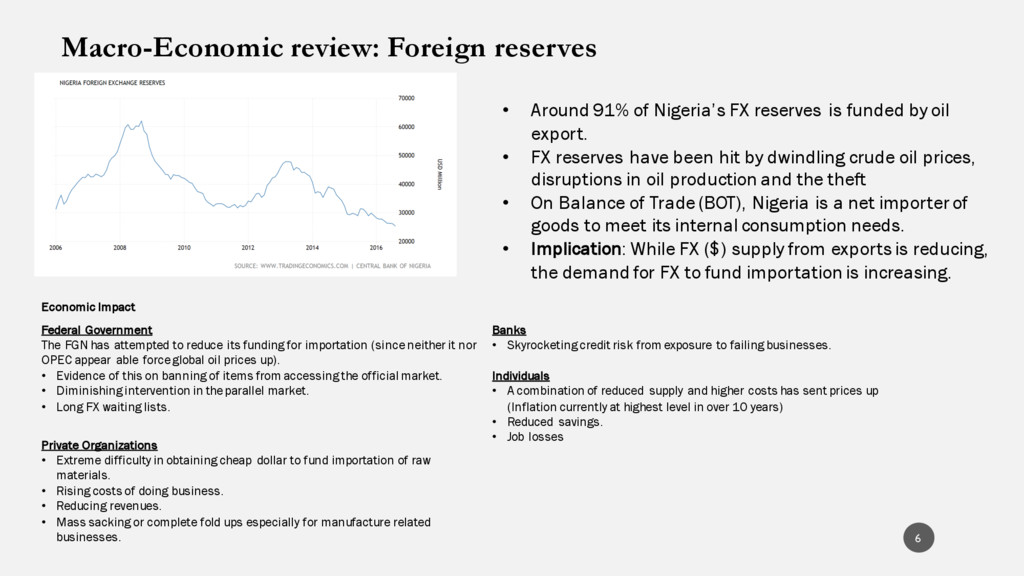
FX reserves is funded by oil export. • FX reserves have been hit by dwindling crude oil prices, disruptions in oil production and the theft • On Balance of Trade (BOT), Nigeria is a net importer of goods to meet its internal consumption needs. • Implication: While FX ($) supply from exports is reducing, the demand for FX to fund importation is increasing. Economic Impact Federal Government The FGN has attempted to reduce its funding for importation (since neither it nor OPEC appear able force global oil prices up). • Evidence of this on banning of items from accessing the official market. • Diminishing intervention in the parallel market. • Long FX waiting lists. Banks • Skyrocketing credit risk from exposure to failing businesses. Individuals • A combination of reduced supply and higher costs has sent prices up (Inflation currently at highest level in over 10 years) • Reduced savings. • Job losses Private Organizations • Extreme difficulty in obtaining cheap dollar to fund importation of raw materials. • Rising costs of doing business. • Reducing revenues. • Mass sacking or complete fold ups especially for manufacture related businesses.
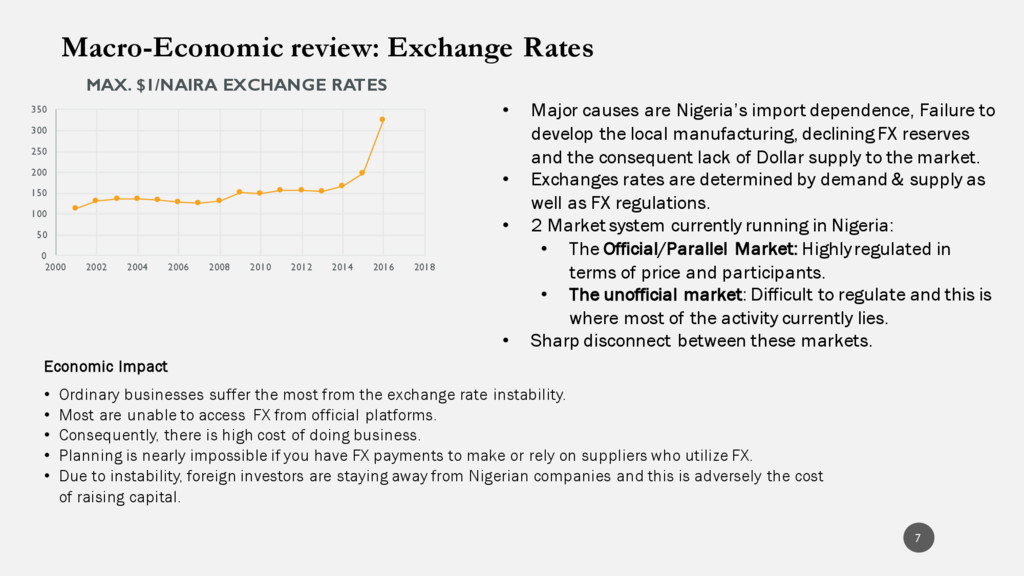
import dependence, Failure to develop the local manufacturing, declining FX reserves and the consequent lack of Dollar supply to the market. • Exchanges rates are determined by demand & supply as well as FX regulations. • 2 Market system currently running in Nigeria: • The Official/Parallel Market: Highly regulated in terms of price and participants. • The unofficial market: Difficult to regulate and this is where most of the activity currently lies. • Sharp disconnect between these markets. Economic Impact • Ordinary businesses suffer the most from the exchange rate instability. • Most are unable to access FX from official platforms. • Consequently, there is high cost of doing business. • Planning is nearly impossible if you have FX payments to make or rely on suppliers who utilize FX. • Due to instability, foreign investors are staying away from Nigerian companies and this is adversely the cost of raising capital. 0 50 100 150 200 250 300 350 2000 2002 2004 2006 2008 2010 2012 2014 2016 2018 MAX. $1/NAIRA EXCHANGE RATES
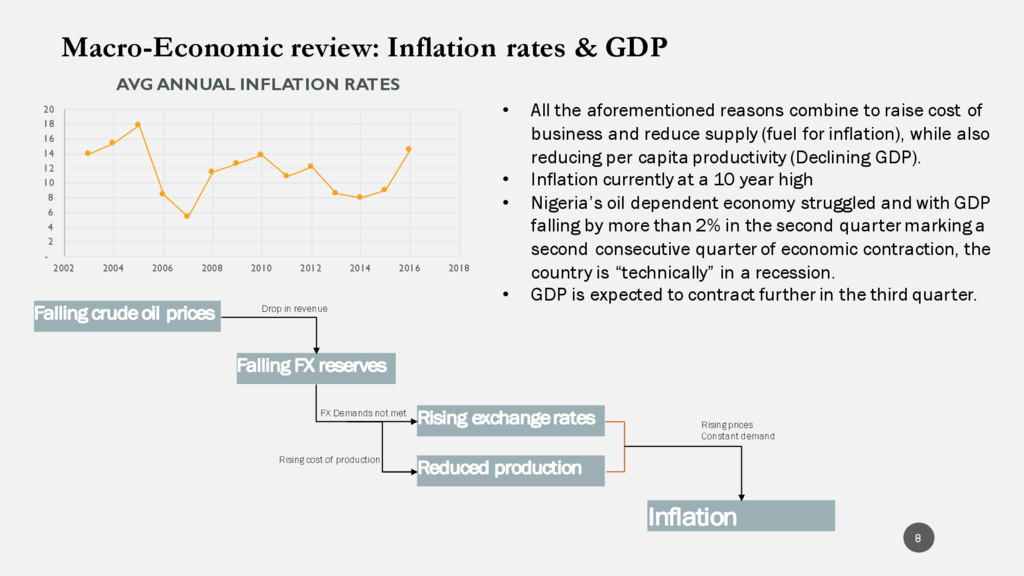
aforementioned reasons combine to raise cost of business and reduce supply (fuel for inflation), while also reducing per capita productivity (Declining GDP). • Inflation currently at a 10 year high • Nigeria’s oil dependent economy struggled and with GDP falling by more than 2% in the second quarter marking a second consecutive quarter of economic contraction, the country is “technically” in a recession. • GDP is expected to contract further in the third quarter. - 2 4 6 8 10 12 14 16 18 20 2002 2004 2006 2008 2010 2012 2014 2016 2018 AVG ANNUAL INFLATION RATES Drop in revenue FX Demands not met Rising cost of production Rising prices Constant demand
the companies listed in the previous slide started during a period of recession. • There is much to learn from them • Value creation. • Markets recognize and pay for value either there is a recession or not. • In tough times, individuals and businesses cut short on excesses, they find the products or services that maximizes value and is cost efficient. • Note that cost efficient is not the same as cheap, it means what product or service creates the most value for each Naira spent. • Innovation. • Innovativebusiness must learn to deliver consistently excellent customer value in a way that is cost efficient to the organization itself. • Innovation usually involves thinking outside the existing business/industry models – this is what gives disruptive start-ups the leverage. • Throw away the business-as-usual ideology, and find ways to create greater value with faster, more efficient processes.
In tough times, vendors are worried about making sales and will usually cut down their prices when they find anyone willing to pay. • This should not mean that you buy things even when you do not need them simply because they are cheaper. Don’t sit through though times • Tough times should not be an excuse but a motivation to do something. • Go out more and chase the sales. • Focus on the loyalty of existing customers, they will become your greatest assets. • Learn from every failure and don’t let them weigh you down. Invest in creating a great team • Better teams are more innovative and produce better results. • Become a knowledgeable organization from top to bottom. • Develop positive habits. • Hire the best talent and keep hold of them.
cut costs without reducing customer value • Leverage technology and wisely: Conference calls instead of travel, resource sharing over isolated systems, explore open source alternatives to every software (e.g. free Open Office vs expensive Microsoft office), in-house automation of processes. • Be creative your internal processes, product development and marketing strategy Be cash conscious • Limit your business risk, avoid providing services on credit as much as possible. Your receivables will default, not because they are bad people but it’s a difficult economy for them as well. Proactive approach to risk • Constantly scan the environment to envisage risk before it arrives. • Risk prevention is almost always cheaper than risk management. • Understand the unique risks that apply to your organization and market, then prepare/plan towards them smartly.
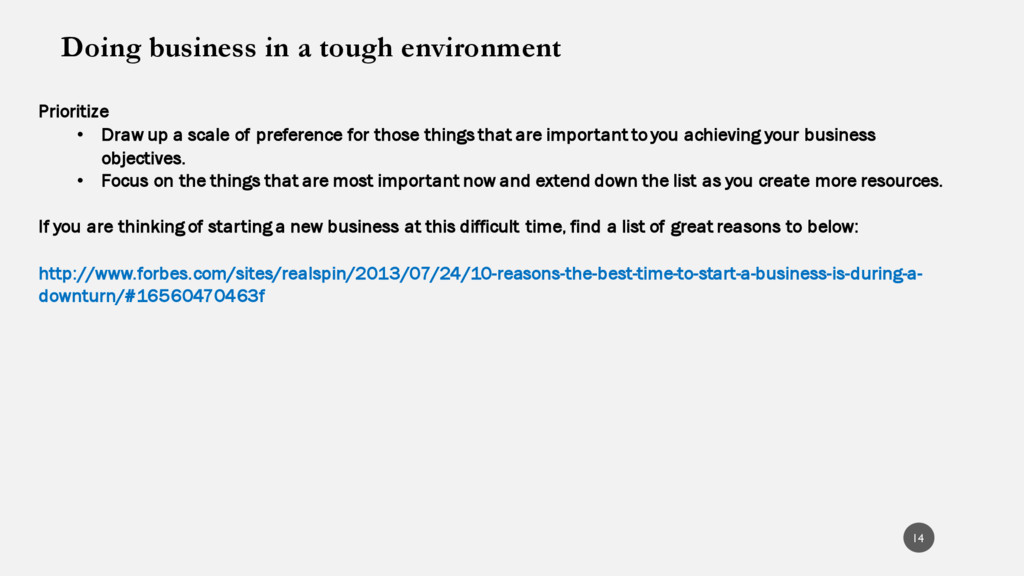
up a scale of preference for those things that are important to you achieving your business objectives. • Focus on the things that are most important now and extend down the list as you create more resources. If you are thinking of starting a new business at this difficult time, find a list of great reasons to below: http://www.forbes.com/sites/realspin/2013/07/24/10-reasons-the-best-time-to-start-a-business-is-during-a- downturn/#16560470463f
time to do business in this country especially if you consider the state of the economy. There are 2 considerations: 1. Internal generation of value in manufacturing and service delivery is the only long term out of this problem Nigeria currently finds itself. 2. Businesses come out of difficulties leaner and much more efficient haven learnt the lessons of adaptation, innovation and hard-work. Whether you are currently in business or about to start on, this is the best opportunity to create sustainable organization.


 akihiro_kokubo
 codingconduct
 katarinadahlin
 frankvandijk
 nikkihalliwell
 portentint
 notwaldorf
 tenderlove
 sarafernandez
 kneath
 inesmontani
 iamctodd