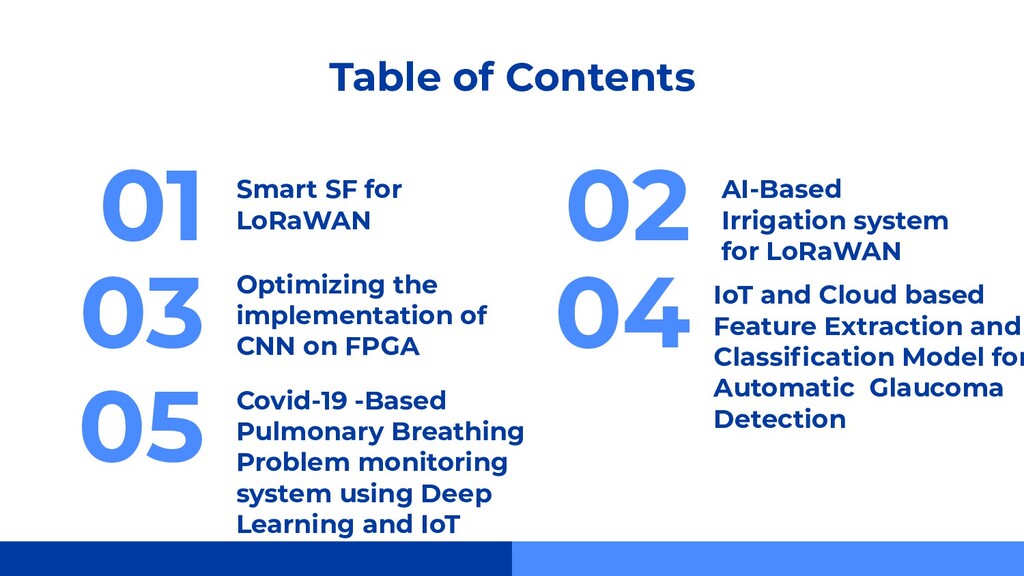
system for LoRaWAN 02 Optimizing the implementation of CNN on FPGA 03 IoT and Cloud based Feature Extraction and Classification Model for Automatic Glaucoma Detection 04 Covid-19 -Based Pulmonary Breathing Problem monitoring system using Deep Learning and IoT 05
communication and strong resilience to interference based on Chirp Spread Spectrum (CSS). Collisions in LoRaWAN networks are strongly related with spreading factor (SF) assignment of nodes which indeed effect network performance. A novel smart SF assignment strategy which utilizes Support Vector Machine (SVM) and Decision Tree Classifier (DTC) machine learning techniques for optimization of SF assignment is proposed. Start by training a classifier to predict future transmission result for a specific node and a specific SF based on the transmission behavior of the nodes in a network. 2019 IEEE Symposium on Computers and Communications (ISCC)
an accurate prediction for the weather and soil conditions to optimize the irrigation process such that the minimal amount of water is provided. The system is composed of sensors data including soil moisture, atmosphere temperature, and humidity. This information is sent via LoRaWAN communication link to a remote center. Base on the data, model using the Wind Driven Optimization - Least Square Support Vector Machine (WDO-LS-SVM) algorithm to train the data. The obtained results show a better performance when compared to the LS-SVM, which verifies the effectiveness of jointly utilizing the WDO with the LS-SVM. Khalifeh, A., Al-Qammaz, A., Darabkh, K. A., Abualigah, L., Khasawneh, A. M., & Zinonos, Z. (2021). An AI Based Irrigation and Weather Forecasting System utilizing LoRaWAN and Cloud Computing Technologies. 2021 IEEE Conference of Russian Young Researchers in Electrical and Electronic Engineering (ElConRus).
efficient implementation strategy of CNN to incorporate more computations in real time. GPUs have long execution time due to sequential logic design. FPGA is becoming hot choice for hardware designers in inference phase of CNN accelerator design due to its parallel architecture. This paper focus on optimizing the array multiplication of input feature map and kernel using FPGA. FPGA has limited built-in multiplier accumulator (MAC) units. In this work, MAC units are replaced by Wallace Tree based Multiplier for the multiplication. Farrukh, F. U. D., Xie, T., Zhang, C., & Wang, Z. (2018). Optimization for Efficient Hardware Implementation of CNN on FPGA. 2018 IEEE International Conference on Integrated Circuits, Technologies and Applications (ICTA). doi:10.1109/cicta.2018.8706067
Automatic Glaucoma Detection A automated glaucoma recognition and classifier approach for the identification of the glaucoma diseases from the color fundus images. The images is collected by IoMT scope and process data on cloud. At first, the real color fundus images hold a collection of three RGB channels and the red channel gets extracted for further processes, then will go through a series of pre-processing and filtering. Then, the extracted features undergo classification by the use of a multi-class support vector machine (MSVM) model to classify the presence of glaucoma. The proposed model is tested using a DRISHTI-GS holds a sum of 101 retinal fundus images. The simulation outcome presented the advantage of the projected approach over the compared approaches. Rajasekaran, Anandh & Indirani, G. (2020). IoT and Cloud based Feature Extraction and Classification Model for Automatic Glaucoma Detection. 13-18.
and IoT The goal is to use Convolution Neural Networks to assist medical experts by providing a detailed analysis of medical respiratory audio data for covid-19 breathing problem detection. Develop a user-friendly, portable, and reasonably priced external mobile device accessory that records and stores a patient's Peak Expiratory Flow. VG-19, CNN, and machine learning library feature called MFCC are proposed methods. Swapna, Y & Sirisha, G & Mary, Anitha & gira, aparna & Ruthvik, Kadiyala & Bhoompallu, Suneela. (2021). Covid-19 -Based Intelligent Healthcare Monitoring System Using Deep Learning & Iot Principles For Pulmonary Breathing Problem Patients. International Journal of Future Generation Communication and Networking. Vol. 14. 1289-1297.


 chriscoyier
 marktimemedia
 holman
 addyosmani
 leimatthew05
 jlugia
 ryanjones
 gurzu
 aleyda
 jonrohan
 mraible
 codingconduct