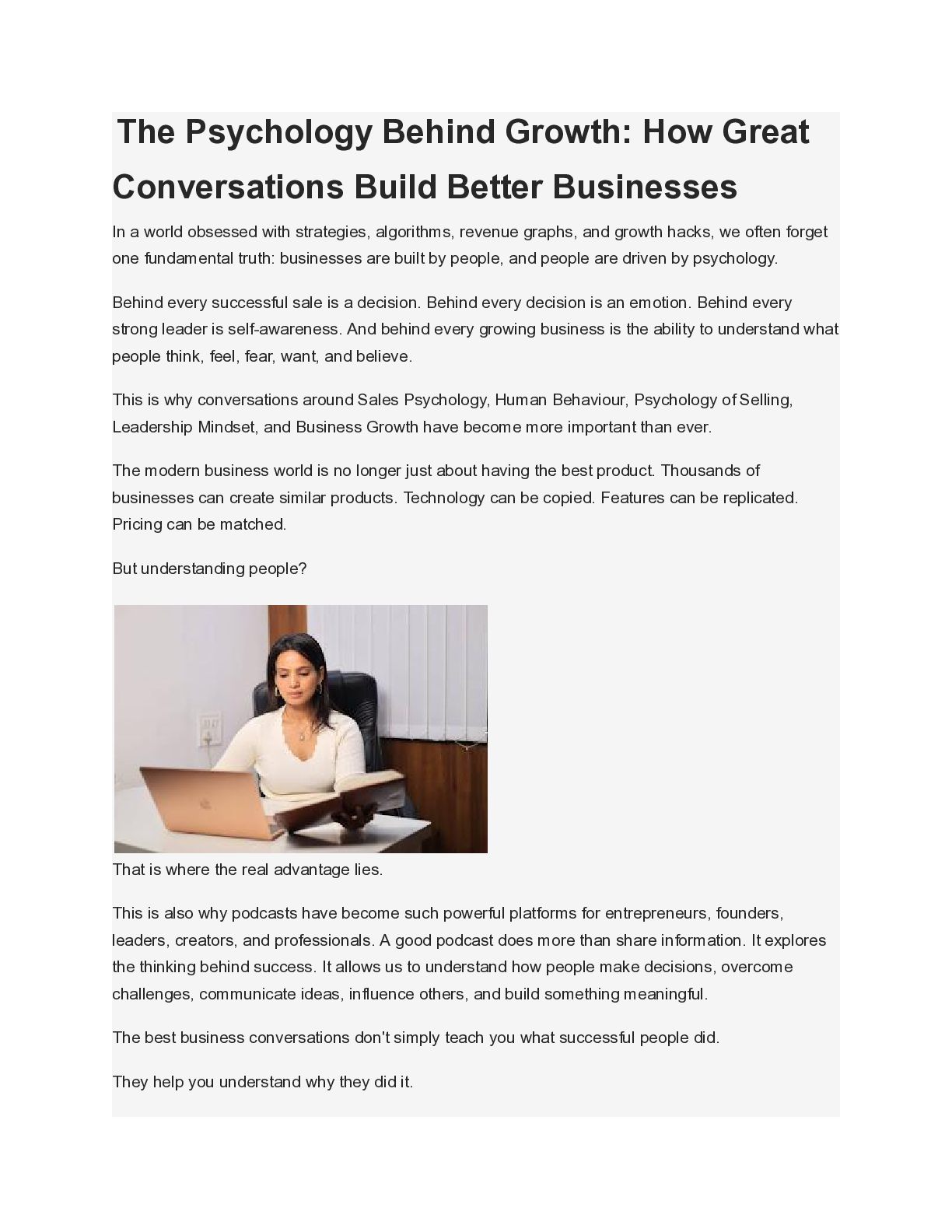
In a world obsessed with strategies, algorithms, revenue graphs, and growth hacks, we often forget one fundamental truth: businesses are built by people, and people are driven by psychology. Behind every successful sale is a decision. Behind every decision is an emotion. Behind every strong leader is self-awareness. And behind every growing business is the ability to understand what people think, feel, fear, want, and believe. This is why conversations around Sales Psychology, Human Behaviour, Psychology of Selling, Leadership Mindset, and Business Growth have become more important than ever. The modern business world is no longer just about having the best product. Thousands of businesses can create similar products. Technology can be copied. Features can be replicated. Pricing can be matched. But understanding people? That is where the real advantage lies. This is also why podcasts have become such powerful platforms for entrepreneurs, founders, leaders, creators, and professionals. A good podcast does more than share information. It explores the thinking behind success. It allows us to understand how people make decisions, overcome challenges, communicate ideas, influence others, and build something meaningful. The best business conversations don't simply teach you what successful people did. They help you understand why they did it.
With Human Behaviour Before someone becomes your customer, employee, investor, partner, or audience member, they are simply a human being. They have emotions. They have fears. They have desires. They want recognition, security, belonging, growth, convenience, and sometimes status. Understanding Human Behaviour is therefore not an optional skill in business. It is one of the foundations of everything. Why does someone choose one brand over another? Why does a customer delay a purchase? Why do people trust certain leaders? Why does one message go viral while another disappears? Why do some teams perform exceptionally well while others struggle despite having talented individuals? The answers are rarely found only in spreadsheets. They are found in human behaviour. This is what makes business conversations so fascinating. When entrepreneurs sit down on a podcast and speak honestly about their journeys, the most valuable lessons often come from moments that cannot be measured by a business metric. A founder might talk about the fear of failure. A salesperson might explain how rejection changed their confidence. A leader might share how they learned to listen.
changing their mindset rather than changing their strategy. These stories remind us that business growth is deeply connected to personal growth. The company may have a balance sheet. But the person running it has a mind. And the mind influences everything. Sales Is Not About Talking More. It Is About Understanding Better. For decades, people imagined sales as a game of persuasion where the loudest person in the room wins. That idea is outdated. Modern selling is less about pushing and more about understanding. This is where Sales Psychology becomes incredibly powerful. Great salespeople understand that customers don't simply buy products. They buy solutions to problems, feelings associated with outcomes, and sometimes a better version of themselves. Someone buying a fitness program may not just want workouts. They may want confidence. Someone investing in a luxury product may not simply want quality. They may want identity or status. Someone purchasing a business service may not just want software. They may want less stress and more control. The deeper you understand the emotional reason behind a decision, the better you can communicate value. This is the real Psychology of Selling. It is not manipulation. It is understanding.
successful sales professionals are usually exceptional listeners. They don't enter every conversation thinking, “How do I convince this person?” They ask, “What does this person actually need?” That small shift changes everything. When a business understands its audience deeply, marketing becomes more relevant. Sales conversations become more natural. Products become more useful. And trust becomes easier to build. Buyer Psychology Is Changing the Way Brands Communicate Today's customers have more options than ever before. They can compare prices within seconds. They can read reviews. They can watch demonstrations. They can ask online communities for recommendations. This means traditional aggressive selling is becoming less effective. Understanding Buyer Psychology is now essential. Modern buyers don't just evaluate what you sell. They evaluate how you make them feel. Do they trust you? Do they understand your message? Do they feel seen? Do they believe your solution is relevant to their problem? Do they feel safe making a decision?
A delayed response. A confusing website. An unclear offer. A robotic sales message. A poorly handled complaint. Each one influences trust. This is why conversations on podcasts can be so valuable for businesses. Long-form conversations allow people to see the person behind the brand. Unlike a 30-second advertisement, a meaningful conversation gives audiences time to understand someone's perspective, personality, values, and expertise. Podcasting creates familiarity. And familiarity can create trust. When people repeatedly hear insightful conversations from a founder, entrepreneur, or expert, they begin forming a connection. They may not buy immediately. But when the right moment arrives, the relationship already exists. That is powerful Buyer Psychology in action. Influence & Persuasion Begin With Trust The words Influence & Persuasion often make people think about convincing others to do something. But true influence is much deeper. Real influence happens when people respect your perspective enough to consider changing their own. And that cannot be built overnight.
Think about the people whose opinions genuinely influence you. They probably don't force you to agree with them. Instead, they communicate ideas in ways that make you think. This is one of the biggest strengths of podcasting. A great podcast doesn't scream instructions at its audience. It starts conversations. It introduces perspectives. It challenges assumptions. It gives listeners access to experiences they may never have encountered otherwise. For business leaders and entrepreneurs, this format can become a powerful way to build authority. Not by constantly saying, “I am an expert.” But by demonstrating expertise through meaningful conversations. The most influential people are often not the ones trying hardest to appear influential. They are the ones consistently adding value. This is particularly important in a digital world filled with noise. Everyone is posting. Everyone is selling. Everyone is competing for attention. The question is no longer simply, “How do I get attention?” The better question is, “What happens after I get attention?” Can you hold it? Can you create trust? Can you provide value? Can you influence without forcing?
or Destroy Opportunities Every opportunity in business begins with communication. A pitch. A meeting. A negotiation. A podcast interview. A leadership conversation. A sales call. A difficult discussion with a team member. All of these depend on Communication Skills. Yet communication is often misunderstood as simply speaking clearly. True communication is about being understood. You can speak for an hour and still fail to communicate. You can say one sentence and completely change someone's perspective. The difference lies in clarity and emotional connection. Great communicators understand their audience. They know when to speak and when to pause. They know how to simplify complex ideas. They know that listening is just as important as speaking. And most importantly, they understand context.
people with good voices or prepared questions. They are curious listeners. They notice what is not being said. They ask follow-up questions. They make guests comfortable enough to share real experiences rather than rehearsed answers. For businesses, this skill is invaluable. A leader who listens builds stronger teams. A salesperson who listens understands customer needs. A founder who listens learns from the market. A creator who listens understands their audience. Communication is not just a soft skill. It is a growth skill. Leadership Mindset Is Built Before Leadership Begins Many people believe leadership begins when you receive a title. Manager. Founder. CEO. Director. But leadership begins much earlier. It begins with how you manage yourself. A strong Leadership Mindset is not about controlling everyone around you. It is about creating clarity, taking responsibility, making difficult decisions, and remaining emotionally stable when things become uncertain.
obvious answer. Revenue drops. A key employee leaves. A product fails. An investor says no. A strategy doesn't work. During these moments, technical knowledge alone is not enough. Mindset becomes critical. How does a leader respond to pressure? Do they panic? Do they blame? Do they avoid difficult conversations? Or do they pause, evaluate, learn, and move forward? These questions define leadership. One of the most powerful things about long-form business podcasts is hearing successful people discuss their failures. Success stories can inspire us. But failure stories can teach us resilience. They reveal that confidence is not the absence of uncertainty. It is the ability to move despite uncertainty. That is the foundation of a powerful Leadership Mindset. Business Growth Is More Than Revenue When people hear the phrase Business Growth, they usually think about larger revenue numbers.
business can grow in customers but struggle internally. It can generate more revenue but have poor systems. It can expand quickly while losing its culture. True growth requires balance. Better people. Better processes. Better communication. Better decision-making. Better customer understanding. Better leadership. This is why mindset and psychology are not separate from business strategy. They are part of it. A founder's ability to handle rejection influences whether they continue pitching investors. A salesperson's confidence influences customer conversations. A leader's emotional awareness influences team culture. A creator's understanding of audience behaviour influences content strategy. Everything is connected. The strongest businesses don't only ask, “How can we grow faster?” They also ask, “What kind of organization are we becoming while growing?” That question matters. Because fast growth without clarity can create chaos.
Talks About Enough When we hear about high performers, we often focus on discipline, productivity, and long working hours. But a true High Performance Mindset is not simply about doing more. It is about doing what matters consistently. High performers understand focus. They understand recovery. They understand self-awareness. They know that motivation comes and goes, but systems can create consistency. They also understand that comparison can become dangerous. In a world where everyone shares achievements online, it is easy to feel behind. Someone has raised funding.
milestone. Someone has built a massive audience. But high performance requires the ability to focus on your own journey. A great mindset does not ignore competition. It simply refuses to become distracted by it. Podcast conversations can be particularly powerful here because they reveal the invisible side of success. Behind the achievements are years of uncertainty. Behind the confidence are moments of doubt. Behind the growth are experiments that failed. Behind the public success is private discipline. This is what makes authentic conversations valuable. They humanize success. And when success becomes human, it becomes easier to learn from. Emotional Intelligence Is the Invisible Business Advantage You can have exceptional technical knowledge and still struggle as a leader. You can have a brilliant product and still lose customers. You can have incredible ideas and still fail to build strong relationships. Why? Because intelligence alone is not enough.
own emotions while also recognizing and responding effectively to the emotions of others. In business, this can make an extraordinary difference. Imagine two leaders receiving criticism. One immediately becomes defensive. The other listens, processes the feedback, asks questions, and responds thoughtfully. The difference is not necessarily intelligence. It is emotional awareness. Similarly, imagine a salesperson dealing with an uncertain customer. One keeps repeating product features. The other recognizes hesitation and asks, “What is making you unsure about this decision?” The second person understands emotions. That is emotional intelligence in action. Strong relationships are rarely built through perfect conversations. They are built through understanding. This applies to leadership, sales, partnerships, content creation, and even podcasting. A great interviewer doesn't simply ask intelligent questions. They understand people. They recognize when a guest is passionate about something. They know when to give space. They sense when a deeper conversation is possible. That emotional awareness transforms an interview into a meaningful conversation.
of podcasts reflects something important about modern audiences. People are tired of surface-level content. They want context. They want stories. They want to understand how people think. A short post can tell you what someone achieved. A podcast can reveal how they think. And thinking is contagious. When entrepreneurs listen to conversations about failure, resilience, sales, leadership, communication, and business building, they begin questioning their own assumptions. That is the real power of a growth mindset. It is not believing that everything will be easy. It is believing that you can learn. Every conversation becomes an opportunity to gain a new perspective. Every guest becomes a case study. Every failure becomes a lesson. Every success becomes a question. How did they do it? What did they believe? What did they do differently? What would they change?
business therefore has the opportunity to become much more than entertainment. It can become a learning ecosystem. A place where founders, professionals, leaders, and ambitious individuals come together through conversations. Because sometimes one powerful idea can change the direction of an entire business. The Future Belongs to People Who Understand People Technology will continue to evolve. Artificial intelligence will transform industries. Business models will change. Marketing platforms will rise and disappear. But one thing will remain constant. People will still make decisions. People will still experience emotions. People will still seek connection. That is why understanding psychology will continue to be one of the most valuable advantages in business. Whether you are building a brand, leading a team, selling a product, hosting a podcast, or growing a company, your ability to understand people will influence your results. Master Sales Psychology and you understand why people say yes. Understand Human Behaviour and you begin seeing the motivations behind actions. Learn the Psychology of Selling and conversations become more meaningful. Develop a strong Leadership Mindset and you become better equipped for uncertainty.
wins. Improve your Communication Skills and opportunities become easier to create. Study Buyer Psychology and your audience becomes clearer. Understand Influence & Persuasion and you learn how trust shapes decisions. Build a High Performance Mindset and consistency becomes your competitive advantage. And develop Emotional Intelligence, because ultimately, business is not just about transactions. It is about people. The greatest businesses are not built only by people who know how to make money. They are built by people who understand how humans think, feel, connect, decide, and grow. And perhaps that is why meaningful conversations matter more than ever. Because behind every successful entrepreneur is a story. Behind every story is a mindset. And behind every mindset is a psychology waiting to be understood. The future of business belongs not only to those who can build great products, but to those who can understand the people they are building them for.


 h32
 chikuwait
 inesmontani
 irinanazarova
 paigeccino
 pwiseman
 axbom
 morganepeng
 addyosmani
 aleyda
 rasmusluckow
 lfama