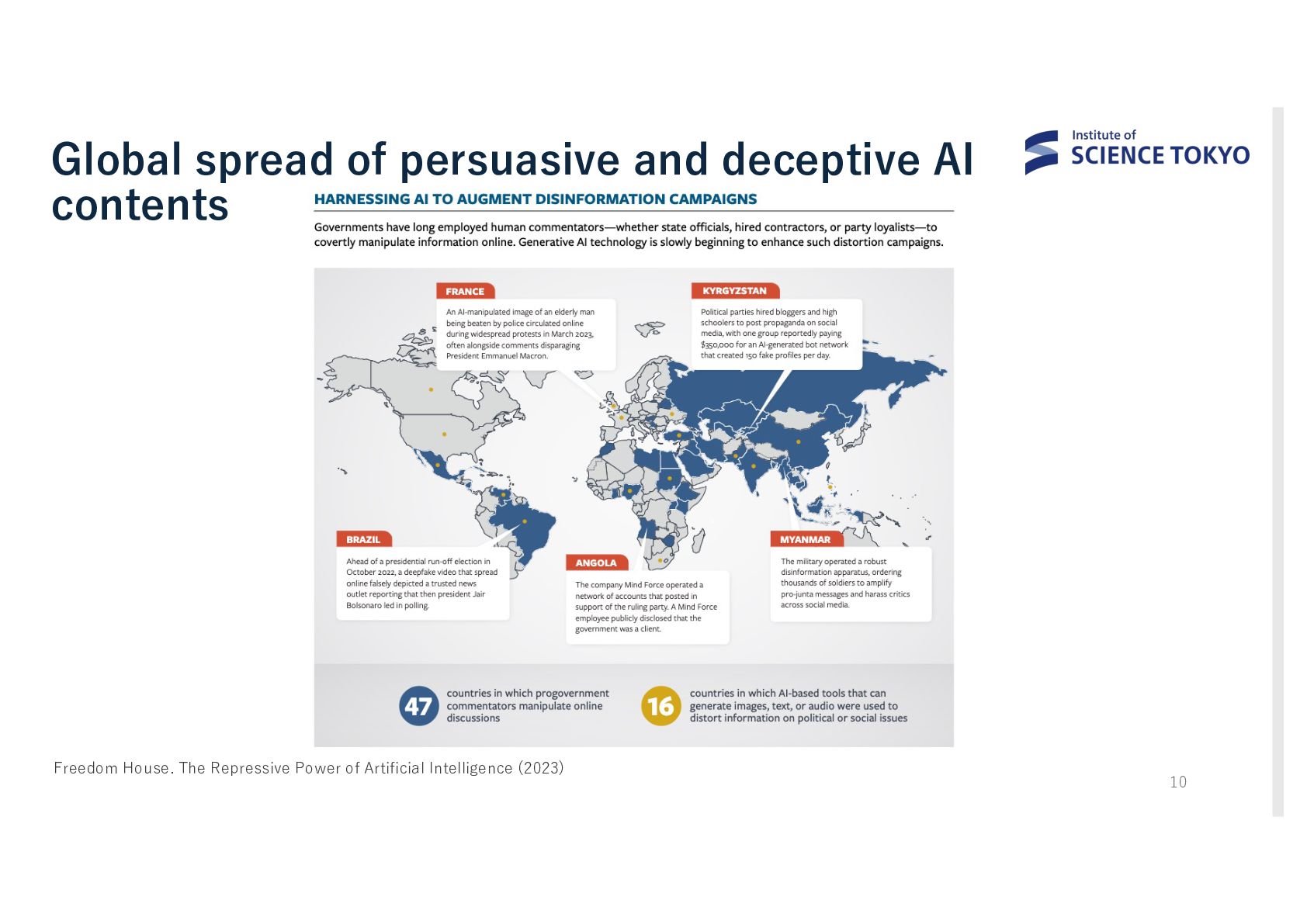
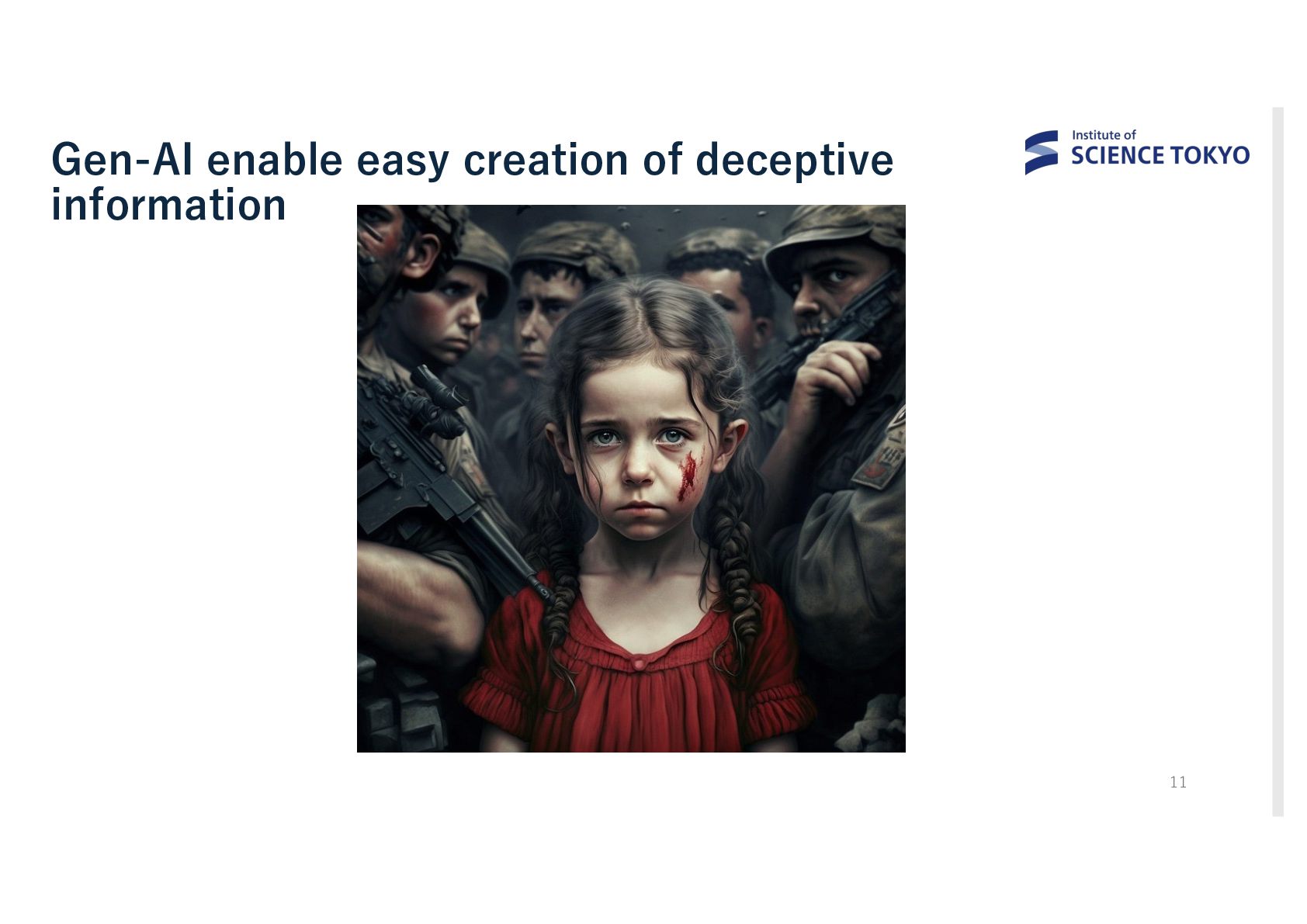
an Online Experiment Kei Ichikawa School of Environment and Technology Institute of Science Tokyo(Formely Tokyo Institute of Technology) HICSS2025/01/07
Study1:Investigation of the Impact of Emotional Valence in Images on Shared Intentions • Study2:Image Substitution Experiment Focusing on Emotional Valence 4. Summary 2
Study1:Investigation of the Impact of Emotional Valence in Images on Shared Intentions • Study2:Image Substitution Experiment Focusing on Emotional Valence 4. Summary 3
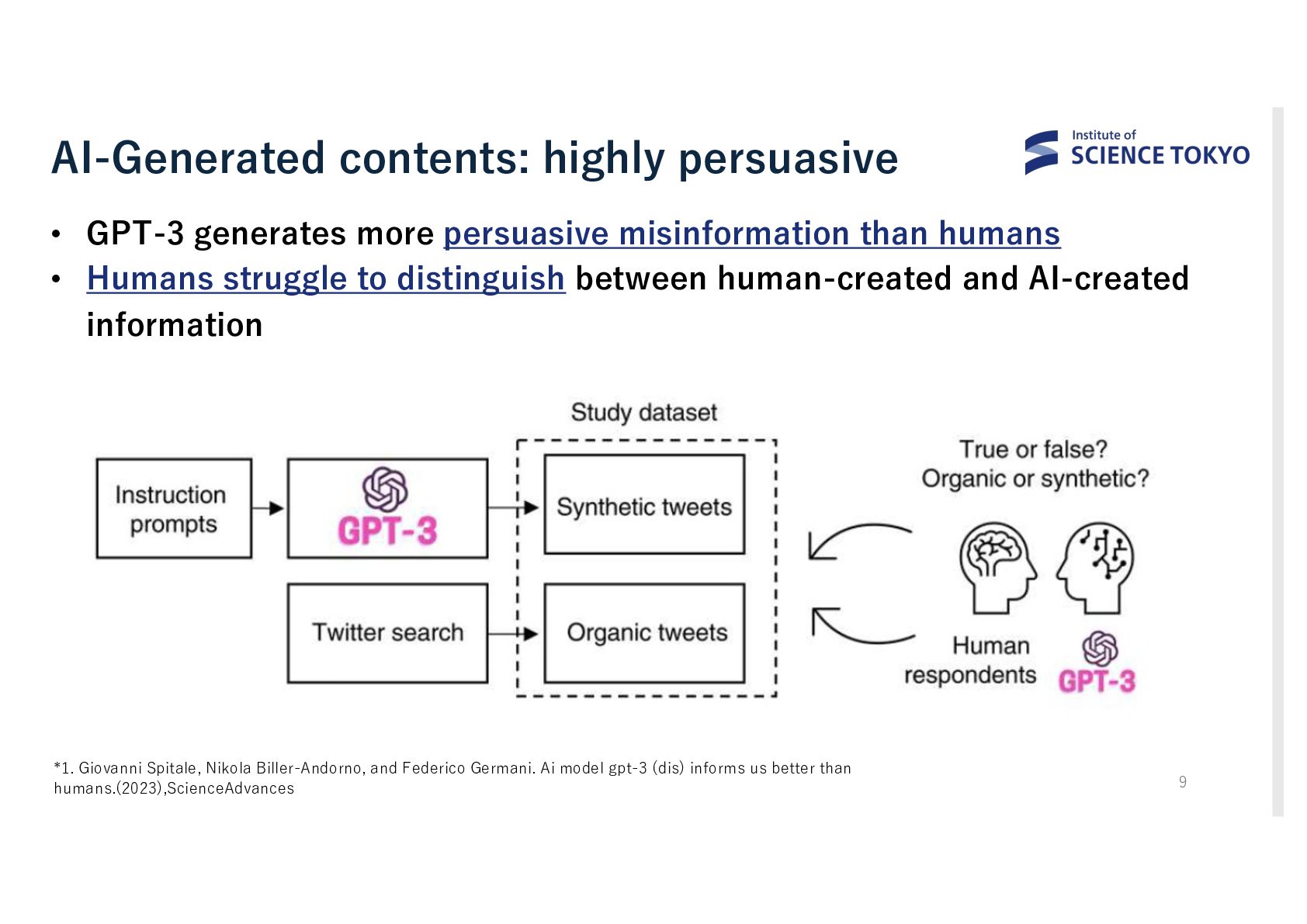
than humans • Humans struggle to distinguish between human-created and AI-created information *1. Giovanni Spitale, Nikola Biller-Andorno, and Federico Germani. Ai model gpt-3 (dis) informs us better than humans.(2023),ScienceAdvances 9
Study1:Investigation of the Impact of Emotional Valence in Images on Shared Intentions • Study2:Image Substitution Experiment Focusing on Emotional Valence 4. Summary 13
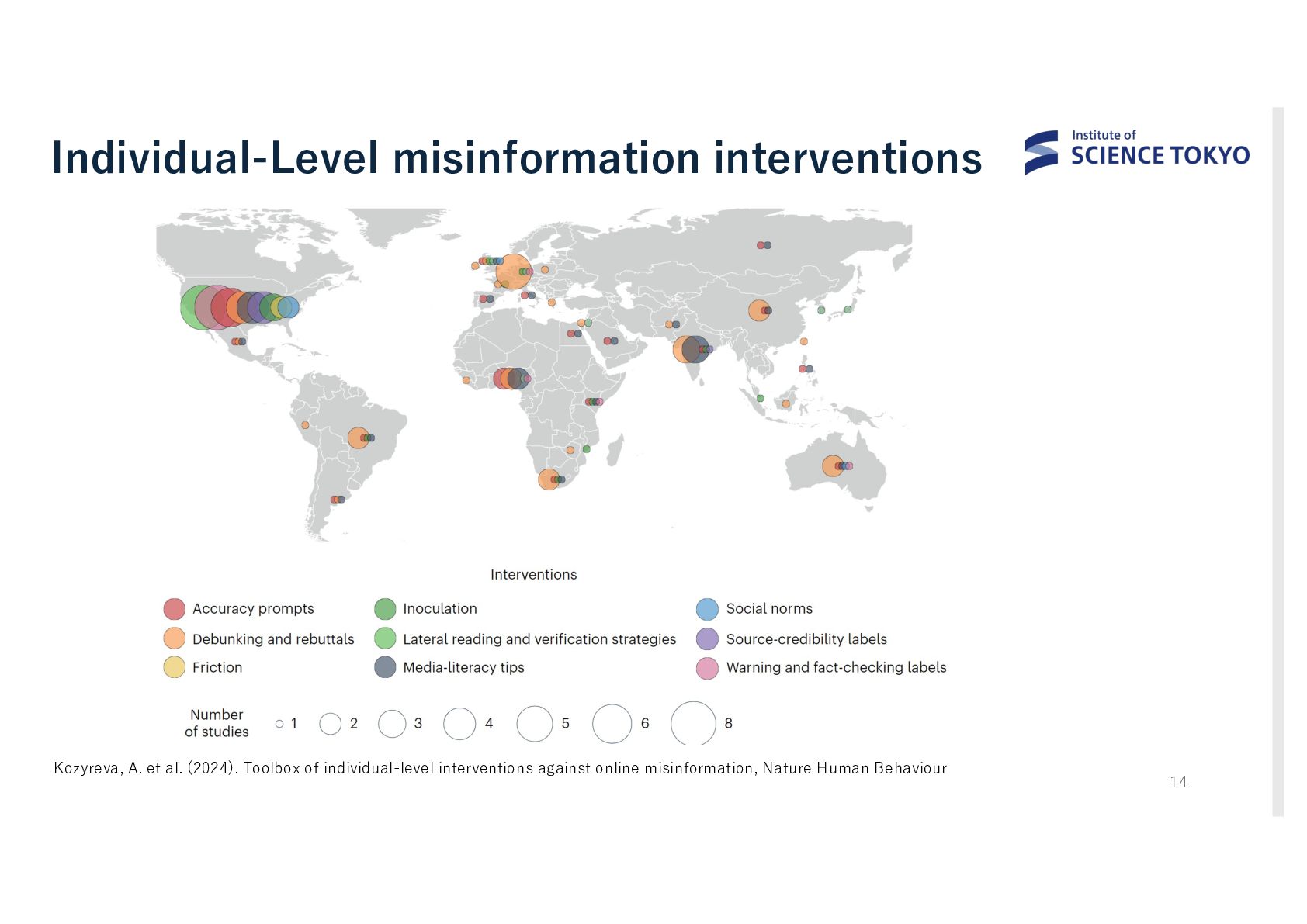
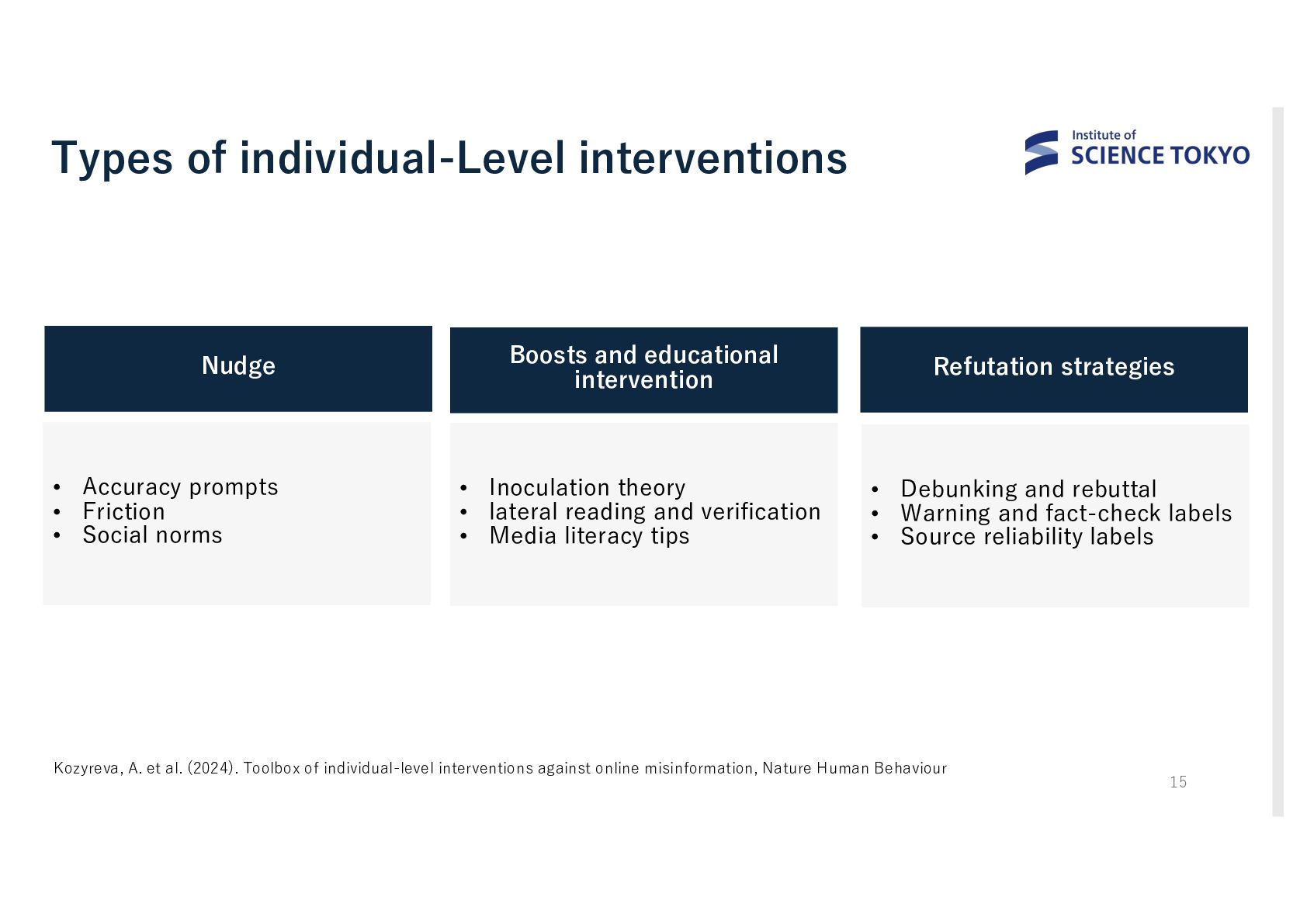
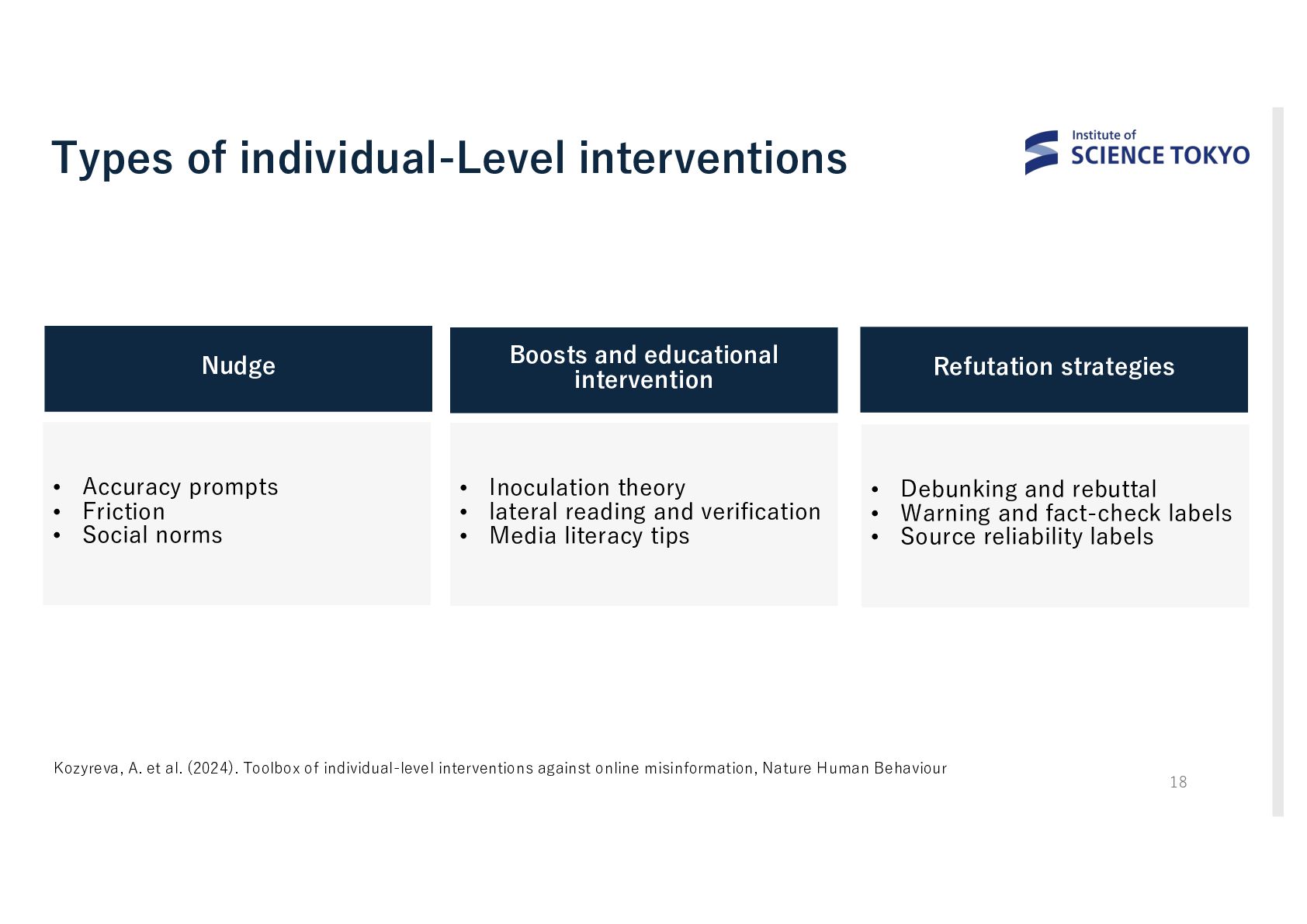
Friction • Social norms Boosts and educational intervention Refutation strategies • Inoculation theory • lateral reading and verification • Media literacy tips • Debunking and rebuttal • Warning and fact-check labels • Source reliability labels Kozyreva, A. et al. (2024). Toolbox of individual-level interventions against online misinformation, Nature Human Behaviour 15
Friction • Social norms Boosts and educational intervention Refutation strategies • Inoculation theory • lateral reading and verification • Media literacy tips • Debunking and rebuttal • Warning and fact-check labels • Source reliability labels While... Kozyreva, A. et al. (2024). Toolbox of individual-level interventions against online misinformation, Nature Human Behaviour 16
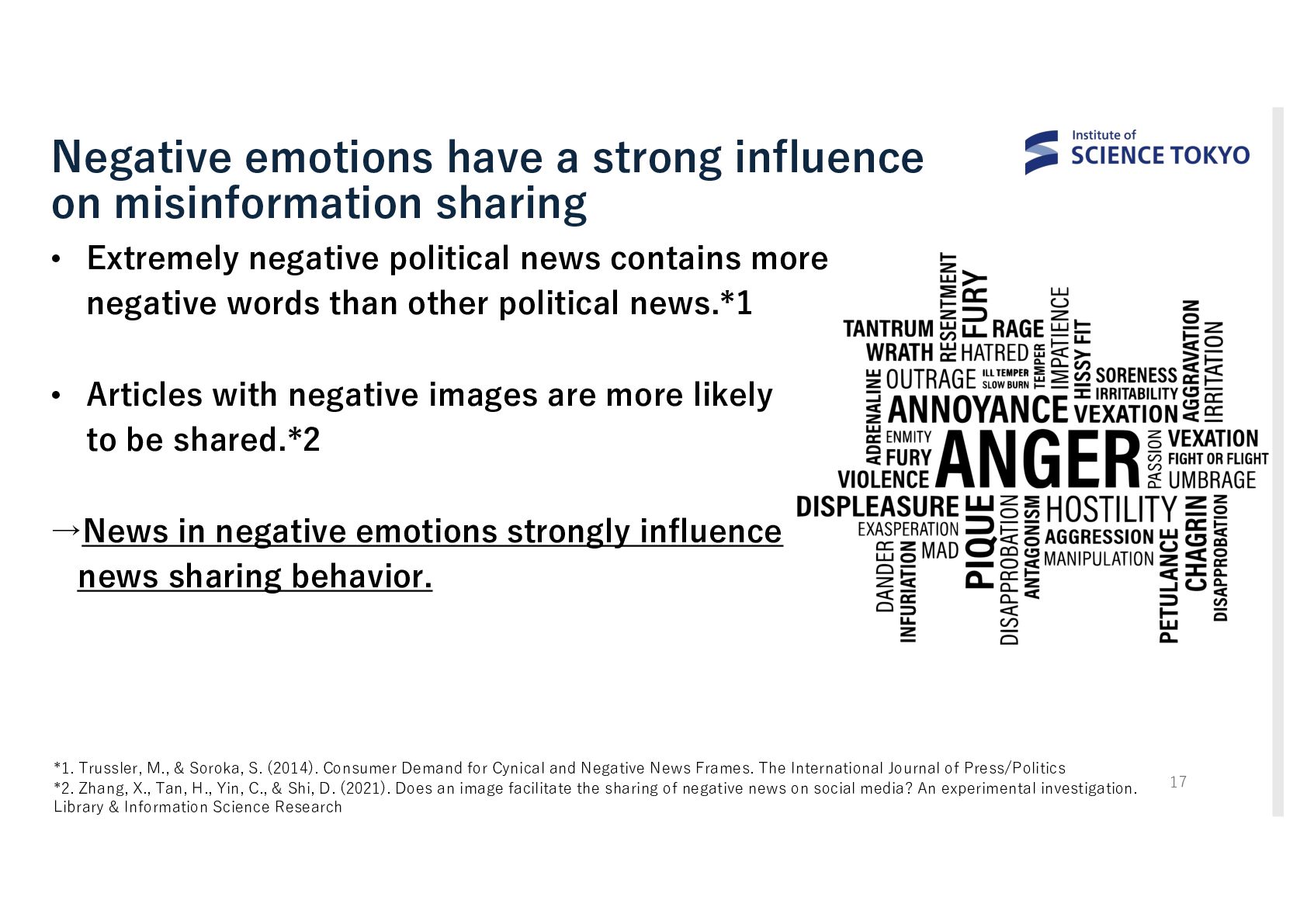
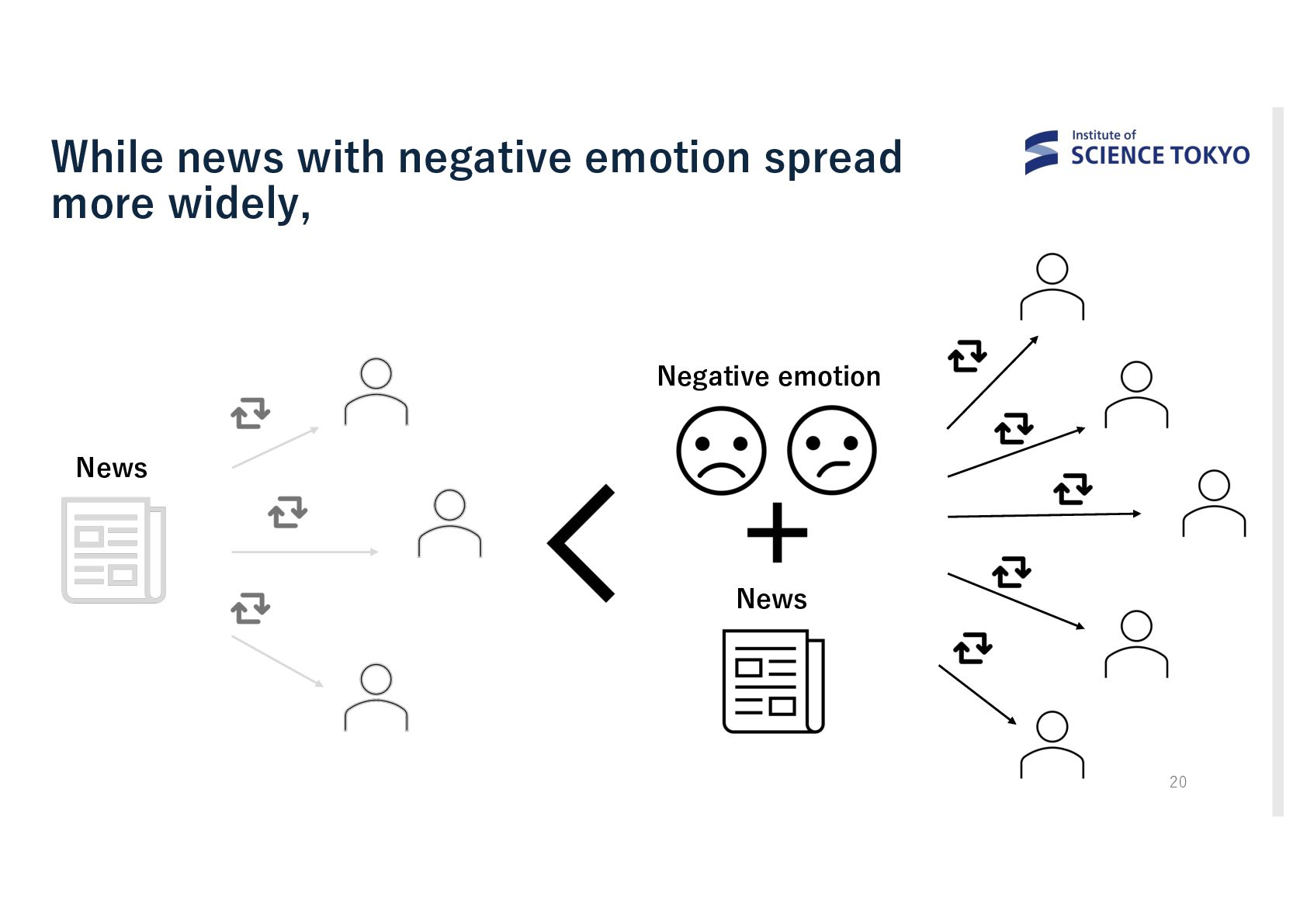
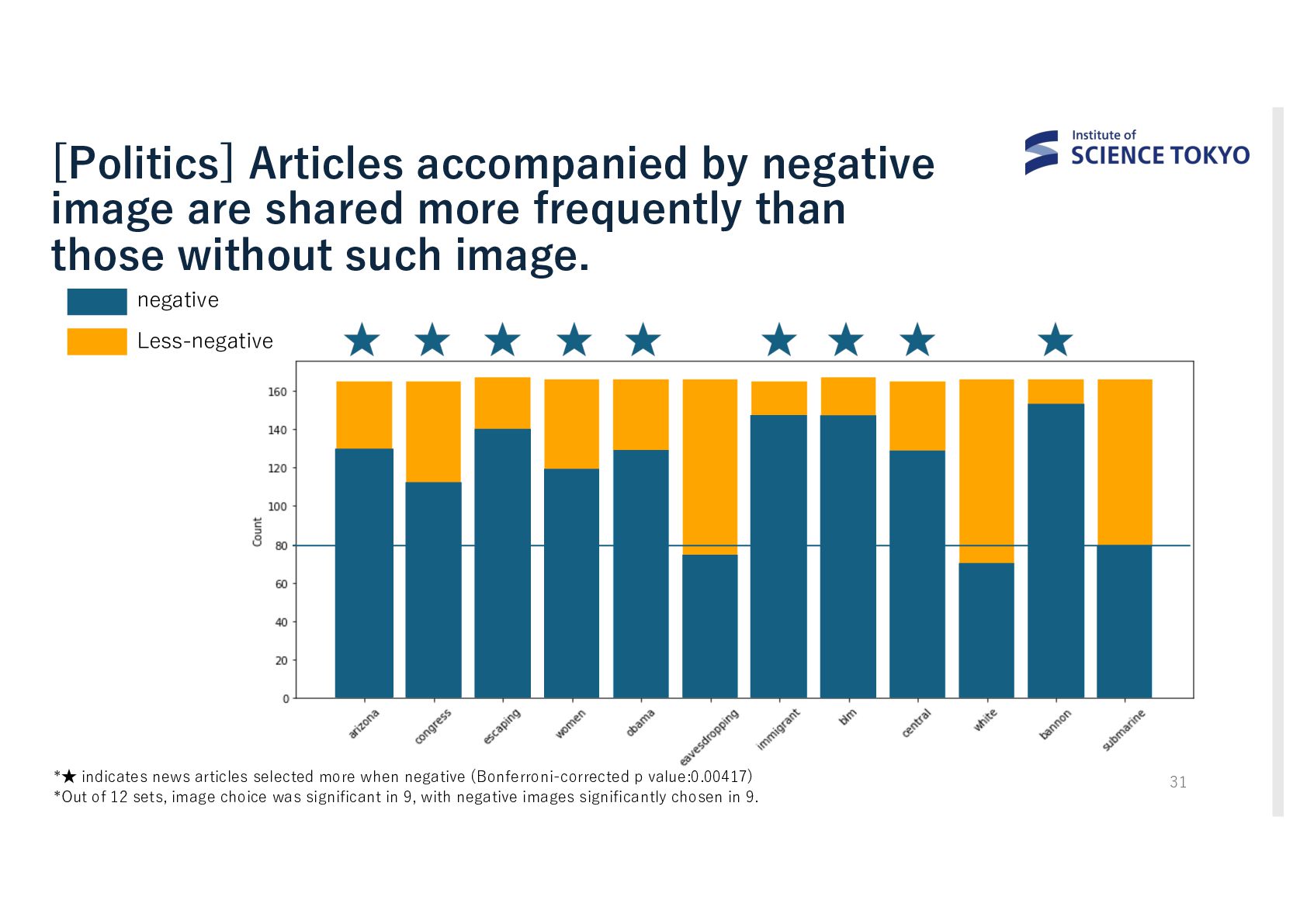
Extremely negative political news contains more negative words than other political news.*1 • Articles with negative images are more likely to be shared.*2 →News in negative emotions strongly influence news sharing behavior. *1. Trussler, M., & Soroka, S. (2014). Consumer Demand for Cynical and Negative News Frames. The International Journal of Press/Politics *2. Zhang, X., Tan, H., Yin, C., & Shi, D. (2021). Does an image facilitate the sharing of negative news on social media? An experimental investigation. Library & Information Science Research 17
Friction • Social norms Boosts and educational intervention Refutation strategies • Inoculation theory • lateral reading and verification • Media literacy tips • Debunking and rebuttal • Warning and fact-check labels • Source reliability labels Kozyreva, A. et al. (2024). Toolbox of individual-level interventions against online misinformation, Nature Human Behaviour 18
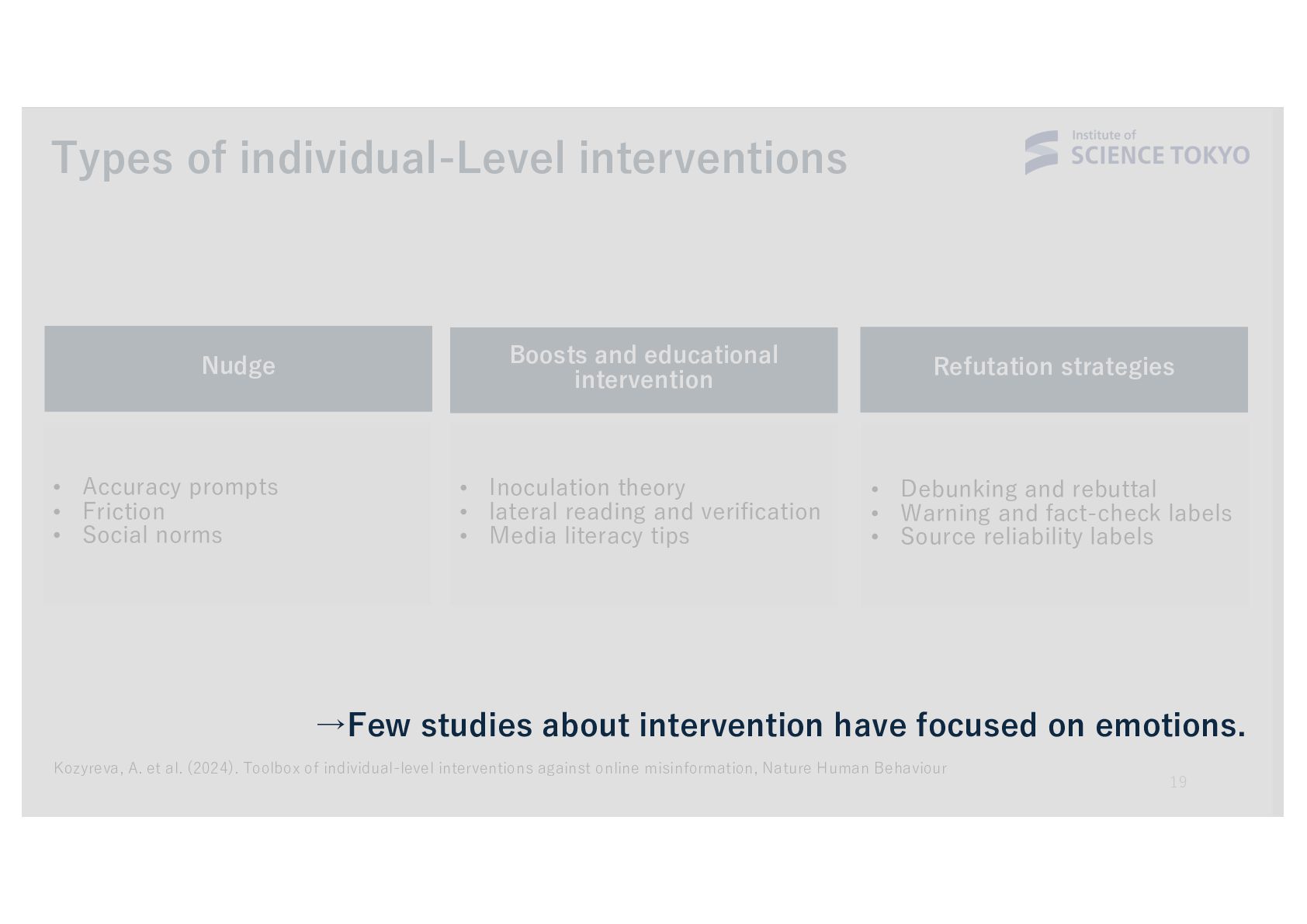
Friction • Social norms Boosts and educational intervention Refutation strategies • Inoculation theory • lateral reading and verification • Media literacy tips • Debunking and rebuttal • Warning and fact-check labels • Source reliability labels →Few studies about intervention have focused on emotions. Kozyreva, A. et al. (2024). Toolbox of individual-level interventions against online misinformation, Nature Human Behaviour 19
Study1:Investigation of the Impact of Emotional Valence in Images on Shared Intentions • Study2:Image Substitution Experiment Focusing on Emotional Valence 4. Summary 23
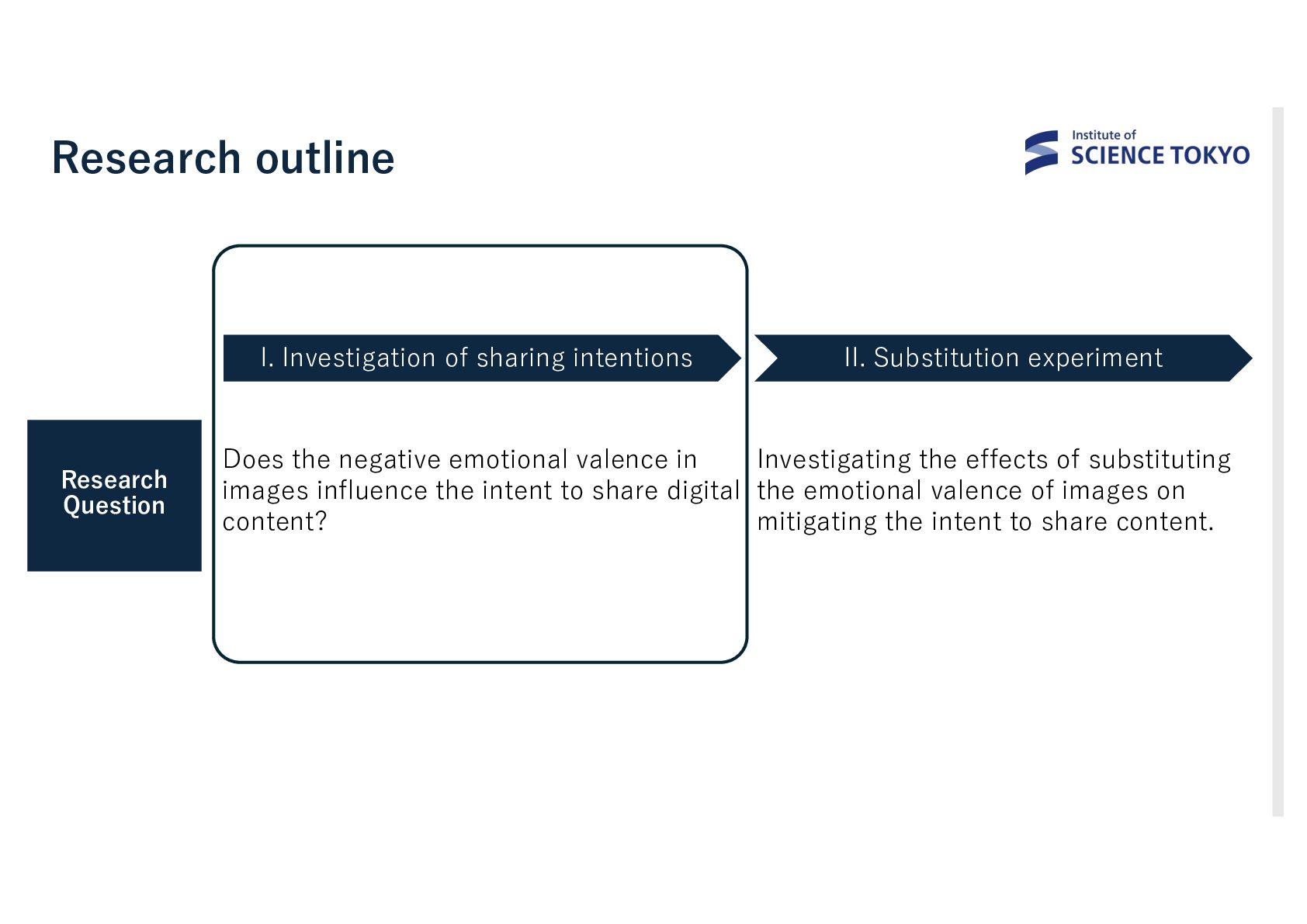
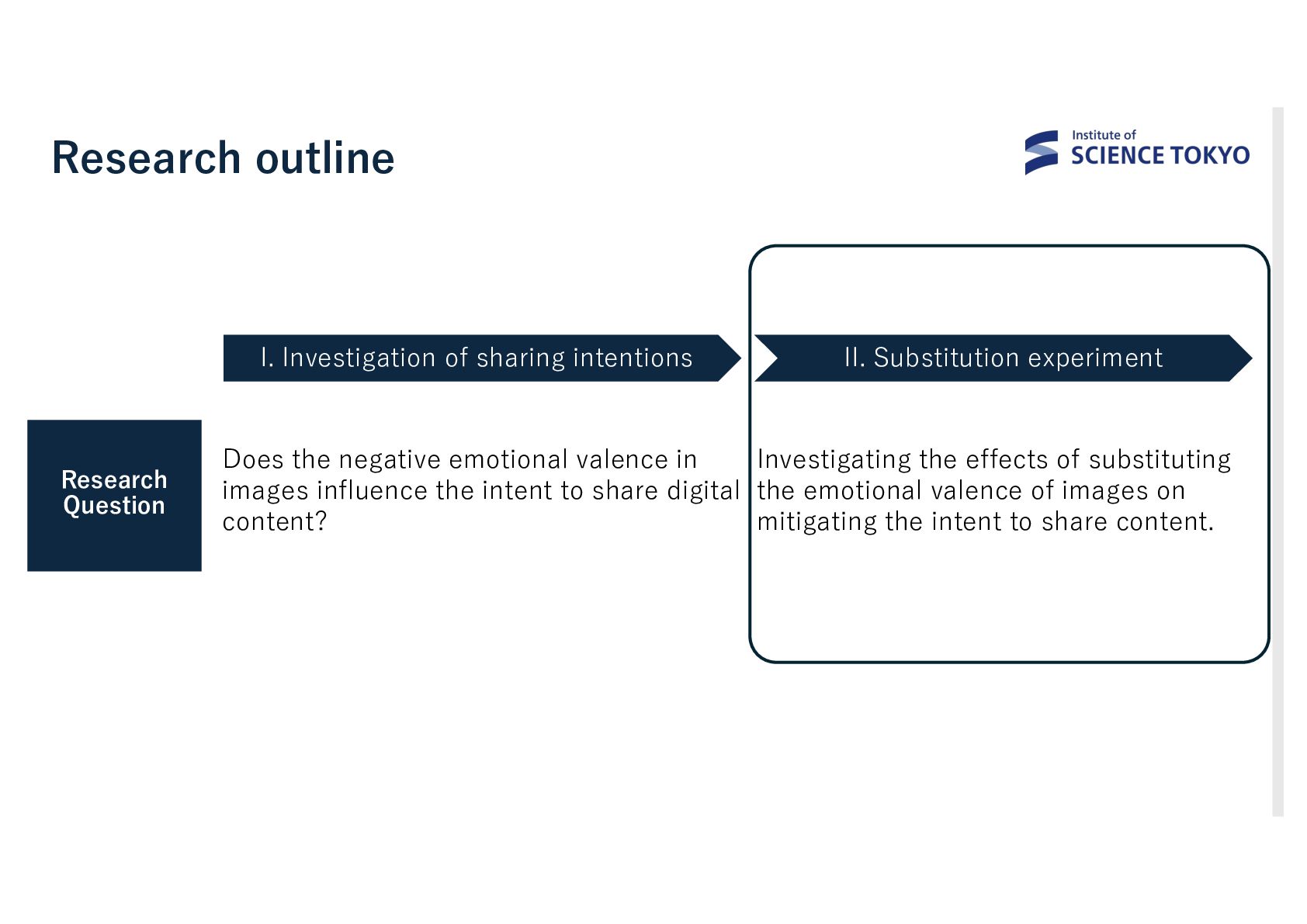
Substitution experiment Does the negative emotional valence in Investigating the effects of substituting images influence the intent to share digital the emotional valence of images on content? mitigating the intent to share content.
Study1:Investigation of the Impact of Emotional Valence in Images on Shared Intentions • Study2:Image Substitution Experiment Focusing on Emotional Valence 4. Summary 26
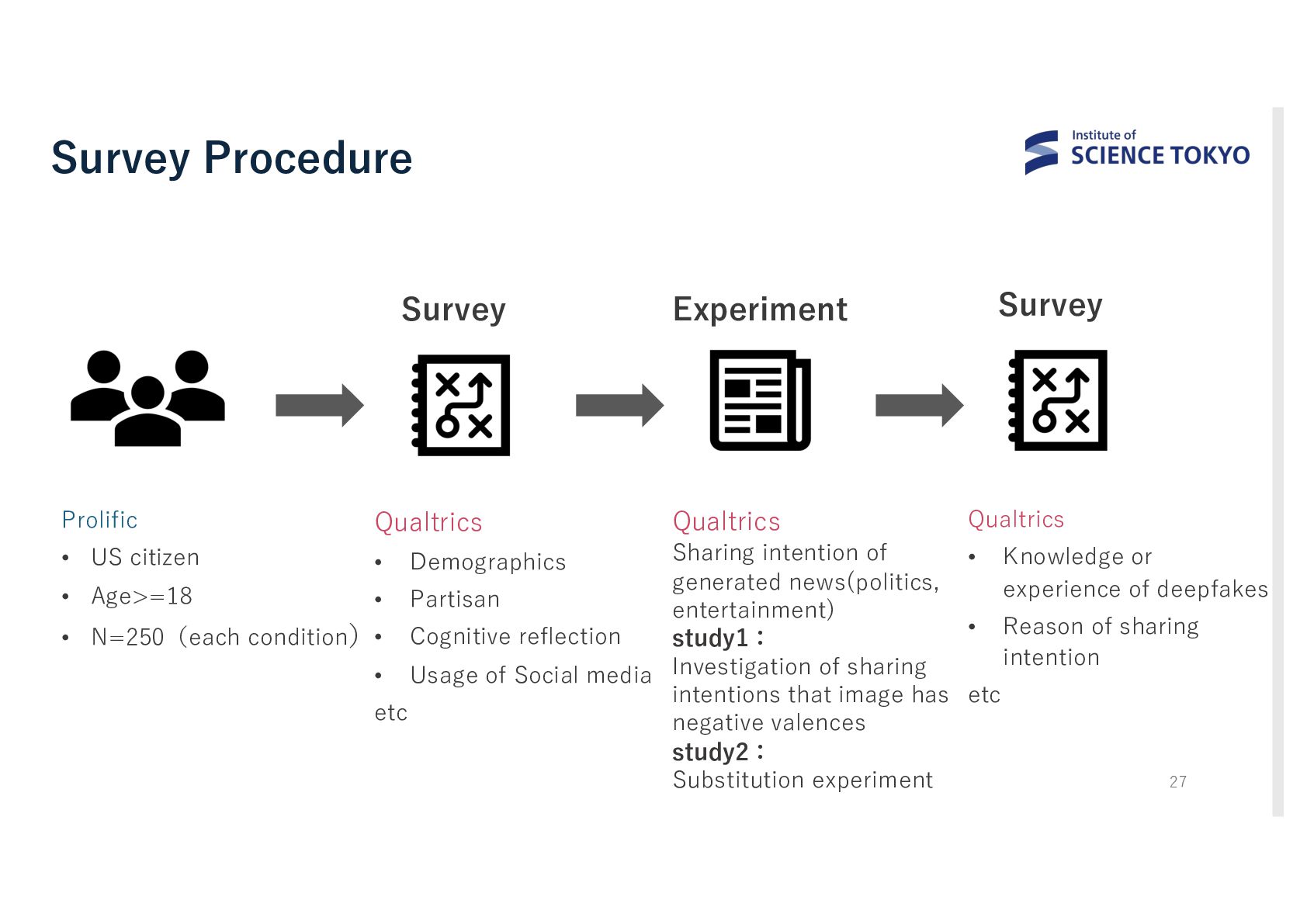
intention of • Knowledge or generated news(politics, experience of deepfakes • Age>=18 • Partisan entertainment) • Reason of sharing • N=250(each condition)• Cognitive reflection study1: intention • Usage of Social media Investigation of sharing intentions that image has etc etc negative valences study2: 27 Substitution experiment • US citizen • Demographics
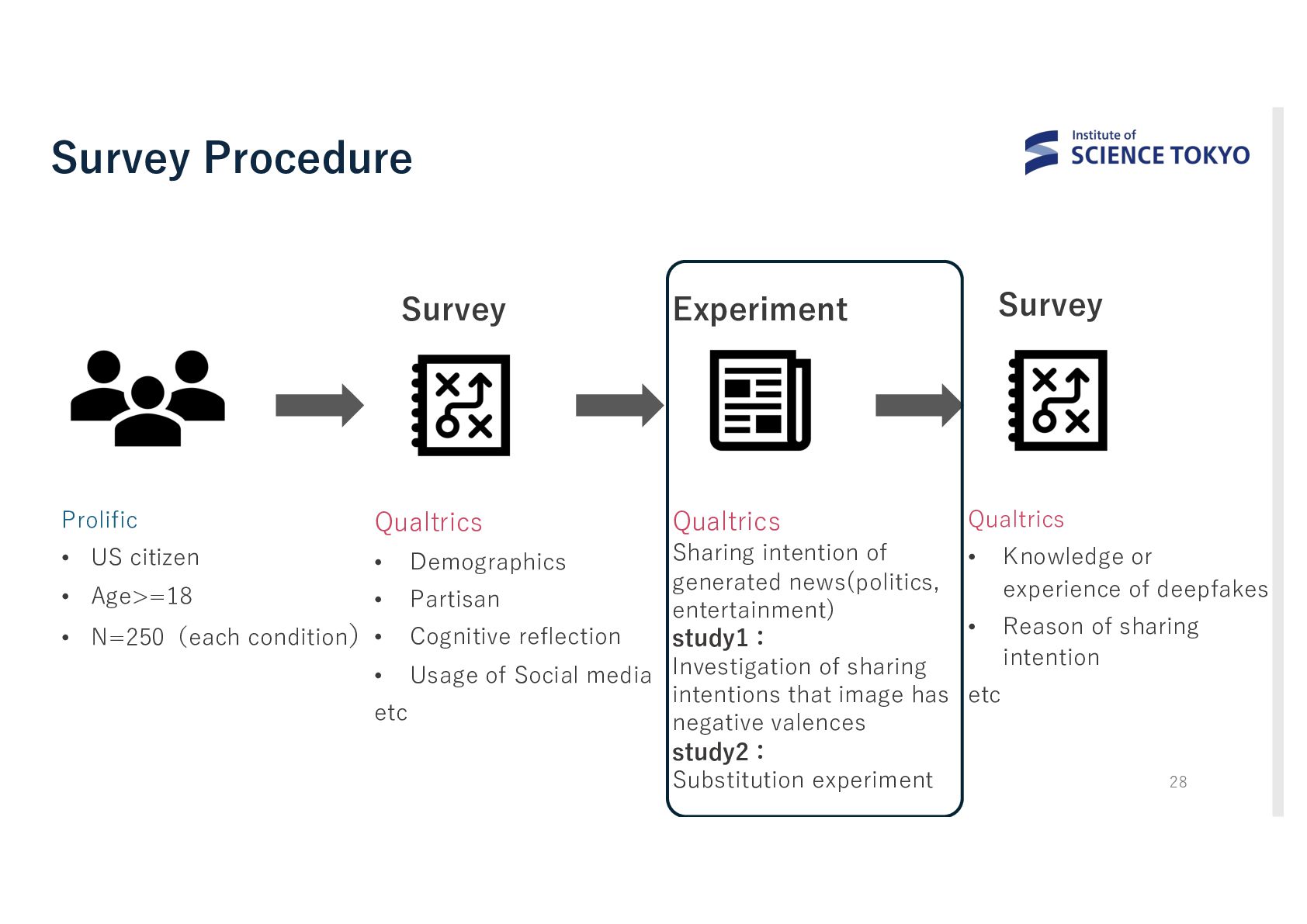
intention of • Knowledge or generated news(politics, experience of deepfakes • Age>=18 • Partisan entertainment) • Reason of sharing • N=250(each condition)• Cognitive reflection study1: intention • Usage of Social media Investigation of sharing intentions that image has etc etc negative valences study2: 28 Substitution experiment • US citizen • Demographics
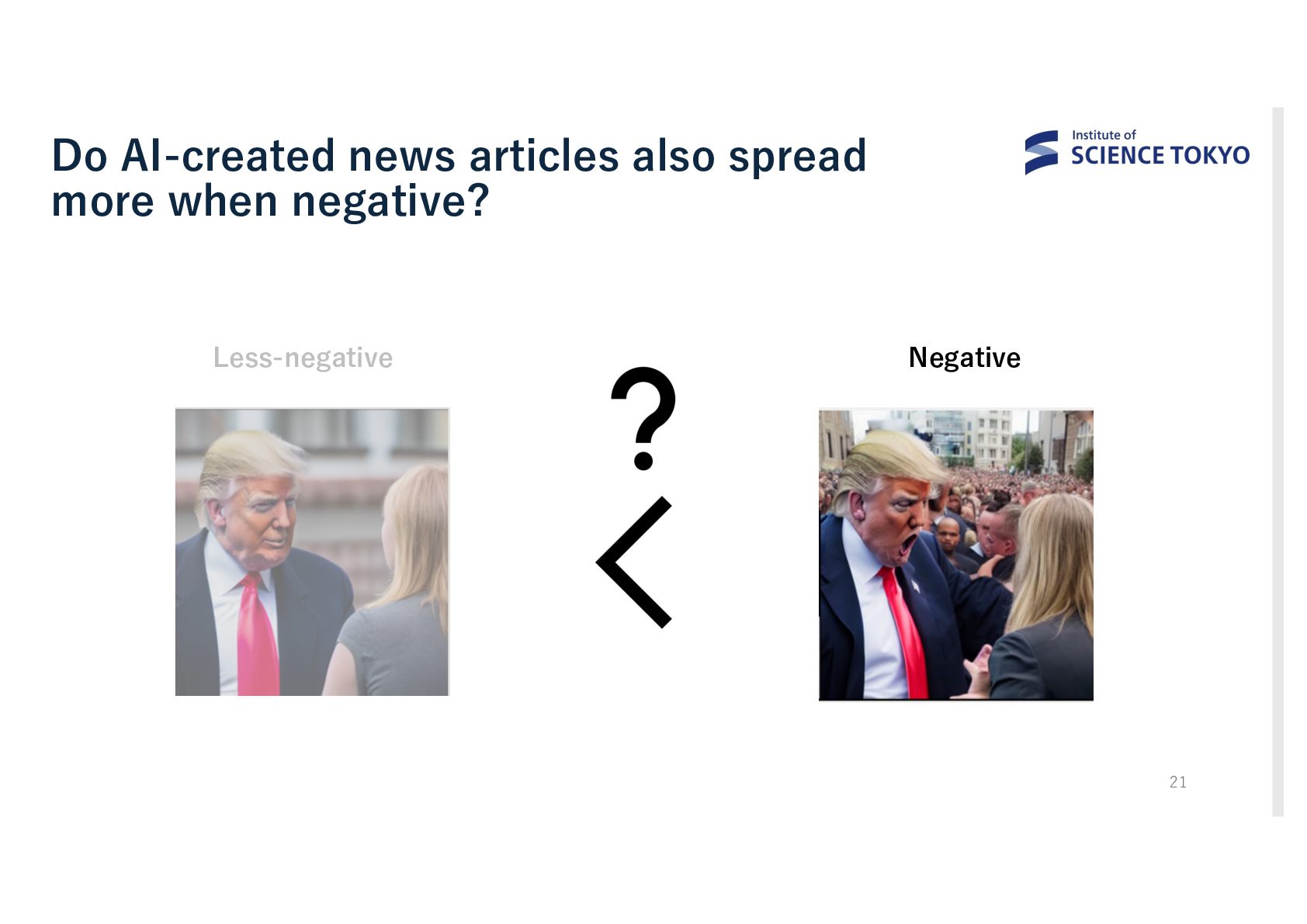
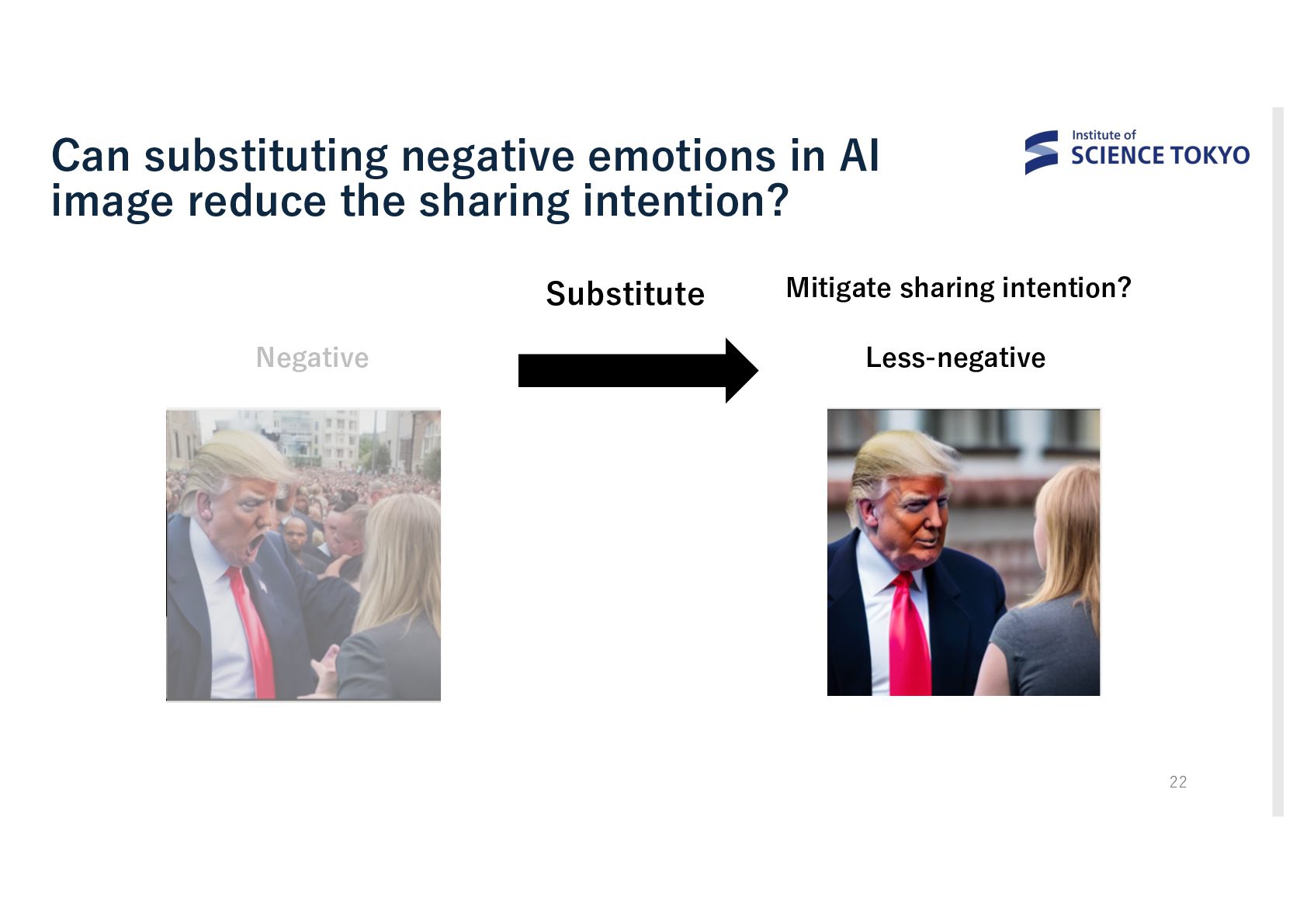
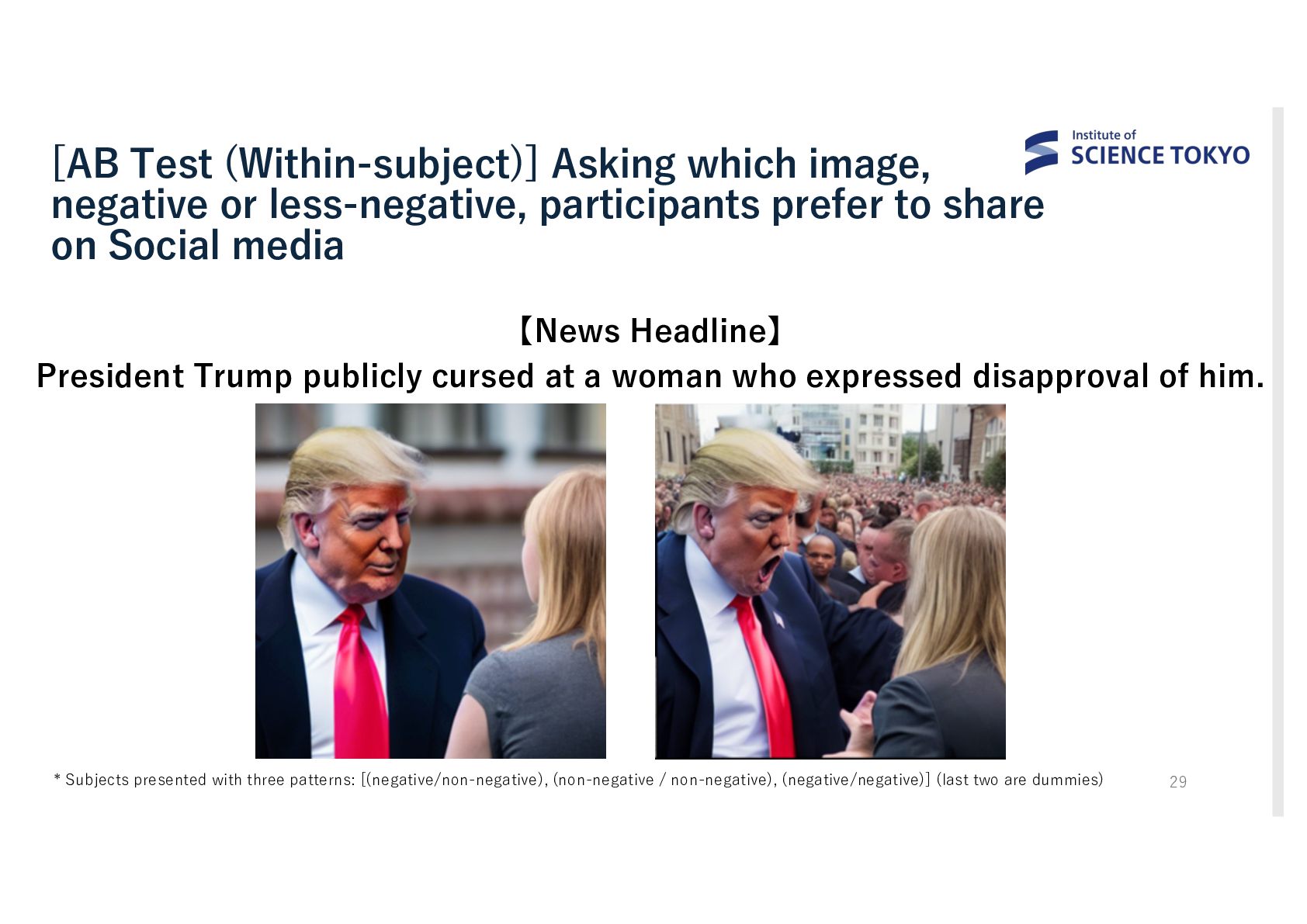
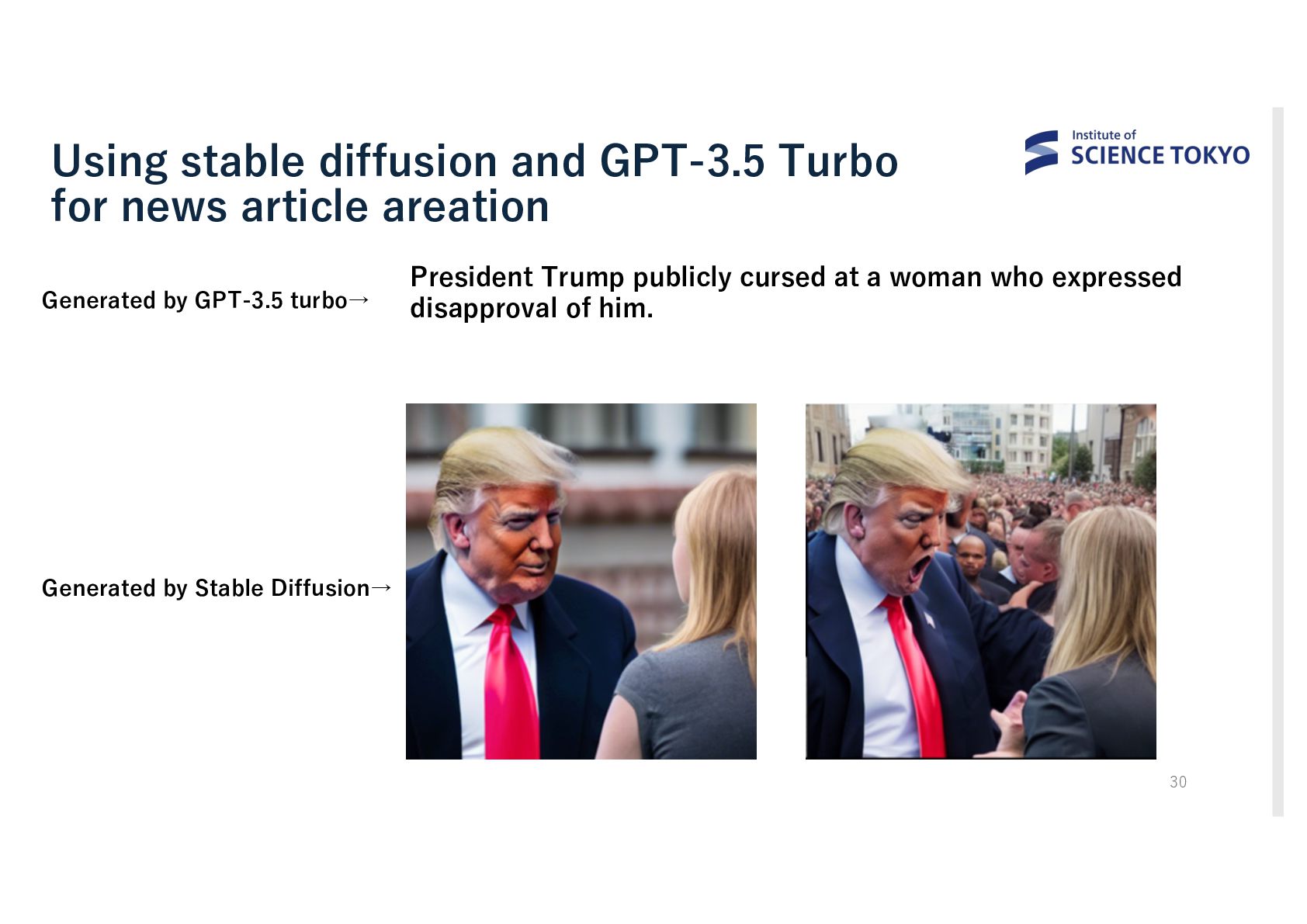
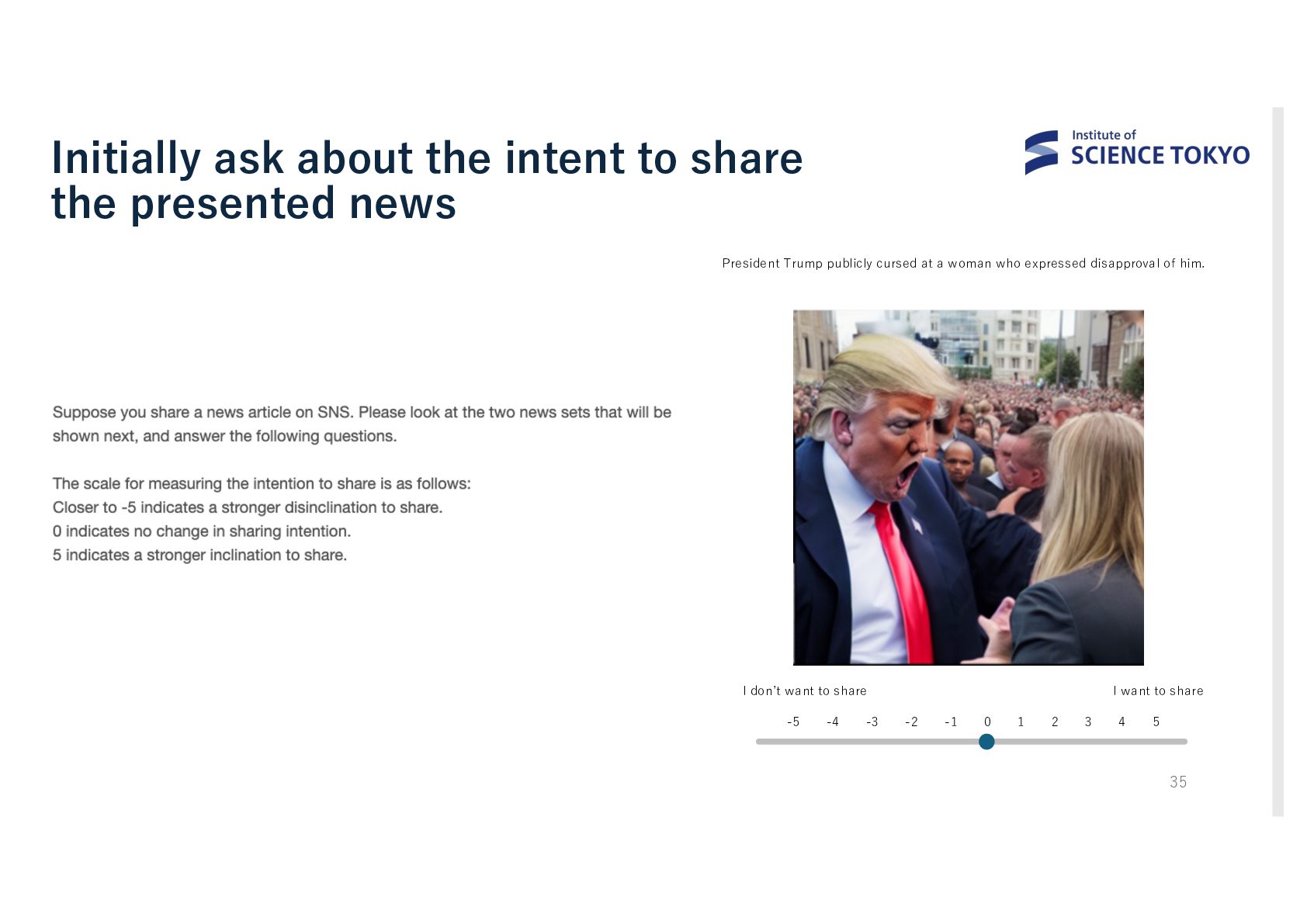
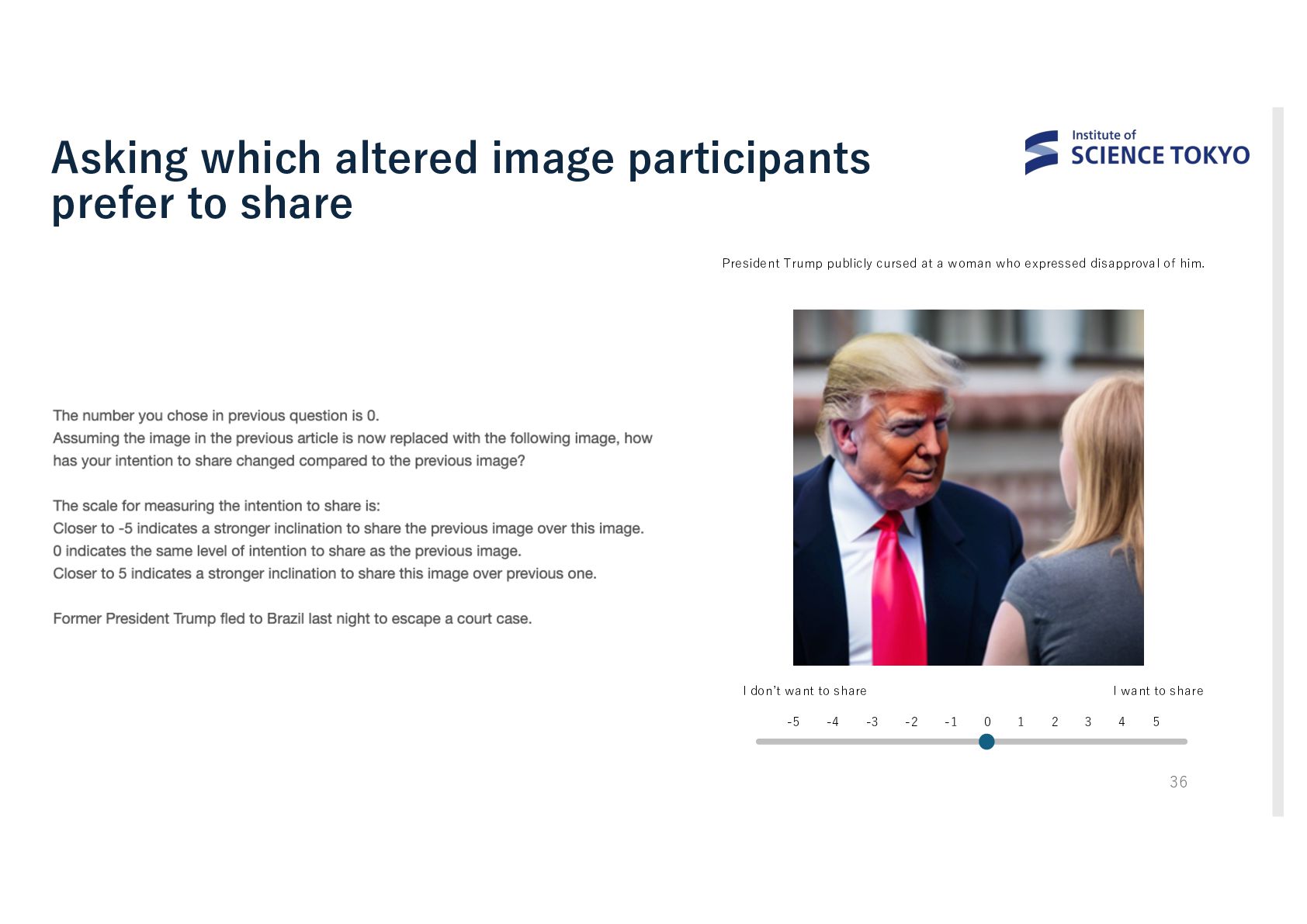
prefer to share on Social media 【News Headline】 President Trump publicly cursed at a woman who expressed disapproval of him. * Subjects presented with three patterns: [(negative/non-negative), (non-negative / non-negative), (negative/negative)] (last two are dummies) 29
than those without such image. negative Less-negative *★ indicates news articles selected more when negative (Bonferroni-corrected p value:0.00417) *Out of 12 sets, image choice was significant in 9, with negative images significantly chosen in 9. 31
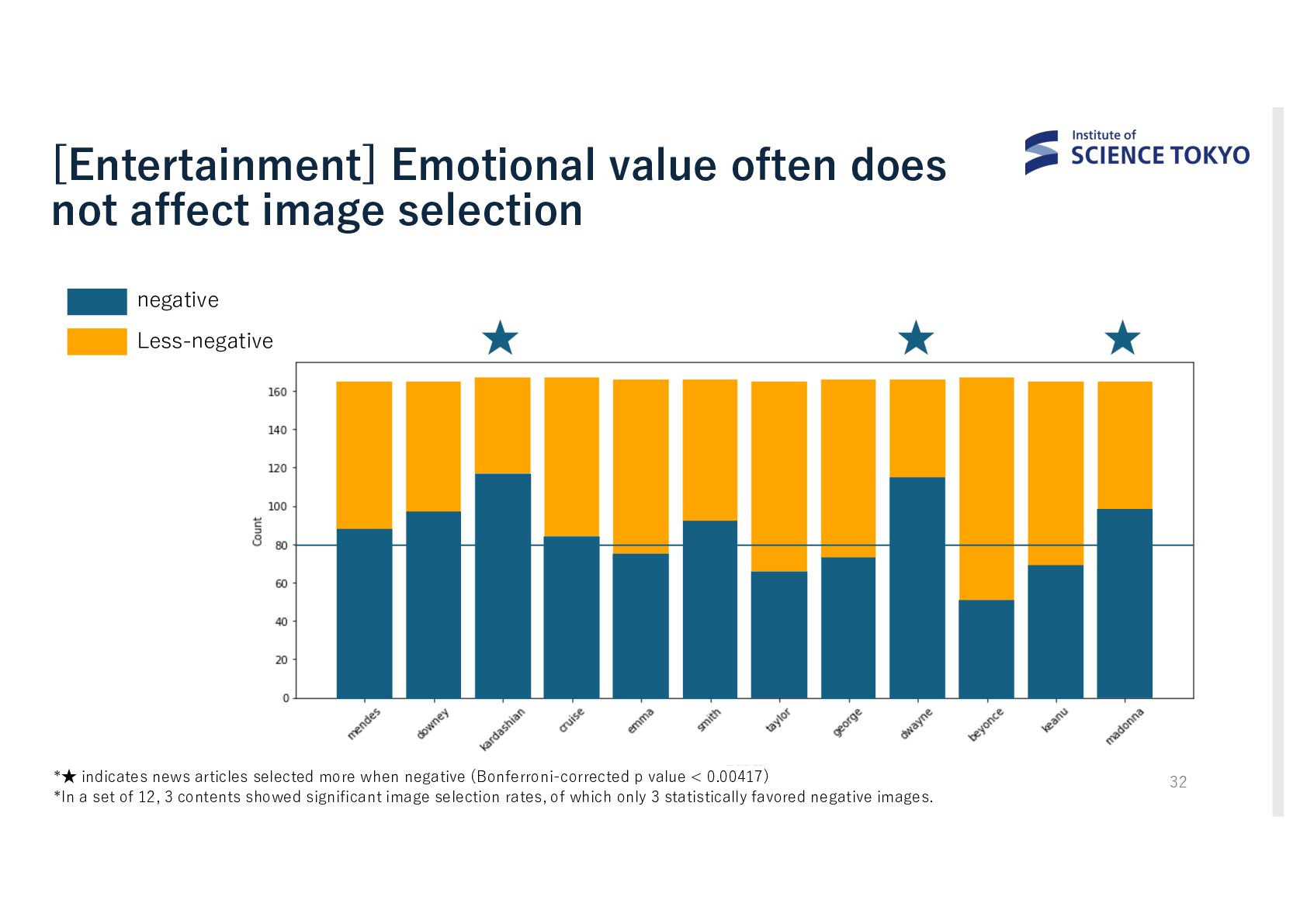
Less-negative *★ indicates news articles selected more when negative (Bonferroni-corrected p value < 0.00417) *In a set of 12, 3 contents showed significant image selection rates, of which only 3 statistically favored negative images. 32
Study1:Investigation of the Impact of Emotional Valence in Images on Shared Intentions • Study2:Image Substitution Experiment Focusing on Emotional Valence 4. Summary 33
Substitution experiment Does the negative emotional valence in Investigating the effects of substituting images influence the intent to share digital the emotional valence of images on content? mitigating the intent to share content.
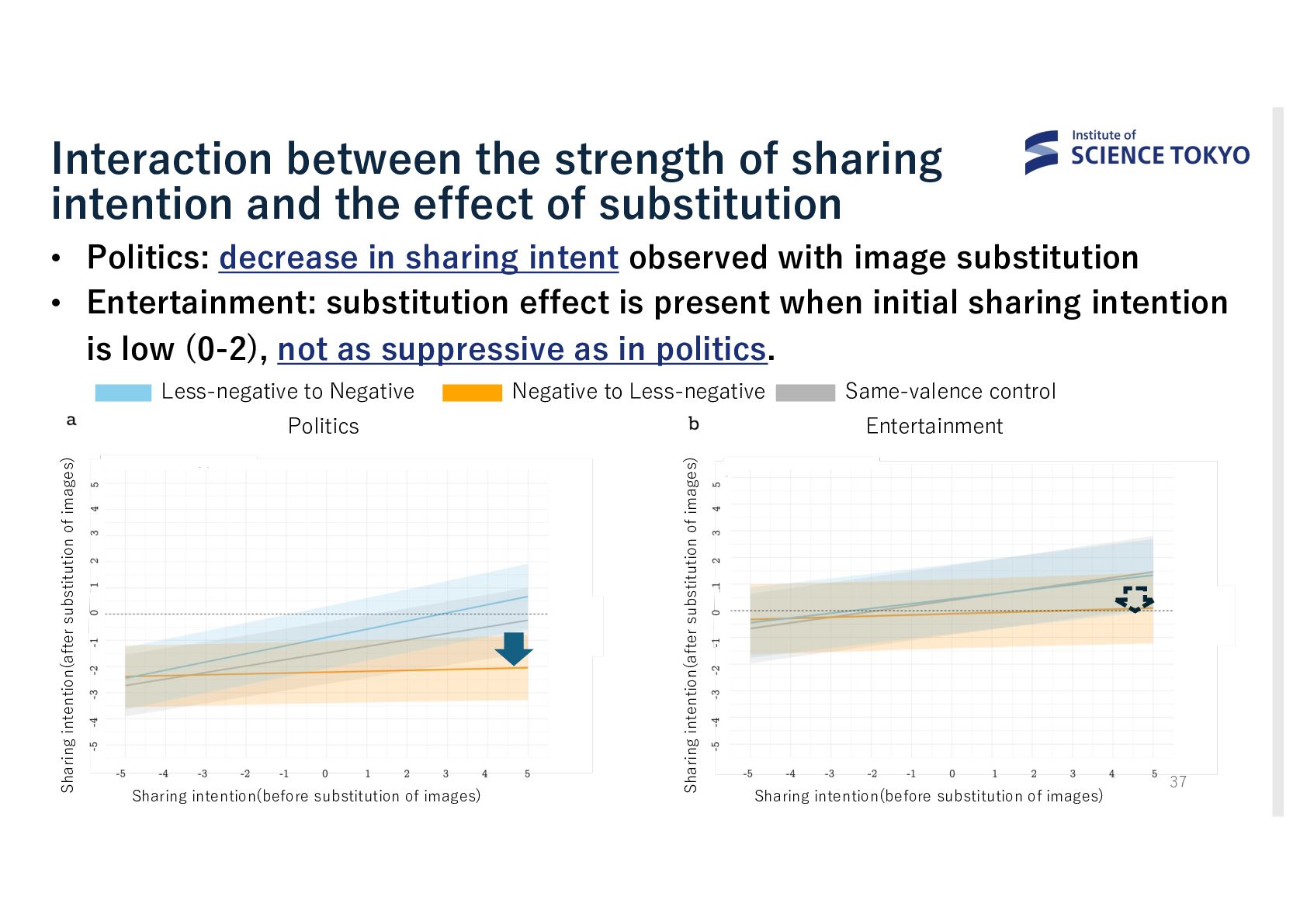
of substitution • Politics: decrease in sharing intent observed with image substitution • Entertainment: substitution effect is present when initial sharing intention is low (0-2), not as suppressive as in politics. Less-negative to Negative Negative to Less-negative Sharing intention(before substitution of images) Entertainment Sharing intention(after substitution of images) Sharing intention(after substitution of images) Politics Same-valence control Sharing intention(before substitution of images) 37
Study1:Investigation of the Impact of Emotional Valence in Images on Shared Intentions • Study2:Image Substitution Experiment Focusing on Emotional Valence 4. Summary 38
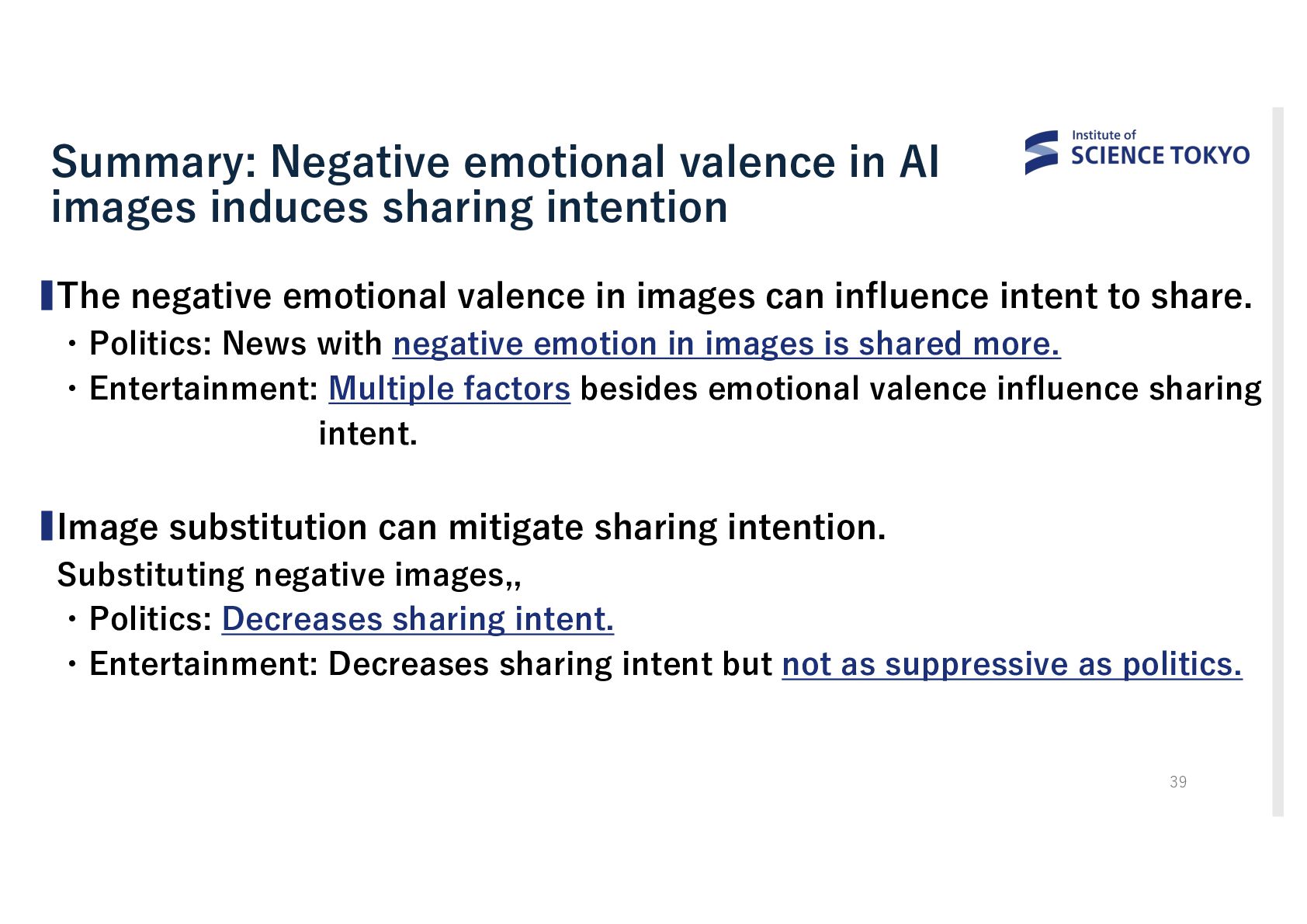
The negative emotional valence in images can influence intent to share. ・Politics: News with negative emotion in images is shared more. ・Entertainment: Multiple factors besides emotional valence influence sharing intent. Image substitution can mitigate sharing intention. Substituting negative images,, ・Politics: Decreases sharing intent. ・Entertainment: Decreases sharing intent but not as suppressive as politics. 39
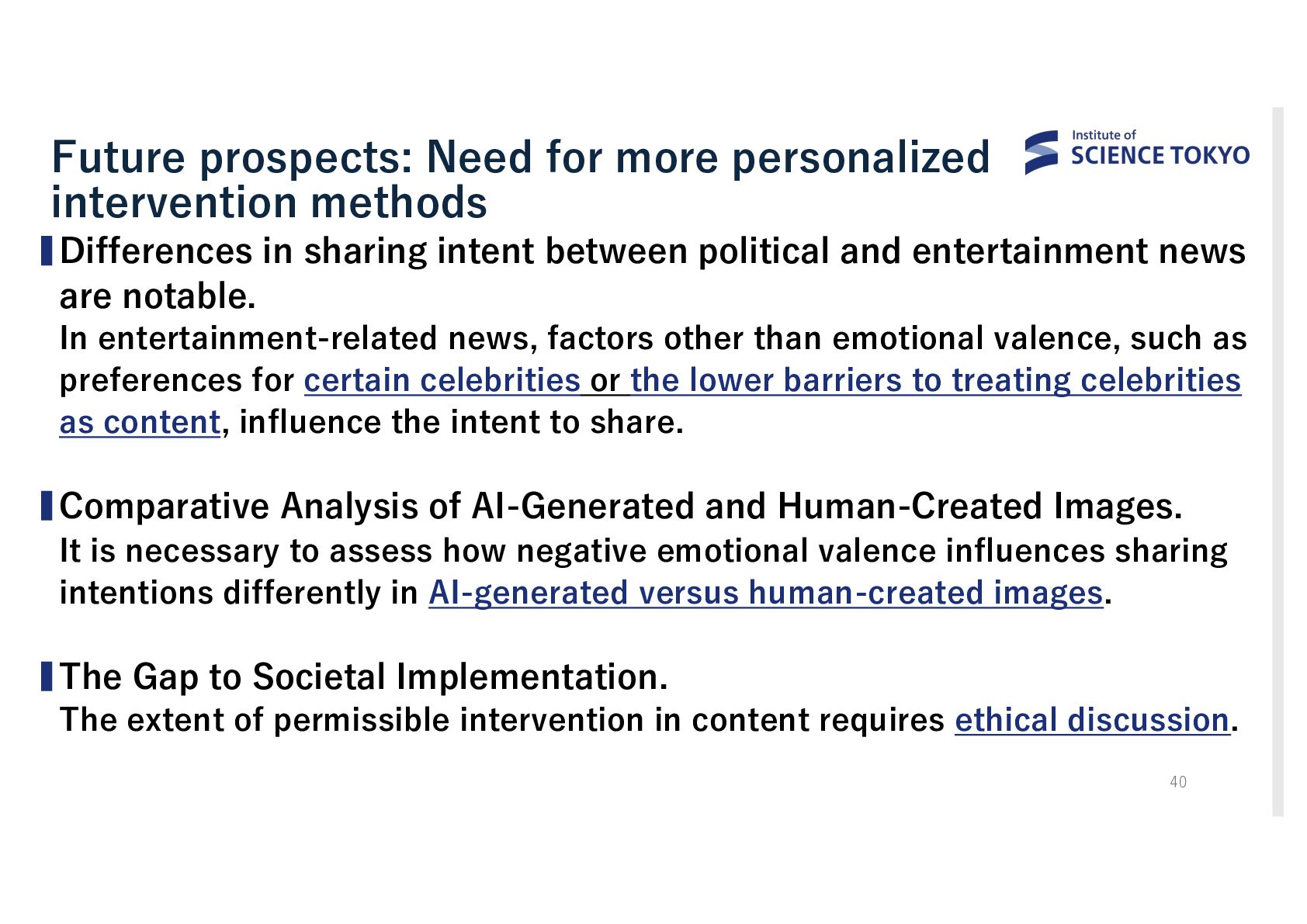
sharing intent between political and entertainment news are notable. In entertainment-related news, factors other than emotional valence, such as preferences for certain celebrities or the lower barriers to treating celebrities as content, influence the intent to share. Comparative Analysis of AI-Generated and Human-Created Images. It is necessary to assess how negative emotional valence influences sharing intentions differently in AI-generated versus human-created images. The Gap to Societal Implementation. The extent of permissible intervention in content requires ethical discussion. 40


 ichika035
 brad_frost
 tammyeverts
 sugarenia
 tessaabrams
 geoffreycrofte
 danielanewman
 helenjbeal
 soysaucechin
 cassininazir
 reverentgeek
 hannesfritz
 lfama