Upgrade to Pro — share decks privately, control downloads, hide ads and more …

Adopting observability at scale

Sponsored · SiteGround - Reliable hosting with speed, security, and support you can count on. →

Adopting observability at scale

Live recording: https://www.youtube.com/watch?v=HEAgbPJhIzg

In this retrospective talk Igor looks back on his experience in establishing and improving observability in microservice stacks. Whether it's 5, 50 or 500 services, whether the stack is built in Go, Node, Java, Python, PHP or all of them at once - operating a complex system at scale means both performance and stability have to have actionable metrics and ways to efficiently find and fix problems.

Key takeaways:
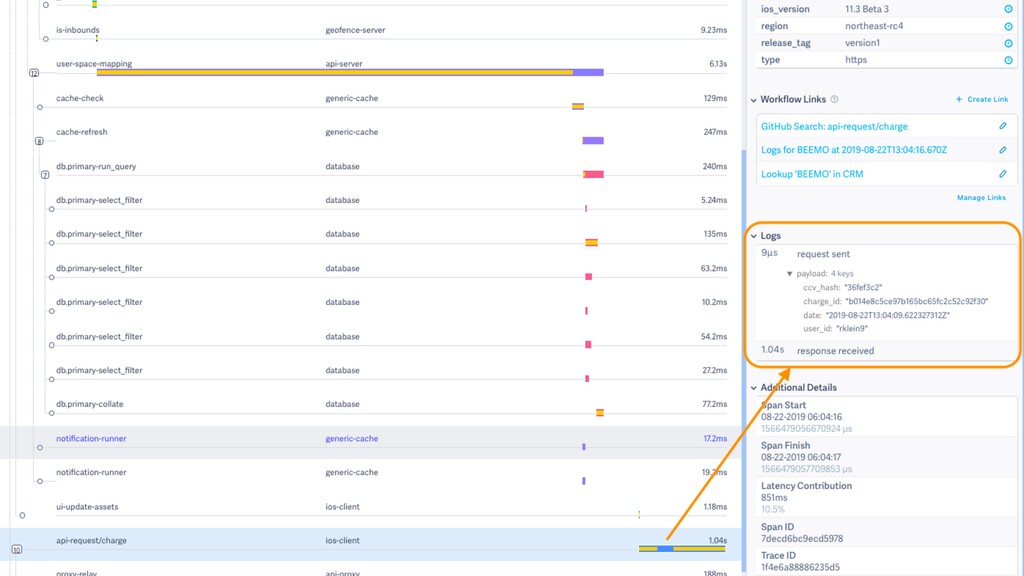
- Ways to meaningfully connect metrics, traces and logs
- Lessons learned when adopting observability across multi-technology stacks
- How observability helps to transition from a monolith or few microservices to large microservice stacks with minimal disruption
- Why standards matter

Igor is a tech lead with strong background in distributed systems. He started his career in a broadband provider helping to design and scale the ISP's core. Igor has been in the industry for 13 years, leading engineering function in a fintech until 2019. He's current challenge is with Skyscanner where Igor is working on a next generation booking platform as a Principal Engineer.

Avatar for Igor Karpovich

Igor Karpovich

February 18, 2020

More Decks by Igor Karpovich

Other Decks in Technology

Transcript

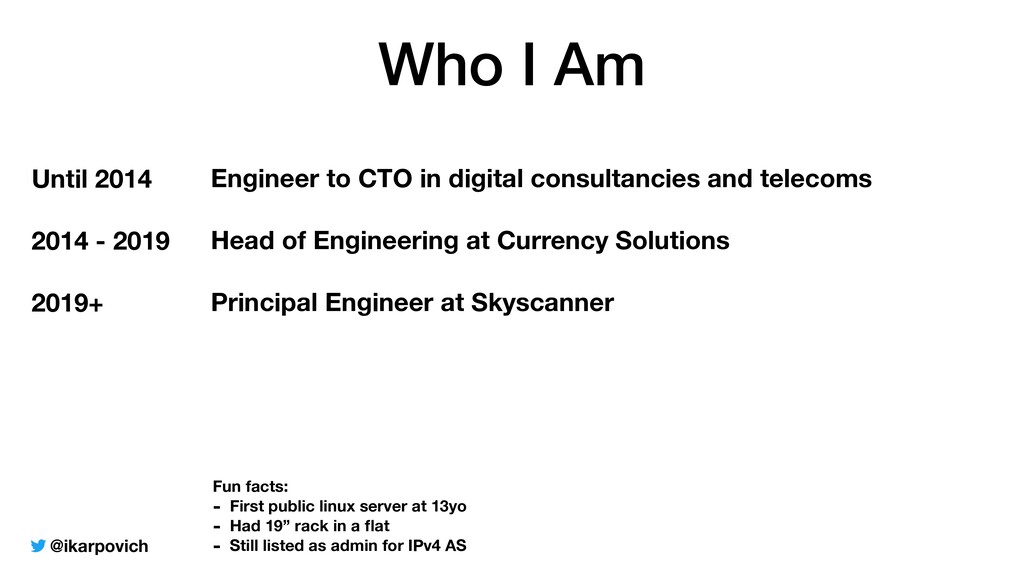
  1. Who I Am @ikarpovich Until 2014 2014 - 2019 2019+

    Engineer to CTO in digital consultancies and telecoms Head of Engineering at Currency Solutions Principal Engineer at Skyscanner Fun facts: - First public linux server at 13yo - Had 19” rack in a flat - Still listed as admin for IPv4 AS
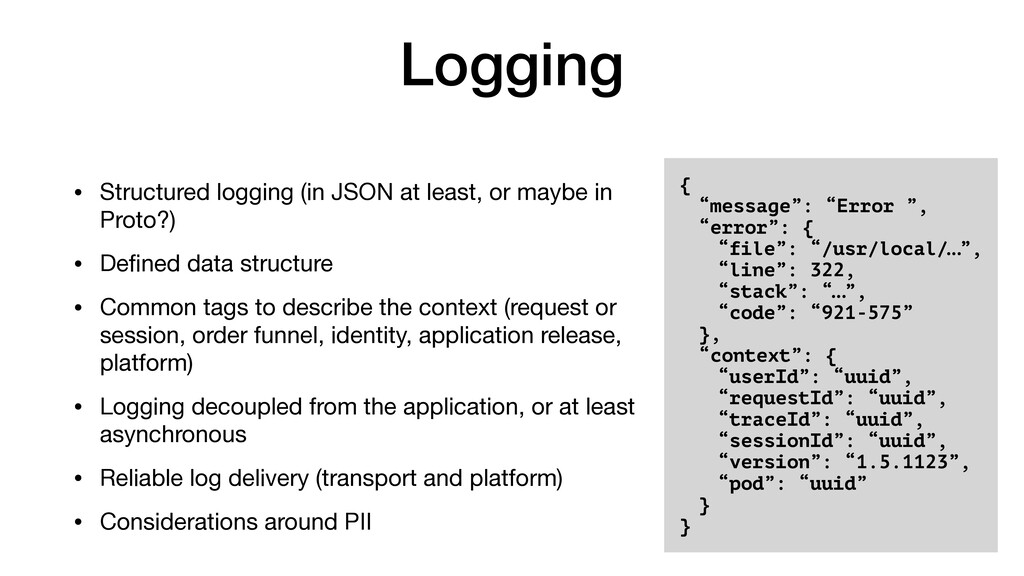
  2. Logging • Structured logging (in JSON at least, or maybe

    in Proto?) • Defined data structure • Common tags to describe the context (request or session, order funnel, identity, application release, platform) • Logging decoupled from the application, or at least asynchronous • Reliable log delivery (transport and platform) • Considerations around PII { “message”: “Error ”, “error”: { “file”: “/usr/local/…”, “line”: 322, “stack”: “…”, “code”: “921-575” }, “context”: { “userId”: “uuid”, “requestId”: “uuid”, “traceId”: “uuid”, “sessionId”: “uuid”, “version”: “1.5.1123”, “pod”: “uuid” } }
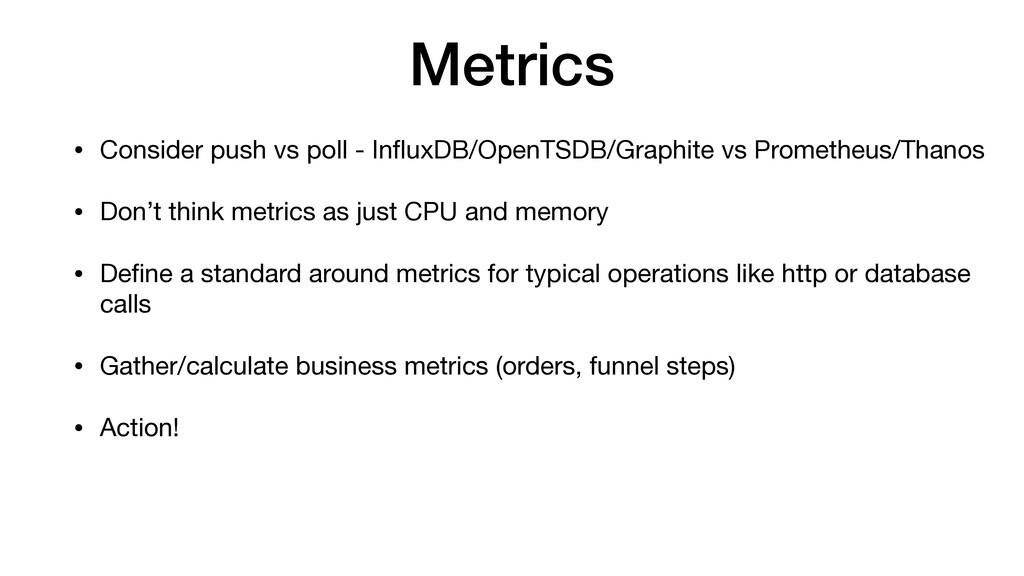
  3. Metrics • Consider push vs poll - InfluxDB/OpenTSDB/Graphite vs Prometheus/Thanos

    • Don’t think metrics as just CPU and memory • Define a standard around metrics for typical operations like http or database calls • Gather/calculate business metrics (orders, funnel steps) • Action!
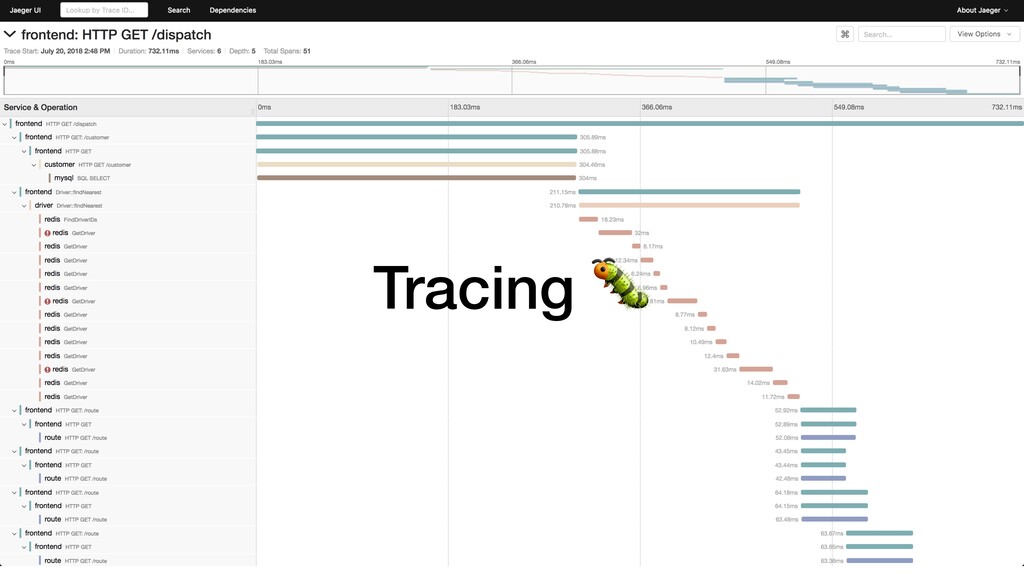
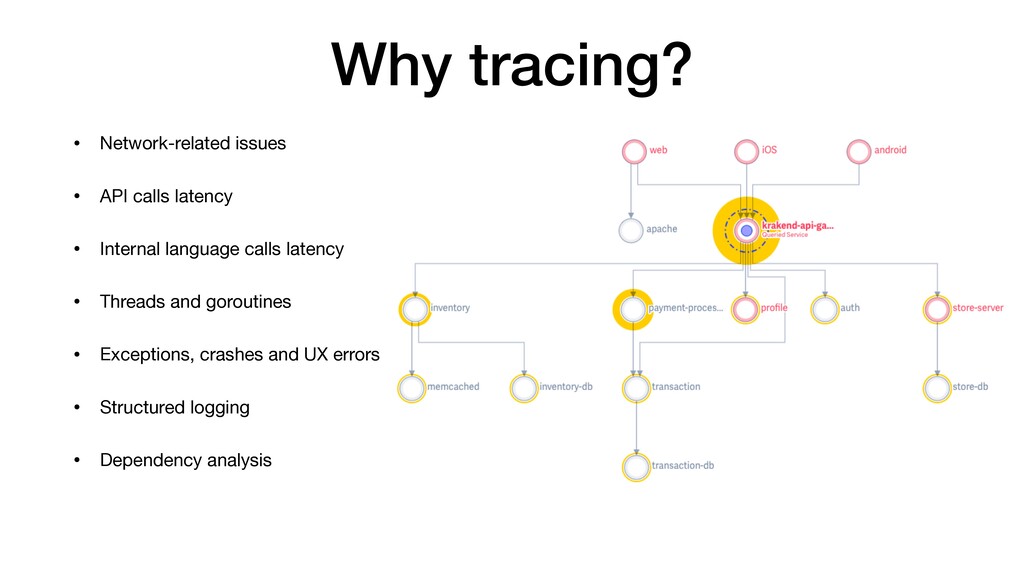
  4. Why tracing? • Network-related issues • API calls latency •

    Internal language calls latency • Threads and goroutines • Exceptions, crashes and UX errors • Structured logging • Dependency analysis
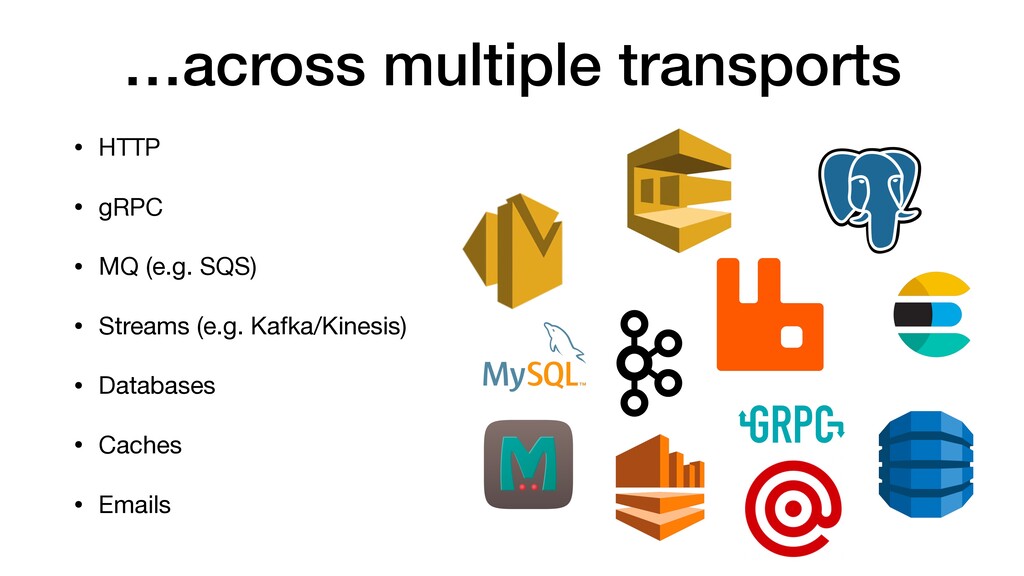
  5. • HTTP • gRPC • MQ (e.g. SQS) • Streams

    (e.g. Kafka/Kinesis) • Databases • Caches • Emails …across multiple transports
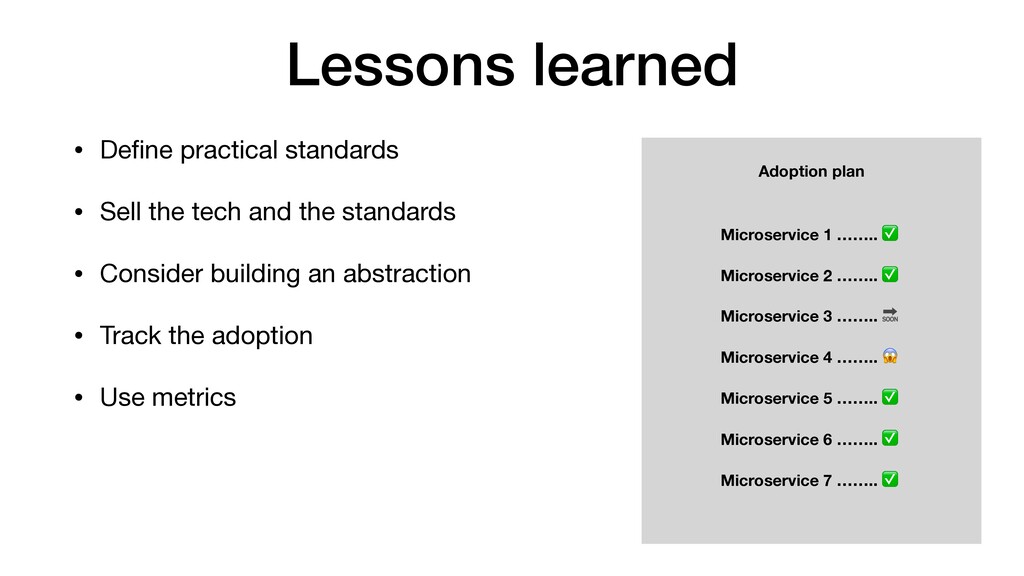
  6. Lessons learned • Define practical standards • Sell the tech

    and the standards • Consider building an abstraction • Track the adoption • Use metrics Microservice 1 …….. ✅ Microservice 2 …….. ✅ Microservice 3 …….. Microservice 4 …….. Microservice 5 …….. ✅ Microservice 6 …….. ✅ Microservice 7 …….. ✅ Adoption plan