individuals are made fully aware of terms to which they are agreeing, particularly when the agreement presents some aspect of risk, such as in legal, medical and research contexts (“Consent,” 2025).
as “a type of user interface that appears to have been carefully crafted to trick users into doing things [where these user interfaces] are carefully crafted with a solid understanding of human psychology, and they do not have the user’s interests in mind” (2011, as cited in Human & Cech, 2021, p. 147). Algorithms hold power over humans by depending on the lack of transparency they are based on. The fact that our clicks, purchases, and preferences are tracked and used to further influence future choices presents issues “regarding the role of algorithms in making choices, political preferences, dating, employment, financial crises, death, war and terrorism” (Neyland, 2019, p. 9).
copyrighted material for a “limited and transformative purpose, such as to comment upon, criticize, or parody” the work (Stanford, n.d.). This doctrine is intended to keep in consideration the rights of creators and copyright holders, while also allowing some amount of these creative works to be used freely for the public interest. The general intention of fair use laws is to prevent copyright law from being too strictly applied, which would have the unintended effect of discouraging others from creating works that may be intentionally or unintentionally similar to a copyrighted work.
by algorithms, which has a number of effects. For creators, it entails that application and enforcement of fair use is less a matter of legal interpretation, and more a reflection of algorithmic restrictions that may be designed with corporate interests in mind (Sprigman, 2018). The automation of copyright enforcement therefore flags legitimate uses of content, such as for education or commentary, and restricts it unnecessarily. In this way, automation may not simply moderate content usage and judge its ‘fairness,’ but also change the conception of what constitutes ‘fair’ in the first place.
or groups based on a variety of categories (“Discrimination,” 2025), while net neutrality refers to the principle that internet service providers (ISPs) must provide equal and consistent access to all websites, platforms and applications, regardless of the content each of these offers (“Net neutrality,” 2025). In effect, it is a prohibition of discrimination of digital services, and prevents providers from either blocking or promoting digital content based on commercial or political motivations.
modes of discrimination. Neyland (2019) discusses how algorithm-identified patterns have led to predictive policing which does not ‘predict’ crime, but uses algorithmically-derived patterns to ensure a higher police presence in areas the algorithm has deemed more likely for crime. This results in a stronger police presence and higher likelihood of arrests in these neighbourhoods. Regarding net neutrality, ISPs may use algorithms to discourage consumption of various sites and platforms. As Neyland says, algorithms are “a means for composing the everyday” (2019, pg. 12), and the concept of corporations or politicians influencing ISPs to limit online activity is a threat that may happen without us realizing.
of) content, products and services to match an individual’s personal preferences. Personalization anticipates the wants and needs of consumers and provides them with a feeling that they are valued, creating positive user experiences and profitable customer relationships (Contentful, 2025).
on user data. Netflix, for example, uses techniques such as collaborative and content-based filtering to push content on users (VIBIDSOFT, 2024). The motivation, of course, is not to satisfy customer needs but to configure behaviour, maximizing engagement and, not coincidentally, profits. In this way, algorithms are participants in our media consumption habits, directing us toward the needs of the producer while convincing the consumer of quite the opposite. Algorithms do not then respond to our personalized preferences so much as shape them.
companion) with whom we share a personal, reciprocal relationship. A friend is someone we can count on and with whom we share common interests and values, history, and equality (Lickerman, 2013).
in the era of social media. Algorithms have changed friendship to be a quantifiable and monetizable commodity. Platforms like Facebook use algorithms to determine which "friends" you see more often, prioritizing engagement over genuine social connection. As Neyland says, “numerous questions are raised regarding the role of algorithms in making choices,” (2019, pg. 9). Which friends we are exposed to online is one of those choices, as algorithms have made ‘friendship’ a curated, data-driven experience, rather than a social one.
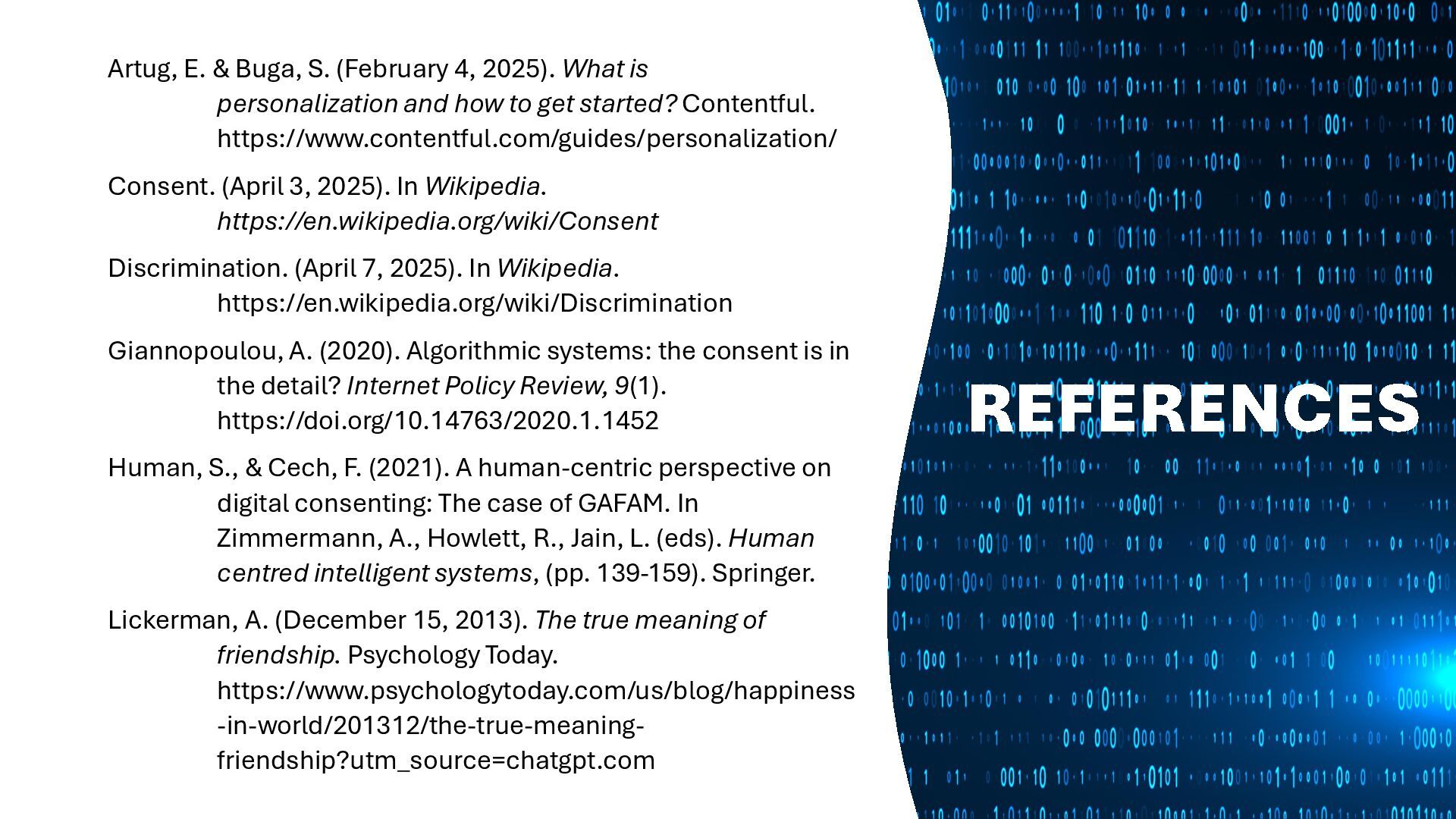
personalization and how to get started? Contentful. https://www.contentful.com/guides/personalization/ Consent. (April 3, 2025). In Wikipedia. https://en.wikipedia.org/wiki/Consent Discrimination. (April 7, 2025). In Wikipedia. https://en.wikipedia.org/wiki/Discrimination Giannopoulou, A. (2020). Algorithmic systems: the consent is in the detail? Internet Policy Review, 9(1). https://doi.org/10.14763/2020.1.1452 Human, S., & Cech, F. (2021). A human-centric perspective on digital consenting: The case of GAFAM. In Zimmermann, A., Howlett, R., Jain, L. (eds). Human centred intelligent systems, (pp. 139-159). Springer. Lickerman, A. (December 15, 2013). The true meaning of friendship. Psychology Today. https://www.psychologytoday.com/us/blog/happiness -in-world/201312/the-true-meaning- friendship?utm_source=chatgpt.com
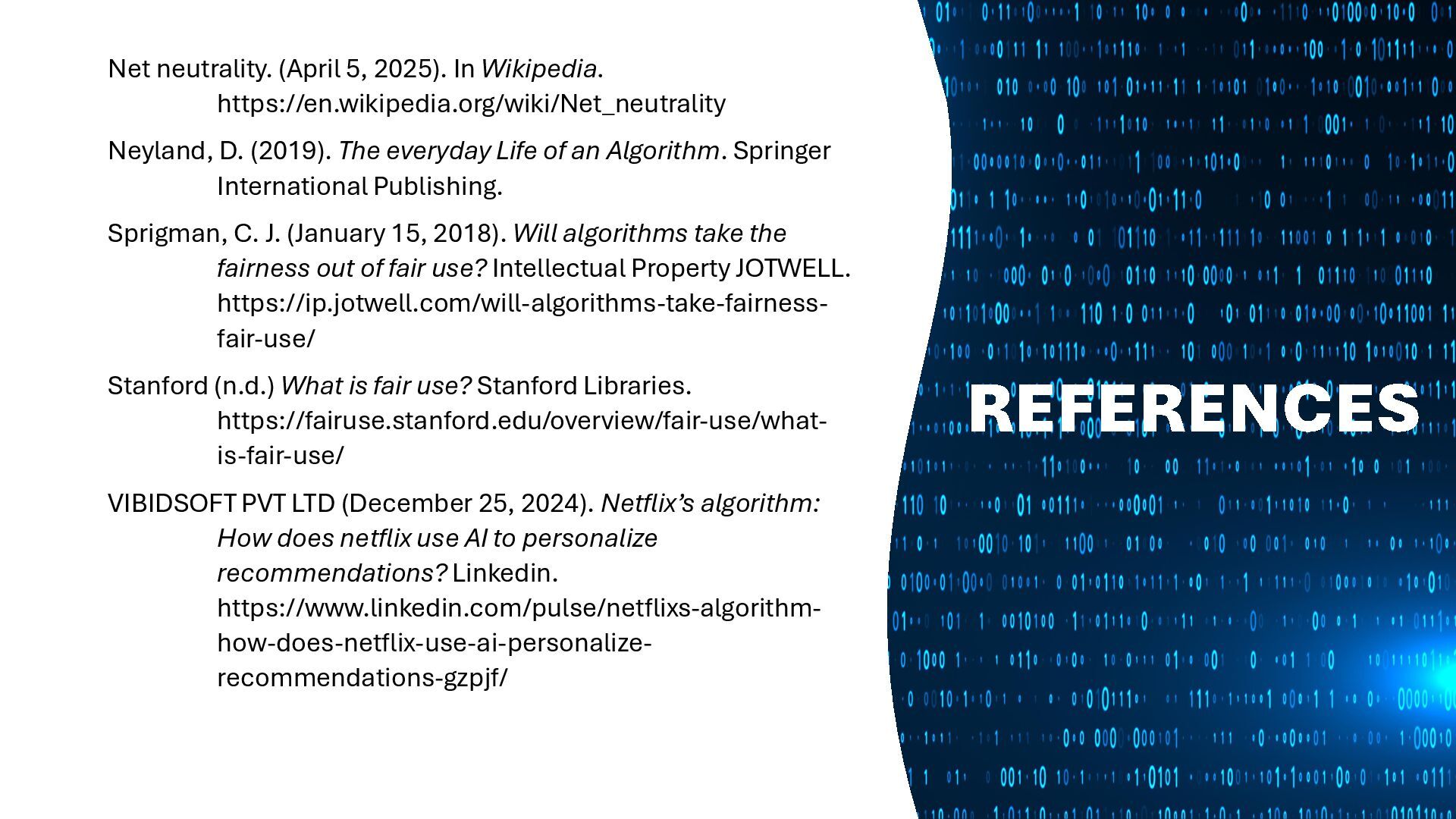
(2019). The everyday Life of an Algorithm. Springer International Publishing. Sprigman, C. J. (January 15, 2018). Will algorithms take the fairness out of fair use? Intellectual Property JOTWELL. https://ip.jotwell.com/will-algorithms-take-fairness- fair-use/ Stanford (n.d.) What is fair use? Stanford Libraries. https://fairuse.stanford.edu/overview/fair-use/what- is-fair-use/ VIBIDSOFT PVT LTD (December 25, 2024). Netflix’s algorithm: How does netflix use AI to personalize recommendations? Linkedin. https://www.linkedin.com/pulse/netflixs-algorithm- how-does-netflix-use-ai-personalize- recommendations-gzpjf/


 cbtlibrary
 juanmartin2026
 yasslab
 eller86
 yatabe
 frievea
 signer
 kekekenta
 sciencetokyo
 hiola
 matleenalaakso
 techseoconnect
 lfama
 marktimemedia
 tmiket
 ryanjones
 mfonobong
 tomoyanonymous
 kneath
 baasie
 addyosmani
 cassininazir
 schlessera