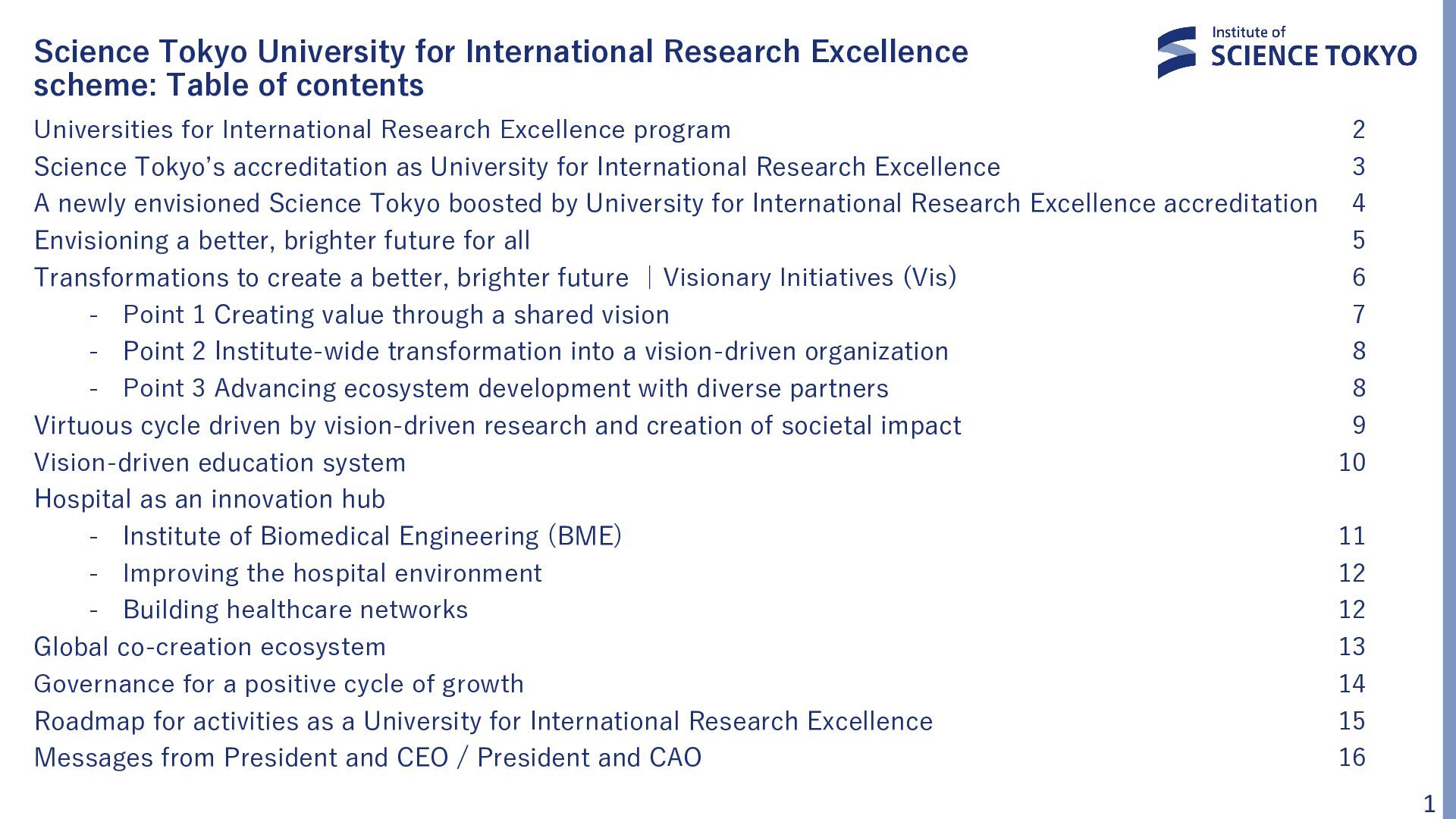
contents Universities for International Research Excellence program Science Tokyo’s accreditation as University for International Research Excellence A newly envisioned Science Tokyo boosted by University for International Research Excellence accreditation Envisioning a better, brighter future for all Transformations to create a better, brighter future |Visionary Initiatives (Vis) - Point 1 Creating value through a shared vision - Point 2 Institute-wide transformation into a vision-driven organization - Point 3 Advancing ecosystem development with diverse partners Virtuous cycle driven by vision-driven research and creation of societal impact Vision-driven education system Hospital as an innovation hub - Institute of Biomedical Engineering (BME) - Improving the hospital environment - Building healthcare networks Global co-creation ecosystem Governance for a positive cycle of growth Roadmap for activities as a University for International Research Excellence Messages from President and CEO / President and CAO 2 3 4 5 6 7 8 8 9 10 11 12 12 13 14 15 16 1
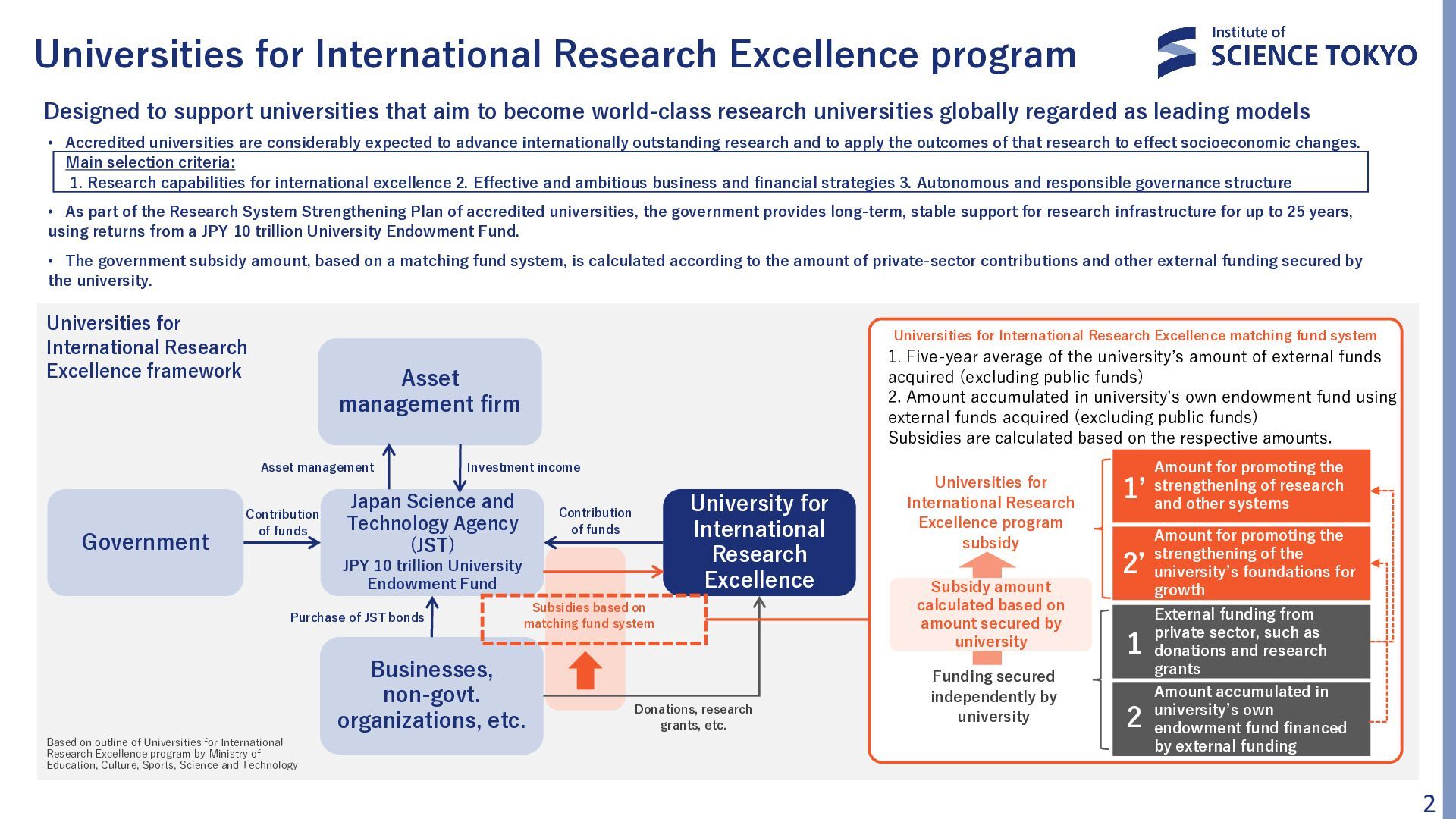
that aim to become world-class research universities globally regarded as leading models • Accredited universities are considerably expected to advance internationally outstanding research and to apply the outcomes of that research to effect socioeconomic changes. Main selection criteria: 1. Research capabilities for international excellence 2. Effective and ambitious business and financial strategies 3. Autonomous and responsible governance structure • As part of the Research System Strengthening Plan of accredited universities, the government provides long-term, stable support for research infrastructure for up to 25 years, using returns from a JPY 10 trillion University Endowment Fund. • The government subsidy amount, based on a matching fund system, is calculated according to the amount of private-sector contributions and other external funding secured by the university. Universities for International Research Excellence framework Universities for International Research Excellence matching fund system Asset management firm Asset management Government 1. Five-year average of the university’s amount of external funds acquired (excluding public funds) 2. Amount accumulated in university’s own endowment fund using external funds acquired (excluding public funds) Subsidies are calculated based on the respective amounts. Contribution of funds Investment income Japan Science and Technology Agency (JST) University for International Research Excellence Contribution of funds JPY 10 trillion University Endowment Fund Purchase of JST bonds Based on outline of Universities for International Research Excellence program by Ministry of Education, Culture, Sports, Science and Technology Subsidies based on matching fund system Businesses, non-govt. organizations, etc. Donations, research grants, etc. Universities for International Research Excellence program subsidy Subsidy amount calculated based on amount secured by university Funding secured independently by university 1’ Amount for promoting the strengthening of research and other systems 2’ Amount for promoting the strengthening of the university’s foundations for growth 1 2 External funding from private sector, such as donations and research grants Amount accumulated in university’s own endowment fund financed by external funding 2
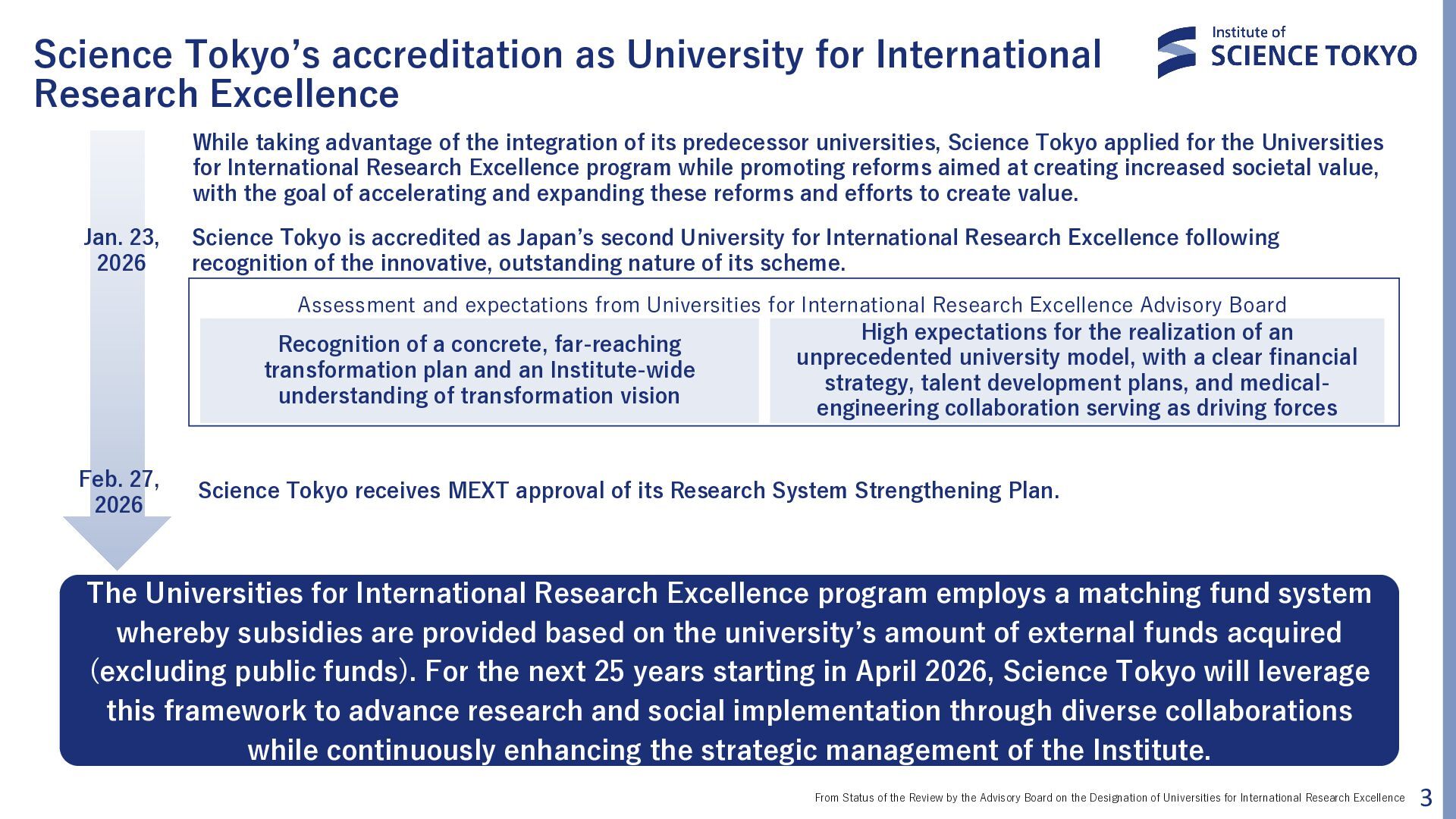
taking advantage of the integration of its predecessor universities, Science Tokyo applied for the Universities for International Research Excellence program while promoting reforms aimed at creating increased societal value, with the goal of accelerating and expanding these reforms and efforts to create value. Jan. 23, 2026 Science Tokyo is accredited as Japan’s second University for International Research Excellence following recognition of the innovative, outstanding nature of its scheme. Assessment and expectations from Universities for International Research Excellence Advisory Board High expectations for the realization of an Recognition of a concrete, far-reaching unprecedented university model, with a clear financial transformation plan and an Institute-wide strategy, talent development plans, and medicalunderstanding of transformation vision engineering collaboration serving as driving forces Feb. 27, 2026 Science Tokyo receives MEXT approval of its Research System Strengthening Plan. The Universities for International Research Excellence program employs a matching fund system whereby subsidies are provided based on the university’s amount of external funds acquired (excluding public funds). For the next 25 years starting in April 2026, Science Tokyo will leverage this framework to advance research and social implementation through diverse collaborations while continuously enhancing the strategic management of the Institute. From Status of the Review by the Advisory Board on the Designation of Universities for International Research Excellence 3
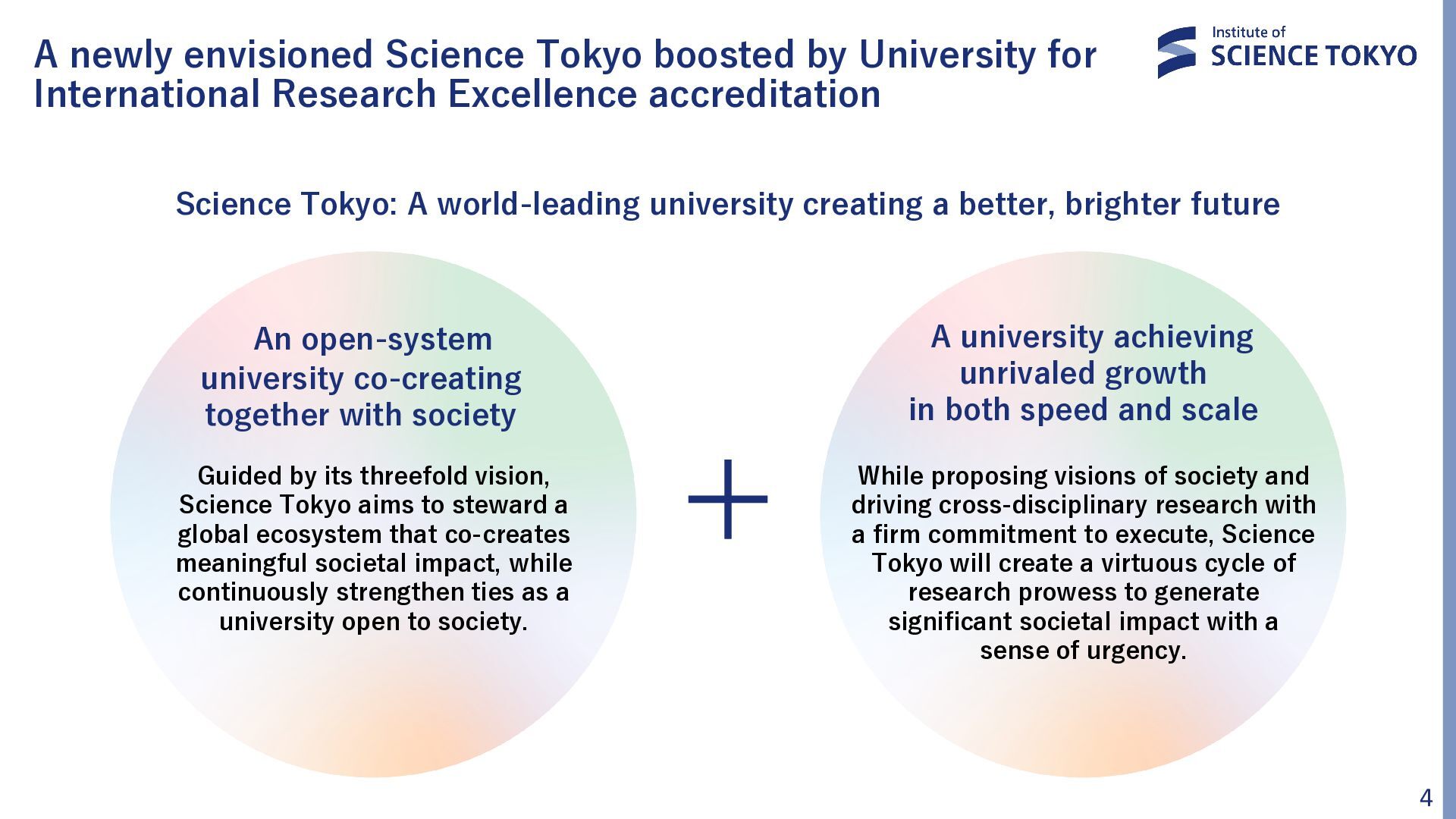
Research Excellence accreditation Science Tokyo: A world-leading university creating a better, brighter future An open-system university co-creating together with society A university achieving unrivaled growth in both speed and scale Guided by its threefold vision, Science Tokyo aims to steward a global ecosystem that co-creates meaningful societal impact, while continuously strengthen ties as a university open to society. While proposing visions of society and driving cross-disciplinary research with a firm commitment to execute, Science Tokyo will create a virtuous cycle of research prowess to generate significant societal impact with a sense of urgency. 4
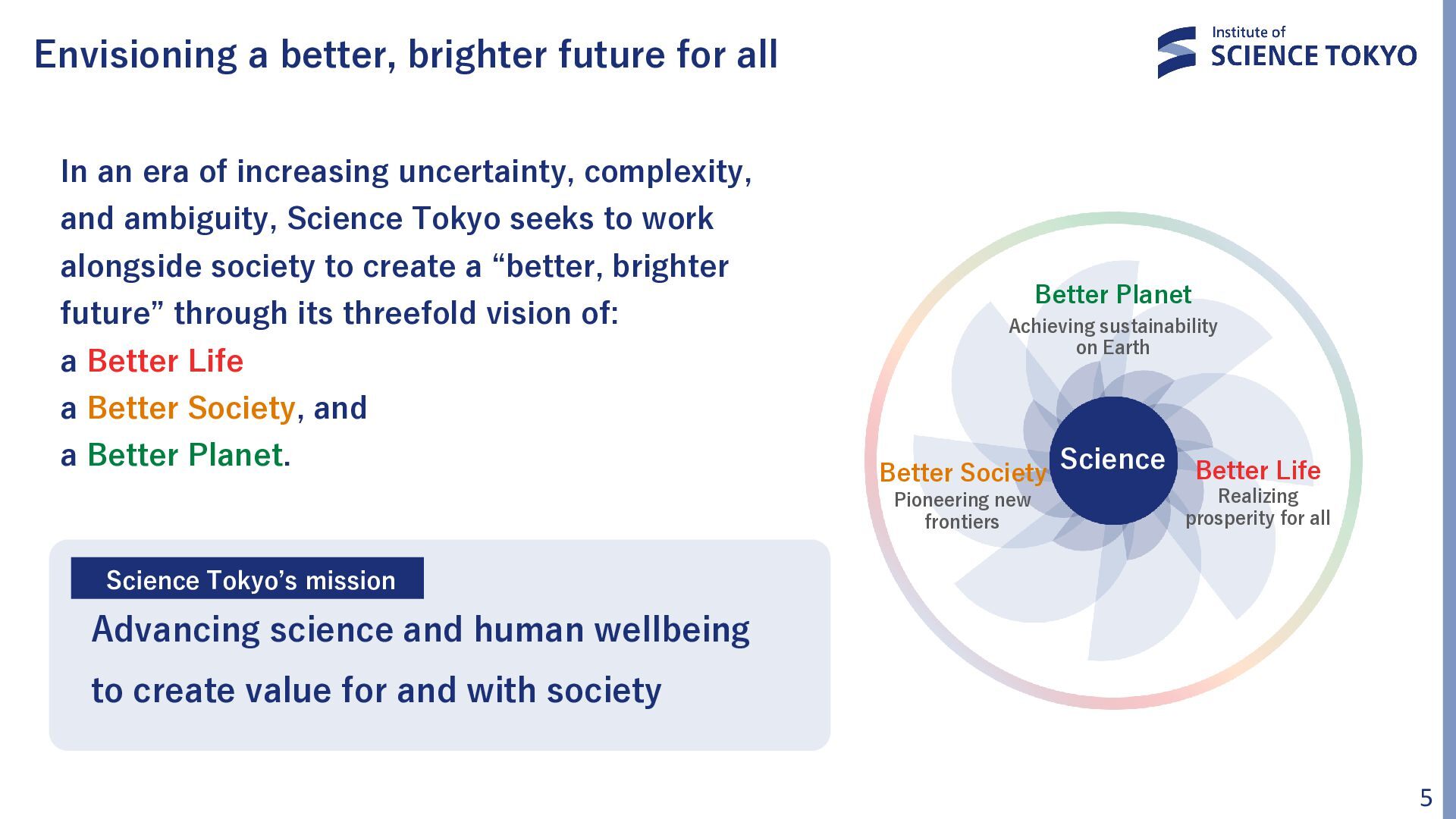
of increasing uncertainty, complexity, and ambiguity, Science Tokyo seeks to work alongside society to create a “better, brighter future” through its threefold vision of: a Better Life Better Planet Achieving sustainability on Earth a Better Society, and a Better Planet. Better Society Pioneering new frontiers Science Better Life Realizing prosperity for all Science Tokyo’s mission Advancing science and human wellbeing to create value for and with society 5
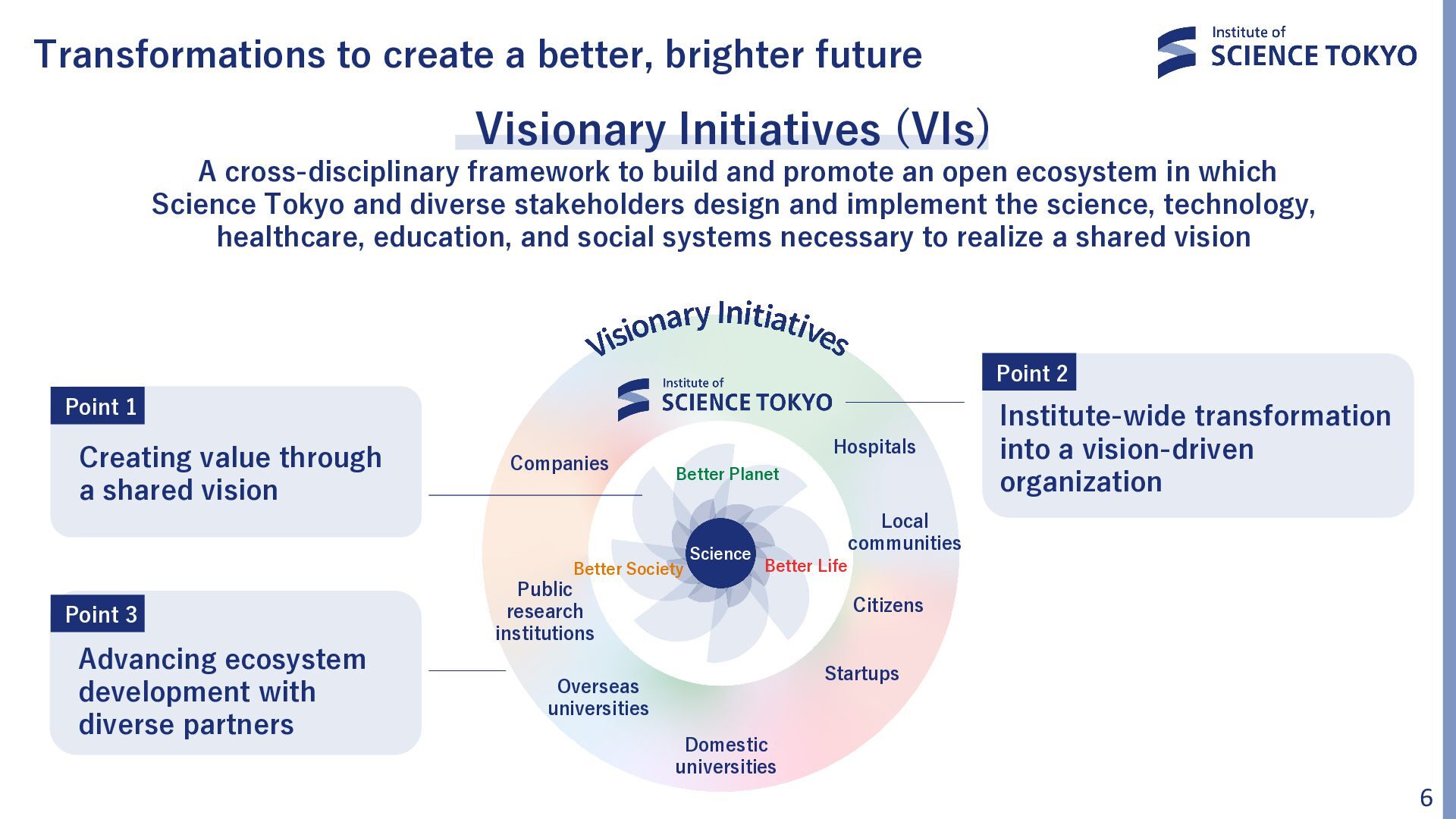
A cross-disciplinary framework to build and promote an open ecosystem in which Science Tokyo and diverse stakeholders design and implement the science, technology, healthcare, education, and social systems necessary to realize a shared vision Point 2 Point 1 Creating value through a shared vision Companies Better Planet Better Society Point 3 Advancing ecosystem development with diverse partners Public research institutions Science Hospitals Better Life Institute-wide transformation into a vision-driven organization Local communities Citizens Startups Overseas universities Domestic universities 6
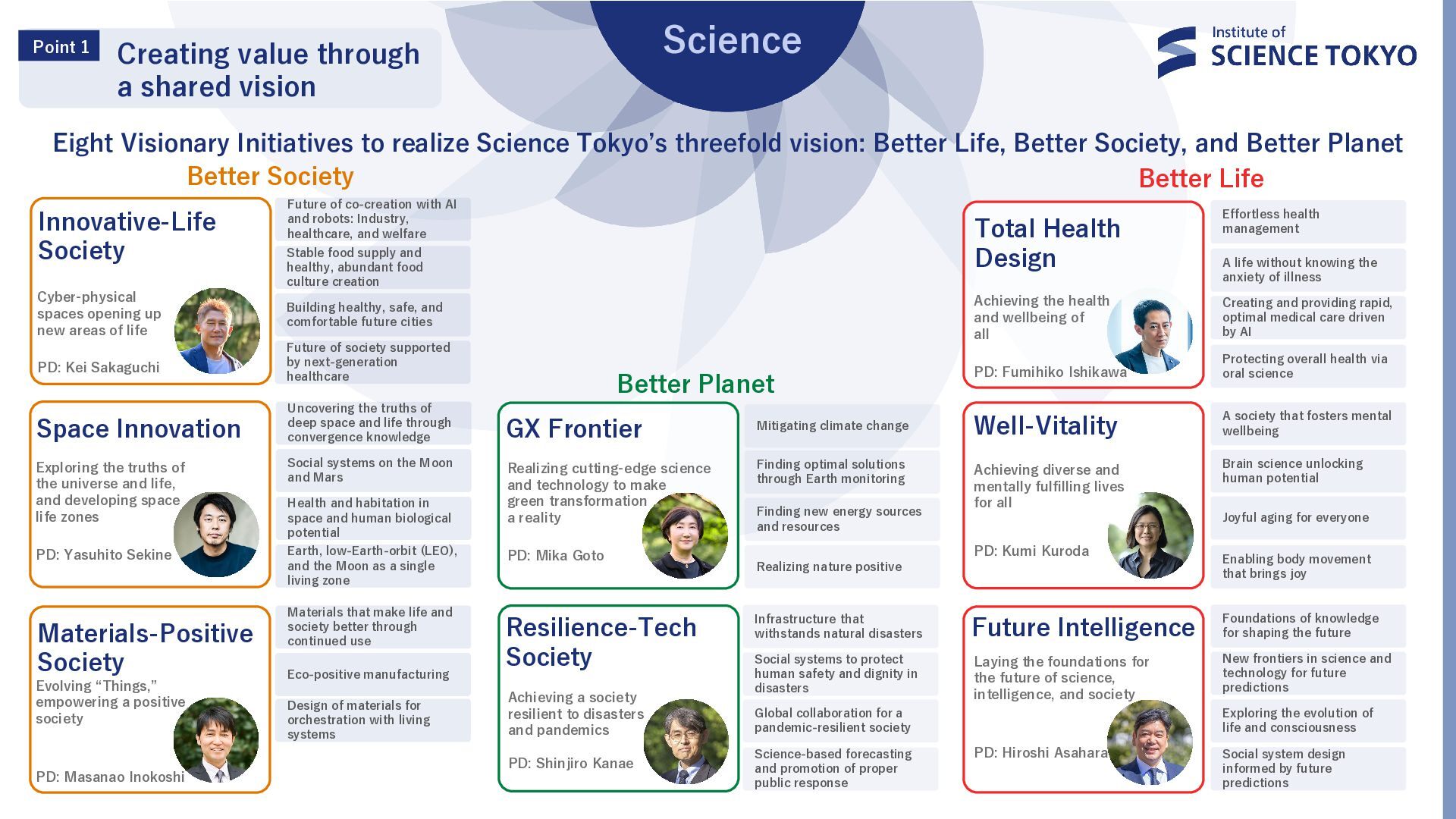
Visionary Initiatives to realize Science Tokyo’s threefold vision: Better Life, Better Society, and Better Planet Better Society Better Life Innovative-Life Society Cyber-physical spaces opening up new areas of life Future of co-creation with AI and robots: Industry, healthcare, and welfare Stable food supply and healthy, abundant food culture creation Building healthy, safe, and comfortable future cities PD: Kei Sakaguchi Future of society supported by next-generation healthcare Space Innovation Uncovering the truths of deep space and life through convergence knowledge Better Planet GX Frontier Exploring the truths of the universe and life, and developing space life zones Social systems on the Moon and Mars PD: Yasuhito Sekine Earth, low-Earth-orbit (LEO), and the Moon as a single living zone PD: Mika Goto Materials that make life and society better through continued use Resilience-Tech Society Materials-Positive Society Evolving “Things,” empowering a positive society PD: Masanao Inokoshi Health and habitation in space and human biological potential Eco-positive manufacturing Design of materials for orchestration with living systems Realizing cutting-edge science and technology to make green transformation a reality Achieving a society resilient to disasters and pandemics PD: Shinjiro Kanae Mitigating climate change Finding optimal solutions through Earth monitoring Finding new energy sources and resources Realizing nature positive Total Health Design Effortless health management Achieving the health and wellbeing of all Creating and providing rapid, optimal medical care driven by AI PD: Fumihiko Ishikawa Protecting overall health via oral science Well-Vitality A society that fosters mental wellbeing Achieving diverse and mentally fulfilling lives for all Brain science unlocking human potential PD: Kumi Kuroda A life without knowing the anxiety of illness Joyful aging for everyone Enabling body movement that brings joy Infrastructure that withstands natural disasters Future Intelligence Foundations of knowledge for shaping the future Social systems to protect human safety and dignity in disasters Laying the foundations for the future of science, intelligence, and society New frontiers in science and technology for future predictions PD: Hiroshi Asahara Social system design informed by future predictions Global collaboration for a pandemic-resilient society Science-based forecasting and promotion of proper public response Exploring the evolution of life and consciousness
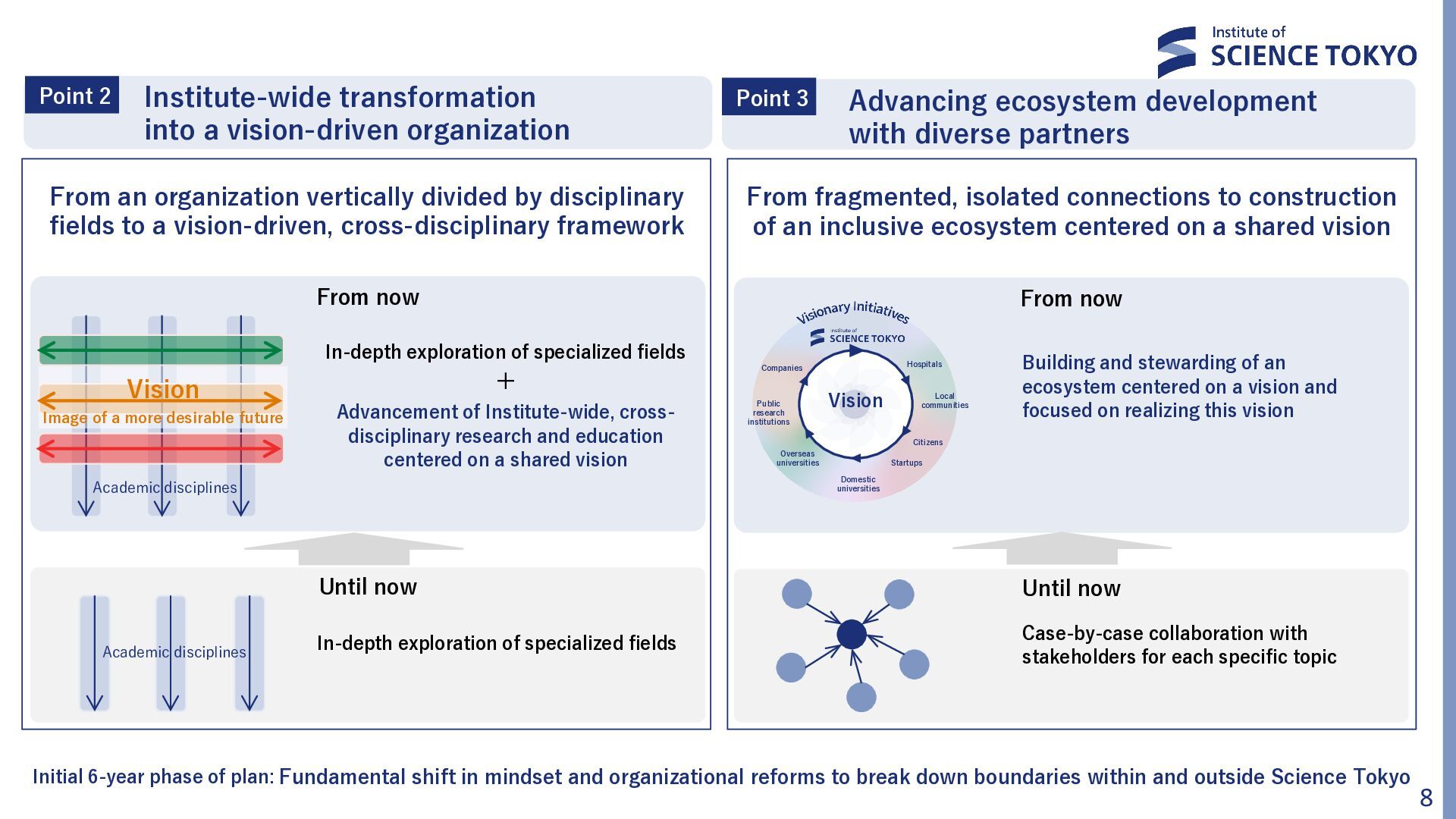
Advancing ecosystem development with diverse partners From an organization vertically divided by disciplinary fields to a vision-driven, cross-disciplinary framework From fragmented, isolated connections to construction of an inclusive ecosystem centered on a shared vision From now From now In-depth exploration of specialized fields Vision Image of a more desirable future + Advancement of Institute-wide, crossdisciplinary research and education centered on a shared vision Public research institutions Vision Local communities Building and stewarding of an ecosystem centered on a vision and focused on realizing this vision Citizens Overseas universities Startups Domestic universities Academic disciplines Academic disciplines Hospitals Companies Until now Until now In-depth exploration of specialized fields Case-by-case collaboration with stakeholders for each specific topic Initial 6-year phase of plan: Fundamental shift in mindset and organizational reforms to break down boundaries within and outside Science Tokyo 8
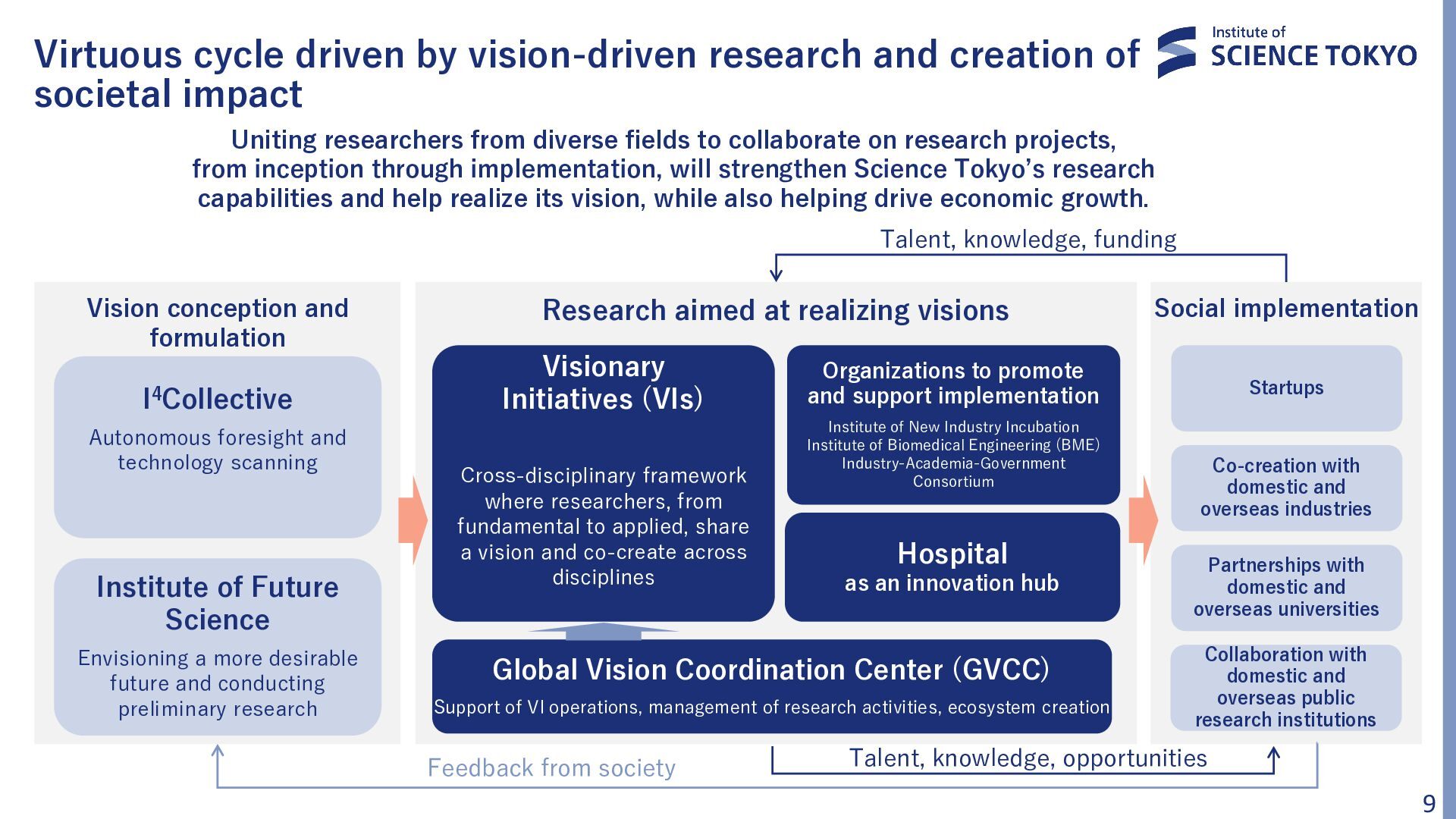
impact Uniting researchers from diverse fields to collaborate on research projects, from inception through implementation, will strengthen Science Tokyo’s research capabilities and help realize its vision, while also helping drive economic growth. Talent, knowledge, funding Vision conception and formulation I4Collective Autonomous foresight and technology scanning Institute of Future Science Envisioning a more desirable future and conducting preliminary research Research aimed at realizing visions Visionary Initiatives (VIs) Cross-disciplinary framework where researchers, from fundamental to applied, share a vision and co-create across disciplines Organizations to promote and support implementation Institute of New Industry Incubation Institute of Biomedical Engineering (BME) Industry-Academia-Government Consortium Hospital as an innovation hub Global Vision Coordination Center (GVCC) Support of VI operations, management of research activities, ecosystem creation Feedback from society Social implementation Startups Co-creation with domestic and overseas industries Partnerships with domestic and overseas universities Collaboration with domestic and overseas public research institutions Talent, knowledge, opportunities 9
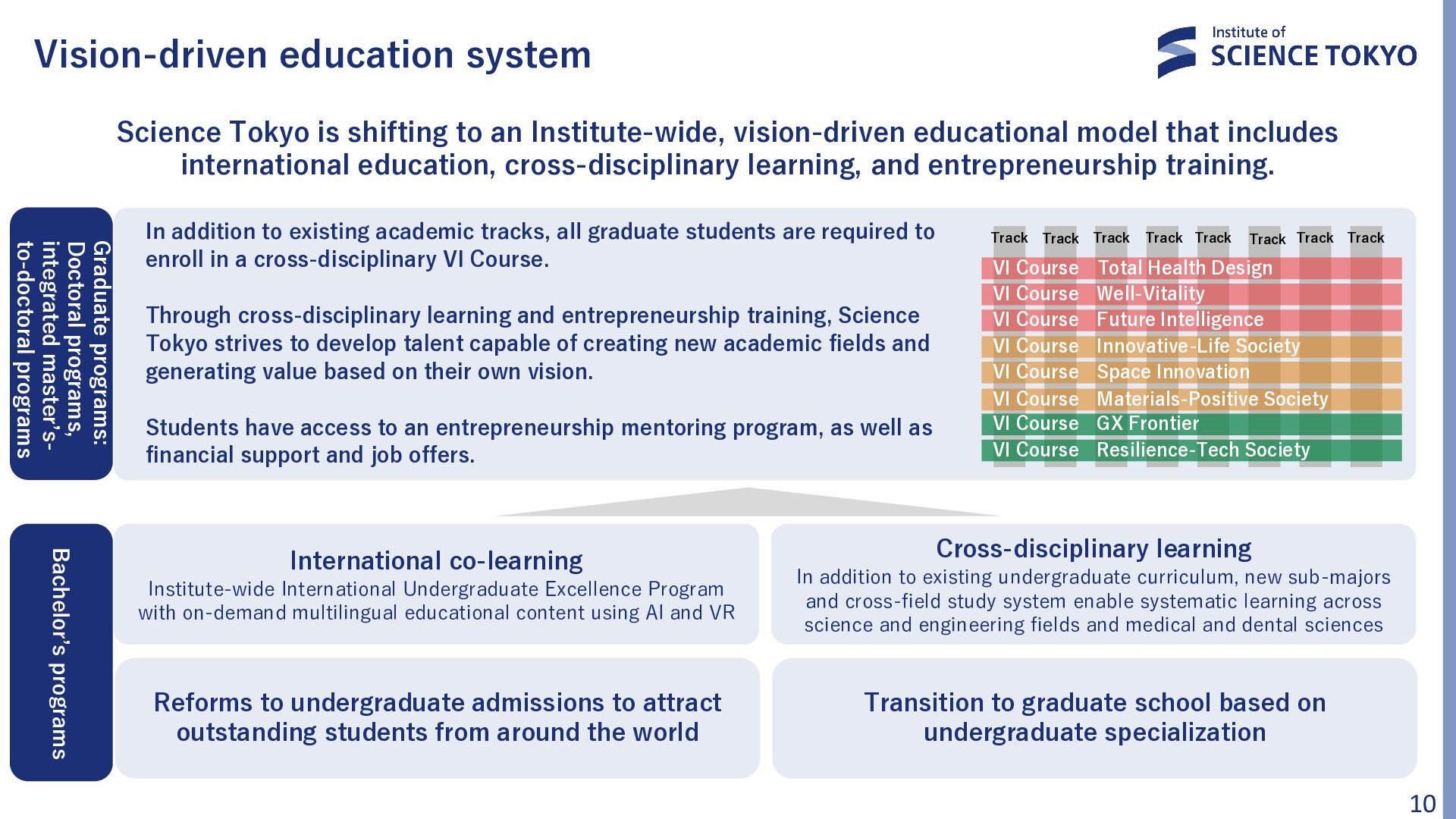
vision-driven educational model that includes international education, cross-disciplinary learning, and entrepreneurship training. Graduate programs: Doctoral programs, integrated master’sto-doctoral programs In addition to existing academic tracks, all graduate students are required to enroll in a cross-disciplinary VI Course. Through cross-disciplinary learning and entrepreneurship training, Science Tokyo strives to develop talent capable of creating new academic fields and generating value based on their own vision. Students have access to an entrepreneurship mentoring program, as well as financial support and job offers. Bachelor’s programs International co-learning Track Track Track VI Course VI Course VI Course VI Course VI Course VI Course VI Course VI Course Track Track Track Track Track Total Health Design Well-Vitality Future Intelligence Innovative-Life Society Space Innovation Materials-Positive Society GX Frontier Resilience-Tech Society Cross-disciplinary learning Institute-wide International Undergraduate Excellence Program with on-demand multilingual educational content using AI and VR In addition to existing undergraduate curriculum, new sub-majors and cross-field study system enable systematic learning across science and engineering fields and medical and dental sciences Reforms to undergraduate admissions to attract outstanding students from around the world Transition to graduate school based on undergraduate specialization 10
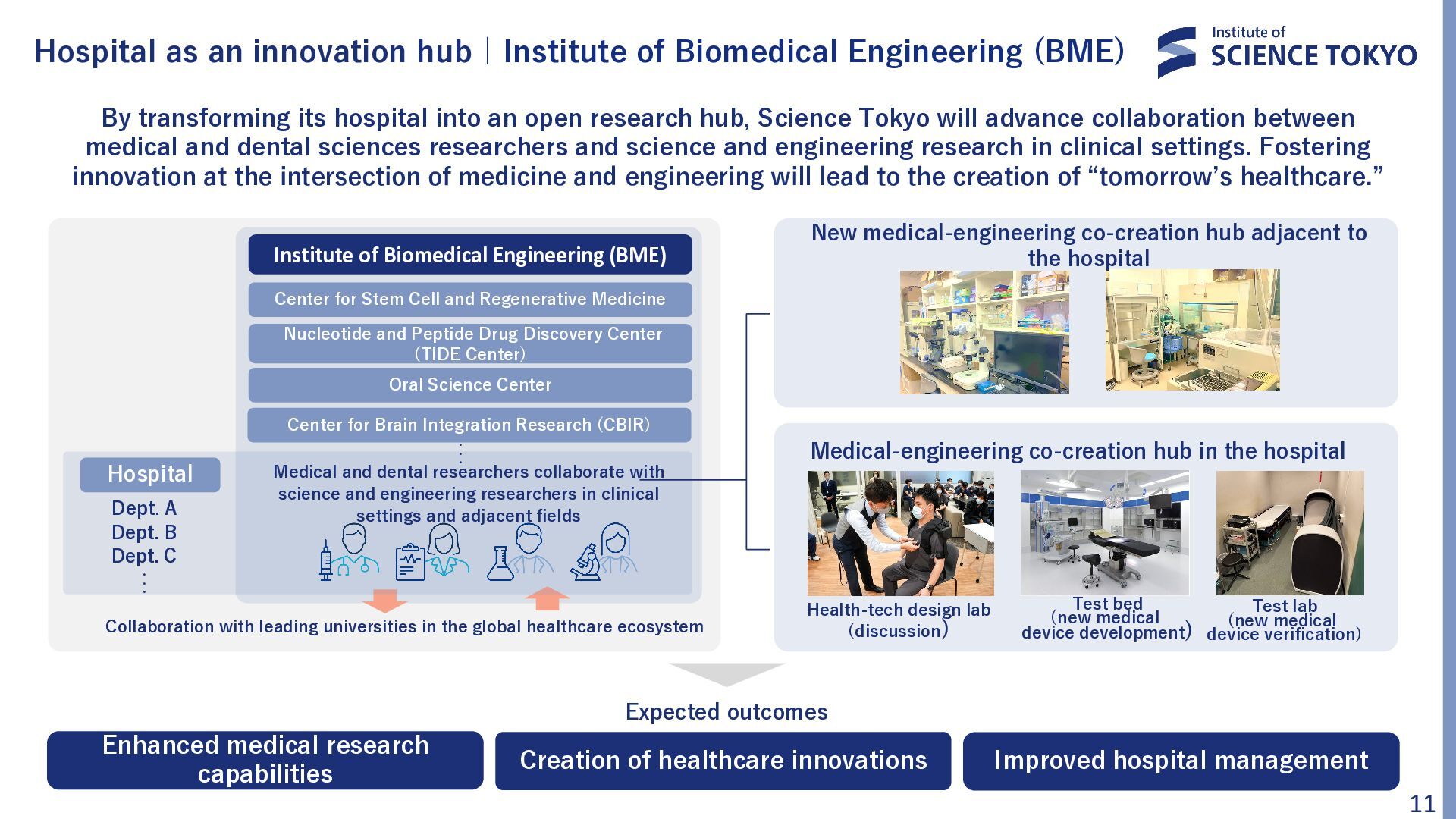
transforming its hospital into an open research hub, Science Tokyo will advance collaboration between medical and dental sciences researchers and science and engineering research in clinical settings. Fostering innovation at the intersection of medicine and engineering will lead to the creation of “tomorrow’s healthcare.” Institute of Biomedical Engineering (BME) New medical-engineering co-creation hub adjacent to the hospital Center for Stem Cell and Regenerative Medicine Nucleotide and Peptide Drug Discovery Center (TIDE Center) Oral Science Center Center for Brain Integration Research (CBIR) Hospital Dept. A Dept. B Dept. C ・ ・ ・ Medical and dental researchers collaborate with science and engineering researchers in clinical settings and adjacent fields ・ ・ ・ Collaboration with leading universities in the global healthcare ecosystem Enhanced medical research capabilities Medical-engineering co-creation hub in the hospital Health-tech design lab (discussion) Test bed Test lab (new medical (new medical device development) device verification) Expected outcomes Creation of healthcare innovations Improved hospital management 11
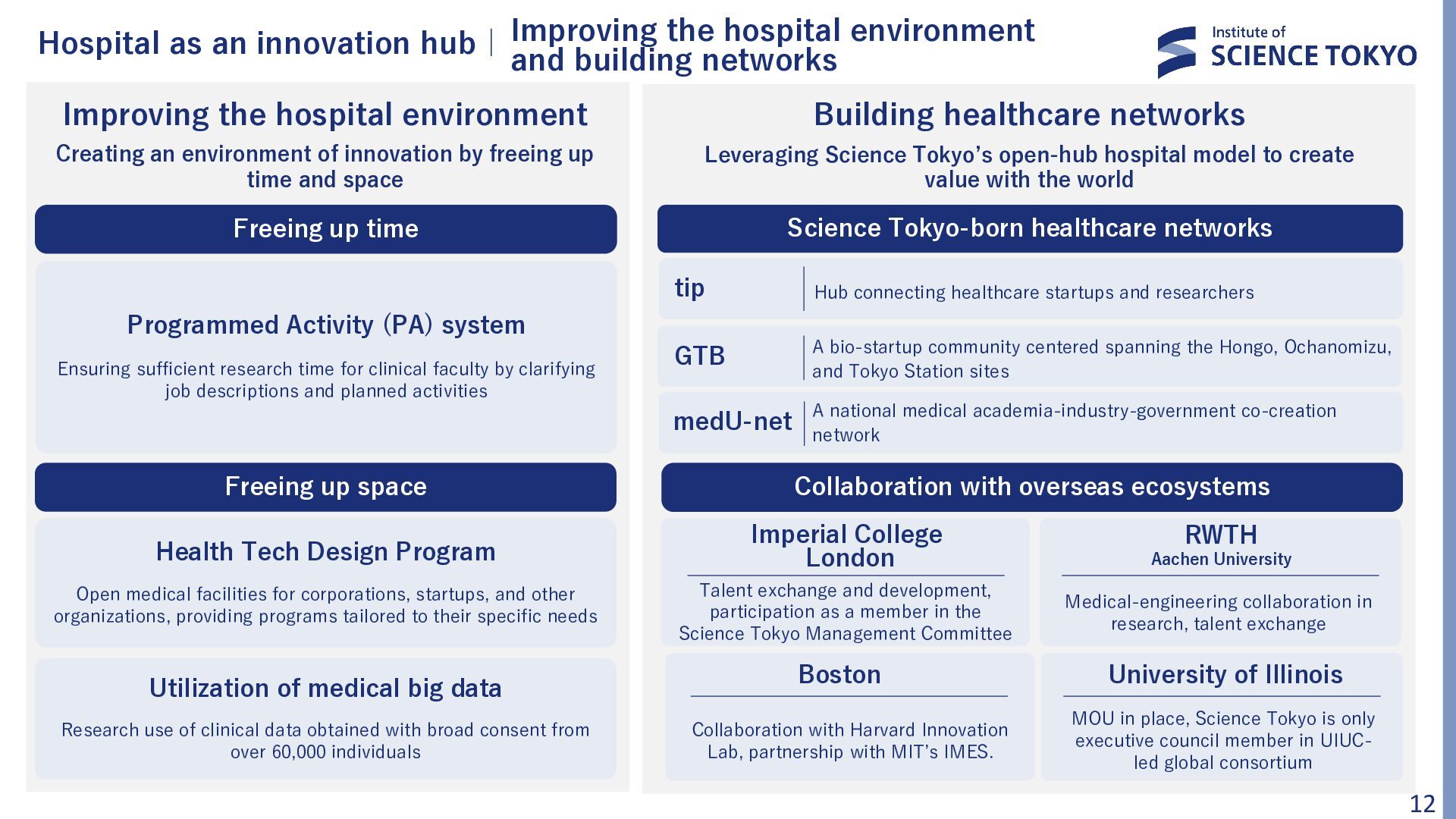
building networks Improving the hospital environment Building healthcare networks Creating an environment of innovation by freeing up time and space Leveraging Science Tokyo’s open-hub hospital model to create value with the world Freeing up time Science Tokyo-born healthcare networks Programmed Activity (PA) system Ensuring sufficient research time for clinical faculty by clarifying job descriptions and planned activities Freeing up space Health Tech Design Program Open medical facilities for corporations, startups, and other organizations, providing programs tailored to their specific needs Utilization of medical big data Research use of clinical data obtained with broad consent from over 60,000 individuals tip Hub connecting healthcare startups and researchers GTB A bio-startup community centered spanning the Hongo, Ochanomizu, and Tokyo Station sites medU-net A national medical academia-industry-government co-creation network Collaboration with overseas ecosystems Imperial College London RWTH Aachen University Talent exchange and development, participation as a member in the Science Tokyo Management Committee Medical-engineering collaboration in research, talent exchange Boston University of Illinois Collaboration with Harvard Innovation Lab, partnership with MIT’s IMES. MOU in place, Science Tokyo is only executive council member in UIUCled global consortium 12
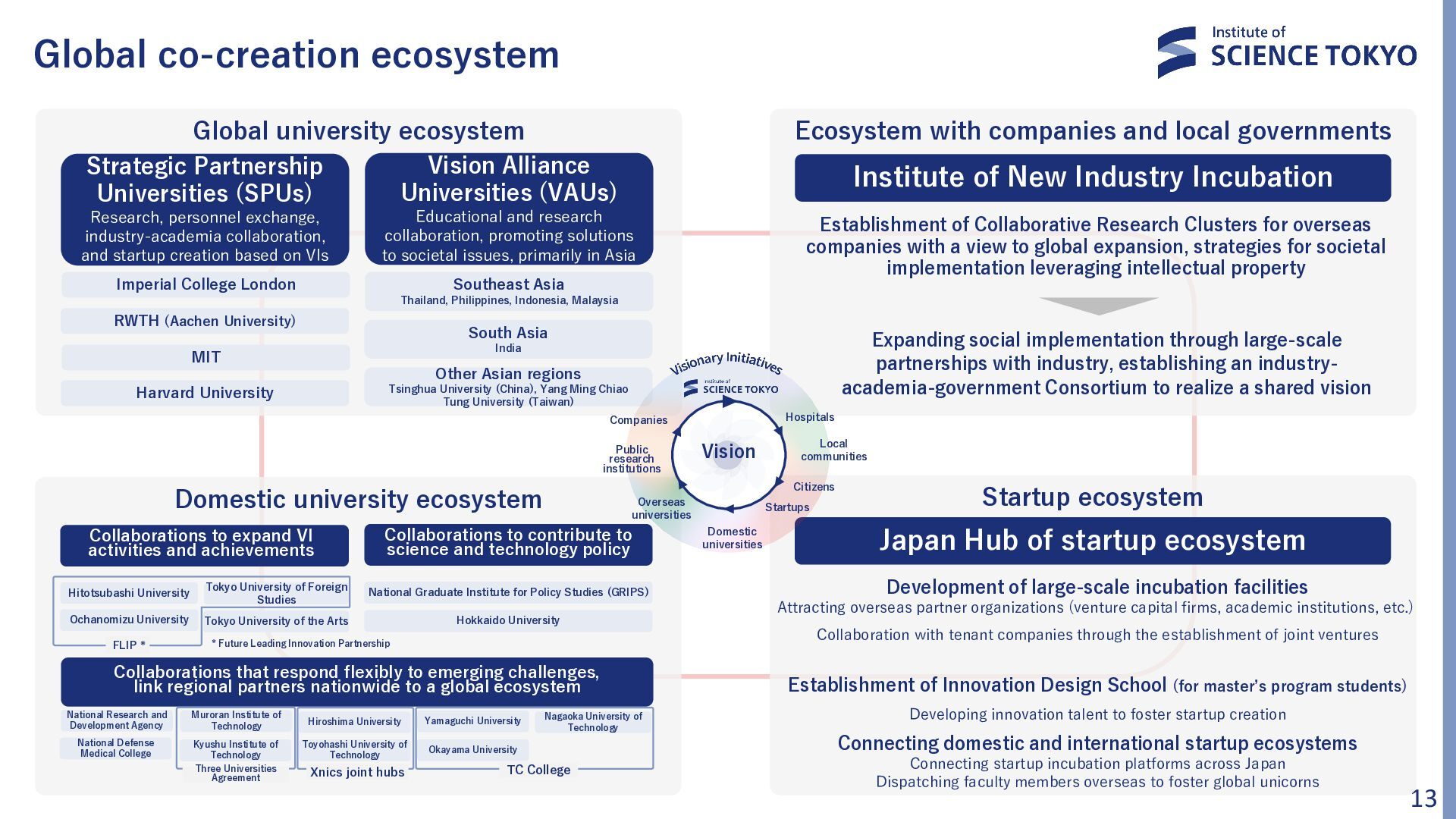
Research, personnel exchange, industry-academia collaboration, and startup creation based on VIs Ecosystem with companies and local governments Vision Alliance Universities (VAUs) Institute of New Industry Incubation Educational and research collaboration, promoting solutions to societal issues, primarily in Asia Imperial College London Establishment of Collaborative Research Clusters for overseas companies with a view to global expansion, strategies for societal implementation leveraging intellectual property Southeast Asia Thailand, Philippines, Indonesia, Malaysia RWTH (Aachen University) South Asia Expanding social implementation through large-scale partnerships with industry, establishing an industryacademia-government Consortium to realize a shared vision India MIT Other Asian regions Harvard University Tsinghua University (China), Yang Ming Chiao Tung University (Taiwan) Hospitals Companies Public research institutions Domestic university ecosystem Collaborations to expand VI activities and achievements Overseas universities Collaborations to contribute to science and technology policy Hitotsubashi University Tokyo University of Foreign Studies National Graduate Institute for Policy Studies (GRIPS) Ochanomizu University Tokyo University of the Arts Hokkaido University FLIP * * Future Leading Innovation Partnership Collaborations that respond flexibly to emerging challenges, link regional partners nationwide to a global ecosystem National Research and Development Agency Muroran Institute of Technology National Defense Medical College Kyushu Institute of Technology Three Universities Agreement Hiroshima University Yamaguchi University Toyohashi University of Technology Okayama University Xnics joint hubs Nagaoka University of Technology TC College Vision Local communities Citizens Startups Domestic universities Startup ecosystem Japan Hub of startup ecosystem Development of large-scale incubation facilities Attracting overseas partner organizations (venture capital firms, academic institutions, etc.) Collaboration with tenant companies through the establishment of joint ventures Establishment of Innovation Design School (for master’s program students) Developing innovation talent to foster startup creation Connecting domestic and international startup ecosystems Connecting startup incubation platforms across Japan Dispatching faculty members overseas to foster global unicorns 13
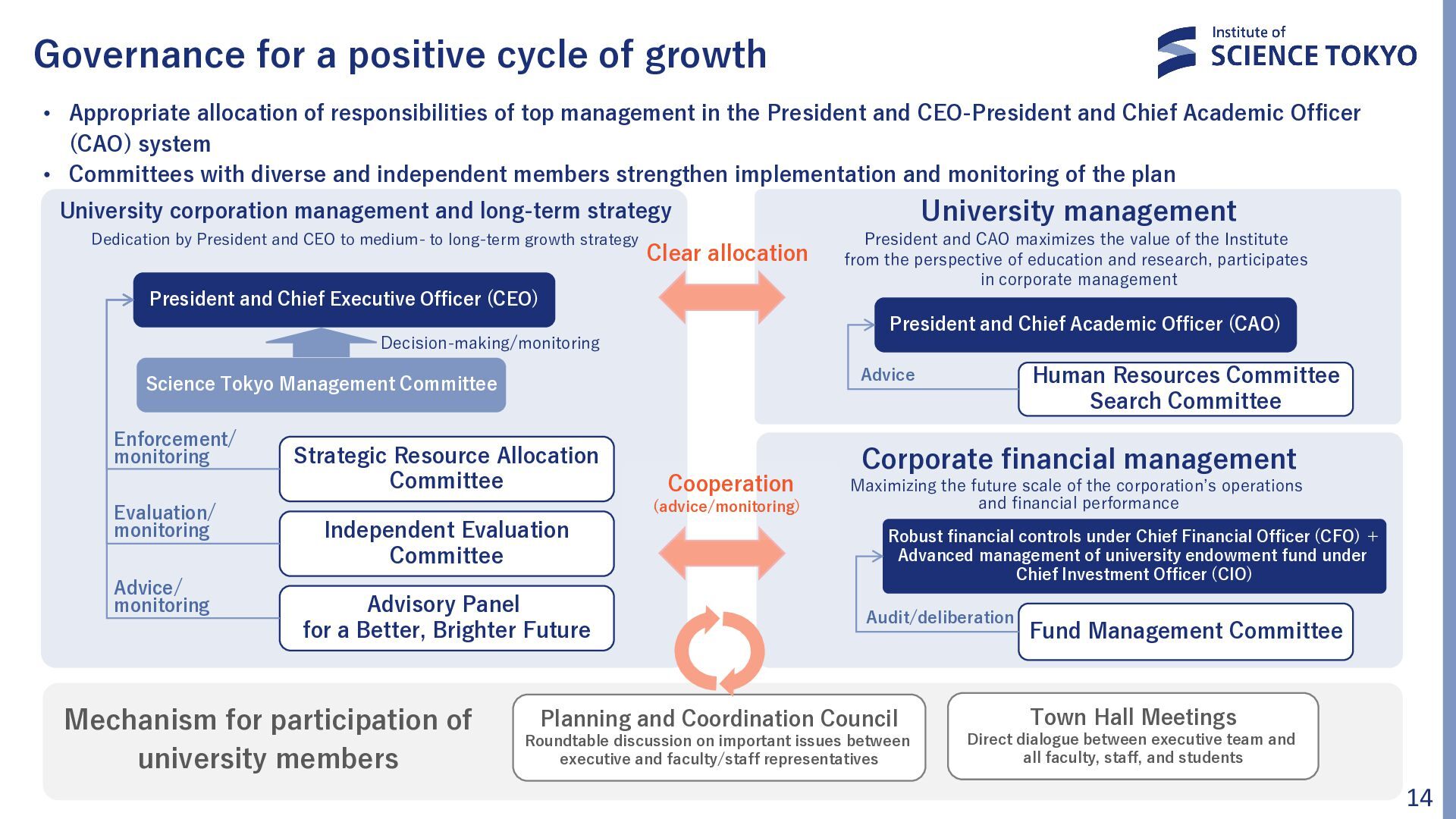
of responsibilities of top management in the President and CEO-President and Chief Academic Officer (CAO) system • Committees with diverse and independent members strengthen implementation and monitoring of the plan University corporation management and long-term strategy Dedication by President and CEO to medium- to long-term growth strategy Clear allocation President and Chief Executive Officer (CEO) Advice/ monitoring Strategic Resource Allocation Committee Independent Evaluation Committee Advisory Panel for a Better, Brighter Future Mechanism for participation of university members Human Resources Committee Search Committee Advice Science Tokyo Management Committee Evaluation/ monitoring President and CAO maximizes the value of the Institute from the perspective of education and research, participates in corporate management President and Chief Academic Officer (CAO) Decision-making/monitoring Enforcement/ monitoring University management Cooperation (advice/monitoring) Corporate financial management Maximizing the future scale of the corporation’s operations and financial performance Robust financial controls under Chief Financial Officer (CFO) + Advanced management of university endowment fund under Chief Investment Officer (CIO) Audit/deliberation Planning and Coordination Council Roundtable discussion on important issues between executive and faculty/staff representatives Fund Management Committee Town Hall Meetings Direct dialogue between executive team and all faculty, staff, and students 14
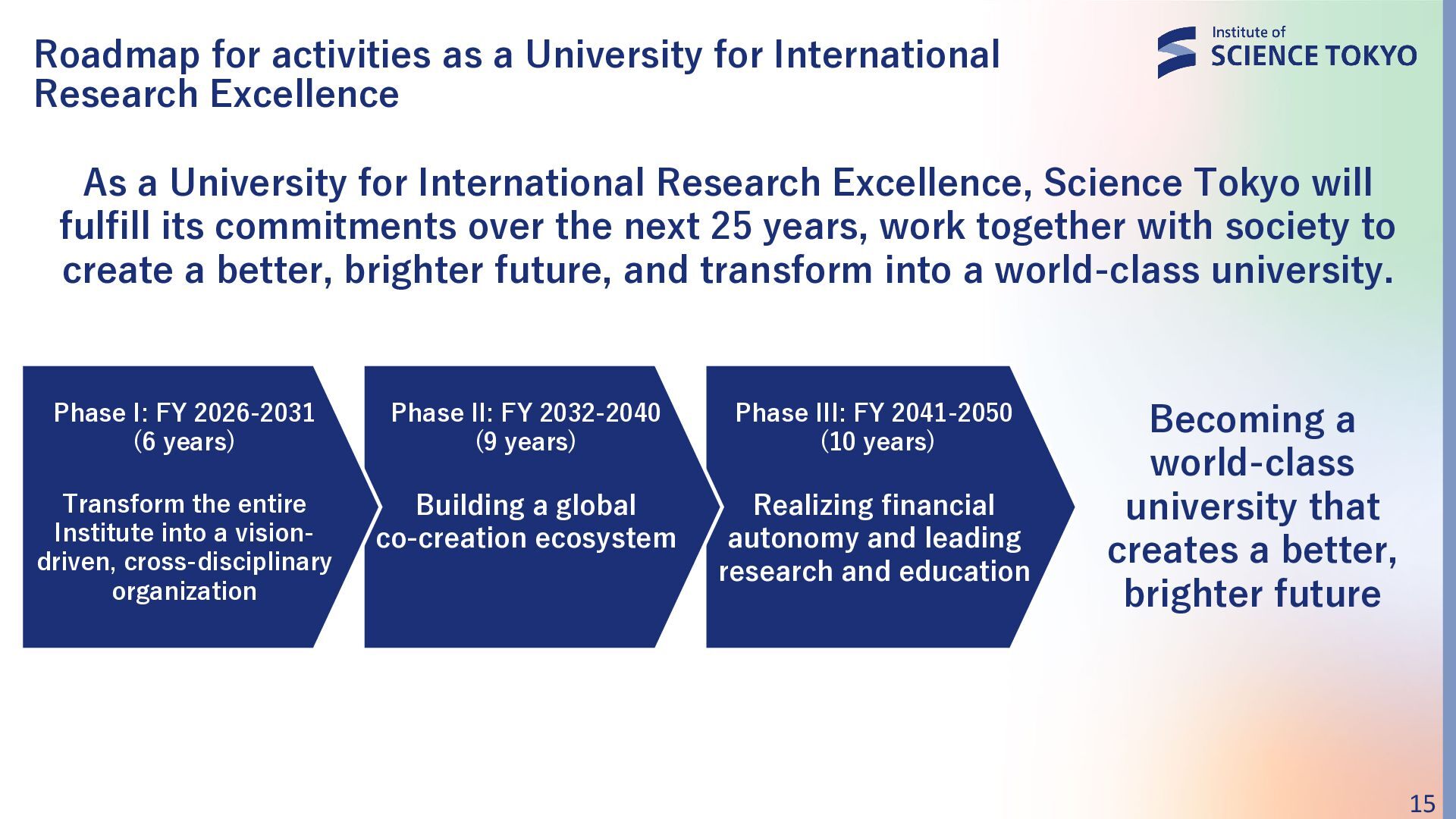
As a University for International Research Excellence, Science Tokyo will fulfill its commitments over the next 25 years, work together with society to create a better, brighter future, and transform into a world-class university. Phase I: FY 2026-2031 (6 years) Phase II: FY 2032-2040 (9 years) Phase III: FY 2041-2050 (10 years) Transform the entire Institute into a visiondriven, cross-disciplinary organization Building a global co-creation ecosystem Realizing financial autonomy and leading research and education Becoming a world-class university that creates a better, brighter future 15
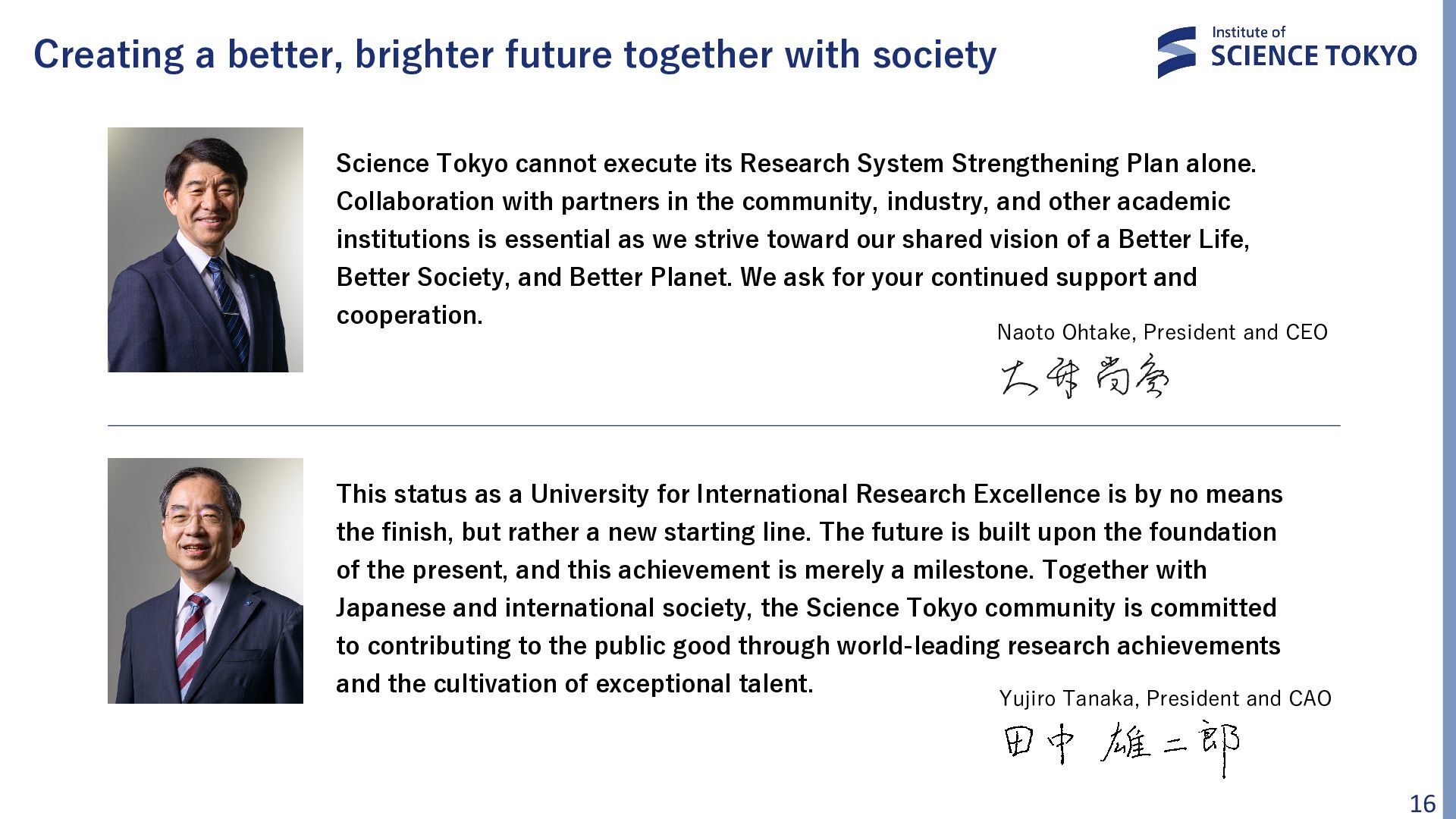
cannot execute its Research System Strengthening Plan alone. Collaboration with partners in the community, industry, and other academic institutions is essential as we strive toward our shared vision of a Better Life, Better Society, and Better Planet. We ask for your continued support and cooperation. Naoto Ohtake, President and CEO This status as a University for International Research Excellence is by no means the finish, but rather a new starting line. The future is built upon the foundation of the present, and this achievement is merely a milestone. Together with Japanese and international society, the Science Tokyo community is committed to contributing to the public good through world-leading research achievements and the cultivation of exceptional talent. Yujiro Tanaka, President and CAO 16


 sciencetokyo
 matleenalaakso
 ichiroc
 coderdojojapan
 pawan_pharm
 juanmartin2026
 frievea
 yasslab
 fmarot
 robintux
 mariooc
 naoji_taniguchi_ksk_0827
 reverentgeek
 sabderemane
 kneath
 soudai
 rakko
rakko
 palkan
 ryanjones
 watany
 samlambert
 mayatellez
 swwweet