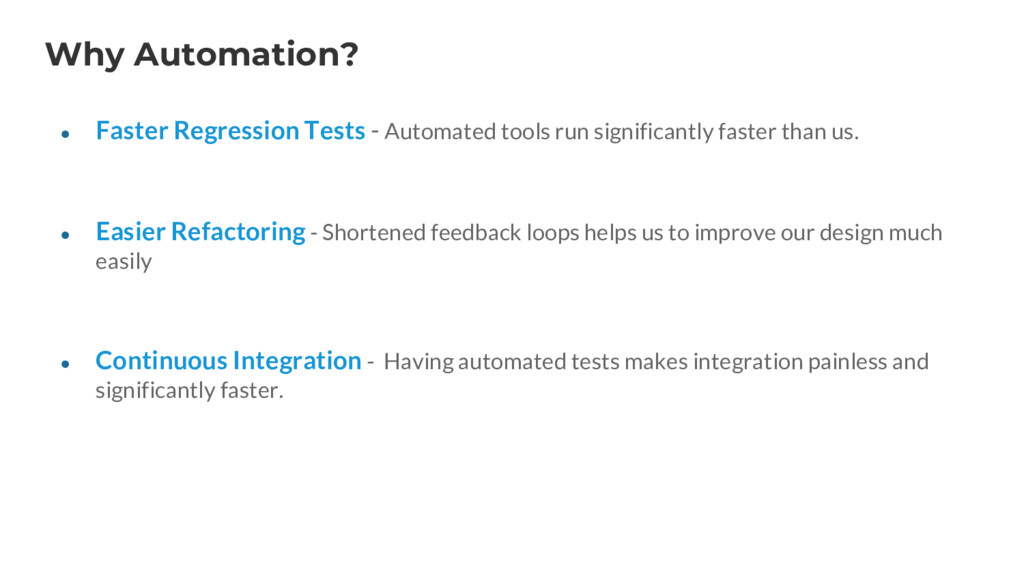
significantly faster than us. • Easier Refactoring - Shortened feedback loops helps us to improve our design much easily • Continuous Integration - Having automated tests makes integration painless and significantly faster.
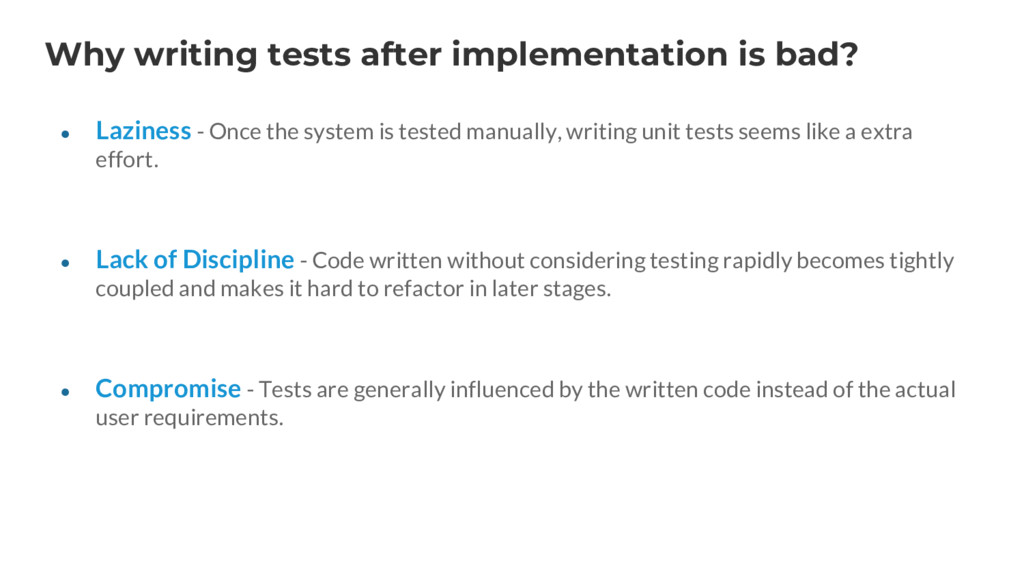
Once the system is tested manually, writing unit tests seems like a extra effort. • Lack of Discipline - Code written without considering testing rapidly becomes tightly coupled and makes it hard to refactor in later stages. • Compromise - Tests are generally influenced by the written code instead of the actual user requirements.
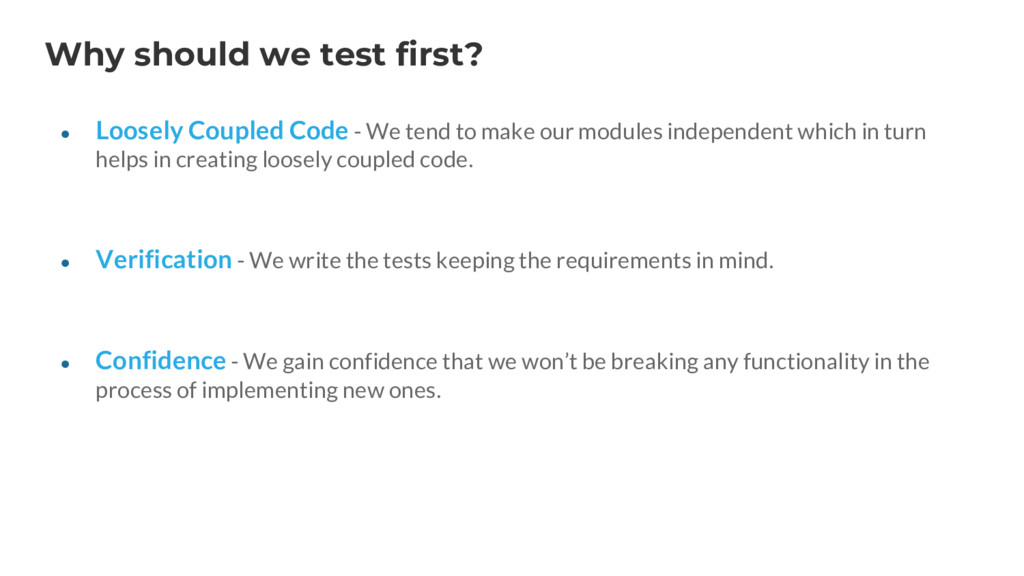
We tend to make our modules independent which in turn helps in creating loosely coupled code. • Verification - We write the tests keeping the requirements in mind. • Confidence - We gain confidence that we won’t be breaking any functionality in the process of implementing new ones.
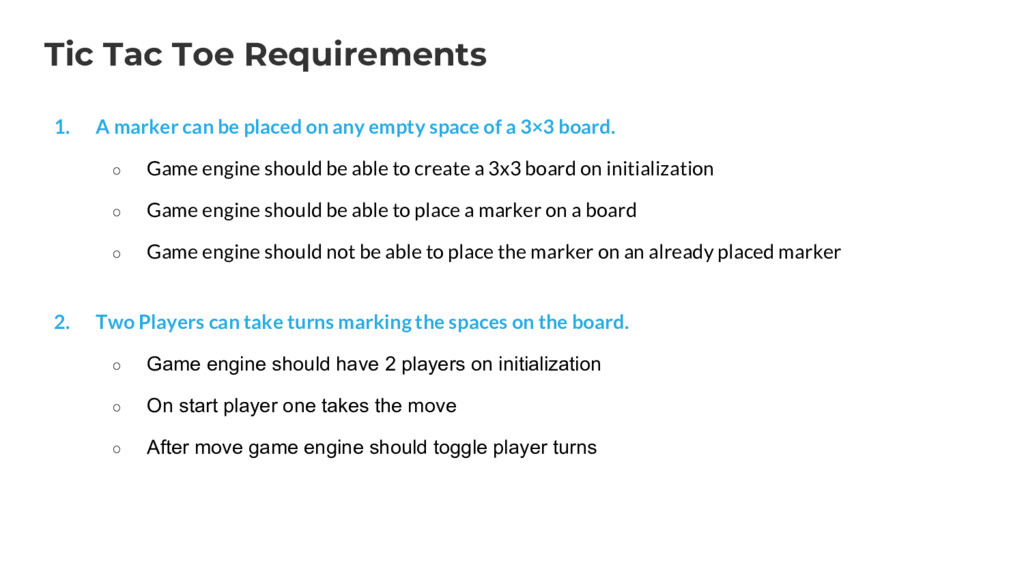
on any empty space of a 3×3 board. ◦ Game engine should be able to create a 3x3 board on initialization ◦ Game engine should be able to place a marker on a board ◦ Game engine should not be able to place the marker on an already placed marker 2. Two Players can take turns marking the spaces on the board. ◦ Game engine should have 2 players on initialization ◦ On start player one takes the move ◦ After move game engine should toggle player turns
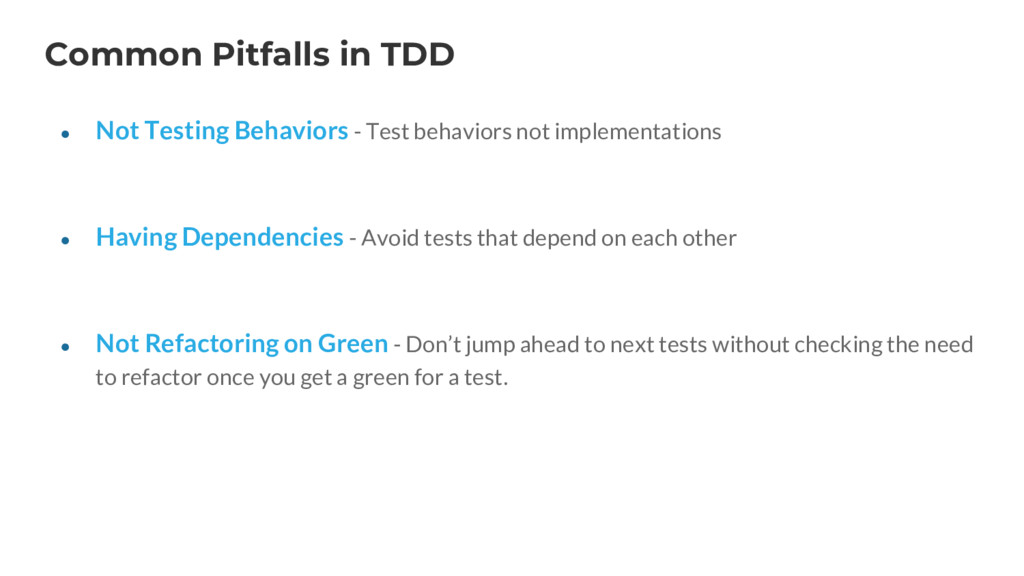
behaviors not implementations • Having Dependencies - Avoid tests that depend on each other • Not Refactoring on Green - Don’t jump ahead to next tests without checking the need to refactor once you get a green for a test.
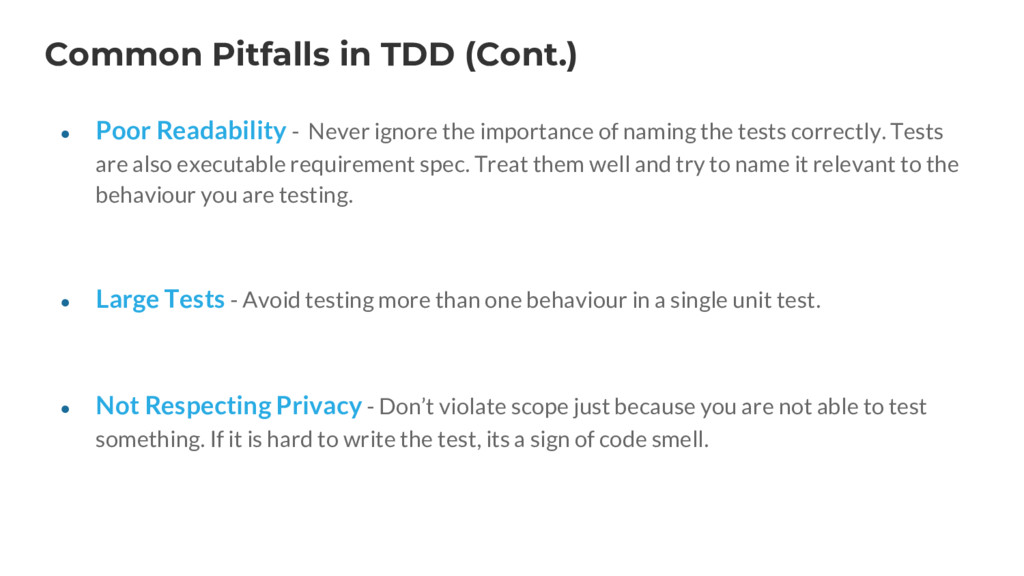
ignore the importance of naming the tests correctly. Tests are also executable requirement spec. Treat them well and try to name it relevant to the behaviour you are testing. • Large Tests - Avoid testing more than one behaviour in a single unit test. • Not Respecting Privacy - Don’t violate scope just because you are not able to test something. If it is hard to write the test, its a sign of code smell.
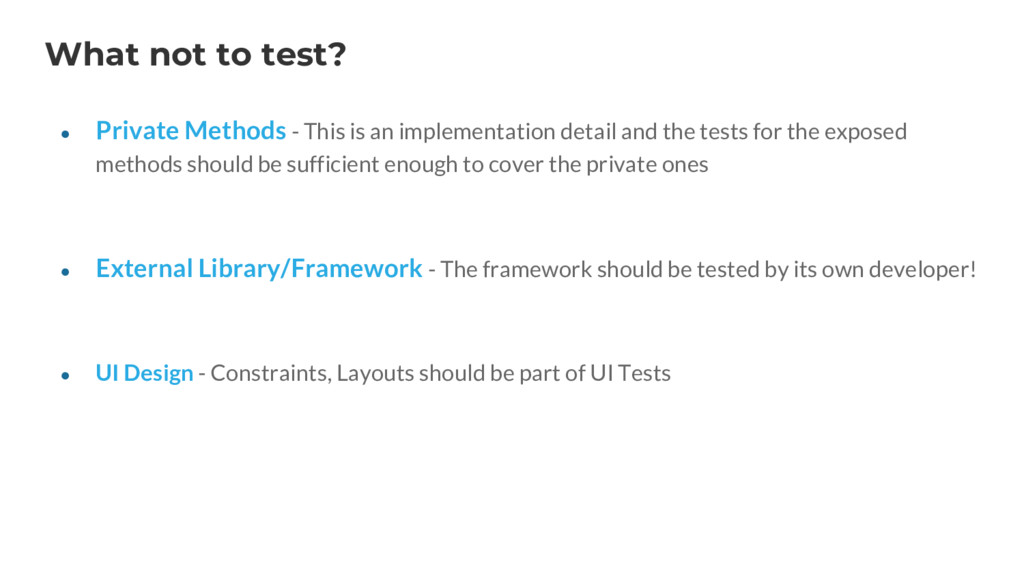
an implementation detail and the tests for the exposed methods should be sufficient enough to cover the private ones • External Library/Framework - The framework should be tested by its own developer! • UI Design - Constraints, Layouts should be part of UI Tests
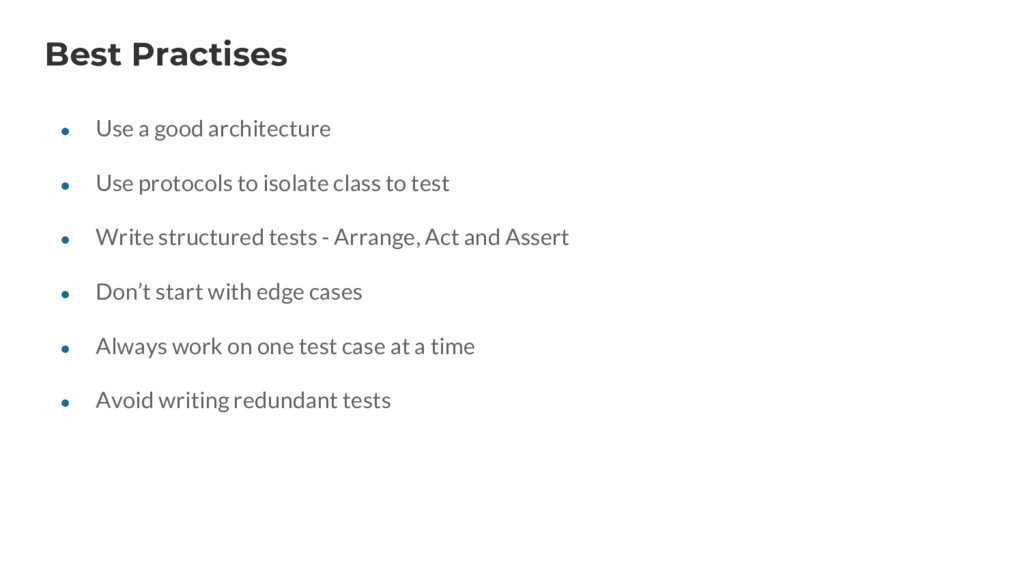
to isolate class to test • Write structured tests - Arrange, Act and Assert • Don’t start with edge cases • Always work on one test case at a time • Avoid writing redundant tests
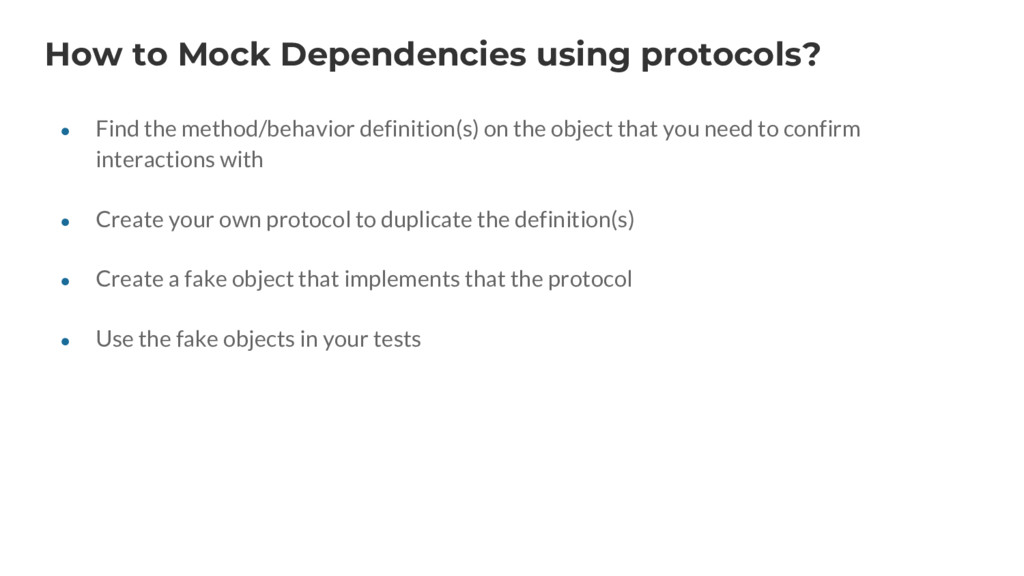
definition(s) on the object that you need to confirm interactions with • Create your own protocol to duplicate the definition(s) • Create a fake object that implements that the protocol • Use the fake objects in your tests
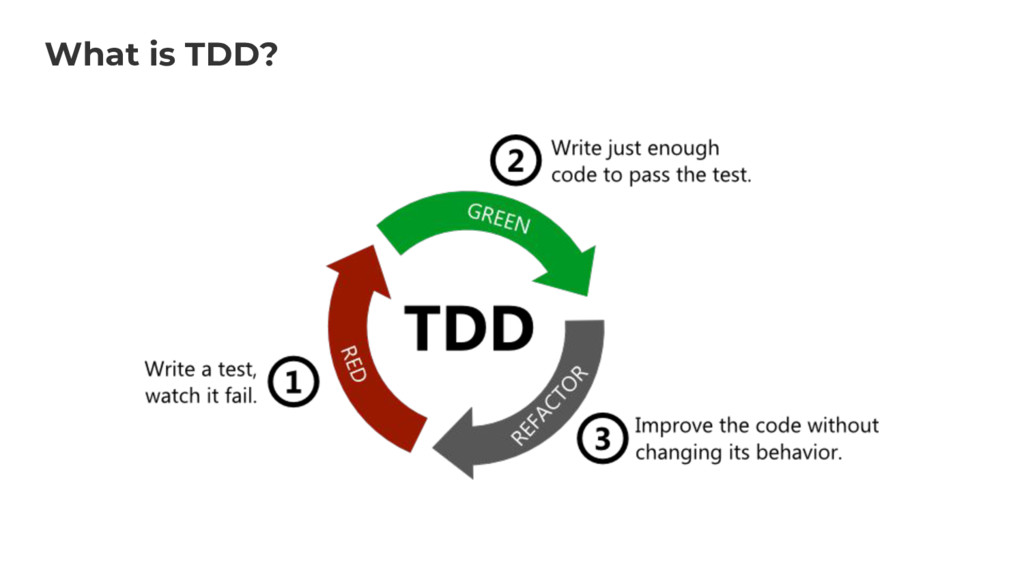
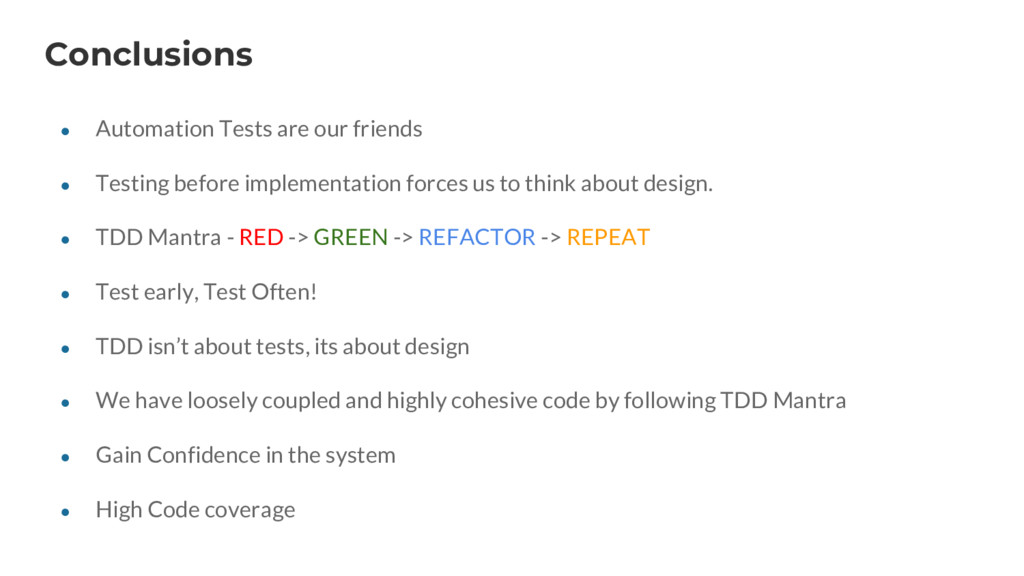
implementation forces us to think about design. • TDD Mantra - RED -> GREEN -> REFACTOR -> REPEAT • Test early, Test Often! • TDD isn’t about tests, its about design • We have loosely coupled and highly cohesive code by following TDD Mantra • Gain Confidence in the system • High Code coverage
Experts UK Ltd 30 Brock Street London NW1 3FG India +91 20 6607 7763 [email protected] Equal Experts India Private Ltd Office No. 4-C Cerebrum IT Park No. B3 Kumar City, Kalyani Nagar Pune, 411006 Canada +1 403 775 4861 [email protected] Equal Experts Devices Inc 205 - 279 Midpark way S.E. T2X 1M2 Calgary, Alberta Portugal +351 211 378 414 [email protected] Equal Experts Portugal Avenida Dom João II, Nº35 Edificio Infante 11ºA 1990-083 Parque das Nações Lisboa – Portugal Thank You USA +1 866-943-9737 [email protected] Equal Experts Inc 1460 Broadway New York NY 10036 LinkedIn linkedin.com/company/equal-experts Twitter @EqualExperts Web www.equalexperts.com


 javalnanda
 ichirokano2
 a_matsuda
 marcoroth
 satoshi256kbyte
 kawashimo0
 econanringo
 shihochan
 tmikov2023
 mixplace
 minodriven
.jpg) yumnumm
yumnumm
 moro
moro
 sergeychernyshev
 mlcsv
mlcsv
.png) helenjbeal
helenjbeal
 destraynor
 iamctodd
 sachag
 soudai
 tmiket
 madoxten
 tammyeverts
 kimpetersen
 honnibal









![Thank You United Kingdom +44 203 603 7830 [email protected] Equal](https://files.speakerdeck.com/presentations/be2385bd1e9c4ec78ea7bff47b370f7c/slide_26.jpg)