Upgrade to Pro — share decks privately, control downloads, hide ads and more …

What Bill Paley Taught Jeff Fager About Television

Sponsored · Your Podcast. Everywhere. Effortlessly. Share. Educate. Inspire. Entertain. You do you. We'll handle the rest.

What Bill Paley Taught Jeff Fager About Television

Jeff Fager reflects on an early lesson from CBS founder Bill Paley about what makes television connect with audiences. From his years in the CBS London Bureau to his eventual move to 60 Minutes, Fager explores how strong journalism, compelling storytelling, and simple likability can make a lasting impact on viewers.

Avatar for Jeff Fager

Jeff Fager PRO

August 17, 2026

More Decks by Jeff Fager

Other Decks in Storyboards

Transcript

  1. JEFF FAGER · A LESSON IN BROADCAST JOURNALISM What Bill

    Paley Taught Jeff Fager About Television What people want to watch.
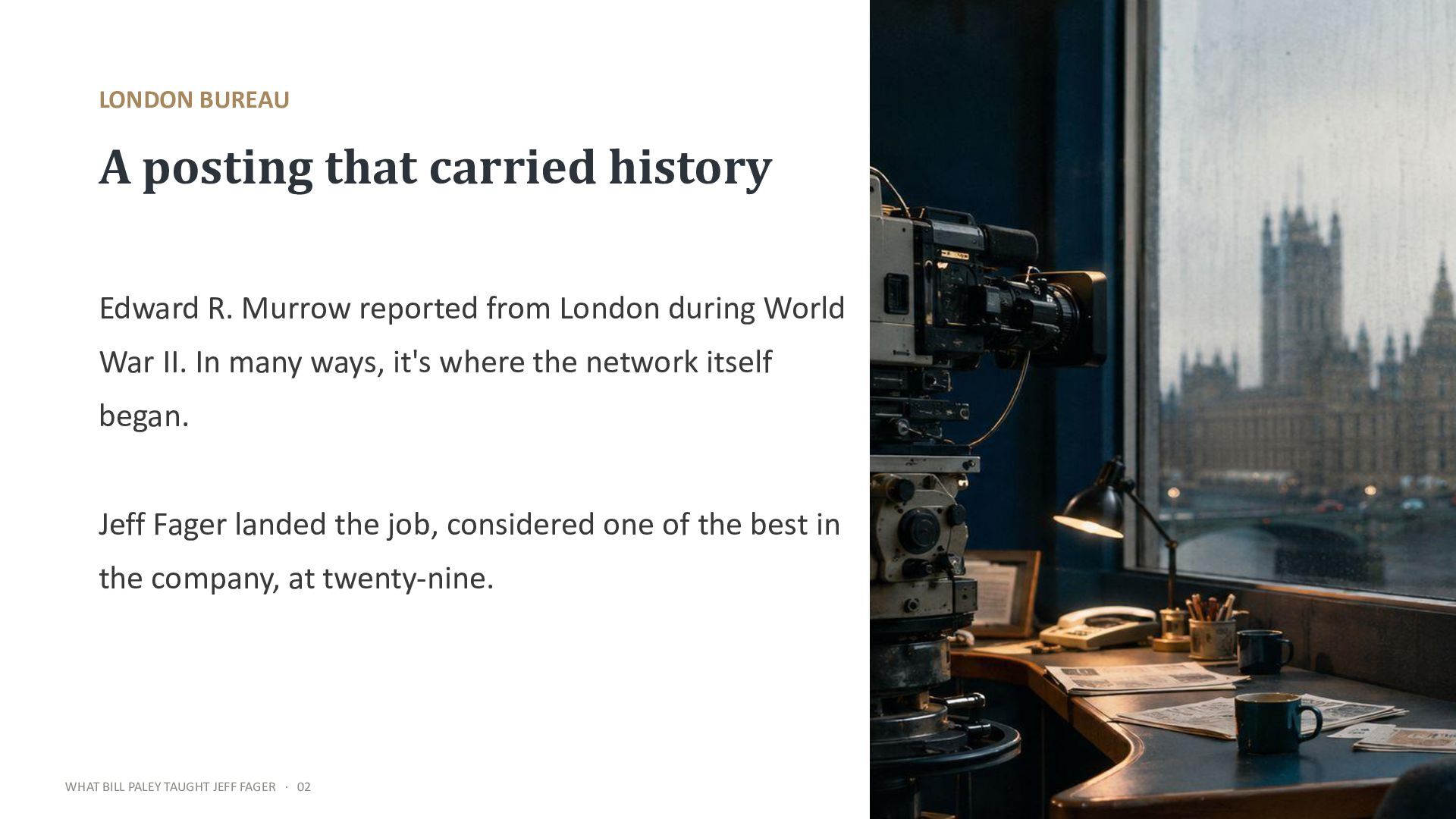
  2. LONDON BUREAU A posting that carried history Edward R. Murrow

    reported from London during World War II. In many ways, it's where the network itself began. Jeff Fager landed the job, considered one of the best in the company, at twenty-nine. WHAT BILL PALEY TAUGHT JEFF FAGER · 02
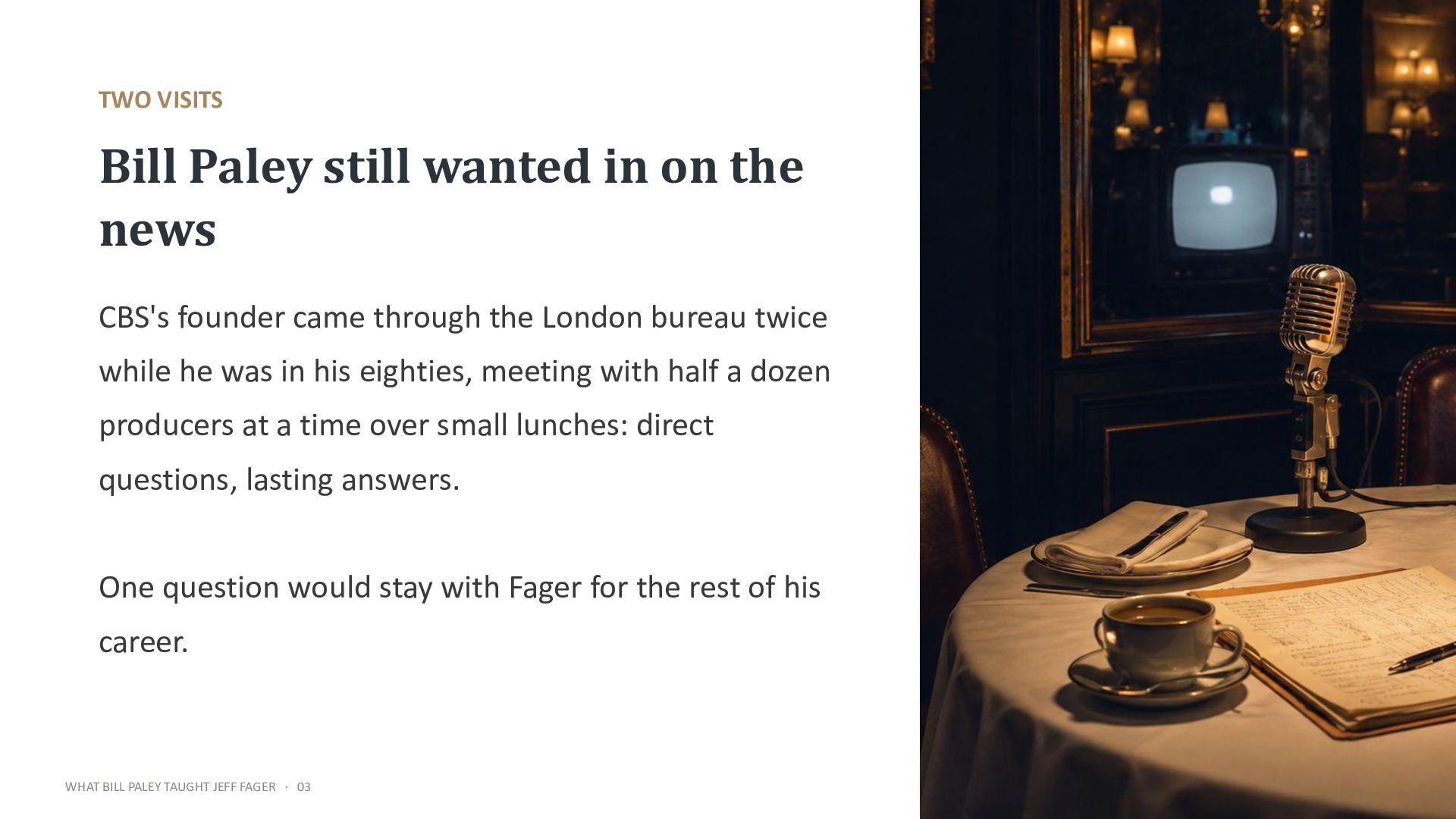
  3. TWO VISITS Bill Paley still wanted in on the news

    CBS's founder came through the London bureau twice while he was in his eighties, meeting with half a dozen producers at a time over small lunches: direct questions, lasting answers. One question would stay with Fager for the rest of his career. WHAT BILL PALEY TAUGHT JEFF FAGER · 03
  4. THE QUESTION What actually makes a show successful? Paley didn't

    hesitate. He went straight to Jack Benny. WHAT BILL PALEY TAUGHT JEFF FAGER · 04
  5. " "Because they like me." Jack Benny's answer, when Paley

    asked him directly why his ratings were so good. Roughly 70 million Americans watched, when the country's population was about half today's size. WHAT BILL PALEY TAUGHT JEFF FAGER · 05
  6. THE PRINCIPLE Journalism drives it. Likability keeps it on. The

    two aren't in tension, Fager came to believe. Journalism is the driving force, non-negotiable, but the experience still has to be one people actually like watching. WHAT BILL PALEY TAUGHT JEFF FAGER · 06
  7. THE IDEA THAT STAYED Nothing about this is in a

    textbook Likable. User-friendly. Approachable. “G-rated,” in the sense that the broadcast should feel easy to enter, without weakening the journalism underneath it. Fager never forgot it. WHAT BILL PALEY TAUGHT JEFF FAGER · 07
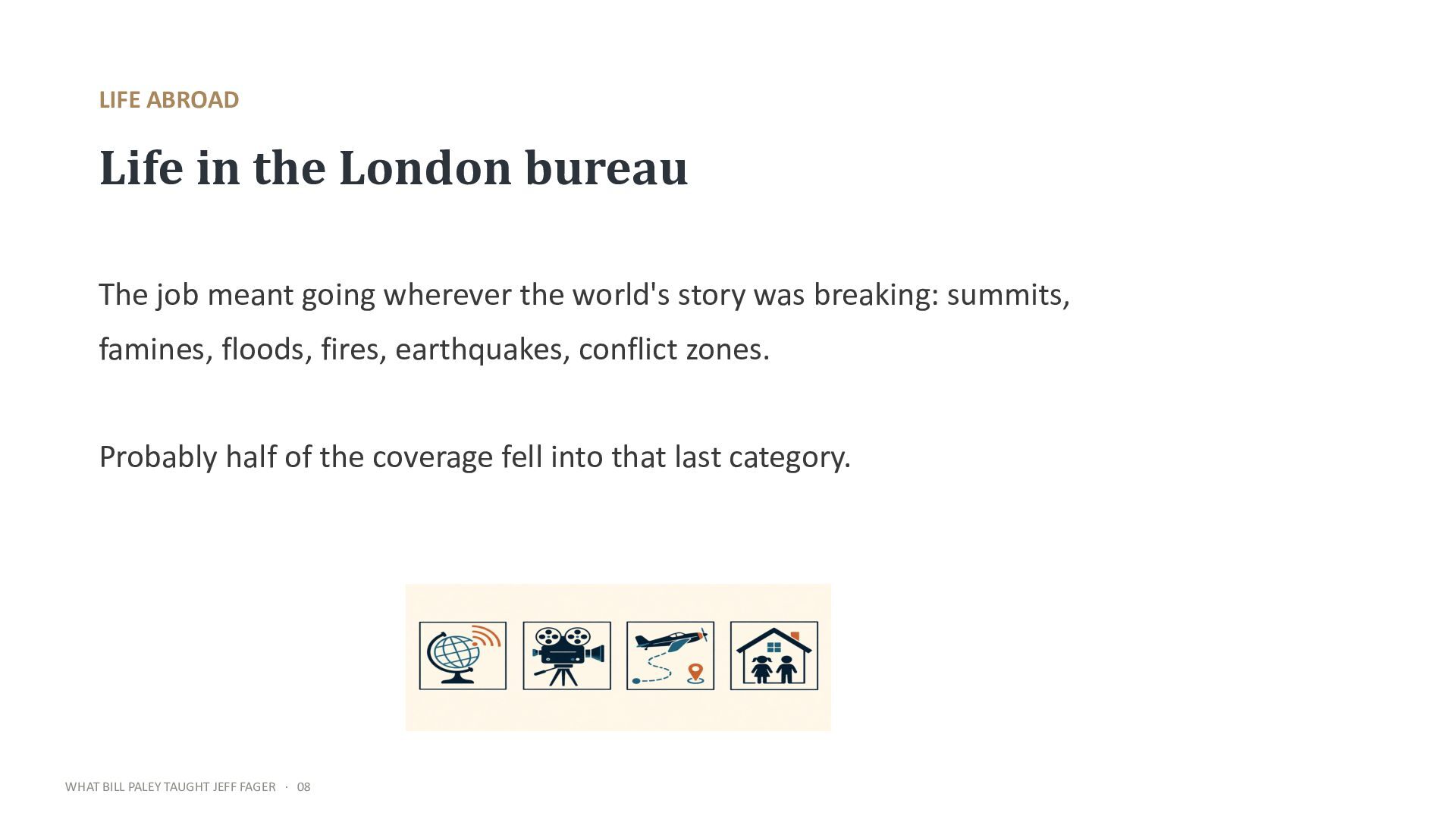
  8. LIFE ABROAD Life in the London bureau The job meant

    going wherever the world's story was breaking: summits, famines, floods, fires, earthquakes, conflict zones. Probably half of the coverage fell into that last category. WHAT BILL PALEY TAUGHT JEFF FAGER · 08
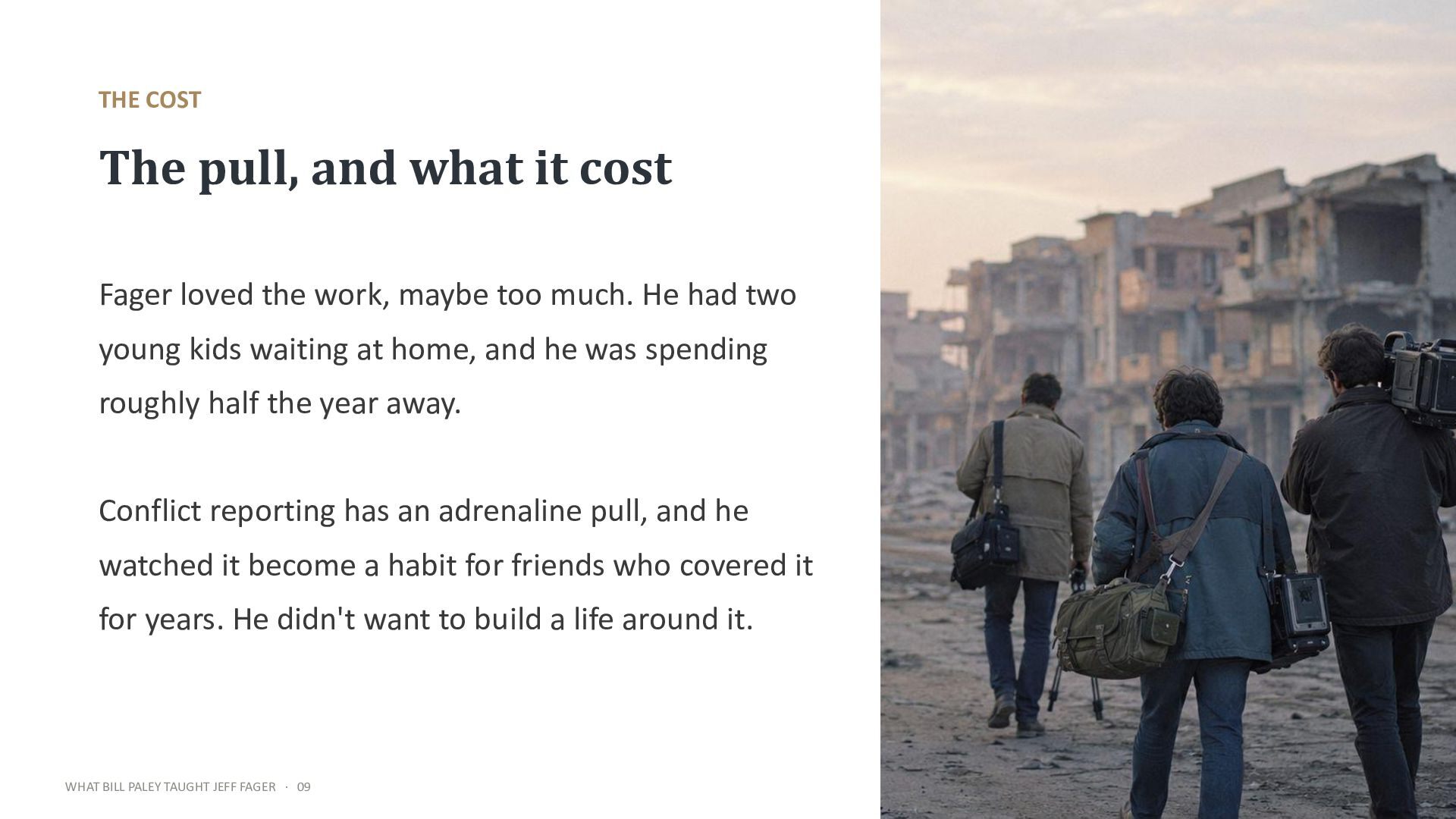
  9. THE COST The pull, and what it cost Fager loved

    the work, maybe too much. He had two young kids waiting at home, and he was spending roughly half the year away. Conflict reporting has an adrenaline pull, and he watched it become a habit for friends who covered it for years. He didn't want to build a life around it. WHAT BILL PALEY TAUGHT JEFF FAGER · 09
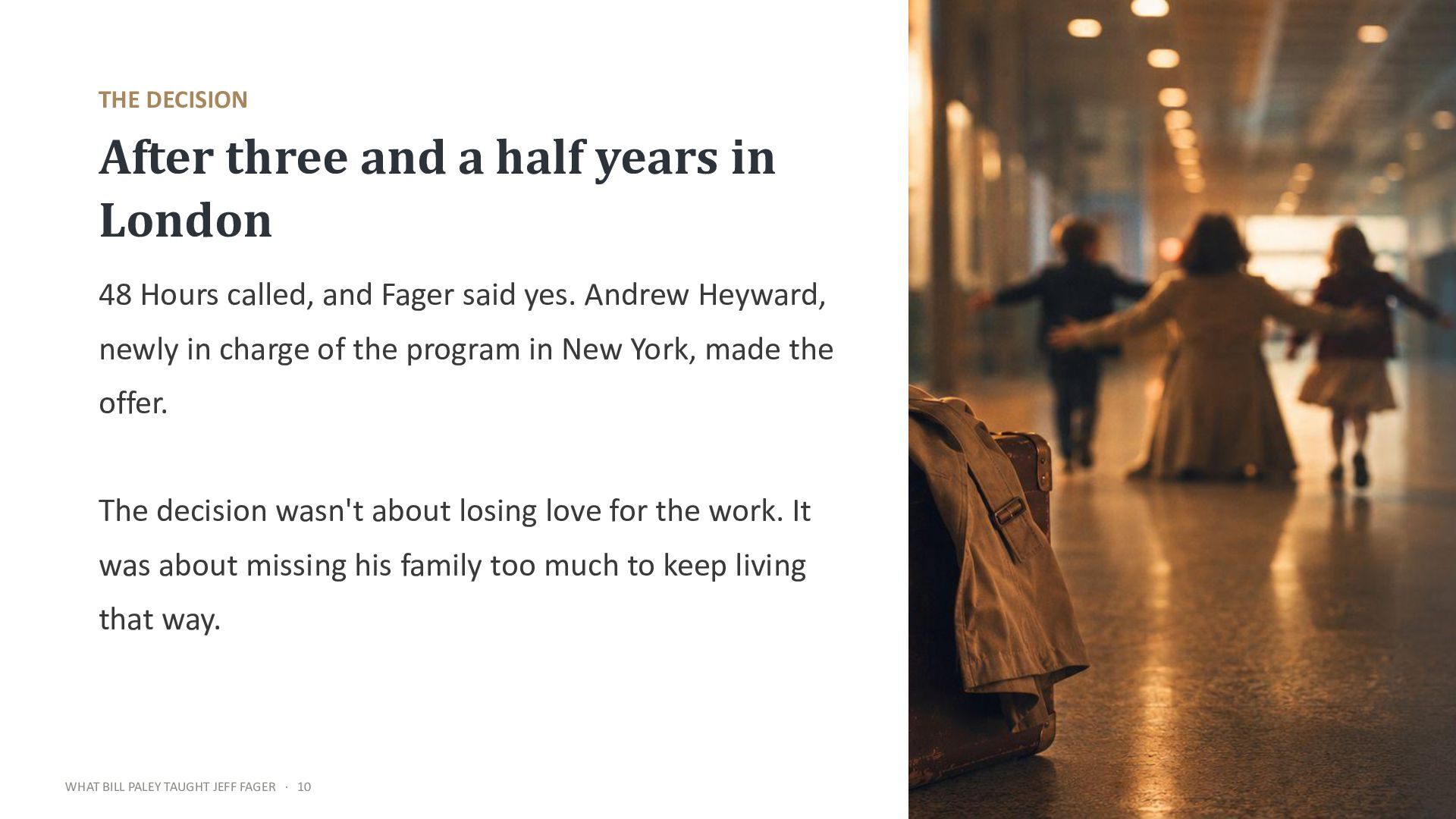
  10. THE DECISION After three and a half years in London

    48 Hours called, and Fager said yes. Andrew Heyward, newly in charge of the program in New York, made the offer. The decision wasn't about losing love for the work. It was about missing his family too much to keep living that way. WHAT BILL PALEY TAUGHT JEFF FAGER · 10
  11. " "For a while, like a slap in the face."

    How Fager described coming home. Expat life had been good, and reverse culture shock was real. Even so, 48 Hours produced genuinely remarkable work. WHAT BILL PALEY TAUGHT JEFF FAGER · 11
  12. THE NEXT CHAPTER The long run began a year later

    Fager moved to 60 Minutes in 1989 and spent more than thirty years there afterward. Paley's insight never left him. London shaped how he thought about broadcast journalism for the rest of his career. WHAT BILL PALEY TAUGHT JEFF FAGER · 12
  13. WHAT STILL SURPRISES HIM The London opportunity was huge; the

    competition for it wasn't. Fager doesn't remember anyone else pushing hard for the posting. Americans, he came to think, are more reluctant than people from other countries to uproot and move overseas. Journalism must be the driving force. But television also has to be worth watching. WHAT BILL PALEY TAUGHT JEFF FAGER · 13