The Power of International Reporting by Jeff Fager, Chairman, CBS News
The Power of International Reporting is a speech about the importance of global journalism and the responsibility of news organizations to cover major world events...
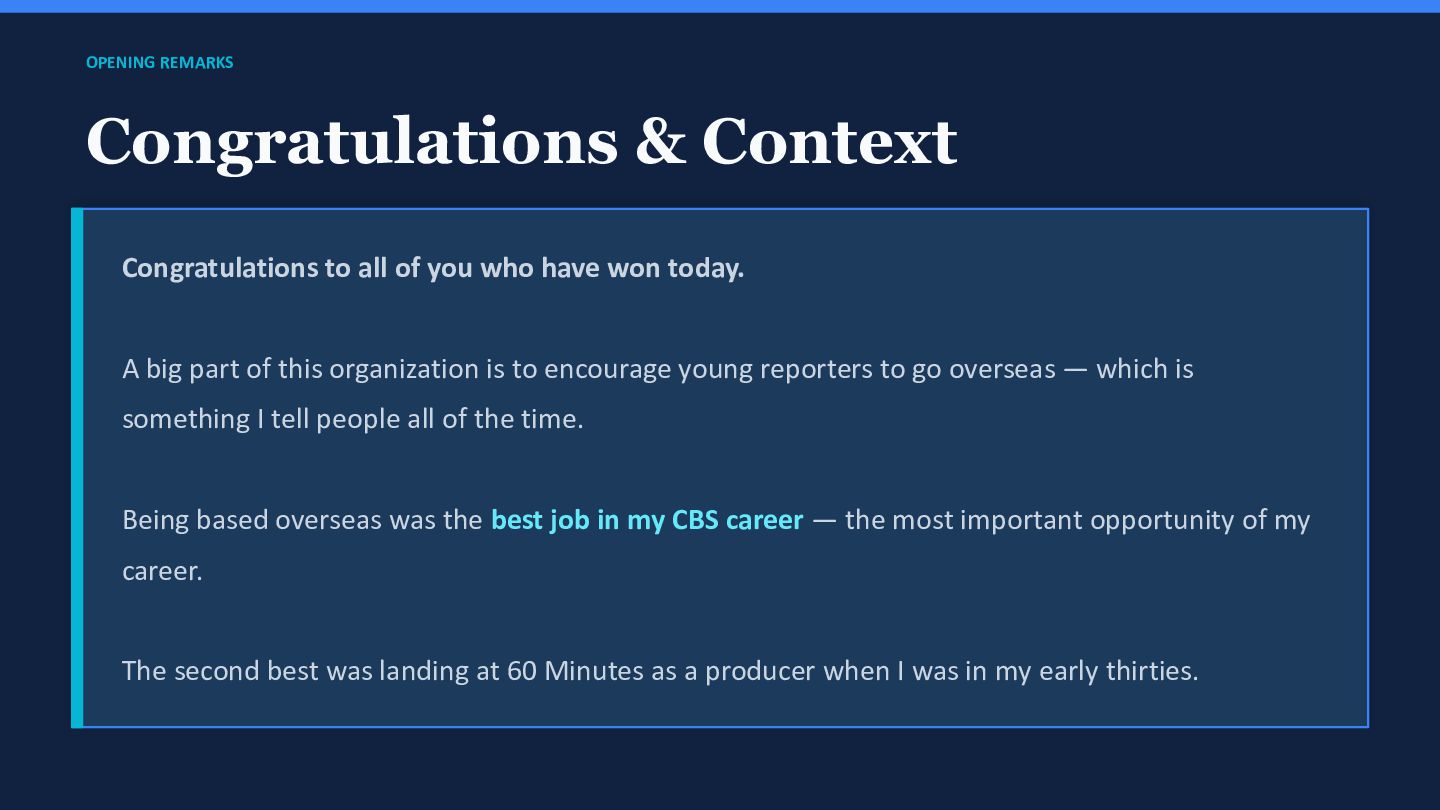
who have won today. A big part of this organization is to encourage young reporters to go overseas — which is something I tell people all of the time. Being based overseas was the best job in my CBS career — the most important opportunity of my career. The second best was landing at 60 Minutes as a producer when I was in my early thirties.
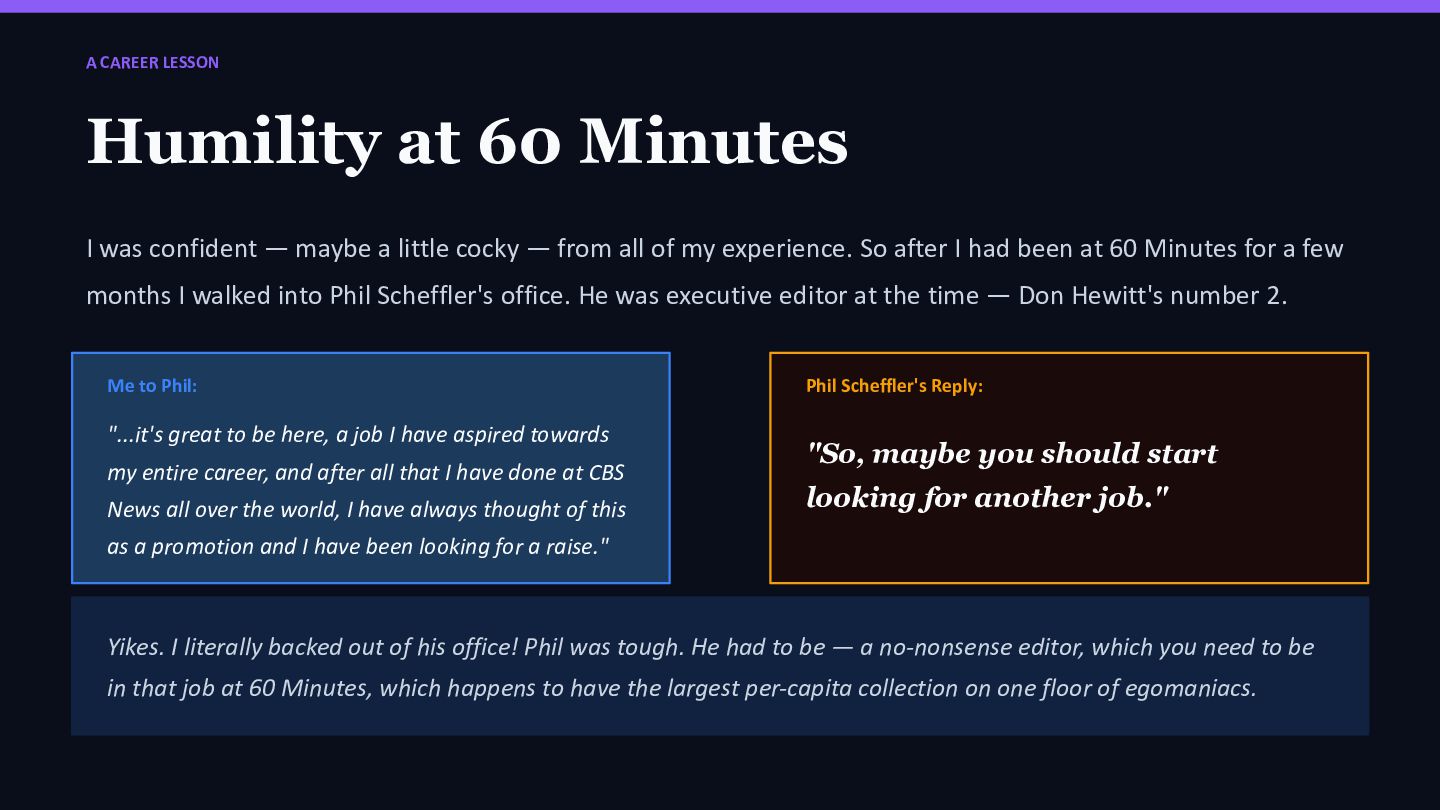
— maybe a little cocky — from all of my experience. So after I had been at 60 Minutes for a few months I walked into Phil Scheffler's office. He was executive editor at the time — Don Hewitt's number 2. Me to Phil: "...it's great to be here, a job I have aspired towards my entire career, and after all that I have done at CBS News all over the world, I have always thought of this as a promotion and I have been looking for a raise." Phil Scheffler's Reply: "So, maybe you should start looking for another job." Yikes. I literally backed out of his office! Phil was tough. He had to be — a no-nonsense editor, which you need to be in that job at 60 Minutes, which happens to have the largest per-capita collection on one floor of egomaniacs.
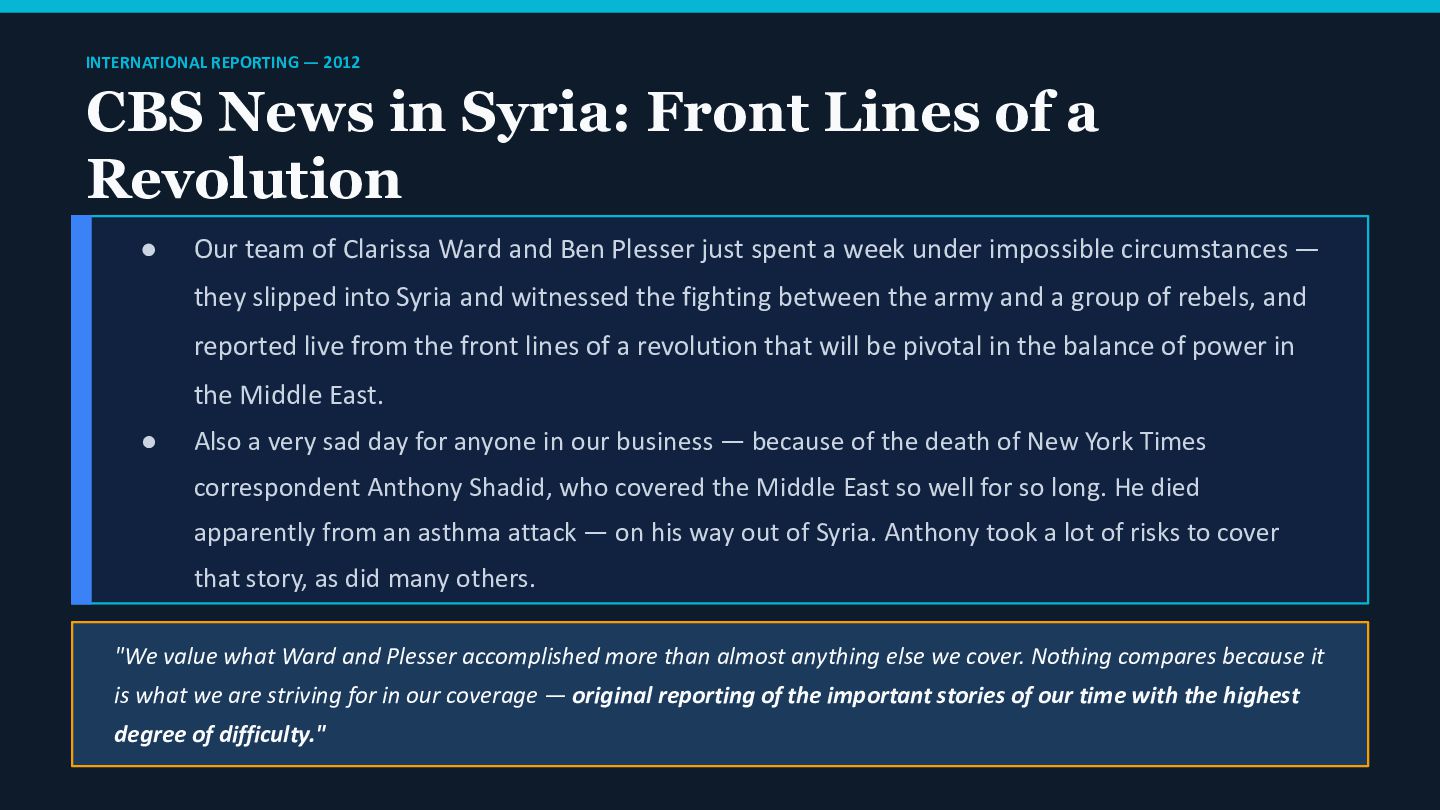
of a Revolution • Our team of Clarissa Ward and Ben Plesser just spent a week under impossible circumstances — they slipped into Syria and witnessed the fighting between the army and a group of rebels, and reported live from the front lines of a revolution that will be pivotal in the balance of power in the Middle East. • Also a very sad day for anyone in our business — because of the death of New York Times correspondent Anthony Shadid, who covered the Middle East so well for so long. He died apparently from an asthma attack — on his way out of Syria. Anthony took a lot of risks to cover that story, as did many others. "We value what Ward and Plesser accomplished more than almost anything else we cover. Nothing compares because it is what we are striving for in our coverage — original reporting of the important stories of our time with the highest degree of difficulty."
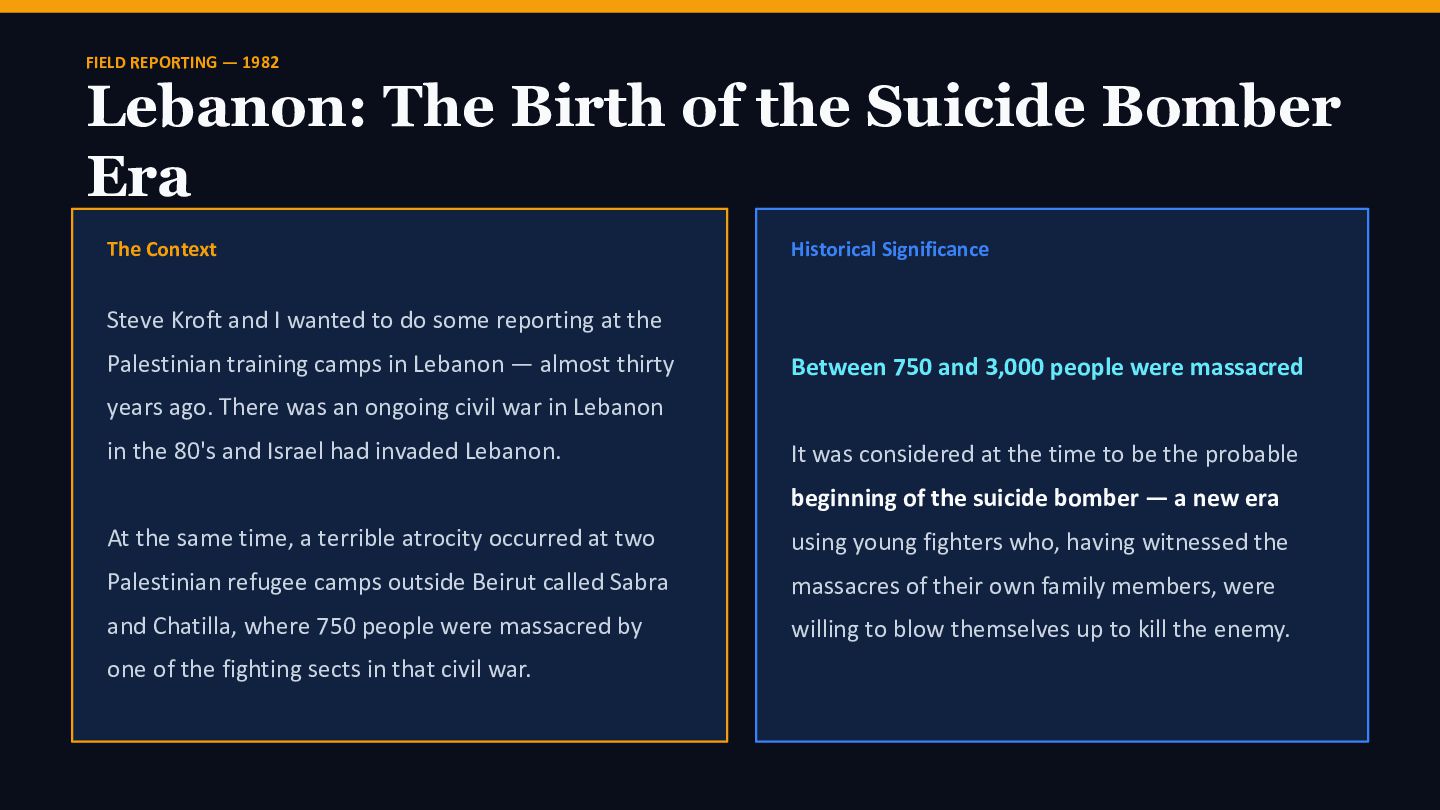
Bomber Era The Context Steve Kroft and I wanted to do some reporting at the Palestinian training camps in Lebanon — almost thirty years ago. There was an ongoing civil war in Lebanon in the 80's and Israel had invaded Lebanon. At the same time, a terrible atrocity occurred at two Palestinian refugee camps outside Beirut called Sabra and Chatilla, where 750 people were massacred by one of the fighting sects in that civil war. Historical Significance Between 750 and 3,000 people were massacred It was considered at the time to be the probable beginning of the suicide bomber — a new era using young fighters who, having witnessed the massacres of their own family members, were willing to blow themselves up to kill the enemy.
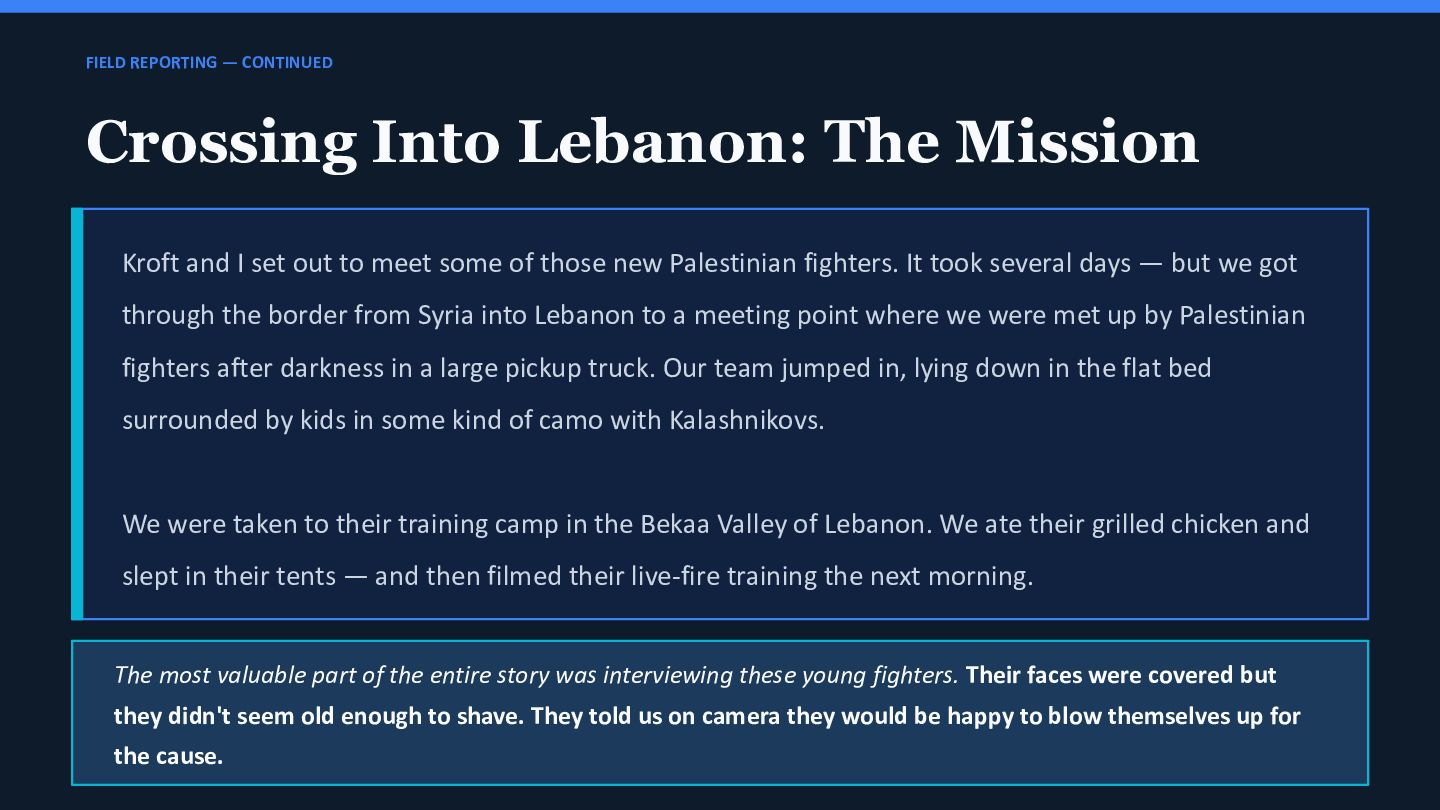
and I set out to meet some of those new Palestinian fighters. It took several days — but we got through the border from Syria into Lebanon to a meeting point where we were met up by Palestinian fighters after darkness in a large pickup truck. Our team jumped in, lying down in the flat bed surrounded by kids in some kind of camo with Kalashnikovs. We were taken to their training camp in the Bekaa Valley of Lebanon. We ate their grilled chicken and slept in their tents — and then filmed their live-fire training the next morning. The most valuable part of the entire story was interviewing these young fighters. Their faces were covered but they didn't seem old enough to shave. They told us on camera they would be happy to blow themselves up for the cause.
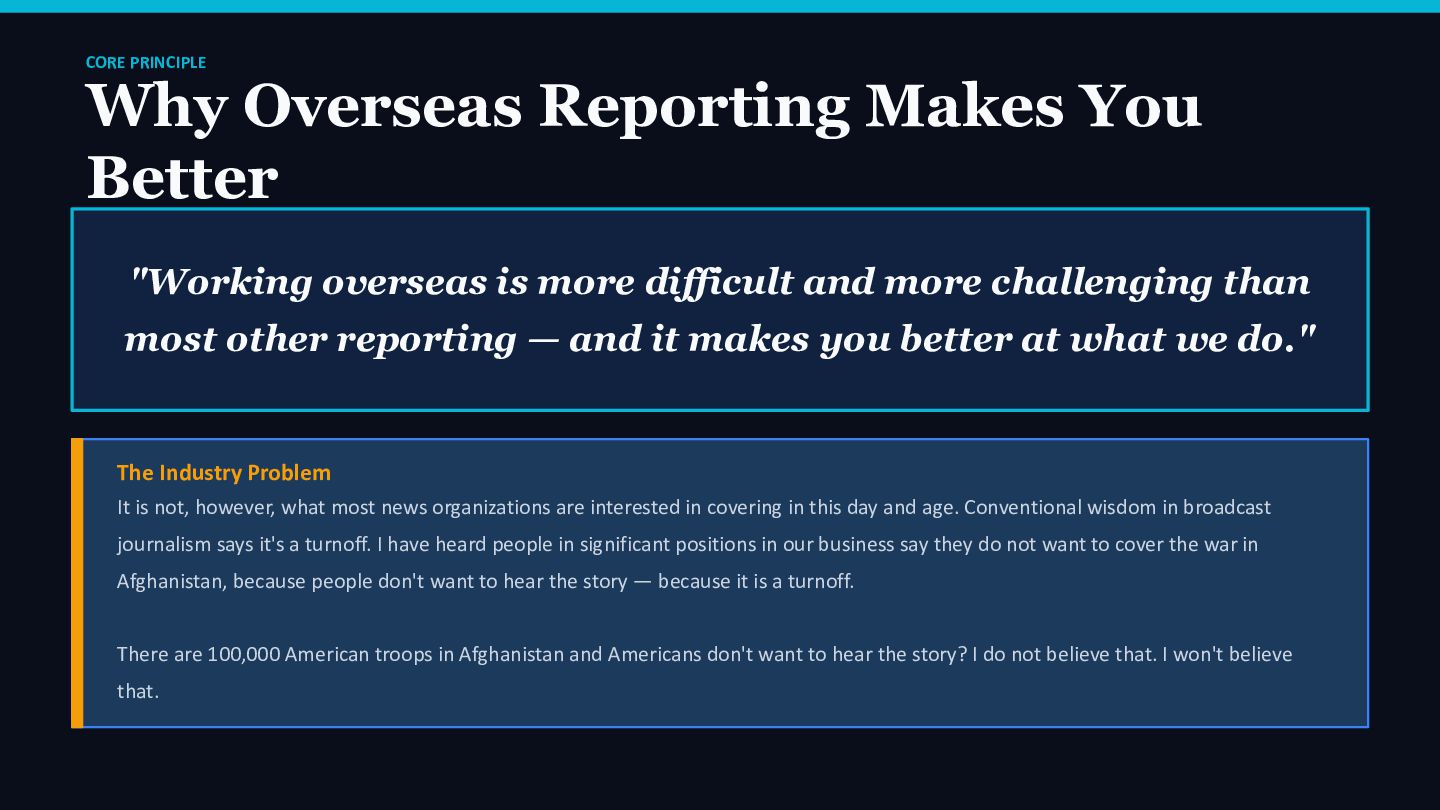
is more difficult and more challenging than most other reporting — and it makes you better at what we do." The Industry Problem It is not, however, what most news organizations are interested in covering in this day and age. Conventional wisdom in broadcast journalism says it's a turnoff. I have heard people in significant positions in our business say they do not want to cover the war in Afghanistan, because people don't want to hear the story — because it is a turnoff. There are 100,000 American troops in Afghanistan and Americans don't want to hear the story? I do not believe that. I won't believe that.
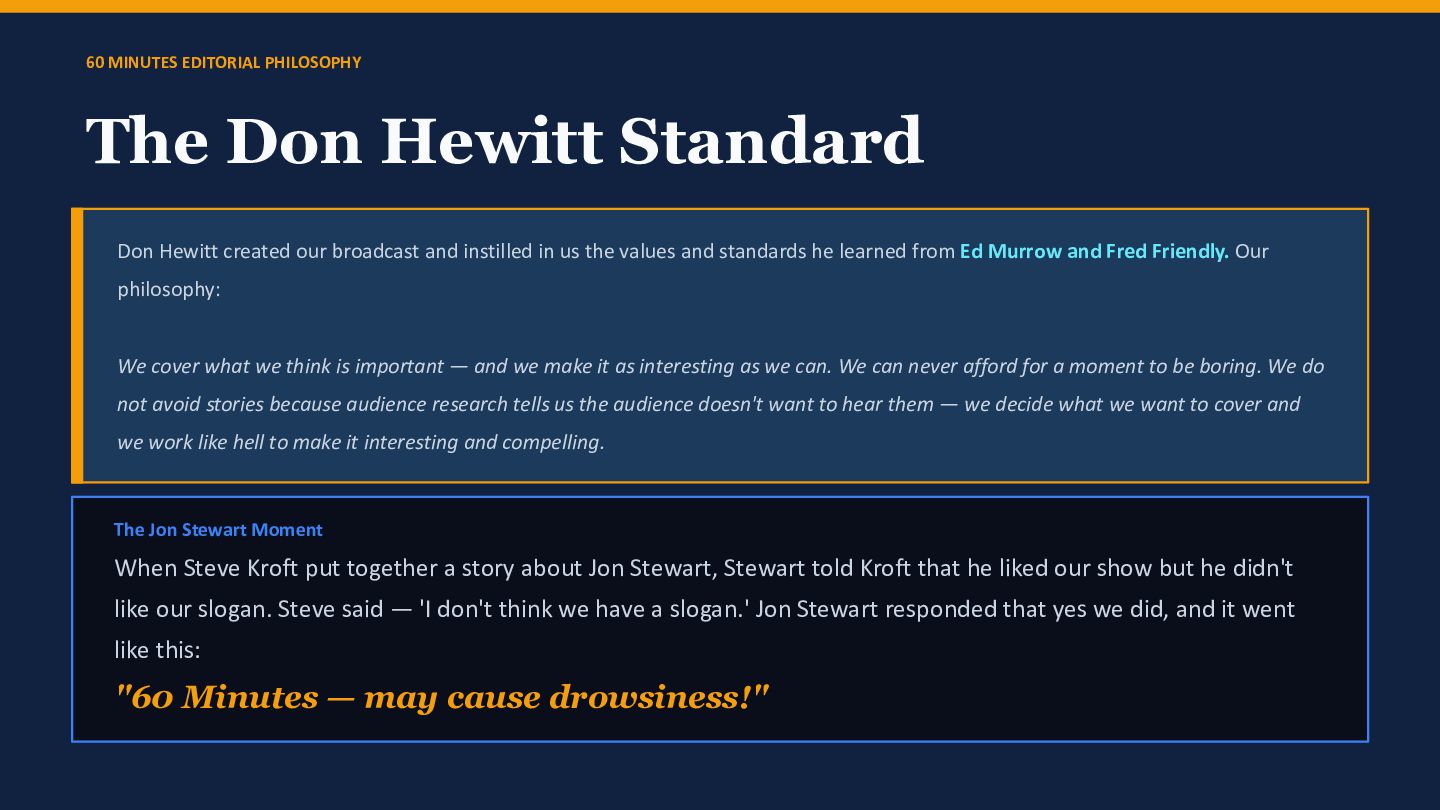
created our broadcast and instilled in us the values and standards he learned from Ed Murrow and Fred Friendly. Our philosophy: We cover what we think is important — and we make it as interesting as we can. We can never afford for a moment to be boring. We do not avoid stories because audience research tells us the audience doesn't want to hear them — we decide what we want to cover and we work like hell to make it interesting and compelling. The Jon Stewart Moment When Steve Kroft put together a story about Jon Stewart, Stewart told Kroft that he liked our show but he didn't like our slogan. Steve said — 'I don't think we have a slogan.' Jon Stewart responded that yes we did, and it went like this: "60 Minutes — may cause drowsiness!"
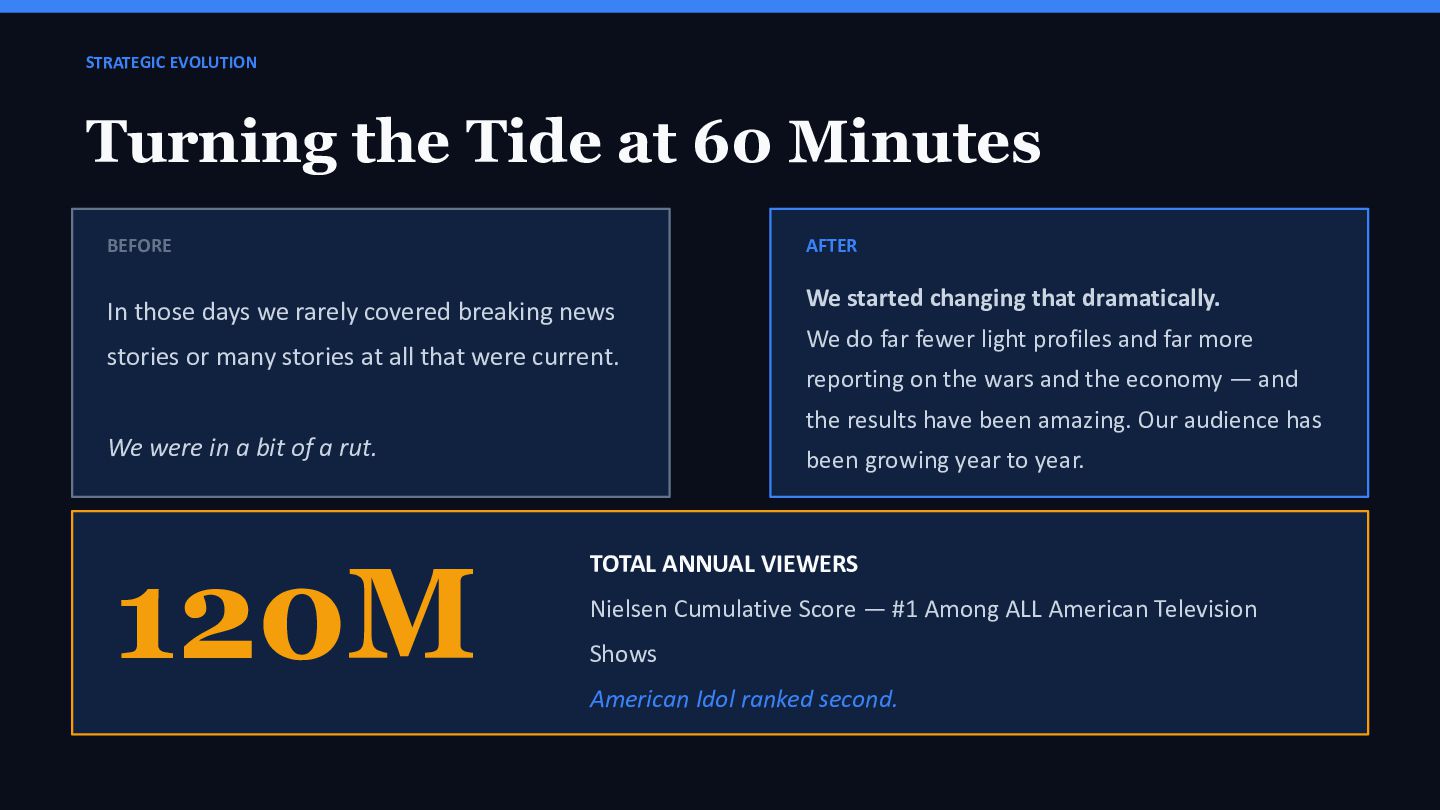
those days we rarely covered breaking news stories or many stories at all that were current. We were in a bit of a rut. AFTER We started changing that dramatically. We do far fewer light profiles and far more reporting on the wars and the economy — and the results have been amazing. Our audience has been growing year to year. 120M TOTAL ANNUAL VIEWERS Nielsen Cumulative Score — #1 Among ALL American Television Shows American Idol ranked second.
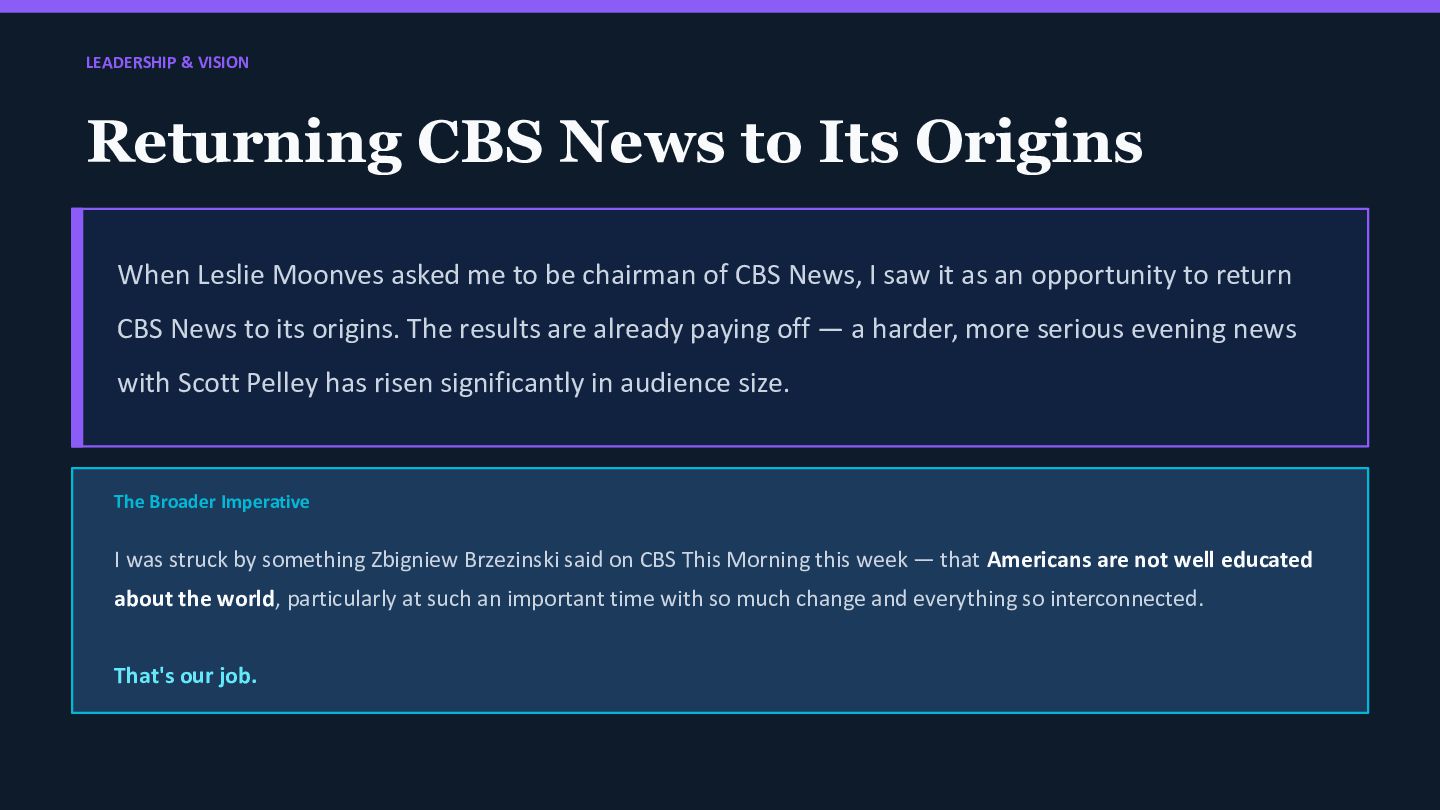
Leslie Moonves asked me to be chairman of CBS News, I saw it as an opportunity to return CBS News to its origins. The results are already paying off — a harder, more serious evening news with Scott Pelley has risen significantly in audience size. The Broader Imperative I was struck by something Zbigniew Brzezinski said on CBS This Morning this week — that Americans are not well educated about the world, particularly at such an important time with so much change and everything so interconnected. That's our job.
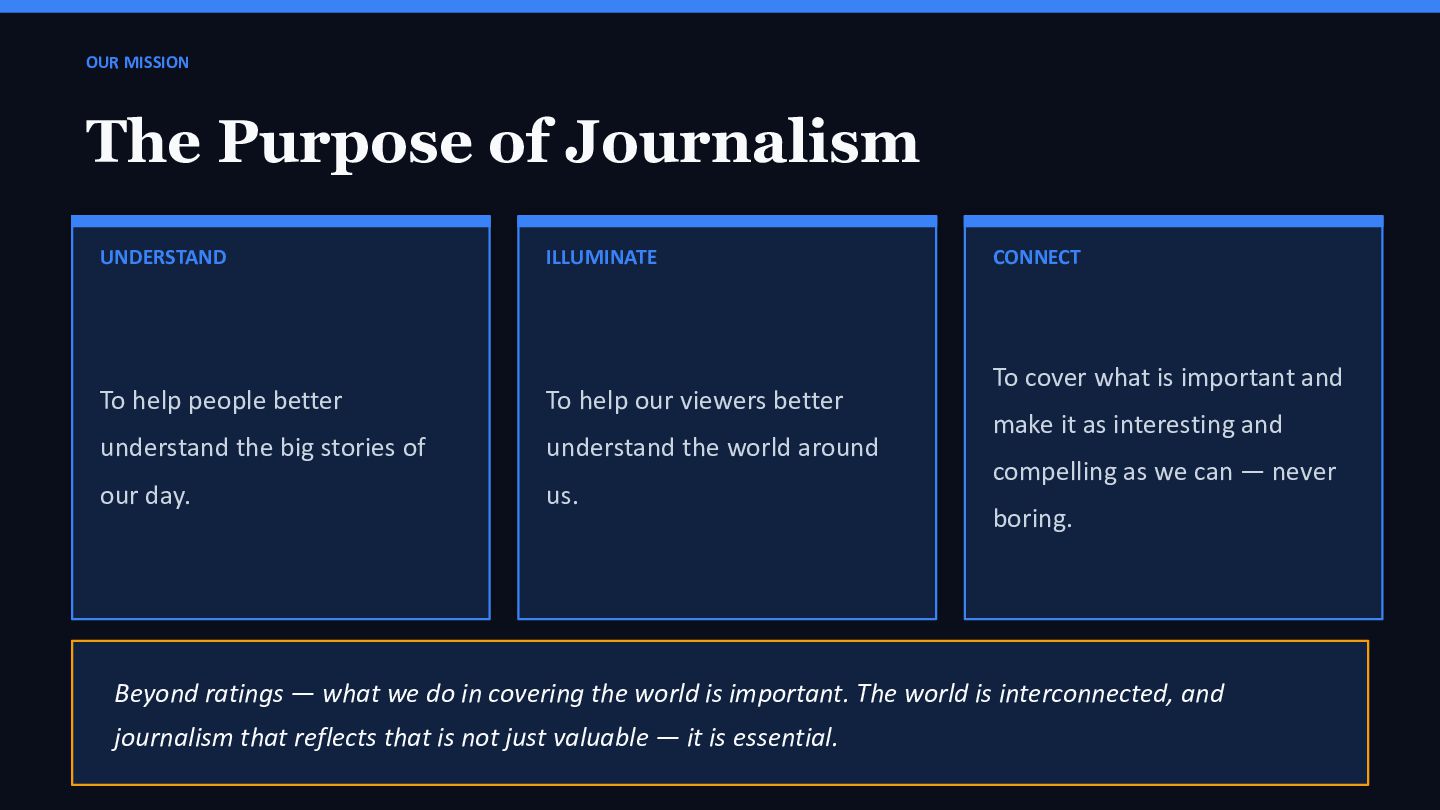
better understand the big stories of our day. ILLUMINATE To help our viewers better understand the world around us. CONNECT To cover what is important and make it as interesting and compelling as we can — never boring. Beyond ratings — what we do in covering the world is important. The world is interconnected, and journalism that reflects that is not just valuable — it is essential.


 jefffager
 ebhernandez
 hptaylor
 mikepelensky1
 jmscrvnts
 yurimnkim
 kawaguti
 pixelduust
 nova1977
 ahmadhunter
 hannahwhiting
 montyli
 mingyiding
 lara
lara
 chriscoyier
 techseoconnect
 baasie
 inesmontani
 ryanjones
 quramy
 rkendrick25
 trallard
 speakerdeck