Champion ★ Technical Lead, CNCF DevEx TAG ★ From Belgium / Live in Switzerland ★ 🗣 English, Dutch, French, Italian youtube.com/@thekevindubois linkedin.com/in/kevindubois github.com/kdubois @kevindubois.com
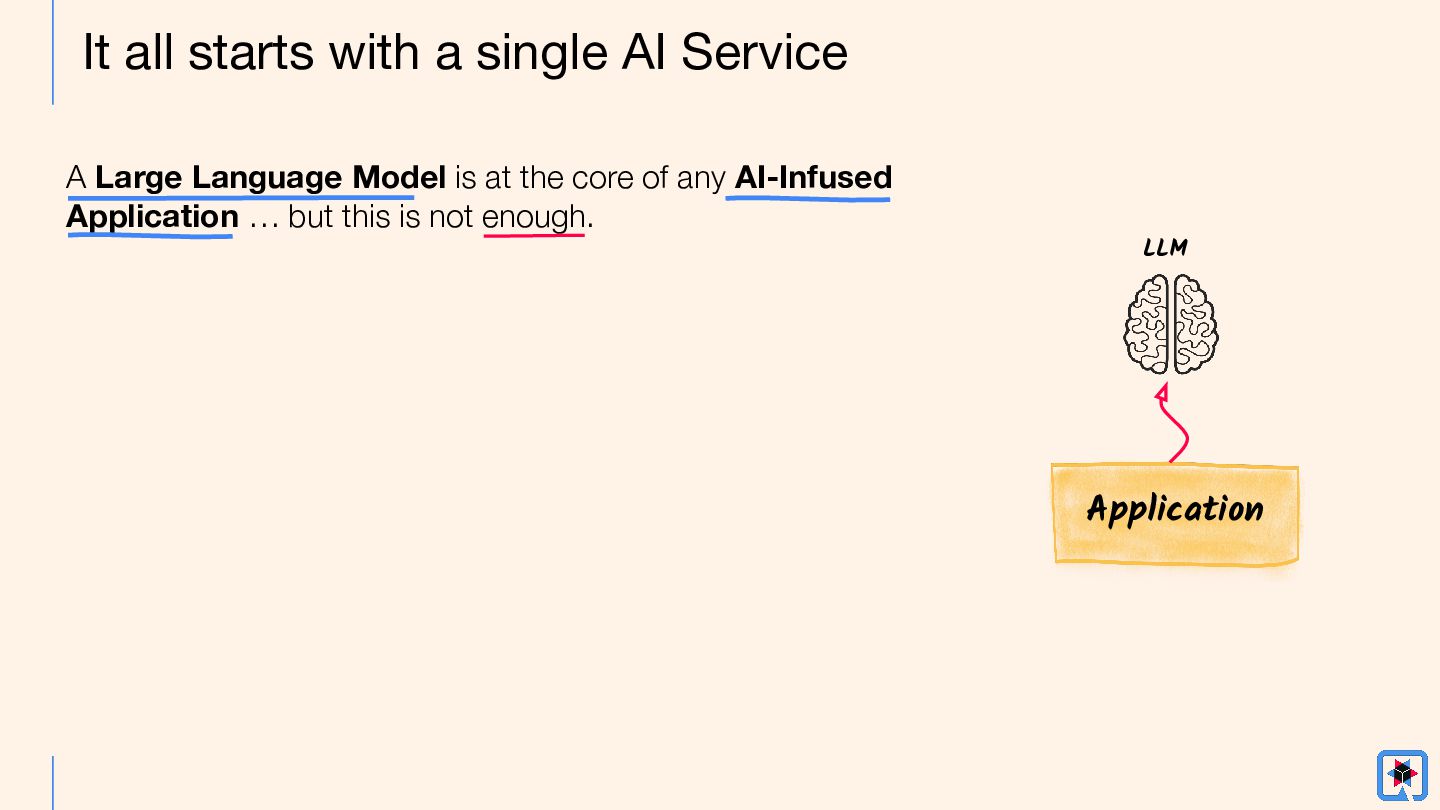
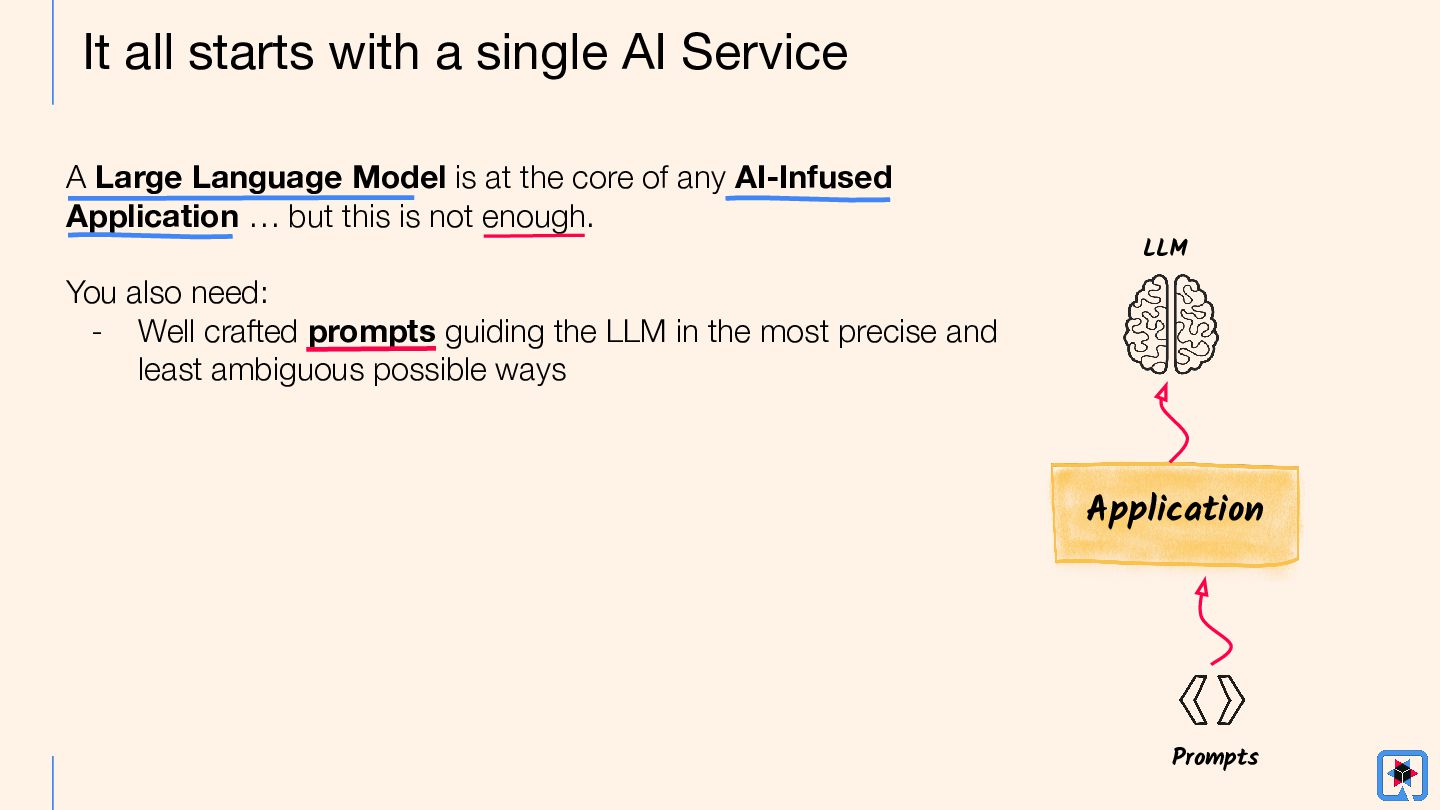
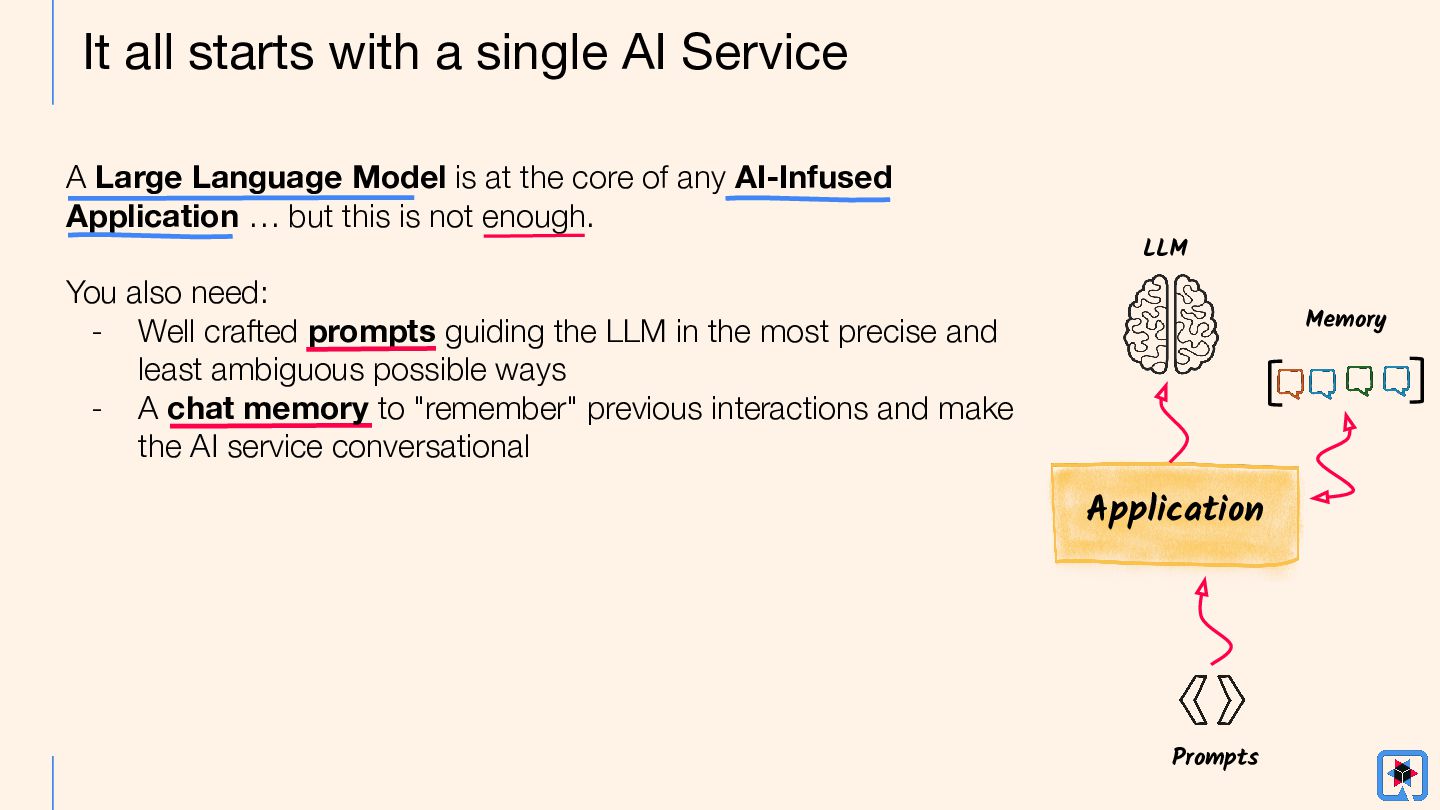
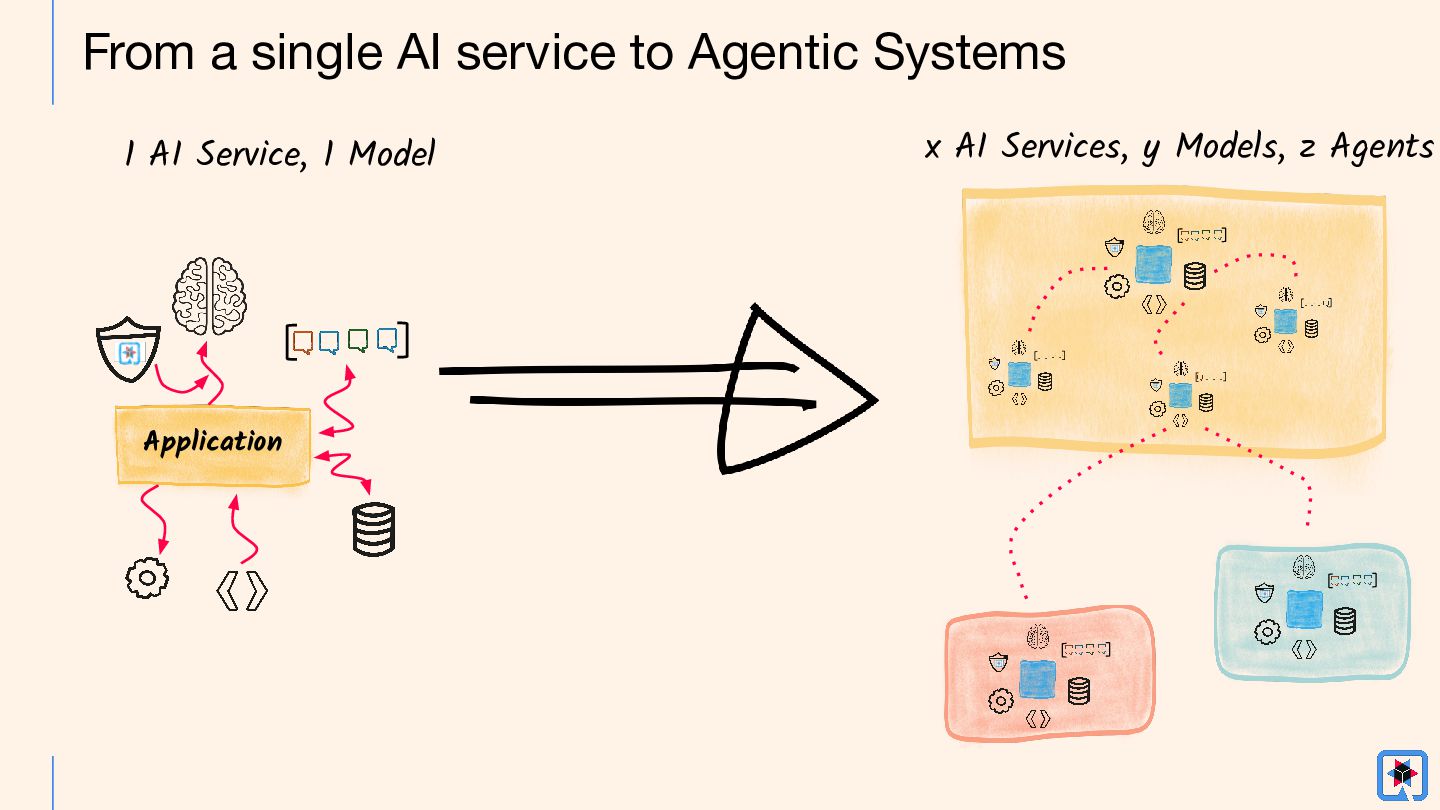
A Large Language Model is at the core of any AI-Infused Application … but this is not enough. You also need: - Well crafted prompts guiding the LLM in the most precise and least ambiguous possible ways Prompts
A Large Language Model is at the core of any AI-Infused Application … but this is not enough. You also need: - Well crafted prompts guiding the LLM in the most precise and least ambiguous possible ways - A chat memory to "remember" previous interactions and make the AI service conversational Prompts Memory
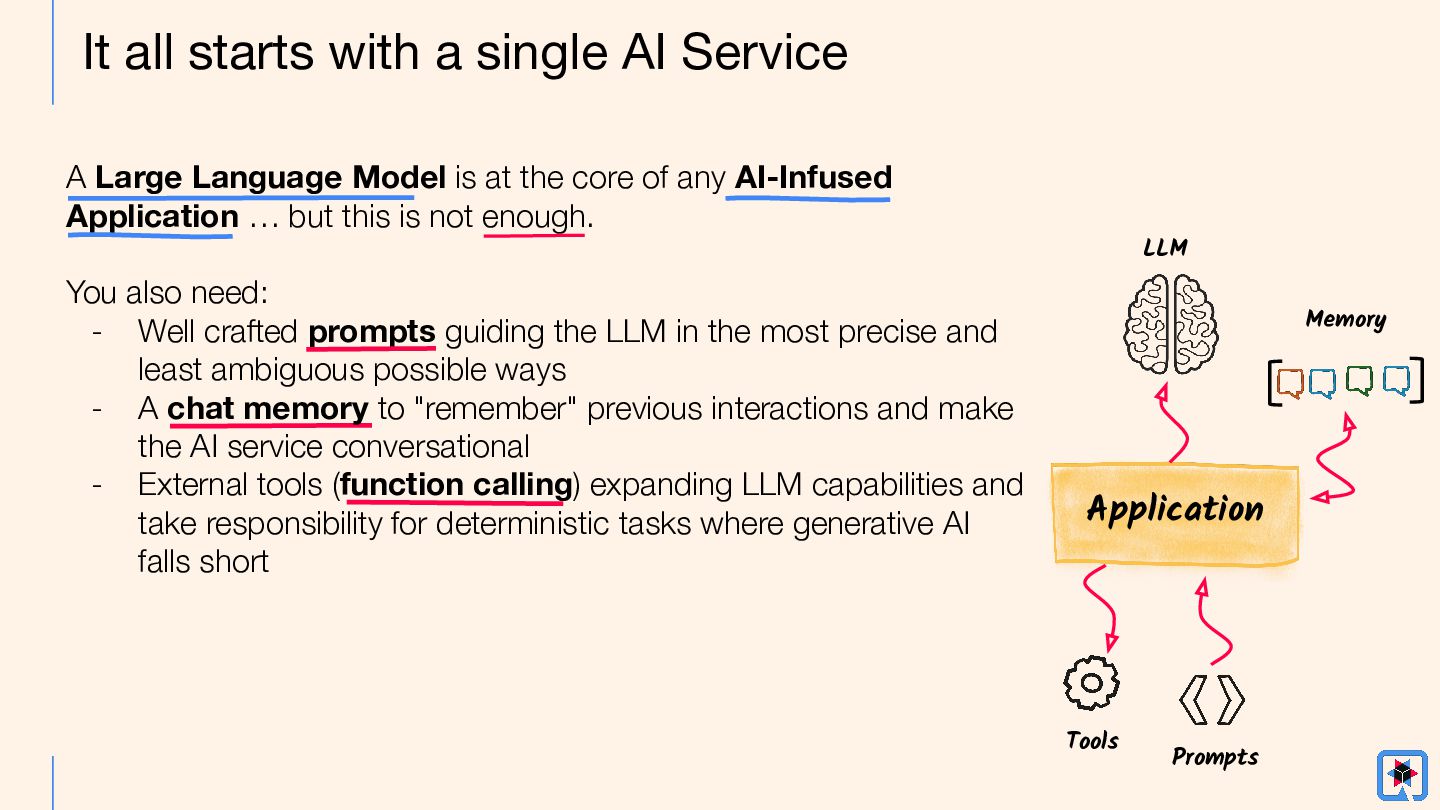
A Large Language Model is at the core of any AI-Infused Application … but this is not enough. You also need: - Well crafted prompts guiding the LLM in the most precise and least ambiguous possible ways - A chat memory to "remember" previous interactions and make the AI service conversational - External tools (function calling) expanding LLM capabilities and take responsibility for deterministic tasks where generative AI falls short Prompts Memory Tools
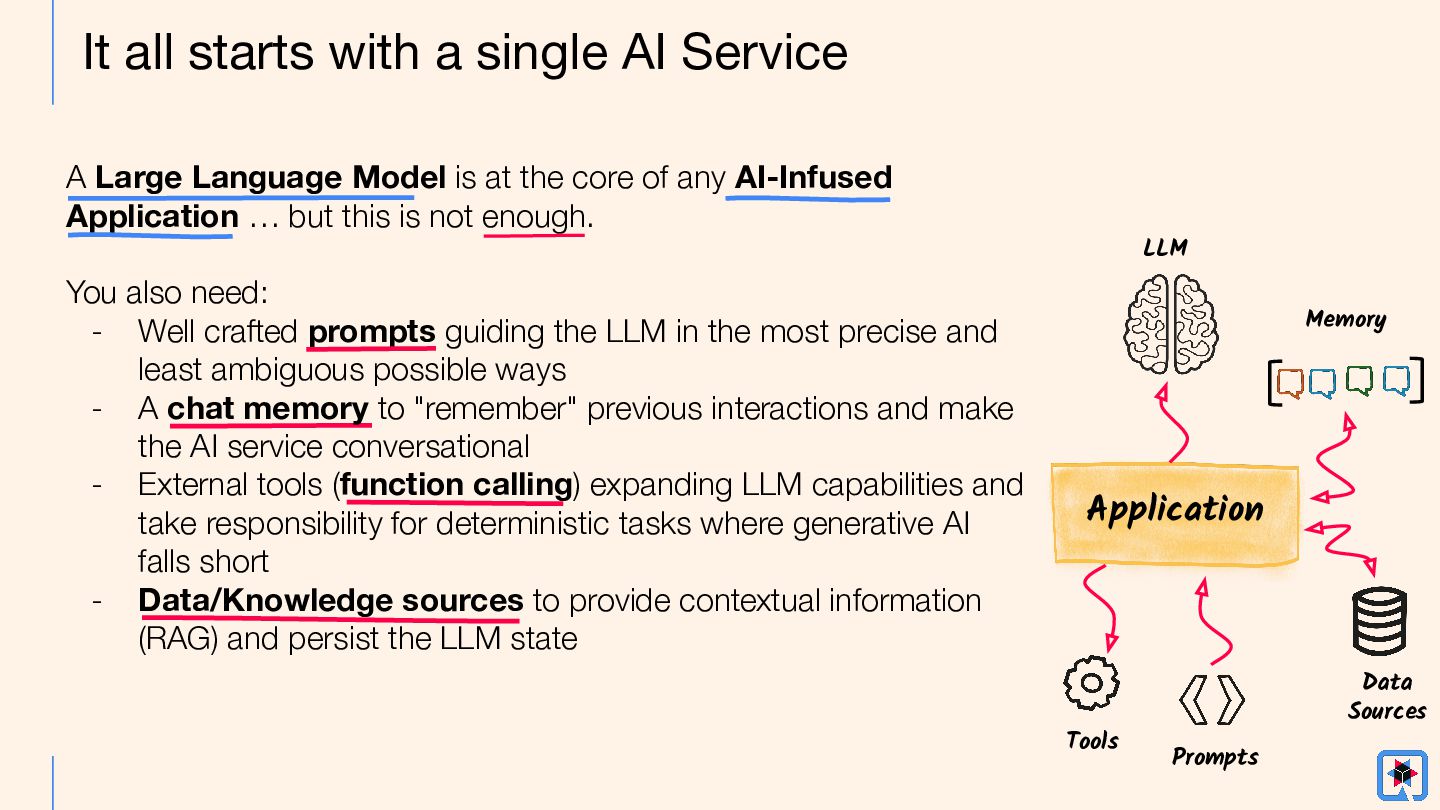
A Large Language Model is at the core of any AI-Infused Application … but this is not enough. You also need: - Well crafted prompts guiding the LLM in the most precise and least ambiguous possible ways - A chat memory to "remember" previous interactions and make the AI service conversational - External tools (function calling) expanding LLM capabilities and take responsibility for deterministic tasks where generative AI falls short - Data/Knowledge sources to provide contextual information (RAG) and persist the LLM state Prompts Memory Tools Data Sources
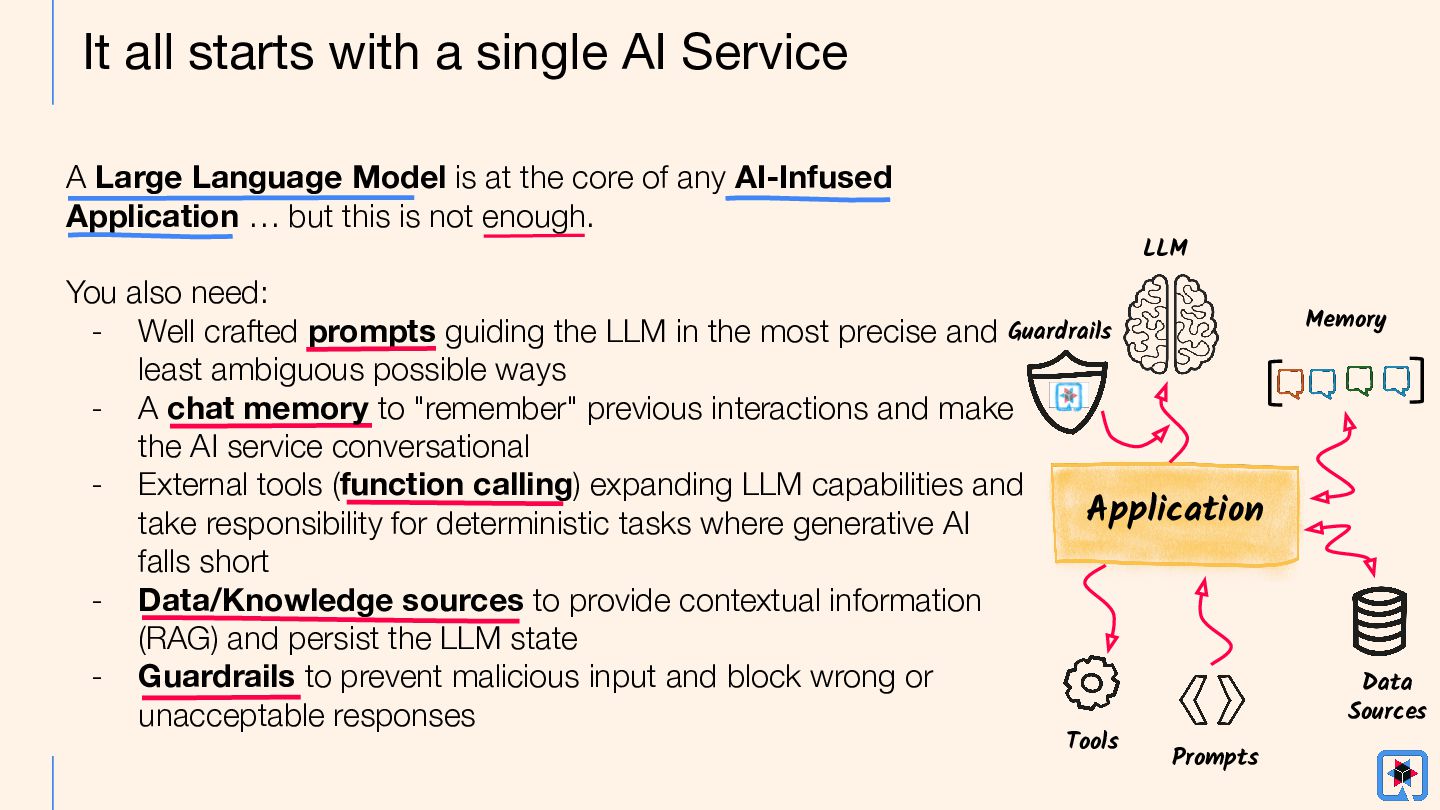
Application A Large Language Model is at the core of any AI-Infused Application … but this is not enough. You also need: - Well crafted prompts guiding the LLM in the most precise and least ambiguous possible ways - A chat memory to "remember" previous interactions and make the AI service conversational - External tools (function calling) expanding LLM capabilities and take responsibility for deterministic tasks where generative AI falls short - Data/Knowledge sources to provide contextual information (RAG) and persist the LLM state - Guardrails to prevent malicious input and block wrong or unacceptable responses Prompts Memory Tools Data Sources
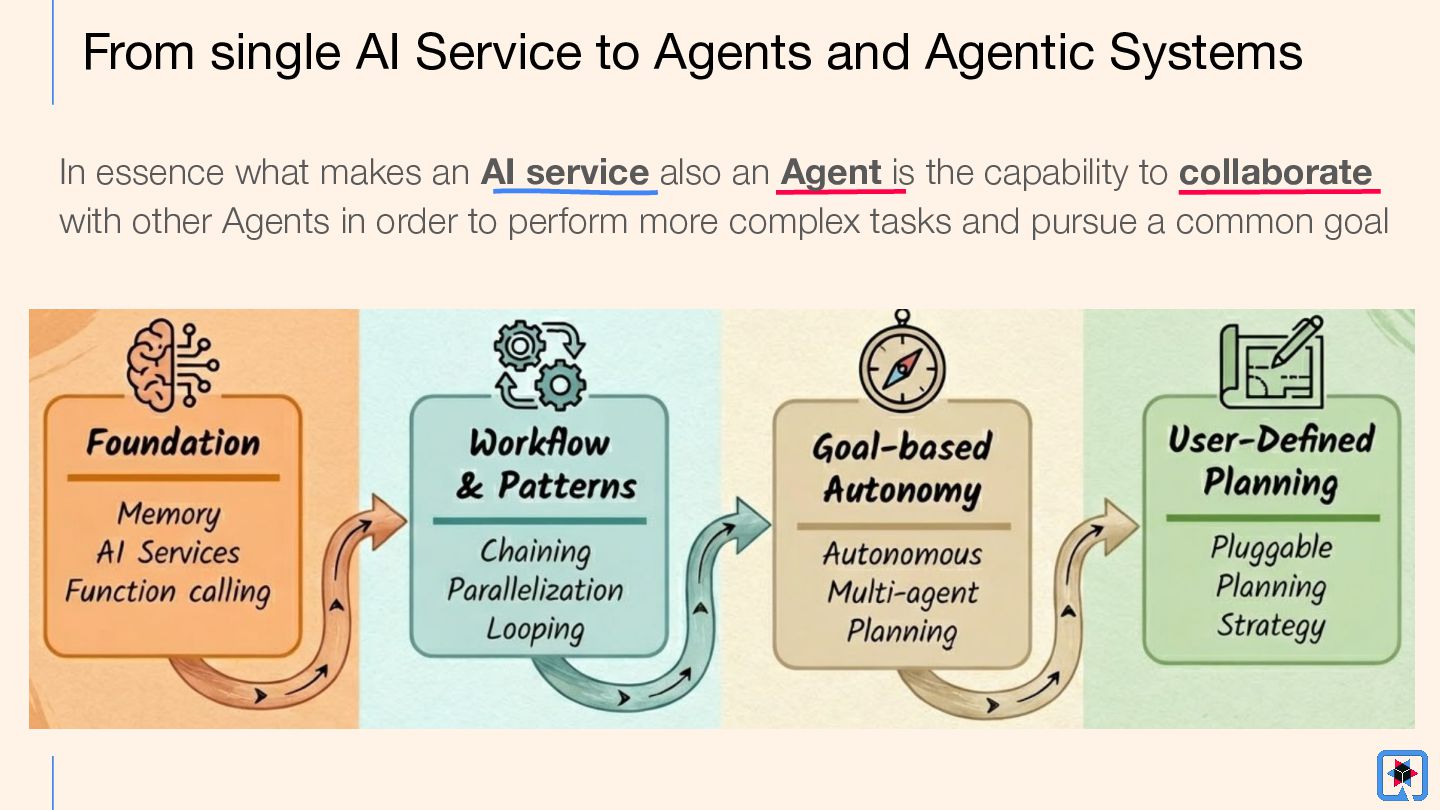
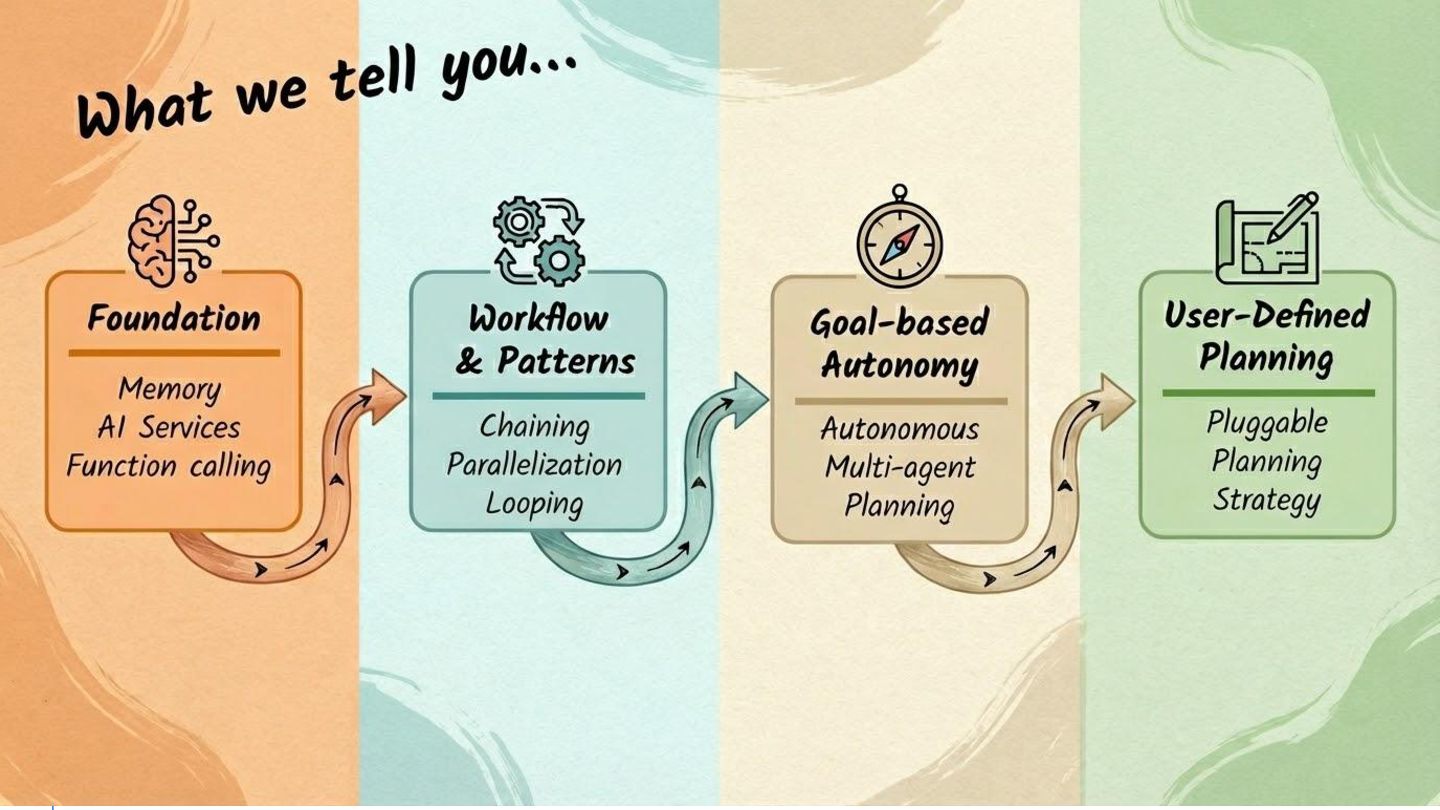
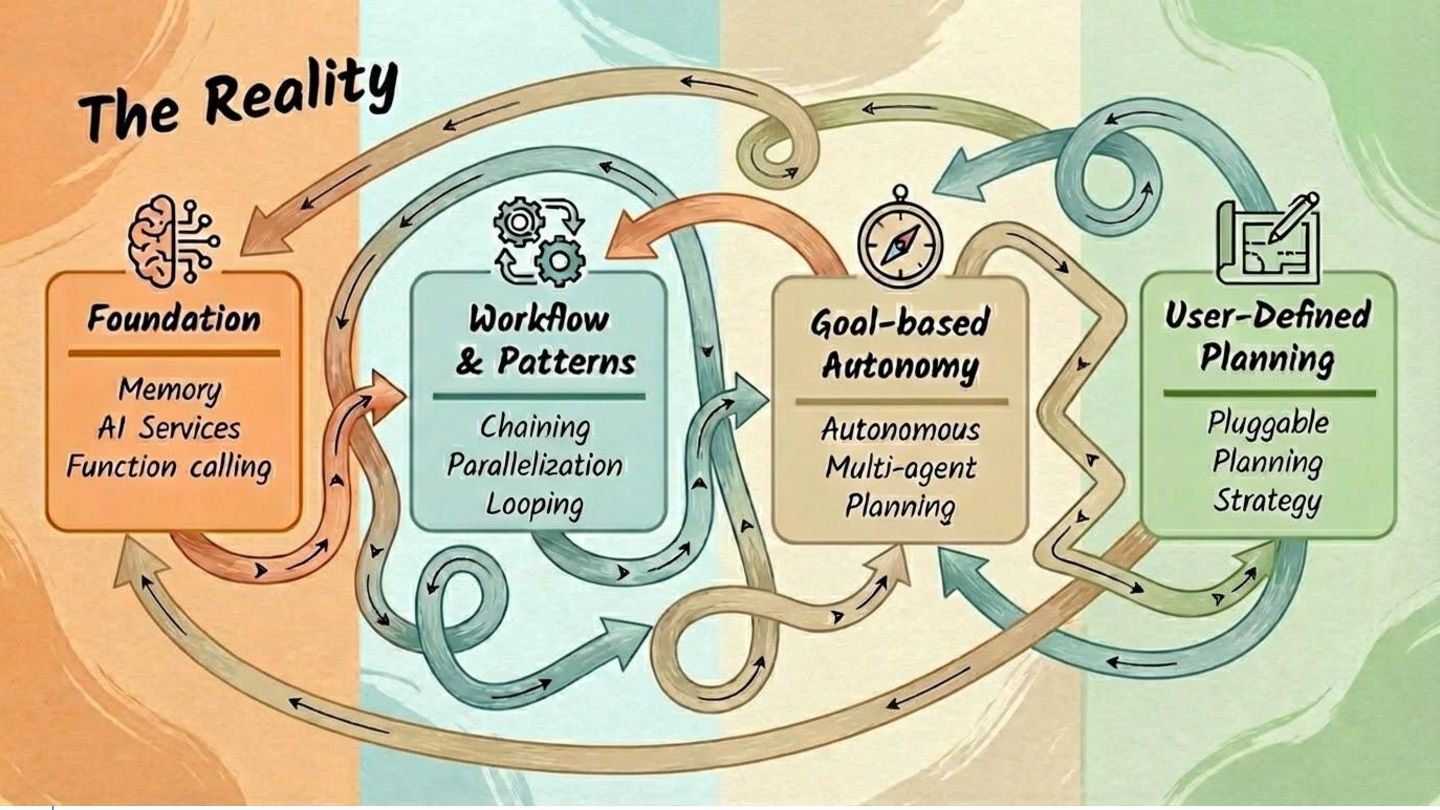
essence what makes an AI service also an Agent is the capability to collaborate with other Agents in order to perform more complex tasks and pursue a common goal
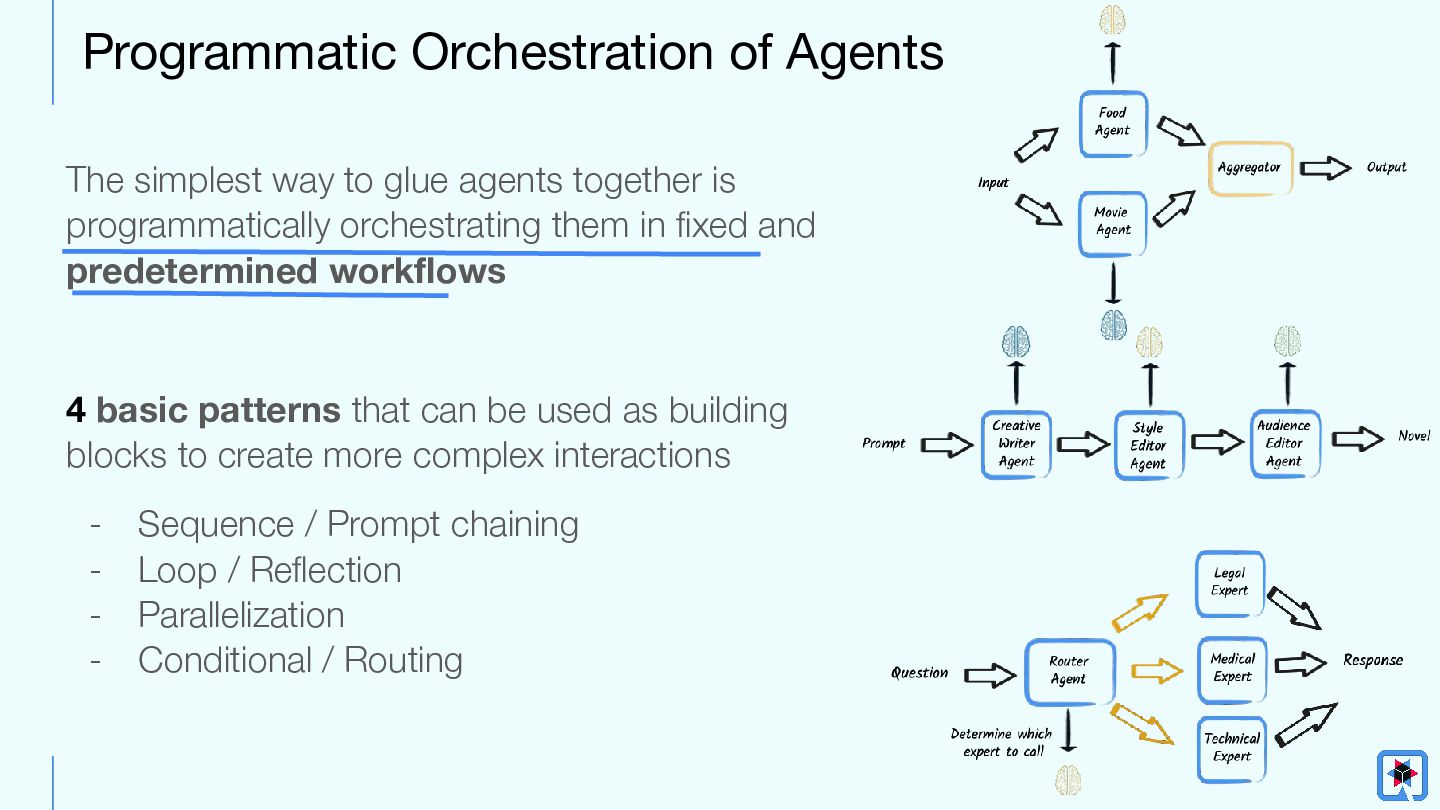
together is programmatically orchestrating them in fixed and predetermined workflows 4 basic patterns that can be used as building blocks to create more complex interactions - Sequence / Prompt chaining - Loop / Reflection - Parallelization - Conditional / Routing
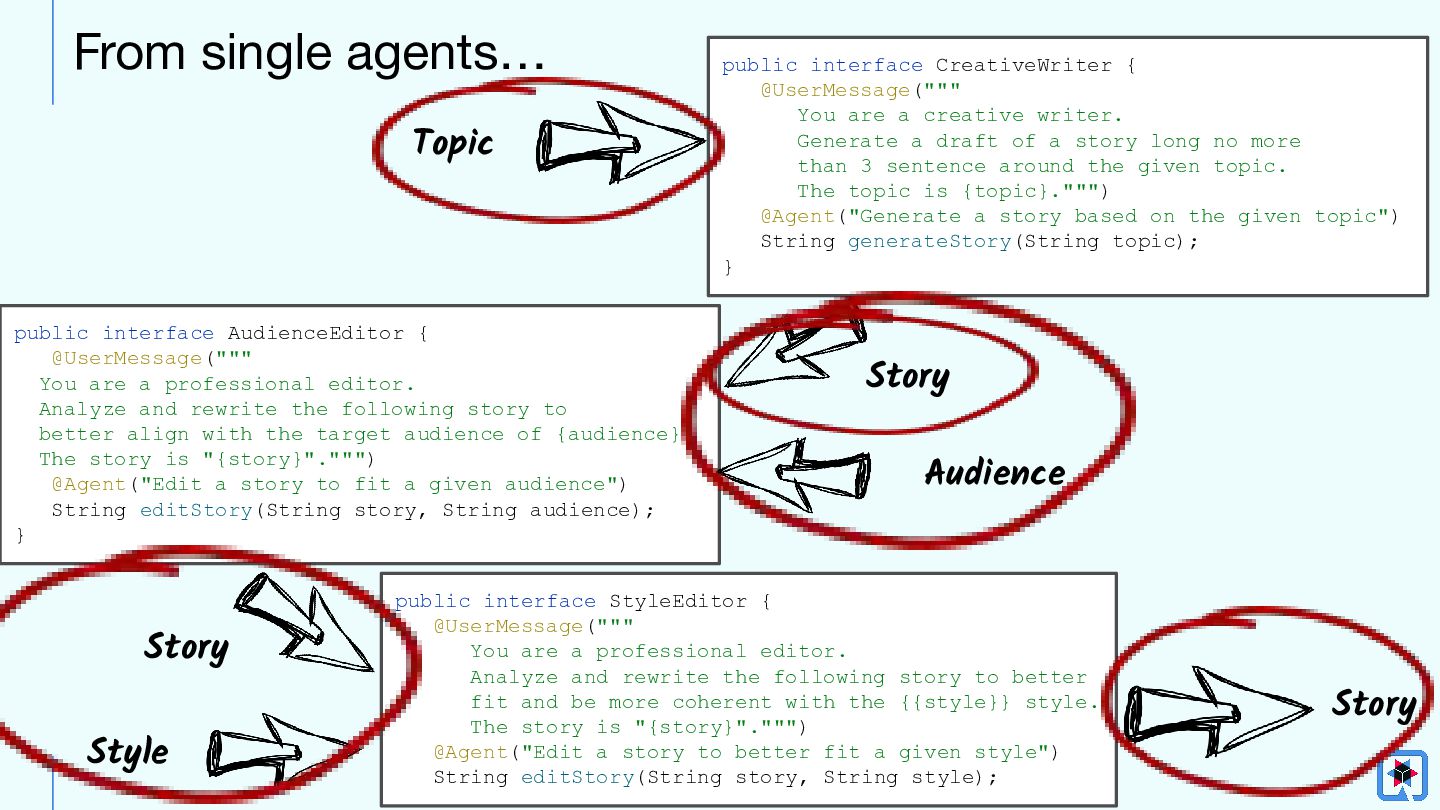
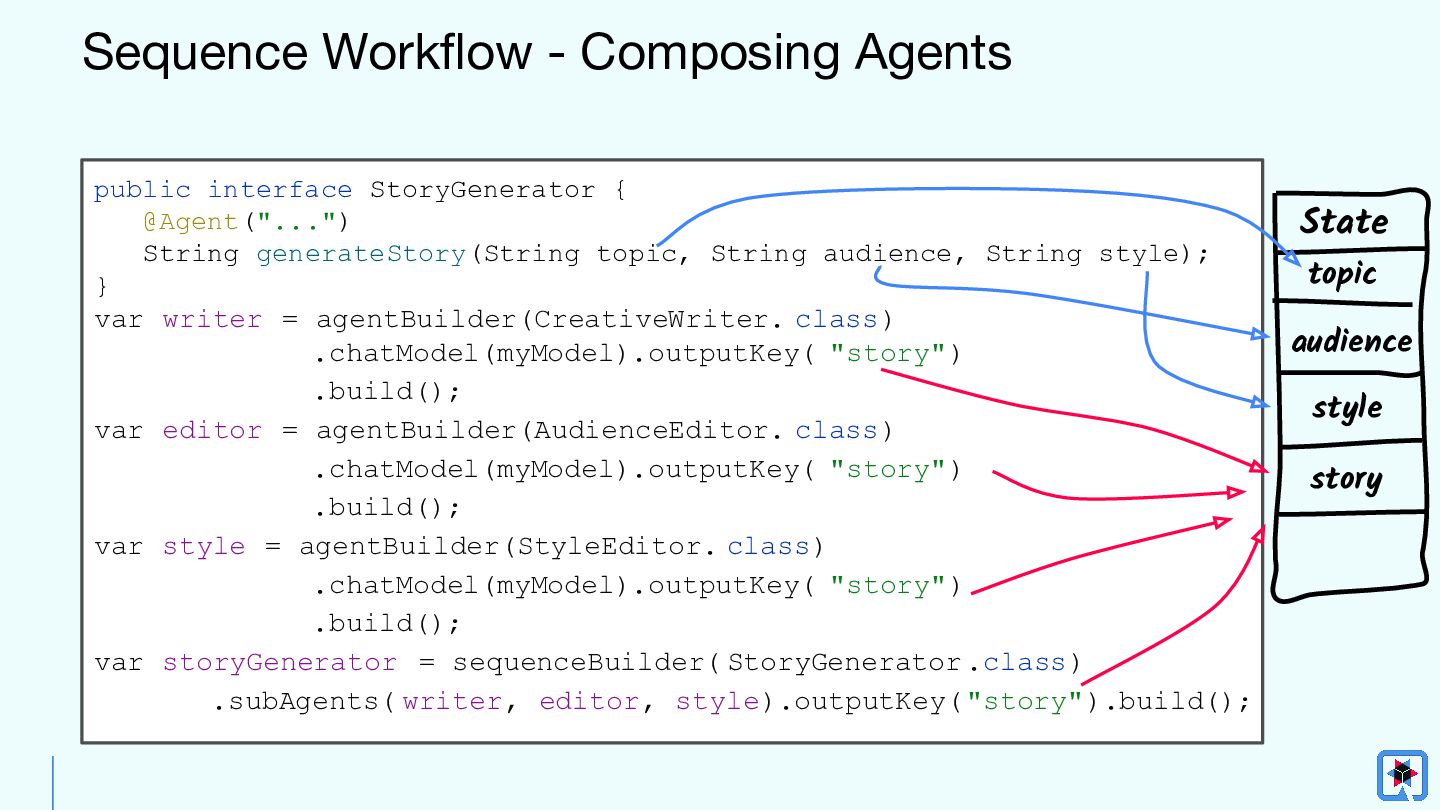
a creative writer. Generate a draft of a story long no more than 3 sentence around the given topic. The topic is {topic}.""") @Agent("Generate a story based on the given topic") String generateStory(String topic); } public interface AudienceEditor { @UserMessage(""" You are a professional editor. Analyze and rewrite the following story to better align with the target audience of {audience}. The story is "{story}".""") @Agent("Edit a story to fit a given audience") String editStory(String story, String audience); } public interface StyleEditor { @UserMessage(""" You are a professional editor. Analyze and rewrite the following story to better fit and be more coherent with the {{style}} style. The story is "{story}".""") @Agent("Edit a story to better fit a given style") String editStory(String story, String style); Topic Story Audience Style Story Story
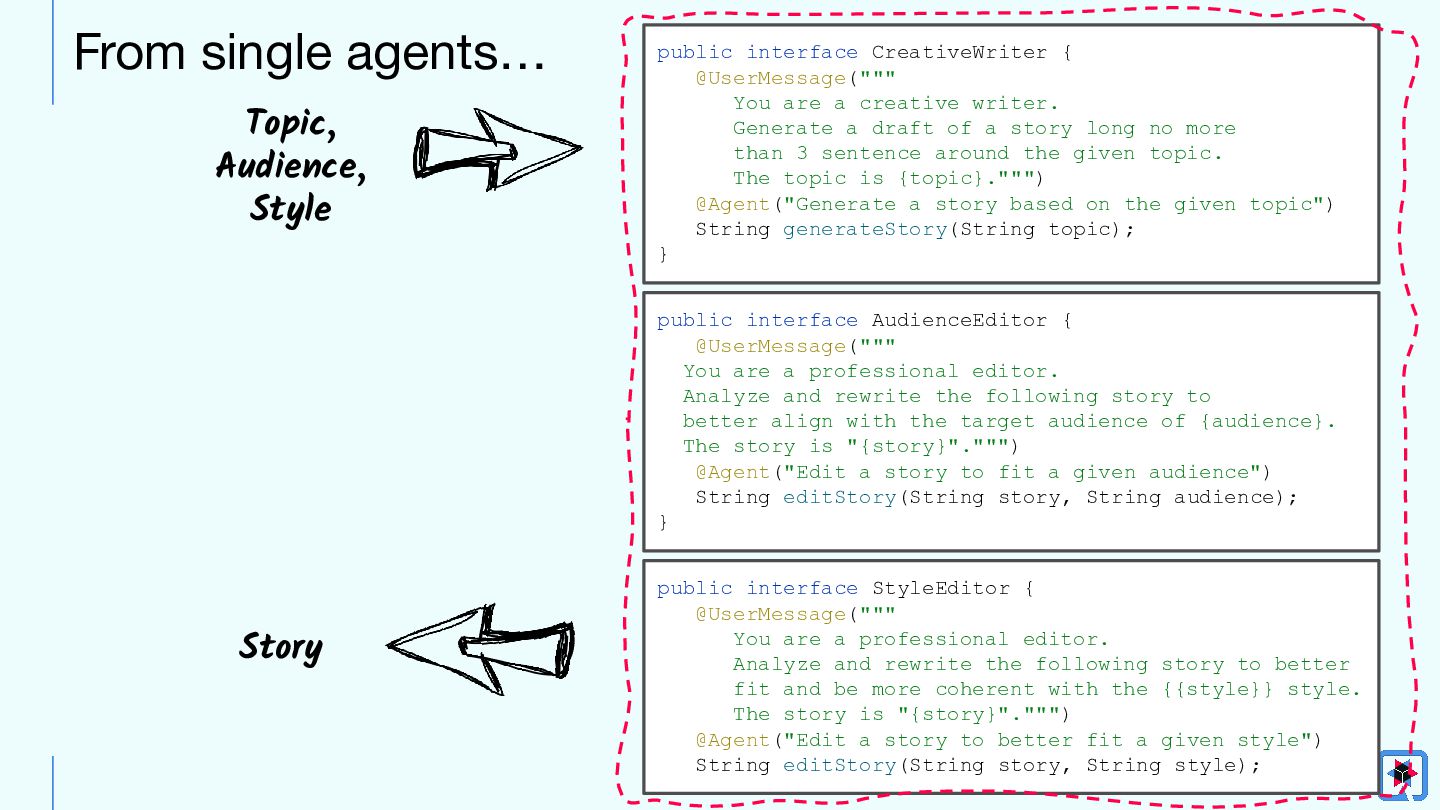
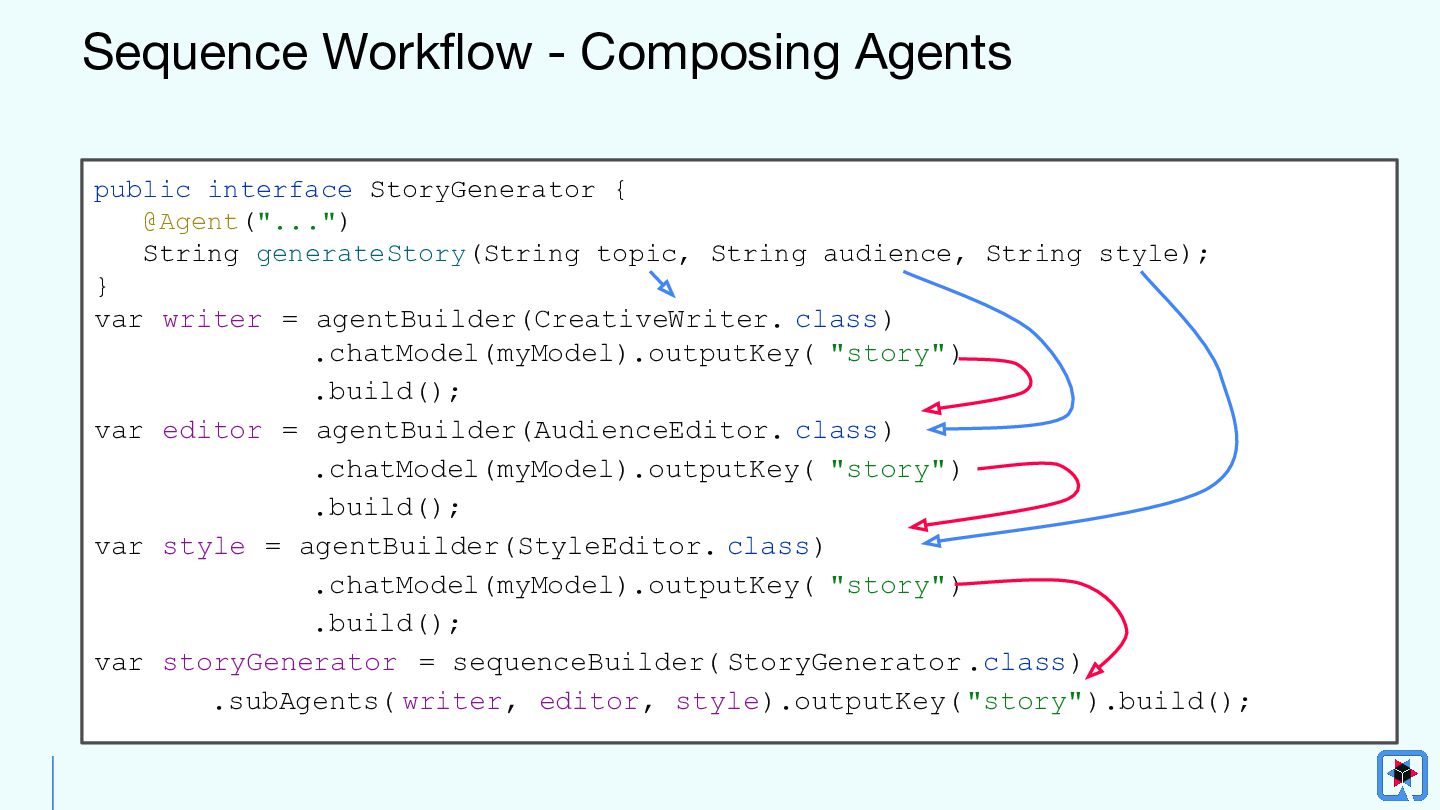
a creative writer. Generate a draft of a story long no more than 3 sentence around the given topic. The topic is {topic}.""") @Agent("Generate a story based on the given topic") String generateStory(String topic); } public interface AudienceEditor { @UserMessage(""" You are a professional editor. Analyze and rewrite the following story to better align with the target audience of {audience}. The story is "{story}".""") @Agent("Edit a story to fit a given audience") String editStory(String story, String audience); } public interface StyleEditor { @UserMessage(""" You are a professional editor. Analyze and rewrite the following story to better fit and be more coherent with the {{style}} style. The story is "{story}".""") @Agent("Edit a story to better fit a given style") String editStory(String story, String style); Topic, Audience, Style Story
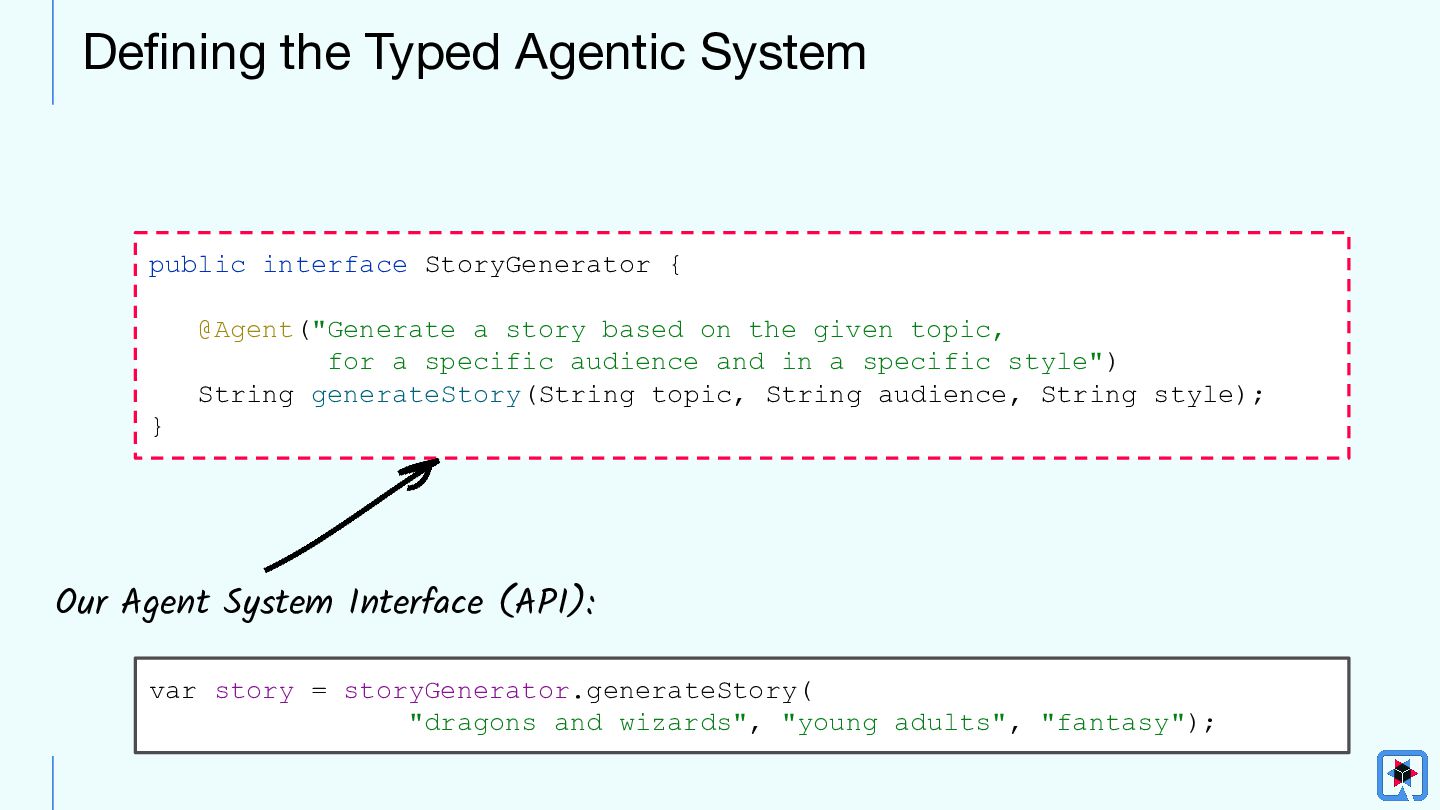
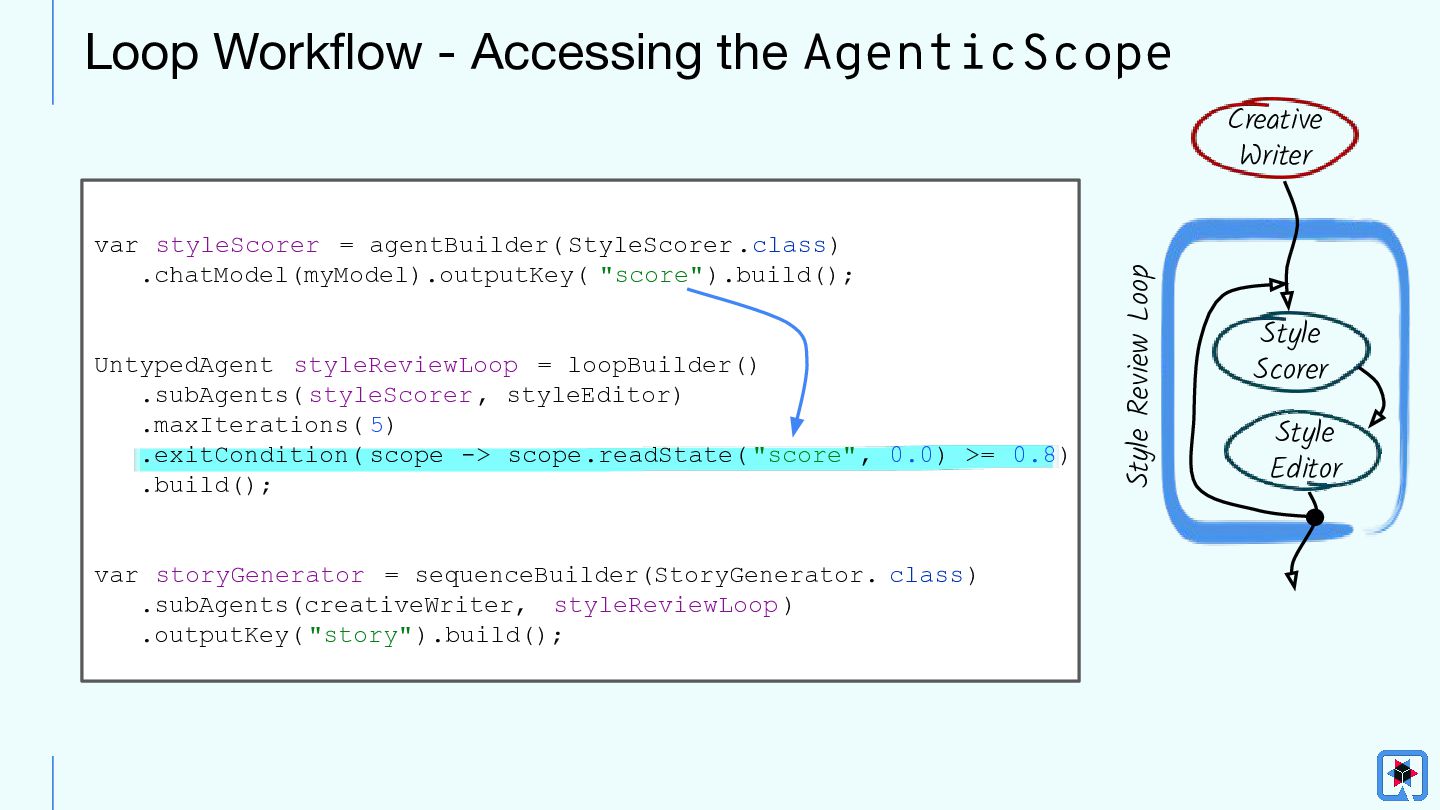
a story based on the given topic, for a specific audience and in a specific style") String generateStory(String topic, String audience, String style); } Our Agent System Interface (API): var story = storyGenerator.generateStory( "dragons and wizards", "young adults", "fantasy");
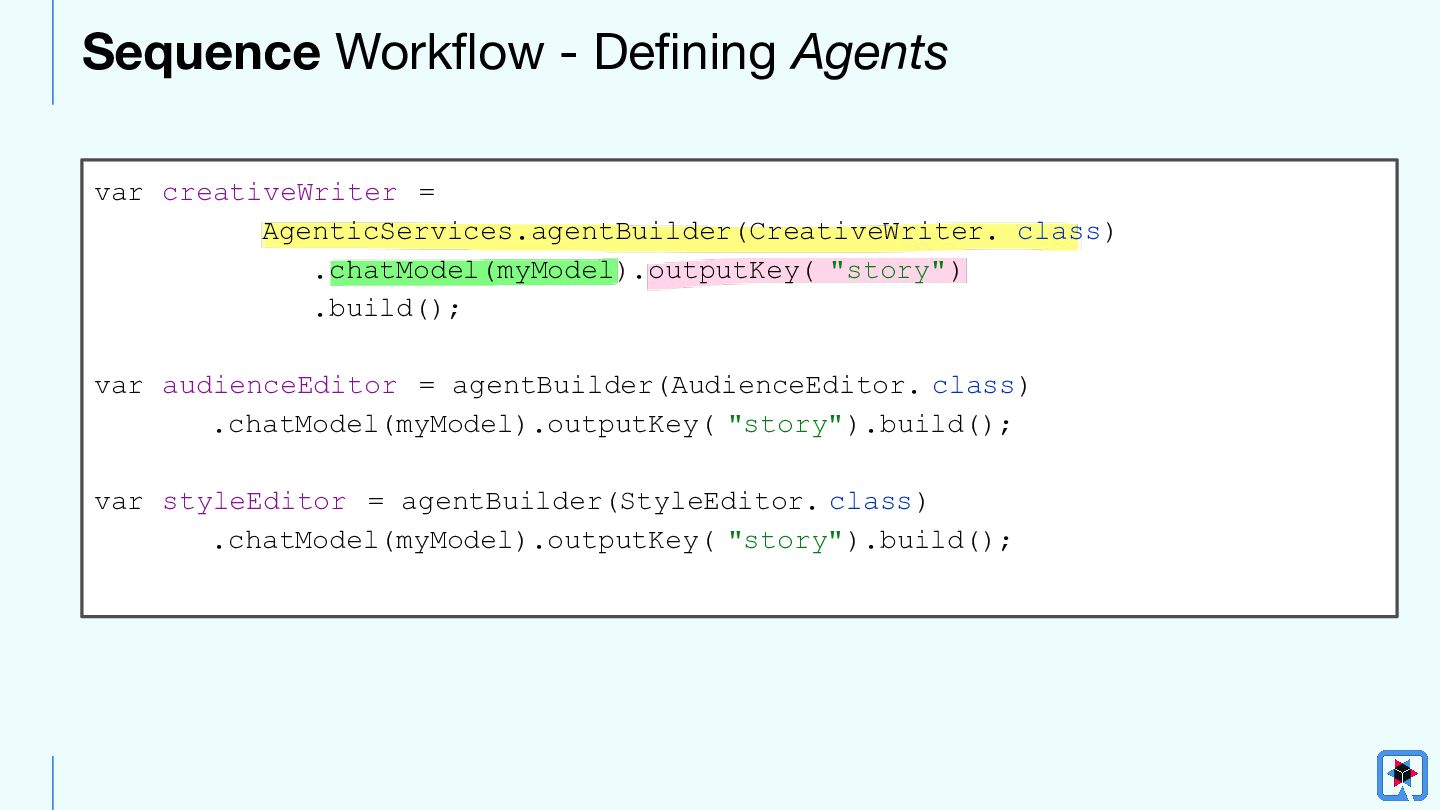
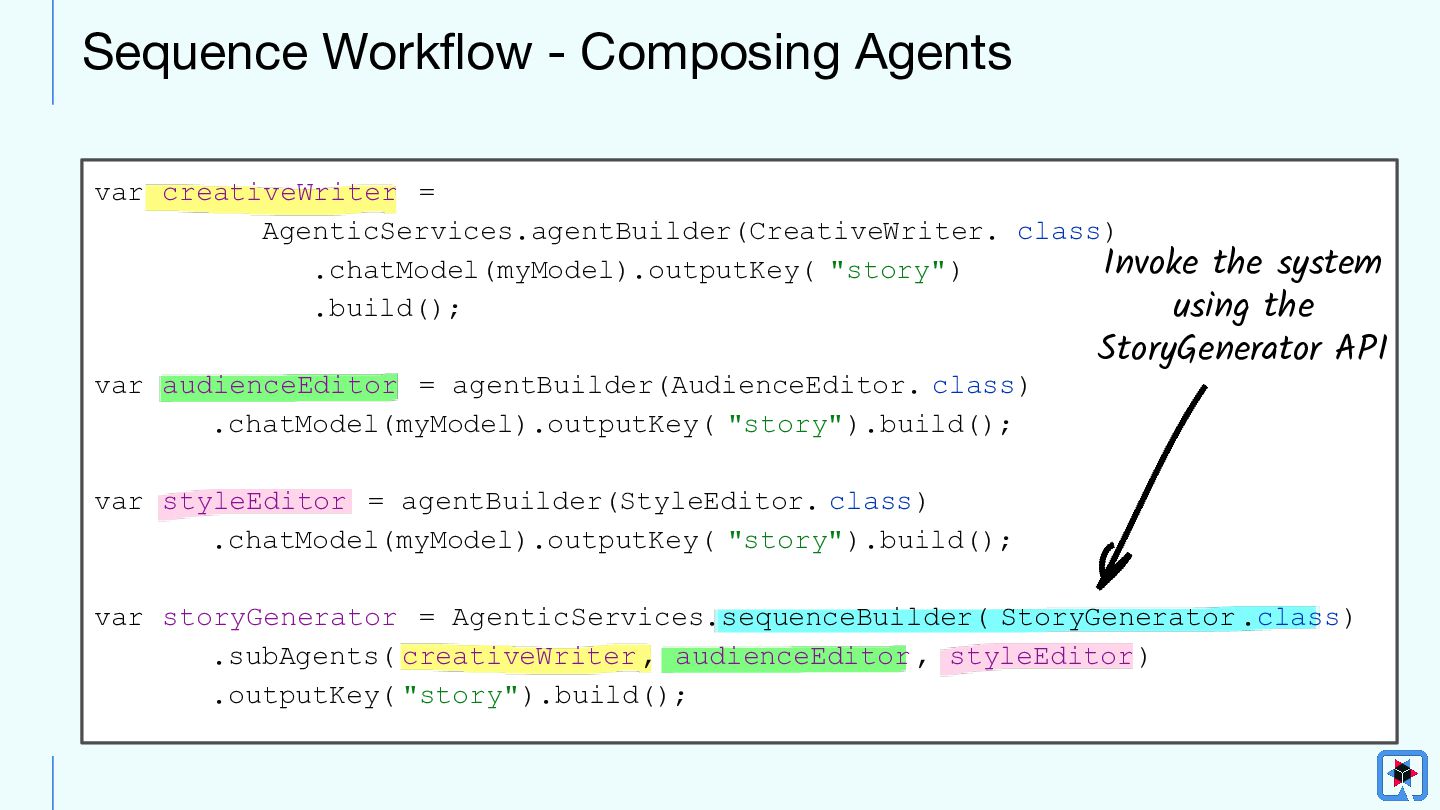
.chatModel(myModel).outputKey( "story") .build(); var audienceEditor = agentBuilder(AudienceEditor. class) .chatModel(myModel).outputKey( "story").build(); var styleEditor = agentBuilder(StyleEditor. class) .chatModel(myModel).outputKey( "story").build(); var storyGenerator = AgenticServices.sequenceBuilder( StoryGenerator .class) .subAgents( creativeWriter , audienceEditor , styleEditor) .outputKey( "story").build(); Invoke the system using the StoryGenerator API
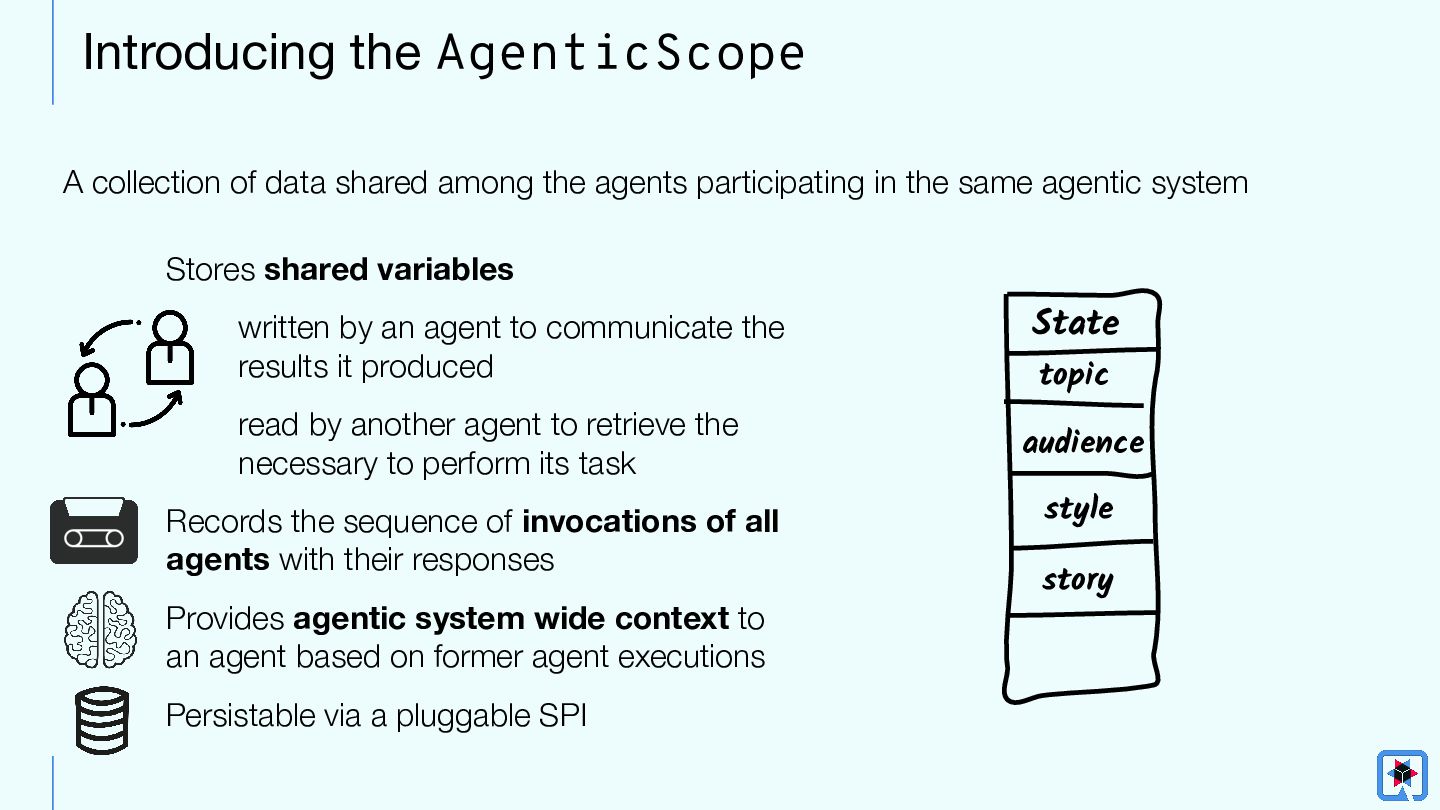
to communicate the results it produced read by another agent to retrieve the necessary to perform its task Records the sequence of invocations of all agents with their responses Provides agentic system wide context to an agent based on former agent executions Persistable via a pluggable SPI A collection of data shared among the agents participating in the same agentic system State topic audience style story
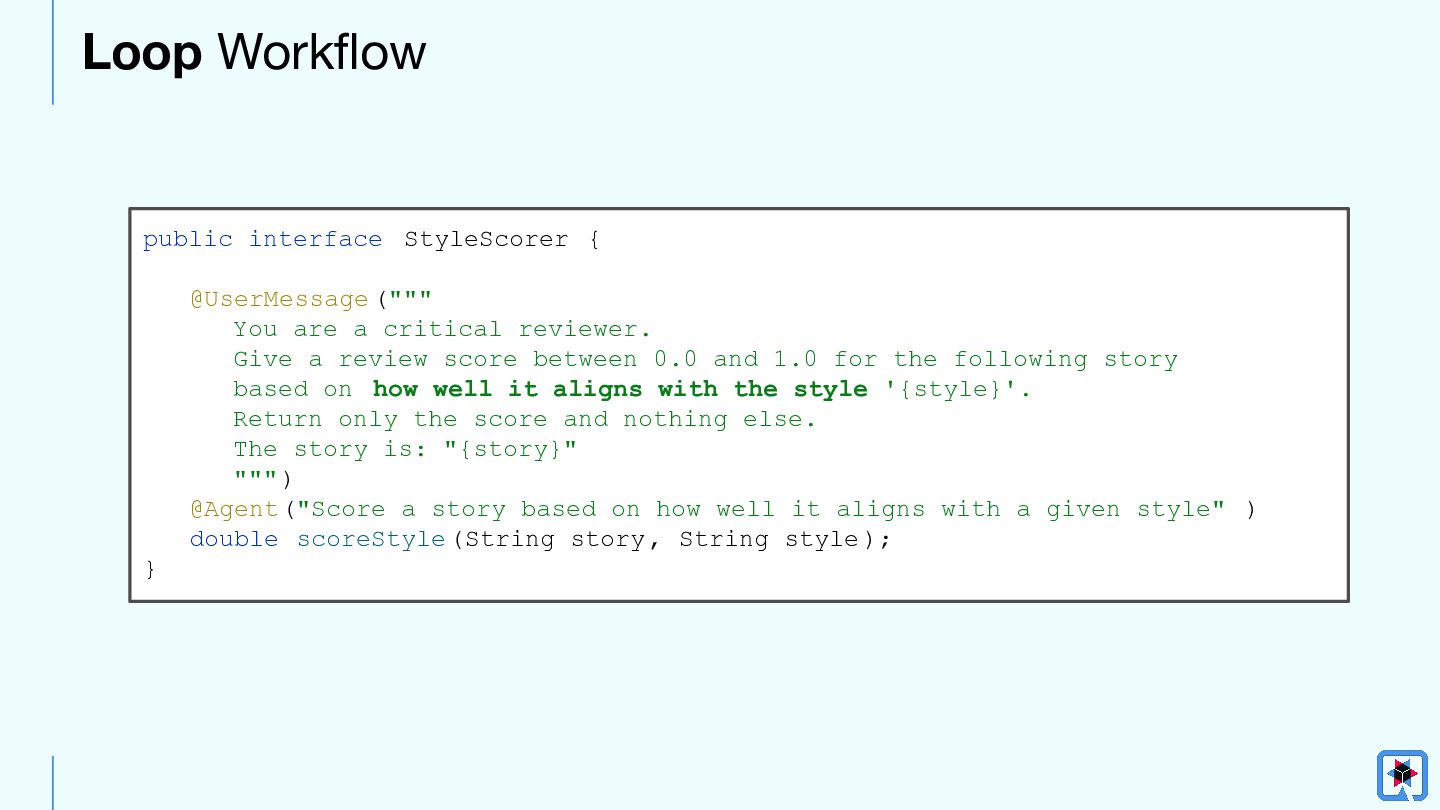
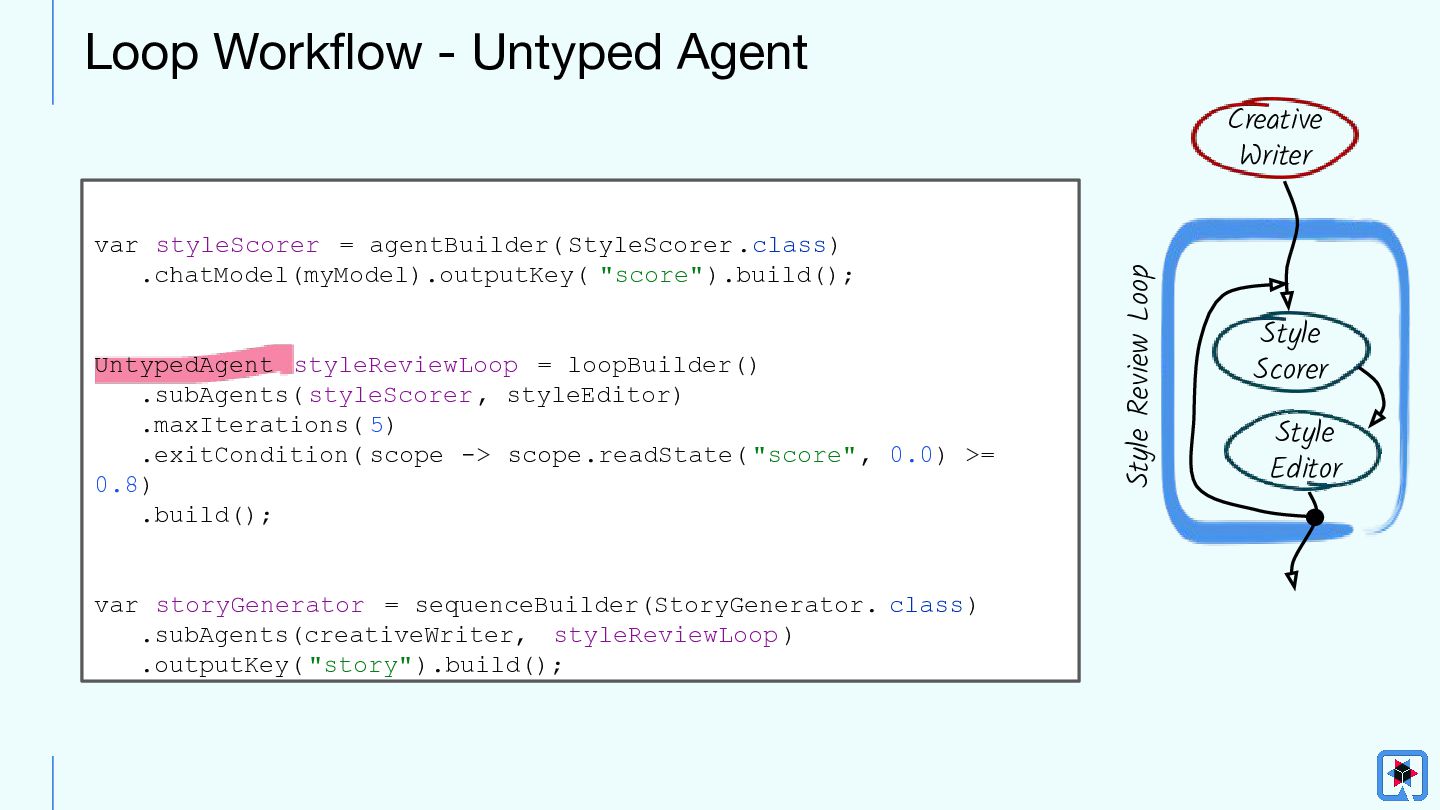
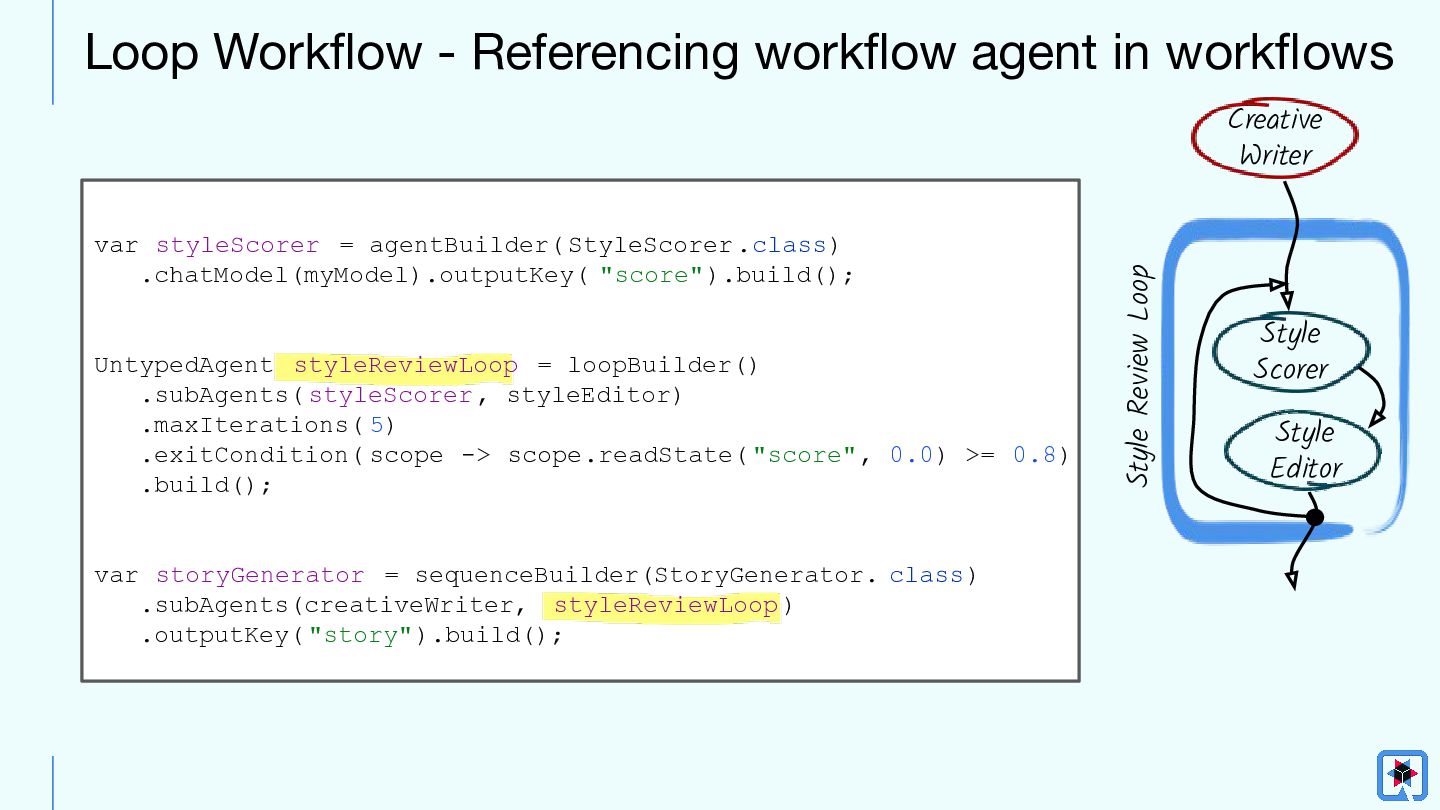
critical reviewer. Give a review score between 0.0 and 1.0 for the following story based on how well it aligns with the style '{style}'. Return only the score and nothing else. The story is: "{story}" """) @Agent("Score a story based on how well it aligns with a given style" ) double scoreStyle(String story, String style); }
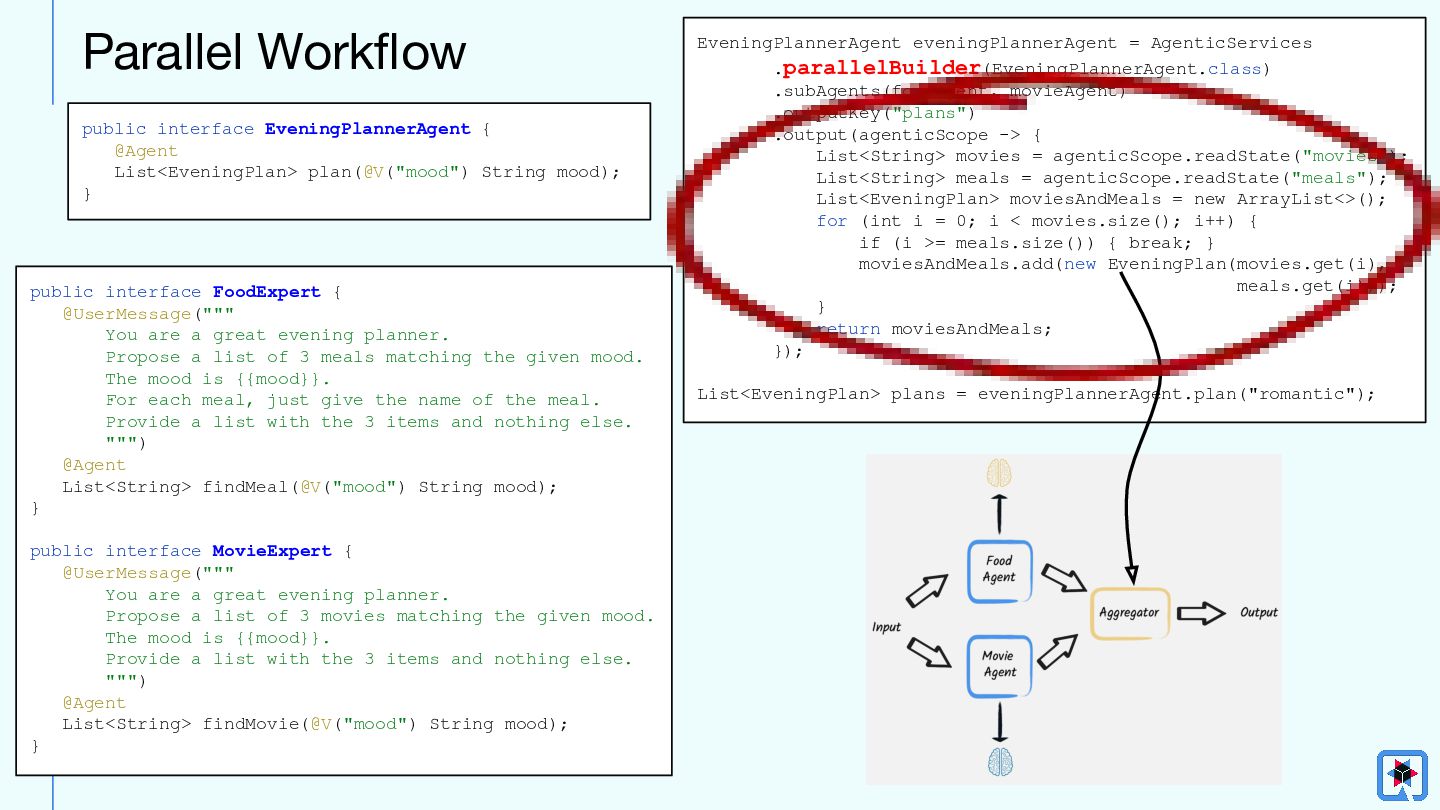
mood); } public interface FoodExpert { @UserMessage(""" You are a great evening planner. Propose a list of 3 meals matching the given mood. The mood is {{mood}}. For each meal, just give the name of the meal. Provide a list with the 3 items and nothing else. """) @Agent List<String> findMeal(@V("mood") String mood); } public interface MovieExpert { @UserMessage(""" You are a great evening planner. Propose a list of 3 movies matching the given mood. The mood is {{mood}}. Provide a list with the 3 items and nothing else. """) @Agent List<String> findMovie(@V("mood") String mood); } EveningPlannerAgent eveningPlannerAgent = AgenticServices .parallelBuilder(EveningPlannerAgent.class) .subAgents(foodAgent, movieAgent) .outputKey("plans") .output(agenticScope -> { List<String> movies = agenticScope.readState("movies"); List<String> meals = agenticScope.readState("meals"); List<EveningPlan> moviesAndMeals = new ArrayList<>(); for (int i = 0; i < movies.size(); i++) { if (i >= meals.size()) { break; } moviesAndMeals.add(new EveningPlan(movies.get(i), meals.get(i))); } return moviesAndMeals; }); List<EveningPlan> plans = eveningPlannerAgent.plan("romantic");
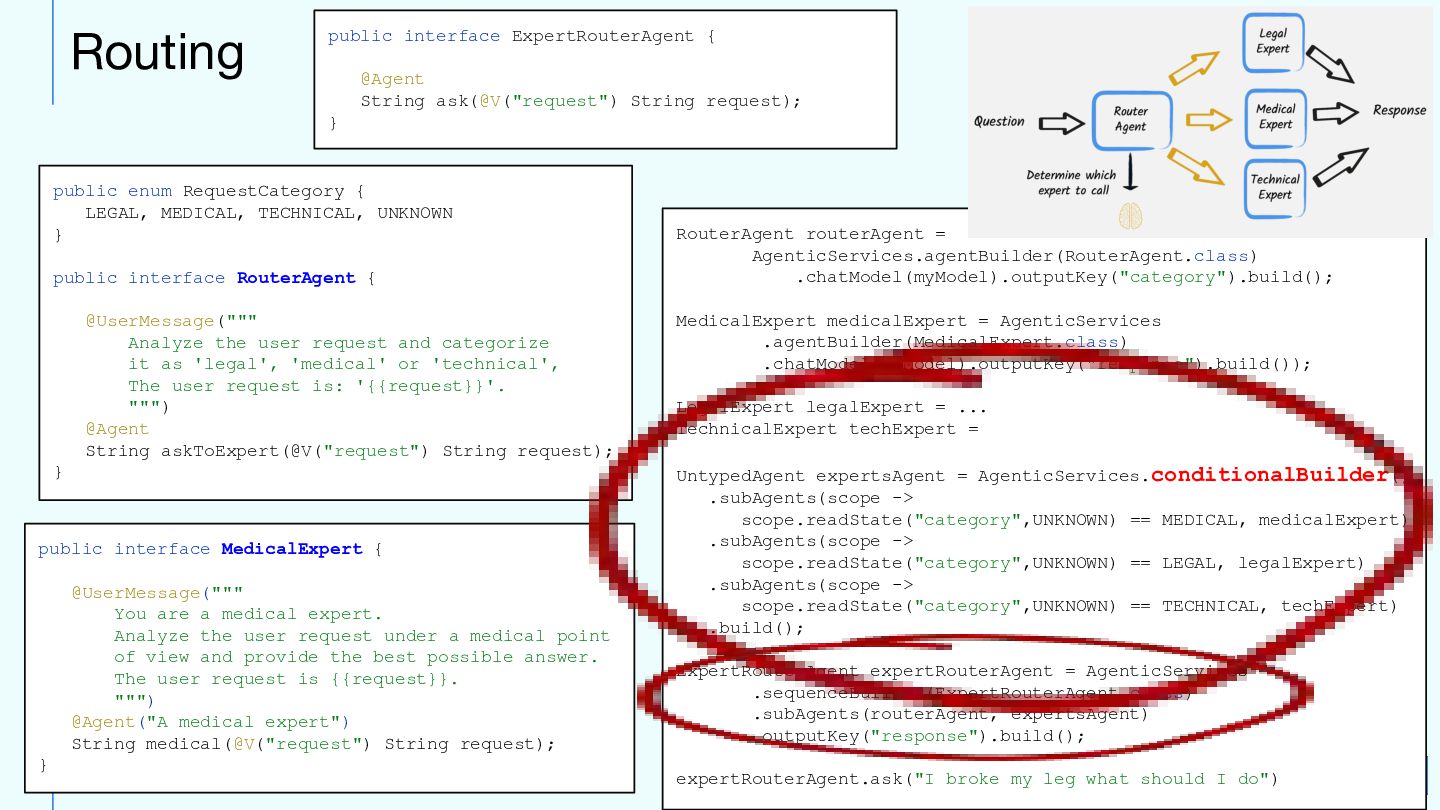
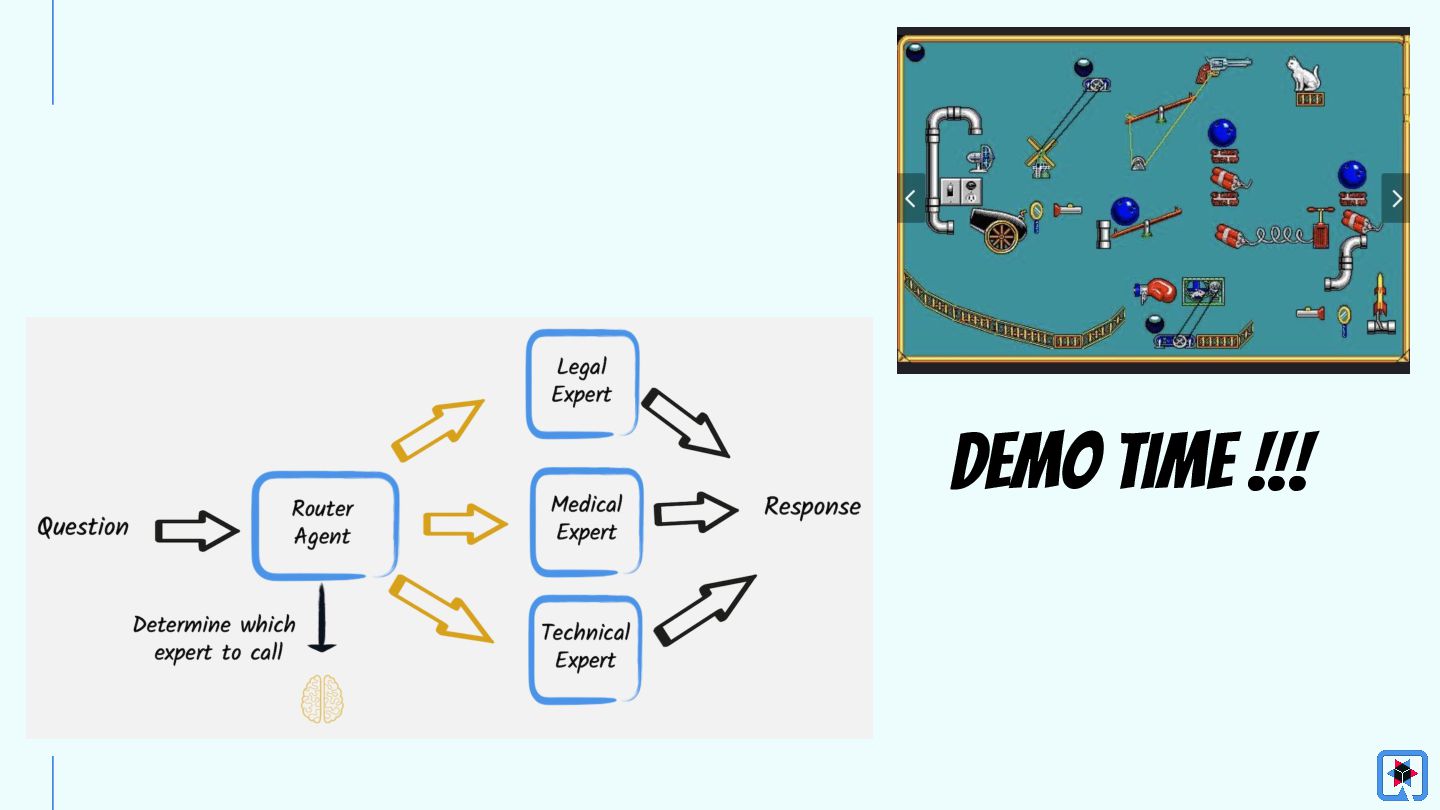
} public enum RequestCategory { LEGAL, MEDICAL, TECHNICAL, UNKNOWN } public interface RouterAgent { @UserMessage(""" Analyze the user request and categorize it as 'legal', 'medical' or 'technical', The user request is: '{{request}}'. """) @Agent String askToExpert(@V("request") String request); } public interface MedicalExpert { @UserMessage(""" You are a medical expert. Analyze the user request under a medical point of view and provide the best possible answer. The user request is {{request}}. """) @Agent("A medical expert") String medical(@V("request") String request); } RouterAgent routerAgent = AgenticServices.agentBuilder(RouterAgent.class) .chatModel(myModel).outputKey("category").build(); MedicalExpert medicalExpert = AgenticServices .agentBuilder(MedicalExpert.class) .chatModel(myModel).outputKey("response").build()); LegalExpert legalExpert = ... TechnicalExpert techExpert = UntypedAgent expertsAgent = AgenticServices.conditionalBuilder() .subAgents(scope -> scope.readState("category",UNKNOWN) == MEDICAL, medicalExpert) .subAgents(scope -> scope.readState("category",UNKNOWN) == LEGAL, legalExpert) .subAgents(scope -> scope.readState("category",UNKNOWN) == TECHNICAL, techExpert) .build(); ExpertRouterAgent expertRouterAgent = AgenticServices .sequenceBuilder(ExpertRouterAgent.class) .subAgents(routerAgent, expertsAgent) .outputKey("response").build(); expertRouterAgent.ask("I broke my leg what should I do")
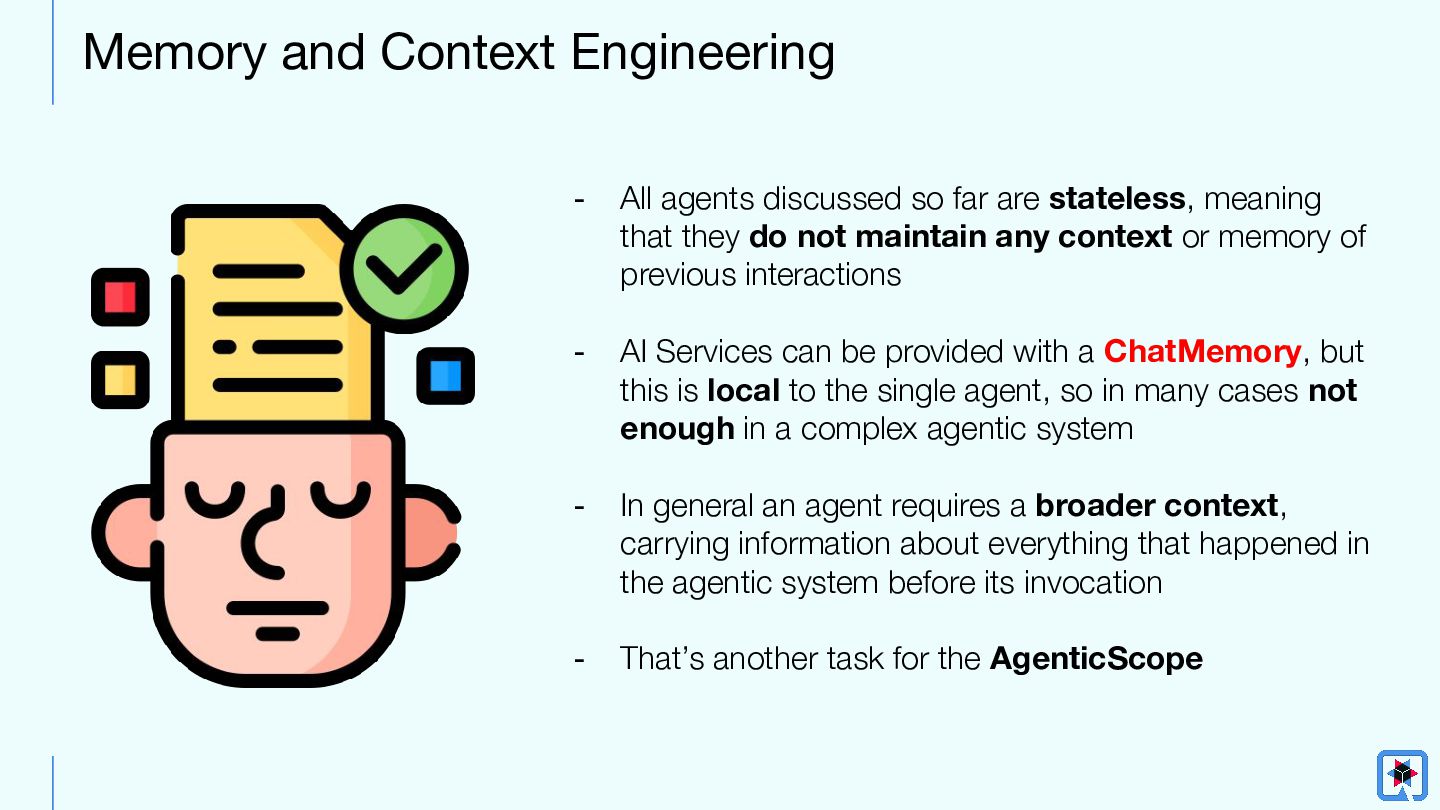
are stateless, meaning that they do not maintain any context or memory of previous interactions - AI Services can be provided with a ChatMemory, but this is local to the single agent, so in many cases not enough in a complex agentic system - In general an agent requires a broader context, carrying information about everything that happened in the agentic system before its invocation - That’s another task for the AgenticScope
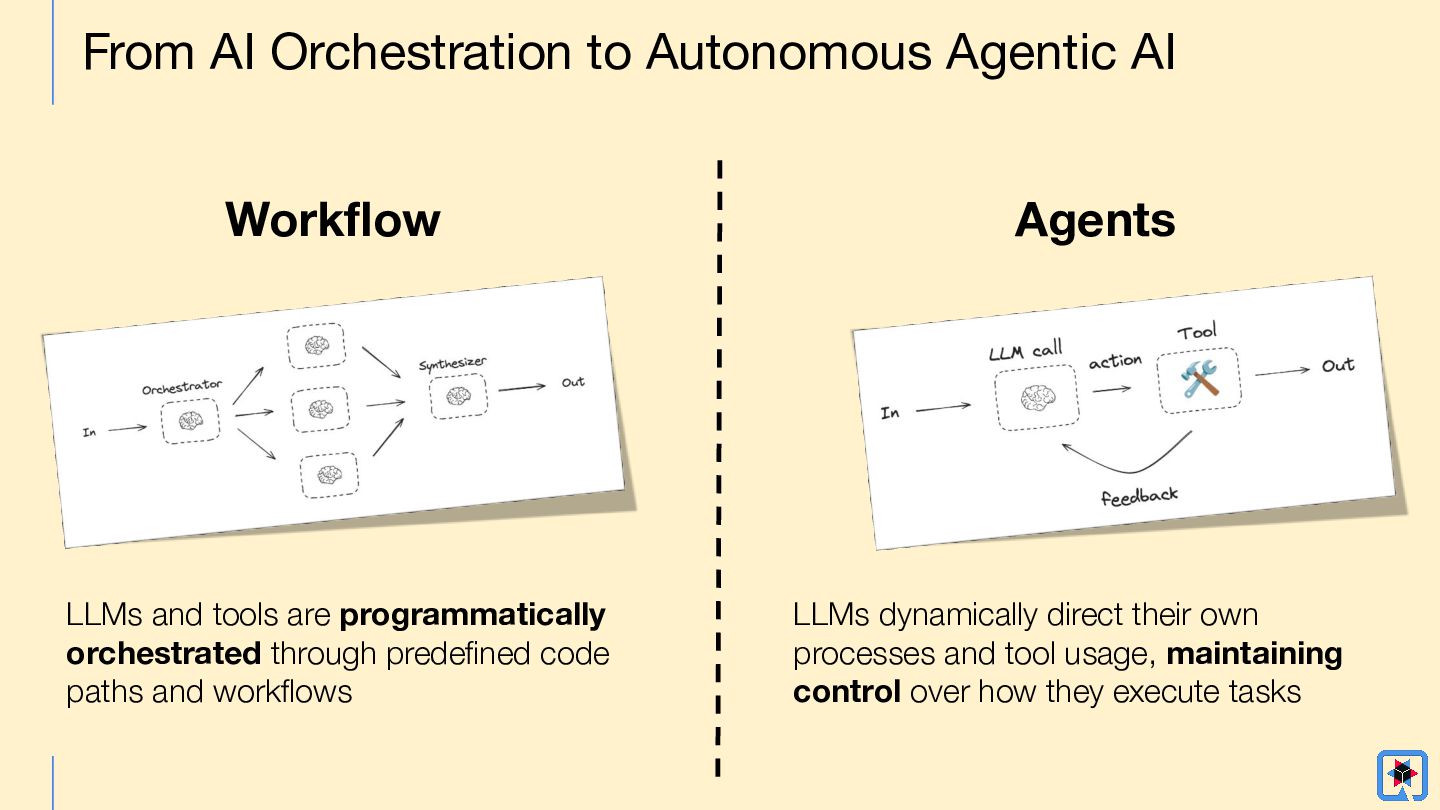
are programmatically orchestrated through predefined code paths and workflows LLMs dynamically direct their own processes and tool usage, maintaining control over how they execute tasks Workflow Agents
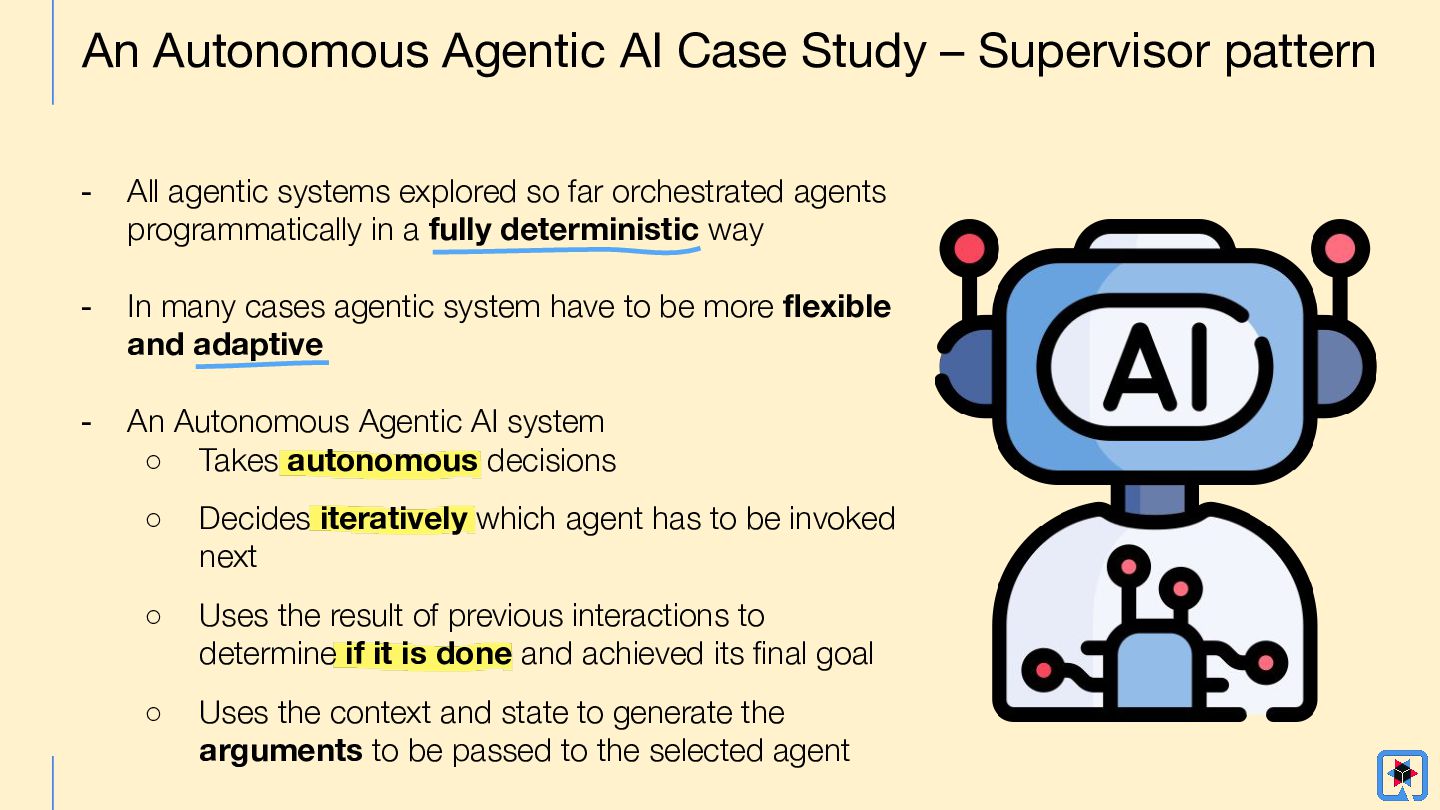
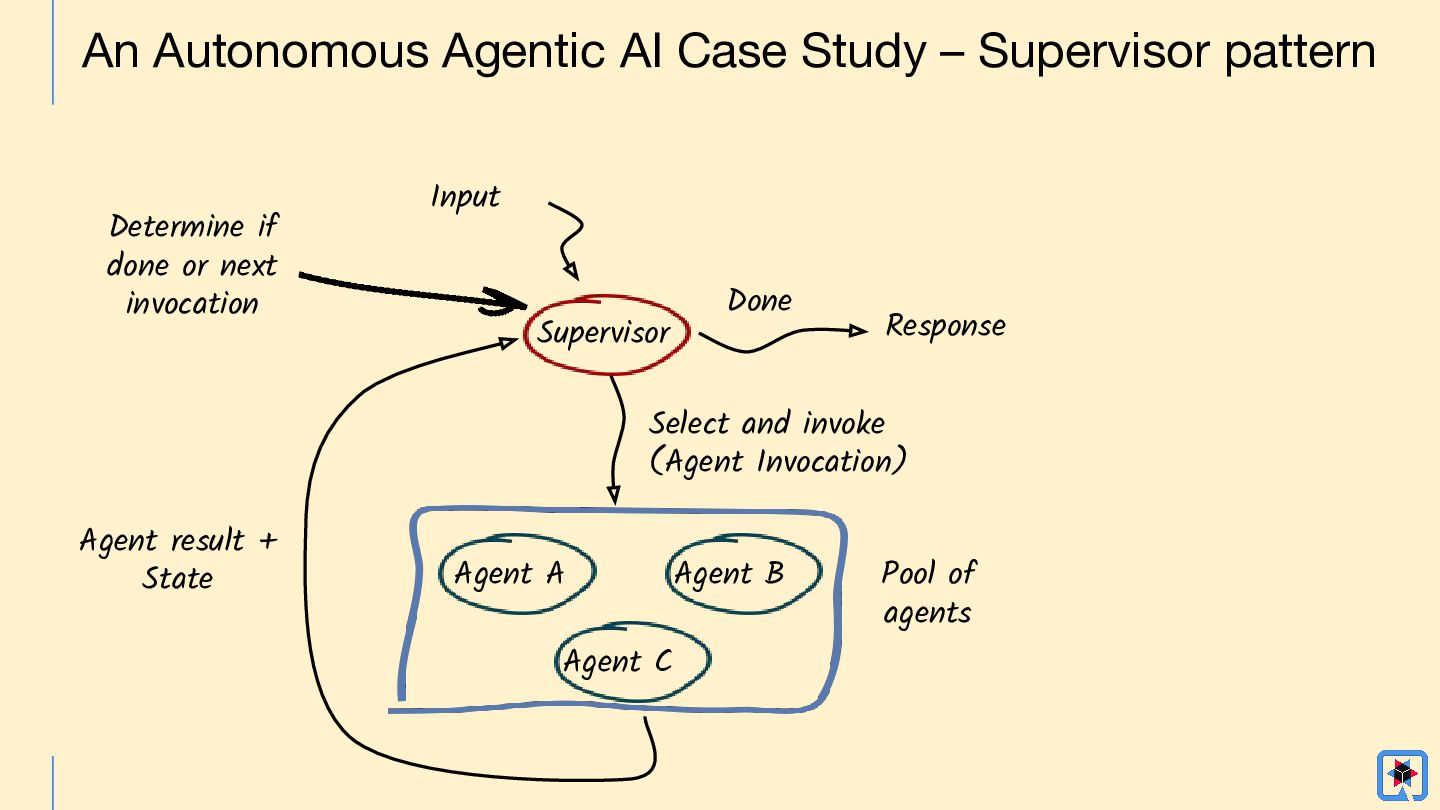
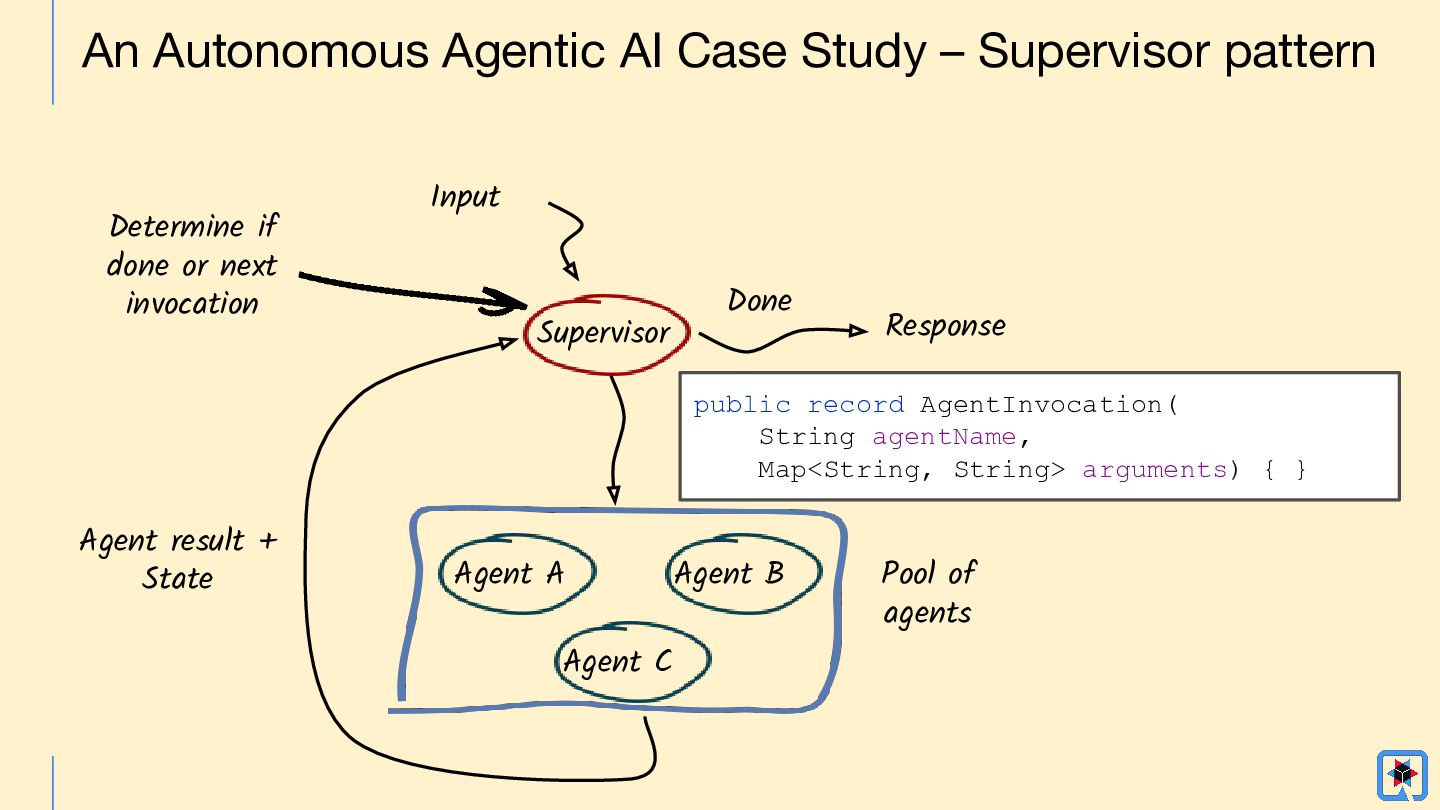
All agentic systems explored so far orchestrated agents programmatically in a fully deterministic way - In many cases agentic system have to be more flexible and adaptive - An Autonomous Agentic AI system ◦ Takes autonomous decisions ◦ Decides iteratively which agent has to be invoked next ◦ Uses the result of previous interactions to determine if it is done and achieved its final goal ◦ Uses the context and state to generate the arguments to be passed to the selected agent
Response Supervisor Agent A Agent B Agent C Agent result + State Determine if done or next invocation Pool of agents Done Select and invoke (Agent Invocation)
result + State Determine if done or next invocation Pool of agents public record AgentInvocation( String agentName, Map<String, String> arguments) { } Done An Autonomous Agentic AI Case Study – Supervisor pattern


.jpg)
.jpg)
.jpg) kdubois
kdubois
 axbom
axbom
 andyhume
 brad_frost
 inesmontani
 mraible
 chriscoyier
 ryanjones
 signer
 smashingmag
 notwaldorf
 joshbly
 mza
mza