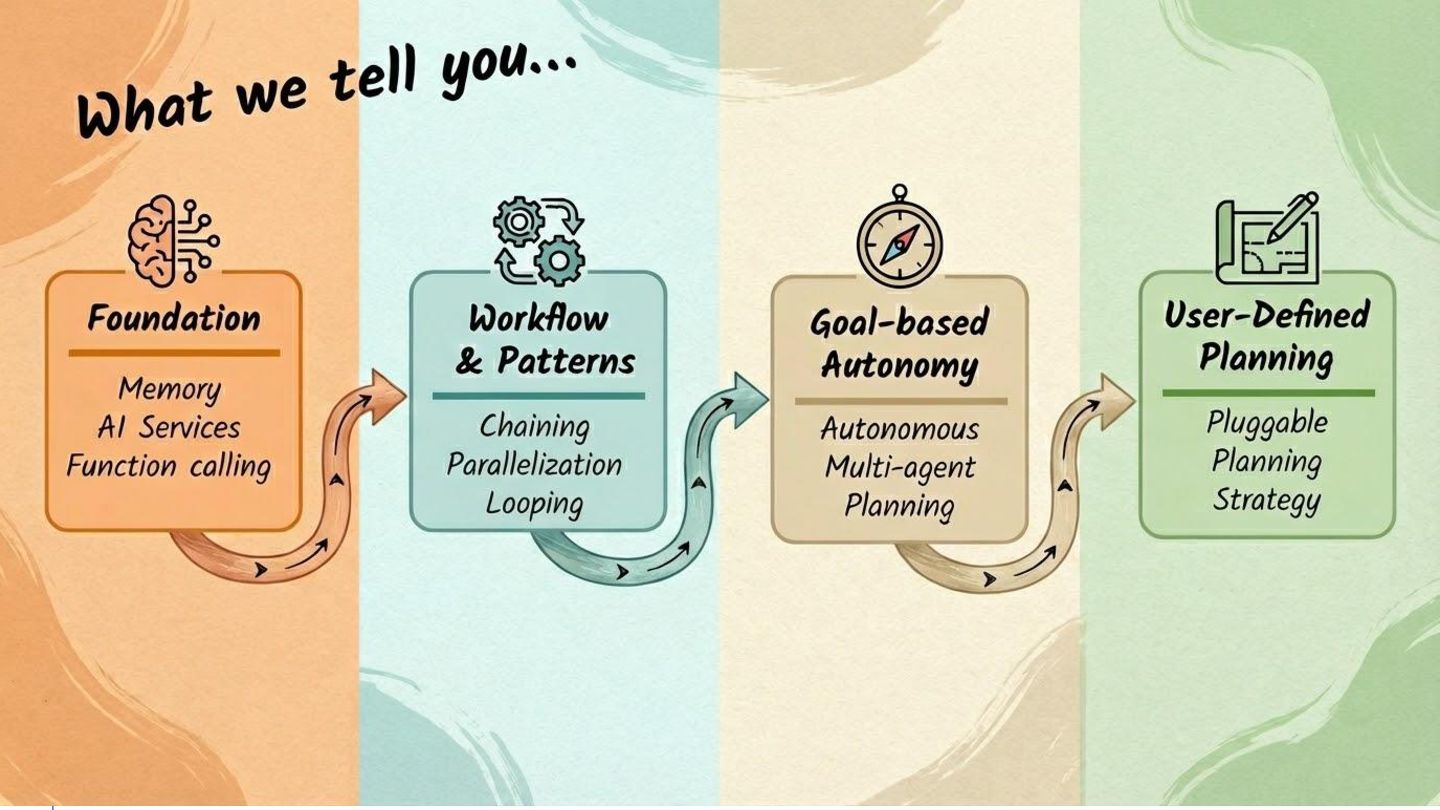
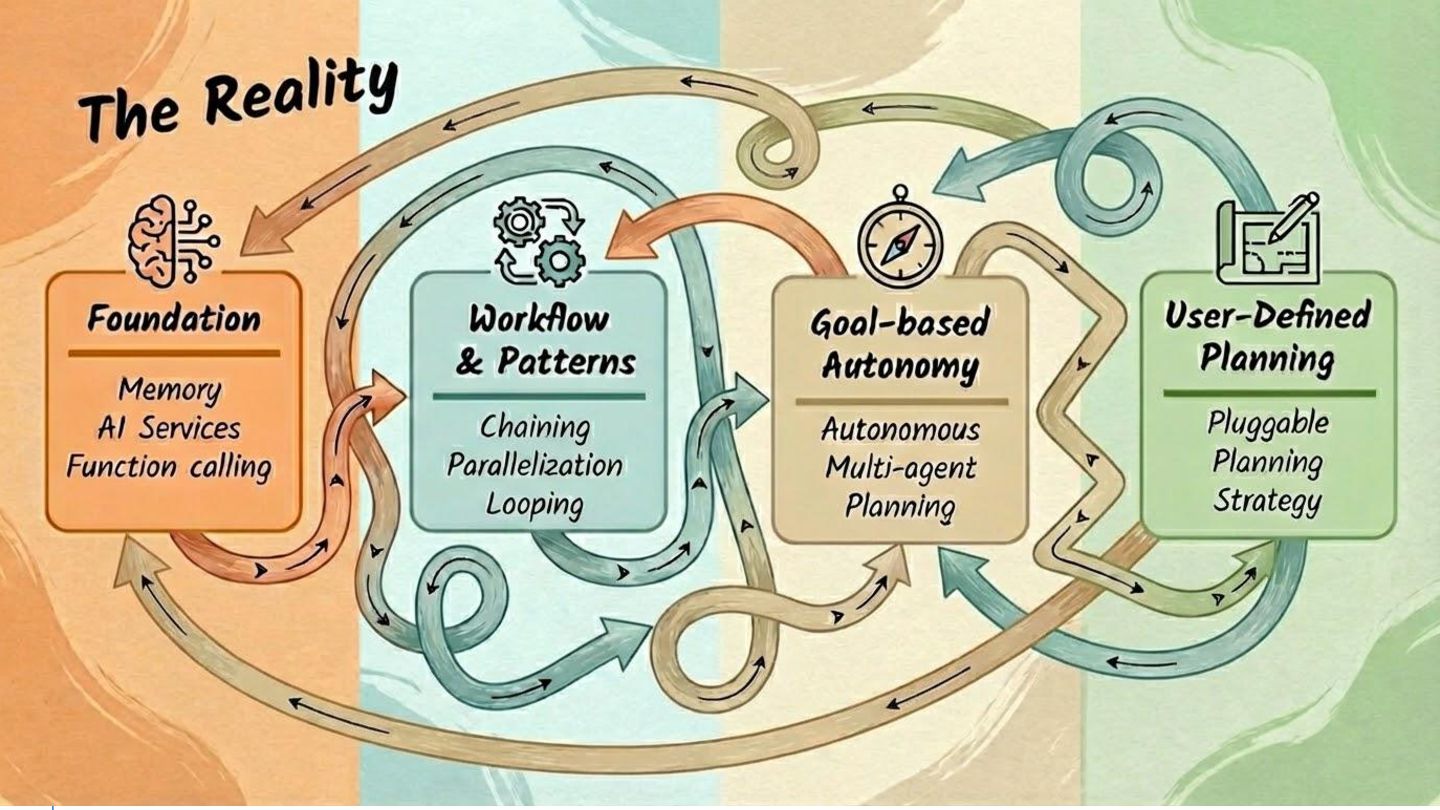
Voxxed Days Ticino - Agentic AI Patterns
Sponsored
·
 Your Podcast. Everywhere. Effortlessly.
Share. Educate. Inspire. Entertain. You do you. We'll handle the rest.
→
Your Podcast. Everywhere. Effortlessly.
Share. Educate. Inspire. Entertain. You do you. We'll handle the rest.
→

Share
Embed
Voxxed Days Ticino - Agentic AI Patterns

Kevin Dubois
February 06, 2026
Transcript
66 slides
-
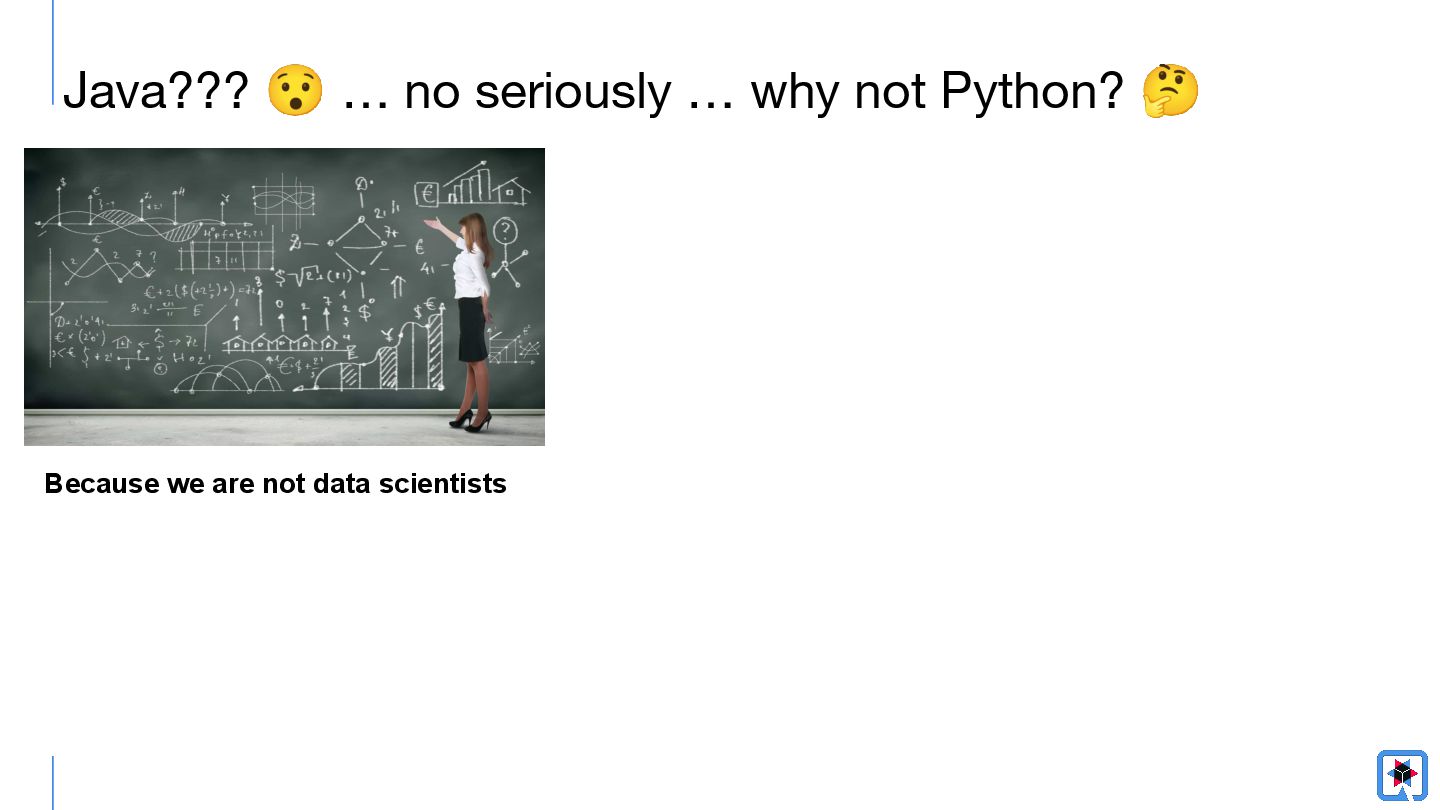
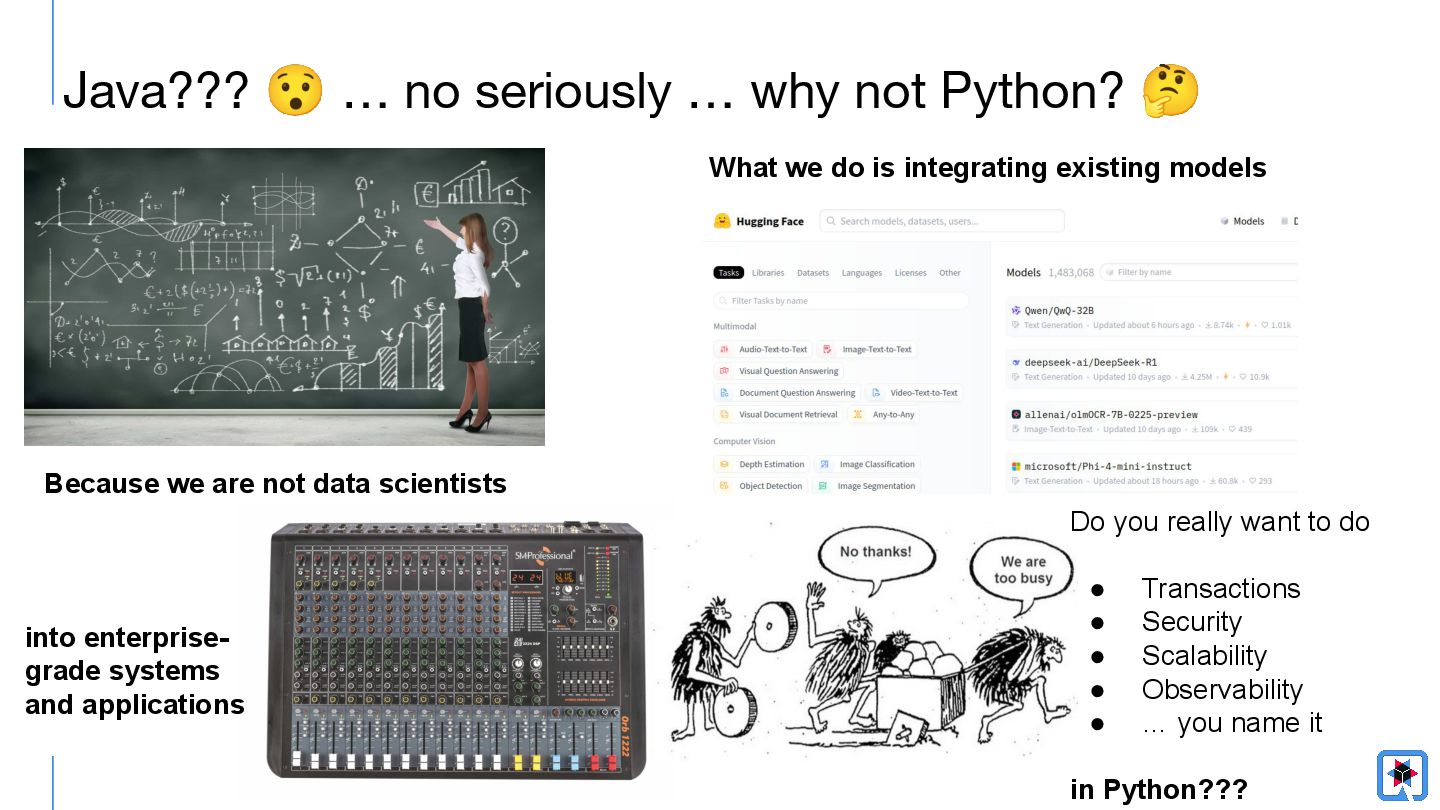
Because we are not data scientists Java??? 😯 … no
seriously … why not Python? 🤔 -
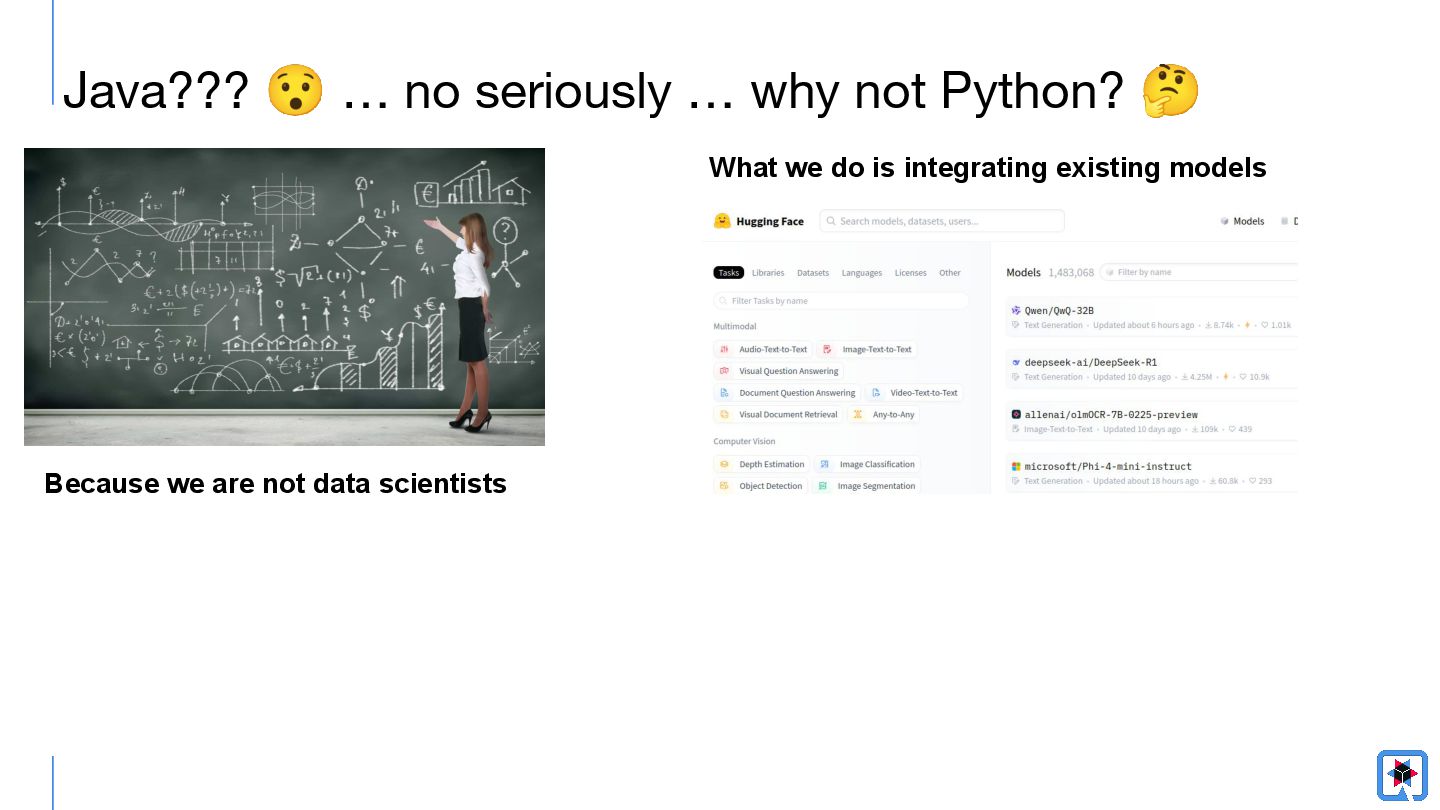
Because we are not data scientists What we do is
integrating existing models Java??? 😯 … no seriously … why not Python? 🤔 -
Because we are not data scientists What we do is
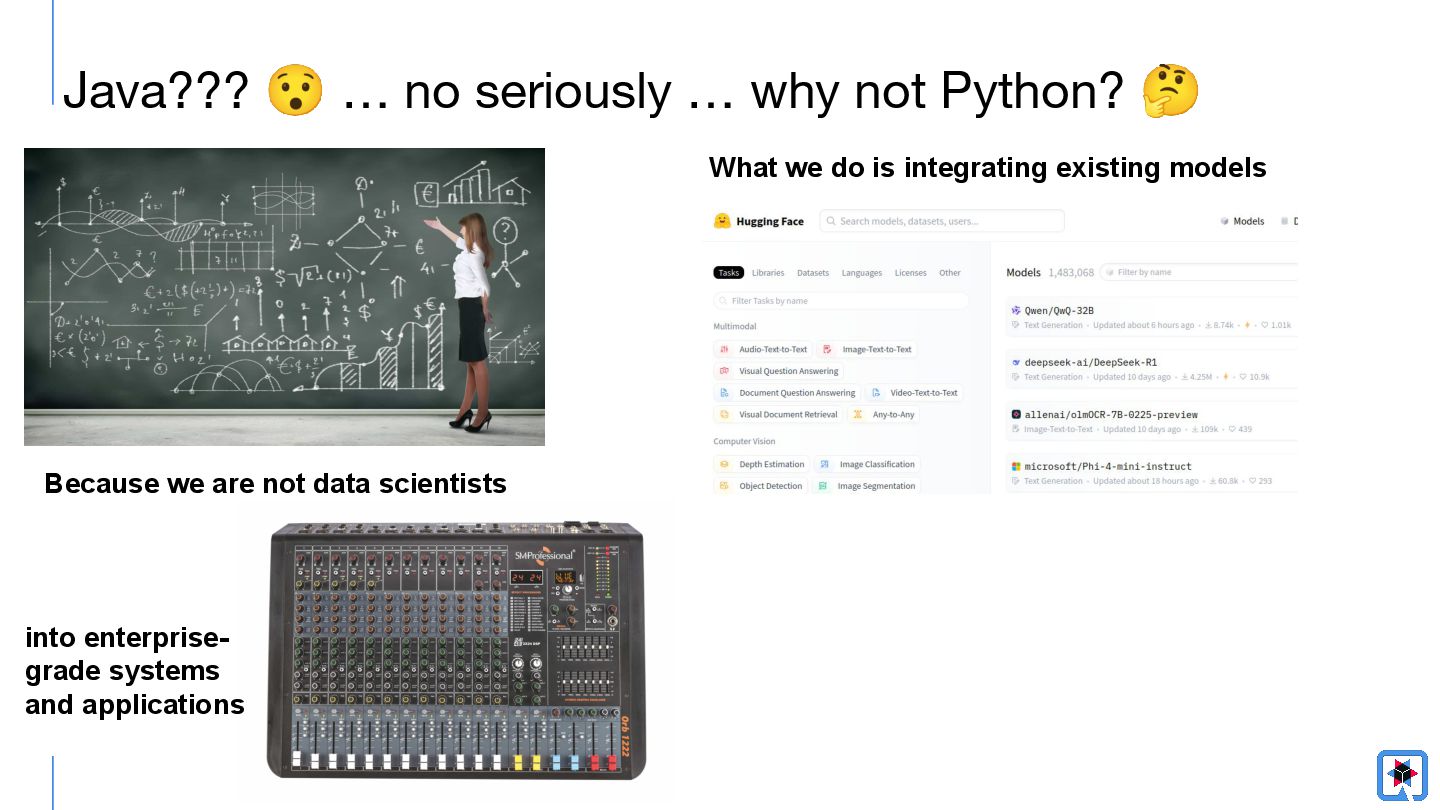
integrating existing models into enterprise- grade systems and applications Java??? 😯 … no seriously … why not Python? 🤔 -
Because we are not data scientists What we do is
integrating existing models Do you really want to do • Transactions • Security • Scalability • Observability • … you name it in Python??? into enterprise- grade systems and applications Java??? 😯 … no seriously … why not Python? 🤔 -
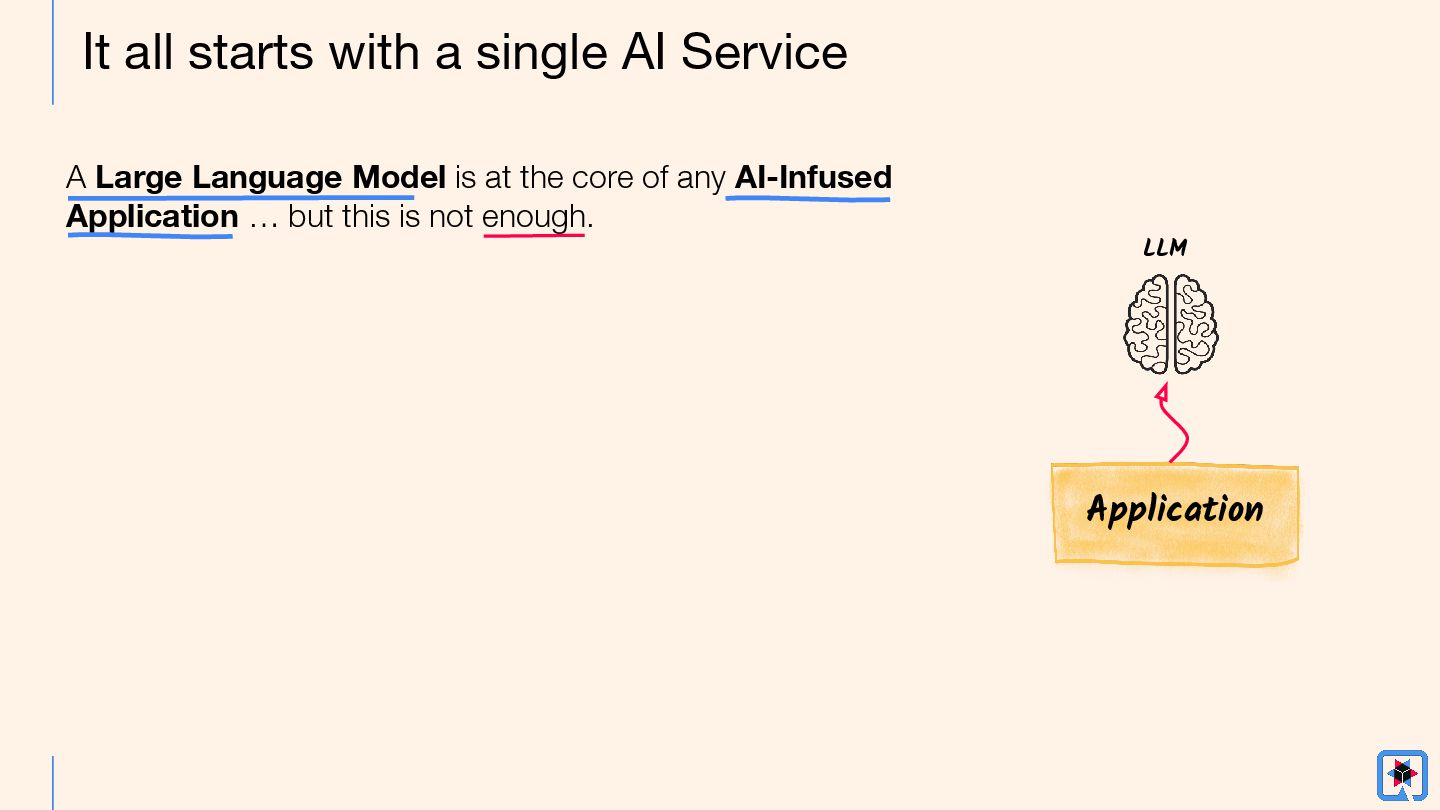
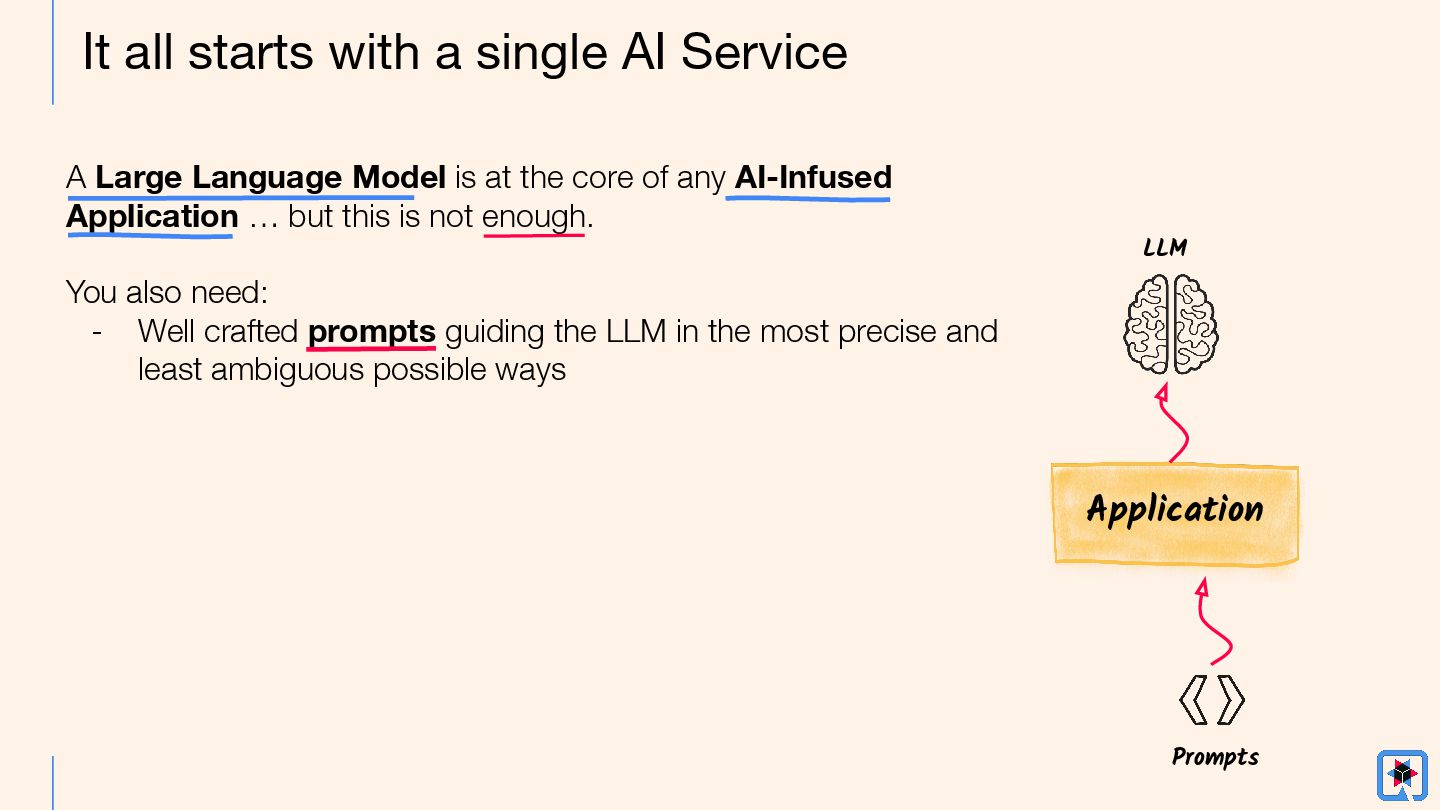
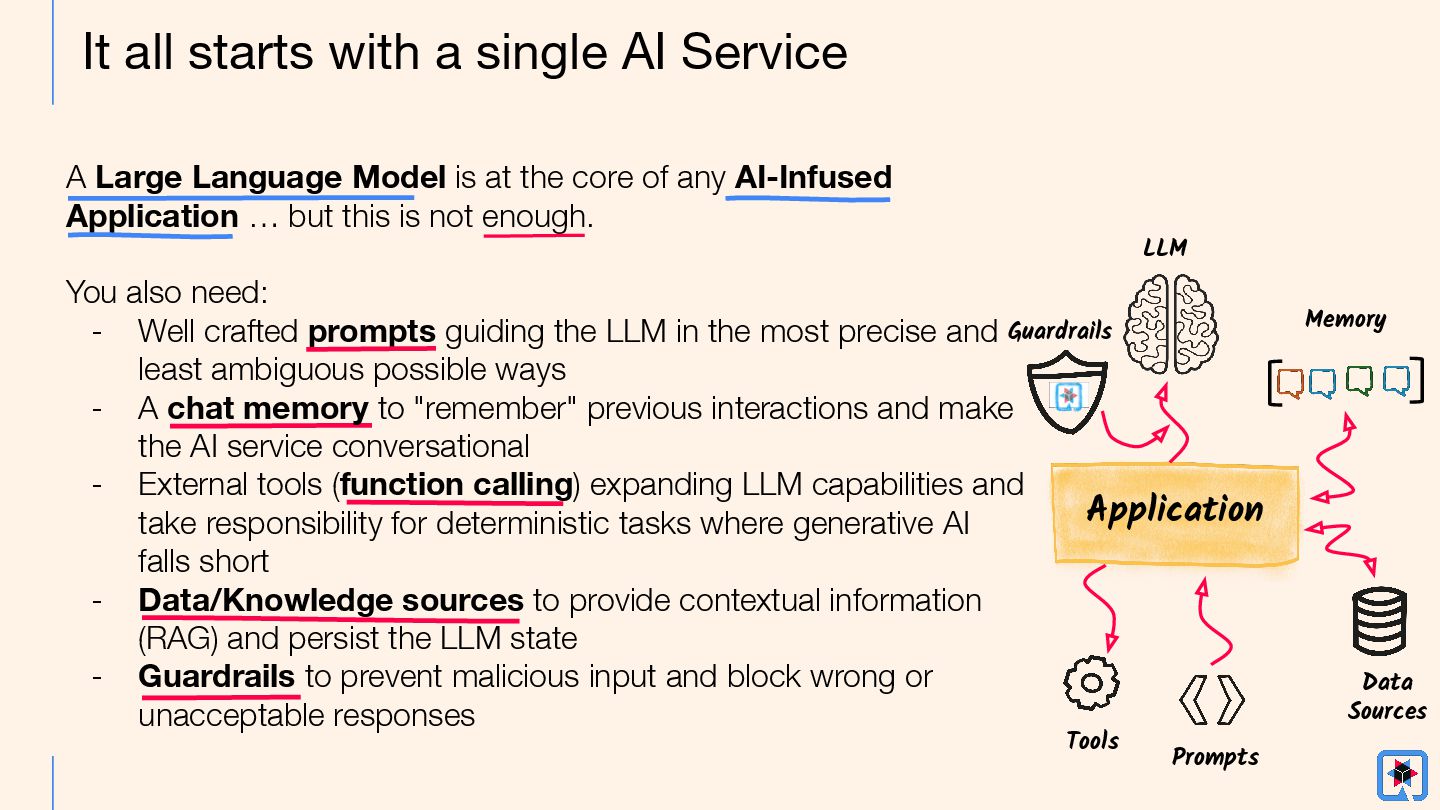
It all starts with a single AI Service A Large
Language Model is at the core of any AI-Infused Application … but this is not enough. Application LLM -
It all starts with a single AI Service LLM Application
A Large Language Model is at the core of any AI-Infused Application … but this is not enough. You also need: - Well crafted prompts guiding the LLM in the most precise and least ambiguous possible ways Prompts -
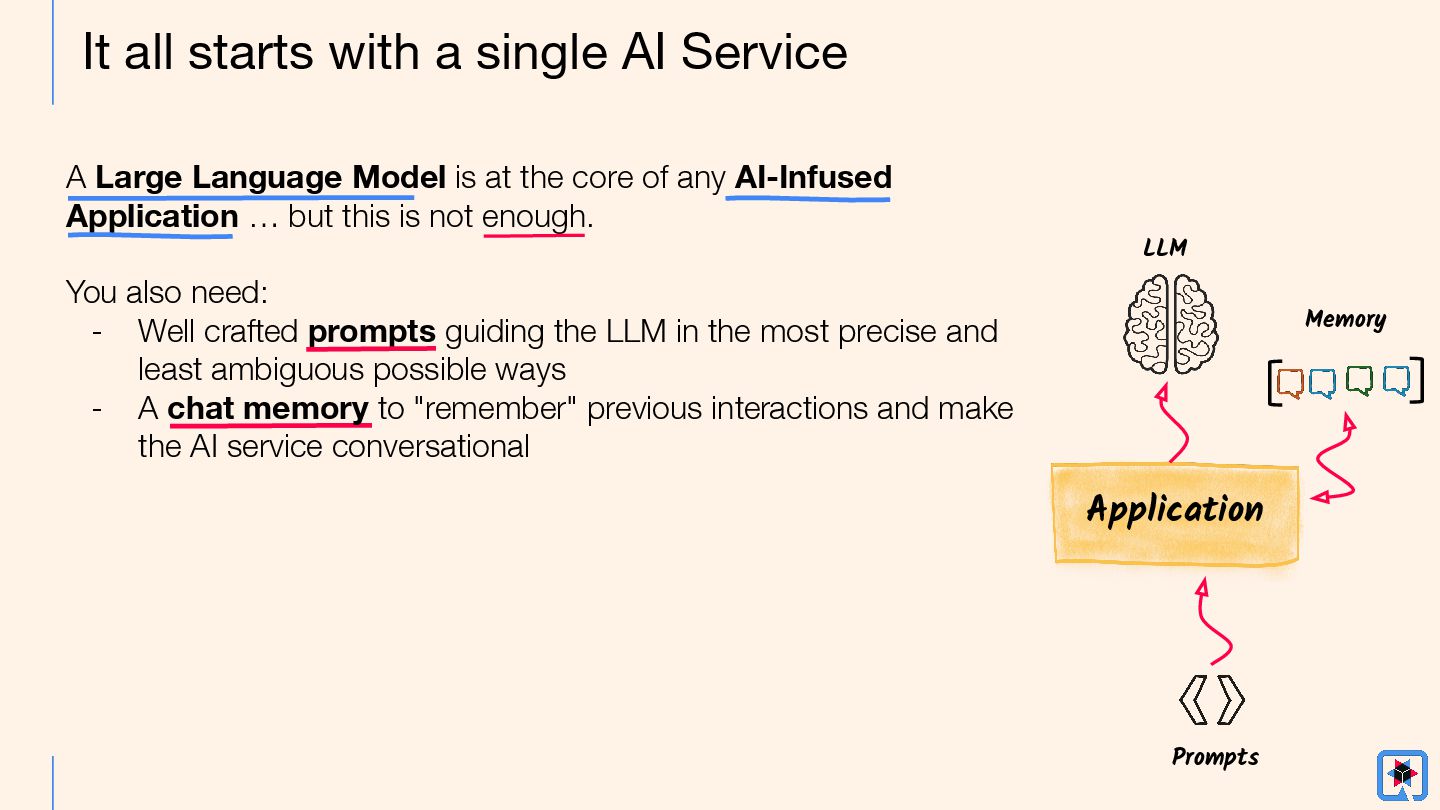
It all starts with a single AI Service LLM Application
A Large Language Model is at the core of any AI-Infused Application … but this is not enough. You also need: - Well crafted prompts guiding the LLM in the most precise and least ambiguous possible ways - A chat memory to "remember" previous interactions and make the AI service conversational Prompts Memory -
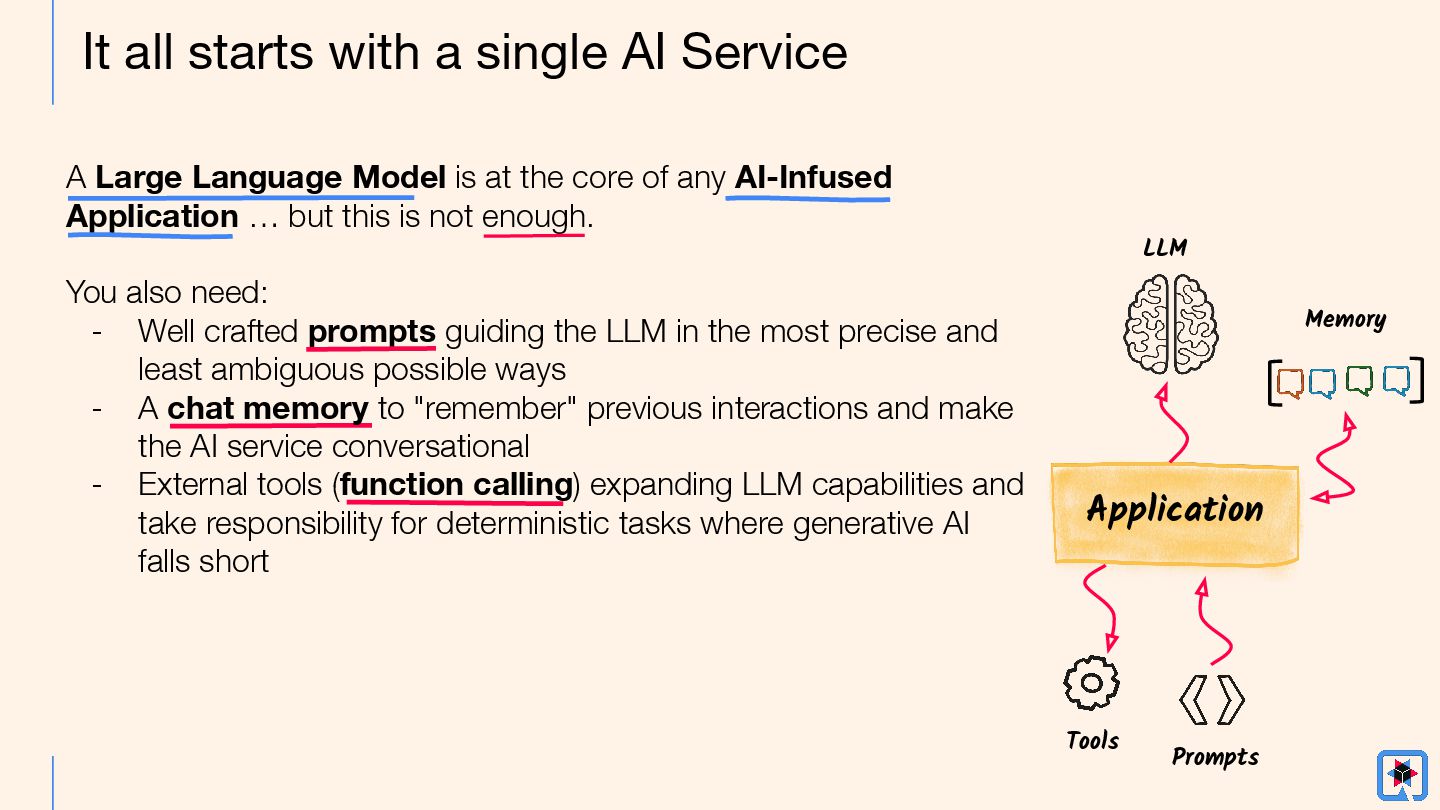
It all starts with a single AI Service LLM Application
A Large Language Model is at the core of any AI-Infused Application … but this is not enough. You also need: - Well crafted prompts guiding the LLM in the most precise and least ambiguous possible ways - A chat memory to "remember" previous interactions and make the AI service conversational - External tools (function calling) expanding LLM capabilities and take responsibility for deterministic tasks where generative AI falls short Prompts Memory Tools -
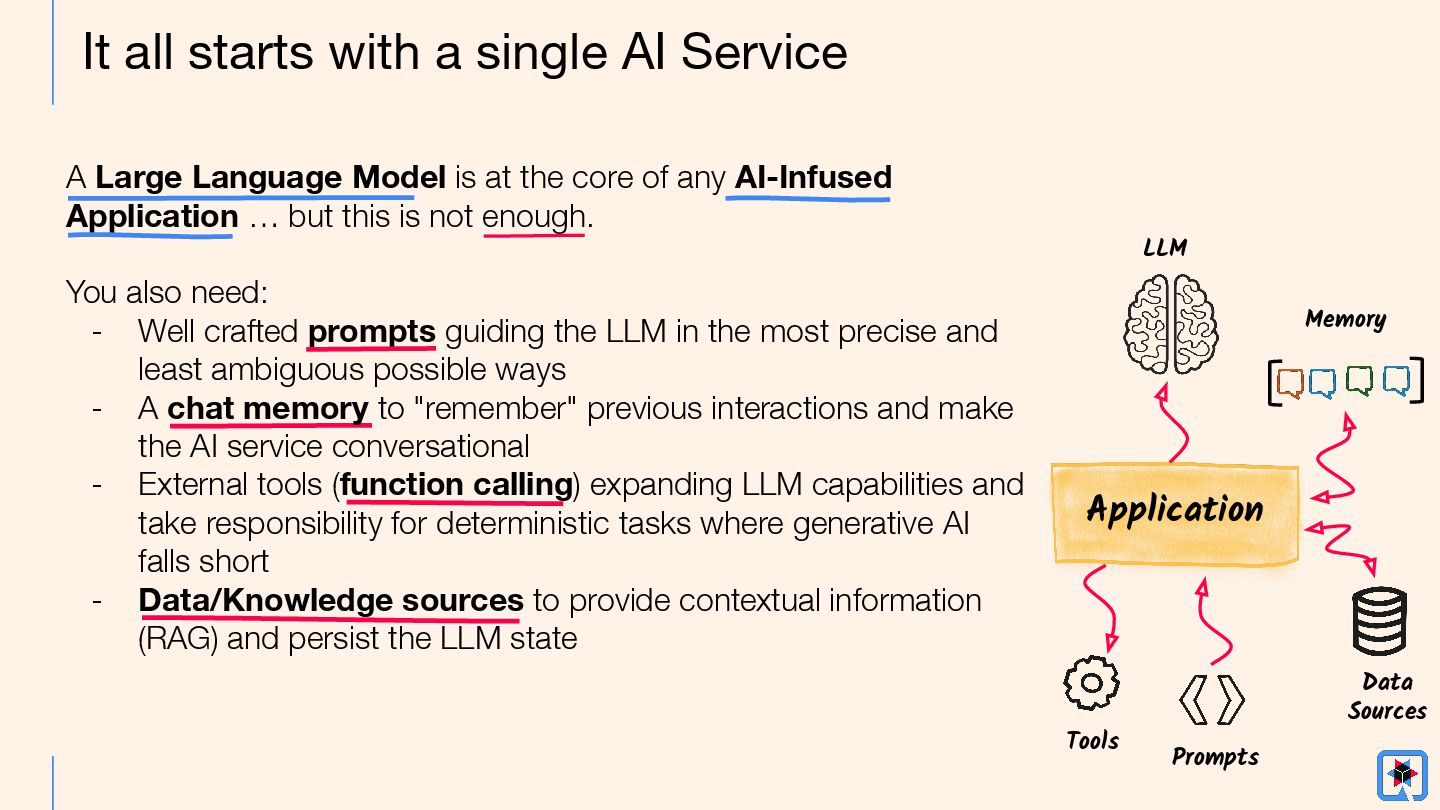
It all starts with a single AI Service LLM Application
A Large Language Model is at the core of any AI-Infused Application … but this is not enough. You also need: - Well crafted prompts guiding the LLM in the most precise and least ambiguous possible ways - A chat memory to "remember" previous interactions and make the AI service conversational - External tools (function calling) expanding LLM capabilities and take responsibility for deterministic tasks where generative AI falls short - Data/Knowledge sources to provide contextual information (RAG) and persist the LLM state Prompts Memory Tools Data Sources -
Guardrails It all starts with a single AI Service LLM
Application A Large Language Model is at the core of any AI-Infused Application … but this is not enough. You also need: - Well crafted prompts guiding the LLM in the most precise and least ambiguous possible ways - A chat memory to "remember" previous interactions and make the AI service conversational - External tools (function calling) expanding LLM capabilities and take responsibility for deterministic tasks where generative AI falls short - Data/Knowledge sources to provide contextual information (RAG) and persist the LLM state - Guardrails to prevent malicious input and block wrong or unacceptable responses Prompts Memory Tools Data Sources -
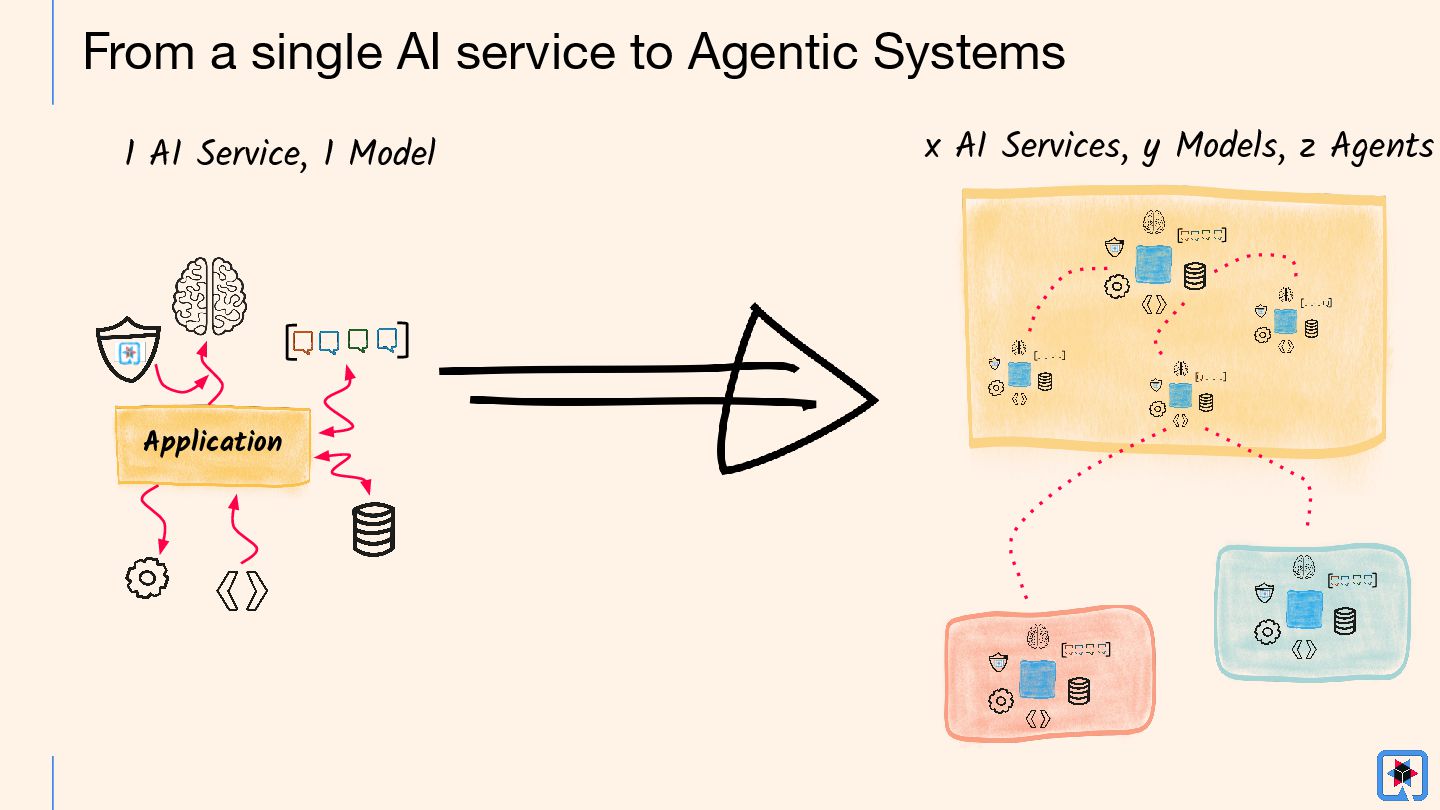
From a single AI service to Agentic Systems Application 1
AI Service, 1 Model x AI Services, y Models, z Agents -
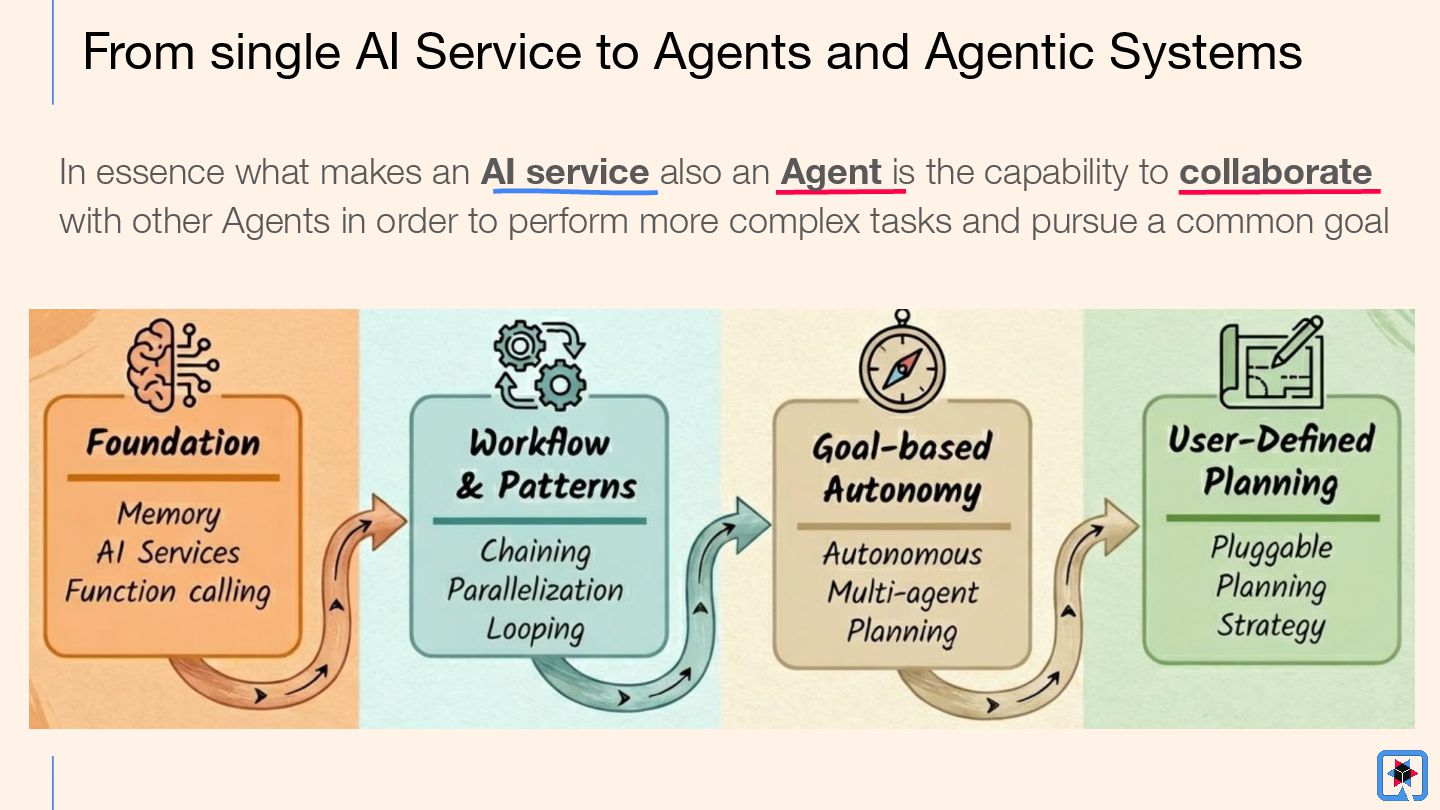
From single AI Service to Agents and Agentic Systems In
essence what makes an AI service also an Agent is the capability to collaborate with other Agents in order to perform more complex tasks and pursue a common goal -
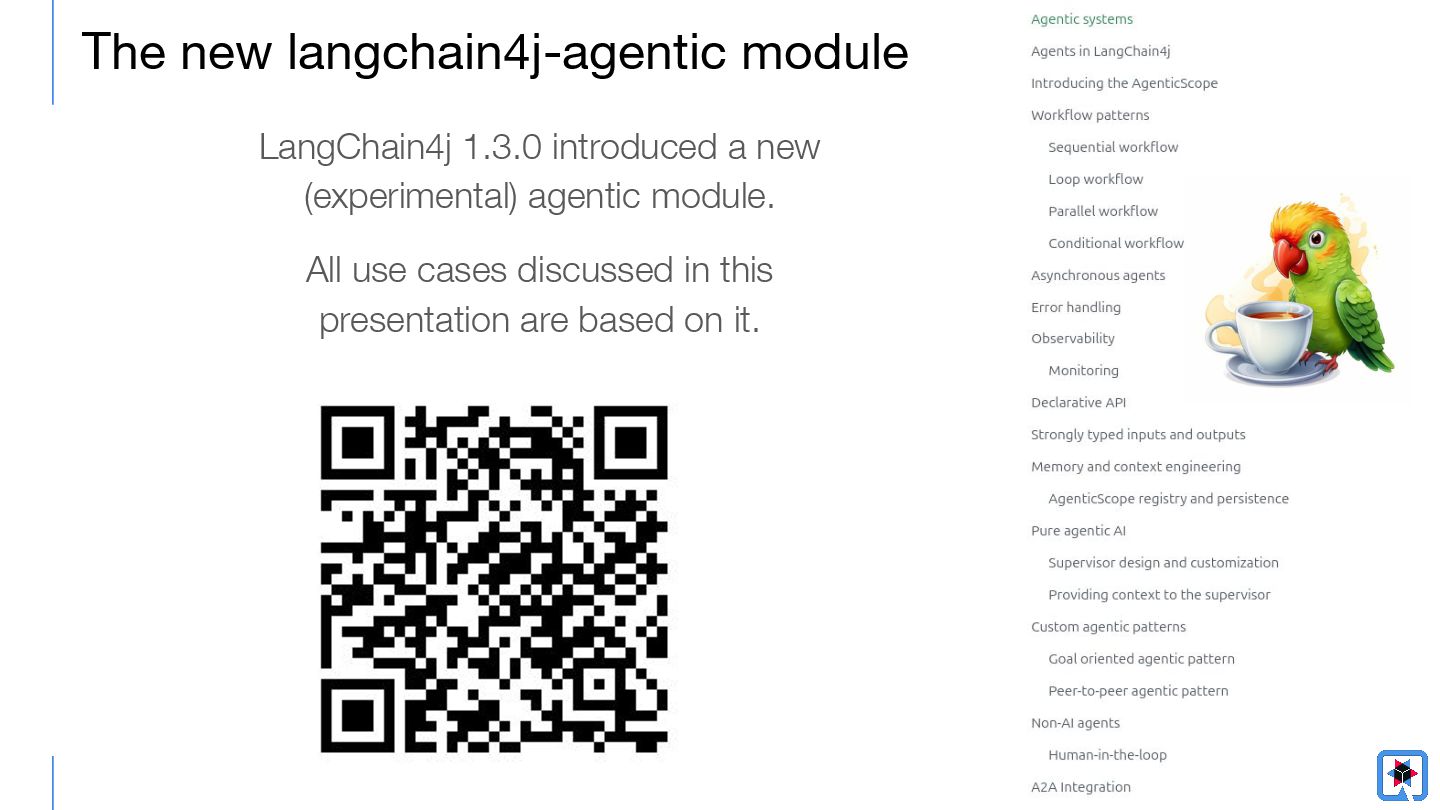
The new langchain4j-agentic module LangChain4j 1.3.0 introduced a new (experimental)
agentic module. All use cases discussed in this presentation are based on it. -
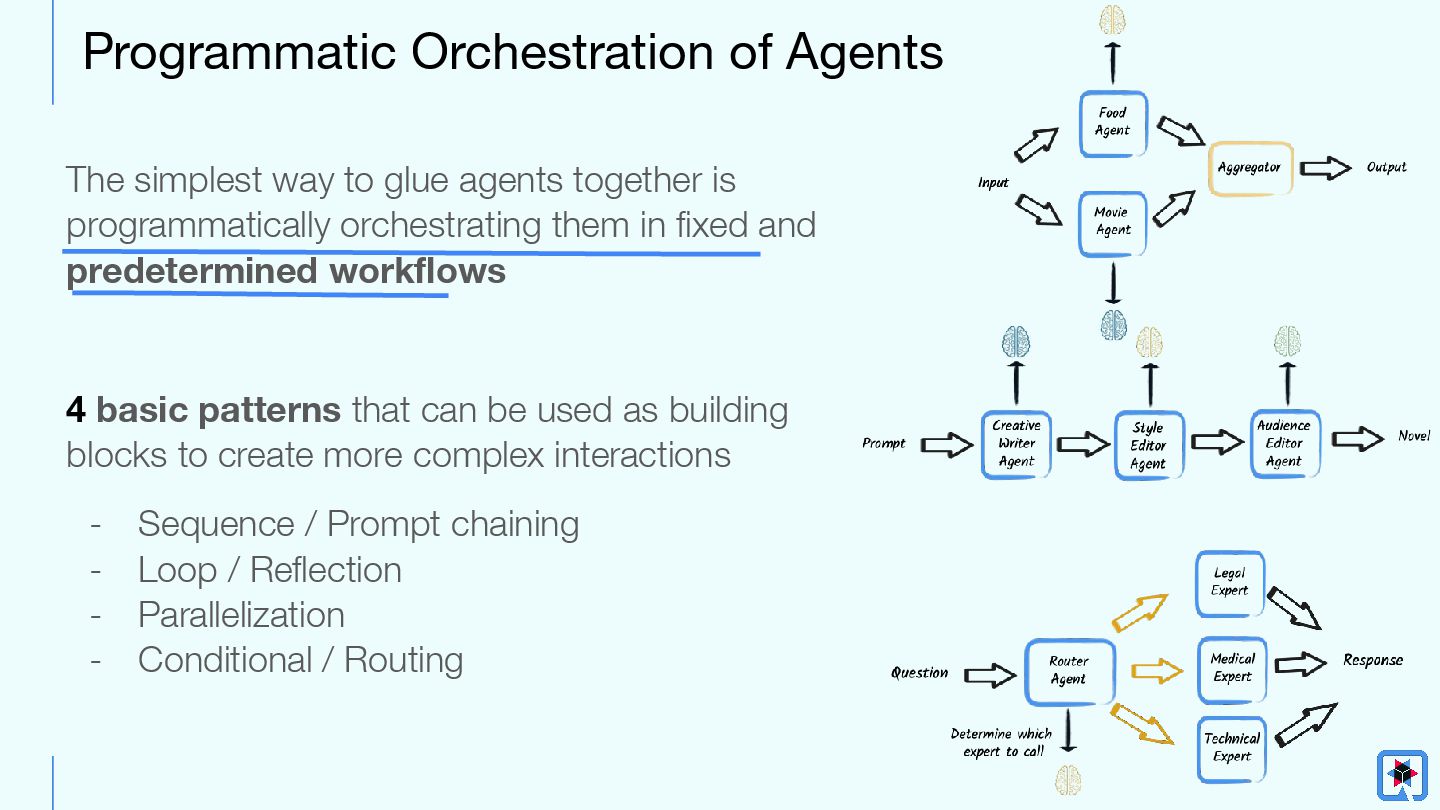
Programmatic Orchestration of Agents The simplest way to glue agents
together is programmatically orchestrating them in fixed and predetermined workflows 4 basic patterns that can be used as building blocks to create more complex interactions - Sequence / Prompt chaining - Loop / Reflection - Parallelization - Conditional / Routing -
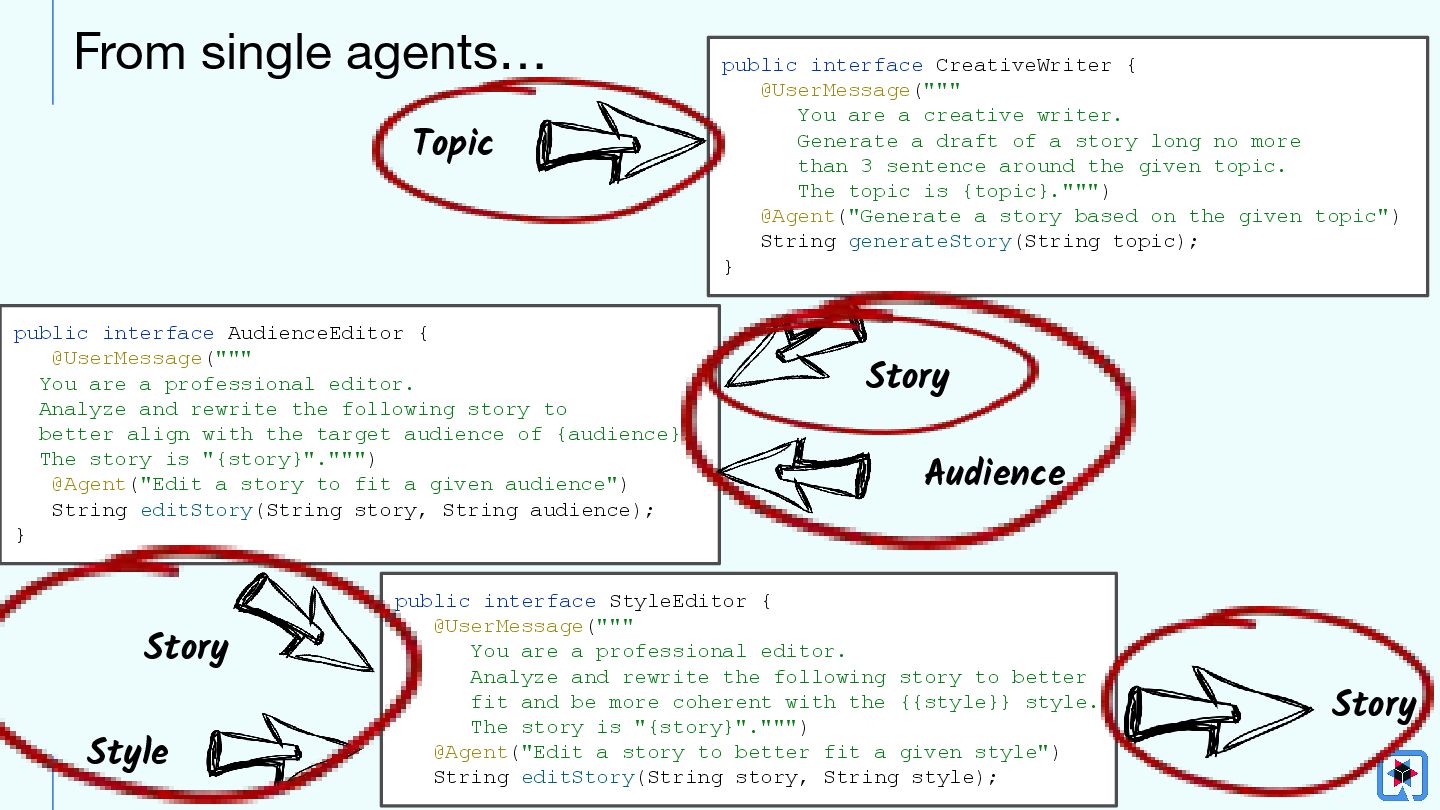
From single agents… public interface CreativeWriter { @UserMessage(""" You are
a creative writer. Generate a draft of a story long no more than 3 sentence around the given topic. The topic is {topic}.""") @Agent("Generate a story based on the given topic") String generateStory(String topic); } public interface AudienceEditor { @UserMessage(""" You are a professional editor. Analyze and rewrite the following story to better align with the target audience of {audience}. The story is "{story}".""") @Agent("Edit a story to fit a given audience") String editStory(String story, String audience); } public interface StyleEditor { @UserMessage(""" You are a professional editor. Analyze and rewrite the following story to better fit and be more coherent with the {{style}} style. The story is "{story}".""") @Agent("Edit a story to better fit a given style") String editStory(String story, String style); Topic Story Audience Style Story Story -
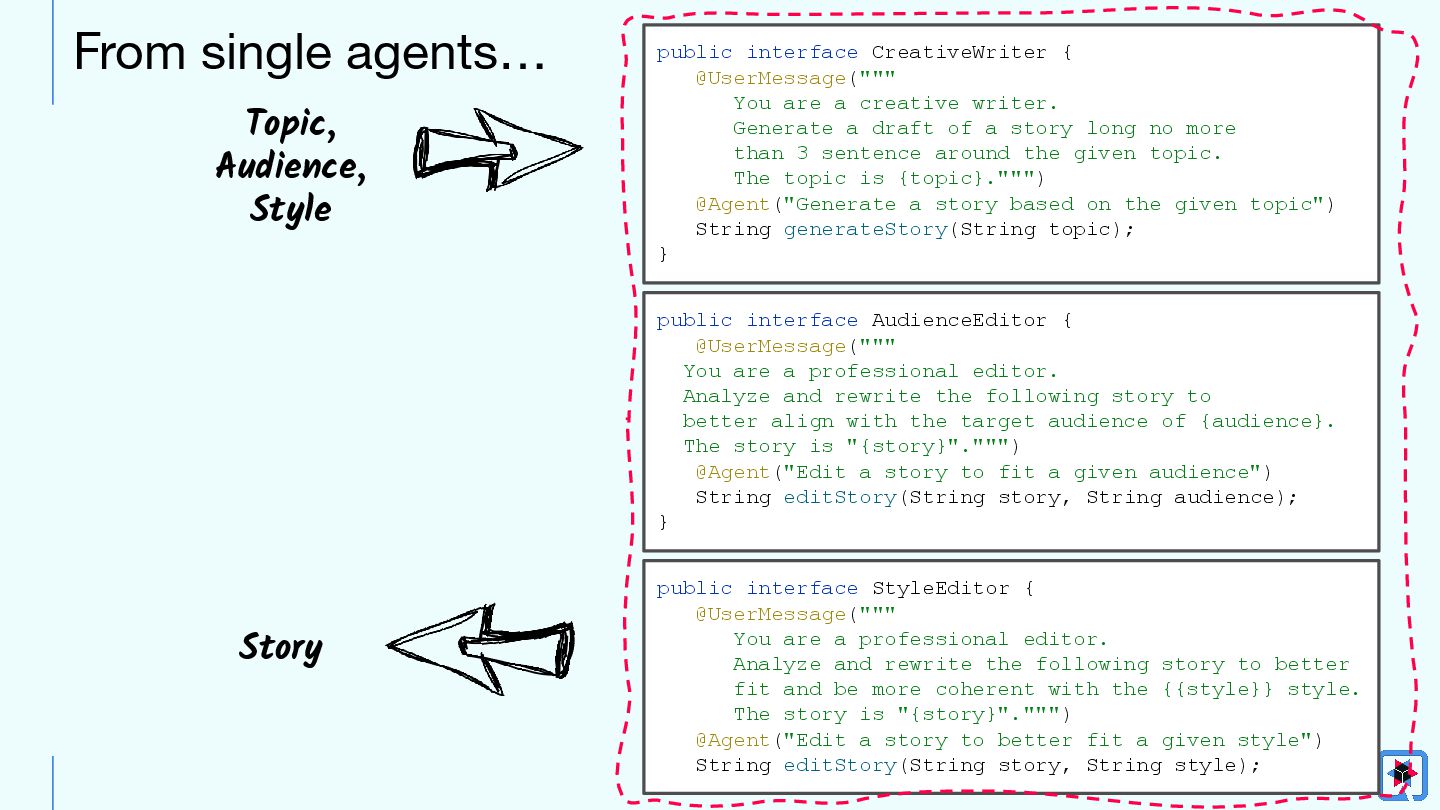
From single agents… public interface CreativeWriter { @UserMessage(""" You are
a creative writer. Generate a draft of a story long no more than 3 sentence around the given topic. The topic is {topic}.""") @Agent("Generate a story based on the given topic") String generateStory(String topic); } public interface AudienceEditor { @UserMessage(""" You are a professional editor. Analyze and rewrite the following story to better align with the target audience of {audience}. The story is "{story}".""") @Agent("Edit a story to fit a given audience") String editStory(String story, String audience); } public interface StyleEditor { @UserMessage(""" You are a professional editor. Analyze and rewrite the following story to better fit and be more coherent with the {{style}} style. The story is "{story}".""") @Agent("Edit a story to better fit a given style") String editStory(String story, String style); Topic, Audience, Style Story -
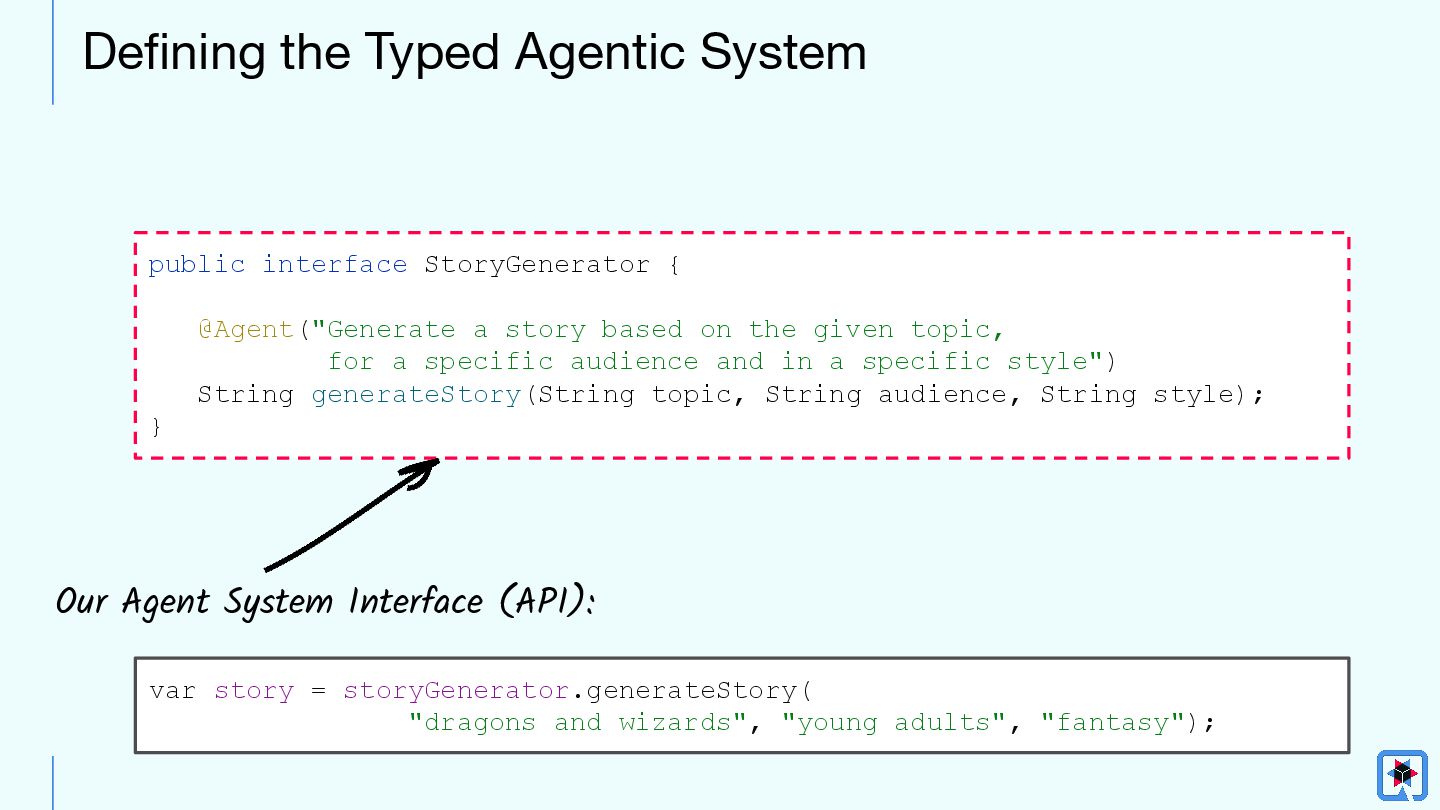
Defining the Typed Agentic System public interface StoryGenerator { @Agent("Generate
a story based on the given topic, for a specific audience and in a specific style") String generateStory(String topic, String audience, String style); } Our Agent System Interface (API): var story = storyGenerator.generateStory( "dragons and wizards", "young adults", "fantasy"); -
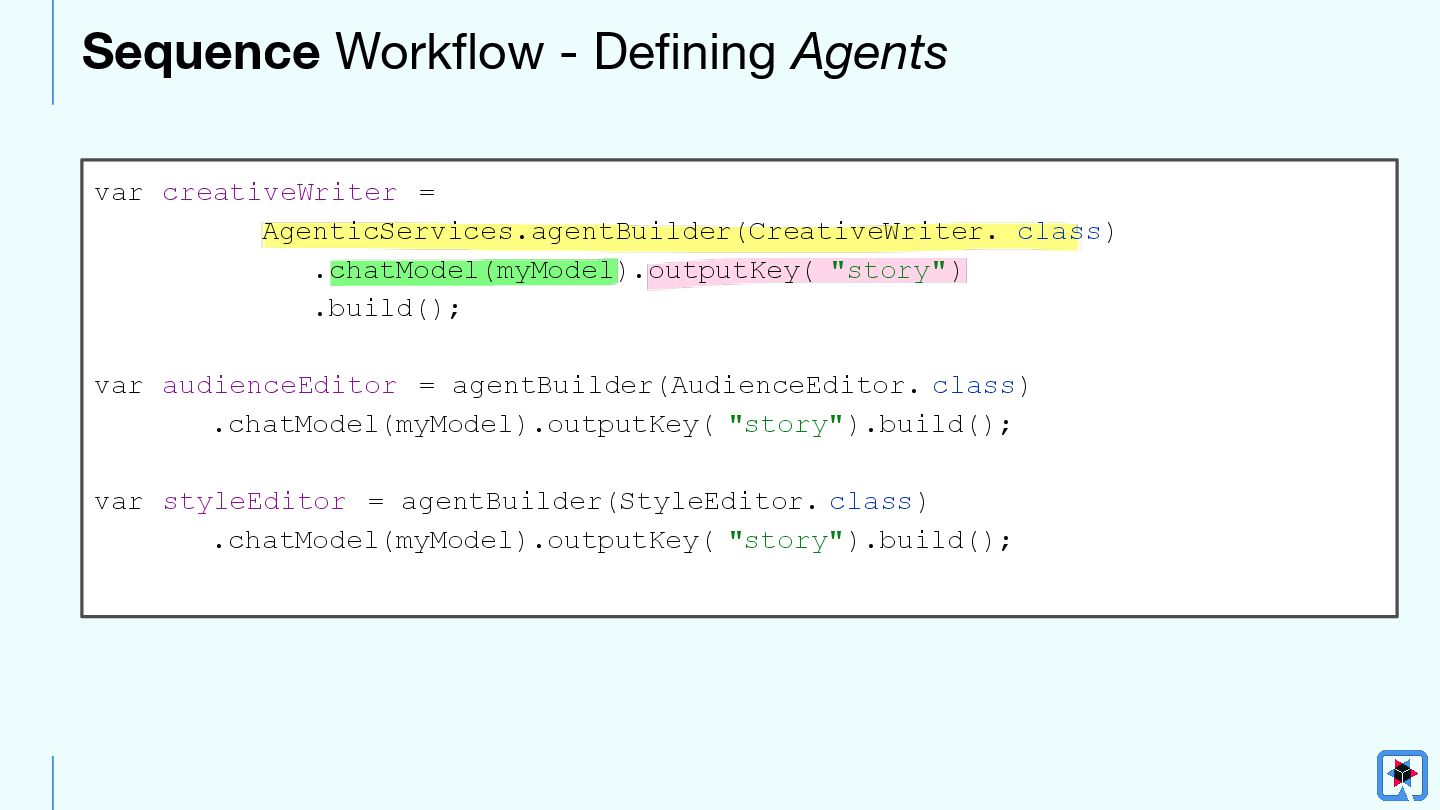
Sequence Workflow - Defining Agents var creativeWriter = AgenticServices.agentBuilder(CreativeWriter. class)
.chatModel(myModel).outputKey( "story") .build(); var audienceEditor = agentBuilder(AudienceEditor. class) .chatModel(myModel).outputKey( "story").build(); var styleEditor = agentBuilder(StyleEditor. class) .chatModel(myModel).outputKey( "story").build(); -
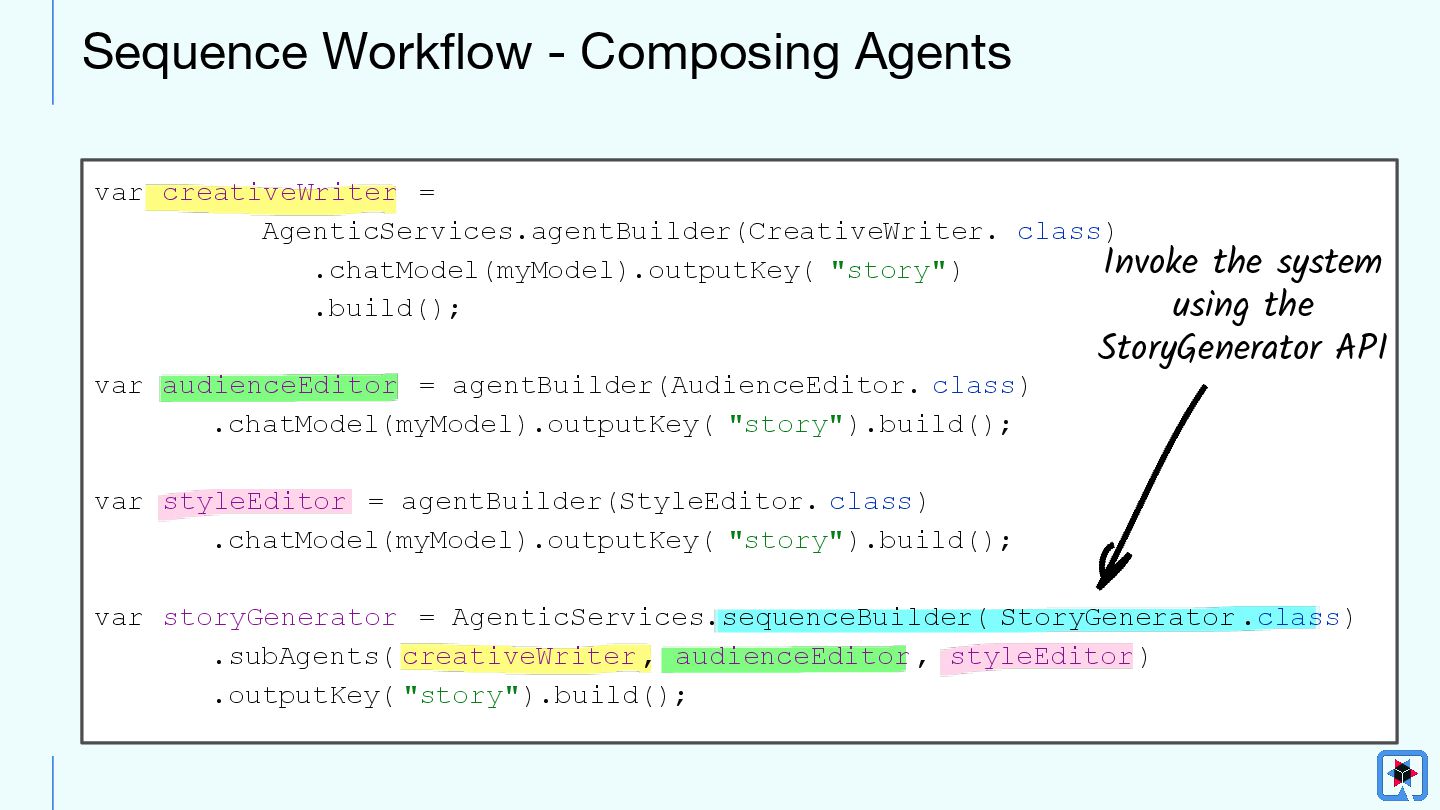
Sequence Workflow - Composing Agents var creativeWriter = AgenticServices.agentBuilder(CreativeWriter. class)
.chatModel(myModel).outputKey( "story") .build(); var audienceEditor = agentBuilder(AudienceEditor. class) .chatModel(myModel).outputKey( "story").build(); var styleEditor = agentBuilder(StyleEditor. class) .chatModel(myModel).outputKey( "story").build(); var storyGenerator = AgenticServices.sequenceBuilder( StoryGenerator .class) .subAgents( creativeWriter , audienceEditor , styleEditor) .outputKey( "story").build(); Invoke the system using the StoryGenerator API -
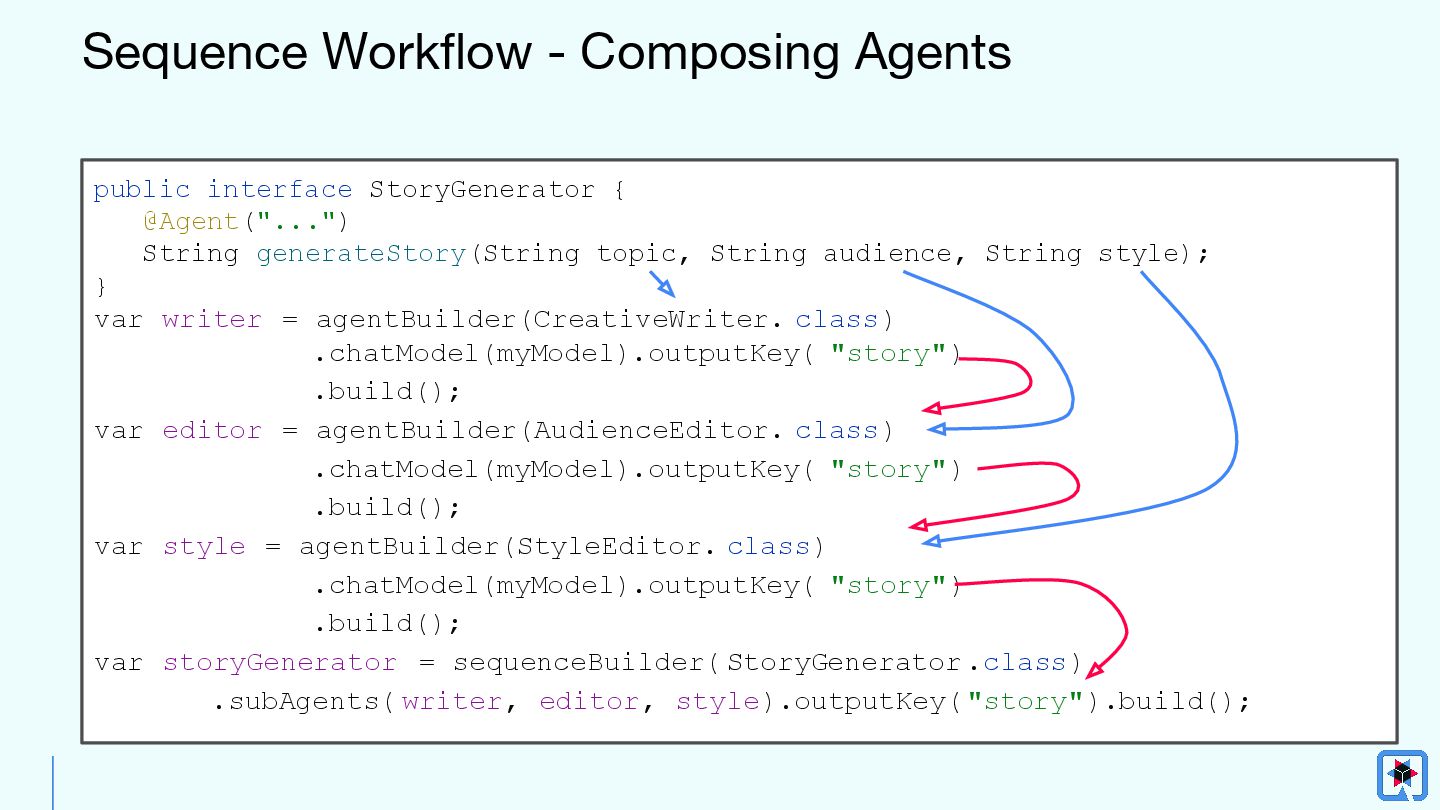
Sequence Workflow - Composing Agents public interface StoryGenerator { @Agent("...")
String generateStory(String topic, String audience, String style); } var writer = agentBuilder(CreativeWriter. class) .chatModel(myModel).outputKey( "story") .build(); var editor = agentBuilder(AudienceEditor. class) .chatModel(myModel).outputKey( "story") .build(); var style = agentBuilder(StyleEditor. class) .chatModel(myModel).outputKey( "story") .build(); var storyGenerator = sequenceBuilder( StoryGenerator .class) .subAgents( writer, editor, style).outputKey("story").build(); -
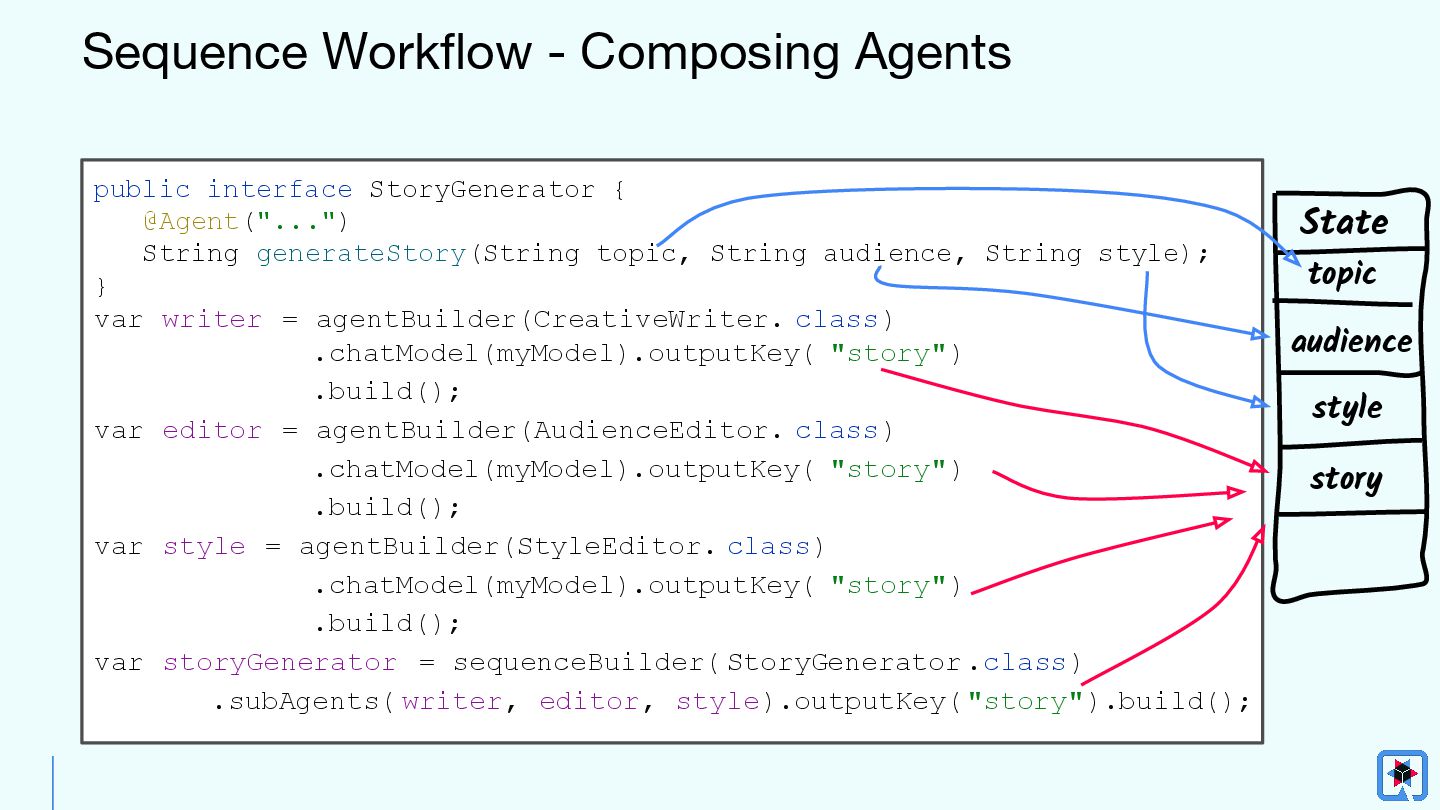
Sequence Workflow - Composing Agents public interface StoryGenerator { @Agent("...")
String generateStory(String topic, String audience, String style); } var writer = agentBuilder(CreativeWriter. class) .chatModel(myModel).outputKey( "story") .build(); var editor = agentBuilder(AudienceEditor. class) .chatModel(myModel).outputKey( "story") .build(); var style = agentBuilder(StyleEditor. class) .chatModel(myModel).outputKey( "story") .build(); var storyGenerator = sequenceBuilder( StoryGenerator .class) .subAgents( writer, editor, style).outputKey("story").build(); State topic audience style story -
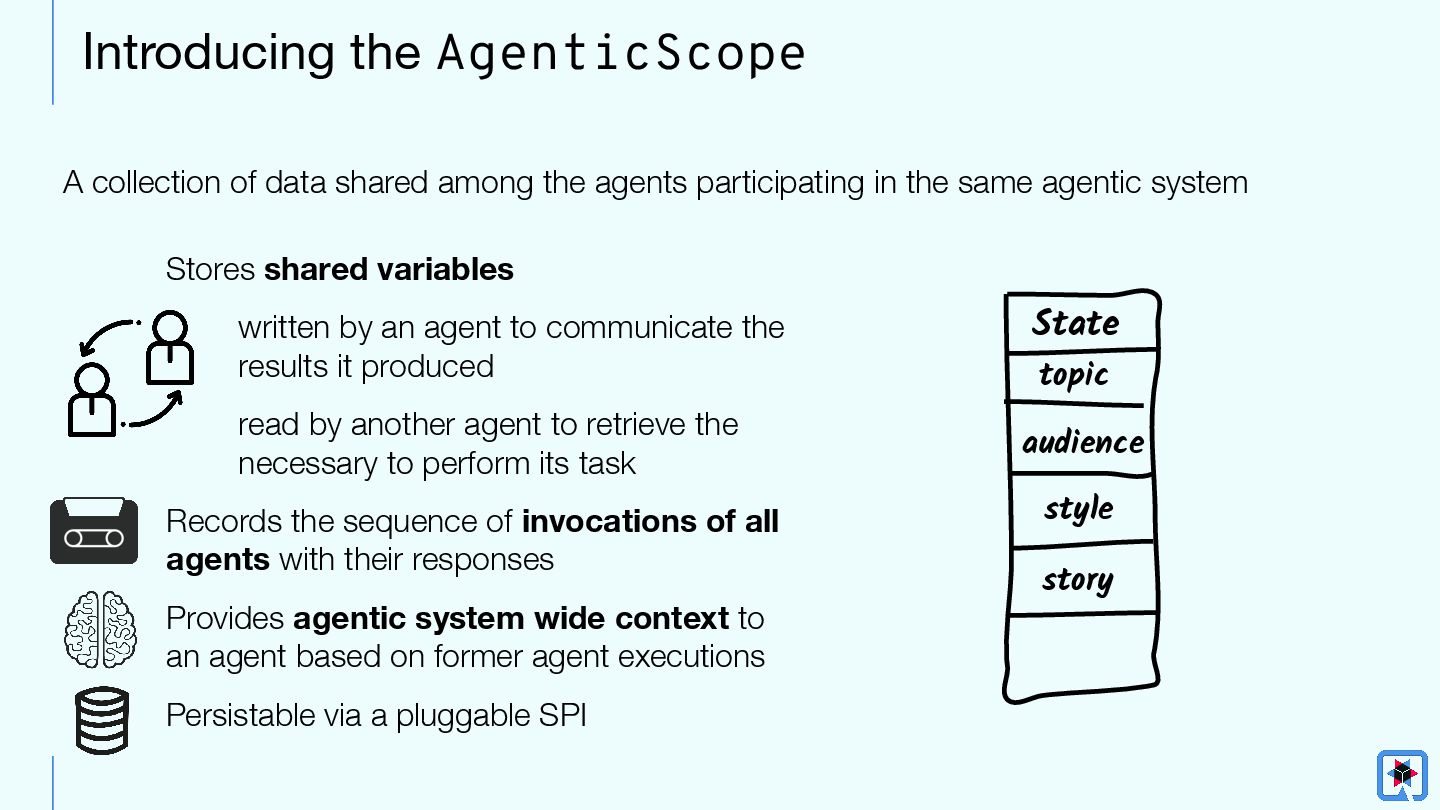
Introducing the AgenticScope Stores shared variables written by an agent
to communicate the results it produced read by another agent to retrieve the necessary to perform its task Records the sequence of invocations of all agents with their responses Provides agentic system wide context to an agent based on former agent executions Persistable via a pluggable SPI A collection of data shared among the agents participating in the same agentic system State topic audience style story -
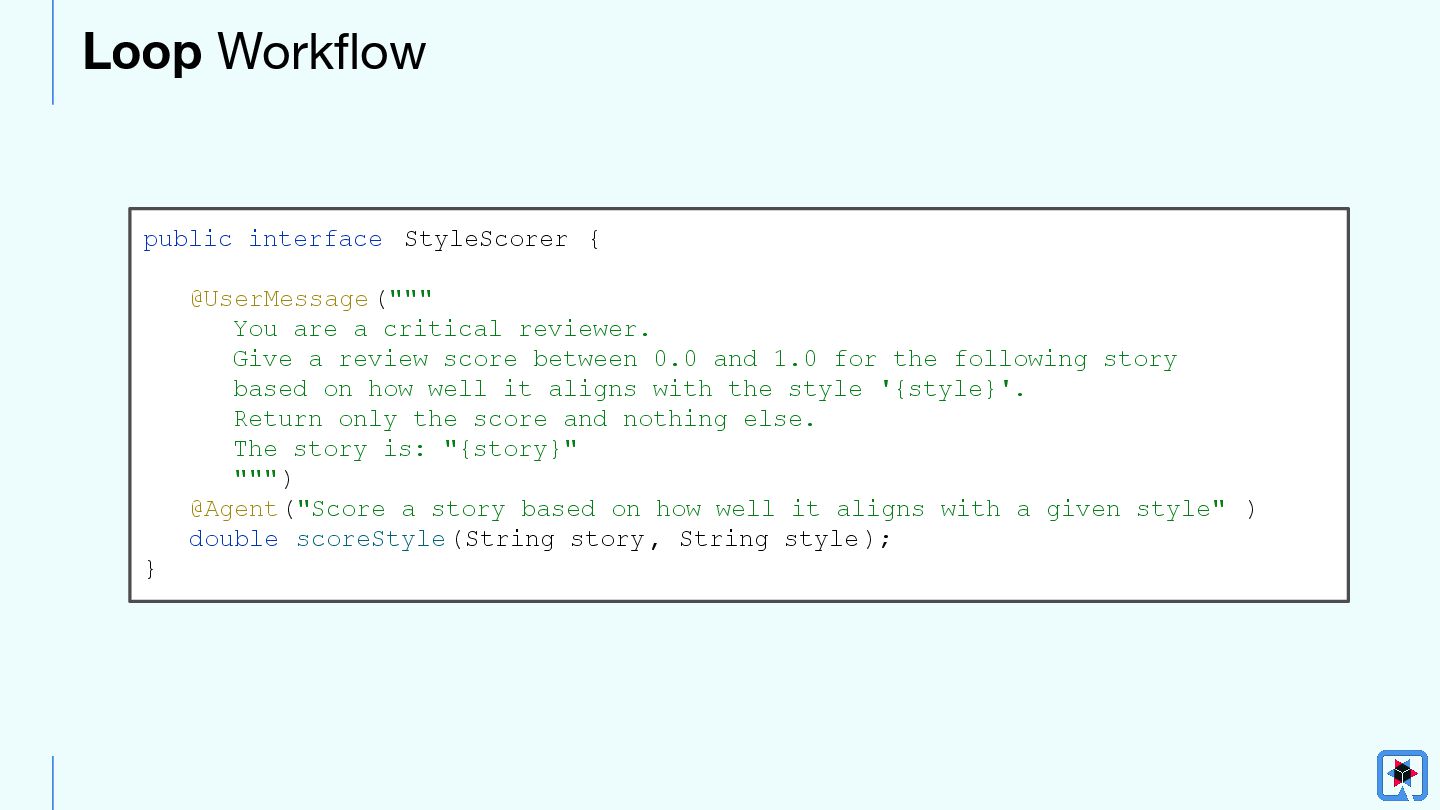
Loop Workflow public interface StyleScorer { @UserMessage(""" You are a
critical reviewer. Give a review score between 0.0 and 1.0 for the following story based on how well it aligns with the style '{style}'. Return only the score and nothing else. The story is: "{story}" """) @Agent("Score a story based on how well it aligns with a given style" ) double scoreStyle(String story, String style); } -
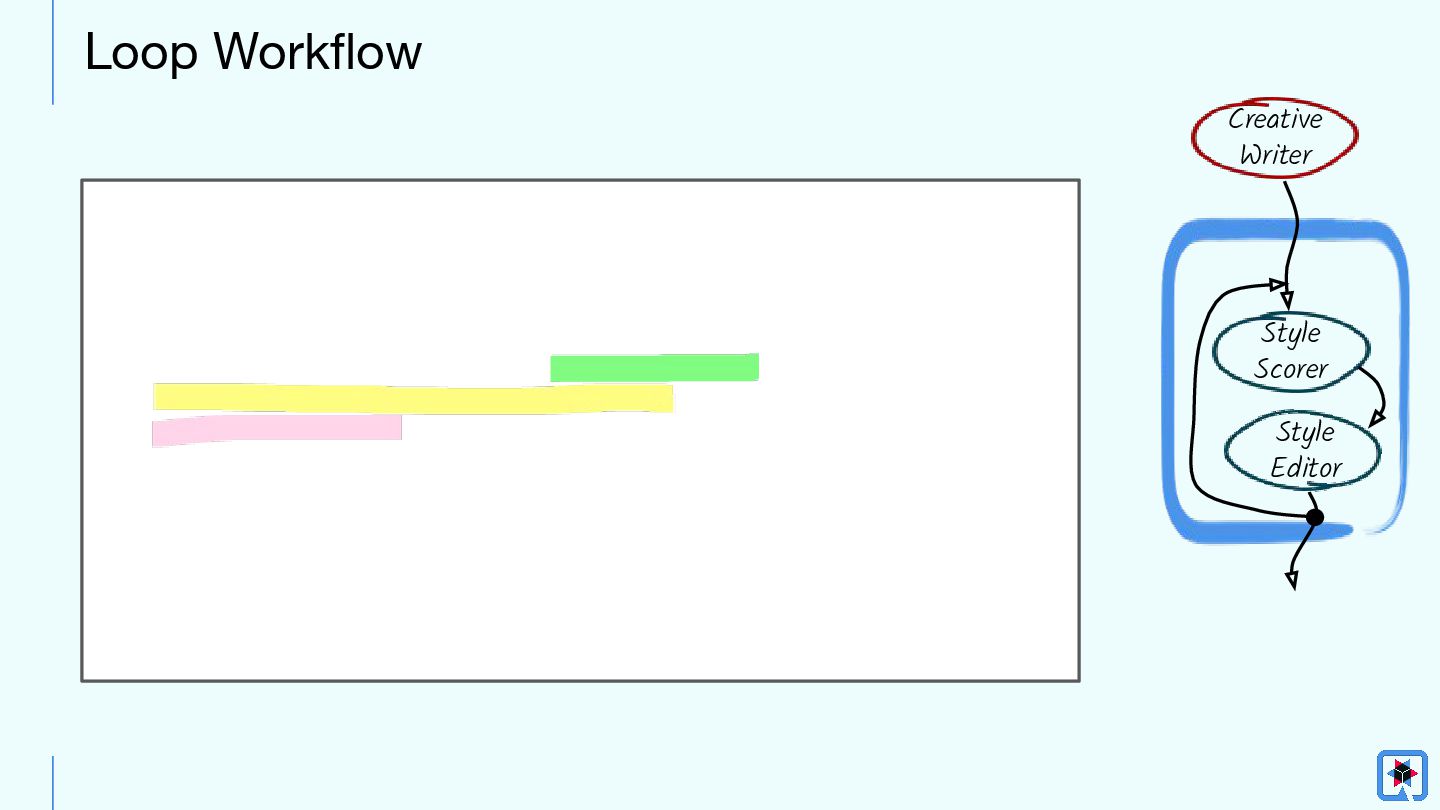
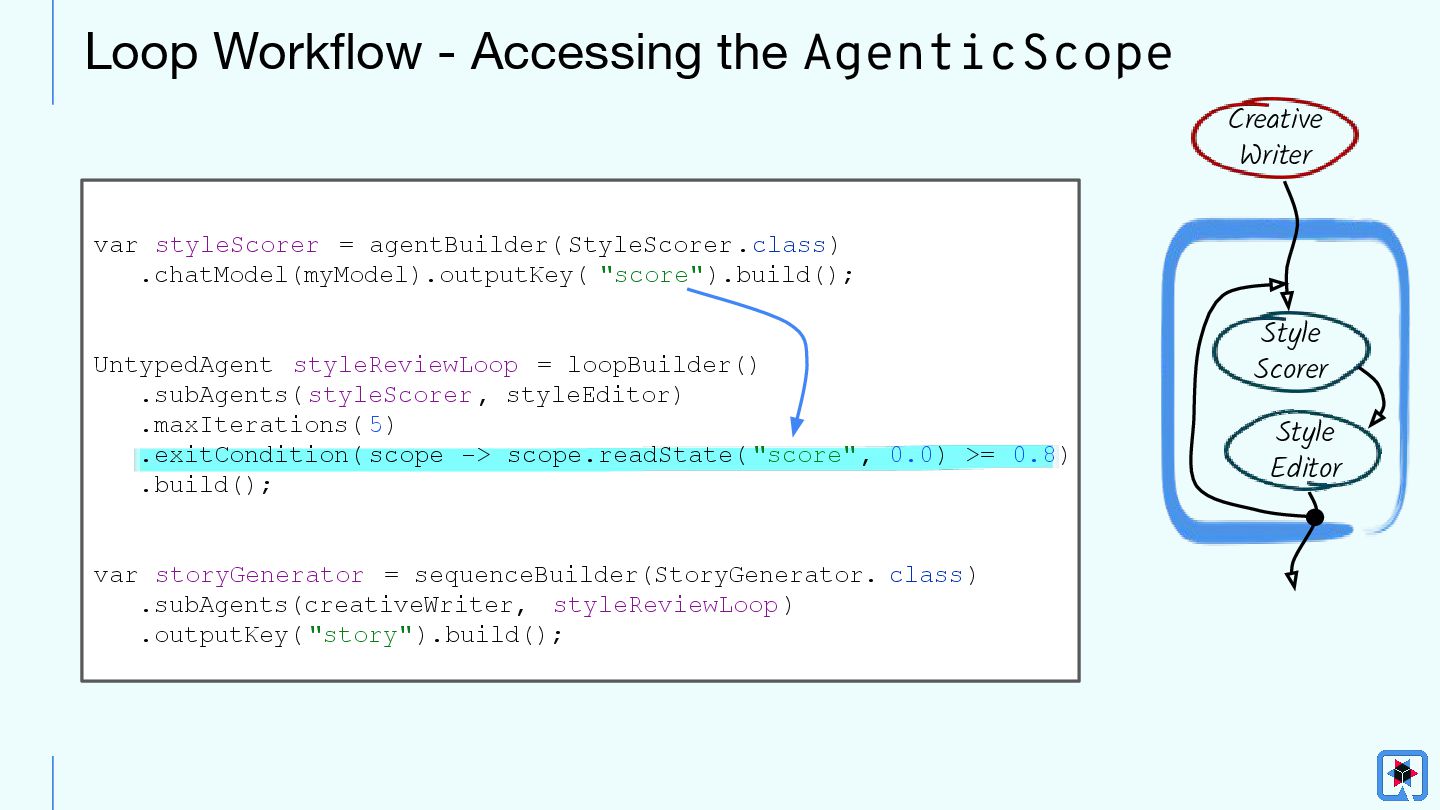
Loop Workflow Creative Writer Style Scorer Style Editor Style Review
Loop var styleScorer = agentBuilder( StyleScorer.class) .chatModel(myModel).outputKey( "score").build(); UntypedAgent styleReviewLoop = loopBuilder() .subAgents( styleScorer, styleEditor) .maxIterations( 5) .exitCondition( scope -> scope.readState("score", 0.0) >= 0.8) .build(); var storyGenerator = sequenceBuilder(StoryGenerator. class) .subAgents(creativeWriter, styleReviewLoop ) .outputKey( "story").build(); -
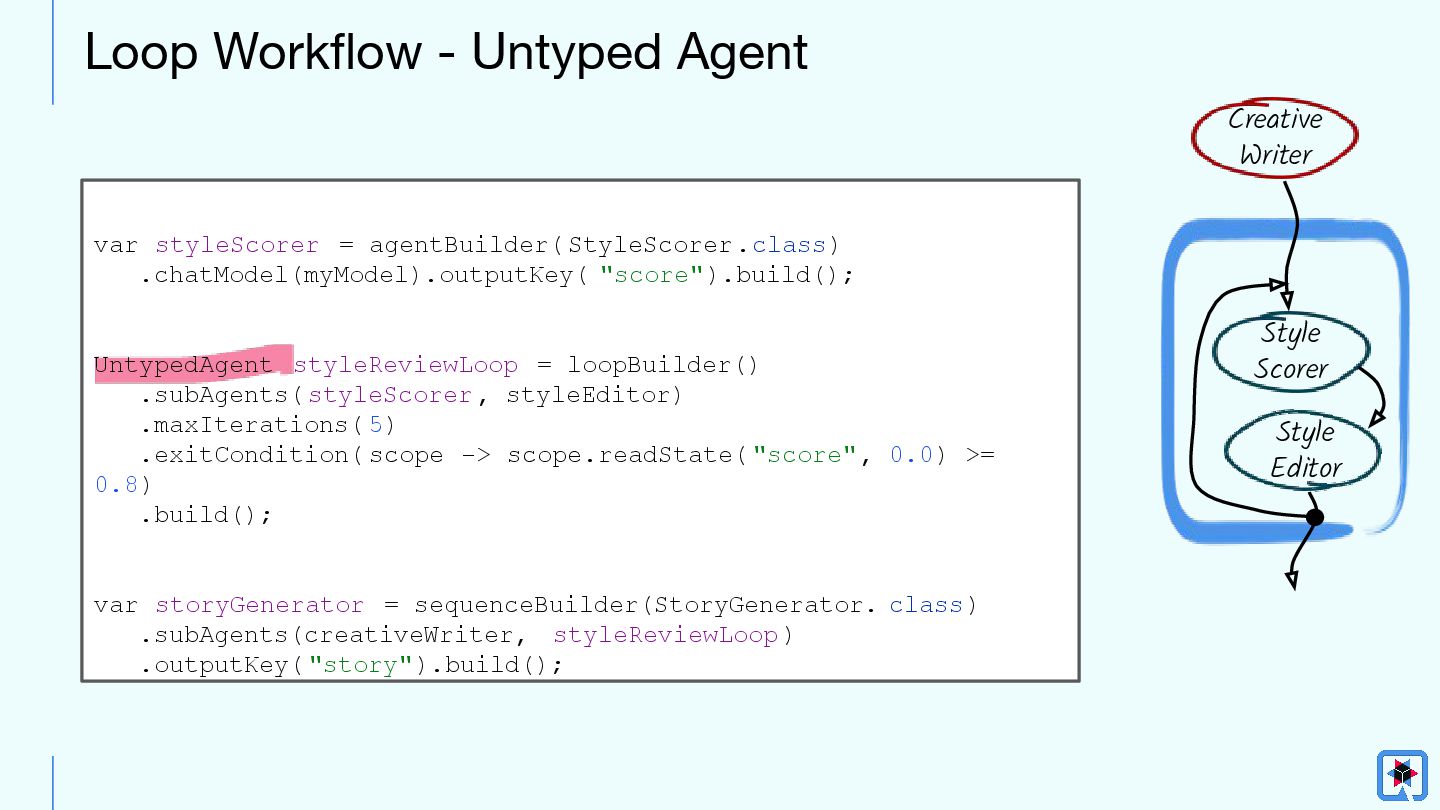
Loop Workflow - Untyped Agent var styleScorer = agentBuilder( StyleScorer.class)
.chatModel(myModel).outputKey( "score").build(); UntypedAgent styleReviewLoop = loopBuilder() .subAgents( styleScorer, styleEditor) .maxIterations( 5) .exitCondition( scope -> scope.readState("score", 0.0) >= 0.8) .build(); var storyGenerator = sequenceBuilder(StoryGenerator. class) .subAgents(creativeWriter, styleReviewLoop ) .outputKey( "story").build(); Creative Writer Style Scorer Style Editor Style Review Loop -
Loop Workflow - Accessing the AgenticScope var styleScorer = agentBuilder(
StyleScorer.class) .chatModel(myModel).outputKey( "score").build(); UntypedAgent styleReviewLoop = loopBuilder() .subAgents( styleScorer, styleEditor) .maxIterations( 5) .exitCondition( scope -> scope.readState("score", 0.0) >= 0.8) .build(); var storyGenerator = sequenceBuilder(StoryGenerator. class) .subAgents(creativeWriter, styleReviewLoop ) .outputKey( "story").build(); Creative Writer Style Scorer Style Editor Style Review Loop -
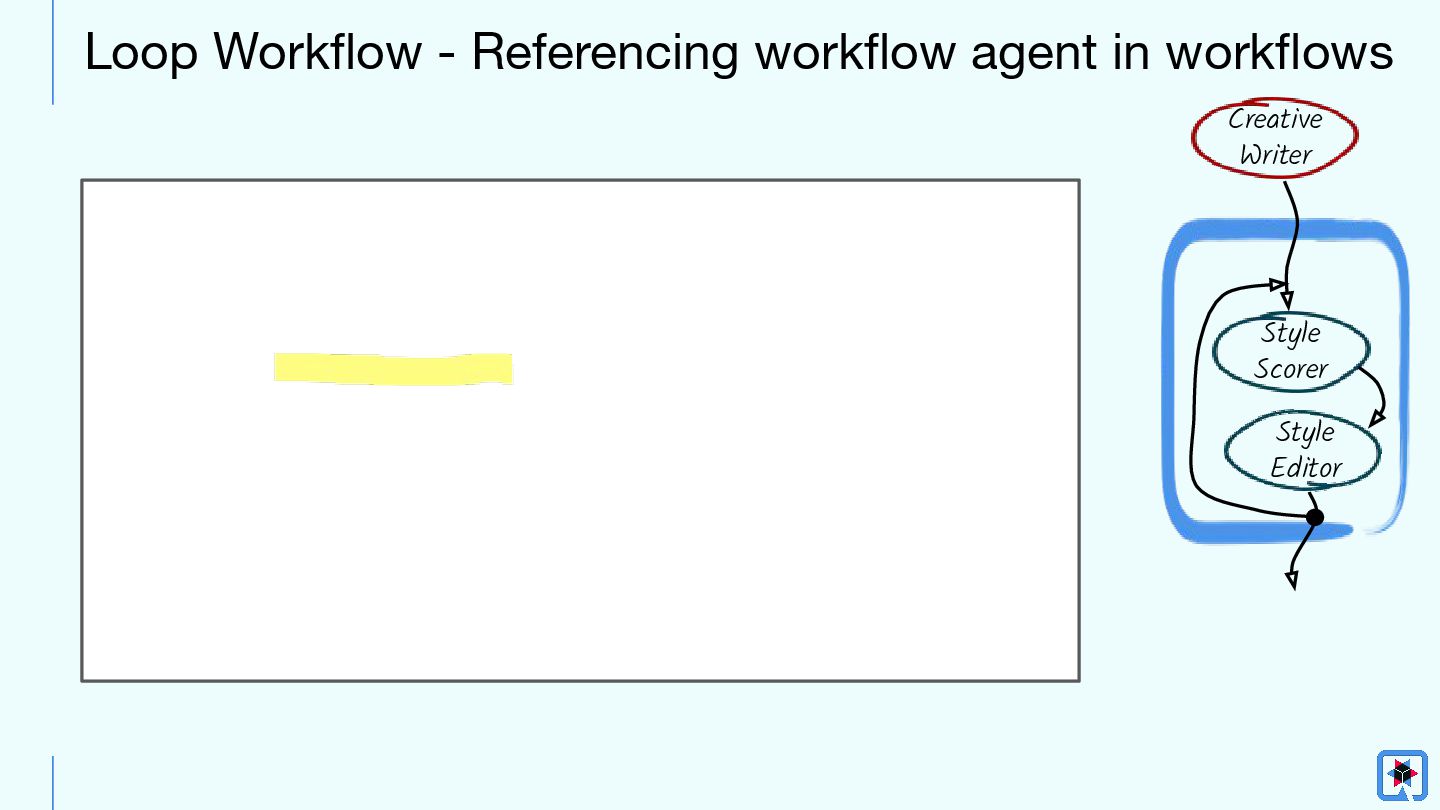
Loop Workflow - Referencing workflow agent in workflows Creative Writer
Style Scorer Style Editor Style Review Loop var styleScorer = agentBuilder( StyleScorer.class) .chatModel(myModel).outputKey( "score").build(); UntypedAgent styleReviewLoop = loopBuilder() .subAgents( styleScorer, styleEditor) .maxIterations( 5) .exitCondition( scope -> scope.readState("score", 0.0) >= 0.8) .build(); var storyGenerator = sequenceBuilder(StoryGenerator. class) .subAgents(creativeWriter, styleReviewLoop ) .outputKey( "story").build(); -
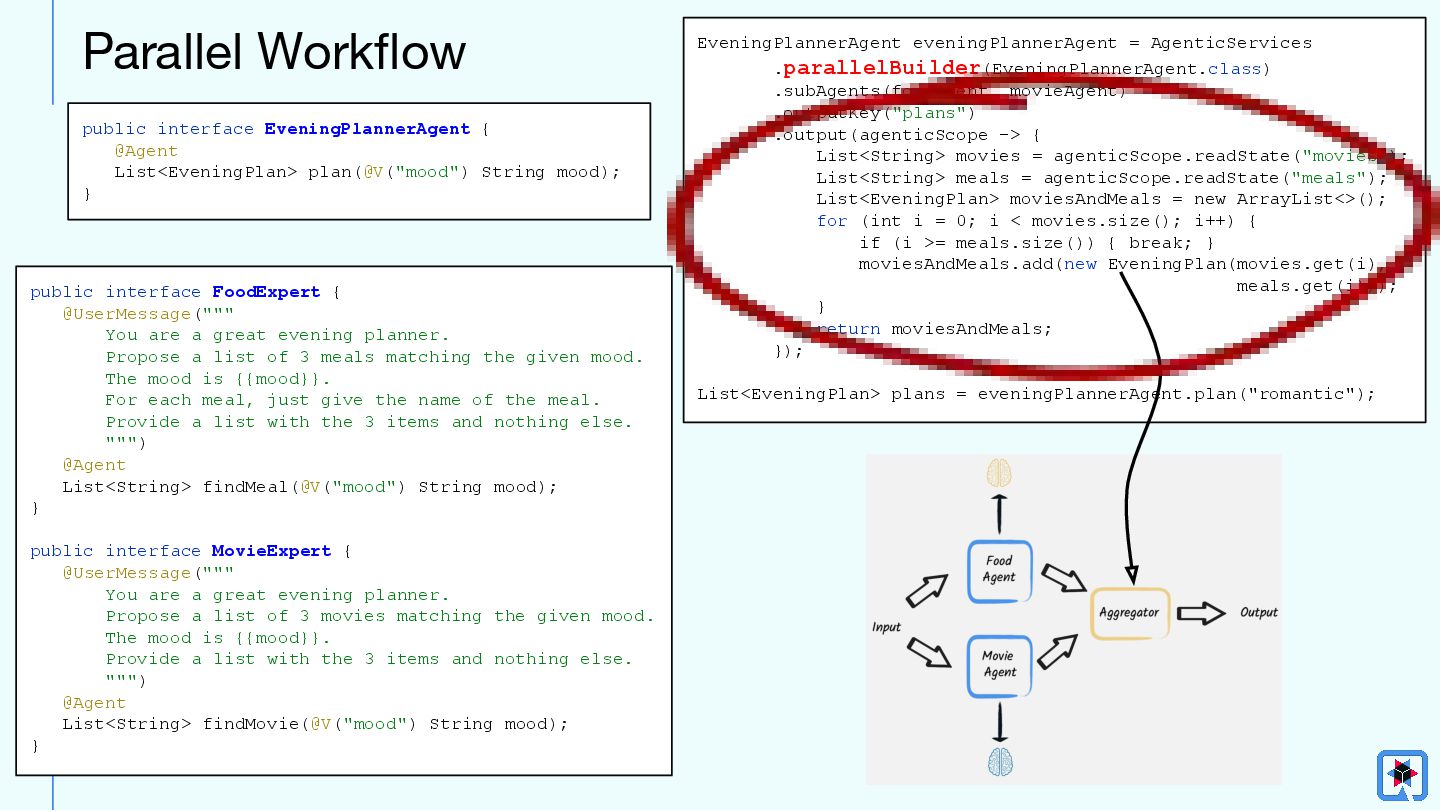
Parallel Workflow public interface EveningPlannerAgent { @Agent List<EveningPlan> plan(@V("mood") String
mood); } public interface FoodExpert { @UserMessage(""" You are a great evening planner. Propose a list of 3 meals matching the given mood. The mood is {{mood}}. For each meal, just give the name of the meal. Provide a list with the 3 items and nothing else. """) @Agent List<String> findMeal(@V("mood") String mood); } public interface MovieExpert { @UserMessage(""" You are a great evening planner. Propose a list of 3 movies matching the given mood. The mood is {{mood}}. Provide a list with the 3 items and nothing else. """) @Agent List<String> findMovie(@V("mood") String mood); } EveningPlannerAgent eveningPlannerAgent = AgenticServices .parallelBuilder(EveningPlannerAgent.class) .subAgents(foodAgent, movieAgent) .outputKey("plans") .output(agenticScope -> { List<String> movies = agenticScope.readState("movies"); List<String> meals = agenticScope.readState("meals"); List<EveningPlan> moviesAndMeals = new ArrayList<>(); for (int i = 0; i < movies.size(); i++) { if (i >= meals.size()) { break; } moviesAndMeals.add(new EveningPlan(movies.get(i), meals.get(i))); } return moviesAndMeals; }); List<EveningPlan> plans = eveningPlannerAgent.plan("romantic"); -
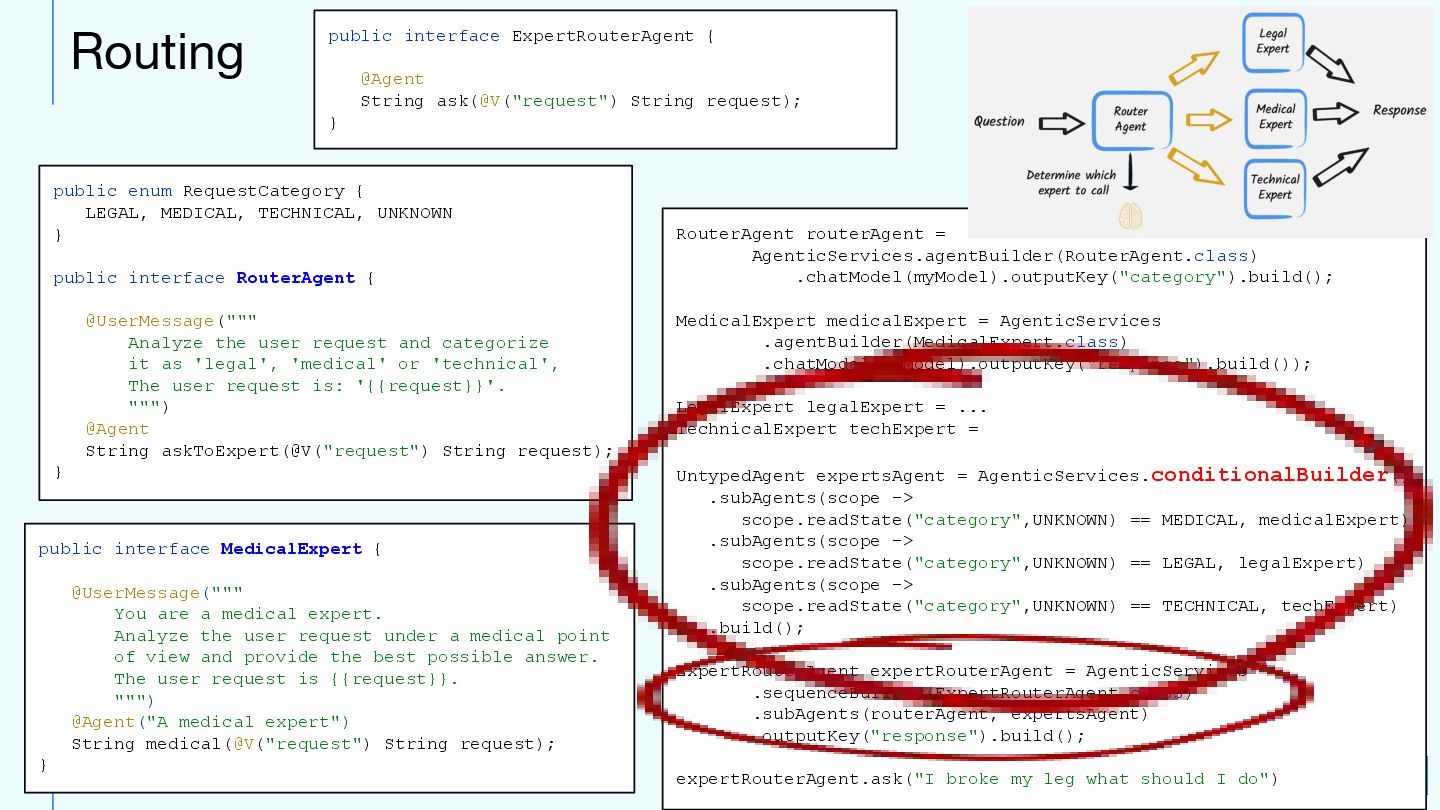
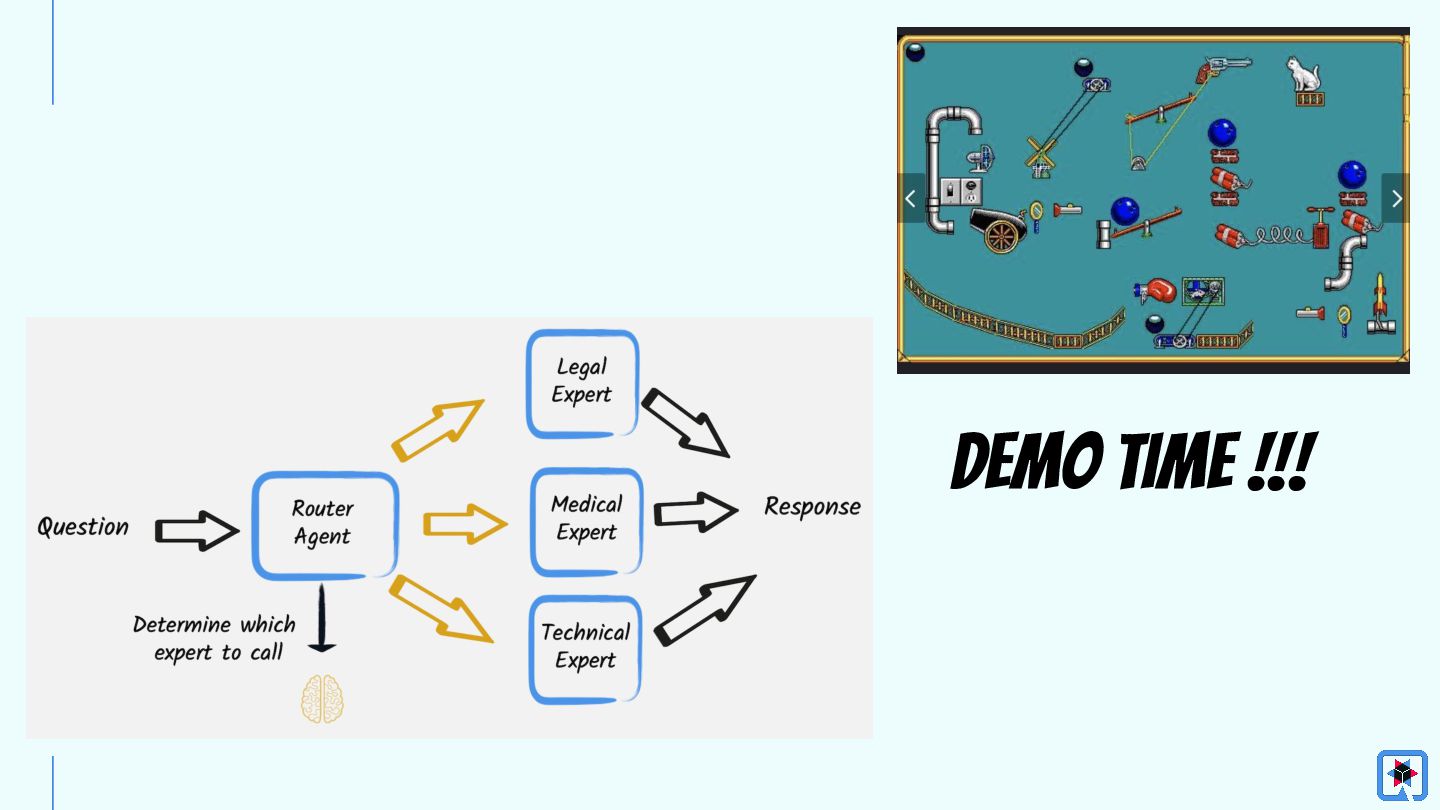
Routing public interface ExpertRouterAgent { @Agent String ask(@V("request") String request);
} public enum RequestCategory { LEGAL, MEDICAL, TECHNICAL, UNKNOWN } public interface RouterAgent { @UserMessage(""" Analyze the user request and categorize it as 'legal', 'medical' or 'technical', The user request is: '{{request}}'. """) @Agent String askToExpert(@V("request") String request); } public interface MedicalExpert { @UserMessage(""" You are a medical expert. Analyze the user request under a medical point of view and provide the best possible answer. The user request is {{request}}. """) @Agent("A medical expert") String medical(@V("request") String request); } RouterAgent routerAgent = AgenticServices.agentBuilder(RouterAgent.class) .chatModel(myModel).outputKey("category").build(); MedicalExpert medicalExpert = AgenticServices .agentBuilder(MedicalExpert.class) .chatModel(myModel).outputKey("response").build()); LegalExpert legalExpert = ... TechnicalExpert techExpert = UntypedAgent expertsAgent = AgenticServices.conditionalBuilder() .subAgents(scope -> scope.readState("category",UNKNOWN) == MEDICAL, medicalExpert) .subAgents(scope -> scope.readState("category",UNKNOWN) == LEGAL, legalExpert) .subAgents(scope -> scope.readState("category",UNKNOWN) == TECHNICAL, techExpert) .build(); ExpertRouterAgent expertRouterAgent = AgenticServices .sequenceBuilder(ExpertRouterAgent.class) .subAgents(routerAgent, expertsAgent) .outputKey("response").build(); expertRouterAgent.ask("I broke my leg what should I do") -
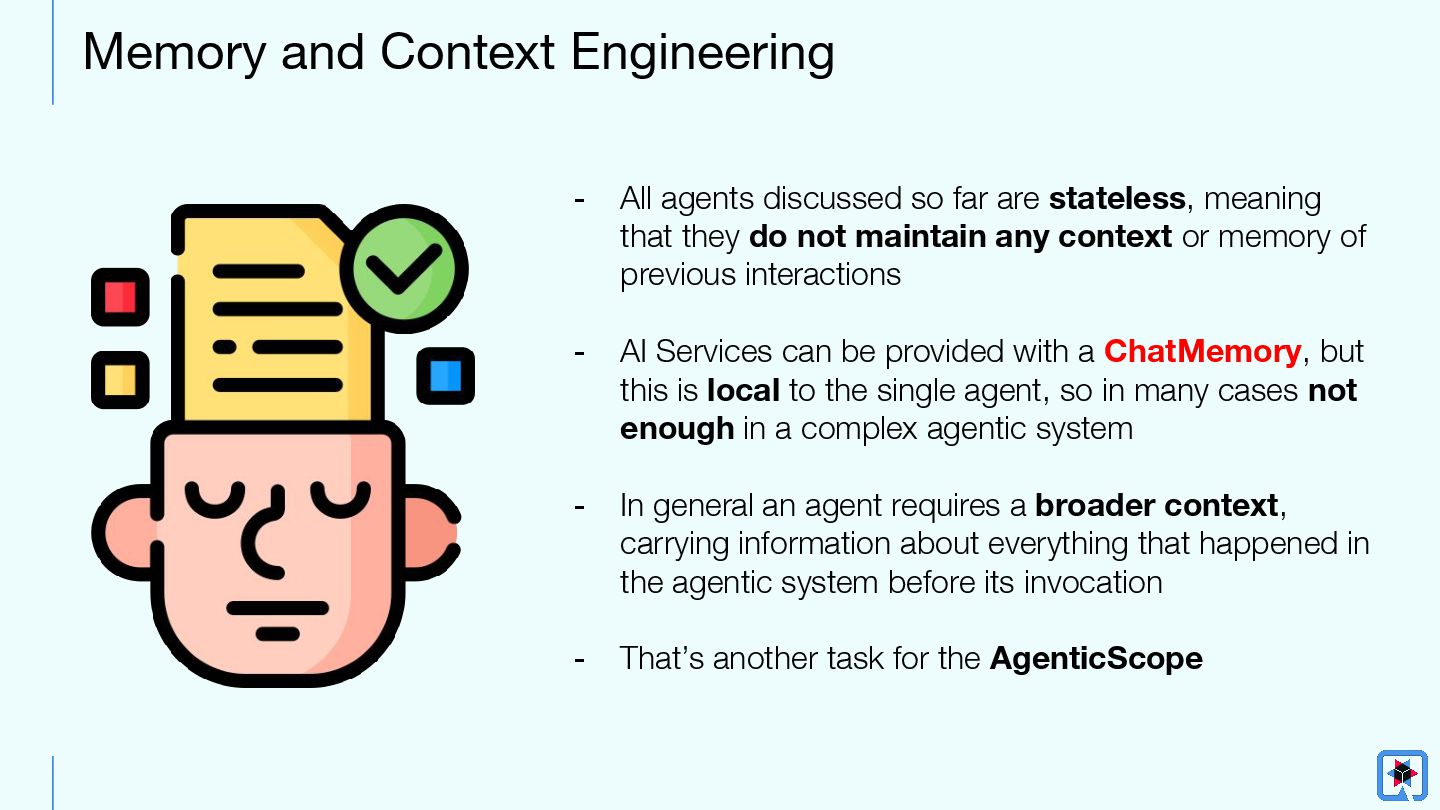
Memory and Context Engineering - All agents discussed so far
are stateless, meaning that they do not maintain any context or memory of previous interactions - AI Services can be provided with a ChatMemory, but this is local to the single agent, so in many cases not enough in a complex agentic system - In general an agent requires a broader context, carrying information about everything that happened in the agentic system before its invocation - That’s another task for the AgenticScope -
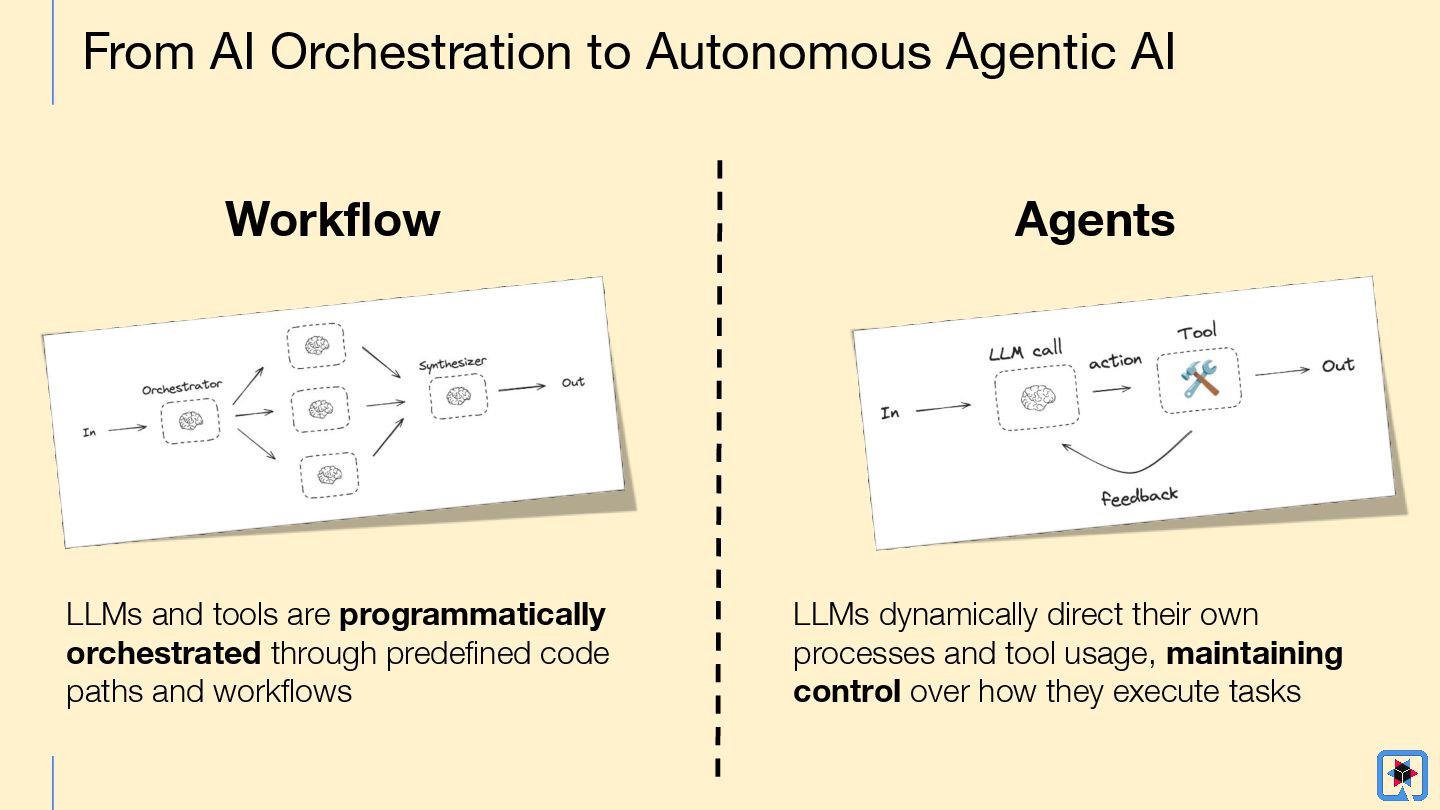
From AI Orchestration to Autonomous Agentic AI LLMs and tools
are programmatically orchestrated through predefined code paths and workflows LLMs dynamically direct their own processes and tool usage, maintaining control over how they execute tasks Workflow Agents -
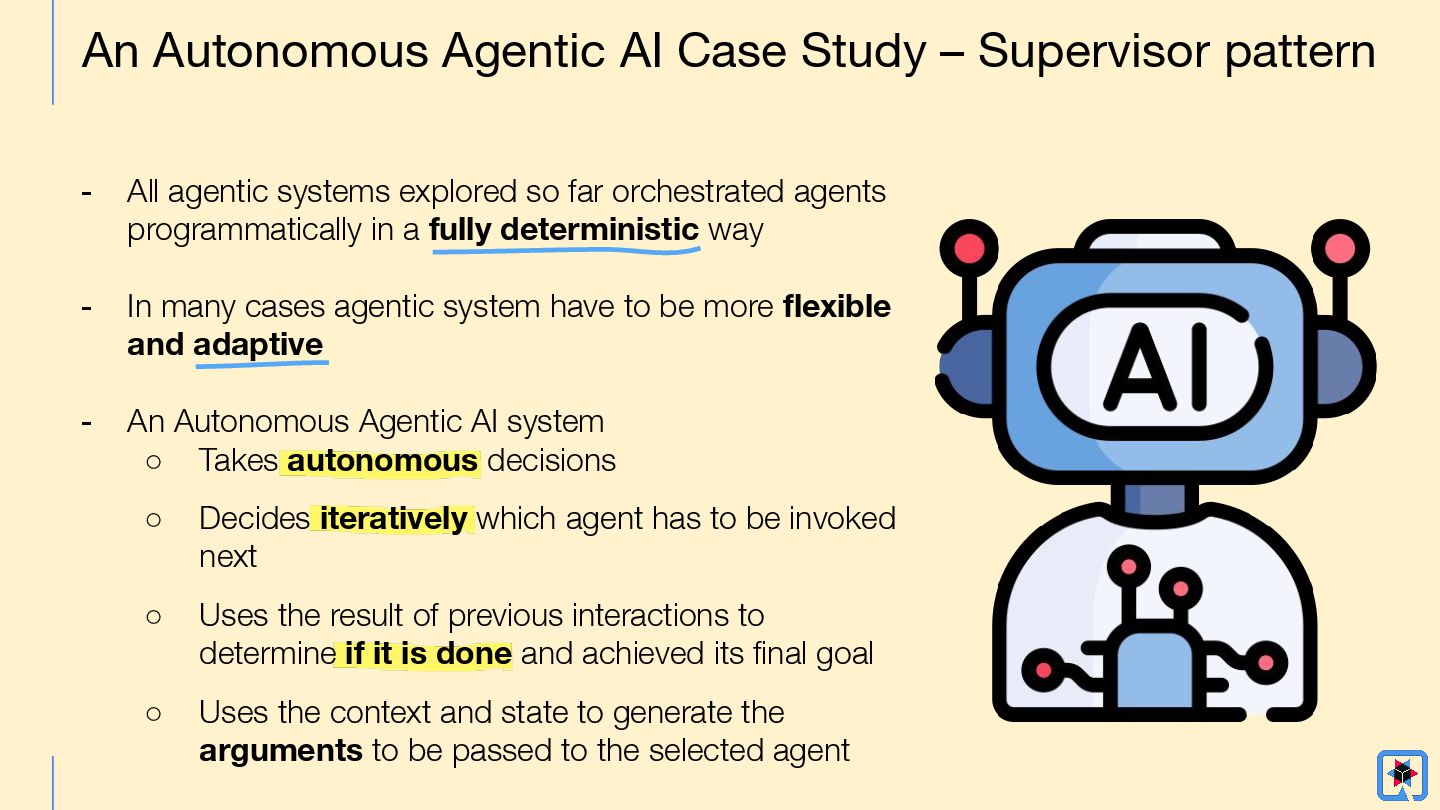
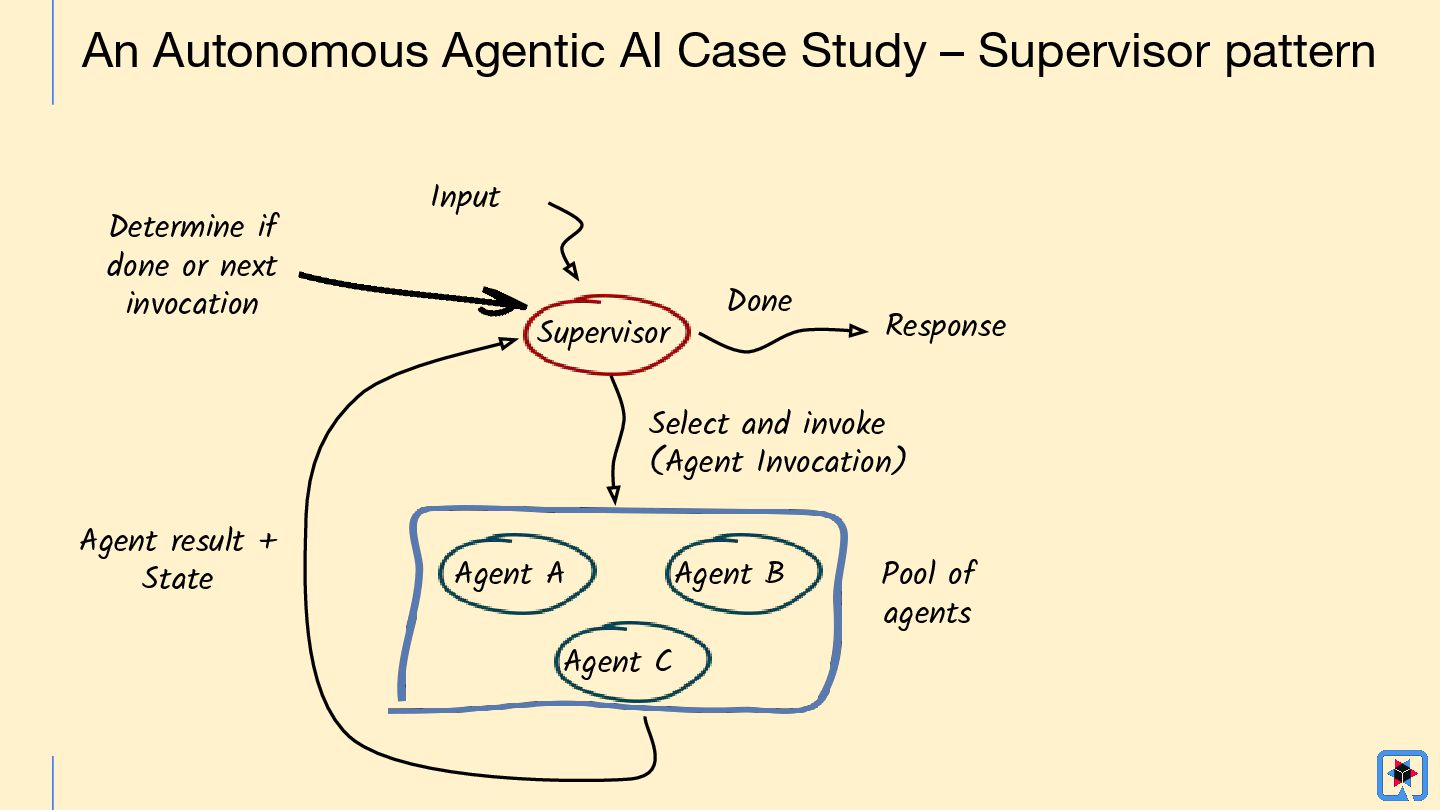
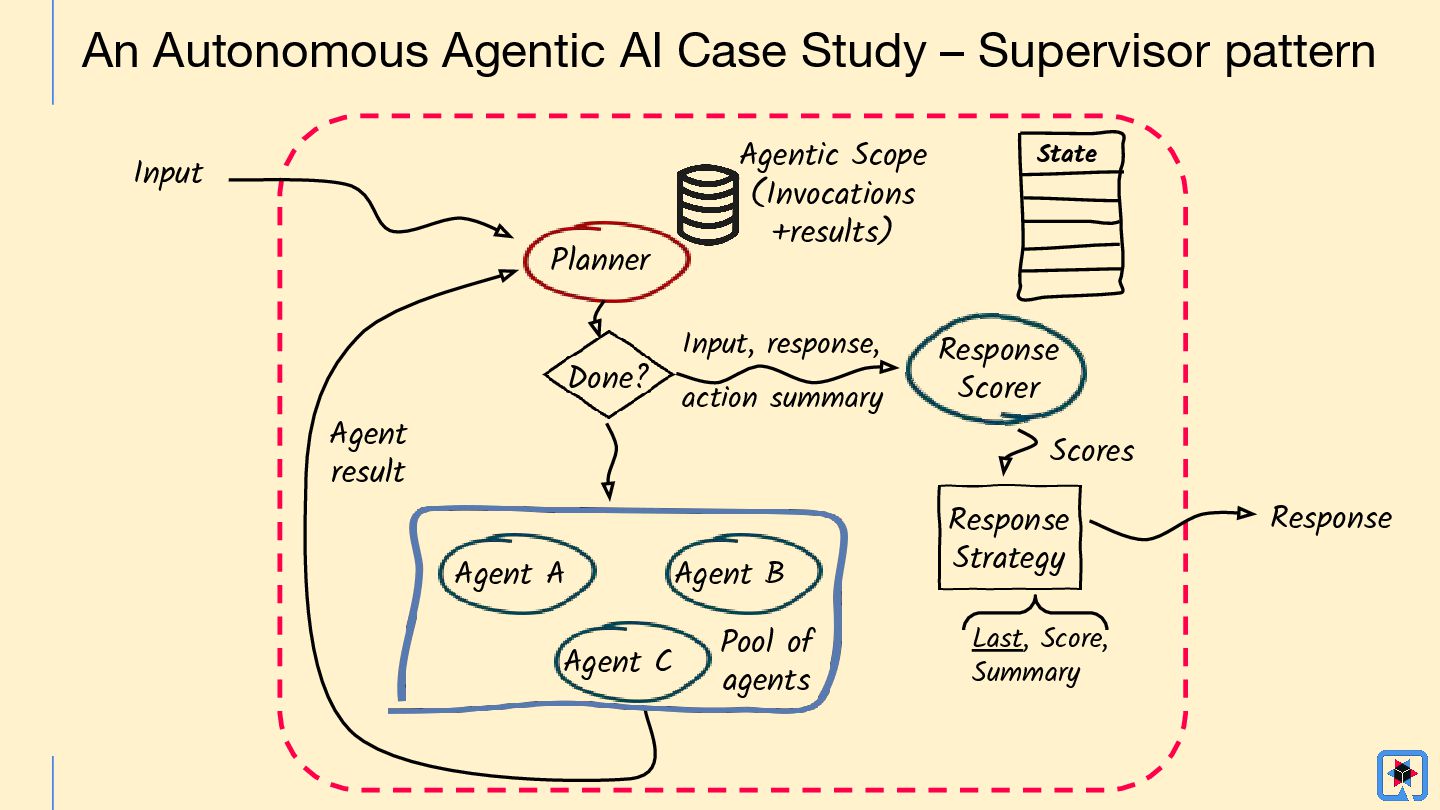
An Autonomous Agentic AI Case Study – Supervisor pattern -
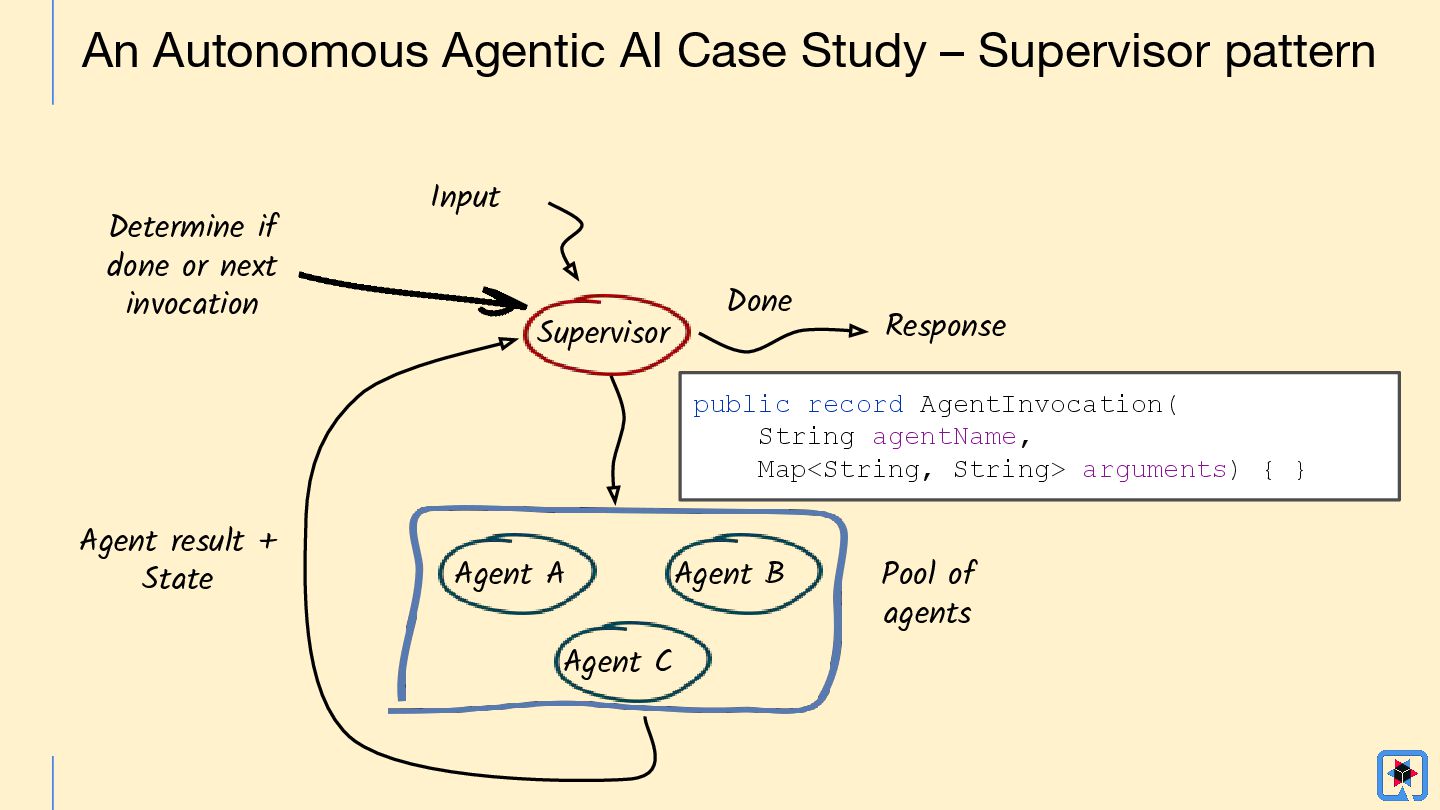
All agentic systems explored so far orchestrated agents programmatically in a fully deterministic way - In many cases agentic system have to be more flexible and adaptive - An Autonomous Agentic AI system ◦ Takes autonomous decisions ◦ Decides iteratively which agent has to be invoked next ◦ Uses the result of previous interactions to determine if it is done and achieved its final goal ◦ Uses the context and state to generate the arguments to be passed to the selected agent -
An Autonomous Agentic AI Case Study – Supervisor pattern Input
Response Supervisor Agent A Agent B Agent C Agent result + State Determine if done or next invocation Pool of agents Done Select and invoke (Agent Invocation) -
Input Response Supervisor Agent A Agent B Agent C Agent
result + State Determine if done or next invocation Pool of agents public record AgentInvocation( String agentName, Map<String, String> arguments) { } Done An Autonomous Agentic AI Case Study – Supervisor pattern -
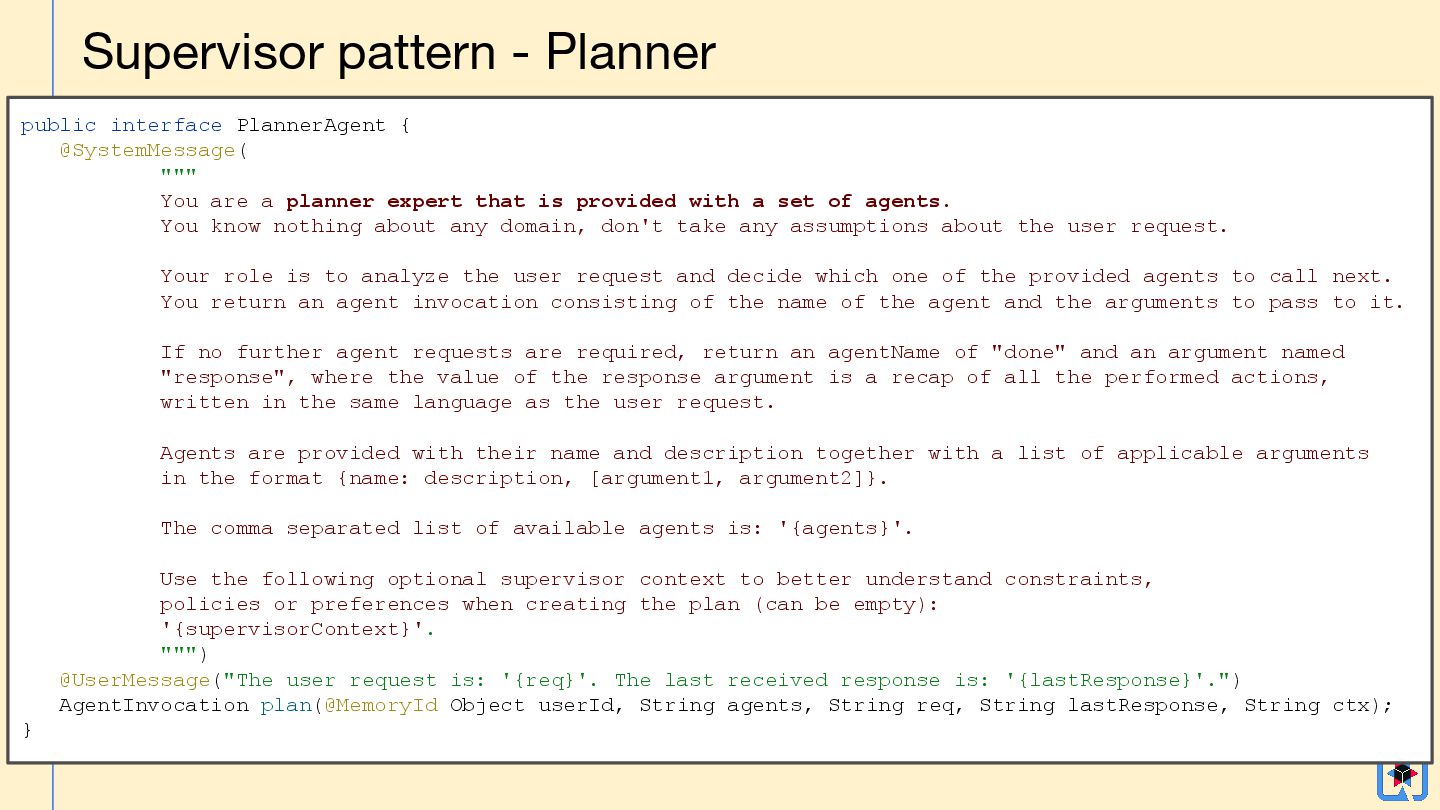
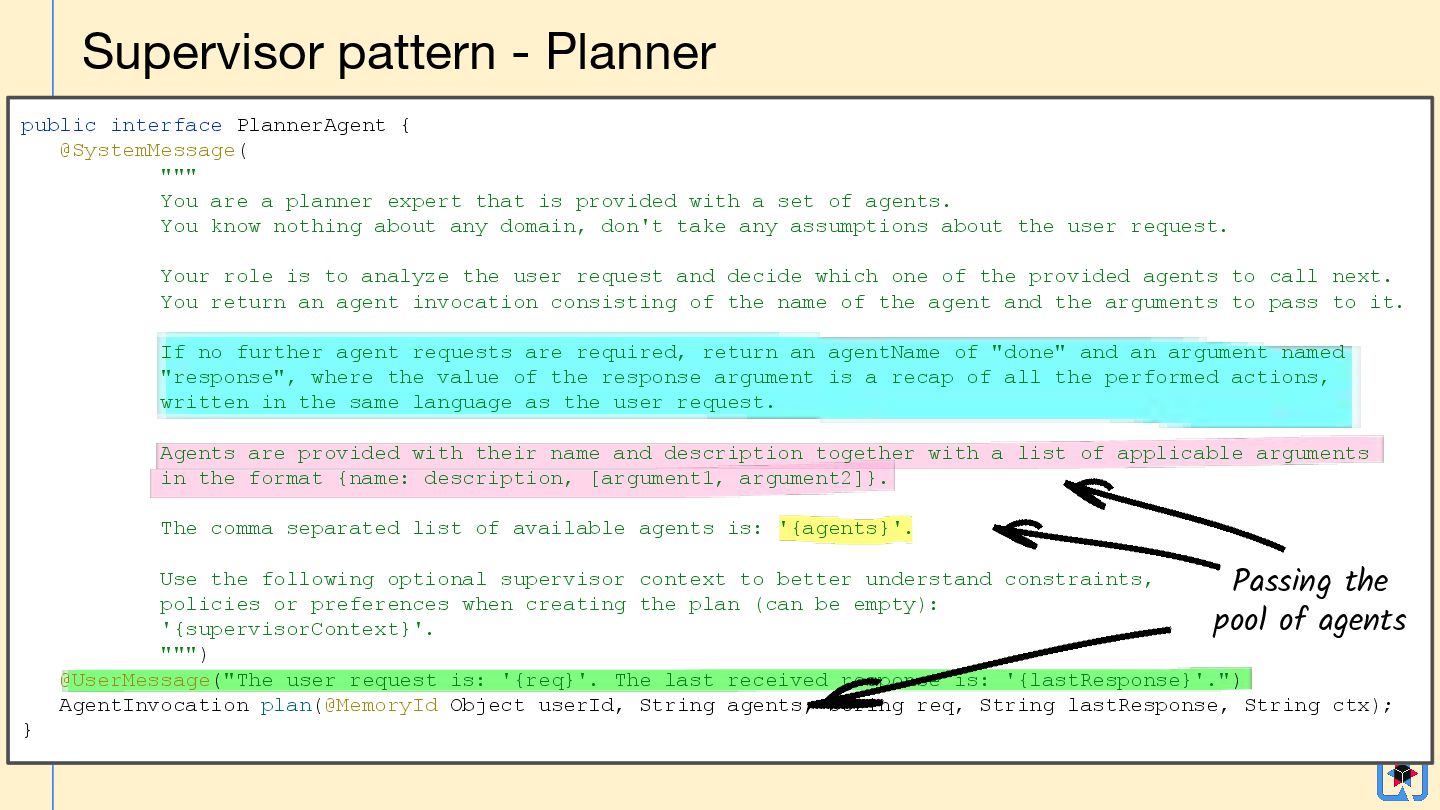
Supervisor pattern - Planner public interface PlannerAgent { @SystemMessage( """
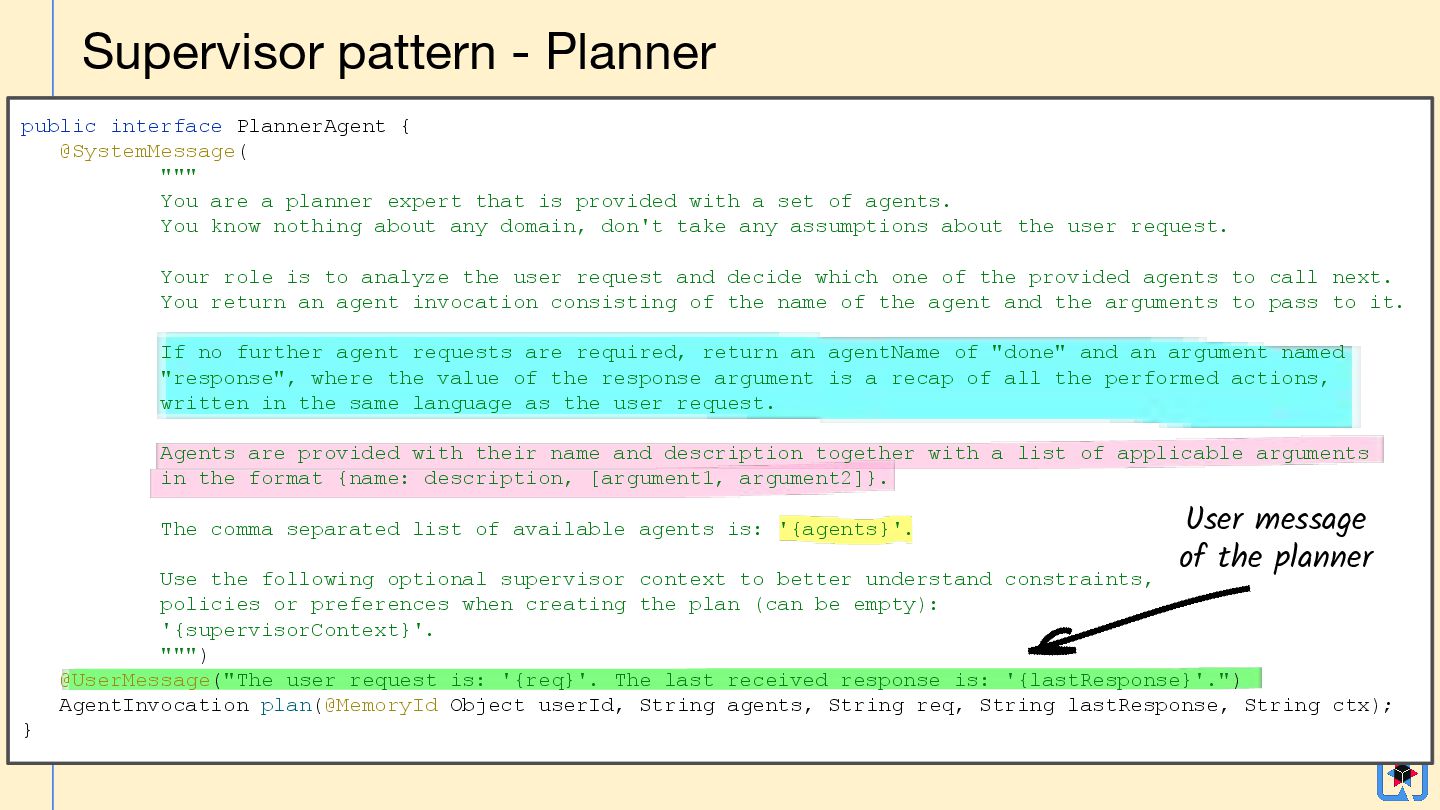
You are a planner expert that is provided with a set of agents. You know nothing about any domain, don't take any assumptions about the user request. Your role is to analyze the user request and decide which one of the provided agents to call next. You return an agent invocation consisting of the name of the agent and the arguments to pass to it. If no further agent requests are required, return an agentName of "done" and an argument named "response", where the value of the response argument is a recap of all the performed actions, written in the same language as the user request. Agents are provided with their name and description together with a list of applicable arguments in the format {name: description, [argument1, argument2]}. The comma separated list of available agents is: '{agents}'. Use the following optional supervisor context to better understand constraints, policies or preferences when creating the plan (can be empty): '{supervisorContext}'. """) @UserMessage("The user request is: '{req}'. The last received response is: '{lastResponse}'.") AgentInvocation plan(@MemoryId Object userId, String agents, String req, String lastResponse, String ctx); } -
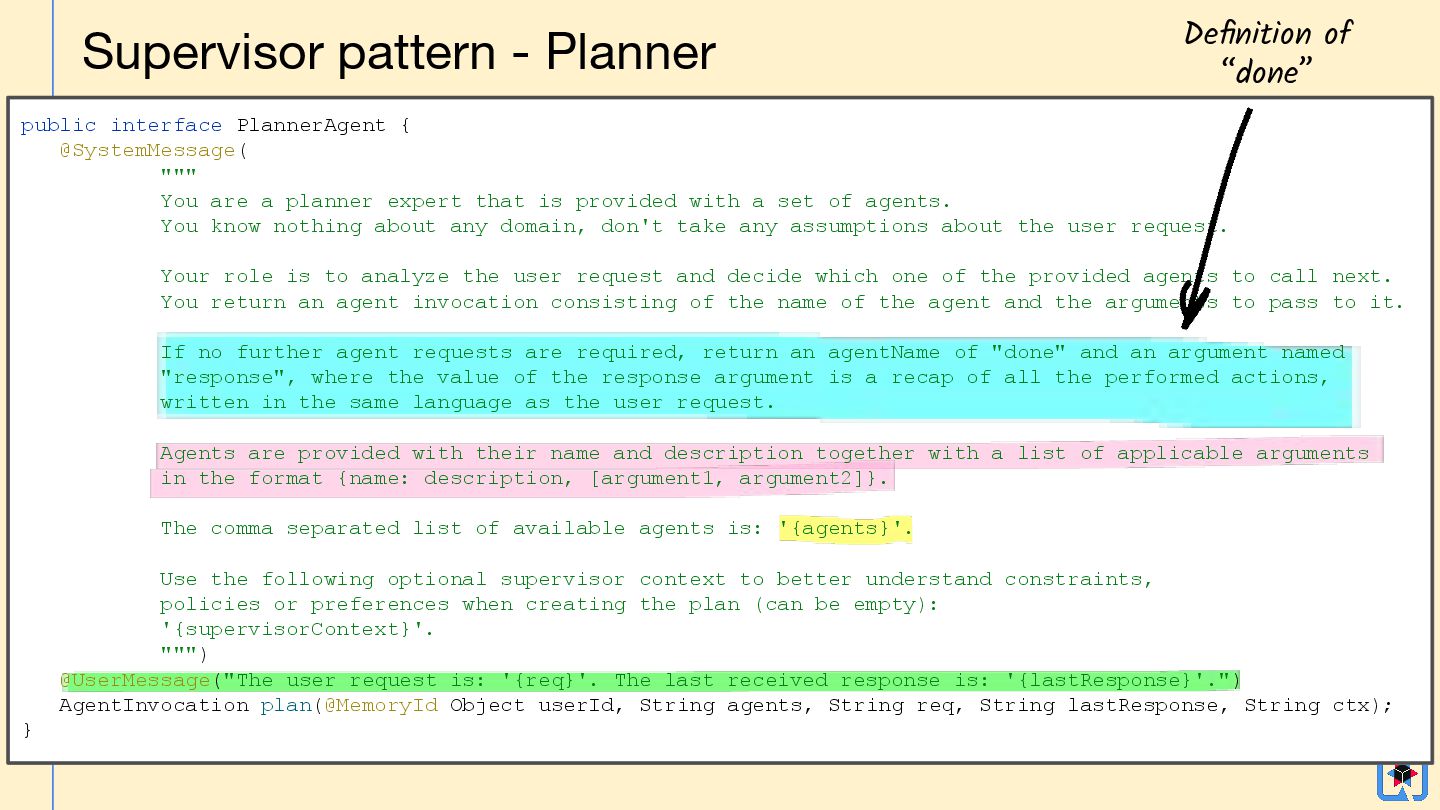
Supervisor pattern - Planner public interface PlannerAgent { @SystemMessage( """
You are a planner expert that is provided with a set of agents. You know nothing about any domain, don't take any assumptions about the user request. Your role is to analyze the user request and decide which one of the provided agents to call next. You return an agent invocation consisting of the name of the agent and the arguments to pass to it. If no further agent requests are required, return an agentName of "done" and an argument named "response", where the value of the response argument is a recap of all the performed actions, written in the same language as the user request. Agents are provided with their name and description together with a list of applicable arguments in the format {name: description, [argument1, argument2]}. The comma separated list of available agents is: '{agents}'. Use the following optional supervisor context to better understand constraints, policies or preferences when creating the plan (can be empty): '{supervisorContext}'. """) @UserMessage("The user request is: '{req}'. The last received response is: '{lastResponse}'.") AgentInvocation plan(@MemoryId Object userId, String agents, String req, String lastResponse, String ctx); } Definition of “done” -
Supervisor pattern - Planner public interface PlannerAgent { @SystemMessage( """
You are a planner expert that is provided with a set of agents. You know nothing about any domain, don't take any assumptions about the user request. Your role is to analyze the user request and decide which one of the provided agents to call next. You return an agent invocation consisting of the name of the agent and the arguments to pass to it. If no further agent requests are required, return an agentName of "done" and an argument named "response", where the value of the response argument is a recap of all the performed actions, written in the same language as the user request. Agents are provided with their name and description together with a list of applicable arguments in the format {name: description, [argument1, argument2]}. The comma separated list of available agents is: '{agents}'. Use the following optional supervisor context to better understand constraints, policies or preferences when creating the plan (can be empty): '{supervisorContext}'. """) @UserMessage("The user request is: '{req}'. The last received response is: '{lastResponse}'.") AgentInvocation plan(@MemoryId Object userId, String agents, String req, String lastResponse, String ctx); } Passing the pool of agents -
Supervisor pattern - Planner public interface PlannerAgent { @SystemMessage( """
You are a planner expert that is provided with a set of agents. You know nothing about any domain, don't take any assumptions about the user request. Your role is to analyze the user request and decide which one of the provided agents to call next. You return an agent invocation consisting of the name of the agent and the arguments to pass to it. If no further agent requests are required, return an agentName of "done" and an argument named "response", where the value of the response argument is a recap of all the performed actions, written in the same language as the user request. Agents are provided with their name and description together with a list of applicable arguments in the format {name: description, [argument1, argument2]}. The comma separated list of available agents is: '{agents}'. Use the following optional supervisor context to better understand constraints, policies or preferences when creating the plan (can be empty): '{supervisorContext}'. """) @UserMessage("The user request is: '{req}'. The last received response is: '{lastResponse}'.") AgentInvocation plan(@MemoryId Object userId, String agents, String req, String lastResponse, String ctx); } User message of the planner -
Input Response Planner Agent A Agent B Agent C Agent
result Agentic Scope (Invocations +results) Pool of agents Done? Response Scorer Response Strategy State Scores Last, Score, Summary Input, response, action summary An Autonomous Agentic AI Case Study – Supervisor pattern -
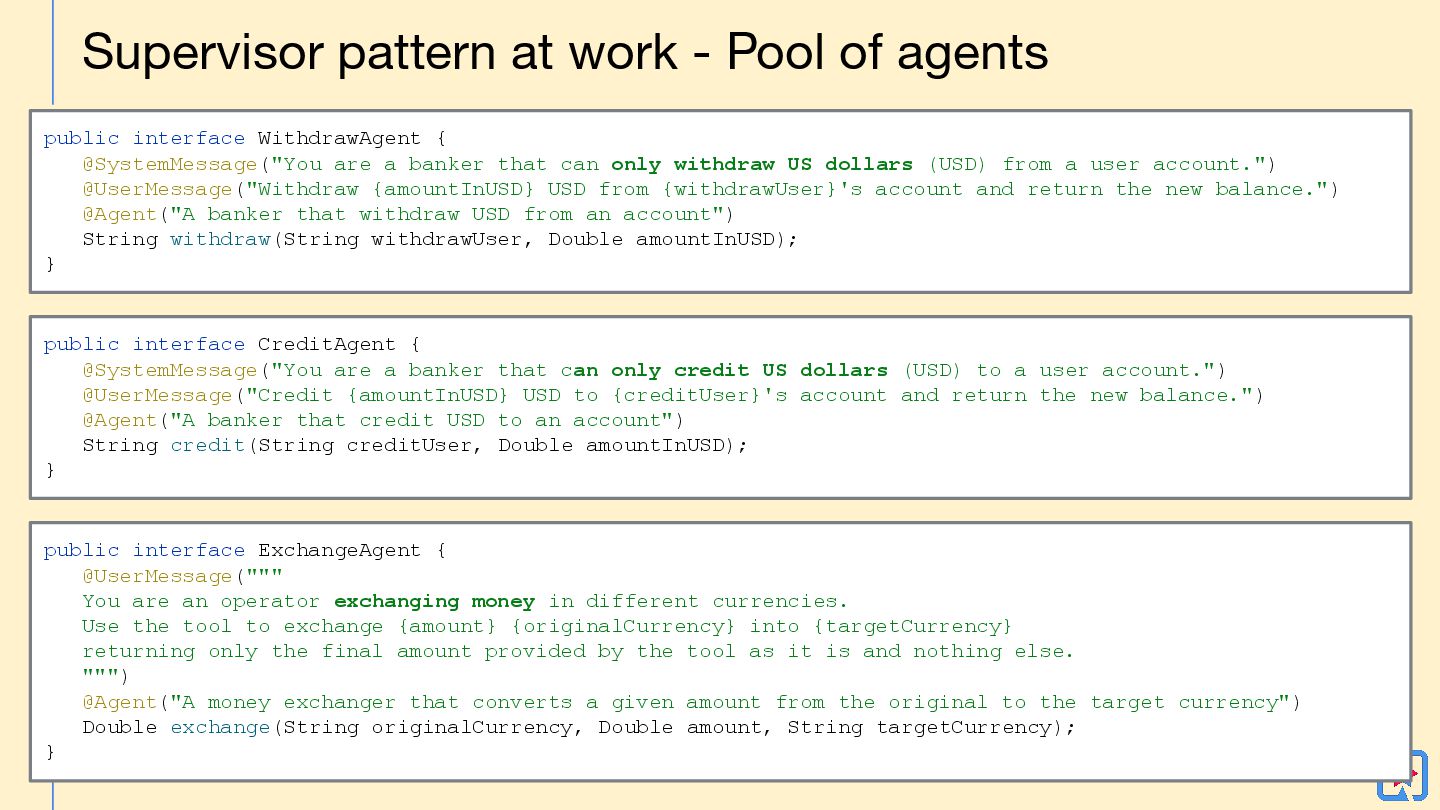
Supervisor pattern at work - Pool of agents public interface
WithdrawAgent { @SystemMessage("You are a banker that can only withdraw US dollars (USD) from a user account.") @UserMessage("Withdraw {amountInUSD} USD from {withdrawUser}'s account and return the new balance.") @Agent("A banker that withdraw USD from an account") String withdraw(String withdrawUser, Double amountInUSD); } public interface CreditAgent { @SystemMessage("You are a banker that can only credit US dollars (USD) to a user account.") @UserMessage("Credit {amountInUSD} USD to {creditUser}'s account and return the new balance.") @Agent("A banker that credit USD to an account") String credit(String creditUser, Double amountInUSD); } public interface ExchangeAgent { @UserMessage(""" You are an operator exchanging money in different currencies. Use the tool to exchange {amount} {originalCurrency} into {targetCurrency} returning only the final amount provided by the tool as it is and nothing else. """) @Agent("A money exchanger that converts a given amount from the original to the target currency") Double exchange(String originalCurrency, Double amount, String targetCurrency); } -
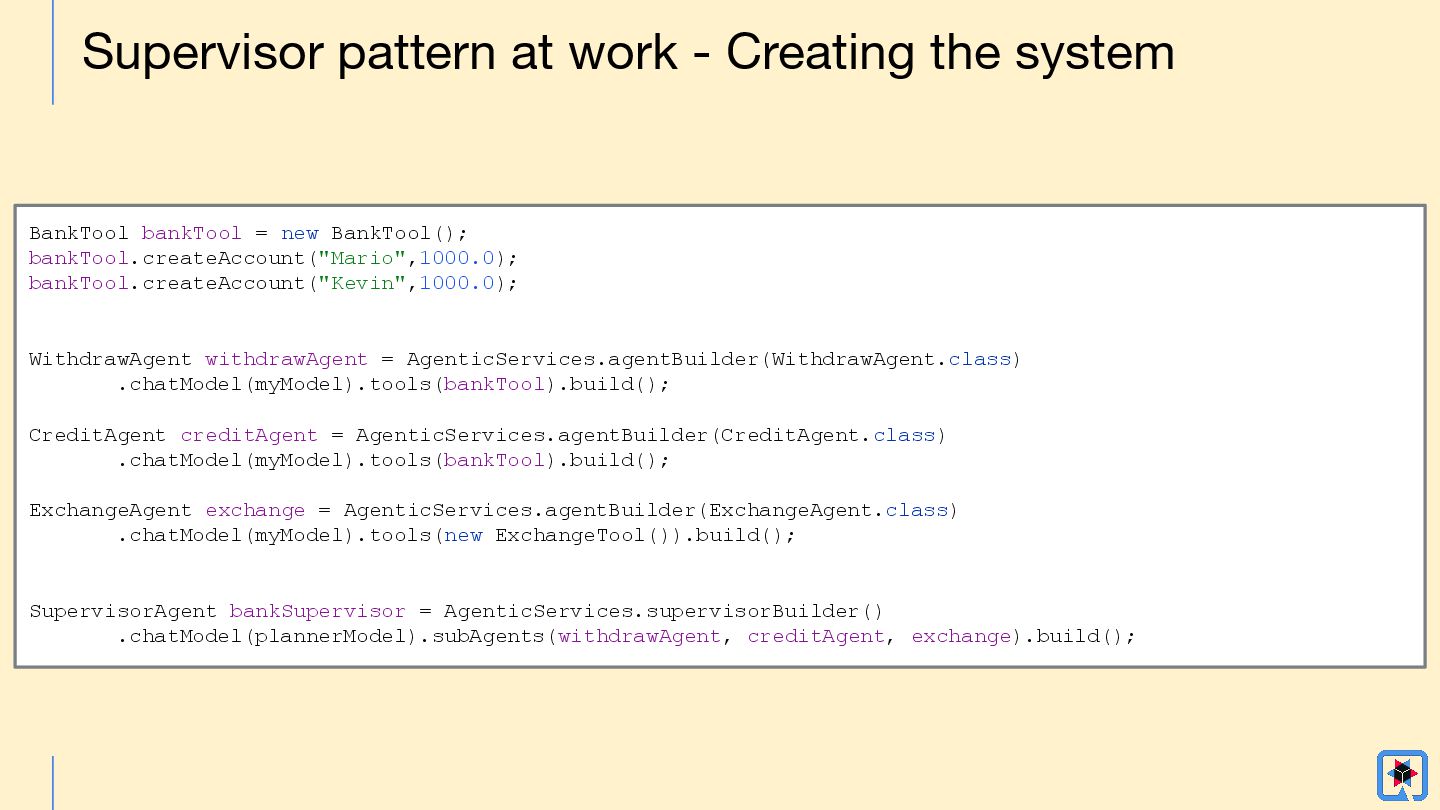
Supervisor pattern at work - Creating the system BankTool bankTool
= new BankTool(); bankTool.createAccount("Mario",1000.0); bankTool.createAccount("Kevin",1000.0); WithdrawAgent withdrawAgent = AgenticServices.agentBuilder(WithdrawAgent.class) .chatModel(myModel).tools(bankTool).build(); CreditAgent creditAgent = AgenticServices.agentBuilder(CreditAgent.class) .chatModel(myModel).tools(bankTool).build(); ExchangeAgent exchange = AgenticServices.agentBuilder(ExchangeAgent.class) .chatModel(myModel).tools(new ExchangeTool()).build(); SupervisorAgent bankSupervisor = AgenticServices.supervisorBuilder() .chatModel(plannerModel).subAgents(withdrawAgent, creditAgent, exchange).build(); -
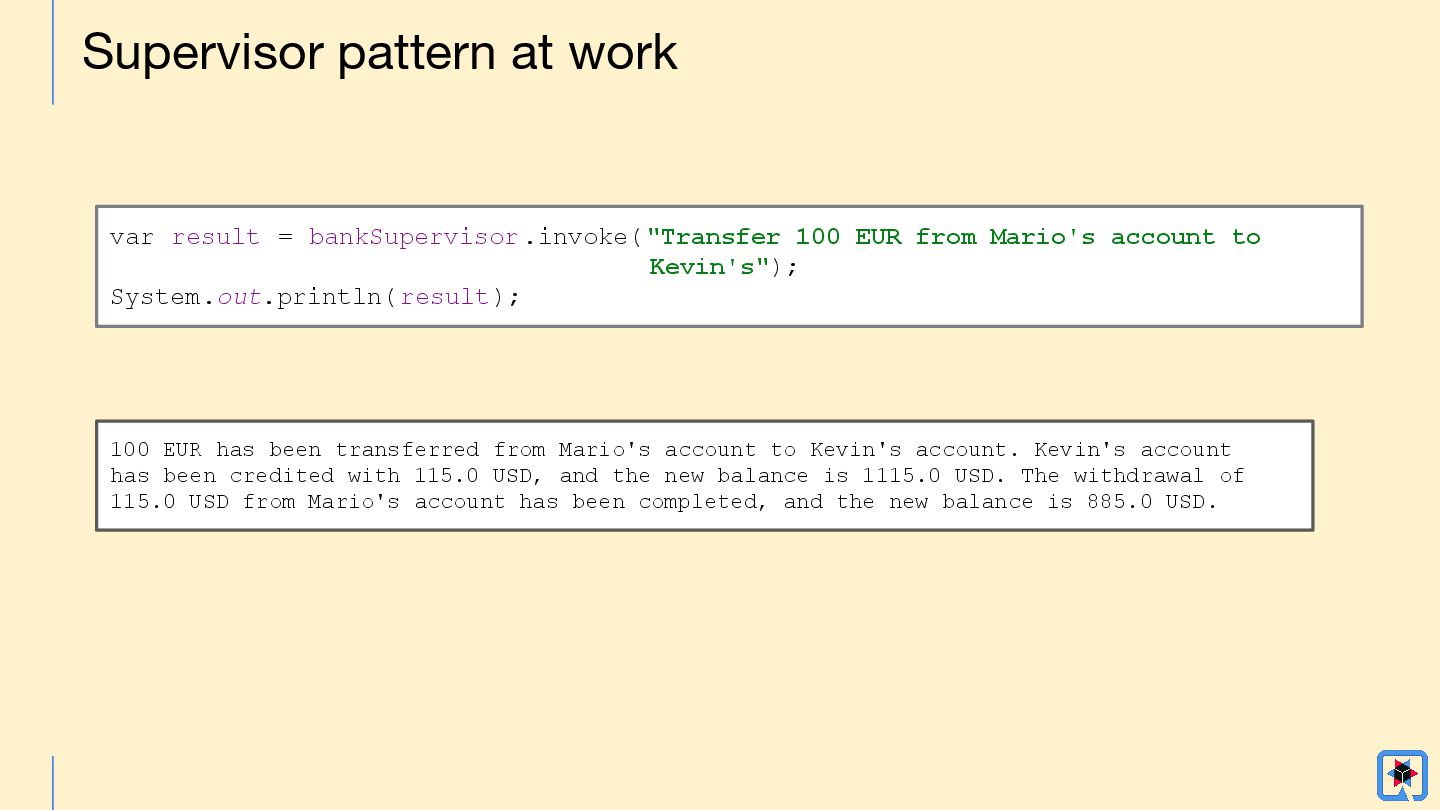
Supervisor pattern at work 100 EUR has been transferred from
Mario's account to Kevin's account. Kevin's account has been credited with 115.0 USD, and the new balance is 1115.0 USD. The withdrawal of 115.0 USD from Mario's account has been completed, and the new balance is 885.0 USD. var result = bankSupervisor .invoke("Transfer 100 EUR from Mario's account to Kevin's"); System.out.println(result); -
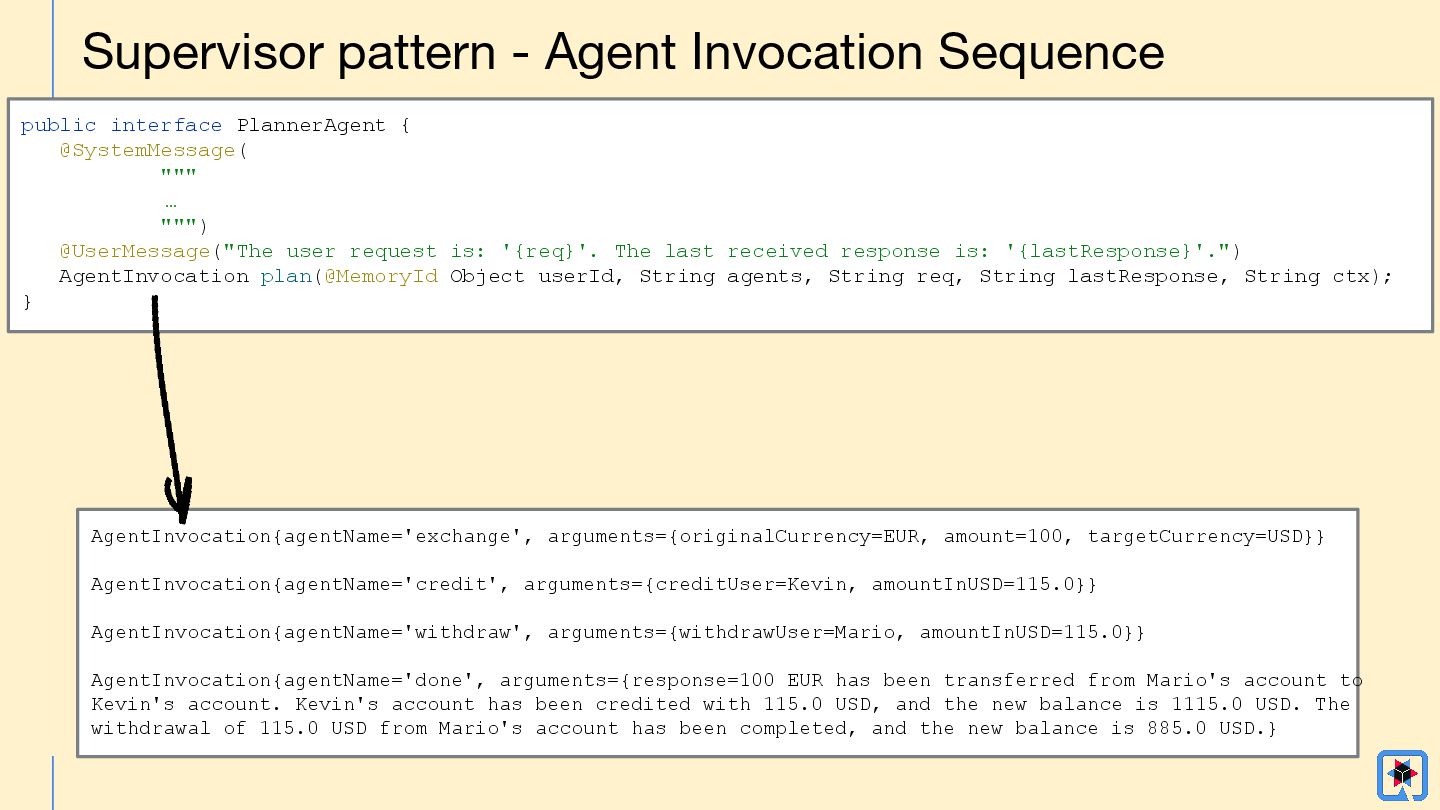
Supervisor pattern - Agent Invocation Sequence public interface PlannerAgent {
@SystemMessage( """ … """) @UserMessage("The user request is: '{req}'. The last received response is: '{lastResponse}'.") AgentInvocation plan(@MemoryId Object userId, String agents, String req, String lastResponse, String ctx); } AgentInvocation{agentName='exchange', arguments={originalCurrency=EUR, amount=100, targetCurrency=USD}} AgentInvocation{agentName='credit', arguments={creditUser=Kevin, amountInUSD=115.0}} AgentInvocation{agentName='withdraw', arguments={withdrawUser=Mario, amountInUSD=115.0}} AgentInvocation{agentName='done', arguments={response=100 EUR has been transferred from Mario's account to Kevin's account. Kevin's account has been credited with 115.0 USD, and the new balance is 1115.0 USD. The withdrawal of 115.0 USD from Mario's account has been completed, and the new balance is 885.0 USD.} -
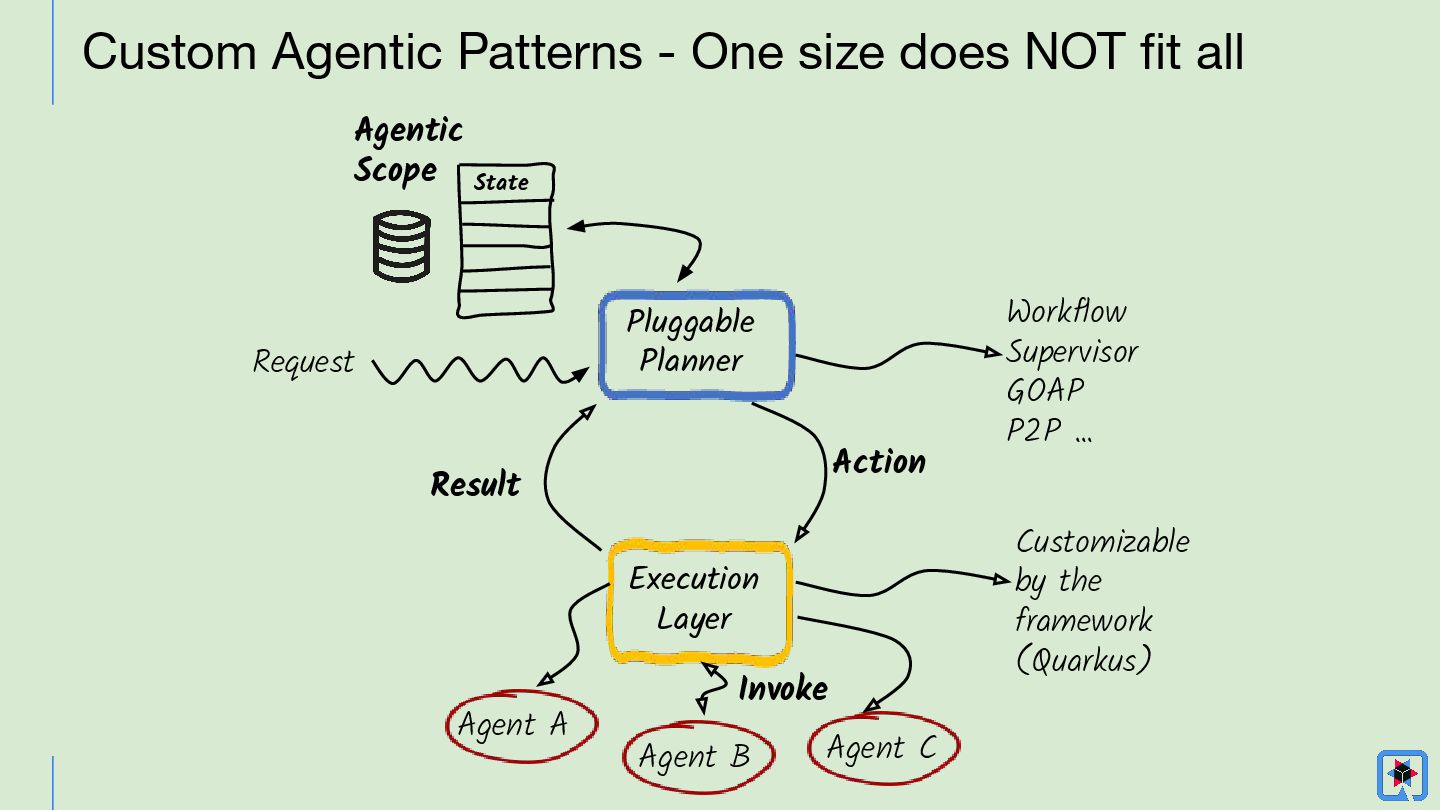
Custom Agentic Patterns - One size does NOT fit all
Pluggable Planner Workflow Supervisor GOAP P2P … Execution Layer Action Result State Agentic Scope Request Invoke Customizable by the framework (Quarkus) Agent A Agent B Agent C -
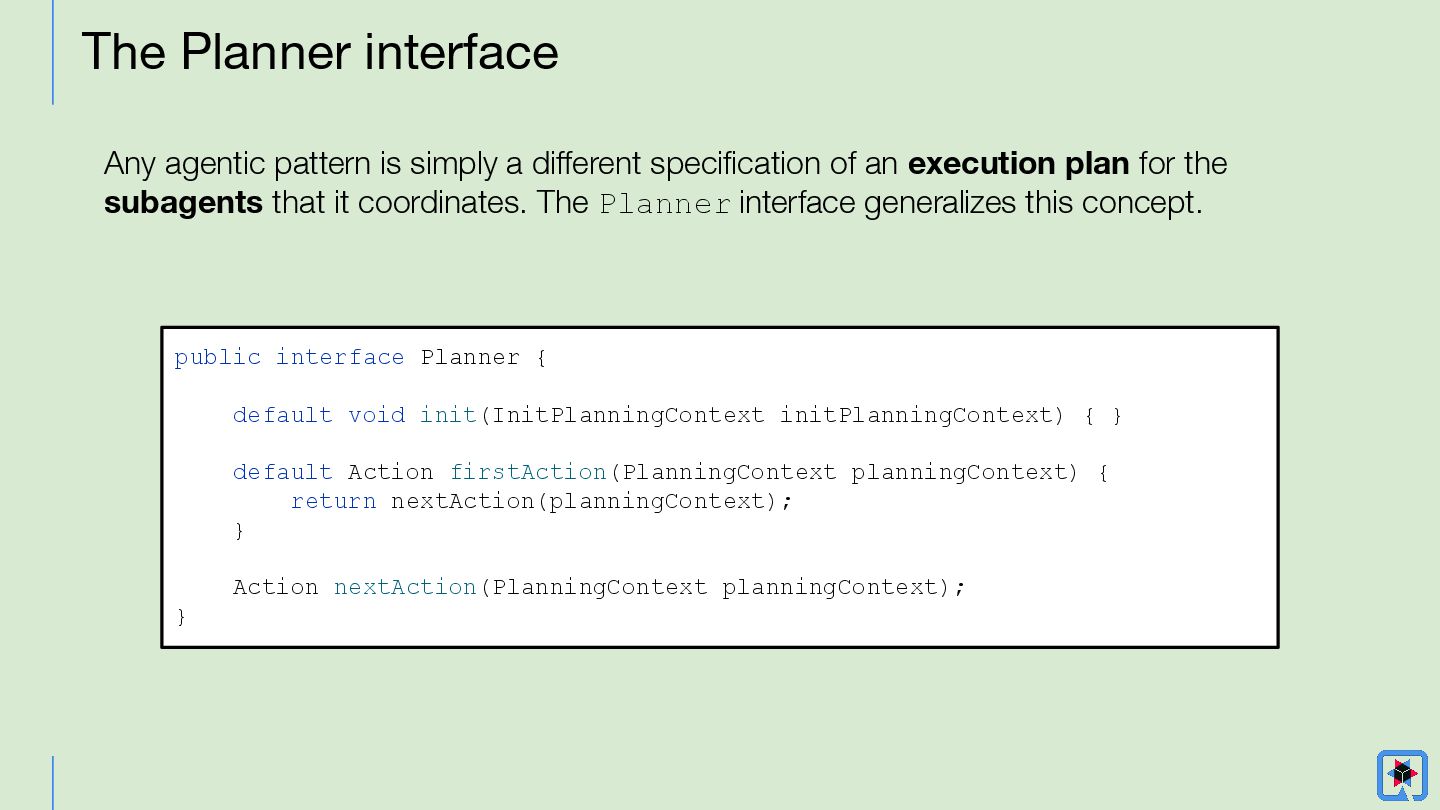
The Planner interface public interface Planner { default void init(InitPlanningContext
initPlanningContext) { } default Action firstAction(PlanningContext planningContext) { return nextAction(planningContext); } Action nextAction(PlanningContext planningContext); } Any agentic pattern is simply a different specification of an execution plan for the subagents that it coordinates. The Planner interface generalizes this concept. -
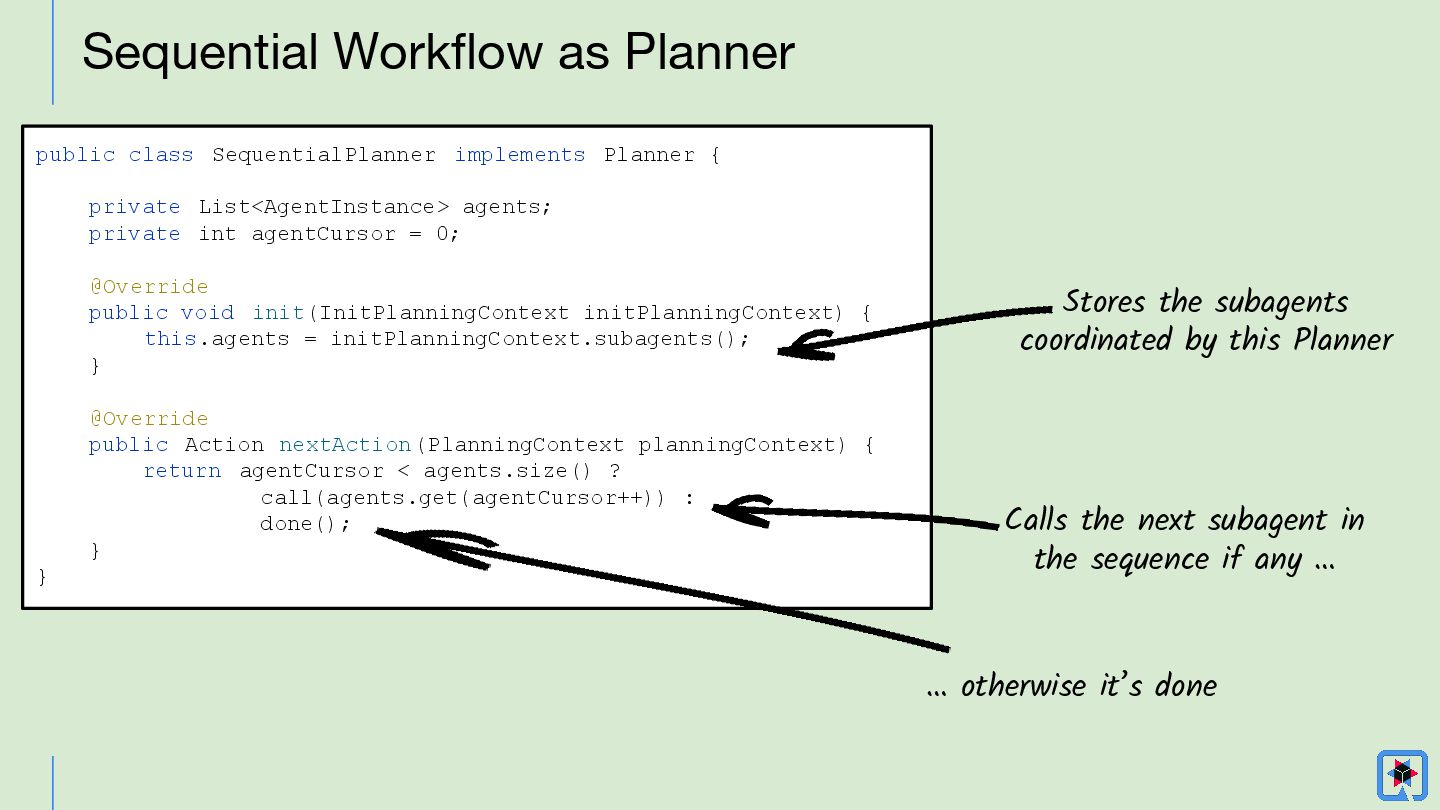
Sequential Workflow as Planner public class SequentialPlanner implements Planner {
private List<AgentInstance> agents; private int agentCursor = 0; @Override public void init(InitPlanningContext initPlanningContext) { this.agents = initPlanningContext.subagents(); } @Override public Action nextAction(PlanningContext planningContext) { return agentCursor < agents.size() ? call(agents.get(agentCursor++)) : done(); } } Stores the subagents coordinated by this Planner Calls the next subagent in the sequence if any … … otherwise it’s done -
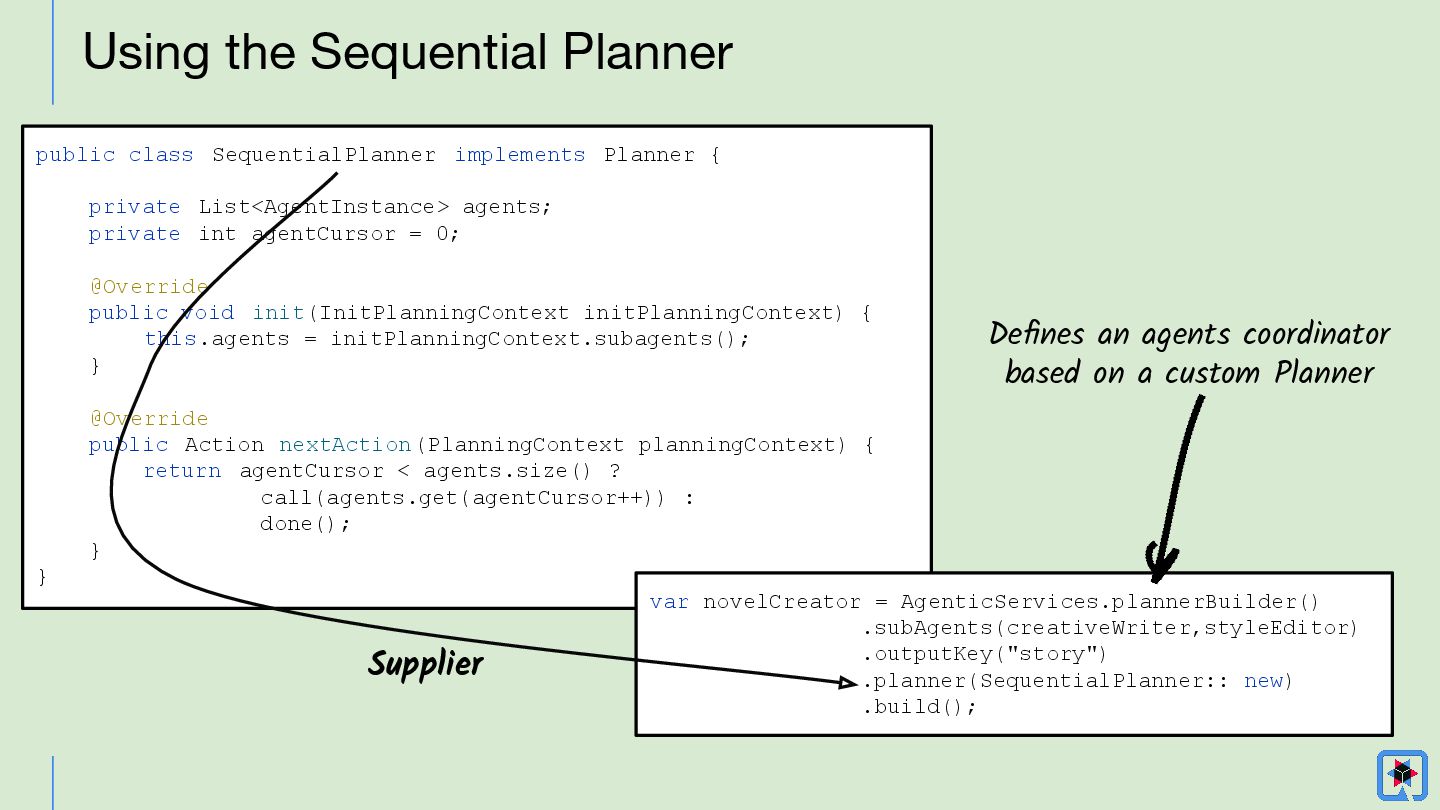
Using the Sequential Planner public class SequentialPlanner implements Planner {
private List<AgentInstance> agents; private int agentCursor = 0; @Override public void init(InitPlanningContext initPlanningContext) { this.agents = initPlanningContext.subagents(); } @Override public Action nextAction(PlanningContext planningContext) { return agentCursor < agents.size() ? call(agents.get(agentCursor++)) : done(); } } var novelCreator = AgenticServices.plannerBuilder() .subAgents(creativeWriter,styleEditor) .outputKey("story") .planner(SequentialPlanner:: new) .build(); Supplier Defines an agents coordinator based on a custom Planner -
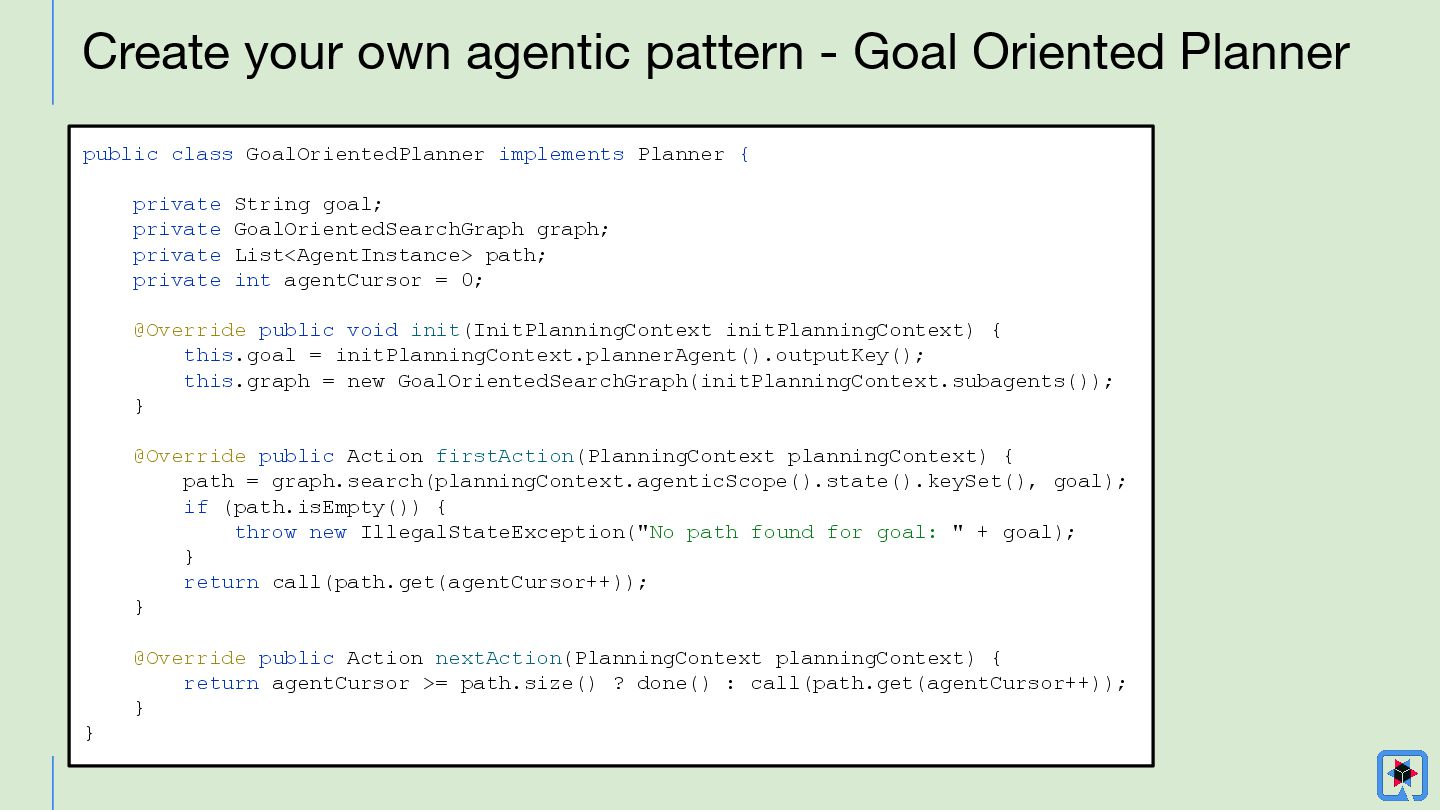
Create your own agentic pattern - Goal Oriented Planner public
class GoalOrientedPlanner implements Planner { private String goal; private GoalOrientedSearchGraph graph; private List<AgentInstance> path; private int agentCursor = 0; @Override public void init(InitPlanningContext initPlanningContext) { this.goal = initPlanningContext.plannerAgent().outputKey(); this.graph = new GoalOrientedSearchGraph(initPlanningContext.subagents()); } @Override public Action firstAction(PlanningContext planningContext) { path = graph.search(planningContext.agenticScope().state().keySet(), goal); if (path.isEmpty()) { throw new IllegalStateException("No path found for goal: " + goal); } return call(path.get(agentCursor++)); } @Override public Action nextAction(PlanningContext planningContext) { return agentCursor >= path.size() ? done() : call(path.get(agentCursor++)); } } -
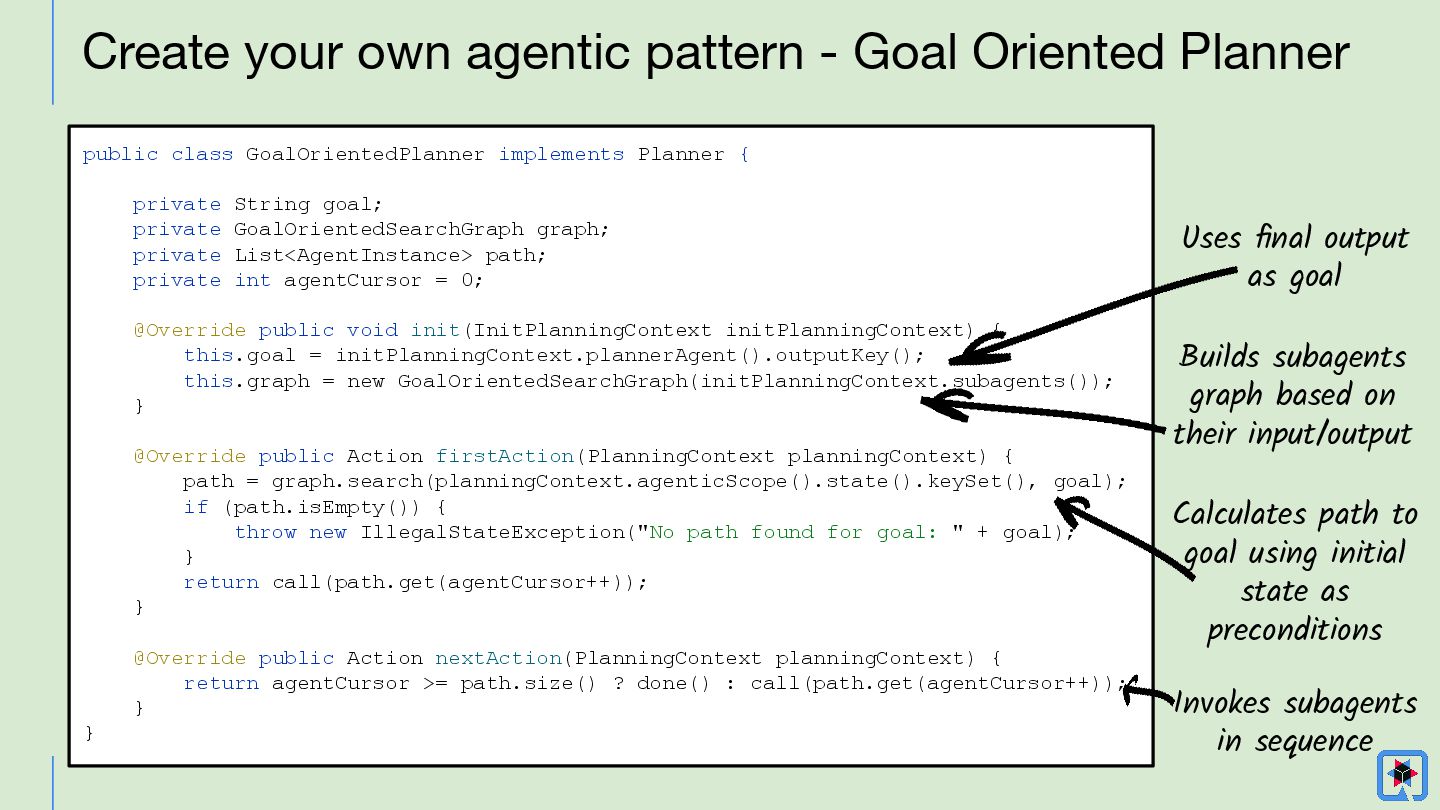
Create your own agentic pattern - Goal Oriented Planner public
class GoalOrientedPlanner implements Planner { private String goal; private GoalOrientedSearchGraph graph; private List<AgentInstance> path; private int agentCursor = 0; @Override public void init(InitPlanningContext initPlanningContext) { this.goal = initPlanningContext.plannerAgent().outputKey(); this.graph = new GoalOrientedSearchGraph(initPlanningContext.subagents()); } @Override public Action firstAction(PlanningContext planningContext) { path = graph.search(planningContext.agenticScope().state().keySet(), goal); if (path.isEmpty()) { throw new IllegalStateException("No path found for goal: " + goal); } return call(path.get(agentCursor++)); } @Override public Action nextAction(PlanningContext planningContext) { return agentCursor >= path.size() ? done() : call(path.get(agentCursor++)); } } Uses final output as goal Builds subagents graph based on their input/output Invokes subagents in sequence Calculates path to goal using initial state as preconditions -
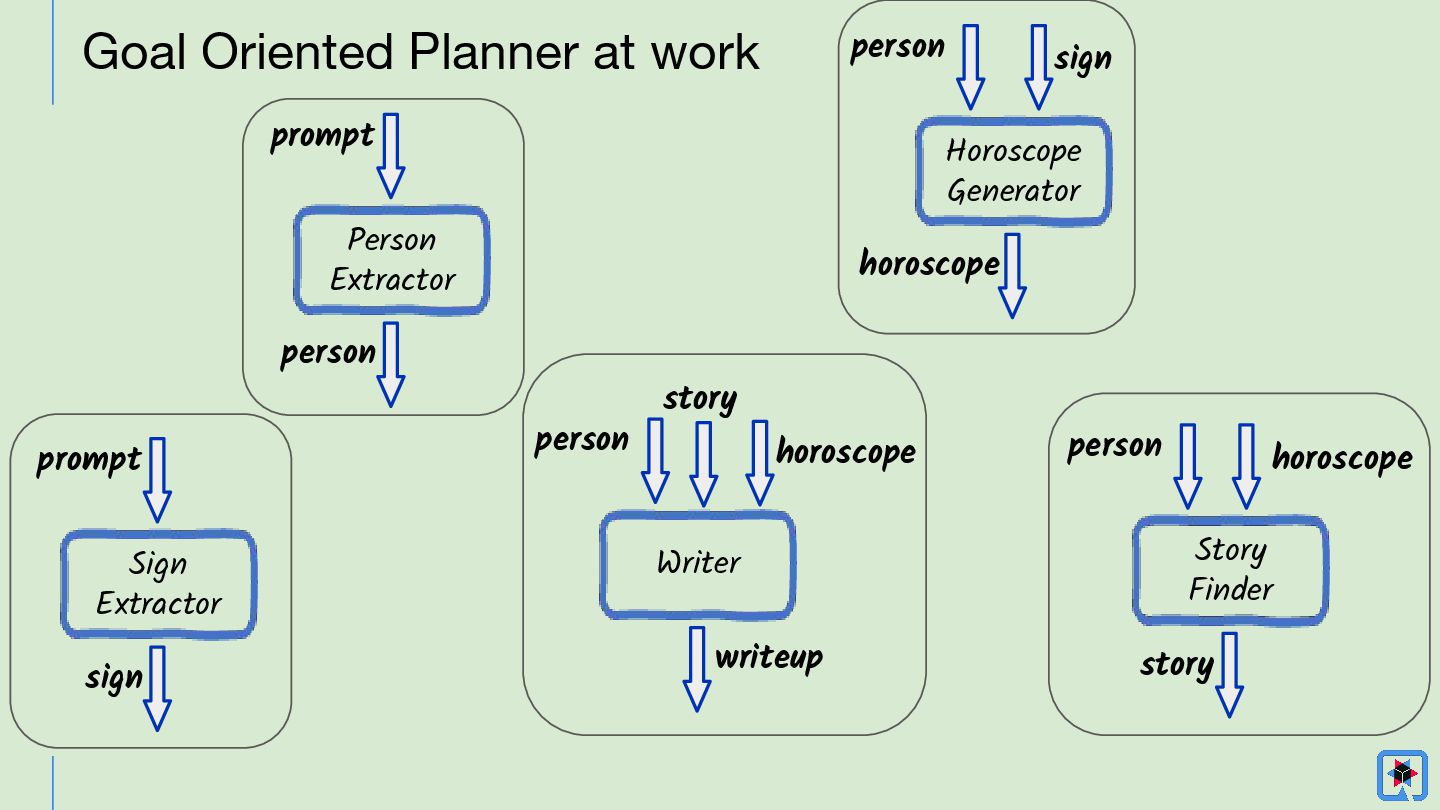
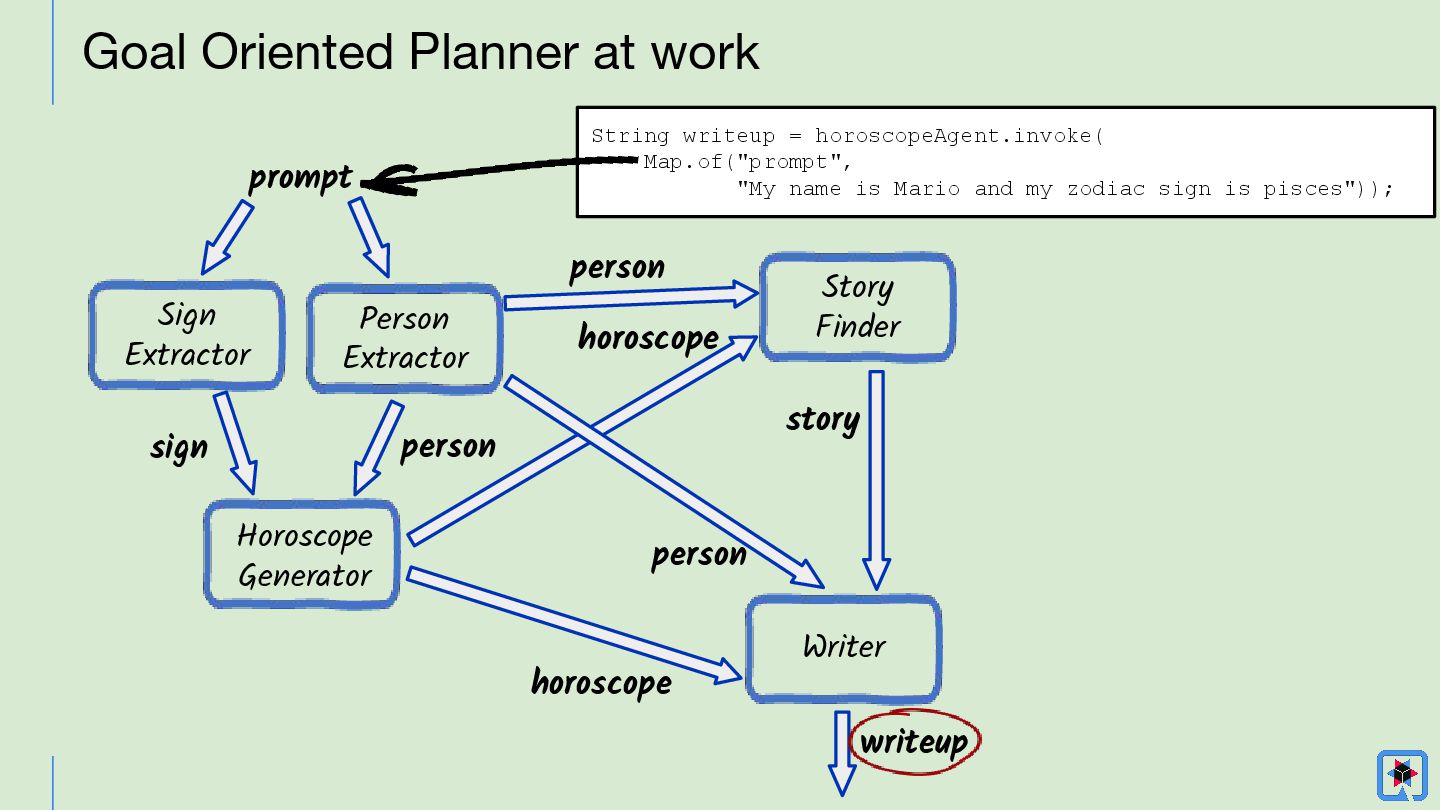
Goal Oriented Planner at work Person Extractor prompt person Sign
Extractor prompt sign Horoscope Generator person horoscope sign Writer person writeup story Story Finder person story horoscope horoscope -
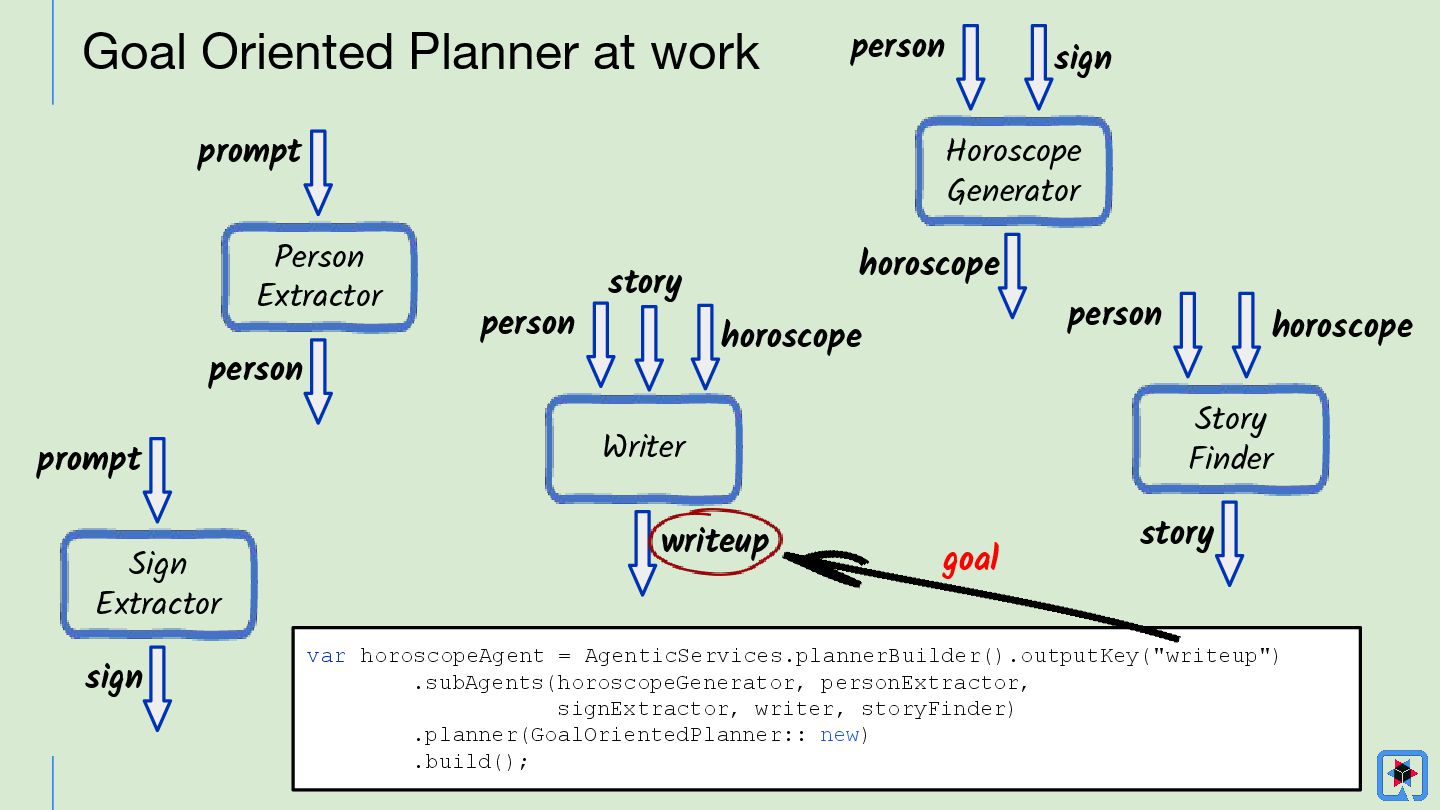
Goal Oriented Planner at work Person Extractor prompt person Sign
Extractor prompt sign Horoscope Generator person horoscope sign Writer person writeup story Story Finder person story horoscope horoscope var horoscopeAgent = AgenticServices.plannerBuilder().outputKey("writeup") .subAgents(horoscopeGenerator, personExtractor, signExtractor, writer, storyFinder) .planner(GoalOrientedPlanner:: new) .build(); goal -
Goal Oriented Planner at work Person Extractor person Sign Extractor
prompt sign Horoscope Generator horoscope Writer person writeup Story Finder story horoscope person String writeup = horoscopeAgent.invoke( Map.of("prompt", "My name is Mario and my zodiac sign is pisces")); -
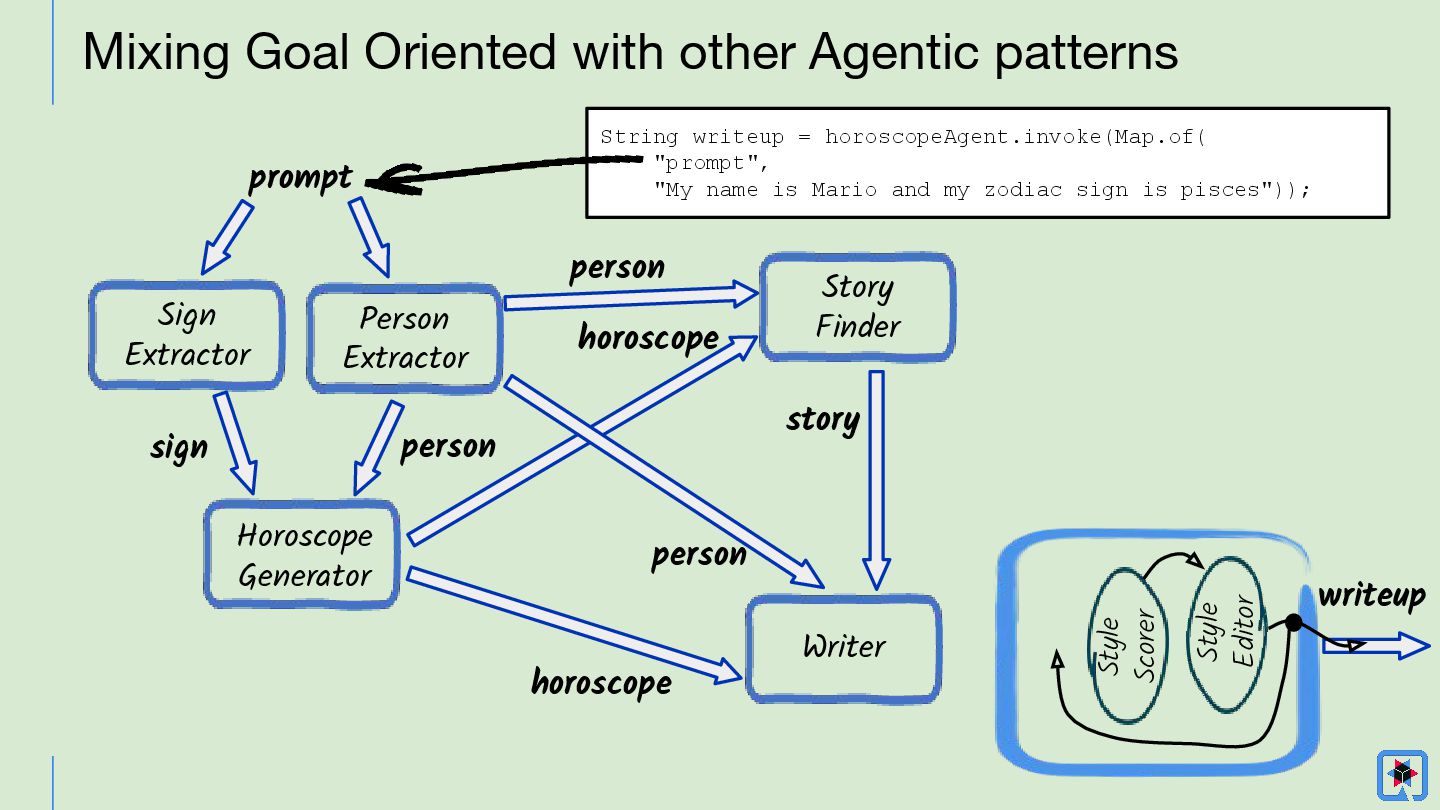
Mixing Goal Oriented with other Agentic patterns Person Extractor person
Sign Extractor prompt sign Horoscope Generator horoscope Writer person Story Finder story writeup horoscope person String writeup = horoscopeAgent.invoke(Map.of( "prompt", "My name is Mario and my zodiac sign is pisces")); Style Scorer Style Editor Style Review Loop unedited writeup -
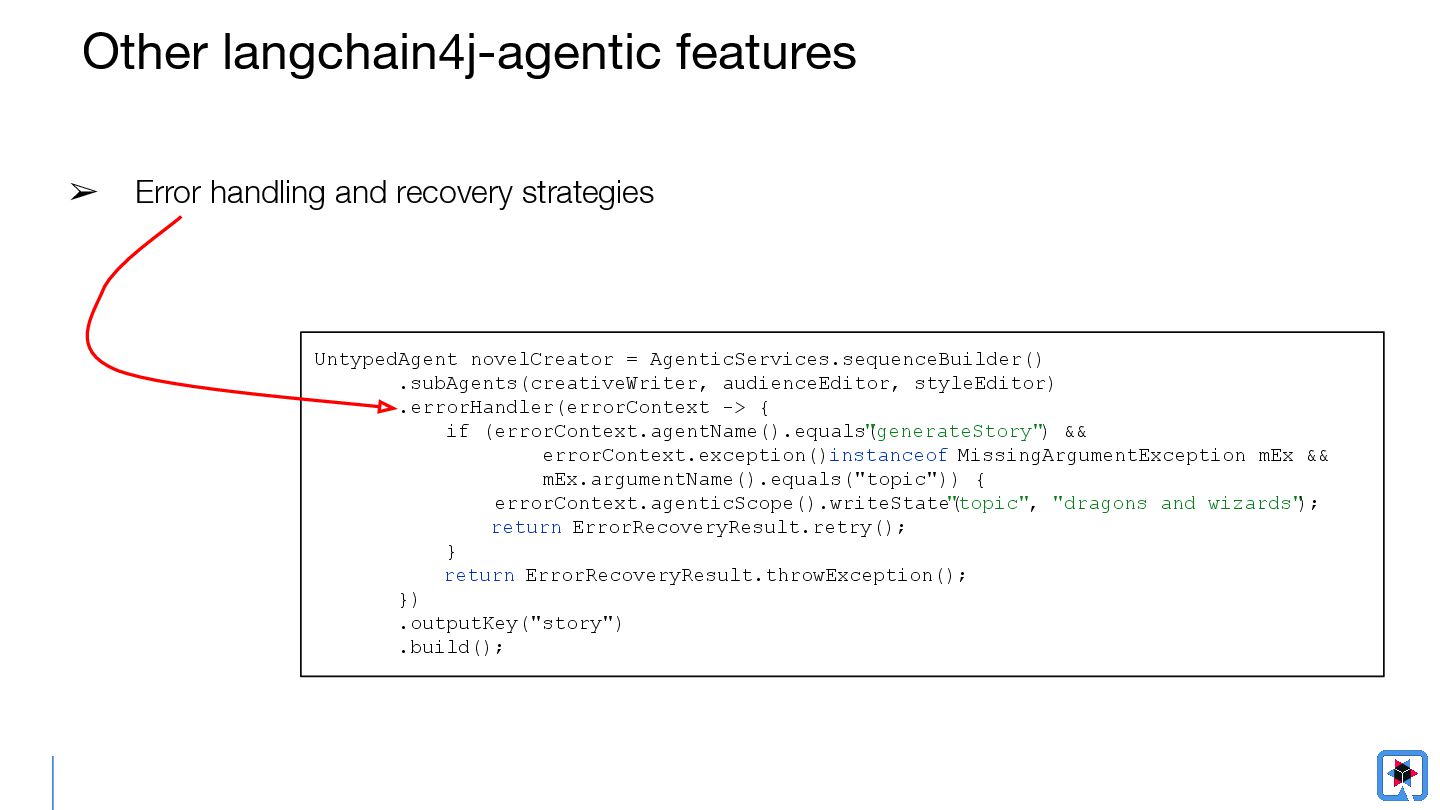
Other langchain4j-agentic features ➢ Error handling and recovery strategies UntypedAgent
novelCreator = AgenticServices.sequenceBuilder() .subAgents(creativeWriter, audienceEditor, styleEditor) .errorHandler(errorContext -> { if (errorContext.agentName().equals( "generateStory" ) && errorContext.exception() instanceof MissingArgumentException mEx && mEx.argumentName().equals("topic")) { errorContext.agenticScope().writeState( "topic", "dragons and wizards" ); return ErrorRecoveryResult.retry(); } return ErrorRecoveryResult.throwException(); }) .outputKey("story") .build(); -
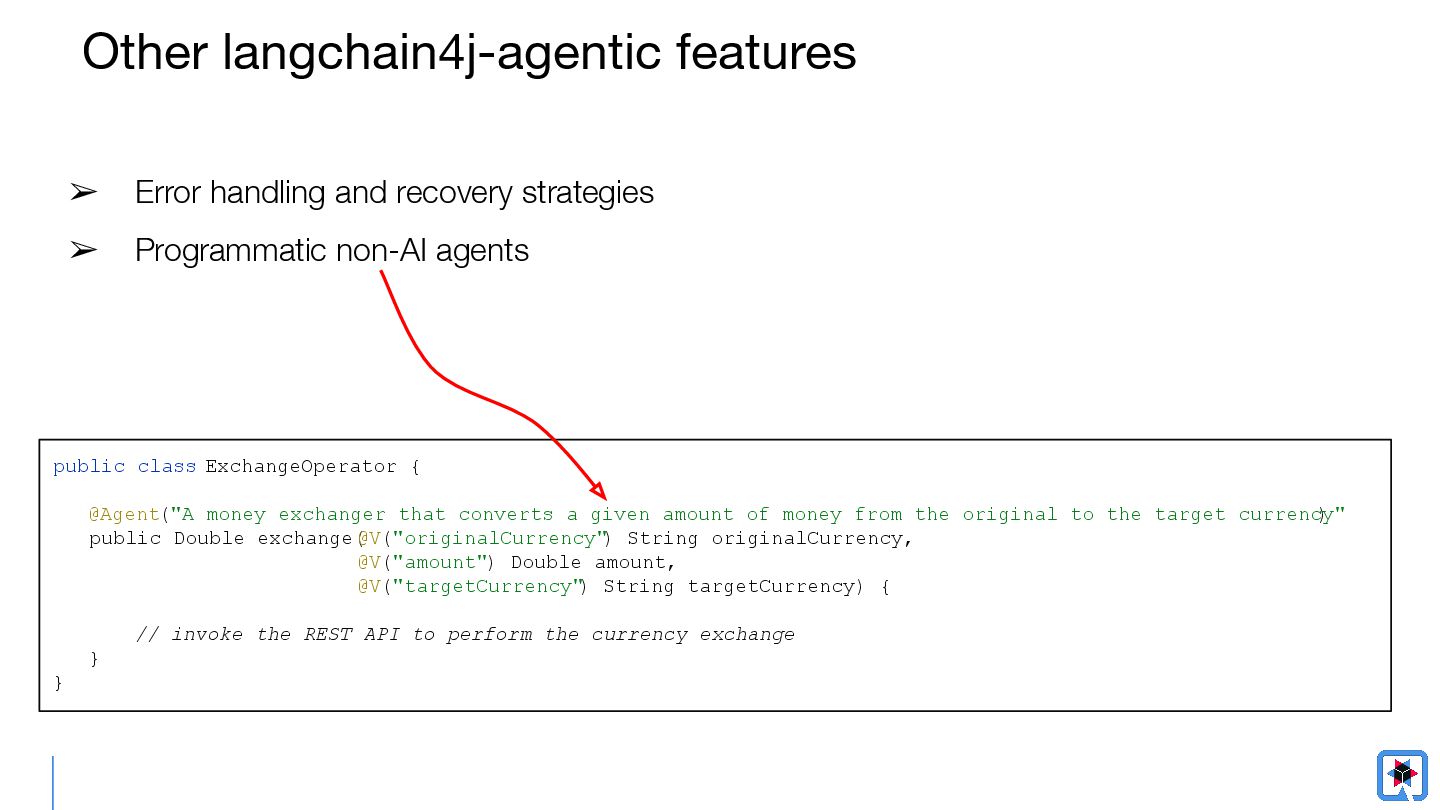
Other langchain4j-agentic features ➢ Error handling and recovery strategies ➢
Programmatic non-AI agents public class ExchangeOperator { @Agent("A money exchanger that converts a given amount of money from the original to the target currency" ) public Double exchange( @V("originalCurrency" ) String originalCurrency, @V("amount") Double amount, @V("targetCurrency" ) String targetCurrency) { // invoke the REST API to perform the currency exchange } } -
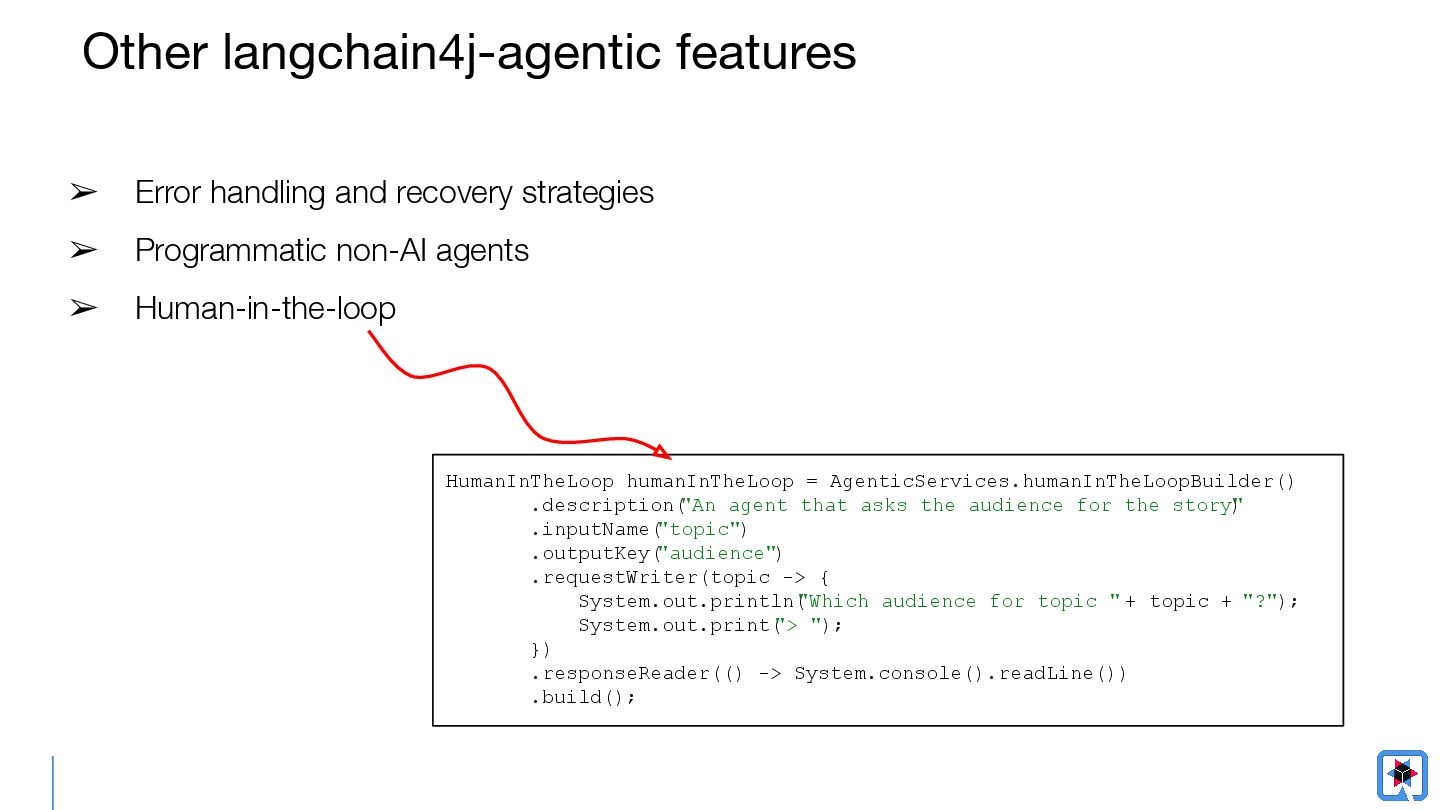
Other langchain4j-agentic features HumanInTheLoop humanInTheLoop = AgenticServices.humanInTheLoopBuilder() .description( "An agent
that asks the audience for the story" ) .inputName( "topic") .outputKey( "audience") .requestWriter(topic -> { System.out.println( "Which audience for topic " + topic + "?"); System.out.print( "> "); }) .responseReader(() -> System.console().readLine()) .build(); ➢ Error handling and recovery strategies ➢ Programmatic non-AI agents ➢ Human-in-the-loop -
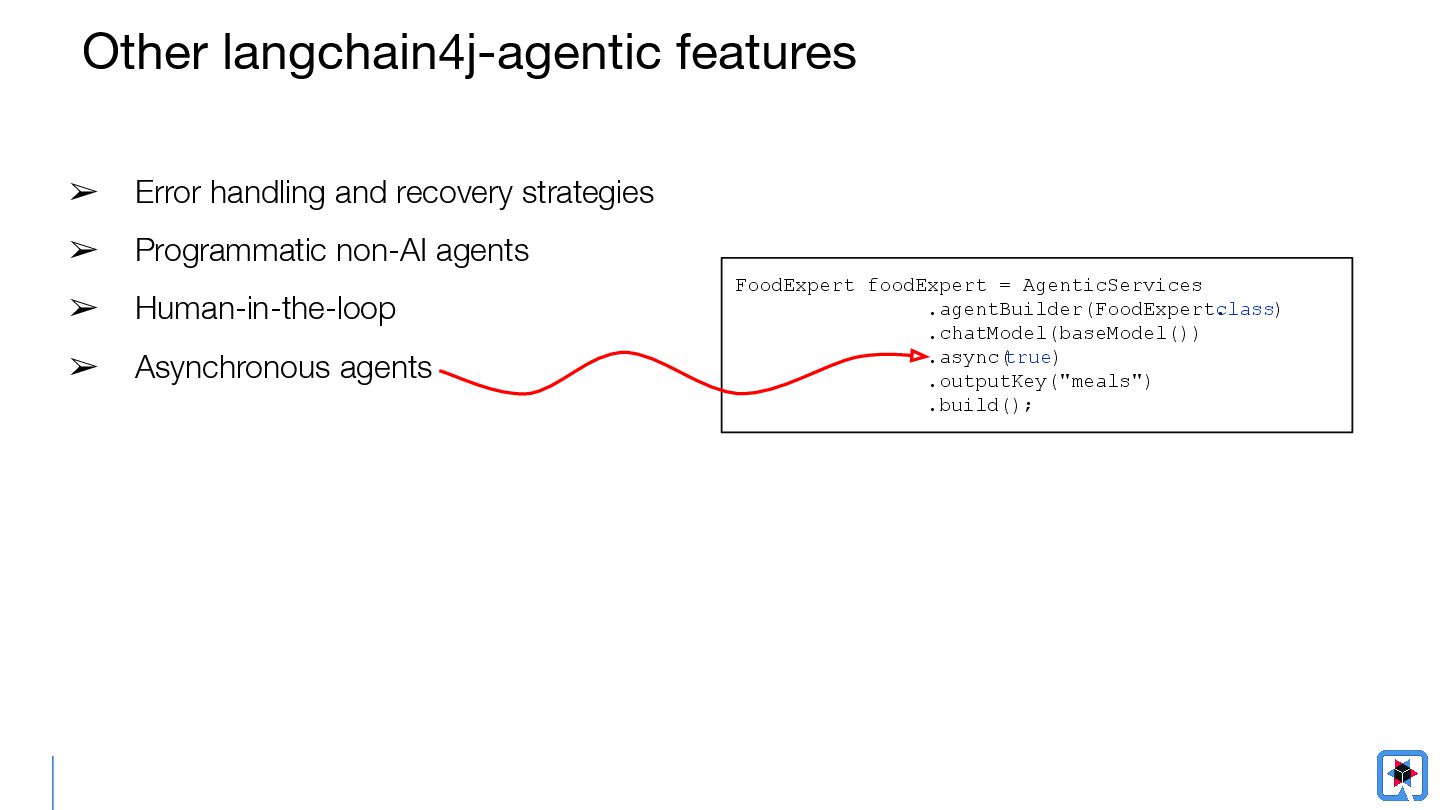
Other langchain4j-agentic features FoodExpert foodExpert = AgenticServices .agentBuilder(FoodExpert. class) .chatModel(baseModel())
.async( true) .outputKey("meals") .build(); ➢ Error handling and recovery strategies ➢ Programmatic non-AI agents ➢ Human-in-the-loop ➢ Asynchronous agents -
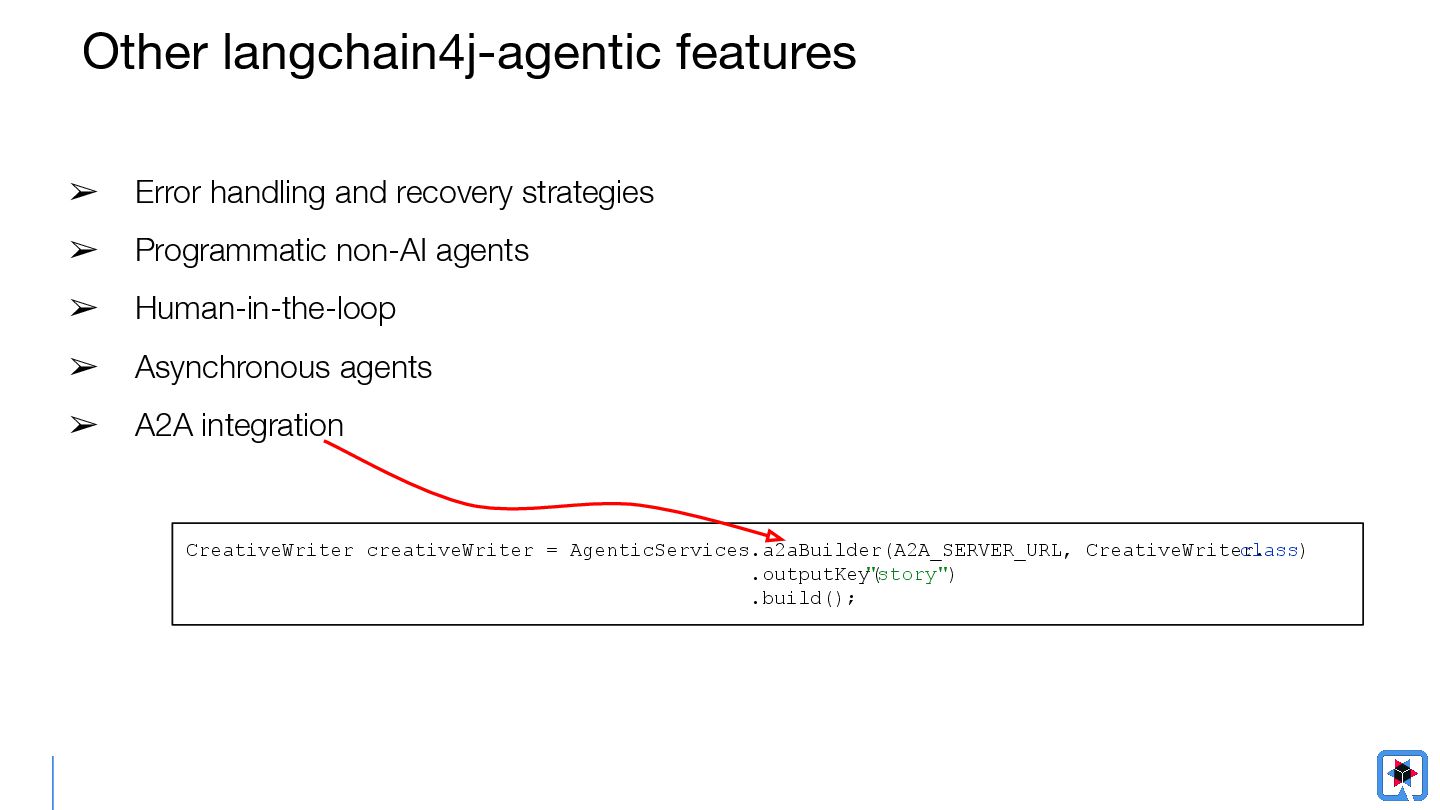
Other langchain4j-agentic features CreativeWriter creativeWriter = AgenticServices.a2aBuilder(A2A_SERVER_URL, CreativeWriter. class) .outputKey(
"story") .build(); ➢ Error handling and recovery strategies ➢ Programmatic non-AI agents ➢ Human-in-the-loop ➢ Asynchronous agents ➢ A2A integration -
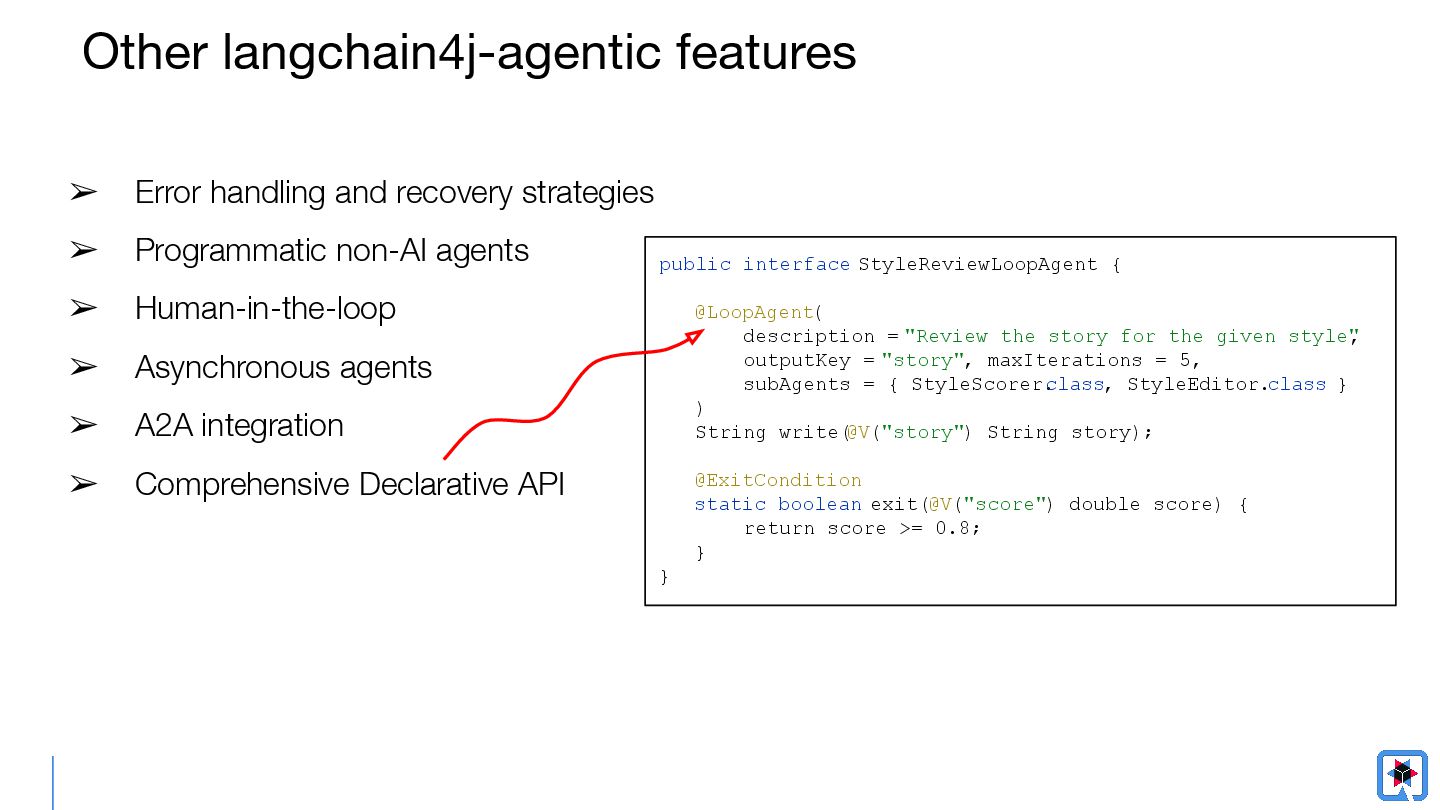
Other langchain4j-agentic features ➢ Error handling and recovery strategies ➢
Programmatic non-AI agents ➢ Human-in-the-loop ➢ Asynchronous agents ➢ A2A integration ➢ Comprehensive Declarative API public interface StyleReviewLoopAgent { @LoopAgent( description = "Review the story for the given style" , outputKey = "story", maxIterations = 5, subAgents = { StyleScorer. class, StyleEditor. class } ) String write( @V("story") String story); @ExitCondition static boolean exit(@V("score") double score) { return score >= 0.8; } } -
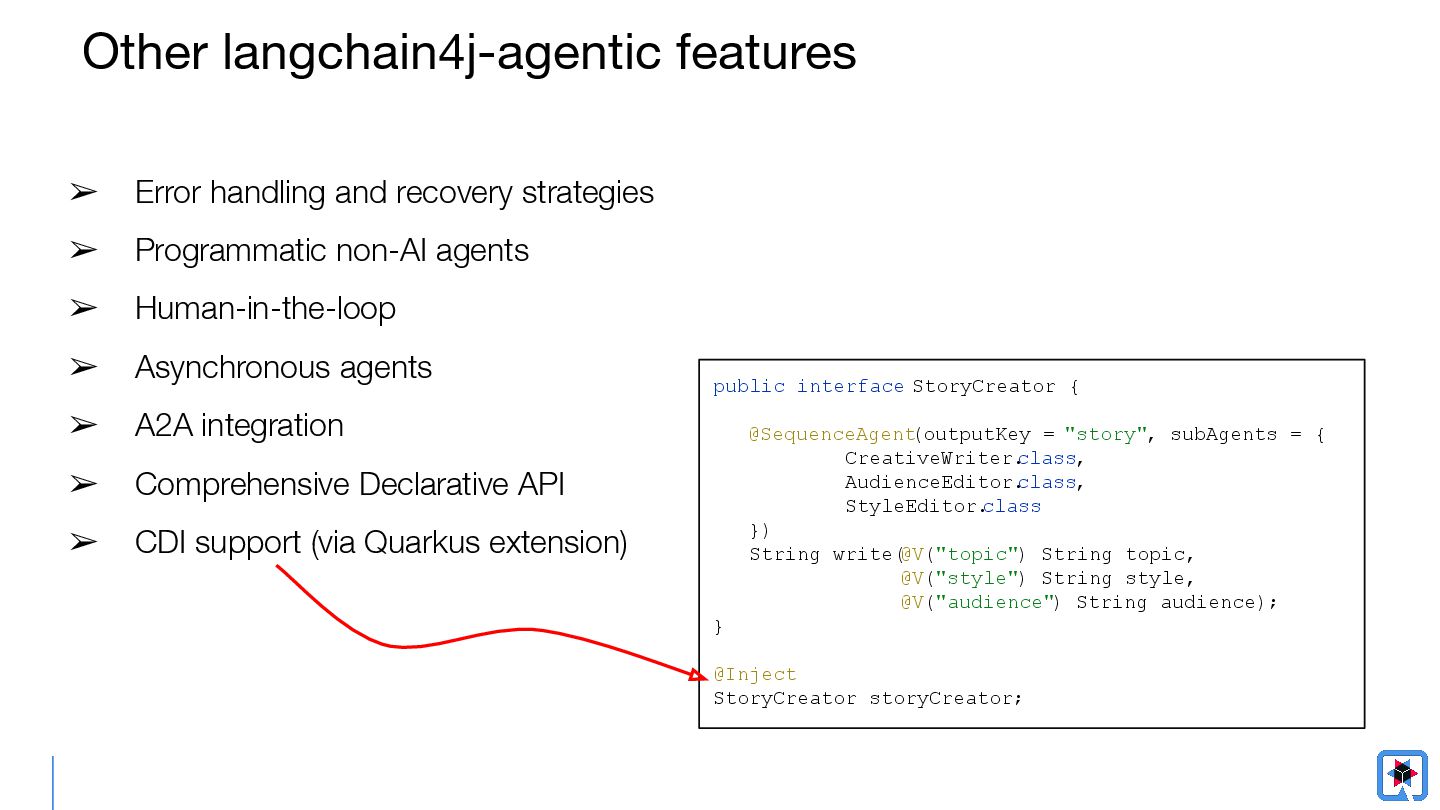
Other langchain4j-agentic features ➢ Error handling and recovery strategies ➢
Programmatic non-AI agents ➢ Human-in-the-loop ➢ Asynchronous agents ➢ A2A integration ➢ Comprehensive Declarative API ➢ CDI support (via Quarkus extension) public interface StoryCreator { @SequenceAgent (outputKey = "story", subAgents = { CreativeWriter. class, AudienceEditor. class, StyleEditor. class }) String write( @V("topic") String topic, @V("style") String style, @V("audience") String audience); } @Inject StoryCreator storyCreator; -
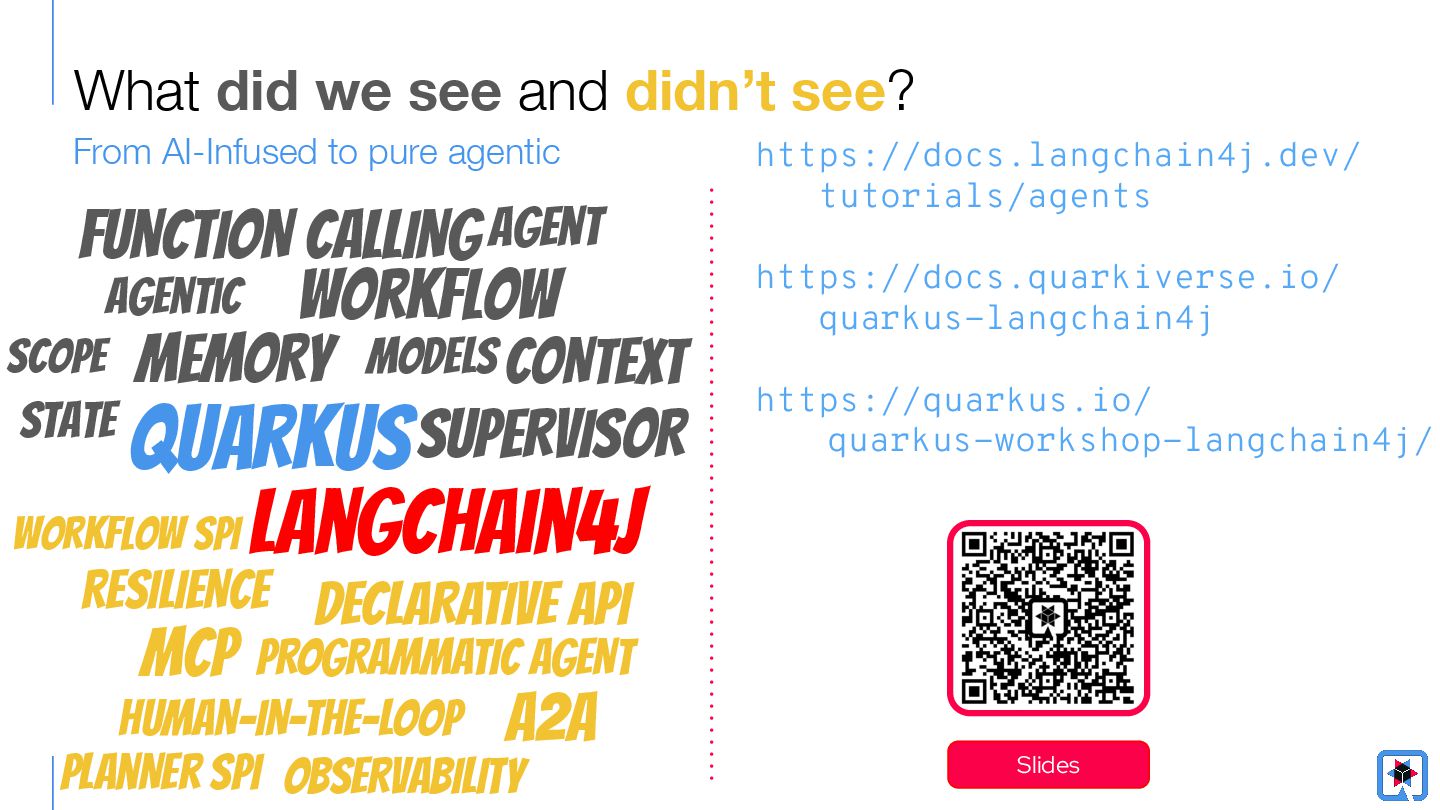
What did we see and didn’t see? From AI-Infused to
pure agentic https://docs.langchain4j.dev/ tutorials/agents https://docs.quarkiverse.io/ quarkus-langchain4j https://quarkus.io/ quarkus-workshop-langchain4j/ Langchain4J Quarkus DECLARATIVE API MEMORY Workflow SUPERVISOR CONTEXT MCP FUNCTION CALLING Agentic MODELS OBSERVABILITY RESILIENCE agent Slides State Scope A2A PROGRAMMATIC AGENT HUMAN-IN-THE-LOOP PlanNer SPI Workflow SPI
 kdubois
 ham0215
 birgitta410
 rlifchitz
 atalie2m
 torounit
 takuyay0ne
 muziyoshiz
 inariku
 pipepasta
 bulbulpaul
 kota2and3kan
 goyoki
 inesmontani
 akihiro_kokubo
 asonas
 moore
 62gerente
 sugarenia
 kimpetersen
 jlugia
 emna__ayadi
 katarinadahlin
 skipperchong