Upgrade to Pro — share decks privately, control downloads, hide ads and more …

Static Analysis in Go

Static Analysis in Go

Talk given at Singapore Gophers meetup on 2014-05-21. Slides and source code at https://bitbucket.org/keyist/static_analysis_in_go-slides

Avatar for keyist

keyist

May 21, 2014

Other Decks in Programming

Transcript

  1. Static analysis Analyze software Without executing it Not limited to

    statically-typed languages! Static Analysis in Go 2 of 29
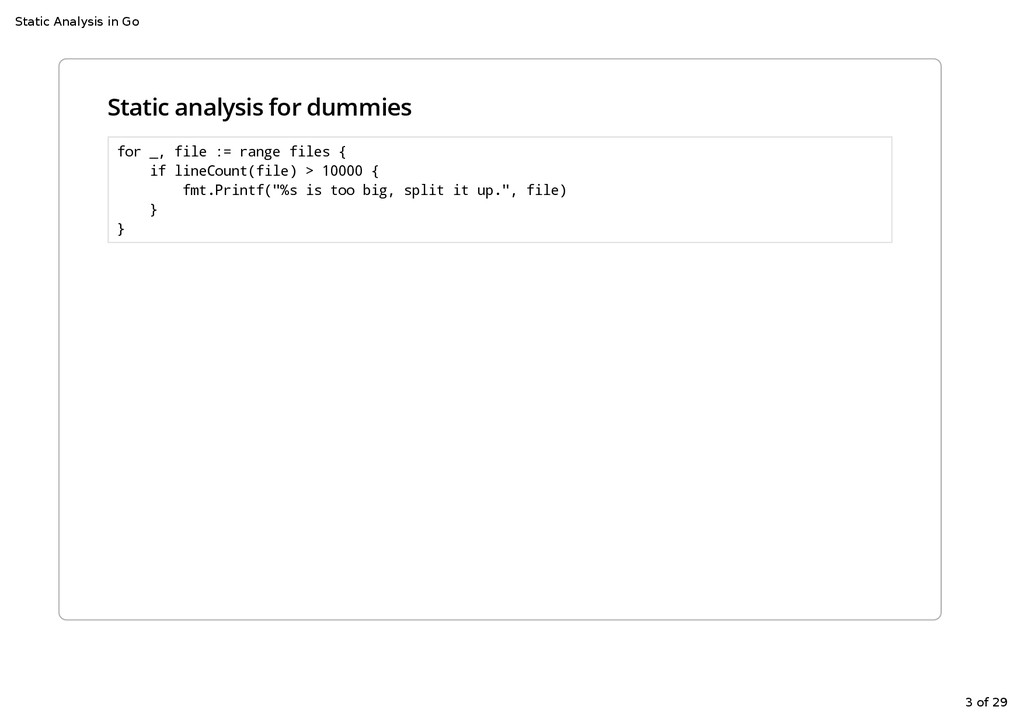
  2. Static analysis for dummies for _, file := range files

    { if lineCount(file) > 10000 { fmt.Printf("%s is too big, split it up.", file) } } Static Analysis in Go 3 of 29
  3. What can you find in automated fashion? repeated definitions repeated

    lines unreachable code complexity heuristics Static Analysis in Go 4 of 29
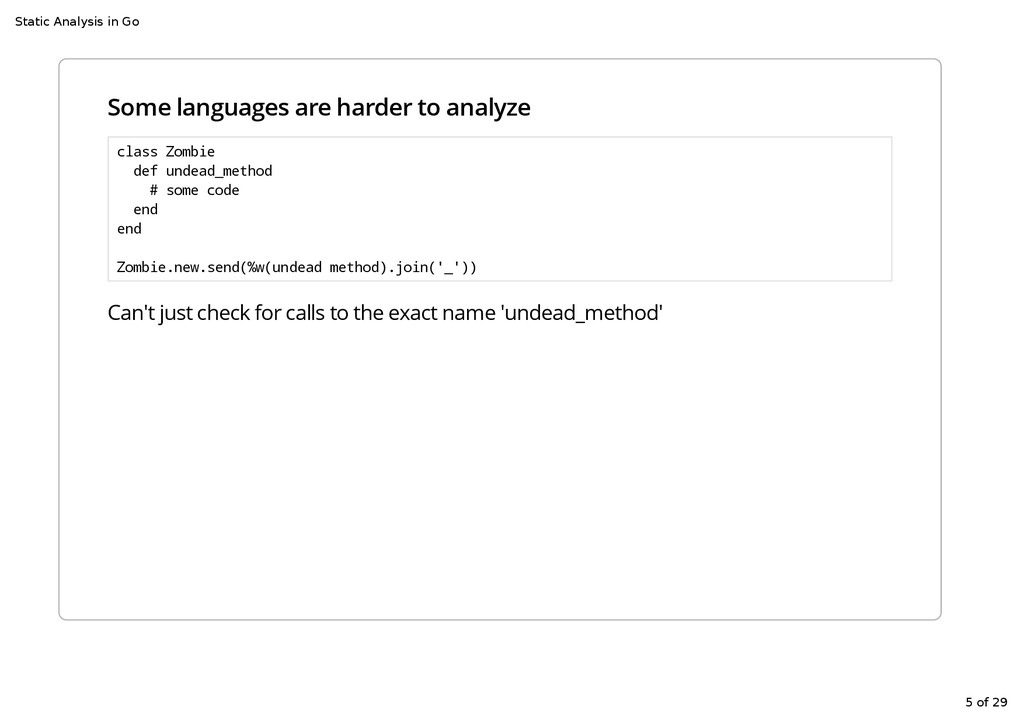
  4. Some languages are harder to analyze class Zombie def undead_method

    # some code end end Zombie.new.send(%w(undead method).join('_')) Can't just check for calls to the exact name 'undead_method' Static Analysis in Go 5 of 29
  5. go tools go fmt go vet go fix `go vet`

    can find unreachable code, amongst other things. Audience participation: in Go, what do you look for to determine unreachable? Static Analysis in Go 9 of 29
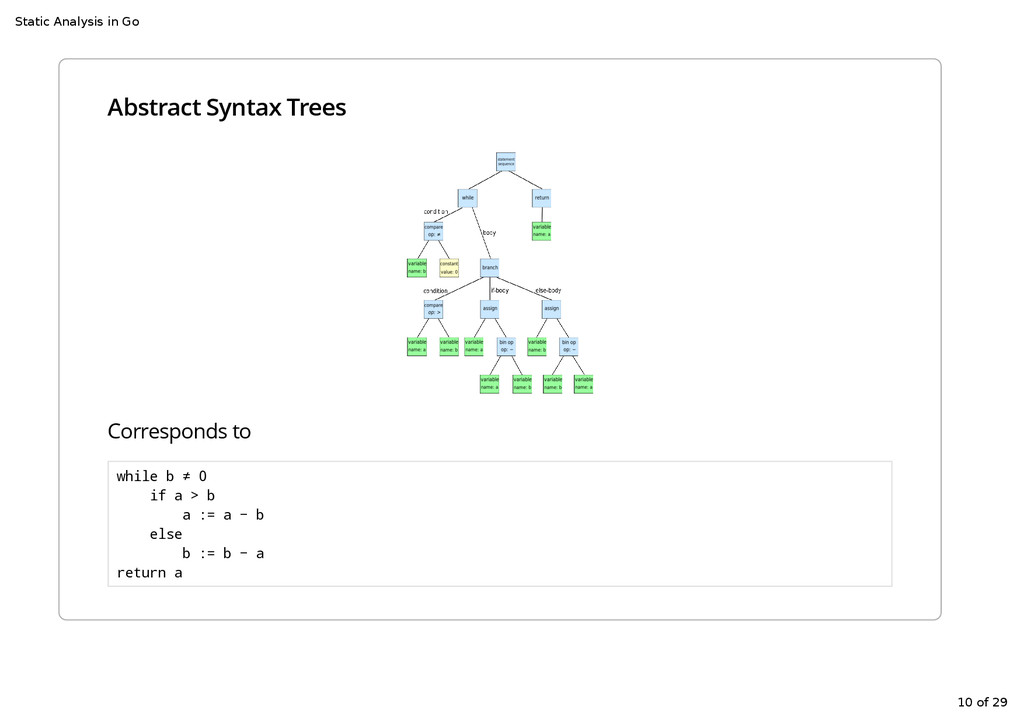
  6. Abstract Syntax Trees Corresponds to while b ≠ 0 if

    a > b a := a − b else b := b − a return a Static Analysis in Go 10 of 29
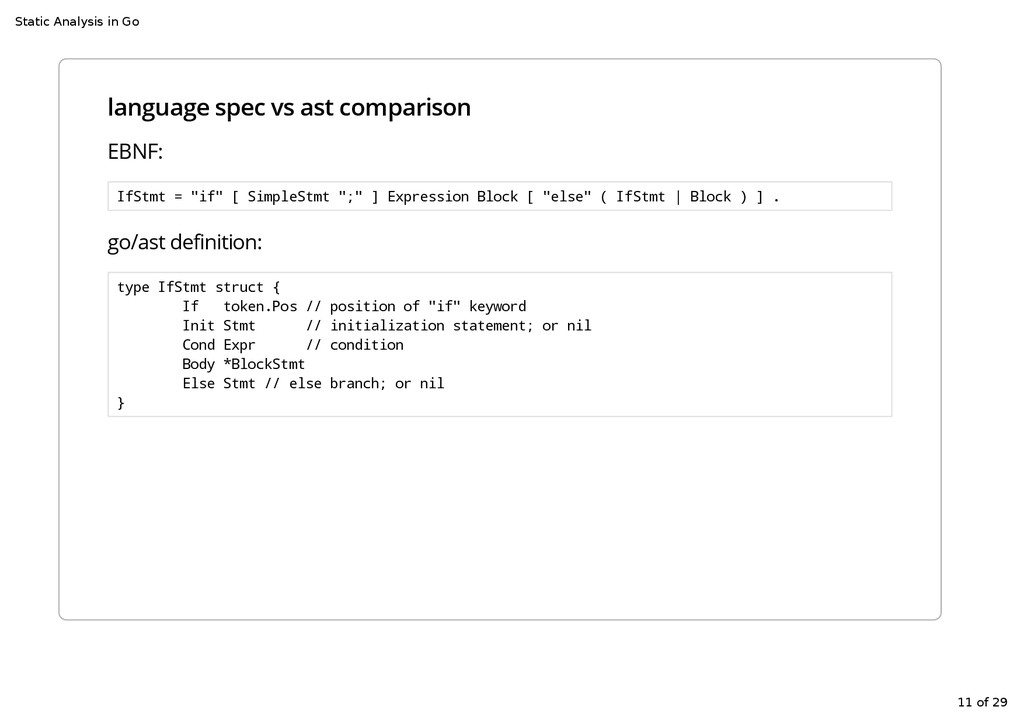
  7. language spec vs ast comparison EBNF: IfStmt = "if" [

    SimpleStmt ";" ] Expression Block [ "else" ( IfStmt | Block ) ] . go/ast definition: type IfStmt struct { If token.Pos // position of "if" keyword Init Stmt // initialization statement; or nil Cond Expr // condition Body *BlockStmt Else Stmt // else branch; or nil } Static Analysis in Go 11 of 29
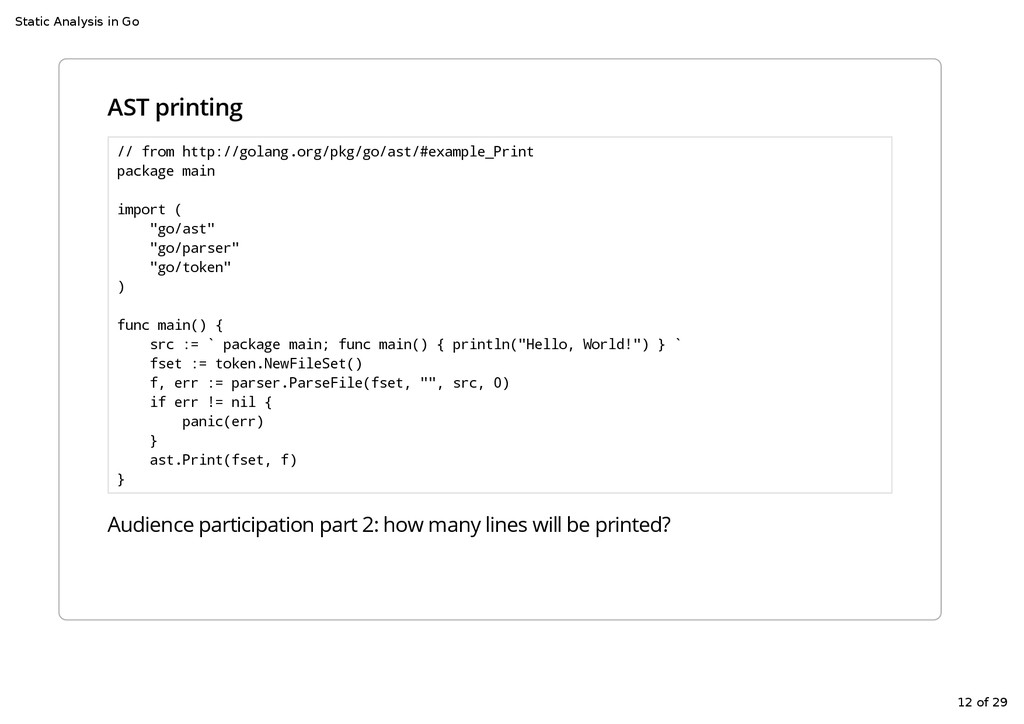
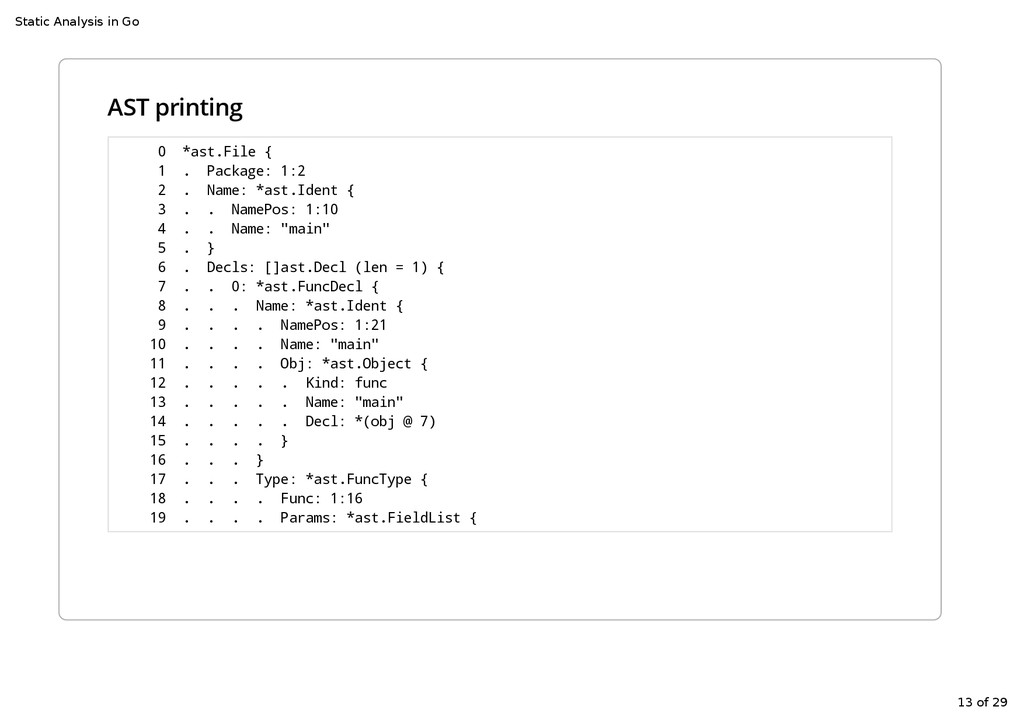
  8. AST printing // from http://golang.org/pkg/go/ast/#example_Print package main import ( "go/ast"

    "go/parser" "go/token" ) func main() { src := ` package main; func main() { println("Hello, World!") } ` fset := token.NewFileSet() f, err := parser.ParseFile(fset, "", src, 0) if err != nil { panic(err) } ast.Print(fset, f) } Audience participation part 2: how many lines will be printed? Static Analysis in Go 12 of 29
  9. AST printing 0 *ast.File { 1 . Package: 1:2 2

    . Name: *ast.Ident { 3 . . NamePos: 1:10 4 . . Name: "main" 5 . } 6 . Decls: []ast.Decl (len = 1) { 7 . . 0: *ast.FuncDecl { 8 . . . Name: *ast.Ident { 9 . . . . NamePos: 1:21 10 . . . . Name: "main" 11 . . . . Obj: *ast.Object { 12 . . . . . Kind: func 13 . . . . . Name: "main" 14 . . . . . Decl: *(obj @ 7) 15 . . . . } 16 . . . } 17 . . . Type: *ast.FuncType { 18 . . . . Func: 1:16 19 . . . . Params: *ast.FieldList { Static Analysis in Go 13 of 29
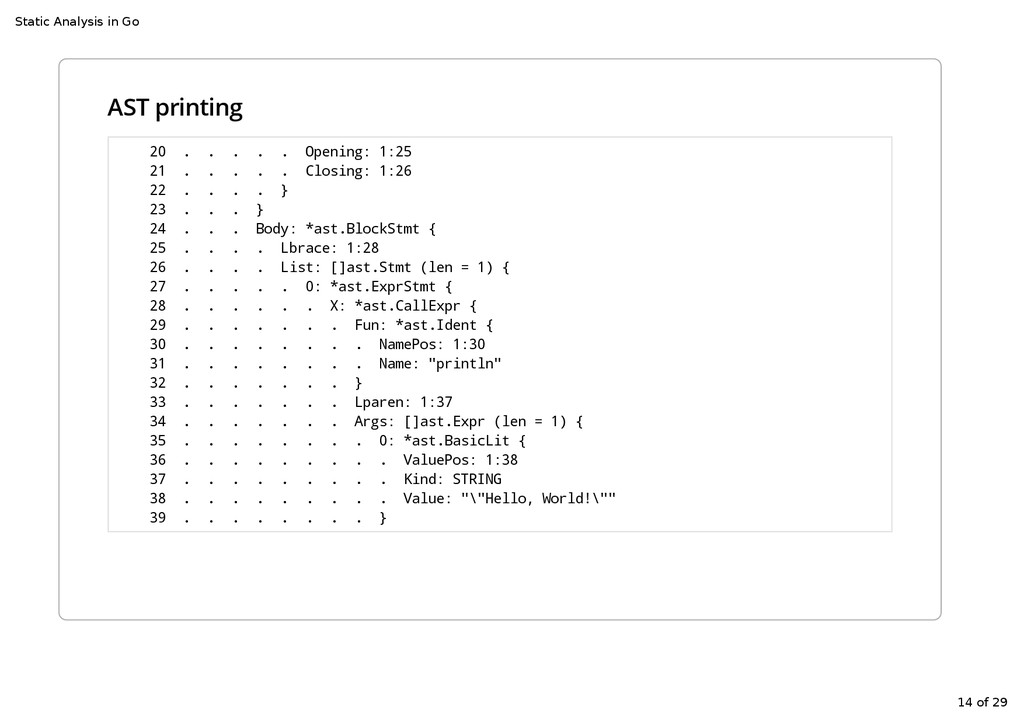
  10. AST printing 20 . . . . . Opening: 1:25

    21 . . . . . Closing: 1:26 22 . . . . } 23 . . . } 24 . . . Body: *ast.BlockStmt { 25 . . . . Lbrace: 1:28 26 . . . . List: []ast.Stmt (len = 1) { 27 . . . . . 0: *ast.ExprStmt { 28 . . . . . . X: *ast.CallExpr { 29 . . . . . . . Fun: *ast.Ident { 30 . . . . . . . . NamePos: 1:30 31 . . . . . . . . Name: "println" 32 . . . . . . . } 33 . . . . . . . Lparen: 1:37 34 . . . . . . . Args: []ast.Expr (len = 1) { 35 . . . . . . . . 0: *ast.BasicLit { 36 . . . . . . . . . ValuePos: 1:38 37 . . . . . . . . . Kind: STRING 38 . . . . . . . . . Value: "\"Hello, World!\"" 39 . . . . . . . . } Static Analysis in Go 14 of 29
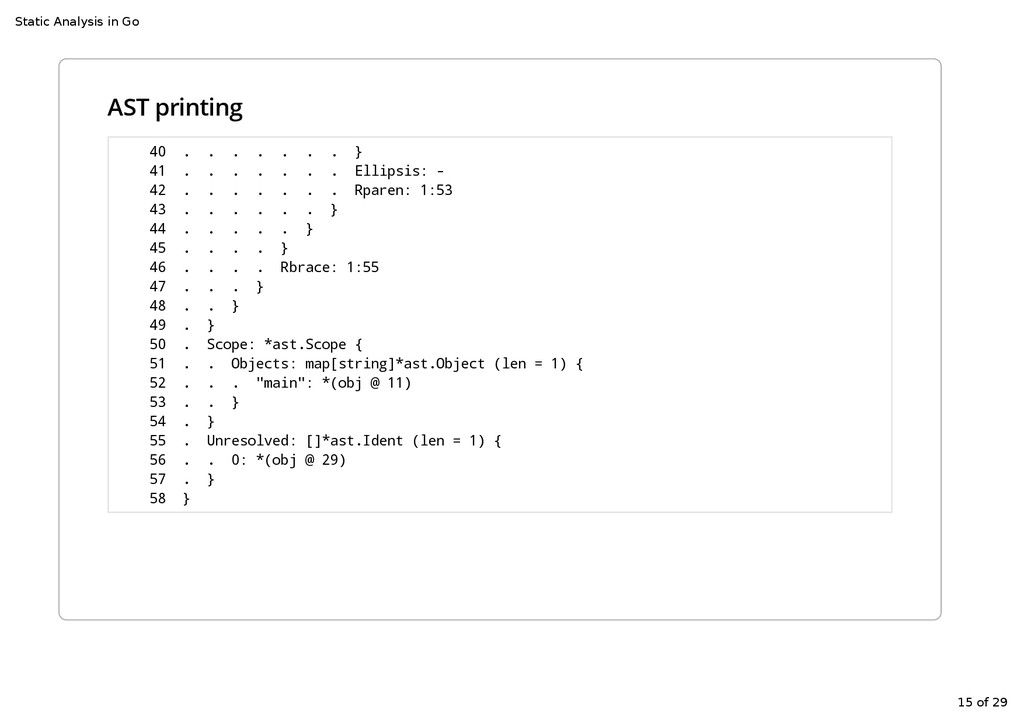
  11. AST printing 40 . . . . . . .

    } 41 . . . . . . . Ellipsis: - 42 . . . . . . . Rparen: 1:53 43 . . . . . . } 44 . . . . . } 45 . . . . } 46 . . . . Rbrace: 1:55 47 . . . } 48 . . } 49 . } 50 . Scope: *ast.Scope { 51 . . Objects: map[string]*ast.Object (len = 1) { 52 . . . "main": *(obj @ 11) 53 . . } 54 . } 55 . Unresolved: []*ast.Ident (len = 1) { 56 . . 0: *(obj @ 29) 57 . } 58 } Static Analysis in Go 15 of 29
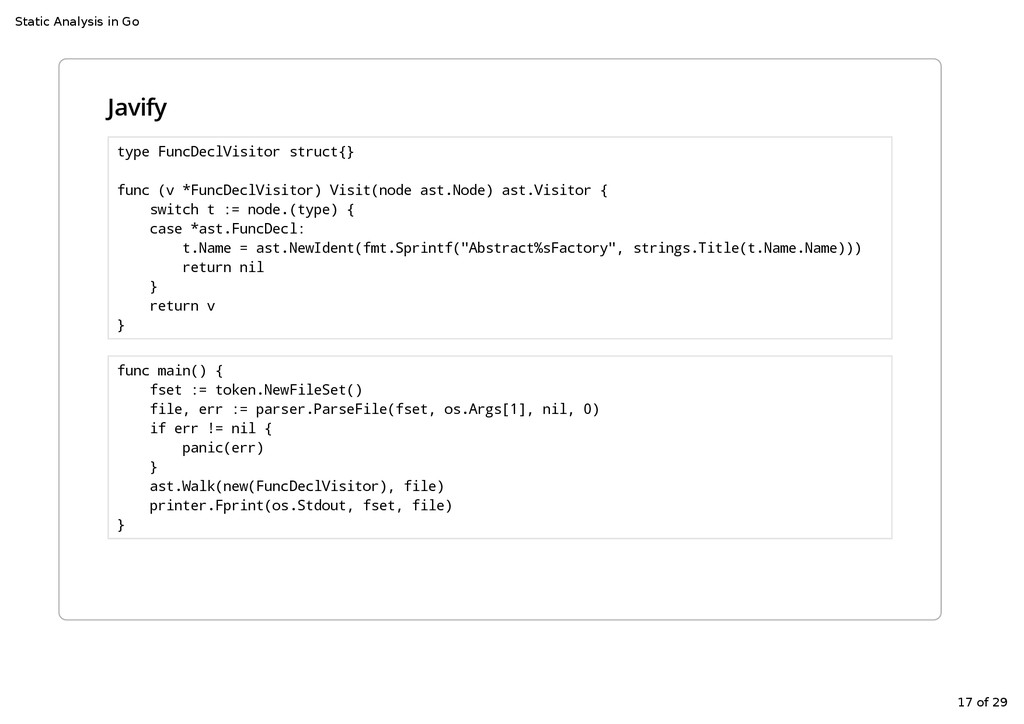
  12. Javify type FuncDeclVisitor struct{} func (v *FuncDeclVisitor) Visit(node ast.Node) ast.Visitor

    { switch t := node.(type) { case *ast.FuncDecl: t.Name = ast.NewIdent(fmt.Sprintf("Abstract%sFactory", strings.Title(t.Name.Name))) return nil } return v } func main() { fset := token.NewFileSet() file, err := parser.ParseFile(fset, os.Args[1], nil, 0) if err != nil { panic(err) } ast.Walk(new(FuncDeclVisitor), file) printer.Fprint(os.Stdout, fset, file) } Static Analysis in Go 17 of 29
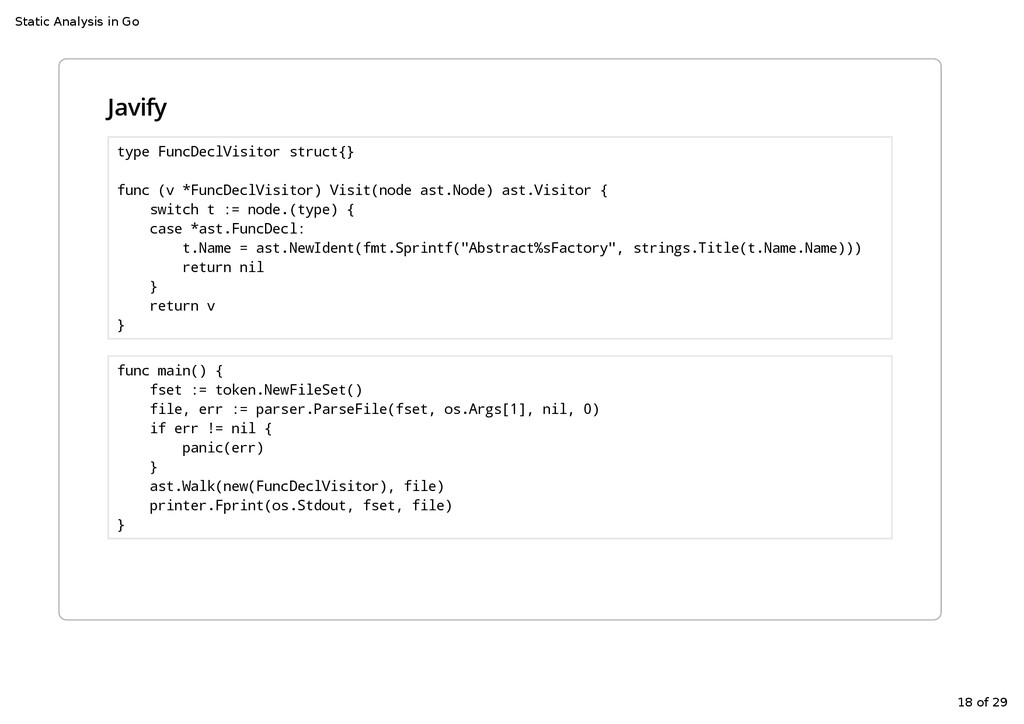
  13. Javify type FuncDeclVisitor struct{} func (v *FuncDeclVisitor) Visit(node ast.Node) ast.Visitor

    { switch t := node.(type) { case *ast.FuncDecl: t.Name = ast.NewIdent(fmt.Sprintf("Abstract%sFactory", strings.Title(t.Name.Name))) return nil } return v } func main() { fset := token.NewFileSet() file, err := parser.ParseFile(fset, os.Args[1], nil, 0) if err != nil { panic(err) } ast.Walk(new(FuncDeclVisitor), file) printer.Fprint(os.Stdout, fset, file) } Static Analysis in Go 18 of 29
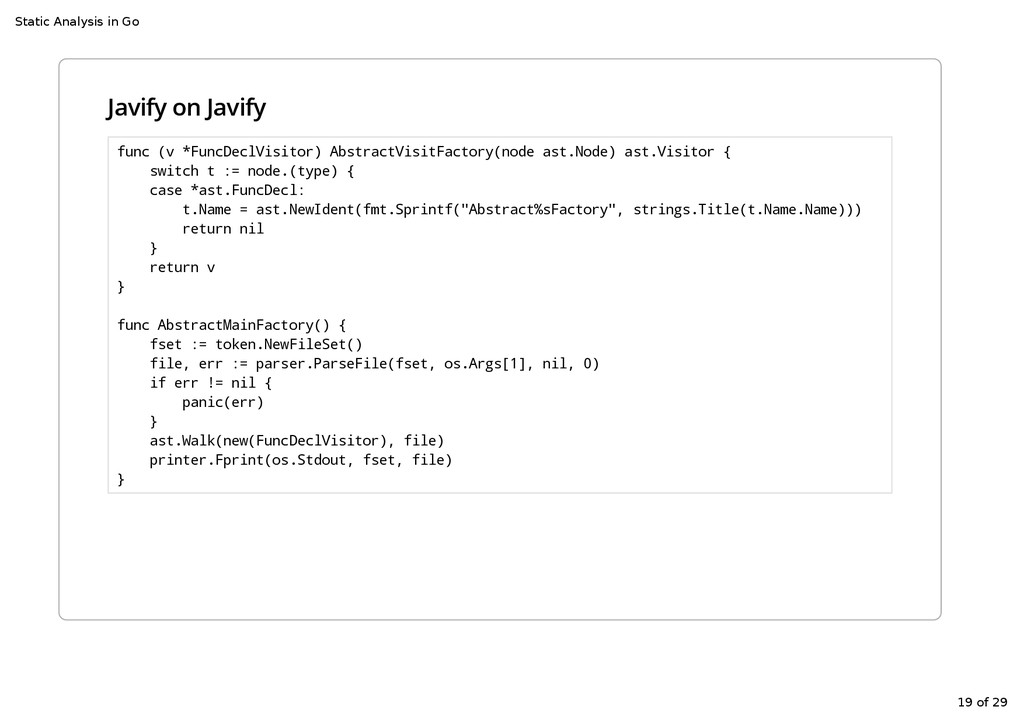
  14. Javify on Javify func (v *FuncDeclVisitor) AbstractVisitFactory(node ast.Node) ast.Visitor {

    switch t := node.(type) { case *ast.FuncDecl: t.Name = ast.NewIdent(fmt.Sprintf("Abstract%sFactory", strings.Title(t.Name.Name))) return nil } return v } func AbstractMainFactory() { fset := token.NewFileSet() file, err := parser.ParseFile(fset, os.Args[1], nil, 0) if err != nil { panic(err) } ast.Walk(new(FuncDeclVisitor), file) printer.Fprint(os.Stdout, fset, file) } Static Analysis in Go 19 of 29
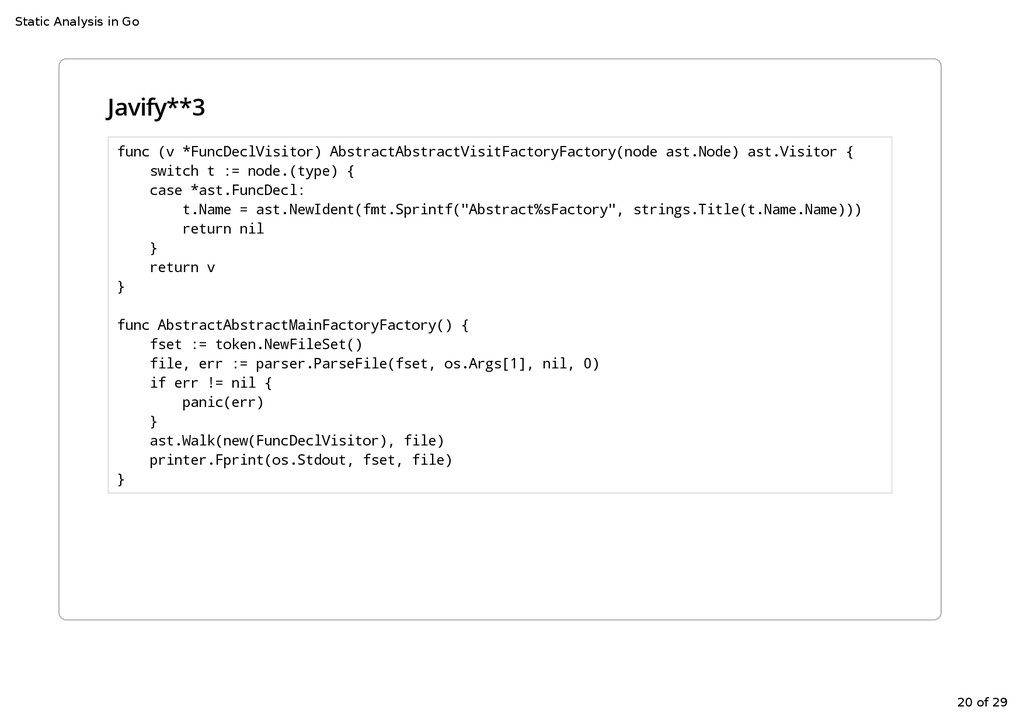
  15. Javify**3 func (v *FuncDeclVisitor) AbstractAbstractVisitFactoryFactory(node ast.Node) ast.Visitor { switch t

    := node.(type) { case *ast.FuncDecl: t.Name = ast.NewIdent(fmt.Sprintf("Abstract%sFactory", strings.Title(t.Name.Name))) return nil } return v } func AbstractAbstractMainFactoryFactory() { fset := token.NewFileSet() file, err := parser.ParseFile(fset, os.Args[1], nil, 0) if err != nil { panic(err) } ast.Walk(new(FuncDeclVisitor), file) printer.Fprint(os.Stdout, fset, file) } Static Analysis in Go 20 of 29
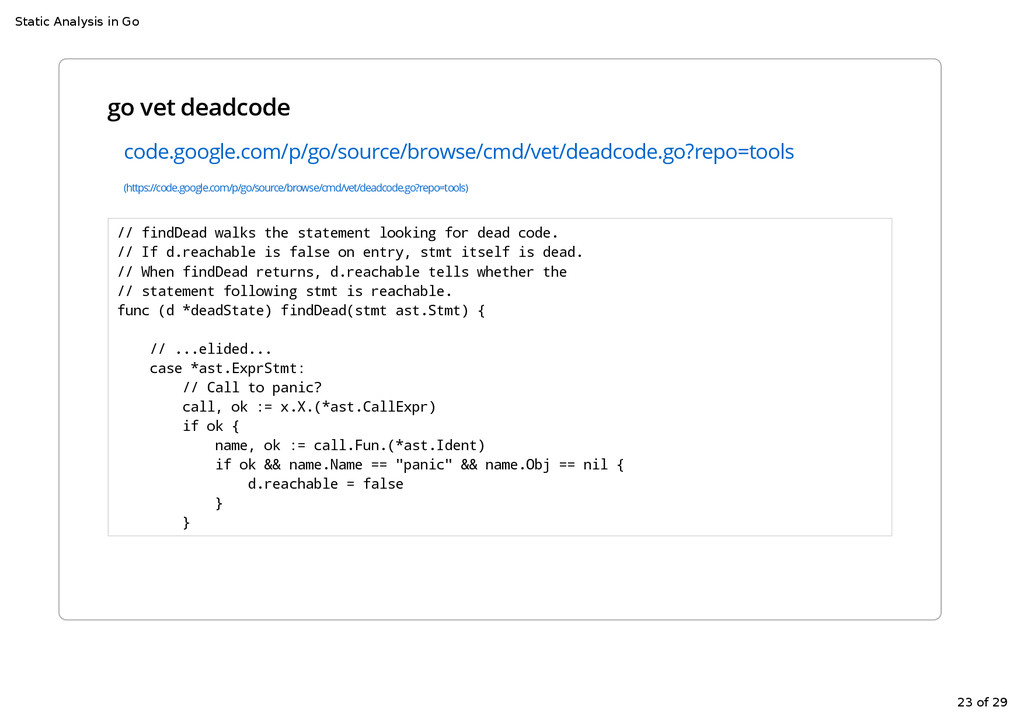
  16. go vet deadcode code.google.com/p/go/source/browse/cmd/vet/deadcode.go?repo=tools (https://code.google.com/p/go/source/browse/cmd/vet/deadcode.go?repo=tools) // findDead walks the statement

    looking for dead code. // If d.reachable is false on entry, stmt itself is dead. // When findDead returns, d.reachable tells whether the // statement following stmt is reachable. func (d *deadState) findDead(stmt ast.Stmt) { // ...elided... case *ast.ExprStmt: // Call to panic? call, ok := x.X.(*ast.CallExpr) if ok { name, ok := call.Fun.(*ast.Ident) if ok && name.Name == "panic" && name.Obj == nil { d.reachable = false } } Static Analysis in Go 23 of 29
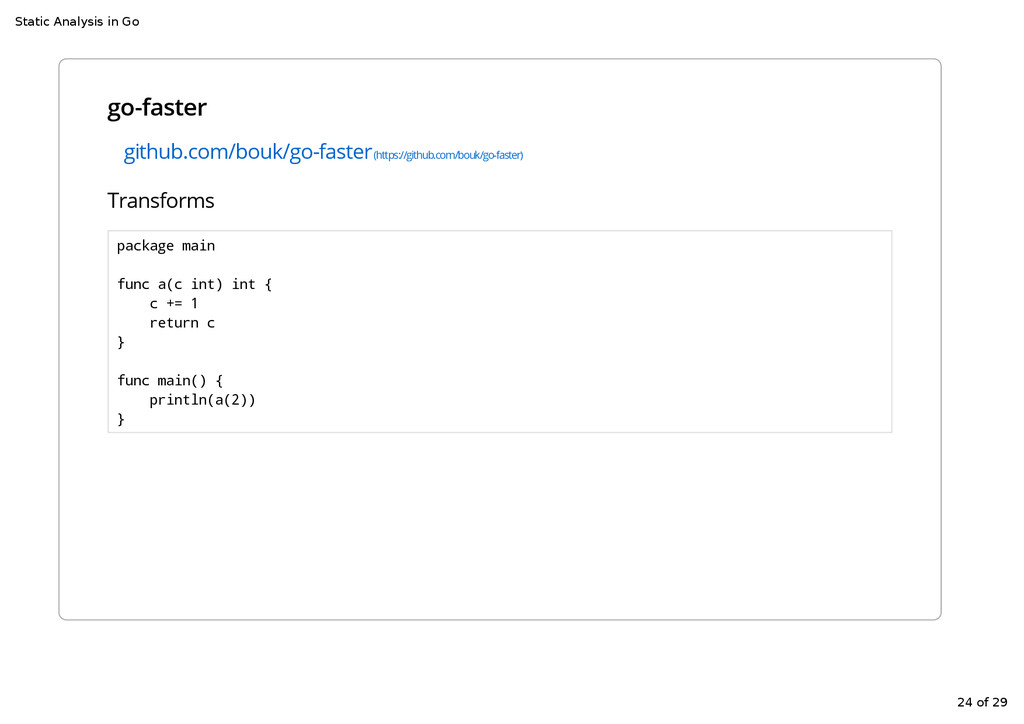
  17. go-faster github.com/bouk/go-faster (https://github.com/bouk/go-faster) Transforms package main func a(c int) int

    { c += 1 return c } func main() { println(a(2)) } Static Analysis in Go 24 of 29
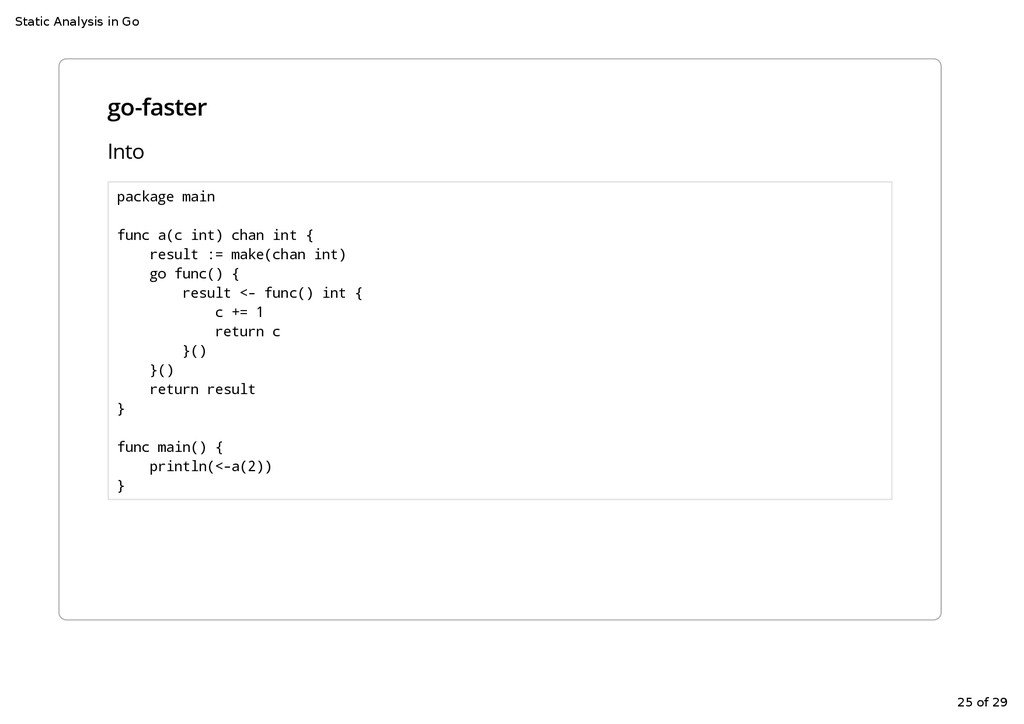
  18. go-faster Into package main func a(c int) chan int {

    result := make(chan int) go func() { result <- func() int { c += 1 return c }() }() return result } func main() { println(<-a(2)) } Static Analysis in Go 25 of 29
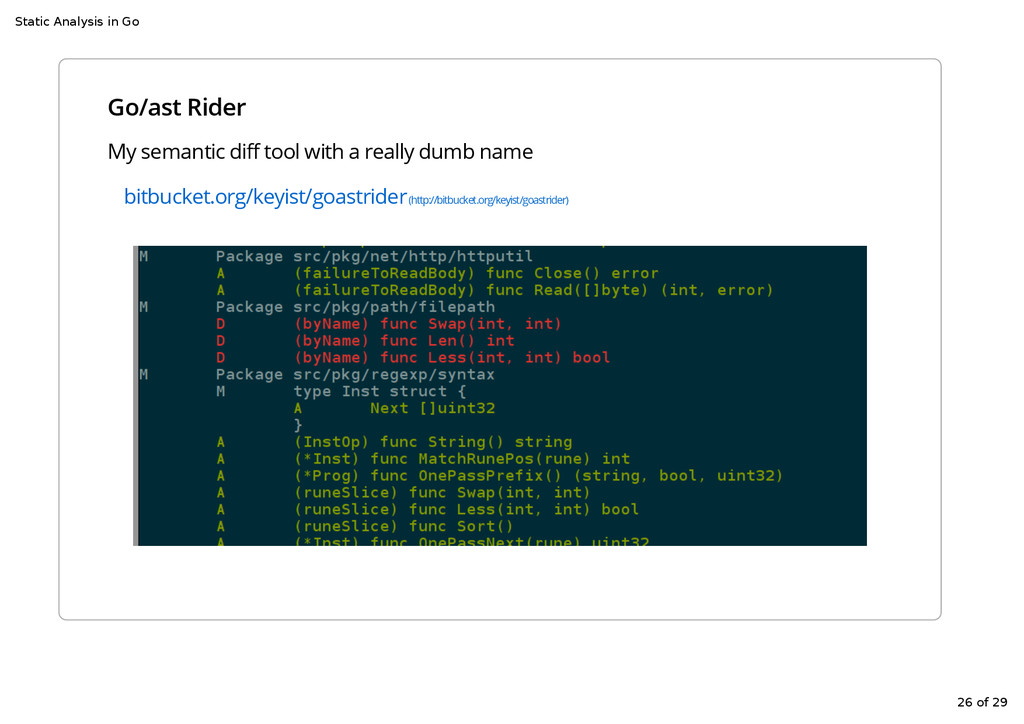
  19. Go/ast Rider My semantic diff tool with a really dumb

    name bitbucket.org/keyist/goastrider (http://bitbucket.org/keyist/goastrider) Static Analysis in Go 26 of 29
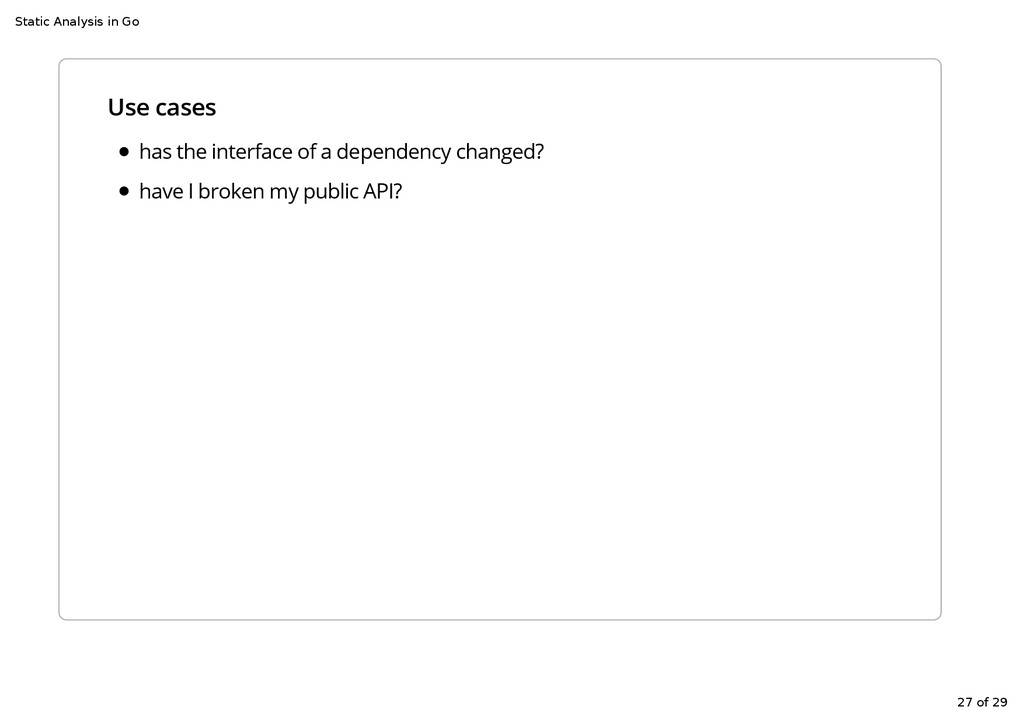
  20. Use cases has the interface of a dependency changed? have

    I broken my public API? Static Analysis in Go 27 of 29
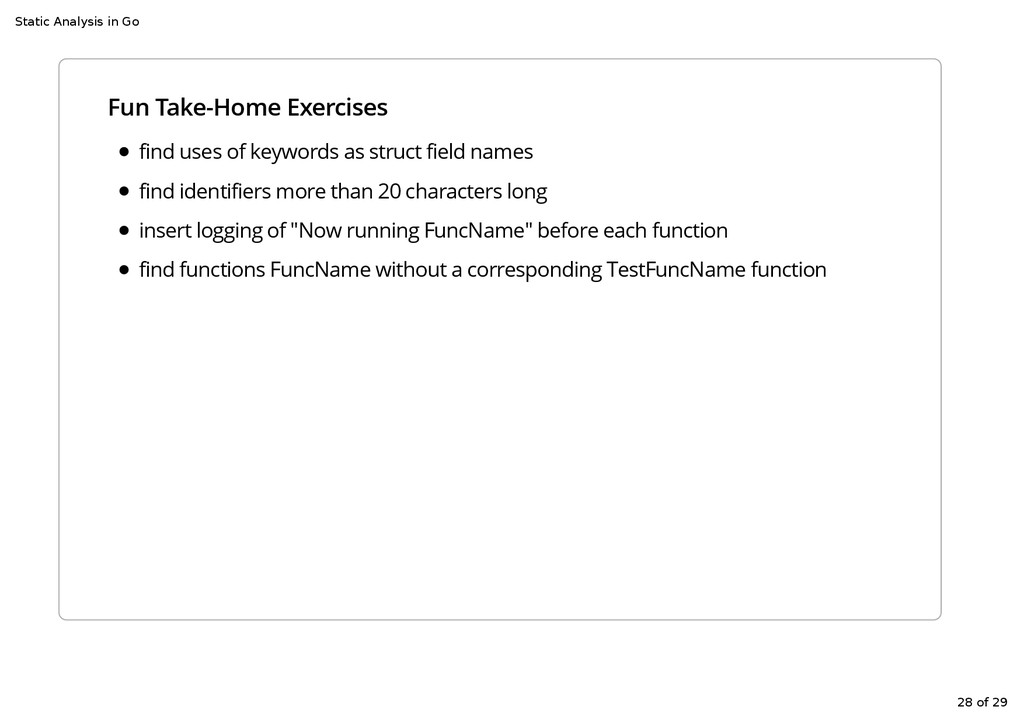
  21. Fun Take-Home Exercises find uses of keywords as struct field

    names find identifiers more than 20 characters long insert logging of "Now running FuncName" before each function find functions FuncName without a corresponding TestFuncName function Static Analysis in Go 28 of 29