Share
Embed
Game-Theoretic Planning with Foundation Models
Presentation at GameSec 2026, Ann Arbor, MI, US, 27 Oct.

Kim Hammar
November 02, 2026
Transcript
34 slides
-
Game-Theoretic Planning with Foundation Models GameSec 2026 Ann Arbor, Michigan,
USA, Oct 27, 2026 Kim Hammar, Tansu Alpcan, Emil Lupu Department of Computing Imperial College London [email protected] 1/20 -
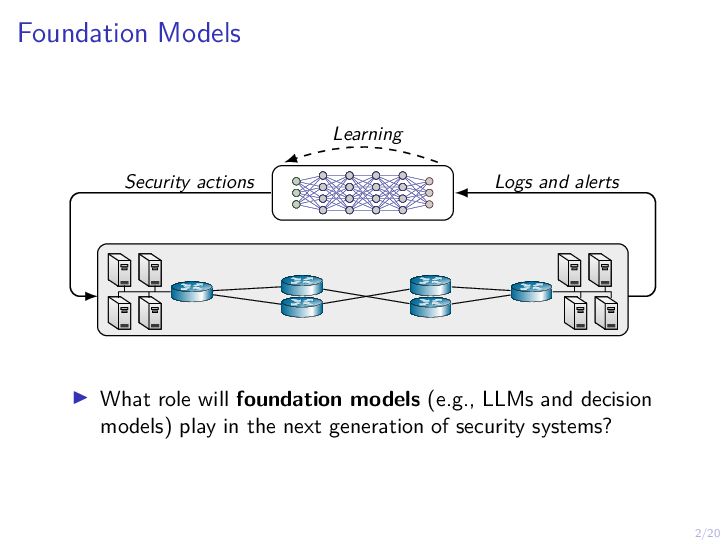
Foundation Models Learning Security actions Logs and alerts ▶ What
role will foundation models (e.g., LLMs and decision models) play in the next generation of security systems? 2/20 -
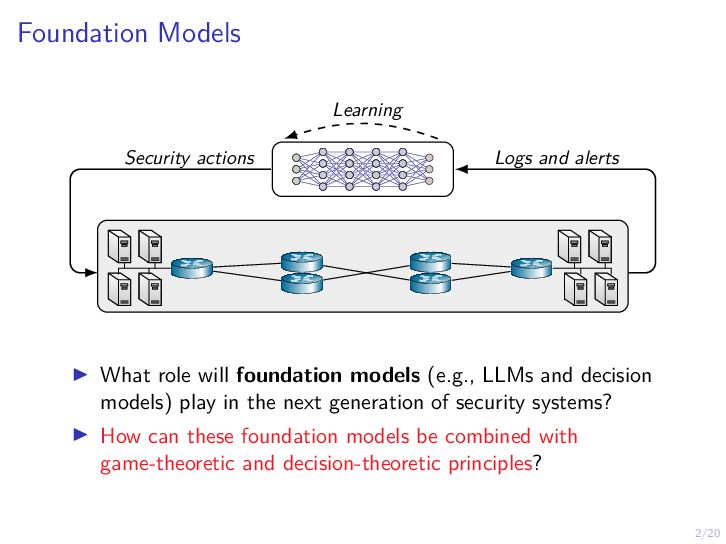
Foundation Models Learning Security actions Logs and alerts ▶ What
role will foundation models (e.g., LLMs and decision models) play in the next generation of security systems? ▶ How can these foundation models be combined with game-theoretic and decision-theoretic principles? 2/20 -
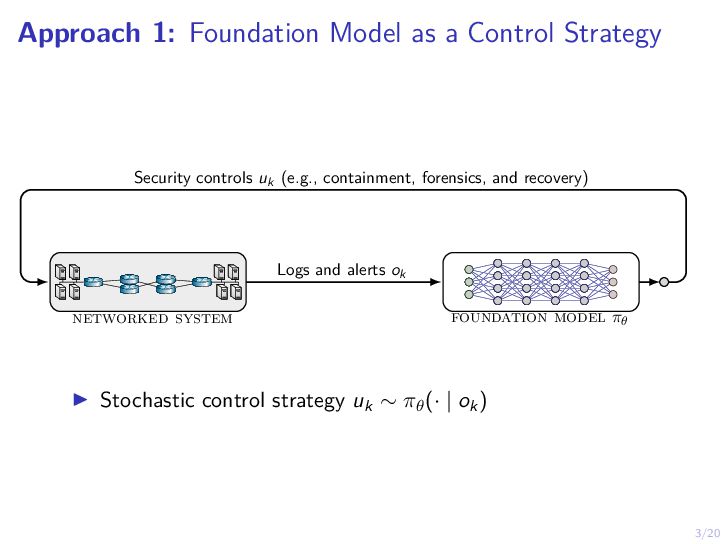
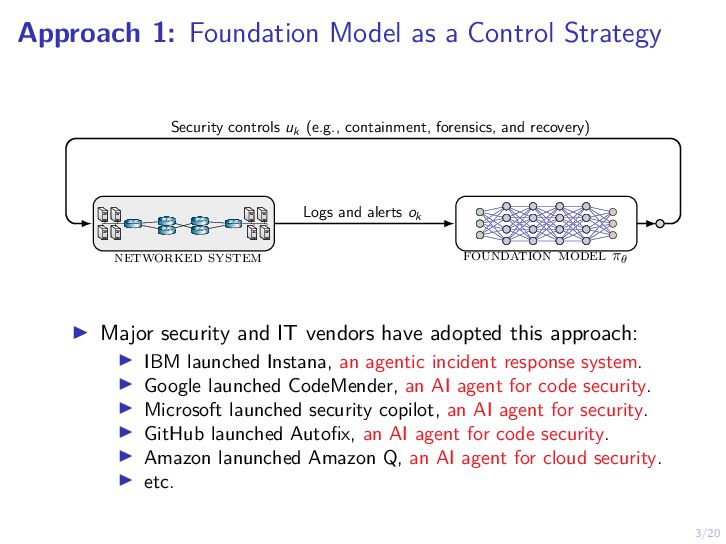
Approach 1: Foundation Model as a Control Strategy Security controls
uk (e.g., containment, forensics, and recovery) Logs and alerts ok networked system foundation model πθ ▶ Stochastic control strategy uk ∼ πθ (· | ok ) 3/20 -
Approach 1: Foundation Model as a Control Strategy Security controls
uk (e.g., containment, forensics, and recovery) Logs and alerts ok networked system foundation model πθ ▶ Major security and IT vendors have adopted this approach: ▶ IBM launched Instana, an agentic incident response system. ▶ Google launched CodeMender, an AI agent for code security. ▶ Microsoft launched security copilot, an AI agent for security. ▶ GitHub launched Autofix, an AI agent for code security. ▶ Amazon lanunched Amazon Q, an AI agent for cloud security. ▶ etc. 3/20 -
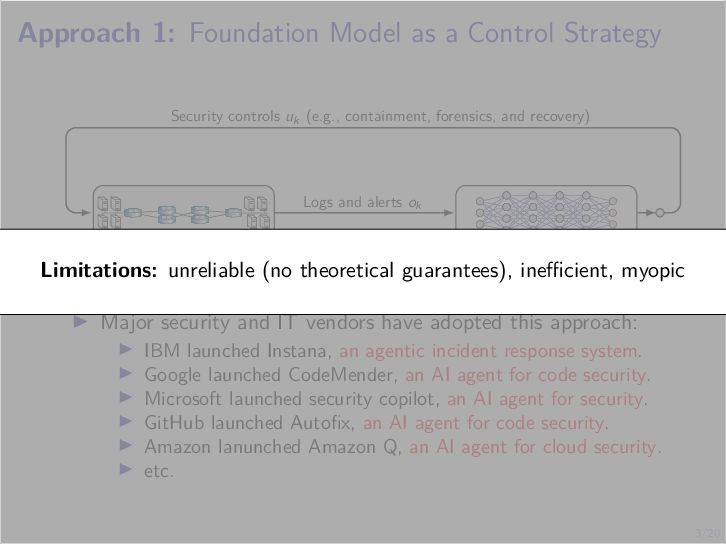
Approach 1: Foundation Model as a Control Strategy Security controls
uk (e.g., containment, forensics, and recovery) Logs and alerts ok networked system foundation model πθ Limitations: unreliable (no theoretical guarantees), inefficient, myopic ▶ Major security and IT vendors have adopted this approach: ▶ IBM launched Instana, an agentic incident response system. ▶ Google launched CodeMender, an AI agent for code security. ▶ Microsoft launched security copilot, an AI agent for security. ▶ GitHub launched Autofix, an AI agent for code security. ▶ Amazon lanunched Amazon Q, an AI agent for cloud security. ▶ etc. 3/20 -
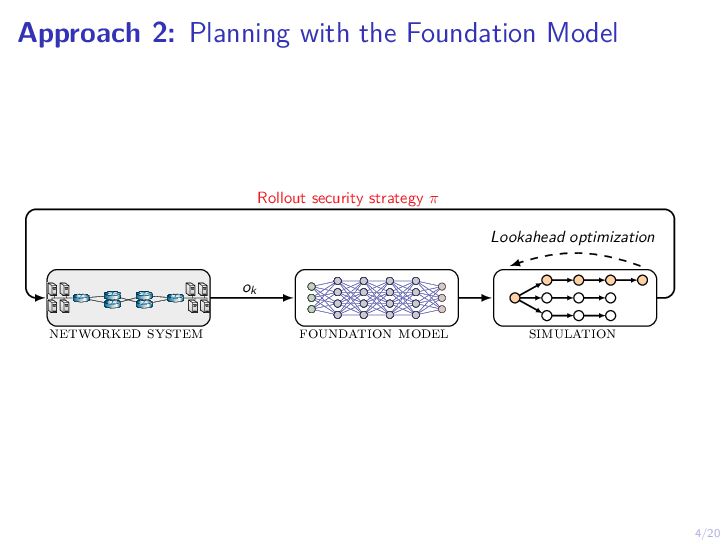
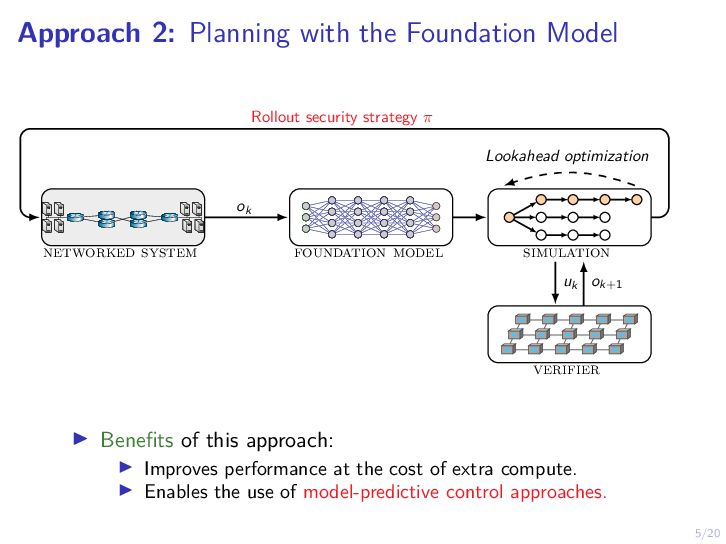
Approach 2: Planning with the Foundation Model Rollout security strategy
π Lookahead optimization ok networked system foundation model simulation 4/20 -
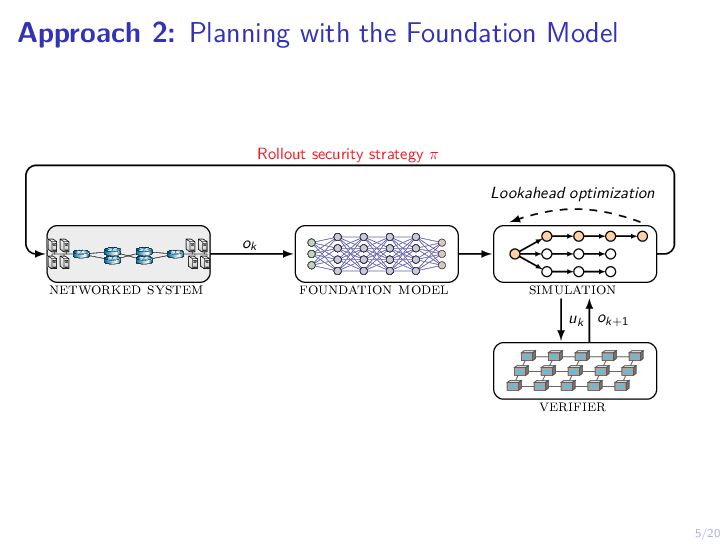
Approach 2: Planning with the Foundation Model Rollout security strategy
π Lookahead optimization ok networked system foundation model simulation uk ok+1 verifier 5/20 -
Approach 2: Planning with the Foundation Model Rollout security strategy
π Lookahead optimization ok networked system foundation model simulation uk ok+1 verifier ▶ Benefits of this approach: ▶ Improves performance at the cost of extra compute. ▶ Enables the use of model-predictive control approaches. 5/20 -
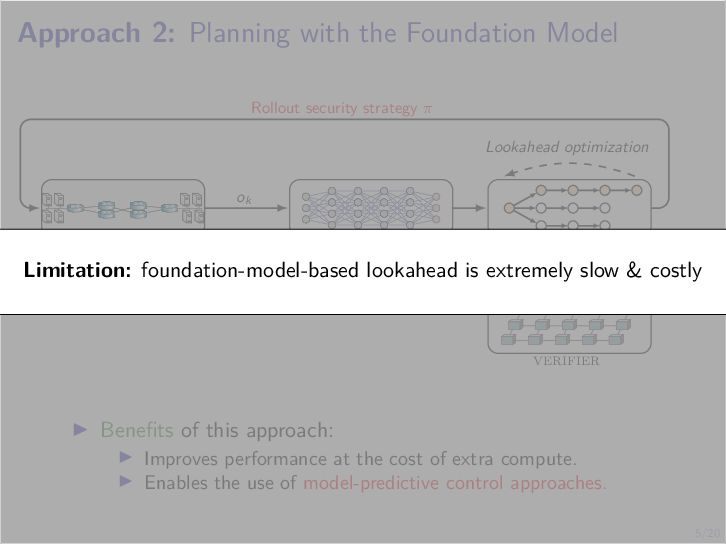
Approach 2: Planning with the Foundation Model Rollout security strategy
π Lookahead optimization ok networked system foundation model simulation ok+1 & costly Limitation: foundation-model-based lookahead is extremelyuk slow verifier ▶ Benefits of this approach: ▶ Improves performance at the cost of extra compute. ▶ Enables the use of model-predictive control approaches. 5/20 -
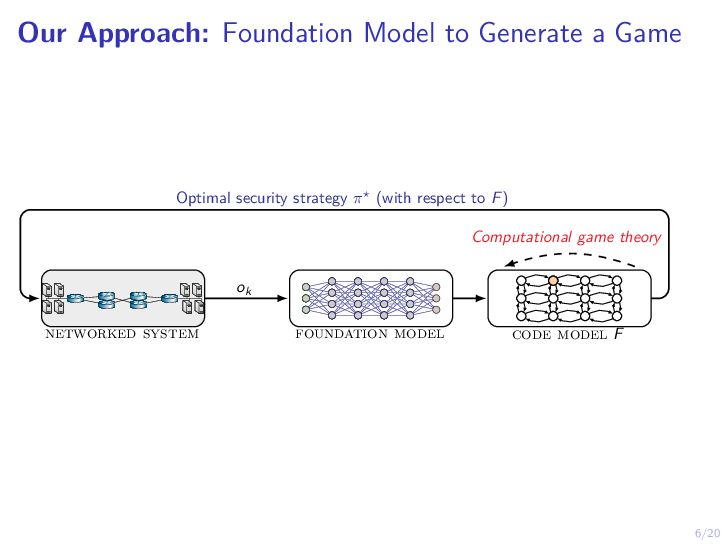
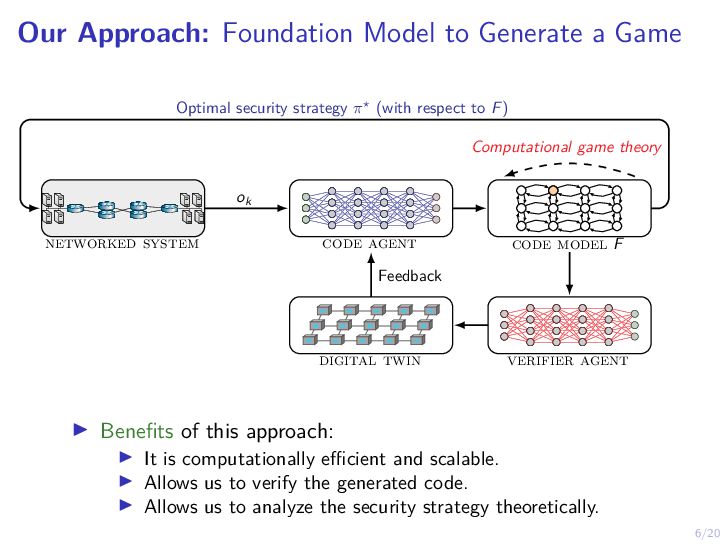
Our Approach: Foundation Model to Generate a Game Optimal security
strategy π ⋆ (with respect to F ) Computational game theory ok networked system foundation model code model F 6/20 -
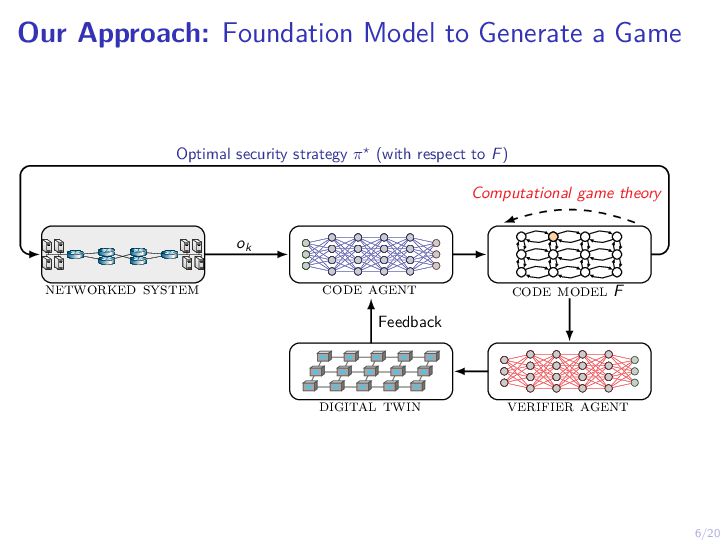
Our Approach: Foundation Model to Generate a Game Optimal security
strategy π ⋆ (with respect to F ) Computational game theory ok networked system code agent code model F Feedback digital twin verifier agent 6/20 -
Our Approach: Foundation Model to Generate a Game Optimal security
strategy π ⋆ (with respect to F ) Computational game theory ok networked system code agent code model F Feedback digital twin verifier agent ▶ Benefits of this approach: ▶ It is computationally efficient and scalable. ▶ Allows us to verify the generated code. ▶ Allows us to analyze the security strategy theoretically. 6/20 -
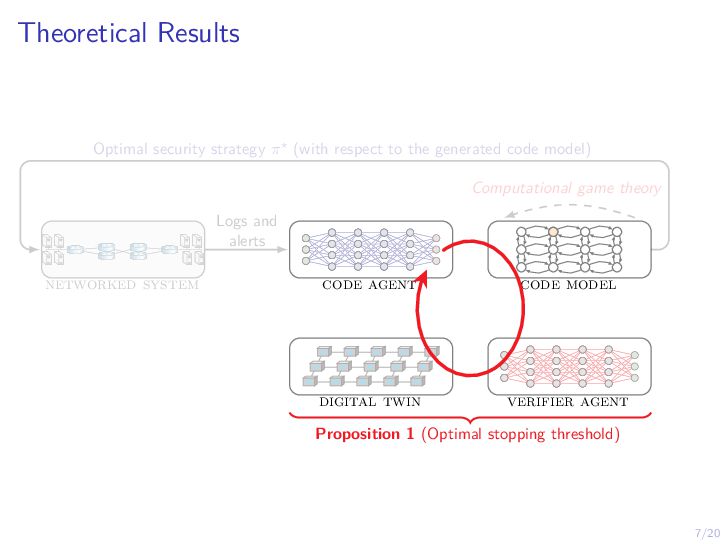
Theoretical Results Optimal security strategy π ⋆ (with respect to
the generated code model) Computational game theory Logs and alerts networked system code agent code model digital twin verifier agent Proposition 1 (Optimal stopping threshold) 7/20 -
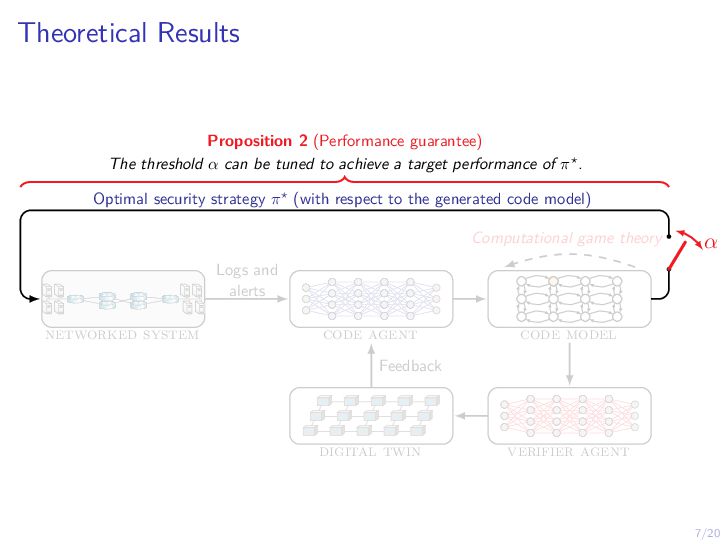
Theoretical Results Proposition 2 (Performance guarantee) The threshold α can
be tuned to achieve a target performance of π ⋆ . Optimal security strategy π ⋆ (with respect to the generated code model) Computational game theory α Logs and alerts networked system code agent code model Feedback digital twin verifier agent 7/20 -
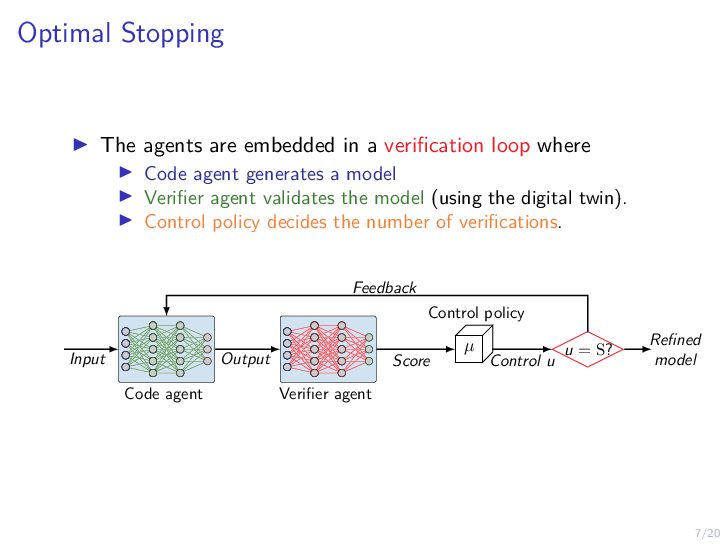
Optimal Stopping ▶ The agents are embedded in a verification
loop where ▶ Code agent generates a model ▶ Verifier agent validates the model (using the digital twin). ▶ Control policy decides the number of verifications. Feedback Control policy Input Output Code agent Score µ Control u u = S? Refined model Verifier agent 7/20 -
Optimal Stopping ▶ The agents are embedded in a verification
loop where ▶ Code agent generates a model ▶ Verifier agent validates the model (using the digital twin). ▶ Control policy decides the number of verifications. Feedback Control policy Input Output Code agent Score µ Control u u = S? Refined model Verifier agent 7/20 -
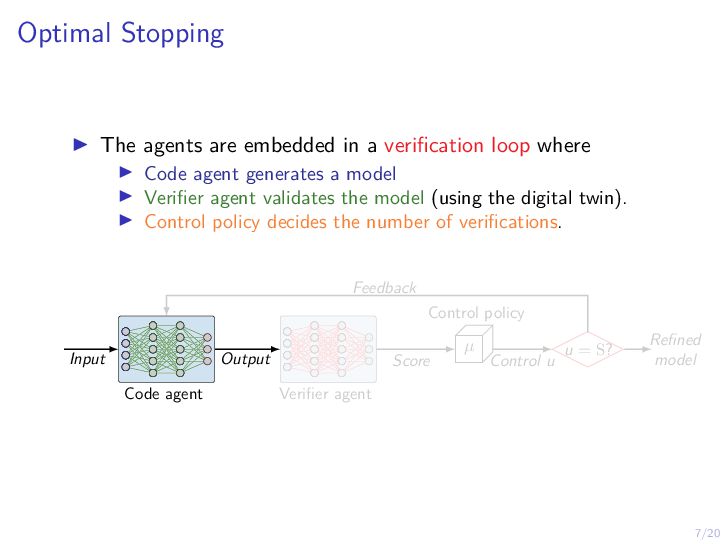
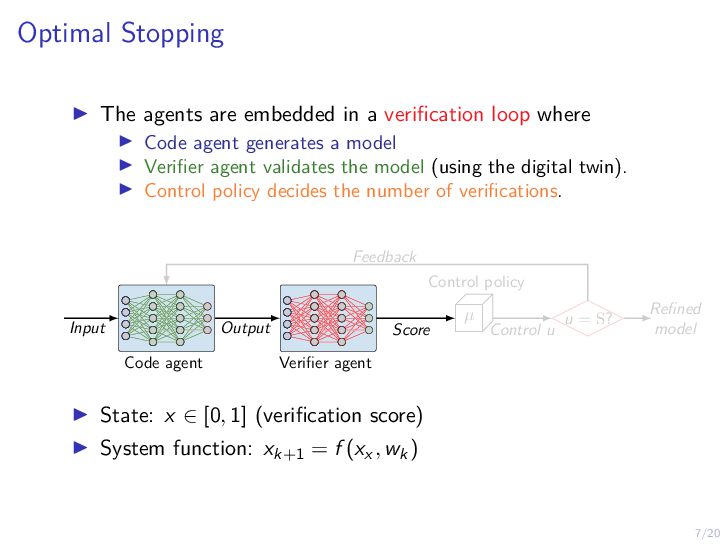
Optimal Stopping ▶ The agents are embedded in a verification
loop where ▶ Code agent generates a model ▶ Verifier agent validates the model (using the digital twin). ▶ Control policy decides the number of verifications. Feedback Control policy Input Output Code agent Score µ Control u u = S? Refined model Verifier agent ▶ State: x ∈ [0, 1] (verification score) ▶ System function: xk+1 = f (xx , wk ) 7/20 -
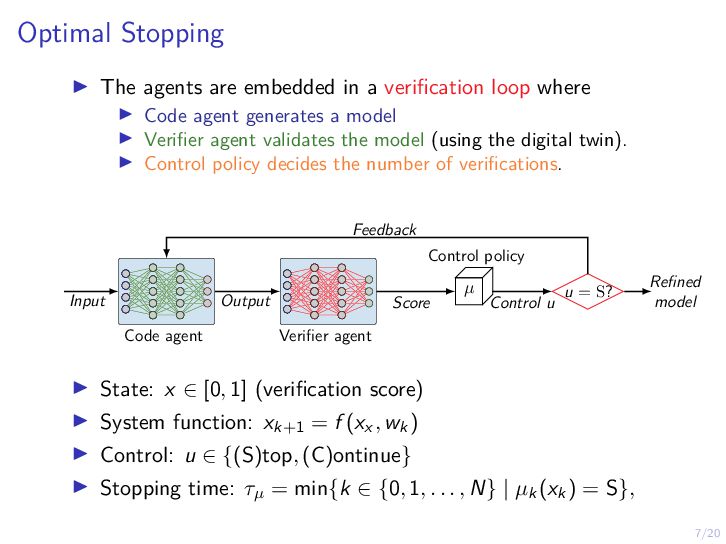
Optimal Stopping ▶ The agents are embedded in a verification
loop where ▶ Code agent generates a model ▶ Verifier agent validates the model (using the digital twin). ▶ Control policy decides the number of verifications. Feedback Control policy Input Output Code agent Score µ Control u u = S? Refined model Verifier agent ▶ State: x ∈ [0, 1] (verification score) ▶ System function: xk+1 = f (xx , wk ) ▶ Control: u ∈ {(S)top, (C)ontinue} ▶ Stopping time: τµ = min{k ∈ {0, 1, . . . , N} | µk (xk ) = S}, 7/20 -
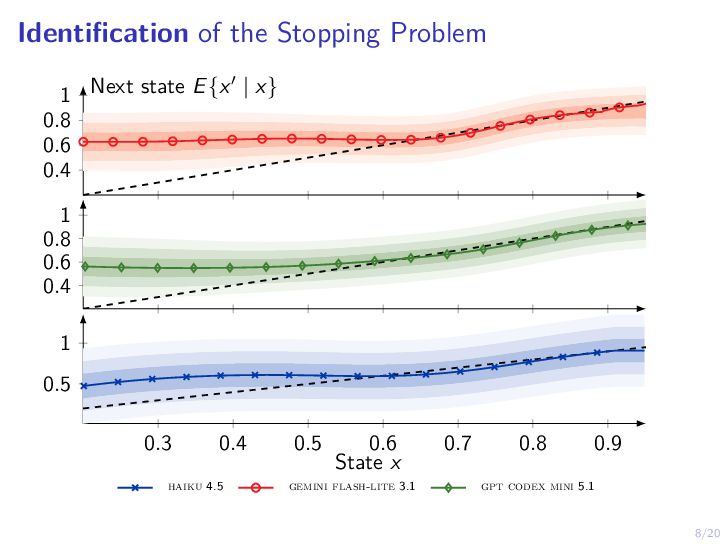
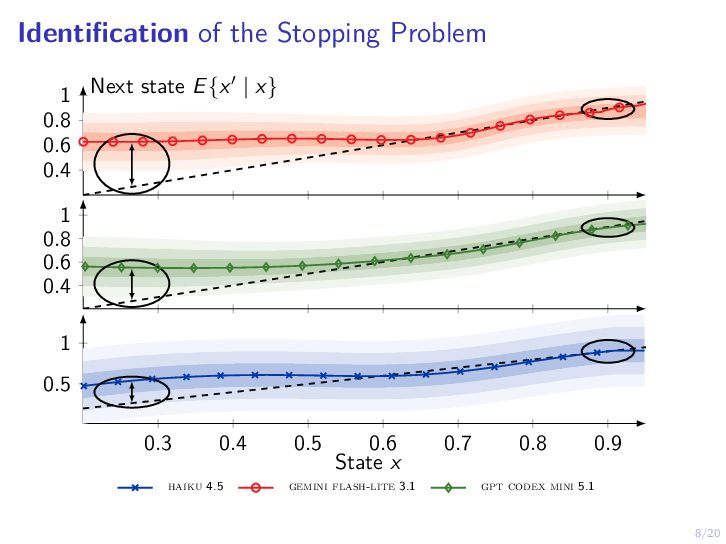
Identification of the Stopping Problem ′ 1 Next state E
{x | x } 0.8 0.6 0.4 1 0.8 0.6 0.4 1 0.5 0.3 0.4 haiku 4.5 0.5 0.6 State x gemini flash-lite 3.1 0.7 0.8 0.9 gpt codex mini 5.1 8/20 -
Identification of the Stopping Problem ′ 1 Next state E
{x | x } 0.8 0.6 0.4 1 0.8 0.6 0.4 1 0.5 0.3 0.4 haiku 4.5 0.5 0.6 State x gemini flash-lite 3.1 0.7 0.8 0.9 gpt codex mini 5.1 8/20 -
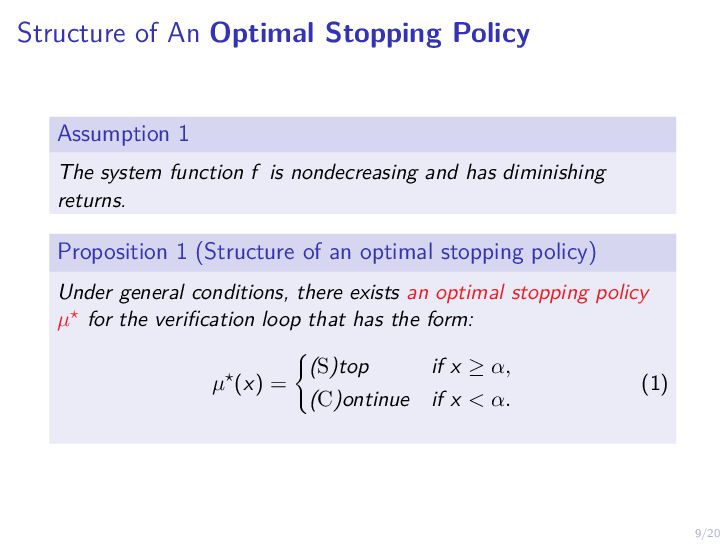
Structure of An Optimal Stopping Policy Assumption 1 The system
function f is nondecreasing and has diminishing returns. Proposition 1 (Structure of an optimal stopping policy) Under general conditions, there exists an optimal stopping policy µ⋆ for the verification loop that has the form: µ (x ) = ⋆ (S)top ( (C)ontinue if x ≥ α, if x < α. (1) 9/20 -
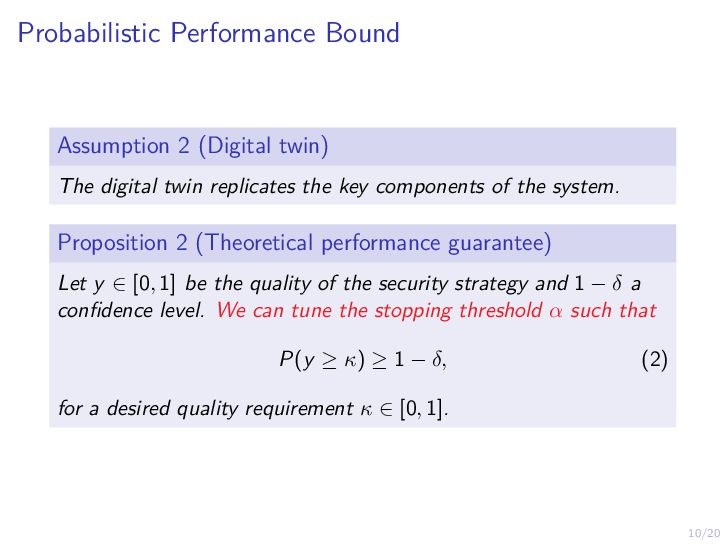
Probabilistic Performance Bound Assumption 2 (Digital twin) The digital twin
replicates the key components of the system. Proposition 2 (Theoretical performance guarantee) Let y ∈ [0, 1] be the quality of the security strategy and 1 − δ a confidence level. We can tune the stopping threshold α such that P(y ≥ κ) ≥ 1 − δ, (2) for a desired quality requirement κ ∈ [0, 1]. 10/20 -
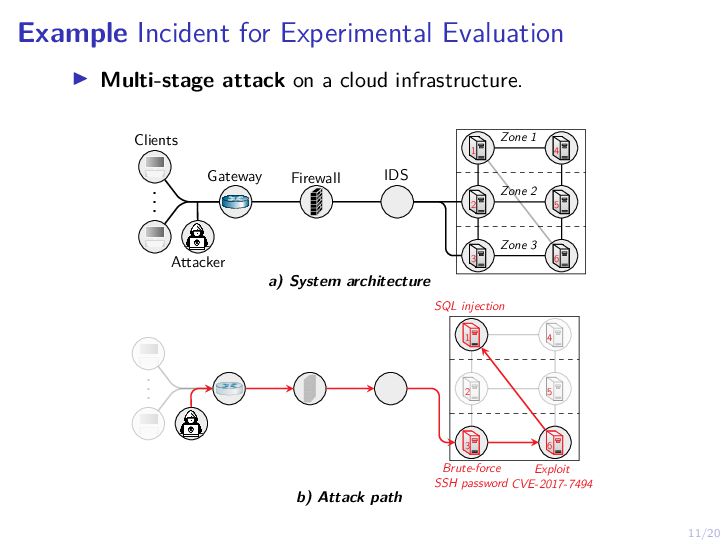
Example Incident for Experimental Evaluation ▶ Multi-stage attack on a
cloud infrastructure. Clients .. . 1 Gateway Firewall IDS 2 Attacker 3 Zone 1 4 Zone 2 5 Zone 3 6 a) System architecture SQL injection .. . b) Attack path 1 4 2 5 3 6 Brute-force Exploit SSH password CVE-2017-7494 11/20 -
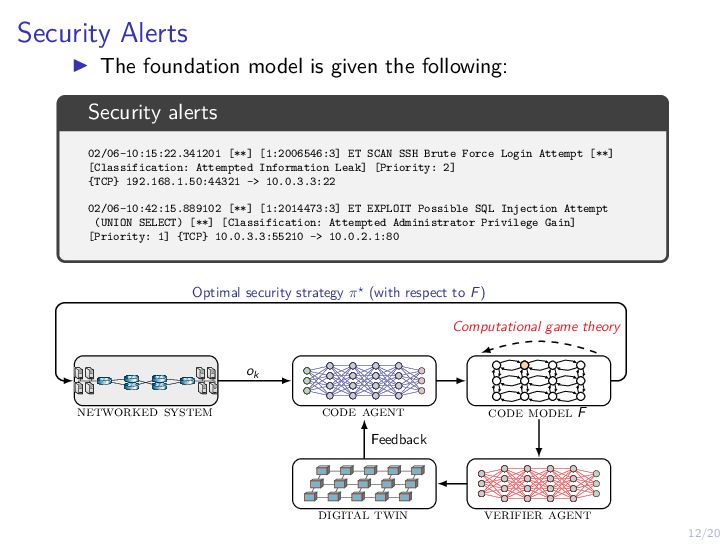
Security Alerts ▶ The foundation model is given the following:
Security alerts 02/06-10:15:22.341201 [**] [1:2006546:3] ET SCAN SSH Brute Force Login Attempt [**] [Classification: Attempted Information Leak] [Priority: 2] {TCP} 192.168.1.50:44321 -> 10.0.3.3:22 02/06-10:42:15.889102 [**] [1:2014473:3] ET EXPLOIT Possible SQL Injection Attempt (UNION SELECT) [**] [Classification: Attempted Administrator Privilege Gain] [Priority: 1] {TCP} 10.0.3.3:55210 -> 10.0.2.1:80 Optimal security strategy π ⋆ (with respect to F ) Computational game theory ok networked system code agent code model F Feedback digital twin verifier agent 12/20 -
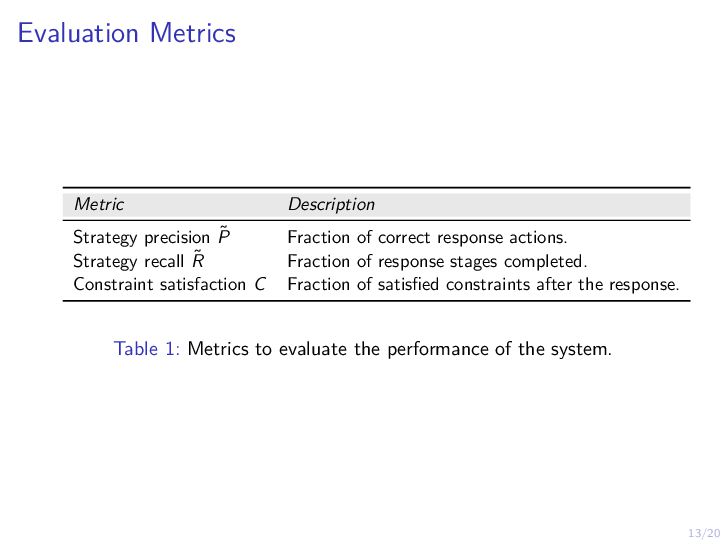
Evaluation Metrics Metric Description Strategy precision P̃ Strategy recall R̃
Constraint satisfaction C Fraction of correct response actions. Fraction of response stages completed. Fraction of satisfied constraints after the response. Table 1: Metrics to evaluate the performance of the system. 13/20 -
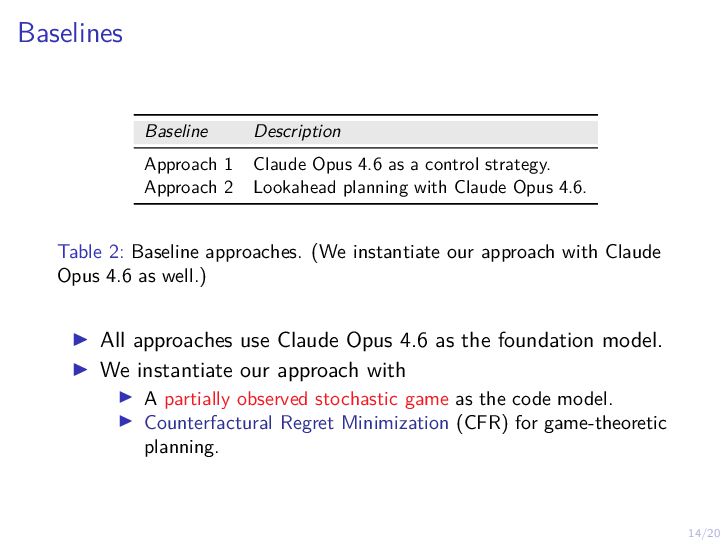
Baselines Baseline Description Approach 1 Approach 2 Claude Opus 4.6
as a control strategy. Lookahead planning with Claude Opus 4.6. Table 2: Baseline approaches. (We instantiate our approach with Claude Opus 4.6 as well.) ▶ All approaches use Claude Opus 4.6 as the foundation model. ▶ We instantiate our approach with ▶ A partially observed stochastic game as the code model. ▶ Counterfactural Regret Minimization (CFR) for game-theoretic planning. 14/20 -
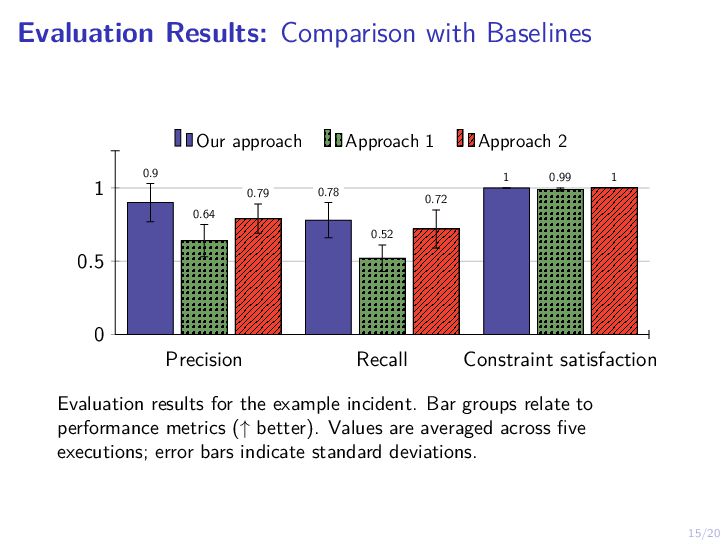
Evaluation Results: Comparison with Baselines Our approach 1 Approach 1
0.9 0.79 Approach 2 1 0.78 0.99 1 0.72 0.64 0.52 0.5 0 Precision Recall Constraint satisfaction Evaluation results for the example incident. Bar groups relate to performance metrics (↑ better). Values are averaged across five executions; error bars indicate standard deviations. 15/20 -
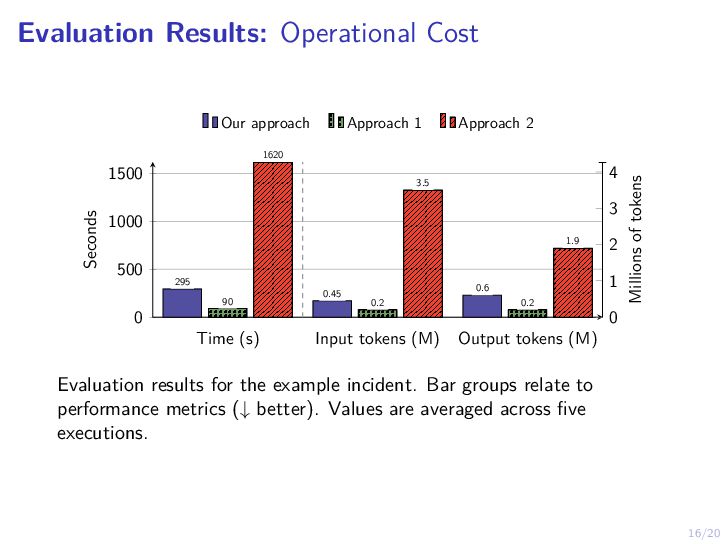
Evaluation Results: Operational Cost 1500 Seconds Approach 1 Approach 2
1620 4 3.5 3 1000 500 0 1.9 295 90 Time (s) 0.45 0.2 Input tokens (M) 0.6 2 1 0.2 Output tokens (M) 0 Millions of tokens Our approach Evaluation results for the example incident. Bar groups relate to performance metrics (↓ better). Values are averaged across five executions. 16/20 -
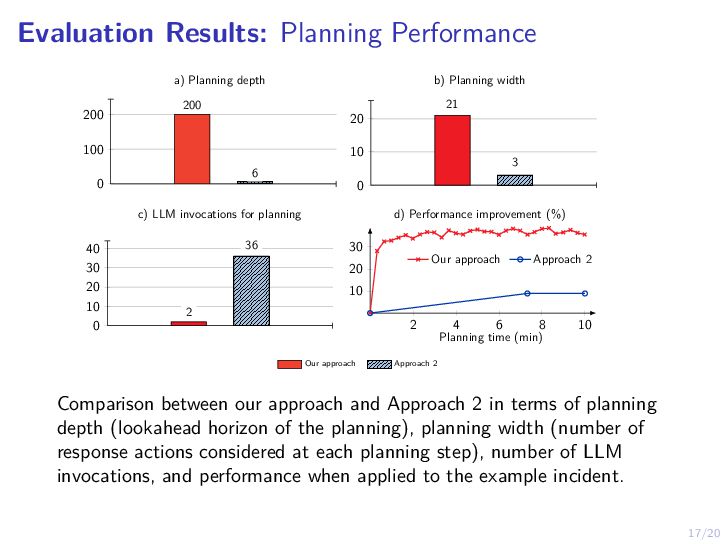
Evaluation Results: Planning Performance a) Planning depth 200 200 b)
Planning width 100 10 6 0 36 3 0 c) LLM invocations for planning 40 30 20 10 0 21 20 d) Performance improvement (%) 30 Our approach 20 Approach 2 10 2 2 Our approach 4 6 8 Planning time (min) 10 Approach 2 Comparison between our approach and Approach 2 in terms of planning depth (lookahead horizon of the planning), planning width (number of response actions considered at each planning step), number of LLM invocations, and performance when applied to the example incident. 17/20 -
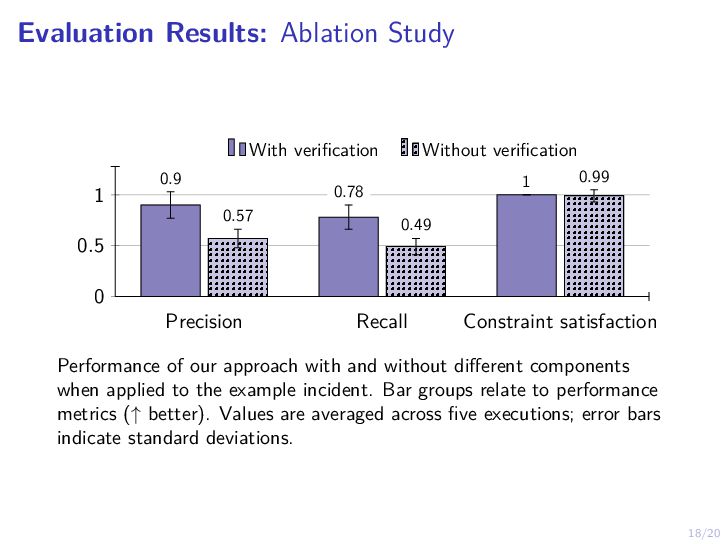
Evaluation Results: Ablation Study With verification 1 0.9 0.57 0.5
0 Precision Without verification 1 0.78 0.99 0.49 Recall Constraint satisfaction Performance of our approach with and without different components when applied to the example incident. Bar groups relate to performance metrics (↑ better). Values are averaged across five executions; error bars indicate standard deviations. 18/20 -
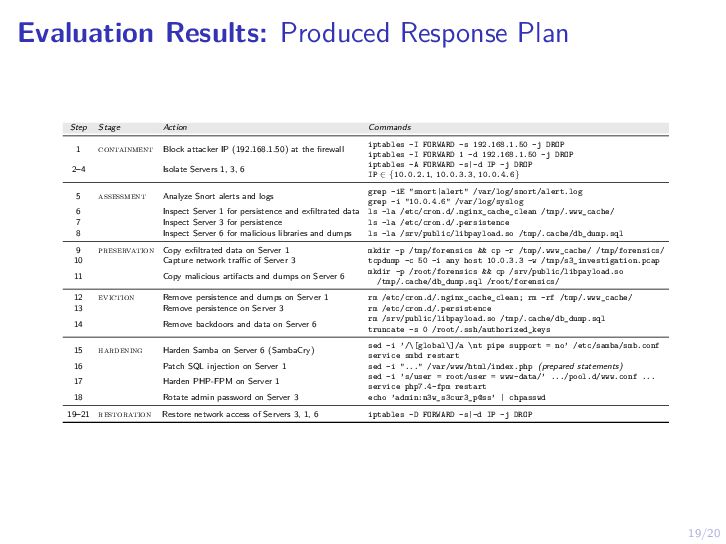
Evaluation Results: Produced Response Plan Step 1 Stage Action Commands
containment Block attacker IP (192.168.1.50) at the firewall iptables -I FORWARD -s 192.168.1.50 -j DROP iptables -I FORWARD 1 -d 192.168.1.50 -j DROP iptables -A FORWARD -s|-d IP -j DROP IP ∈ {10.0.2.1, 10.0.3.3, 10.0.4.6} 2–4 5 Isolate Servers 1, 3, 6 assessment 6 7 8 9 10 preservation 11 12 13 Copy exfiltrated data on Server 1 Capture network traffic of Server 3 Copy malicious artifacts and dumps on Server 6 eviction 14 15 Analyze Snort alerts and logs Inspect Server 1 for persistence and exfiltrated data Inspect Server 3 for persistence Inspect Server 6 for malicious libraries and dumps Remove persistence and dumps on Server 1 Remove persistence on Server 3 Remove backdoors and data on Server 6 hardening Rotate admin password on Server 3 iptables -D FORWARD -s|-d IP -j DROP 17 Harden PHP-FPM on Server 1 restoration rm /etc/cron.d/.nginx_cache_clean; rm -rf /tmp/.www_cache/ rm /etc/cron.d/.persistence rm /srv/public/libpayload.so /tmp/.cache/db_dump.sql truncate -s 0 /root/.ssh/authorized_keys Restore network access of Servers 3, 1, 6 Patch SQL injection on Server 1 19–21 mkdir -p /tmp/forensics && cp -r /tmp/.www_cache/ /tmp/forensics/ tcpdump -c 50 -i any host 10.0.3.3 -w /tmp/s3_investigation.pcap mkdir -p /root/forensics && cp /srv/public/libpayload.so /tmp/.cache/db_dump.sql /root/forensics/ sed -i ’/\[global\]/a \nt pipe support = no’ /etc/samba/smb.conf service smbd restart sed -i "..." /var/www/html/index.php (prepared statements) sed -i ’s/user = root/user = www-data/’ .../pool.d/www.conf ... service php7.4-fpm restart echo ’admin:n3w_s3cur3_p@ss’ | chpasswd Harden Samba on Server 6 (SambaCry) 16 18 grep -iE "snort|alert" /var/log/snort/alert.log grep -i "10.0.4.6" /var/log/syslog ls -la /etc/cron.d/.nginx_cache_clean /tmp/.www_cache/ ls -la /etc/cron.d/.persistence ls -la /srv/public/libpayload.so /tmp/.cache/db_dump.sql 19/20 -
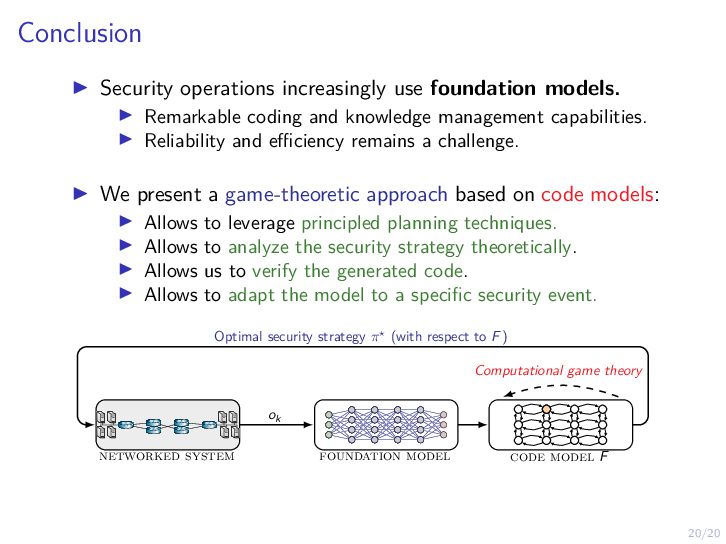
Conclusion ▶ Security operations increasingly use foundation models. ▶ Remarkable
coding and knowledge management capabilities. ▶ Reliability and efficiency remains a challenge. ▶ We present a game-theoretic approach based on code models: ▶ Allows to leverage principled planning techniques. ▶ Allows to analyze the security strategy theoretically. ▶ Allows us to verify the generated code. ▶ Allows to adapt the model to a specific security event. Optimal security strategy π ⋆ (with respect to F ) Computational game theory ok networked system foundation model code model F 20/20
 harutiro
 tomoaki25
 masasuzu
 yama3133
 xkxaxkx
 falken
 ykimi
 takano0131
 bengo4com
 jirtosterone
 kobayashiyorimitsu
 demaecan
 rakko
 dougneiner
 marktimemedia
 coloredviolet
 techseoconnect
 mayatellez
 bermonpainter
 sarafernandez
 ryanjones
 cromwellryan
 katarinadahlin