Upgrade to Pro — share decks privately, control downloads, hide ads and more …

Indexing with MongoDB

Sponsored · Your Podcast. Everywhere. Effortlessly. Share. Educate. Inspire. Entertain. You do you. We'll handle the rest.

Indexing with MongoDB

Avatar for kircul

kircul

May 07, 2012
Tweet

Other Decks in Programming

Transcript

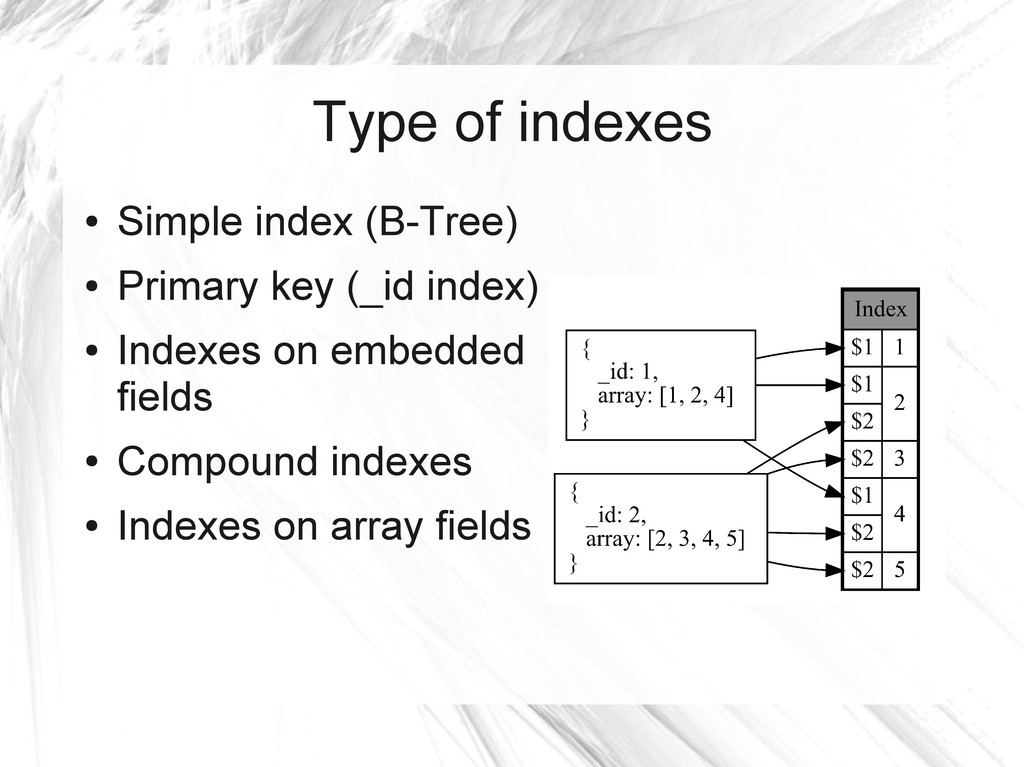
  1. Type of indexes • Simple index (B-Tree) • Primary key

    (_id index) • Indexes on embedded fields • Compound indexes • Indexes on array fields
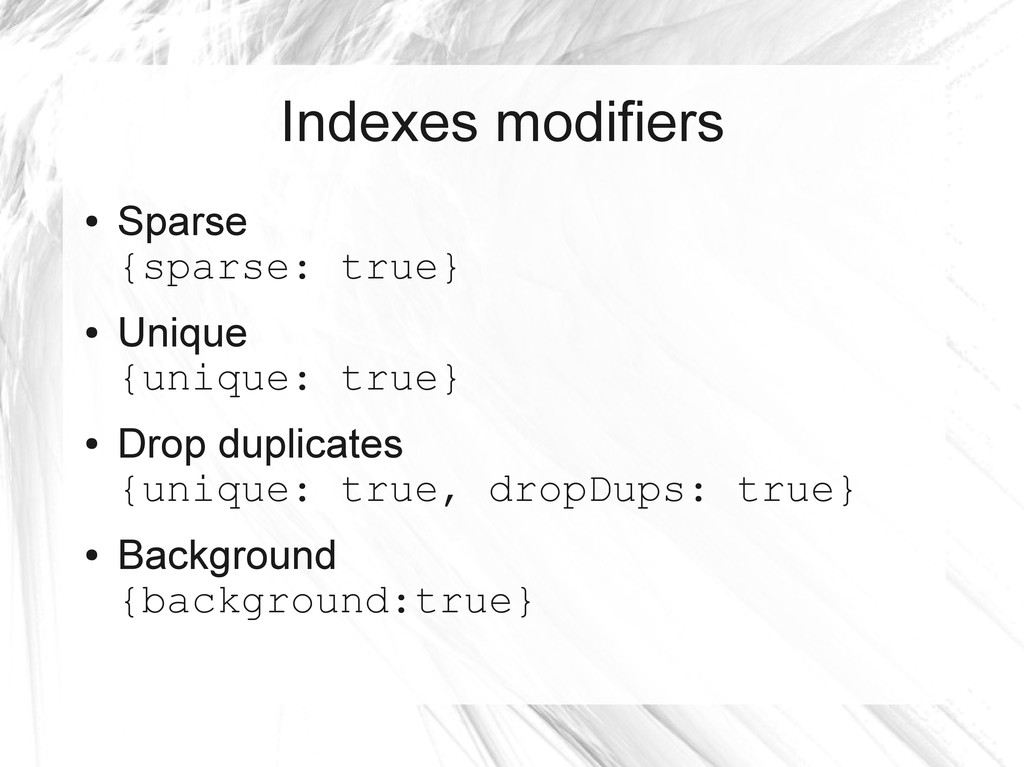
  2. Indexes modifiers • Sparse {sparse: true} • Unique {unique: true}

    • Drop duplicates {unique: true, dropDups: true} • Background {background:true}
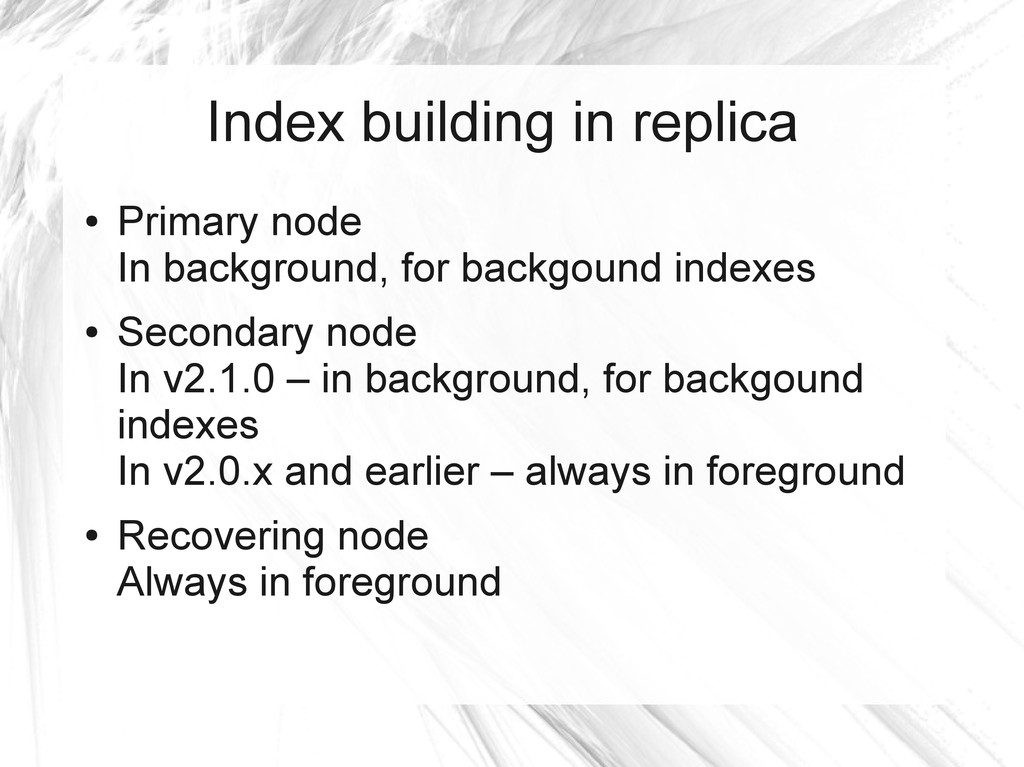
  3. Index building in replica • Primary node In background, for

    backgound indexes • Secondary node In v2.1.0 – in background, for backgound indexes In v2.0.x and earlier – always in foreground • Recovering node Always in foreground
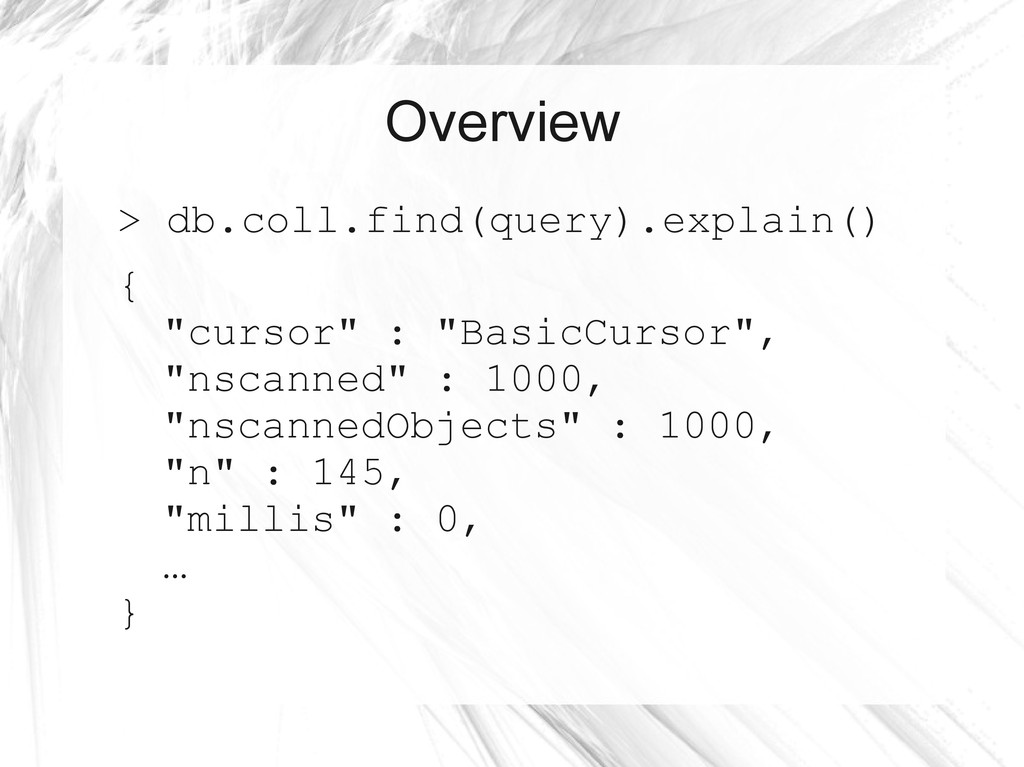
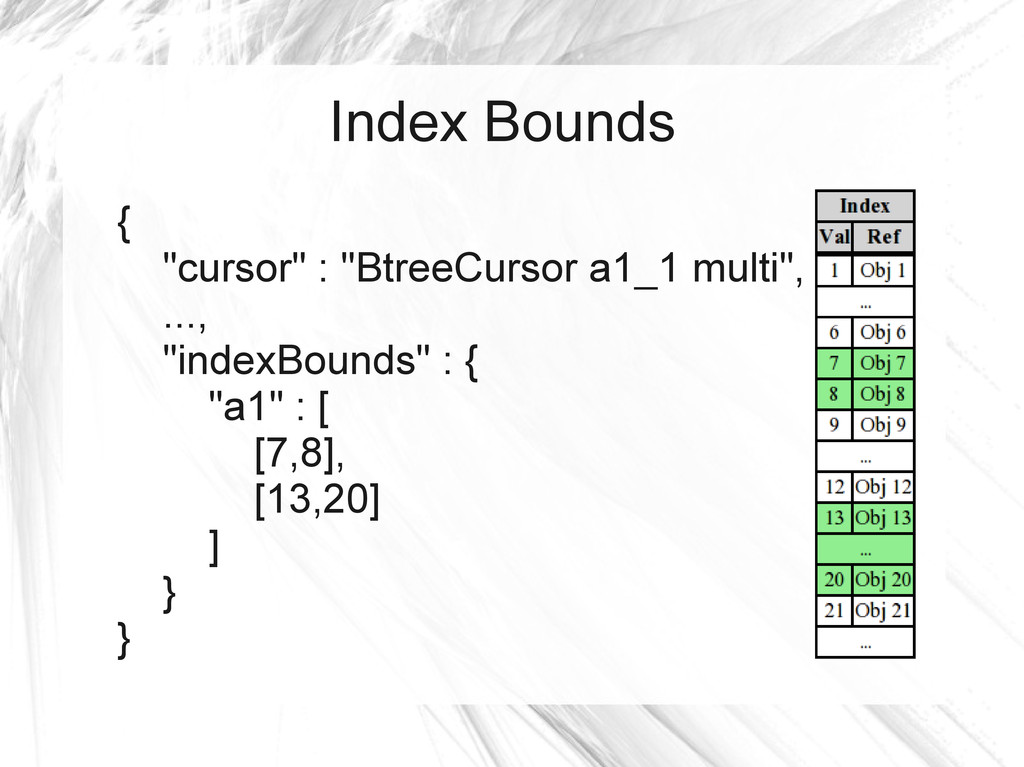
  4. Overview > db.coll.find(query).explain() { "cursor" : "BasicCursor", "nscanned" : 1000,

    "nscannedObjects" : 1000, "n" : 145, "millis" : 0, … }
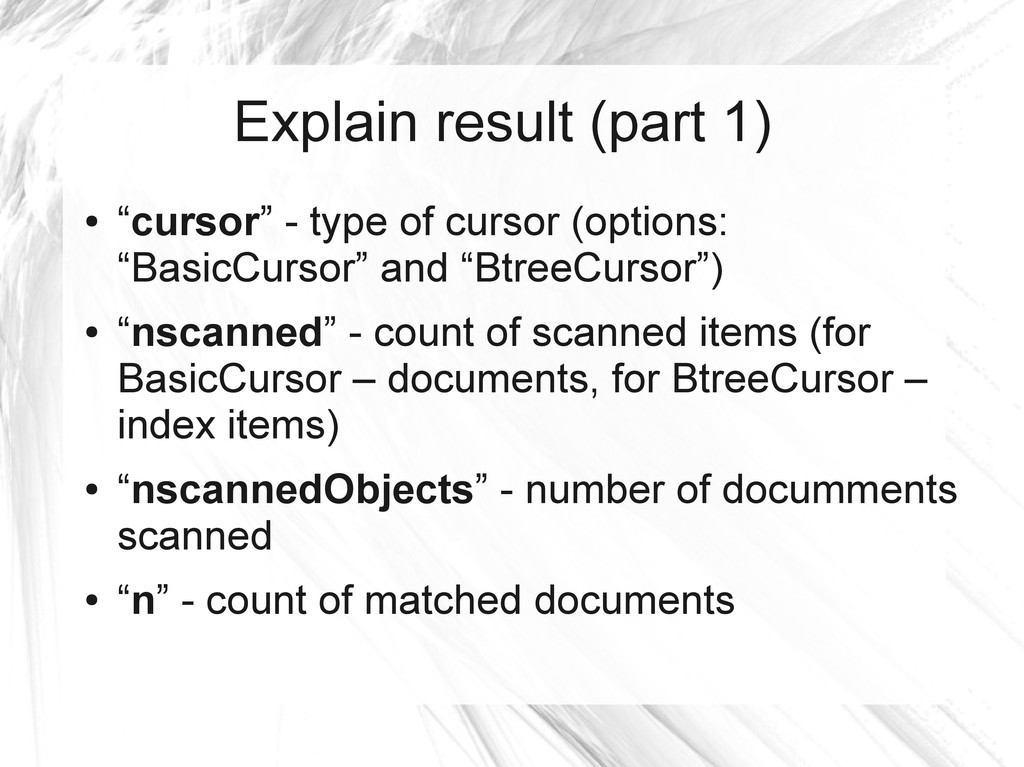
  5. Explain result (part 1) • “cursor” - type of cursor

    (options: “BasicCursor” and “BtreeCursor”) • “nscanned” - count of scanned items (for BasicCursor – documents, for BtreeCursor – index items) • “nscannedObjects” - number of documments scanned • “n” - count of matched documents
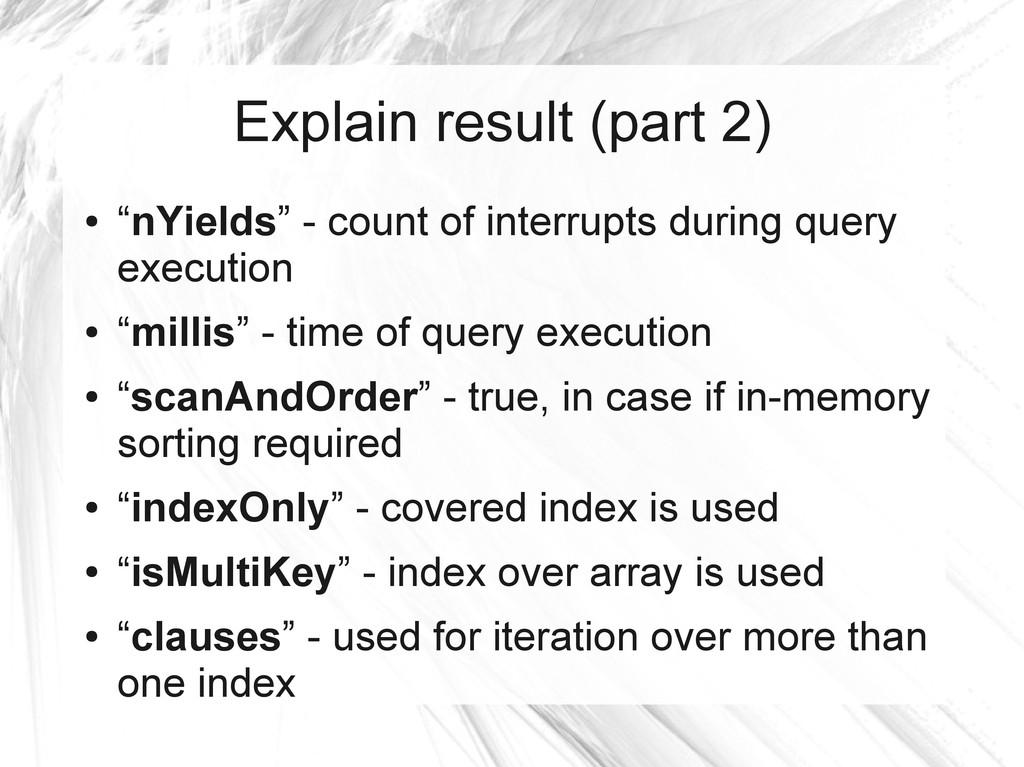
  6. Explain result (part 2) • “nYields” - count of interrupts

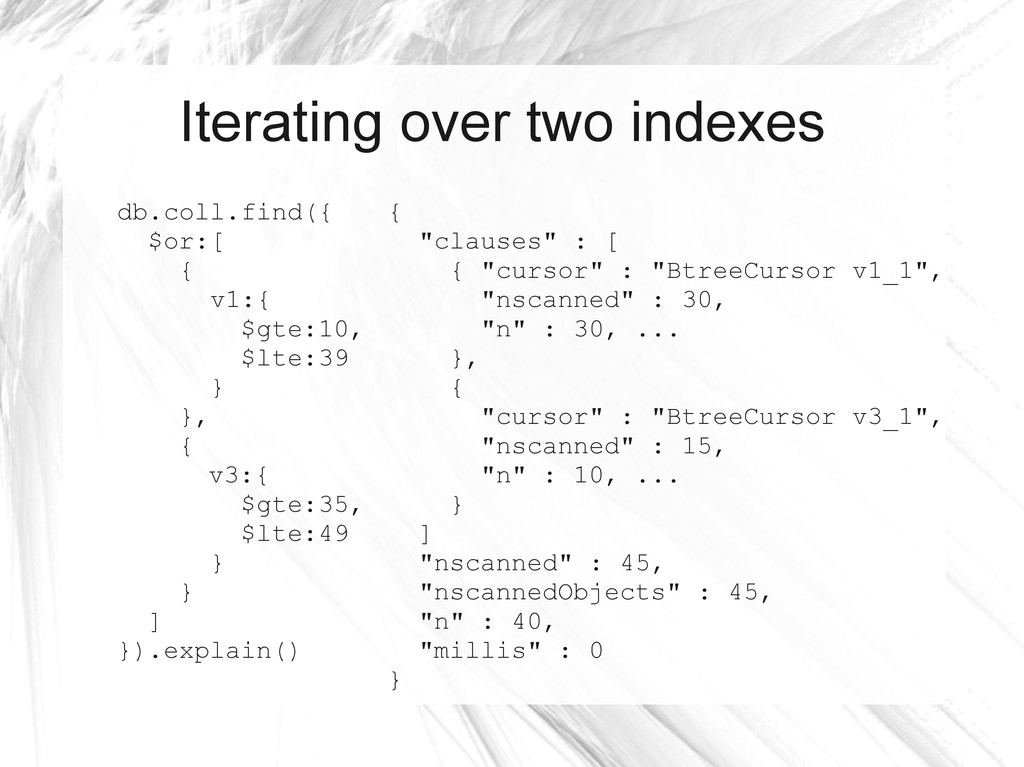
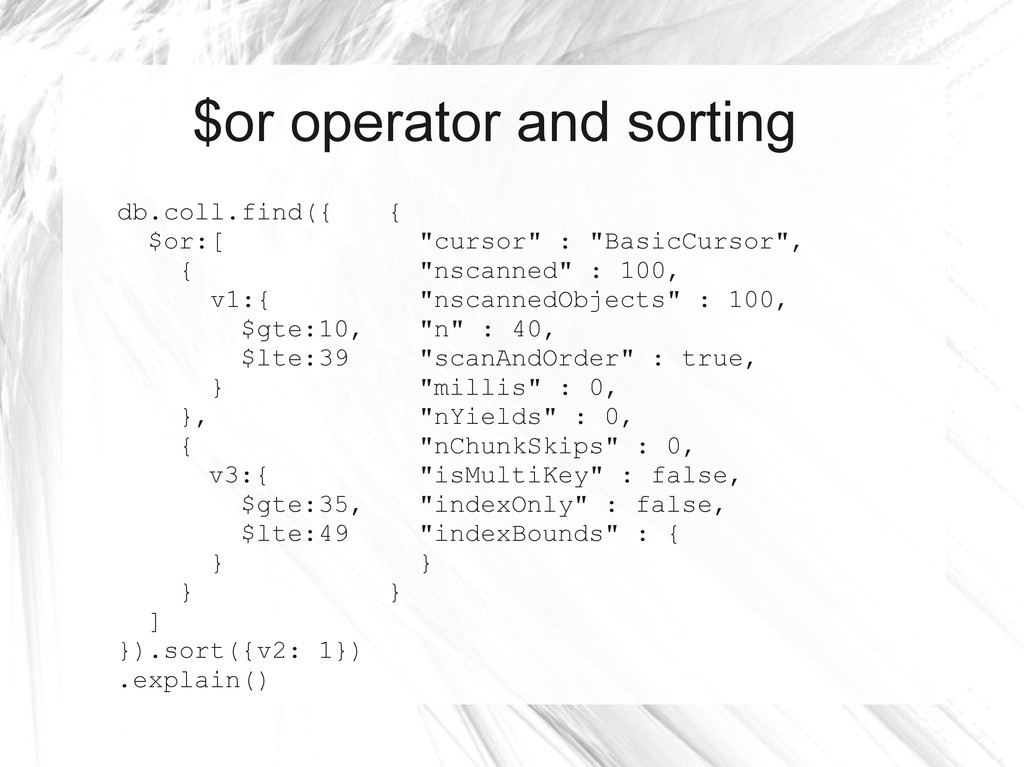
    during query execution • “millis” - time of query execution • “scanAndOrder” - true, in case if in-memory sorting required • “indexOnly” - covered index is used • “isMultiKey” - index over array is used • “clauses” - used for iteration over more than one index
  7. Iterating over two indexes db.coll.find({ $or:[ { v1:{ $gte:10, $lte:39

    } }, { v3:{ $gte:35, $lte:49 } } ] }).explain() { "clauses" : [ { "cursor" : "BtreeCursor v1_1", "nscanned" : 30, "n" : 30, ... }, { "cursor" : "BtreeCursor v3_1", "nscanned" : 15, "n" : 10, ... } ] "nscanned" : 45, "nscannedObjects" : 45, "n" : 40, "millis" : 0 }
  8. $or operator and sorting db.coll.find({ $or:[ { v1:{ $gte:10, $lte:39

    } }, { v3:{ $gte:35, $lte:49 } } ] }).sort({v2: 1}) .explain() { "cursor" : "BasicCursor", "nscanned" : 100, "nscannedObjects" : 100, "n" : 40, "scanAndOrder" : true, "millis" : 0, "nYields" : 0, "nChunkSkips" : 0, "isMultiKey" : false, "indexOnly" : false, "indexBounds" : { } }
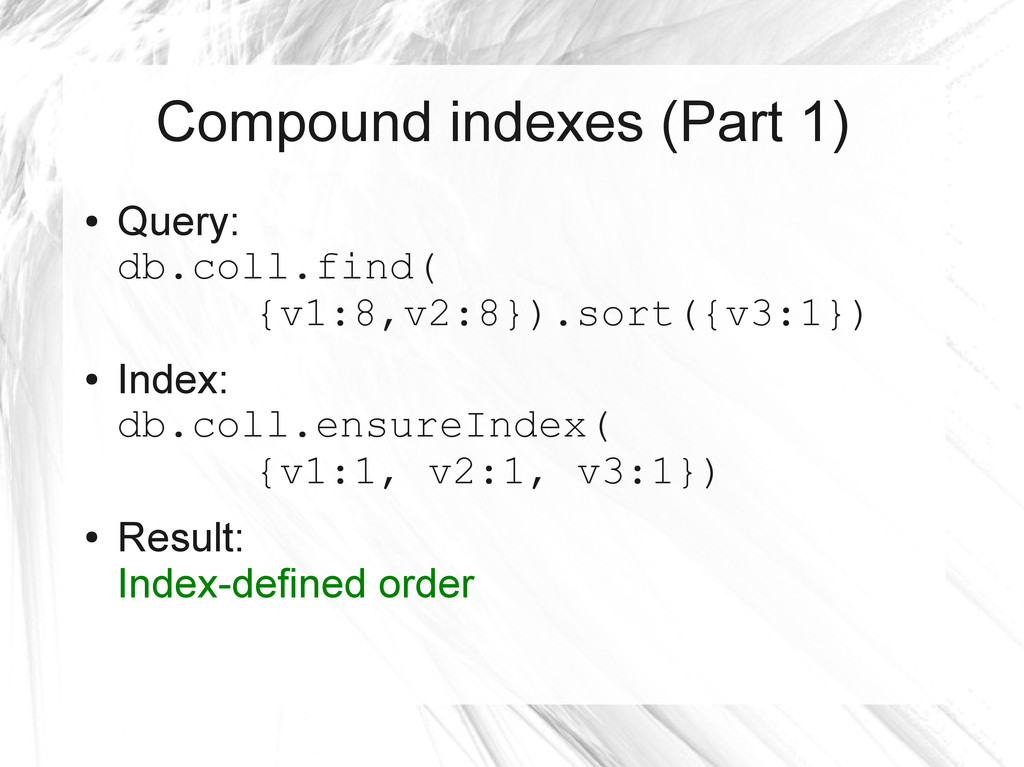
  9. Compound indexes (Part 1) • Query: db.coll.find( {v1:8,v2:8}).sort({v3:1}) • Index:

    db.coll.ensureIndex( {v1:1, v2:1, v3:1}) • Result: Index-defined order
  10. Compound indexes (Part 2) • Query: db.coll.find( {v1:{$in:[8, 4]},v2:8}) .sort({v3:1})

    • Index: db.coll.ensureIndex( {v1:1, v2:1, v3:1}) • Result: In-memory sorting
  11. Compound indexes (Part 3) • Query: db.coll.find( {v1:{$in:[8, 4]},v2:8}) .sort({v3:1})

    • Index: db.coll.ensureIndex( {v2:1, v3:1}) • Result: Index-defined order
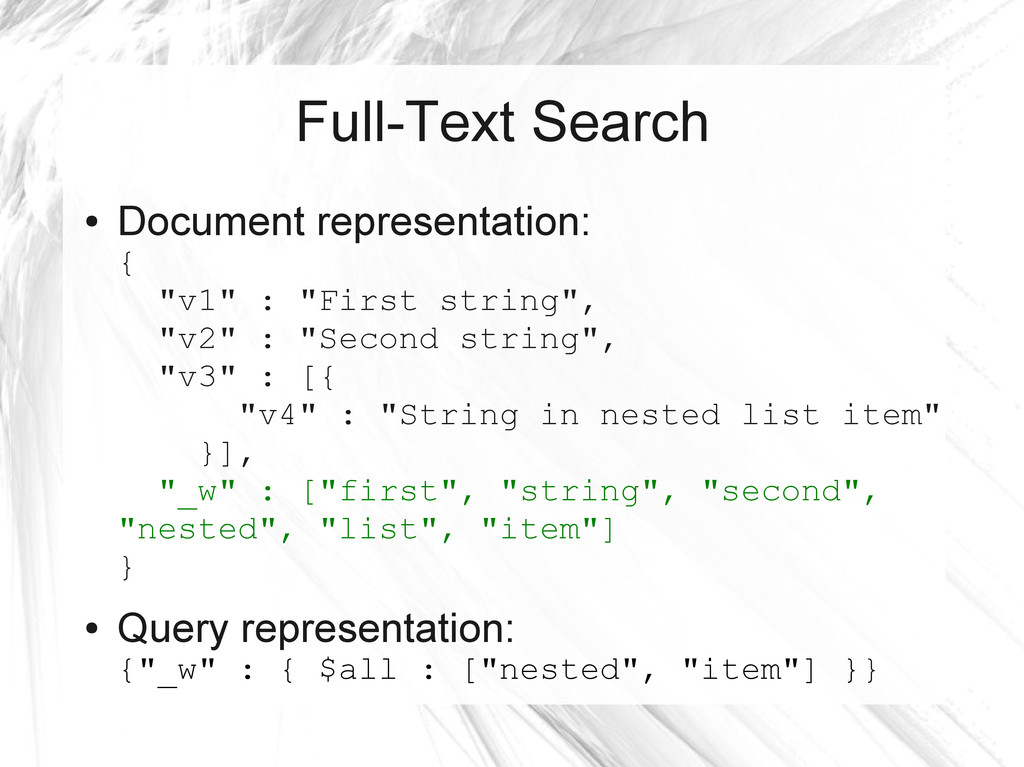
  12. Full-Text Search • Document representation: { "v1" : "First string",

    "v2" : "Second string", "v3" : [{ "v4" : "String in nested list item" }], "_w" : ["first", "string", "second", "nested", "list", "item"] } • Query representation: {"_w" : { $all : ["nested", "item"] }}
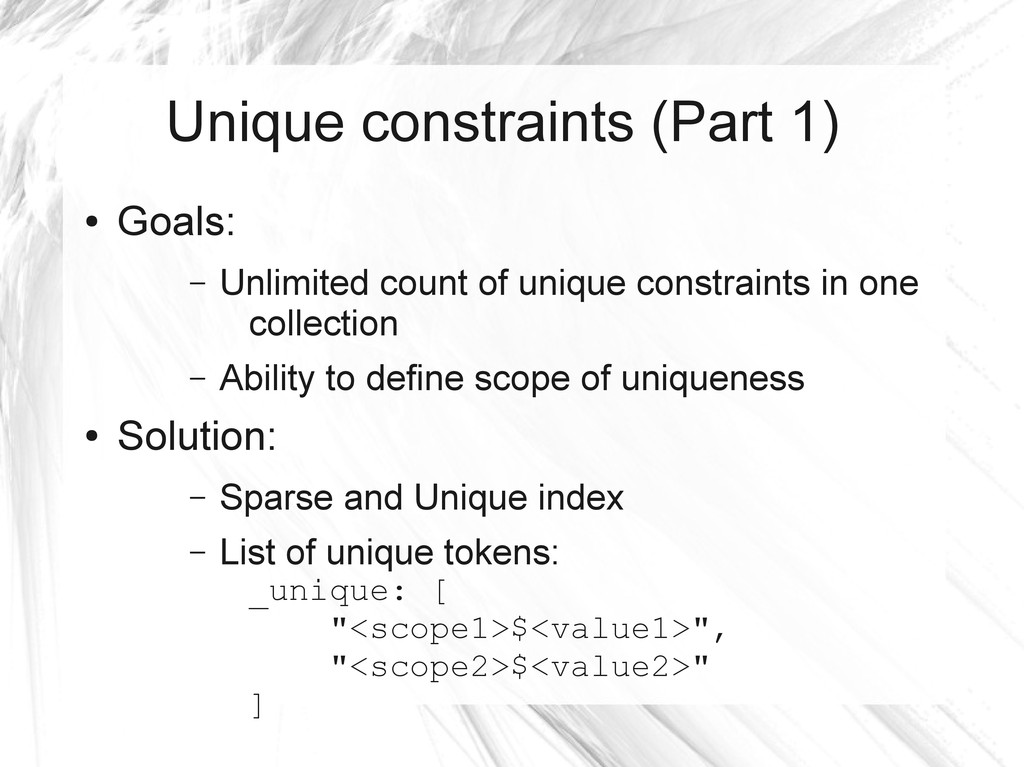
  13. Unique constraints (Part 1) • Goals: – Unlimited count of

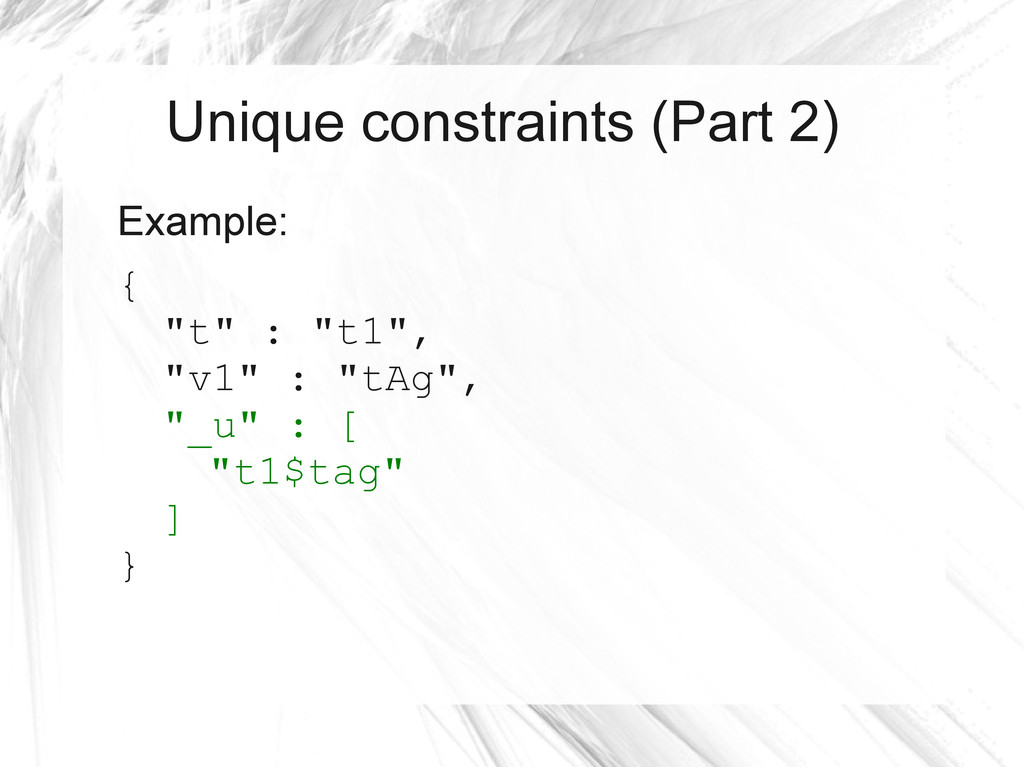
    unique constraints in one collection – Ability to define scope of uniqueness • Solution: – Sparse and Unique index – List of unique tokens: _unique: [ "<scope1>$<value1>", "<scope2>$<value2>" ]
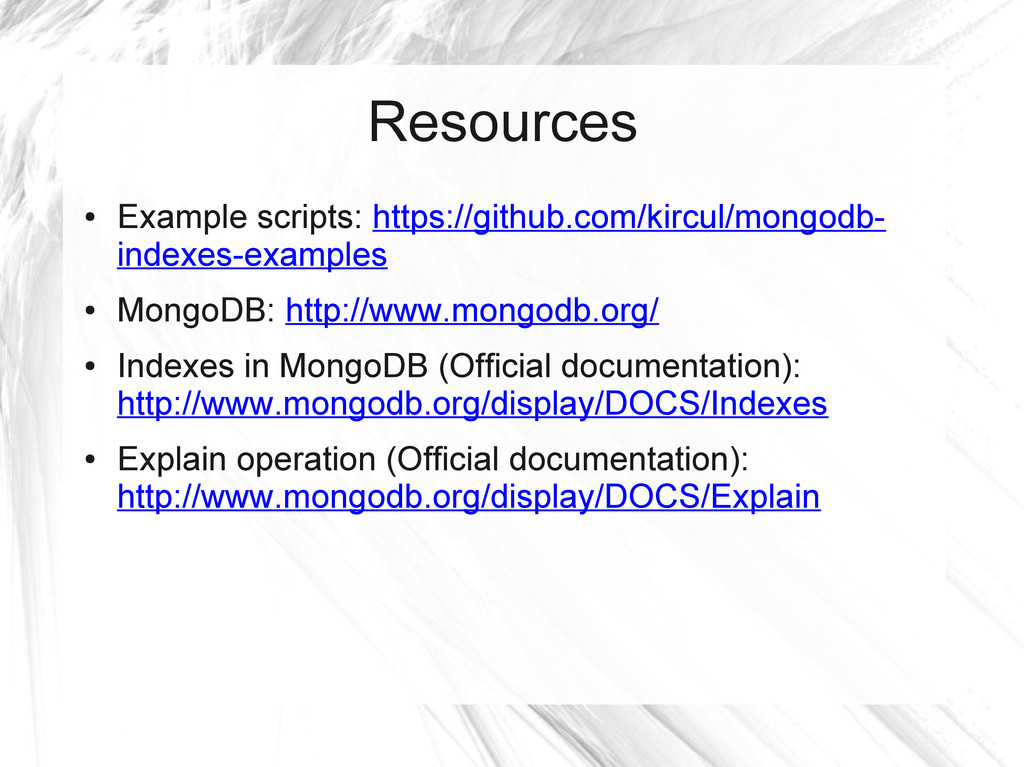
  14. Resources • Example scripts: https://github.com/kircul/mongodb- indexes-examples • MongoDB: http://www.mongodb.org/ •

    Indexes in MongoDB (Official documentation): http://www.mongodb.org/display/DOCS/Indexes • Explain operation (Official documentation): http://www.mongodb.org/display/DOCS/Explain