Upgrade to Pro — share decks privately, control downloads, hide ads and more …

brazil

Avatar for kitaynik kitaynik
August 08, 2013
71

 brazil

test

Avatar for kitaynik

kitaynik

August 08, 2013

Transcript

  1. Research Publication Date: 31 October 2008 ID Number: G00161996 ©

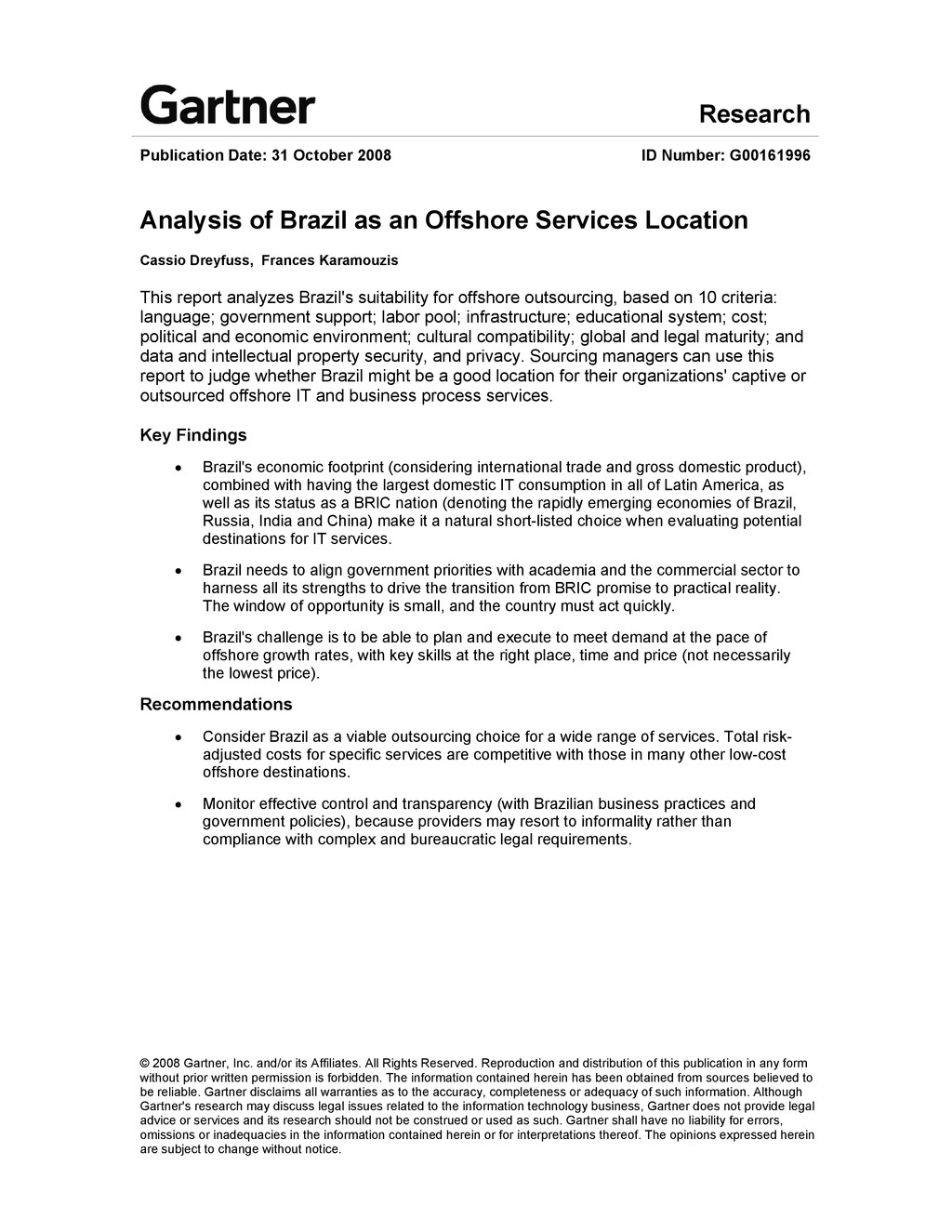
    2008 Gartner, Inc. and/or its Affiliates. All Rights Reserved. Reproduction and distribution of this publication in any form without prior written permission is forbidden. The information contained herein has been obtained from sources believed to be reliable. Gartner disclaims all warranties as to the accuracy, completeness or adequacy of such information. Although Gartner's research may discuss legal issues related to the information technology business, Gartner does not provide legal advice or services and its research should not be construed or used as such. Gartner shall have no liability for errors, omissions or inadequacies in the information contained herein or for interpretations thereof. The opinions expressed herein are subject to change without notice. Analysis of Brazil as an Offshore Services Location Cassio Dreyfuss, Frances Karamouzis This report analyzes Brazil's suitability for offshore outsourcing, based on 10 criteria: language; government support; labor pool; infrastructure; educational system; cost; political and economic environment; cultural compatibility; global and legal maturity; and data and intellectual property security, and privacy. Sourcing managers can use this report to judge whether Brazil might be a good location for their organizations' captive or outsourced offshore IT and business process services. Key Findings • Brazil's economic footprint (considering international trade and gross domestic product), combined with having the largest domestic IT consumption in all of Latin America, as well as its status as a BRIC nation (denoting the rapidly emerging economies of Brazil, Russia, India and China) make it a natural short-listed choice when evaluating potential destinations for IT services. • Brazil needs to align government priorities with academia and the commercial sector to harness all its strengths to drive the transition from BRIC promise to practical reality. The window of opportunity is small, and the country must act quickly. • Brazil's challenge is to be able to plan and execute to meet demand at the pace of offshore growth rates, with key skills at the right place, time and price (not necessarily the lowest price). Recommendations • Consider Brazil as a viable outsourcing choice for a wide range of services. Total risk- adjusted costs for specific services are competitive with those in many other low-cost offshore destinations. • Monitor effective control and transparency (with Brazilian business practices and government policies), because providers may resort to informality rather than compliance with complex and bureaucratic legal requirements.
  2. Publication Date: 31 October 2008/ID Number: G00161996 Page 2 of

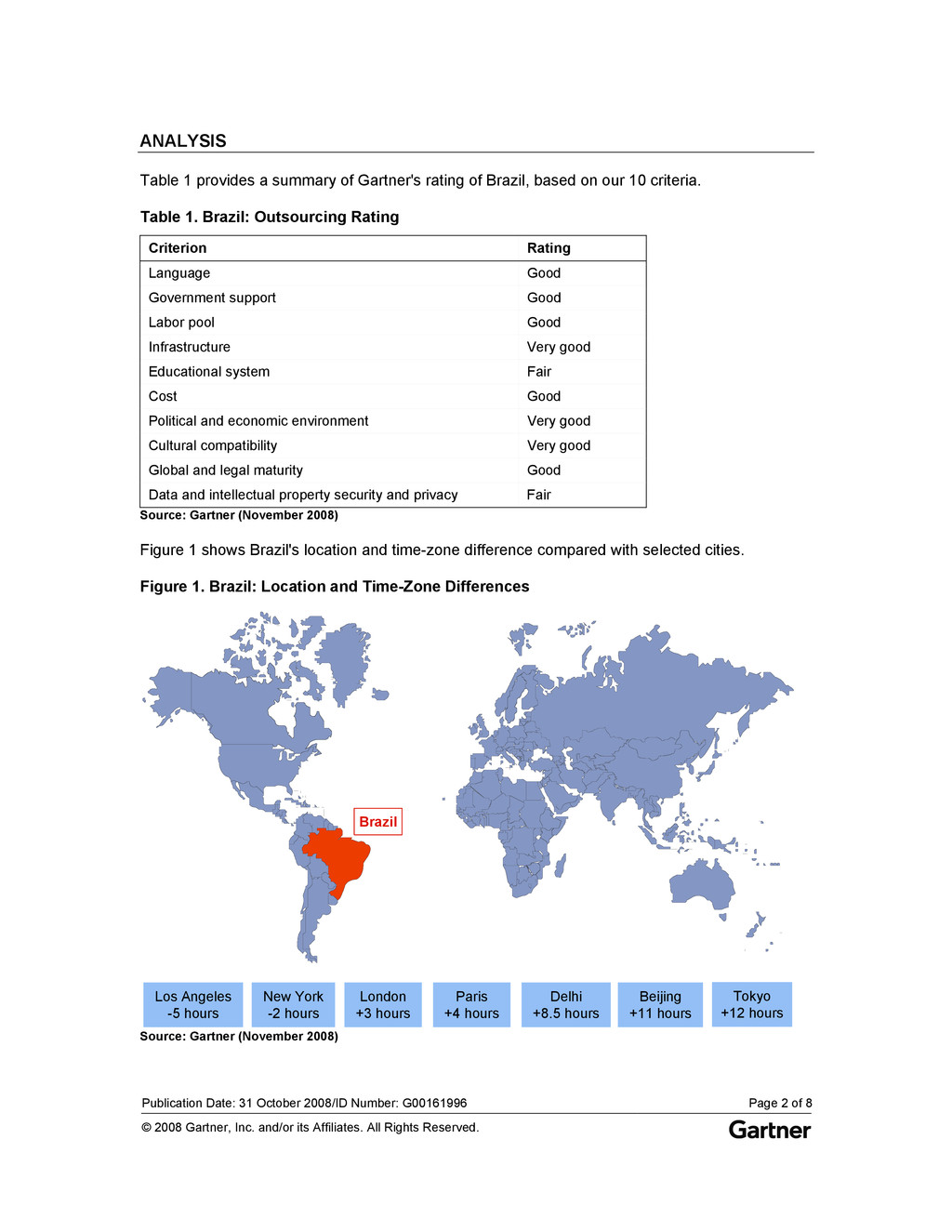
    8 © 2008 Gartner, Inc. and/or its Affiliates. All Rights Reserved. ANALYSIS Table 1 provides a summary of Gartner's rating of Brazil, based on our 10 criteria. Table 1. Brazil: Outsourcing Rating Criterion Rating Language Good Government support Good Labor pool Good Infrastructure Very good Educational system Fair Cost Good Political and economic environment Very good Cultural compatibility Very good Global and legal maturity Good Data and intellectual property security and privacy Fair Source: Gartner (November 2008) Figure 1 shows Brazil's location and time-zone difference compared with selected cities. Figure 1. Brazil: Location and Time-Zone Differences Los Angeles -5 hours New York -2 hours London +3 hours Paris +4 hours Delhi +8.5 hours Beijing +11 hours Tokyo +12 hours Brazil Los Angeles -5 hours New York -2 hours London +3 hours Paris +4 hours Delhi +8.5 hours Beijing +11 hours Tokyo +12 hours Brazil Source: Gartner (November 2008)
  3. Publication Date: 31 October 2008/ID Number: G00161996 Page 3 of

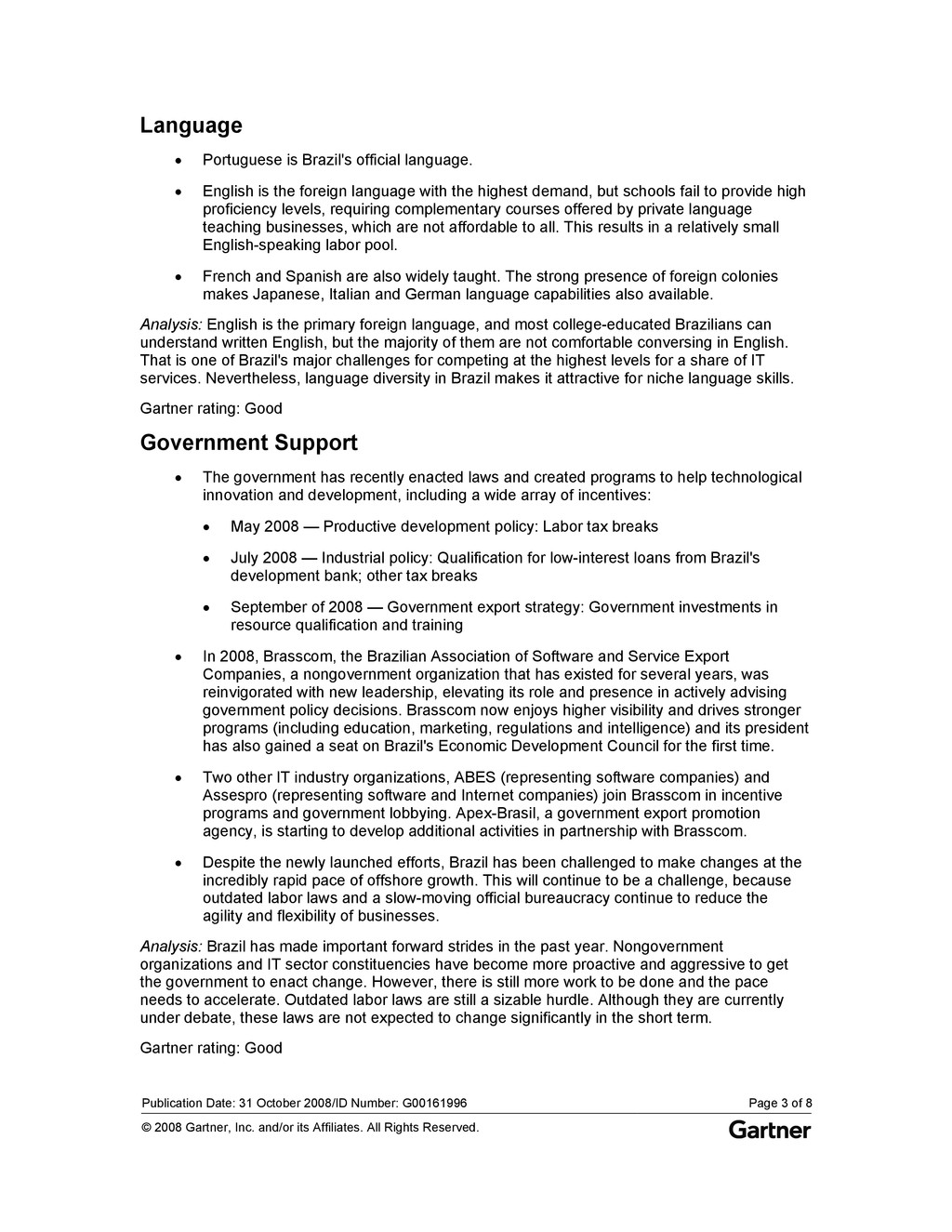
    8 © 2008 Gartner, Inc. and/or its Affiliates. All Rights Reserved. Language • Portuguese is Brazil's official language. • English is the foreign language with the highest demand, but schools fail to provide high proficiency levels, requiring complementary courses offered by private language teaching businesses, which are not affordable to all. This results in a relatively small English-speaking labor pool. • French and Spanish are also widely taught. The strong presence of foreign colonies makes Japanese, Italian and German language capabilities also available. Analysis: English is the primary foreign language, and most college-educated Brazilians can understand written English, but the majority of them are not comfortable conversing in English. That is one of Brazil's major challenges for competing at the highest levels for a share of IT services. Nevertheless, language diversity in Brazil makes it attractive for niche language skills. Gartner rating: Good Government Support • The government has recently enacted laws and created programs to help technological innovation and development, including a wide array of incentives: • May 2008 — Productive development policy: Labor tax breaks • July 2008 — Industrial policy: Qualification for low-interest loans from Brazil's development bank; other tax breaks • September of 2008 — Government export strategy: Government investments in resource qualification and training • In 2008, Brasscom, the Brazilian Association of Software and Service Export Companies, a nongovernment organization that has existed for several years, was reinvigorated with new leadership, elevating its role and presence in actively advising government policy decisions. Brasscom now enjoys higher visibility and drives stronger programs (including education, marketing, regulations and intelligence) and its president has also gained a seat on Brazil's Economic Development Council for the first time. • Two other IT industry organizations, ABES (representing software companies) and Assespro (representing software and Internet companies) join Brasscom in incentive programs and government lobbying. Apex-Brasil, a government export promotion agency, is starting to develop additional activities in partnership with Brasscom. • Despite the newly launched efforts, Brazil has been challenged to make changes at the incredibly rapid pace of offshore growth. This will continue to be a challenge, because outdated labor laws and a slow-moving official bureaucracy continue to reduce the agility and flexibility of businesses. Analysis: Brazil has made important forward strides in the past year. Nongovernment organizations and IT sector constituencies have become more proactive and aggressive to get the government to enact change. However, there is still more work to be done and the pace needs to accelerate. Outdated labor laws are still a sizable hurdle. Although they are currently under debate, these laws are not expected to change significantly in the short term. Gartner rating: Good
  4. Publication Date: 31 October 2008/ID Number: G00161996 Page 4 of

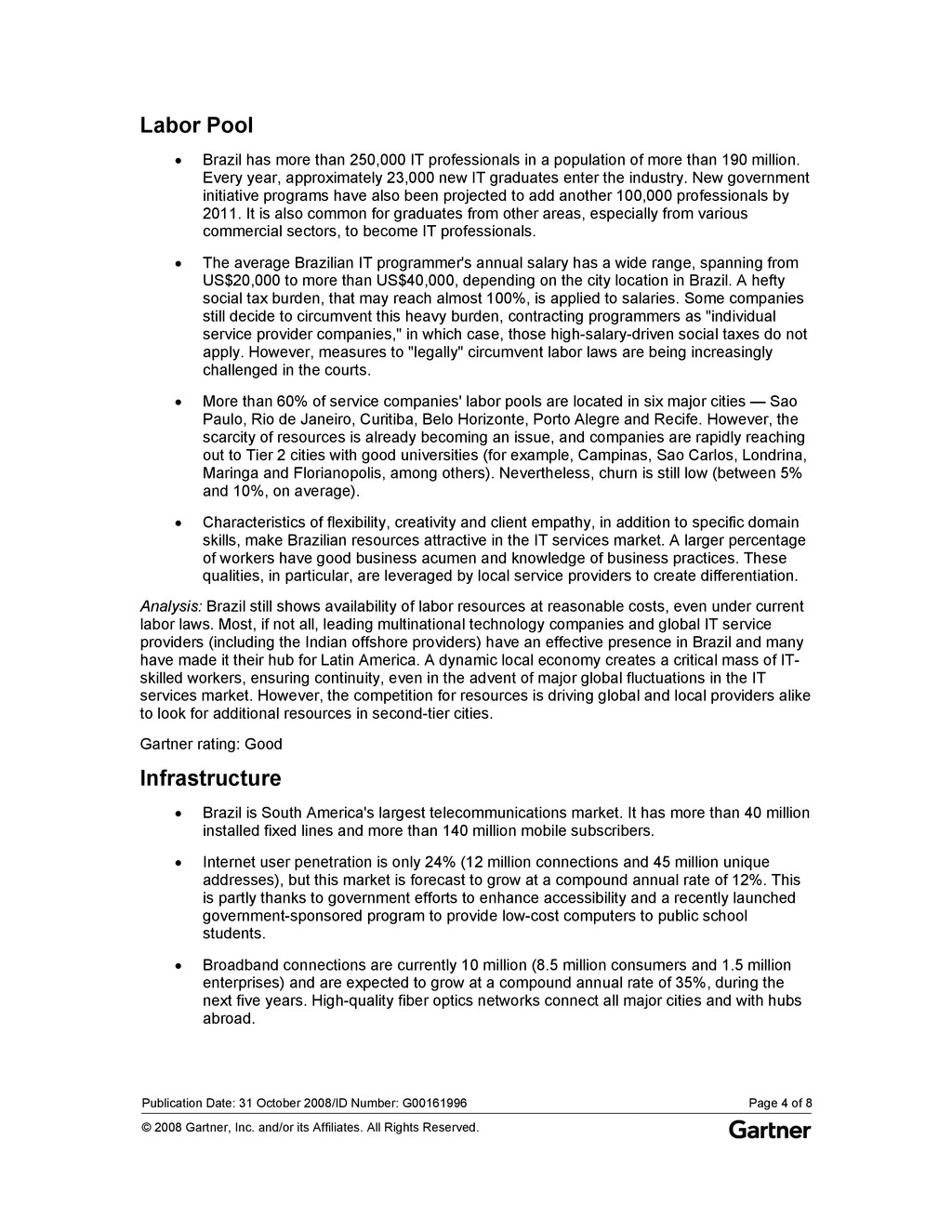
    8 © 2008 Gartner, Inc. and/or its Affiliates. All Rights Reserved. Labor Pool • Brazil has more than 250,000 IT professionals in a population of more than 190 million. Every year, approximately 23,000 new IT graduates enter the industry. New government initiative programs have also been projected to add another 100,000 professionals by 2011. It is also common for graduates from other areas, especially from various commercial sectors, to become IT professionals. • The average Brazilian IT programmer's annual salary has a wide range, spanning from US$20,000 to more than US$40,000, depending on the city location in Brazil. A hefty social tax burden, that may reach almost 100%, is applied to salaries. Some companies still decide to circumvent this heavy burden, contracting programmers as "individual service provider companies," in which case, those high-salary-driven social taxes do not apply. However, measures to "legally" circumvent labor laws are being increasingly challenged in the courts. • More than 60% of service companies' labor pools are located in six major cities — Sao Paulo, Rio de Janeiro, Curitiba, Belo Horizonte, Porto Alegre and Recife. However, the scarcity of resources is already becoming an issue, and companies are rapidly reaching out to Tier 2 cities with good universities (for example, Campinas, Sao Carlos, Londrina, Maringa and Florianopolis, among others). Nevertheless, churn is still low (between 5% and 10%, on average). • Characteristics of flexibility, creativity and client empathy, in addition to specific domain skills, make Brazilian resources attractive in the IT services market. A larger percentage of workers have good business acumen and knowledge of business practices. These qualities, in particular, are leveraged by local service providers to create differentiation. Analysis: Brazil still shows availability of labor resources at reasonable costs, even under current labor laws. Most, if not all, leading multinational technology companies and global IT service providers (including the Indian offshore providers) have an effective presence in Brazil and many have made it their hub for Latin America. A dynamic local economy creates a critical mass of IT- skilled workers, ensuring continuity, even in the advent of major global fluctuations in the IT services market. However, the competition for resources is driving global and local providers alike to look for additional resources in second-tier cities. Gartner rating: Good Infrastructure • Brazil is South America's largest telecommunications market. It has more than 40 million installed fixed lines and more than 140 million mobile subscribers. • Internet user penetration is only 24% (12 million connections and 45 million unique addresses), but this market is forecast to grow at a compound annual rate of 12%. This is partly thanks to government efforts to enhance accessibility and a recently launched government-sponsored program to provide low-cost computers to public school students. • Broadband connections are currently 10 million (8.5 million consumers and 1.5 million enterprises) and are expected to grow at a compound annual rate of 35%, during the next five years. High-quality fiber optics networks connect all major cities and with hubs abroad.
  5. Publication Date: 31 October 2008/ID Number: G00161996 Page 5 of

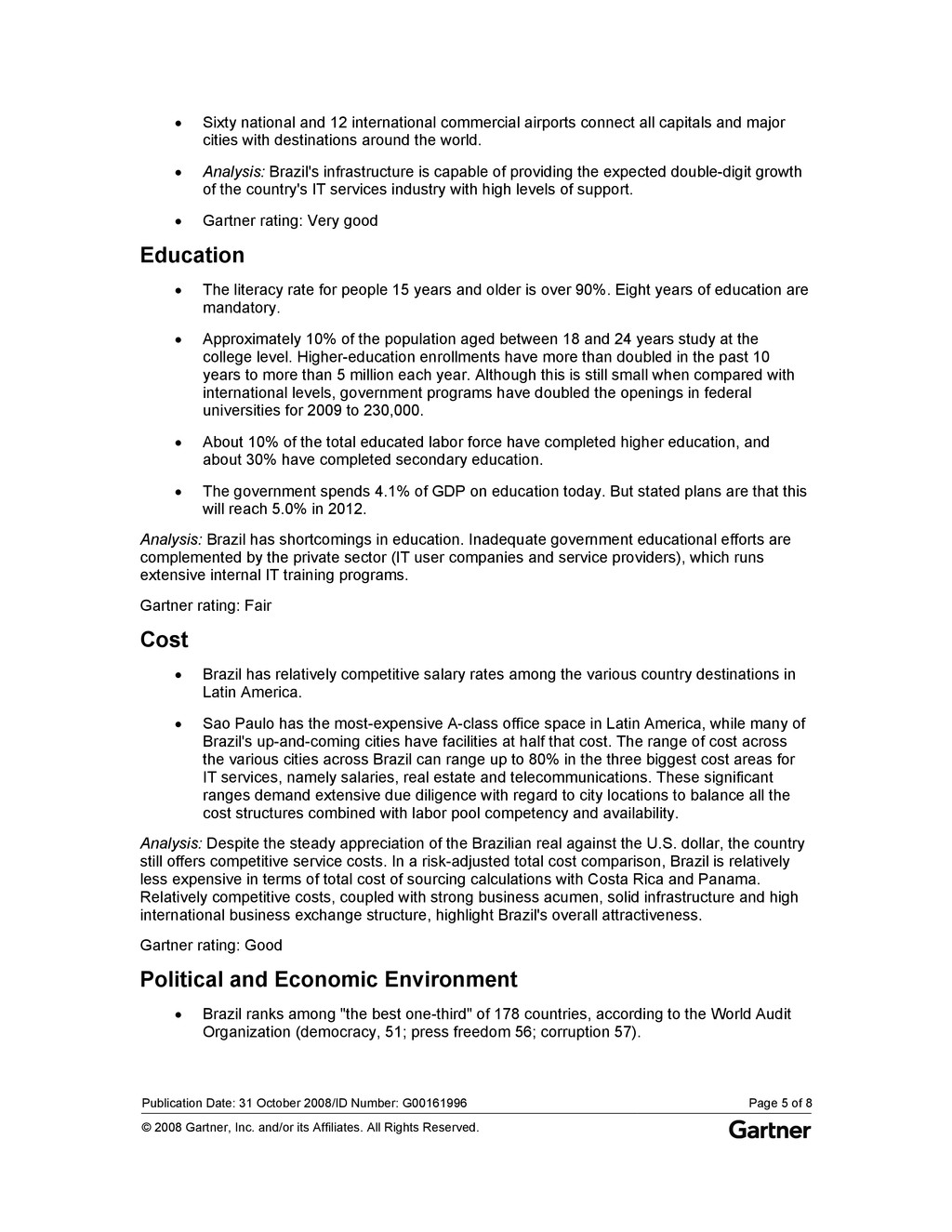
    8 © 2008 Gartner, Inc. and/or its Affiliates. All Rights Reserved. • Sixty national and 12 international commercial airports connect all capitals and major cities with destinations around the world. • Analysis: Brazil's infrastructure is capable of providing the expected double-digit growth of the country's IT services industry with high levels of support. • Gartner rating: Very good Education • The literacy rate for people 15 years and older is over 90%. Eight years of education are mandatory. • Approximately 10% of the population aged between 18 and 24 years study at the college level. Higher-education enrollments have more than doubled in the past 10 years to more than 5 million each year. Although this is still small when compared with international levels, government programs have doubled the openings in federal universities for 2009 to 230,000. • About 10% of the total educated labor force have completed higher education, and about 30% have completed secondary education. • The government spends 4.1% of GDP on education today. But stated plans are that this will reach 5.0% in 2012. Analysis: Brazil has shortcomings in education. Inadequate government educational efforts are complemented by the private sector (IT user companies and service providers), which runs extensive internal IT training programs. Gartner rating: Fair Cost • Brazil has relatively competitive salary rates among the various country destinations in Latin America. • Sao Paulo has the most-expensive A-class office space in Latin America, while many of Brazil's up-and-coming cities have facilities at half that cost. The range of cost across the various cities across Brazil can range up to 80% in the three biggest cost areas for IT services, namely salaries, real estate and telecommunications. These significant ranges demand extensive due diligence with regard to city locations to balance all the cost structures combined with labor pool competency and availability. Analysis: Despite the steady appreciation of the Brazilian real against the U.S. dollar, the country still offers competitive service costs. In a risk-adjusted total cost comparison, Brazil is relatively less expensive in terms of total cost of sourcing calculations with Costa Rica and Panama. Relatively competitive costs, coupled with strong business acumen, solid infrastructure and high international business exchange structure, highlight Brazil's overall attractiveness. Gartner rating: Good Political and Economic Environment • Brazil ranks among "the best one-third" of 178 countries, according to the World Audit Organization (democracy, 51; press freedom 56; corruption 57).
  6. Publication Date: 31 October 2008/ID Number: G00161996 Page 6 of

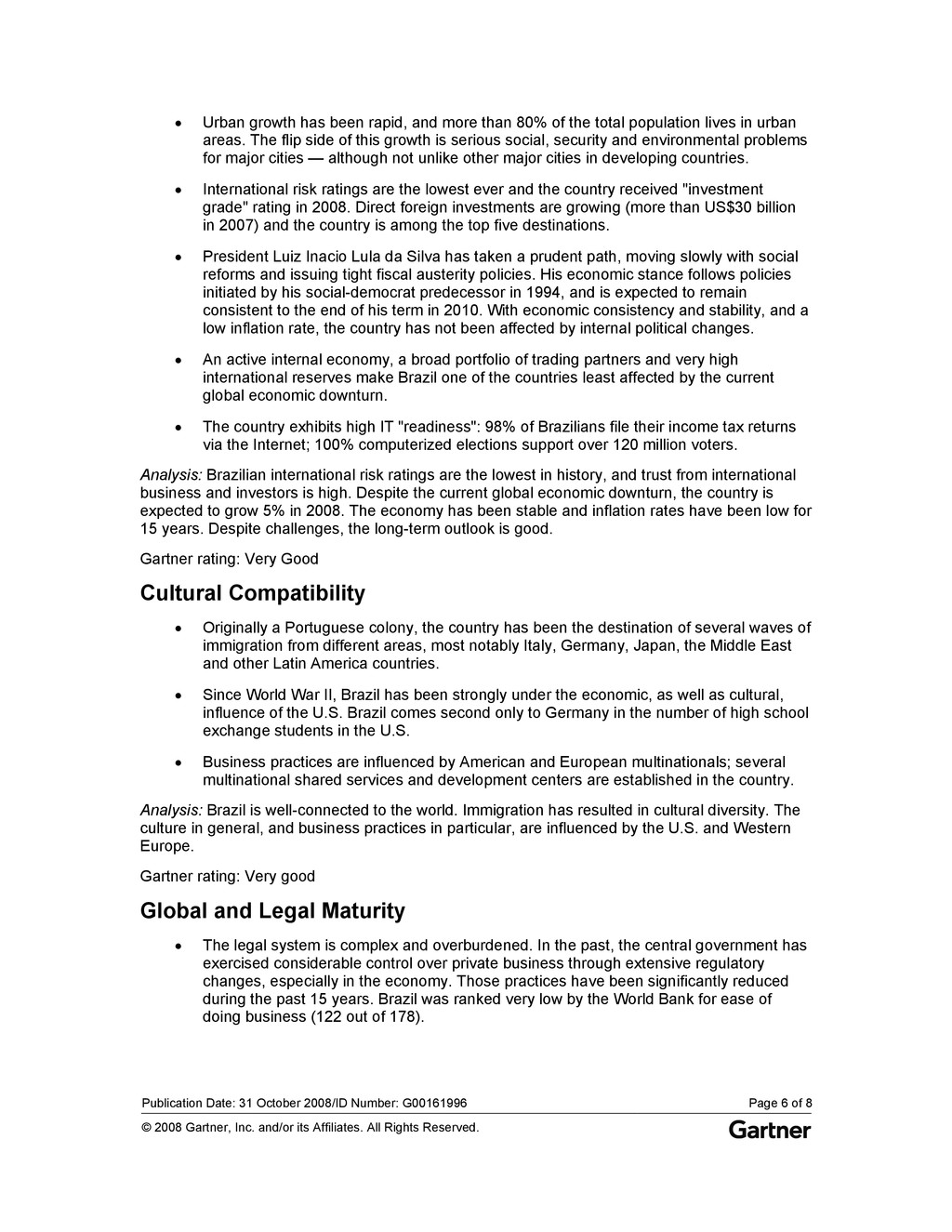
    8 © 2008 Gartner, Inc. and/or its Affiliates. All Rights Reserved. • Urban growth has been rapid, and more than 80% of the total population lives in urban areas. The flip side of this growth is serious social, security and environmental problems for major cities — although not unlike other major cities in developing countries. • International risk ratings are the lowest ever and the country received "investment grade" rating in 2008. Direct foreign investments are growing (more than US$30 billion in 2007) and the country is among the top five destinations. • President Luiz Inacio Lula da Silva has taken a prudent path, moving slowly with social reforms and issuing tight fiscal austerity policies. His economic stance follows policies initiated by his social-democrat predecessor in 1994, and is expected to remain consistent to the end of his term in 2010. With economic consistency and stability, and a low inflation rate, the country has not been affected by internal political changes. • An active internal economy, a broad portfolio of trading partners and very high international reserves make Brazil one of the countries least affected by the current global economic downturn. • The country exhibits high IT "readiness": 98% of Brazilians file their income tax returns via the Internet; 100% computerized elections support over 120 million voters. Analysis: Brazilian international risk ratings are the lowest in history, and trust from international business and investors is high. Despite the current global economic downturn, the country is expected to grow 5% in 2008. The economy has been stable and inflation rates have been low for 15 years. Despite challenges, the long-term outlook is good. Gartner rating: Very Good Cultural Compatibility • Originally a Portuguese colony, the country has been the destination of several waves of immigration from different areas, most notably Italy, Germany, Japan, the Middle East and other Latin America countries. • Since World War II, Brazil has been strongly under the economic, as well as cultural, influence of the U.S. Brazil comes second only to Germany in the number of high school exchange students in the U.S. • Business practices are influenced by American and European multinationals; several multinational shared services and development centers are established in the country. Analysis: Brazil is well-connected to the world. Immigration has resulted in cultural diversity. The culture in general, and business practices in particular, are influenced by the U.S. and Western Europe. Gartner rating: Very good Global and Legal Maturity • The legal system is complex and overburdened. In the past, the central government has exercised considerable control over private business through extensive regulatory changes, especially in the economy. Those practices have been significantly reduced during the past 15 years. Brazil was ranked very low by the World Bank for ease of doing business (122 out of 178).
  7. Publication Date: 31 October 2008/ID Number: G00161996 Page 7 of

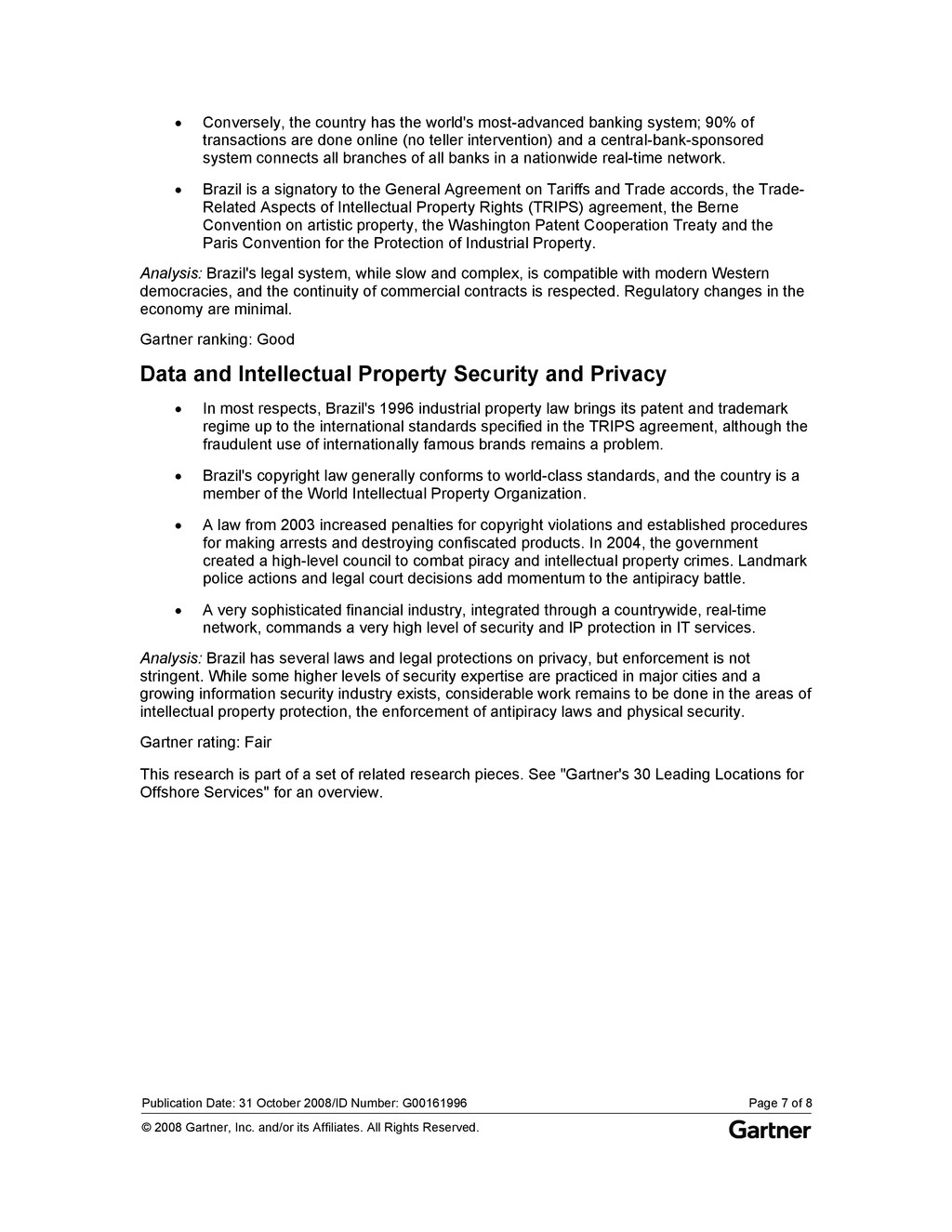
    8 © 2008 Gartner, Inc. and/or its Affiliates. All Rights Reserved. • Conversely, the country has the world's most-advanced banking system; 90% of transactions are done online (no teller intervention) and a central-bank-sponsored system connects all branches of all banks in a nationwide real-time network. • Brazil is a signatory to the General Agreement on Tariffs and Trade accords, the Trade- Related Aspects of Intellectual Property Rights (TRIPS) agreement, the Berne Convention on artistic property, the Washington Patent Cooperation Treaty and the Paris Convention for the Protection of Industrial Property. Analysis: Brazil's legal system, while slow and complex, is compatible with modern Western democracies, and the continuity of commercial contracts is respected. Regulatory changes in the economy are minimal. Gartner ranking: Good Data and Intellectual Property Security and Privacy • In most respects, Brazil's 1996 industrial property law brings its patent and trademark regime up to the international standards specified in the TRIPS agreement, although the fraudulent use of internationally famous brands remains a problem. • Brazil's copyright law generally conforms to world-class standards, and the country is a member of the World Intellectual Property Organization. • A law from 2003 increased penalties for copyright violations and established procedures for making arrests and destroying confiscated products. In 2004, the government created a high-level council to combat piracy and intellectual property crimes. Landmark police actions and legal court decisions add momentum to the antipiracy battle. • A very sophisticated financial industry, integrated through a countrywide, real-time network, commands a very high level of security and IP protection in IT services. Analysis: Brazil has several laws and legal protections on privacy, but enforcement is not stringent. While some higher levels of security expertise are practiced in major cities and a growing information security industry exists, considerable work remains to be done in the areas of intellectual property protection, the enforcement of antipiracy laws and physical security. Gartner rating: Fair This research is part of a set of related research pieces. See "Gartner's 30 Leading Locations for Offshore Services" for an overview.
  8. Publication Date: 31 October 2008/ID Number: G00161996 Page 8 of

    8 © 2008 Gartner, Inc. and/or its Affiliates. All Rights Reserved. REGIONAL HEADQUARTERS Corporate Headquarters 56 Top Gallant Road Stamford, CT 06902-7700 U.S.A. +1 203 964 0096 European Headquarters Tamesis The Glanty Egham Surrey, TW20 9AW UNITED KINGDOM +44 1784 431611 Asia/Pacific Headquarters Gartner Australasia Pty. Ltd. Level 9, 141 Walker Street North Sydney New South Wales 2060 AUSTRALIA +61 2 9459 4600 Japan Headquarters Gartner Japan Ltd. Aobadai Hills, 6F 7-7, Aobadai, 4-chome Meguro-ku, Tokyo 153-0042 JAPAN +81 3 3481 3670 Latin America Headquarters Gartner do Brazil Av. das Nações Unidas, 12551 9° andar—World Trade Center 04578-903—São Paulo SP BRAZIL +55 11 3443 1509