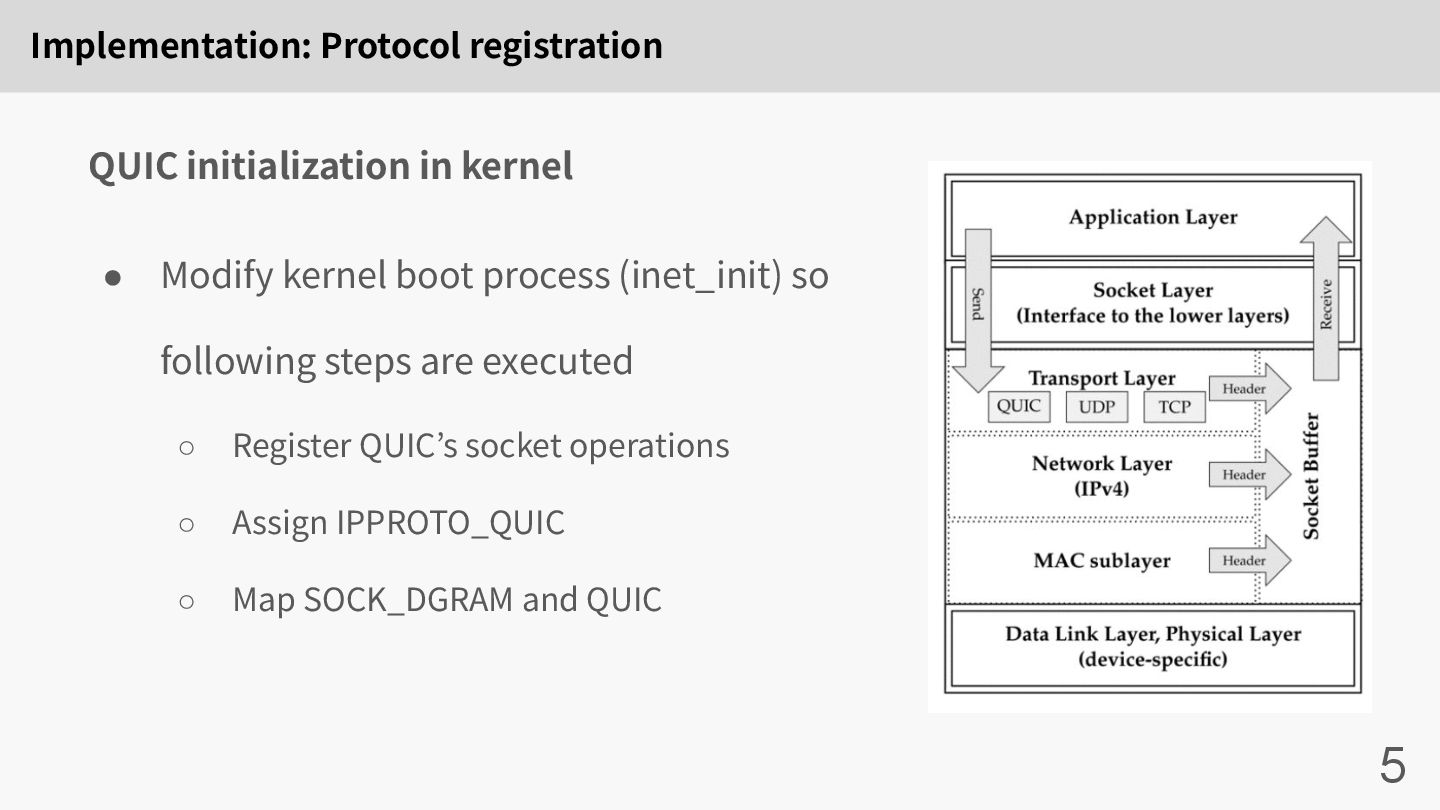
Kernel Peng Wang, Carmine Bianco, Janne Riihijärvi and Marina Petrova Presenter: Kota Yatagai MSWIM '18: Proceedings of the 21st ACM International Conference on Modeling, Analysis and Simulation of Wireless and Mobile Systems
improve HTTPS performance, overcoming problems in TCP • Current QUIC deployments run in user space, but context switching per packet limits its performance • This study implements QUIC in the Linux kernel to fairly compare it against TCP • Experiments show that kernel-space QUIC outperforms TCP in scenarios with low latency and high packet loss 2
1974, has evolved but struggles with modern requirements ◦ TCP has no built-in support for encryption ▪ TLS over TCP (HTTP/2) improved security but added handshake delays ◦ TCP’s strict reliable streams limits performance in real-time communications • Updating TCP is impractical because of the “protocol ossification” ▪ it would require global update to OS kernels and middleboxes
is designed to run in user space, making deployment quicker • QUIC also has TLS1.3 as its required subsystem, ensuring security ◦ QUIC-specific information such as initial CID is piggybacked in TLS handshake ◦ Whole QUIC handshake will be done with 1RTT at maximum • Prior studies compared user-space QUIC vs kernel-space TCP, which seemed unfair • This work implements QUIC inside the Linux kernel for a fair comparison against TCP
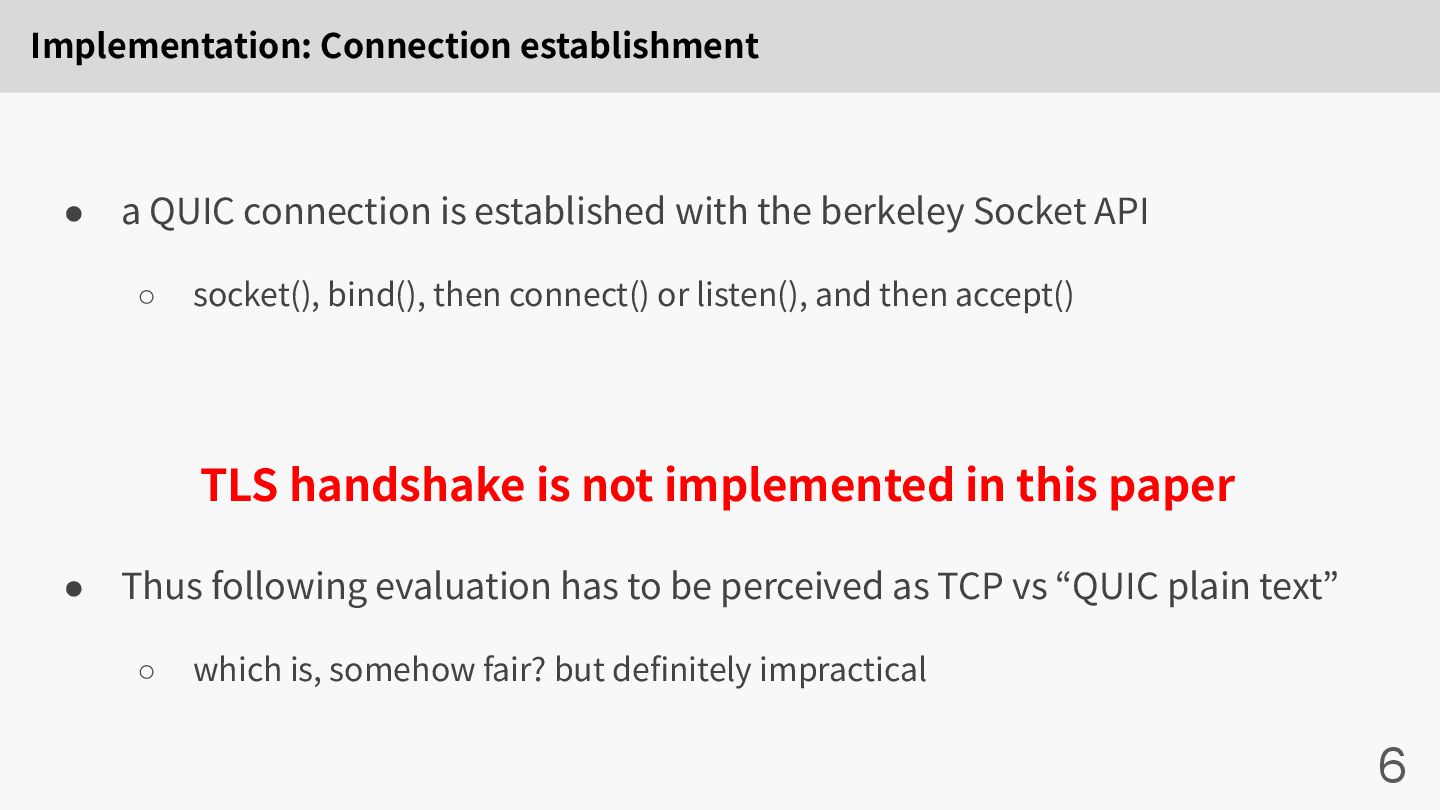
with the berkeley Socket API ◦ socket(), bind(), then connect() or listen(), and then accept() TLS handshake is not implemented in this paper • Thus following evaluation has to be perceived as TCP vs “QUIC plain text” ◦ which is, somehow fair? but definitely impractical
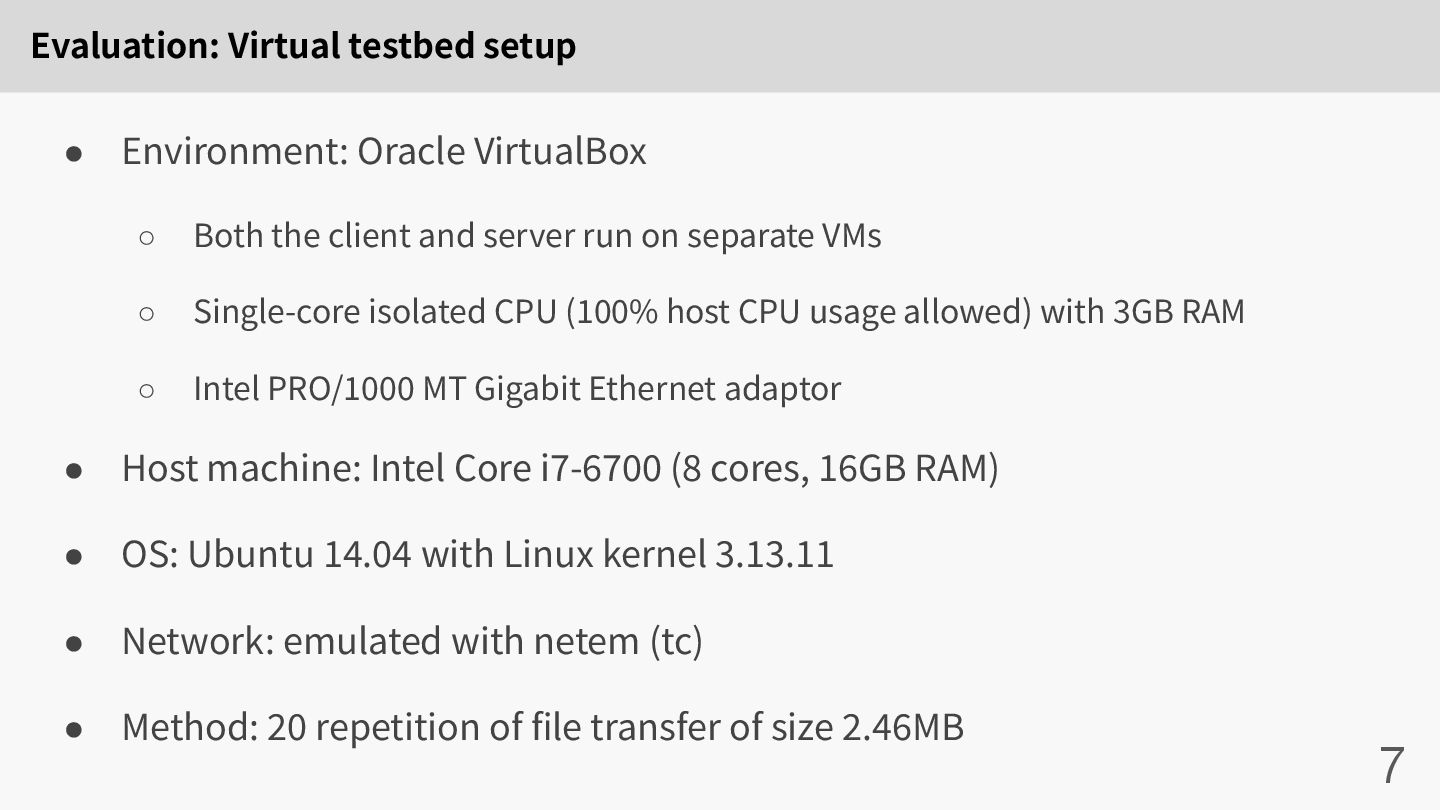
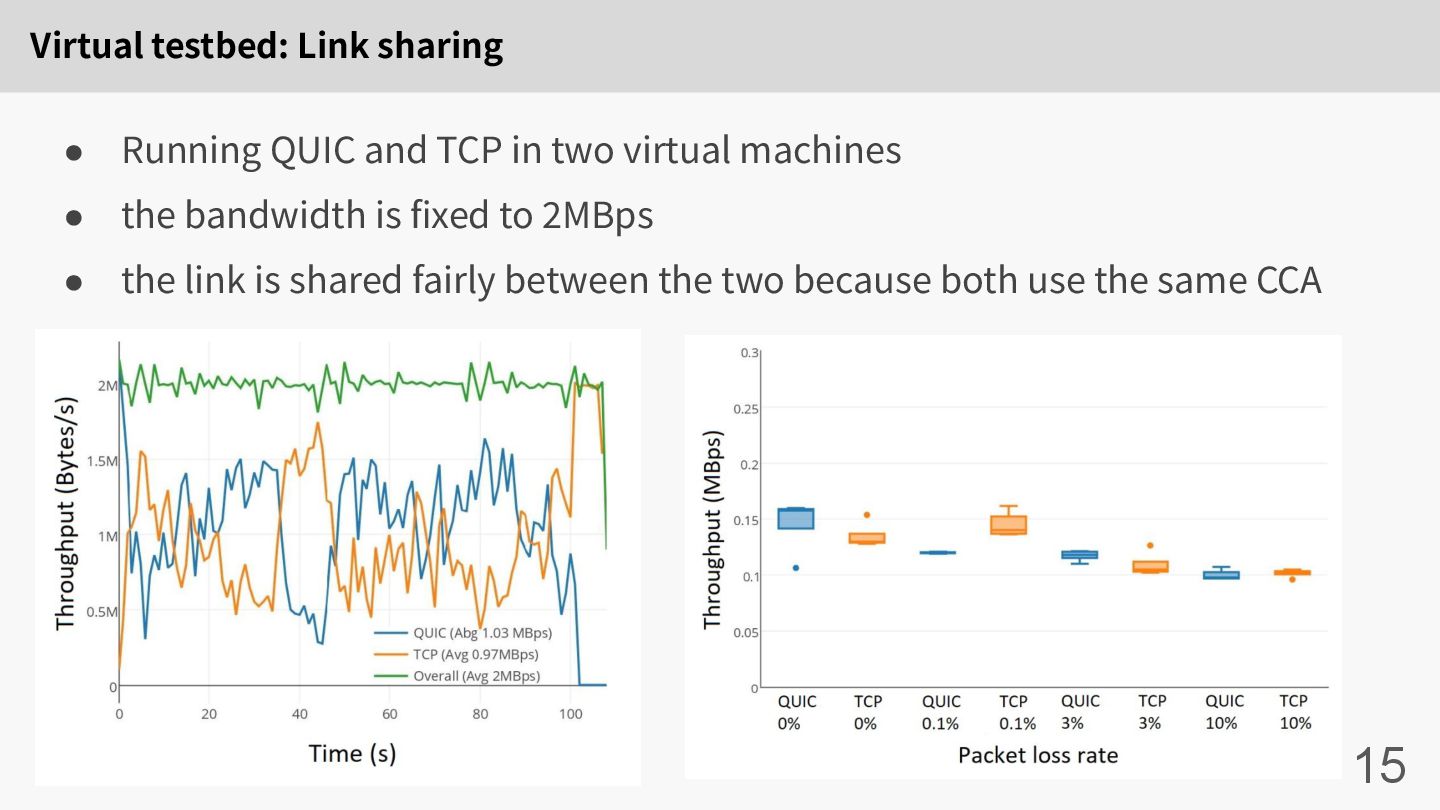
Both the client and server run on separate VMs ◦ Single-core isolated CPU (100% host CPU usage allowed) with 3GB RAM ◦ Intel PRO/1000 MT Gigabit Ethernet adaptor • Host machine: Intel Core i7-6700 (8 cores, 16GB RAM) • OS: Ubuntu 14.04 with Linux kernel 3.13.11 • Network: emulated with netem (tc) • Method: 20 repetition of file transfer of size 2.46MB
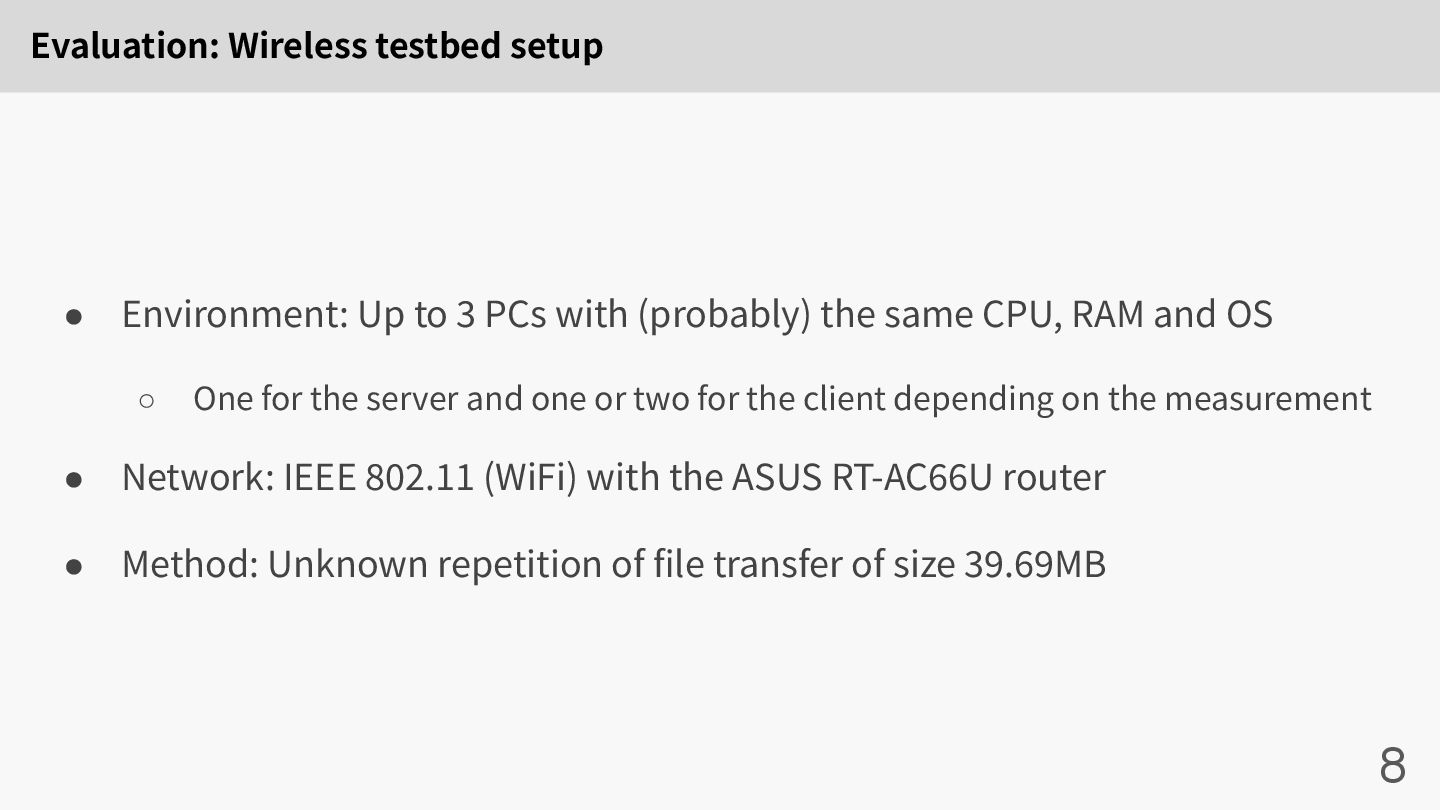
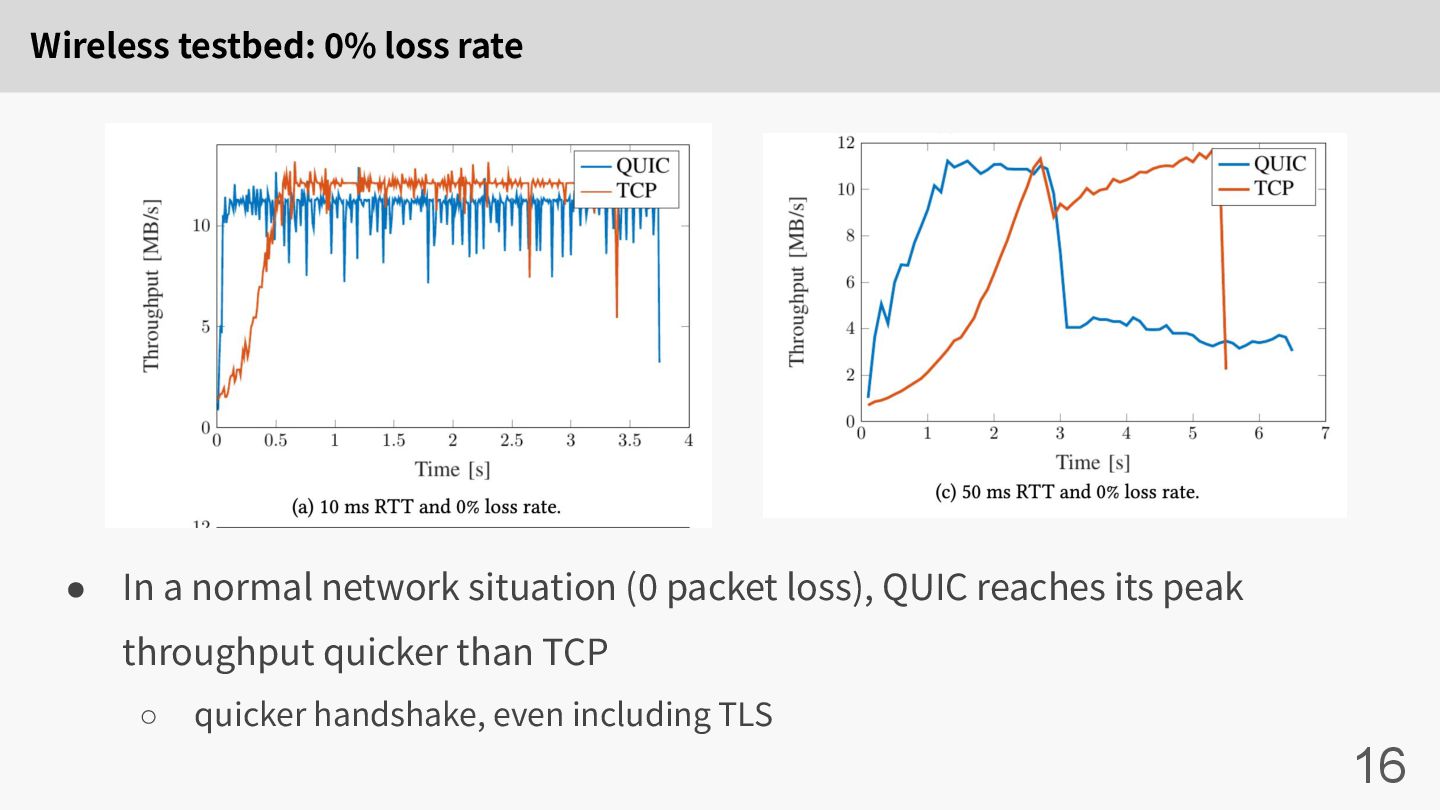
PCs with (probably) the same CPU, RAM and OS ◦ One for the server and one or two for the client depending on the measurement • Network: IEEE 802.11 (WiFi) with the ASUS RT-AC66U router • Method: Unknown repetition of file transfer of size 39.69MB
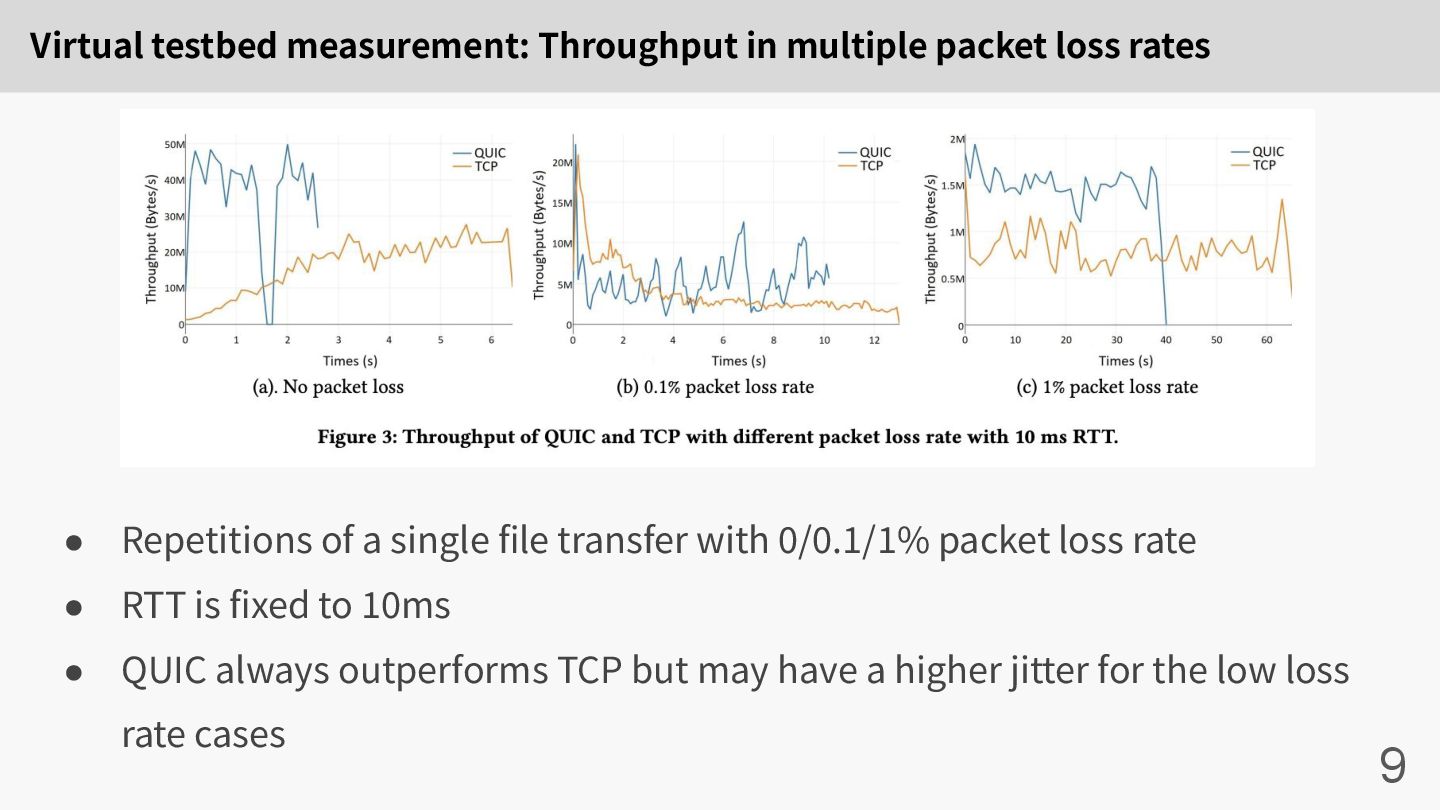
• Repetitions of a single file transfer with 0/0.1/1% packet loss rate • RTT is fixed to 10ms • QUIC always outperforms TCP but may have a higher jitter for the low loss rate cases
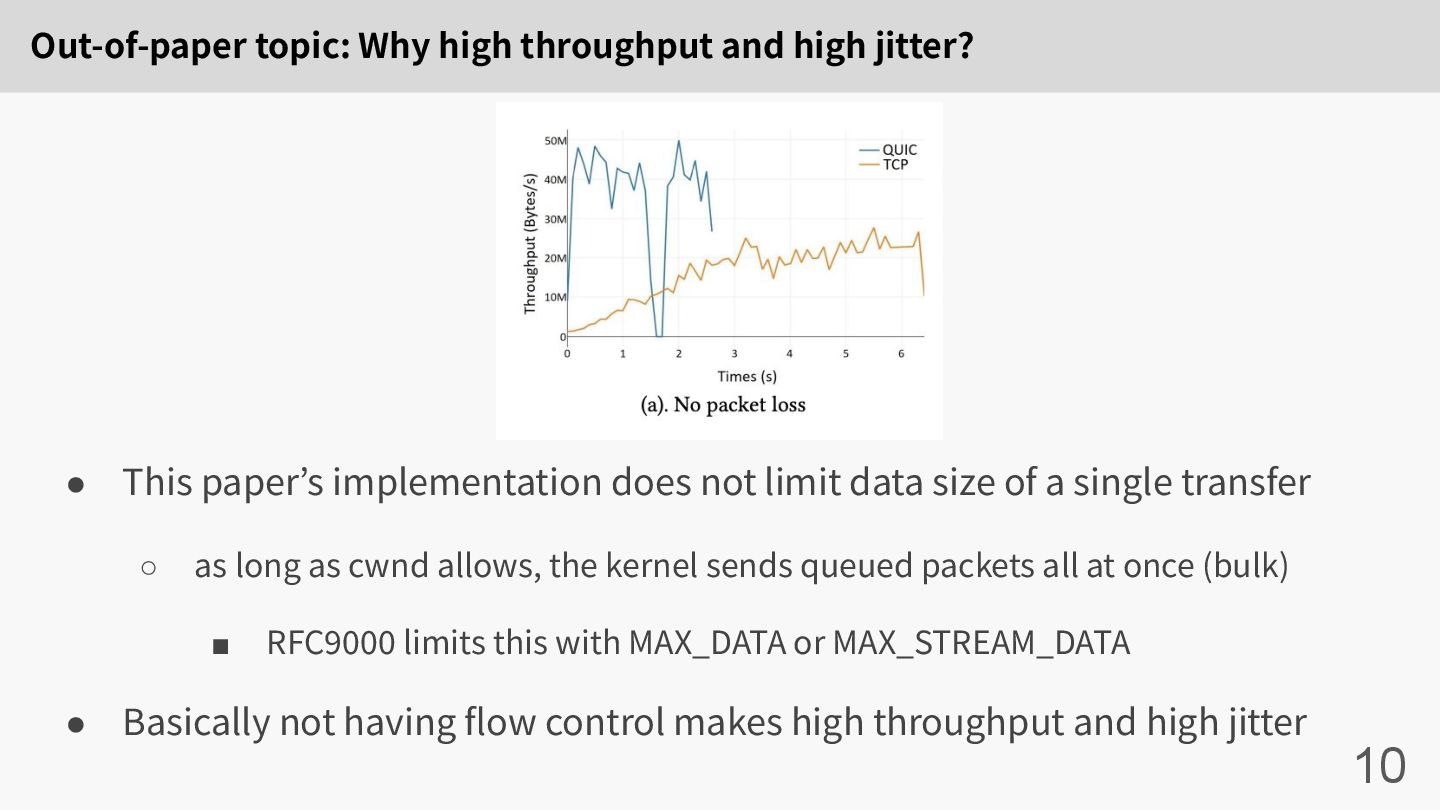
This paper’s implementation does not limit data size of a single transfer ◦ as long as cwnd allows, the kernel sends queued packets all at once (bulk) ▪ RFC9000 limits this with MAX_DATA or MAX_STREAM_DATA • Basically not having flow control makes high throughput and high jitter
Theoretically, QUIC will not overcome TCP in terms of throughput ◦ because encryption process is computational intensive. • QUIC will overcome TCP + TLS1.3 ◦ quicker handshakes, more flexible SACK (Selective ACK) • We do not have a real-world measurement of properly implemented QUIC in kernel at this point ◦ there are other in-kernel QUIC implementations such as lxin/quic, though not evaluated yet
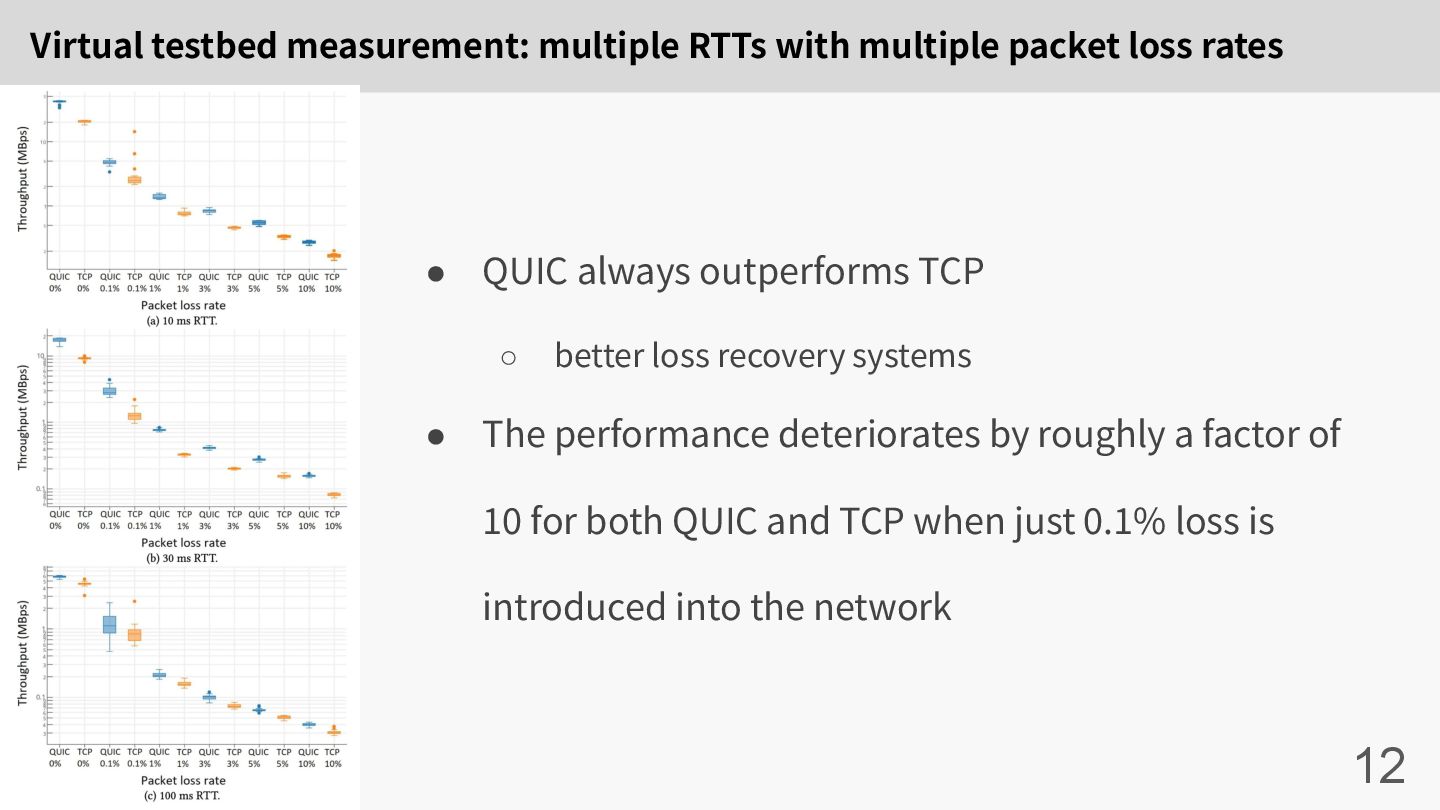
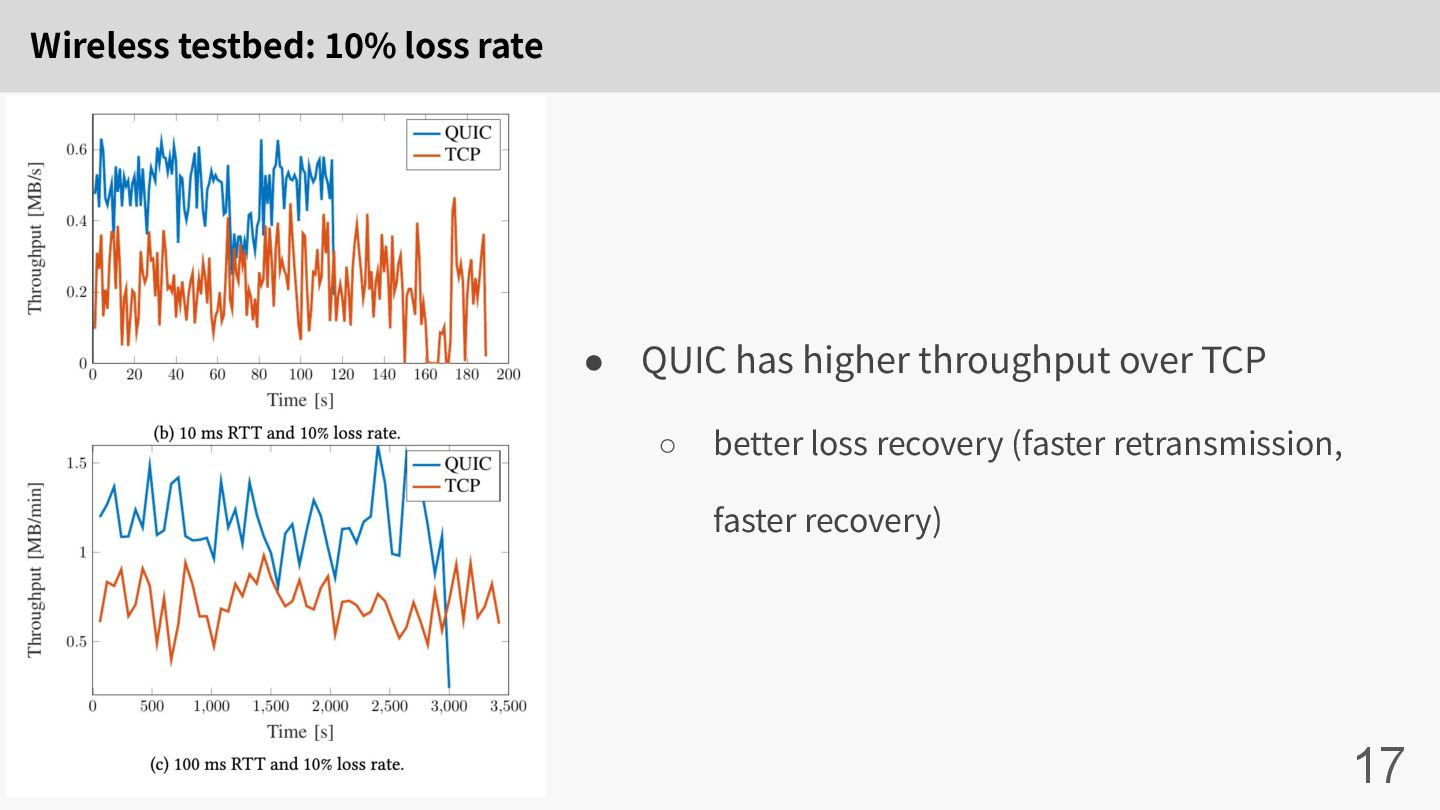
12 • QUIC always outperforms TCP ◦ better loss recovery systems • The performance deteriorates by roughly a factor of 10 for both QUIC and TCP when just 0.1% loss is introduced into the network
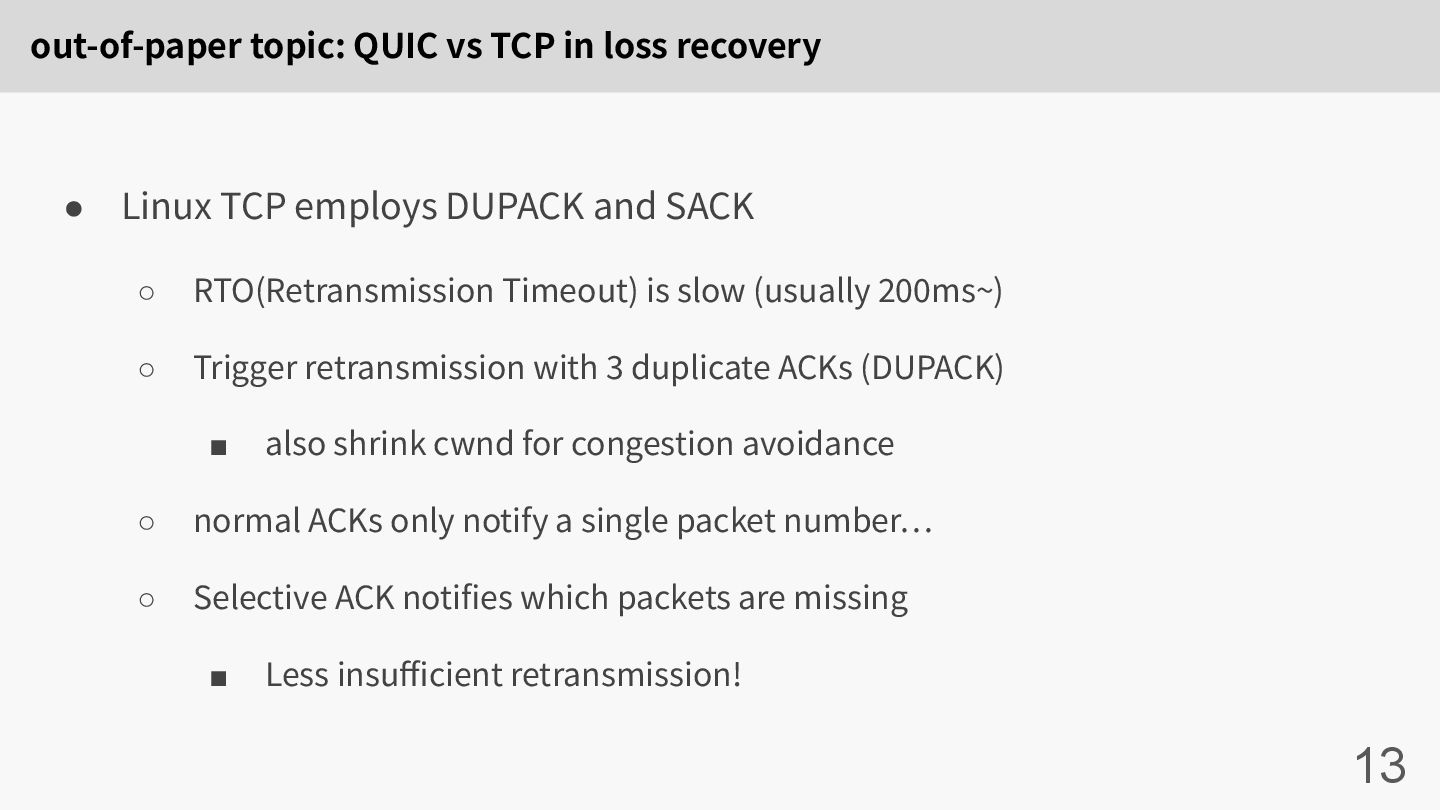
Linux TCP employs DUPACK and SACK ◦ RTO(Retransmission Timeout) is slow (usually 200ms~) ◦ Trigger retransmission with 3 duplicate ACKs (DUPACK) ▪ also shrink cwnd for congestion avoidance ◦ normal ACKs only notify a single packet number… ◦ Selective ACK notifies which packets are missing ▪ Less insufficient retransmission!
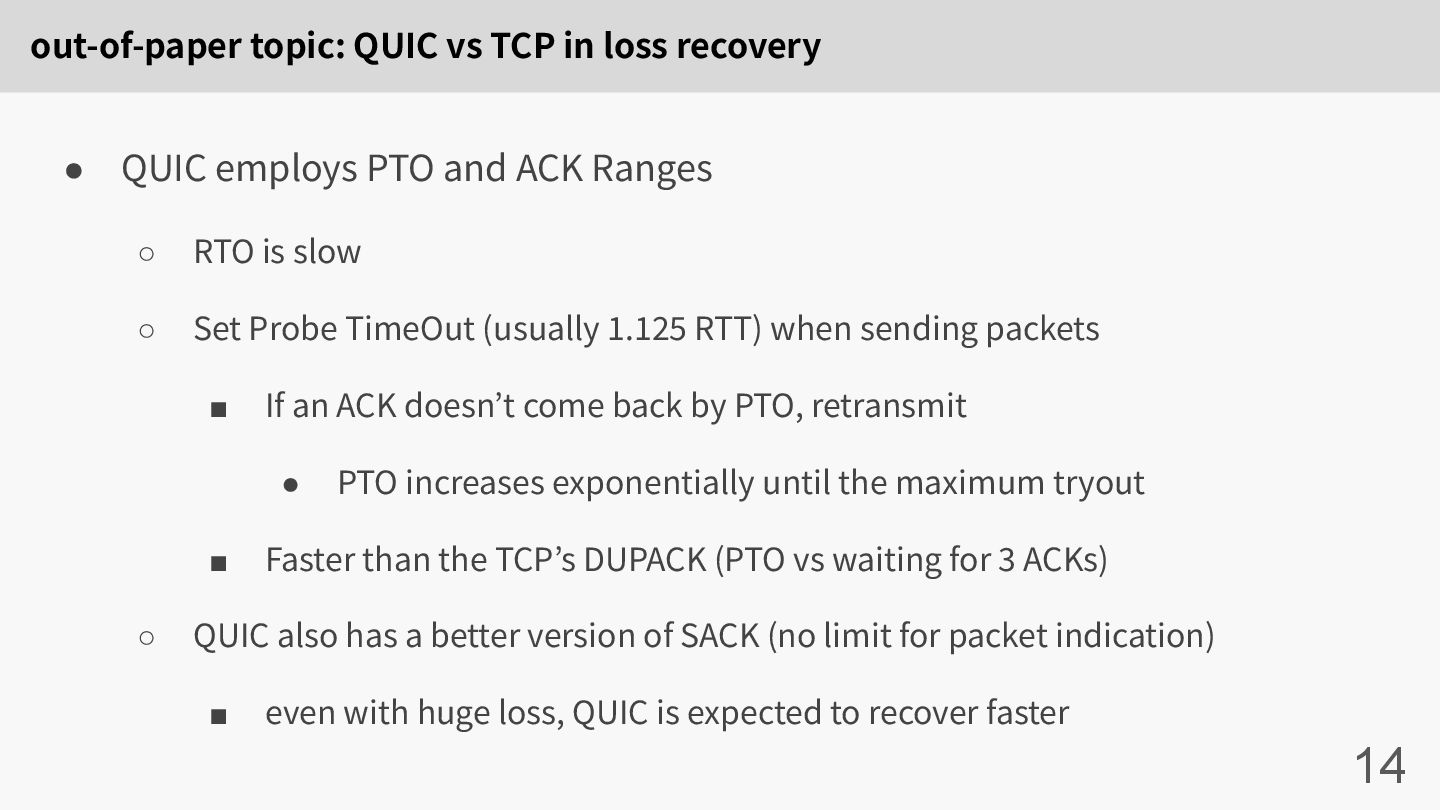
QUIC employs PTO and ACK Ranges ◦ RTO is slow ◦ Set Probe TimeOut (usually 1.125 RTT) when sending packets ▪ If an ACK doesn’t come back by PTO, retransmit • PTO increases exponentially until the maximum tryout ▪ Faster than the TCP’s DUPACK (PTO vs waiting for 3 ACKs) ◦ QUIC also has a better version of SACK (no limit for packet indication) ▪ even with huge loss, QUIC is expected to recover faster
QUIC also completes handshake quicker • In-kernel QUIC with no encryption has higher performance in most situations ◦ proper QUIC vs TCP+TLS1.3 will be the same result, but there’s no measurement


 kota_yata
 willnet
 irinanazarova
 myus4a
 akit37
 neuecc
 ogom
ogom
 teyamagu
 syumai
 oku053
 monolithic_adam
 soyuka
 panda728
 garrettdimon
 emna__ayadi
 addyosmani
 jonoalderson
 tammyeverts
 lemiorhan
 reverentgeek
 inesmontani
 pwiseman
 minecr
 rakko
rakko