Upgrade to Pro — share decks privately, control downloads, hide ads and more …

It was working yesterday! Investigating regress...

Sponsored · Your Podcast. Everywhere. Effortlessly. Share. Educate. Inspire. Entertain. You do you. We'll handle the rest. →
Avatar for Leandro Nunes Leandro Nunes
February 03, 2019
7

It was working yesterday! Investigating regressions with llvmlab bisect

Investigating the source of correctness of performance regressions can be a very challenging and time consuming process. In this talk, I’m going to present an introduction to automated LLVM/clang bisecting with llvmlab bisect. Examples will be demonstrated using a Raspberry Pi board.

Understanding the source of a correctness, performance regression or behaviour changes is valuable information for developers. The process of going backwards and looking for a specific code change that caused a given issue is called bisection, see also https://en.wikipedia.org/wiki/Bisection(softwareengineering).

Even though the algorithmic complexity of bisection is O(log N), the constants involved are sometimes very large, leading to a very long run time. It can be very simple when an obvious local change causes something to start malfunctioning. On the flip side, it can become very costly in case the behaviour change is actually a side effect of a supposedly unrelated commit.

In projects with large code bases, lots of commits per day and requiring more than few minutes to be built - like LLVM and clang -, manually bisecting issues can be a painful and time-consuming process. That is why many tools are available to automate this process, with probably "git bisect" and "svn bisect" amongst the best known ones.

llvmlab bisect is a tool introduced in 2015 by Chris Matthews and Daniel Dunbar, to address challenges when bisecting behavioural changes in LLVM. Especially, it sharply reduces bisection time by not needing to rebuild LLVM on every bisection step, resulting in often many order of magnitude improvements in bisection speed. For example, it is not uncommon for a bisection run to find the commit that changes behaviour in 1 day worth of LLVM commits, to be sped up from hours to minutes.

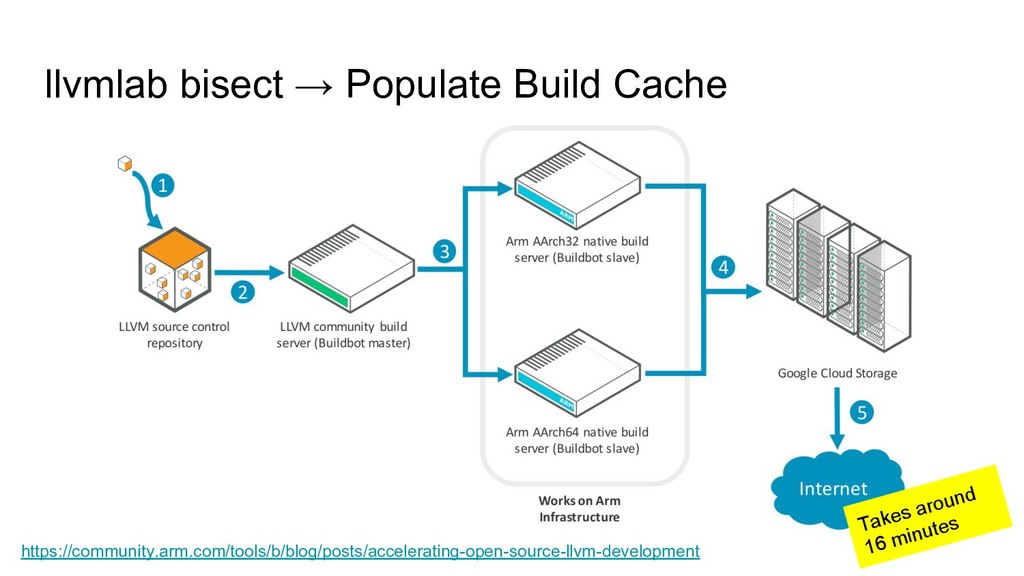
The bisection process with llvmlab bisect relies on a publicly available build cache. This build cache saves time by avoiding the need to build a toolchain for every commit, by every developer. We have been using a build cache internally at Arm to be able to keep on top of correctness and performance regressions. Without this tool, the bisection runs would take too long to be able to feedback regressions introduced in recent commits in a timely fashion to external developers.

This talk on FOSDEM webiste:
https://fosdem.org/2019/schedule/event/llvm_bisect/

Avatar for Leandro Nunes

Leandro Nunes

February 03, 2019

Transcript

  1. Getting Started • When investigating a bug or performance change,

    finding which commit introduced it can be very helpful to understand the problem • The process of looking into changes and finding which commit causes a given behaviour is called code bisection ◦ In projects with many commits a day (like LLVM, Clang, etc.), bisecting can be a time consuming task ◦ Automated bisection can use clever ways to navigate you repository, helping to speed up the process
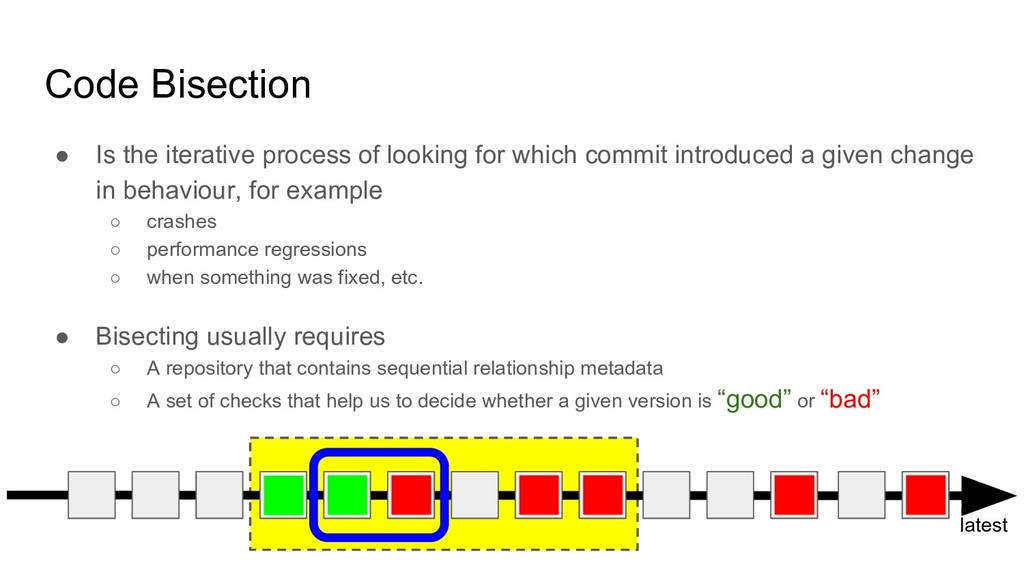
  2. Code Bisection • Is the iterative process of looking for

    which commit introduced a given change in behaviour, for example ◦ crashes ◦ performance regressions ◦ when something was fixed, etc. • Bisecting usually requires ◦ A repository that contains sequential relationship metadata ◦ A set of checks that help us to decide whether a given version is “good” or “bad” latest
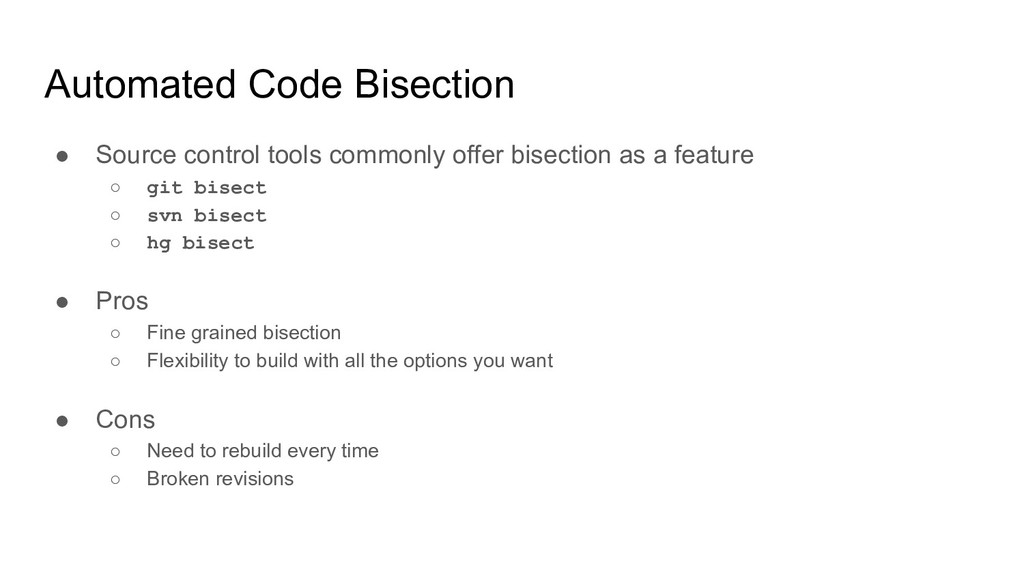
  3. Automated Code Bisection • Source control tools commonly offer bisection

    as a feature ◦ git bisect ◦ svn bisect ◦ hg bisect • Pros ◦ Fine grained bisection ◦ Flexibility to build with all the options you want • Cons ◦ Need to rebuild every time ◦ Broken revisions
  4. Automated Code Bisection • As source control tools are agnostic

    to what is being under bisection, all need to be setup by the user • In projects with large code bases and many commits every day, like LLVM and Clang, the need of building each revision on demand can make this process time consuming • llvmlab bisect is a tool that speeds up of bisecting LLVM and Clang
  5. llvmlab bisect • Contributed in 2015 by Chris Matthews and

    Daniel Dunbar • Written in Python, specifically for bisecting LLVM related projects • Documentation here: ◦ https://github.com/llvm/llvm-zorg/blob/master/llvmbisect/docs/llvmlab_bisect.rst
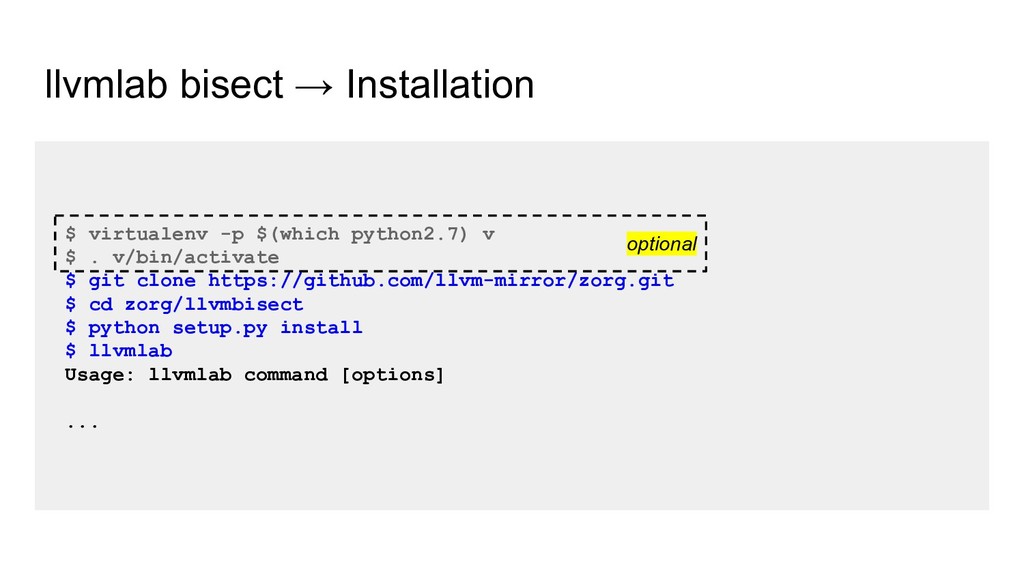
  6. llvmlab bisect → Installation $ virtualenv -p $(which python2.7) v

    $ . v/bin/activate $ git clone https://github.com/llvm-mirror/zorg.git $ cd zorg/llvmbisect $ python setup.py install $ llvmlab Usage: llvmlab command [options] ... optional
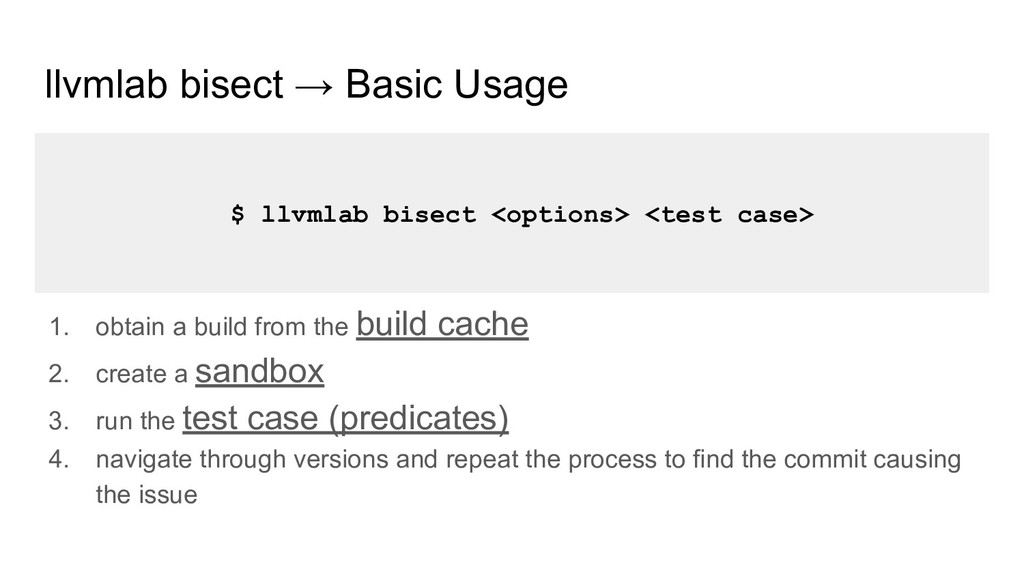
  7. llvmlab bisect → Basic Usage $ llvmlab bisect <options> <test

    case> 1. obtain a build from the build cache 2. create a sandbox 3. run the test case (predicates) 4. navigate through versions and repeat the process to find the commit causing the issue
  8. llvmlab bisect → Concepts • Build cache • Sandbox •

    Predicates ◦ Variables ◦ Test filters
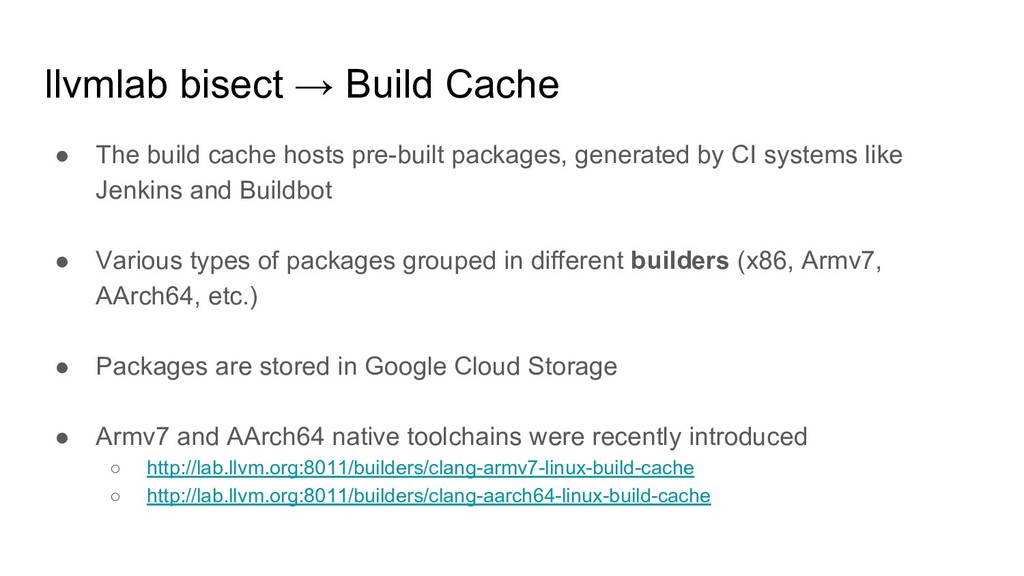
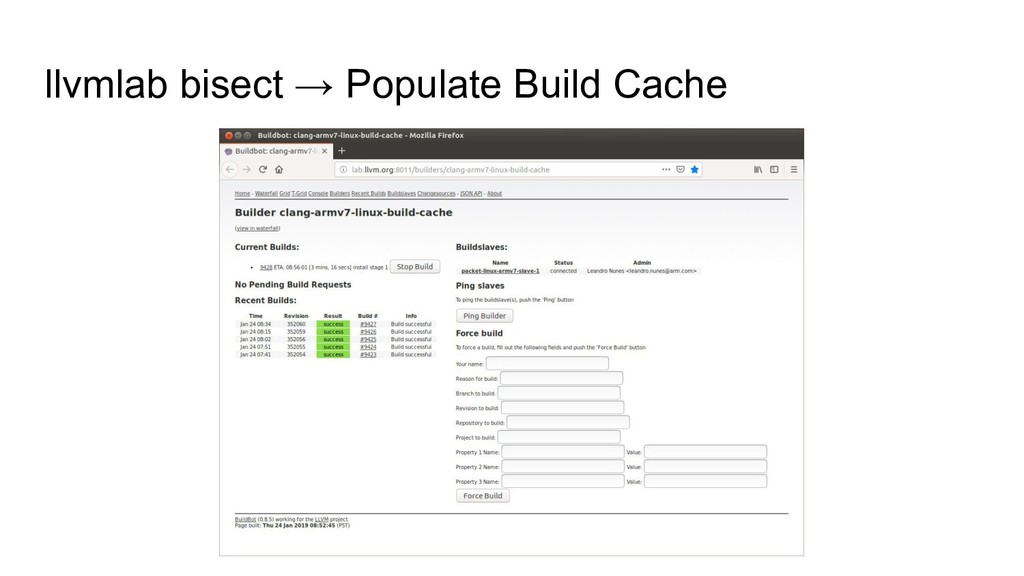
  9. llvmlab bisect → Build Cache • The build cache hosts

    pre-built packages, generated by CI systems like Jenkins and Buildbot • Various types of packages grouped in different builders (x86, Armv7, AArch64, etc.) • Packages are stored in Google Cloud Storage • Armv7 and AArch64 native toolchains were recently introduced ◦ http://lab.llvm.org:8011/builders/clang-armv7-linux-build-cache ◦ http://lab.llvm.org:8011/builders/clang-aarch64-linux-build-cache
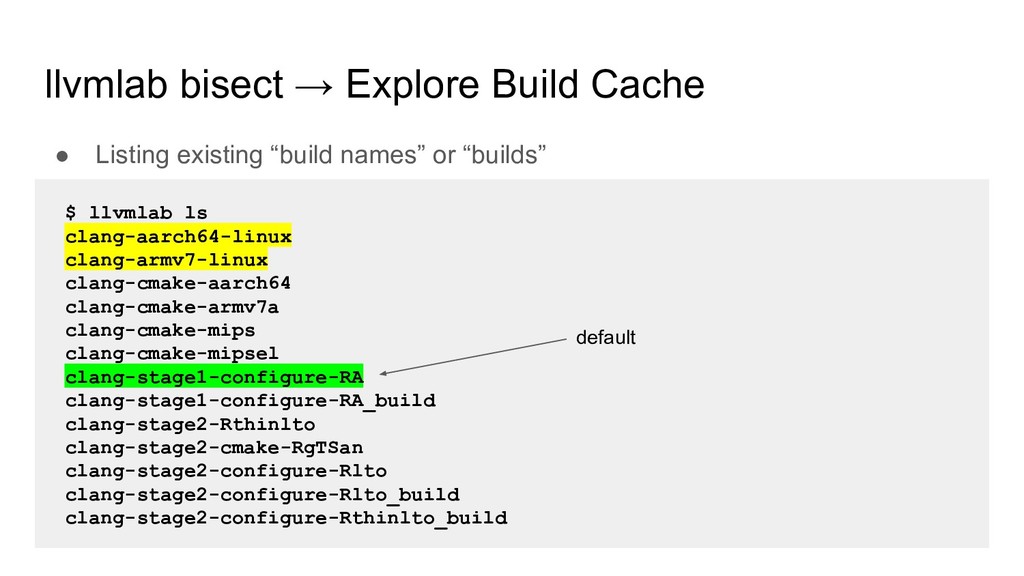
  10. llvmlab bisect → Explore Build Cache • Listing existing “build

    names” or “builds” $ llvmlab ls clang-aarch64-linux clang-armv7-linux clang-cmake-aarch64 clang-cmake-armv7a clang-cmake-mips clang-cmake-mipsel clang-stage1-configure-RA clang-stage1-configure-RA_build clang-stage2-Rthinlto clang-stage2-cmake-RgTSan clang-stage2-configure-Rlto clang-stage2-configure-Rlto_build clang-stage2-configure-Rthinlto_build default
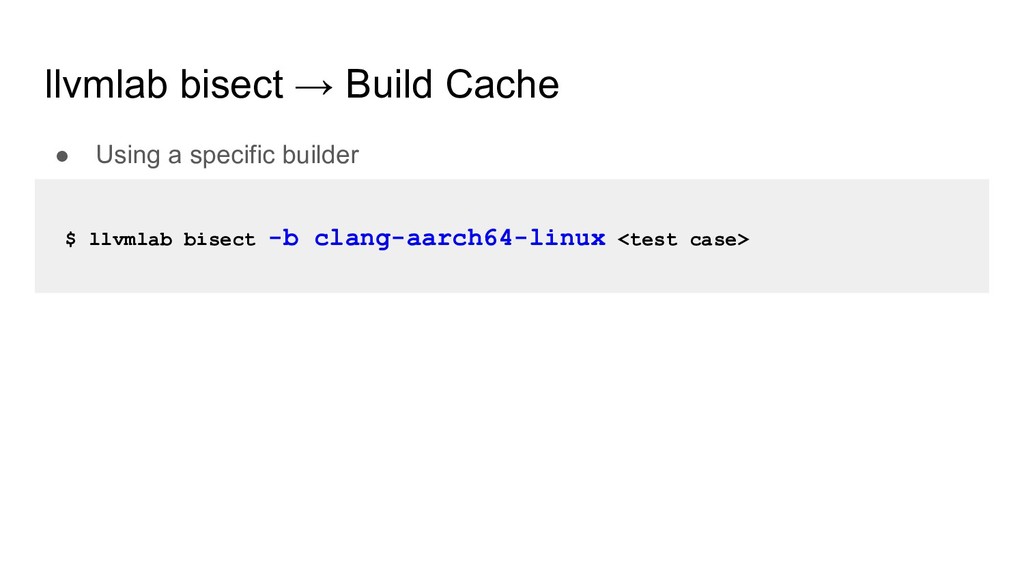
  11. llvmlab bisect → Build Cache • Using a specific builder

    $ llvmlab bisect -b clang-aarch64-linux <test case>
  12. llvmlab bisect → Concepts • Build cache • Sandbox •

    Predicates ◦ Variables ◦ Test filters
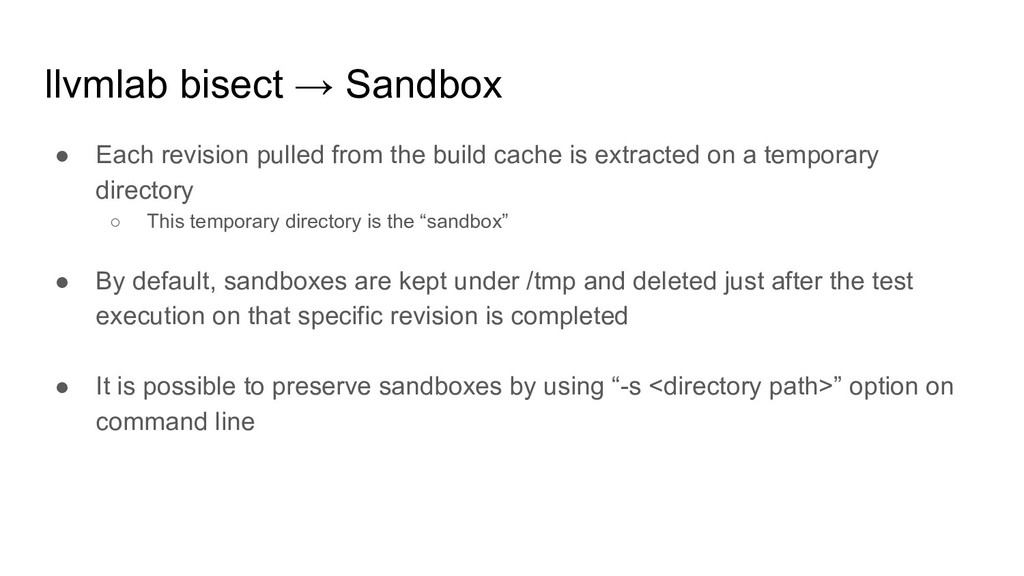
  13. llvmlab bisect → Sandbox • Each revision pulled from the

    build cache is extracted on a temporary directory ◦ This temporary directory is the “sandbox” • By default, sandboxes are kept under /tmp and deleted just after the test execution on that specific revision is completed • It is possible to preserve sandboxes by using “-s <directory path>” option on command line
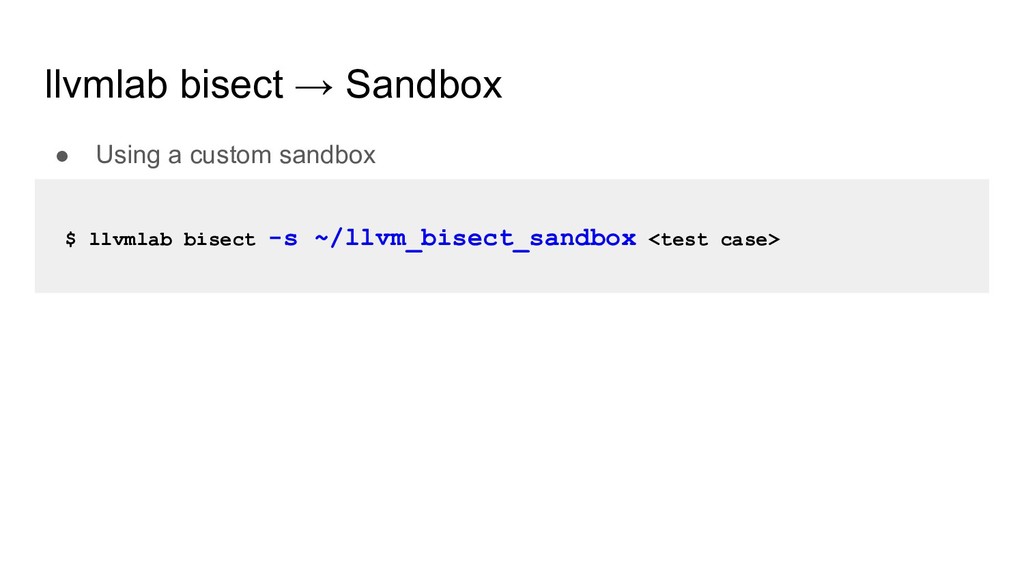
  14. llvmlab bisect → Sandbox • Using a custom sandbox $

    llvmlab bisect -s ~/llvm_bisect_sandbox <test case>
  15. llvmlab bisect → Concepts • Build cache • Sandbox •

    Predicates ◦ Variables ◦ Test filters
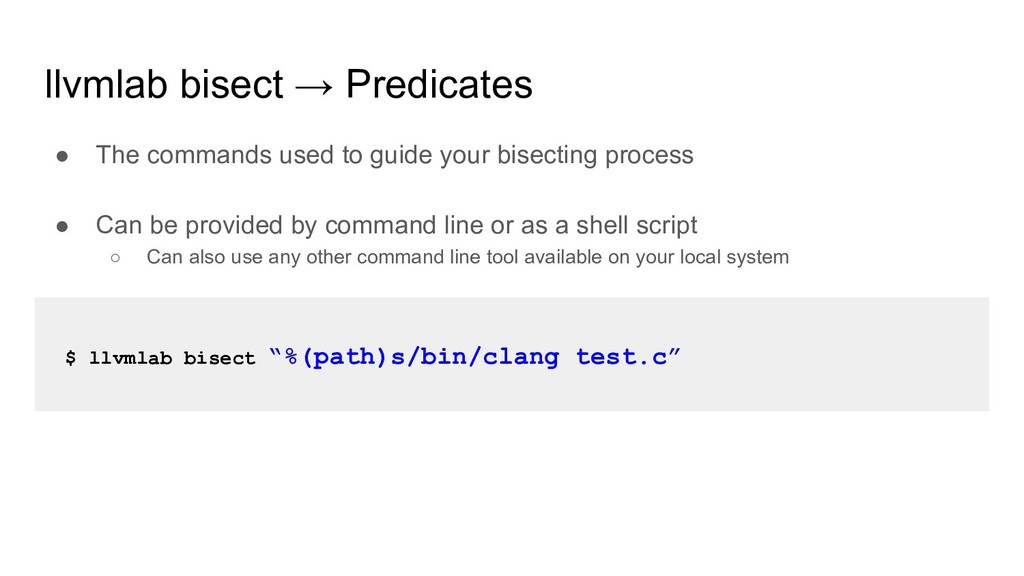
  16. llvmlab bisect → Predicates • The commands used to guide

    your bisecting process • Can be provided by command line or as a shell script ◦ Can also use any other command line tool available on your local system $ llvmlab bisect “%(path)s/bin/clang test.c”
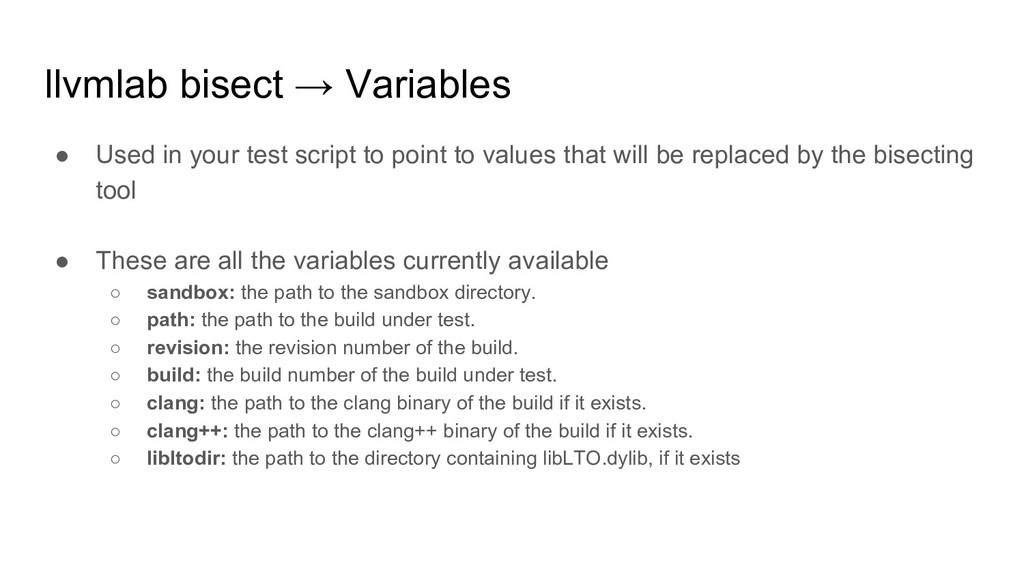
  17. llvmlab bisect → Variables • Used in your test script

    to point to values that will be replaced by the bisecting tool • These are all the variables currently available ◦ sandbox: the path to the sandbox directory. ◦ path: the path to the build under test. ◦ revision: the revision number of the build. ◦ build: the build number of the build under test. ◦ clang: the path to the clang binary of the build if it exists. ◦ clang++: the path to the clang++ binary of the build if it exists. ◦ libltodir: the path to the directory containing libLTO.dylib, if it exists
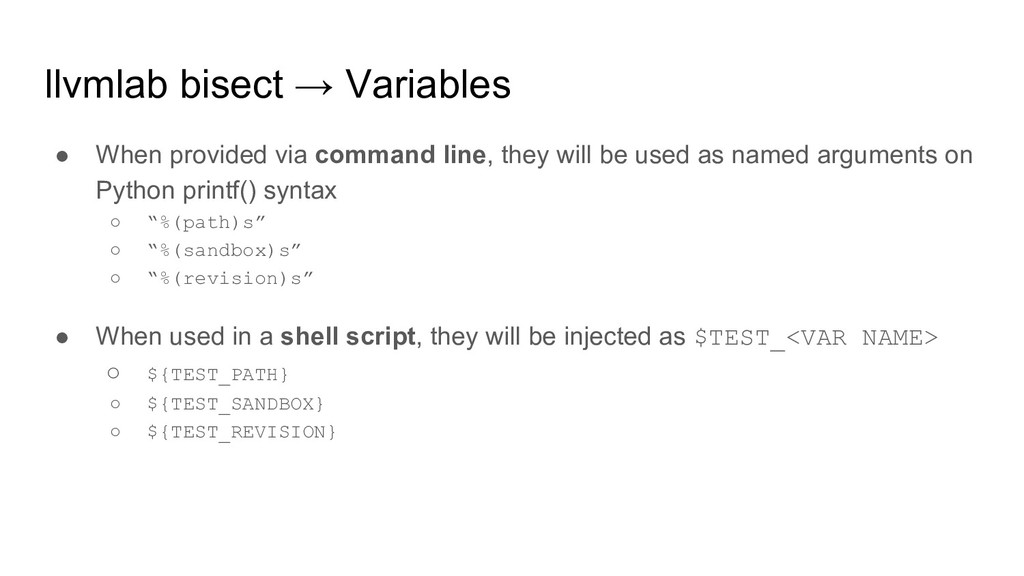
  18. llvmlab bisect → Variables • When provided via command line,

    they will be used as named arguments on Python printf() syntax ◦ “%(path)s” ◦ “%(sandbox)s” ◦ “%(revision)s” • When used in a shell script, they will be injected as $TEST_<VAR NAME> ◦ ${TEST_PATH} ◦ ${TEST_SANDBOX} ◦ ${TEST_REVISION}
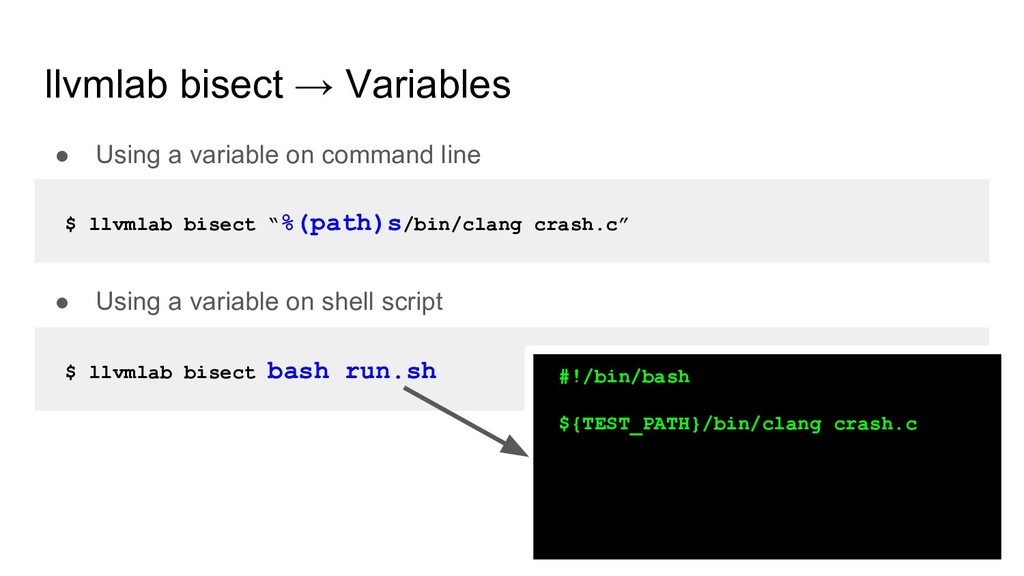
  19. llvmlab bisect → Variables • Using a variable on command

    line $ llvmlab bisect “%(path)s/bin/clang crash.c” • Using a variable on shell script $ llvmlab bisect bash run.sh #!/bin/bash ${TEST_PATH}/bin/clang crash.c
  20. llvmlab bisect → Test Filters • Extra values to be

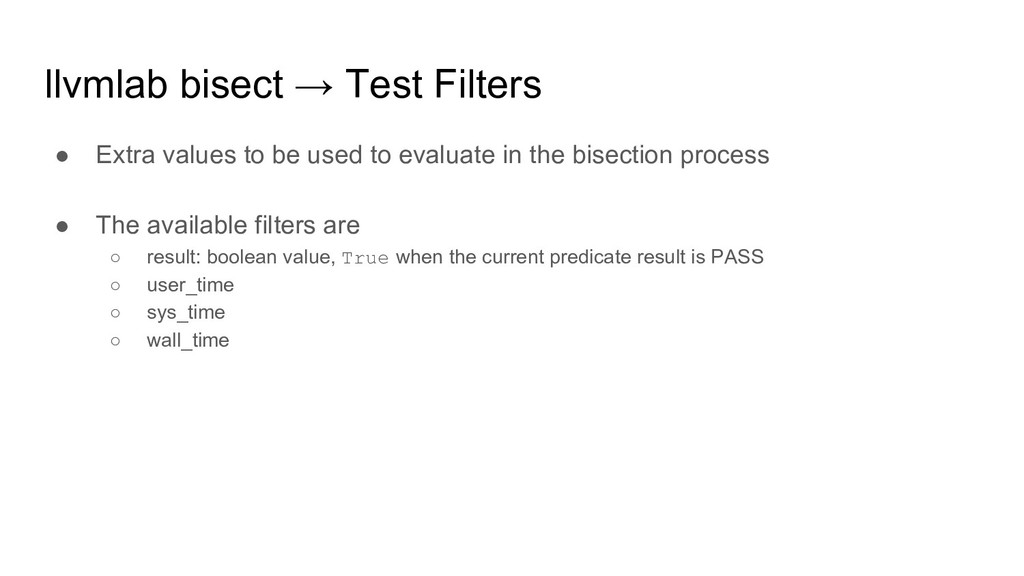
    used to evaluate in the bisection process • The available filters are ◦ result: boolean value, True when the current predicate result is PASS ◦ user_time ◦ sys_time ◦ wall_time
  21. llvmlab bisect → Test Filters • Using a test filter

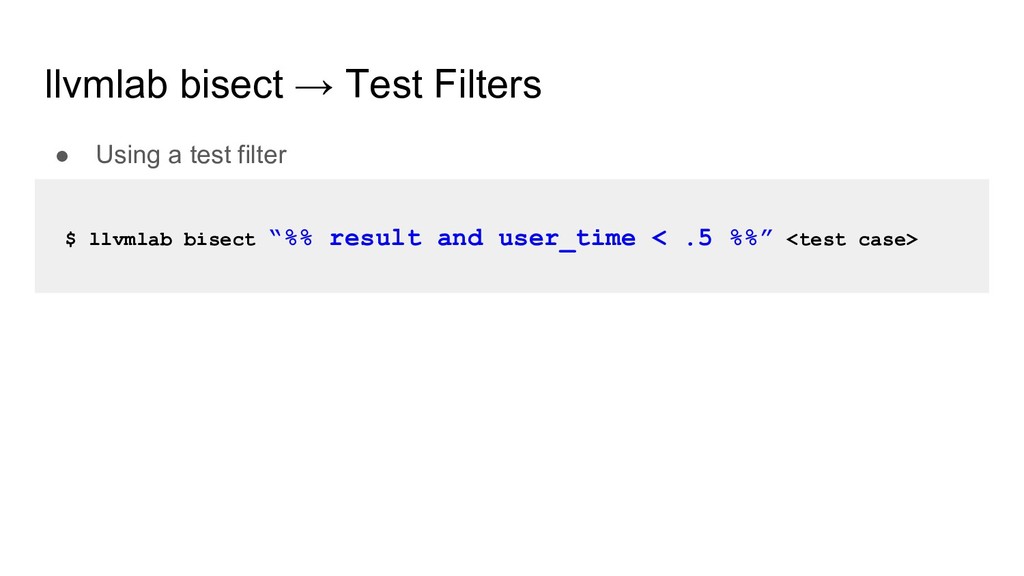
    $ llvmlab bisect “%% result and user_time < .5 %%” <test case>
  22. llvmlab bisect • Useful command line options ◦ --very-verbose enables

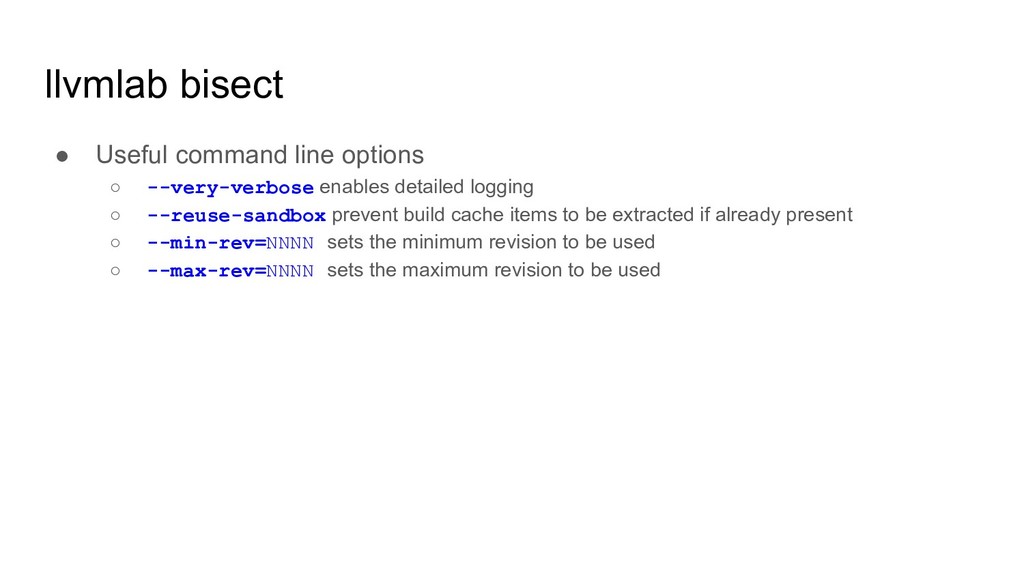
    detailed logging ◦ --reuse-sandbox prevent build cache items to be extracted if already present ◦ --min-rev=NNNN sets the minimum revision to be used ◦ --max-rev=NNNN sets the maximum revision to be used
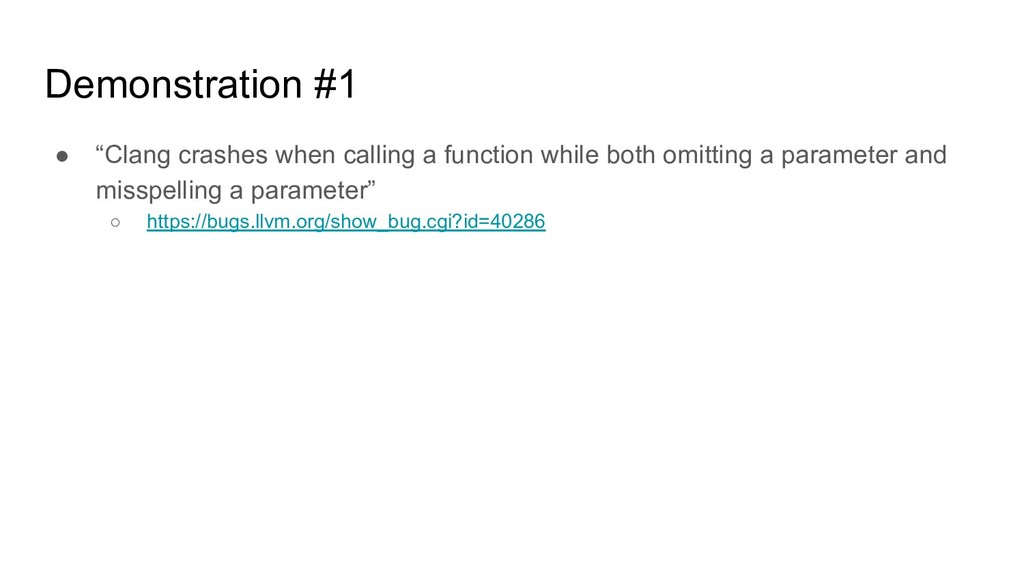
  23. Demonstration #1 • “Clang crashes when calling a function while

    both omitting a parameter and misspelling a parameter” ◦ https://bugs.llvm.org/show_bug.cgi?id=40286
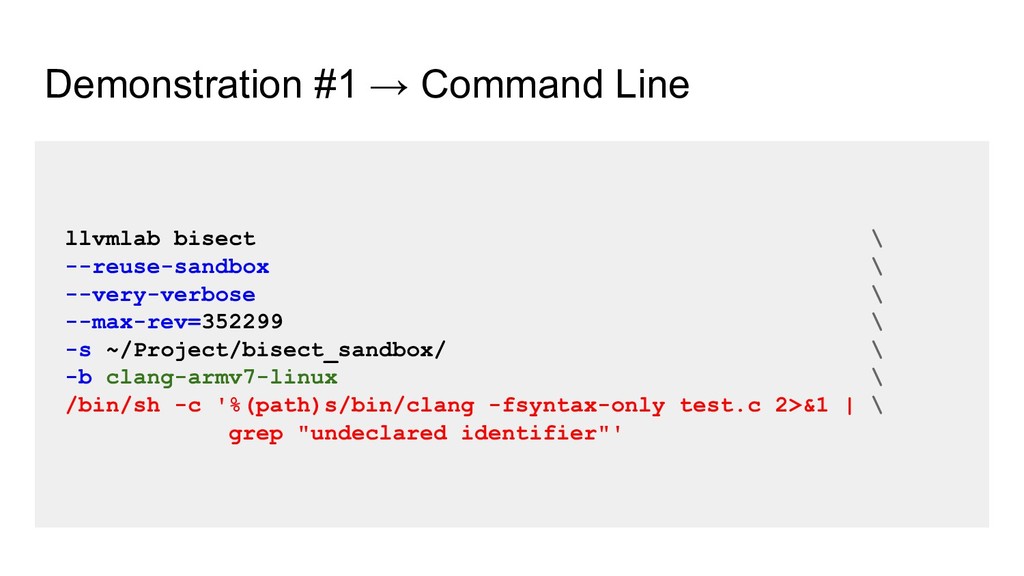
  24. Demonstration #1 → Command Line llvmlab bisect \ --reuse-sandbox \

    --very-verbose \ --max-rev=352299 \ -s ~/Project/bisect_sandbox/ \ -b clang-armv7-linux \ /bin/sh -c '%(path)s/bin/clang -fsyntax-only test.c 2>&1 | \ grep "undeclared identifier"'
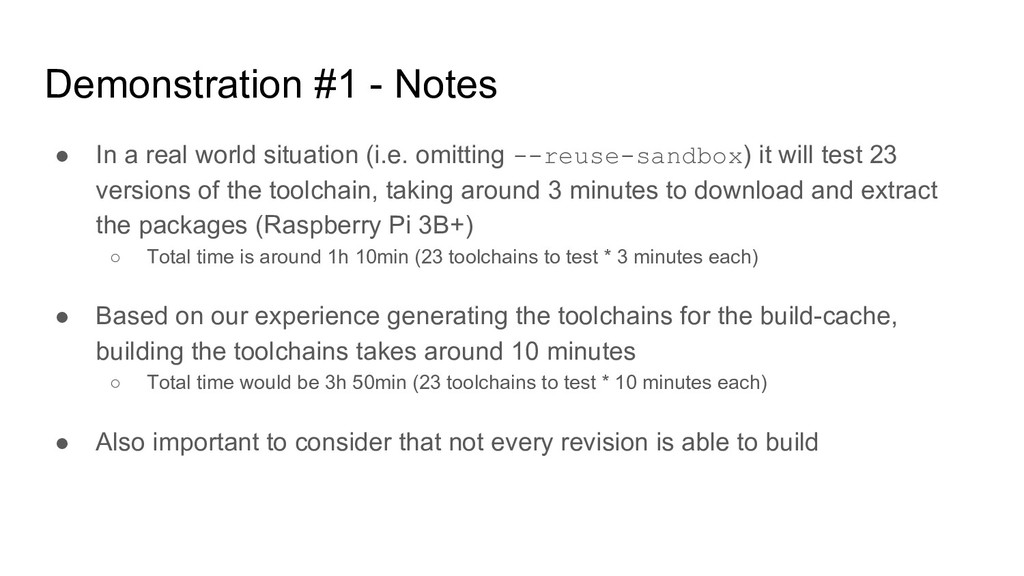
  25. Demonstration #1 - Notes • In a real world situation

    (i.e. omitting --reuse-sandbox) it will test 23 versions of the toolchain, taking around 3 minutes to download and extract the packages (Raspberry Pi 3B+) ◦ Total time is around 1h 10min (23 toolchains to test * 3 minutes each) • Based on our experience generating the toolchains for the build-cache, building the toolchains takes around 10 minutes ◦ Total time would be 3h 50min (23 toolchains to test * 10 minutes each) • Also important to consider that not every revision is able to build
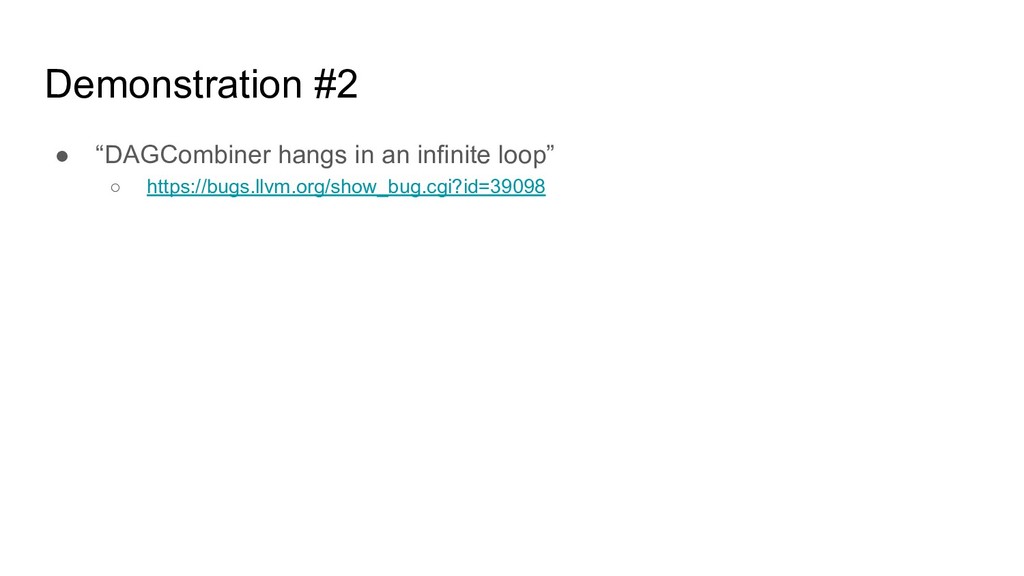
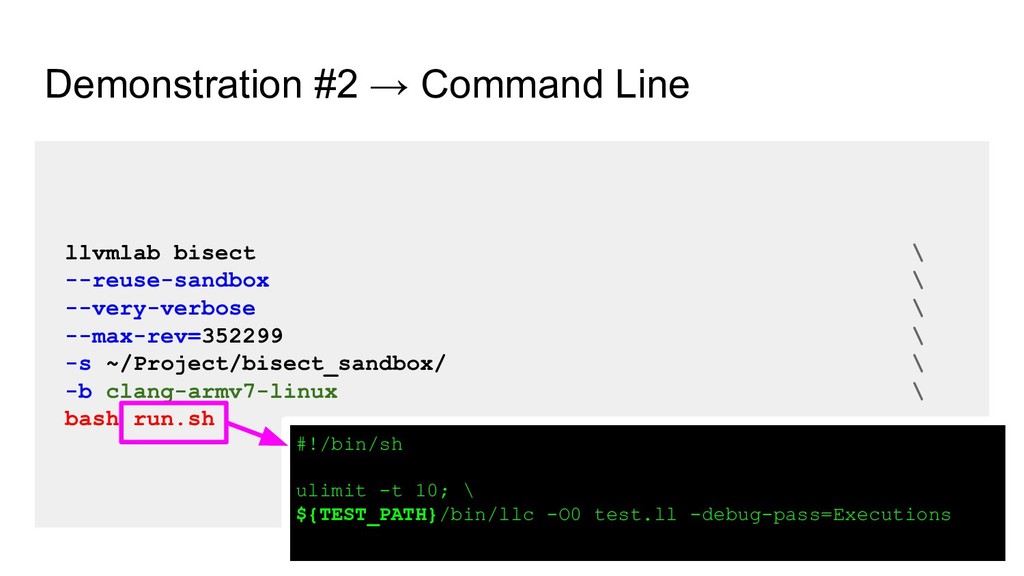
  26. Demonstration #2 • “DAGCombiner hangs in an infinite loop” ◦

    https://bugs.llvm.org/show_bug.cgi?id=39098
  27. Demonstration #2 → Command Line llvmlab bisect \ --reuse-sandbox \

    --very-verbose \ --max-rev=352299 \ -s ~/Project/bisect_sandbox/ \ -b clang-armv7-linux \ bash run.sh #!/bin/sh ulimit -t 10; \ ${TEST_PATH}/bin/llc -O0 test.ll -debug-pass=Executions
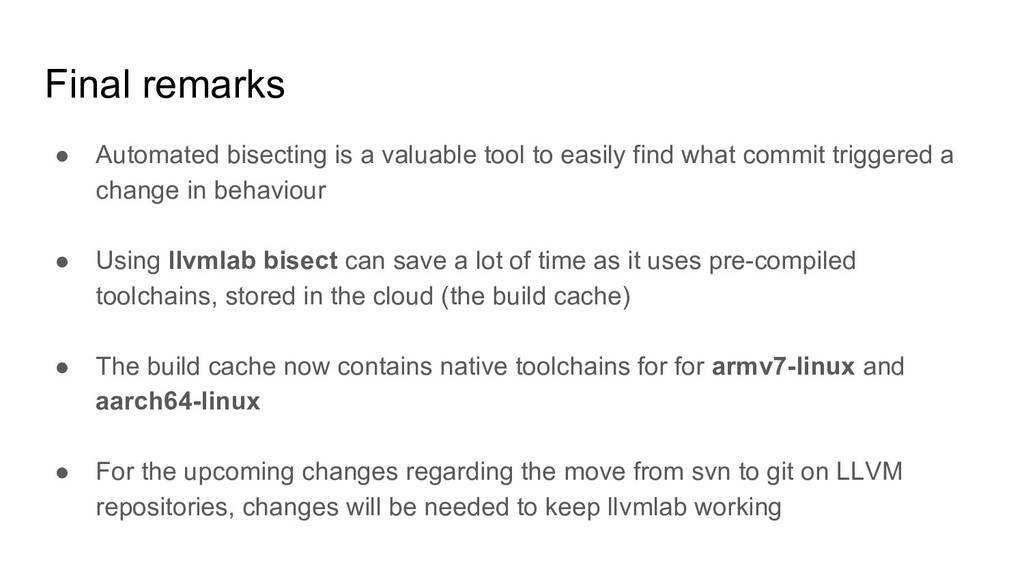
  28. Final remarks • Automated bisecting is a valuable tool to

    easily find what commit triggered a change in behaviour • Using llvmlab bisect can save a lot of time as it uses pre-compiled toolchains, stored in the cloud (the build cache) • The build cache now contains native toolchains for for armv7-linux and aarch64-linux • For the upcoming changes regarding the move from svn to git on LLVM repositories, changes will be needed to keep llvmlab working
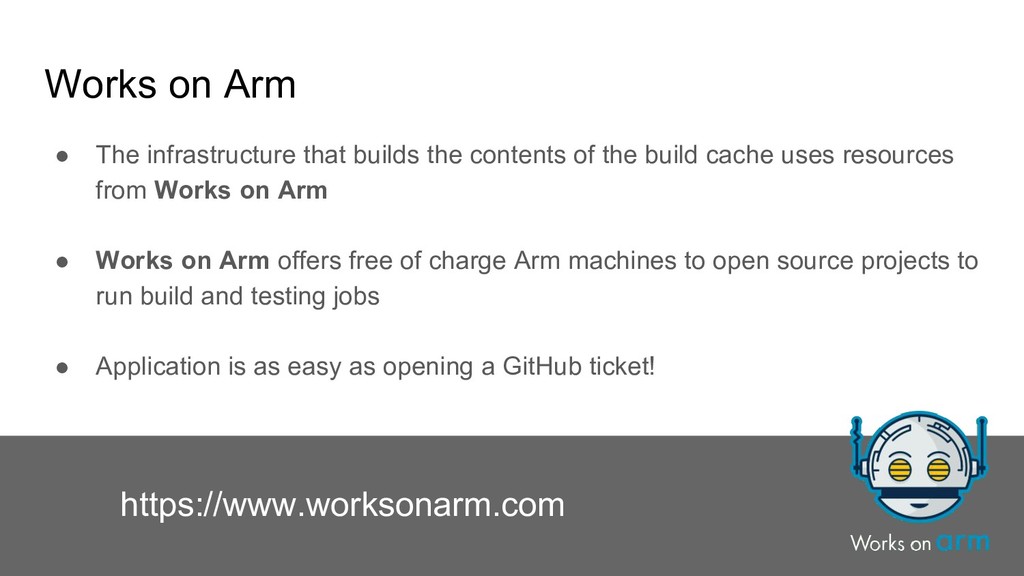
  29. Works on Arm • The infrastructure that builds the contents

    of the build cache uses resources from Works on Arm • Works on Arm offers free of charge Arm machines to open source projects to run build and testing jobs • Application is as easy as opening a GitHub ticket! https://www.worksonarm.com