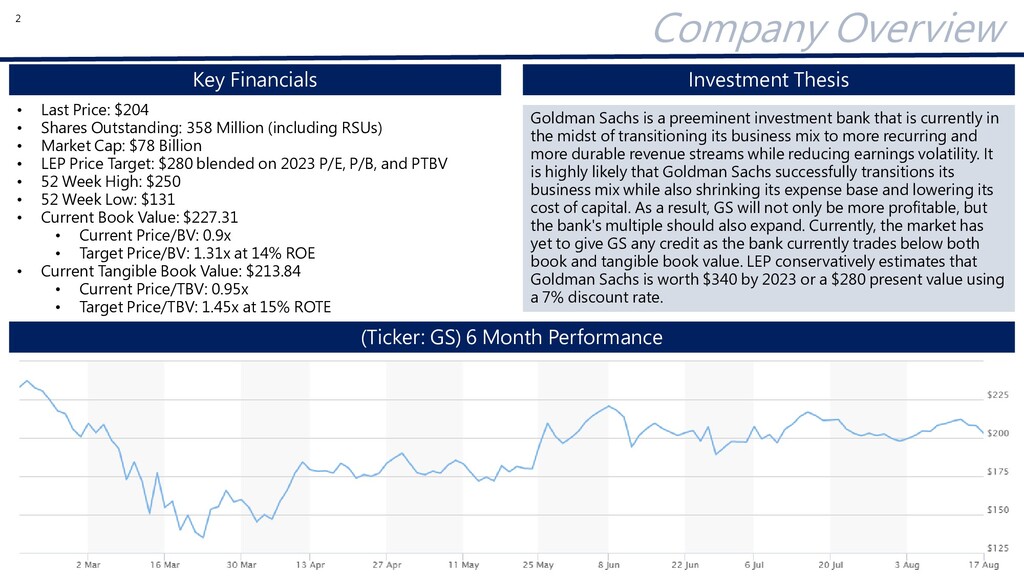
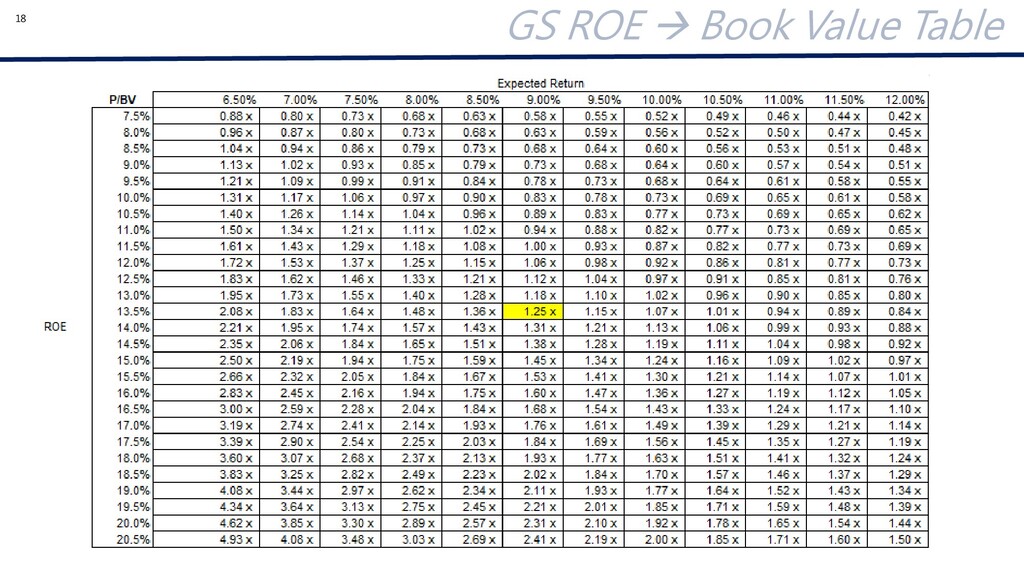
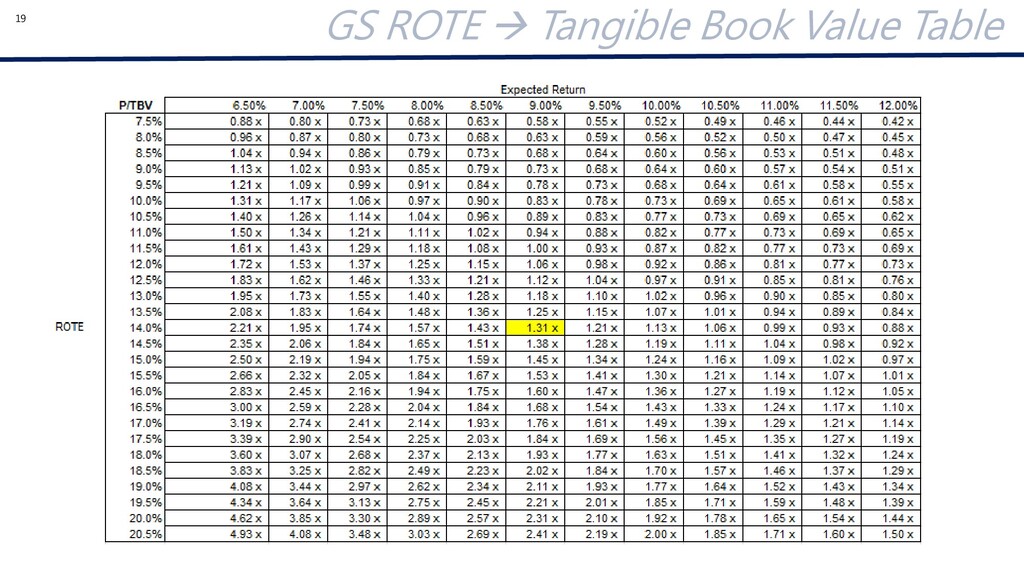
Last Price: $204 • Shares Outstanding: 358 Million (including RSUs) • Market Cap: $78 Billion • LEP Price Target: $280 blended on 2023 P/E, P/B, and PTBV • 52 Week High: $250 • 52 Week Low: $131 • Current Book Value: $227.31 • Current Price/BV: 0.9x • Target Price/BV: 1.31x at 14% ROE • Current Tangible Book Value: $213.84 • Current Price/TBV: 0.95x • Target Price/TBV: 1.45x at 15% ROTE Investment Thesis Goldman Sachs is a preeminent investment bank that is currently in the midst of transitioning its business mix to more recurring and more durable revenue streams while reducing earnings volatility. It is highly likely that Goldman Sachs successfully transitions its business mix while also shrinking its expense base and lowering its cost of capital. As a result, GS will not only be more profitable, but the bank's multiple should also expand. Currently, the market has yet to give GS any credit as the bank currently trades below both book and tangible book value. LEP conservatively estimates that Goldman Sachs is worth $340 by 2023 or a $280 present value using a 7% discount rate. 2
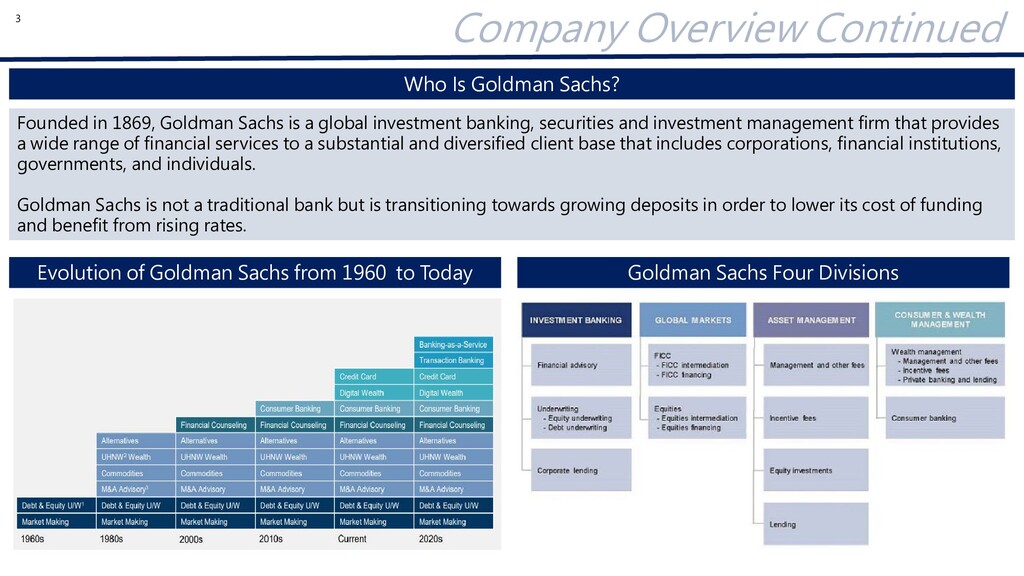
Today Who Is Goldman Sachs? Goldman Sachs Four Divisions Founded in 1869, Goldman Sachs is a global investment banking, securities and investment management firm that provides a wide range of financial services to a substantial and diversified client base that includes corporations, financial institutions, governments, and individuals. Goldman Sachs is not a traditional bank but is transitioning towards growing deposits in order to lower its cost of funding and benefit from rising rates. 3
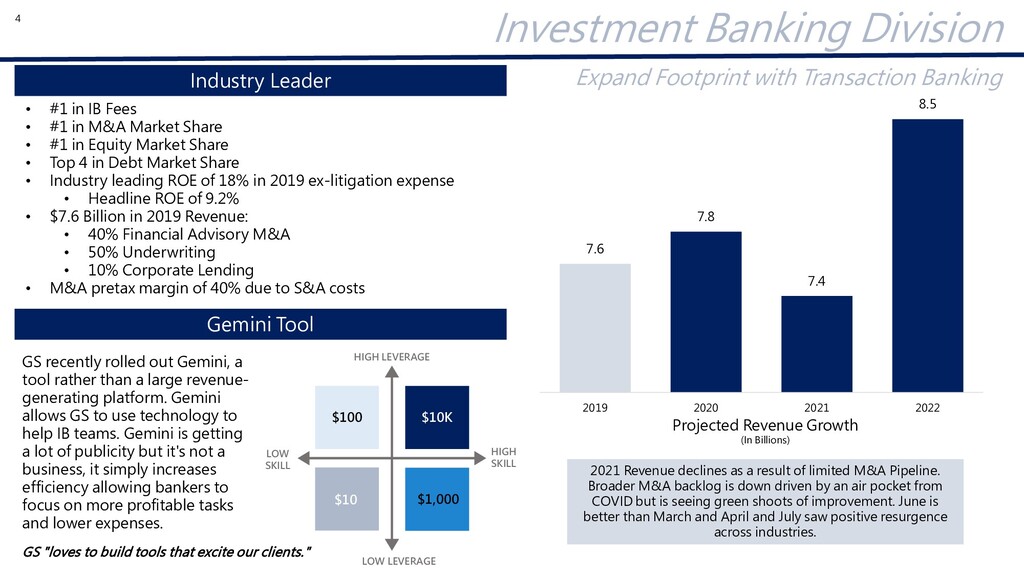
Industry Leader • #1 in IB Fees • #1 in M&A Market Share • #1 in Equity Market Share • Top 4 in Debt Market Share • Industry leading ROE of 18% in 2019 ex-litigation expense • Headline ROE of 9.2% • $7.6 Billion in 2019 Revenue: • 40% Financial Advisory M&A • 50% Underwriting • 10% Corporate Lending • M&A pretax margin of 40% due to S&A costs 7.6 7.8 7.4 8.5 2019 2020 2021 2022 Projected Revenue Growth (In Billions) 2021 Revenue declines as a result of limited M&A Pipeline. Broader M&A backlog is down driven by an air pocket from COVID but is seeing green shoots of improvement. June is better than March and April and July saw positive resurgence across industries. $100 $10K $10 $1,000 HIGH LEVERAGE LOW LEVERAGE LOW SKILL HIGH SKILL GS recently rolled out Gemini, a tool rather than a large revenue- generating platform. Gemini allows GS to use technology to help IB teams. Gemini is getting a lot of publicity but it's not a business, it simply increases efficiency allowing bankers to focus on more profitable tasks and lower expenses. GS "loves to build tools that excite our clients." 4
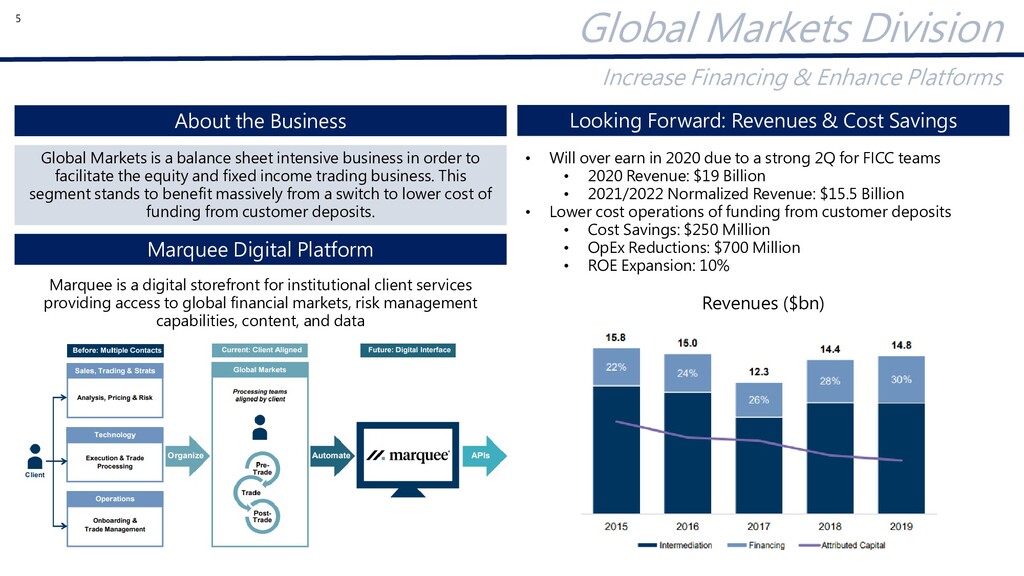
Financing & Enhance Platforms About the Business • Will over earn in 2020 due to a strong 2Q for FICC teams • 2020 Revenue: $19 Billion • 2021/2022 Normalized Revenue: $15.5 Billion • Lower cost operations of funding from customer deposits • Cost Savings: $250 Million • OpEx Reductions: $700 Million • ROE Expansion: 10% Global Markets is a balance sheet intensive business in order to facilitate the equity and fixed income trading business. This segment stands to benefit massively from a switch to lower cost of funding from customer deposits. Marquee Digital Platform Revenues ($bn) Marquee is a digital storefront for institutional client services providing access to global financial markets, risk management capabilities, content, and data 5
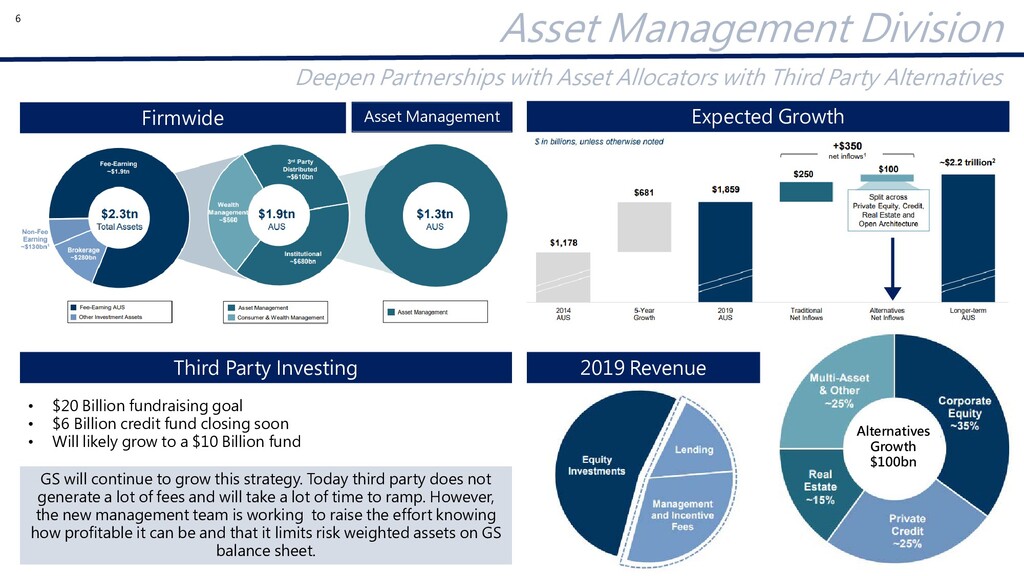
Third Party Alternatives Third Party Investing • $20 Billion fundraising goal • $6 Billion credit fund closing soon • Will likely grow to a $10 Billion fund GS will continue to grow this strategy. Today third party does not generate a lot of fees and will take a lot of time to ramp. However, the new management team is working to raise the effort knowing how profitable it can be and that it limits risk weighted assets on GS balance sheet. Asset Management Expected Growth Alternatives Growth $100bn 2019 Revenue 6
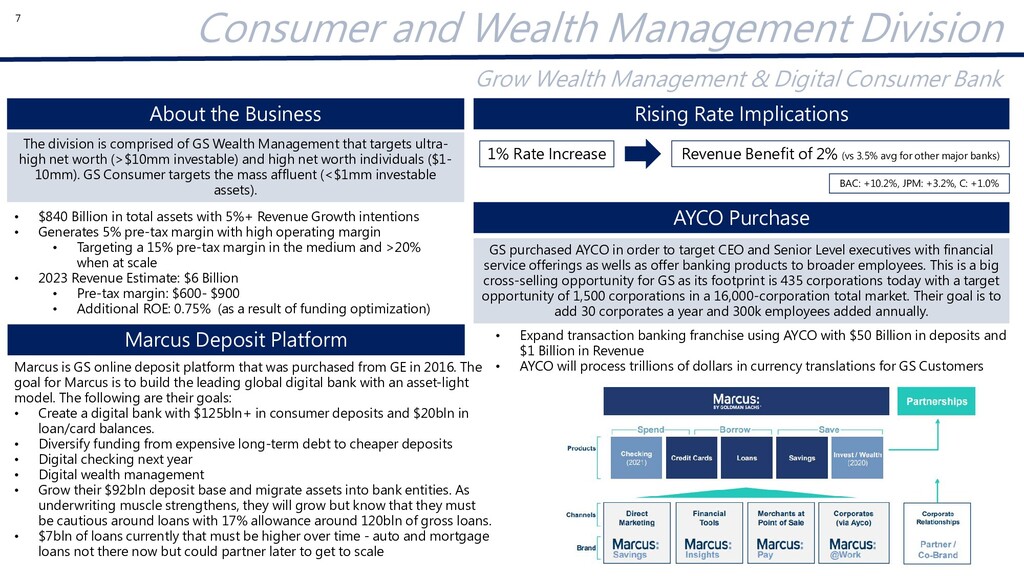
intentions • Generates 5% pre-tax margin with high operating margin • Targeting a 15% pre-tax margin in the medium and >20% when at scale • 2023 Revenue Estimate: $6 Billion • Pre-tax margin: $600- $900 • Additional ROE: 0.75% (as a result of funding optimization) Consumer and Wealth Management Division About the Business Grow Wealth Management & Digital Consumer Bank Marcus Deposit Platform The division is comprised of GS Wealth Management that targets ultra- high net worth (>$10mm investable) and high net worth individuals ($1- 10mm). GS Consumer targets the mass affluent (<$1mm investable assets). Marcus is GS online deposit platform that was purchased from GE in 2016. The goal for Marcus is to build the leading global digital bank with an asset-light model. The following are their goals: • Create a digital bank with $125bln+ in consumer deposits and $20bln in loan/card balances. • Diversify funding from expensive long-term debt to cheaper deposits • Digital checking next year • Digital wealth management • Grow their $92bln deposit base and migrate assets into bank entities. As underwriting muscle strengthens, they will grow but know that they must be cautious around loans with 17% allowance around 120bln of gross loans. • $7bln of loans currently that must be higher over time - auto and mortgage loans not there now but could partner later to get to scale AYCO Purchase GS purchased AYCO in order to target CEO and Senior Level executives with financial service offerings as wells as offer banking products to broader employees. This is a big cross-selling opportunity for GS as its footprint is 435 corporations today with a target opportunity of 1,500 corporations in a 16,000-corporation total market. Their goal is to add 30 corporates a year and 300k employees added annually. • Expand transaction banking franchise using AYCO with $50 Billion in deposits and $1 Billion in Revenue • AYCO will process trillions of dollars in currency translations for GS Customers 1% Rate Increase Revenue Benefit of 2% (vs 3.5% avg for other major banks) BAC: +10.2%, JPM: +3.2%, C: +1.0% Rising Rate Implications 7
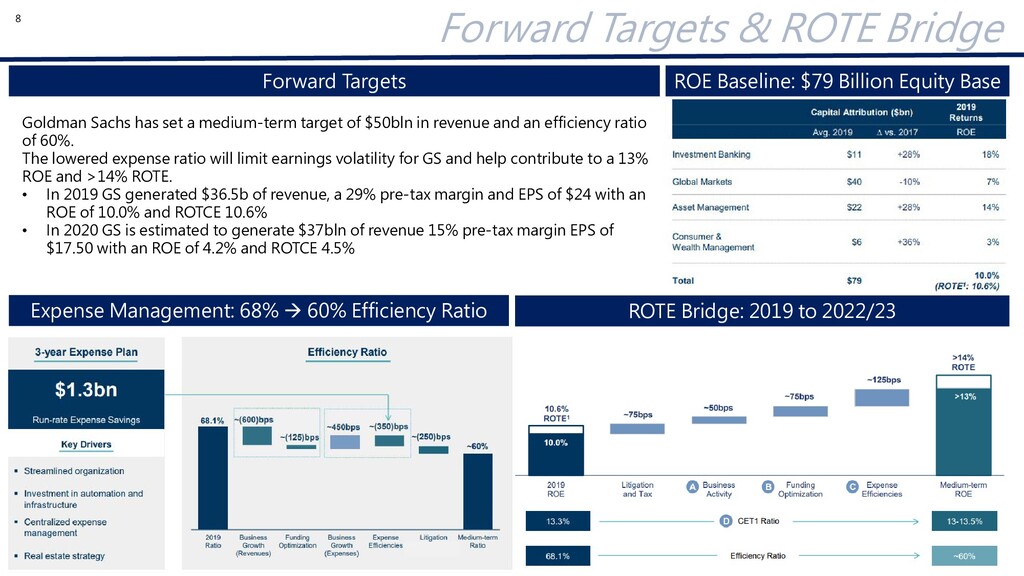
set a medium-term target of $50bln in revenue and an efficiency ratio of 60%. The lowered expense ratio will limit earnings volatility for GS and help contribute to a 13% ROE and >14% ROTE. • In 2019 GS generated $36.5b of revenue, a 29% pre-tax margin and EPS of $24 with an ROE of 10.0% and ROTCE 10.6% • In 2020 GS is estimated to generate $37bln of revenue 15% pre-tax margin EPS of $17.50 with an ROE of 4.2% and ROTCE 4.5% Expense Management: 68% 60% Efficiency Ratio ROTE Bridge: 2019 to 2022/23 ROE Baseline: $79 Billion Equity Base 8
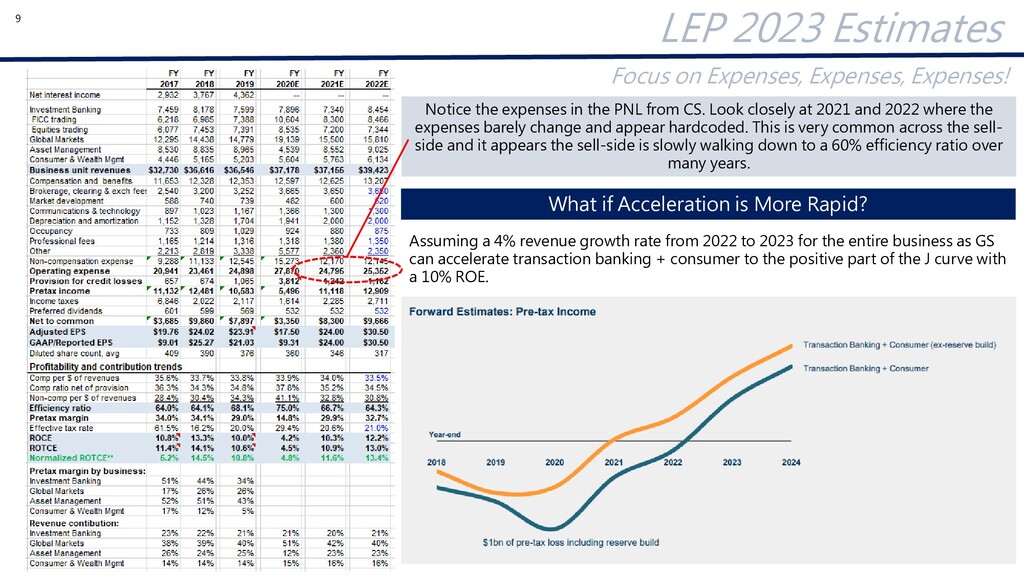
on Expenses, Expenses, Expenses! Notice the expenses in the PNL from CS. Look closely at 2021 and 2022 where the expenses barely change and appear hardcoded. This is very common across the sell- side and it appears the sell-side is slowly walking down to a 60% efficiency ratio over many years. Assuming a 4% revenue growth rate from 2022 to 2023 for the entire business as GS can accelerate transaction banking + consumer to the positive part of the J curve with a 10% ROE. 9
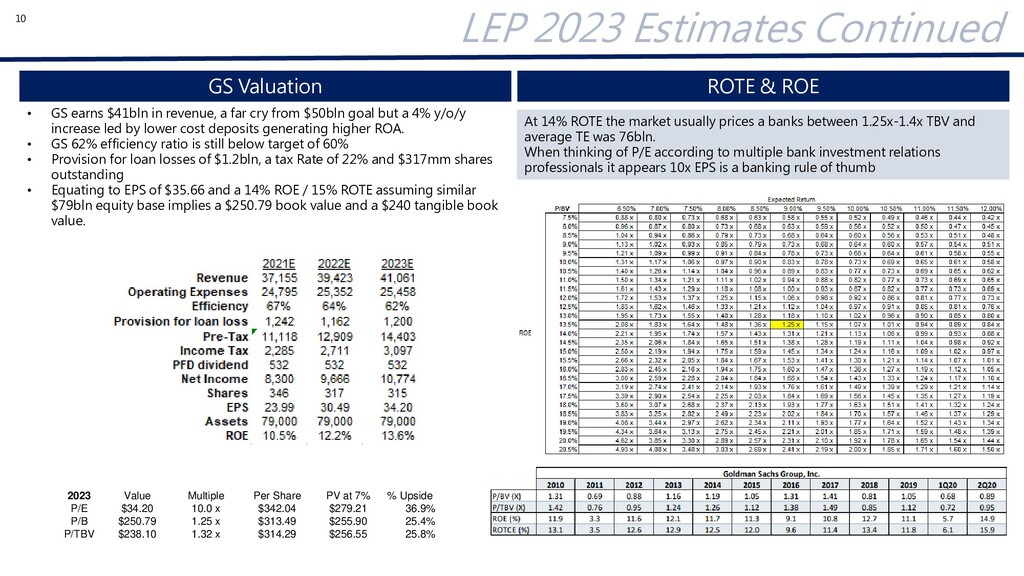
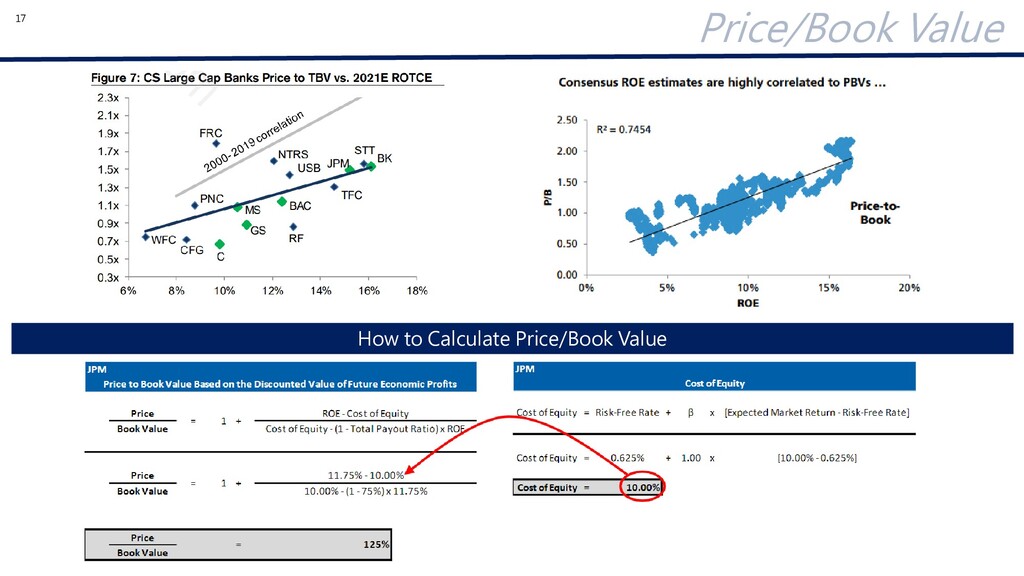
a far cry from $50bln goal but a 4% y/o/y increase led by lower cost deposits generating higher ROA. • GS 62% efficiency ratio is still below target of 60% • Provision for loan losses of $1.2bln, a tax Rate of 22% and $317mm shares outstanding • Equating to EPS of $35.66 and a 14% ROE / 15% ROTE assuming similar $79bln equity base implies a $250.79 book value and a $240 tangible book value. GS Valuation ROTE & ROE At 14% ROTE the market usually prices a banks between 1.25x-1.4x TBV and average TE was 76bln. When thinking of P/E according to multiple bank investment relations professionals it appears 10x EPS is a banking rule of thumb 10 2023 Value Multiple Per Share PV at 7% % Upside P/E $34.20 10.0 x $342.04 $279.21 36.9% P/B $250.79 1.25 x $313.49 $255.90 25.4% P/TBV $238.10 1.32 x $314.29 $256.55 25.8%
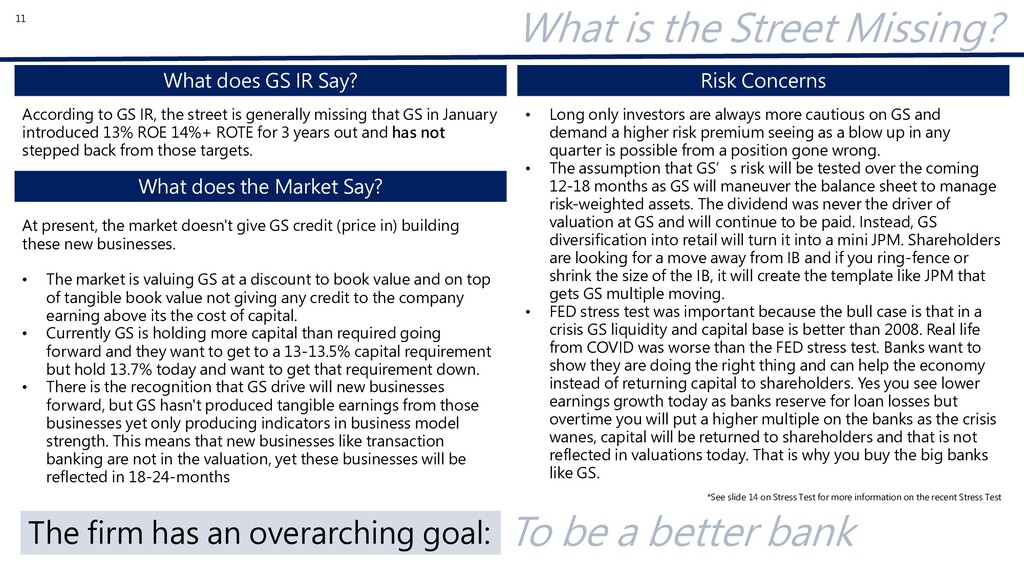
What does GS IR Say? At present, the market doesn't give GS credit (price in) building these new businesses. • The market is valuing GS at a discount to book value and on top of tangible book value not giving any credit to the company earning above its the cost of capital. • Currently GS is holding more capital than required going forward and they want to get to a 13-13.5% capital requirement but hold 13.7% today and want to get that requirement down. • There is the recognition that GS drive will new businesses forward, but GS hasn't produced tangible earnings from those businesses yet only producing indicators in business model strength. This means that new businesses like transaction banking are not in the valuation, yet these businesses will be reflected in 18-24-months The firm has an overarching goal: To be a better bank According to GS IR, the street is generally missing that GS in January introduced 13% ROE 14%+ ROTE for 3 years out and has not stepped back from those targets. Risk Concerns • Long only investors are always more cautious on GS and demand a higher risk premium seeing as a blow up in any quarter is possible from a position gone wrong. • The assumption that GS’s risk will be tested over the coming 12-18 months as GS will maneuver the balance sheet to manage risk-weighted assets. The dividend was never the driver of valuation at GS and will continue to be paid. Instead, GS diversification into retail will turn it into a mini JPM. Shareholders are looking for a move away from IB and if you ring-fence or shrink the size of the IB, it will create the template like JPM that gets GS multiple moving. • FED stress test was important because the bull case is that in a crisis GS liquidity and capital base is better than 2008. Real life from COVID was worse than the FED stress test. Banks want to show they are doing the right thing and can help the economy instead of returning capital to shareholders. Yes you see lower earnings growth today as banks reserve for loan losses but overtime you will put a higher multiple on the banks as the crisis wanes, capital will be returned to shareholders and that is not reflected in valuations today. That is why you buy the big banks like GS. *See slide 14 on Stress Test for more information on the recent Stress Test 11
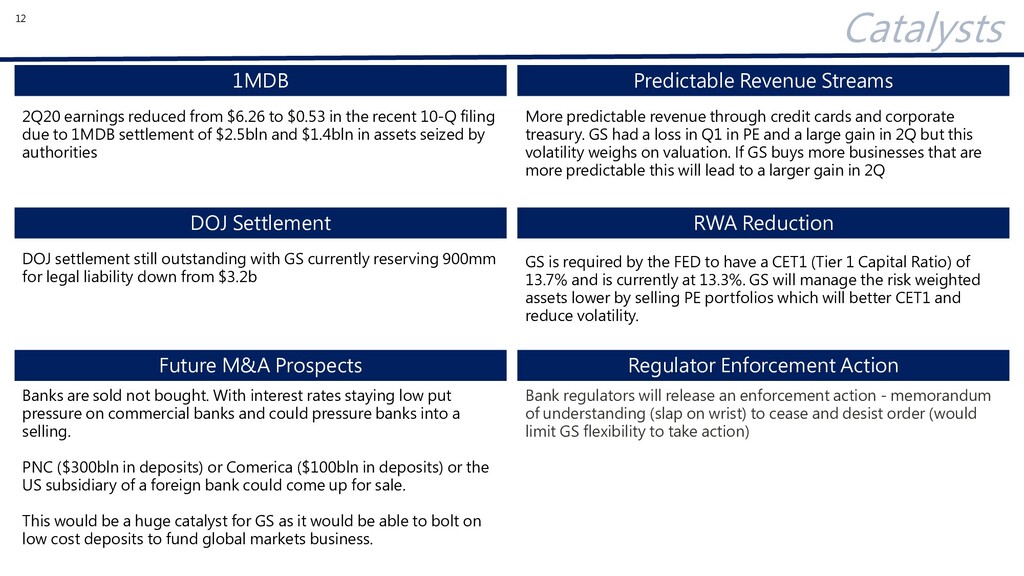
currently reserving 900mm for legal liability down from $3.2b 2Q20 earnings reduced from $6.26 to $0.53 in the recent 10-Q filing due to 1MDB settlement of $2.5bln and $1.4bln in assets seized by authorities Bank regulators will release an enforcement action - memorandum of understanding (slap on wrist) to cease and desist order (would limit GS flexibility to take action) Regulator Enforcement Action Predictable Revenue Streams More predictable revenue through credit cards and corporate treasury. GS had a loss in Q1 in PE and a large gain in 2Q but this volatility weighs on valuation. If GS buys more businesses that are more predictable this will lead to a larger gain in 2Q RWA Reduction GS is required by the FED to have a CET1 (Tier 1 Capital Ratio) of 13.7% and is currently at 13.3%. GS will manage the risk weighted assets lower by selling PE portfolios which will better CET1 and reduce volatility. Future M&A Prospects Banks are sold not bought. With interest rates staying low put pressure on commercial banks and could pressure banks into a selling. PNC ($300bln in deposits) or Comerica ($100bln in deposits) or the US subsidiary of a foreign bank could come up for sale. This would be a huge catalyst for GS as it would be able to bolt on low cost deposits to fund global markets business. 12
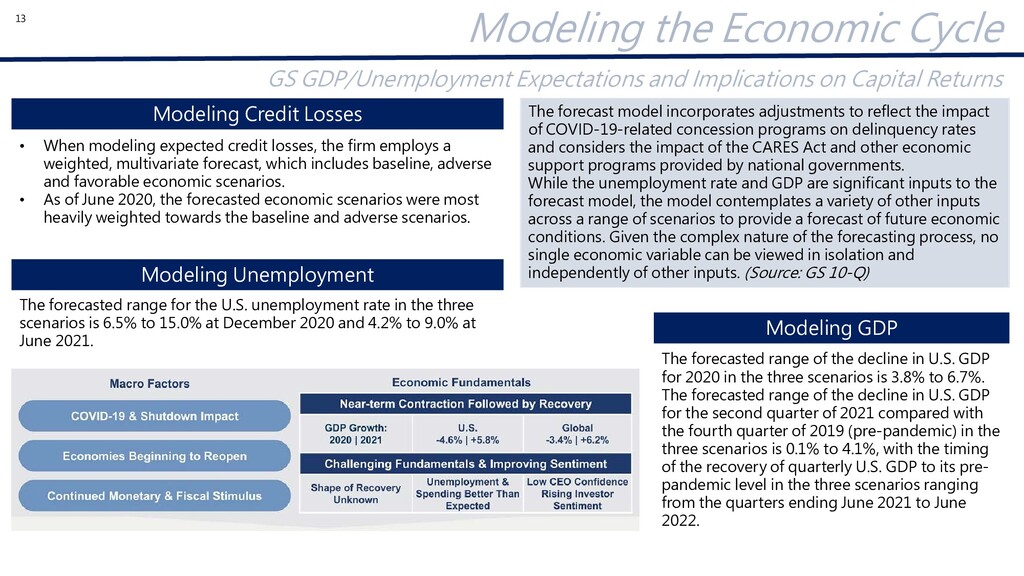
and Implications on Capital Returns 13 • When modeling expected credit losses, the firm employs a weighted, multivariate forecast, which includes baseline, adverse and favorable economic scenarios. • As of June 2020, the forecasted economic scenarios were most heavily weighted towards the baseline and adverse scenarios. Modeling Unemployment The forecasted range for the U.S. unemployment rate in the three scenarios is 6.5% to 15.0% at December 2020 and 4.2% to 9.0% at June 2021. Modeling GDP The forecasted range of the decline in U.S. GDP for 2020 in the three scenarios is 3.8% to 6.7%. The forecasted range of the decline in U.S. GDP for the second quarter of 2021 compared with the fourth quarter of 2019 (pre-pandemic) in the three scenarios is 0.1% to 4.1%, with the timing of the recovery of quarterly U.S. GDP to its pre- pandemic level in the three scenarios ranging from the quarters ending June 2021 to June 2022. The forecast model incorporates adjustments to reflect the impact of COVID-19-related concession programs on delinquency rates and considers the impact of the CARES Act and other economic support programs provided by national governments. While the unemployment rate and GDP are significant inputs to the forecast model, the model contemplates a variety of other inputs across a range of scenarios to provide a forecast of future economic conditions. Given the complex nature of the forecasting process, no single economic variable can be viewed in isolation and independently of other inputs. (Source: GS 10-Q)
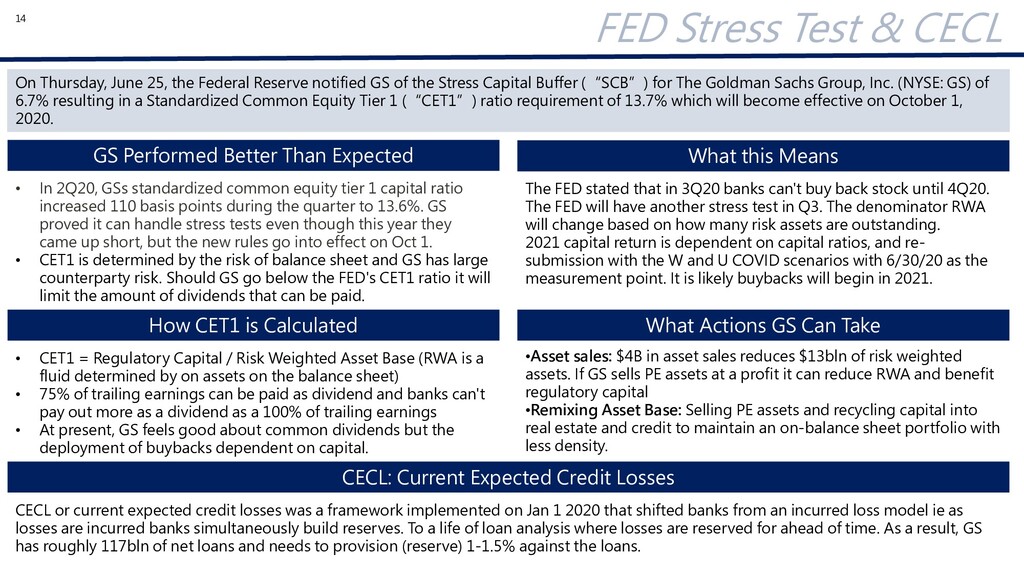
On Thursday, June 25, the Federal Reserve notified GS of the Stress Capital Buffer (“SCB”) for The Goldman Sachs Group, Inc. (NYSE: GS) of 6.7% resulting in a Standardized Common Equity Tier 1 (“CET1”) ratio requirement of 13.7% which will become effective on October 1, 2020. 14 • In 2Q20, GSs standardized common equity tier 1 capital ratio increased 110 basis points during the quarter to 13.6%. GS proved it can handle stress tests even though this year they came up short, but the new rules go into effect on Oct 1. • CET1 is determined by the risk of balance sheet and GS has large counterparty risk. Should GS go below the FED's CET1 ratio it will limit the amount of dividends that can be paid. What this Means The FED stated that in 3Q20 banks can't buy back stock until 4Q20. The FED will have another stress test in Q3. The denominator RWA will change based on how many risk assets are outstanding. 2021 capital return is dependent on capital ratios, and re- submission with the W and U COVID scenarios with 6/30/20 as the measurement point. It is likely buybacks will begin in 2021. How CET1 is Calculated • CET1 = Regulatory Capital / Risk Weighted Asset Base (RWA is a fluid determined by on assets on the balance sheet) • 75% of trailing earnings can be paid as dividend and banks can't pay out more as a dividend as a 100% of trailing earnings • At present, GS feels good about common dividends but the deployment of buybacks dependent on capital. CECL: Current Expected Credit Losses CECL or current expected credit losses was a framework implemented on Jan 1 2020 that shifted banks from an incurred loss model ie as losses are incurred banks simultaneously build reserves. To a life of loan analysis where losses are reserved for ahead of time. As a result, GS has roughly 117bln of net loans and needs to provision (reserve) 1-1.5% against the loans. What Actions GS Can Take •Asset sales: $4B in asset sales reduces $13bln of risk weighted assets. If GS sells PE assets at a profit it can reduce RWA and benefit regulatory capital •Remixing Asset Base: Selling PE assets and recycling capital into real estate and credit to maintain an on-balance sheet portfolio with less density.
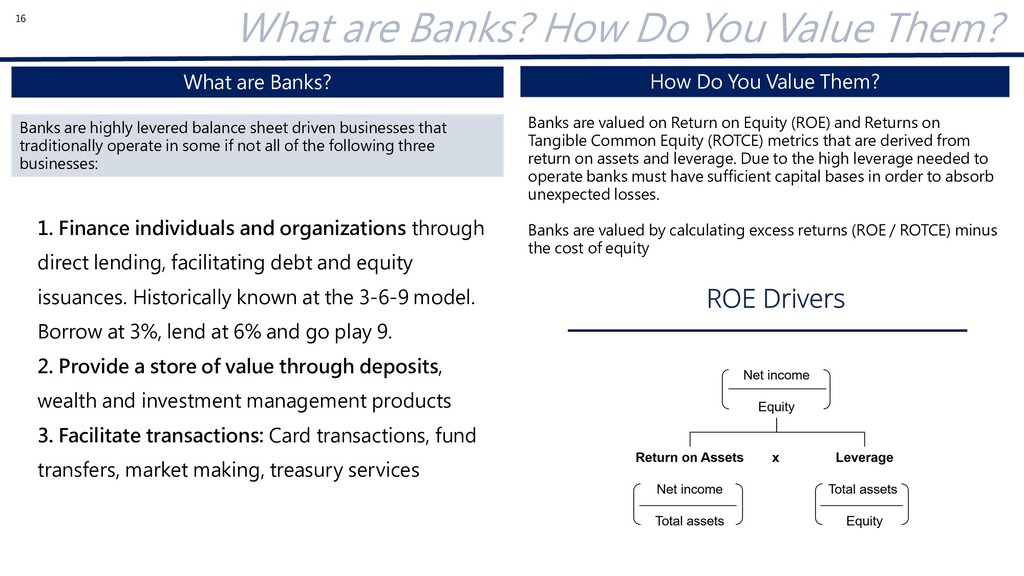
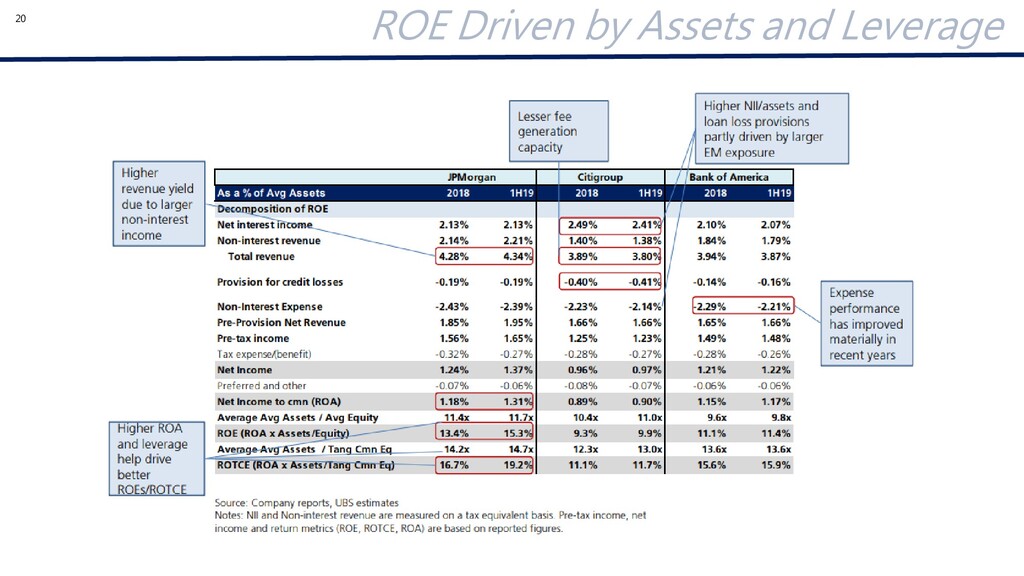
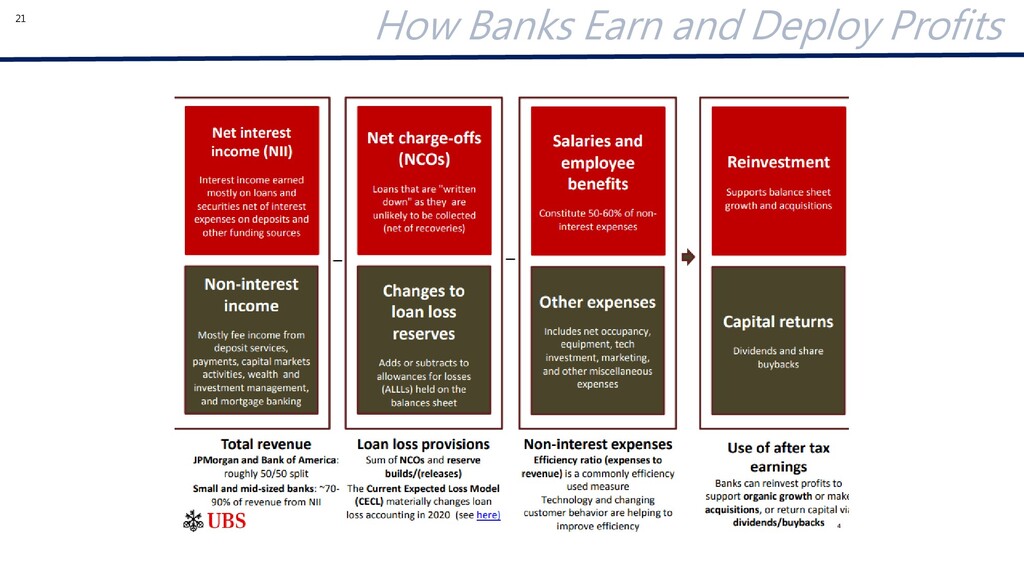
Banks? 16 How Do You Value Them? Banks are valued on Return on Equity (ROE) and Returns on Tangible Common Equity (ROTCE) metrics that are derived from return on assets and leverage. Due to the high leverage needed to operate banks must have sufficient capital bases in order to absorb unexpected losses. Banks are valued by calculating excess returns (ROE / ROTCE) minus the cost of equity Banks are highly levered balance sheet driven businesses that traditionally operate in some if not all of the following three businesses: 1. Finance individuals and organizations through direct lending, facilitating debt and equity issuances. Historically known at the 3-6-9 model. Borrow at 3%, lend at 6% and go play 9. 2. Provide a store of value through deposits, wealth and investment management products 3. Facilitate transactions: Card transactions, fund transfers, market making, treasury services


 levineasterly
 morganepeng
 letsgokoyo
 eileencodes
 jacobian
 addyosmani
 tamaranovitovic
 leimatthew05
 wjessup
 smashingmag
 lauravandoore