Upgrade to Pro — share decks privately, control downloads, hide ads and more …

Q3 Consumer Staples Review

Sponsored · Your Podcast. Everywhere. Effortlessly. Share. Educate. Inspire. Entertain. You do you. We'll handle the rest. →
Avatar for Levin Easterly Levin Easterly
August 22, 2020
31

Q3 Consumer Staples Review

Avatar for Levin Easterly

Levin Easterly

August 22, 2020

Transcript

  1. Levin Easterly’s Focus in the Sector Archer Daniels Midland (ADM):

    Global leader in human and animal nutrition as well as agricultural origination and processing. Their agriculture production includes oilseeds, corn, wheat, milo, oats, rice, and barley. Post Holdings (POST): Consumer packaged goods company operating in center-of- the-store, foodservice, food ingredient, refrigerated, active nutrition and private label categories. Primo Water (PRMW): Leading service-based manufacturer of water sources and filtration to homes and offices in North America and Europe. TreeHouse Foods (THS): Premier multinational food manufacturing and processing company specializing in Private Label brands for snacking & beverages and meal preparation. Tyson Foods (TSN): The world’s second largest producer and marketer of Beef, Chicken, and Pork as well as the US’s largest exporter of Beef.
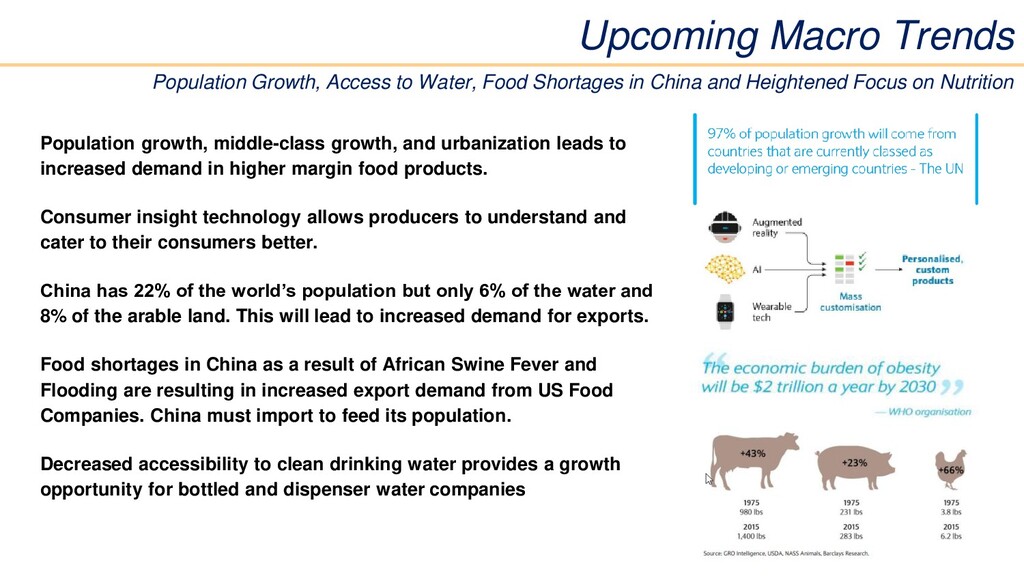
  2. Upcoming Macro Trends Population growth, middle-class growth, and urbanization leads

    to increased demand in higher margin food products. Consumer insight technology allows producers to understand and cater to their consumers better. China has 22% of the world’s population but only 6% of the water and 8% of the arable land. This will lead to increased demand for exports. Food shortages in China as a result of African Swine Fever and Flooding are resulting in increased export demand from US Food Companies. China must import to feed its population. Decreased accessibility to clean drinking water provides a growth opportunity for bottled and dispenser water companies Population Growth, Access to Water, Food Shortages in China and Heightened Focus on Nutrition
  3. ASF Benefits US Food Companies African Swine Fever is a

    highly contagious and deadly virus that spreads in swine. There is no treatment or vaccine meaning swine producers have to eliminate any infected or potentially infected swine. The virus began spreading through China in 2018 and has resulted in a 33% decrease in production and 97% increase in price. This shortage and increased price of swine in China allows for beneficial trade between China and the US where swine prices have fallen and production rose over the past two years. This is beneficial to Tyson Foods who has seen a 600% increase in year-over- year pork orders to China as a result of the ASF outbreak.
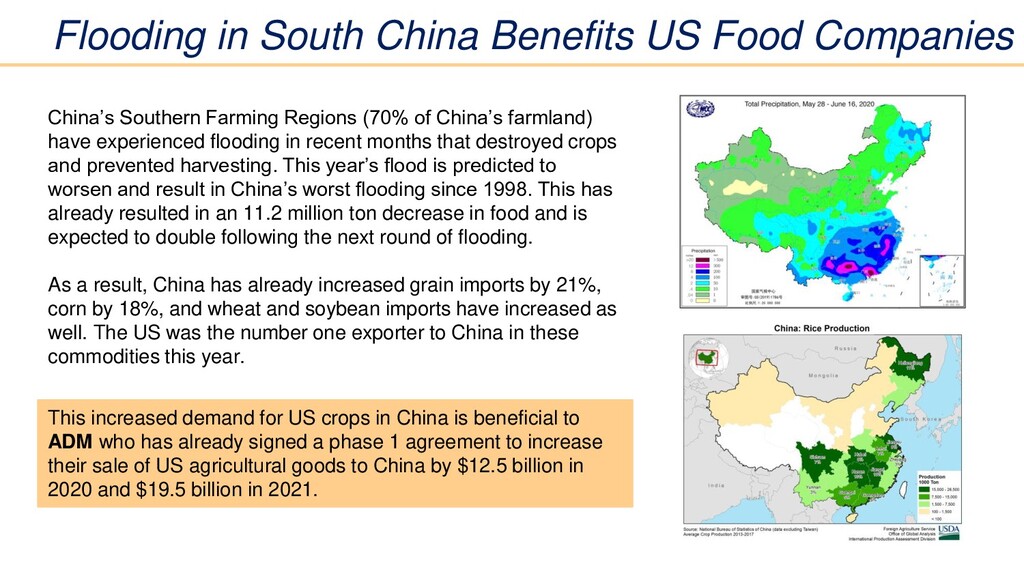
  4. Flooding in South China Benefits US Food Companies China’s Southern

    Farming Regions (70% of China’s farmland) have experienced flooding in recent months that destroyed crops and prevented harvesting. This year’s flood is predicted to worsen and result in China’s worst flooding since 1998. This has already resulted in an 11.2 million ton decrease in food and is expected to double following the next round of flooding. As a result, China has already increased grain imports by 21%, corn by 18%, and wheat and soybean imports have increased as well. The US was the number one exporter to China in these commodities this year. This increased demand for US crops in China is beneficial to ADM who has already signed a phase 1 agreement to increase their sale of US agricultural goods to China by $12.5 billion in 2020 and $19.5 billion in 2021.
  5. Tyson Foods (TSN) TSN Positioned Well for Food Challenges in

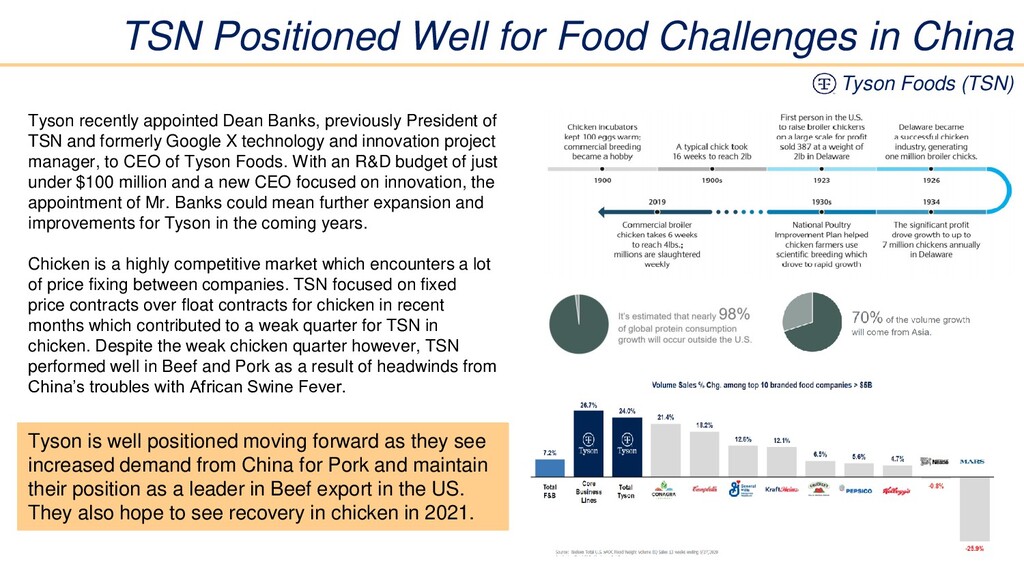
    China Tyson recently appointed Dean Banks, previously President of TSN and formerly Google X technology and innovation project manager, to CEO of Tyson Foods. With an R&D budget of just under $100 million and a new CEO focused on innovation, the appointment of Mr. Banks could mean further expansion and improvements for Tyson in the coming years. Chicken is a highly competitive market which encounters a lot of price fixing between companies. TSN focused on fixed price contracts over float contracts for chicken in recent months which contributed to a weak quarter for TSN in chicken. Despite the weak chicken quarter however, TSN performed well in Beef and Pork as a result of headwinds from China’s troubles with African Swine Fever. Tyson is well positioned moving forward as they see increased demand from China for Pork and maintain their position as a leader in Beef export in the US. They also hope to see recovery in chicken in 2021.
  6. Archer Daniels Midland (ADM) ADM Benefits from Nutrition Focus Trends

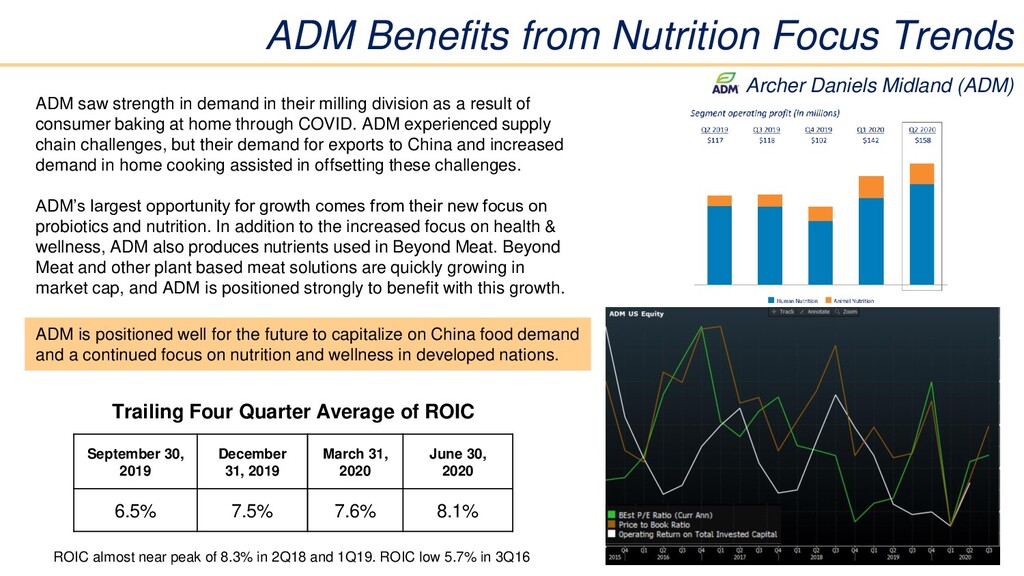
    ADM saw strength in demand in their milling division as a result of consumer baking at home through COVID. ADM experienced supply chain challenges, but their demand for exports to China and increased demand in home cooking assisted in offsetting these challenges. ADM’s largest opportunity for growth comes from their new focus on probiotics and nutrition. In addition to the increased focus on health & wellness, ADM also produces nutrients used in Beyond Meat. Beyond Meat and other plant based meat solutions are quickly growing in market cap, and ADM is positioned strongly to benefit with this growth. September 30, 2019 December 31, 2019 March 31, 2020 June 30, 2020 6.5% 7.5% 7.6% 8.1% Trailing Four Quarter Average of ROIC ROIC almost near peak of 8.3% in 2Q18 and 1Q19. ROIC low 5.7% in 3Q16 ADM is positioned well for the future to capitalize on China food demand and a continued focus on nutrition and wellness in developed nations.
  7. Nutrition Trends Allow for Sale of High Margin Products Over

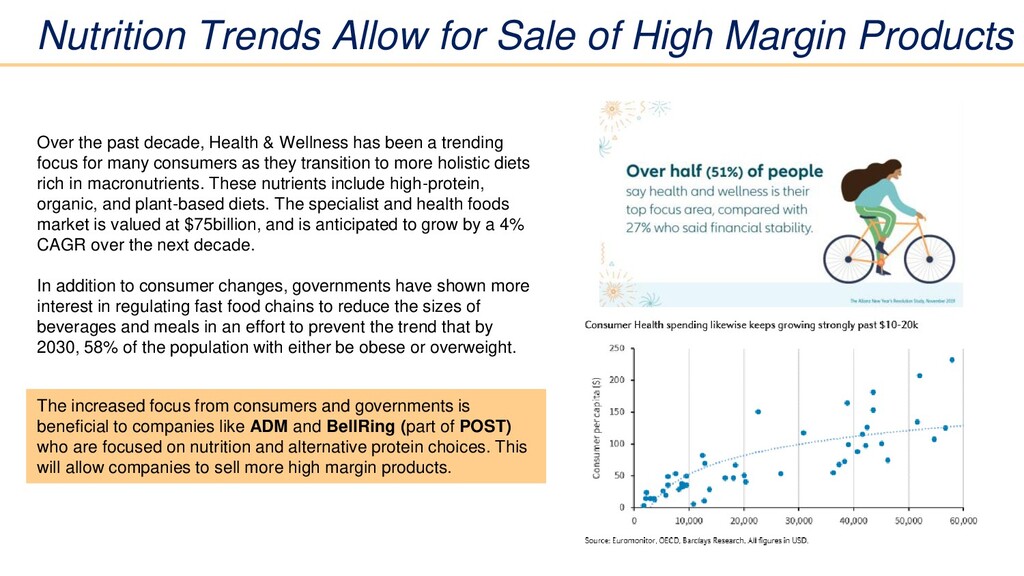
    the past decade, Health & Wellness has been a trending focus for many consumers as they transition to more holistic diets rich in macronutrients. These nutrients include high-protein, organic, and plant-based diets. The specialist and health foods market is valued at $75billion, and is anticipated to grow by a 4% CAGR over the next decade. In addition to consumer changes, governments have shown more interest in regulating fast food chains to reduce the sizes of beverages and meals in an effort to prevent the trend that by 2030, 58% of the population with either be obese or overweight. The increased focus from consumers and governments is beneficial to companies like ADM and BellRing (part of POST) who are focused on nutrition and alternative protein choices. This will allow companies to sell more high margin products.
  8. POST Stuggles in COVID but Signals Strong FCF Growth Post

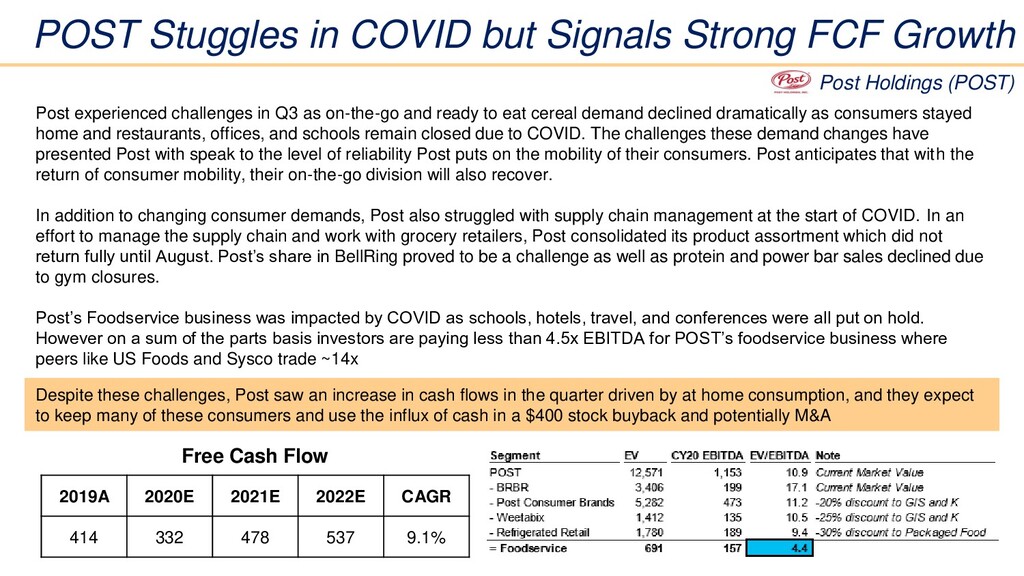
    experienced challenges in Q3 as on-the-go and ready to eat cereal demand declined dramatically as consumers stayed home and restaurants, offices, and schools remain closed due to COVID. The challenges these demand changes have presented Post with speak to the level of reliability Post puts on the mobility of their consumers. Post anticipates that with the return of consumer mobility, their on-the-go division will also recover. In addition to changing consumer demands, Post also struggled with supply chain management at the start of COVID. In an effort to manage the supply chain and work with grocery retailers, Post consolidated its product assortment which did not return fully until August. Post’s share in BellRing proved to be a challenge as well as protein and power bar sales declined due to gym closures. Post’s Foodservice business was impacted by COVID as schools, hotels, travel, and conferences were all put on hold. However on a sum of the parts basis investors are paying less than 4.5x EBITDA for POST’s foodservice business where peers like US Foods and Sysco trade ~14x 2019A 2020E 2021E 2022E CAGR 414 332 478 537 9.1% Free Cash Flow Post Holdings (POST) Despite these challenges, Post saw an increase in cash flows in the quarter driven by at home consumption, and they expect to keep many of these consumers and use the influx of cash in a $400 stock buyback and potentially M&A
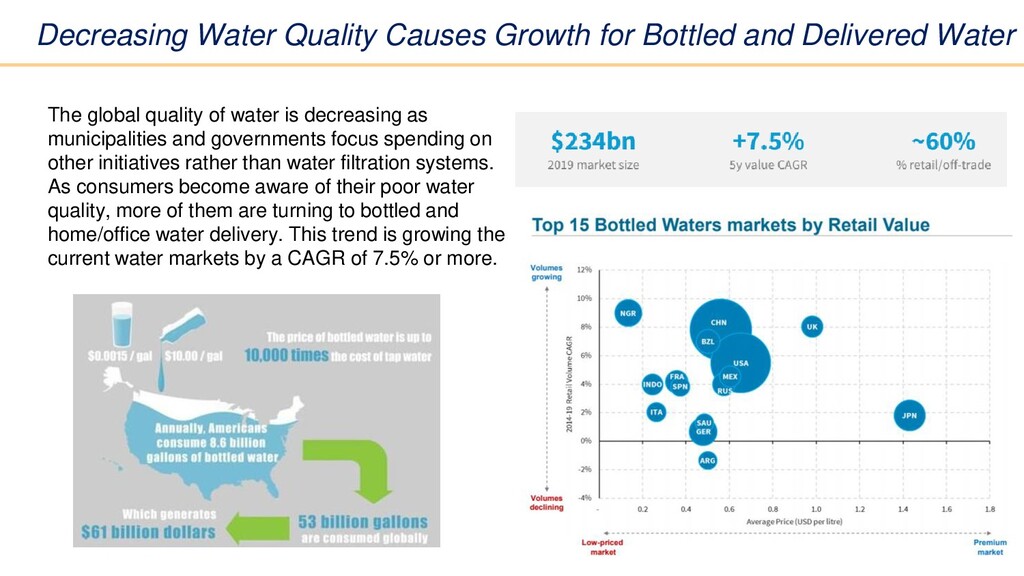
  9. The global quality of water is decreasing as municipalities and

    governments focus spending on other initiatives rather than water filtration systems. As consumers become aware of their poor water quality, more of them are turning to bottled and home/office water delivery. This trend is growing the current water markets by a CAGR of 7.5% or more. Decreasing Water Quality Causes Growth for Bottled and Delivered Water
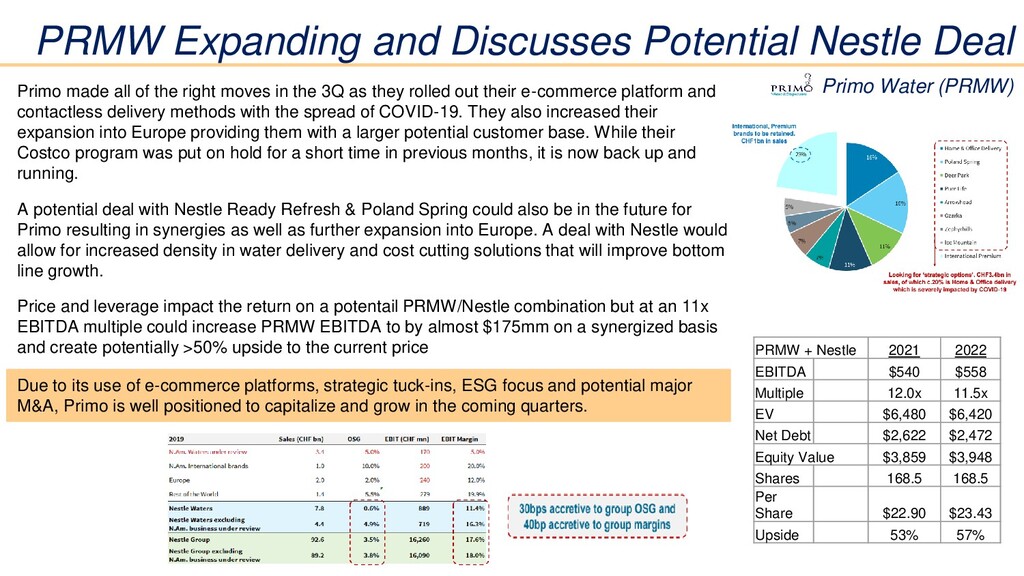
  10. PRMW Expanding and Discusses Potential Nestle Deal Primo made all

    of the right moves in the 3Q as they rolled out their e-commerce platform and contactless delivery methods with the spread of COVID-19. They also increased their expansion into Europe providing them with a larger potential customer base. While their Costco program was put on hold for a short time in previous months, it is now back up and running. A potential deal with Nestle Ready Refresh & Poland Spring could also be in the future for Primo resulting in synergies as well as further expansion into Europe. A deal with Nestle would allow for increased density in water delivery and cost cutting solutions that will improve bottom line growth. Price and leverage impact the return on a potentail PRMW/Nestle combination but at an 11x EBITDA multiple could increase PRMW EBITDA to by almost $175mm on a synergized basis and create potentially >50% upside to the current price PRMW + Nestle 2021 2022 EBITDA $540 $558 Multiple 12.0x 11.5x EV $6,480 $6,420 Net Debt $2,622 $2,472 Equity Value $3,859 $3,948 Shares 168.5 168.5 Per Share $22.90 $23.43 Upside 53% 57% Primo Water (PRMW) Due to its use of e-commerce platforms, strategic tuck-ins, ESG focus and potential major M&A, Primo is well positioned to capitalize and grow in the coming quarters.
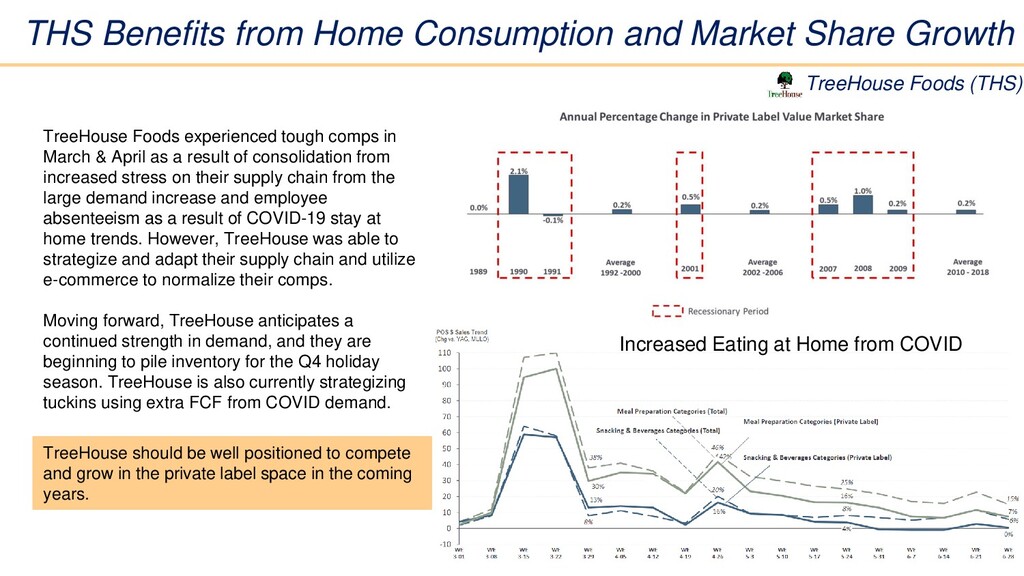
  11. TreeHouse Foods (THS) THS Benefits from Home Consumption and Market

    Share Growth TreeHouse Foods experienced tough comps in March & April as a result of consolidation from increased stress on their supply chain from the large demand increase and employee absenteeism as a result of COVID-19 stay at home trends. However, TreeHouse was able to strategize and adapt their supply chain and utilize e-commerce to normalize their comps. Moving forward, TreeHouse anticipates a continued strength in demand, and they are beginning to pile inventory for the Q4 holiday season. TreeHouse is also currently strategizing tuckins using extra FCF from COVID demand. Increased Eating at Home from COVID TreeHouse should be well positioned to compete and grow in the private label space in the coming years.
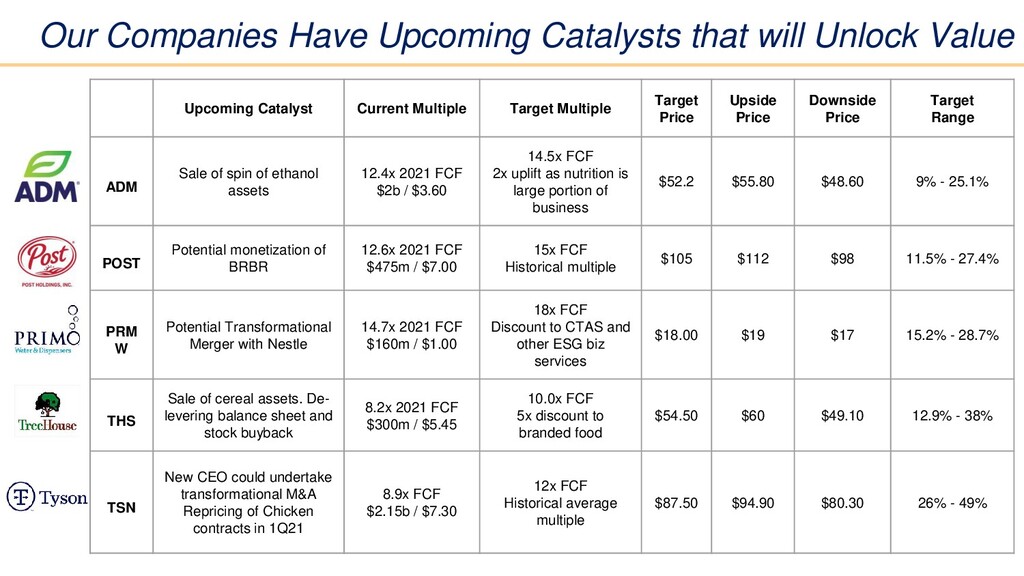
  12. Upcoming Catalyst Current Multiple Target Multiple Target Price Upside Price

    Downside Price Target Range ADM Sale of spin of ethanol assets 12.4x 2021 FCF $2b / $3.60 14.5x FCF 2x uplift as nutrition is large portion of business $52.2 $55.80 $48.60 9% - 25.1% POST Potential monetization of BRBR 12.6x 2021 FCF $475m / $7.00 15x FCF Historical multiple $105 $112 $98 11.5% - 27.4% PRM W Potential Transformational Merger with Nestle 14.7x 2021 FCF $160m / $1.00 18x FCF Discount to CTAS and other ESG biz services $18.00 $19 $17 15.2% - 28.7% THS Sale of cereal assets. De- levering balance sheet and stock buyback 8.2x 2021 FCF $300m / $5.45 10.0x FCF 5x discount to branded food $54.50 $60 $49.10 12.9% - 38% TSN New CEO could undertake transformational M&A Repricing of Chicken contracts in 1Q21 8.9x FCF $2.15b / $7.30 12x FCF Historical average multiple $87.50 $94.90 $80.30 26% - 49% Our Companies Have Upcoming Catalysts that will Unlock Value
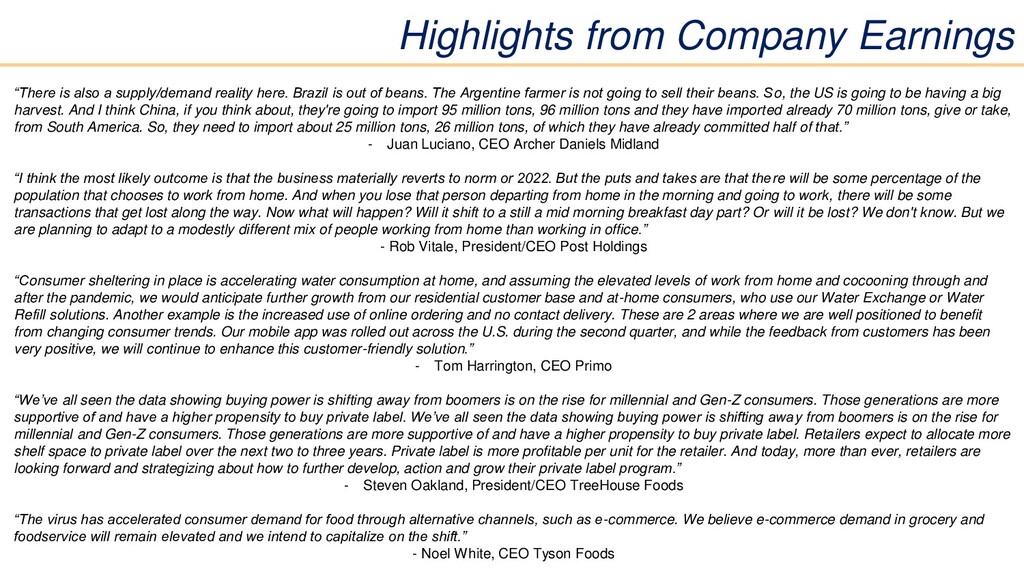
  13. Highlights from Company Earnings “There is also a supply/demand reality

    here. Brazil is out of beans. The Argentine farmer is not going to sell their beans. So, the US is going to be having a big harvest. And I think China, if you think about, they're going to import 95 million tons, 96 million tons and they have imported already 70 million tons, give or take, from South America. So, they need to import about 25 million tons, 26 million tons, of which they have already committed half of that.” - Juan Luciano, CEO Archer Daniels Midland “I think the most likely outcome is that the business materially reverts to norm or 2022. But the puts and takes are that there will be some percentage of the population that chooses to work from home. And when you lose that person departing from home in the morning and going to work, there will be some transactions that get lost along the way. Now what will happen? Will it shift to a still a mid morning breakfast day part? Or will it be lost? We don't know. But we are planning to adapt to a modestly different mix of people working from home than working in office.” - Rob Vitale, President/CEO Post Holdings “Consumer sheltering in place is accelerating water consumption at home, and assuming the elevated levels of work from home and cocooning through and after the pandemic, we would anticipate further growth from our residential customer base and at-home consumers, who use our Water Exchange or Water Refill solutions. Another example is the increased use of online ordering and no contact delivery. These are 2 areas where we are well positioned to benefit from changing consumer trends. Our mobile app was rolled out across the U.S. during the second quarter, and while the feedback from customers has been very positive, we will continue to enhance this customer-friendly solution.” - Tom Harrington, CEO Primo “We’ve all seen the data showing buying power is shifting away from boomers is on the rise for millennial and Gen-Z consumers. Those generations are more supportive of and have a higher propensity to buy private label. We’ve all seen the data showing buying power is shifting away from boomers is on the rise for millennial and Gen-Z consumers. Those generations are more supportive of and have a higher propensity to buy private label. Retailers expect to allocate more shelf space to private label over the next two to three years. Private label is more profitable per unit for the retailer. And today, more than ever, retailers are looking forward and strategizing about how to further develop, action and grow their private label program.” - Steven Oakland, President/CEO TreeHouse Foods “The virus has accelerated consumer demand for food through alternative channels, such as e-commerce. We believe e-commerce demand in grocery and foodservice will remain elevated and we intend to capitalize on the shift.” - Noel White, CEO Tyson Foods