Upgrade to Pro — share decks privately, control downloads, hide ads and more …

Simultaneous Clustering and Decomposition of Ne...

Sponsored · Your Podcast. Everywhere. Effortlessly. Share. Educate. Inspire. Entertain. You do you. We'll handle the rest.
Avatar for Madison Stoms Madison Stoms
November 21, 2023
19

Simultaneous Clustering and Decomposition of Neural Activation Data Across Repeated Trials

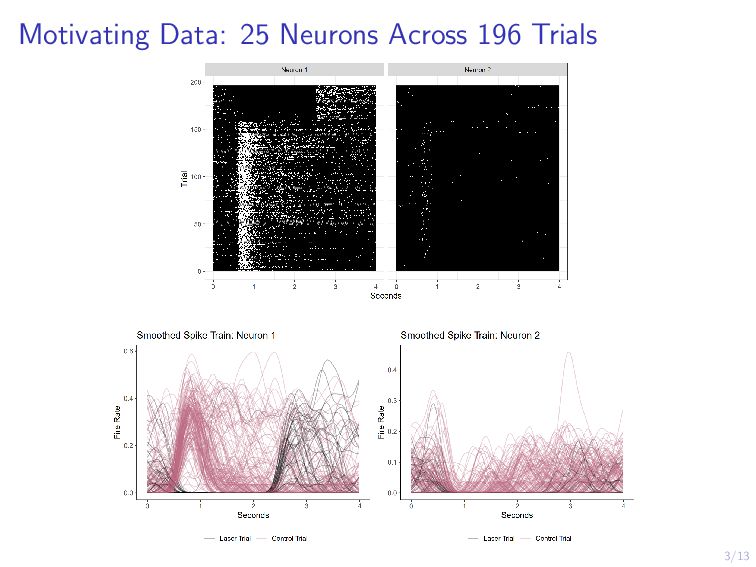
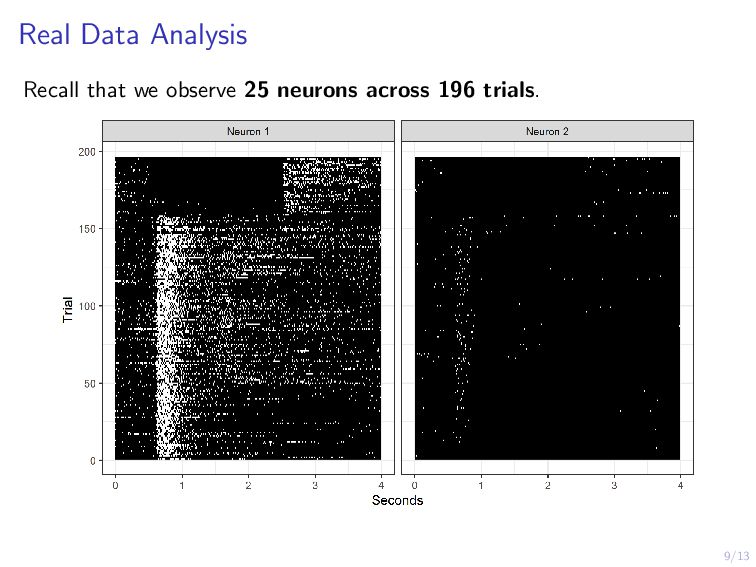
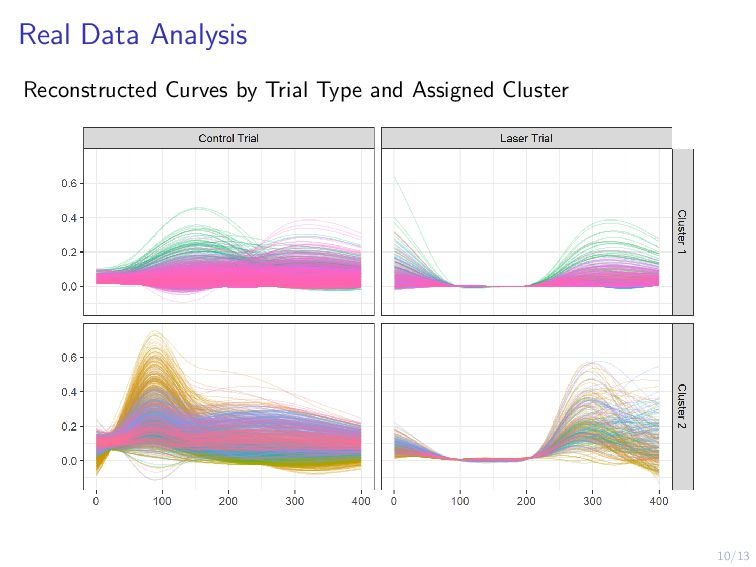
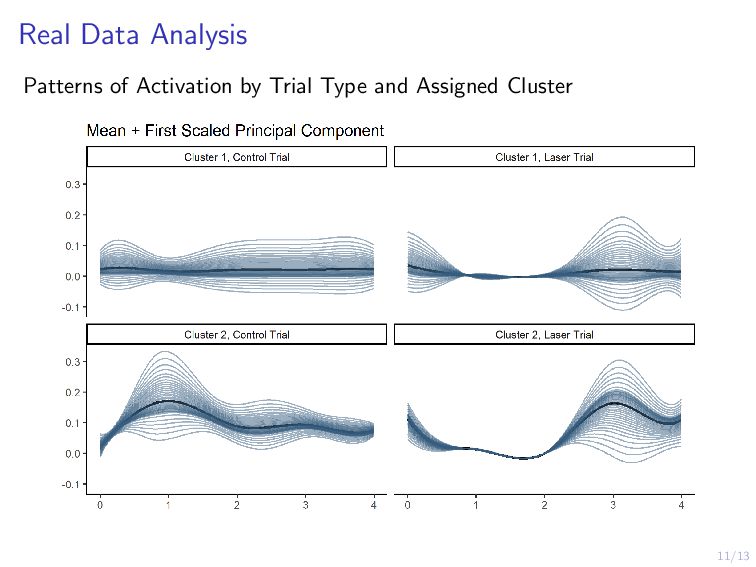
Scientists are interested in identifying neural activation patterns associated with skilled movement in the motor cortex. Neural firing rates are collected from trained mice as they reach for a food pellet on a number of trials under different scenarios. Functional data analysis is a collection of methods which treat data measured on a dense grid as a random function. Under this framework, we aim to cluster the neurons into interpretable clusters while preserving the inherent differences in activation between trial types. Additionally, we are interested in extracting low-dimension, cluster-specific activation patterns. We develop a method which simultaneously clusters and decomposes multilevel functional data across trials, resulting in distinguishable cluster-and-trial-type-specific representations of the data. We demonstrate this method on a collection of 25 neurons across 196 trials of two types.

Avatar for Madison Stoms

Madison Stoms

November 21, 2023
Tweet

Transcript

  1. 1/13 Simultaneous Clustering and Decomposition of Neural Activation Data across

    Repeated Trials Madison Stoms1, Britton Sauerbrei2, Jeff Goldsmith1 1Columbia University 2Case Western Reserve University
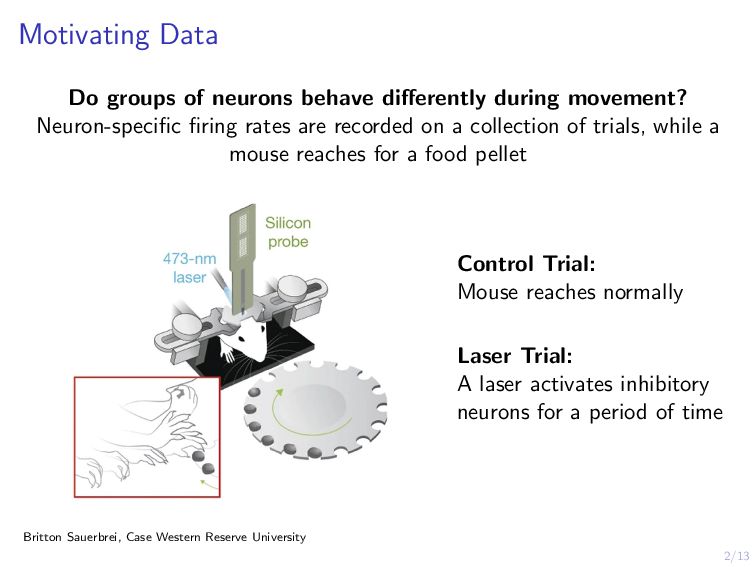
  2. 2/13 Motivating Data Do groups of neurons behave differently during

    movement? Neuron-specific firing rates are recorded on a collection of trials, while a mouse reaches for a food pellet Control Trial: Mouse reaches normally Laser Trial: A laser activates inhibitory neurons for a period of time Britton Sauerbrei, Case Western Reserve University
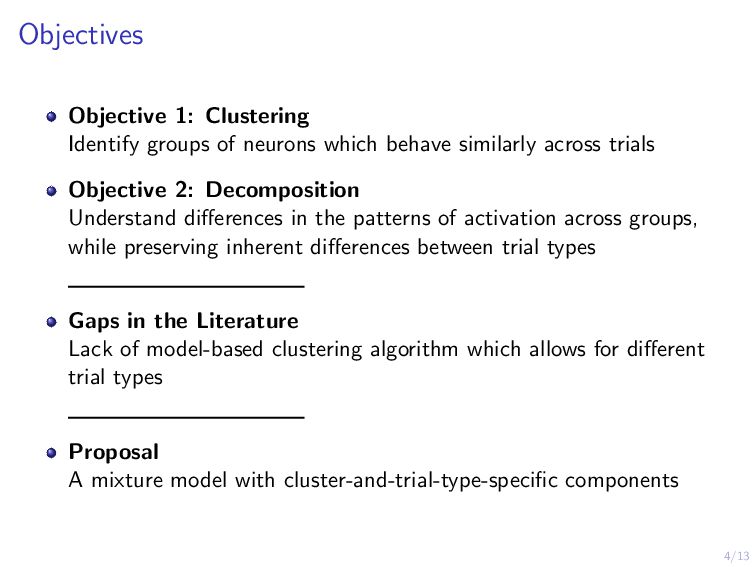
  3. 4/13 Objectives Objective 1: Clustering Identify groups of neurons which

    behave similarly across trials Objective 2: Decomposition Understand differences in the patterns of activation across groups, while preserving inherent differences between trial types Gaps in the Literature Lack of model-based clustering algorithm which allows for different trial types Proposal A mixture model with cluster-and-trial-type-specific components
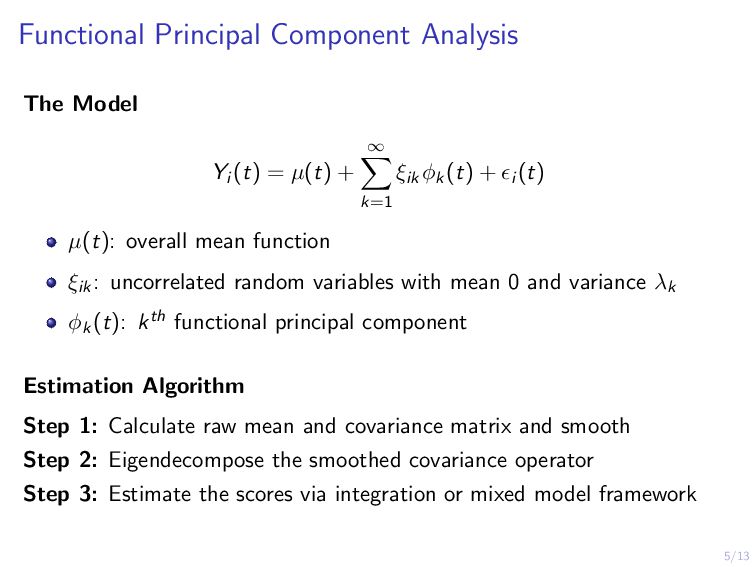
  4. 5/13 Functional Principal Component Analysis The Model Yi (t) =

    µ(t) + ∞ k=1 ξikϕk(t) + ϵi (t) µ(t): overall mean function ξik: uncorrelated random variables with mean 0 and variance λk ϕk(t): kth functional principal component Estimation Algorithm Step 1: Calculate raw mean and covariance matrix and smooth Step 2: Eigendecompose the smoothed covariance operator Step 3: Estimate the scores via integration or mixed model framework
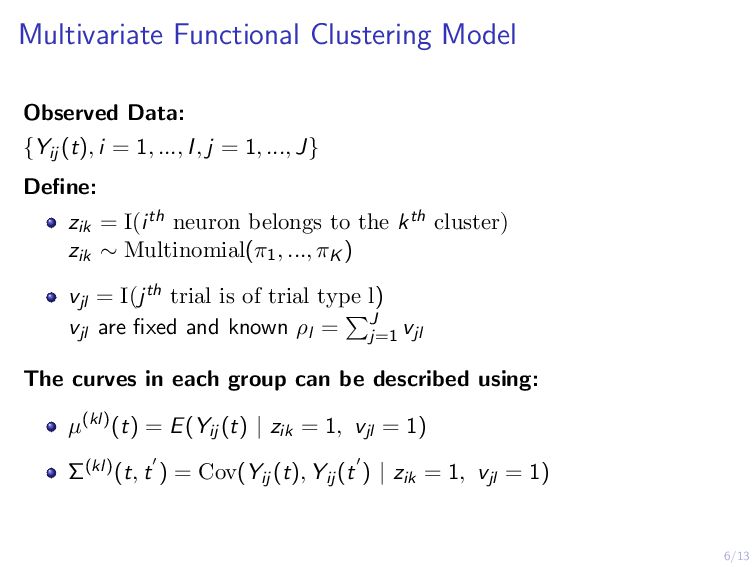
  5. 6/13 Multivariate Functional Clustering Model Observed Data: {Yij (t), i

    = 1, ..., I, j = 1, ..., J} Define: zik = I(ith neuron belongs to the kth cluster) zik ∼ Multinomial(π1, ..., πK ) vjl = I(jth trial is of trial type l) vjl are fixed and known ρl = J j=1 vjl The curves in each group can be described using: µ(kl)(t) = E(Yij (t) | zik = 1, vjl = 1) Σ(kl)(t, t′ ) = Cov(Yij (t), Yij (t′ ) | zik = 1, vjl = 1)
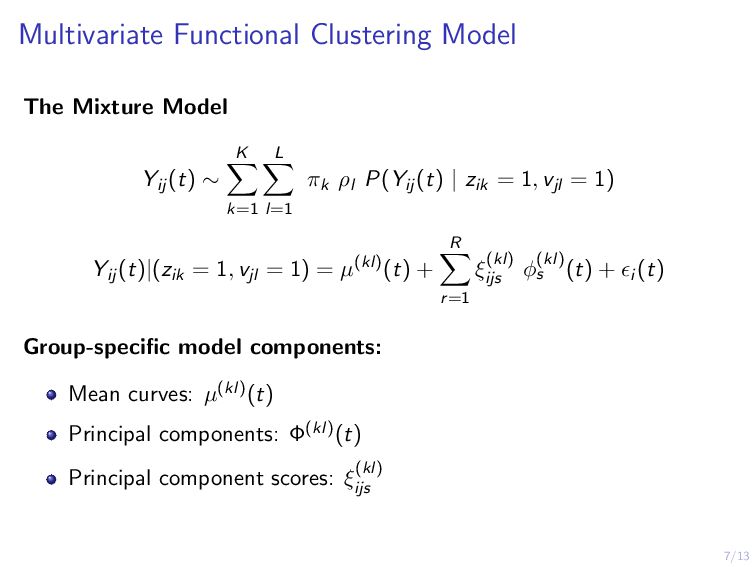
  6. 7/13 Multivariate Functional Clustering Model The Mixture Model Yij (t)

    ∼ K k=1 L l=1 πk ρl P(Yij (t) | zik = 1, vjl = 1) Yij (t)|(zik = 1, vjl = 1) = µ(kl)(t) + R r=1 ξ(kl) ijs ϕ(kl) s (t) + ϵi (t) Group-specific model components: Mean curves: µ(kl)(t) Principal components: Φ(kl)(t) Principal component scores: ξ(kl) ijs
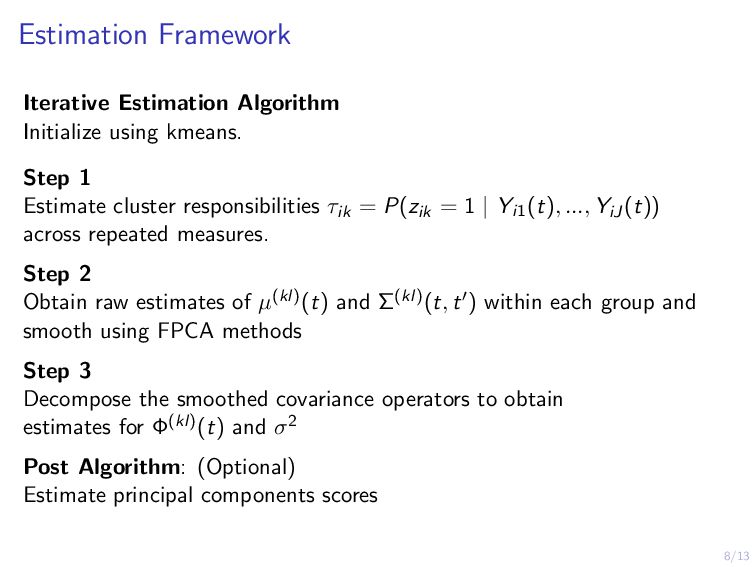
  7. 8/13 Estimation Framework Iterative Estimation Algorithm Initialize using kmeans. Step

    1 Estimate cluster responsibilities τik = P(zik = 1 | Yi1(t), ..., YiJ(t)) across repeated measures. Step 2 Obtain raw estimates of µ(kl)(t) and Σ(kl)(t, t′) within each group and smooth using FPCA methods Step 3 Decompose the smoothed covariance operators to obtain estimates for Φ(kl)(t) and σ2 Post Algorithm: (Optional) Estimate principal components scores
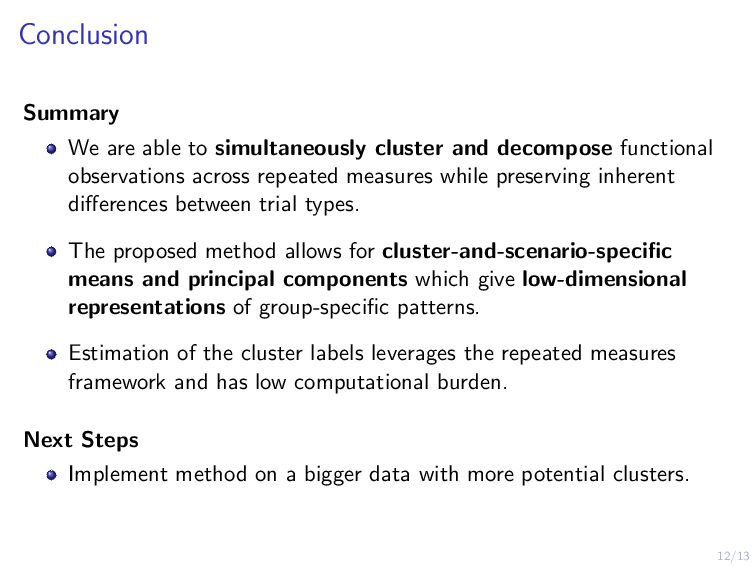
  8. 12/13 Conclusion Summary We are able to simultaneously cluster and

    decompose functional observations across repeated measures while preserving inherent differences between trial types. The proposed method allows for cluster-and-scenario-specific means and principal components which give low-dimensional representations of group-specific patterns. Estimation of the cluster labels leverages the repeated measures framework and has low computational burden. Next Steps Implement method on a bigger data with more potential clusters.