techniques intended to inform the development and responsible use of artificial intelligence technology. It is used to make credit card decisions to conduct video surveillance in airports and to inform military operations. This can be extremely helpful to the people and at the same time can also be harmful to them. It formally defines the role of artificial intelligence as it applies to the continued development of the human race. It guides the stakeholders in making ethical decisions regarding the use of artificial technology. The rapid advancement of Al Ethics in past 5 to 10 years has spurred groups of experts to develop safeguards for protection against the risk of Artificial Intelligence. In present times, Al Ethics has an impact on everything from social media to healthcare.
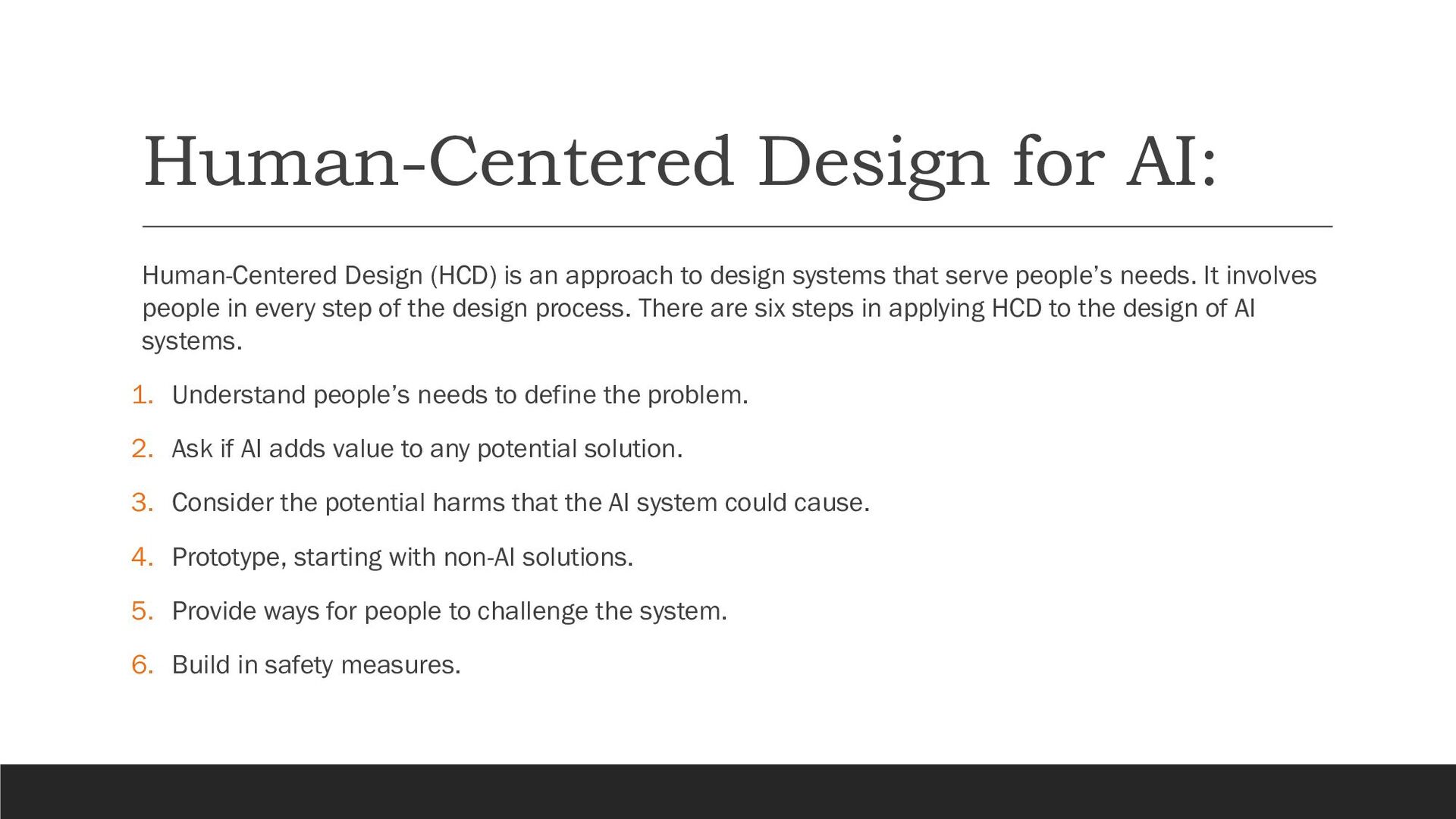
to design systems that serve people’s needs. It involves people in every step of the design process. There are six steps in applying HCD to the design of AI systems. 1. Understand people’s needs to define the problem. 2. Ask if AI adds value to any potential solution. 3. Consider the potential harms that the AI system could cause. 4. Prototype, starting with non-AI solutions. 5. Provide ways for people to challenge the system. 6. Build in safety measures.
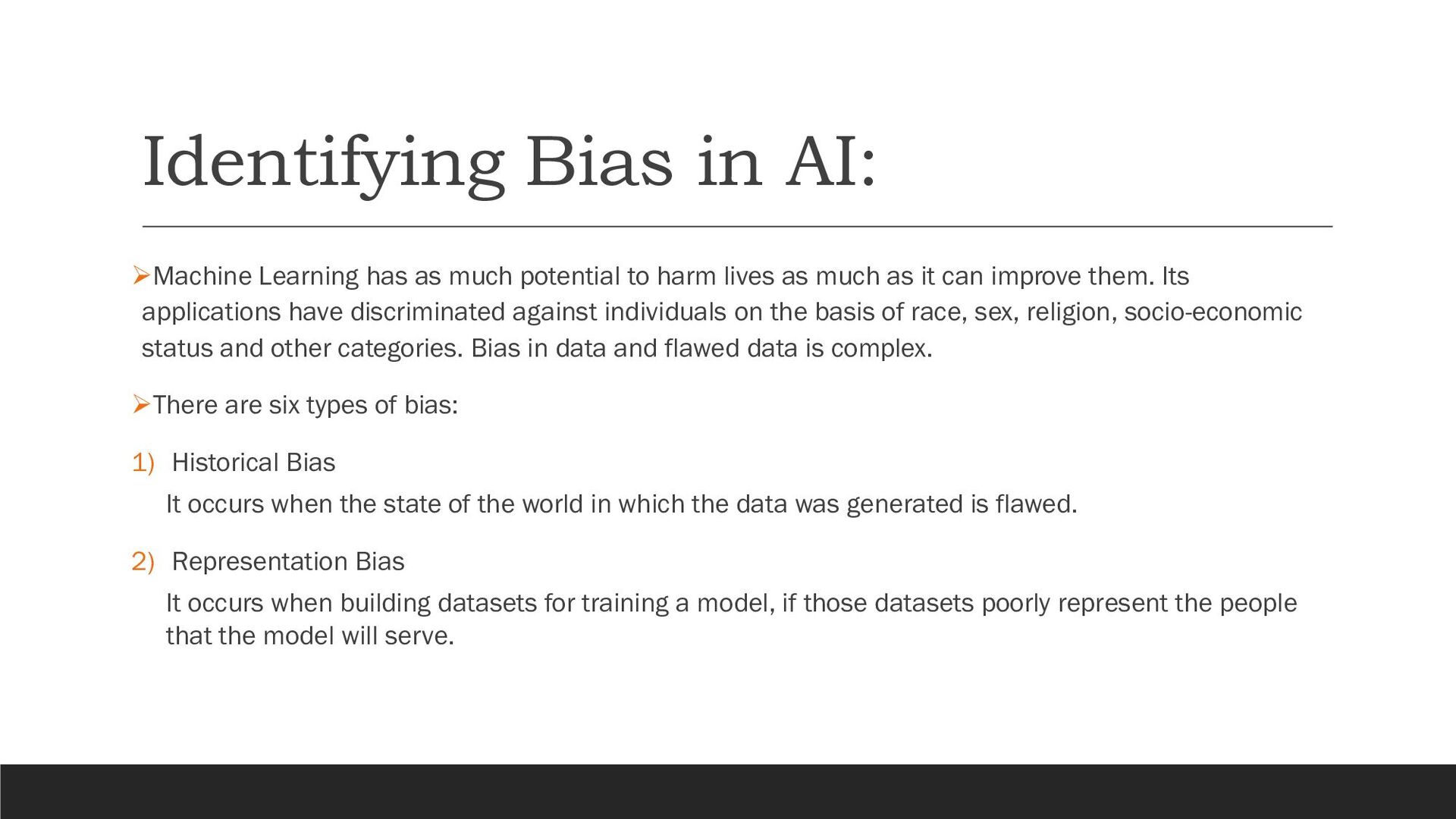
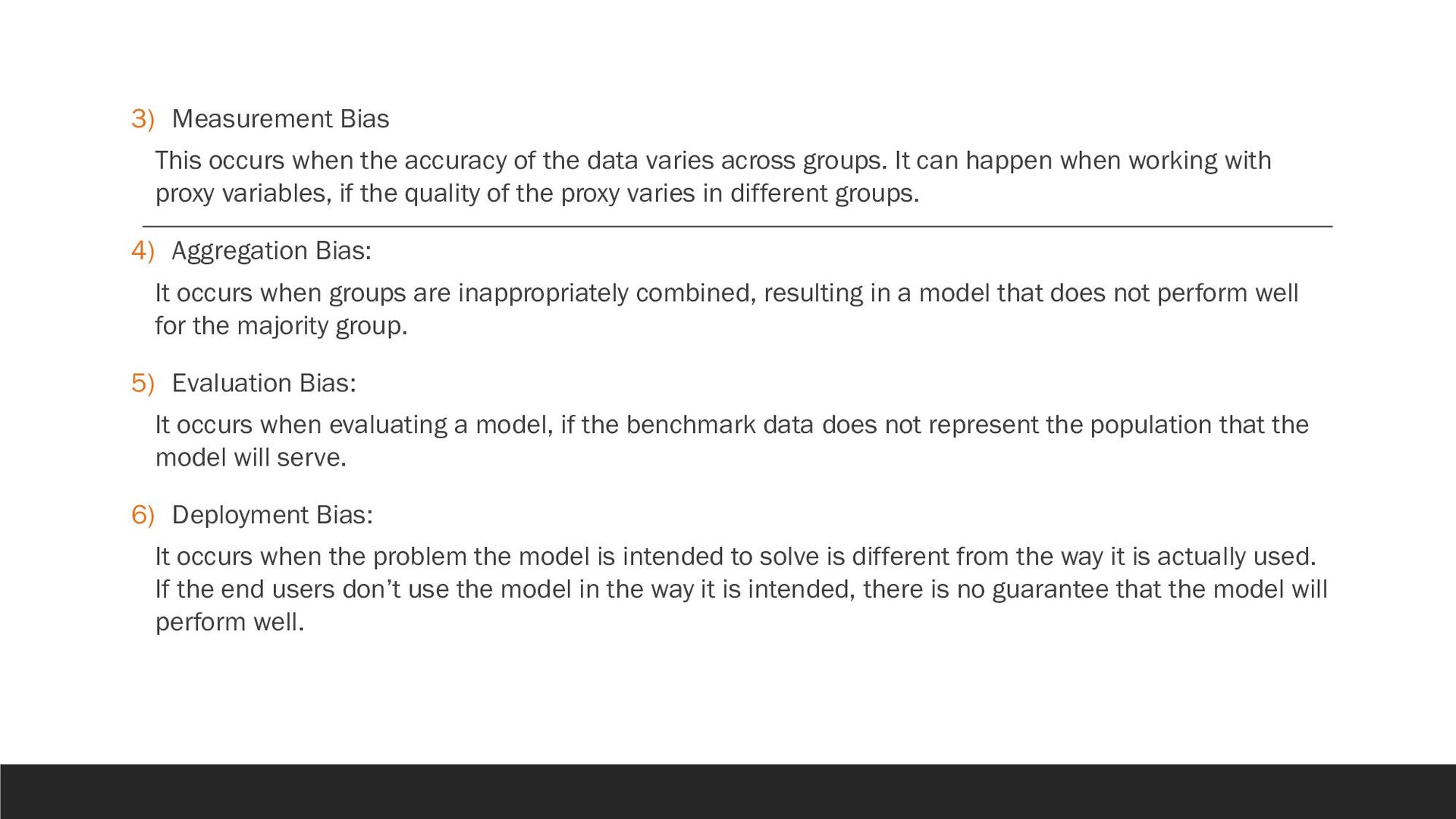
to harm lives as much as it can improve them. Its applications have discriminated against individuals on the basis of race, sex, religion, socio-economic status and other categories. Bias in data and flawed data is complex. There are six types of bias: 1) Historical Bias It occurs when the state of the world in which the data was generated is flawed. 2) Representation Bias It occurs when building datasets for training a model, if those datasets poorly represent the people that the model will serve.
data varies across groups. It can happen when working with proxy variables, if the quality of the proxy varies in different groups. 4) Aggregation Bias: It occurs when groups are inappropriately combined, resulting in a model that does not perform well for the majority group. 5) Evaluation Bias: It occurs when evaluating a model, if the benchmark data does not represent the population that the model will serve. 6) Deployment Bias: It occurs when the problem the model is intended to solve is different from the way it is actually used. If the end users don’t use the model in the way it is intended, there is no guarantee that the model will perform well.
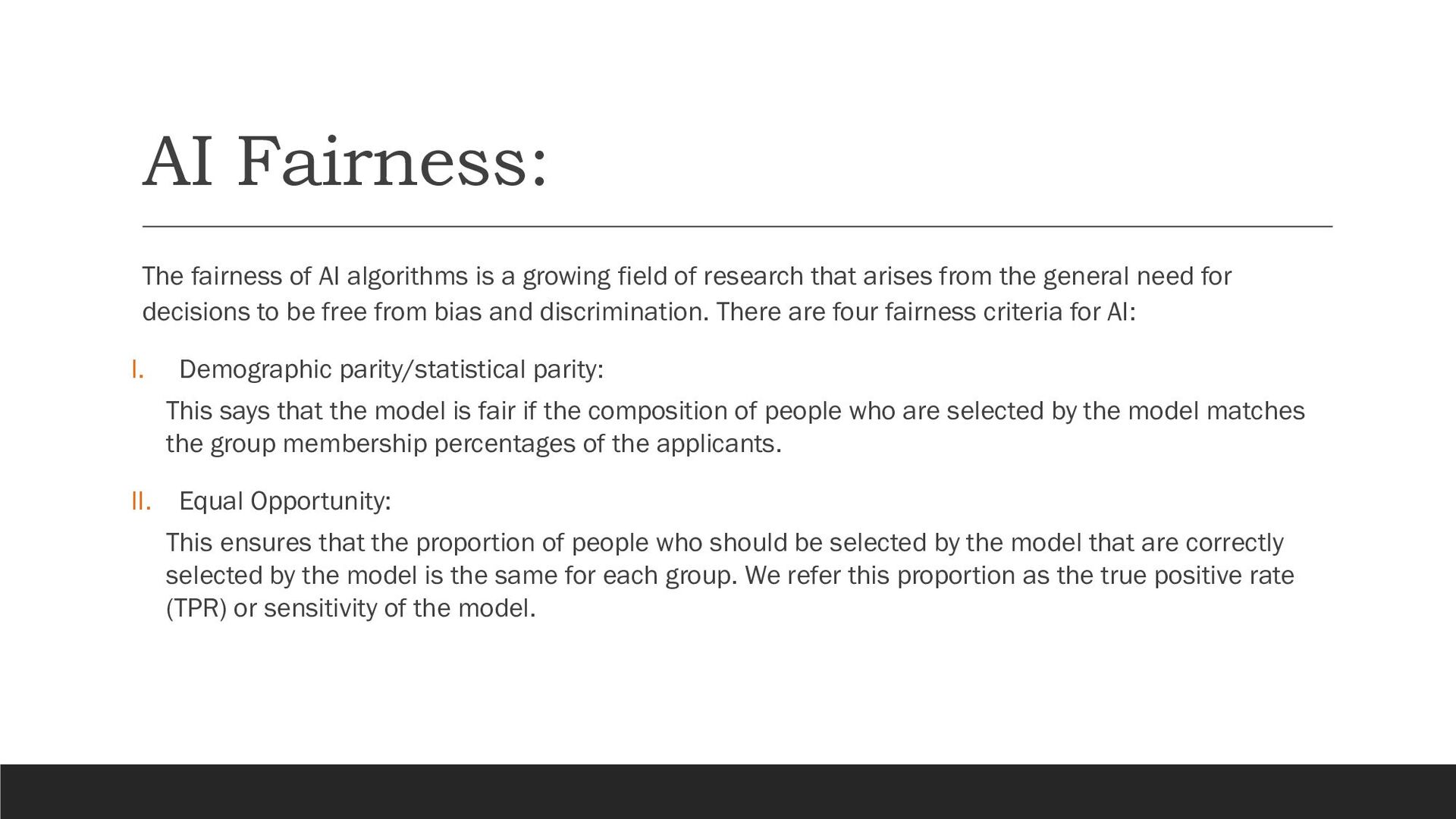
field of research that arises from the general need for decisions to be free from bias and discrimination. There are four fairness criteria for AI: I. Demographic parity/statistical parity: This says that the model is fair if the composition of people who are selected by the model matches the group membership percentages of the applicants. II. Equal Opportunity: This ensures that the proportion of people who should be selected by the model that are correctly selected by the model is the same for each group. We refer this proportion as the true positive rate (TPR) or sensitivity of the model.
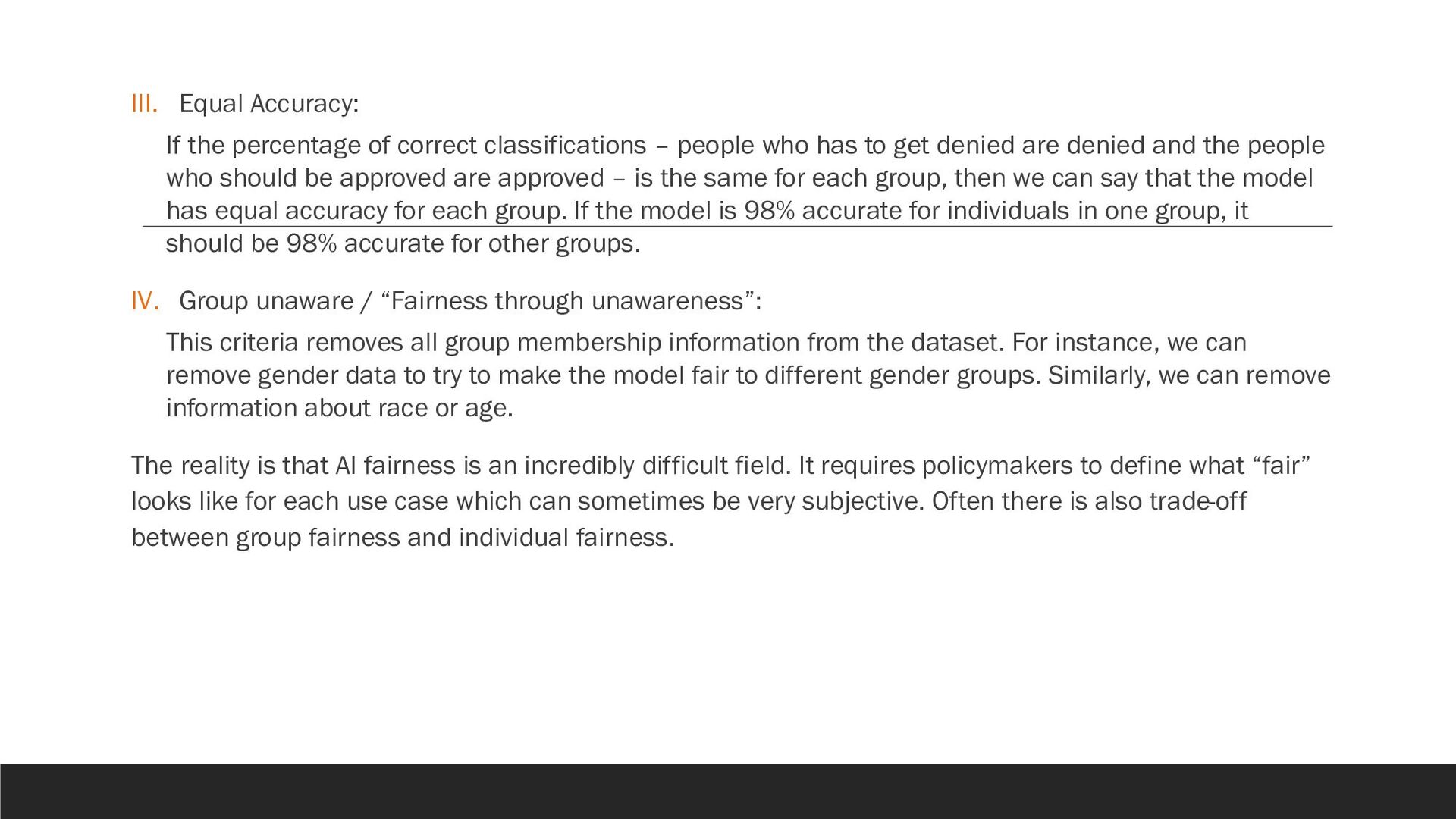
people who has to get denied are denied and the people who should be approved are approved – is the same for each group, then we can say that the model has equal accuracy for each group. If the model is 98% accurate for individuals in one group, it should be 98% accurate for other groups. IV. Group unaware / “Fairness through unawareness”: This criteria removes all group membership information from the dataset. For instance, we can remove gender data to try to make the model fair to different gender groups. Similarly, we can remove information about race or age. The reality is that AI fairness is an incredibly difficult field. It requires policymakers to define what “fair” looks like for each use case which can sometimes be very subjective. Often there is also trade-off between group fairness and individual fairness.
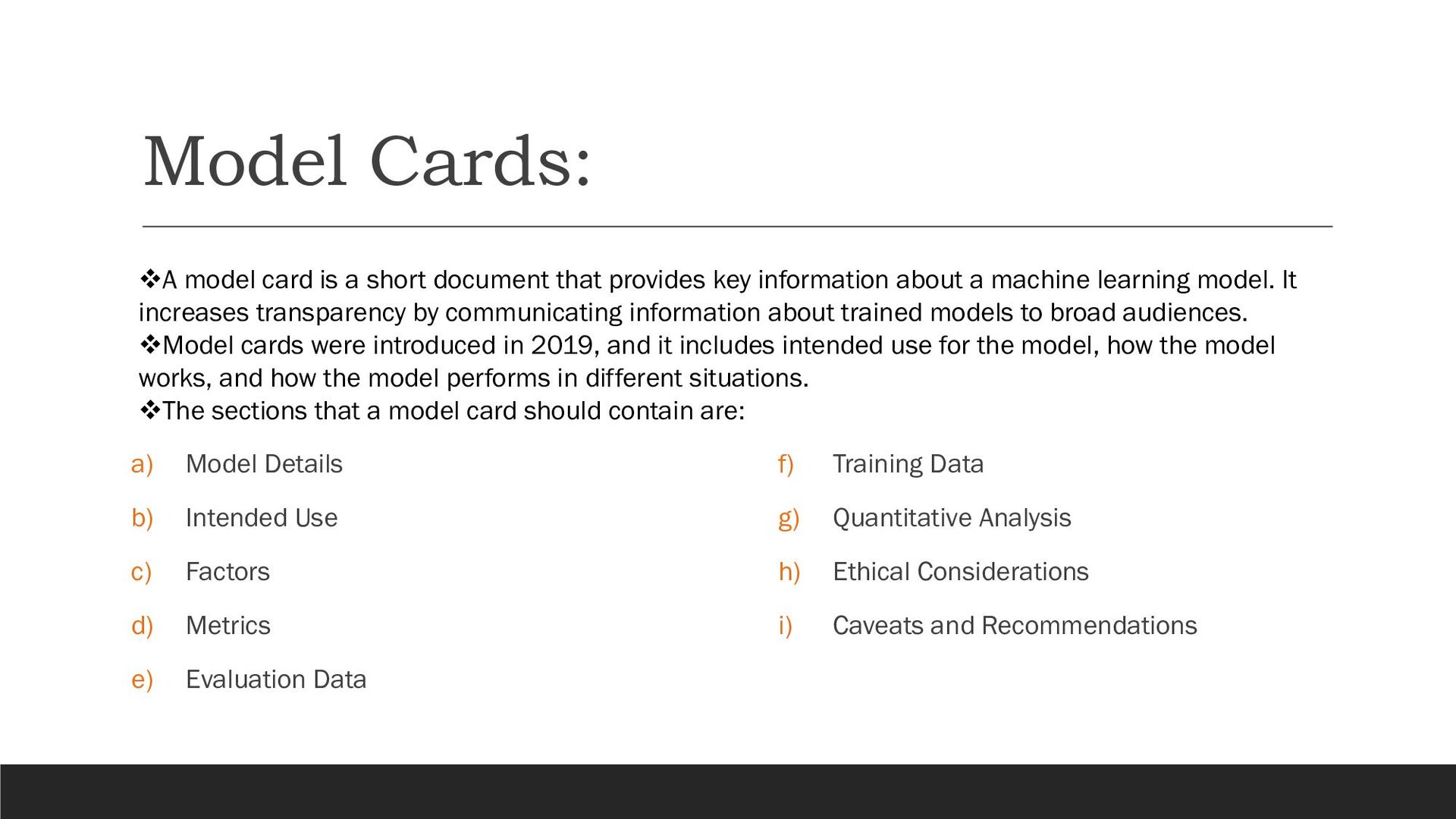
d) Metrics e) Evaluation Data f) Training Data g) Quantitative Analysis h) Ethical Considerations i) Caveats and Recommendations A model card is a short document that provides key information about a machine learning model. It increases transparency by communicating information about trained models to broad audiences. Model cards were introduced in 2019, and it includes intended use for the model, how the model works, and how the model performs in different situations. The sections that a model card should contain are:
augment or replace human intelligence. These tools only rely on large volumes of various types of data to develop insights. AI Ethics is important because it shines a light on the risks and benefits of AI tools and establishes guidelines for its responsible use. Explain-ability, Responsibility, Misuse and Fairness are the ethical challenges of AI. Responsible use of AI is necessary to ensure a positive impact. The development of AI systems must always be responsible and developed towards optimal sustainability for public benefit.


 melnitha25
 ryanjones
 aleyda
 rkendrick25
 cassininazir
 akosma
 soysaucechin
 charlesmeaden
 coloredviolet
 smashingmag
 inesmontani
 techseoconnect