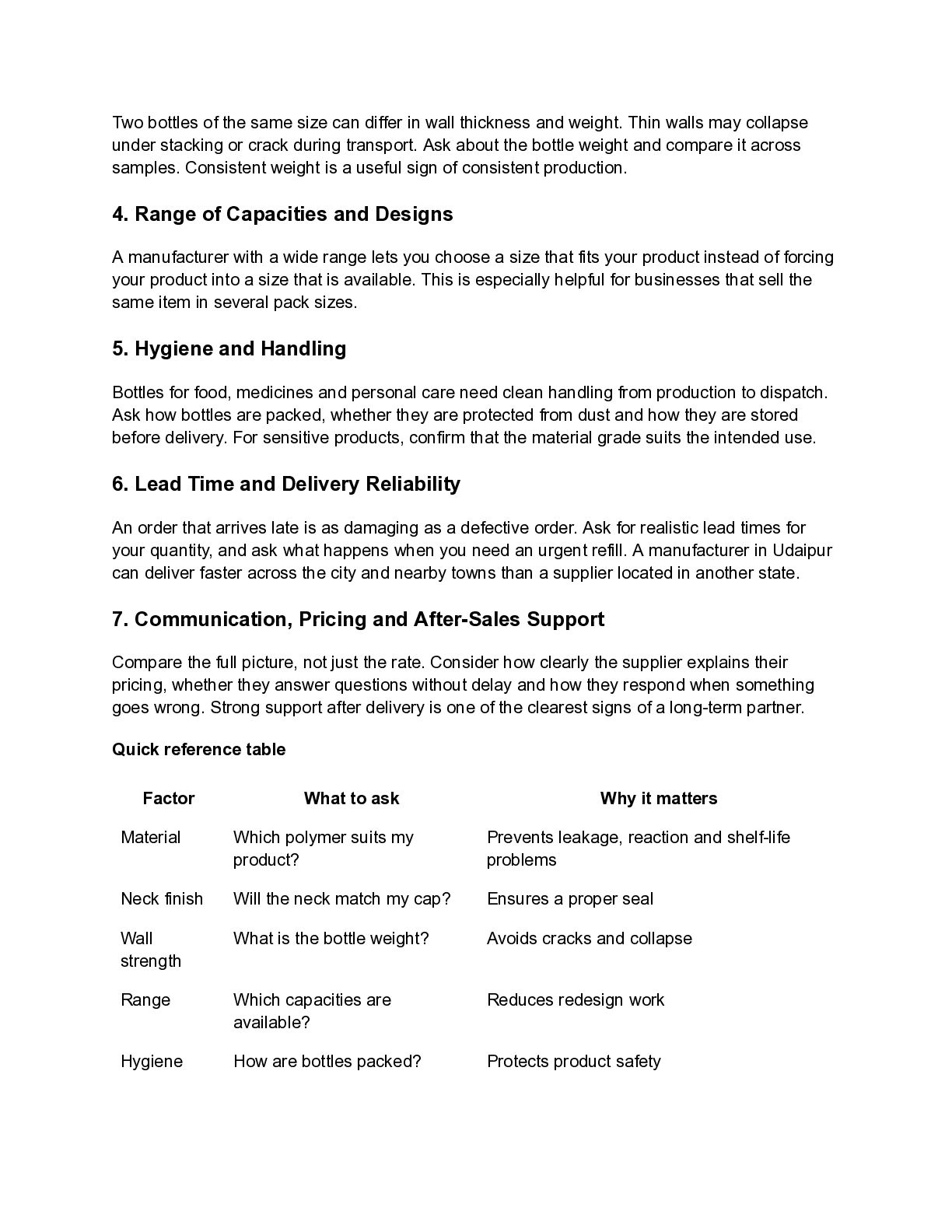
Support Who do I call with issues? Builds long-term trust Product Quality, Samples and Specifications Specifications on paper are only the beginning. The real proof of quality comes when you hold a bottle in your hand, fill it with your own product and watch how it behaves. Why Specifications Matter Before requesting a quote, write down your requirements clearly. A clear specification helps the manufacturer respond with accurate information and prevents misunderstandings. Include these points: • Product to be filled: Liquid, gel, powder or granules, and whether it is oily, acidic, alkaline or solvent-based. • Required capacity: For example 100 ml, 200 ml, 500 ml or 1 litre. • Preferred material: HDPE, PET, PP or LDPE, or ask the supplier to recommend one. • Neck size and closure type: Screw cap, flip-top, pump, spray, dropper or tamper-evident seal. • Colour and finish: Natural, white, amber, blue or another shade, with a glossy or matte surface. • Quantity per order: Your expected monthly or per-batch requirement. • Intended use: Retail sale, institutional use, bulk distribution or export packing. When you share this information with Mewar Poly Containers, the team can tell you which bottles are available, which are suitable and what to expect in terms of quantity and timing. Why Samples Are Essential A sample is the most honest piece of information a supplier can give you. It reveals more than any brochure. Here is what a proper sample test should include. Visual check. Look at the colour, surface, seam lines and overall finish. Check for marks, uneven areas or distortion. Fit check. Screw the cap on and off several times. It should turn smoothly and seal firmly without cross-threading. Fill test. Fill the bottle with your actual product and leave it for a few days. Look for leakage, swelling, colour change or odour. Squeeze and drop test. Gently squeeze the bottle and check how it recovers. Simulate a short drop to see how it handles minor impact.


 mewarpolycontainers
 nmsamuel
 palkan
 andyhume
 garrettdimon
 jonoalderson
 keithpitt
 rasagy
 sabderemane
 maggiecrowley
 soudai
 ivargrimstad
 lcolladotor