Upgrade to PRO for Only $50/Year—Limited-Time Offer! 🔥

toolkit - layout

Avatar for michella michella
July 14, 2023
42

toolkit - layout

Avatar for michella

michella

July 14, 2023
Tweet

Transcript

  1. Traveling Together: Pathways of Transformative Research from Indigenous Ways of

    Knowing and Doing By Lorena Garvey, M. Ed. and S. Victoria Herrera, M. Ed. Artwork by Michella Lim Mark
  2. Thanksgiving Address Land Acknowledgement Setting the Foundation The Gift of

    the Four Directions 04 08 10 11 12 13 14 16 18 18 20 23 23 24 28 29 30 31 31 34 35 36 40 43 45 46 48 49 52 52 52 53 54 Mapping Our Journey with the Gifts of the Four Directions All My Relations The Four Quadrants of Self (Wholism) EAST - VISION - “to see” SOUTH - TIME - “to understand” WEST - REASON - “to know” NORTH - MOVEMENT - “to do it” FULL CIRCLE Resources References Indigenous Research and Knowledge Systems History of Indigenous Research in the Academy Five Stages of Indigenous Research Four Stages in the Developement of an Indigenous Paradigm 5 R’s of Indigenous Pedagogy Research The 5 R’s in Action Understanding Systems of Oppression Understanding Power and Privilege Interlocking Systems of Oppression and Intersectionality Understanding Power and Privilege in Research Cultural Humilty and Cultural Safety Community Need & Desire Preparing for the Journey Methodology Research with Sheridan College How do we continue to maintain reciprocal relationships once the research project has completed? How is data kept and distributed to the communities we are in relation to? Indigenous Worldviews Diversity of Indigenous Knowledge Traveling Together: Pathways of Transformative Research from Indigenous Ways of Knowing and Doing - 02 Contents
  3. Throughout this toolkit you will find symbols and information boxes

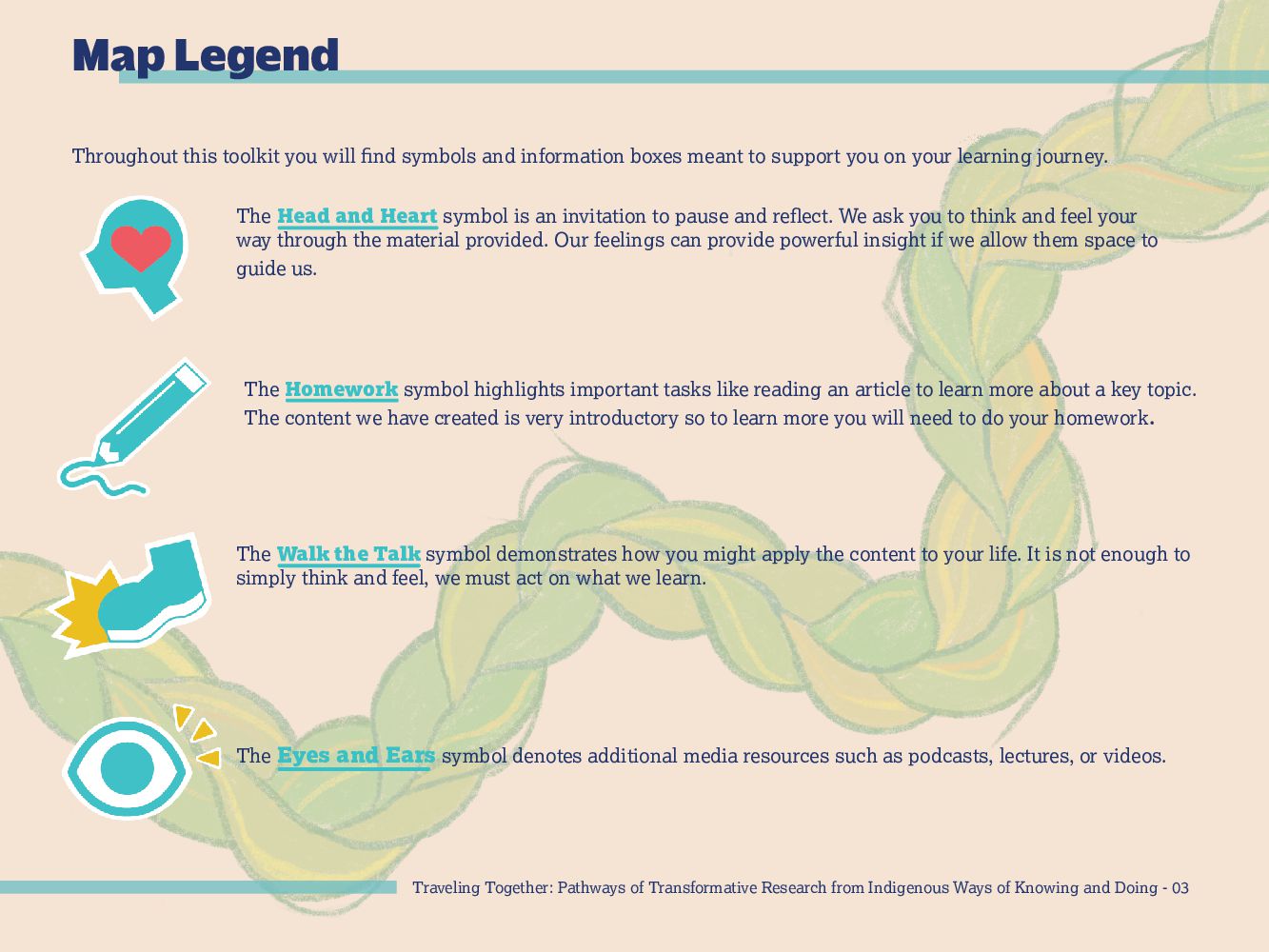
    meant to support you on your learning journey. The Head and Heart symbol is an invitation to pause and reflect. We ask you to think and feel your way through the material provided. Our feelings can provide powerful insight if we allow them space to guide us. The Homework symbol highlights important tasks like reading an article to learn more about a key topic. The content we have created is very introductory so to learn more you will need to do your homework. The Walk the Talk symbol demonstrates how you might apply the content to your life. It is not enough to simply think and feel, we must act on what we learn. The Eyes and Ears symbol denotes additional media resources such as podcasts, lectures, or videos. Map Legend Traveling Together: Pathways of Transformative Research from Indigenous Ways of Knowing and Doing - 03
  4. The Food Plants With one mind, we turn to honor

    and thank all the Food Plants we harvest from the garden. Since the beginning of time, the grains, vegetables, beans and berries have helped the people survive. Many other living things draw strength from them too. We gather all the Plant Foods together as one and send them a greeting of thanks. Now our minds are one. Haudenosaunee Thanksgiving Address: Greetings to the Natural World Let us begin with the Words Before All Else, the Thanksgiving Address. We invite you to read aloud. The People Today we have gathered and we see that the cycles of life continue. We have been given the duty to live in balance and har- mony with each other and all living things. So now, we bring our minds together as one as we give greetings and thanks to each other as people. Now our minds are one. The Earth Mother We are all thankful to our Mother, the Earth, for she gives us all that we need for life. She supports our feet as we walk about upon her. It gives us joy that she continues to care for us as she has from the beginning of time. To our mother, we send greetings and thanks. Now our minds are one.thanks to each other as people. Now our minds are one. The Waters We give thanks to all the waters of the world for quenching our thirst and providing us with strength. Water is life. We know its power in many forms- waterfalls and rain, mists and streams, rivers and oceans. With one mind, we send greetings and thanks to the spirit of Water. Now our minds are one. The Fish We turn our minds to the all the Fish life in the water. They were instructed to cleanse and purify the water. They also give themselves to us as food. We are grateful that we can still find pure water. So, we turn now to the Fish and send our greetings and thanks. Now our minds are one. The Plants Now we turn toward the vast fields of Plant life. As far as the eye can see, the Plants grow, working many wonders. They sus- tain many life forms. With our minds gathered together, we give thanks and look forward to seeing Plant life for many genera- tions to come. Now our minds are one. Thanksgiving Address Traveling Together: Pathways of Transformative Research from Indigenous Ways of Knowing and Doing - 04
  5. Thanksgiving Address Traveling Together: Pathways of Transformative Research from Indigenous

    Ways of Knowing and Doing - 05 The Medicine Herbs Now we turn to all the Medicine herbs of the world. From the beginning they were instructed to take away sickness. They are always waiting and ready to heal us. We are happy there are still among us those special few who remember how to use these plants for healing. With one mind, we send greetings and thanks to the Medicines and to the keepers of the Medicines. Now our minds are one. The Animals We gather our minds together to send greetings and thanks to all the Animal life in the world. They have many things to teach us as people. We are honored by them when they give up their lives so we may use their bodies as food for our people. We see them near our homes and in the deep forests. We are glad they are still here and we hope that it will always be so. Now our minds are one. The Trees We now turn our thoughts to the Trees. The Earth has many families of Trees who have their own instructions and uses. Some provide us with shelter and shade, others with fruit, beauty and other useful things. Many people of the world use a Tree as a symbol of peace and strength. With one mind, we greet and thank the Tree life. Now our minds are one. The Birds We put our minds together as one and thank all the Birds who move and fly about over our heads. The Creator gave them beautiful songs. Each day they remind us to enjoy and appreciate life. The Eagle was chosen to be their leader. To all the Birds-from the smallest to the largest-we send our joyful greetings and thanks. Now our minds are one. The Four Winds We are all thankful to the powers we know as the Four Winds. We hear their voices in the moving air as they refresh us and purify the air we breathe. They help us to bring the change of seasons. From the four directions they come, bringing us messages and giving us strength. With one mind, we send our greetings and thanks to the Four Winds. Now our minds are one. The Thunderers Now we turn to the west where our grandfathers, the Thunder Beings, live. With lightning and thundering voices, they bring with them the water that renews life. We are thankful that they keep those evil things made by Okwiseres underground. We bring our minds together as one to send greetings and thanks to our Grandfathers, the Thunderers. Now our minds are one.
  6. The Creator Now we turn our thoughts to the Creator,

    or Great Spirit, and send greetings and thanks for all the gifts of Creation. Every- thing we need to live a good life is here on this Mother Earth. For all the love that is still around us, we gather our minds together as one and send our choicest words of greetings and thanks to the Creator. Now our minds are one. Closing Words We have now arrived at the place where we end our words. Of all the things we have named, it was not our intention to leave anything out. If something was forgotten, we leave it to each individual to send such greetings and thanks in their own way. Now our minds are one. Listen to Knowledge Keepers explain the importance of the Thanksgiving Address. Thanksgiving Address Traveling Together: Pathways of Transformative Research from Indigenous Ways of Knowing and Doing - 06 The Sun We now send greetings and thanks to our eldest Brother, the Sun. Each day without fail he travels the sky from east to west, bringing the light of a new day. He is the source of all the fires of life. With one mind, we send greetings and thanks to our Brother, the Sun. Now our minds are one. Grandmother Moon We put our minds together to give thanks to our oldest Grandmother, the Moon, who lights the night-time sky. She is the leader of woman all over the world, and she governs the movement of the ocean tides. By her changing face we measure time, and it is the Moon who watches over the arrival of children here on Earth. With one mind, we send greetings and thanks to our Grandmother, the Moon. Now our minds are one. The Stars We give thanks to the Stars who are spread across the sky like jewelry. We see them in the night, helping the Moon to light the darkness and bringing dew to the gardens and growing things. When we travel at night, they guide us home. With our minds gathered together as one, we send greetings and thanks to the Stars. Now our minds are one. The Enlightened Teachers We gather our minds to greet and thank the enlightened Teachers who have come to help throughout the ages. When we for- get how to live in harmony, they remind us of the way we were instructed to live as people. With one mind, we send greetings and thanks to these caring teachers. Now our minds are one.
  7. Thanksgiving Address Traveling Together: Pathways of Transformative Research from Indigenous

    Ways of Knowing and Doing - 07 This translation of the Mohawk version of the Haudenosaunee Thanksgiving Address was developed, published in 1993, and provided, courtesy of: Six Nations Indian Museum and the Tracking Project All rights reserved. Thanksgiving Address: Greet- ings to the Natural World English version: John Stokes and Kanawahienton (David Benedict, Turtle Clan/Mohawk) Mohawk version: Rokwaho (Dan Thompson, Wolf Clan/Mohawk) Original inspiration: Tekaronianekon (Jake Swamp, Wolf Clan/Mo- hawk) Text provided by the National Museum of the American Indian, Simthsonian Website. Who are the beings you depend on? Do you include more-than-human beings? How might we live and express our gratitude towards these beings?
  8. Land Acknowledgement Traveling Together: Pathways of Transformative Research from Indigenous

    Ways of Knowing and Doing - 08 The land sustains us. It provides us with all the necessities of life. As we pause and reflect upon the land, we see we are not separate. We are a part of creation and cannot be separated from nature. From the land we learn how to be in relationship with her and all of creation, including our more-than-human relatives. From the land we learn how to be in relationship with her and all of creation, including our more-than-human relatives. This territory from which we write is covered by Dish with One Spoon treaty. It is a reminder of how we are to care for our Mother Earth and how we are to share with others the gifts we have been given from her. This territory is covered by the Two Row Wampum treaty which is emphasizes the importance of peace, friendship, and respect. Both agreements remind us that we all have responsibilities to the land and to each other. We are to act and live as stewards of each other and the land. We must never forget this land that we move upon has been and still is the traditional territory of several Indigenous nations, including the Anishinaabe, the Haudenosaunee Confederacy, the Wendat, and the Mississaugas of the Credit First Nation. Since time immemorial, numerous Indigenous nations and Indigenous peoples have lived and passed through this territory and continue to do so. Despite decades of displacement and attempts of assimilation, these nations and the people of these nations are enduring As people who live, teach, learn, and work on this land, we all have a collective responsibility to uphold the treaties and the Nation-to-Nation relationship that was first envisioned. To honour and respect the land, and those who have gone before us, those who are here, and those who have yet to come, we must recognize Indigenous sovereignty and self determination. As we express our gratitude for the opportunity to be learning, working, and thriving on this land, let us recognize we have the responsibility to live in a good way. Listen to Stepeh Paquette share his perspective on land acknowledgements In Our Voices: Land Acknowledgment
  9. Land Acknowledgement Traveling Together: Pathways of Transformative Research from Indigenous

    Ways of Knowing and Doing - 09 How do you honour and respect Indigenous peoples and Indigenous Lands in your every- day life, personally and professionally? How might we be stewards of the land and stewards of each other? Review Sheridan’s Land Acknowledgement Guide to learn more about the Dish with One Spoon, the Two Row Wampum, and the nations mentioned in the Land Acknowledgement. Visit Whose Land to learn more about the specific territory you are on. Consider how you move upon the land and live your life. Over consumption causes a great deal of harm to all of creation. How might you live in a way that is respectful of all your relations and future generations?
  10. Beginning Our Journey Traveling Together: Pathways of Transformative Research from

    Indigenous Ways of Knowing and Doing - 10 Across Turtle Island there are numerous nations and communities with differing languages, stories, teachings and experiences. As a result, Indigenous knowledge and Indigenous knowledge systems are rich in diversity and complexity. It would be beyond the scope of this toolkit and our shared expertise to even attempt to meaningfully dive into the nuances between nations. Instead, we have provided general overview of common cultural beliefs and practices. This toolkit highlights the importance of Indigenous knowledge systems as a foundation to exploring transformative ways of conducting research. In approaching Indigenous research, we ask you to consider the local knowledges of the people you engage with first and foremost. The people and communities you work with should guide the research projects and activities. Thank you for taking the time to read Traveling Together: Pathways of Transformative Research from Indigenous Ways of Knowing and Doing. It is an honour and a privilege to be able to journey together with you for a time and share some of what we have learned about Indigenous research along the way. When we first began this project, we were tasked with a developing a module about “transformative research” through the lens of Indigenous ways of knowing and doing. After conducting a literature review, the ongoing gaps in the understanding of what transformative research can look and feel like within post-secondary institutions became apparent to us. Together we discussed what we thought was the most critical information to share with readers and how we might present the knowledge we’ve gathered. An aspect of transformative research that was foundational to the development of this toolkit was the importance of relation- ality and reflexivity. In recognizing this, we wanted to ensure that those who engaged in this toolkit were brought on their own journey from their head through to their heart. To achieve this, we have intentionally created opportunities for us reflect and engage with the topics presented. We hope this will allow you to critically analyze and relate to the material throughout our journey together. From the start, we wanted to ensure the development of this toolkit would role model the research journey in way that is rela- tional and purposeful. Beyond just a creating a learning module, we wanted to create a resource that readers could return to for insight and reflection. There is no single source that can provide everything you need to know about Indigenous research. Plus, we understand learning is a never-ending journey and to support your ongoing path towards transformative research, we have included several additional resources as springboard into deeper learning. Diversity of Indigenous Knowledge
  11. Beginning Our Journey In this toolkit we use the language

    general term Indigenous to recognize the original inhabitants of what we now know as Canada. This includes First Nations (status, non-status and urban), Metis and Inuit communities. Many of the teachings and Indigenous knowledge highlighted throughout this toolkit have been transmitted from Haudenosaunee (Mohawk, Cayuga, Seneca, Oneida, Onondaga and Tuscarora), and Anishinaabe (Mississauga, Chippewa, Potawatomi, Algonquin and Odawa) worldviews and ways of knowing. Recognizing this diversity within the Indigenous Nations highlighted within this toolkit allows us to better understand the complexities, contributions, and brilliance of Indigenous knowledge systems. Setting the Foundation Traveling Together: Pathways of Transformative Research from Indigenous Ways of Knowing and Doing - 11 Whether you were taught to call them Teaching Circles or Medicine Wheels, these symbols are important teaching tools that support a wholistic form of learning and knowledge transmission. The teaching circle or wheel represents an interconnected whole that never ends. When we think we are finished and have completed our journey around the wheel, we can also look back at where we started and see things from a different perspective. There are countless medicine wheel teachings and understandings that have been passed down from different Elders and Knowledge Keepers from many different Indigenous nations across Turtle Island. While there are many variations, it is our belief that all are correct as they arise from local knowledge systems. This toolkit utilizes three wheels throughout, to unpack your own relationship with transformative research. The three foundational wheels for this toolkit include the Gifts of the Four Directions, All My Relations, and The Four Quadrants of Self (Wholism).It is important to understand within each wheel, each quadrant, and all its characteristics, do not exist in isolation from the other quadrants. Rather they are integrated parts of a whole system and must be attended to simultaneously as we journey through life and as we consider the development of research, education, and communication
  12. Traveling Together: Pathways of Transformative Research from Indigenous Ways of

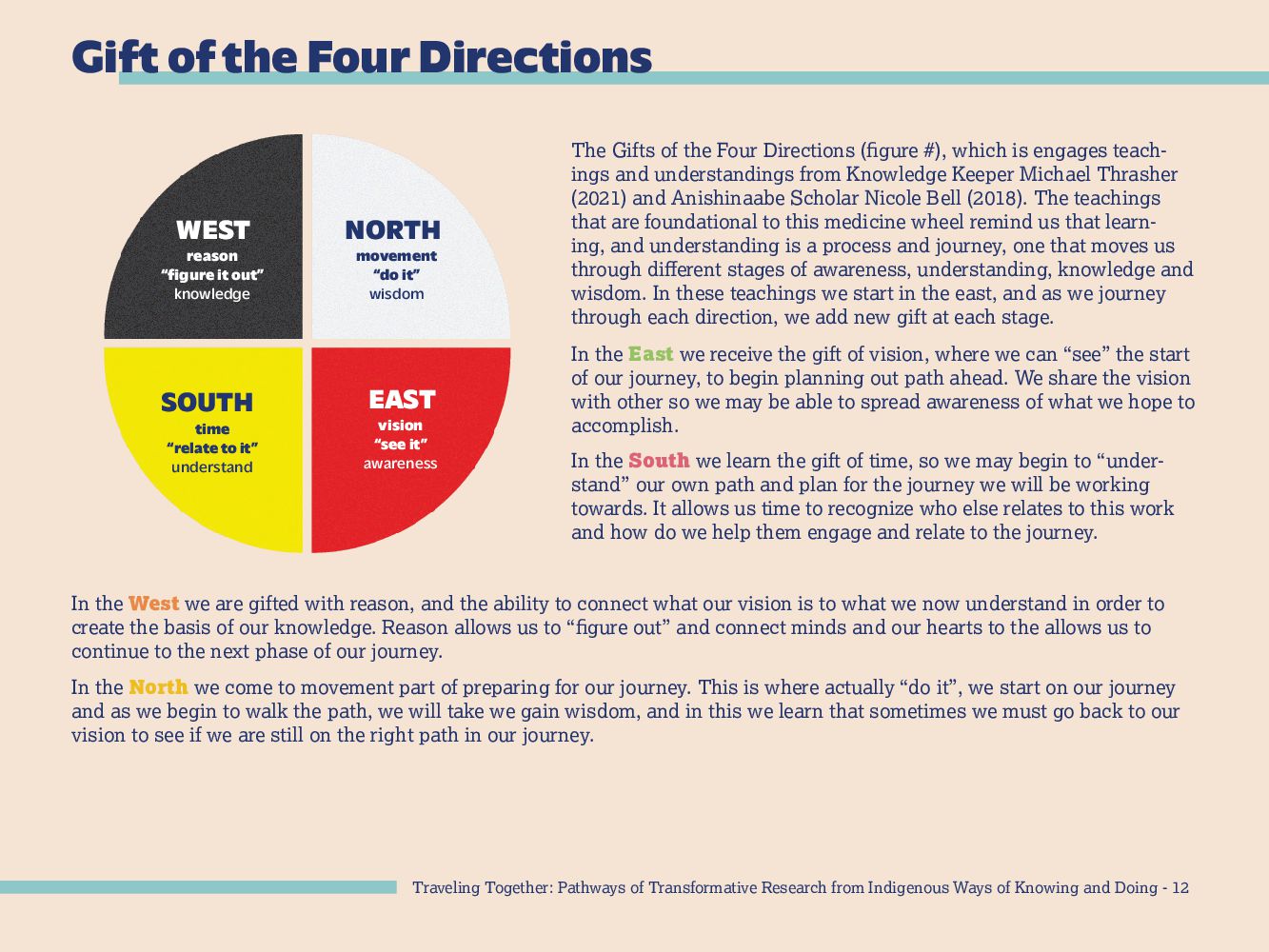
    Knowing and Doing - 12 The Gifts of the Four Directions (figure #), which is engages teach- ings and understandings from Knowledge Keeper Michael Thrasher (2021) and Anishinaabe Scholar Nicole Bell (2018). The teachings that are foundational to this medicine wheel remind us that learn- ing, and understanding is a process and journey, one that moves us through different stages of awareness, understanding, knowledge and wisdom. In these teachings we start in the east, and as we journey through each direction, we add new gift at each stage. In the East we receive the gift of vision, where we can “see” the start of our journey, to begin planning out path ahead. We share the vision with other so we may be able to spread awareness of what we hope to accomplish. In the South we learn the gift of time, so we may begin to “under- stand” our own path and plan for the journey we will be working towards. It allows us time to recognize who else relates to this work and how do we help them engage and relate to the journey. In the West we are gifted with reason, and the ability to connect what our vision is to what we now understand in order to create the basis of our knowledge. Reason allows us to “figure out” and connect minds and our hearts to the allows us to continue to the next phase of our journey. In the North we come to movement part of preparing for our journey. This is where actually “do it”, we start on our journey and as we begin to walk the path, we will take we gain wisdom, and in this we learn that sometimes we must go back to our vision to see if we are still on the right path in our journey. Gift of the Four Directions WEST NORTH SOUTH EAST reason “figure it out” knowledge movement “do it” wisdom time “relate to it” understand vision “see it” awareness
  13. Traveling Together: Pathways of Transformative Research from Indigenous Ways of

    Knowing and Doing - 13 Gift of the Four Directions Mapping Our Journey with the Gifts of the Four Directions In this toolkit we utilize the wheel to better understand the journey research will take in beginning to understand what Indige- nous research is and how it can take place. We have divided up the content of this toolkit around the four directions. In the East we introduce a vision for transformative research based on Indigenous worldviews and principles that underpin this toolkit and shape Indigenous research. In the South we being to understand the impacts of settler colonialism on research with and in Indigenous communi- ties and how has this has shifted over time. In the West we start to reflect on how Indigenous research grounded in Indigenous worldviews and principles is so- cially and systemically transformative as it moves us away from systemic oppression. In the North we focus on the movement necessary to begin implementing Indigenous research. Sheridan specific resources are provided to support your participation in transformative research processes. Before reviewing the rest of the toolkit, have you considered your personal vision for engaging with In- digenous research? What brings you to this point in your journey? How have you already prepared? What do you already know about Indigenous research?
  14. Traveling Together: Pathways of Transformative Research from Indigenous Ways of

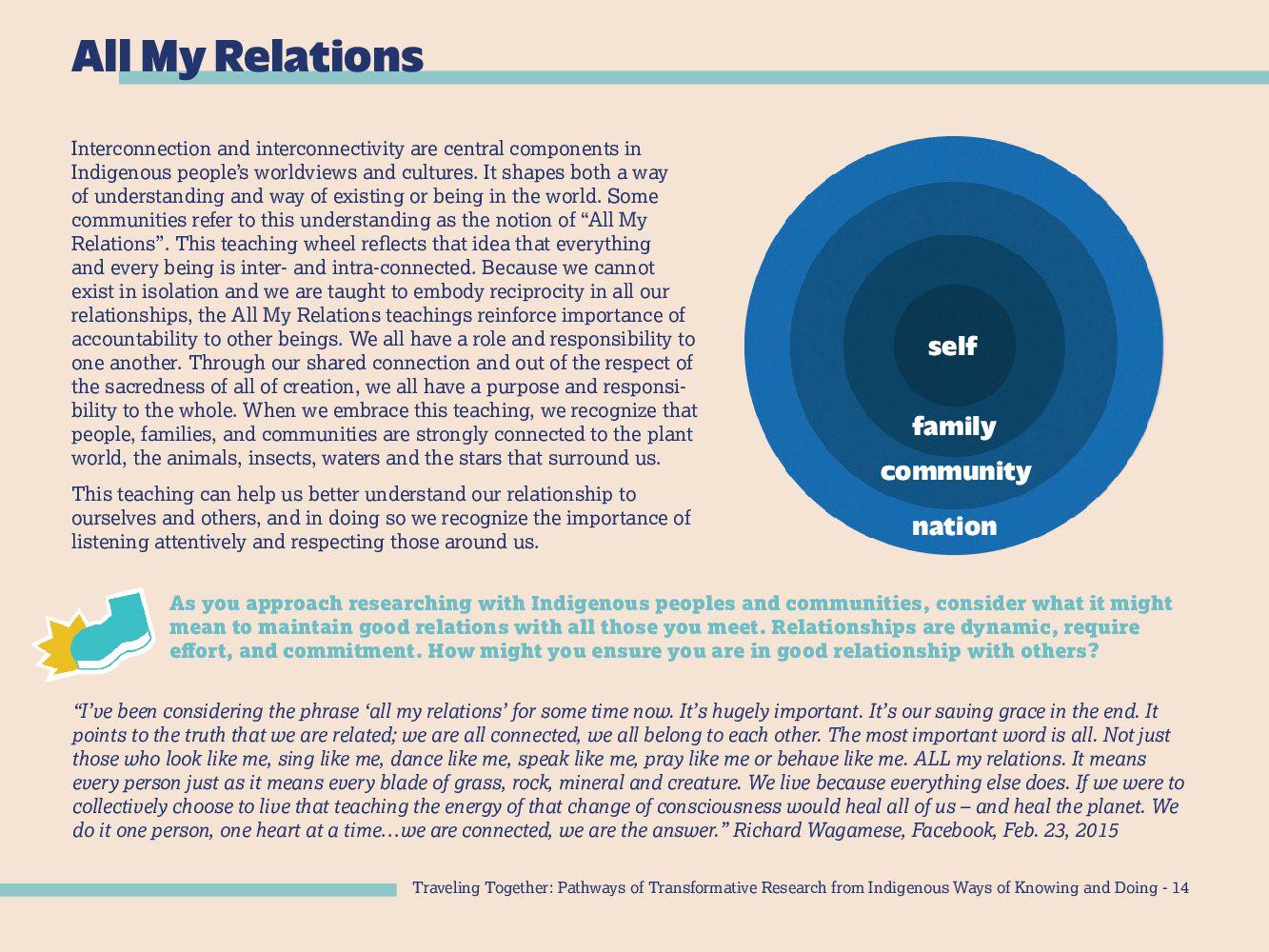
    Knowing and Doing - 14 All My Relations This teaching can help us better understand our relationship to ourselves and others, and in doing so we recognize the importance of listening attentively and respecting those around us. “I’ve been considering the phrase ‘all my relations’ for some time now. It’s hugely important. It’s our saving grace in the end. It points to the truth that we are related; we are all connected, we all belong to each other. The most important word is all. Not just those who look like me, sing like me, dance like me, speak like me, pray like me or behave like me. ALL my relations. It means every person just as it means every blade of grass, rock, mineral and creature. We live because everything else does. If we were to collectively choose to live that teaching the energy of that change of consciousness would heal all of us – and heal the planet. We do it one person, one heart at a time…we are connected, we are the answer.” Richard Wagamese, Facebook, Feb. 23, 2015 Interconnection and interconnectivity are central components in Indigenous people’s worldviews and cultures. It shapes both a way of understanding and way of existing or being in the world. Some communities refer to this understanding as the notion of “All My Relations”. This teaching wheel reflects that idea that everything and every being is inter- and intra-connected. Because we cannot exist in isolation and we are taught to embody reciprocity in all our relationships, the All My Relations teachings reinforce importance of accountability to other beings. We all have a role and responsibility to one another. Through our shared connection and out of the respect of the sacredness of all of creation, we all have a purpose and responsi- bility to the whole. When we embrace this teaching, we recognize that people, families, and communities are strongly connected to the plant world, the animals, insects, waters and the stars that surround us. As you approach researching with Indigenous peoples and communities, consider what it might mean to maintain good relations with all those you meet. Relationships are dynamic, require effort, and commitment. How might you ensure you are in good relationship with others? self family community nation
  15. Traveling Together: Pathways of Transformative Research from Indigenous Ways of

    Knowing and Doing - 15 All My Relations How do you see yourself in relation to others? How do you see yourself in relation to the natural world? How do you see yourself in relation to others? How do you see yourself in relation to the natural world?
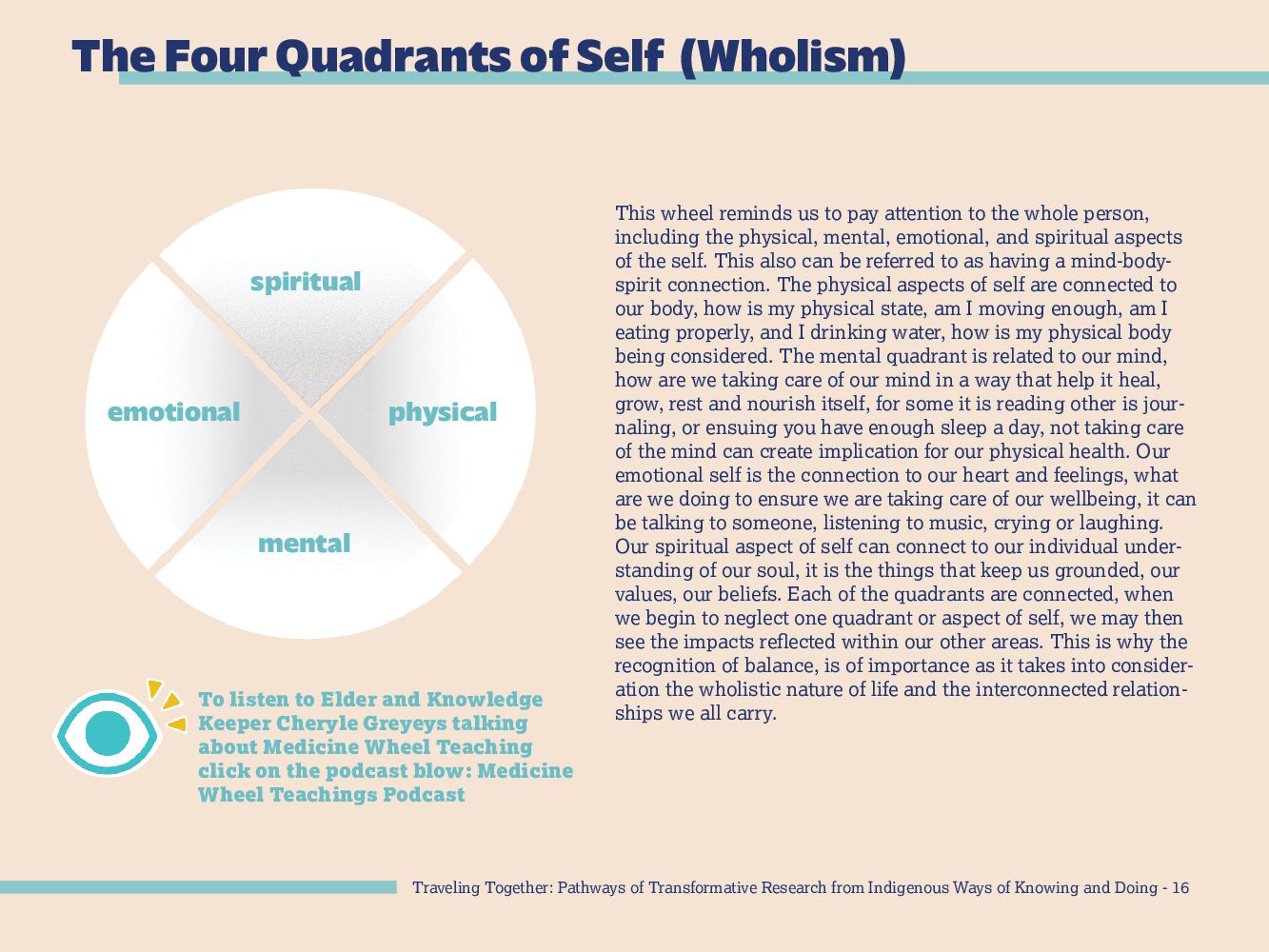
  16. Traveling Together: Pathways of Transformative Research from Indigenous Ways of

    Knowing and Doing - 16 The Four Quadrants of Self (Wholism) This wheel reminds us to pay attention to the whole person, including the physical, mental, emotional, and spiritual aspects of the self. This also can be referred to as having a mind-body- spirit connection. The physical aspects of self are connected to our body, how is my physical state, am I moving enough, am I eating properly, and I drinking water, how is my physical body being considered. The mental quadrant is related to our mind, how are we taking care of our mind in a way that help it heal, grow, rest and nourish itself, for some it is reading other is jour- naling, or ensuing you have enough sleep a day, not taking care of the mind can create implication for our physical health. Our emotional self is the connection to our heart and feelings, what are we doing to ensure we are taking care of our wellbeing, it can be talking to someone, listening to music, crying or laughing. Our spiritual aspect of self can connect to our individual under- standing of our soul, it is the things that keep us grounded, our values, our beliefs. Each of the quadrants are connected, when we begin to neglect one quadrant or aspect of self, we may then see the impacts reflected within our other areas. This is why the recognition of balance, is of importance as it takes into consider- ation the wholistic nature of life and the interconnected relation- ships we all carry. To listen to Elder and Knowledge Keeper Cheryle Greyeys talking about Medicine Wheel Teaching click on the podcast blow: Medicine Wheel Teachings Podcast spiritual physical emotional mental
  17. The Four Quadrants of Self (Wholism) Traveling Together: Pathways of

    Transformative Research from Indigenous Ways of Knowing and Doing - 17 How do you maintain balance between the four quadrants of yourself? How might an imbalance impact your ability to engage in meaningful relationships with others?
  18. EAST - VISION - “to see” Traveling Together: Pathways of

    Transformative Research from Indigenous Ways of Knowing and Doing - 18 “Starting in the east, the Anishinaabe researcher obtains vision with respect to the research journey by being able to see and identify the task at hand. This vision can be obtained through personal fasting, sharing/talking circles, or speaking with an Elder” (Bell, 2018, p.180). “I believe that Indigenous epistemology and ontology are based upon relationality. Our axiology and methodology are based upon maintaining relational accountability” (Wilson, S. 2008, p7). “Research in any field or discipline that is conducted by, grounded in or engaged with First Nations, Inuit, Metis or other Indigenous Nations, communities, societies or individuals, and their wisdom, cultures experience or knowledge systems as expressed in their dynamic forms, past and present. Indigenous research can embrace the intellectual, physical, emo- tional and/or spiritual dimensions of knowledge in creative and interconnected relationships with people, places, and the natural environment” (Government of Canada, 2012). Like the sun rises in the East, we too begin our journey in the East with the establishment of a vision of what transformative Indigenous research is and why it is important. We introduce key concepts of Indigenous worldviews and Indigenous knowl- edge systems as our understanding of transformative research necessitates the respect for and honouring of Indigenous ways of knowing, being, and doing. Through remembering and reclaiming Indigenous ways of knowing as valid and integral to Indigenous research, we set the foundation for relationally transformative research and research practices. Indigenous re- search challenges the status-quo of how research is conducted and has the ability to fill in and account for gaps in other ways of conducting research. Indigenous research emerges from values and principles embedded in Indigenous worldviews, languages, and relationality. The Social Sciences and Humanities Research Council (SSHRC), Indigenous Advisory Circle has defined Indigenous re- search as: Have you considered what it means to carry someone’s story? What might you consider when listening to another person’s stories, be they personal stories or cultural stories? Indigenous Research and Knowledge Systems
  19. EAST - VISION - “to see” Traveling Together: Pathways of

    Transformative Research from Indigenous Ways of Knowing and Doing - 19 This definition upholds values and principles intrinsic to Indigenous worldviews and knowledge systems. By ensuring aca- demic, scholarly and community research happens through these guidelines, we not only create space for Indigenous knowl- edge to take be highlighted, we create opportunities for Indigenous voices to be reclaimed in spaces that for generations have attempted to silence them. When we ensure Indigenous research happens in a way that allows for the reclamation of Indige- nous worldviews, knowledge systems and voices, we have the opportunity to re-write realities, histories and truths, previous- ly not recognized. The resurgence and reclamation of Indigenous knowledge systems and ways of knowing is key to restoring knowledge in ways that guide healing, leadership governance, and social practices across Turtle Island. Indigenous knowledges are com- plex systems that have been developed over time and passed down from generation to generations. In Wayi Wah! Indige- nous Pedagogies An Act for Reconciliation and Anti-Racist Education, Jo Chrona discuses different dynamics of Indigenous Knowledge. “Because IK have often been referred to as “traditional Knowledge,” some people view them as unchanging knowledge based only in the past” (P. 144). However, Indigenous knowledge systems continue in dynamic ways reflective of the strength and resilience of Indigenous peoples and communities. Foundational to the success of research within Indigenous communities are the different ways in which knowledge is trans- mitted Knowledge not only informs our ways of knowing and doing, but it also informs how we relate to one another, how we connect to the land and spaces that surround us. Indigenous scholar and author Leanne Simpson (2017) often relates our knowledge system to constellations and webs that connect everyone through relations and responsibilities. She writes, “Indigenous intelligence systems set up, maintain, and regenerate the neuropathways for Indigenous living both inside our bodies and the web of connections that structure our nationhood outside our bodies.” (Simpson, 2017, pp.19-20). How knowledge is transmitted varies, and depends on who is sharing the knowledge, who is receiving the knowledge, the season or time period, the context it was given, and the relationships of those involved. Some examples of ways Indigenous Knowledge takes place includes: Storytelling/Storywork Ceremony Songs Oral teachings
  20. EAST - VISION - “to see” Traveling Together: Pathways of

    Transformative Research from Indigenous Ways of Knowing and Doing - 20 In Joanne Archibald and Amy Parent’s (2019) article “Hands Back, Hands Forward for Indigenous Storywork as Method- ology”, seven principles are identified as core components of storywork as a research method. These 7 principles include: respect, responsibility, reverence, reciprocity, holism, inter-relatedness and synergy (p.3). Similarly to how many of these prin- ciples are highlighted as key component to Indigenous worldviews, the principles in storywork, remind us that knowledge is not to be held by only a select few. Instead, it is to be transmitted so that inter-generational and intra-generational learning and growth can take place for the benefit of all. Worldviews are sets of beliefs and experiences that ground and influence our day-to-day interactions and understanding of the world around us. In preparing to conduct research with Indigenous communities it is imperative to reflect on some of the key difference between Indigenous and Eurocentric worldviews. Understanding these differences can provide a starting point for conducting research that is trauma-informed and decolonial for both researcher and the communities you are engaging with. Indigenous understanding of worldviews recognizes that all things in life are connected, whether it be animate or inanimate. In acknowledging there is connection between all things, Indigenous worldviews uphold the importance of relational ac- countability, reminds us all that we have responsibilities that extend beyond ourselves. Relational accountability recognizes the land-based and more-than-human relatives that we interact with daily. Through this process of upholding relationality, Indigenous worldviews recognizes we are both teacher and leaners in all areas of our lives. Any individual within a culture is going to have his or her own personal interpretation of the collective cultural code; however, the individual’s worldview has its roots in the culture – that is, in the society’s shared philosophy, values, and customs” (Little Bear, 2000, p.77). Listen to Joanne Archibald discuss how you can become “story ready”. Joanne Archibald shares the story of Lady Louse as an example of story- work. Indigenous Worldviews
  21. EAST - VISION - “to see” Traveling Together: Pathways of

    Transformative Research from Indigenous Ways of Knowing and Doing - 21 A key aspect of relationality and relational accountability, introduces individuals to the principles of interconnectivity. Nish- naabeg scholar and educator Leanne Simpson often compares these aspects of Indigenous worldviews to a series of webs or relationships, “It is a web of connections to each other, to the plant nations, the animal nations, the rivers and lakes, the cosmos, and our neighboring Indigenous nations” (Simpson, 2019). This web of relationships is represented in the All My Relations wheel. Wholism is a fundamental aspect of Indigenous worldviews in which we come to know ourselves and the world by inter- acting with all aspects of self, which include the physical, mental, emotional and spiritual. We live and learn in relationship to others. This connection between the self and all of creation can be seen with the placement of the self at the centre of the All My Relations wheel. All principles and values highlighted in Indigenous worldviews echo the importance of sustaining balance within the self and within the community. In relation to Wholism, many Indigenous nations recognize that time is cyclical in nature, meaning that time is measured by events or season, and is not focused on a linear understanding. Both the recognition of holism and cyclical understanding of seeing the world recognizes that all things are in constant motion and flux. The implementation of dates and timelines is core to Western worldviews and does not take into consideration the time it takes to build and maintain meaningful relationships and experience. The understanding of the world around us through linear lens has impacts on relationships and experiences that are in constant flux and that may require change and renewal. Consider using Wholistic vs Holistic when referencing Indigenous worldviews. Wholistic is connected to the understanding of “whole” one that is complete and full. Holistic has been connected to language of “holy” or there being a “hole” a missing component outside of the “whole”. To further understand wholistic theory read the following article Indigenous Wholistic Theory: A Knowledge Set for Practice by Kathy Experience listening and learning Indigenous knowledge and philosophy with Elders and Knowledge keepers on the Four Directions Teachings website.
  22. EAST - VISION - “to see” Traveling Together: Pathways of

    Transformative Research from Indigenous Ways of Knowing and Doing - 22 How might your worldview impact your work as a researcher? Does your research project reflect and/or support Indigenous Worldviews and Knowledge Systems? Do you foresee any potential challenges?
  23. SOUTH - TIME - “to understand” Traveling Together: Pathways of

    Transformative Research from Indigenous Ways of Knowing and Doing - 23 “The Time must be spent relating to the topic of the research. This time must be spent in the south requires that the researcher get to a place of being able to feel the research topic has been visioned” (Bell, 2018, p. 180) After we have arrived at a vision for our research project or in this case, as we aspire to understand transformative Indigenous research, we spend time in the Southern direction to understand the history and development of Indigenous research. How was Indigenous research introduced to the academy? For whose benefit and what purpose was Indigenous research devel- oped? How has the understanding of Indigenous research in the academy shifted over time? What led to the development of an Indigenist research paradigm and what are the values that underpin Indigenous research? By developing a deeper under- standing of the history of Indigenous research, we are better able to avoid repeating the mistakes of the past. The history of Indigenous research in the academy has not been innocent. Research has had a detrimental impact on Indig- enous peoples and communities as the goals and methods of early Indigenous research were intertwined with the goals of settler colonialism itself. Because research was weaponized against Indigenous people and communities, it is imperative contemporary researchers develop a strong understanding of this history and its impact before engaging in research with Indigenous communities. Settler colonialism can be understood as the historical and ongoing process and structure in which one group of people, Settlers, seek to replace the Indigenous peoples in a given territory. Examples of settler colonial states include Canada, the United States of America, Australia, South Africa, amongst others. Settler colonialism is distinct from other forms of colonial- ism in the following ways: Settlers intend to permanently occupy, and assert their sovereignty, over Indigenous lands. This invasion is structural rather than a single event, designed to ensure the elimination of Indigenous populations and control of their lands through the imposition of a new governmental/legal system. The goal of settler colonialism is to eliminate colonial difference by eliminating Indigenous peoples, thereby establishing settler right to Indigenous lands, (Eidinger & York-Bertram, 2019, p 183). History of Indigenous Research in the Academy 1. 2. 3. As a researcher, ensure you have an in depth understanding of the context your topic may have on the people you are researching with or collaborating with for a research project. For example, if you are engaging in educational research, you will want to have a thorough un- derstanding of Indigenous education in Canada and be sure to pay close attention to ethical
  24. SOUTH - TIME - “to understand” Traveling Together: Pathways of

    Transformative Research from Indigenous Ways of Knowing and Doing - 24 The settler colonial project relied upon what is commonly referred to as the settler colonial narrative which was a means to justify the treatment, subjugation, and elimination of the native populations. Shaped by the Doctrine of Discovery and terra nullius which provided the religious and moral justification of colonization around the world, this narrative was dehumanizing and saw the Indigenous peoples as bestial or child-like and over all inferior to settlers. In “Progressing Toward an Indigenous Research Paradigm in Canada and Australia”, Shawn Wilson provides an overview of several events effecting Indigenous peoples and research in Canada building off the research phases outlined by Karen Mar- tin in reference to the Australian context (2003). These stages “reconceptualize and reframe from an [Indigenous] position, the structural relations towards [Indigenous] people and [Indigenous] lands and the role of research has played in these relations,” (Karen, M. as cited in Wilson, 2003, p.162). While listed in a chronology, the stages may overlap and in some instances these types of research persist in neo-colonial ways. This phase of research was marked primarily by non-Indigenous researchers who were observing Indigenous peo- ples and lands, identifying and cataloging flora and fauna. The goal was to control Indigenous peoples, lands, and resources and remove Indigenous peoples to make way for settlement as deemed necessary. The process of dispos- session included a head bounty on Indians, the use of smallpox contaminated blankets, killing of the buffalo and starvation. Paternalistic and assimilatory policies and legislation were introduced to ensure complete control over Indigenous peoples lives and attempt to eradicate Indigenous peoples. Terra Nullius Phase (1770-1900) Five Stages of Indigenous Research Listen to the podcast UnReserved with Rosanna Deerchild as she discusses nutritional ex- periments carried out on Indigenous children.
  25. SOUTH - TIME - “to understand” Traveling Together: Pathways of

    Transformative Research from Indigenous Ways of Knowing and Doing - 25 This phase of research continued to see non-Indigenous researchers conduct research on Indigenous people from racist perspectives. The goal of research in this stage was to prove or disprove the humanity of Indigenous peoples and understand Indigenous lifestyles. This phase was marked by eugenics practices which entailed “experimental and empirical data collection in the form “scientific measurements” of “native” intelligence by procuring specimens of human remains and material goods to send overseas to the repositories of universities and museums,” (p.164). This type of data collection would continue in the form of psychological intelligence testing and clinical investiga- tion that “would enhance the careers [of non-Indigenous researchers] and further the notion that [Indigenous] people were unable to care for their own health and well-being,” (p.165). This phase saw the imposition of a pan-Indigenous identity, the categorization of Indigenous peoples into typographies of who is more or less traditional, and the devel- opment of the Noble Savage and Vanishing Indian tropes. Traditionalizing Phase (1900 – 1940) This phase of research began to focus on Indigenous peoples’ social structures, kinship networks, and mythologies with the intention of “saving” Indigenous peoples and furthering traditionalist understandings of Indigenous peo- ples. The research was “used to inform government policy, thus reshaping structural relations,” (166). This phase saw the development of “Indigenous experts” in the form of non-Indigenous scholars and academics who were deemed qualified and seen as authorities to speak on behalf of and for Indigenous people. Research during this time rarely included Indigenous researchers. During this phase Indigenous peoples continued to be researched by non-Indigenous researchers. Despite a grow- ing interest in human rights and justice amongst researchers, Indigenous peoples and communities had little say in the research process in terms of focus, implementation, and interpretation of research. This lack of inclusion meant Indigenous peoples, their worldviews, cultures, and values continued to be viewed and represented through Western interpretations. Indigenous peoples believed they were the most researched peoples during this time period. Assimilationist Phase (1940-1970) Early Aboriginal Research (1970- 1990s) As a researcher, ensure you have an in depth understanding of the context your topic may have on the people you are researching with or collaborating with for a research project. For example, if you are engaging in educational
  26. SOUTH - TIME - “to understand” Traveling Together: Pathways of

    Transformative Research from Indigenous Ways of Knowing and Doing - 26 As you engage with Indigenous research, consider the narratives used to describe your project that may underpin your ideas. Do they reify settler colonial narratives and stereotypes of Indigenous peoples? Be sure to consider how settler colonialism, policies and legislation have impacted the community or communities you may be working with. It is useful to spend time unpacking stereotypes and harmful tropes so as not to perpetuate them unintentionally. Review A. Eidinger & S. York-Bertram’s “Imagining a Better Future: An Introduction to Teaching and Learning about Settler Colonialism in Canada” for an in depth look at settler colonialism in Canada. Read Ian Mosby’s “Administering Colonial Science: Nutrition Research and Human Bio- medical Experimentation in Aboriginal Communities and Residential Schools, 1942–1952.” The latest phase in research was marked by significant changes in the relationship between Canada and Indig- enous peoples. One significant catalyst for this change was the Royal Commission on Aboriginal Peoples (1996) which made numerous recommendations to encourage the creation of a fair and honorable relationships between Indigenous and non-Indigenous peoples in Canada. At this point the need for Indigenous voices to be heard became apparent and Indigenous scholars began to engage in collaborative research processes and form unique Indigenous Recent Aboriginal Research (1990s-2000s) Karen, M. as cited in Wilson (2003).
  27. SOUTH - TIME - “to understand” Traveling Together: Pathways of

    Transformative Research from Indigenous Ways of Knowing and Doing - 27 For what purpose are you engaging in research with Indigenous peoples and/or communities? Who benefits from the research con- ducted? What worldview(s) frames or underpins the research project? Whose voices are included or excluded from the research? How might we intentionally or unintentionally be perpetuating the oppressive early forms of research?
  28. SOUTH - TIME - “to understand” Traveling Together: Pathways of

    Transformative Research from Indigenous Ways of Knowing and Doing - 28 Read Sheila Cote-Meek’s “Ne- gotiating the Cultural/Colonial Didvide in the Post-Secondary Classroom” to unpack racial- ized constructions of Indige- nous academics. Remember Indigenous research- ers may choose to use Indige- nous methodologies and meth- ods or others as they see fit. Do not assume because someone is Indigenous that will engage in research in a particular way. The best way to know is ask Four Stages in the Development of an Indigenous Paradigm Like any other research paradigm, Indigenous research paradigms are dynamic and continue to grow, develop and evolve over time. Patsy Steinhaur (2001) identified at least four stages in the development of an Indigenous paradigm. Consider the various stages in the development of an Indigenous research paradigm and how Indigenous scholars may wish to engage with them. The importance of having autonomy in choosing one’s approach to research, combining research paradigms, or having a nation specific paradigm cannot be understated. There is no one size approach that fits all Indigenous peo- ples or researchers. Indigenous scholars engaged in research from Western frameworks and separated themselves from the work or used dominant frameworks to highlight Indigenous concerns that went against dominant ways. It is important to recognize some Indigenous scholars will continue to use Western frameworks and provided this is without coercion, it’s not a problem. In this stage Indigenous researchers continue to use dominant frameworks to avoid marginalization as Indigenous research is seen in comparison with Western frameworks.The idea of combining Indigenous and Western frameworks or using multiple methods was not seen as valid (Hermes 1998 as cited in Wilson, 2003). Shaped by the work of Maroi scholar Linda Tuhiwai Smith in Decolonizing Method- ologies (2021), this stage is marked by efforts to decolonize Western methods and Western focused research In this stage, Indigenous researchers and scholars are articulating research meth- odologies and methods and conducting research based on Indigenist paradigms. First Stage Second Stage Third Stage Fourth Stage
  29. Susan Dion’s new book braided learning SOUTH - TIME -

    “to understand” Traveling Together: Pathways of Transformative Research from Indigenous Ways of Knowing and Doing - 29 5 Rs of Indigenous Pedagogy Research The reclamation and implementation Indigenous knowledge systems in research have led to the creation of several frameworks for research based on Indigenous principles and values. Kirkness and Barnhardt (2001) first identified the 4Rs of Indigenous education as respect, reciprocity, relevance, and responsibility. The “fifth R” of relationship was added later (Tessaro et al., n.d.) As the 5Rs emanate from Indigenous ways of knowing, being, and doing, they are foundational to working with and alongside Indigenous peoples and communities in any context. We have outlined them here in relation to research. Respect is demonstrated by recognizing and upholding Indigenous worldviews, values, principles, and cultural ways throughout the research process. Reciprocity is a core value that is embodied through cultivating and maintaining equitable, mutually beneficial relationships. Relevance is insured when the research reflects the needs, goals, and aspirations of the community and reflect Indigenous ways of knowing, being and doing. Responsibility is expressed in holding oneself account- able to all relationships, community values, teach- ings, knowledge, and voice. All have the responsibility to ensure research is done in culturally safe and trauma informed manner. Relationships are a core principle of Indigenous worl- dviews. Relationships are cultivated with respect, reciprocity, relevance, and responsibility. Relationships are the foundation for which all of creation rests upon. Strong relationships based on mutual respect are required for research to take place in a meaningful capacity. This principle affirms the responsibility for reciprocal relationships between, researchers and communities and is a reminder that connections should continue to be fos- tered beyond the project’s completion date. Respect Reciprocity Responsibility Relevance Relationships
  30. SOUTH - TIME - “to understand” Traveling Together: Pathways of

    Transformative Research from Indigenous Ways of Knowing and Doing - 30 The 5 R’s in Action What do I currently know about the community in which I hope to engage with? How does this project benefit the community in which I am engaging with? What relationships do I currently have with the community I hope to engage with for my research project? What relationships do I have internally at Sheridan that might support the establishment of a relationship with the community I intend to engage with? How would you introduce the project to communities? How will you engage with the community on the project? How will you ensure an ongoing relationship with the community? What are some relational practices I can implement to ensure this project takes place in a respectful manner? Does the project or proposal align with the communities vision, goals and priorities? What are the different communities in which we have responsibilities to? How am I accountable to the people and communities I am working with? How are grievances addressed? Am I aware of community protocols or processes in transmitting knowledge? Do I understand the community’s worldview and cultural practices? Are there ways the research project can be revised or modified to ensure community voice is central to the project? How are the people and/or communities involved in the project being compensated for their time, knowledge and expertise? What can we do to support the community throughout the duration of the project and after the project? Respect Reciprocity Responsibility Relevance Relationships
  31. WEST - REASON - “to know” Traveling Together: Pathways of

    Transformative Research from Indigenous Ways of Knowing and Doing - 31 “In the west, reason begins to take form as the Anishinaabe researcher begins to figure out what has been learned and reflect on his/her personal experiences and learning. It is at this point that he/she begins to understand the information about the topic being considered” (Bell, 2018, p.p. 180-181). As we move into the Western direction, we enter the space of deep knowing. It is here we make the long journey between the head and the heart. As many Elders and Knowledge Keepers have stated to truly know something we must know it in our hearts. Therefore, the journey into the Western direction is often considered the longest journey. Here we must reflect upon our deeper reasons for engaging in Indigenous research and centering Indigenous ways of knowing, being, and doing as valid forms of living and learning. What impact might Indigenous research have on us socially with all our relations including our more than human relations? In a society built on settler colonialism, Indigenous research has the power to transform us relationally as individuals and col- lectives. Indigenous research from Indigenist paradigms provides a radically affirming approach to relationships that extends beyond research and into how we live our everyday lives. We have come to understand settler colonialism as a structure of domination. This structure influences how we as humans engage with one another and the natural world. Because colonialism as centred western forms of domination and the subju- gation of others, we must question everything we have been taught as normative. By understanding systems of oppression and how power and privilege is activated on multiple levels, we can start to dismantle the structure or at the very least carve out spaces where other ways of knowing and doing can flourish. Discussing systems of oppression, such as racism and classism, is not easy. At times this learning can be uncomfortable as it challenges the way we view the world around us. Pay close attention to how you feel physically, mentally, emotionally, and spiritually when learning about oppression and anti-oppressive practice. Leaning into the discomfort and places of unknow- ing with humility and openness can lead us to meaningful growth that extends beyond our professional lives and into our personal lives. Let us explore some working definitions of oppression and how it operates. According to The Anti-Oppression Network (nd), we can understand oppression as: Understanding Systems of Oppression
  32. WEST - REASON - “to know” societal / cultural institutional

    interpersonal individual Traveling Together: Pathways of Transformative Research from Indigenous Ways of Knowing and Doing - 32 A pervasive system of supremacy and discrimination that perpetuates itself through differential treatment, ideological domination, and institutional control. Oppression depends on a socially constructed binary of a dominant group (though not necessarily more populous) as being normal, natural, superior, and required over the “other”. These binary benefits said group, who historically have greater access to power and the ability to influence the process of planetary change and evolution. In Teaching for Diversity and Social Justice Hardiman, Jackson, and Giffin (2007) define oppression as “a sys- tem that maintains advantage and disadvantage based on social group memberships and operates, intentionally and unintentionally, on individual, institutional, and cultural levels,” (p. 58). They further explain the levels of oppres- sion on each level. Individual: attitudes and actions that reflect preju- dice against a social group (intentional and uninten- tional) Institutional: policies, laws, rules, norms, and customs enacted by organizations and social insti- tutions that disadvantage some social groups and advantage other social groups. These institutions Societal/cultural: social norms, roles, rituals, lan- guage, music, and art that reflect and reinforce the belief that one social group is superior to another
  33. WEST - REASON - “to know” Traveling Together: Pathways of

    Transformative Research from Indigenous Ways of Knowing and Doing - 33 When it comes to Canadian society, it is evident to those who are oppressed who benefits from systemic oppression and who does not. Settler colonial society and colonial ways of knowing and doing are seen as natural and have become the normative centre. Those who are not from the dominant groups are often “othered” and judged as inferior. This is often unquestioned and unchallenged because of the combination of social and institutional power maintained through societal messages. Oppression is not just a single instance of suffering or in justice. It is not a single act of harm but reflective of the larger sys- tem. This means when there is an instance of anti-Indigenous racism between two people, it cannot be excused as an isolated occurrence operating outside the larger societal structure. We are all responsible for dismantling oppressive systems and working towards anti-oppressive spaces. Similarly, non-Indigenous people should not be shamed and blamed for the privilege granted to them in society. Oppression often operates unintentionally or in the guise of good intentions. This does not lessen the impact of harm caused and it does not excuse oppressive behaviour. Rather members of the dominate groups should take up the responsibility to learn about oppression and how to use their privilege to centre those who have intentionally been marginalised and disadvantaged. All of us can benefit from continuously unlearning and relearning ways of being together that are free from domination. You’re working on a project and trying to ensure its grounded in Indigenous values, and you utilize the 7 Grandfather teachings, assuming all Indige- nous Nations use these teachings. The community identified that the 7 Grandfather teach- ings are not part of their communities’ teachings but you continue to use them as the basis for your project. Elders and Knowl- edge keepers are only invited to open and close at events on Indigenous Topics. Indigenous knowl- edge is only useful for Indigenous courses and Indige- nous students. Indigenous students are only engaged in dia- logue and conversations when the focus is on Indigenous Peoples and projects. Indigenous staff and researchers are not utilized or under-utilized based on their skills and knowledge, often tokenized in spaces. The project leaders ask the only Indigenous team member to do the land acknowledgement at the first meeting as they are hoping to be respectful of the com- munities involved. Indigenous art and ceremonial items are displayed across the institution, however protocols and teachings on how to care for items are not provided or honoured involved. As members of advantaged groups, it is often not easy to see the oppression of others in nuanced ways. Here are some exam- ples of how anti-Indigenous oppression may be seen in all levels of Canadian society. Individual Unintentional Individual Intentional Institutional Unintentional Institutional Intentional Societal/cultural Unintentional Societal/cultural Intentional
  34. WEST - REASON - “to know” Traveling Together: Pathways of

    Transformative Research from Indigenous Ways of Knowing and Doing - 34 Understanding power and privilege and how it operates is another way of understanding oppression. Power is the ability to exercise domination. In other words, power is the ability to oppress others. Enact violence on systemic and structural levels Experience violence on levels Racialized, othered, stereotyped, Rendered invisible – voices are invalidated or silenced Know more about dominants than vice versa Must concentrate on survival, become targets Denied self-determination Experience internalized oppression (Rothenberg, 2004) Experiences are not included into the social, political, legal or educational discourses Control systems: education, political, religious, economic Make and enforce the rules and have access to the resources to do so Experience is normative Define measures of intelligence, morality, and standards Create myths or stereotypes of worthiness - determines who is valuable and who’s not Legitimizes inequality and incorporates it into the fabric of society Think they’re where they are by merit Define the roles of the subordinates Can impede the success of subordinates (laws/hiring practices) Privilege can be understood as “access to power enjoyed by a dominant group, giving them economic, political, social and cultural advantages at the expense of members of a marginalized group. It reduces the likelihood and/or provides more tools for someone from said dominant group from facing or to better cope with various forms of exclusion, marginalization and violence that would otherwise be guaranteed” (The Anti-Oppression Network, nd). In other words, privilege is an unearned advantage and increased access. In a settler colonial society, power has been usurped from the Indigenous peoples through the nation state and settlers in turn have been privileged within all institutions and on societal and cultural levels. This power dynamic is often not apparent to members of the dominate group and may operate unintentionally. By identifying some of the characteristics of dominates and subordinates, the power dynamics of oppression can be better understood. Understanding Power and Privilege Dominates Subordinates
  35. WEST - REASON - “to know” Traveling Together: Pathways of

    Transformative Research from Indigenous Ways of Knowing and Doing - 35 Interlocking Systems of Oppression and Intersectionality “There is no such thing as a single-issue struggle because we do not live single-issue lives.” Audre Lorde Let’s take a closer look at racism and how it operates with other forms of oppression. Racism is typically defined as hatred or prejudice against other races. This simplistic understanding fails to see how racism is perpetuated throughout all areas of society. A more robust definition of racism recognizes racism “is about power to oppress and subordinate. It is the structural subordination of a group in society based on the idea of racial inferiority that establishes a hierarchical power relationship (Battiste, 2013, p. 138). This hierarchical power relationship is often combined with other forms of oppression to create what is known as an interlocking system of oppression. Interlocking systems of oppression rely upon multiple narratives of inferi- ority such as race, gender, class, and ability. Expanding upon this understanding, Kimberlé Crenshaw (2017) introduced intersectionality as a framework. Amongst Indigenous peoples there are numerous intersecting identities and sites of oppression. For example, Indigenous women experience what is often referred to as the double-burden of being discriminated against as women and for being Indigenous. Understanding the experiences of Indigenous women requires an understanding of how colonization has impacted the role, status, and voice of Indigenous women as well as how sexism, patriarchy and racism intersect. Often Indigenous people’s experiences are flattened to only their indigeneity. Consider how a young Indigenous queer person might experience ageism, anti-Indigenous racism, and discrimination based on their sexuality or gender. All of these intersec- tions would have an impact upon the person’s life. By applying an intersectional lens, the full experiences of a person can be greater understood and you may be able to enter into relationship with a greater appreciation for it. “Intersectionality is a lens through which you can see where power comes and collides, where it interlocks and intersects. It’s not simply that there’s a race problem here, a gender problem here, and a class or LBGTQ problem there. Many times, that framework erases what happens to people who are subject to all of these things.” Watch Dr. Kimberlé Crenshaw speak on Intersectionality
  36. WEST - REASON - “to know” Traveling Together: Pathways of

    Transformative Research from Indigenous Ways of Knowing and Doing - 36 Understanding Power and Privilege in Research There are numerous forms of oppression, and it is useful to develop a strong understanding of them to avoid perpetuating these forms of domination. Some of these “isms” include: By developing a strong awareness of how these systems of oppression are enacted, researchers can actively work against them in transformative ways. We can begin to address these forms of oppression by looking inward and reflecting on our own biases, stereotypes, and misconceptions. All of us can benefit from developing an anti-oppressive praxis in our personal and professional lives. Numerous Indigenous scholars have concluded and demonstrated how post-secondary teaching and learning spaces are sites of ongoing colonialism. This is evident in how education systems were created and continue to be maintained. Battiste (2013) writes, “Education can either maintain domination or it can liberate. It can sustain colonization in neocolonial ways or it can decolonize. Every school is either a site of reproduction or a site of change.” (Battiste, 2013, p. 175). As a result, teaching and learning spaces are inherently sites of ongoing colonial violence, which include racism, sexism, classism, and other forms of oppression (Cote-Meek, 2014). Marie Battiste writes, “Whiteness and privilege are less evident to those who swim in the sea of whiteness and dominance.” (Battiste, 2013, p.125). To understand how power and privilege manifest in the academy and specifically in research, its useful to discuss cognitive imperialism and white supremacy culture in greater depth. Colonialism Cis-sexism Heterosexism Ableism Ageism Colorism Cognitive imperialism Racism Capitalism Classism Sexism Human centrism / anthropocrentrisim
  37. WEST - REASON - “to know” Traveling Together: Pathways of

    Transformative Research from Indigenous Ways of Knowing and Doing - 37 Cognitive imperialism is the reason why Indigenous knowledge systems have systematically been devalued, excluded, or exploited in the academy. Battiste (2017) explains the term in the Encyclopedia of Educational Philosophy and Theory: Cognitive imperialism is a term that describes the mental, emotional, destructive, and traumatic effects of the expe- rience of individuals and peoples forced to be educated and living under Eurocentric colonialism and imperialism (Fanon 1965, 1967; Memmi 1967, 2006). It is a form of cognitive manipulation used in social and education systems to disclaim other knowledge systems and values, known as a banking model (Freire 2004), cultural imperialism (Carnoy 1974), mental colonization or colonization of the mind (Chinweizu 1987; Hotep 2003), culturalism, cultural racism, epistemic violence, cultural genocide, or cognitive assimilation. “White supremacy culture is the idea (ideology) that white people and the ideas, thoughts, beliefs, and actions of white people are superior to People of Colour and their ideas, thoughts, beliefs, and actions. White supremacy expresses itself interpersonally as well as structurally (through our governments, education systems, food systems, etc).” (p 7). Despite the recent shift towards reconciliation discourses, the effects of cognitive imperialism continue to linger in our insti- tutions in a variety of ways. For example, Indigenous peoples or other racialized peoples lack achievement or lack of pres- ence in the academy is seen as a cultural deficit and not as a result of systemic racism. Another example is how Indigenous knowledge may be seen as only beneficial to Indigenous students. The lasting impact of cognitive imperialism and its accom- panying white supremacy culture continues to harm Indigenous students, faculty, researchers, and communities and prevents others from engaging with Indigenous knowledge systems. White supremacy culture is seen within the academy and other institutions in numerous ways, consciously and unconscious- ly in both spoken and unspoken ways. Dismantling Racism Works and the Centre for Community Organizations (n.d.) explain white supremacy culture. Review the characteristics of white supremacy culture in detail. Dedicate time to set up a learning plan for understanding various forms of oppres-
  38. WEST - REASON - “to know” Traveling Together: Pathways of

    Transformative Research from Indigenous Ways of Knowing and Doing - 38 This form of domination is so pervasive and normalized and yet is rarely challenged as many of the characteristics of white supremacy culture have been universalized. They are seen as the standard for which others are to abide. Dismantling Rac- ism Works and the Centre for Community Organizations (n.d.) further explain: We can all benefit from learning more about the characteristics of white supremacy culture and how to de-centre white supremacy and re-centre marginalized ways of doing. Here are some of characteristics of white supremacy culture that are prevalent in post-secondary teaching and learning spaces. These attitudes and behaviours can show up in any group or organization, whether it is white-led, predominantly white, people of colour-led, or predominantly people of colour. Part of the complexity of dismantling white supremacy is that peo- ple of colour, though marginalized within a white supremacist society, might also be complicit in and/or actively contrib- uting to perpetuating norms and behaviours that map onto a white supremacy culture (p.7). Perfectionism Individualism Fear of open conflict Worship of the written word Power hoarding Meritocracy Quantity over quality Paternalism Misuse of authority Sense of urgency Defensiveness Exploitation Lack of respect for time Right to comfort
  39. WEST - REASON - “to know” Traveling Together: Pathways of

    Transformative Research from Indigenous Ways of Knowing and Doing - 39 White supremacy culture is a barrier to cultivating meaningful relationships with Indigenous communities and peoples, as well as other racialized folks. Particular attention must be given to how white supremacy culture is displayed in conflict res- olution and communication approaches. Conflicting values and practices supported by the dominate group and maintained within higher education often trump Indigenous ways of knowing, being, and doing. The resulting effect is erasure, silenc- ing, and/or forced assimilation into the dominate ways of knowing, being, and doing thus making our ability to have authen- tic relationships and therefore meaningful research relationships impossible. How do you occupy spaces of power and privilege? How might you use your power and privi- lege to de-centre domination? How might your research approach or project be unintentionally perpetuating cognitive imperialism?
  40. WEST - REASON - “to know” Traveling Together: Pathways of

    Transformative Research from Indigenous Ways of Knowing and Doing - 40 Given the structural and systemic oppression and ongoing settler colonialism, how might we cultivate relationships in a in a good way? How might we approach working with Indigenous peoples and communities in ways that does not reify colonial narratives? Indigenous scholars and practitioners have advanced two key concepts: cultural humility and cultural safety. Orig- inating as a means of addressing racism in health care, cultural humility and safety can be adapted to education, research, and service provision. Instead of focusing on “the other” and identifying cultural differences, cultural humility asks us to look at ourselves first and foremost. It requires a thorough investigation into how we look at others that have different experiences than our own. When we uncover personal and systemic biases, we can be aware of how we engage in relationships so as not to unintentionally dominate or oppress others. By practicing cultural humility, we de-centre ourselves and re-centre the experiences, stories, and knowledge of the other person. Cultural humility is a lifelong process of self-reflection to understand personal and systemic biases. It is a way to devel- op and maintain respectful processes and relationships based on mutual trust. Confronting racism is confronting racial superiority and its legacy, not only in history but also in contemporary experi- ence. (Battiste, 2013, p. 125) Spend some time reflecting on your identities and social groups. When you listen to the ex- periences of others, practice being a witness. Pay attention to your responses to others. Do you become defensive? Do you deny or minimize other peoples’ experiences? Consider how you address conflict or disagreements. How might you restore justice or repair harm in ways that do not reify domination and paternalism? Cultural Humility and Cultural Safety
  41. WEST - REASON - “to know” Traveling Together: Pathways of

    Transformative Research from Indigenous Ways of Knowing and Doing - 41 Cultural safety is an outcome based on respectful engagement that recognizes and strives to address power imbalances inher- ent in settler society and manifested in health care and education systems, and social services. The result is an environment free of racism and discrimination, where people feel safe engaging in relationships and/or receiving services. It requires us to be aware of and actively challenge and dismantle power dynamics to create spaces of cultural safety. In culturally safe spaces, participants can fully be themselves and are able to exercise their own power and self-determination. Indigenous scholars such as Marie Battiste and Sheila Cote-Meek emphasize the importance of anti-oppressive praxis. An- ti-oppressive praxis is essential to disrupting colonial domination and its related narratives. As we have discussed, systemic oppression is about power and privilege and rarely is about a single identity or experience of oppression. Rather it is often at the intersections of gender, sexual orientation, and socio-economic class that racism manifests itself which is why we need to go beyond just anti-racism work. We cannot achieve cultural safety where oppression is prevalent. Oppression marginalizes and silences people. In othering, people are misrepresented and tokenized. As a result, the other is dehumanized and disempowered. It sounds a lot like the settler colonial narrative, as it is an extension of that structure, manifested in relationships. Anti-oppressive practice on the other hand, seeks to re-centre marginalized voices and de-centre dominate ways thus disrupting the colonial narrative and addressing everyday colonial violence. It allows for authentic representation in a way that is humanizing and affirming of col- lective liberation. Without it, collaborating with Indigenous peoples and conducting Indigenous research in meaningful ways is not possible. Visit the following page to listen to a variety of webinars that focus on Indigenous cultural safety and humility in health care and education. Indigenous Cultural Safety Collaborative Learning Series
  42. WEST - REASON - “to know” Traveling Together: Pathways of

    Transformative Research from Indigenous Ways of Knowing and Doing - 42 How might you engage in regular self-reflection to examine your own biases? What are some strategies for dismantling power in relationships? How might you as a researcher exercise power and privilege? How might you address these power imbal-
  43. WEST - REASON - “to know” Traveling Together: Pathways of

    Transformative Research from Indigenous Ways of Knowing and Doing - 43 Community Need & Desire “Research within [Indigenous] communities can be problematic if it is not informed by [Indigenous] people themselves, based on ethical knowledge(s) and procedures which locate the protocols of working with [Indigenous] peoples within themselves. Research must be approached with integrity and fidelity to these knowledge(s) procedures and protocols (p. 4 Atkinson, 2002, as cited in Wilson, 2003). Over the last few decades communities have identified a greater need to set their own research priorities and co-development and co-lead their own research. This call from Indigenous communities is to directly address the issues and concerns that are tied to the communities identified priorities. Many Indigenous communities and organizations have done the work required to develop their own standards and frameworks that guide community-led research practices and protocols that address the individual communities’ priorities. Several of these frameworks have been established to support self-determination in research and ensure research is commu- nity-driven. It is important to consider who you are working with, what time of research is being conducted, and what are the preferences of the other researchers and research community when choosing a framework. Keep in mind that additional nation and/or community specific frameworks are continuously emerging and being articulated community specific ways. Below are two examples of frameworks that highlight principles central to Indigenous worldviews, including the 5Rs of re- search reflected earlier within this document. Each of the below documents recognizes the need for priorities and practices to be informed by community in all aspects of the research projects.
  44. WEST - REASON - “to know” Traveling Together: Pathways of

    Transformative Research from Indigenous Ways of Knowing and Doing - 44 The First Nations Principles of OCAP™ (ownership, control, access, and possession) means that First Nations control data collection processes in their communities. First Nations own, protect and control how their information is used. Access to First Nations data is important and First Nations determine, under appropriate mandates and protocols, how access to external researchers are facilitated and respected. The right of First Nations communities to own, control, access, and possess information about their peoples is fundamentally tied to self-determination and to the preserva- tion and development of their culture. OCAP™ allows a community to make decisions regarding why, how and by whom information is collected, used or shared. (First Nations Information Governance Centre, no date, p. 1) [The Ontario Federation of Indigenous Friendship Centre’s] Research Framework, named USAI after the four ethical principles that govern it -- Utility, Self-voicing, Access, and Inter-relationality -- is designed to ensure research integ- rity from the perspective of Knowledge Authors and Knowledge Keepers. The unique, trauma-informed features of our research paradigm, where both the historical perspectives and contemporary socio-political context of Indigenous knowledge and praxis are fully recognized, make the USAI framework an effective decolonization tool to situate Indig- enous knowledge as pragmatic, authentic, and valid. (OFIFC, 2012, p. 4) The First Nations Principles of OCAP ™ Ownership, Control, Access, Possession OCAP Principles The USAI Research Framework – Utility, Self-Voicing, Access, Inter-relationality USAI Research Framework
  45. NORTH - MOVEMENT - “to do it” Traveling Together: Pathways

    of Transformative Research from Indigenous Ways of Knowing and Doing - 45 “In the north, the Anishinaabe researcher is able to move with the information that has been gathered to be able to do some- thing with it to create change” (Bell, 2018, p181). As we transition to the North and focus on Movement and Action, this is the area where we begin to discuss how we do the work, and what are the initial steps we need to take to begin the process. In preparing to begin the research journey with Indigenous communities, it is important to consider that some researchers and projects will include prolonged engagement and in some case lifetime engagement, to ensure that the reciprocal relationship and account- ability practices are maintained and upheld. Remember this is a journey, and it is important to be open to learning and growing holistically.). There are many steps that are important in beginning this journey, this includes reflecting on the following areas: “To have a strong and lasting relationship, you must have 1000 cups of tea” (Thrasher, M. 2021) What relationships are currently developed between the research team and the community we will be work- ing with? What information and history do I know about the community we will be working with? What information and history do I know about the community we will be working with? What has the community identified as priorities for research? What is the sharing, growth and learning that is taking place and is it reciprocal? Preparing for the Journey
  46. NORTH - MOVEMENT - “to do it” Traveling Together: Pathways

    of Transformative Research from Indigenous Ways of Knowing and Doing - 46 Respectful Representation: consider how you represent yourself, your research and the people, events, or phenomena you are researching; consider journeying into the ancestral memory banks through ceremony, tradition and ritual in order to reconnect and remember who you are; consider creating research processes that foster and maintain connections with community and with contemporary issues; consider incorporating our histories, diversities, traditions, cultures and ancestral roots; consider innovative Indig- enous methodologies, be a trailblazer, have cour- age, tenacity and faith consider changing your methods, listen to the community and be flexible and open to processes that are culturally relevant; consider asserting and being proud of yourself; trust in your traditions and cultural identity to inform and guide your process of sharing and creating knowledge; consider ‘Indigenizing’ lan- guage by restructuring and reworking it to create mean- ings that are Indigenous; Remembering: Reconnecting: Recovering: Researching: Revising: Reclaiming: Renaming: As we transition to the North and focus on Movement and Action, this is the area where we begin to discuss how we do the work, and what are the initial steps we need to take to begin the process. In preparing to begin the research journey with Indigenous communities, it is important to consider that some researchers and projects will include prolonged engagement and in some case lifetime engagement, to ensure that the reciprocal relationship and accountability practices are maintained and upheld. Remember this is a journey, and it is important to be open to learning and growing holistically.). Kathleen Absolon and Cam Willet (2004, p. 15), have suggested some considerations for researchers to consider when utilizing Indigenous methodologies. These considerations include the following: Respectful representation, revising, reclaiming, renaming, remembering, reconnecting, recovering and researching. Methodology
  47. NORTH - MOVEMENT - “to do it” Traveling Together: Pathways

    of Transformative Research from Indigenous Ways of Knowing and Doing - 47 How might the research methods selected help build respectful relationships between Indige- nous communities and the topic I am studying as a researcher? When considering the importance of reciprocity what can I do to contribute back to the rela- tionship and community I will be working with? For an example of Indigenous methodol- ogies in practice Read chapter 5 and 6 in Kaandossiwin: How We Come to Know Indigenous re-Search Methodologies by Kathleen E. Absolon - https://fernwoodpub- lishing.ca/book/kaandossiwin-2nd-ed Watch the following video on Indigenous Methodologies which utilizes stories as the basis for their research Indigenous Research Methodologies: chuutsqa’s Story
  48. NORTH - MOVEMENT - “to do it” Traveling Together: Pathways

    of Transformative Research from Indigenous Ways of Knowing and Doing - 48 To learn more about the different project methods read Chapter 8 – Decolonizing Methodologies – Research and indigenous Peoples by Linda Smith https://www. bloomsbury.com/ca/decolonizing-meth- odologies-9781786998125/ Listen and engage with the following Podcast which highlights story telling and listening to decolonize research methodologies Storytelling and Story Listening Claiming Testimonies Storytelling Celebrating Survival Remembering Indigenizing Connecting Reading Writing Representing Intervening Revitalizing Returning Democratizing Gendering Envisioning Reframing Restoring Networking Naming Protecting Creating Negotiating Discovery Research methods are simply a technique or process for how to gather information or evidence needed for the projects. Over the last 6 decades Indigenous scholars and communities have engaged in acts of resilience and reclamation that en- courage the survivance (Vizenor, G., 1994), of Indigenous ways of knowing, doing in relation to research methods. These methods also include the revitalization of languages, ceremonies, community-based programing, education that upholds Indigenous values and principles that echo the 5R’s of research previously identified in this toolkit. In the book ‘Decolonizing Methodologies – Research and Indigenous peoples’ by Linda Smith, she highlights 25 differ- ent research projects and methods that upholds Indigenous worldviews. Smith recognizes that these projects are “not claimed that projects are entirely Indigenous, or that they have been created by Indigenous researchers. Some of the approaches have arisen out of social science methodologies” (Smith, L. 2021, P. 163). The project methods include: Methods
  49. NORTH - MOVEMENT - “to do it” Traveling Together: Pathways

    of Transformative Research from Indigenous Ways of Knowing and Doing - 49 This section will provide an overview of steps required for research projects to take place at Sheridan College with Indigenous Communities. The first step would be to engage with the Generator Support Office (formerly known as the Research Office). The Generator Support Office (GSO), located at Trafalgar Campus J-Wing, helps to support new and experienced re- searchers throughout the research grant application process (pre-award) and the research grant administration process (post-award). The GSO also helps connect external organizations to innovation supports on our campuses. The Generator at Sheridan homepage on Sheridan Central, has useful resources including: The Generator at Sheridan Newsletter is monthly and announces new funding opportunities. Grant summaries of funding opportunities and information about their calls for applications. Generator at Sheridan webpage has a link to sign up for the newsletter using your name and email address. Information for potential Industry and Community partners as well as direct links to each of Sheridan’s Research and Incubation Centres. A link to the Faculty180 database where faculty members can connect with each other and collaborate on research ideas. Explanations about the role of the Principal Investigator (PI), a link to the Standard Research Collaborative Research Agreement (CRA), and information on Capstone Projects. Guidance for students including information about Research Assistants, Co-Curricular Activities, and compensation. A list of Sheridan Research, Innovation and Entrepreneurship (RIE) Policies. Research with Sheridan College
  50. NORTH - MOVEMENT - “to do it” Traveling Together: Pathways

    of Transformative Research from Indigenous Ways of Knowing and Doing - 50 What the Generator Support Office can support with pre-/post-award: Services and Role: The primary part of the role of the GSO is to provide administrative support in applying for and managing research grants, from start to finish. An important distinction is that the GSO manages grants, rather than manages research proj- ects, and strives to be a comprehensive “one stop shop” for Principal Investigators (PIs). Identify, facilitate and nurture research opportunities Connect partners with Sheridan’s expertise and facilities Supports include: The role of staff in the GSO is project support. There are streamlined processes to ensure that the team has the knowl- edge and expertise to support researchers particularly in the development of their research ideas, methodology and build- ing a strong grant application as well as to help keep the project on track in time and budget. Research Development Leads (RDLs) have strong research backgrounds themselves in STEM and social sciences. The RDLs facilitate the development and submission of grant applications and oversee the administration of funded projects. The Research Finance Analyst (RFA) team administers the research project budgets for the PIs, takes care of hiring students, purchasing grant related supplies and equipment and creating various financial report backs to the funders on behalf of the PI. Identifying funding sources and partnerships Grant application development Research Ethics Board support Hiring of research personnel and procurement Grant administration and reporting Marketing and communications of research successes
  51. NORTH - MOVEMENT - “to do it” Traveling Together: Pathways

    of Transformative Research from Indigenous Ways of Knowing and Doing - 51 Sheridan’s Research Ethics Board: https://central.sheridancollege.ca/research-ethics-board Any research conducted at Sheridan or undertaken by Sheridan Faculty, students or administrator that involves human par- ticipation, must be reviewed and approved by the SERB. It is important to ensure that all forms and guidelines are completed and submitted to the SERB. The REB meet monthly and requites applications to be submitted on the dates identified on the SERB page. The intent of the SREB is to ensure that any research that involves human participants meets the highest ethical standard. By having the projects go through the SREB it ensures that research: The SREB utilizes the guidelines set out in the – Tri-Council Policy Statement on Ethical Conduct for Research Involving Humans, in order to ensure that research involving humans is done so in an ethical approach. Stay connected with us: website: research.sheridancollege.ca email: [email protected] Twitter: @SheridanRIE Protect interest of research participants and are in accordance with the mission and values of Sheridan Considers ethical implications across all stages of the research process Meets accepted ethical standards for conducting research with human participants.
  52. Full Circle Traveling Together: Pathways of Transformative Research from Indigenous

    Ways of Knowing and Doing - 52 If research doesn’t change you as a person, then you haven’t done it right” (Wilson, 2008, p.135) We began this journey of understanding what and how transformative research can take place and have travelled through different phases of the wheel from Vision, Time, Feeling and Movement. Through each phase we unpacked and reflected on your own connection to each part of the whole. We highlighted at the start, that in many understandings of circles and wheel teachings there is no ending, it is not a linear process, and in the same way transformative research has no ending, and is an ongoing journey. Once we have gotten through each phase of our journey and are transitioning out of movement, it is important for us to reflect back on our vision, where did we begin and how do we ensure we maintain our accountability to the initial vision we established for the research journey to begin. Aspects of transformative research that are crucial to consider are the following: How do we continue to maintain reciprocal relationships once the research project has completed? How is data kept and distributed to the communities we are in relation to?
  53. References Traveling Together: Pathways of Transformative Research from Indigenous Ways

    of Knowing and Doing - 54 Absolon (Minogiizhigokwe), K. E. (2022). Kaandossiwin, 2nd ed.: How We Come to Know: Indigenous Re-Search Methodologies. Fernwood Absolon, K., & Willett, C. (2004). Aboriginal Research: Berry Picking and Hunting in the 21st Century. First Peoples Child & Family Review, 1(1), Article 1. https://fpcfr.com/index.php/FPCFR/article/view/5/2 Battiste, M. (2017). Cognitive imperialism. In M. Peters, Springer reference: Encyclopedia of educational philosophy and theory. Springer Science+Business Media. Credo Reference: https://login.library.sheridanc.on.ca/login? url=https://search.credoreference.com/content/entry/sprepat/cognitive_imperialism/0?institutionId=1988 Bell, N. (2018). Anishinaabe Research a nd Methodology as Informed by Nanaboozhoo, the Bundle Bag, and the Medicine Wheel. In McGregor, D., Restoule, J. P., & Johnston, R. (Eds.). Indigenous Research: Theories, Practices, and Relationships (pp. 175-186). Toronto, ON: Canadian Scholars. Beaulé, C. I., & Viinikainen, M. (2022). 8 Building trust with storytelling Dialogues and encounters in the Arctic (pp. 104–118). https://doi.org/10.4324/9781003227557-10 Chiblow, S. (2020). An Indigenous Research Methodology That Employs Anishinaabek Elders, Language Speakers and Women’s Knowledge for Sustainable Water Governance. Water, 12, 3058. https://doi.org/10.3390/w12113058 Chrona, J. (2022). Wayi Wah! Indigenous Pedagogies: An Act for Reconciliation and Anti-Racist Education. Portage & Main Press. Cote-Meek. (2014). Colonized classrooms : racism, trauma and resistance in post-secondary education. Fernwood Publishing. Datta. (2018). Decolonizing both researcher and research and its effectiveness in Indigenous research. Research Ethics Review, 14(2), 1–24. https://doi.org/10.1177/1747016117733296 Dismantling Racism Works and the Centre for Community Organizations (n.d.). White Supremacy Culture in Organization. Retrieved from https://coco-net.org/wp-content/uploads/2019/11/Coco-WhiteSupCulture-ENG4.pdfDismantling Racism Works and the Centre for Community Eidinger, A. & York-Bertram, S. (2019). Imaging a Better Future: An Introduction to Teaching and Learning about Settler Colonialism in Canada in A. Eidinger & K. McCracken (Eds.), Beyond the lecture: Innovations in teaching Canadian history (pp. 180 – 202). Active History. https://ecampusontario.pressbooks
  54. References Traveling Together: Pathways of Transformative Research from Indigenous Ways

    of Knowing and Doing - 55 Government of Canada, S. S. and H. R. C. of C. (2012, May 11). Social Sciences and Humanities Research Council. https://www.sshrccrsh. gc.ca/funding-financement/programs-programmes/definitions-eng.aspx#a11 Hardiman, R., Jackson, B., and Giffin, P. (2007). Conceptual Foundations for Social Justice Education. In M. Adams, L. Bell, & P. Griffin (Eds.), Teaching for Diversity and Social Justice p.p. 35 – 67. Routledge. Hayward, A., Sjoblom, E., Sinclair, S., & Cidro, J. (2021). A New Era of Indigenous Research: Community-based Indigenous Research Ethics Protocols in Canada. Journal of Empirical Research on Human Research Ethics : JERHRE, 16, 15562646211023704. Hughes, M., Wilson, S., & Barlo, S. (2022). Preparing for the Research Ceremony: Indigenist Researcher Training. Qualitative Inquiry, 107780042211113. https://doi.org/10.1177/10778004221111381 Kilian, A., Fellows, T., Giroux, R., Pennington, J., Kuper, A., Whitehead, C., & Richardson, L. (2019). Exploring the approaches of non-Indigenous researchers to Indigenous research: A qualitative study. CMAJ Open, 7. https://doi.org/10.9778/cmajo.20180204 Kimberlé Crenshaw on Intersectionality, More than Two Decades Later. (n.d.-b). Columbia Law School. https://www.law.columbia.edu/news/archive/kimberle-crenshaw-intersectionality-more-two-decades-later Kovach. (2021). Indigenous methodologies: characteristics, conversations, and contexts (Second edition.). University of Toronto Press. https://doi.org/10.1177/15562646211023705 Little Bear, L. (2000). Jagged worldviews colliding. In M. Battiste (Ed.), Reclaiming Indigenous Voice and Vision (pp. 77–85). Columbia Press: University of British. Vancouver, Canada. Mosby, I. (2013). Administering Colonial Science: Nutrition Research and Human Biomedical Experimentation in Aboriginal Communities and Residential Schools, 1942–1952. Histoire sociale / Social History 46(1), 145-172. doi:10.1353/his.2013.0015. Parter, C., & Wilson, S. (2021). My Research Is My Story: A Methodological Framework of Inquiry Told Through Storytelling by a Doctor of Philosophy Student. Qualitative Inquiry, 27, 107780042097875. https://doi.org/10.1177/1077800420978759 Pulpan, A., and M. Rumbolt. “Stories of Resurfacing: The University and Aboriginal Knowledge.” Canadian Journal of Native Education 31.1 (2008): 214. Ryder, Mackean, T., Coombs, J., Williams, H., Hunter, K., Holland, A. J. A., & Ivers, R. Q. (2020). Indigenous research methodology - weaving a research interface. International Journal of Social Research Methodology, 23(3), 255–267. https://doi.org/10.1080/13645579.2019.1669923 Simpson, L. B. (2017). As we have always done: Indigenous freedom through radical resistance. University of Minnesota Press. Smith, L. T. (2021). Decolonizing Methodologies: Research and Indigenous Peoples. Bloomsbury Publishing.
  55. References Traveling Together: Pathways of Transformative Research from Indigenous Ways
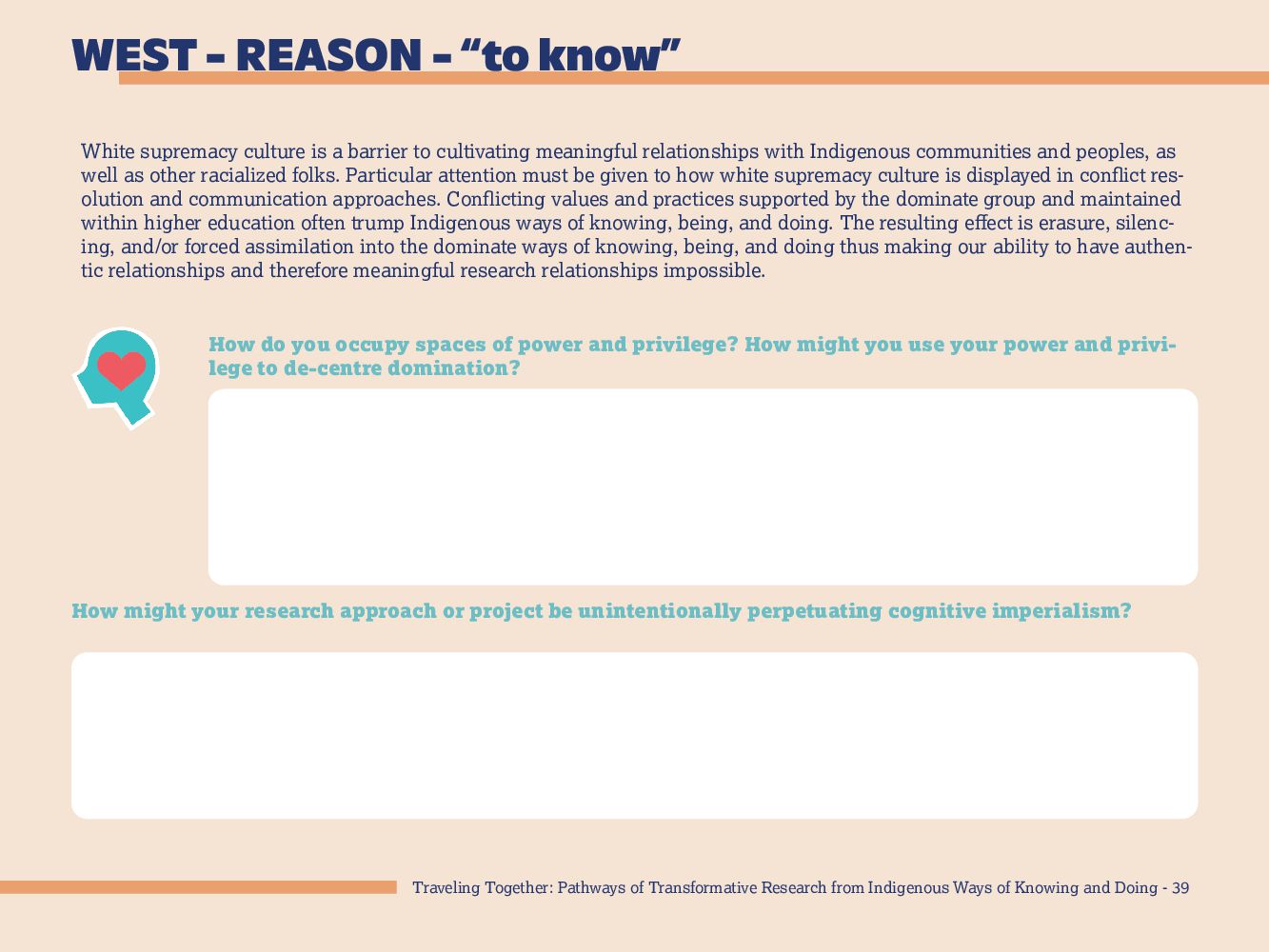
    of Knowing and Doing - 56 The Anti-Oppression Network (n.d.). Terminologies of Oppression. Retrieved from https://theantioppressionnetwork.com/resources/terminologiesof- oppression/ Tessaro, D., Restoule, J.-P., Gaviria, P., Flessa, J., Lindeman, C., & Scully-Stewart, C. (n.d.). The Five R’s for Indigenizing Online Learning: A Case Study of the First Nations Schools’ Principals Course. 40(1),19. https://tspace.library.utoronto.ca/bitstream/1807/91087/1/The%20Five%20R%27s%20for%20Indigenizing%20Online%20Learning%20- %20A%20Case%20study%20of%20the%20First%20Nations%20Schools%27%20Principals%20Course.pdf The First Nations principles of OCAP®. The First Nations Information Governance Centre. (2022, June 8). Retrieved March 28, 2023, from https://fnigc.ca/ocap-training/ Thrasher, M., Cree, Toronto ON, Personal Communication, Winds of Change Teachings (2021) Tuck, E. (2009). Suspending Damage: A Letter to Communities. Harvard Educational Review, 79. https://doi.org/10.17763/haer.79.3.n0016675661t3n15 Tuck, E. and K.W. Yang. (2014b). ‘R-Words: Refusing Research’ in D. Paris and M. T. Winn (Eds.) Humanizing Research: Decolonizing Qualitative Inquiry with youth and Communities. Thousand Oakes, CA: Sage Publications. Vizenor, G. (1994). Manifest manners: Narratives on postindian survivance. London: University Press of New England Wilson. (2008). Research is ceremony: indigenous research methods. Fernwood Pub. Wilson, S. (2003). Progressing toward an indigenous research paradigm in canada and australia. Canadian Journal of Native Education, 27(2), 161-178. Retrieved from https://www.proquest.com/scholarly-journals/progressing-toward-indigenous-researchparadigm/ docview/230305890/se-2 Windchief, S., & San Pedro, T. (2019). Applying Indigenous Research Methods: Storying with Peoples and Communities. In Applying Indigenous Research Methods: Storying with Peoples and Communities. https://doi.org/10.4324/9781315169811