Upgrade to Pro — share decks privately, control downloads, hide ads and more …

The American AI Initiative

The American AI Initiative

In light of rapidly emerging technologies, and their expected impact across society, the U.S. government formed several initiatives in 2019 to help “accelerate AI innovation” and realize its full potential. This presentation is intended to summarize the four key pillars of this strategy.

Avatar for Mike Hare

Mike Hare

August 07, 2019

Other Decks in Technology

Transcript

  1. The White House., 2019, whitehouse.gov/articles/accelerating- americas-leadership-in-artificial-intelligence. Accessed 27 Jul. 2019.

    “…as the pace of AI innovation increases around the world, we cannot sit idly by and presume that our leadership is guaranteed. ” whitehouse.gov In light of rapidly emerging technologies, and their expected impact across society, the U.S. government formed several initiatives in 2019 to help “accelerate AI innovation” and realize its full potential. This SlideShare is intended to summarize the four key pillars of this strategy.
  2. AN EXECUTIVE ORDER FOR INNOVATION • Announced on February 11,

    2019 by President Donald Trump. Designed as a concerted effort to promote and protect national AI technology and innovation. • Implements a “whole-of-government strategy” in collaboration and engagement with the private sector, academia, the public, and like-minded international partners. • Directs Federal agencies to pursue a multipronged approach to advance AI, including: o promoting sustained AI R&D investment o enhancing access to high-quality cyberinfrastructure and data o removing regulatory barriers o ensuring that America leads in the development of technical standards for AI o providing education and training opportunities to prepare the American workforce for AI o developing and implementing an action plan to protect our technological advantage in AI
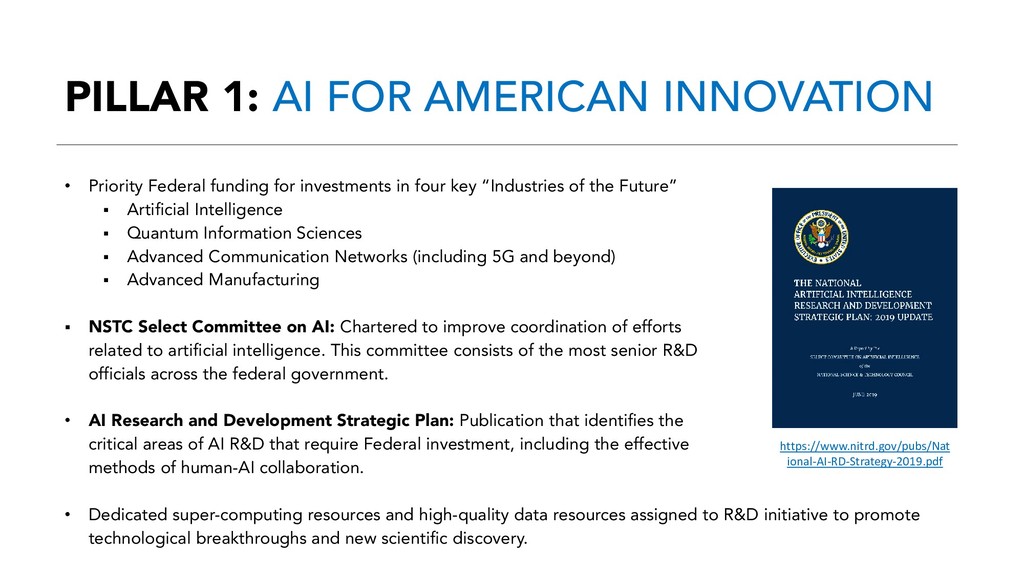
  3. PILLAR 1: AI FOR AMERICAN INNOVATION • Priority Federal funding

    for investments in four key “Industries of the Future”  Artificial Intelligence  Quantum Information Sciences  Advanced Communication Networks (including 5G and beyond)  Advanced Manufacturing  NSTC Select Committee on AI: Chartered to improve coordination of efforts related to artificial intelligence. This committee consists of the most senior R&D officials across the federal government. • AI Research and Development Strategic Plan: Publication that identifies the critical areas of AI R&D that require Federal investment, including the effective methods of human-AI collaboration. • Dedicated super-computing resources and high-quality data resources assigned to R&D initiative to promote technological breakthroughs and new scientific discovery. https://www.nitrd.gov/pubs/Nat ional-AI-RD-Strategy-2019.pdf
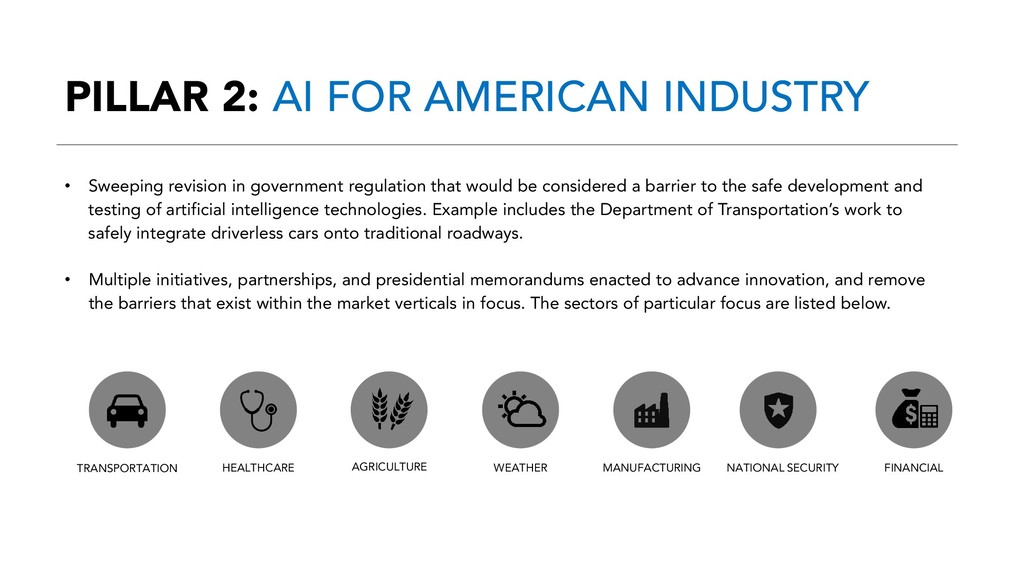
  4. PILLAR 2: AI FOR AMERICAN INDUSTRY • Sweeping revision in

    government regulation that would be considered a barrier to the safe development and testing of artificial intelligence technologies. Example includes the Department of Transportation’s work to safely integrate driverless cars onto traditional roadways. • Multiple initiatives, partnerships, and presidential memorandums enacted to advance innovation, and remove the barriers that exist within the market verticals in focus. The sectors of particular focus are listed below. HEALTHCARE TRANSPORTATION MANUFACTURING FINANCIAL AGRICULTURE WEATHER NATIONAL SECURITY
  5. PILLAR 3: AI FOR THE AMERICAN WORKER • A call

    for every government agency to implement fellowship and training programs to help American workers gain AI-relevant skills through apprenticeships, skills programs, fellowships, and education in computer science and other growing Science, Technology, Engineering, and Math (STEM) fields. • Additional executive order in July 2018 established the President’s National Council for the American Worker. This Council recognizes skilled American workers as our country’s most valuable resource and works to raise awareness of urgent workforce issues and develop a national strategy for empowering American workers with affordable education and skills-based training for the jobs of today and of the future.
  6. PILLAR 4: AI WITH AMERICAN VALUES • Federal R&D investments,

    such as DARPA’s AI Next Campaign, intend to create solutions for countering adversarial attacks on AI technologies, such as those that attempt to contaminate training data, modify algorithms, create adversarial inputs, or exploit flaws in AI system goals. • Provides educational and training opportunities that help the workforce thrive in the new economy. • Promotes an international environment that supports AI R&D and opens markets for American AI industries while also ensuring that the technology is developed in a manner consistent with our Nation’s values and interests. • In June 2019, the White House Office of Science and Technology Policy (OSTP) led the U.S. delegation to the G20 Digital Ministerial, where the G20 nations agreed to the G20 AI Principles, which are drawn from the OECD Recommendation on AI. https://www.darpa.mil/work-with-us/ai-next-campaign AI NEXT CAMPAIGN
  7. WHITE HOUSE AI SUMMIT • An event also worth noting,

    hosted on May 10, 2018 at the White House. • Described as “an opportunity to discuss the promise of AI and the policies we will need to realize that promise for the American people and maintain U.S. leadership in the age of artificial intelligence.” • Brought together more than 100 senior government officials, technical experts from top academic institutions, heads of industrial research labs, and American business leaders who are adopting AI technologies to benefit their customers, workers, and shareholders. • In addition to White House senior staff, Federal participants included senior officials from the National Science Foundation, the Office of the Director of National Intelligence, and the Departments of Agriculture, Commerce, Defense, Energy, Health & Human Services, Labor, Transportation, and Treasury. https://www.whitehouse.gov/wp-content/uploads/2018/05/Summary-Report-of-White-House-AI-Summit.pdf