experimental evidence on the effectiveness of technology-based approaches in education, focusing on four categories of education technology: access to technology, computer-assisted learning, technology-enabled behavioral interventions in education, and online learning. EDUCATION TECHNOLOGY: AN EVIDENCE-BASED REVIEW 2017
the potential for technology to transform learning. As investments in education technology continue to grow, students, parents, and teachers face a seemingly endless array of education technologies from which to choose— from digital personalized learning platforms to educational games to online courses. Amidst the excitement, it is important to step back and understand how technology can help—or in some cases hinder—how students learn. This review paper synthesizes and discusses experimental evidence on the effectiveness of technology-based approaches in education and outlines areas for future inquiry. In particular, we examine RCTs across the following categories of education technology: (1) access to technology, (2) computer-assisted learning, (3) technology-enabled behavioral interventions in education, and (4) online learning. While this review focuses on literature from developed countries, it also draws upon extensive research from developing countries. We hope this literature review will advance the knowledge base of how technology can be used to support education, outline key areas for new experimental research, and help drive improvements to the policies, programs, and structures that contribute to successful teaching and learning.
Robinson, 2013. Fairlie, 2012A; Fairlie, 2012B; Fairlie and Bahr, 2017; Fairlie and Grunberg, 2014; Fairlie and London, 2012. The term “community college” in the US context generally refers to postsecondary institutions that provide only two‐year degrees, traditionally catering in particular to disadvantaged or nontraditional students. Malamud and Pop‐Eleches, 2011. Leuven et al, 2007. Goolsbee and Guryan, 2006. Faber et al, 2015. points relative to those who were not assigned to receive free laptops.38 Though they may seem intuitive, these findings are noteworthy considering that the significant resources required to expand computer and Internet access may be wasted because of the logistical difficulties of distribution Finally, the most comprehensive study in this strand of the literature—the only one to test fully online, blended, and fully face-to-face courses within the same experiment—found results consistent with each of the above.184 Here, the authors test the impact in an economics course of two treatments arms—one purely online and one blended—along with a fully face-to-face. 183 Keefe, 2003 conducted a related study in an undergraduate business course and comes up with results that are in the same direction as Figlio et al, 2013 but
Canadian university tested three treatment arms: one-on-one coaching, an online exercise, and a text messaging support program. Only the one-on-one coaching arm showed significant results, potentially indicating limits in using electronic communication in helping foster longer- term academic performance.153 The other study evaluated a program at Georgia State University that leveraged AI technology in developing a texting program with AdmitHub that sent customized messages to students guiding them through many aspects of the college enrollment process.154 The “augmented intelligence technology” upon which the program was based made it possible for the computer to respond to a large majority of incoming questions, saving scarce time for Oreopoulos and Ford, 2016 Ibid. Oreopoulos and Petronijevic, 2017
the effectiveness of technology-based approaches in education, focusing on four categories of education technology: access to technology, computer- assisted learning, technology-enabled behavioral interventions in education, and online learning.
show promise in improving learning outcomes, particularly in mathematics. Computer-assisted learning programs have been shown to be effective in improving math scores, and educational software has been found to have positive effects on academic achievement. The review highlights the following key findings: Providing students with access to technology yields mixed results on learning outcomes Computer-assisted learning programs show promise in improving learning outcomes, particularly in math Behavioral interventions, such as mindset interventions, can improve academic achievement
discuss experimental evidence on the effectiveness of technology-based approaches in education, and to identify policy-relevant insights and highlight key areas for future inquiry.
analyze publicly available studies using randomized control trials (RCTs) and regression discontinuity designs (RDDs) that estimate the effects of an ed-tech intervention on any education-related outcome. The review employed a systematic search of experimental studies on ed-tech interventions, including: Randomized controlled trials (RCTs) Administrative data and survey data The methods used in the review include: Experimental evidence from various studies Data collection from MOOC platforms, job vacancies, and administrative records Surveys and self-assessment questions
as laptops or computers, has mixed effects on educational outcomes, with some studies showing positive effects and others showing no effect or negative effects. Computer-assisted learning programs, on the other hand, have been shown to be effective in improving math scores. Educational software has also been found to have positive effects on academic achievement. The review presents the results of various studies, including: The effectiveness of computer-assisted learning programs in improving math scores The impact of online learning courses on student outcomes The results of the review include: Mixed results from providing students with access to technology Positive effects of computer-assisted learning and behavioral interventions Increased enrollment and satisfaction in online courses Improved performance and engagement through social comparison cues, mindset interventions, and interactive e-learning environments Mixed results for academic achievement and other learning outcomes.
promise in improving learning outcomes, particularly in mathematics. However, the effectiveness of these approaches depends on the specific context and implementation. Ed-tech interventions have mixed results on learning outcomes Computer-assisted learning and behavioral interventions show promise in improving learning outcomes More research is needed to understand the mechanisms behind ed-tech interventions and to identify effective strategies for improving learning outcomes The conclusions of the review are: Ed-tech has the potential to transform how students learn Further research is needed to understand the mechanisms behind ed-tech interventions Technology-based interventions have shown positive effects, although smaller than those of computer- assisted learning models. The appropriate combination of online and in-person learning may be cost-effective.
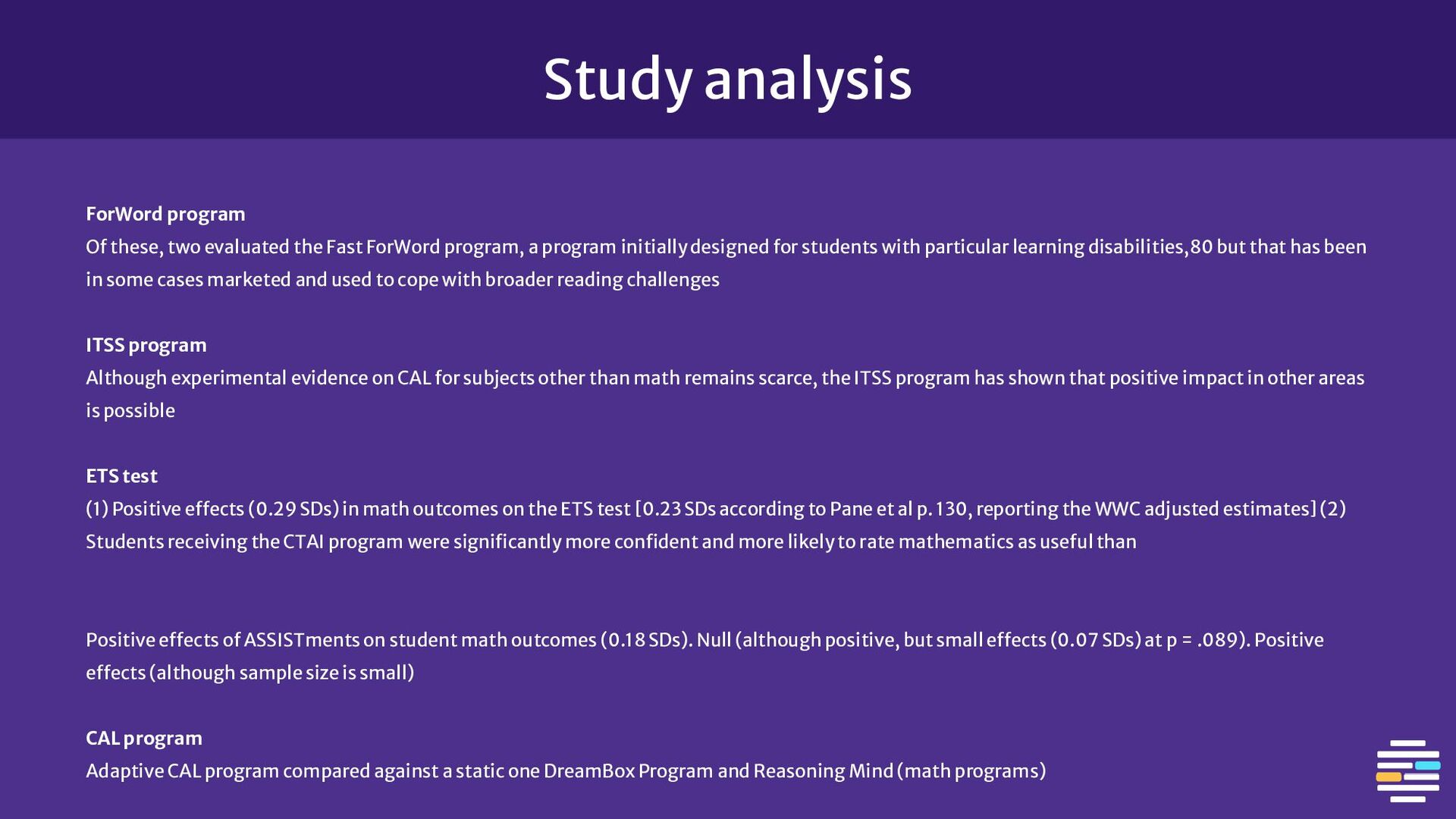
ForWord program, a program initially designed for students with particular learning disabilities,80 but that has been in some cases marketed and used to cope with broader reading challenges ITSS program Although experimental evidence on CAL for subjects other than math remains scarce, the ITSS program has shown that positive impact in other areas is possible ETS test (1) Positive effects (0.29 SDs) in math outcomes on the ETS test [0.23 SDs according to Pane et al p. 130, reporting the WWC adjusted estimates] (2) Students receiving the CTAI program were significantly more confident and more likely to rate mathematics as useful than Positive effects of ASSISTments on student math outcomes (0.18 SDs). Null (although positive, but small effects (0.07 SDs) at p = .089). Positive effects (although sample size is small) CAL program Adaptive CAL program compared against a static one DreamBox Program and Reasoning Mind (math programs)
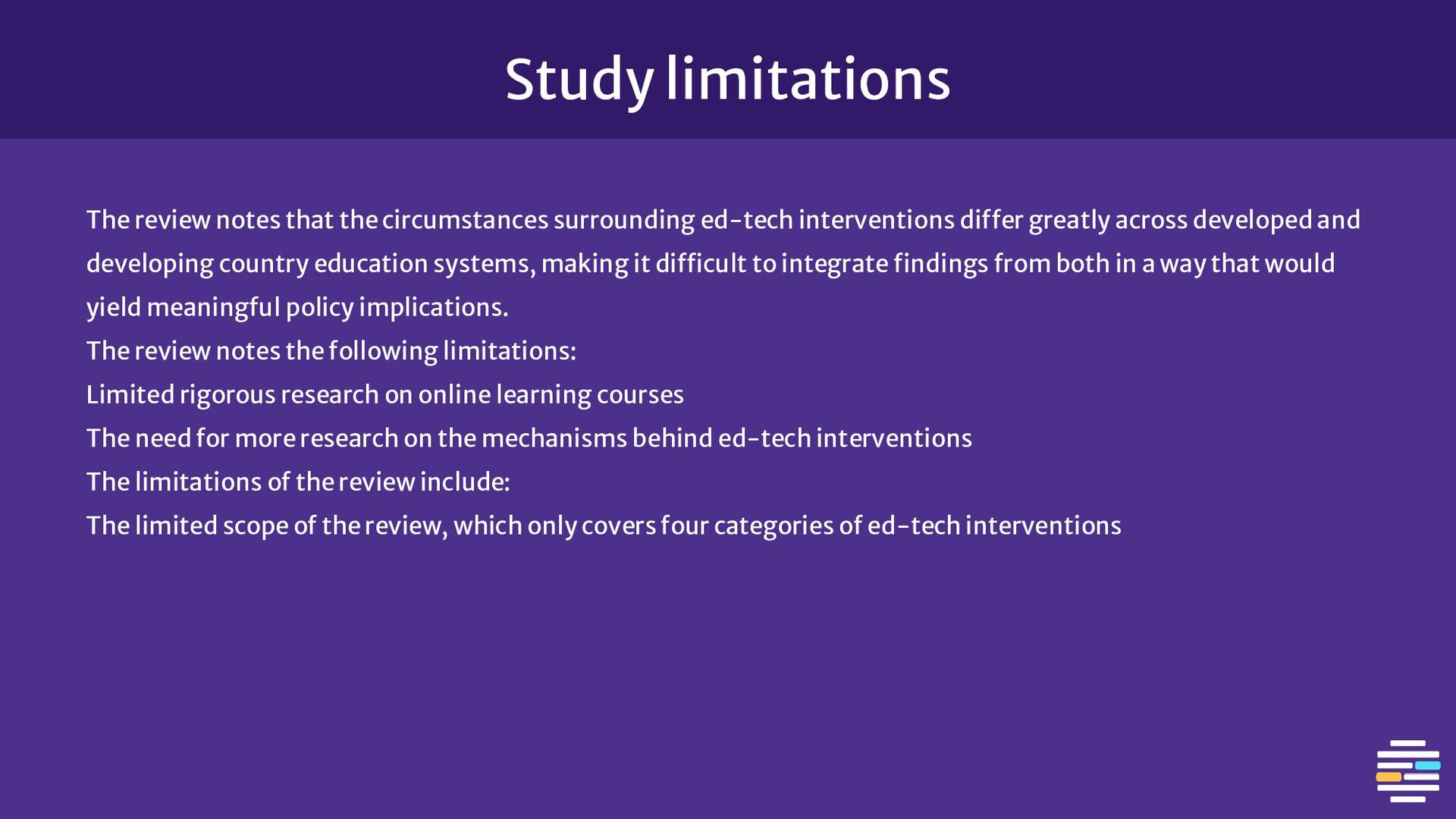
interventions differ greatly across developed and developing country education systems, making it difficult to integrate findings from both in a way that would yield meaningful policy implications. The review notes the following limitations: Limited rigorous research on online learning courses The need for more research on the mechanisms behind ed-tech interventions The limitations of the review include: The limited scope of the review, which only covers four categories of ed-tech interventions
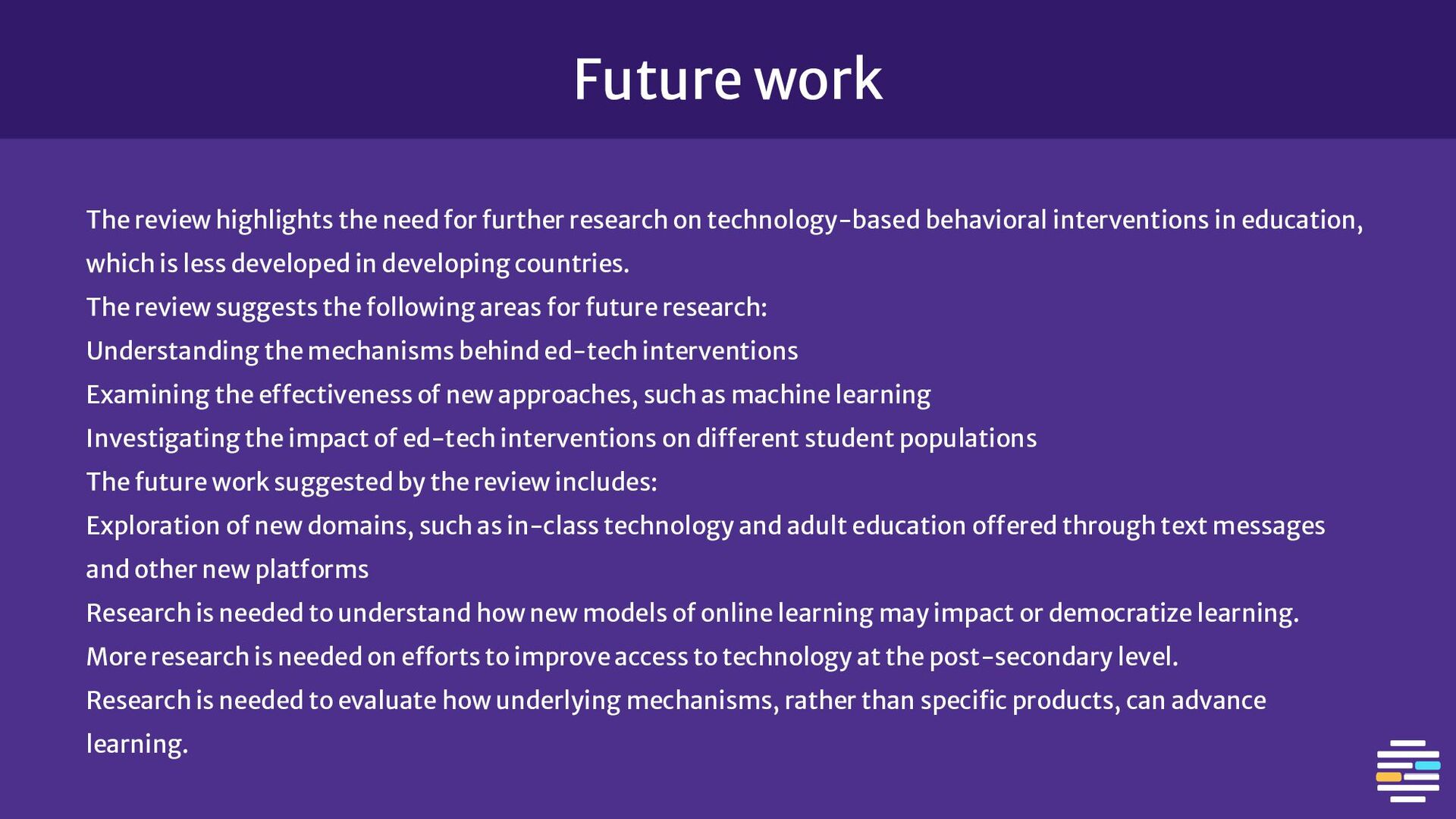
on technology-based behavioral interventions in education, which is less developed in developing countries. The review suggests the following areas for future research: Understanding the mechanisms behind ed-tech interventions Examining the effectiveness of new approaches, such as machine learning Investigating the impact of ed-tech interventions on different student populations The future work suggested by the review includes: Exploration of new domains, such as in-class technology and adult education offered through text messages and other new platforms Research is needed to understand how new models of online learning may impact or democratize learning. More research is needed on efforts to improve access to technology at the post-secondary level. Research is needed to evaluate how underlying mechanisms, rather than specific products, can advance learning.
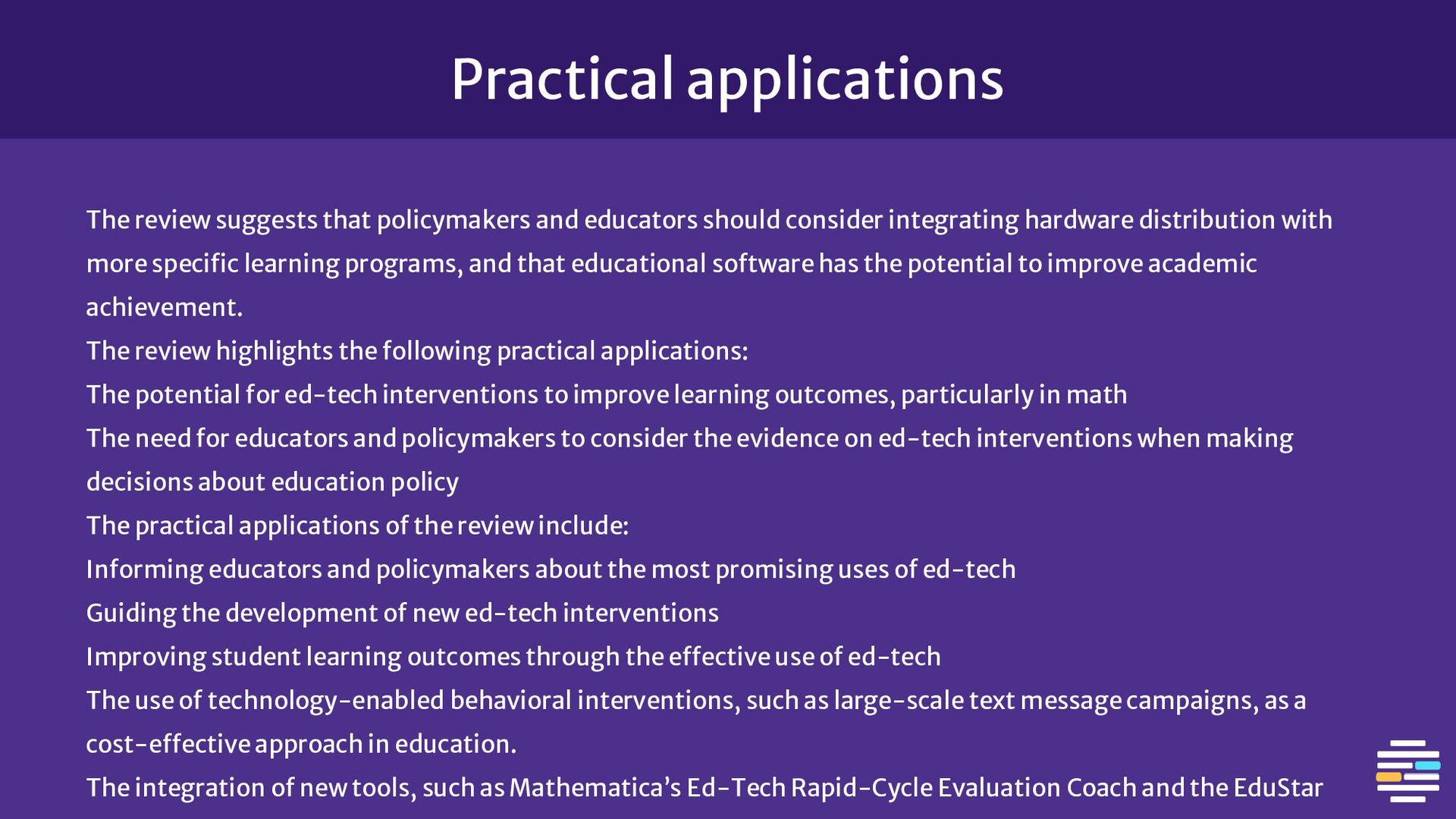
consider integrating hardware distribution with more specific learning programs, and that educational software has the potential to improve academic achievement. The review highlights the following practical applications: The potential for ed-tech interventions to improve learning outcomes, particularly in math The need for educators and policymakers to consider the evidence on ed-tech interventions when making decisions about education policy The practical applications of the review include: Informing educators and policymakers about the most promising uses of ed-tech Guiding the development of new ed-tech interventions Improving student learning outcomes through the effective use of ed-tech The use of technology-enabled behavioral interventions, such as large-scale text message campaigns, as a cost-effective approach in education. The integration of new tools, such as Mathematica’s Ed-Tech Rapid-Cycle Evaluation Coach and the EduStar


 katiecoart
 cromwellryan
 sstephenson
 rakko
 lauravandoore
 axbom
 marketingsoph
 mfonobong
 bluesmoon
 ivargrimstad
 mkilby
 tamaranovitovic