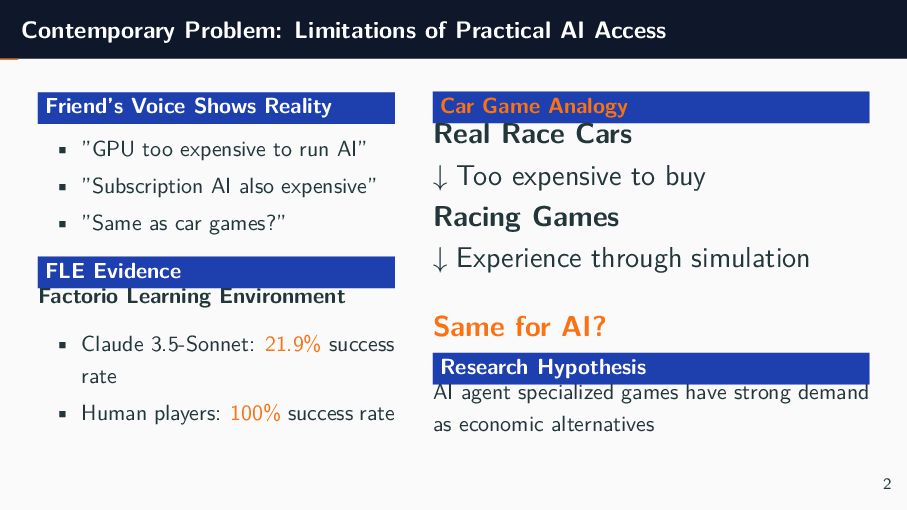
Reality • ”GPU too expensive to run AI” • ”Subscription AI also expensive” • ”Same as car games?” FLE Evidence Factorio Learning Environment • Claude 3.5-Sonnet: 21.9% success rate • Human players: 100% success rate Car Game Analogy Real Race Cars ↓ Too expensive to buy Racing Games ↓ Experience through simulation Same for AI? Research Hypothesis AI agent specialized games have strong demand as economic alternatives 2
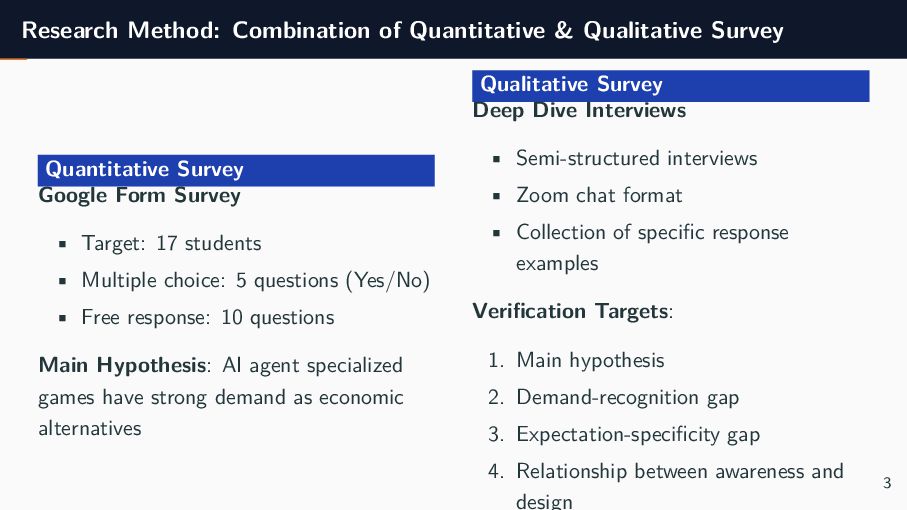
Google Form Survey • Target: 17 students • Multiple choice: 5 questions (Yes/No) • Free response: 10 questions Main Hypothesis: AI agent specialized games have strong demand as economic alternatives Qualitative Survey Deep Dive Interviews • Semi-structured interviews • Zoom chat format • Collection of specific response examples Verification Targets: 1. Main hypothesis 2. Demand-recognition gap 3. Expectation-specificity gap 4. Relationship between awareness and design 3
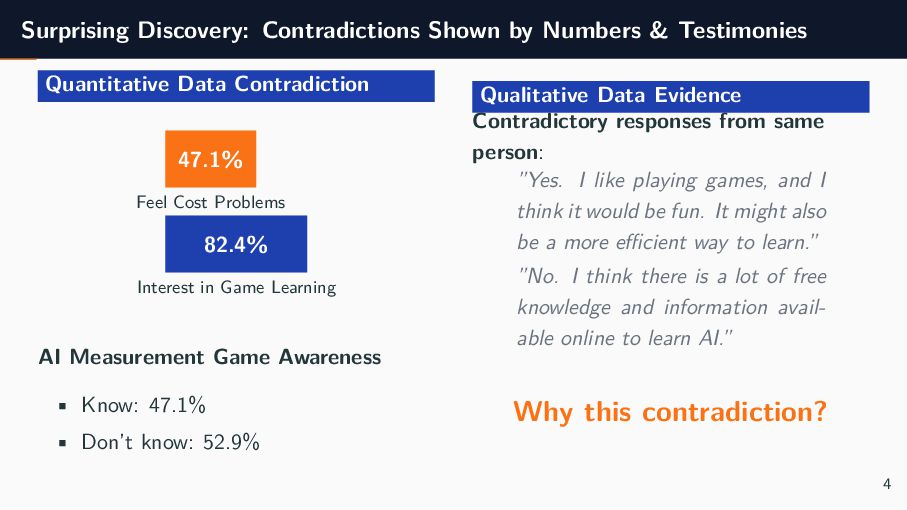
Contradiction 82.4% Interest in Game Learning 47.1% Feel Cost Problems AI Measurement Game Awareness • Know: 47.1% • Don’t know: 52.9% Qualitative Data Evidence Contradictory responses from same person: ”Yes. I like playing games, and I think it would be fun. It might also be a more efficient way to learn.” ”No. I think there is a lot of free knowledge and information avail- able online to learn AI.” Why this contradiction? 4
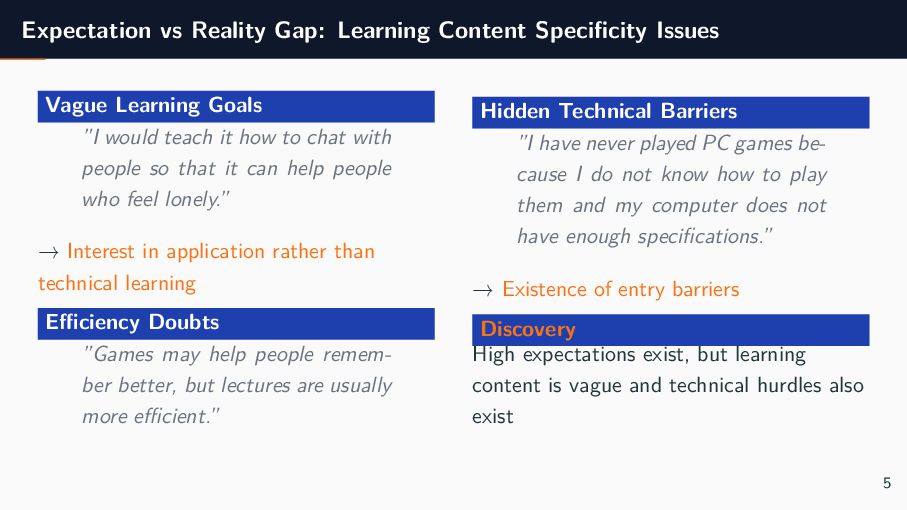
Goals ”I would teach it how to chat with people so that it can help people who feel lonely.” → Interest in application rather than technical learning Efficiency Doubts ”Games may help people remem- ber better, but lectures are usually more efficient.” Hidden Technical Barriers ”I have never played PC games be- cause I do not know how to play them and my computer does not have enough specifications.” → Existence of entry barriers Discovery High expectations exist, but learning content is vague and technical hurdles also exist 5
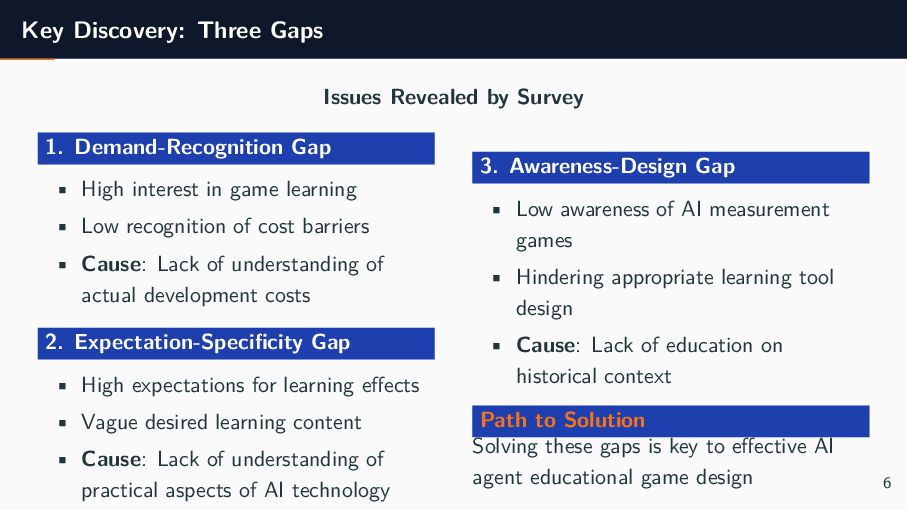
Gap • High interest in game learning • Low recognition of cost barriers • Cause: Lack of understanding of actual development costs 2. Expectation-Specificity Gap • High expectations for learning effects • Vague desired learning content • Cause: Lack of understanding of practical aspects of AI technology 3. Awareness-Design Gap • Low awareness of AI measurement games • Hindering appropriate learning tool design • Cause: Lack of education on historical context Path to Solution Solving these gaps is key to effective AI agent educational game design 6
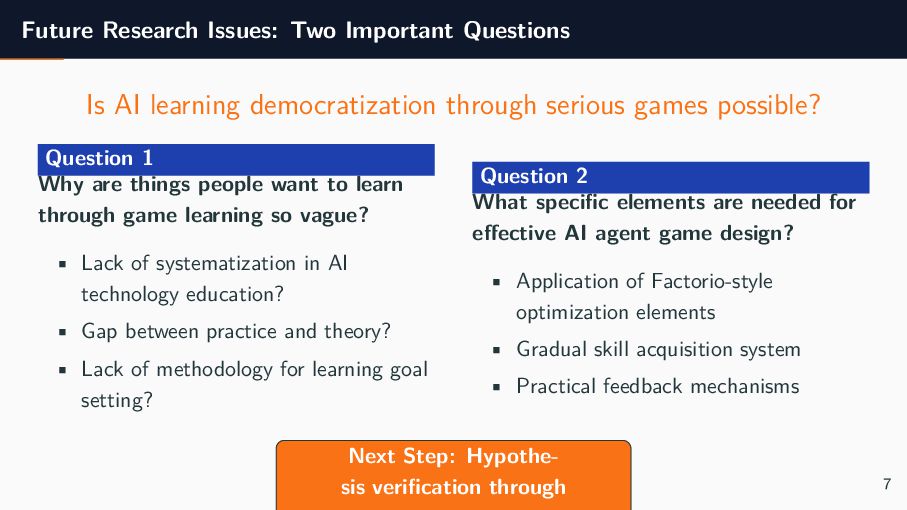
through serious games possible? Question 1 Why are things people want to learn through game learning so vague? • Lack of systematization in AI technology education? • Gap between practice and theory? • Lack of methodology for learning goal setting? Question 2 What specific elements are needed for effective AI agent game design? • Application of Factorio-style optimization elements • Gradual skill acquisition system • Practical feedback mechanisms Next Step: Hypothe- sis verification through 7
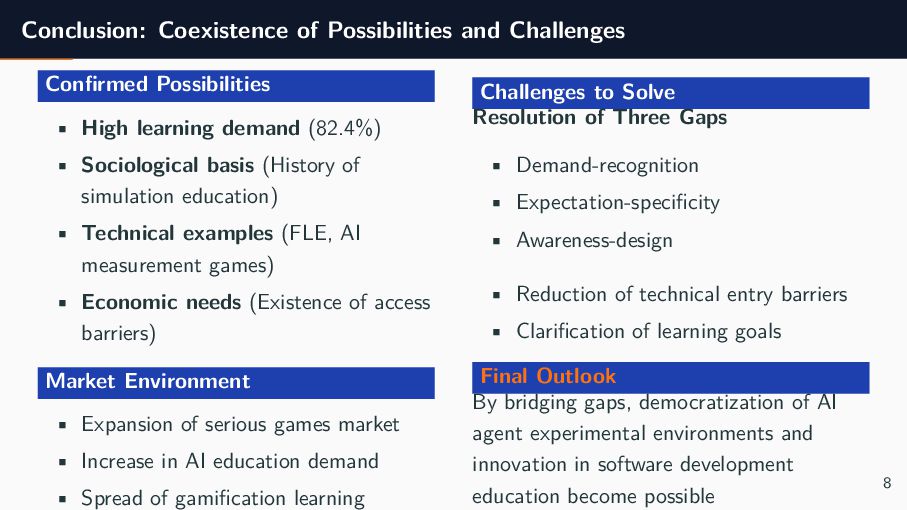
learning demand (82.4%) • Sociological basis (History of simulation education) • Technical examples (FLE, AI measurement games) • Economic needs (Existence of access barriers) Market Environment • Expansion of serious games market • Increase in AI education demand • Spread of gamification learning Challenges to Solve Resolution of Three Gaps • Demand-recognition • Expectation-specificity • Awareness-design • Reduction of technical entry barriers • Clarification of learning goals Final Outlook By bridging gaps, democratization of AI agent experimental environments and innovation in software development education become possible 8


 mtdnot
 kevinliebholz
 danielanewman
 zakiyama
 addyosmani
 madoxten
 katiecoart
 joshbly
 livdayseo
 baasie
 katarinadahlin
 chriscoyier
 nmsamuel