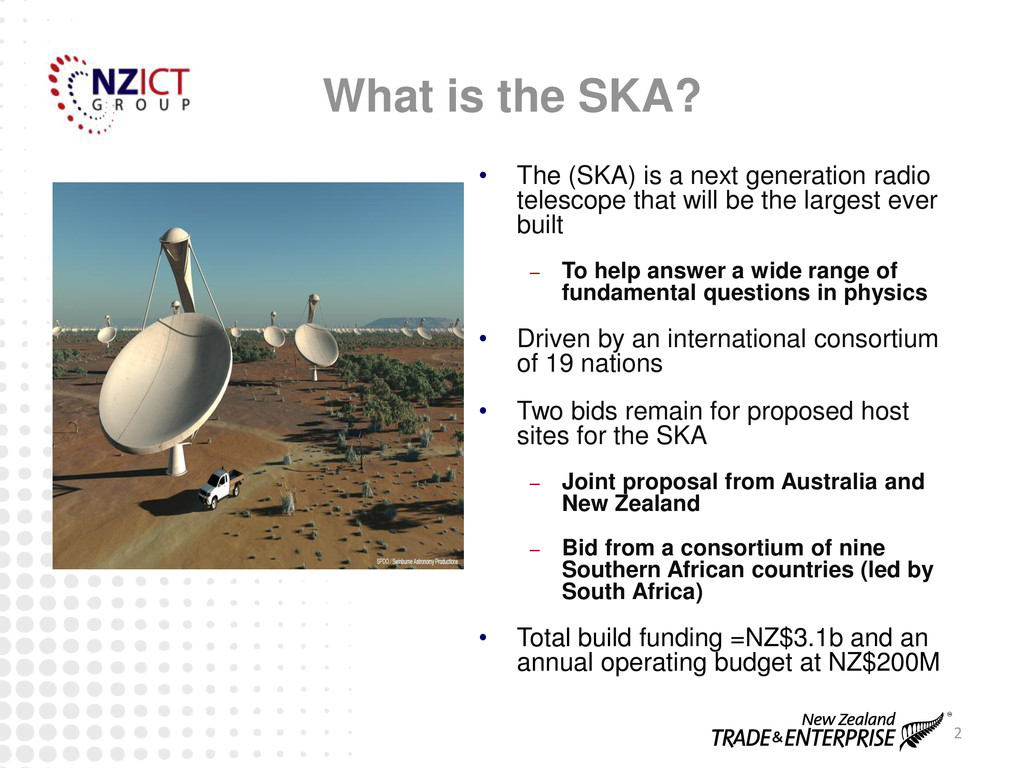
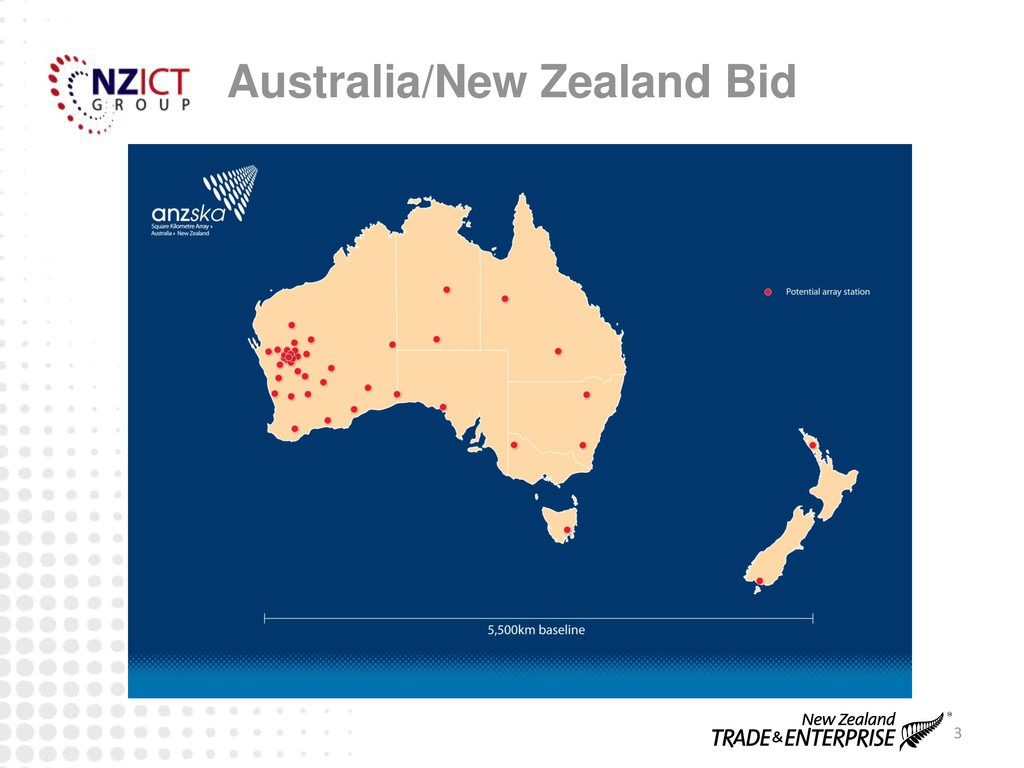
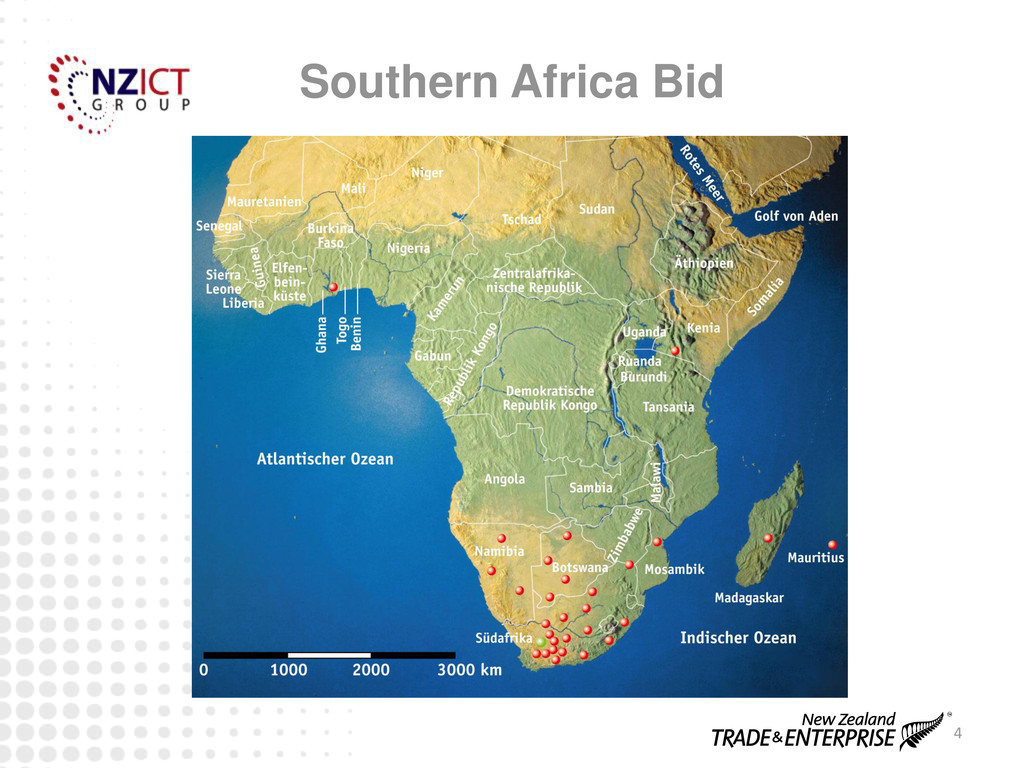
next generation radio telescope that will be the largest ever built – To help answer a wide range of fundamental questions in physics • Driven by an international consortium of 19 nations • Two bids remain for proposed host sites for the SKA – Joint proposal from Australia and New Zealand – Bid from a consortium of nine Southern African countries (led by South Africa) • Total build funding =NZ$3.1b and an annual operating budget at NZ$200M
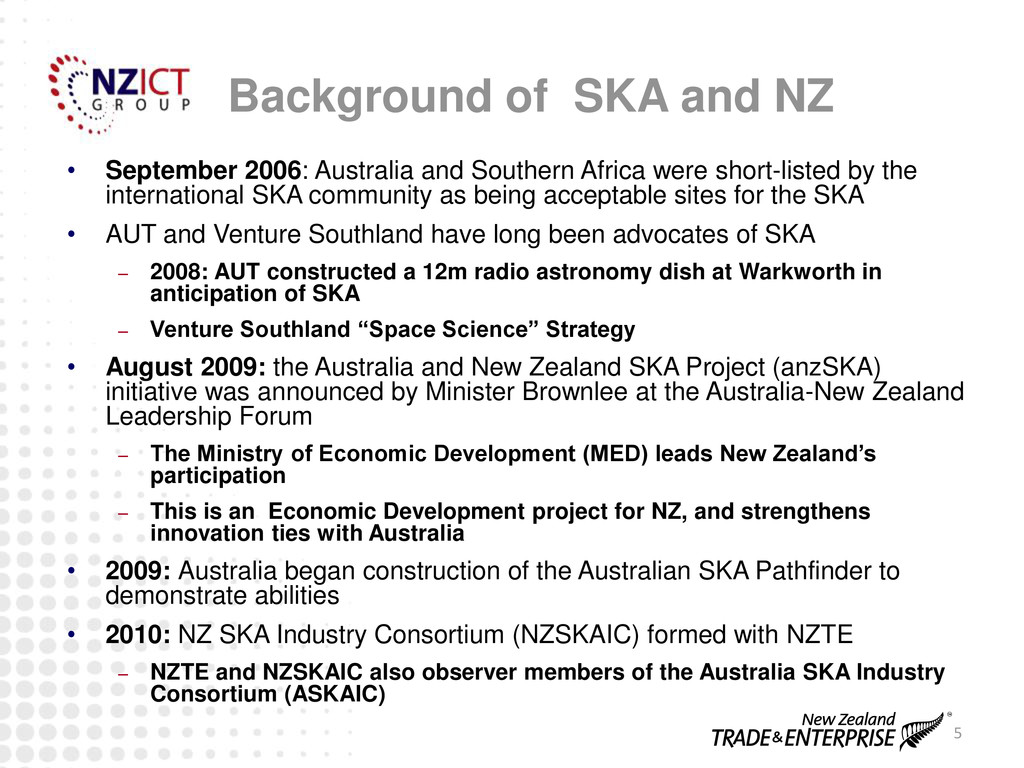
and Southern Africa were short-listed by the international SKA community as being acceptable sites for the SKA • AUT and Venture Southland have long been advocates of SKA – 2008: AUT constructed a 12m radio astronomy dish at Warkworth in anticipation of SKA – Venture Southland “Space Science” Strategy • August 2009: the Australia and New Zealand SKA Project (anzSKA) initiative was announced by Minister Brownlee at the Australia-New Zealand Leadership Forum – The Ministry of Economic Development (MED) leads New Zealand’s participation – This is an Economic Development project for NZ, and strengthens innovation ties with Australia • 2009: Australia began construction of the Australian SKA Pathfinder to demonstrate abilities • 2010: NZ SKA Industry Consortium (NZSKAIC) formed with NZTE – NZTE and NZSKAIC also observer members of the Australia SKA Industry Consortium (ASKAIC)
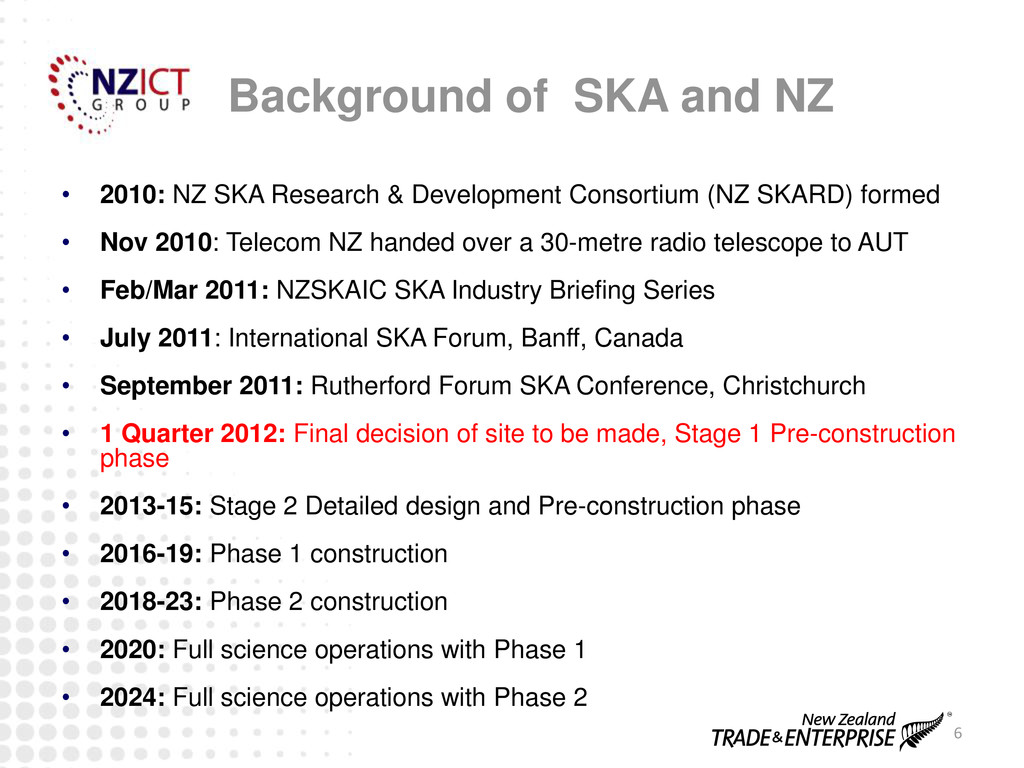
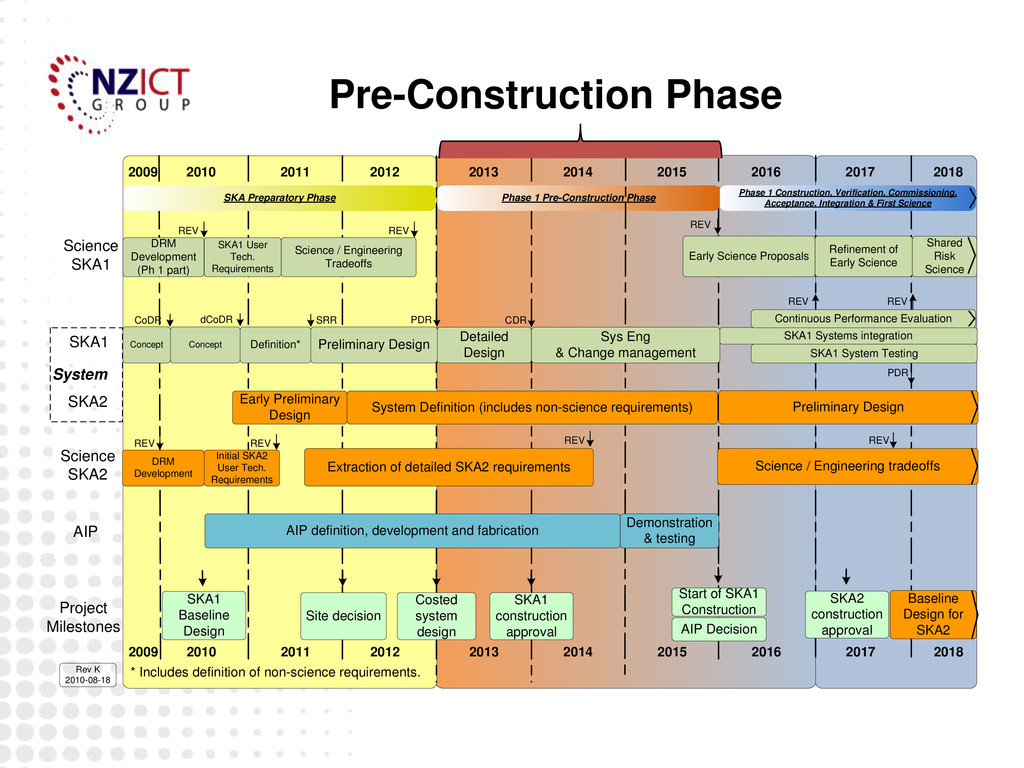
& Development Consortium (NZ SKARD) formed • Nov 2010: Telecom NZ handed over a 30-metre radio telescope to AUT • Feb/Mar 2011: NZSKAIC SKA Industry Briefing Series • July 2011: International SKA Forum, Banff, Canada • September 2011: Rutherford Forum SKA Conference, Christchurch • 1 Quarter 2012: Final decision of site to be made, Stage 1 Pre-construction phase • 2013-15: Stage 2 Detailed design and Pre-construction phase • 2016-19: Phase 1 construction • 2018-23: Phase 2 construction • 2020: Full science operations with Phase 1 • 2024: Full science operations with Phase 2 6
= 0.4TB in 8hrs • Image file size = 64 GB • 1.4 TB of data per day (0.016 GB/s) • 0.5 PB / year in images •Spectral line • Visibility data = 22.5TB in 8hrs • Image file size = 2 TB • 73.5 TB of data per day (0.9 GB/s) • 26.8 PB / year in cubes •Transient • Visibility data = 48TB in 8hrs • 156 TB of data per day (1.81GB/s) • 56.8 PB / year in images •Annual raw data flow – approx. 50PB •Annual science data flow – approx. 5PB by 2013
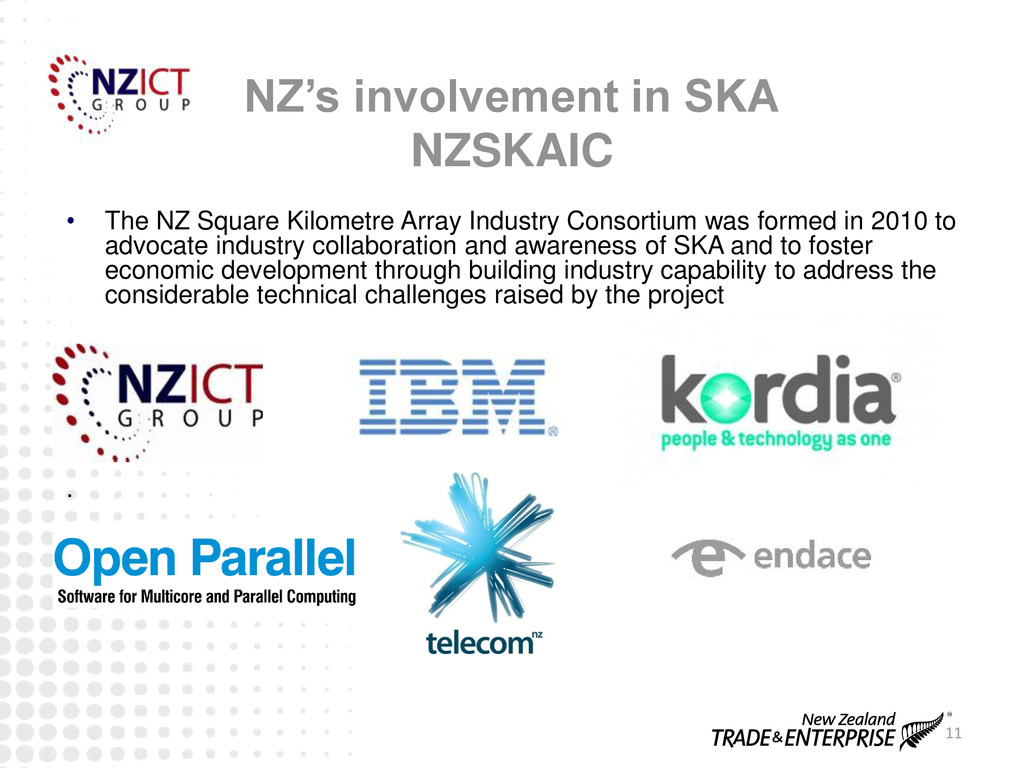
Kilometre Array Industry Consortium was formed in 2010 to advocate industry collaboration and awareness of SKA and to foster economic development through building industry capability to address the considerable technical challenges raised by the project .
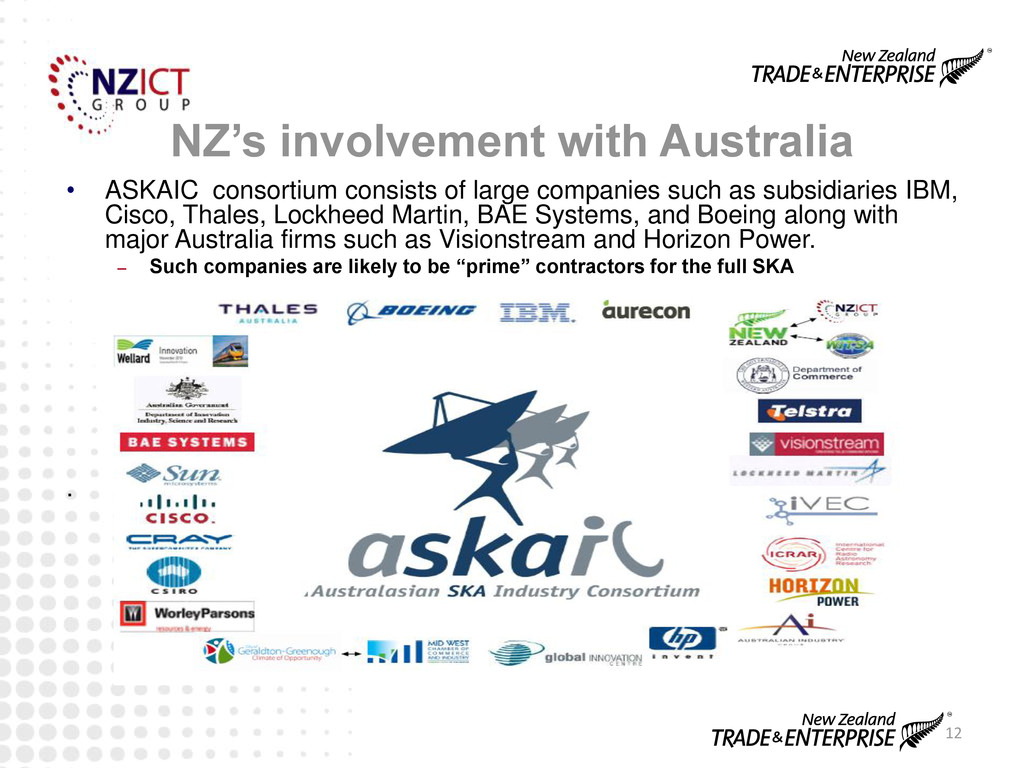
large companies such as subsidiaries IBM, Cisco, Thales, Lockheed Martin, BAE Systems, and Boeing along with major Australia firms such as Visionstream and Horizon Power. – Such companies are likely to be “prime” contractors for the full SKA .
play an important role in implementing the best window into the history and make-up of our universe enabling worldwide economic & social growth for the next generation • To be associated with the world leading radio telescope, producing a paradigm shift in science & engineering • For New Zealand to be recognised as a world leader in radio astronomy science and technology by 2050 and where leading edge science and technology happens • Use opportunities offered by the SKA to inspire a new generation of scientists & engineers: this is our 'mission to mars' • For NZ to be a coherent contributor to Australia’s bid to win the SKA; having a credible world-leading role in a mega science project • To have SKA as a world class exemplar of trans-Tasman science & technology collaboration .
1% = $30M investment 5 X Return • International Partnerships with major hi-tech companies and research and development • Innovation and IP • Development of the leading-edge technology in ICT, renewable & off-grid energy and advanced engineering • SKA Pilot project prospects for New Zealand and possible industry involvement: - Murchison Widefield Array (MWA) project – NZ has just joined - SKA Preconstruction Programme – Computing Work Package
data reduction across instrument pipeline, packaging of science products • Heterogeneous computing architectures • Multicore software development • Very large scale – and automated – data and image analysis – Researcher front-end (Virtual Observatory) – Automated decision support systems – Spill-overs data rich instrumentation and sensor networks (e.g., in agriculture) • New Zealand as host for the SKA Science Data Archive • Advanced signal processing, Ultra-high speed telecommunications • Large scale and complex project management, systems integration, and software development 15
arising from SKA is the ability to manage the huge volumes of data the instrument will produce. • NZSKAIC is working with NZSKARD and other industry and research collaborators to address this huge challenge, through a research and development programme to construct a new framework to automate aspects of very high volume data management and; to increase scientist productivity. • NZSKAIC will also investigate how this framework can be extended to other sectors of the New Zealand economy with similar requirements for processing large volumes of data from instrumentation/sensors to enhance decision making ability and performance. NZSKAIC Initiatives


 multicoreworld
 techseoconnect
 cassininazir
 notwaldorf
 garrettdimon
 dugsong
 tessaabrams
 marketingsoph
 soysaucechin
 bluesmoon
 akademiya2063
 marktimemedia
 lara
lara

![17 www.nzskaic.org.nz John Houlker [email protected]](https://files.speakerdeck.com/presentations/500910ef78b8ae0002110010/slide_16.jpg)