James Reinders. INTEL, United States
Sponsored
·
 Your Podcast. Everywhere. Effortlessly.
Share. Educate. Inspire. Entertain. You do you. We'll handle the rest.
→
Your Podcast. Everywhere. Effortlessly.
Share. Educate. Inspire. Entertain. You do you. We'll handle the rest.
→

Share
Embed
James Reinders. INTEL, United States
KEYNOTE: Parallel Programming for C and C++ done right.
Please note that the slides are ALL BLACK (a kind recognition from the speaker towards New Zealand winning the Rugby World Cup in 2011)

Multicore World
July 18, 2012
Transcript
85 slides
-
© Intel 2012, All Rights Reserved Parallel Programming for
C and C++ done right (a work in progress) James Reinders, Intel Corp. -
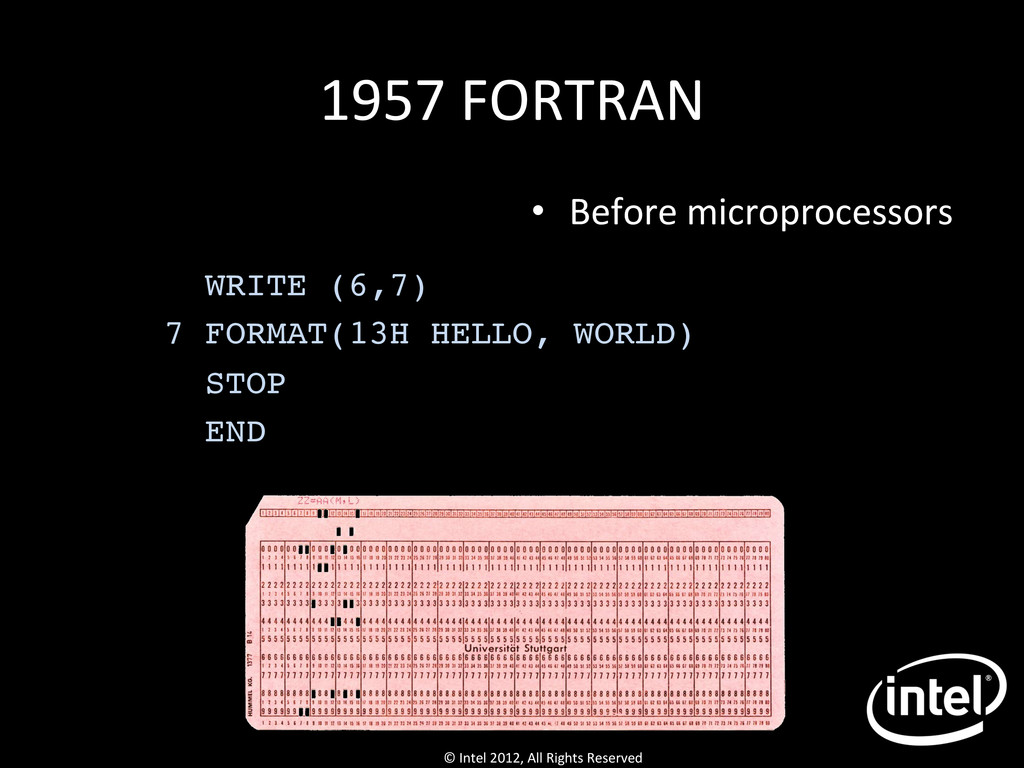
© Intel 2012, All Rights Reserved 1957 FORTRAN
WRITE (6,7)! 7 FORMAT(13H HELLO, WORLD)! STOP! END! • Before microprocessors -
© Intel 2012, All Rights Reserved Fortran •
First Compiler: 1957 – Some of the influences on design: • Punch-‐cards • OpQmizaQon (users were reluctant to switch from assembly language) • ManipulaQon of sense switches and sense lights • MathemaQcal excepQons (overflow, divide check) • Tape operaQons (read, write, rewind, backspace) 4 Photos: Wikimedia Commons (hXp://commons.wikimedia.org) -
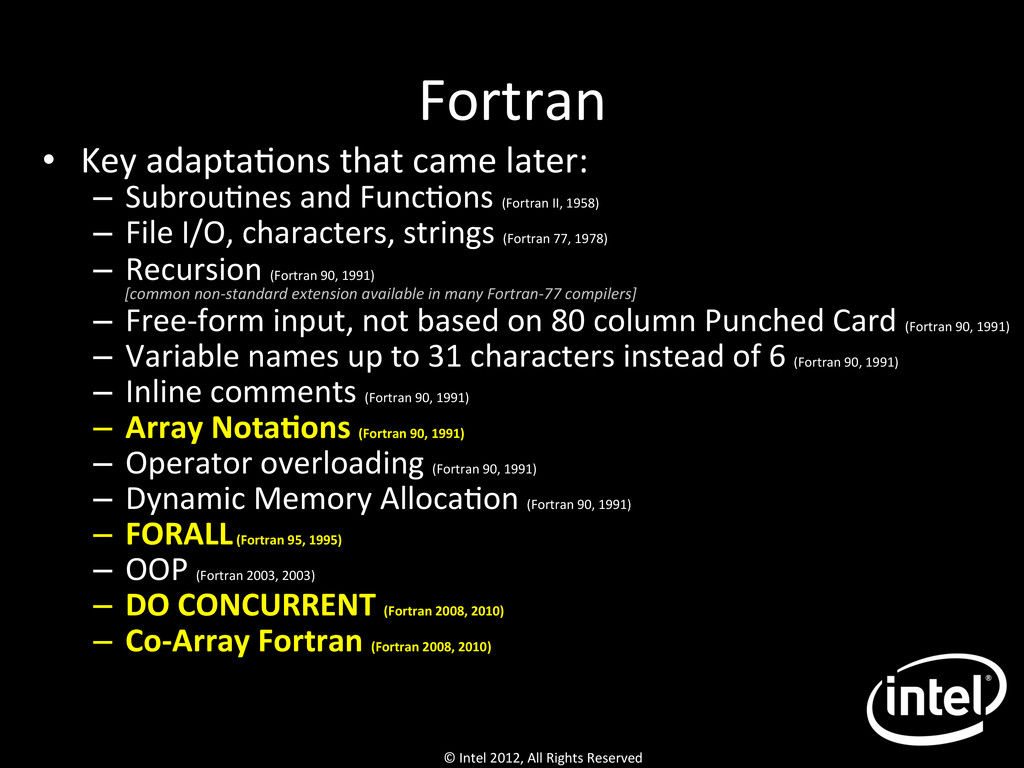
© Intel 2012, All Rights Reserved Fortran •
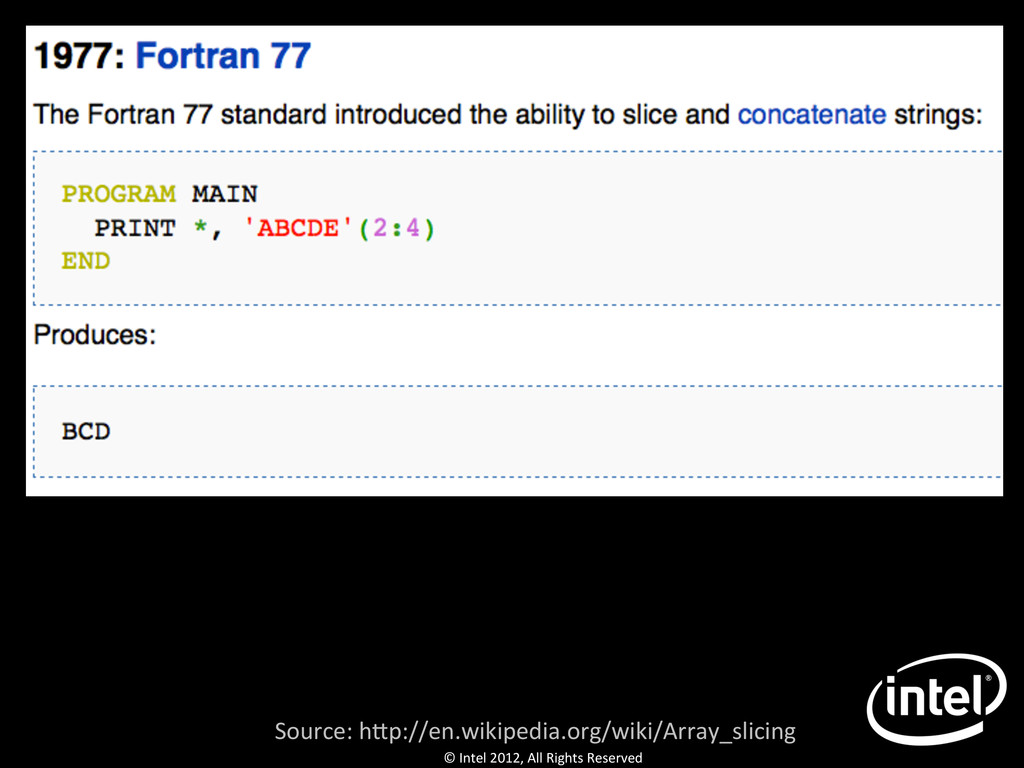
Key adaptaQons that came later: – SubrouQnes and FuncQons (Fortran II, 1958) – File I/O, characters, strings (Fortran 77, 1978) – Recursion (Fortran 90, 1991) [common non-‐standard extension available in many Fortran-‐77 compilers] – Free-‐form input, not based on 80 column Punched Card (Fortran 90, 1991) – Variable names up to 31 characters instead of 6 (Fortran 90, 1991) – Inline comments (Fortran 90, 1991) – Array Nota)ons (Fortran 90, 1991) – Operator overloading (Fortran 90, 1991) – Dynamic Memory AllocaQon (Fortran 90, 1991) – FORALL (Fortran 95, 1995) – OOP (Fortran 2003, 2003) – DO CONCURRENT (Fortran 2008, 2010) – Co-‐Array Fortran (Fortran 2008, 2010) 5 -
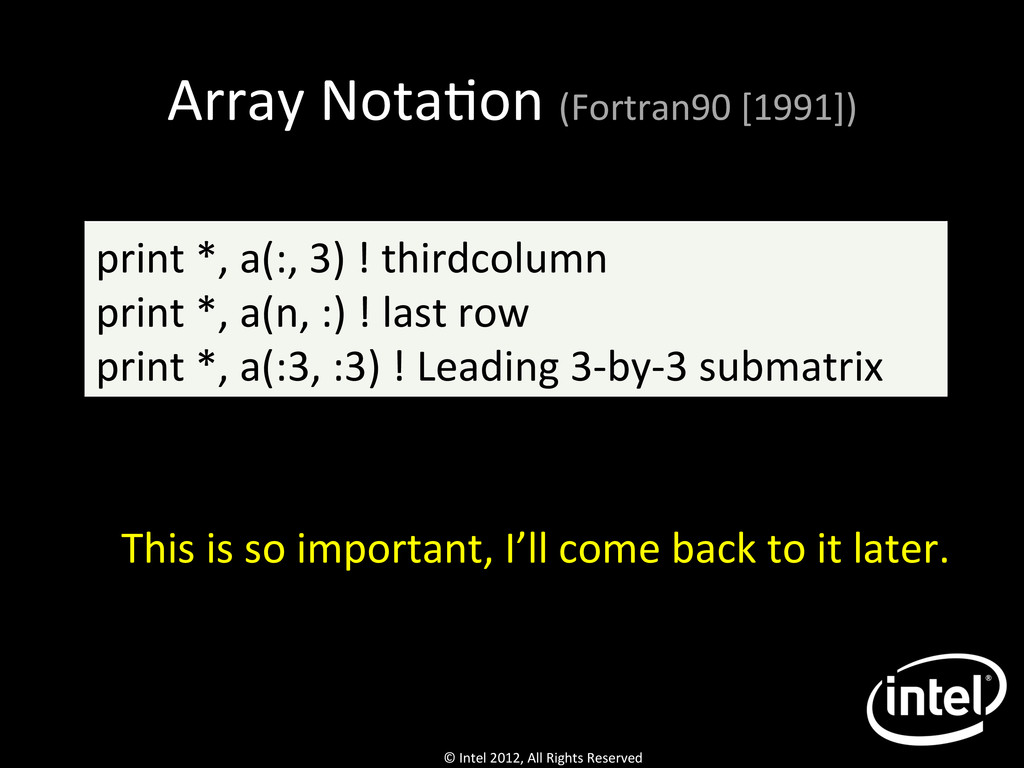
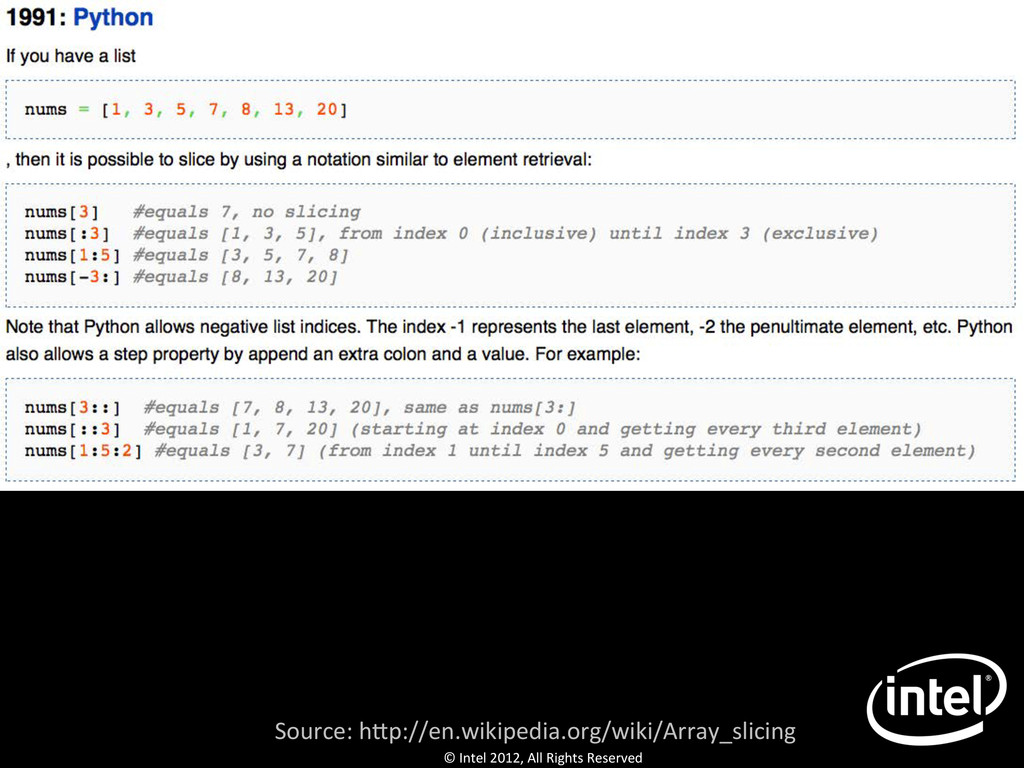
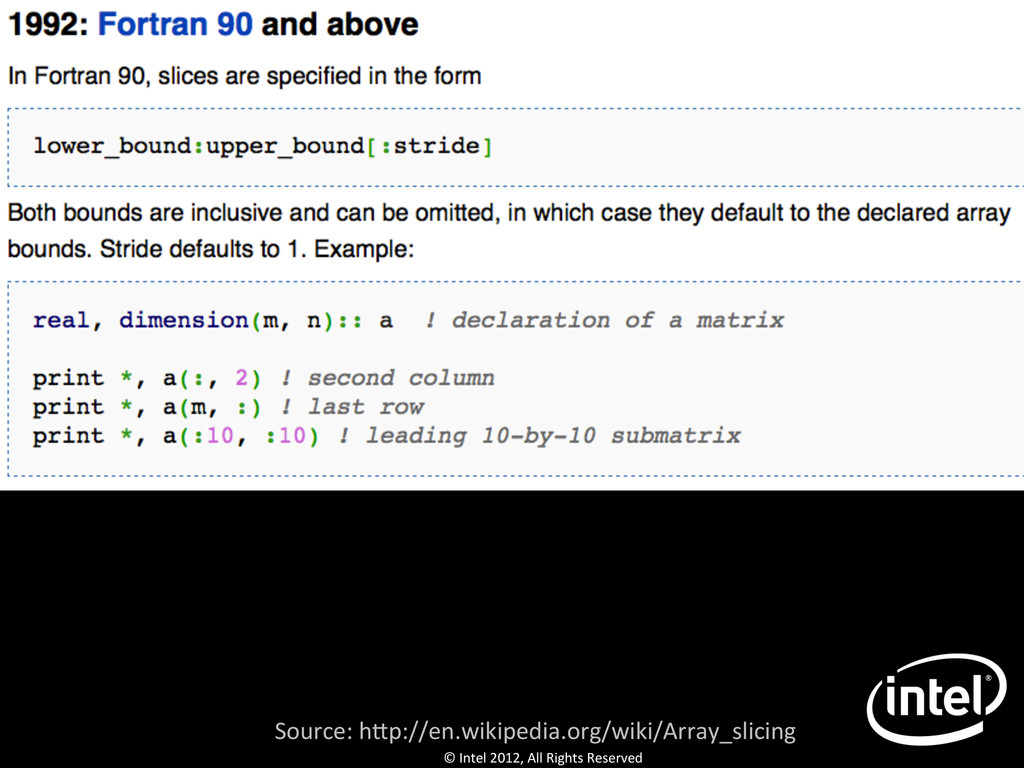
© Intel 2012, All Rights Reserved Array NotaQon (Fortran90
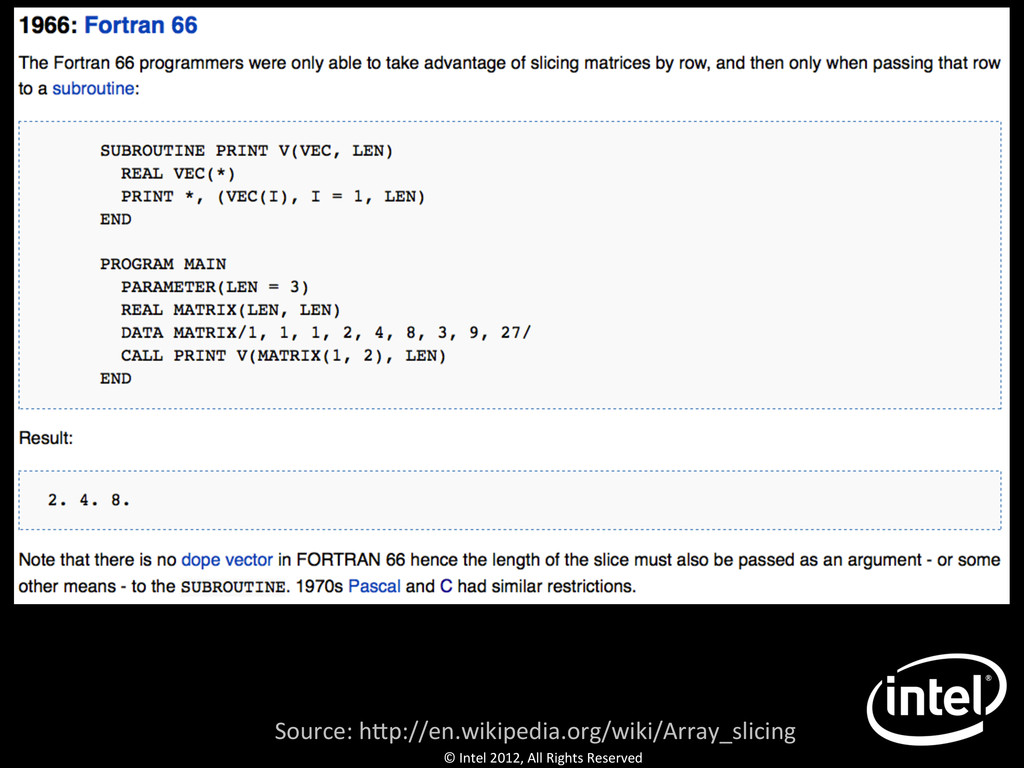
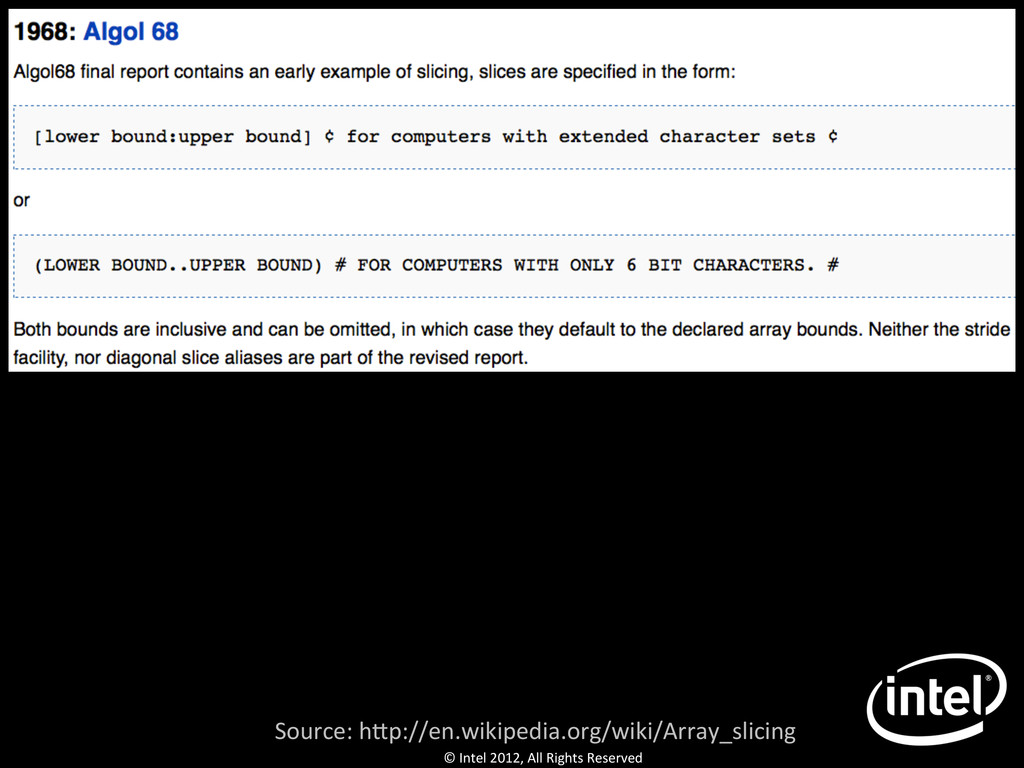
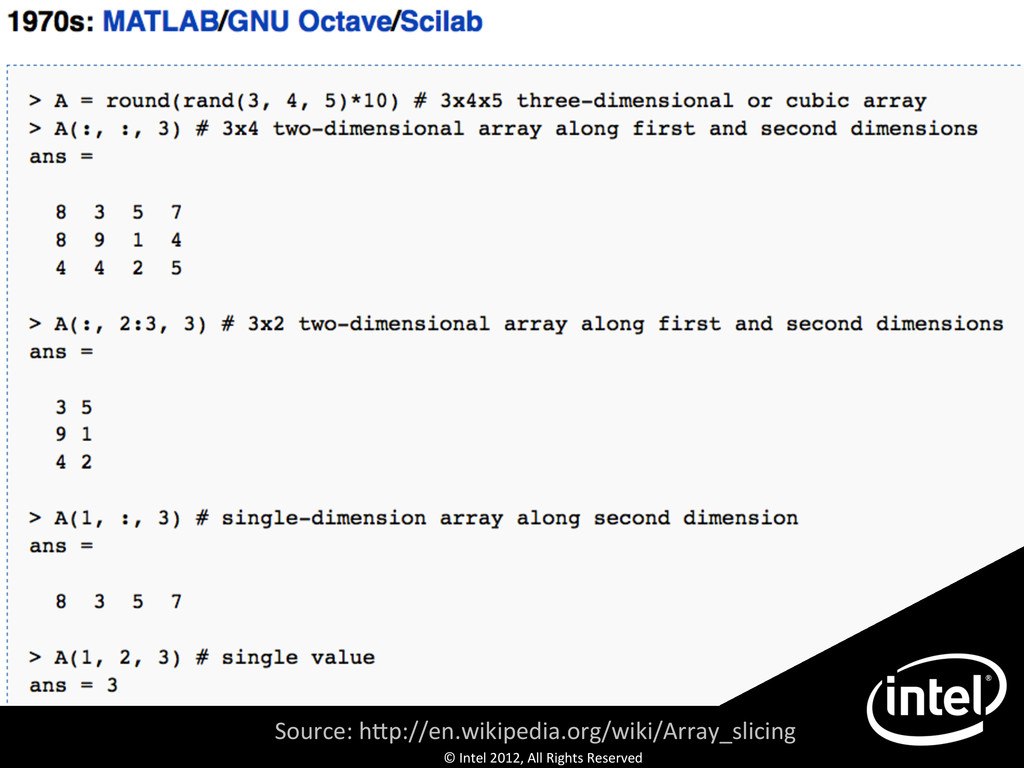
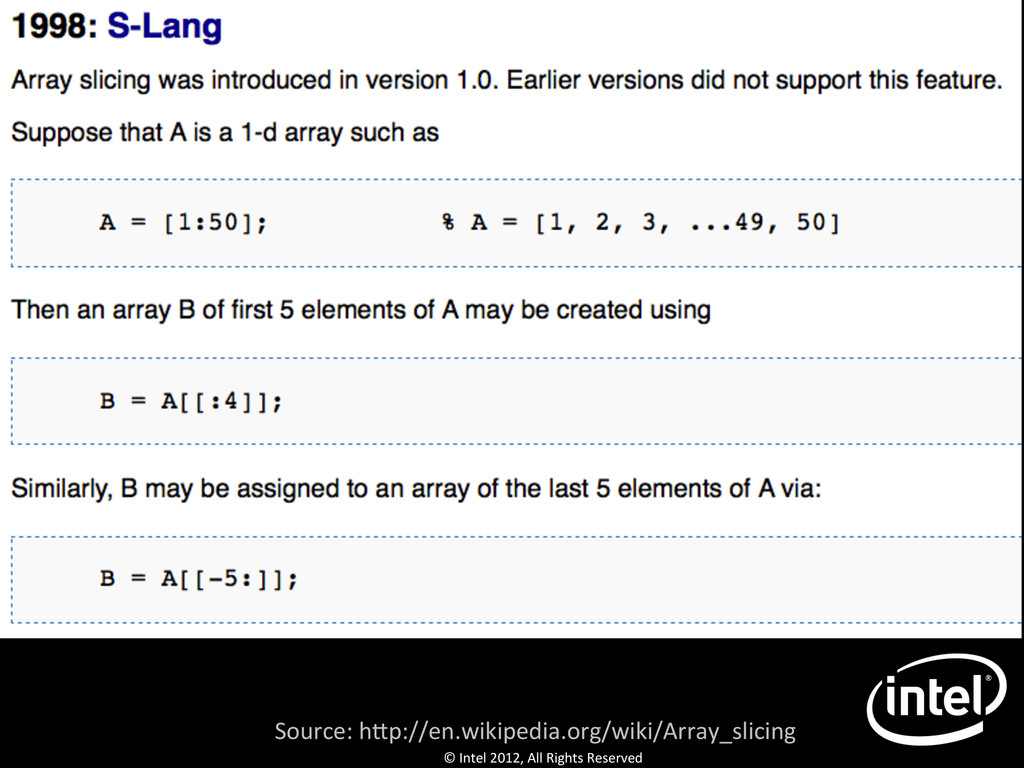
[1991]) print *, a(:, 3) ! thirdcolumn print *, a(n, :) ! last row print *, a(:3, :3) ! Leading 3-‐by-‐3 submatrix This is so important, I’ll come back to it later. -
© Intel 2012, All Rights Reserved • A standard,
explicit notation for data decomposition • Shared memory and distributed memory systems Sum in Fortran, using co-‐array feature: REAL SUM[*] CALL SYNC_ALL( WAIT=1 ) DO IMG= 2,NUM_IMAGES() IF (IMG==THIS_IMAGE()) THEN SUM = SUM + SUM[IMG-1] ENDIF CALL SYNC_ALL( WAIT=IMG ) ENDDO Coarray Fortran (Fortran 2008 [2010]) -
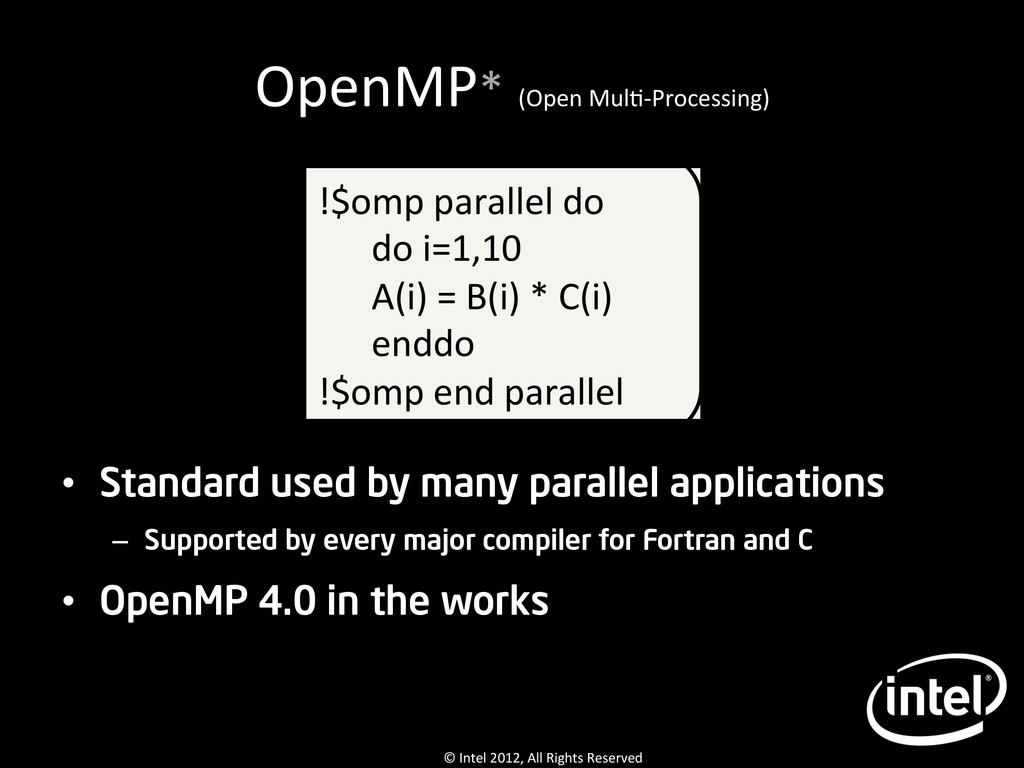
© Intel 2012, All Rights Reserved • Standard used
by many parallel applications – Supported by every major compiler for Fortran and C • OpenMP 4.0 in the works !$omp parallel do do i=1,10 A(i) = B(i) * C(i) enddo !$omp end parallel OpenMP* (Open MulQ-‐Processing) -
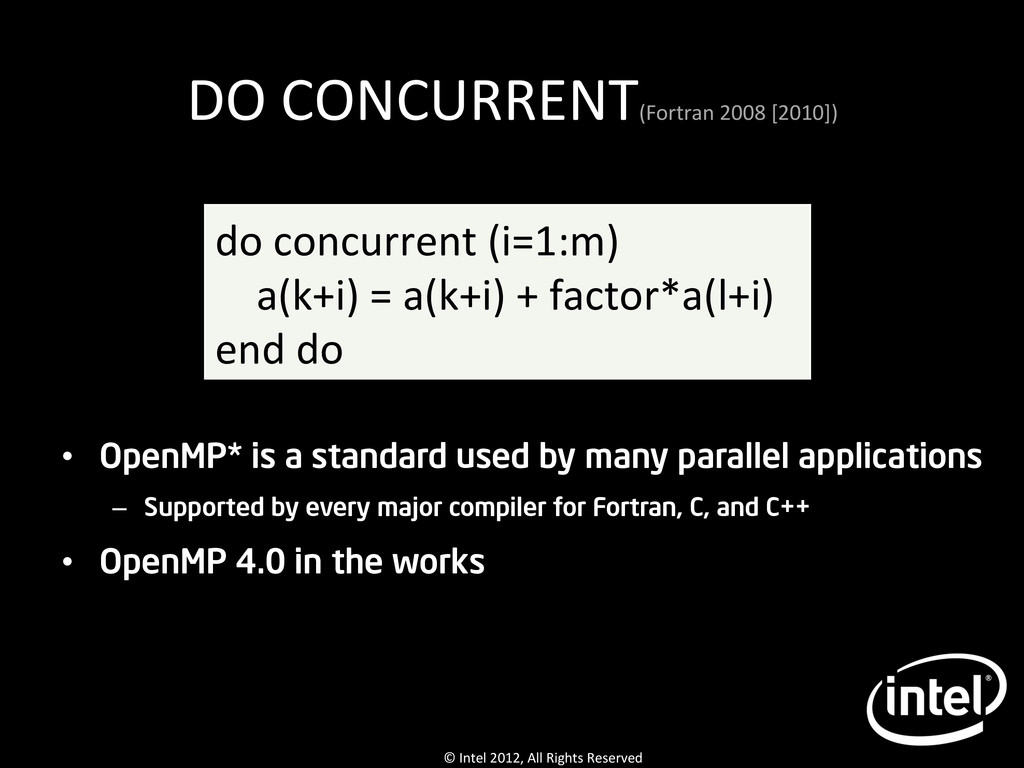
© Intel 2012, All Rights Reserved DO CONCURRENT(Fortran 2008
[2010]) • OpenMP* is a standard used by many parallel applications – Supported by every major compiler for Fortran, C, and C++ • OpenMP 4.0 in the works do concurrent (i=1:m) a(k+i) = a(k+i) + factor*a(l+i) end do -
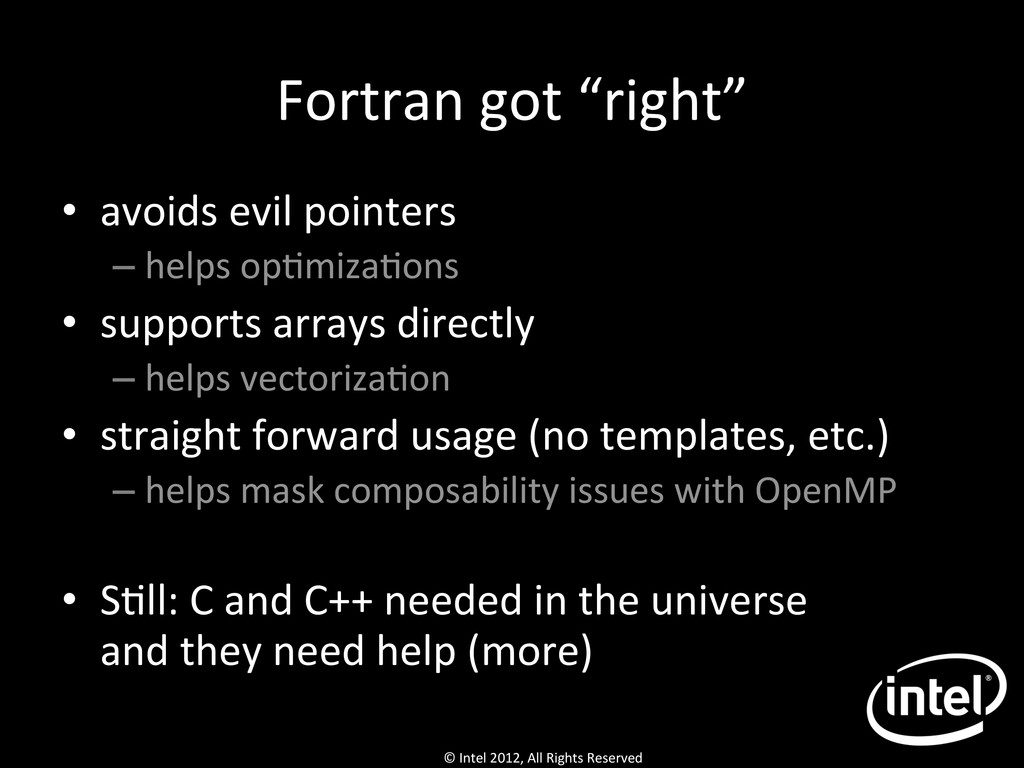
© Intel 2012, All Rights Reserved Fortran got “right”
• avoids evil pointers – helps opQmizaQons • supports arrays directly – helps vectorizaQon • straight forward usage (no templates, etc.) – helps mask composability issues with OpenMP • SQll: C and C++ needed in the universe and they need help (more) -
© Intel 2012, All Rights Reserved but...
I promised to talk about C and C++ -
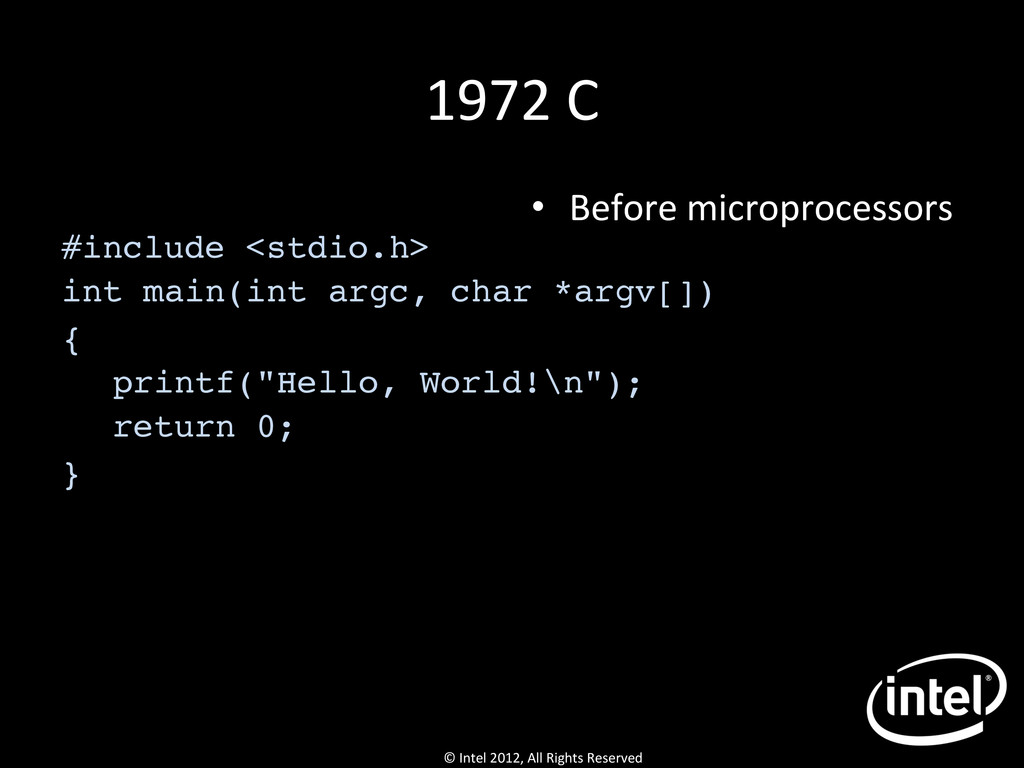
© Intel 2012, All Rights Reserved 1972 C
#include <stdio.h>! int main(int argc, char *argv[])! {! !printf("Hello, World!\n");! !return 0;! }! • Before microprocessors -
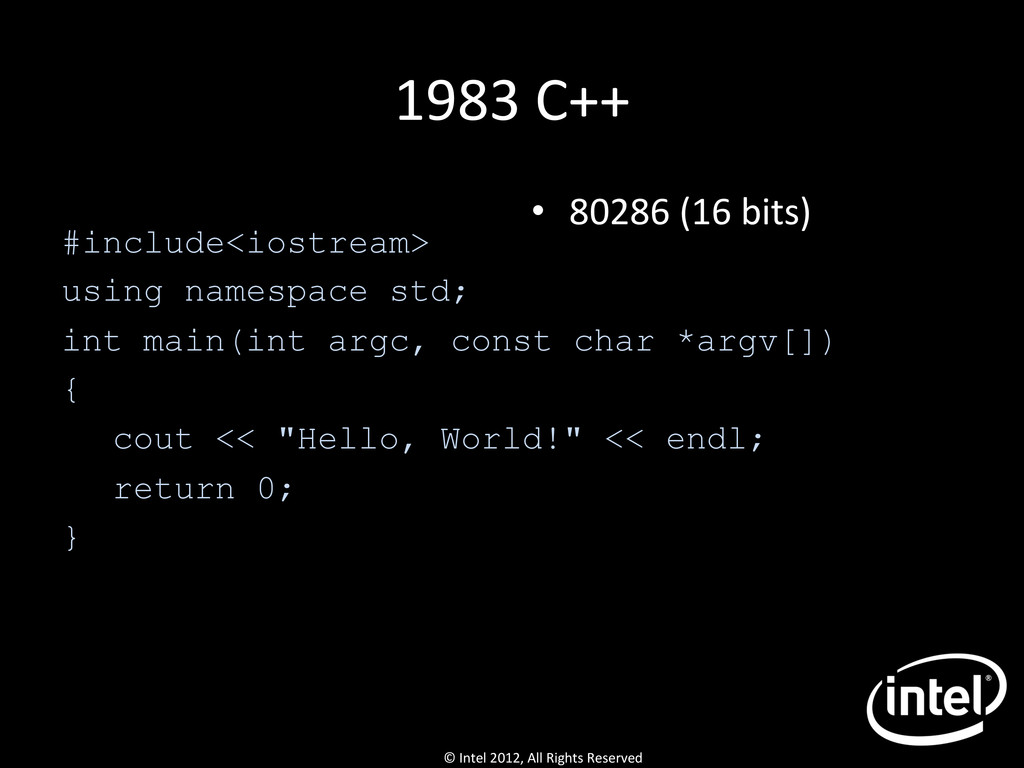
© Intel 2012, All Rights Reserved 1983 C++
#include<iostream> using namespace std; int main(int argc, const char *argv[]) { cout << "Hello, World!" << endl; return 0; } • 80286 (16 bits) -
© Intel 2012, All Rights Reserved in order to
fix • We need to jointly understand the “problem” -
© Intel 2012, All Rights Reserved I will moQvate
more than show the soluQon • I’m learning that SHOWING SOLUTIONS is useless if the PROBLEM is not FELT • Our soluQons are heavily adopted by those who were in pain already! -
© Intel 2012, All Rights Reserved • C
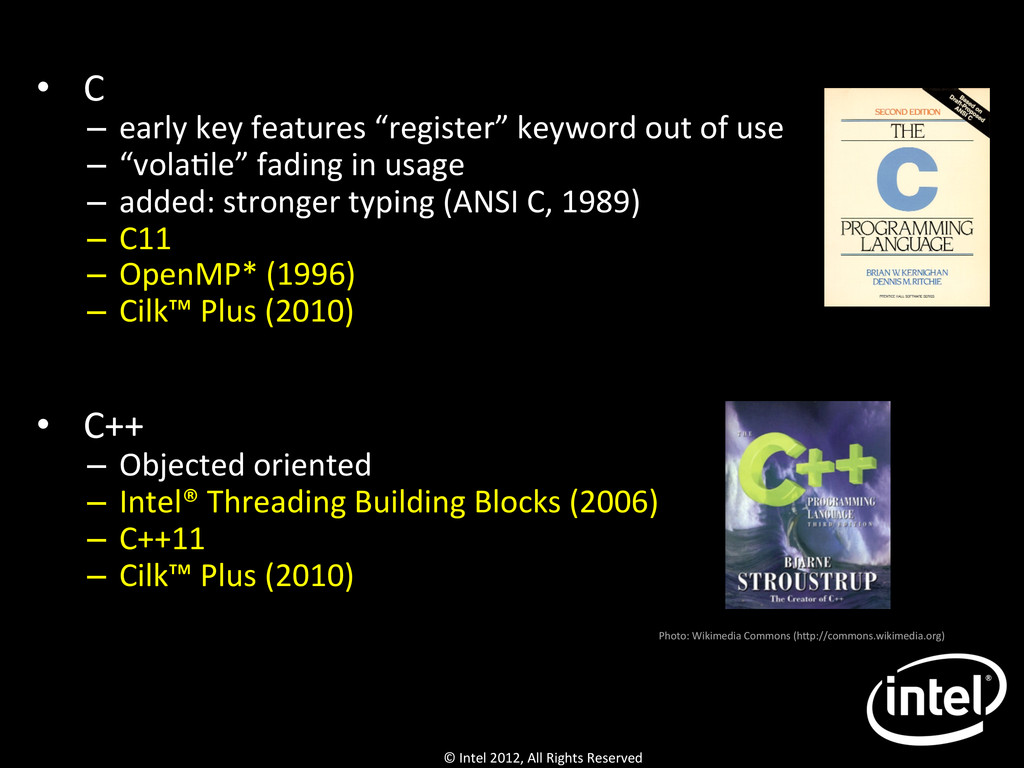
– early key features “register” keyword out of use – “volaQle” fading in usage – added: stronger typing (ANSI C, 1989) – C11 – OpenMP* (1996) – Cilk™ Plus (2010) • C++ – Objected oriented – Intel® Threading Building Blocks (2006) – C++11 – Cilk™ Plus (2010) 16 Photo: Wikimedia Commons (hXp://commons.wikimedia.org) -
© Intel 2012, All Rights Reserved C++11 (some applies
to C11 also) Core language runQme performance enhancements • Rvalue references and move constructors • Generalized constant expressions • ModificaQon to the definiQon of plain old data Core language build Qme performance enhancements • Extern template Core language usability enhancements • IniQalizer lists • Uniform iniQalizaQon • Type inference • Range-‐based for-‐loop • Lambda funcQons and expressions • AlternaQve funcQon syntax • Object construcQon improvement • Explicit overrides and final • Null pointer constant • Strongly typed enumeraQons • Right angle bracket • Explicit conversion operators • Alias templates • Unrestricted unions Core language funcQonality improvements • Variadic templates • New string literals • User-‐defined literals • MulQthreading memory model • Thread-‐local storage • Explicitly defaulted and deleted special member funcQons • Type long long int • StaQc asserQons • Allow sizeof to work on members of classes without an explicit object • Control and query object alignment • Allow garbage collected implementaQons C++ standard library changes • Upgrades to standard library components • Threading faciliQes • Tuple types • Hash tables • Regular expressions • General-‐purpose smart pointers • Extensible random number facility • Wrapper reference • Polymorphic wrappers for funcQon objects • Type traits for metaprogramming • Uniform method for compuQng the return type of funcQon objects Some material adopted from wikipedia.org futures & promises, async defining visibility of stores anonymous funcQons -
© Intel 2012, All Rights Reserved What about futures
& promises? future : think of as a consumer end of a 1-‐element produce/consumer queue • A future can be created only from an exisQng promise object. • Producer computes the value: calls set_value() on the promise. • Consumer needs the future value: it calls get() on the future. • Consumer blocks waiQng on the producer if producer has not yet set_value(). • Futures can be used via the async() member funcQon. double foo(double arg); // consider normal funcQon // You can execute foo(x) asynchronously by calling std::future<double> result = std::async(foo, x); … double val = result.get(); -
© Intel 2012, All Rights Reserved What about futures
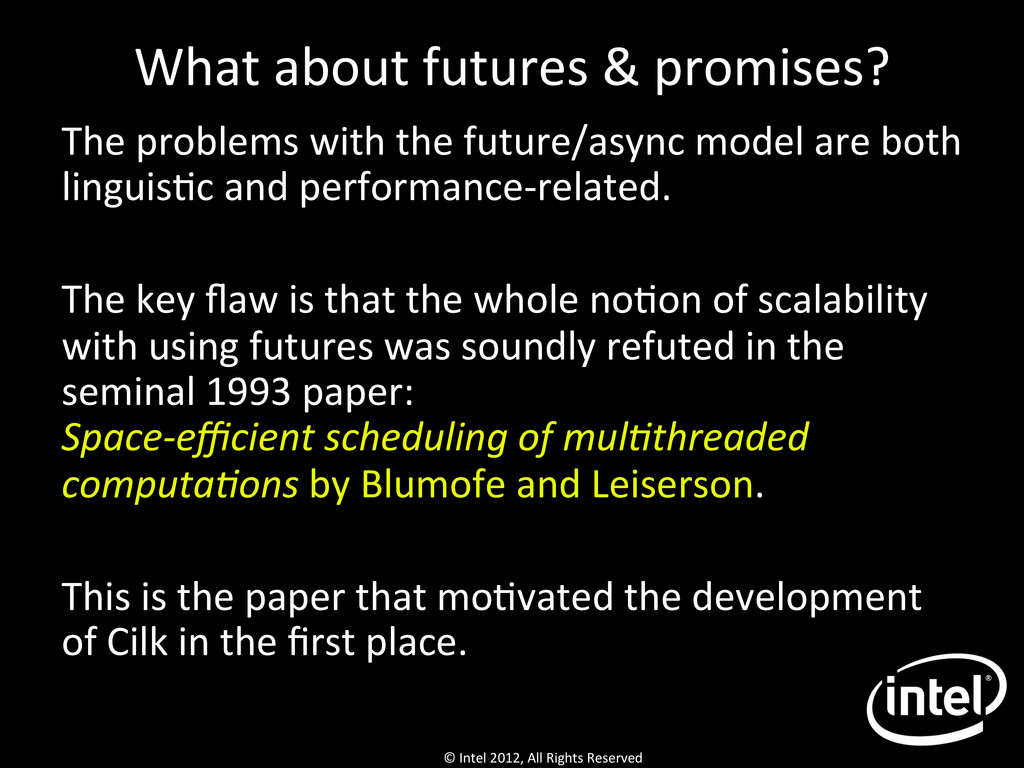
& promises? The problems with the future/async model are both linguisQc and performance-‐related. The key flaw is that the whole noQon of scalability with using futures was soundly refuted in the seminal 1993 paper: Space-‐efficient scheduling of mulBthreaded computaBons by Blumofe and Leiserson. This is the paper that moQvated the development of Cilk in the first place. -
© Intel 2012, All Rights Reserved What about futures
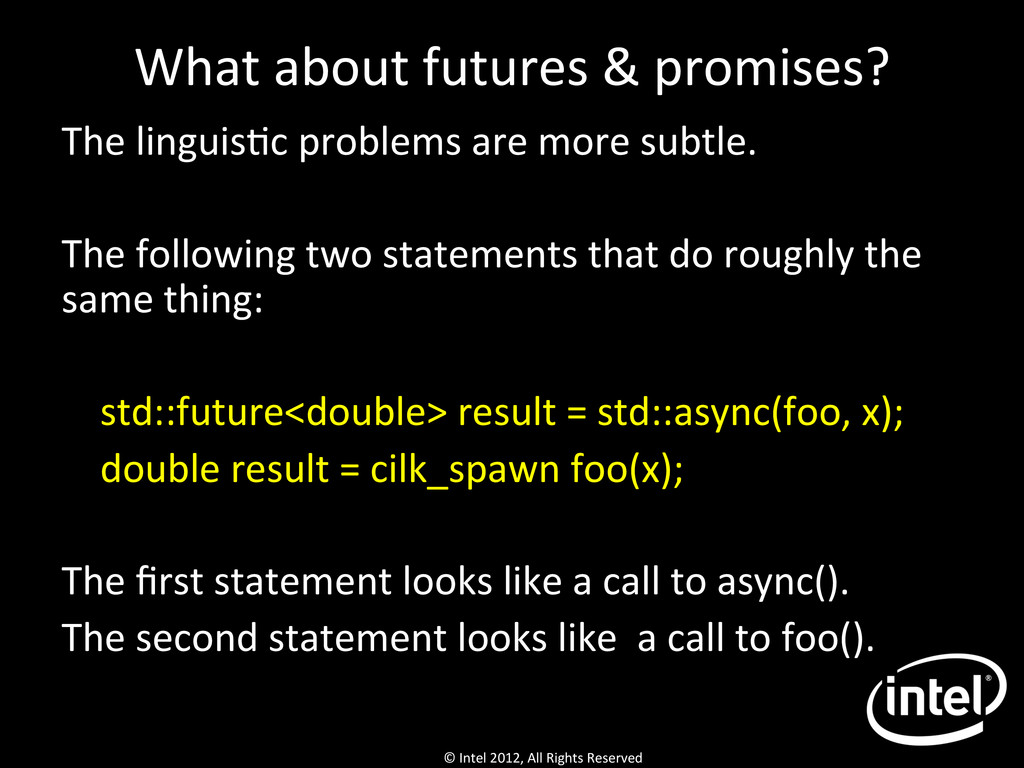
& promises? The linguisQc problems are more subtle. The following two statements that do roughly the same thing: std::future<double> result = std::async(foo, x); double result = cilk_spawn foo(x); The first statement looks like a call to async(). The second statement looks like a call to foo(). -
© Intel 2012, All Rights Reserved What about futures
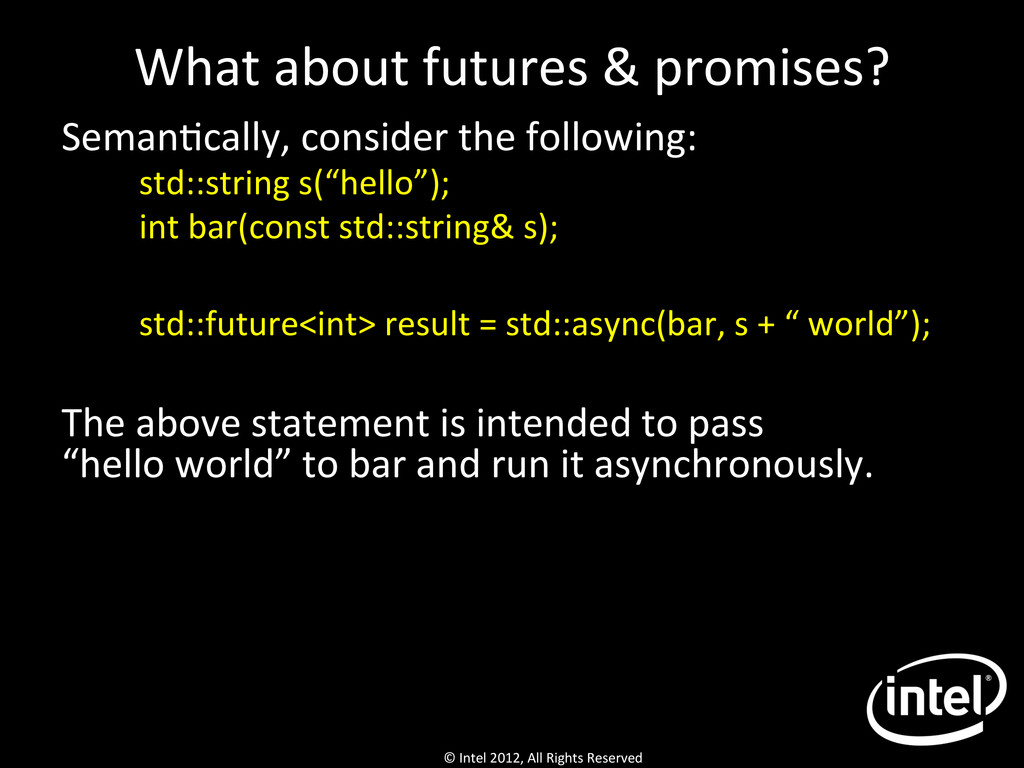
& promises? SemanQcally, consider the following: std::string s(“hello”); int bar(const std::string& s); std::future<int> result = std::async(bar, s + “ world”); The above statement is intended to pass “hello world” to bar and run it asynchronously. The problem is that s + “ world” is a temporary object that gets destroyed as soon as the statement completes. -
© Intel 2012, All Rights Reserved What about futures
& promises? SemanQcally, consider the following: std::string s(“hello”); int bar(const std::string& s); std::future<int> result = std::async(bar, s + “ world”); The above statement is intended to pass “hello world” to bar and run it asynchronously. The problem is that s + “ world” is a temporary object that gets destroyed as soon as the statement completes. -
© Intel 2012, All Rights Reserved What about futures
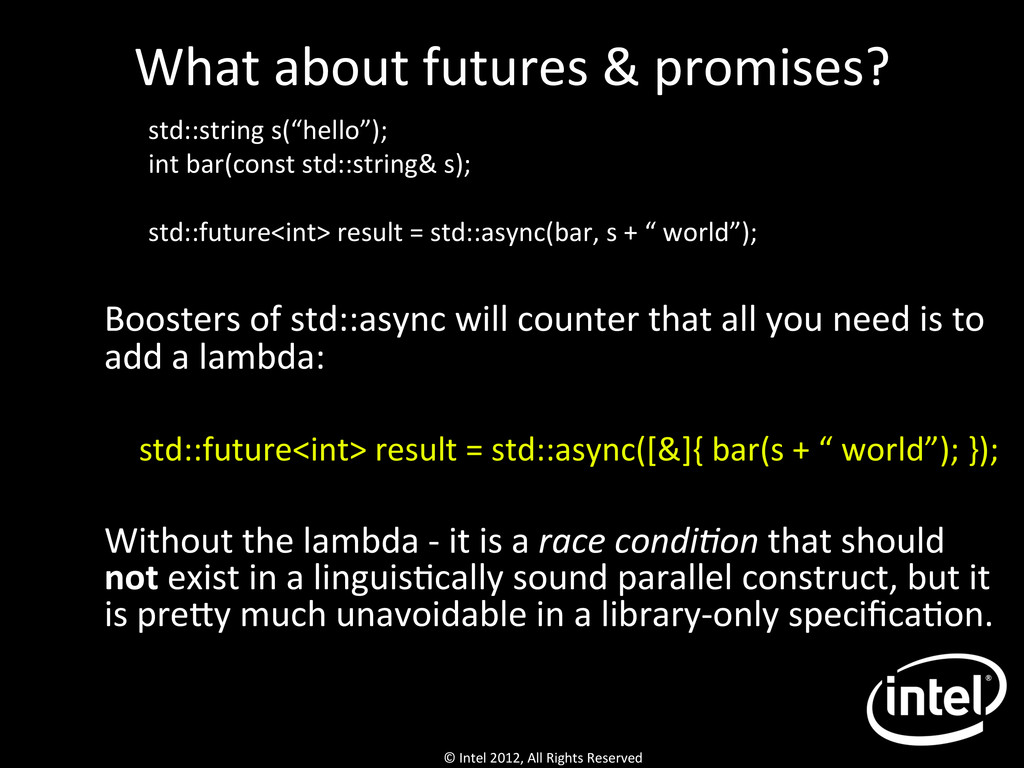
& promises? std::string s(“hello”); int bar(const std::string& s); std::future<int> result = std::async(bar, s + “ world”); Boosters of std::async will counter that all you need is to add a lambda: std::future<int> result = std::async([&]{ bar(s + “ world”); }); Without the lambda -‐ it is a race condiBon that should not exist in a linguisQcally sound parallel construct, but it is preXy much unavoidable in a library-‐only specificaQon. -
© Intel 2012, All Rights Reserved Let’s fix C
and C++ and the soluQon is NOT OpenMP and the soluQon is NOT CUDA and the soluQon is NOT OpenCL -
© Intel 2012, All Rights Reserved Let’s fix C
and C++ and the soluQon is NOT OpenMP and the soluQon is NOT CUDA and the soluQon is NOT OpenCL for starters, none of them are “composable” -
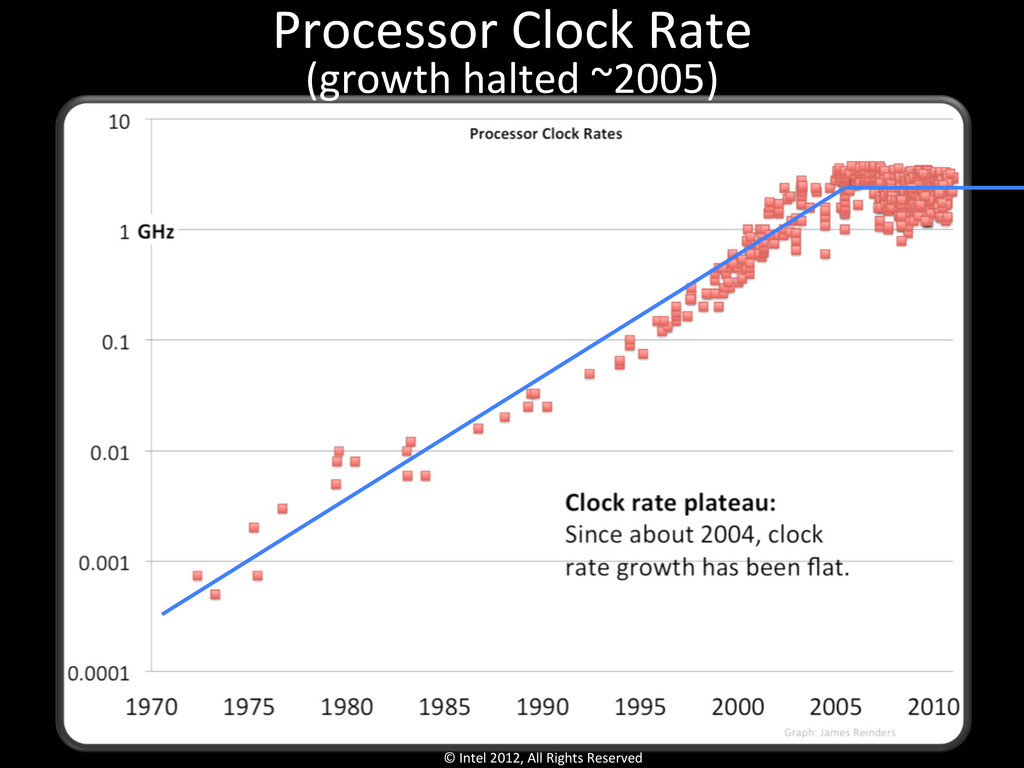
© Intel 2012, All Rights Reserved Processor Clock Rate
(growth halted ~2005) -
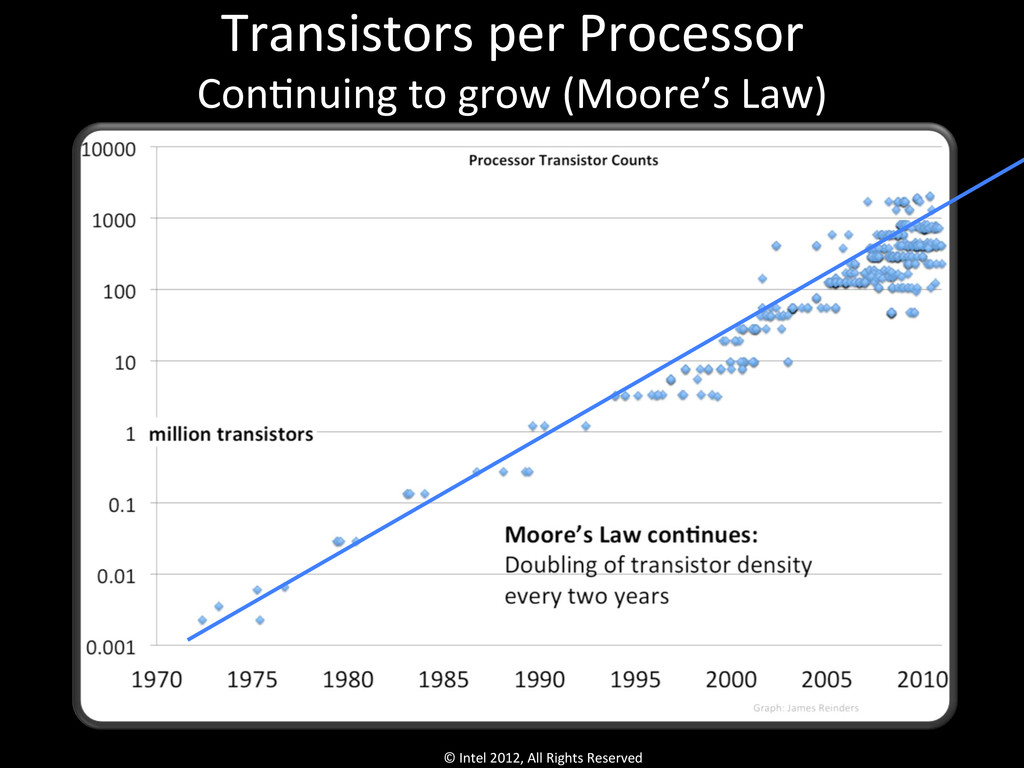
© Intel 2012, All Rights Reserved Transistors per Processor
ConQnuing to grow (Moore’s Law) -
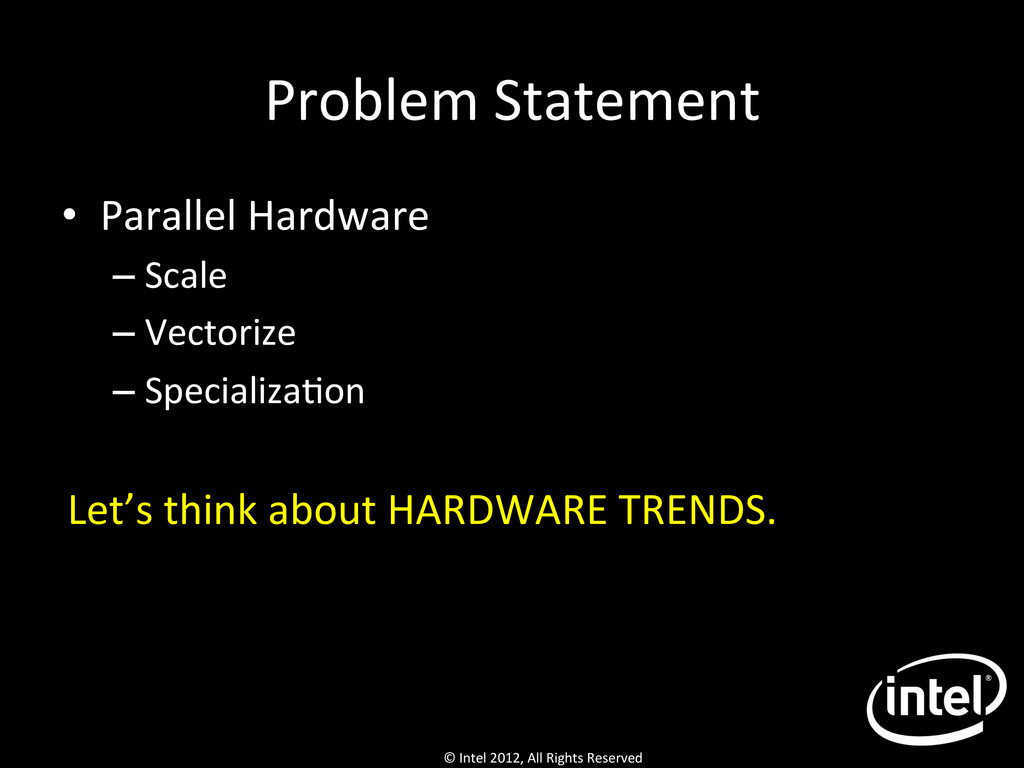
© Intel 2012, All Rights Reserved Problem Statement
• Parallel Hardware – Scale – Vectorize – SpecializaQon -
© Intel 2012, All Rights Reserved Problem Statement
• Parallel Hardware – Scale – Vectorize – SpecializaQon Let’s think about HARDWARE TRENDS. -
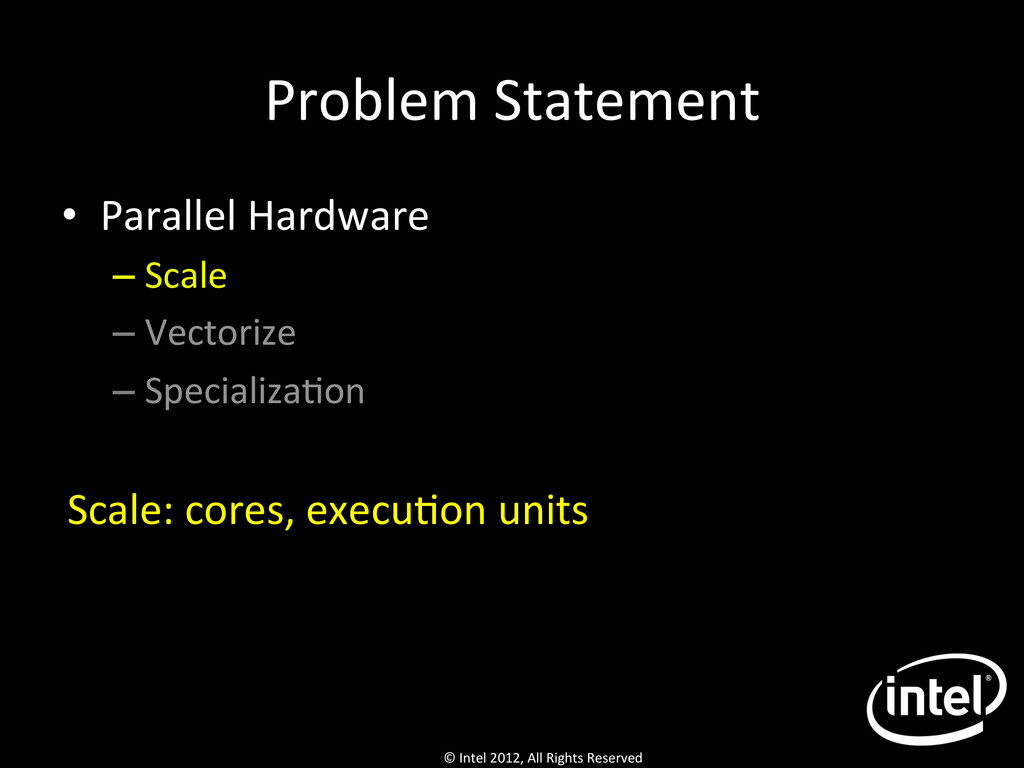
© Intel 2012, All Rights Reserved Problem Statement
• Parallel Hardware – Scale – Vectorize – SpecializaQon Scale: cores, execuQon units -
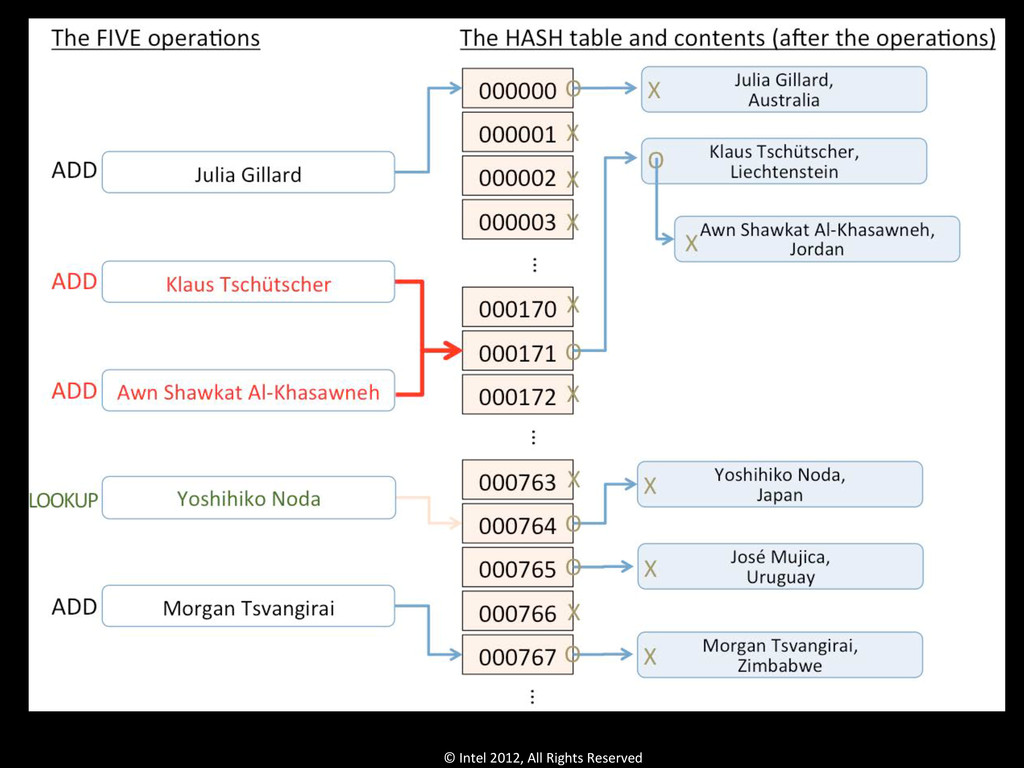
© Intel 2012, All Rights Reserved Locks
Kill Scaling o•en -
© Intel 2012, All Rights Reserved TransacQonal SynchronizaQon Extensions
• a beauQful example of HARDWARE making life “simple again” helping CONCURRENCY / PARALLEL PROGRAMMING • HLE is a hint inserted in front of a LOCK operaQon to indicate a region is a candidate for lock elision – XACQUIRE (0xF2) and XRELEASE (0xF3) prefixes – Don’t actually acquire lock, but execute region speculaQvely – Hardware buffers loads and stores, checkpoints registers – Hardware aXempts to commit atomically without locks – If cannot do without locks, restart, execute non-‐speculaQvely • RTM is three new instrucQons (XBEGIN, XEND, XABORT) – Similar operaQon as HLE (except no locks, new ISA) – If cannot commit atomically, go to handler indicated by XBEGIN – Provides so•ware addiQonal capabiliQes over HLE -
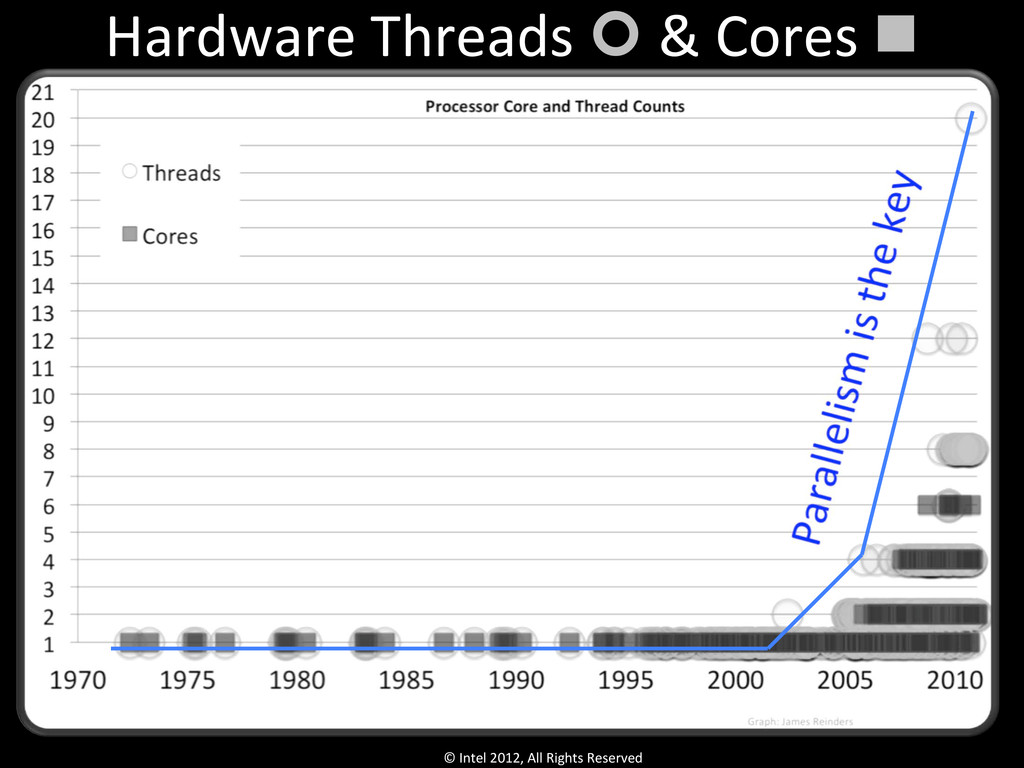
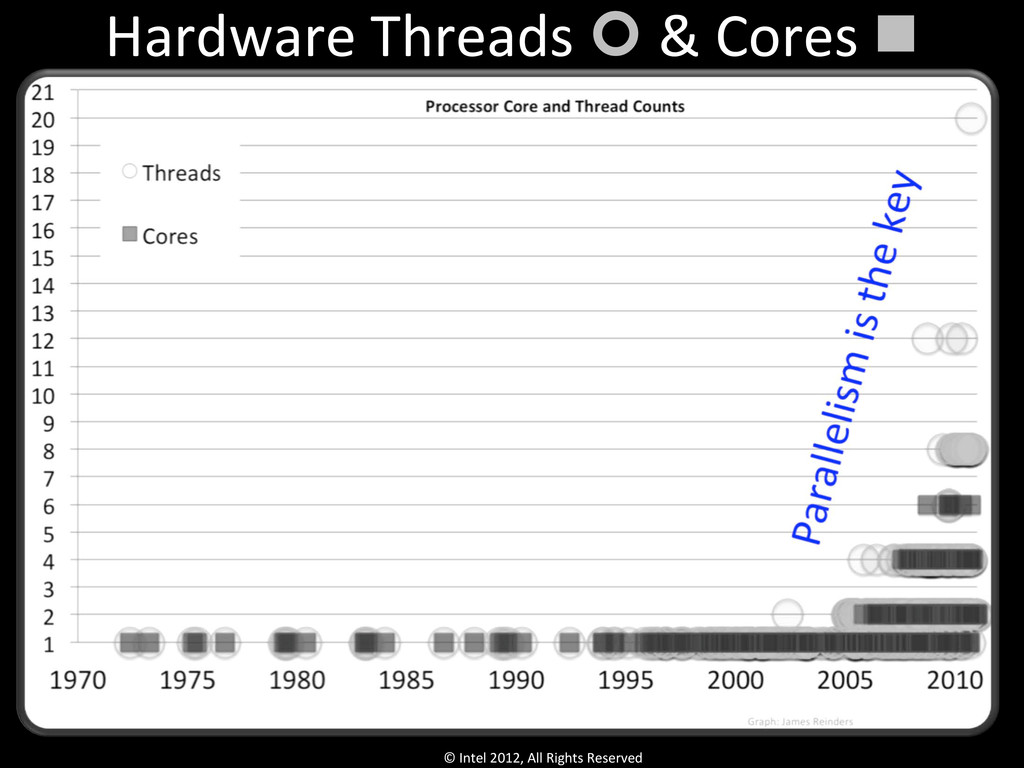
© Intel 2012, All Rights Reserved Hardware Threads ¢
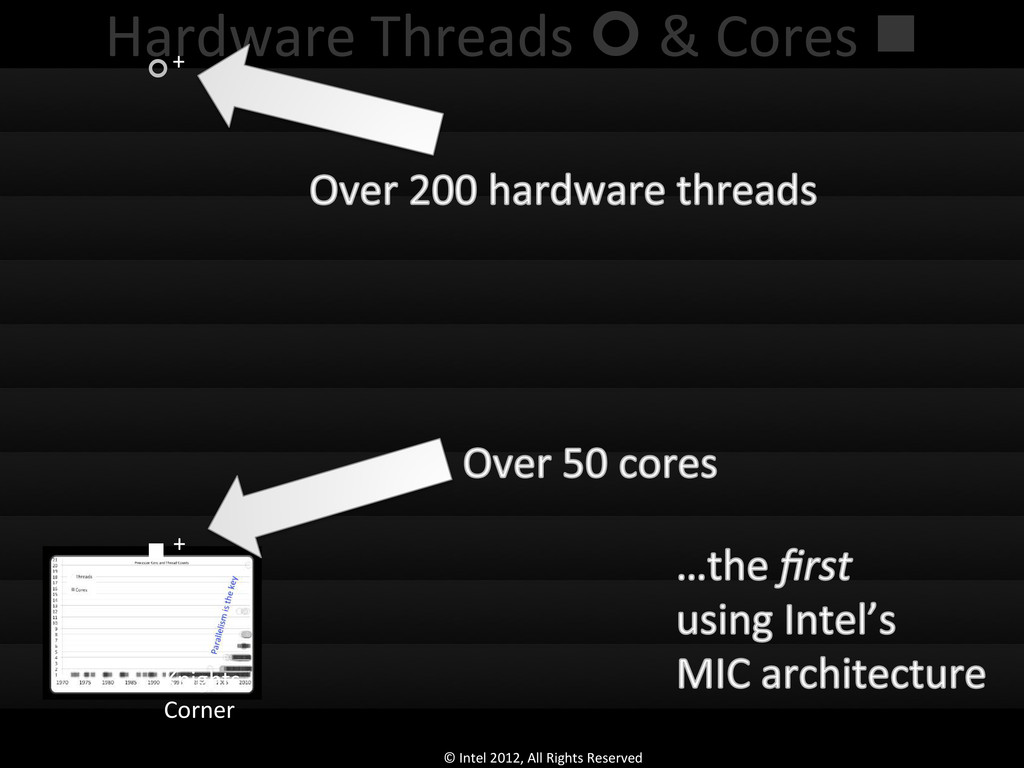
& Cores n ¢ n + + Knights Corner -
© Intel 2012, All Rights Reserved 1996 1996
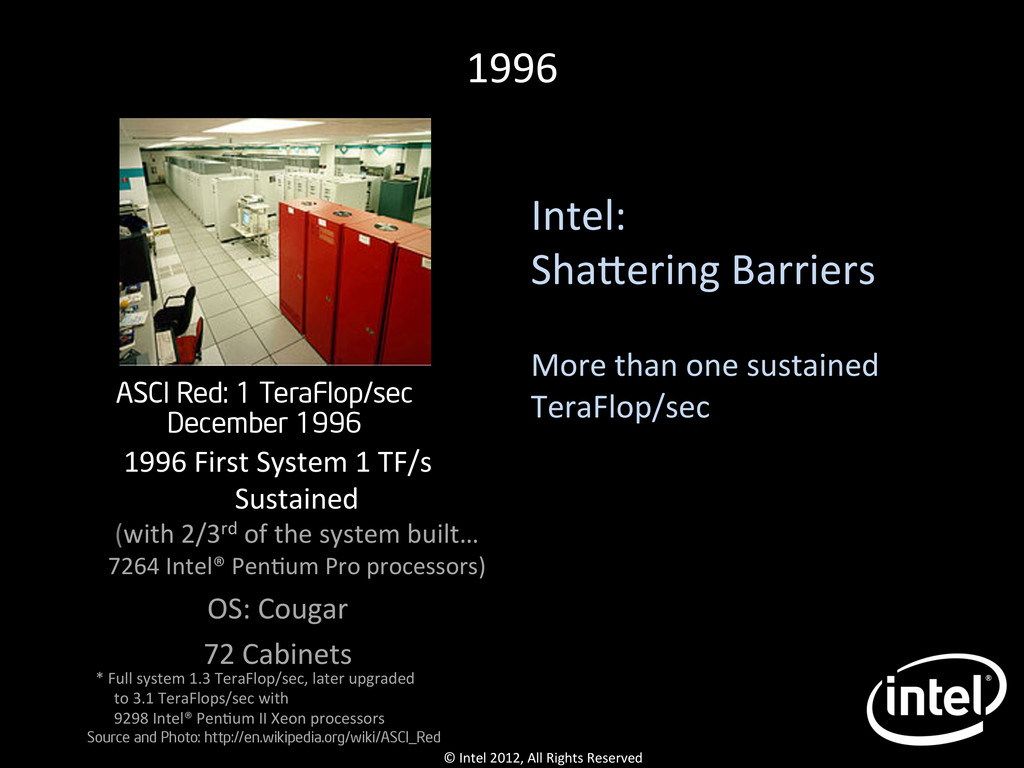
First System 1 TF/s Sustained (with 2/3rd of the system built… 7264 Intel® PenQum Pro processors) OS: Cougar 72 Cabinets 2011 First Chip 1 TF/s Sustained One 22nm Chip OS: Linux* One PCI express slot ASCI Red: 1 TeraFlop/sec December 1996 Knights Corner: 1 TeraFlop/sec November 2011 Source and Photo: http://en.wikipedia.org/wiki/ASCI_Red * Full system 1.3 TeraFlop/sec, later upgraded to 3.1 TeraFlops/sec with 9298 Intel® PenQum II Xeon processors * Other names and brands may be claimed as the property of others. Intel: ShaXering Barriers More than one sustained TeraFlop/sec -
© Intel 2012, All Rights Reserved 2011 1996
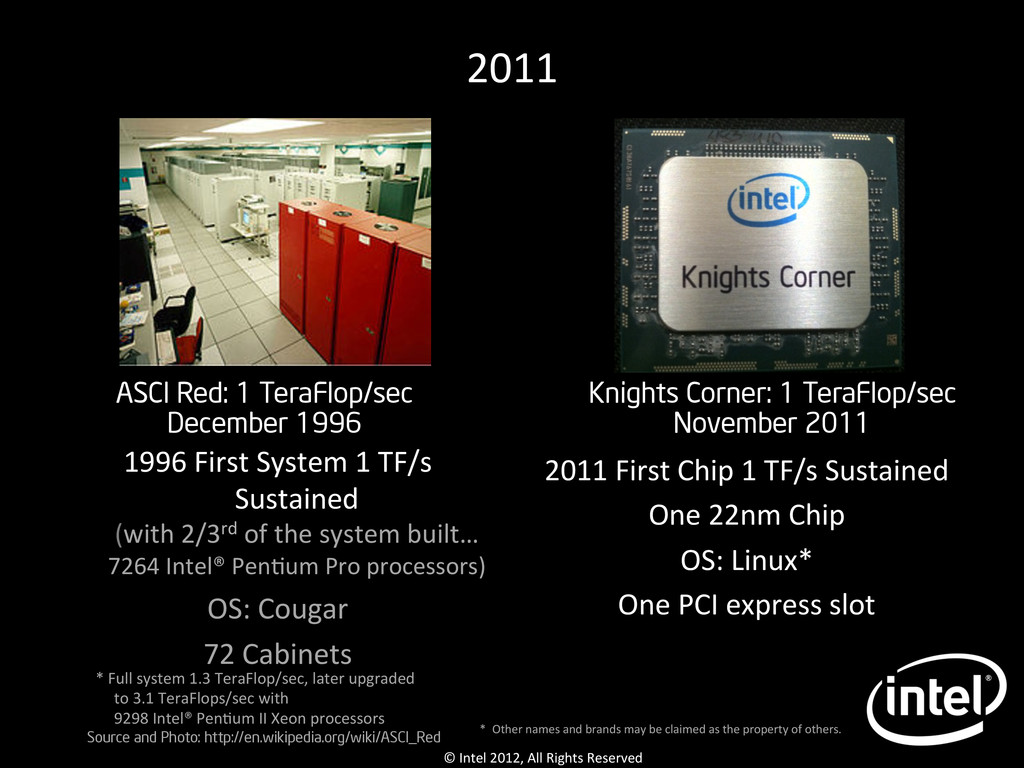
First System 1 TF/s Sustained (with 2/3rd of the system built… 7264 Intel® PenQum Pro processors) OS: Cougar 72 Cabinets 2011 First Chip 1 TF/s Sustained One 22nm Chip OS: Linux* One PCI express slot ASCI Red: 1 TeraFlop/sec December 1996 Knights Corner: 1 TeraFlop/sec November 2011 Source and Photo: http://en.wikipedia.org/wiki/ASCI_Red * Full system 1.3 TeraFlop/sec, later upgraded to 3.1 TeraFlops/sec with 9298 Intel® PenQum II Xeon processors * Other names and brands may be claimed as the property of others. -
© Intel 2012, All Rights Reserved www.threadingbuildingblocks.org ü
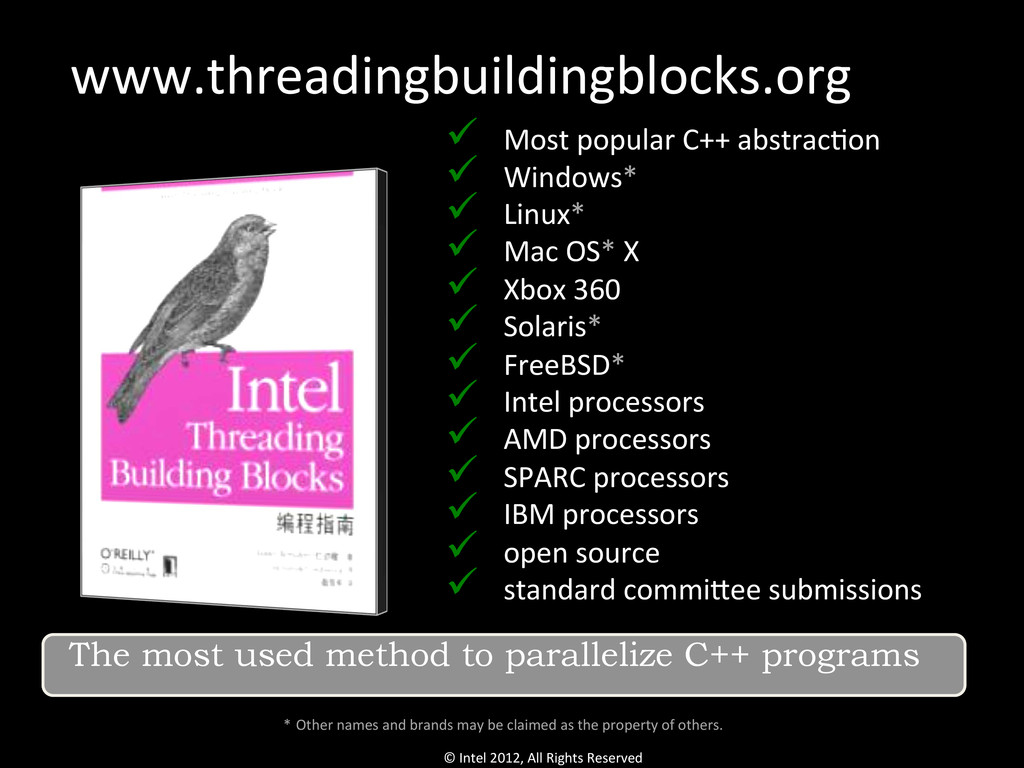
Most popular C++ abstracQon ü Windows* ü Linux* ü Mac OS* X ü Xbox 360 ü Solaris* ü FreeBSD* ü Intel processors ü AMD processors ü SPARC processors ü IBM processors ü open source ü standard commiXee submissions The most used method to parallelize C++ programs * Other names and brands may be claimed as the property of others. -
© Intel 2012, All Rights Reserved Intel® Threading Building
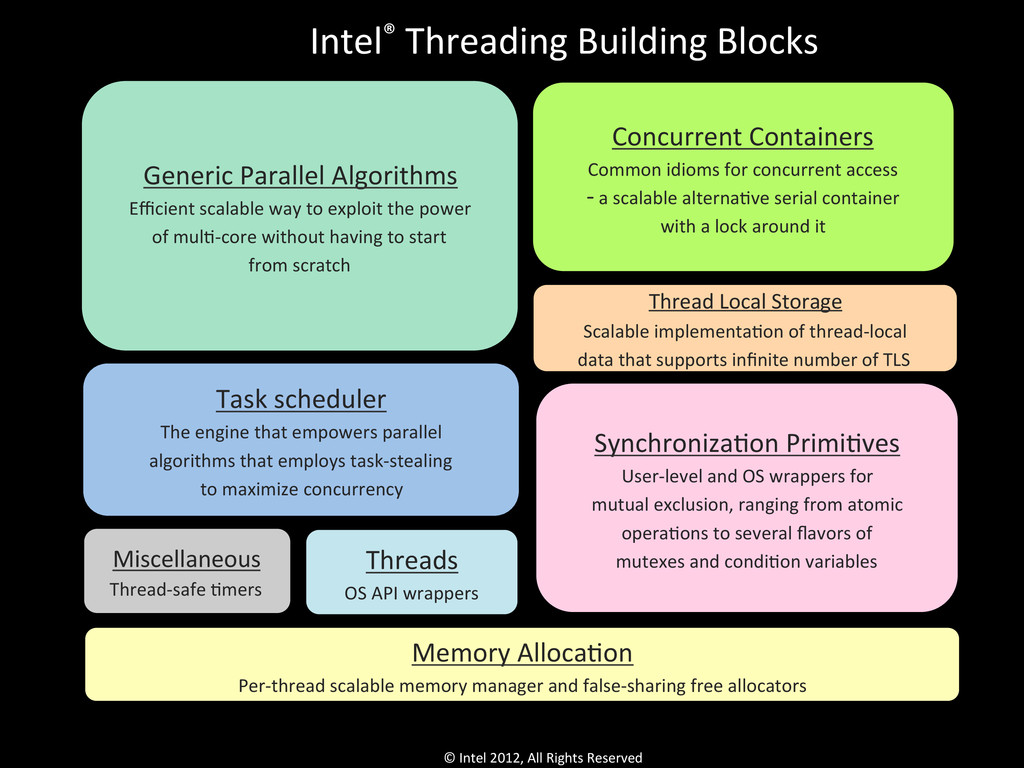
Blocks Concurrent Containers Common idioms for concurrent access -‐ a scalable alternaQve serial container with a lock around it Miscellaneous Thread-‐safe Qmers Generic Parallel Algorithms Efficient scalable way to exploit the power of mulQ-‐core without having to start from scratch Task scheduler The engine that empowers parallel algorithms that employs task-‐stealing to maximize concurrency SynchronizaQon PrimiQves User-‐level and OS wrappers for mutual exclusion, ranging from atomic operaQons to several flavors of mutexes and condiQon variables Memory AllocaQon Per-‐thread scalable memory manager and false-‐sharing free allocators Threads OS API wrappers Thread Local Storage Scalable implementaQon of thread-‐local data that supports infinite number of TLS -
© Intel 2012, All Rights Reserved Scale Forward
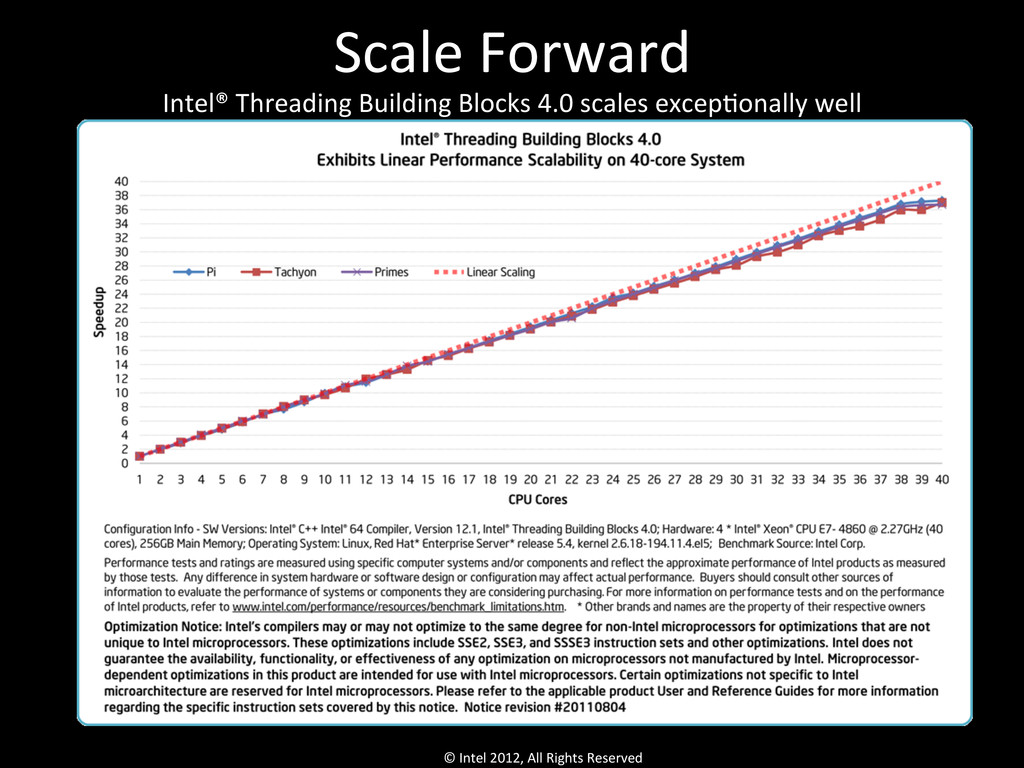
Intel® Threading Building Blocks 4.0 scales excepQonally well -
© Intel 2012, All Rights Reserved Intel® TBB Class
Graph: Components New Feature as of TBB 4.0 Release (2011) • Graph object – Contains a pointer to the root task – Owns tasks created on behalf of the graph – Users can wait for the compleQon of all tasks of the graph • Graph nodes – Implement sender and/or receiver interfaces – Nodes manage messages and/or execute funcQon objects • Edges – Connect predecessors to successors Graph object == graph handle Graph node Edge -
© Intel 2012, All Rights Reserved threadingbuildingblocks.org TBB
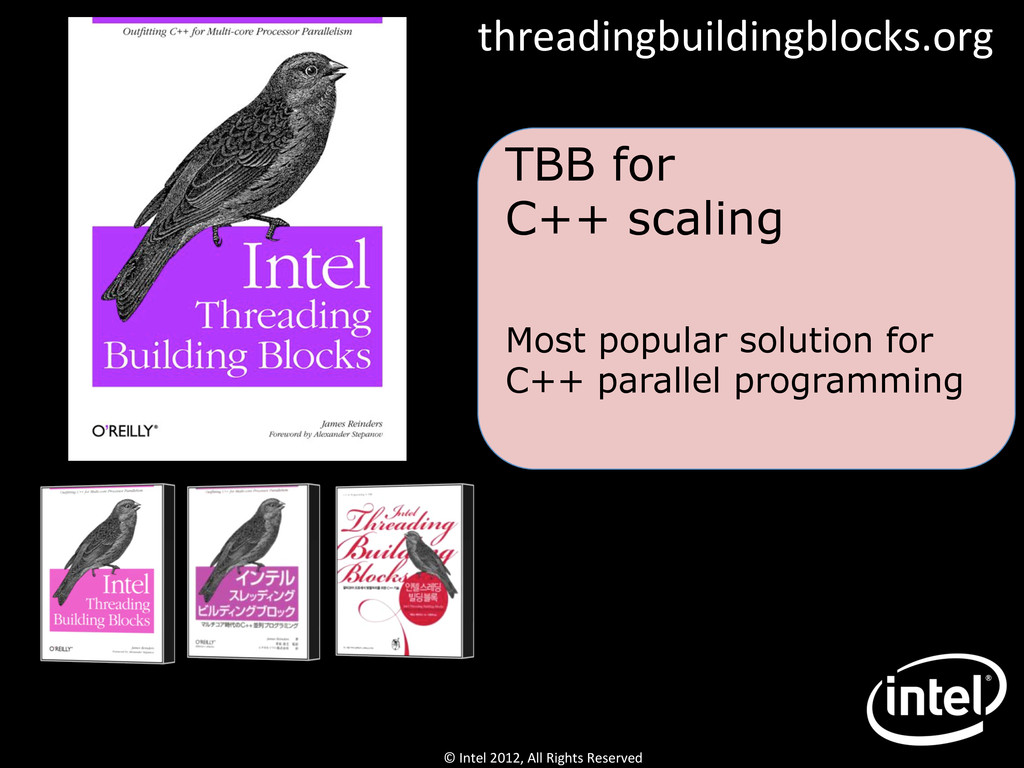
for C++ scaling Most popular solution for C++ parallel programming -
© Intel 2012, All Rights Reserved threadingbuildingblocks.org cilkplus.org
TBB has a “sister” Cilk™ Plus: • Help for C programmers • Involve compiler • Vectorization support -
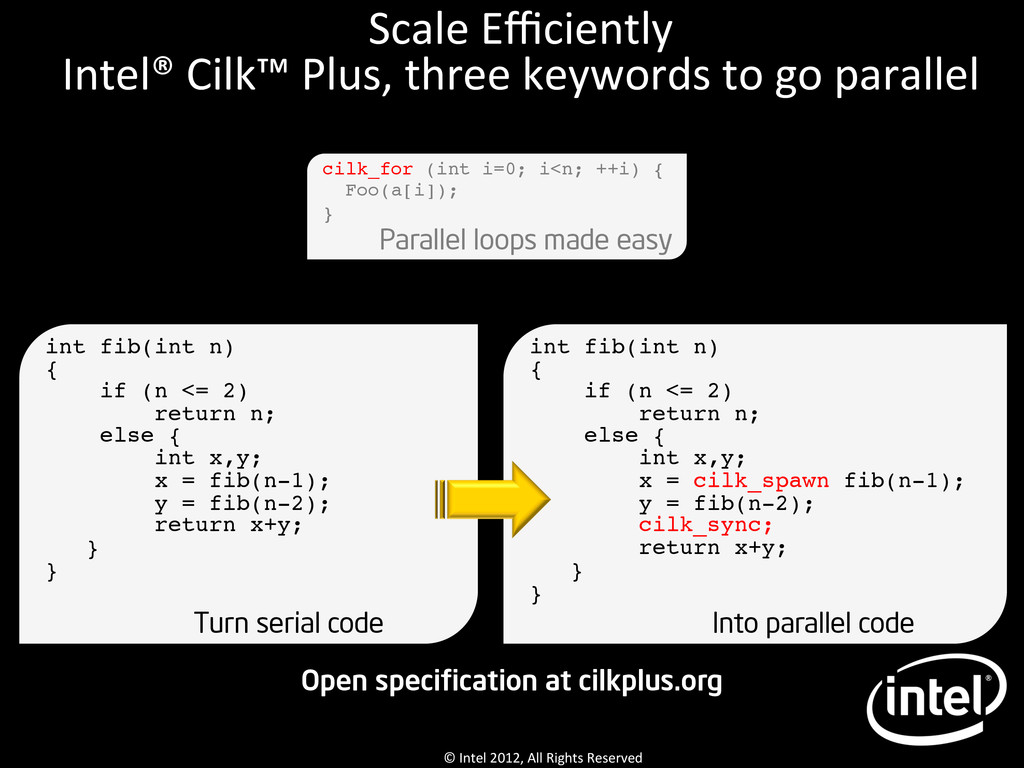
© Intel 2012, All Rights Reserved Scale Efficiently
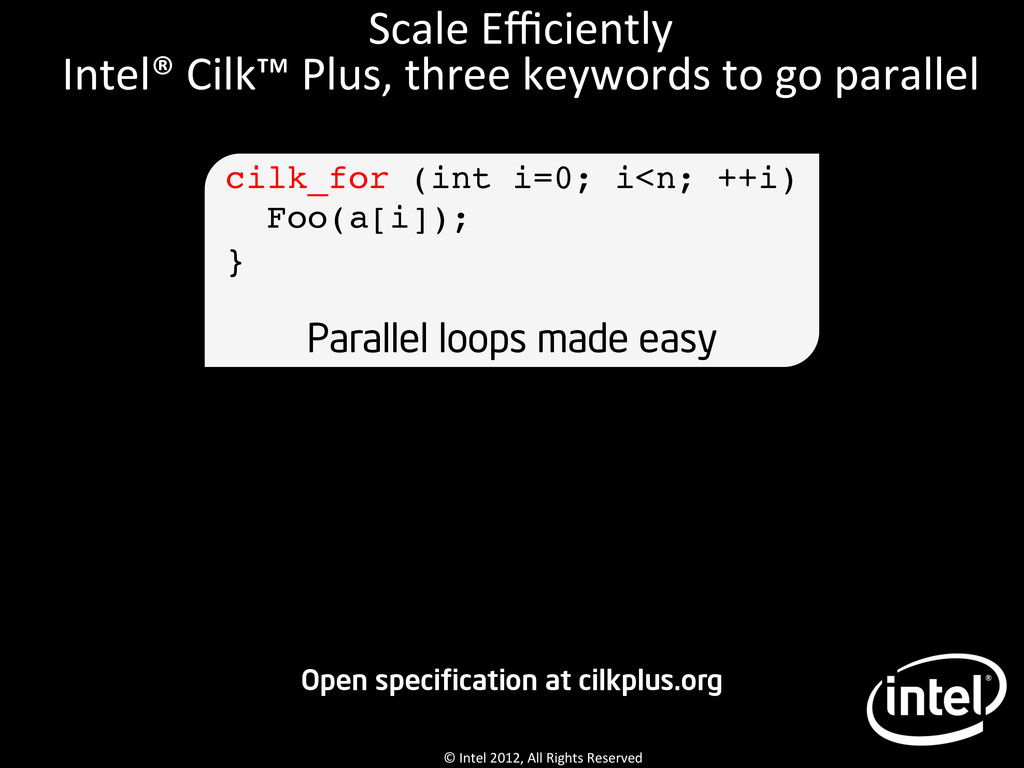
Intel® Cilk™ Plus, three keywords to go parallel cilk_for (int i=0; i<n; ++i) {! Foo(a[i]);! }! Open specification at cilkplus.org Parallel loops made easy -
© Intel 2012, All Rights Reserved Scale Efficiently
Intel® Cilk™ Plus, three keywords to go parallel cilk_for (int i=0; i<n; ++i) {! Foo(a[i]);! }! Open specification at cilkplus.org int fib(int n)! {! if (n <= 2)! return n;! else {! int x,y;! x = fib(n-1);! y = fib(n-2);! return x+y;! }! }! int fib(int n)! {! if (n <= 2)! return n;! else {! int x,y;! x = cilk_spawn fib(n-1);! y = fib(n-2);! cilk_sync;! return x+y;! }! }! Turn serial code Into parallel code Parallel loops made easy -
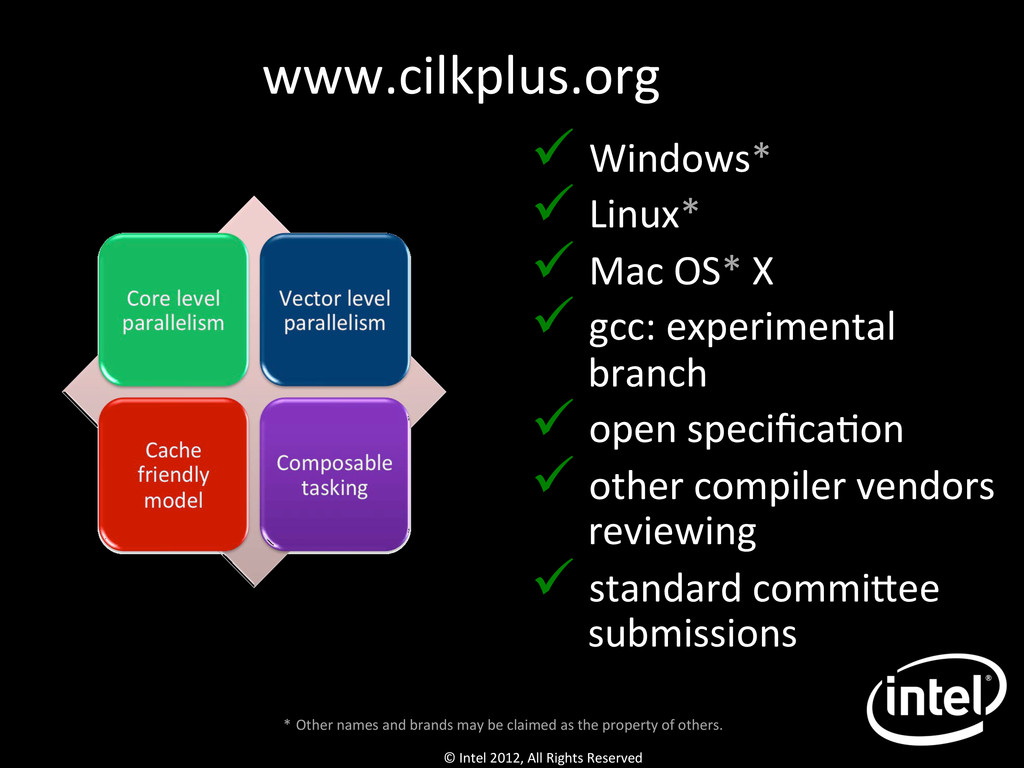
© Intel 2012, All Rights Reserved www.cilkplus.org ü Windows*
ü Linux* ü Mac OS* X ü gcc: experimental branch ü open specificaQon ü other compiler vendors reviewing ü standard commiXee submissions * Other names and brands may be claimed as the property of others. -
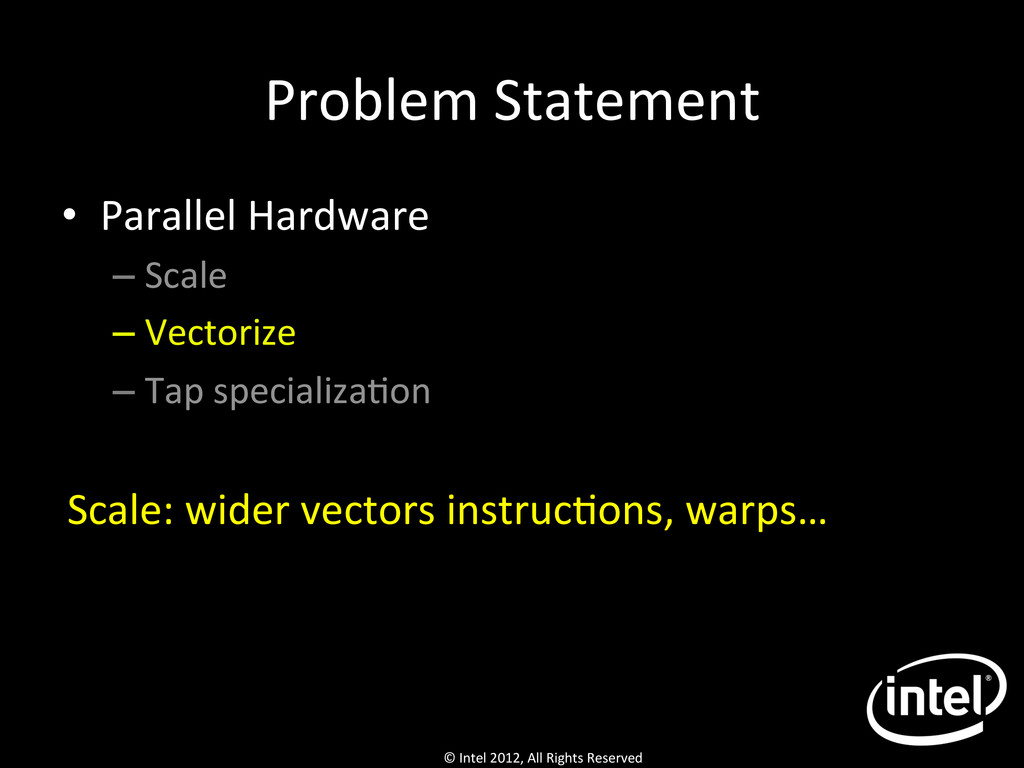
© Intel 2012, All Rights Reserved Problem Statement
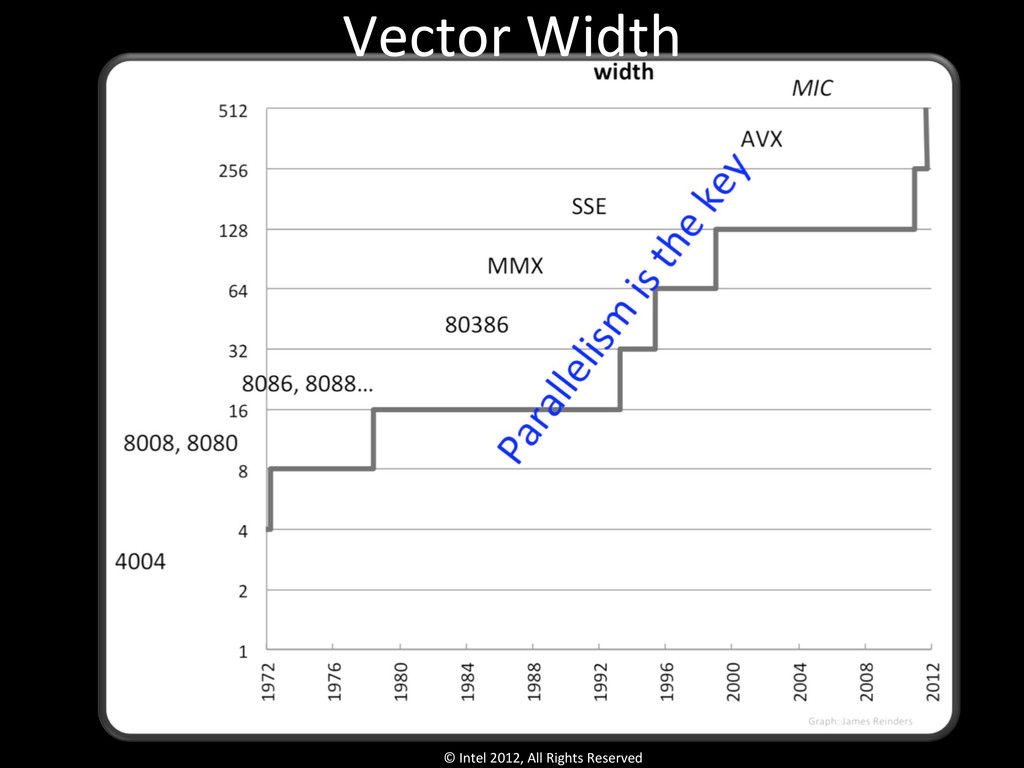
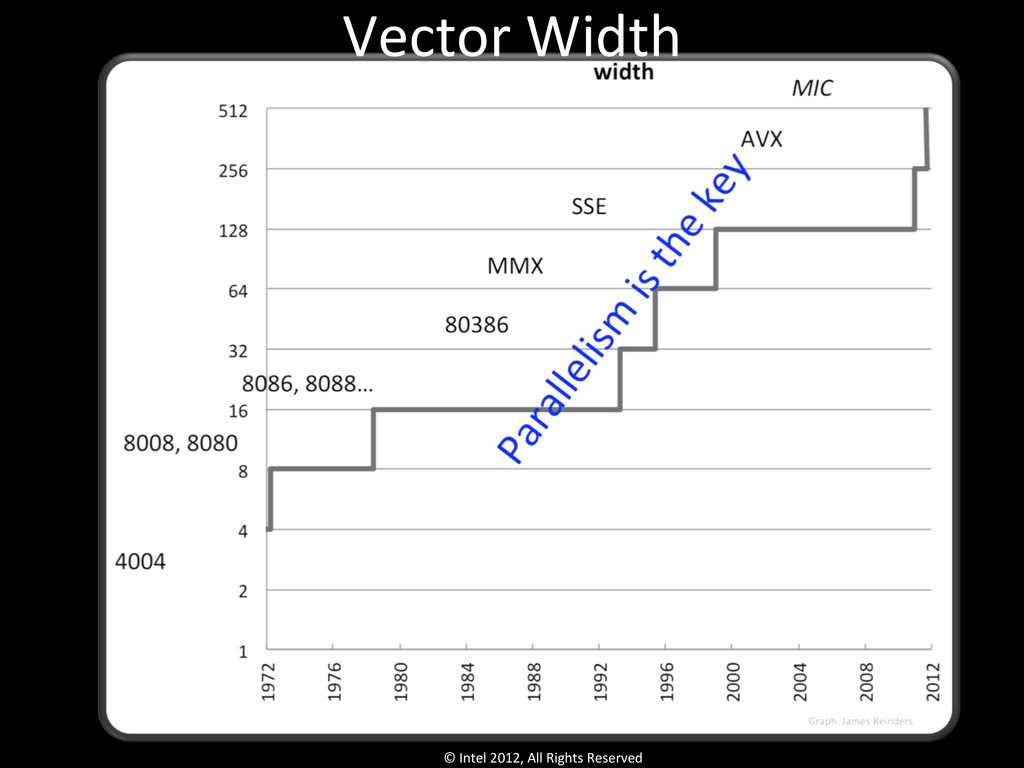
• Parallel Hardware – Scale – Vectorize – Tap specializaQon Scale: wider vectors instrucQons, warps… -
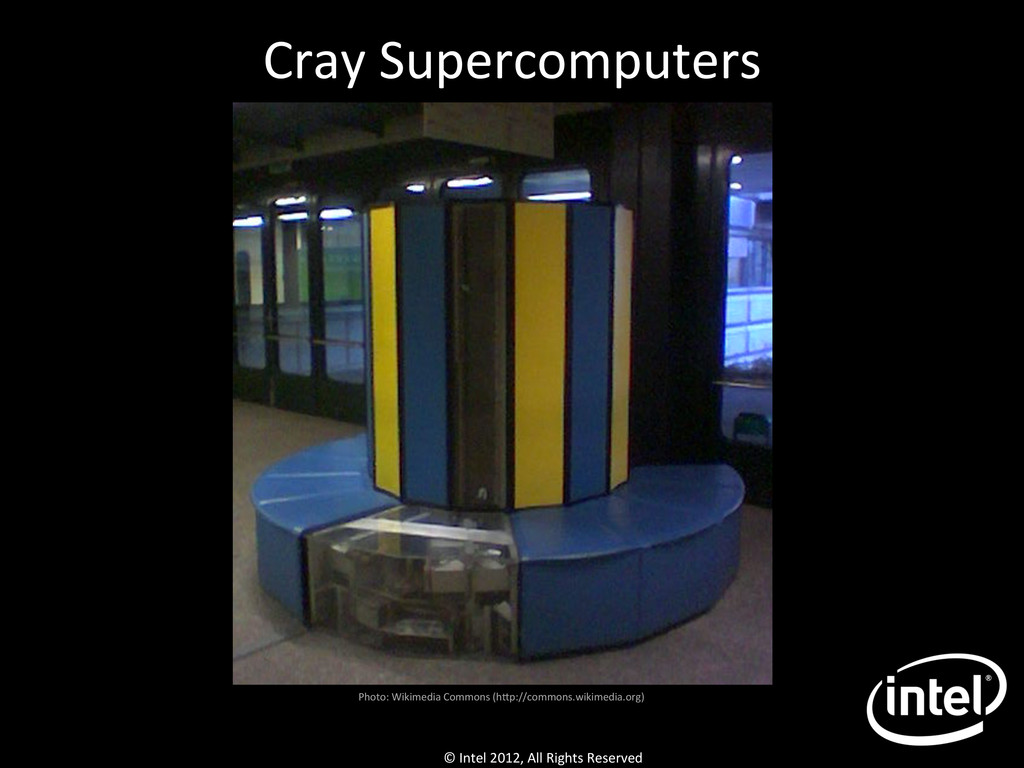
© Intel 2012, All Rights Reserved Cray Supercomputers
Photo: Wikimedia Commons (hXp://commons.wikimedia.org) -
© Intel 2012, All Rights Reserved Auto VectorizaQon: Useful,
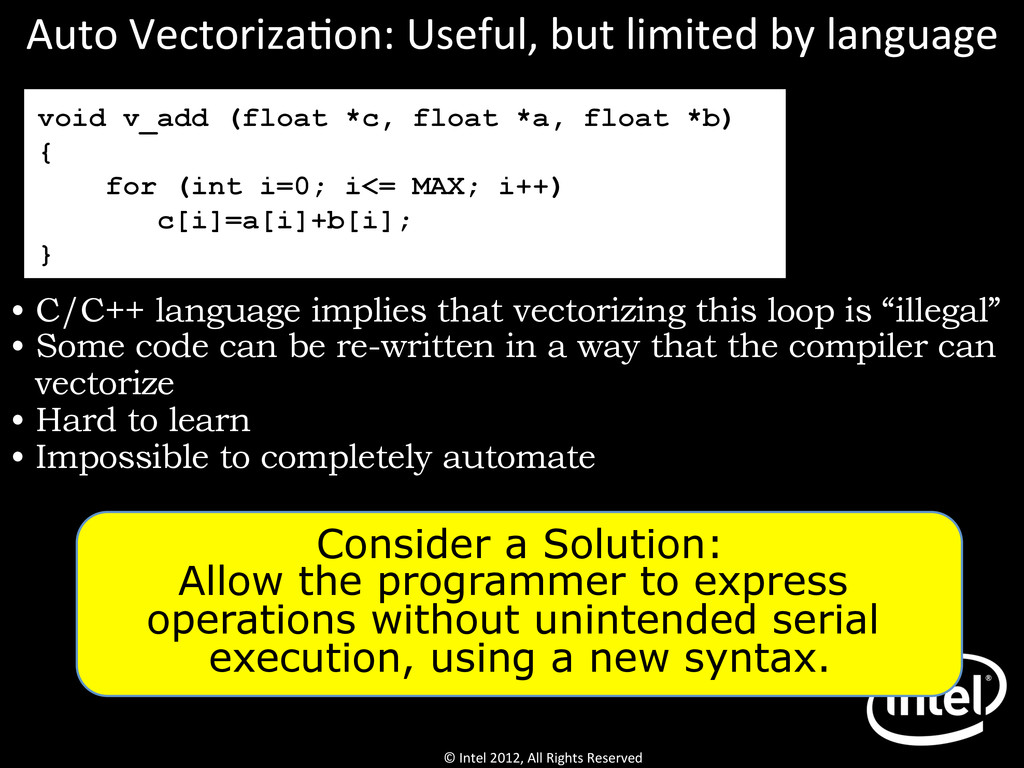
but limited by language void v_add (float *c, float *a, float *b) { for (int i=0; i<= MAX; i++) c[i]=a[i]+b[i]; } • C/C++ language implies that vectorizing this loop is “illegal” • Some code can be re-written in a way that the compiler can vectorize • Hard to learn • Impossible to completely automate Consider a Solution: Allow the programmer to express operations without unintended serial execution, using a new syntax. -
© Intel 2012, All Rights Reserved What went wrong?
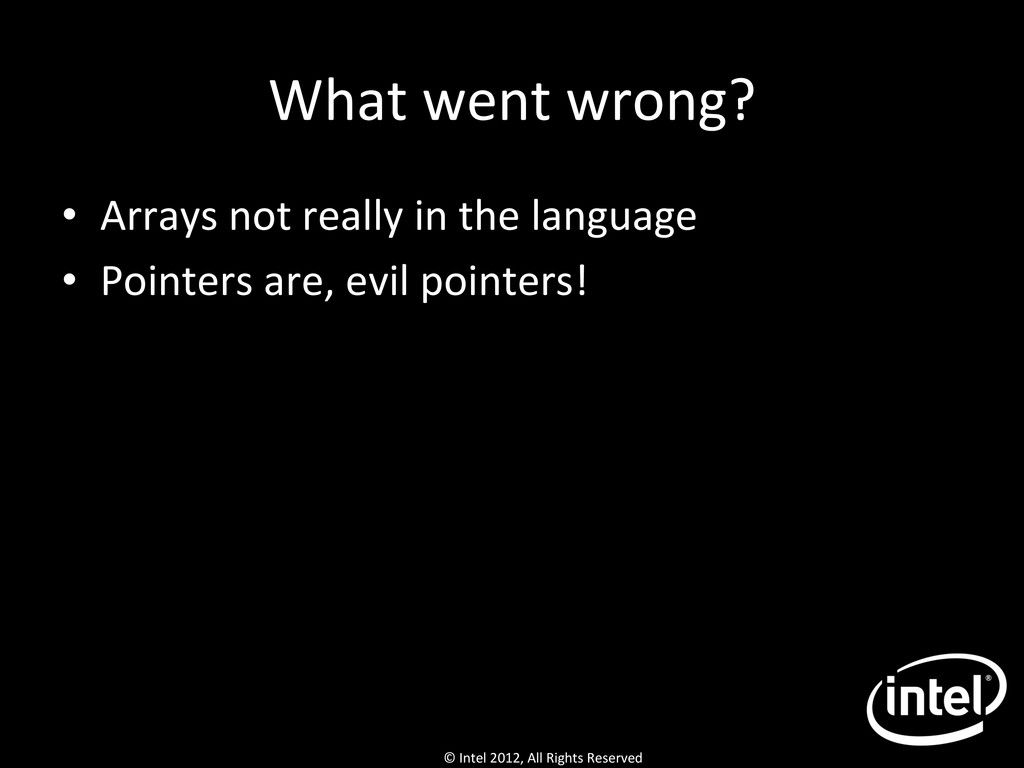
• Arrays not really in language • Pointers are, evil pointers! -
© Intel 2012, All Rights Reserved What went wrong?
• Arrays not really in the language • Pointers are, evil pointers! -
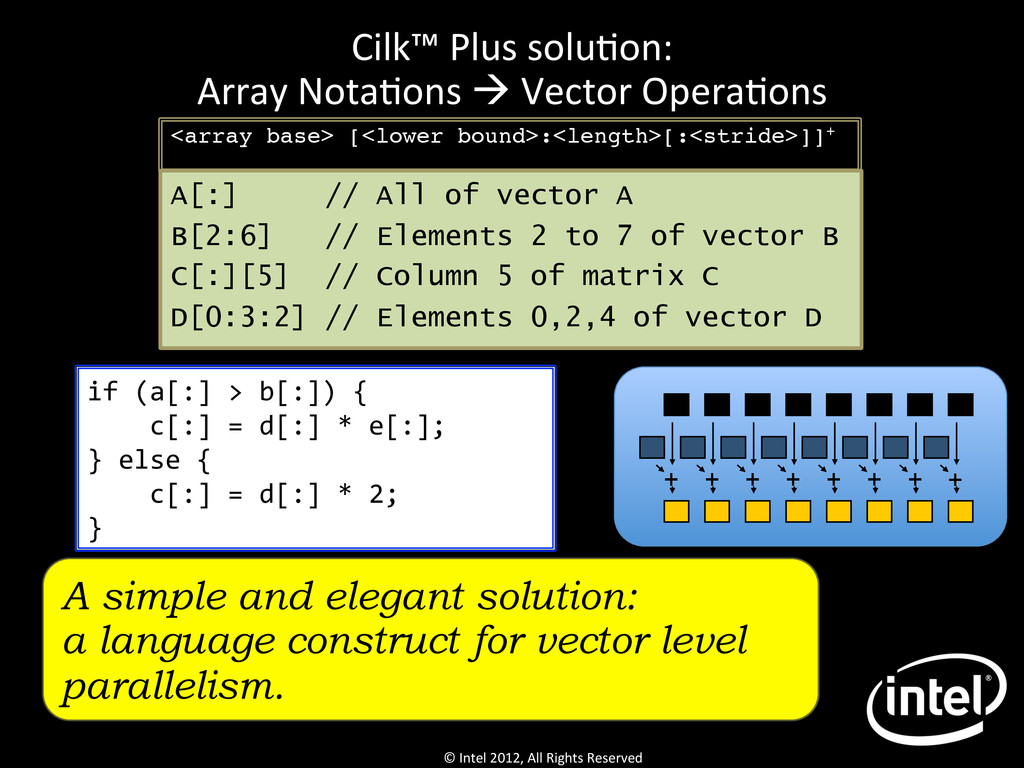
© Intel 2012, All Rights Reserved Cilk™ Plus soluQon:
Array NotaQons à Vector OperaQons <array base> [<lower bound>:<length>[:<stride>]]+ ! A[:] // All of vector A B[2:6] // Elements 2 to 7 of vector B C[:][5] // Column 5 of matrix C D[0:3:2] // Elements 0,2,4 of vector D + + + + + + + + if (a[:] > b[:]) { c[:] = d[:] * e[:]; } else { c[:] = d[:] * 2; } A simple and elegant solution: a language construct for vector level parallelism. -
© Intel 2012, All Rights Reserved BeXer than Intrinsics
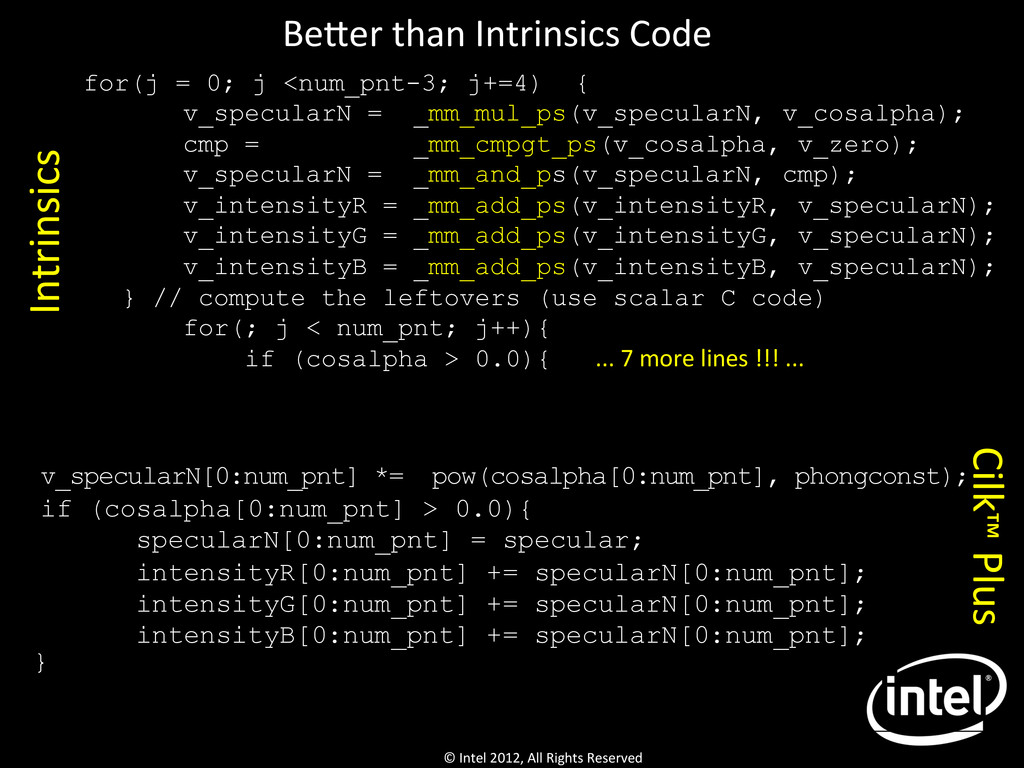
Code for(j = 0; j <num_pnt-3; j+=4) { v_specularN = _mm_mul_ps(v_specularN, v_cosalpha); cmp = _mm_cmpgt_ps(v_cosalpha, v_zero); v_specularN = _mm_and_ps(v_specularN, cmp); v_intensityR = _mm_add_ps(v_intensityR, v_specularN); v_intensityG = _mm_add_ps(v_intensityG, v_specularN); v_intensityB = _mm_add_ps(v_intensityB, v_specularN); } // compute the leftovers (use scalar C code) for(; j < num_pnt; j++){ if (cosalpha > 0.0){ ... 7 more lines !!! ... v_specularN[0:num_pnt] *= pow(cosalpha[0:num_pnt], phongconst); if (cosalpha[0:num_pnt] > 0.0){ specularN[0:num_pnt] = specular; intensityR[0:num_pnt] += specularN[0:num_pnt]; intensityG[0:num_pnt] += specularN[0:num_pnt]; intensityB[0:num_pnt] += specularN[0:num_pnt]; } Cilk™ Plus Intrinsics -
© Intel 2012, All Rights Reserved AddiQonal Cilk Plus
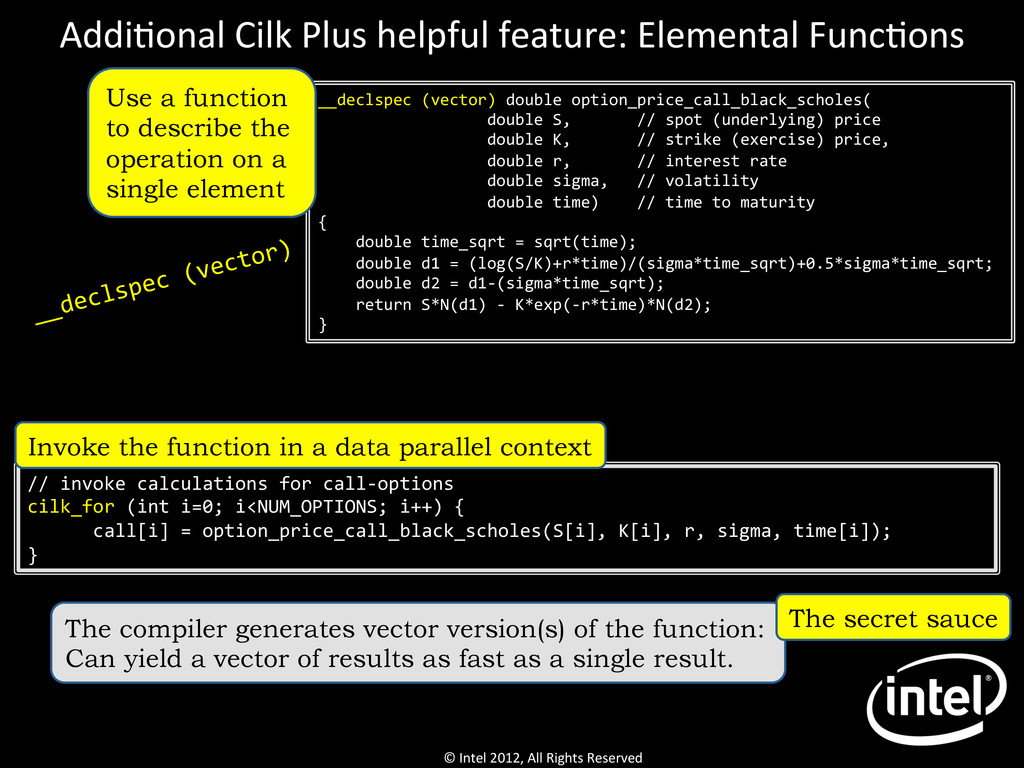
helpful feature: Elemental FuncQons __declspec (vector) __declspec (vector) double option_price_call_black_scholes( double S, // spot (underlying) price double K, // strike (exercise) price, double r, // interest rate double sigma, // volatility double time) // time to maturity { double time_sqrt = sqrt(time); double d1 = (log(S/K)+r*time)/(sigma*time_sqrt)+0.5*sigma*time_sqrt; double d2 = d1-‐(sigma*time_sqrt); return S*N(d1) -‐ K*exp(-‐r*time)*N(d2); } // invoke calculations for call-‐options cilk_for (int i=0; i<NUM_OPTIONS; i++) { call[i] = option_price_call_black_scholes(S[i], K[i], r, sigma, time[i]); } Use a function to describe the operation on a single element Invoke the function in a data parallel context The compiler generates vector version(s) of the function: Can yield a vector of results as fast as a single result. The secret sauce __declspec (vector) -
© Intel 2012, All Rights Reserved Op)ons for using
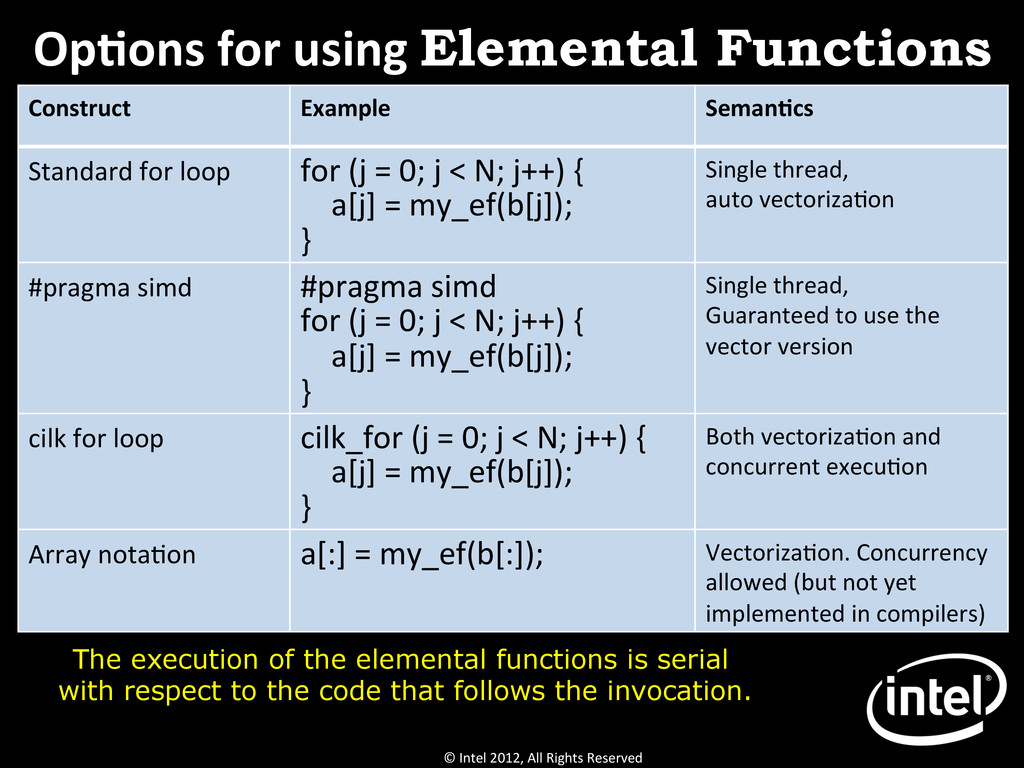
Elemental Functions Construct Example Seman)cs Standard for loop for (j = 0; j < N; j++) { a[j] = my_ef(b[j]); } Single thread, auto vectorizaQon #pragma simd #pragma simd for (j = 0; j < N; j++) { a[j] = my_ef(b[j]); } Single thread, Guaranteed to use the vector version cilk for loop cilk_for (j = 0; j < N; j++) { a[j] = my_ef(b[j]); } Both vectorizaQon and concurrent execuQon Array notaQon a[:] = my_ef(b[:]); VectorizaQon. Concurrency allowed (but not yet implemented in compilers) The execution of the elemental functions is serial with respect to the code that follows the invocation. -
© Intel 2012, All Rights Reserved #pragma SIMD: forcing
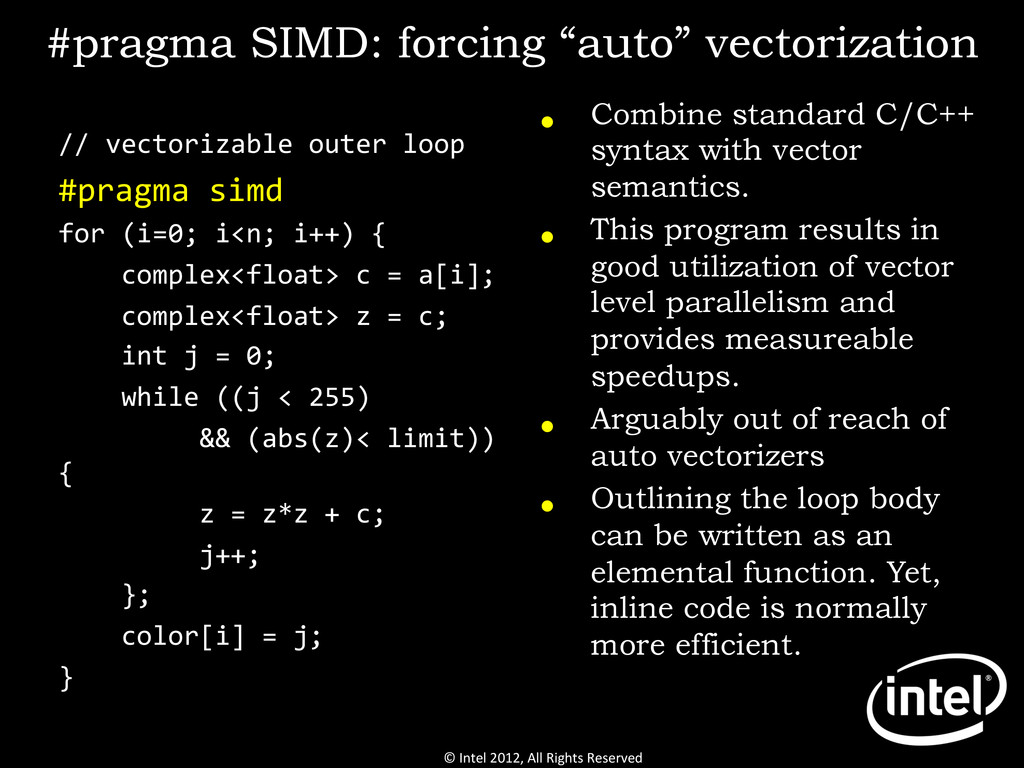
“auto” vectorization // vectorizable outer loop #pragma simd for (i=0; i<n; i++) { complex<float> c = a[i]; complex<float> z = c; int j = 0; while ((j < 255) && (abs(z)< limit)) { z = z*z + c; j++; }; color[i] = j; } • Combine standard C/C++ syntax with vector semantics. • This program results in good utilization of vector level parallelism and provides measureable speedups. • Arguably out of reach of auto vectorizers • Outlining the loop body can be written as an elemental function. Yet, inline code is normally more efficient. -
© Intel 2012, All Rights Reserved TBB and Cilk
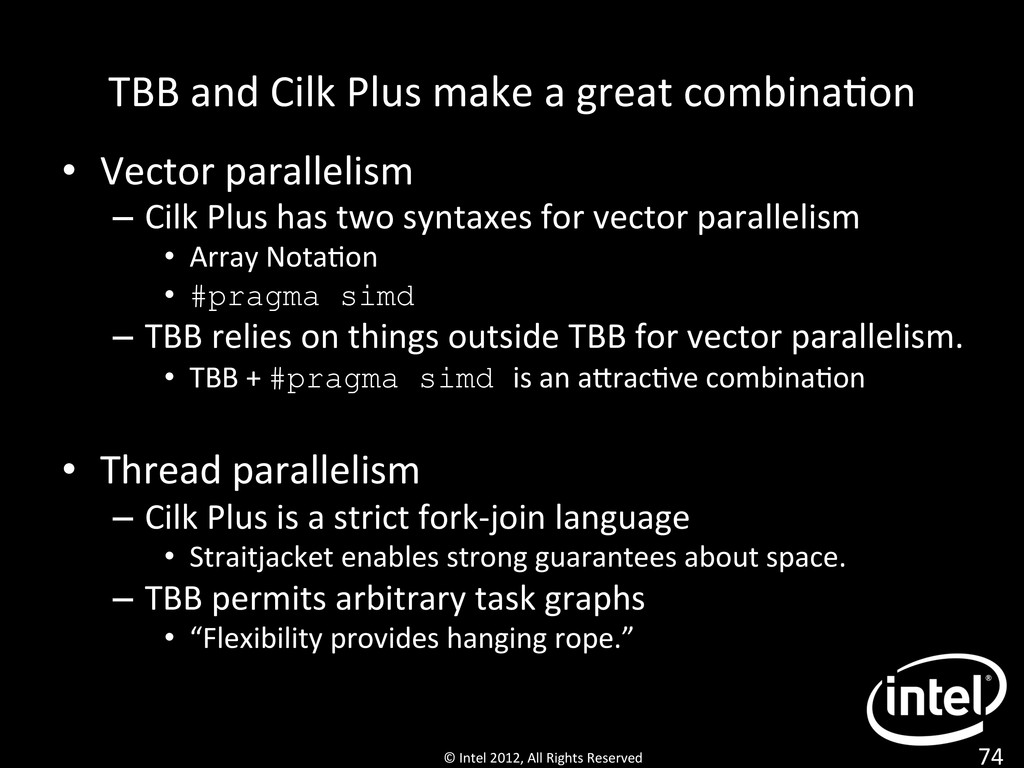
Plus make a great combinaQon • Vector parallelism – Cilk Plus has two syntaxes for vector parallelism • Array NotaQon • #pragma simd – TBB relies on things outside TBB for vector parallelism. • TBB + #pragma simd is an aXracQve combinaQon • Thread parallelism – Cilk Plus is a strict fork-‐join language • Straitjacket enables strong guarantees about space. – TBB permits arbitrary task graphs • “Flexibility provides hanging rope.” 74 -
© Intel 2012, All Rights Reserved Problem Statement
• Parallel Hardware – Scale – Vectorize – SpecializaQon Scale: GPUs, A/D, cameras, co-‐processors… -
© Intel 2012, All Rights Reserved Problem Statement
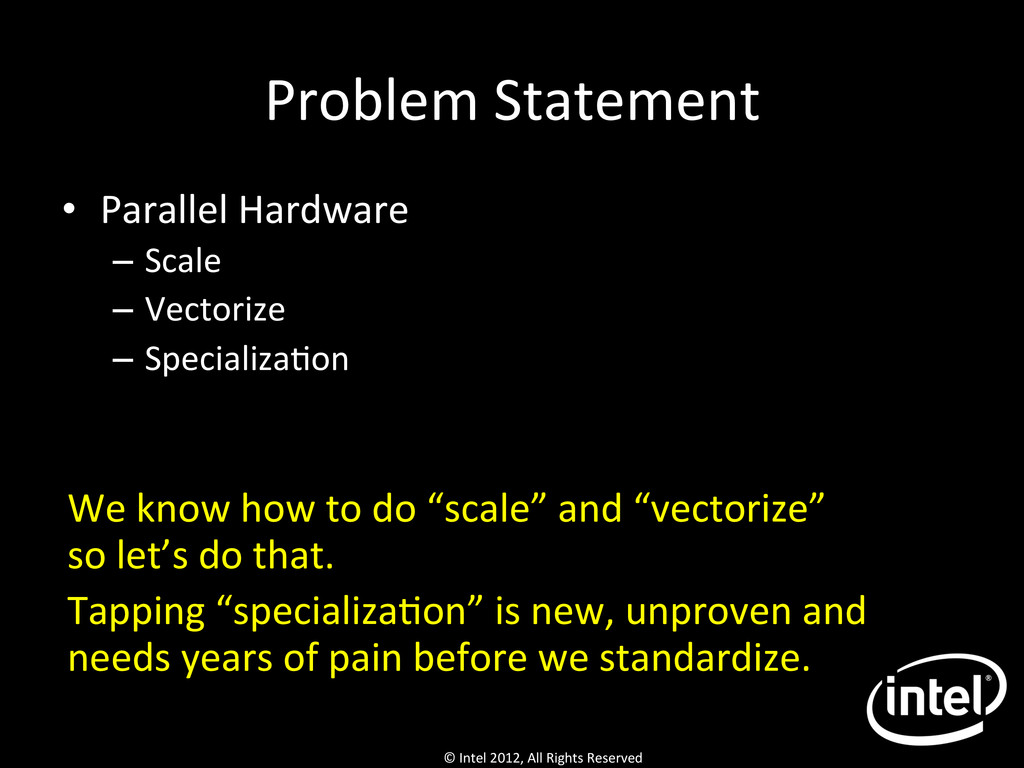
• Parallel Hardware – Scale – Vectorize – SpecializaQon We know how to do “scale” and “vectorize” so let’s do that. Tapping “specializaQon” is new, unproven and needs years of pain before we standardize. -
© Intel 2012, All Rights Reserved Moral of the
story • Composability needs to be KING • Simplicity is ESSSENTIAL • Harness parallelism in hardware by: – Scaling – VectorizaQon – SpecializaQon -
© Intel 2012, All Rights Reserved Resources to help
in quest to “Think Parallel” -
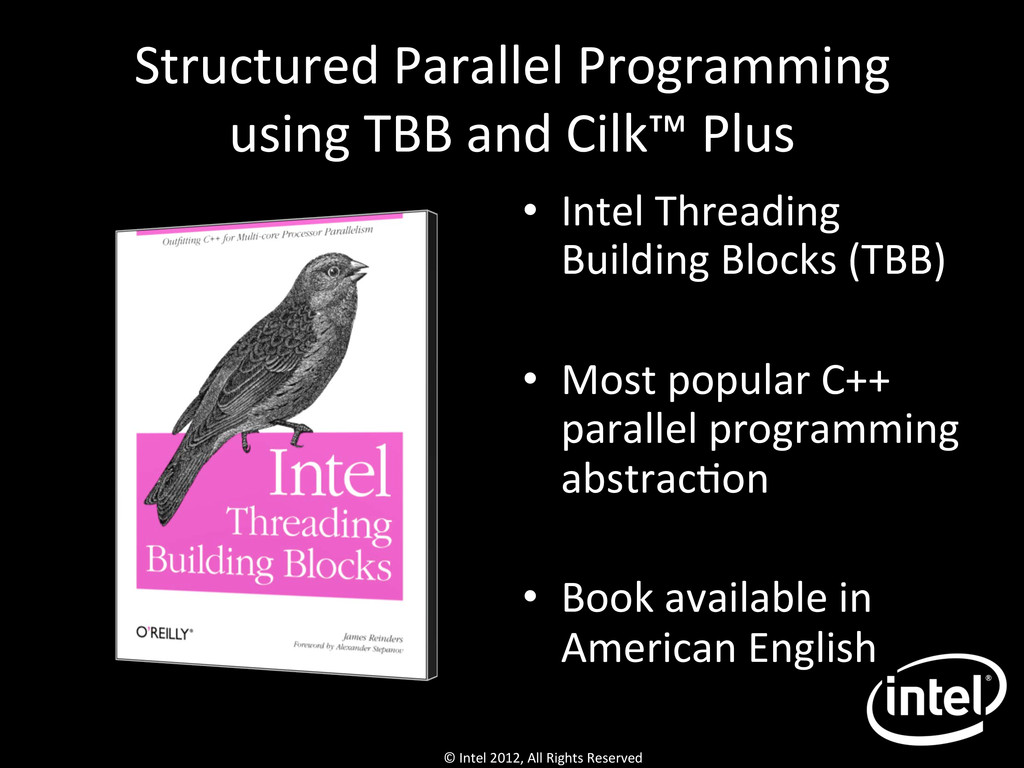
© Intel 2012, All Rights Reserved Structured Parallel Programming
using TBB and Cilk™ Plus • Intel Threading Building Blocks (TBB) • Most popular C++ parallel programming abstracQon • Book available in American English www.parallelbook.com -
© Intel 2012, All Rights Reserved Structured Parallel Programming
using TBB and Cilk™ Plus • Teaching structured parallel programming • Designed for programmers not computer architects • Teach best methods (known as paXerns) Coming: July 2012 www.parallelbook.com -
© Intel 2012, All Rights Reserved • Use more
Fortran and • Let’s work together and fix up C and C++ for the 21st Century intel.com/go/parallel -
© Intel 2012, All Rights Reserved Legal Disclaimer &
OpQmizaQon NoQce INFORMATION IN THIS DOCUMENT IS PROVIDED “AS IS”. NO LICENSE, EXPRESS OR IMPLIED, BY ESTOPPEL OR OTHERWISE, TO ANY INTELLECTUAL PROPERTY RIGHTS IS GRANTED BY THIS DOCUMENT. INTEL ASSUMES NO LIABILITY WHATSOEVER AND INTEL DISCLAIMS ANY EXPRESS OR IMPLIED WARRANTY, RELATING TO THIS INFORMATION INCLUDING LIABILITY OR WARRANTIES RELATING TO FITNESS FOR A PARTICULAR PURPOSE, MERCHANTABILITY, OR INFRINGEMENT OF ANY PATENT, COPYRIGHT OR OTHER INTELLECTUAL PROPERTY RIGHT. Performance tests and raQngs are measured using specific computer systems and/or components and reflect the approximate performance of Intel products as measured by those tests. Any difference in system hardware or so•ware design or configuraQon may affect actual performance. Buyers should consult other sources of informaQon to evaluate the performance of systems or components they are considering purchasing. For more informaQon on performance tests and on the performance of Intel products, reference www.intel.com/so•ware/products. Copyright ©, Intel CorporaQon. All rights reserved. Intel, the Intel logo, Xeon, Core, VTune, and Cilk are trademarks of Intel CorporaQon in the U.S. and other countries. *Other names and brands may be claimed as the property of others. Optimization Notice Intel’s compilers may or may not optimize to the same degree for non-Intel microprocessors for optimizations that are not unique to Intel microprocessors. These optimizations include SSE2, SSE3, and SSSE3 instruction sets and other optimizations. Intel does not guarantee the availability, functionality, or effectiveness of any optimization on microprocessors not manufactured by Intel. Microprocessor-dependent optimizations in this product are intended for use with Intel microprocessors. Certain optimizations not specific to Intel microarchitecture are reserved for Intel microprocessors. Please refer to the applicable product User and Reference Guides for more information regarding the specific instruction sets covered by this notice. Notice revision #20110804
 multicoreworld
 iwiwi
 marcoroth
 naruogram
 shihochan
 ostk0069
 koukimiura
 veronikapj
 har1101
 steliosf
 kasacchiful
 akihisaikeda
 falcon8823
 maltzj
 hannesfritz
 shlominoach
 holman
 keathley
 jct
 reverentgeek
 carmenintech
 thekraken
 62gerente
 palkan
 marketingsoph