Upgrade to Pro — share decks privately, control downloads, hide ads and more …

Section 8 Company Registration in India: Comple...

Avatar for ngo project report ngo project report
September 14, 2026
1

Section 8 Company Registration in India: Complete 2026 Guide

This comprehensive guide explains Section 8 Company registration in India, covering eligibility, registration process, required documents, estimated costs, timelines, benefits, and ongoing compliance. It simplifies key legal and regulatory requirements into practical steps for founders, nonprofits, and social organizations. The guide also includes useful checklists, comparison tables, process flows, charts, and common mistakes to avoid, helping readers understand what is required before and after incorporation. Whether you are planning to establish a nonprofit for charitable, educational, social, or other public-benefit objectives, this guide provides a clear and practical overview of the Section 8 Company registration journey.

Avatar for ngo project report

ngo project report

September 14, 2026

Transcript

  1. Updated 2026 Section 8 Company Registration in India A Practical

    2026 Guide to Eligibility, Registration Process, Documents, Cost & Compliance Empowering social entrepreneurs with a comprehensive roadmap to establishing a non-profit corporate entity under the Companies Act, 2013. Start Your Section 8 Registration Journey →
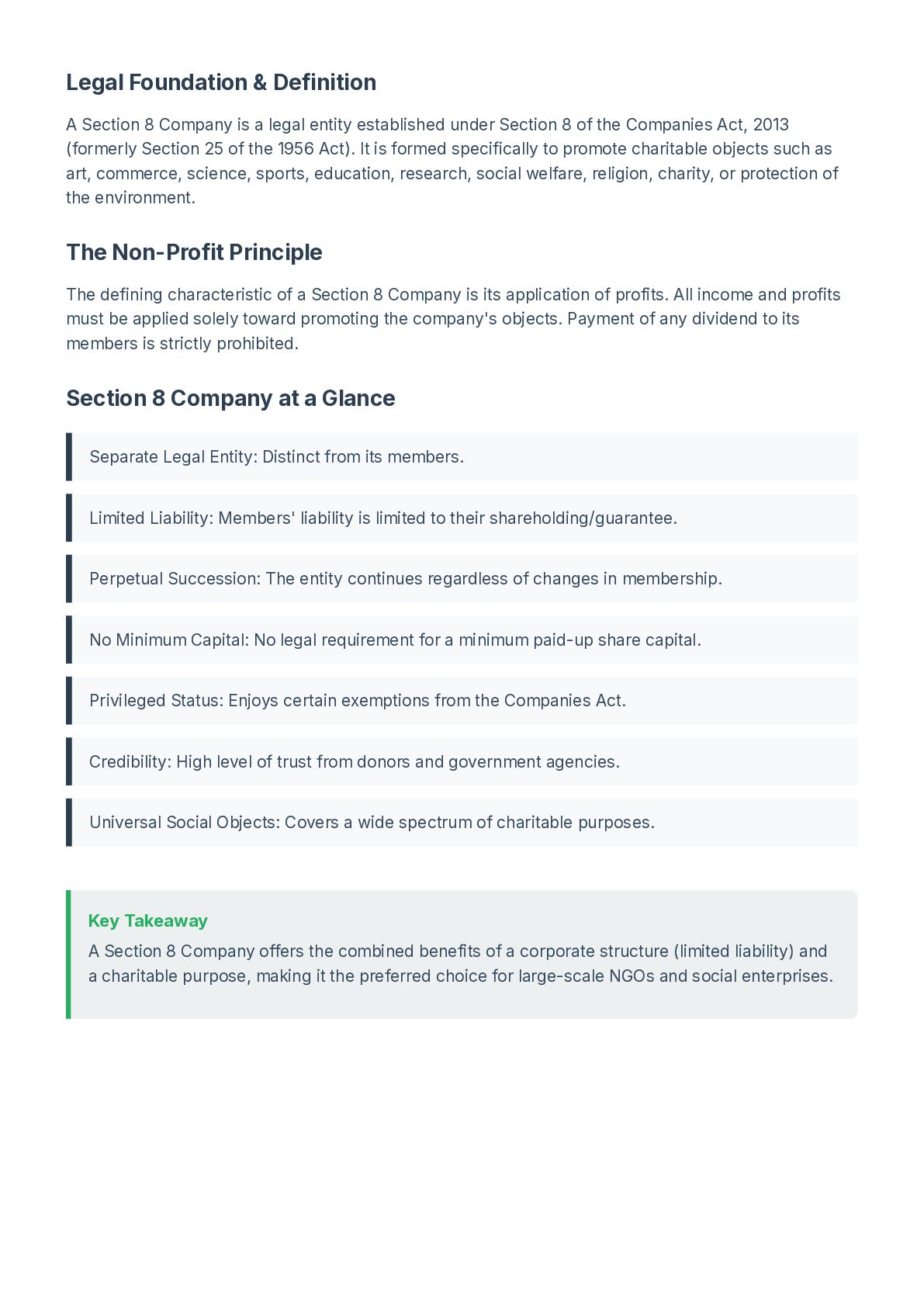
  2. Legal Foundation & Definition A Section 8 Company is a

    legal entity established under Section 8 of the Companies Act, 2013 (formerly Section 25 of the 1956 Act). It is formed specifically to promote charitable objects such as art, commerce, science, sports, education, research, social welfare, religion, charity, or protection of the environment. The Non-Profit Principle The defining characteristic of a Section 8 Company is its application of profits. All income and profits must be applied solely toward promoting the company's objects. Payment of any dividend to its members is strictly prohibited. Section 8 Company at a Glance Separate Legal Entity: Distinct from its members. Limited Liability: Members' liability is limited to their shareholding/guarantee. Perpetual Succession: The entity continues regardless of changes in membership. No Minimum Capital: No legal requirement for a minimum paid-up share capital. Privileged Status: Enjoys certain exemptions from the Companies Act. Credibility: High level of trust from donors and government agencies. Universal Social Objects: Covers a wide spectrum of charitable purposes. Key Takeaway A Section 8 Company offers the combined benefits of a corporate structure (limited liability) and a charitable purpose, making it the preferred choice for large-scale NGOs and social enterprises.
  3. Who Can Register a Section 8 Company? Structural Requirements A

    Section 8 Company can be registered as a Company Limited by Shares or a Company Limited by Guarantee. It requires a minimum of two directors and two members (who can be the same individuals). Eligibility Checklist ✓ Individual, HUF, or even another Company can be a member. ✓ At least one Director must be a resident of India. ✓ The objects must be purely for the promotion of social welfare/charity. ✓ Clear commitment to the 'non-distribution of profit' principle. ✓ Proposed name must include words like Foundation, Forum, Association, etc. The Formation Flow Founders → Directors → Charitable Objects → MCA Incorporation → Section 8 License
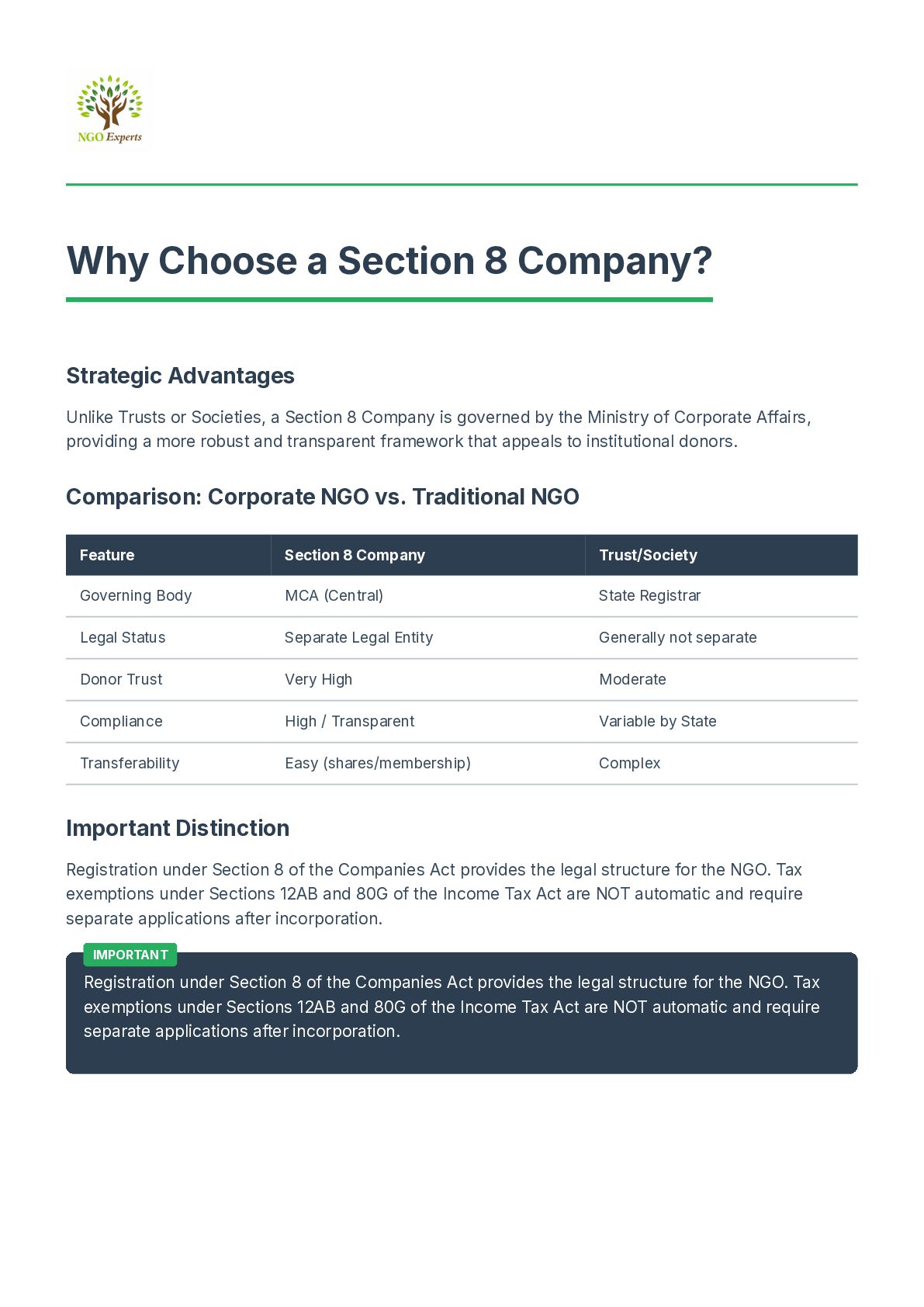
  4. Why Choose a Section 8 Company? Strategic Advantages Unlike Trusts

    or Societies, a Section 8 Company is governed by the Ministry of Corporate Affairs, providing a more robust and transparent framework that appeals to institutional donors. Comparison: Corporate NGO vs. Traditional NGO Feature Section 8 Company Trust/Society Governing Body MCA (Central) State Registrar Legal Status Separate Legal Entity Generally not separate Donor Trust Very High Moderate Compliance High / Transparent Variable by State Transferability Easy (shares/membership) Complex Important Distinction Registration under Section 8 of the Companies Act provides the legal structure for the NGO. Tax exemptions under Sections 12AB and 80G of the Income Tax Act are NOT automatic and require separate applications after incorporation. IMPORTANT Registration under Section 8 of the Companies Act provides the legal structure for the NGO. Tax exemptions under Sections 12AB and 80G of the Income Tax Act are NOT automatic and require separate applications after incorporation.
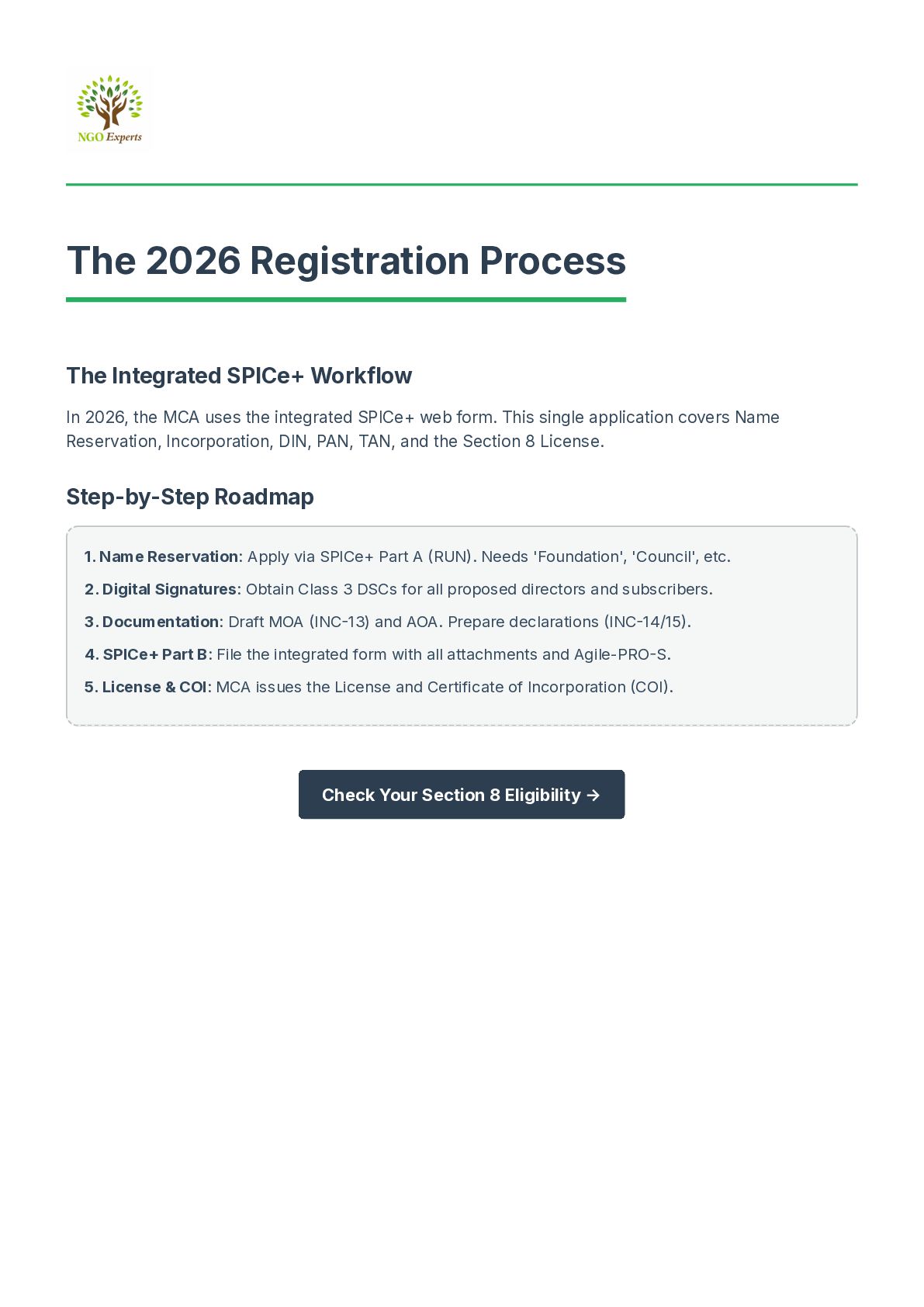
  5. The 2026 Registration Process The Integrated SPICe+ Workflow In 2026,

    the MCA uses the integrated SPICe+ web form. This single application covers Name Reservation, Incorporation, DIN, PAN, TAN, and the Section 8 License. Step-by-Step Roadmap 1. Name Reservation: Apply via SPICe+ Part A (RUN). Needs 'Foundation', 'Council', etc. 2. Digital Signatures: Obtain Class 3 DSCs for all proposed directors and subscribers. 3. Documentation: Draft MOA (INC-13) and AOA. Prepare declarations (INC-14/15). 4. SPICe+ Part B: File the integrated form with all attachments and Agile-PRO-S. 5. License & COI: MCA issues the License and Certificate of Incorporation (COI). Check Your Section 8 Eligibility →
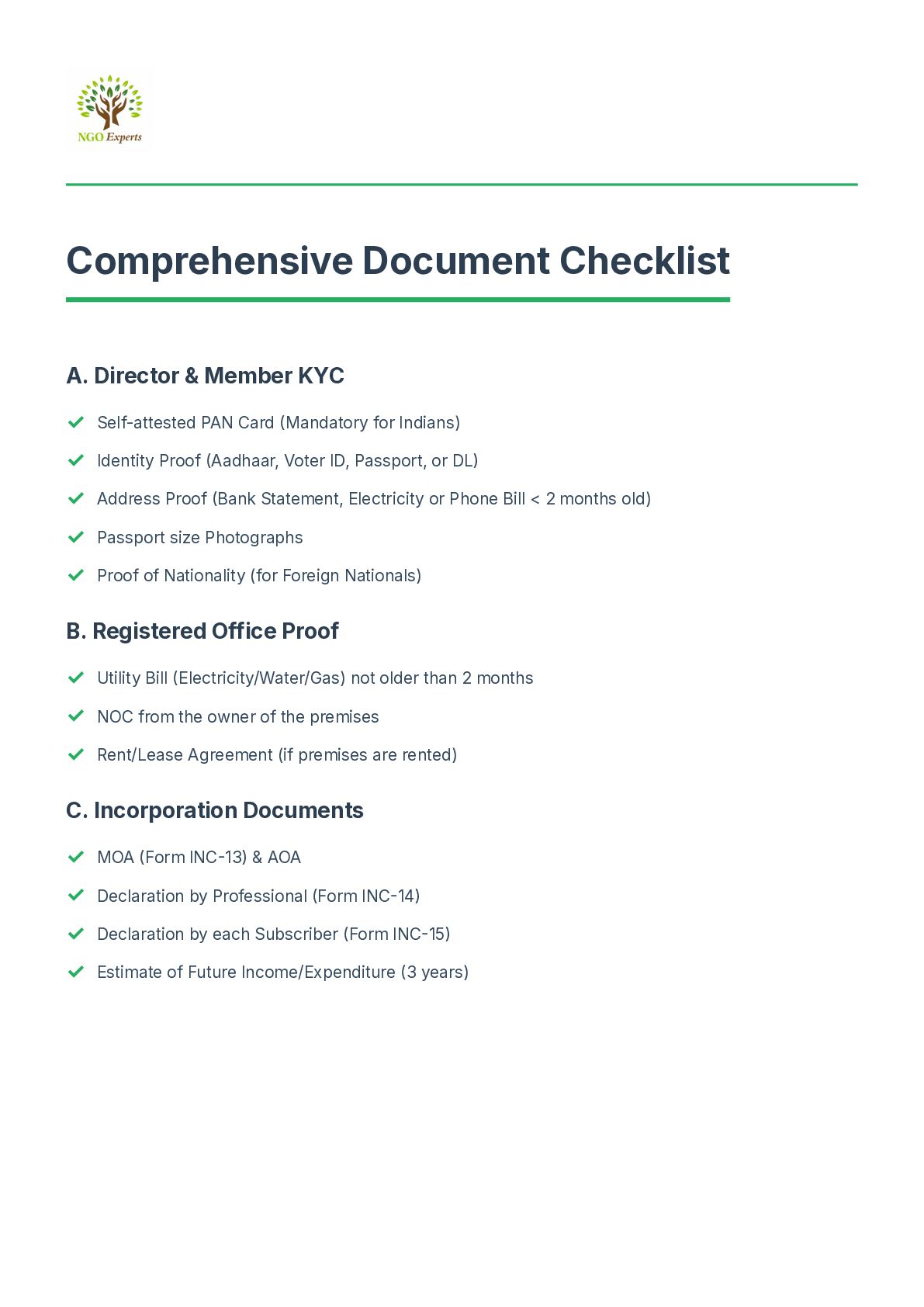
  6. Comprehensive Document Checklist A. Director & Member KYC ✓ Self-attested

    PAN Card (Mandatory for Indians) ✓ Identity Proof (Aadhaar, Voter ID, Passport, or DL) ✓ Address Proof (Bank Statement, Electricity or Phone Bill < 2 months old) ✓ Passport size Photographs ✓ Proof of Nationality (for Foreign Nationals) B. Registered Office Proof ✓ Utility Bill (Electricity/Water/Gas) not older than 2 months ✓ NOC from the owner of the premises ✓ Rent/Lease Agreement (if premises are rented) C. Incorporation Documents ✓ MOA (Form INC-13) & AOA ✓ Declaration by Professional (Form INC-14) ✓ Declaration by each Subscriber (Form INC-15) ✓ Estimate of Future Income/Expenditure (3 years)
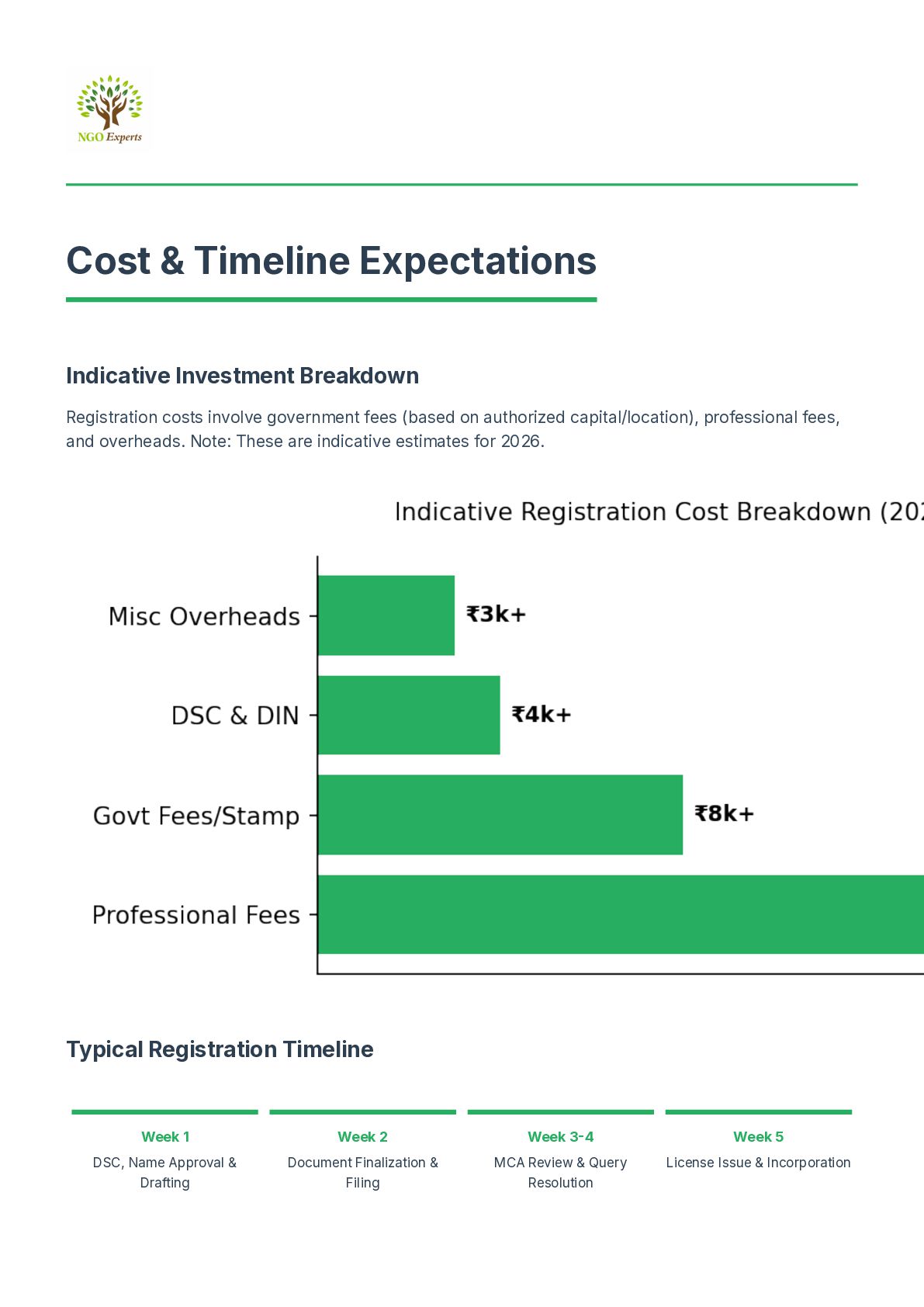
  7. Cost & Timeline Expectations Indicative Investment Breakdown Registration costs involve

    government fees (based on authorized capital/location), professional fees, and overheads. Note: These are indicative estimates for 2026. Typical Registration Timeline Week 1 Week 2 Week 3-4 Week 5 DSC, Name Approval & Document Finalization & MCA Review & Query License Issue & Incorporation Drafting Filing Resolution
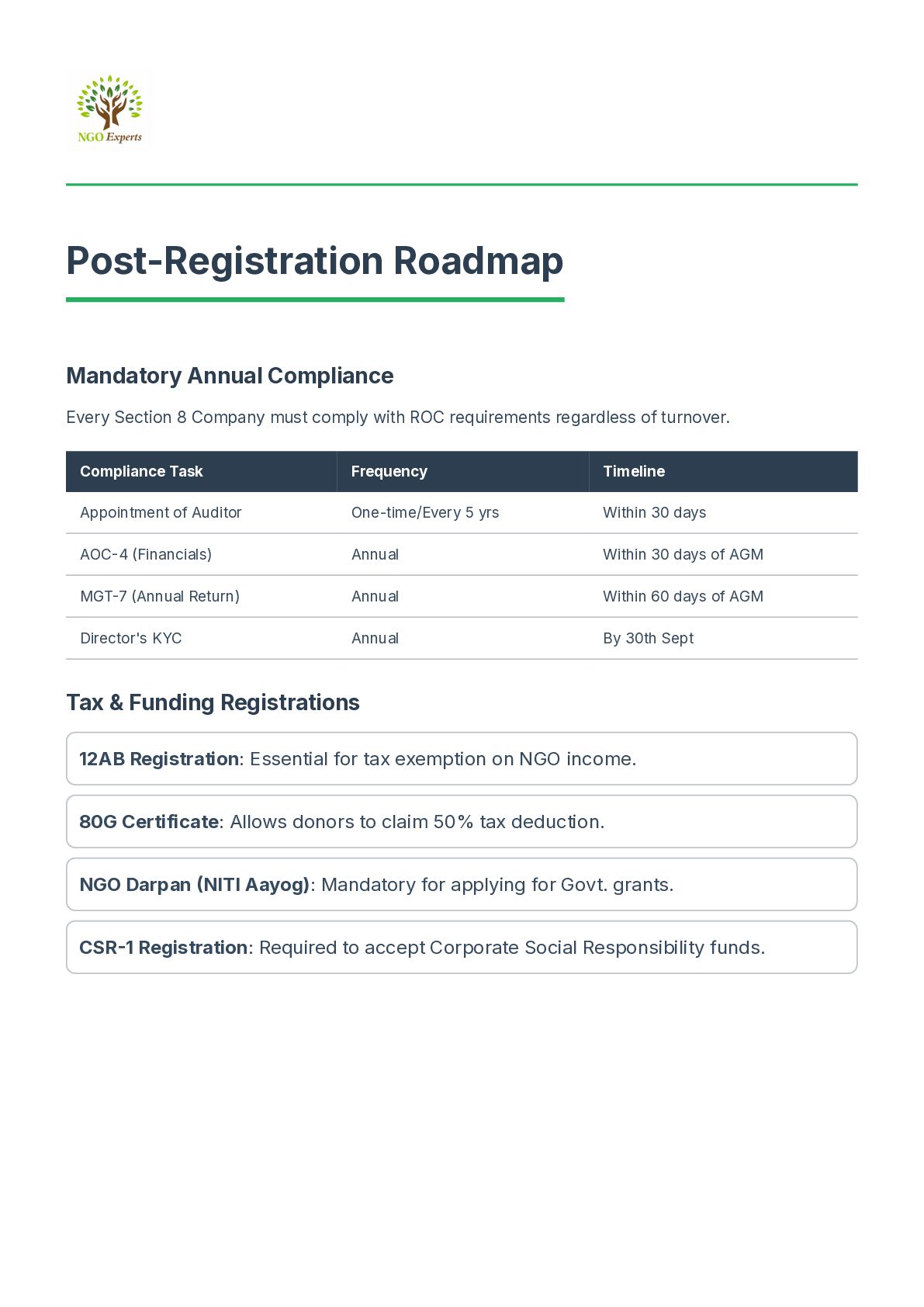
  8. Post-Registration Roadmap Mandatory Annual Compliance Every Section 8 Company must

    comply with ROC requirements regardless of turnover. Compliance Task Frequency Timeline Appointment of Auditor One-time/Every 5 yrs Within 30 days AOC-4 (Financials) Annual Within 30 days of AGM MGT-7 (Annual Return) Annual Within 60 days of AGM Director's KYC Annual By 30th Sept Tax & Funding Registrations 12AB Registration: Essential for tax exemption on NGO income. 80G Certificate: Allows donors to claim 50% tax deduction. NGO Darpan (NITI Aayog): Mandatory for applying for Govt. grants. CSR-1 Registration: Required to accept Corporate Social Responsibility funds.
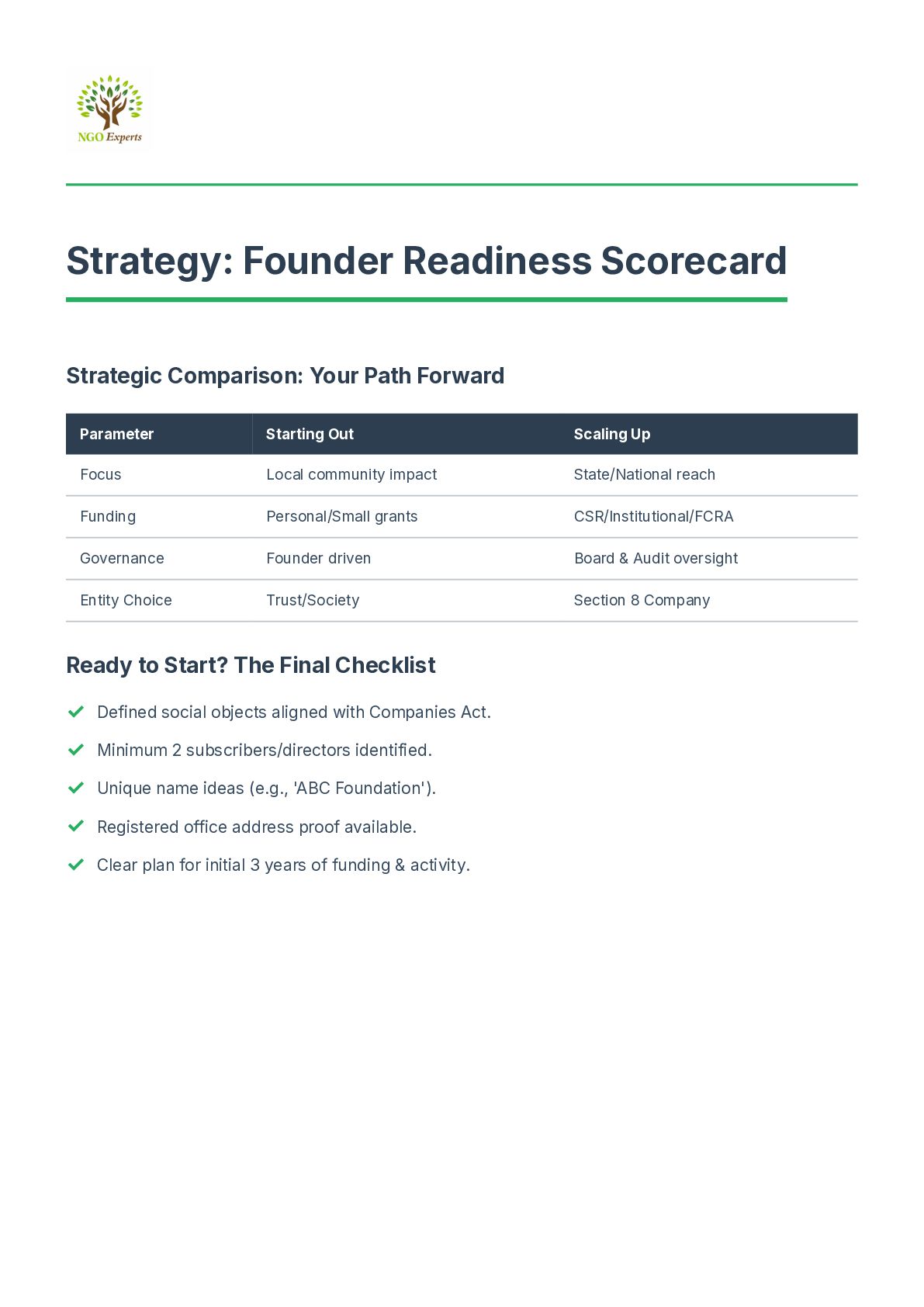
  9. Strategy: Founder Readiness Scorecard Strategic Comparison: Your Path Forward Parameter

    Starting Out Scaling Up Focus Local community impact State/National reach Funding Personal/Small grants CSR/Institutional/FCRA Governance Founder driven Board & Audit oversight Entity Choice Trust/Society Section 8 Company Ready to Start? The Final Checklist ✓ Defined social objects aligned with Companies Act. ✓ Minimum 2 subscribers/directors identified. ✓ Unique name ideas (e.g., 'ABC Foundation'). ✓ Registered office address proof available. ✓ Clear plan for initial 3 years of funding & activity.
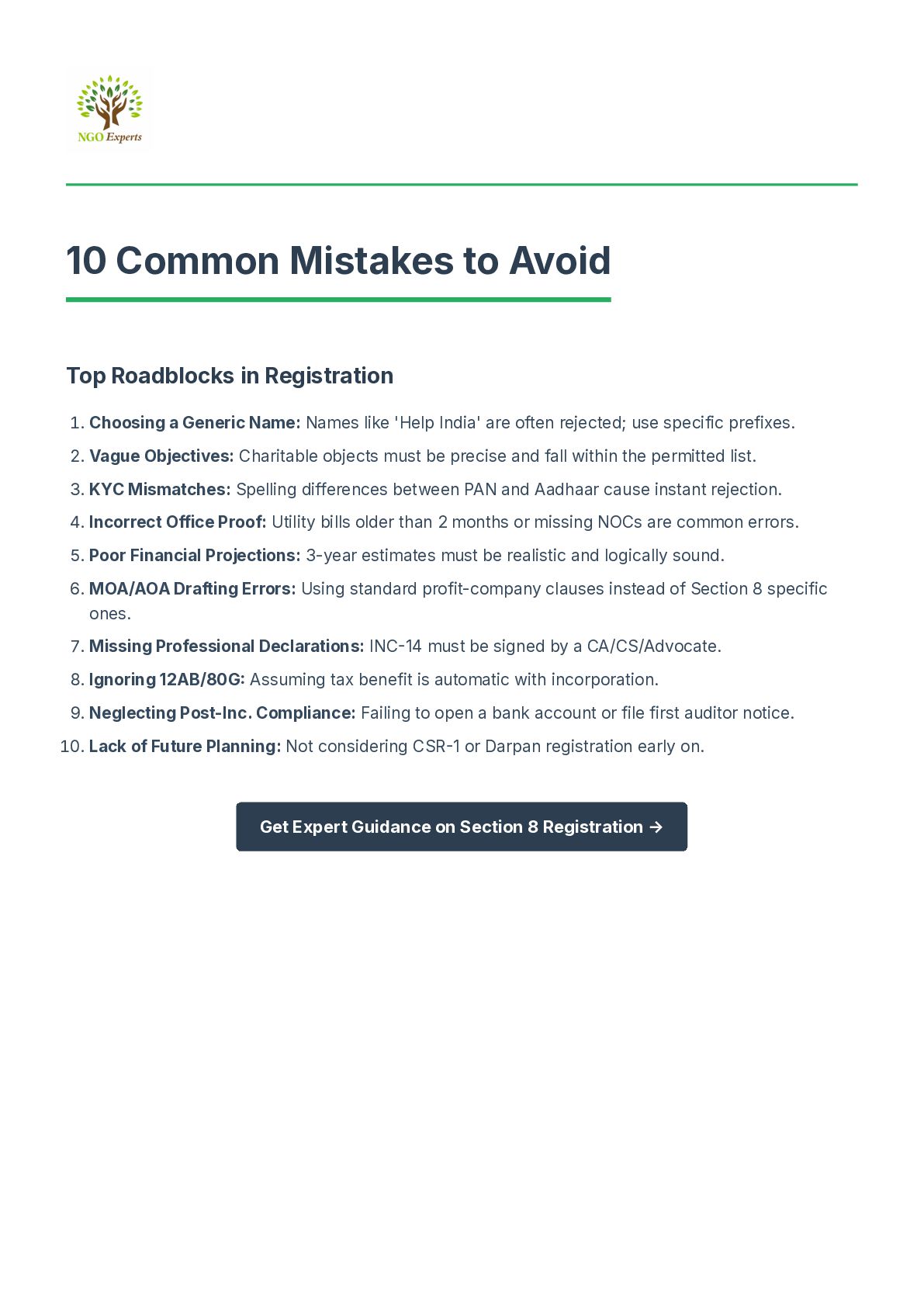
  10. 10 Common Mistakes to Avoid Top Roadblocks in Registration 1.

    Choosing a Generic Name: Names like 'Help India' are often rejected; use specific prefixes. 2. Vague Objectives: Charitable objects must be precise and fall within the permitted list. 3. KYC Mismatches: Spelling differences between PAN and Aadhaar cause instant rejection. 4. Incorrect Office Proof: Utility bills older than 2 months or missing NOCs are common errors. 5. Poor Financial Projections: 3-year estimates must be realistic and logically sound. 6. MOA/AOA Drafting Errors: Using standard profit-company clauses instead of Section 8 specific ones. 7. Missing Professional Declarations: INC-14 must be signed by a CA/CS/Advocate. 8. Ignoring 12AB/80G: Assuming tax benefit is automatic with incorporation. 9. Neglecting Post-Inc. Compliance: Failing to open a bank account or file first auditor notice. 10. Lack of Future Planning: Not considering CSR-1 or Darpan registration early on. Get Expert Guidance on Section 8 Registration →
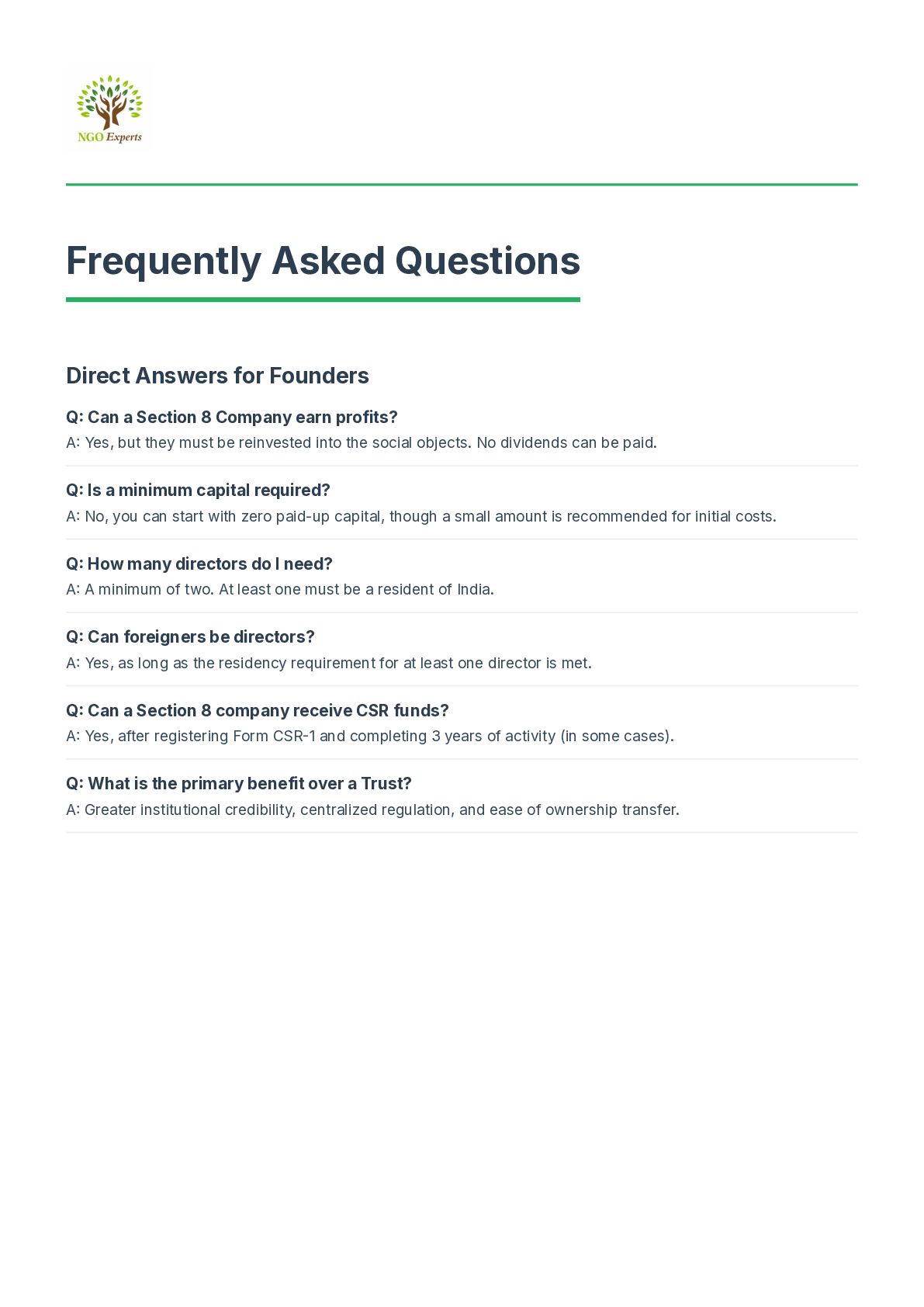
  11. Frequently Asked Questions Direct Answers for Founders Q: Can a

    Section 8 Company earn profits? A: Yes, but they must be reinvested into the social objects. No dividends can be paid. Q: Is a minimum capital required? A: No, you can start with zero paid-up capital, though a small amount is recommended for initial costs. Q: How many directors do I need? A: A minimum of two. At least one must be a resident of India. Q: Can foreigners be directors? A: Yes, as long as the residency requirement for at least one director is met. Q: Can a Section 8 company receive CSR funds? A: Yes, after registering Form CSR-1 and completing 3 years of activity (in some cases). Q: What is the primary benefit over a Trust? A: Greater institutional credibility, centralized regulation, and ease of ownership transfer.
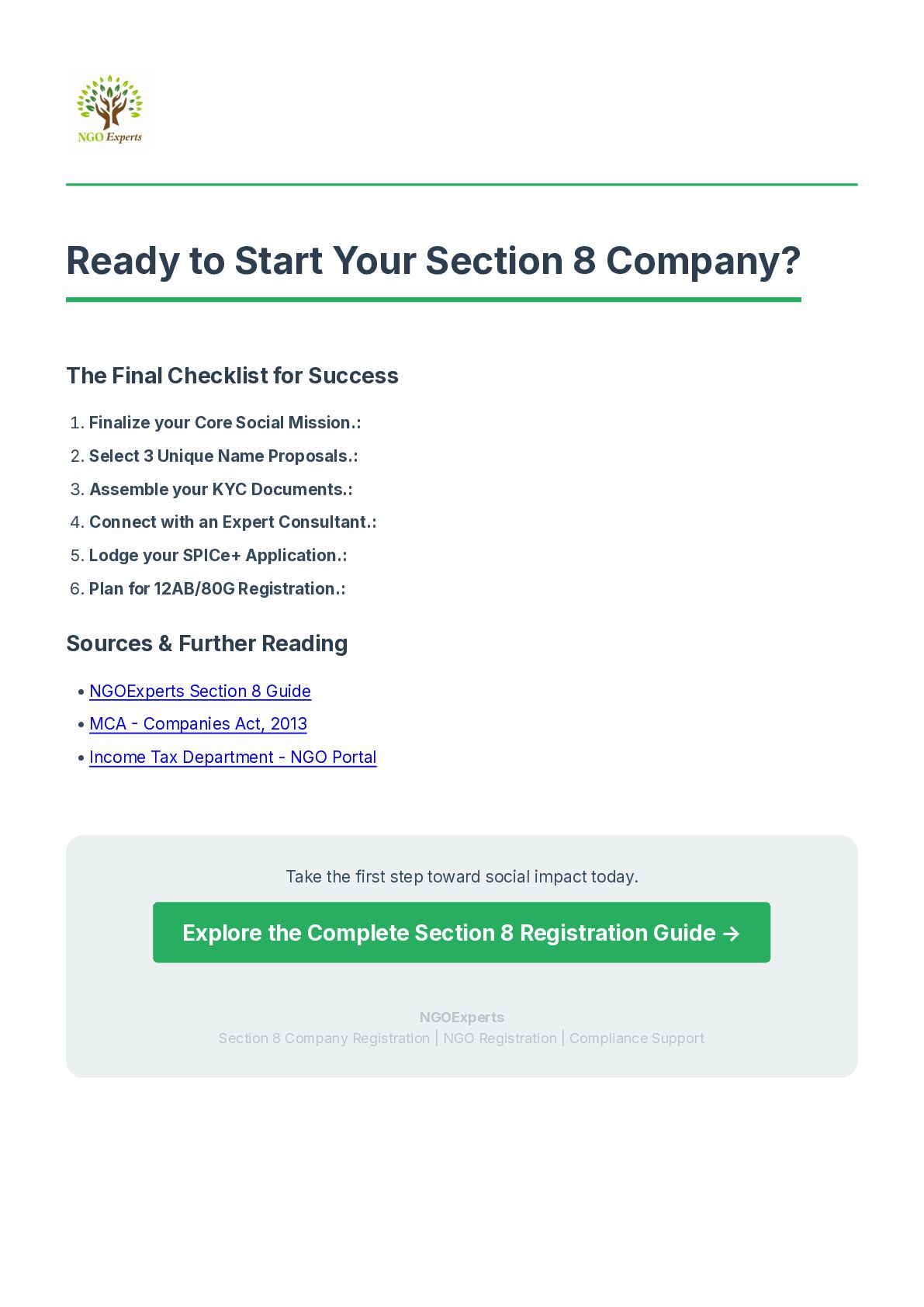
  12. Ready to Start Your Section 8 Company? The Final Checklist

    for Success 1. Finalize your Core Social Mission.: 2. Select 3 Unique Name Proposals.: 3. Assemble your KYC Documents.: 4. Connect with an Expert Consultant.: 5. Lodge your SPICe+ Application.: 6. Plan for 12AB/80G Registration.: Sources & Further Reading • NGOExperts Section 8 Guide • MCA - Companies Act, 2013 • Income Tax Department - NGO Portal Take the first step toward social impact today. Explore the Complete Section 8 Registration Guide → NGOExperts Section 8 Company Registration | NGO Registration | Compliance Support