tokenization? • How does tokenizing a Real World Asset work? • Benefits and use-cases of tokenization • How to build a RWA dapp • Challenges and best practices.
ownership of assets in the digital realm. It's not just a technological innovation; it's a revolutionary force, poised to disrupt industries, democratize access to investments and redefine nature of ownership itself. In simpler terms, tokenization is the process of recording rights to a given asset into a digital token that can be held, sold and traded on a blockchain. The allure of tokenization is in its ability to democratize access to assets that were previously out of reach for many. Just about anything can be tokenized - from real estate and art to finance and intellectual property. Tokenization brings about fractional ownership, access, transparency, reduced intermediaries, mitigated risks and possibility of fraud.
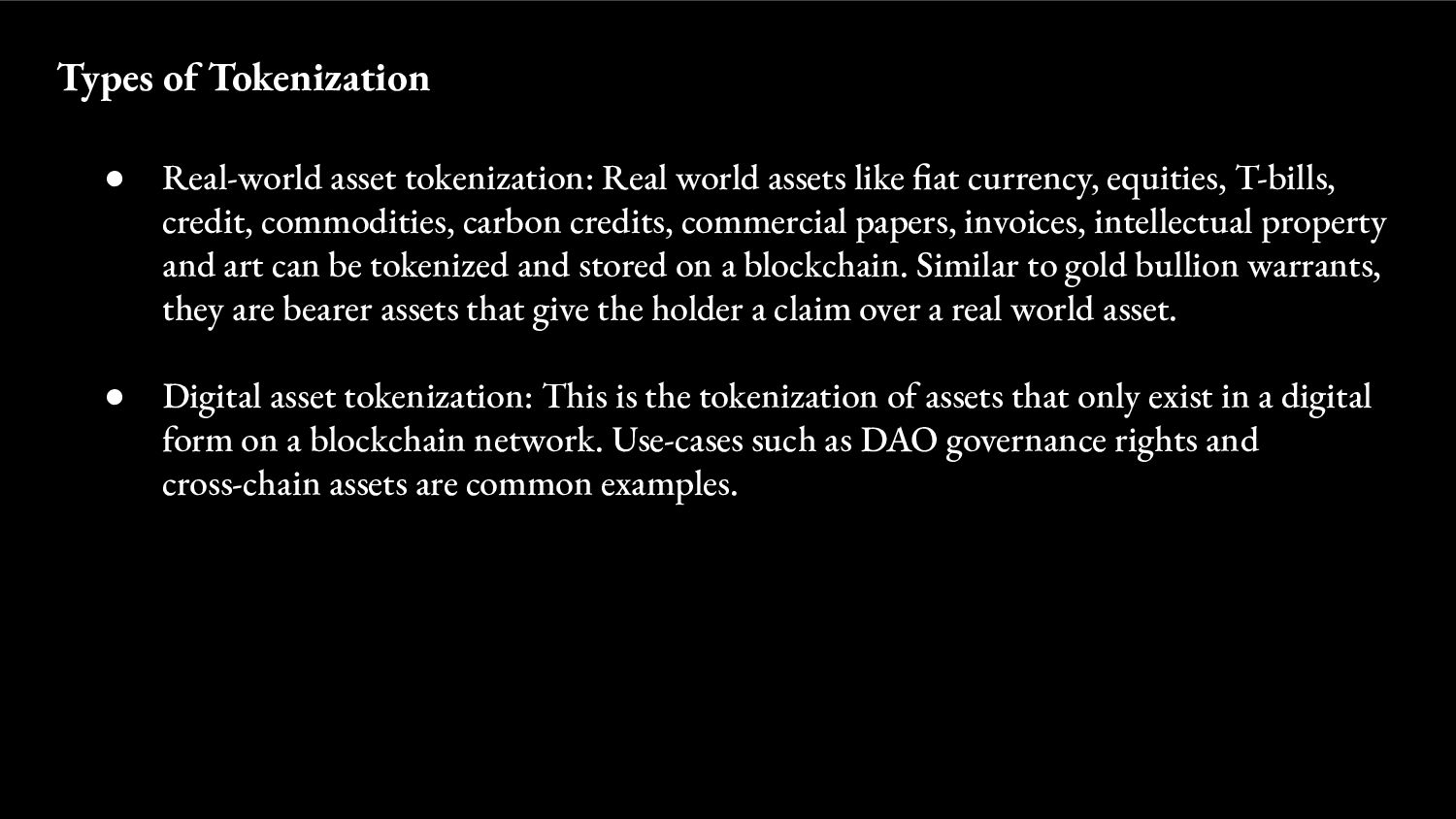
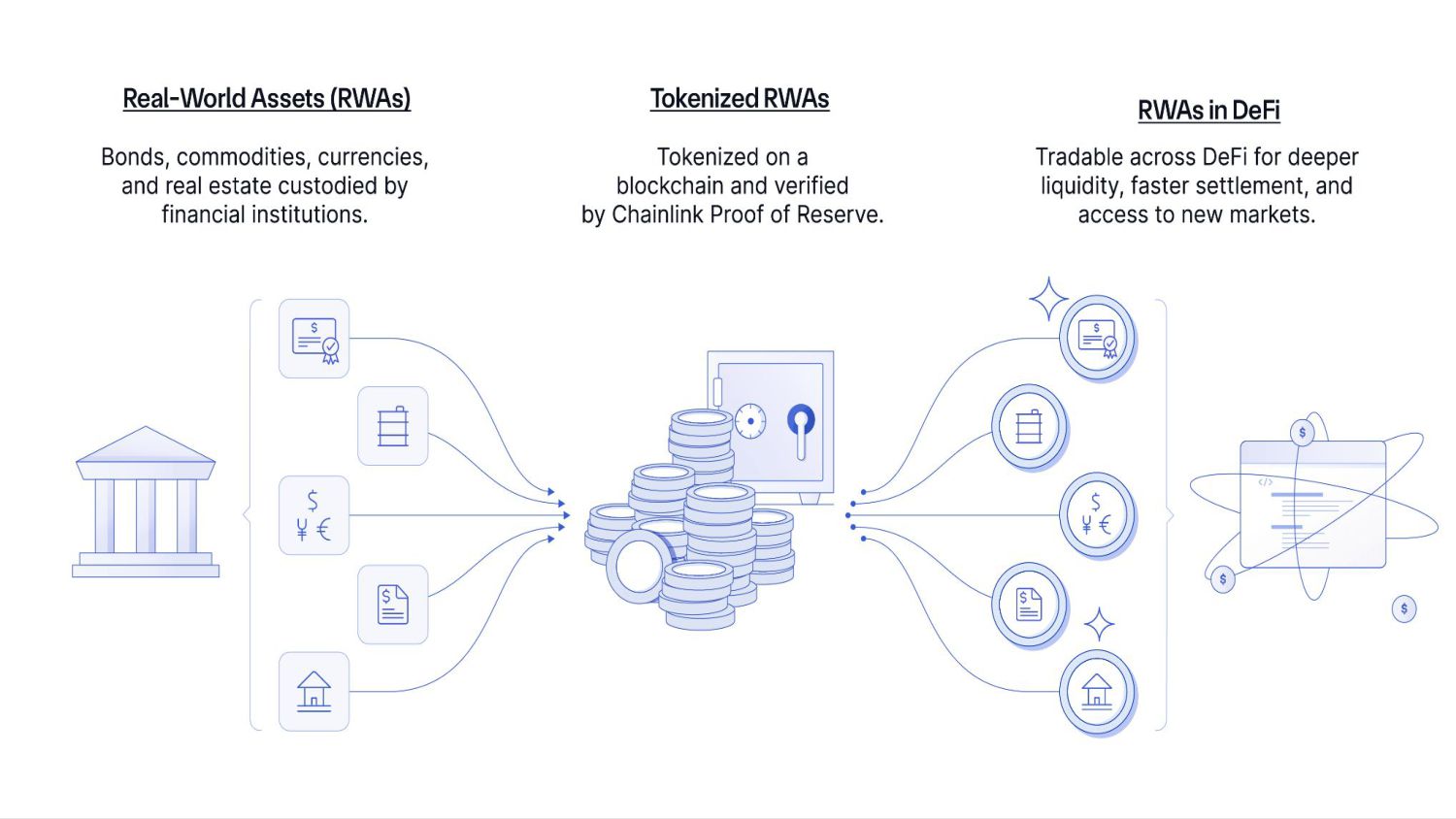
like fiat currency, equities, T-bills, credit, commodities, carbon credits, commercial papers, invoices, intellectual property and art can be tokenized and stored on a blockchain. Similar to gold bullion warrants, they are bearer assets that give the holder a claim over a real world asset. • Digital asset tokenization: This is the tokenization of assets that only exist in a digital form on a blockchain network. Use-cases such as DAO governance rights and cross-chain assets are common examples.
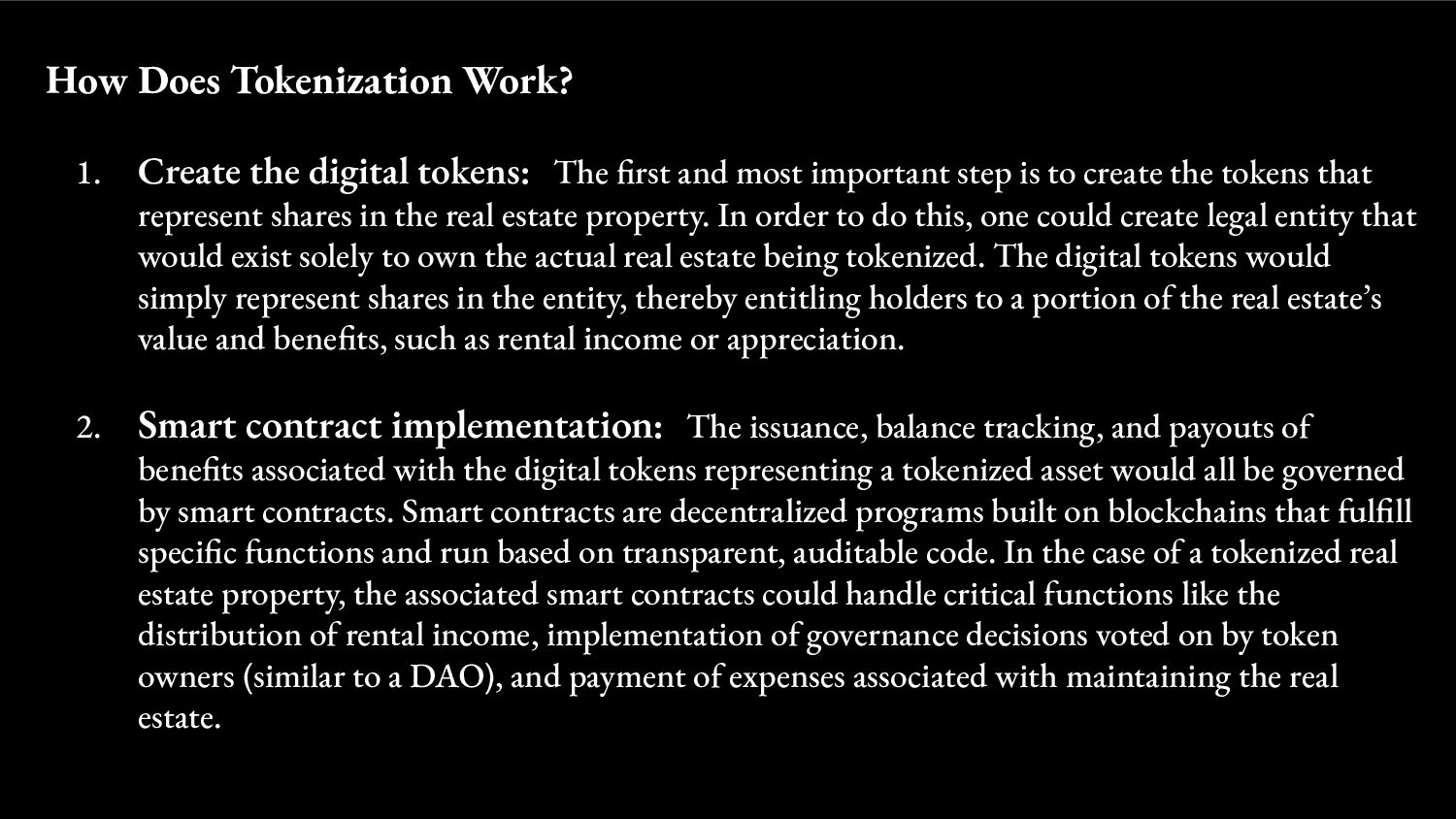
first and most important step is to create the tokens that represent shares in the real estate property. In order to do this, one could create legal entity that would exist solely to own the actual real estate being tokenized. The digital tokens would simply represent shares in the entity, thereby entitling holders to a portion of the real estate’s value and benefits, such as rental income or appreciation. 2. Smart contract implementation: The issuance, balance tracking, and payouts of benefits associated with the digital tokens representing a tokenized asset would all be governed by smart contracts. Smart contracts are decentralized programs built on blockchains that fulfill specific functions and run based on transparent, auditable code. In the case of a tokenized real estate property, the associated smart contracts could handle critical functions like the distribution of rental income, implementation of governance decisions voted on by token owners (similar to a DAO), and payment of expenses associated with maintaining the real estate.
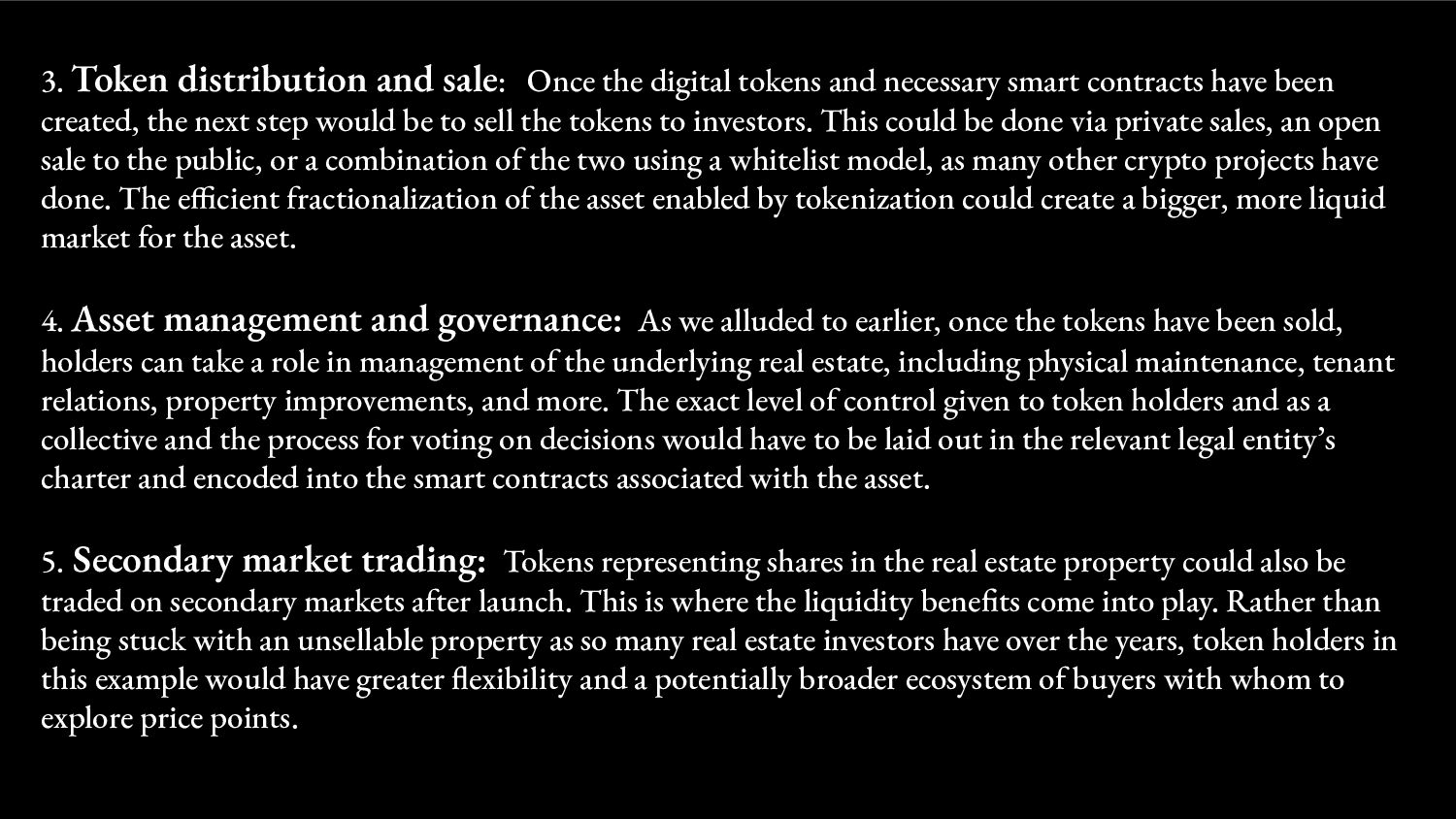
necessary smart contracts have been created, the next step would be to sell the tokens to investors. This could be done via private sales, an open sale to the public, or a combination of the two using a whitelist model, as many other crypto projects have done. The efficient fractionalization of the asset enabled by tokenization could create a bigger, more liquid market for the asset. 4. Asset management and governance: As we alluded to earlier, once the tokens have been sold, holders can take a role in management of the underlying real estate, including physical maintenance, tenant relations, property improvements, and more. The exact level of control given to token holders and as a collective and the process for voting on decisions would have to be laid out in the relevant legal entity’s charter and encoded into the smart contracts associated with the asset. 5. Secondary market trading: Tokens representing shares in the real estate property could also be traded on secondary markets after launch. This is where the liquidity benefits come into play. Rather than being stuck with an unsellable property as so many real estate investors have over the years, token holders in this example would have greater flexibility and a potentially broader ecosystem of buyers with whom to explore price points.
generally recorded across siloed ledgers, resulting in significant market inefficiencies, such as increased costs and lengthened settlement times. This lack of interoperability between different systems represents a significant opportunity for asset tokenization to help solve the resulting fractionalized liquidity through interoperable tokenized assets. Tokenization can also help improve liquidity for historically illiquid assets. With tokenization, an asset can be represented as millions or even billions of tokens, creating fractional ownership, which can be subsequently listed on a variety of widely-available and accessible exchanges. This eliminates the need for costly transactional intermediaries and expands the potential buyer pool while simultaneously keeping the tokens tied to a unique asset.
out of reach to common investors due to financial or regulatory constraints. For instance, consider financing a big-budget movie: the upfront costs, as well as the risk of a production crew going over-budget, comfortably price out all but the wealthiest investors. However, a successful film can earn a return on the investment multiple times over in a relatively short time frame. Other low-access, high-return examples include collecting sports cars, investing in distressed foreign assets, or the purchase and renting of multifamily real estate. In this case, the benefits of tokenization essentially become similar to crowdfunding, but within a model where the group of investors funding or purchasing an asset also reap the financial rewards of their participation. This allows smaller investors a path towards investing in riskier, but higher-upside assets with relatively low capital.
lack of reliable and easily-available information regarding returns, ownership history, sale history, and other key metrics users need to be able to make informed economic decisions. This lack of information is especially acute when evaluating foreign assets, or instances where a buyer cannot personally inspect an asset prior to purchase. A key benefit of tokenization is that it allows for the open tracking and auditing of all these records due to the fundamentally public nature of many blockchains. With tokenization, users can see a record of ownership as well as returns in interest or dividends, depending on the smart contract logic of the asset. Provenance tracking on the blockchain allows for immutable records, significantly decreasing investment security risks by minimizing record-keeping trust. These features have the potential to significantly reduce the risk of fraud across multiple industries where forgeries and knock-offs are common, such as high-priced luxuries like wine and caviar, as well as fashion and art.
of asset tokenization is also among the least well-explored: connecting the value of real-world assets to the composability of the DeFi ecosystem. Decentralized money markets around tokenized real-world assets enable users to earn equity percentage in the interest generated from off-chain collateral. This enhances the liquidity of the wider DeFi space while simultaneously giving retail investors access to an investment class that would otherwise be difficult to access. Moving forward, asset tokenization will allow for a plethora of opportunities for smart contracts developers seeking to tap into real-world value. Whole new types of synthetic assets, indexes, and token baskets can easily be built by combining tokens tied to various assets, and the ability to turn real-world revenue streams into collateral offers another jolt of innovation for an already rapidly expanding DeFi field.


 nnamdei
 palkan
 jonyablonski
 rkaga
 letsgokoyo
 jnunemaker
 geoffreycrofte
 inesmontani
 ipullrank
 marktimemedia
 keathley
 nikkihalliwell
 techseoconnect