0; } Better for most people, still a bit lacking for novices Assigning an integer Produces a file binary which can be run as: Output There is no output, but an assignment of an integer with value 3 takes place g++ main.cpp -o file ./file What about different languages? 10
program main integer :: x = 3 + 6 print *, x end program lfortran has a nicer intermediate structure conda create -n lf conda activate lf conda install lfortran \ -c conda-forge lfortran --show-asr consint.f90 11
Plain text, and preferably an open license is pretty handy for this license-generator .gitignore Lists files which do not need to be committed; typically generated files can be used to generate these gibo $ git init # Inside project $ gibo macOS Windows Xcode Emacs \ Vim Python C++ \ CMake TeX > .gitignore $ touch readme.md $ license-generator MIT \ --author "Person" $ tree -L 2 . ├── LICENSE ├── docs │ └── pres └── readme.org 2 directories, 2 files 14
* @date 2021-02-25 * @brief Classes and functions relating to the binary operation of ad * * Created on: 2012-07-11 * * This file contains the basic binary operations defined for symbolic * In particular the @ref Add class for representing addition is * @b declared here, along with the `add` and `substract` functions. */ #ifndef SYMENGINE_ADD_H #define SYMENGINE_ADD_H 32
dictionary quickly. * @pre The dictionary must be in canonical form. * @see `Mul` for how `Pow` gets returned. * @see `Basic` for the guarantees and expectations. * @param coef the numeric coefficient. * @param d the dictionary of the expression without the coefficien * @return `coef` if the dictionary is empty (size 0). * @return `Mul` if the dictionary has one element which is a `Mul` * @return `Integer` if the dictionary has one element which is a * `Integer`. * @return `Symbol` if the dictionary has one element which is a `S * @return `Pow` if the dictionary has one element which is a `Pow` * @return `Add` if the size of the dictionary is greater than 1. */ static RCP<const Basic> from_dict(const RCP<const Number> &coef, umap_basic_num &&d); 33
term in *dict* is in canoni * form. The implementation in the form of a exclusion list (defaults * true). * * @note **Canonical form** requires the existance of both `coef` and * `dict`, so `null` coefficients and purely numerical (empty dictiona * are also not considered to be in canonical form. Also, the ordering * important, it must be `(coeff, dict)` and **not** `(dict, coeff)`. * * Some **non-cannonical** forms are: * - @f$0 + x@f$. * - @f$0 + 2x@f$. * - @f$ 2 \times 3 @f$. * - @f$ x \times 0 @f$. * - @f$ 1 \times x @f$ has the wrong order. * - @f$ 3x \times 2 @f$ is actually just @f$6x@f$. */ bool Add::is_canonical(const RCP<const Number> &coef, const umap_basic_num &dict) const 34
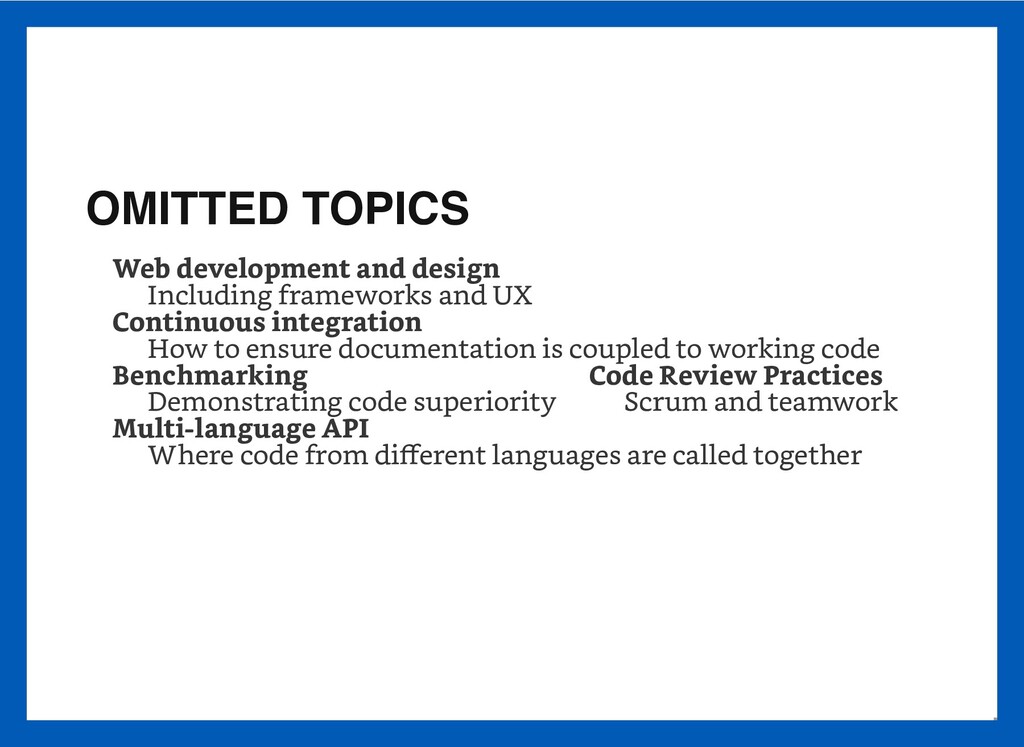
Continuous integration How to ensure documentation is coupled to working code Benchmarking Demonstrating code superiority Code Review Practices Scrum and teamwork Multi-language API Where code from different languages are called together 47
the context of a large multi-language project A large scientific code project designed with a user- wiki, SymEngine and the Season of Docs d-SEAMS [goswamiDSEAMSDeferredStructural2020] 48
for the job Internationalize only where necessary User level Ensure documentation expires Keep provenance Ensure a documentation style guide is present Lint automatically 49


 rgoswami
 akosma
 raygrieselhuber
 hannesfritz
 katarinadahlin
 destraynor
 palkan
 cassininazir
 tammielis
 leimatthew05
 nikkihalliwell
 tomoyanonymous