Upgrade to Pro — share decks privately, control downloads, hide ads and more …

AI Agents Explained: What They Are, How They Wo...

AI Agents Explained: What They Are, How They Work, and Why Everyone's Talking About Them

This deck breaks down what AI agents actually are (McKinsey's goal-driven, self-directed software), how they work through a perceive-plan-act-adjust loop, and why adoption is surging now (Gartner, McKinsey stats). It covers the different types of agents (copilot, workflow, domain-specific, multi-agent) and ties it directly to B2B sales, positioning keum's AI Sales Concierge as a real-world example, while closing with a simple framework for teams to get started.

Avatar for James Risner

James Risner

July 09, 2026

Other Decks in Technology

Transcript

  1. AI Agents Explained What they are, how they work, and

    why everyone's talking about them A plain language guide for B2B teams
  2. 01 / DEFINITION What Is an AI Agent, Really? Most

    people first meet the term through a chatbot or a copilot tucked inside their email. A true AI agent goes further than that. McKinsey defines an AI agent as software built to reach a specific goal, working out its own steps and making real time decisions along the way. Give it a task, and it plans, acts, checks its own work, and only comes back to a person when it genuinely needs one.
  3. 02 / HOW IT WORKS How an AI Agent Actually

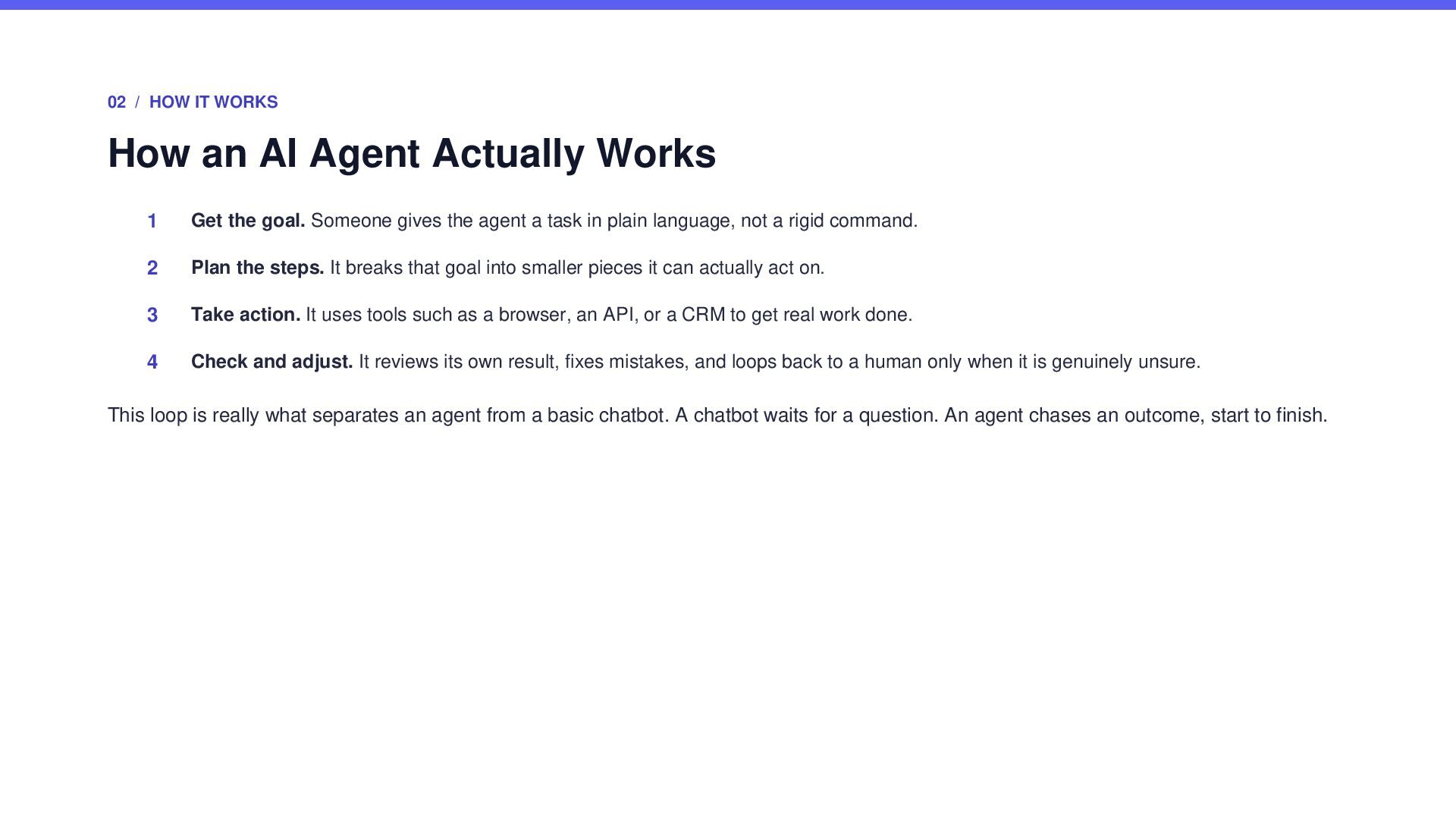
    Works 1 Get the goal. Someone gives the agent a task in plain language, not a rigid command. 2 Plan the steps. It breaks that goal into smaller pieces it can actually act on. 3 Take action. It uses tools such as a browser, an API, or a CRM to get real work done. 4 Check and adjust. It reviews its own result, fixes mistakes, and loops back to a human only when it is genuinely unsure. This loop is really what separates an agent from a basic chatbot. A chatbot waits for a question. An agent chases an outcome, start to finish.
  4. 03 / AGENT VS CHATBOT Agent, Chatbot, or Just Automation?

    Chatbot. Answers questions inside a single conversation, then stops there. Traditional automation. Follows a fixed rulebook and breaks the moment something falls outside it. AI agent. Sets its own path toward a goal, adapts mid task, and touches multiple systems, a calendar, a CRM, an inbox, without a person clicking through every step.
  5. 04 / WHY NOW Why Everyone's Talking About Them Three

    things changed at once. Language models got good enough to understand messy, real world instructions rather than rigid commands. Tool integrations let agents actually act inside a CRM or browser instead of just describing what to do. And leadership pressure for real productivity gains did the rest. Gartner expects AI agents to outnumber human sellers within the next couple of years, while cautioning that fewer than 40 percent of sellers report a genuine productivity gain from them today. McKinsey's own research shows 62 percent of organizations are already piloting agents, though far fewer have scaled one past the pilot stage.
  6. 05 / TYPES OF AGENTS Not All Agents Look the

    Same Copilot agents. Sit next to a person and boost what they already do, like Microsoft 365 Copilot drafting a document. Workflow agents. Take over a defined process end to end, like an AI sales agent qualifying every inbound lead the moment it arrives. Domain specific agents. Built around one function, such as customer support or scheduling, going deep rather than wide. Multi agent systems. Put several of these to work together, with one agent coordinating and handing pieces of a task to others. Most companies start with just one of these, usually a copilot or a single workflow agent, long before they ever touch a multi agent setup.
  7. 06 / AI FOR SALES Where This Shows Up in

    B2B Sales Nowhere is this shift more visible than in sales. This is really what people mean when they talk about ai for sales today: an agent that engages a website visitor, a WhatsApp message, or an inbound call the moment it happens, asks the right qualifying questions, and books a meeting straight onto a rep's calendar. keum's AI Sales Concierge is a good example of this in practice, running across web chat, voice, WhatsApp, and email, and logging a verified, structured summary straight into HubSpot, Salesforce, or whatever CRM a team already runs day to day.
  8. 07 / BEYOND SALES It's Not Just Sales Agents show

    up everywhere work happens, not only in sales. Microsoft's 365 Copilot drafts and researches inside a person's own inbox. Salesforce's Agentforce automates workflows for teams already living inside that CRM. Support teams use agents to triage tickets before a human ever sees them, and HR teams use them to screen resumes and schedule first round interviews. The common thread stays the same across every function: less waiting on a person to start the work, and less busywork left over once it is done.
  9. 08 / THE HUMAN SIDE Where a Human Still Has

    to Step In None of this makes people optional. Complex negotiations, judgment calls, and anything that needs real trust still lean on a person who can read the room and think on their feet. Most well built agent platforms are actually designed this way on purpose. When the AI is not confident in an answer, it flags the conversation for a human instead of guessing, then learns from that correction so the same gap does not happen twice down the line.
  10. 09 / GETTING STARTED A Simple Way to Get Started

    Pick one repetitive, well defined task to start, something like first response to a website visitor or a first pass at triaging support tickets. Give the agent a narrow scope and a clear path to escalate back to a human whenever it is unsure. Watch what it actually gets right for a few weeks before expanding its scope any further. Most ai for sales tools on the market today, keum included, offer a free tier specifically so teams can test the approach before committing real budget or headcount to the decision.