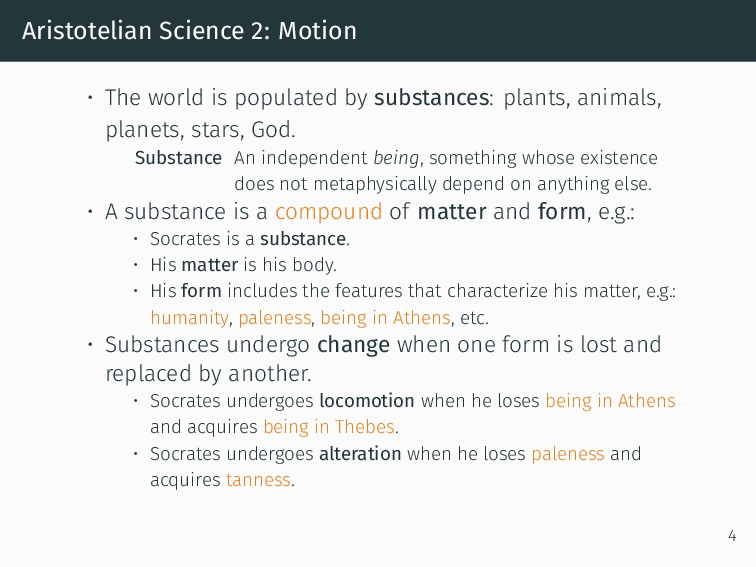
substances: plants, animals, planets, stars, God. Substance An independent being, something whose existence does not metaphysically depend on anything else. 4
substances: plants, animals, planets, stars, God. Substance An independent being, something whose existence does not metaphysically depend on anything else. • A substance is a compound of matter and form, e.g.: 4
substances: plants, animals, planets, stars, God. Substance An independent being, something whose existence does not metaphysically depend on anything else. • A substance is a compound of matter and form, e.g.: • Socrates is a substance. 4
substances: plants, animals, planets, stars, God. Substance An independent being, something whose existence does not metaphysically depend on anything else. • A substance is a compound of matter and form, e.g.: • Socrates is a substance. • His matter is his body. 4
substances: plants, animals, planets, stars, God. Substance An independent being, something whose existence does not metaphysically depend on anything else. • A substance is a compound of matter and form, e.g.: • Socrates is a substance. • His matter is his body. • His form includes the features that characterize his matter, e.g.: humanity, paleness, being in Athens, etc. 4
substances: plants, animals, planets, stars, God. Substance An independent being, something whose existence does not metaphysically depend on anything else. • A substance is a compound of matter and form, e.g.: • Socrates is a substance. • His matter is his body. • His form includes the features that characterize his matter, e.g.: humanity, paleness, being in Athens, etc. • Substances undergo change when one form is lost and replaced by another. 4
substances: plants, animals, planets, stars, God. Substance An independent being, something whose existence does not metaphysically depend on anything else. • A substance is a compound of matter and form, e.g.: • Socrates is a substance. • His matter is his body. • His form includes the features that characterize his matter, e.g.: humanity, paleness, being in Athens, etc. • Substances undergo change when one form is lost and replaced by another. • Socrates undergoes locomotion when he loses being in Athens and acquires being in Thebes. 4
substances: plants, animals, planets, stars, God. Substance An independent being, something whose existence does not metaphysically depend on anything else. • A substance is a compound of matter and form, e.g.: • Socrates is a substance. • His matter is his body. • His form includes the features that characterize his matter, e.g.: humanity, paleness, being in Athens, etc. • Substances undergo change when one form is lost and replaced by another. • Socrates undergoes locomotion when he loses being in Athens and acquires being in Thebes. • Socrates undergoes alteration when he loses paleness and acquires tanness. 4
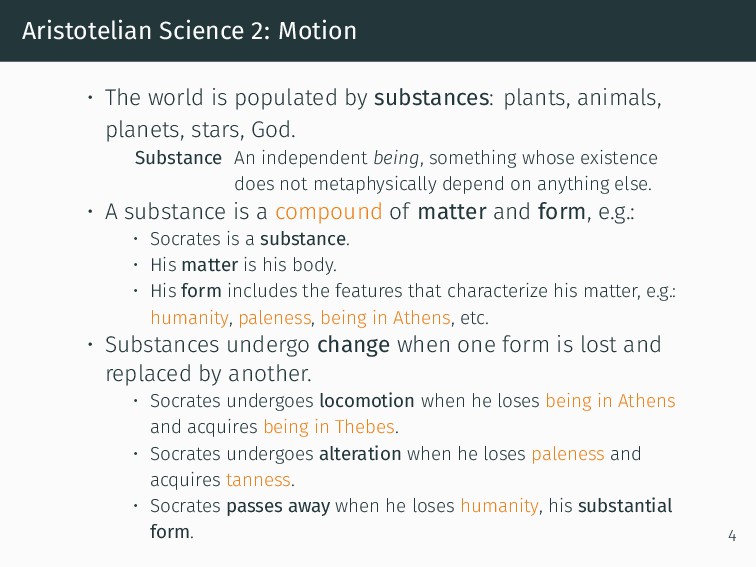
substances: plants, animals, planets, stars, God. Substance An independent being, something whose existence does not metaphysically depend on anything else. • A substance is a compound of matter and form, e.g.: • Socrates is a substance. • His matter is his body. • His form includes the features that characterize his matter, e.g.: humanity, paleness, being in Athens, etc. • Substances undergo change when one form is lost and replaced by another. • Socrates undergoes locomotion when he loses being in Athens and acquires being in Thebes. • Socrates undergoes alteration when he loses paleness and acquires tanness. • Socrates passes away when he loses humanity, his substantial form. 4
from self-evident, unproved principles or axioms. • Observation, experiment, and induction have little or no place in science. • Rather, “natural philosophy” is a deductive enterprise, dedicated to the discovery of new theorems from the most general principles of the science. 5
theory that the natural world operates mechanistically. Some consequences of the mechanical philosophy: • Many of the forms traditionally associated with bodies have no causal efficacy, including especially sensible properties like color, flavor, etc. 7
theory that the natural world operates mechanistically. Some consequences of the mechanical philosophy: • Many of the forms traditionally associated with bodies have no causal efficacy, including especially sensible properties like color, flavor, etc. • All that needs to be ascribed to bodies to explain change mechanistically are mathematically quantifiable properties like size, shape, mass, velocity. 7
ultimate material constituents are indivisible bodies or corpuscles whose mechanical interaction produce macroscopic phenomena. … I cannot believe that there exists in external bodies anything other than their size, shape, or motion (slow or rapid), which could excite in ust our tastes, sounds, and odors. And indeed I should judge that, if ears, tongues, and noses be taken away, the number, shape and motion of bodies would remain, but not their tastes, sounds, and odors. [… H]aving now shown that how some affec- tions, often reputed to be indwelling properties, have really no ex- istence save in us […] I confess myself to be very much inclined to believe that heat, too, is of this sort, and that those materials which produce and make felt in us the sense of heat and to which we give the general name “fire” consist of a multitude of tiny particles of such and such a shape, and having such and such a velocity. (The Assayer, p. 23) 8
scientific inquiry: 19. There can be only two ways of searching into and discovering truth. The one flies from the senses and particulars to the most general axioms, and from these principles, the truth of which it takes to be settled and immovable, proceeds to judgment and to the discovery of middle axioms. And this way is now in fashion. The other derives axioms from the senses and particulars, rising by a gradual and unbroken ascent, so that it arrives at the most general axioms last of all. This is the true way, but as yet untried. 9
having been suggested by a scanty and mainpular experience and a few particulars of most general oc- currence, are made for the most part just large enough to fit and take these in; and therefore it is no wonder if they do not lead to new particulars. And if some opposite instance, not observed or known before, chances to come in the way, the axiom is res- cued and preserved by some frivilous distinction; whereas the truer course would be to correct the axiom itself. 10
to expect any great advancement in science from the superinducing and engrafting of new things upon old. We must begin anew from the very foundations, unless we would revolve forever in a circle with mean and contemptible progress. […] 36. One method of discovery alone remains to us, which is simply this: We must lead men to the particulars themselves, and their series and order, while men on their side must force themselves for a while to lay their notions by and begin to familiarize themselves with the facts. (Bacon, New Organon) 11
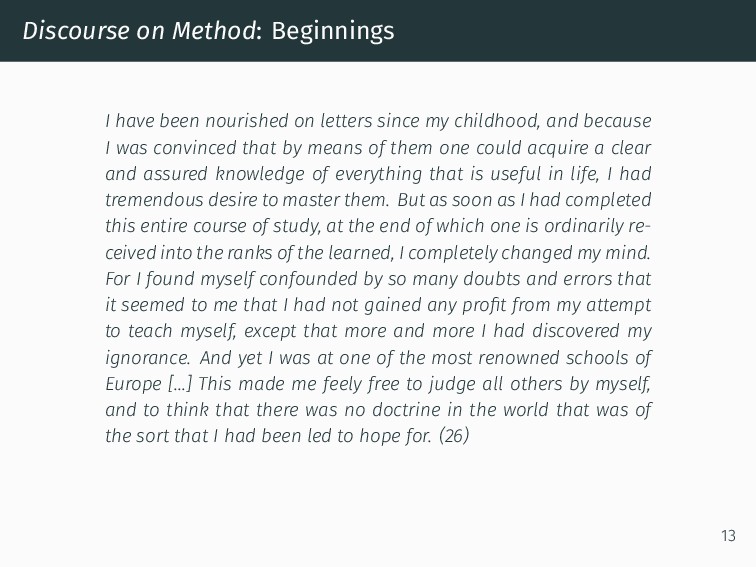
since my childhood, and because I was convinced that by means of them one could acquire a clear and assured knowledge of everything that is useful in life, I had tremendous desire to master them. But as soon as I had completed this entire course of study, at the end of which one is ordinarily re- ceived into the ranks of the learned, I completely changed my mind. For I found myself confounded by so many doubts and errors that it seemed to me that I had not gained any profit from my attempt to teach myself, except that more and more I had discovered my ignorance. And yet I was at one of the most renowned schools of Europe […] This made me feely free to judge all others by myself, and to think that there was no doctrine in the world that was of the sort that I had been led to hope for. (26) 13
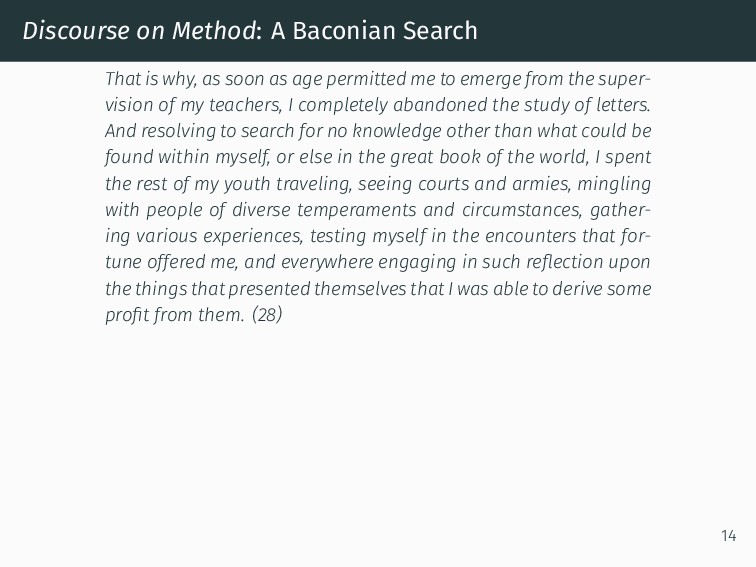
soon as age permitted me to emerge from the super- vision of my teachers, I completely abandoned the study of letters. And resolving to search for no knowledge other than what could be found within myself, or else in the great book of the world, I spent the rest of my youth traveling, seeing courts and armies, mingling with people of diverse temperaments and circumstances, gather- ing various experiences, testing myself in the encounters that for- tune offered me, and everywhere engaging in such reflection upon the things that presented themselves that I was able to derive some profit from them. (28) 14
soon as age permitted me to emerge from the super- vision of my teachers, I completely abandoned the study of letters. And resolving to search for no knowledge other than what could be found within myself, or else in the great book of the world, I spent the rest of my youth traveling, seeing courts and armies, mingling with people of diverse temperaments and circumstances, gather- ing various experiences, testing myself in the encounters that for- tune offered me, and everywhere engaging in such reflection upon the things that presented themselves that I was able to derive some profit from them. (28) But after I had spent some years studying in the book of the world and in trying to gain some experience, I resolved one day to study within myself too and to spend of the powers of my mind in choos- ing the paths that I should follow. In this I had much more success, it seems to me, than had I never left either my country or my books. (28) 14
really be at all reasonable for a single individual to plan to reform a state by changing everything in it from the foun- dations up and by toppling it in order to set it up again; nor even also to reform the body of the sciences or the order established by the schools for teaching them; but that, as regards all the opinions to which I had until now given credence, I could not do better than to try to get rid of them once and for all, in order to replace them later one, either with ones that are better, or even with the same ones once I had reconciled them to the level reason. (29) 15
accept anything as true that I did not plainly know to be such; that is to say, carefully to avoid hasty judg- ment and prejudice; and to include nothing more in my judgments than what presented itself to my mind so clearly and distinctly that I had no occasion to call it in doubt. The second, to divide each of the difficulties I would examine into as many parts as possible and as was required in order better to resolve them. The third, to conduct my thoughts in an orderely fashion, by commencing with those objects that are simplest and easiest to know, in order to ascend, little by little, as by degrees, to the knowl- edge of the most composite things, and by supposing an order even among those things that do not naturally precede one an- other. And the last, everywhere to make enumerations so complete and reviews so general that I was assured of having omitted noth- ing. (31) 16
ourselves, that these six Meditations con- tain all the foundations of my physics. But please do not tell peo- ple, for that might make it harder for supporters of Aristotle to approve of them. I hope that readers will gradually get used to my principles, and recognize their truth, before they notice that they destroy the principles of Aristotle. (Letter to Mersenne, 18 January 1641) 17


 mfonobong
 jakevdp
 lara
 aleyda
 keithpitt
 3n
 techseoconnect
 deanohume
 auna
 baasie