Upgrade to Pro — share decks privately, control downloads, hide ads and more …

Food Delivery- The Past, Present, and Future

Avatar for Rosa Helm Rosa Helm
August 09, 2021

Food Delivery- The Past, Present, and Future

Food delivery has grown to become extremely popular especially through the pandemic. So how exactly has COVID-19 changed the trend of our food consumption? Get a deeper insight starting from the emergence of food delivery business models to the future of Food Delivery Business.

Avatar for Rosa Helm

Rosa Helm

August 09, 2021
Tweet

More Decks by Rosa Helm

Other Decks in Technology

Transcript

  1. www.locus.sh Food Delivery: The Past, Present, and Future “Ordering food

    has now become a way of life. Food literally lands up at your doorstep in just a few clicks. But, behind the few clicks lies centuries of history.” Author: Lakshmi Narashimman
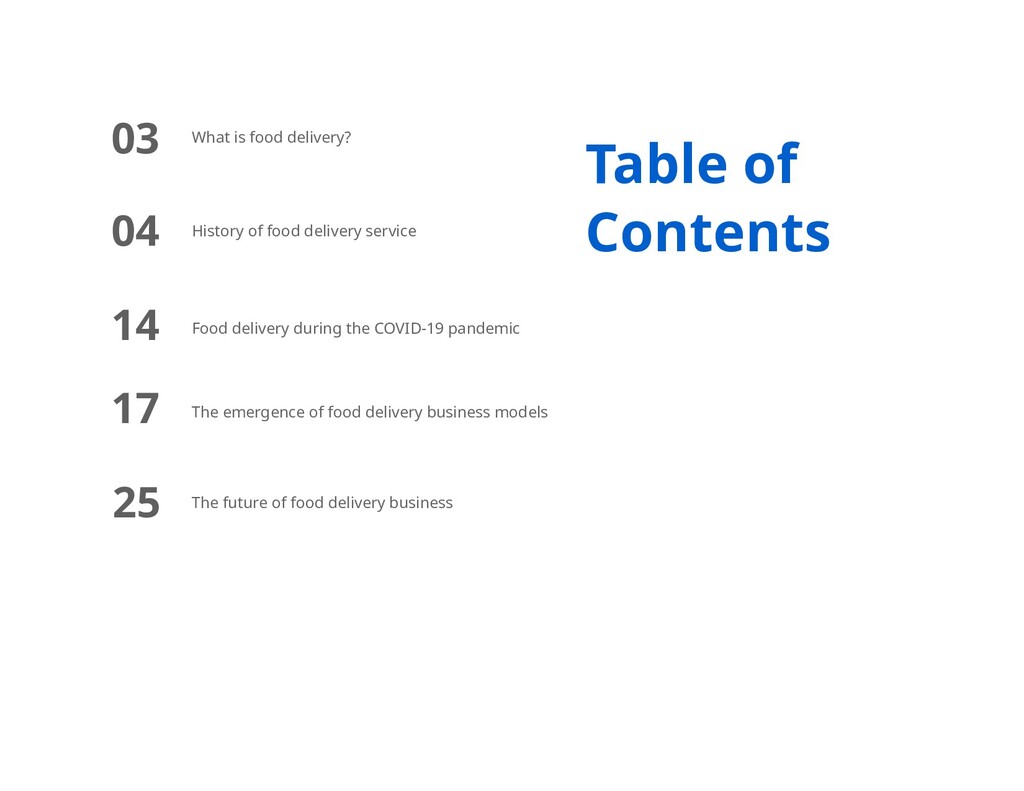
  2. Table of Contents 03 04 14 17 25 What is

    food delivery? History of food delivery service Food delivery during the COVID-19 pandemic The emergence of food delivery business models The future of food delivery business
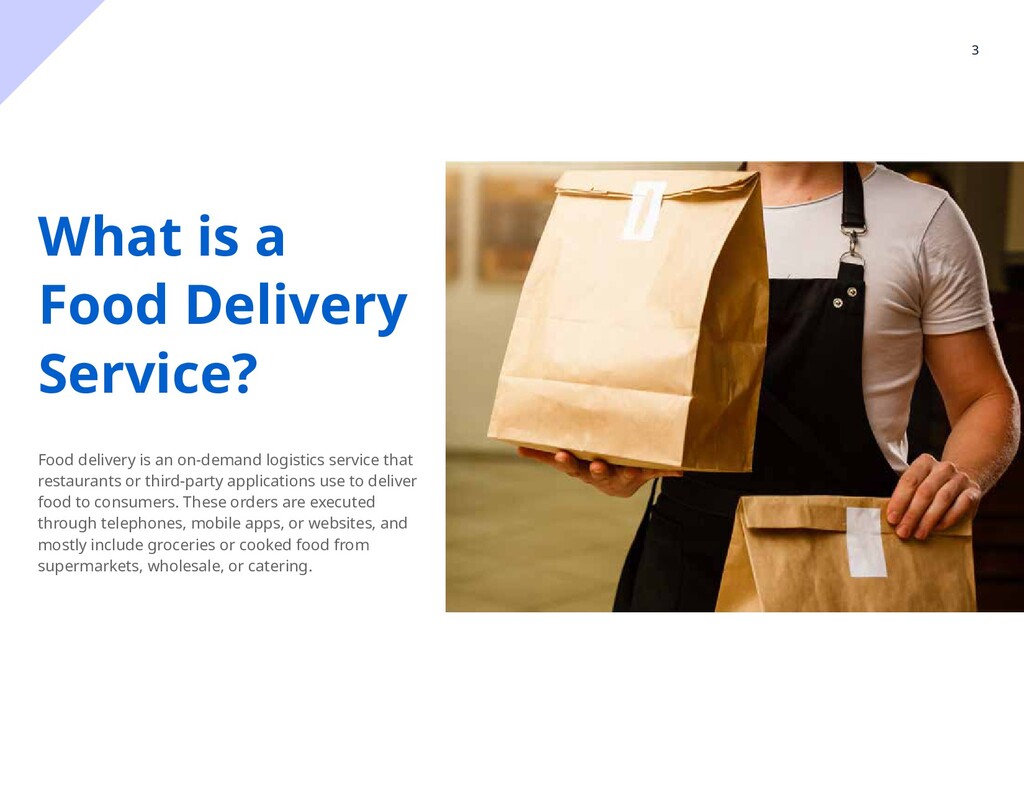
  3. What is a Food Delivery Service? 3 Food delivery is

    an on-demand logistics service that restaurants or third-party applications use to deliver food to consumers. These orders are executed through telephones, mobile apps, or websites, and mostly include groceries or cooked food from supermarkets, wholesale, or catering.
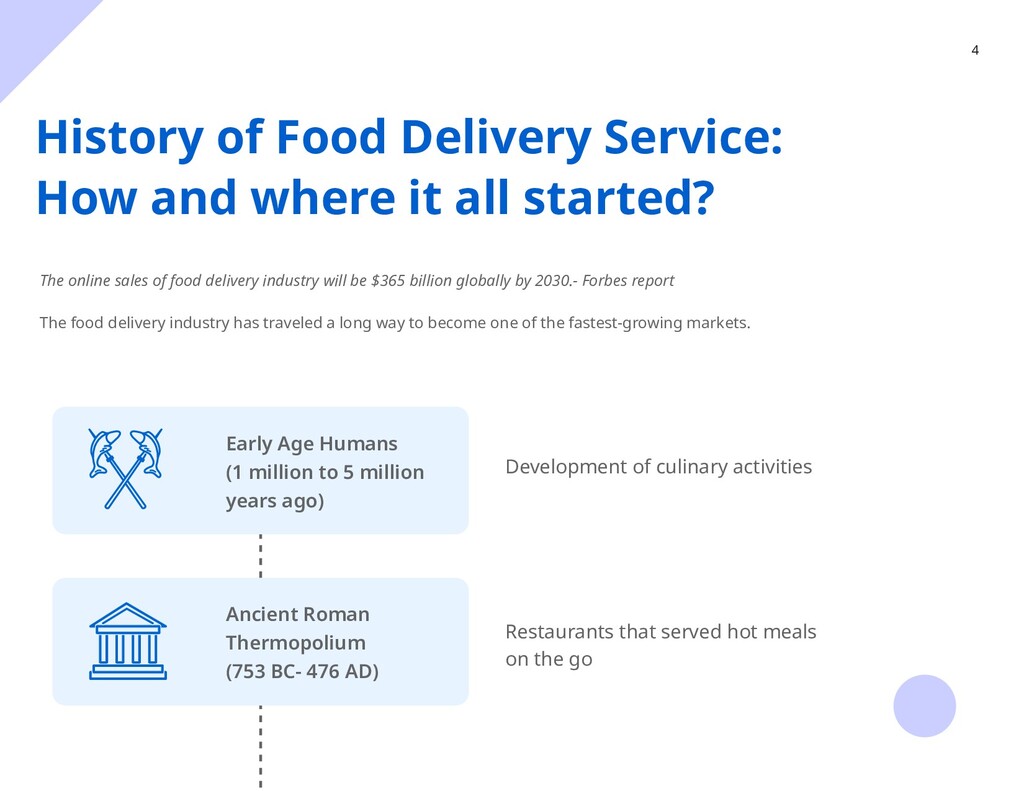
  4. History of Food Delivery Service: How and where it all

    started? 4 The online sales of food delivery industry will be $365 billion globally by 2030.- Forbes report The food delivery industry has traveled a long way to become one of the fastest-growing markets. Early Age Humans (1 million to 5 million years ago) Ancient Roman Thermopolium (753 BC- 476 AD) Development of culinary activities Restaurants that served hot meals on the go
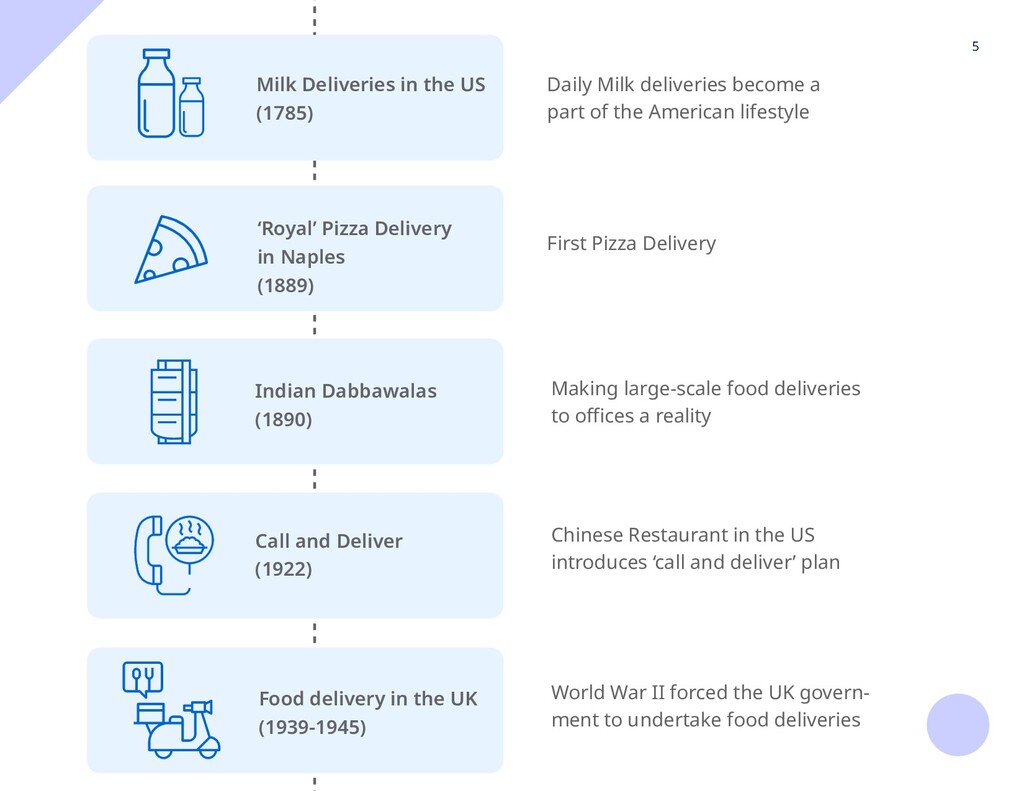
  5. 5 Milk Deliveries in the US (1785) ‘Royal’ Pizza Delivery

    in Naples (1889) Indian Dabbawalas (1890) Call and Deliver (1922) Food delivery in the UK (1939-1945) Daily Milk deliveries become a part of the American lifestyle First Pizza Delivery Making large-scale food deliveries to offices a reality Chinese Restaurant in the US introduces ‘call and deliver’ plan World War II forced the UK govern- ment to undertake food deliveries
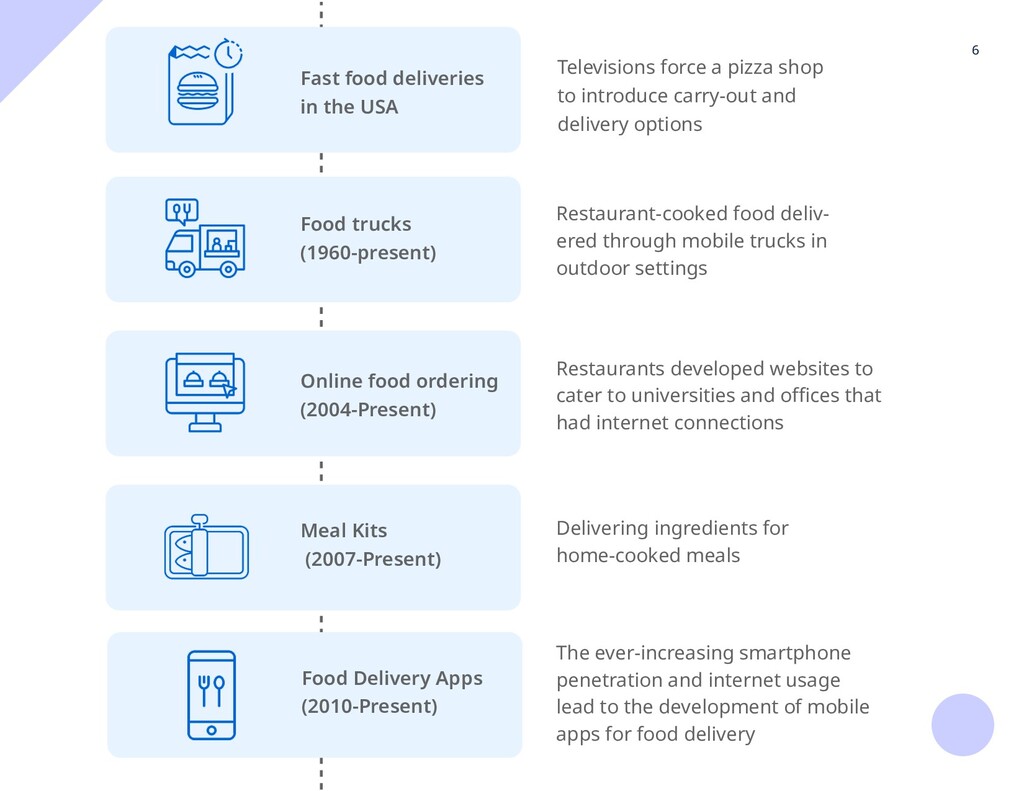
  6. 6 Food trucks (1960-present) Online food ordering (2004-Present) Meal Kits

    (2007-Present) Food Delivery Apps (2010-Present) Fast food deliveries in the USA Televisions force a pizza shop to introduce carry-out and delivery options Restaurant-cooked food deliv- ered through mobile trucks in outdoor settings Restaurants developed websites to cater to universities and offices that had internet connections Delivering ingredients for home-cooked meals The ever-increasing smartphone penetration and internet usage lead to the development of mobile apps for food delivery
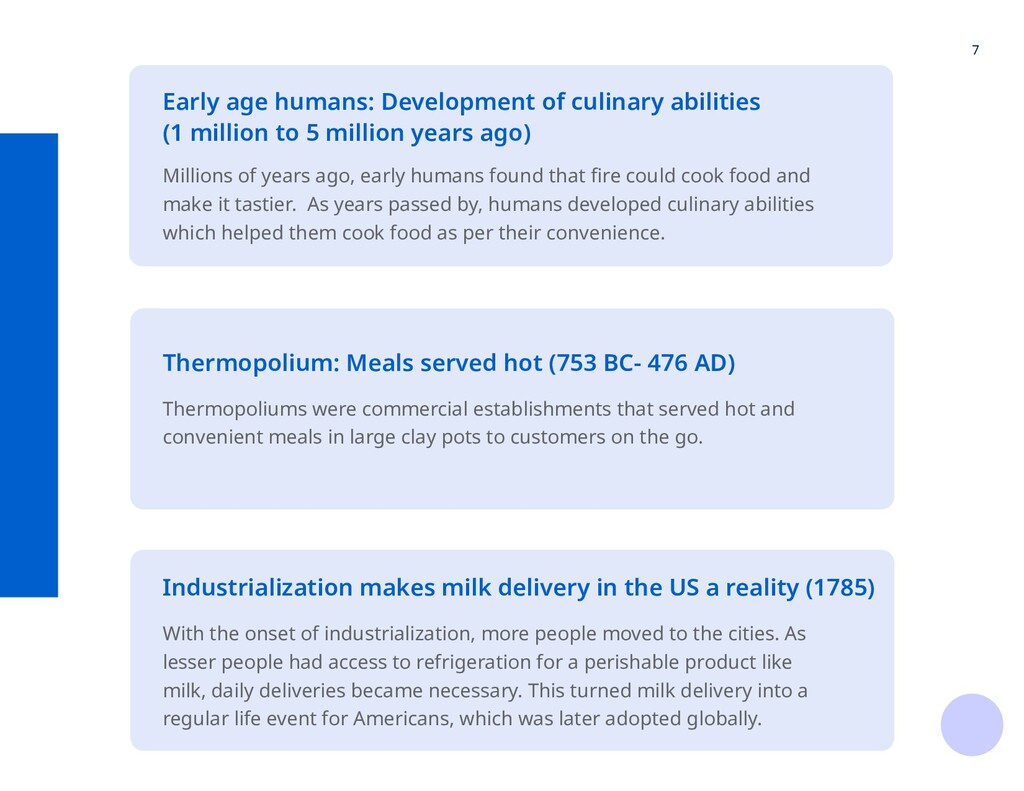
  7. 7 Early age humans: Development of culinary abilities (1 million

    to 5 million years ago) Millions of years ago, early humans found that fire could cook food and make it tastier. As years passed by, humans developed culinary abilities which helped them cook food as per their convenience. Thermopolium: Meals served hot (753 BC- 476 AD) Thermopoliums were commercial establishments that served hot and convenient meals in large clay pots to customers on the go. Industrialization makes milk delivery in the US a reality (1785) With the onset of industrialization, more people moved to the cities. As lesser people had access to refrigeration for a perishable product like milk, daily deliveries became necessary. This turned milk delivery into a regular life event for Americans, which was later adopted globally.
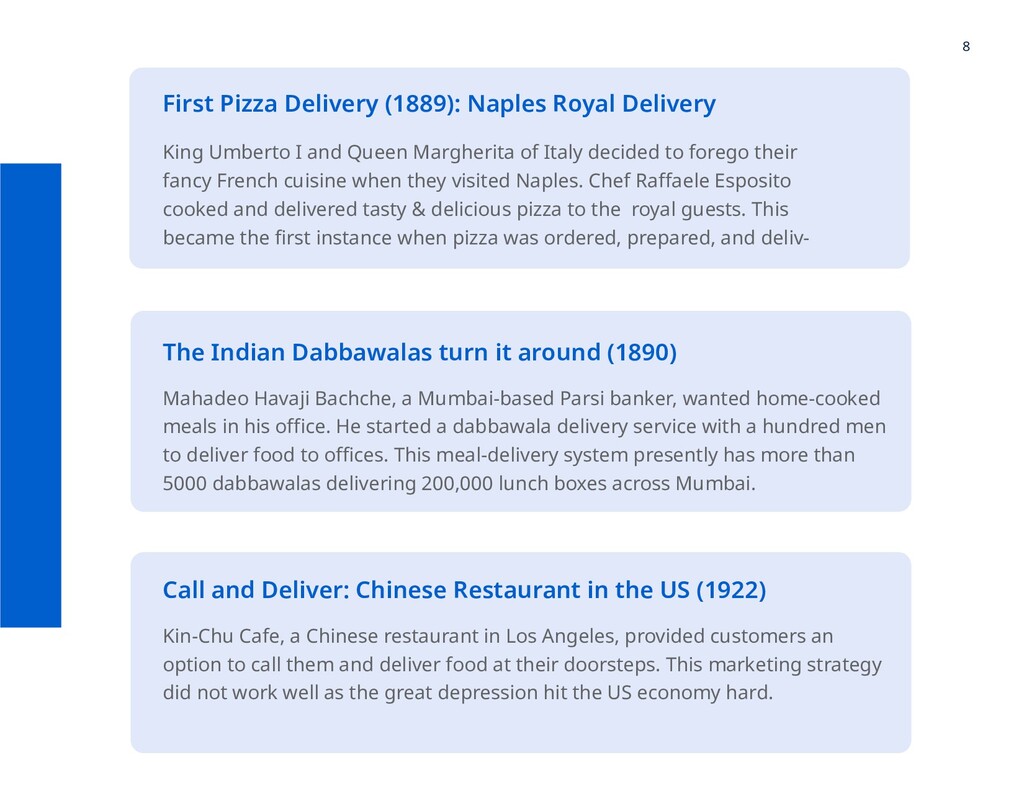
  8. 88 First Pizza Delivery (1889): Naples Royal Delivery King Umberto

    I and Queen Margherita of Italy decided to forego their fancy French cuisine when they visited Naples. Chef Raffaele Esposito cooked and delivered tasty & delicious pizza to the royal guests. This became the first instance when pizza was ordered, prepared, and deliv- The Indian Dabbawalas turn it around (1890) Mahadeo Havaji Bachche, a Mumbai-based Parsi banker, wanted home-cooked meals in his office. He started a dabbawala delivery service with a hundred men to deliver food to offices. This meal-delivery system presently has more than 5000 dabbawalas delivering 200,000 lunch boxes across Mumbai. Call and Deliver: Chinese Restaurant in the US (1922) Kin-Chu Cafe, a Chinese restaurant in Los Angeles, provided customers an option to call them and deliver food at their doorsteps. This marketing strategy did not work well as the great depression hit the US economy hard.
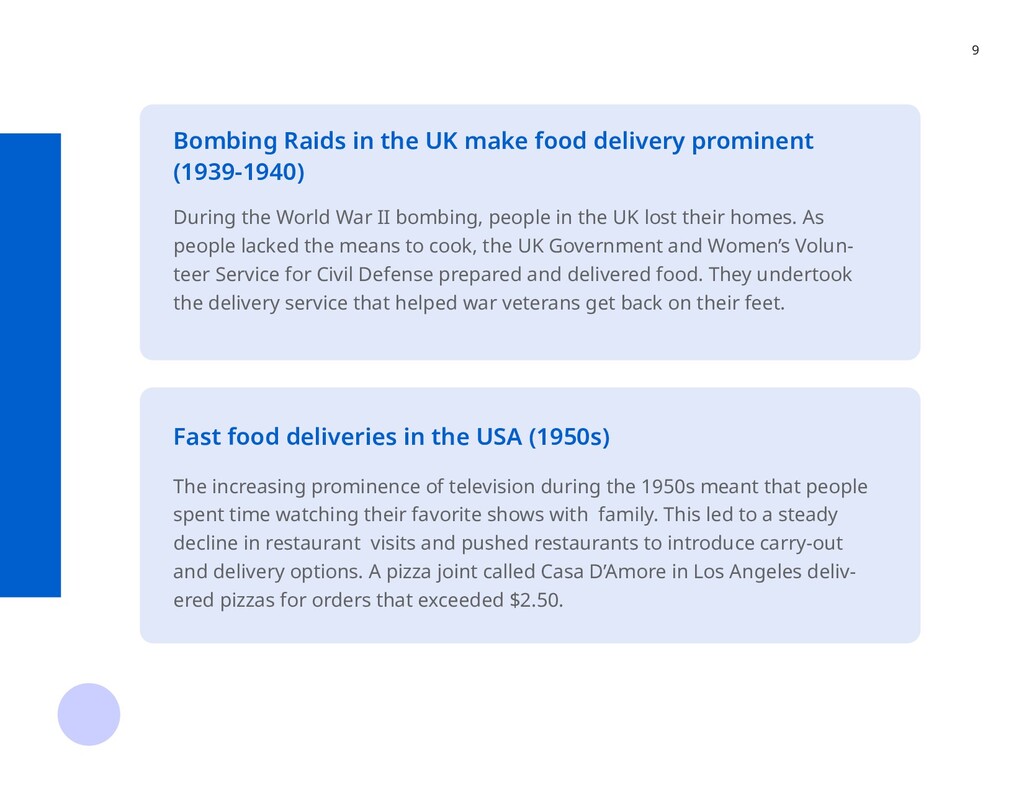
  9. 9 Bombing Raids in the UK make food delivery prominent

    (1939-1940) During the World War II bombing, people in the UK lost their homes. As people lacked the means to cook, the UK Government and Women’s Volun- teer Service for Civil Defense prepared and delivered food. They undertook the delivery service that helped war veterans get back on their feet. Fast food deliveries in the USA (1950s) The increasing prominence of television during the 1950s meant that people spent time watching their favorite shows with family. This led to a steady decline in restaurant visits and pushed restaurants to introduce carry-out and delivery options. A pizza joint called Casa D’Amore in Los Angeles deliv- ered pizzas for orders that exceeded $2.50.
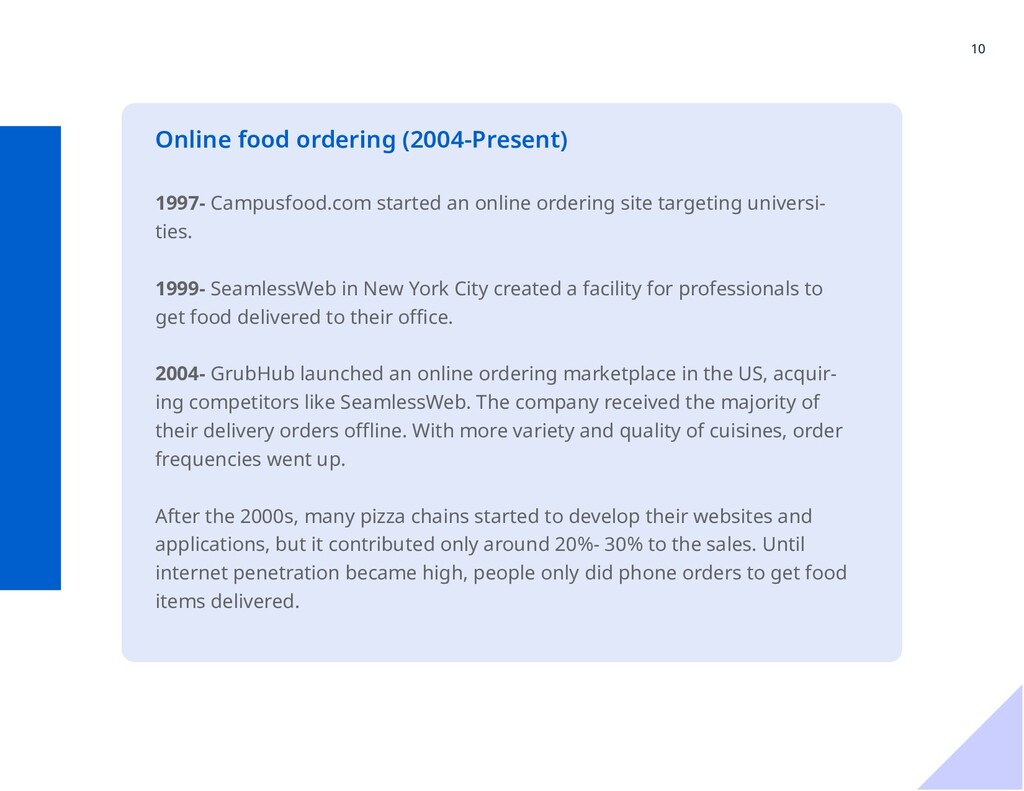
  10. 10 Online food ordering (2004-Present) 1997- Campusfood.com started an online

    ordering site targeting universi- ties. 1999- SeamlessWeb in New York City created a facility for professionals to get food delivered to their office. 2004- GrubHub launched an online ordering marketplace in the US, acquir- ing competitors like SeamlessWeb. The company received the majority of their delivery orders offline. With more variety and quality of cuisines, order frequencies went up. After the 2000s, many pizza chains started to develop their websites and applications, but it contributed only around 20%- 30% to the sales. Until internet penetration became high, people only did phone orders to get food items delivered.
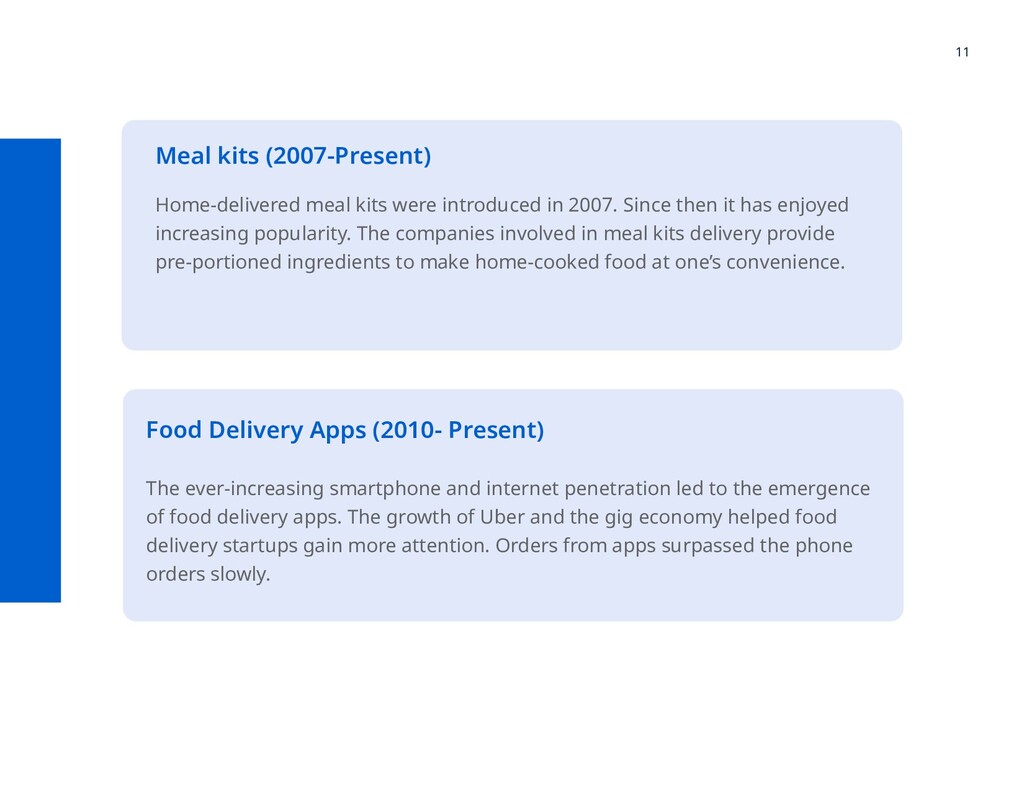
  11. 11 Meal kits (2007-Present) Home-delivered meal kits were introduced in

    2007. Since then it has enjoyed increasing popularity. The companies involved in meal kits delivery provide pre-portioned ingredients to make home-cooked food at one’s convenience. Food Delivery Apps (2010- Present) The ever-increasing smartphone and internet penetration led to the emergence of food delivery apps. The growth of Uber and the gig economy helped food delivery startups gain more attention. Orders from apps surpassed the phone orders slowly.
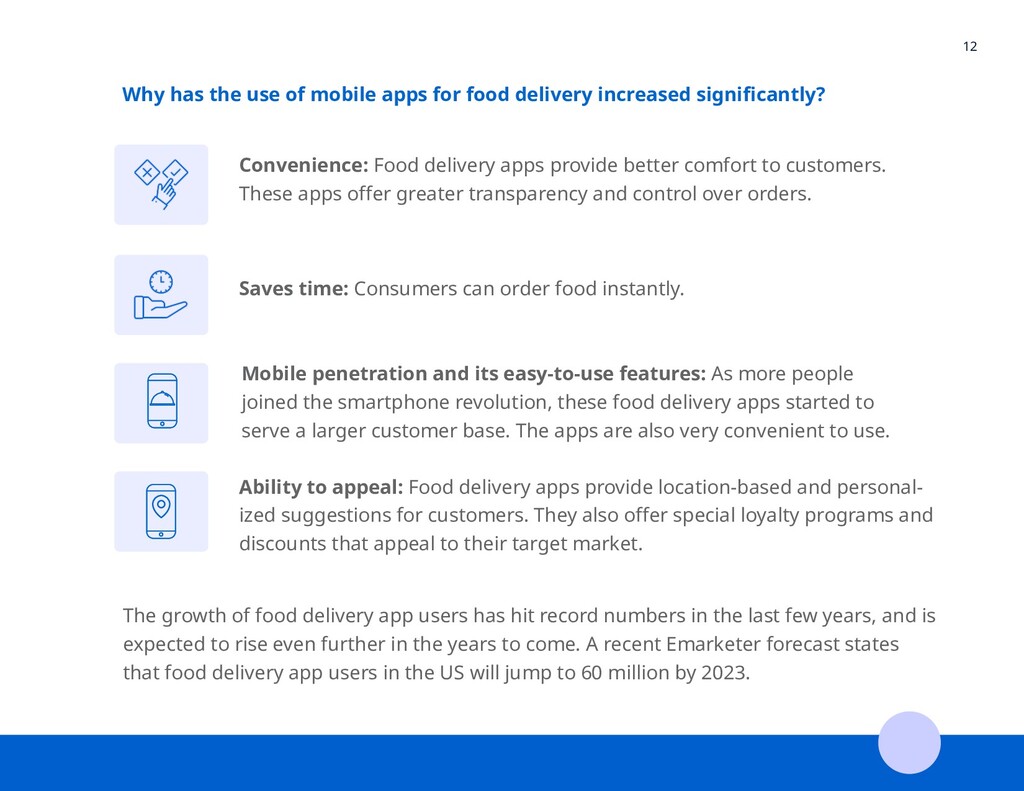
  12. 12 Why has the use of mobile apps for food

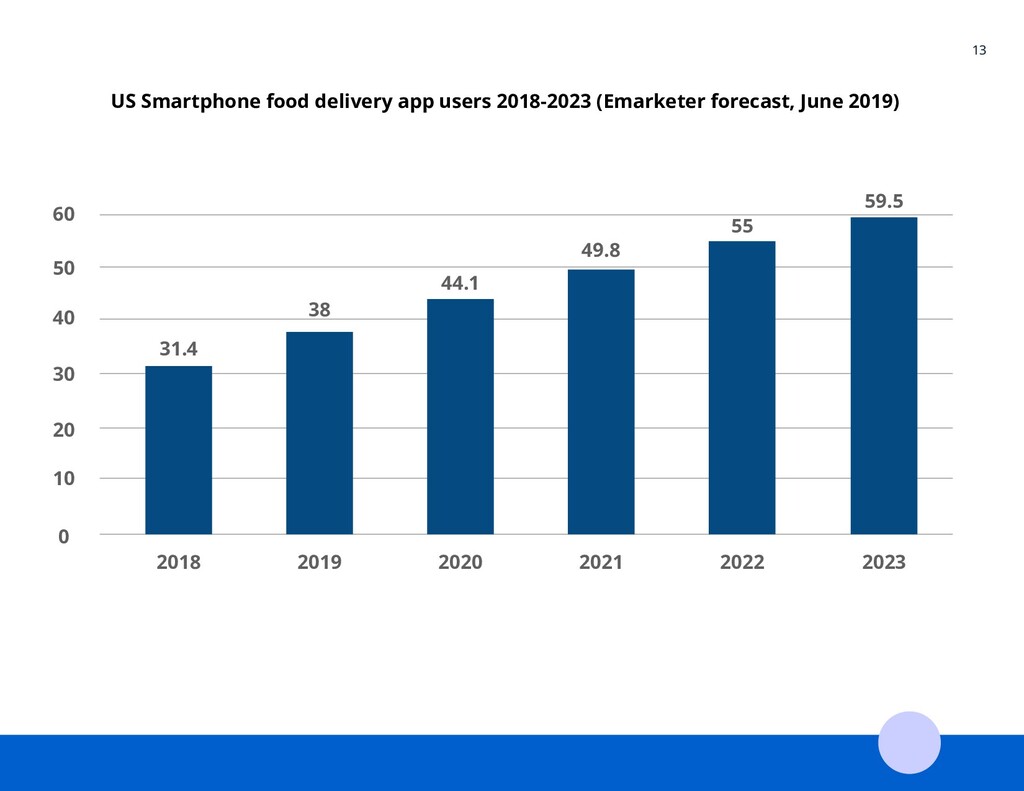
    delivery increased significantly? Ability to appeal: Food delivery apps provide location-based and personal- ized suggestions for customers. They also offer special loyalty programs and discounts that appeal to their target market. The growth of food delivery app users has hit record numbers in the last few years, and is expected to rise even further in the years to come. A recent Emarketer forecast states that food delivery app users in the US will jump to 60 million by 2023. Saves time: Consumers can order food instantly. Convenience: Food delivery apps provide better comfort to customers. These apps offer greater transparency and control over orders. Mobile penetration and its easy-to-use features: As more people joined the smartphone revolution, these food delivery apps started to serve a larger customer base. The apps are also very convenient to use.
  13. 13 US Smartphone food delivery app users 2018-2023 (Emarketer forecast,

    June 2019) 0 10 20 30 40 31.4 38 44.1 49.8 55 59.5 50 60 2018 2019 2020 2021 2022 2023
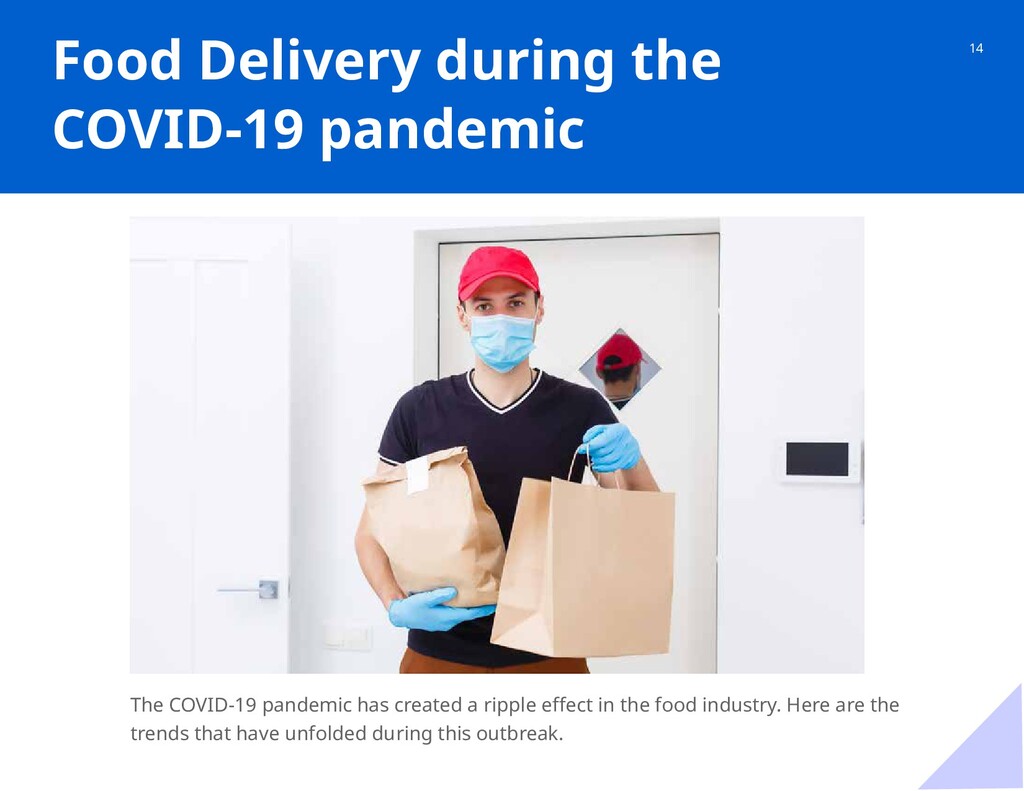
  14. 14 Food Delivery during the COVID-19 pandemic The COVID-19 pandemic

    has created a ripple effect in the food industry. Here are the trends that have unfolded during this outbreak.
  15. 15 Local food chains partnering with at least one aggregator

    (third-party food logistics platform) Full-service restaurants that implement online ordering see an 11% to 20% increase in revenue.- Annual Restaurant report, 2020. Due to the Coronavirus pandemic, local restaurants have entered the food delivery business by partnering with at least one aggregator. A decline in phone orders (offline orders) Through 2025, delivery through phone orders will shrink by 3% annually.- Alphawise survey There is a rapid increase in migration towards digital services, hence food deliveries via phone orders are shrinking considerably. Rise of ghost restaurants Restaurants are channelizing their efforts towards executing online deliveries through ghost kitchens. They are commercial kitchens that do not have a dine-in experience. The operational costs are lower for running these ghost kitchens.
  16. 16 Increase in contactless deliveries The United States has witnessed

    a 20% increase in consumer preference for contactless deliveries.- McKinsey report, Customer Experience during Coronavirus, Apr 2020. Safety has become the primary focus of the food delivery industry. This has caused an increase in food packaging costs and a rise in contactless deliveries. Presently, companies are looking for technologies like Electronic Proof of Delivery to facilitate contactless deliveries. Aggregators using aggressive discounts Promotions and deals play a crucial role for 58% of diners' decision-making, leading to negative earnings in every region except New York.- Brian Nowak, Equity Analyst covering US Internet Industry. The food delivery industry is price-sensitive. Aggregators use aggressive discounts and free delivery to attract customers. Though discounts play a positive role in con- sumer decision-making, it could also lead to more losses. Search for food delivery models Restaurants need to reduce promotional costs and increase efficiency so as to sur- vive this pandemic. Food delivery businesses allow restaurants to do just that. Through these apps, restaurants can now reach more customers.
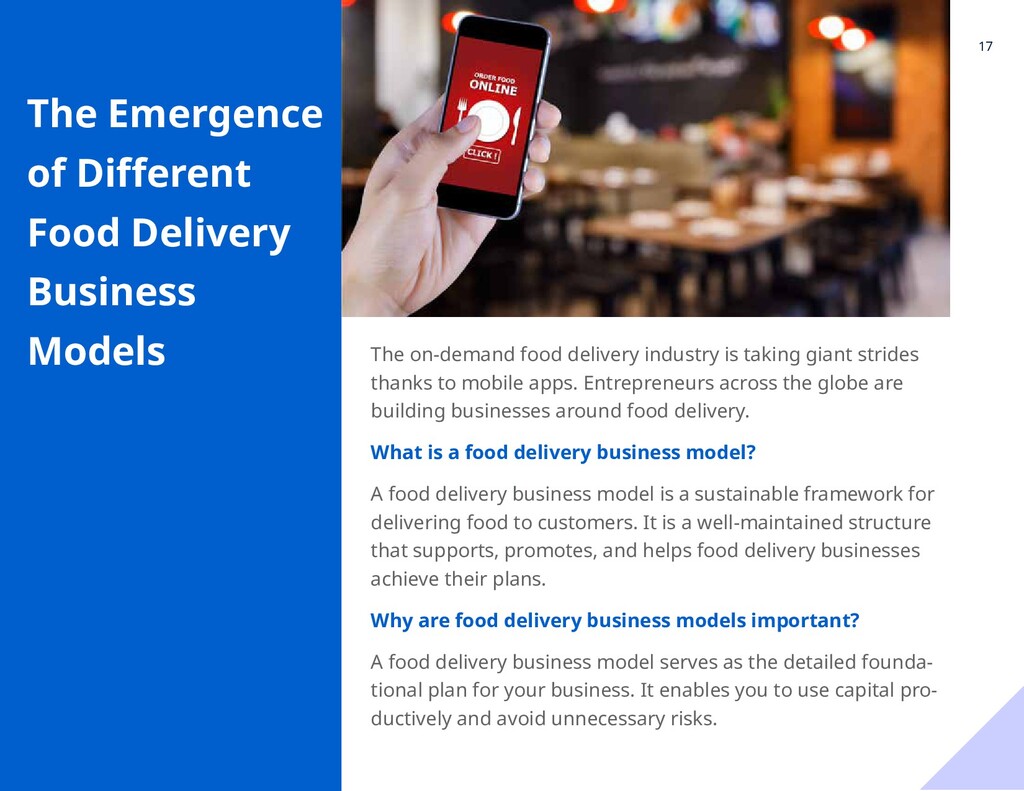
  17. 17 17 The on-demand food delivery industry is taking giant

    strides thanks to mobile apps. Entrepreneurs across the globe are building businesses around food delivery. What is a food delivery business model? A food delivery business model is a sustainable framework for delivering food to customers. It is a well-maintained structure that supports, promotes, and helps food delivery businesses achieve their plans. Why are food delivery business models important? A food delivery business model serves as the detailed founda- tional plan for your business. It enables you to use capital pro- ductively and avoid unnecessary risks. The Emergence of Different Food Delivery Business Models
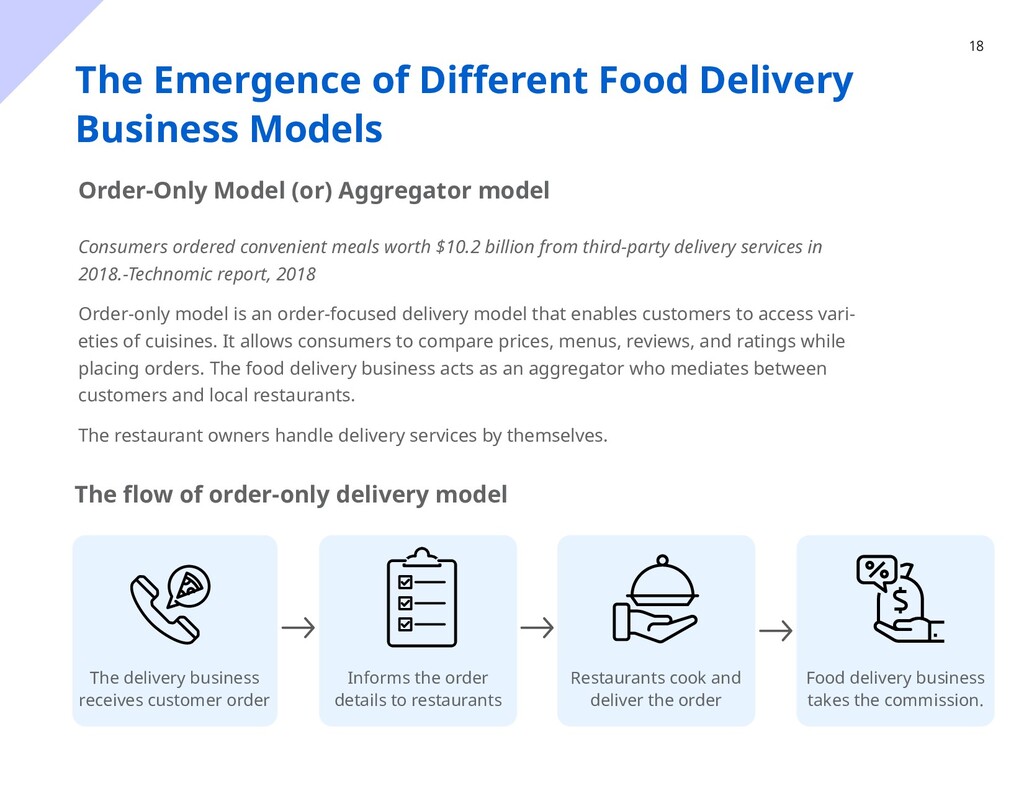
  18. 18 The Emergence of Different Food Delivery Business Models Order-Only

    Model (or) Aggregator model Consumers ordered convenient meals worth $10.2 billion from third-party delivery services in 2018.-Technomic report, 2018 Order-only model is an order-focused delivery model that enables customers to access vari- eties of cuisines. It allows consumers to compare prices, menus, reviews, and ratings while placing orders. The food delivery business acts as an aggregator who mediates between customers and local restaurants. The restaurant owners handle delivery services by themselves. The flow of order-only delivery model The delivery business receives customer order Informs the order details to restaurants Restaurants cook and deliver the order Food delivery business takes the commission.
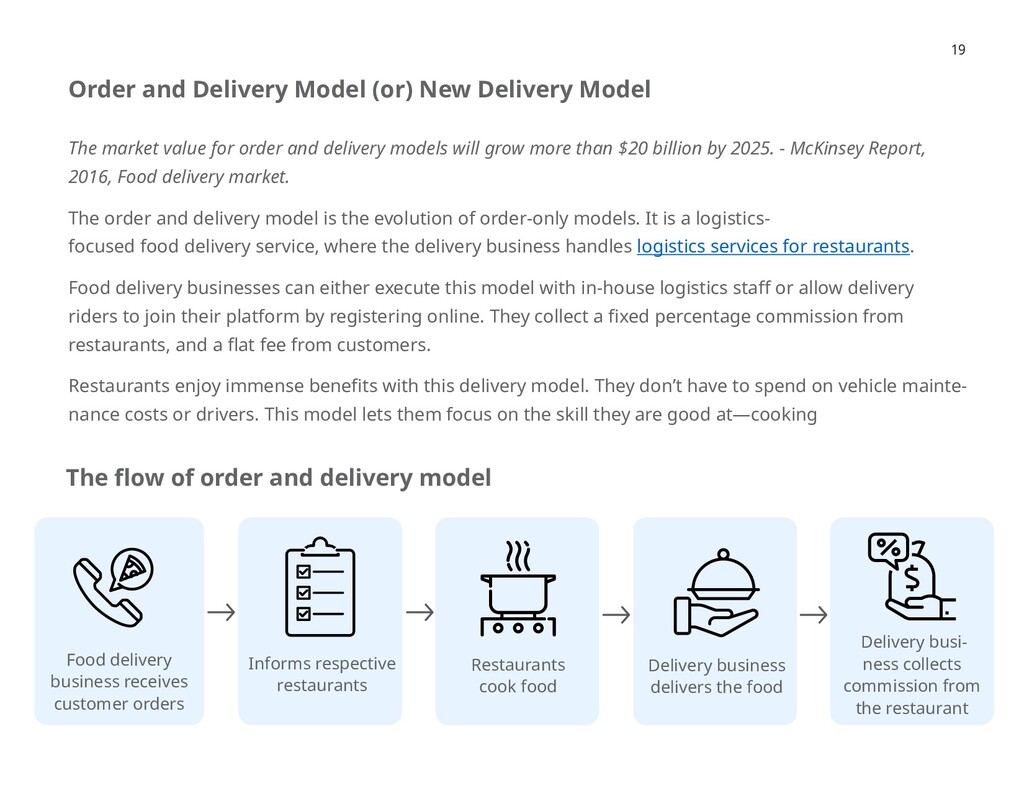
  19. 19 Order and Delivery Model (or) New Delivery Model The

    market value for order and delivery models will grow more than $20 billion by 2025. - McKinsey Report, 2016, Food delivery market. The order and delivery model is the evolution of order-only models. It is a logistics- focused food delivery service, where the delivery business handles logistics services for restaurants. Food delivery businesses can either execute this model with in-house logistics staff or allow delivery riders to join their platform by registering online. They collect a fixed percentage commission from restaurants, and a flat fee from customers. Restaurants enjoy immense benefits with this delivery model. They don’t have to spend on vehicle mainte- nance costs or drivers. This model lets them focus on the skill they are good at—cooking The flow of order and delivery model Food delivery business receives customer orders Informs respective restaurants Delivery business delivers the food Delivery busi- ness collects commission from the restaurant Restaurants cook food 19
  20. 20 Fully Integrated model (or) Full stack-model: Employing Cloud kitchens

    The global market value of cloud kitchens was $0.65 billion in 2018. It is expected to reach $2.63 billion by 2026 at a CAGR of 17.2. - Reports and Data, 2019 The present COVID-19 scenario has pushed food delivery businesses towards Cloud kitchens. The fully integrated food delivery model is quite different from the aforemen- tioned models. It is a complete meal delivery business plan where the food delivery business takes care of the order, cooking, and delivery. The in-house delivery team delivers food products to customers. Restaurant businesses facing steep losses during this COVID-19 outbreak are entering the cloud kitchen delivery model. This delivery model requires fewer resources. As everything is cooked in-house, delivery platforms can control their whole value chain. They can also personal- ize core services based on customer needs like the menu, chefs, and delivery drivers. There are two ways this model serves customers— scheduled deliveries and instant deliveries.
  21. 21 Fully-Integrated Model for scheduled deliveries Once the kitchen is

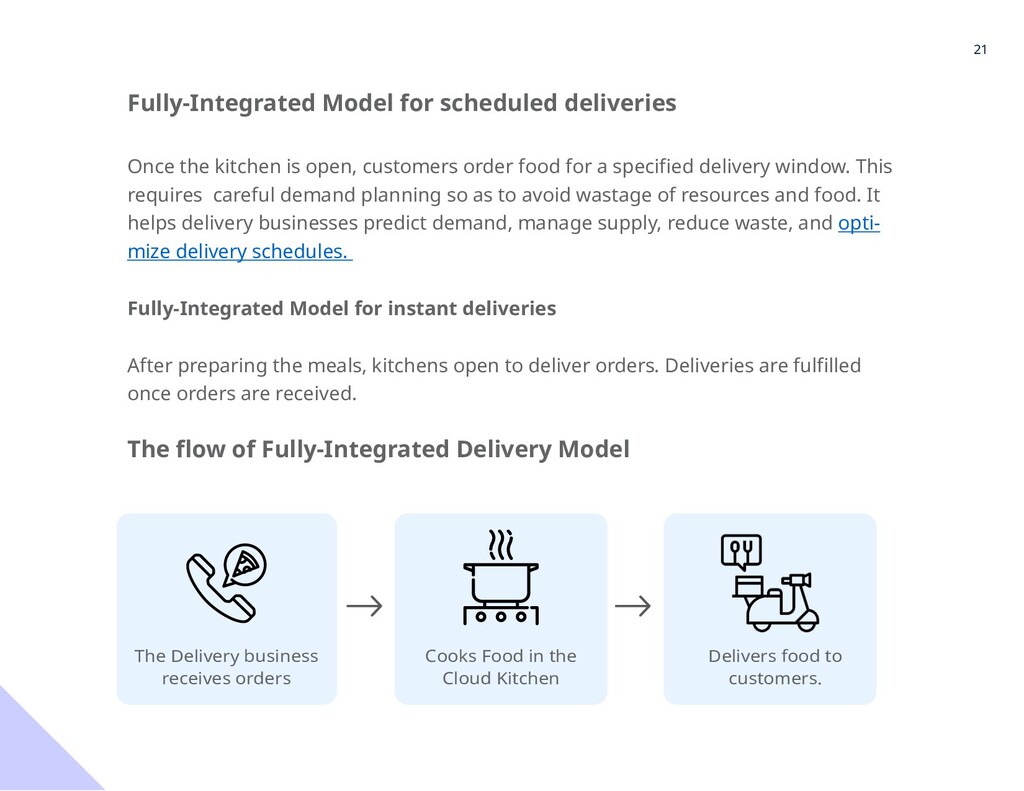
    open, customers order food for a specified delivery window. This requires careful demand planning so as to avoid wastage of resources and food. It helps delivery businesses predict demand, manage supply, reduce waste, and opti- mize delivery schedules. Fully-Integrated Model for instant deliveries After preparing the meals, kitchens open to deliver orders. Deliveries are fulfilled once orders are received. The flow of Fully-Integrated Delivery Model The Delivery business receives orders Cooks Food in the Cloud Kitchen Delivers food to customers.
  22. 22 Types of Cloud Kitchens Hub and spoke model -

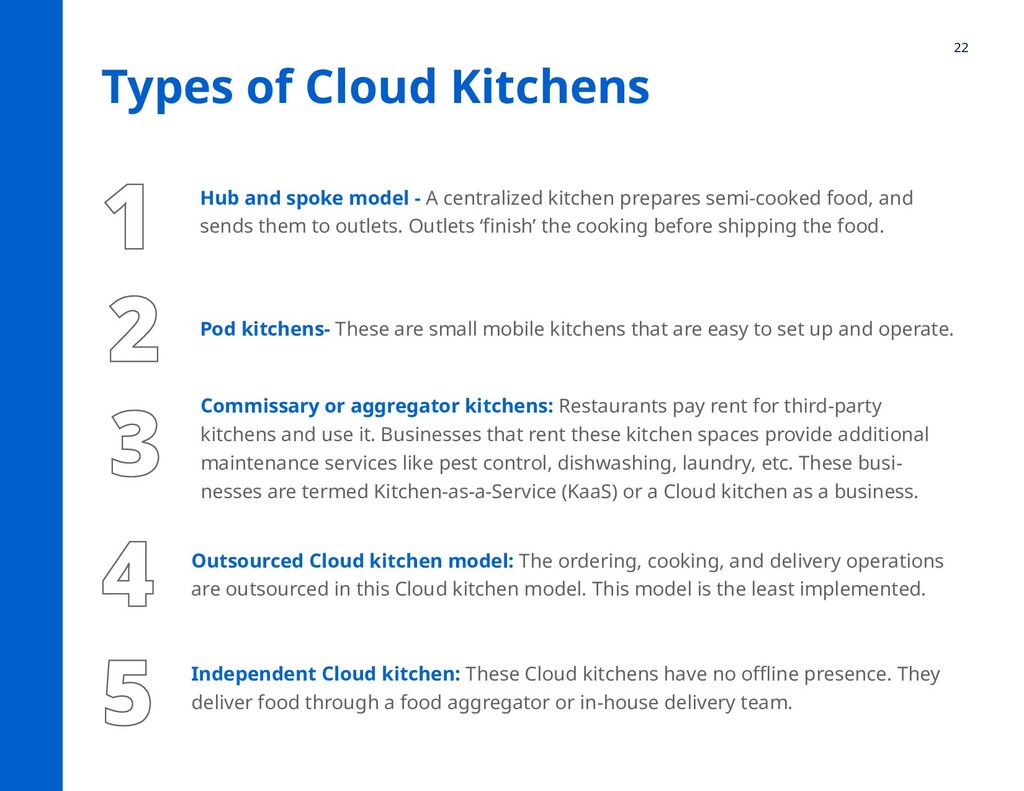
    A centralized kitchen prepares semi-cooked food, and sends them to outlets. Outlets ‘finish’ the cooking before shipping the food. Outsourced Cloud kitchen model: The ordering, cooking, and delivery operations are outsourced in this Cloud kitchen model. This model is the least implemented. Independent Cloud kitchen: These Cloud kitchens have no offline presence. They deliver food through a food aggregator or in-house delivery team. Commissary or aggregator kitchens: Restaurants pay rent for third-party kitchens and use it. Businesses that rent these kitchen spaces provide additional maintenance services like pest control, dishwashing, laundry, etc. These busi- nesses are termed Kitchen-as-a-Service (KaaS) or a Cloud kitchen as a business. Pod kitchens- These are small mobile kitchens that are easy to set up and operate.
  23. 23 Meal Kit delivery Model The market worth of the

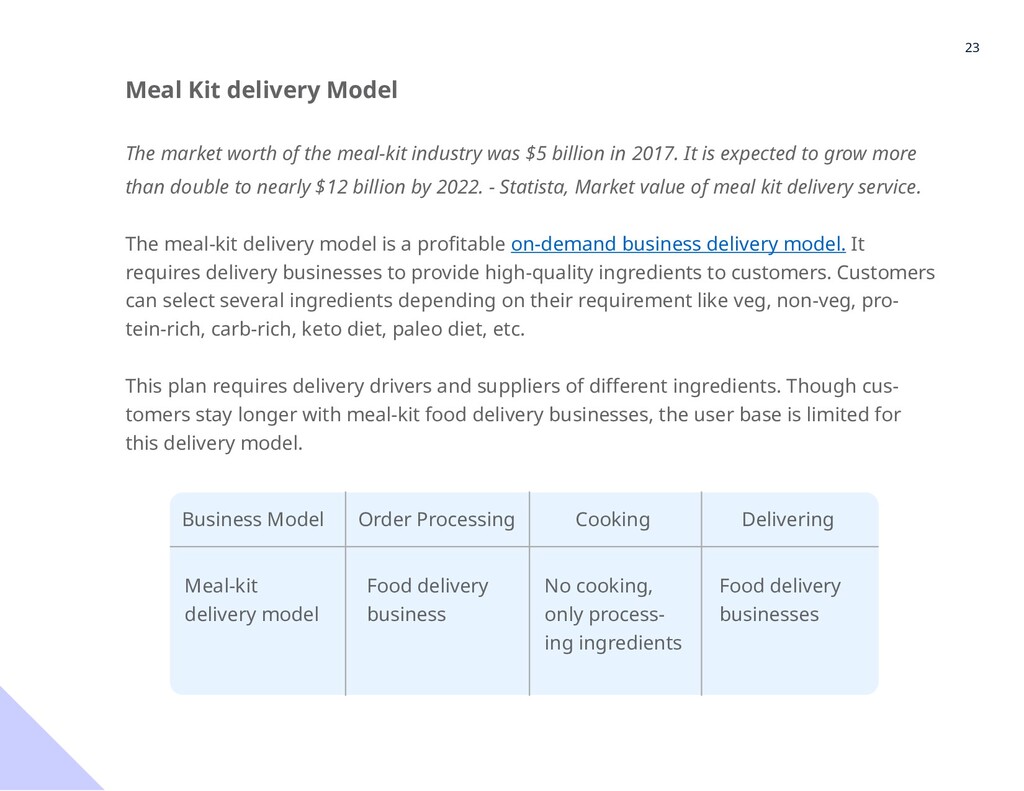
    meal-kit industry was $5 billion in 2017. It is expected to grow more than double to nearly $12 billion by 2022. - Statista, Market value of meal kit delivery service. The meal-kit delivery model is a profitable on-demand business delivery model. It requires delivery businesses to provide high-quality ingredients to customers. Customers can select several ingredients depending on their requirement like veg, non-veg, pro- tein-rich, carb-rich, keto diet, paleo diet, etc. This plan requires delivery drivers and suppliers of different ingredients. Though cus- tomers stay longer with meal-kit food delivery businesses, the user base is limited for this delivery model. Business Model Meal-kit delivery model Food delivery business No cooking, only process- ing ingredients Food delivery businesses Order Processing Cooking Delivering
  24. 24 Restaurant-to-customer model Revenue is expected to show an annual

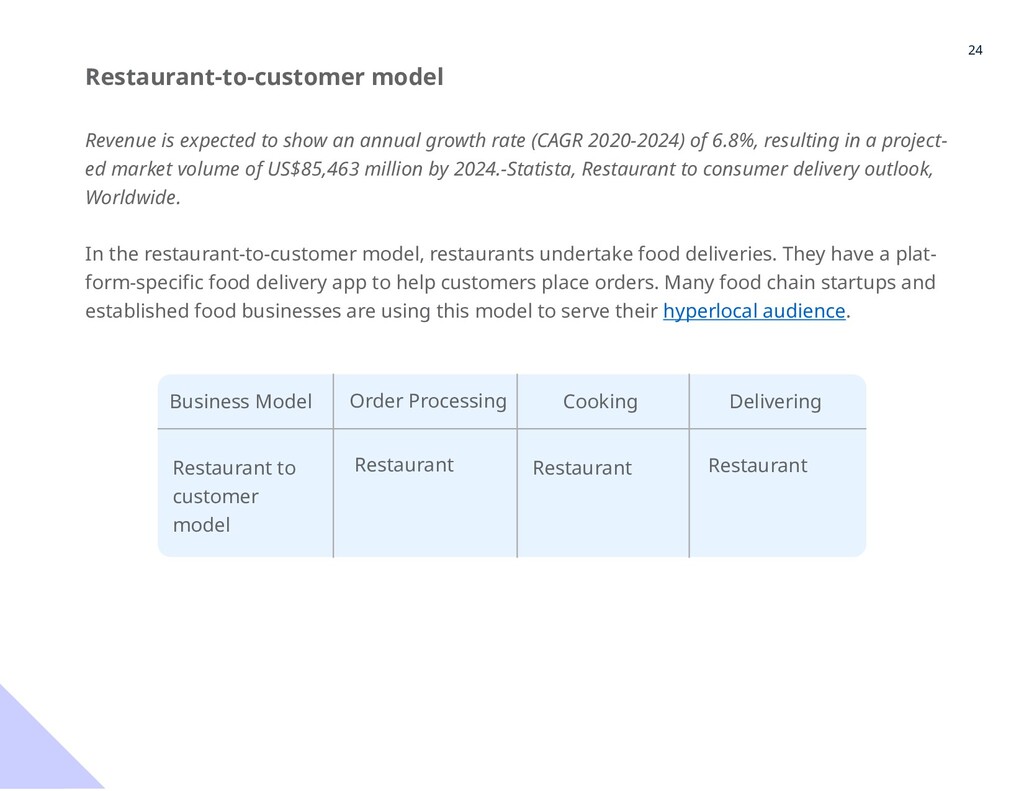
    growth rate (CAGR 2020-2024) of 6.8%, resulting in a project- ed market volume of US$85,463 million by 2024.-Statista, Restaurant to consumer delivery outlook, Worldwide. In the restaurant-to-customer model, restaurants undertake food deliveries. They have a plat- form-specific food delivery app to help customers place orders. Many food chain startups and established food businesses are using this model to serve their hyperlocal audience. Business Model Restaurant to customer model Restaurant Restaurant Restaurant Cooking Delivering Order Processing
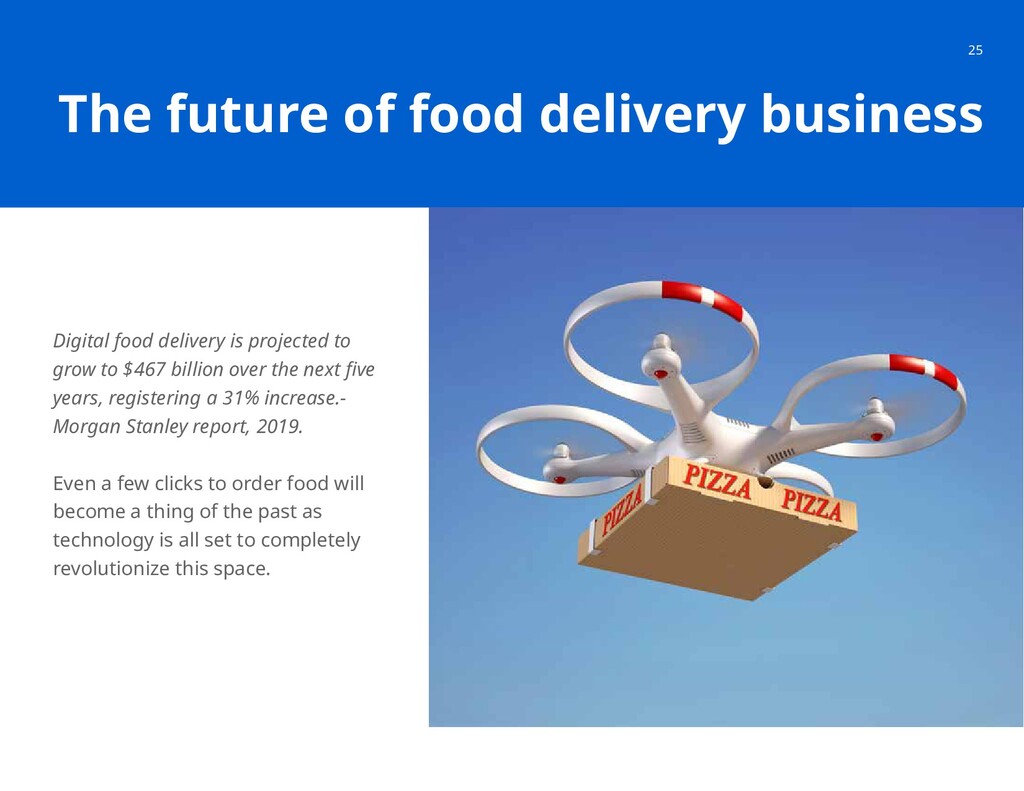
  25. The future of food delivery business 25 Digital food delivery

    is projected to grow to $467 billion over the next five years, registering a 31% increase.- Morgan Stanley report, 2019. Even a few clicks to order food will become a thing of the past as technology is all set to completely revolutionize this space.
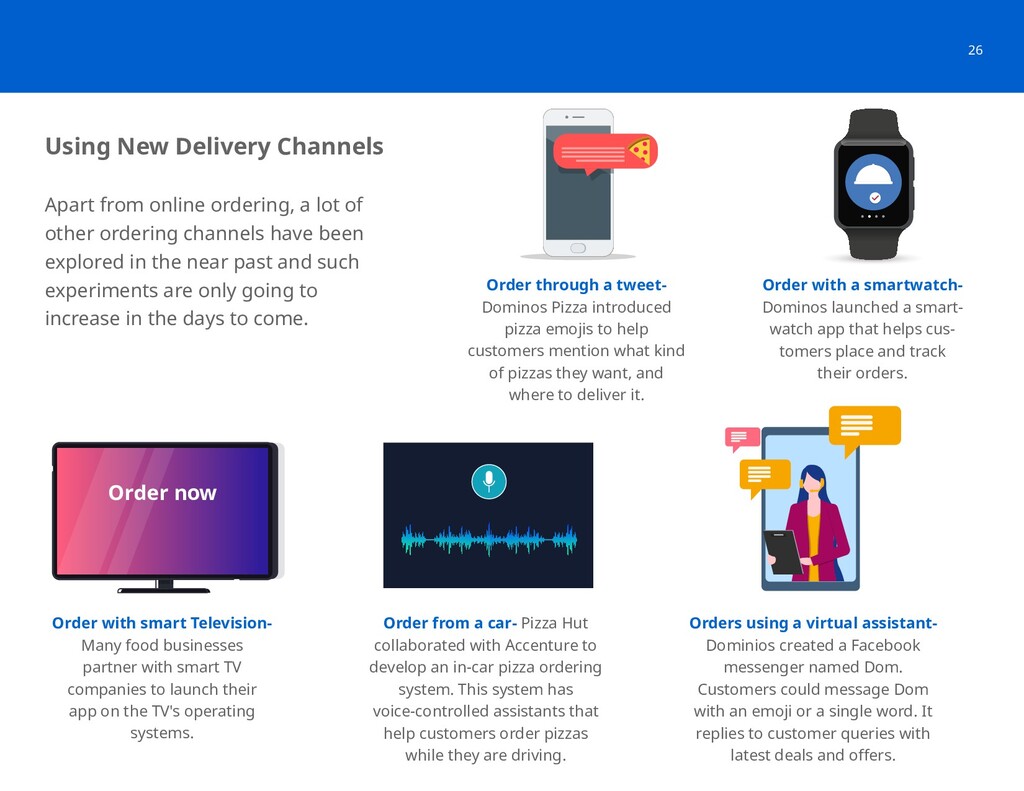
  26. 26 Using New Delivery Channels Apart from online ordering, a

    lot of other ordering channels have been explored in the near past and such experiments are only going to increase in the days to come. Order through a tweet- Dominos Pizza introduced pizza emojis to help customers mention what kind of pizzas they want, and where to deliver it. Order with smart Television- Many food businesses partner with smart TV companies to launch their app on the TV's operating systems. Order from a car- Pizza Hut collaborated with Accenture to develop an in-car pizza ordering system. This system has voice-controlled assistants that help customers order pizzas while they are driving. Orders using a virtual assistant- Dominios created a Facebook messenger named Dom. Customers could message Dom with an emoji or a single word. It replies to customer queries with latest deals and offers. Order with a smartwatch- Dominos launched a smart- watch app that helps cus- tomers place and track their orders. Order now
  27. 27 Getting into new niches Food delivery businesses will enter

    niche markets to avoid competition barriers in the near future. They will focus on delivering vegan-friendly, keto-diet, health shakes, etc. This new niche market can create a significant impact on the food delivery market. Food waste apps One-third of the food that is produced globally is wasted.- FAO report on food waste. Food waste apps help grocery stores and restaurants to deliver extra/leftover food to those in need. Pet Food Apps 68% of American families own a pet, and 40% buy pet foods online- American Pet Product Associa- tion study and Statista report on pet food delivery in the US. Millennials demand customized, convenient, and healthy food for their pets. These apps enable pet owners or pet parents to order food for their beloved animals. This demand for pet food has increased the number of pet food delivery services.
  28. 28 Investing in big data, automation, and last-mile technologies Food

    delivery businesses will increase their investments in technologies like big data, machine learning, and robotics to enhance their last-mile operations. This helps them determine customer emotions, customize offers, and respond to cus- tomer queries quickly. The food delivery industry is striving hard to manage on-demand orders efficiently. It is a massive challenge to control costs, provide delightful customer experience, and ensure safe deliveries. Last-mile technologies help in maximizing profitability & efficiency and minimizing unnecessary costs. Development of virtual kitchen apps Food delivery businesses in the future will adopt a virtual kitchen model. Under this model, they partner with restaurants and rent space for them to prepare meals. These businesses will collect orders via an app, cook the food, and deliver it to cus- tomers. This model will help restaurants to save costs and focus more on product development & data analysis. Food delivery businesses will move into autonomous delivery The autonomous last-mile delivery market is expected to reach $11.13 billion in 2021. It is estimated to reach $75.65 billion by 2030, with a CAGR of 23.7%. - Allied Market Research Report, 2019.
  29. 29 Food delivery businesses are experimenting with autonomous delivery options

    like drones and robots. But these delivery options are executed only in a few areas due to wide-scale infrastructure requirements. Due to COVID-19, their use might see a steep rise and act as a differentiator for businesses. Autonomous delivery technologies can ensure contactless deliveries with negligible human dependency. It saves operational costs involved in last-mile food delivery. Food delivery industry: On the brink of transformation The food delivery market is a massive industry. It is surpassing expectations with each passing day. The COVID-19 pandemic has accelerated its growth and this sector will see new and exciting innovation in the days to come. Locus provides AI-driven logistics solutions to enterprises in the food delivery industry. Get in touch with our experts to optimize your food delivery operations.
  30. 30 References https://www.mckinsey.com/industries/technology-media-and-tele- communications/our-insights/the-changing-market-for-food-delivery# https://www.accenture.com/us-en/_acnmedia/pdf-70/accenture-future-of-food-new-realities-for-the-industry.pdf https://www.consumerreports.org/food-delivery-services/food-delivery-services-apps-review/ https://upserve.com/restaurant-insider/online-ordering-statistics/ https://www.reuters.com/article/us-health-coronavirus-food-de- livery-focu/online-meal-delivery-firms-knocked-off-course-by-coronavirus-crisis-idUSKBN21P1IQ https://www.uschamber.com/co/good-company/launch-pad/coronavirus-pandemic-food-delivery-businesses

    https://bigseventravel.com/2020/06/food-delivery-trends-restaurants-report-2020/ https://www.foodnavigator.com/Article/2020/03/19/On- line-food-delivery-one-of-the-only-winners-in-coronavirus-outbreak https://www.touchbistro.com/blog/pros-and-cons-of-offering-food-delivery-service/ https://pos.toasttab.com/blog/on-the-line/7-restaurant-delivery-trends-that-scream-start-delivering https://folo.my/blog/what-is-a-food-delivery-service https://medium.com/@andy.wang./food-delivery-past-present-future-d12f44977a2e https://statistacloudfront.s3.amazonaws.com/download/pdf/OnlineFoodDelivery_Preview.pdf https://www2.deloitte.com/content/dam/Deloitte/au/Documents/E- conomics/deloitte-au-economics-future-food-uber-eats-100719.pdf https://thespoon.tech/report-food-delivery-apps-will-have-44m-u-s-users-by-2020/ https://techcrunch.com/2020/03/16/the-hidden-cost-of-food-delivery/ https://civicscience.com/another-tremendous-uptick-in-u-s-adults-using-food-delivery-services/ https://nypost.com/2019/07/29/more-than-1-in-4-delivery-drivers-eat-your-food-order-study/ https://www.cbre.us/research-and-reports/US-Market- Flash-COVID-19-Impact-on-the-Food-Industry-Implications-for-Industrial-Real-Estate
  31. 31 https://foodinstitute.com/focus/delivery-war https://www.mintel.com/press-centre/- food-and-drink/9-in-10-us-food-delivery-service-users-say-it-makes-their-lives-easier https://rubygarage.org/blog/food-delivery-trends-2019 https://medium.com/@houck/the-future-of-food-delivery-report-d4df49789632 https://www.forbes.com/sites/sarwantsing- h/2019/09/09/the-soon-to-be-200b-online-food-delivery-is-rapidly-changing-the-global-food-industry/#3886e3a2b1bc https://yourstory.com/mystory/new-trends-that-will-change-the-future-of-food-del https://www.quora.com/What-is-the-future-of-food-delivery-1

    https://liveinspiredmag.com/2019/12/16/trends-that-will-change-the-future-of-the-food-delivery-business/ https://www.morganstanley.com/ideas/food-delivery-app-profits https://www.jpmorgan.com/global/research/online-food-delivery https://www.usfoods.com/our-services/business-trends/2019-food-delivery-statistics.html https://www.zionandzion.com/research/food-delivery-apps-usage-and-demographics-winners-losers-and-laggards/ https://www.statista.com/topics/1986/food-delivery-industry-in-the-us/ https://www.touchbistro.com/blog/state-of-restaurant-report-2020/ https://www.alliedmarketresearch.com/autonomous-last-mile-delivery-market https://blog.factor75.com/the-history-evolution-of-food-delivery/ https://mentalitch.com/the-evolution-of-food-delivery-systems/ https://www.ordermeal.co.nz/blog/the-history-and-evolution-of-food-delivery/ https://www.spot.ph/eatdrink/the-latest-eat-drink/81524/food-delivery-history-a3284-20200325 https://lovebelfast.co.uk/a-history-of-online-food-delivery-system/ https://www.theskinny.co.uk/food-and-drink/features/delivery-history-deliveroo https://timelines.issarice.com/wiki/Timeline_of_online_food_delivery https://www.thevintagenews.com/2019/01/08/food-delivery/ https://www.octalsoftware.com/blog/3-food-delivery-business-opportunities-platforms https://www.coruscatesolution.com/4-successful-on-demand-food-delivery-app-business-models/
  32. 32 https://jungleworks.com/food-on-demand-business-models-of-meal-delivery-startups/ https://www.excellentwebworld.com/food-delivery-business-model/ https://productmint.com/the-food-delivery-business-model-a-complete-guide/ https://smallbizclub.com/startup/creating-a-plan/13-profitable-models-start-food-ordering-business/ https://asterisminfosoft.com/best-food-delivery-business-models/ https://www.volumetree.com/food-ordering-business-model/ https://www.statista.com/outlook/374/109/online-food-delivery/united-states https://blog.capterra.com/restaurant-online-ordering-delivery/ https://www.fixlastmile.com/blog/last-mile-delivery-optimization-for-food-delivery-industr

    https://nymag.com/intelligencer/2020/05/why-do-food-delivery-companies-lose-money.html https://limetray.com/blog/cloud-kitchen-business-model/ https://www.boardofinnovation.com/blog/40-food-innovations-that-excite-us/ https://spdload.com/blog/food-delivery-business-model/ https://www.mckinsey.com/business-functions/market- ing-and-sales/our-insights/adapting-customer-experience-in-the-time-of-coronavirus https://www.statista.com/outlook/375/100/restaurant-to-consum- er-delivery/worldwide#:~:text=Revenue%20in%20the%20Restaurant%2Dto,to%20hit%2012.4%25%20by%202024.