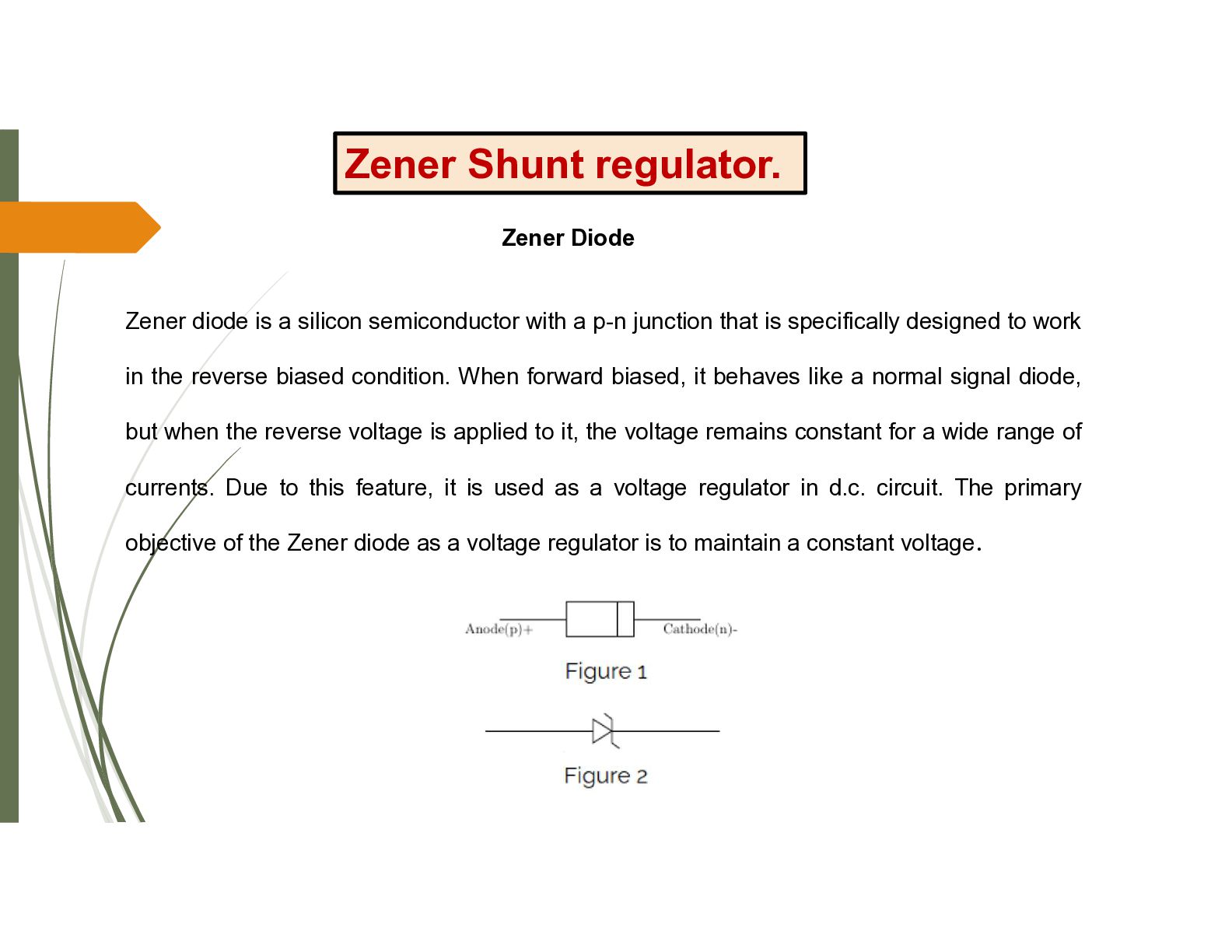
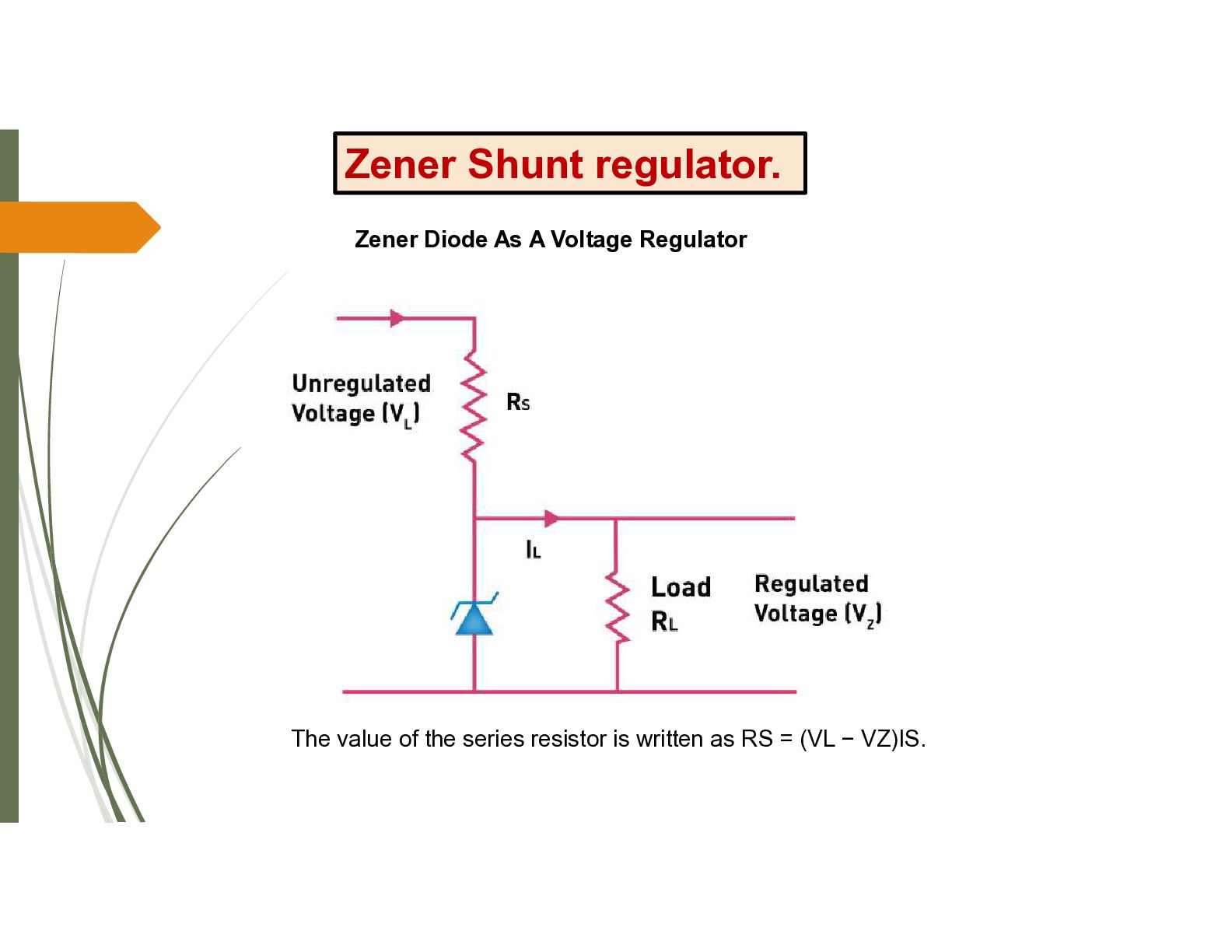
semiconductor with a p-n junction that is specifically designed to work in the reverse biased condition. When forward biased, it behaves like a normal signal diode, but when the reverse voltage is applied to it, the voltage remains constant for a wide range of currents. Due to this feature, it is used as a voltage regulator in d.c. circuit. The primary objective of the Zener diode as a voltage regulator is to maintain a constant voltage.
regulator is a device that regulates the voltage level. It essentially steps down the input voltage to the desired level and keeps it at that same level during the supply. This ensures that even when a load is applied the voltage doesn’t drop. The voltage regulator is used for two main reasons, and they are: To regulate the output voltage To keep the output voltage constant at the desired value in spite of variations in the supply voltage. Voltage regulators are used in computers, power generators, alternators to control the output of the plant.
voltage regulator is an electronic circuit that provides a stable DC voltage independent of the load current, temperature and AC line voltage variations. A Zener diode of break down voltage VZ is reverse connected to an input voltage source VI across a load resistance RL and a series resistor RS. The voltage across the zener will remain steady at its break down voltage VZ for all the values of zener current IZ as long as the current remains in the break down region. Hence a regulated DC output voltage V0=VZ is obtained across RL, whenever the input voltage remains within a minimum and maximum voltage. Basically there are two type of regulations such as: Line Regulation: In this type of regulation, series resistance and load resistance are fixed, only input voltage is changing. Output voltage remains the same as long as the input voltage is maintained above a minimum value. Load Regulation: In this type of regulation, input voltage is fixed and the load resistance is varying.


 malarkey
 productmarketing
 oripsolob
 katiecoart
 takai
 jcasabona
 nikkihalliwell
 tammyeverts
 davidcarrasco
 letsgokoyo
 lara
 lindahogenes