Upgrade to Pro — share decks privately, control downloads, hide ads and more …

Operational Leadership Projects

Avatar for Sarah Smith Sarah Smith
January 19, 2026
9

Operational Leadership Projects

These projects showcase how I lead complex operational initiatives across people, process, and systems to drive scalable growth, cost efficiency, and strong customer experience. Each example reflects a practical, metrics-driven approach to leadership, change management, and execution—designed to translate seamlessly across service-based and growth-oriented organizations.

Avatar for Sarah Smith

Sarah Smith

January 19, 2026

Transcript

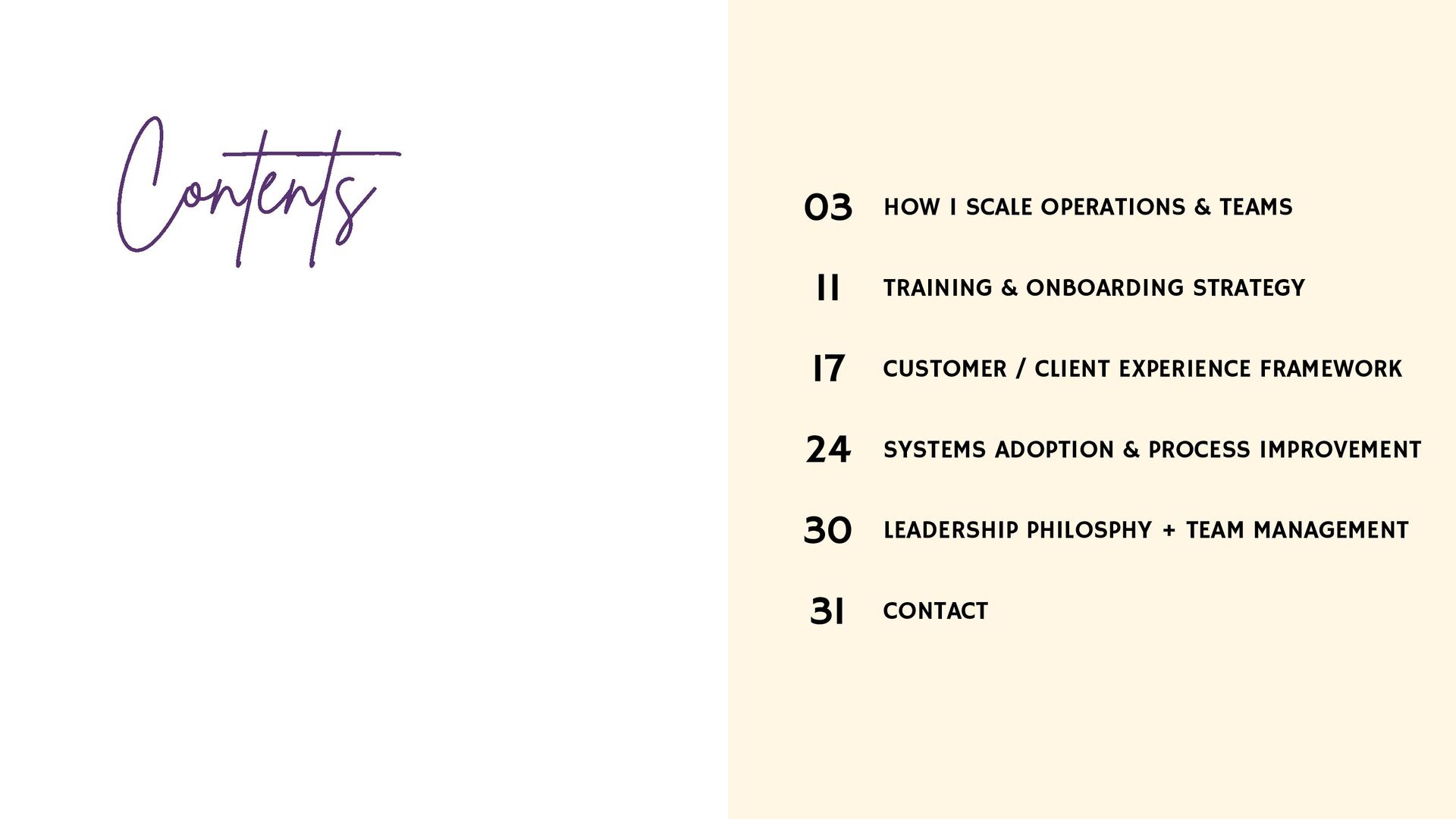
  1. 31 03 HOW I SCALE OPERATIONS & TEAMS 11 TRAINING

    & ONBOARDING STRATEGY 17 CUSTOMER / CLIENT EXPERIENCE FRAMEWORK 24 SYSTEMS ADOPTION & PROCESS IMPROVEMENT 30 LEADERSHIP PHILOSPHY + TEAM MANAGEMENT CONTACT Contents
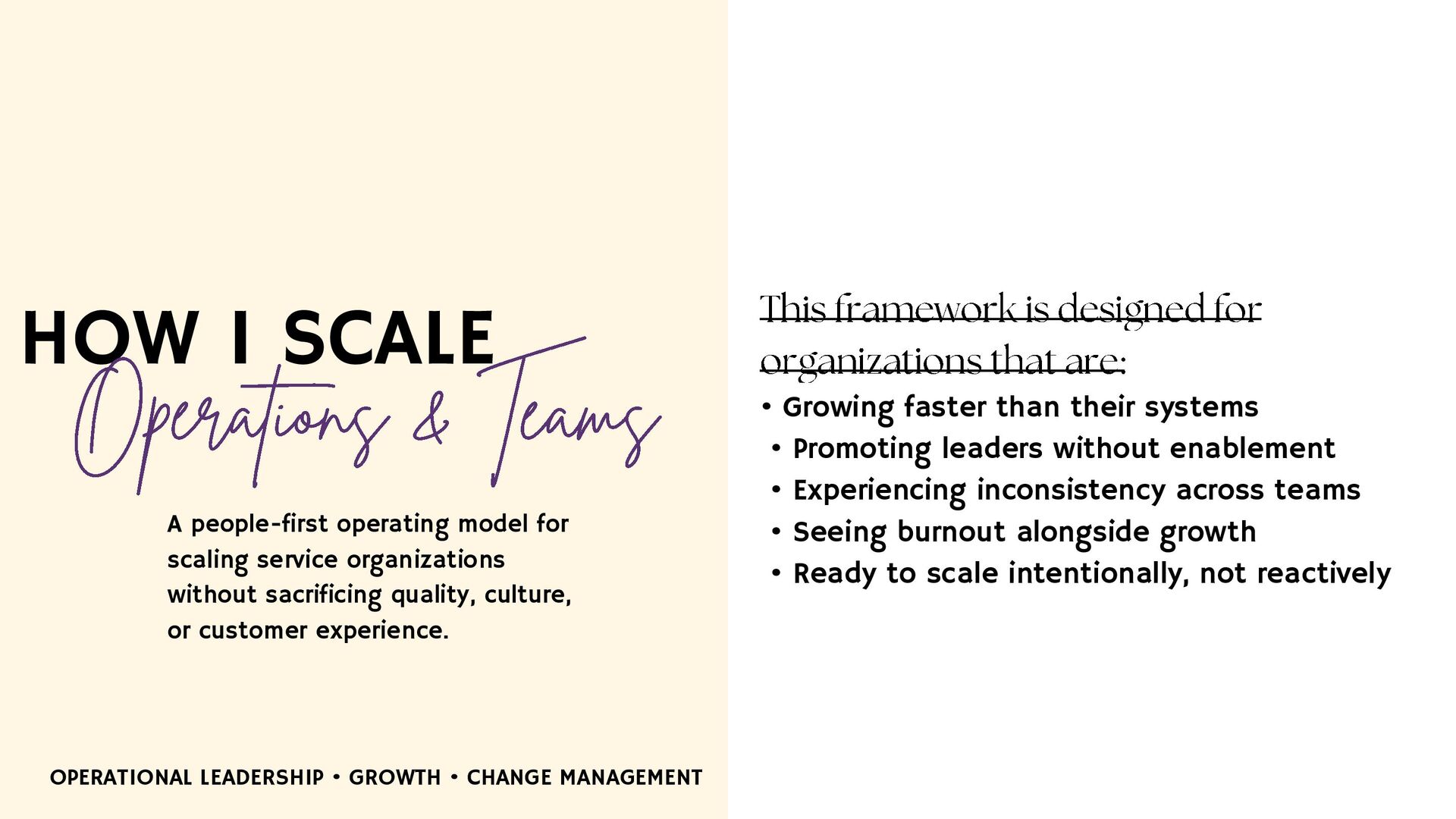
  2. HOW I SCALE A people-first operating model for scaling service

    organizations without sacrificing quality, culture, or customer experience. Operations & Teams OPERATIONAL LEADERSHIP • GROWTH • CHANGE MANAGEMENT This framework is designed for organizations that are: • Growing faster than their systems • Promoting leaders without enablement • Experiencing inconsistency across teams • Seeing burnout alongside growth • Ready to scale intentionally, not reactively
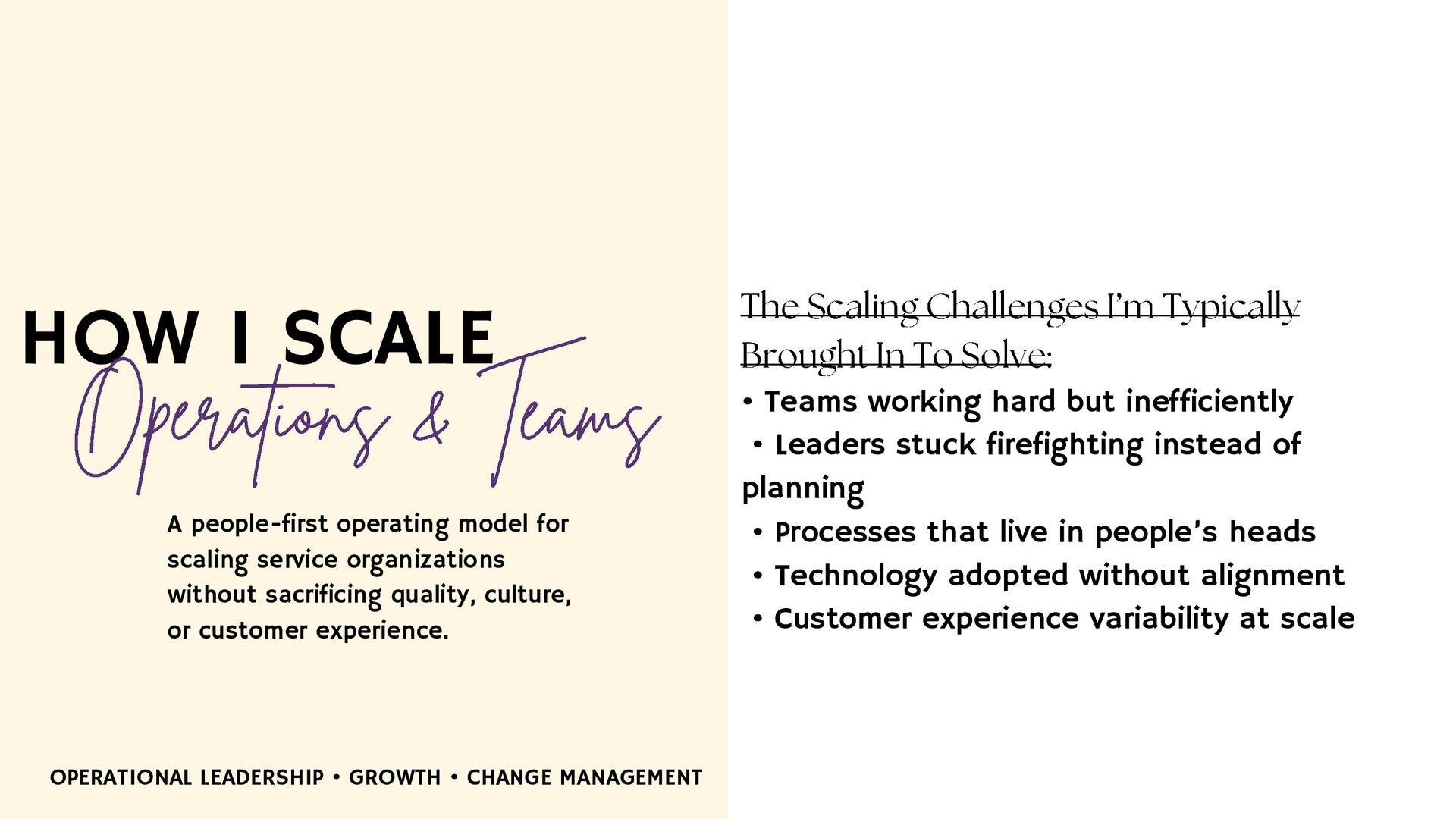
  3. HOW I SCALE A people-first operating model for scaling service

    organizations without sacrificing quality, culture, or customer experience. Operations & Teams OPERATIONAL LEADERSHIP • GROWTH • CHANGE MANAGEMENT The Scaling Challenges I’m Typically Brought In To Solve: • Teams working hard but inefficiently • Leaders stuck firefighting instead of planning • Processes that live in people’s heads • Technology adopted without alignment • Customer experience variability at scale
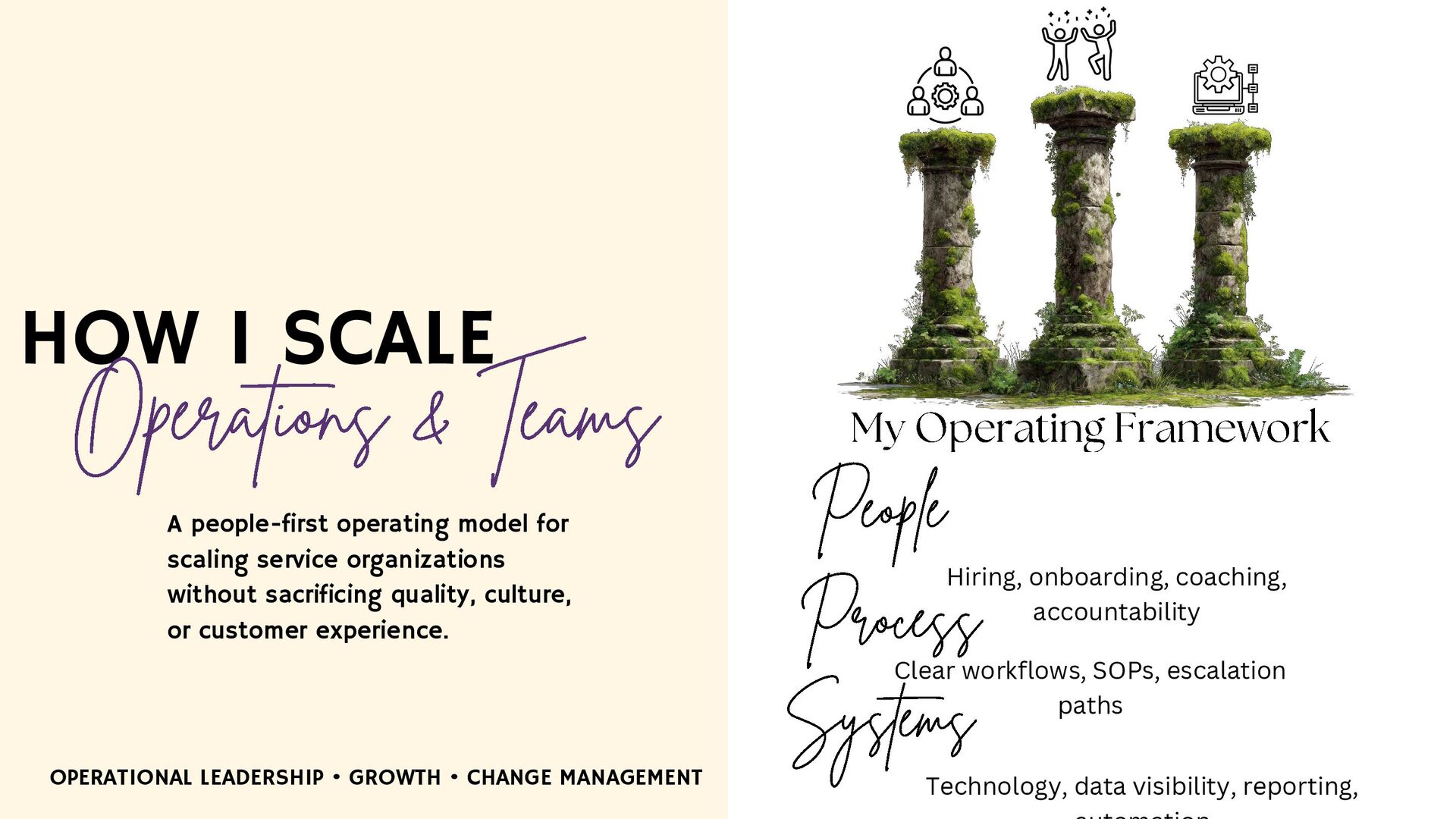
  4. My Operating Framework People Hiring, onboarding, coaching, accountability Clear workflows,

    SOPs, escalation paths Technology, data visibility, reporting, HOW I SCALE A people-first operating model for scaling service organizations without sacrificing quality, culture, or customer experience. Operations & Teams OPERATIONAL LEADERSHIP • GROWTH • CHANGE MANAGEMENT Process Systems
  5. HOW I SCALE A people-first operating model for scaling service

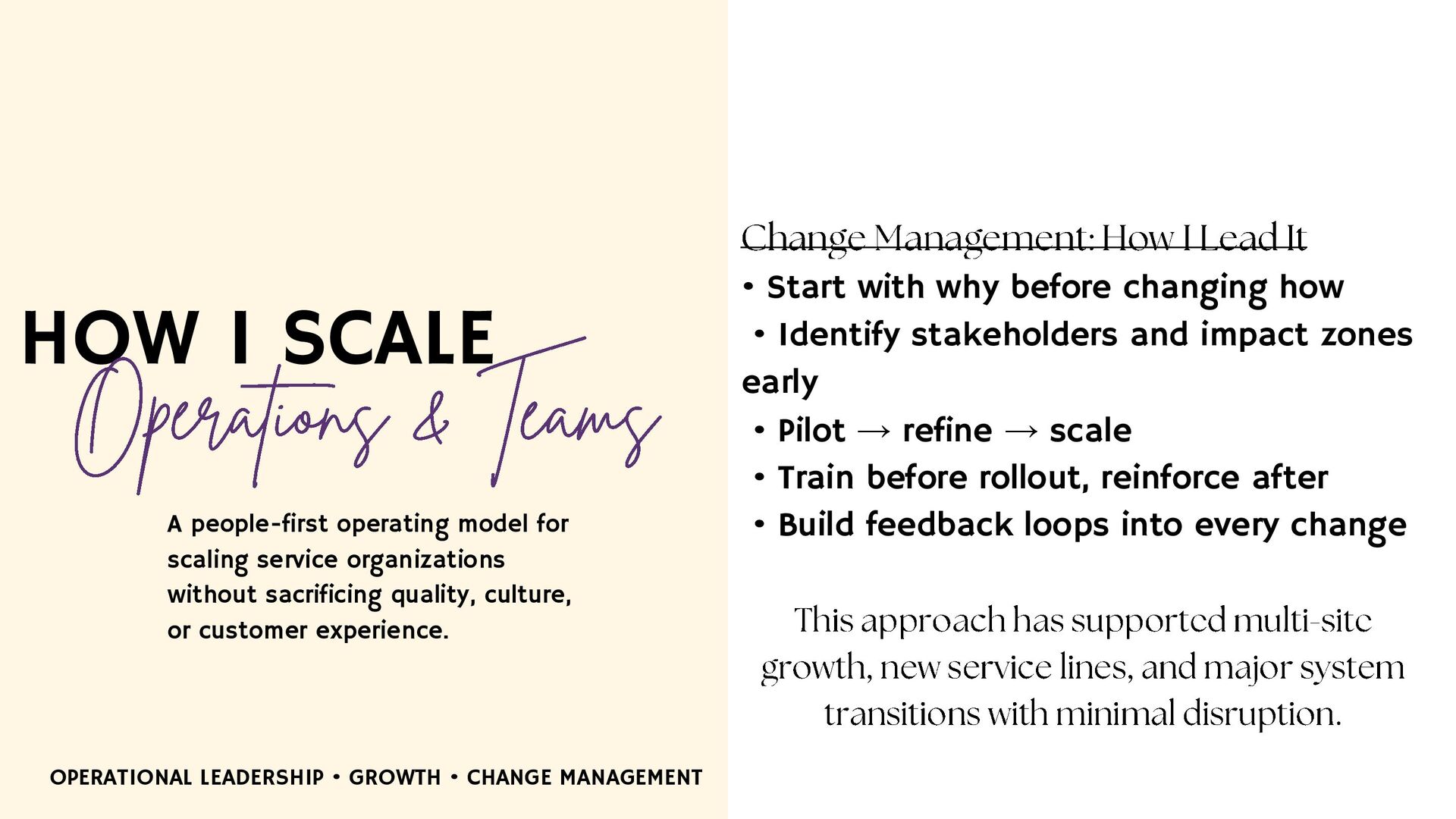
    organizations without sacrificing quality, culture, or customer experience. Operations & Teams OPERATIONAL LEADERSHIP • GROWTH • CHANGE MANAGEMENT Change Management: How I Lead It • Start with why before changing how • Identify stakeholders and impact zones early • Pilot → refine → scale • Train before rollout, reinforce after • Build feedback loops into every change This approach has supported multi -site growth, new service lines, and major system transitions with minimal disruption.
  6. HOW I SCALE A people-first operating model for scaling service

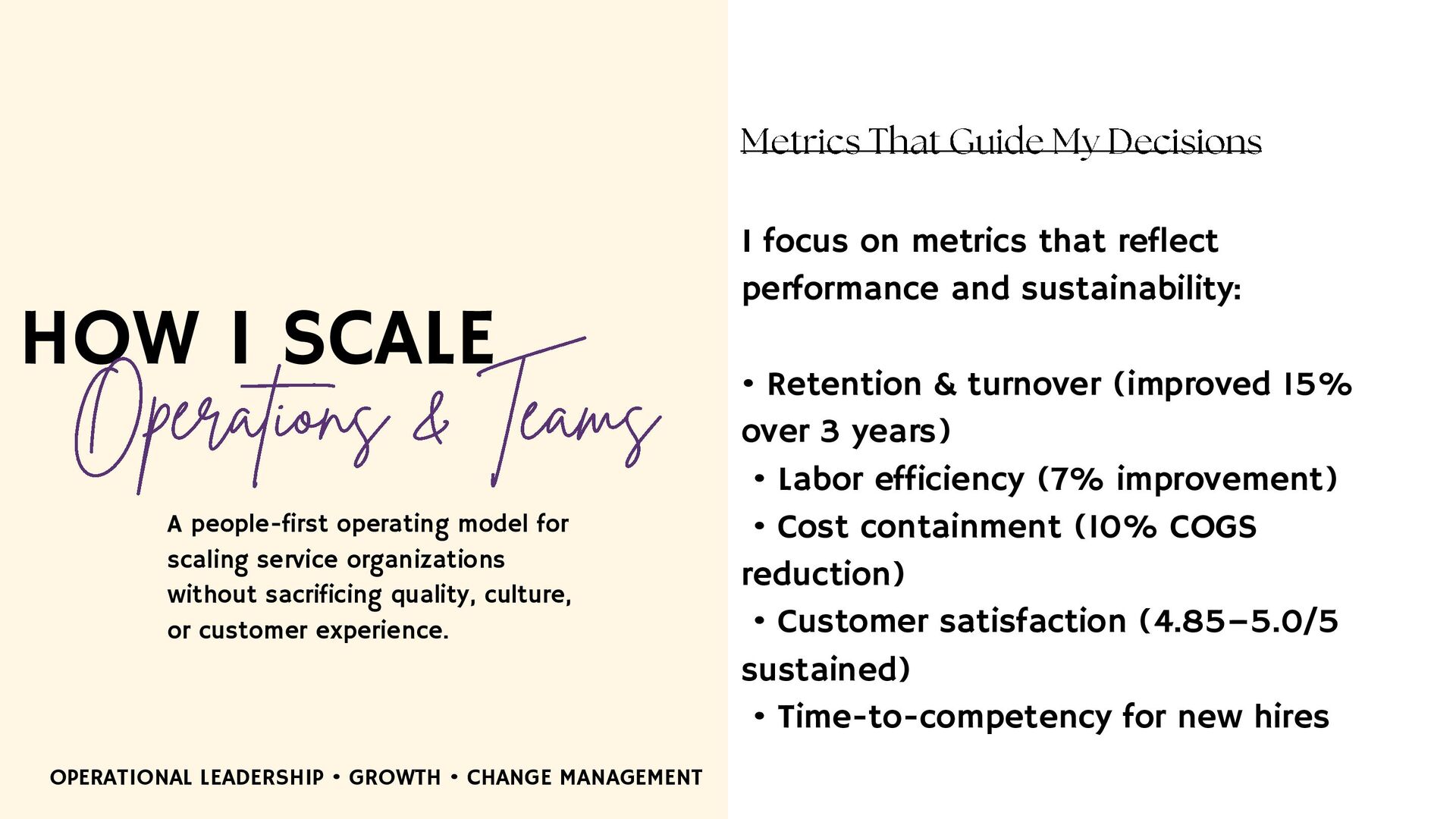
    organizations without sacrificing quality, culture, or customer experience. Operations & Teams OPERATIONAL LEADERSHIP • GROWTH • CHANGE MANAGEMENT Metrics That Guide My Decisions I focus on metrics that reflect performance and sustainability: • Retention & turnover (improved 15% over 3 years) • Labor efficiency (7% improvement) • Cost containment (10% COGS reduction) • Customer satisfaction (4.85–5.0/5 sustained) • Time-to-competency for new hires
  7. HOW I SCALE A people-first operating model for scaling service

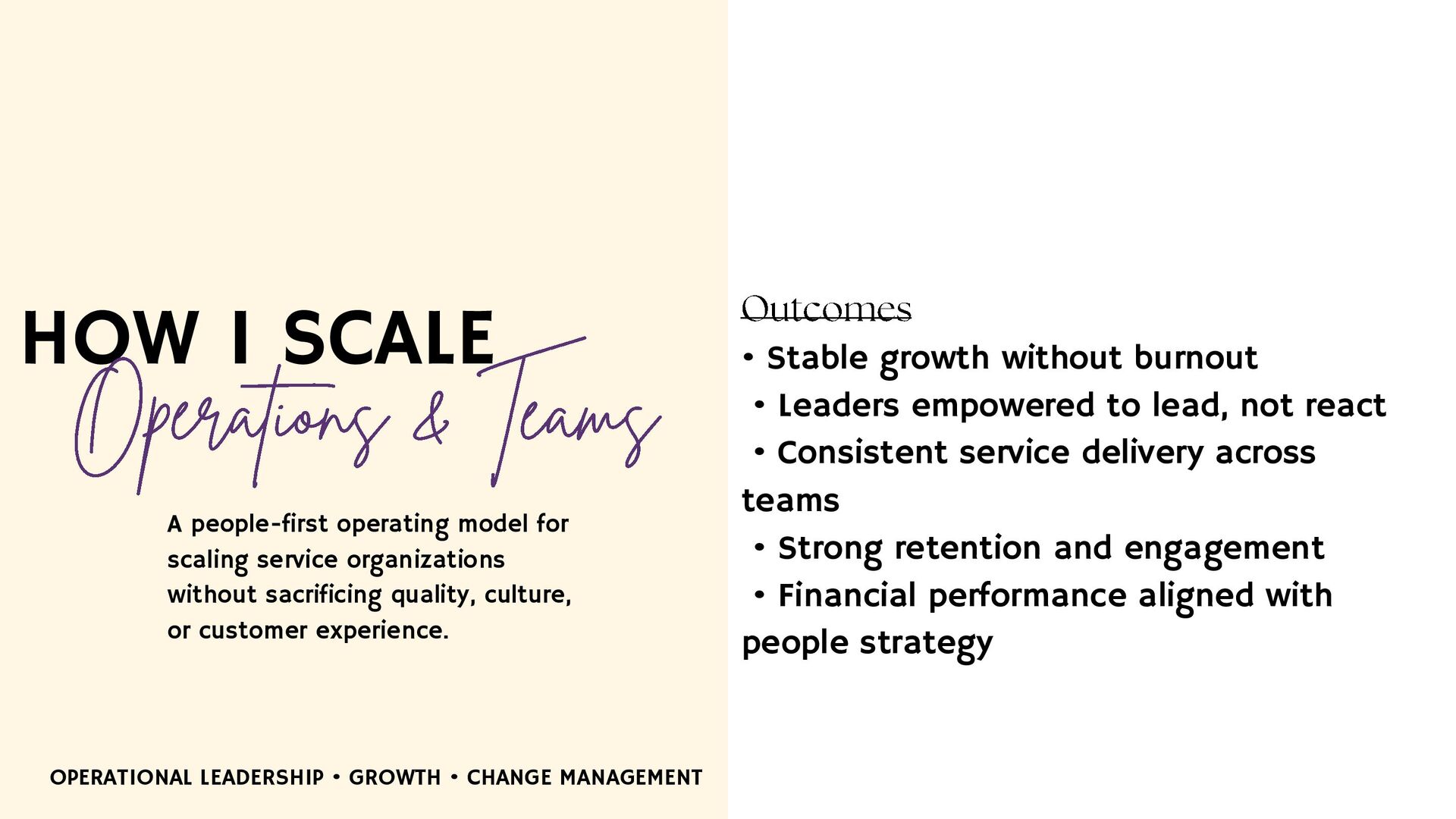
    organizations without sacrificing quality, culture, or customer experience. Operations & Teams OPERATIONAL LEADERSHIP • GROWTH • CHANGE MANAGEMENT Outcomes • Stable growth without burnout • Leaders empowered to lead, not react • Consistent service delivery across teams • Strong retention and engagement • Financial performance aligned with people strategy
  8. HOW I SCALE A people-first operating model for scaling service

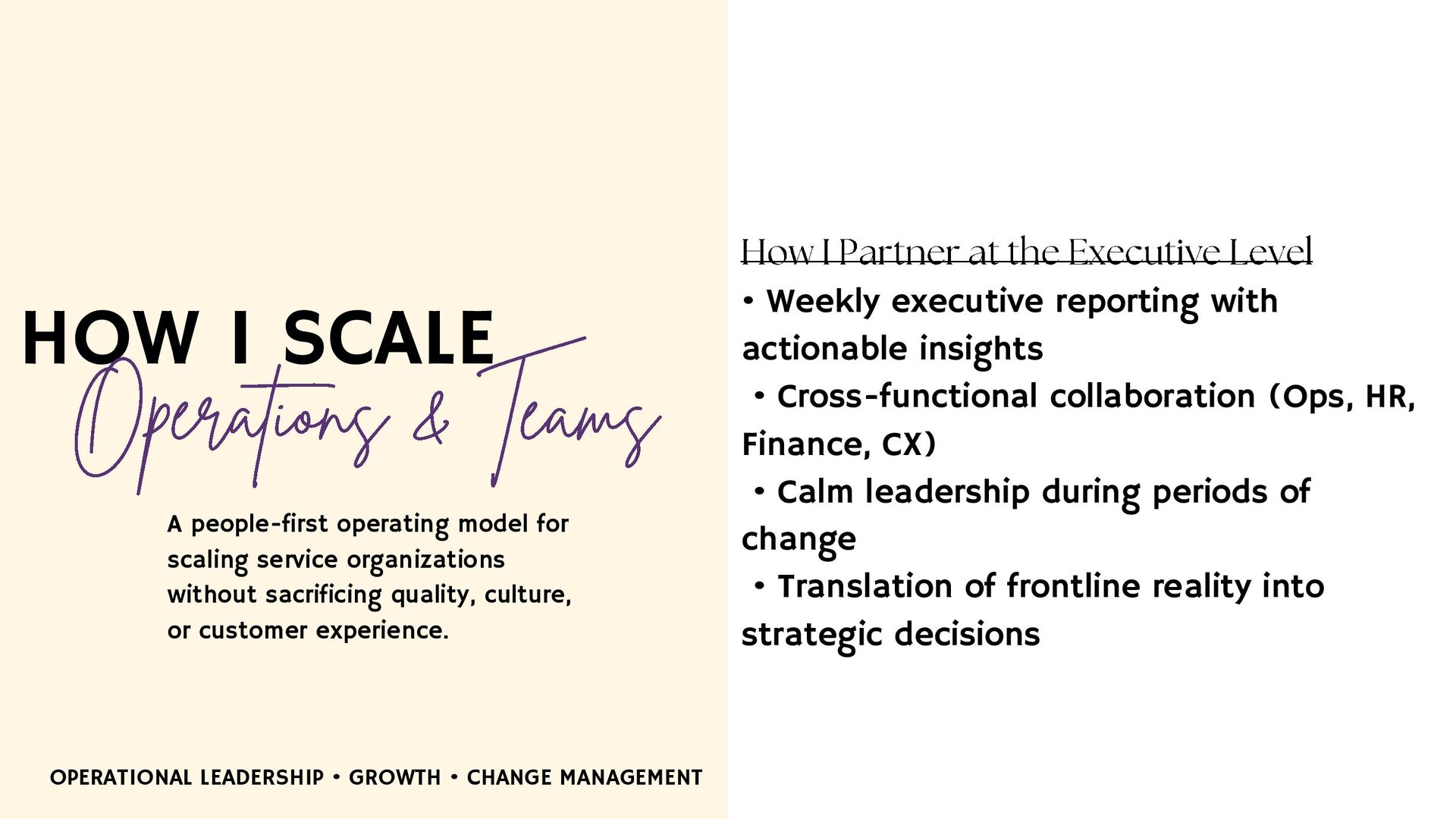
    organizations without sacrificing quality, culture, or customer experience. Operations & Teams OPERATIONAL LEADERSHIP • GROWTH • CHANGE MANAGEMENT How I Partner at the Executive Level • Weekly executive reporting with actionable insights • Cross-functional collaboration (Ops, HR, Finance, CX) • Calm leadership during periods of change • Translation of frontline reality into strategic decisions
  9. HOW I SCALE A people-first operating model for scaling service

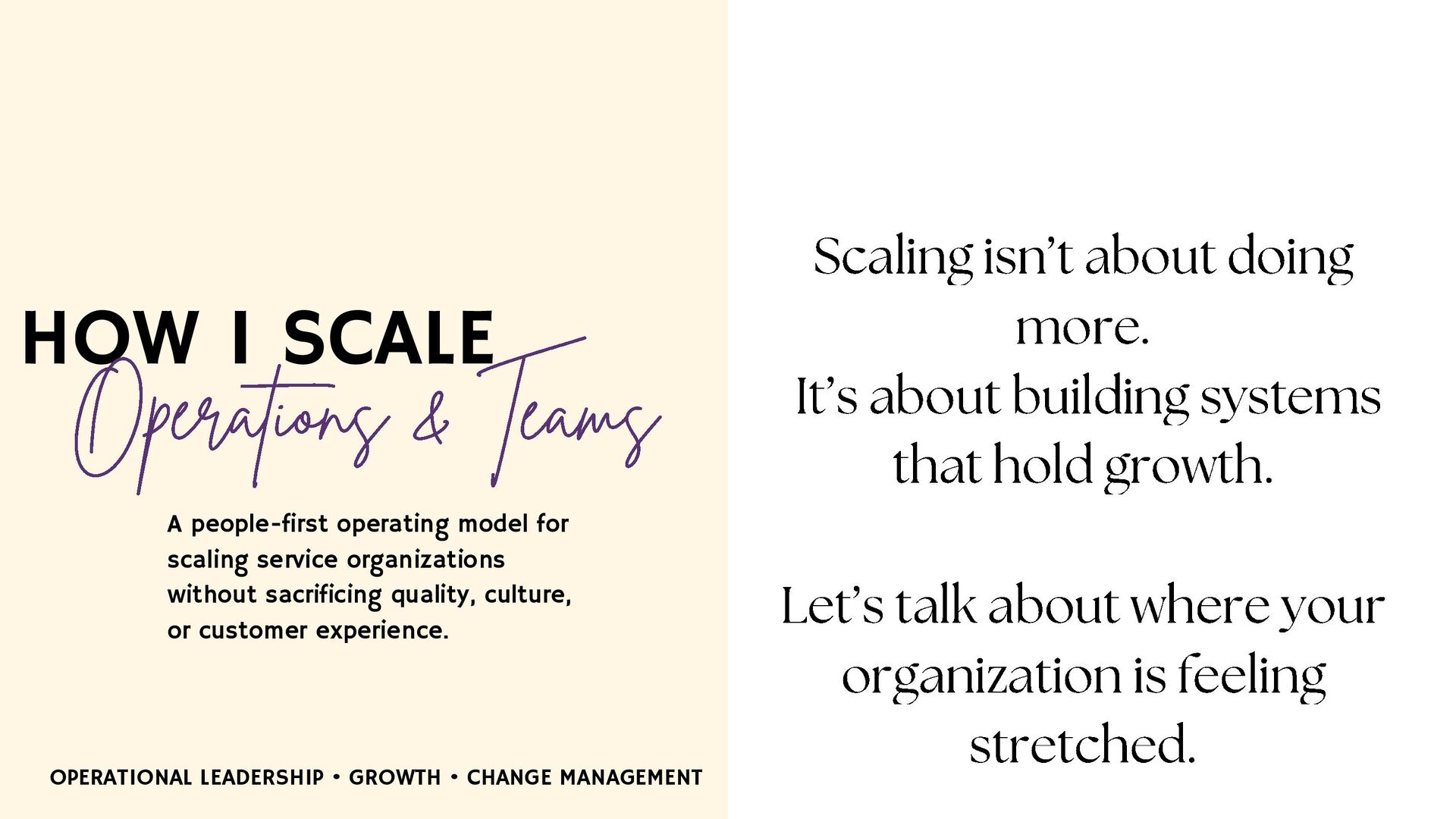
    organizations without sacrificing quality, culture, or customer experience. Operations & Teams OPERATIONAL LEADERSHIP • GROWTH • CHANGE MANAGEMENT Scaling isn’t about doing more. It’s about building systems that hold growth. Let’s talk about where your organization is feeling stretched.
  10. TRAINING, ONBOARDING ENABLEMENT How I build confident, capable teams —

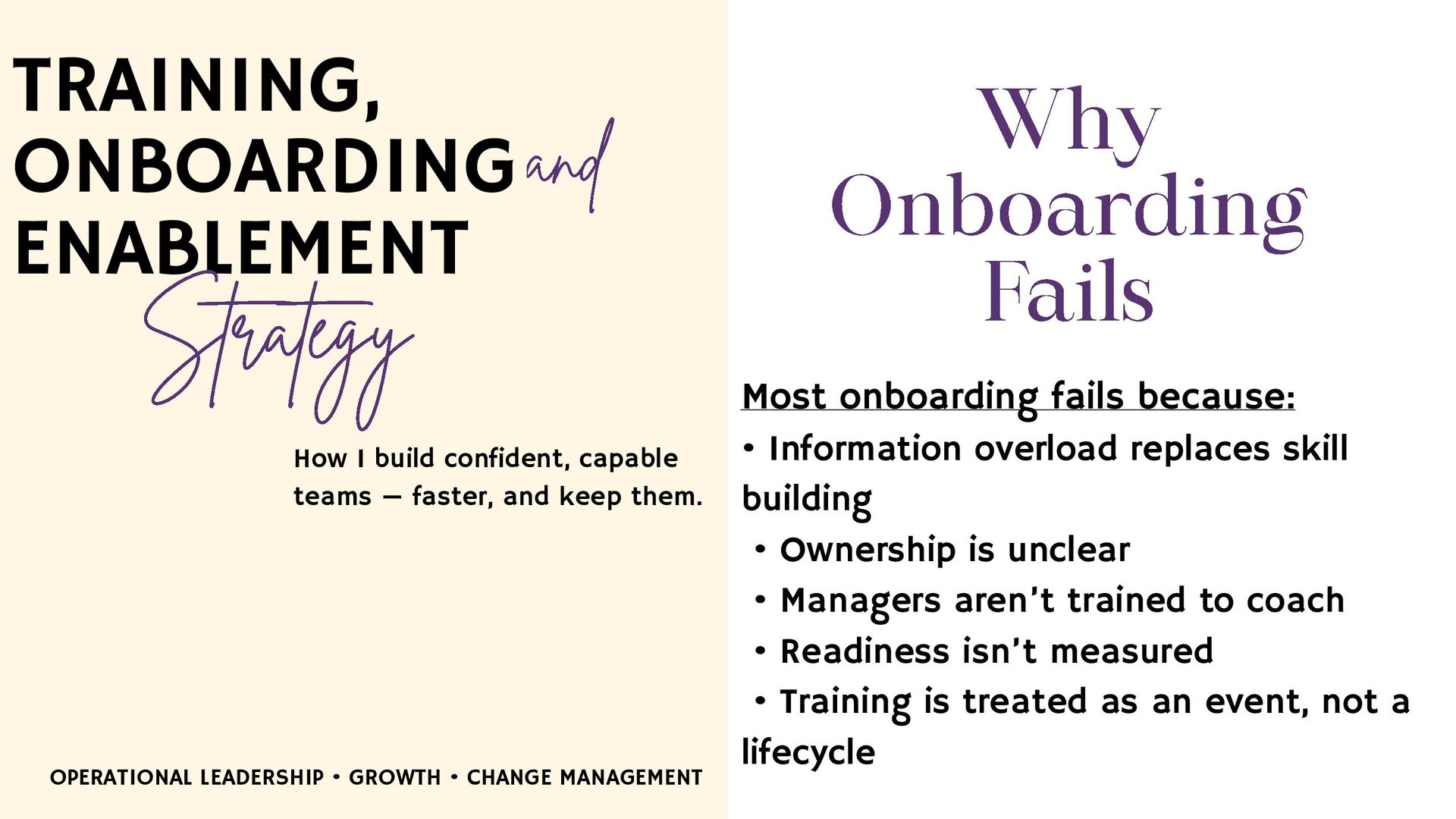
    faster, and keep them. Strategy OPERATIONAL LEADERSHIP • GROWTH • CHANGE MANAGEMENT and Most onboarding fails because: • Information overload replaces skill building • Ownership is unclear • Managers aren’t trained to coach • Readiness isn’t measured • Training is treated as an event, not a lifecycle Why Onboarding Fails
  11. TRAINING, ONBOARDING ENABLEMENT How I build confident, capable teams —

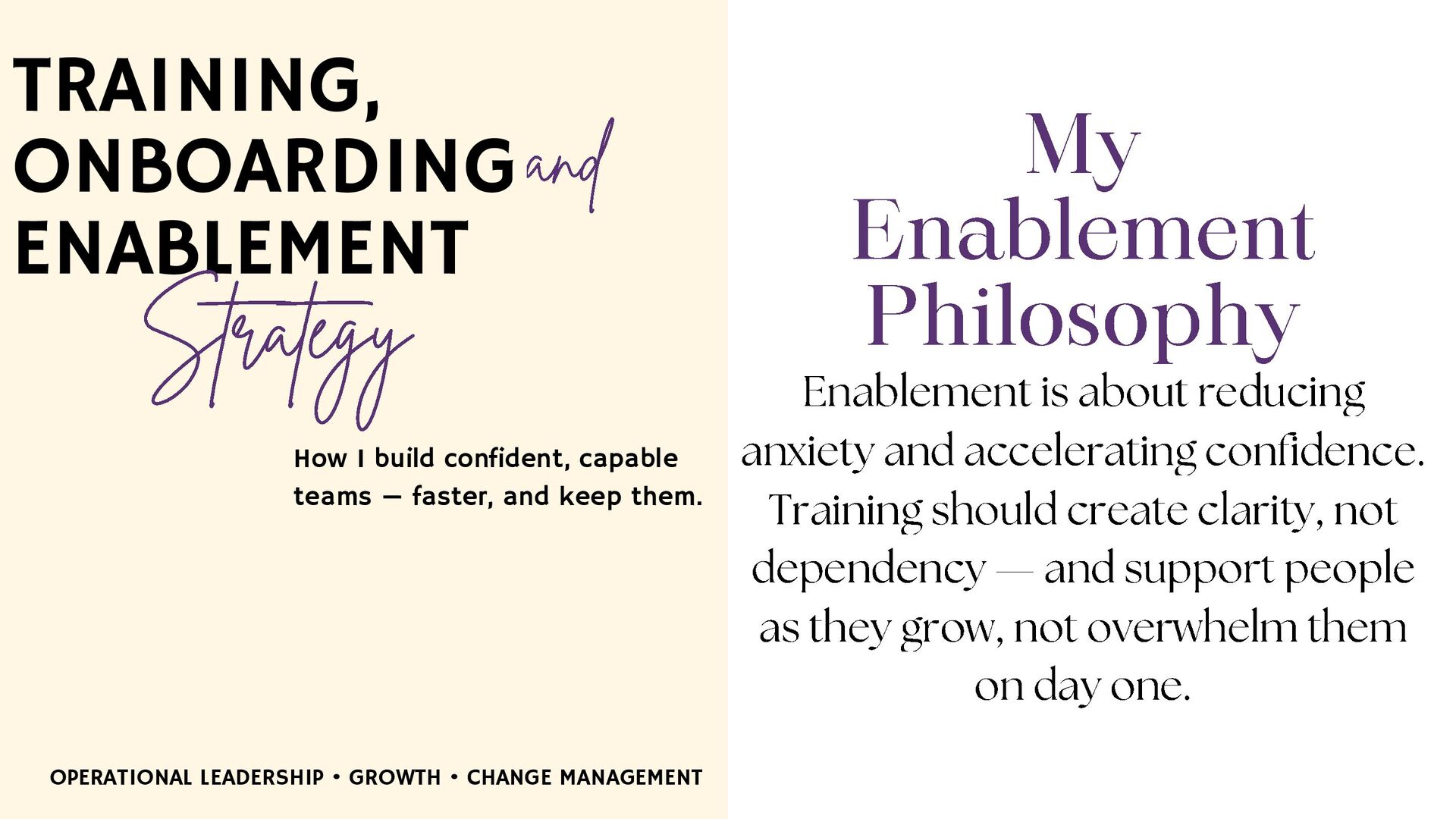
    faster, and keep them. OPERATIONAL LEADERSHIP • GROWTH • CHANGE MANAGEMENT and Enablement is about reducing anxiety and accelerating confidence. Training should create clarity, not dependency — and support people as they grow, not overwhelm them on day one. My Enablement Philosophy Strategy
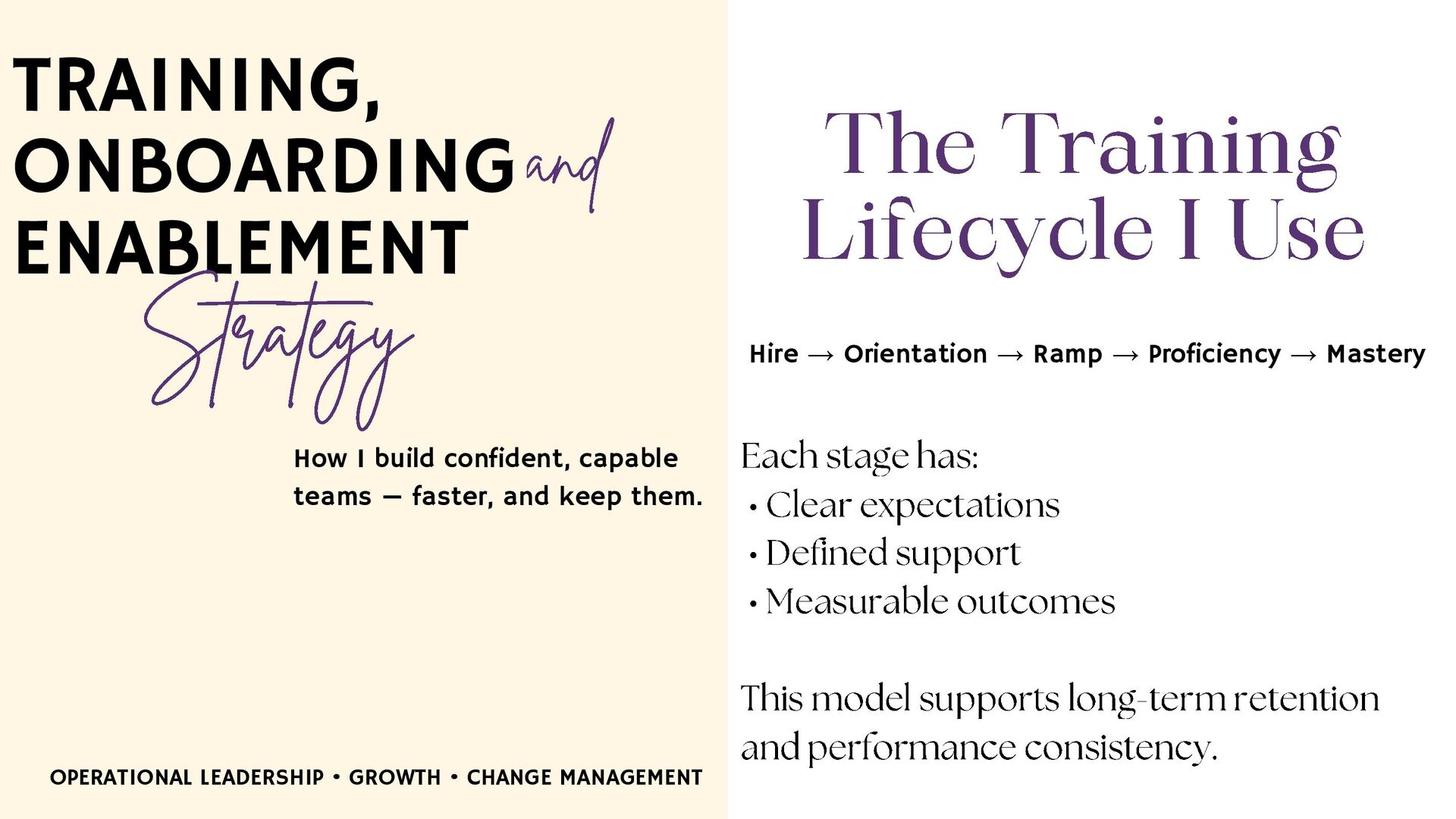
  12. TRAINING, ONBOARDING ENABLEMENT How I build confident, capable teams —

    faster, and keep them. OPERATIONAL LEADERSHIP • GROWTH • CHANGE MANAGEMENT and Each stage has: • Clear expectations • Defined support • Measurable outcomes This model supports long -term retention and performance consistency. The Training Lifecycle I Use Hire → Orientation → Ramp → Proficiency → Mastery Strategy
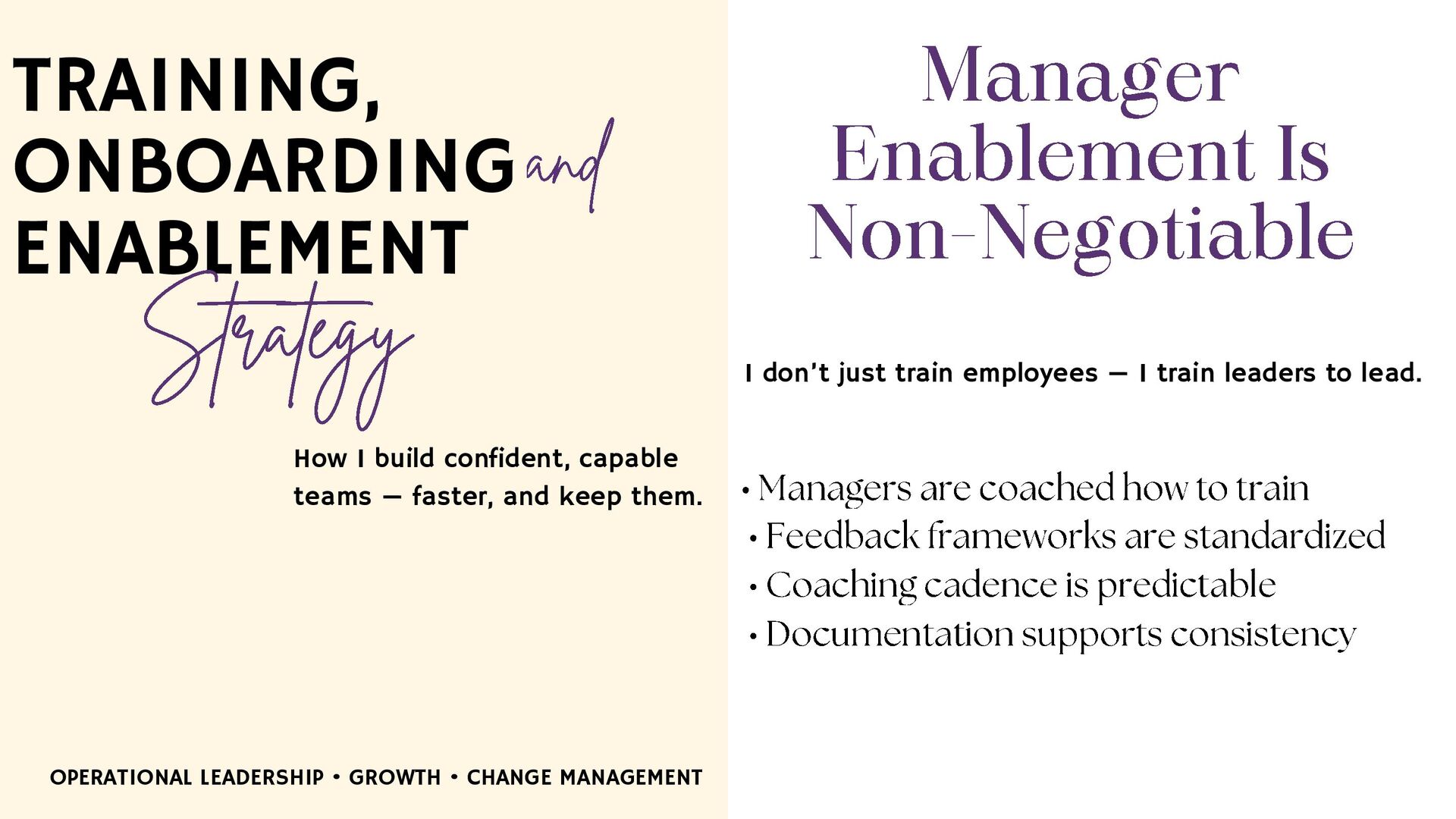
  13. TRAINING, ONBOARDING ENABLEMENT How I build confident, capable teams —

    faster, and keep them. OPERATIONAL LEADERSHIP • GROWTH • CHANGE MANAGEMENT and • Managers are coached how to train • Feedback frameworks are standardized • Coaching cadence is predictable • Documentation supports consistency Manager Enablement Is Non -Negotiable I don’t just train employees — I train leaders to lead. Strategy
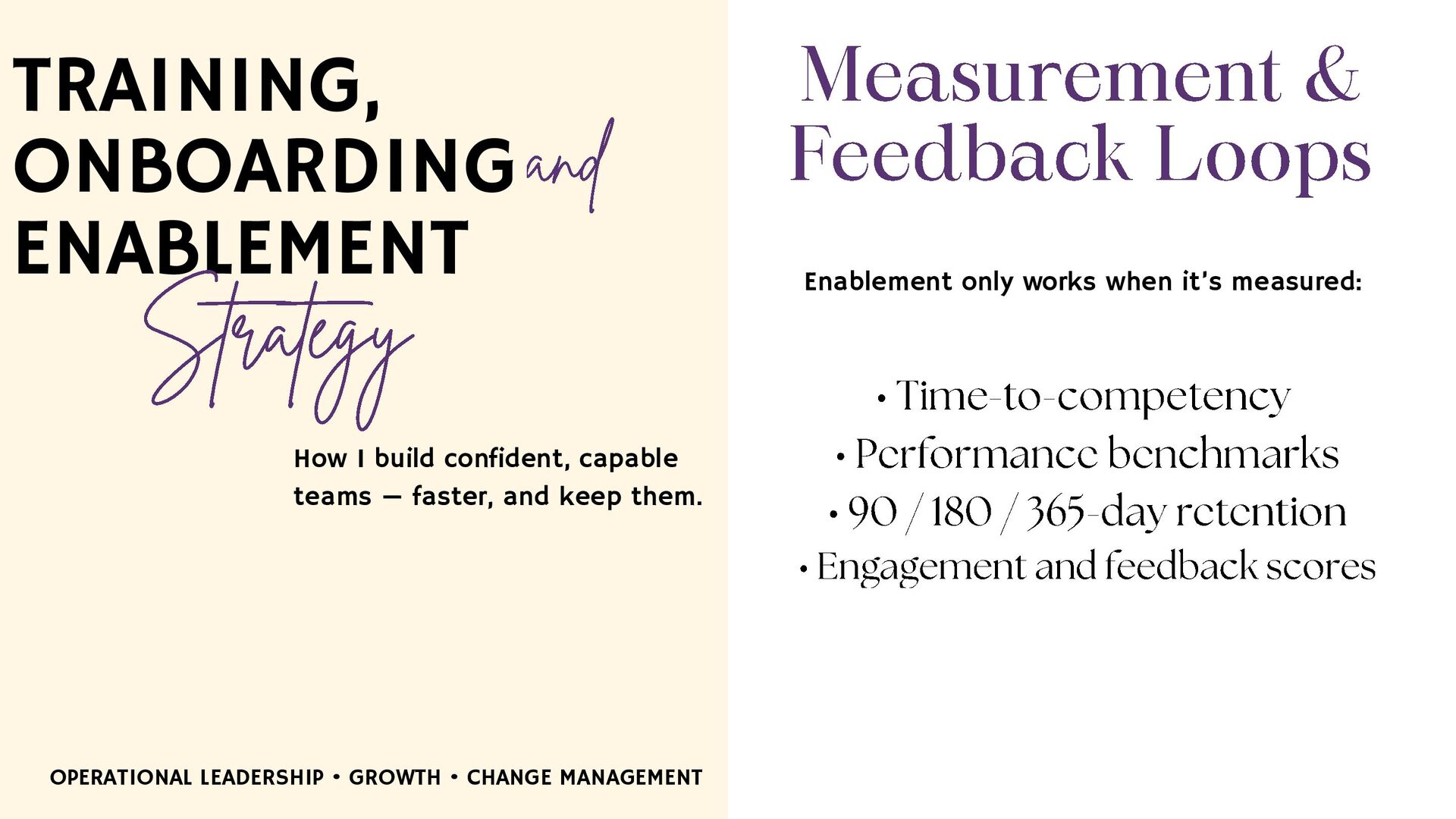
  14. TRAINING, ONBOARDING ENABLEMENT How I build confident, capable teams —

    faster, and keep them. OPERATIONAL LEADERSHIP • GROWTH • CHANGE MANAGEMENT and • Time-to-competency • Performance benchmarks • 90 / 180 / 365-day retention • Engagement and feedback scores Measurement & Feedback Loops Enablement only works when it’s measured: Strategy
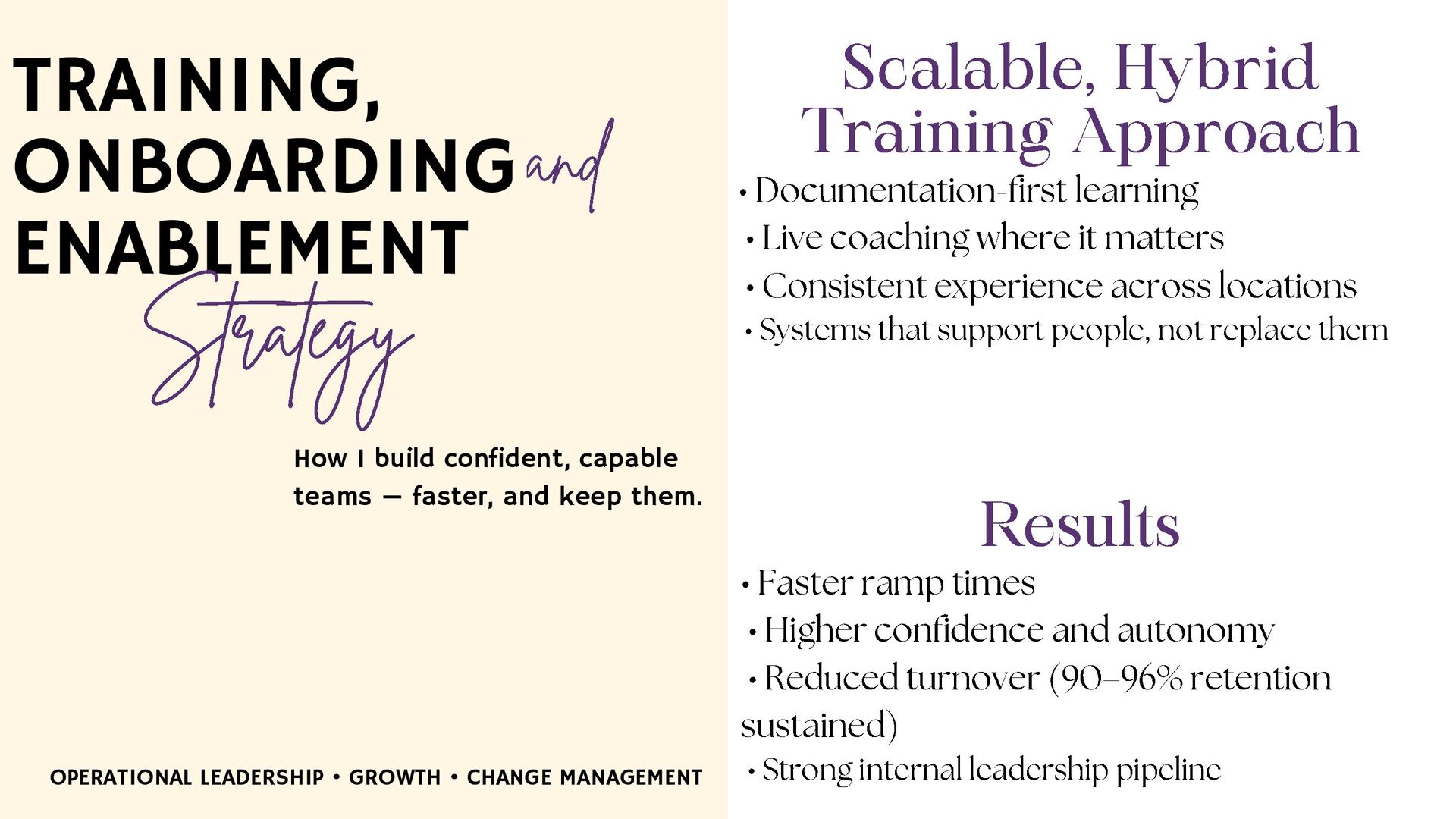
  15. TRAINING, ONBOARDING ENABLEMENT How I build confident, capable teams —

    faster, and keep them. OPERATIONAL LEADERSHIP • GROWTH • CHANGE MANAGEMENT and • Documentation -first learning • Live coaching where it matters • Consistent experience across locations • Systems that support people, not replace them Scalable, Hybrid Training Approach • Faster ramp times • Higher confidence and autonomy • Reduced turnover (90 –96% retention sustained) • Strong internal leadership pipeline Results Strategy
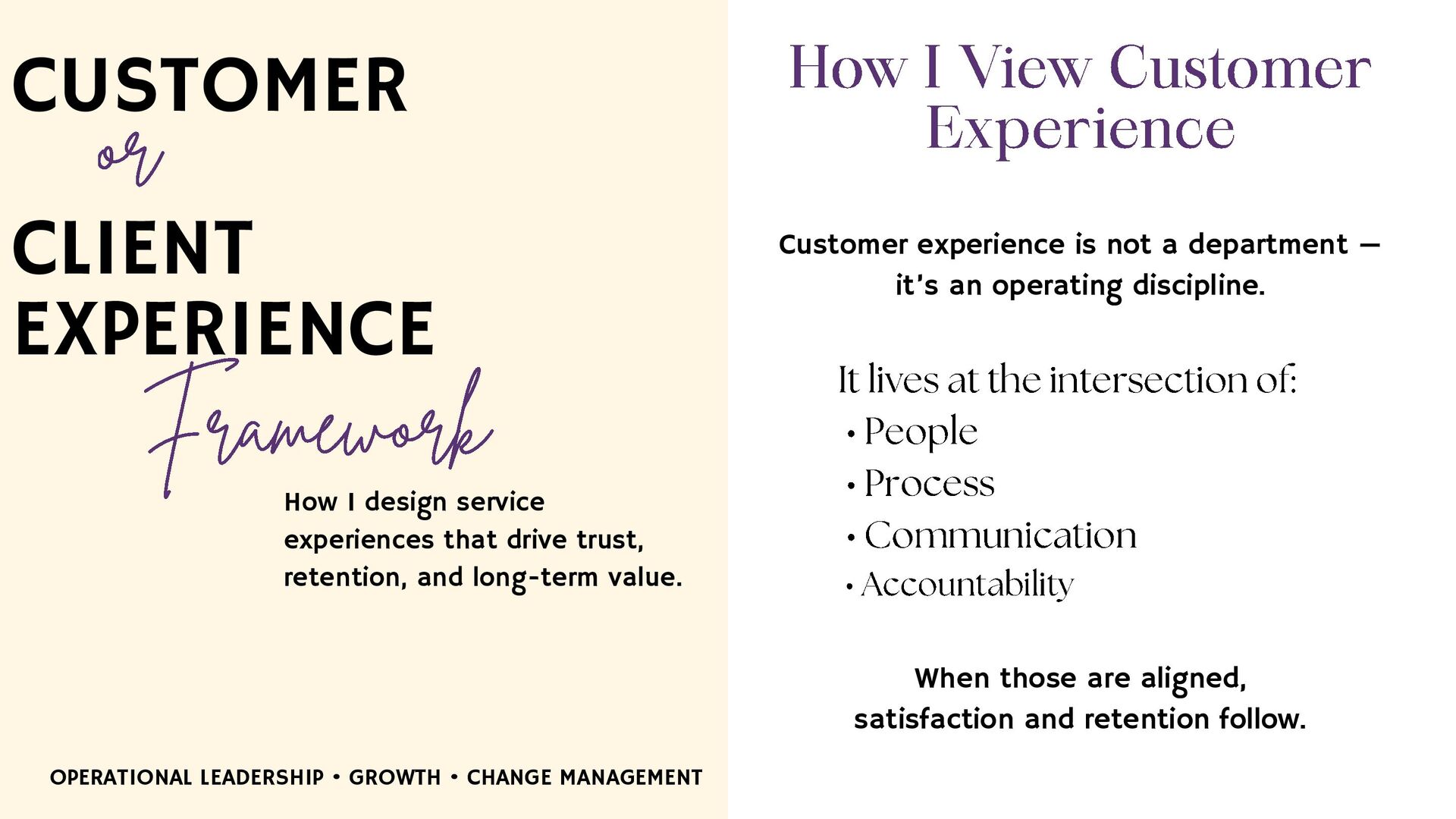
  16. CUSTOMER CLIENT EXPERIENCE How I design service experiences that drive

    trust, retention, and long-term value. Framework OPERATIONAL LEADERSHIP • GROWTH • CHANGE MANAGEMENT It lives at the intersection of: • People • Process • Communication • Accountability How I View Customer Experience or Customer experience is not a department — it’s an operating discipline. When those are aligned, satisfaction and retention follow.
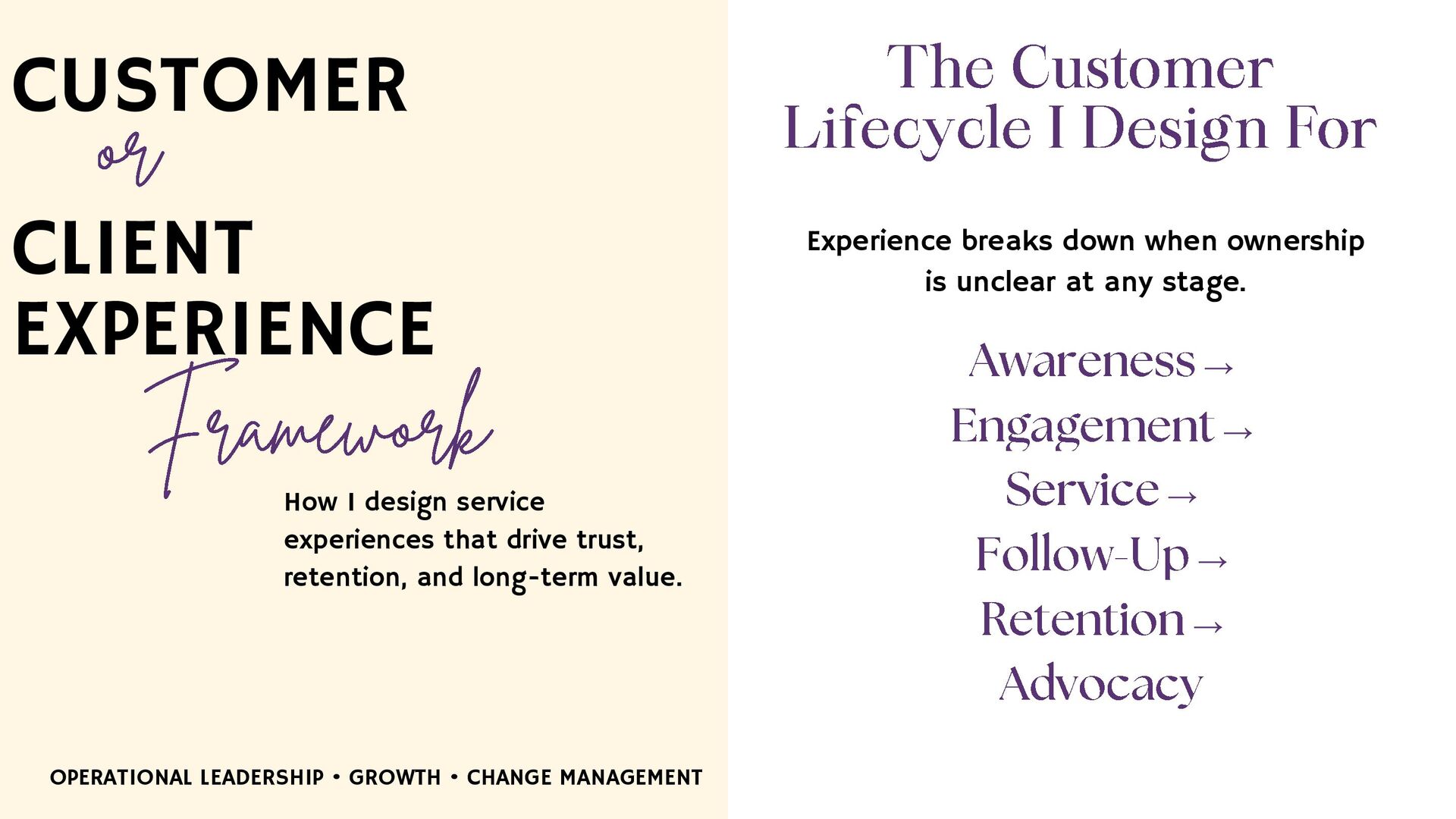
  17. CUSTOMER CLIENT EXPERIENCE How I design service experiences that drive

    trust, retention, and long-term value. Framework OPERATIONAL LEADERSHIP • GROWTH • CHANGE MANAGEMENT The Customer Lifecycle I Design For or Experience breaks down when ownership is unclear at any stage. Awareness → Engagement → Service → Follow -Up → Retention → Advocacy
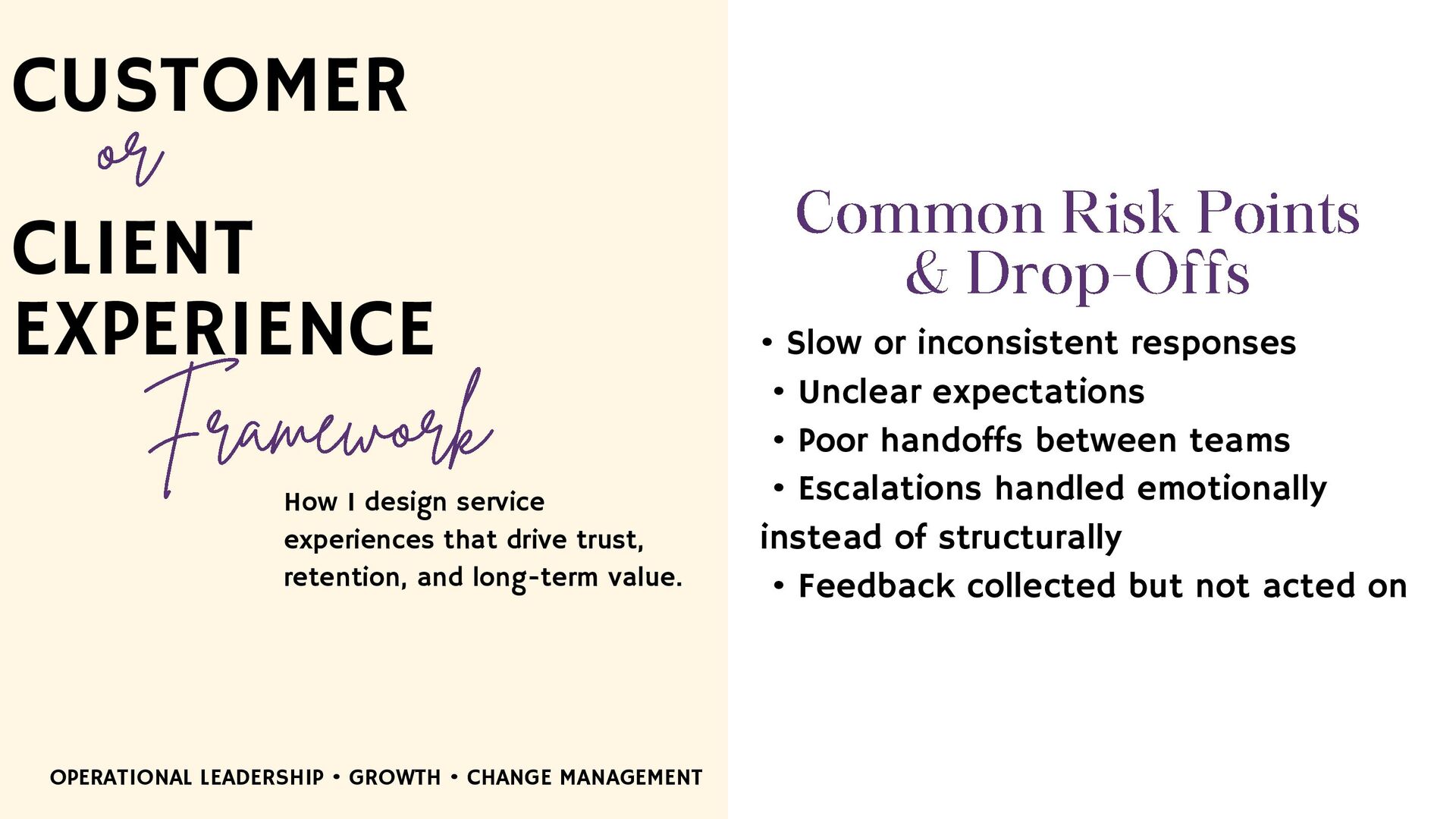
  18. CUSTOMER CLIENT EXPERIENCE How I design service experiences that drive

    trust, retention, and long-term value. Framework OPERATIONAL LEADERSHIP • GROWTH • CHANGE MANAGEMENT Common Risk Points & Drop -Offs or • Slow or inconsistent responses • Unclear expectations • Poor handoffs between teams • Escalations handled emotionally instead of structurally • Feedback collected but not acted on
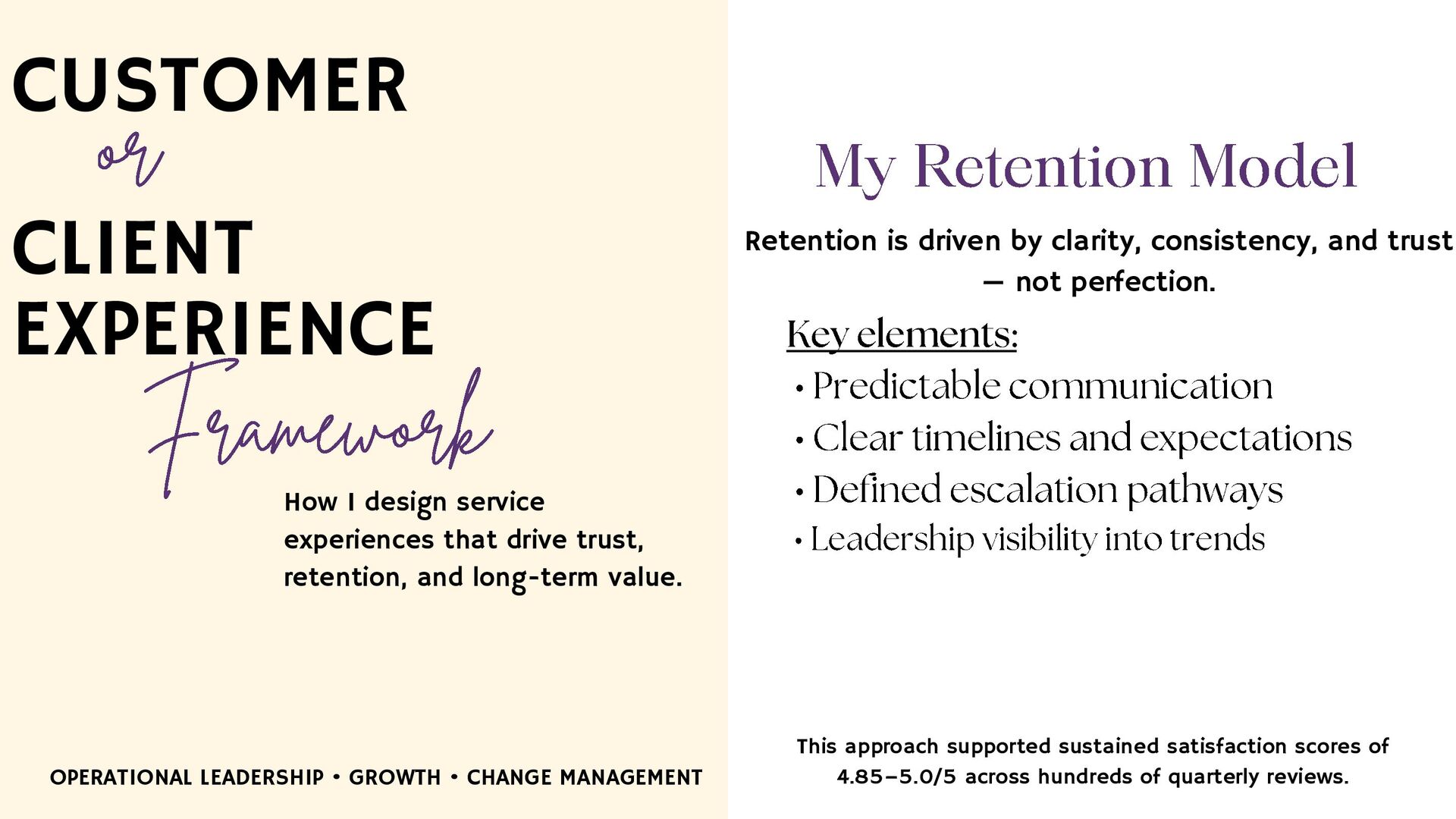
  19. CUSTOMER CLIENT EXPERIENCE How I design service experiences that drive

    trust, retention, and long-term value. Framework OPERATIONAL LEADERSHIP • GROWTH • CHANGE MANAGEMENT My Retention Model or Retention is driven by clarity, consistency, and trust — not perfection. Key elements: • Predictable communication • Clear timelines and expectations • Defined escalation pathways • Leadership visibility into trends This approach supported sustained satisfaction scores of 4.85–5.0/5 across hundreds of quarterly reviews.
  20. CUSTOMER CLIENT EXPERIENCE How I design service experiences that drive

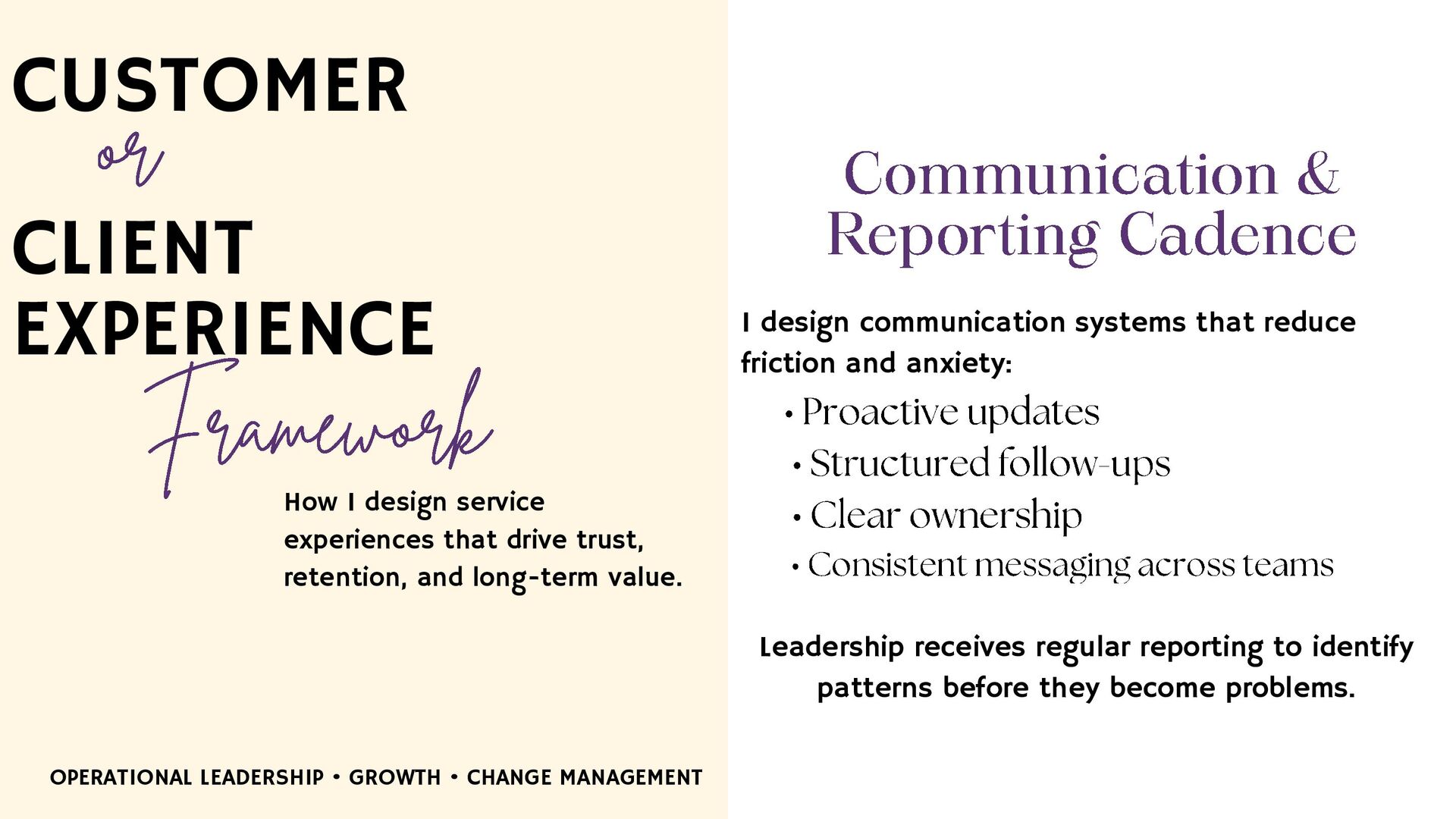
    trust, retention, and long-term value. Framework OPERATIONAL LEADERSHIP • GROWTH • CHANGE MANAGEMENT Communication & Reporting Cadence or I design communication systems that reduce friction and anxiety: • Proactive updates • Structured follow -ups • Clear ownership • Consistent messaging across teams Leadership receives regular reporting to identify patterns before they become problems.
  21. CUSTOMER CLIENT EXPERIENCE How I design service experiences that drive

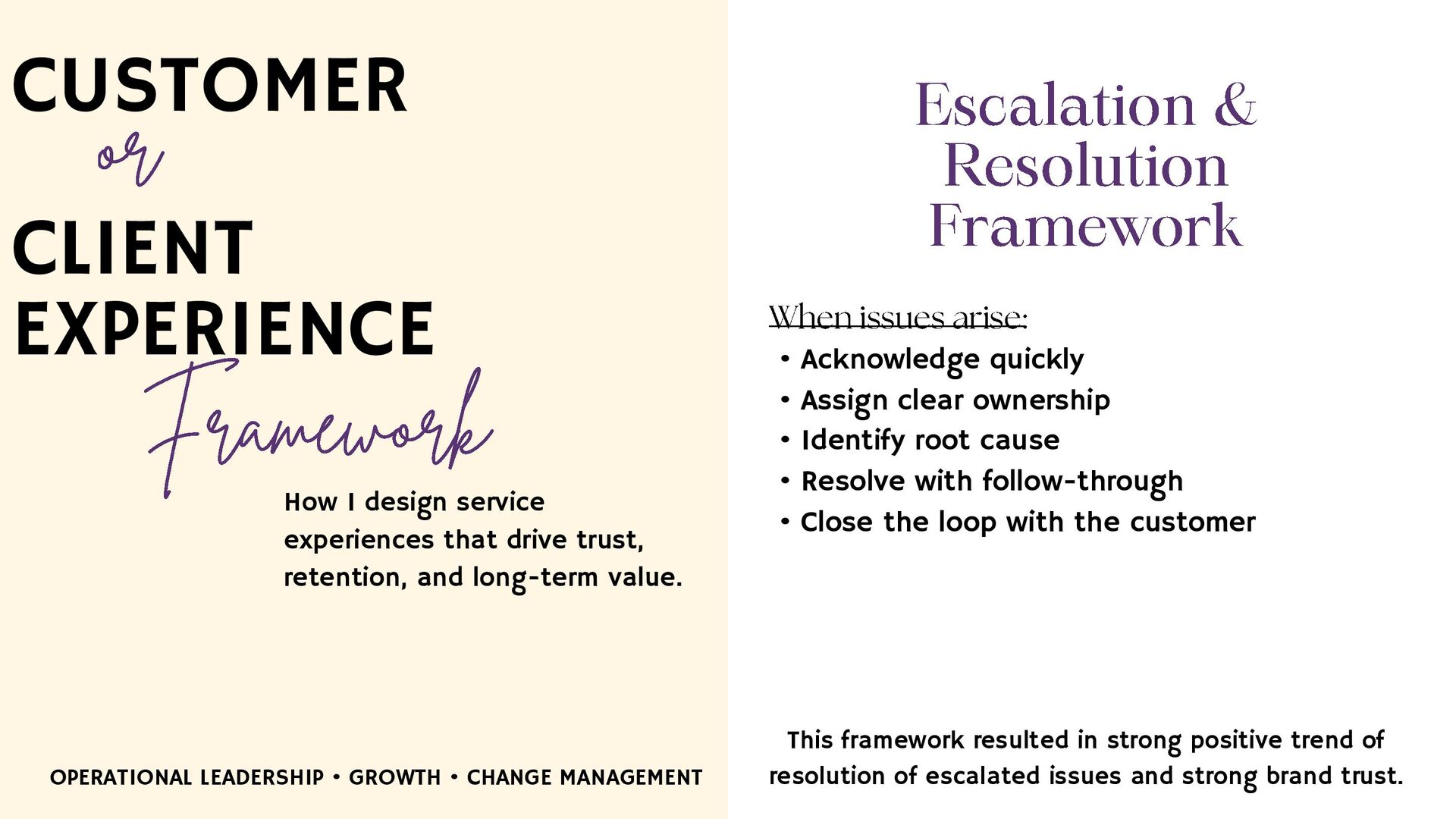
    trust, retention, and long-term value. Framework OPERATIONAL LEADERSHIP • GROWTH • CHANGE MANAGEMENT Escalation & Resolution Framework or When issues arise: • Acknowledge quickly • Assign clear ownership • Identify root cause • Resolve with follow-through • Close the loop with the customer This framework resulted in strong positive trend of resolution of escalated issues and strong brand trust.
  22. CUSTOMER CLIENT EXPERIENCE How I design service experiences that drive

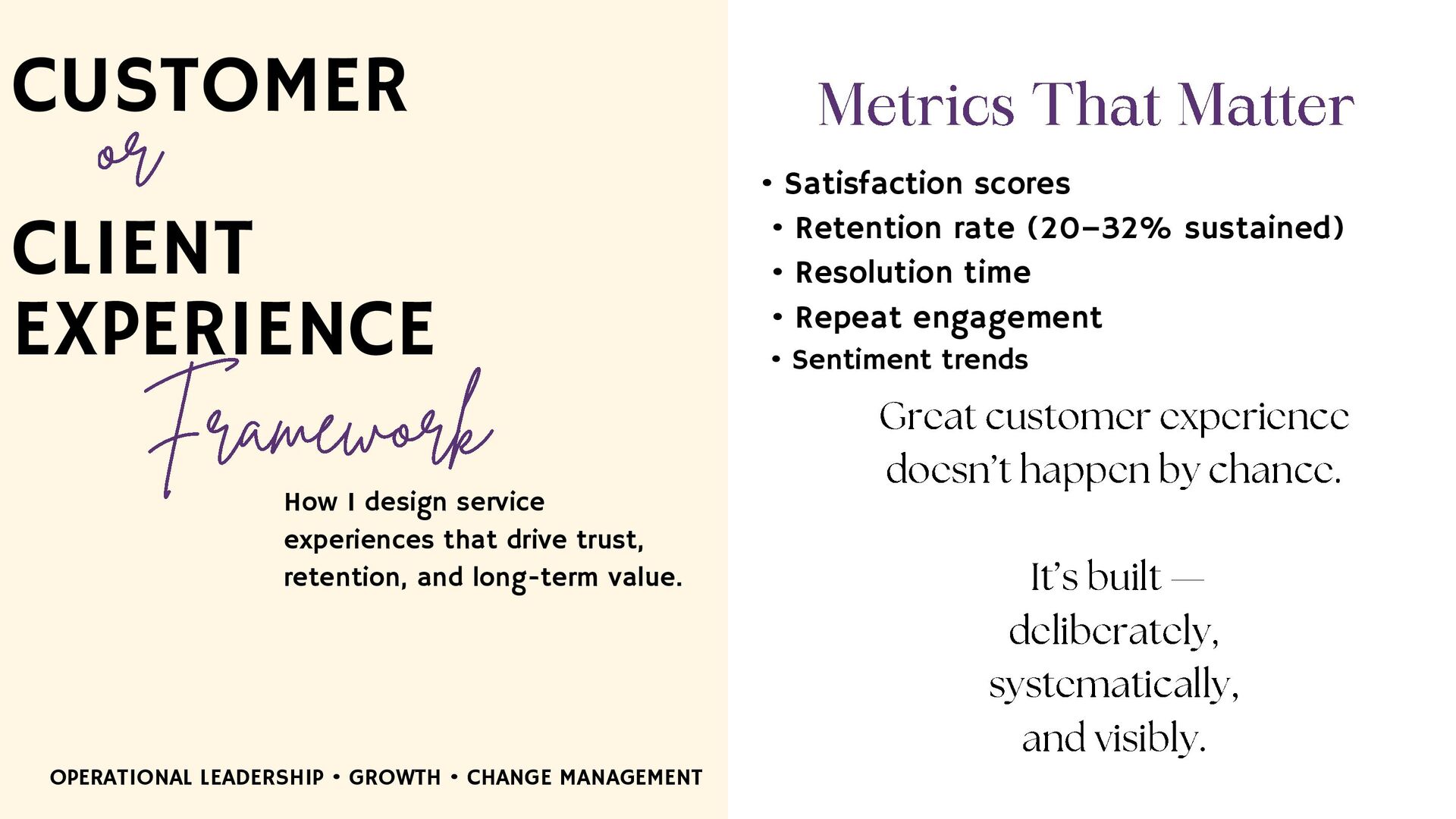
    trust, retention, and long-term value. Framework OPERATIONAL LEADERSHIP • GROWTH • CHANGE MANAGEMENT Metrics That Matter or • Satisfaction scores • Retention rate (20–32% sustained) • Resolution time • Repeat engagement • Sentiment trends Great customer experience doesn’t happen by chance. It’s built — deliberately, systematically, and visibly.
  23. SYSTEMS ADOPTION PROCESS IMPROVEMENT How I lead change so technology

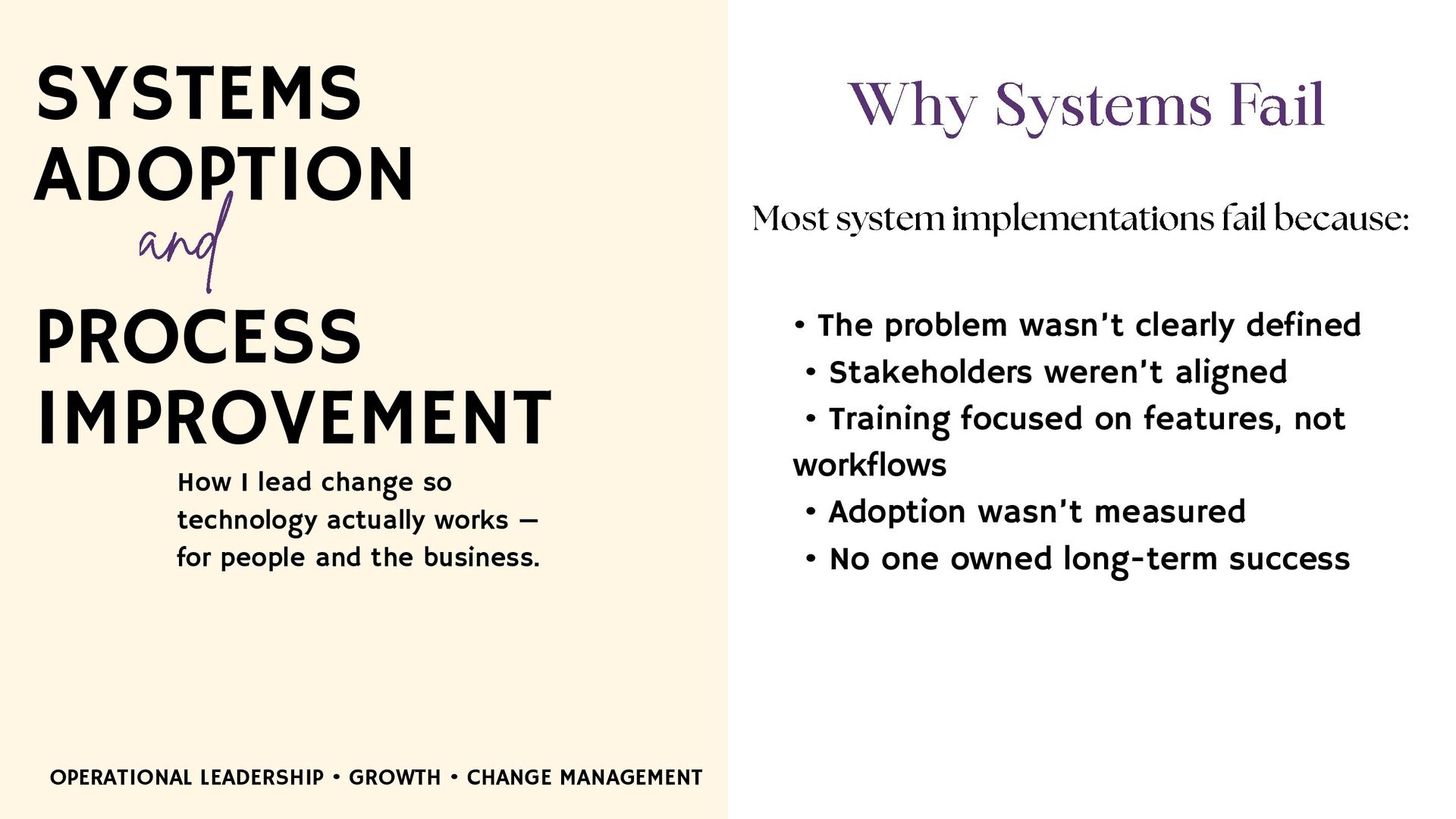
    actually works — for people and the business. OPERATIONAL LEADERSHIP • GROWTH • CHANGE MANAGEMENT Why Systems Fail and Most system implementations fail because: • The problem wasn’t clearly defined • Stakeholders weren’t aligned • Training focused on features, not workflows • Adoption wasn’t measured • No one owned long-term success
  24. SYSTEMS ADOPTION PROCESS IMPROVEMENT How I lead change so technology

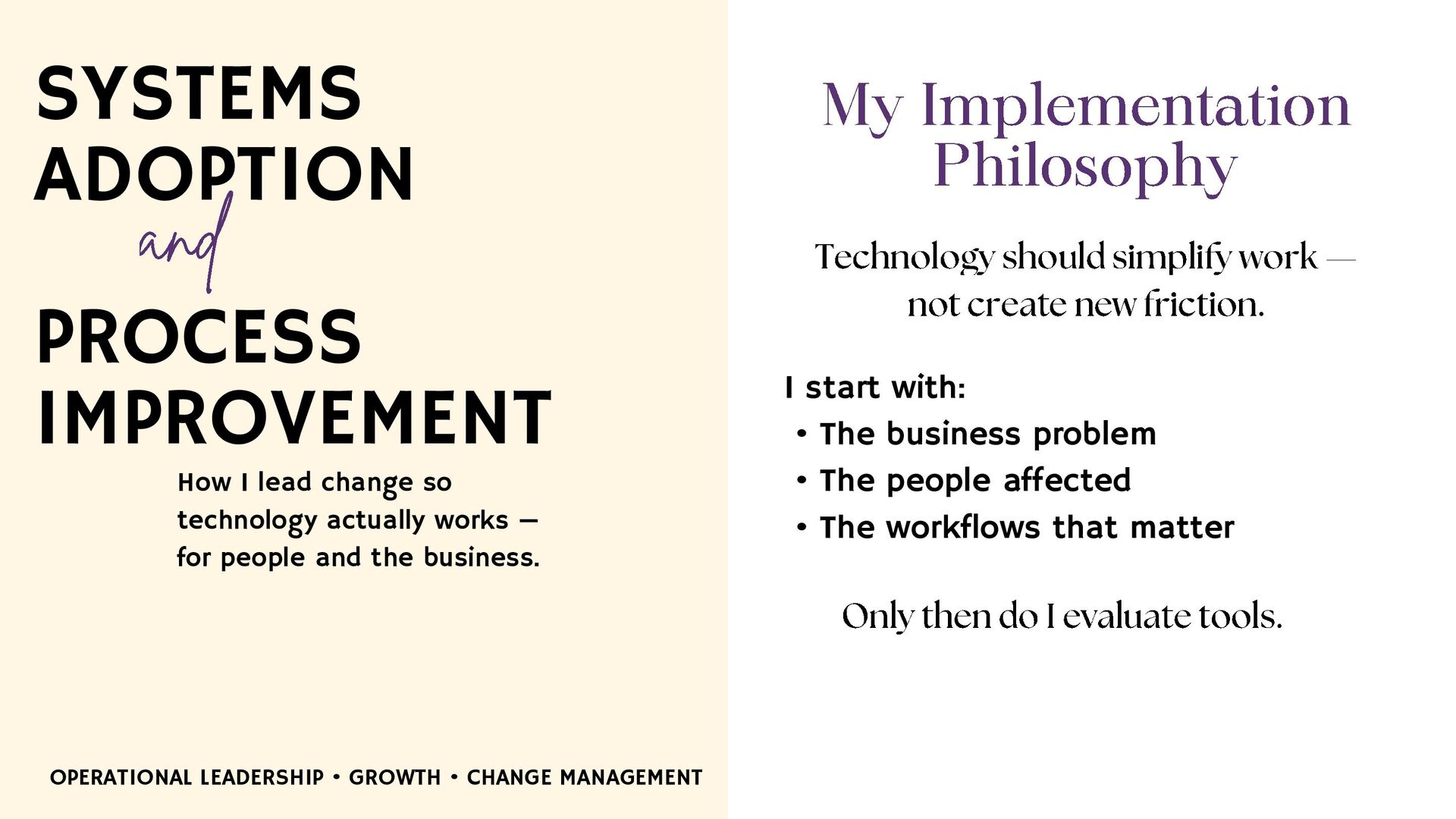
    actually works — for people and the business. OPERATIONAL LEADERSHIP • GROWTH • CHANGE MANAGEMENT My Implementation Philosophy and Technology should simplify work — not create new friction. I start with: • The business problem • The people affected • The workflows that matter Only then do I evaluate tools.
  25. SYSTEMS ADOPTION PROCESS IMPROVEMENT How I lead change so technology

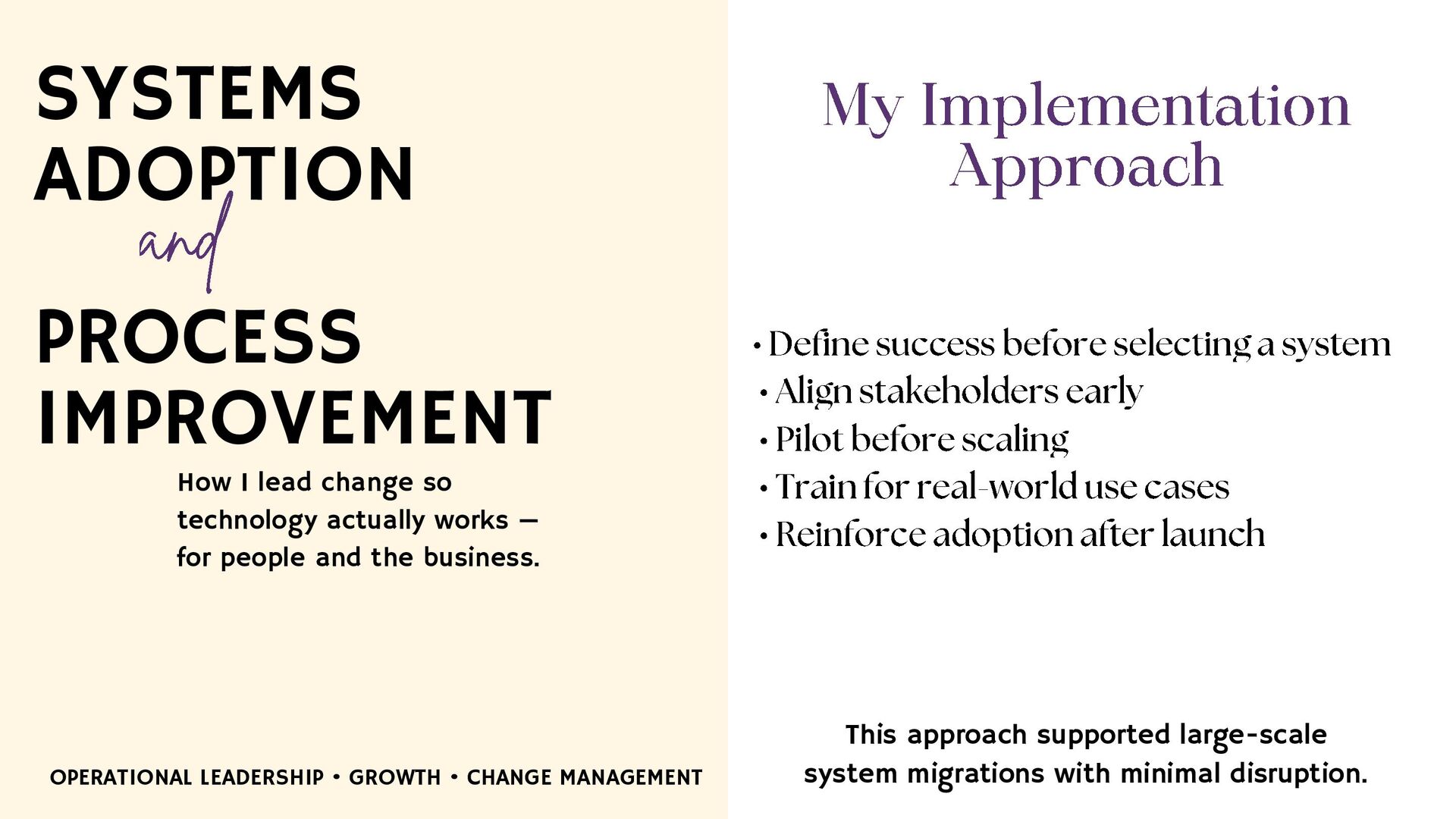
    actually works — for people and the business. OPERATIONAL LEADERSHIP • GROWTH • CHANGE MANAGEMENT My Implementation Approach and • Define success before selecting a system • Align stakeholders early • Pilot before scaling • Train for real -world use cases • Reinforce adoption after launch This approach supported large-scale system migrations with minimal disruption.
  26. SYSTEMS ADOPTION PROCESS IMPROVEMENT How I lead change so technology

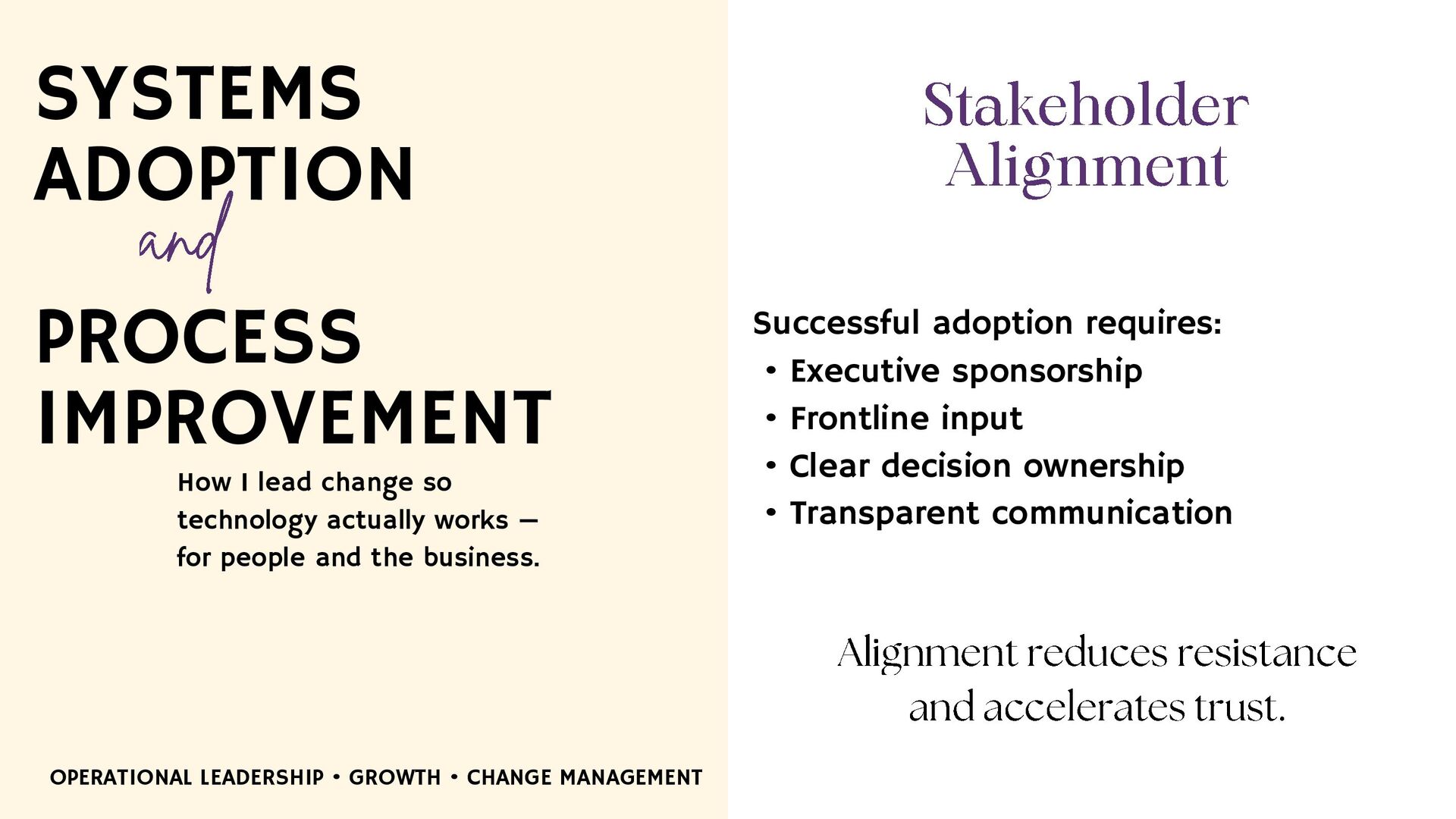
    actually works — for people and the business. OPERATIONAL LEADERSHIP • GROWTH • CHANGE MANAGEMENT Stakeholder Alignment and Successful adoption requires: • Executive sponsorship • Frontline input • Clear decision ownership • Transparent communication Alignment reduces resistance and accelerates trust.
  27. SYSTEMS ADOPTION PROCESS IMPROVEMENT How I lead change so technology

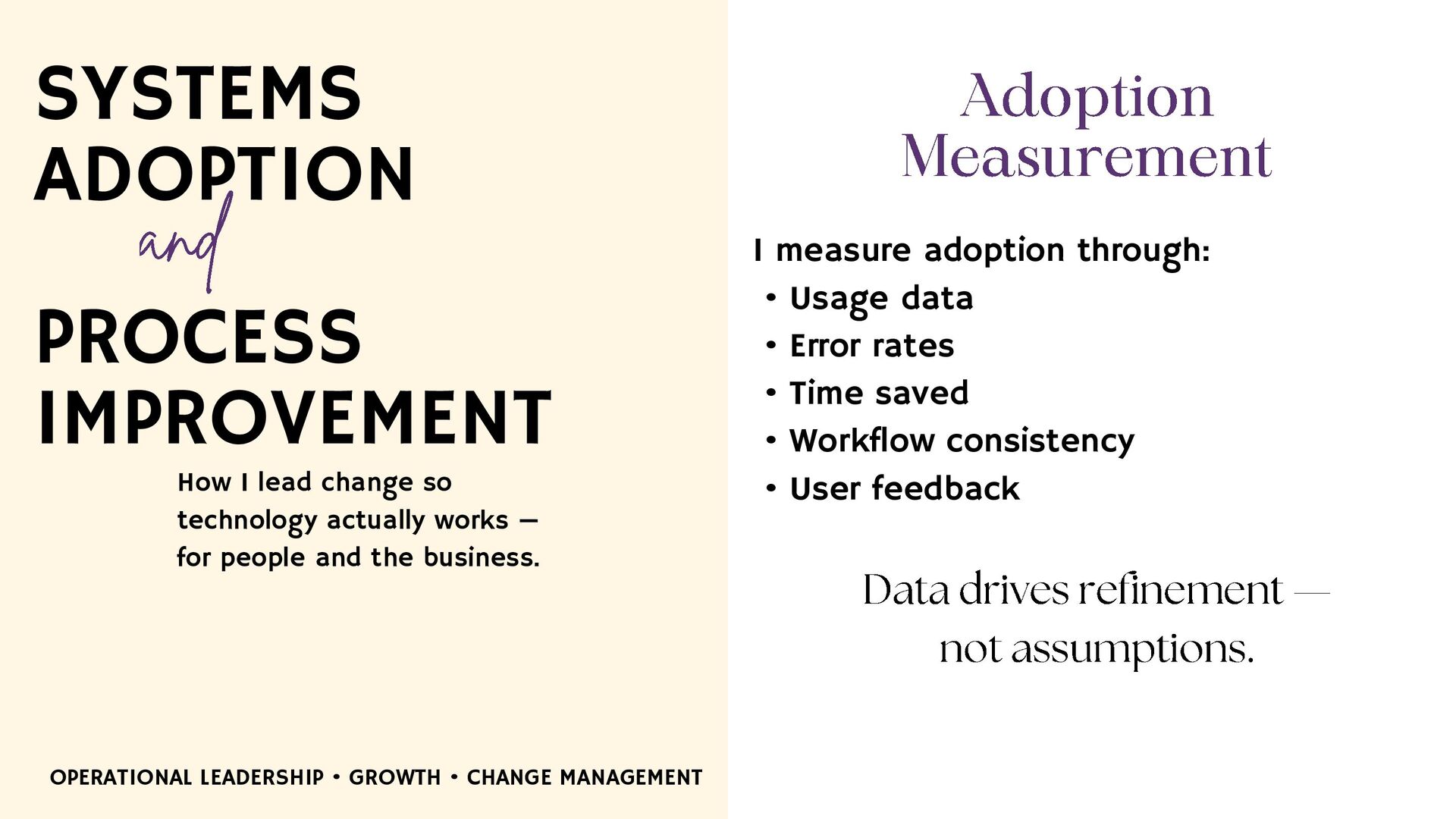
    actually works — for people and the business. OPERATIONAL LEADERSHIP • GROWTH • CHANGE MANAGEMENT Adoption Measurement and I measure adoption through: • Usage data • Error rates • Time saved • Workflow consistency • User feedback Data drives refinement — not assumptions.
  28. SYSTEMS ADOPTION PROCESS IMPROVEMENT How I lead change so technology

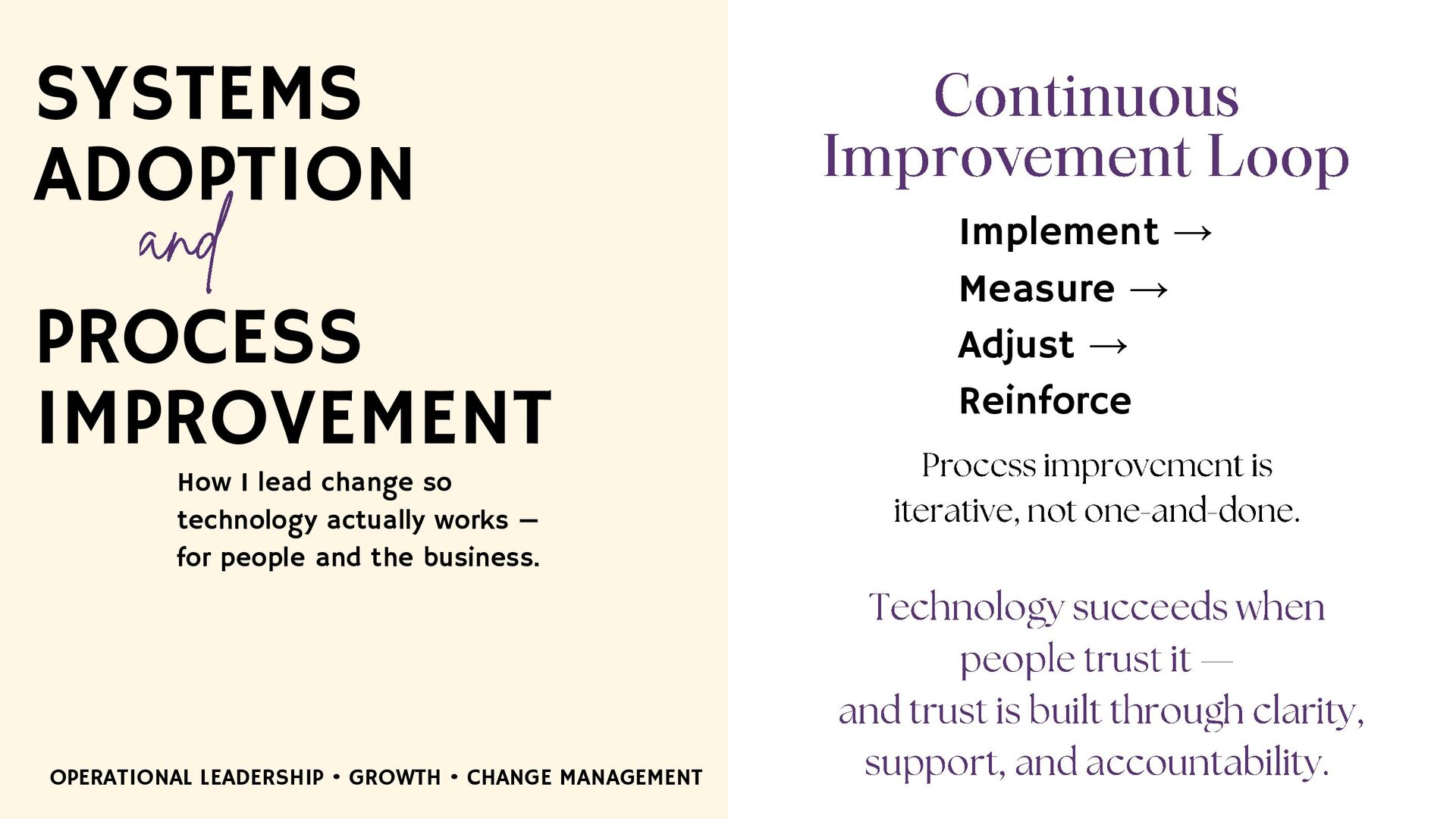
    actually works — for people and the business. OPERATIONAL LEADERSHIP • GROWTH • CHANGE MANAGEMENT Continuous Improvement Loop and Implement → Measure → Adjust → Reinforce Process improvement is iterative, not one -and-done. Technology succeeds when people trust it — and trust is built through clarity, support, and accountability.
  29. LEADERSHIP PHILOSOPHY TEAM MANAGEMENT How I lead teams through clarity,

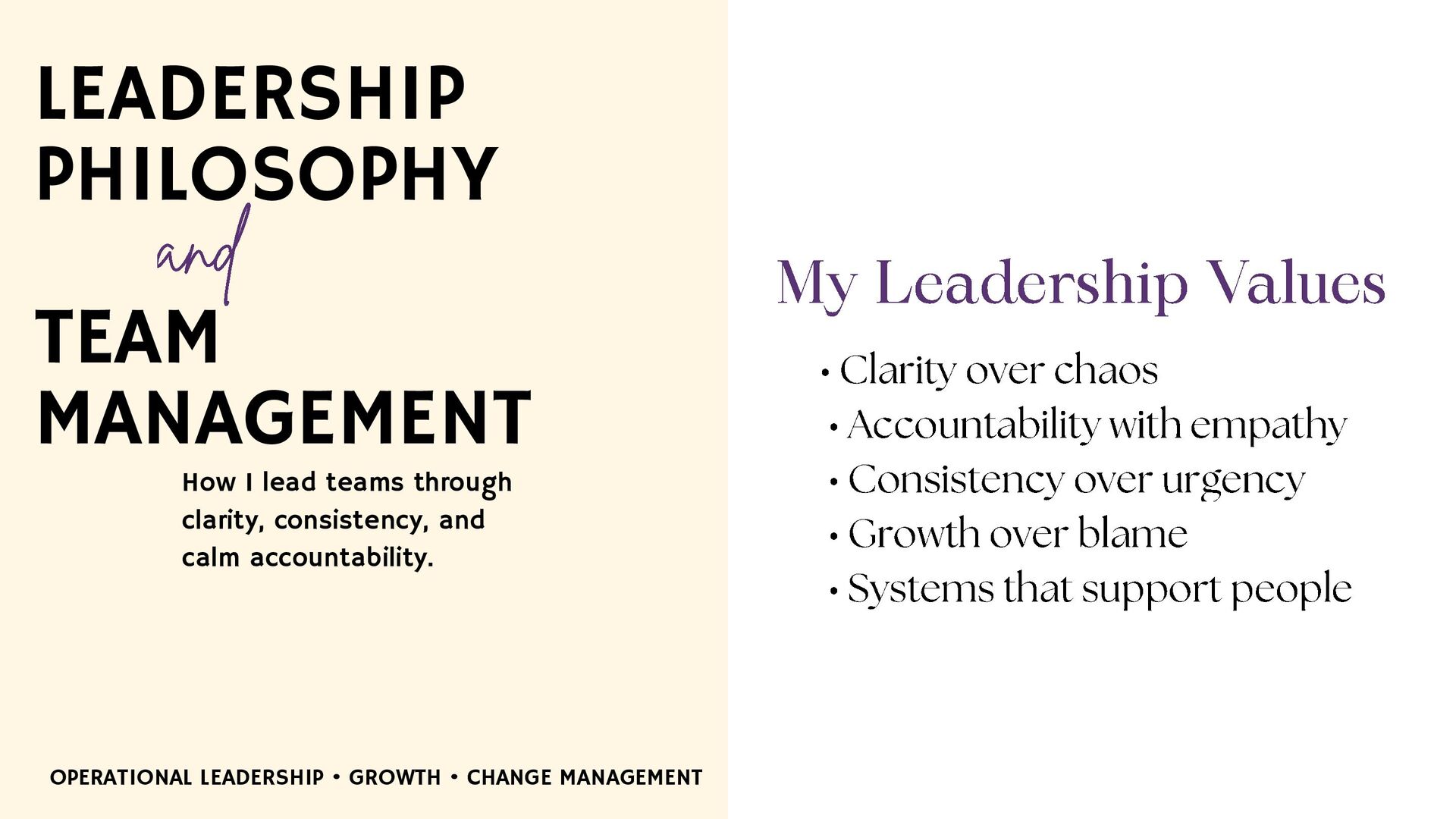
    consistency, and calm accountability. OPERATIONAL LEADERSHIP • GROWTH • CHANGE MANAGEMENT My Leadership Values and • Clarity over chaos • Accountability with empathy • Consistency over urgency • Growth over blame • Systems that support people
  30. LEADERSHIP PHILOSOPHY TEAM MANAGEMENT How I lead teams through clarity,

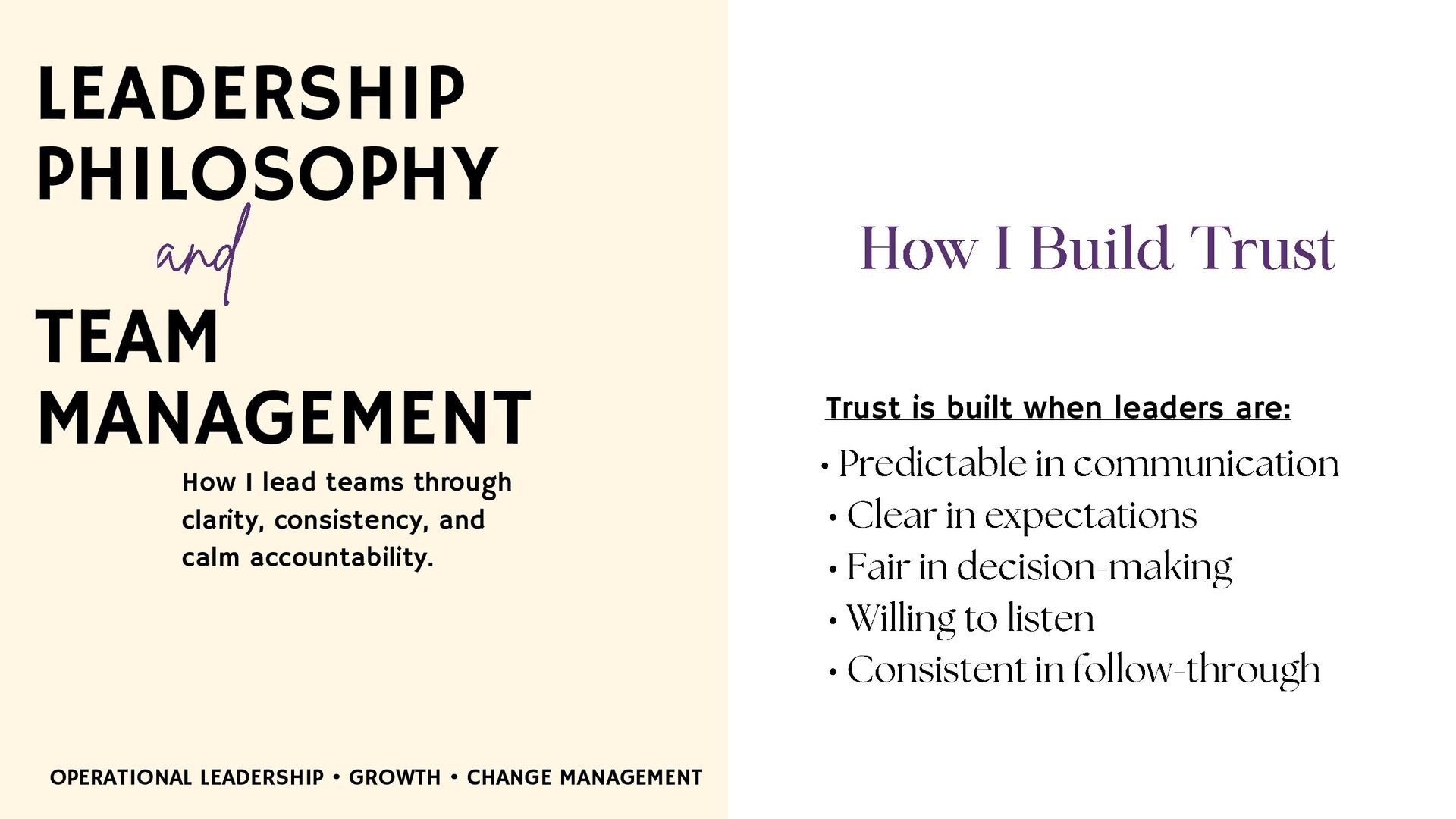
    consistency, and calm accountability. OPERATIONAL LEADERSHIP • GROWTH • CHANGE MANAGEMENT How I Build Trust and • Predictable in communication • Clear in expectations • Fair in decision -making • Willing to listen • Consistent in follow -through Trust is built when leaders are:
  31. LEADERSHIP PHILOSOPHY TEAM MANAGEMENT How I lead teams through clarity,

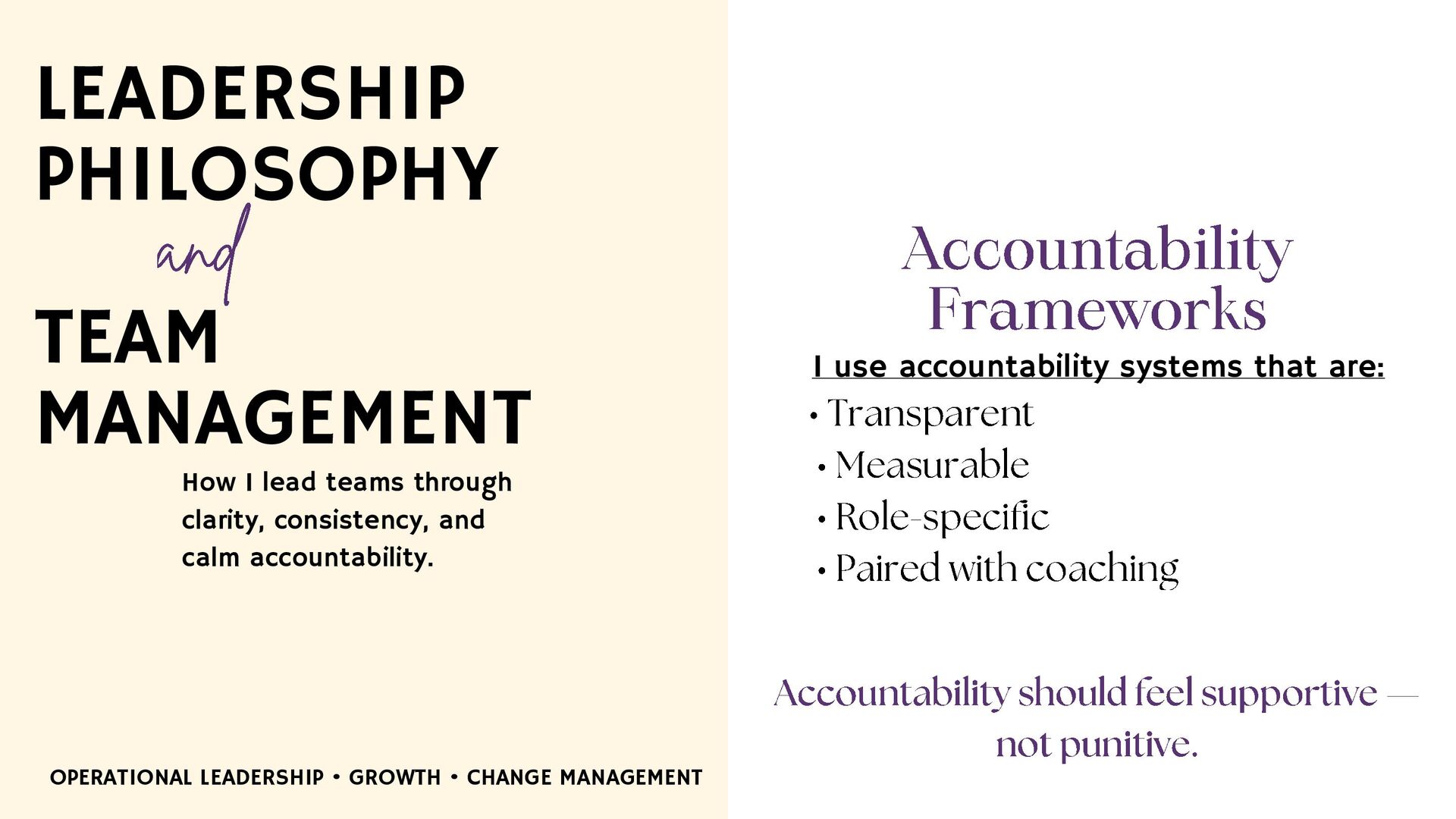
    consistency, and calm accountability. OPERATIONAL LEADERSHIP • GROWTH • CHANGE MANAGEMENT Accountability Frameworks and • Transparent • Measurable • Role-specific • Paired with coaching I use accountability systems that are: Accountability should feel supportive — not punitive.
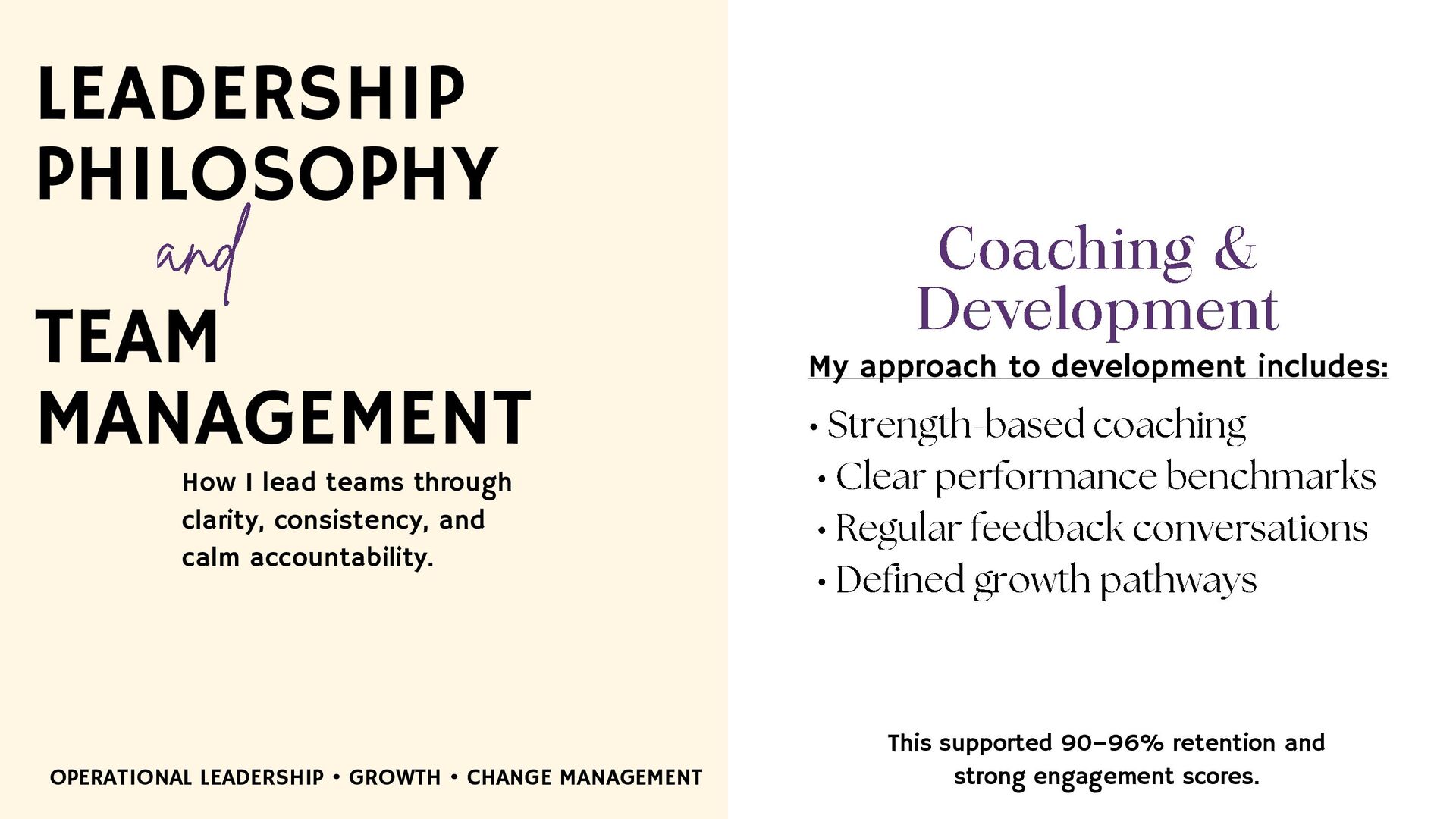
  32. LEADERSHIP PHILOSOPHY TEAM MANAGEMENT How I lead teams through clarity,

    consistency, and calm accountability. OPERATIONAL LEADERSHIP • GROWTH • CHANGE MANAGEMENT Coaching & Development and • Strength -based coaching • Clear performance benchmarks • Regular feedback conversations • Defined growth pathways My approach to development includes: This supported 90–96% retention and strong engagement scores.
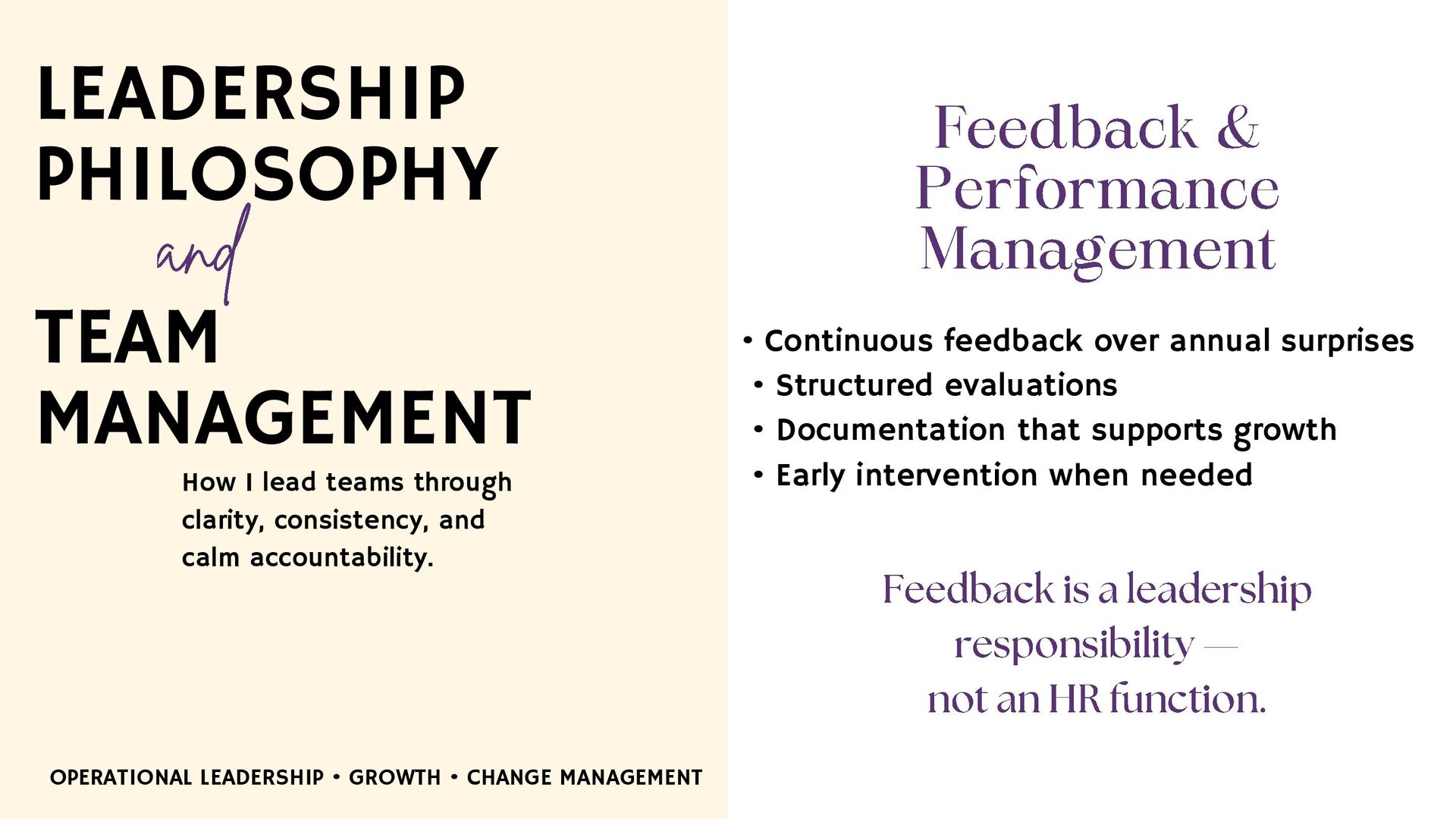
  33. LEADERSHIP PHILOSOPHY TEAM MANAGEMENT How I lead teams through clarity,

    consistency, and calm accountability. OPERATIONAL LEADERSHIP • GROWTH • CHANGE MANAGEMENT Feedback & Performance Management and Feedback is a leadership responsibility — not an HR function. • Continuous feedback over annual surprises • Structured evaluations • Documentation that supports growth • Early intervention when needed
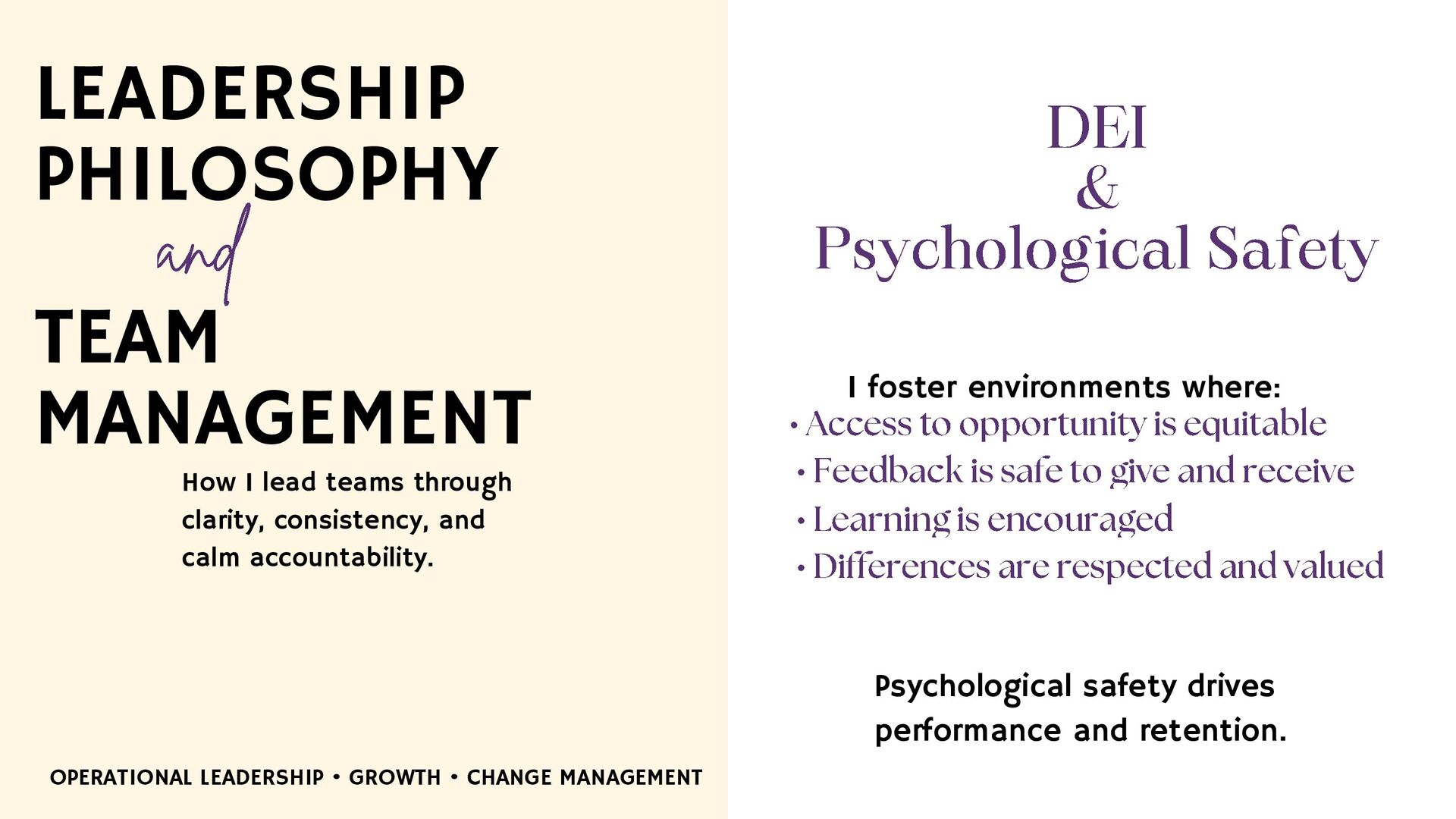
  34. LEADERSHIP PHILOSOPHY TEAM MANAGEMENT How I lead teams through clarity,

    consistency, and calm accountability. OPERATIONAL LEADERSHIP • GROWTH • CHANGE MANAGEMENT DEI & Psychological Safety and • Access to opportunity is equitable • Feedback is safe to give and receive • Learning is encouraged • Differences are respected and valued I foster environments where: Psychological safety drives performance and retention.
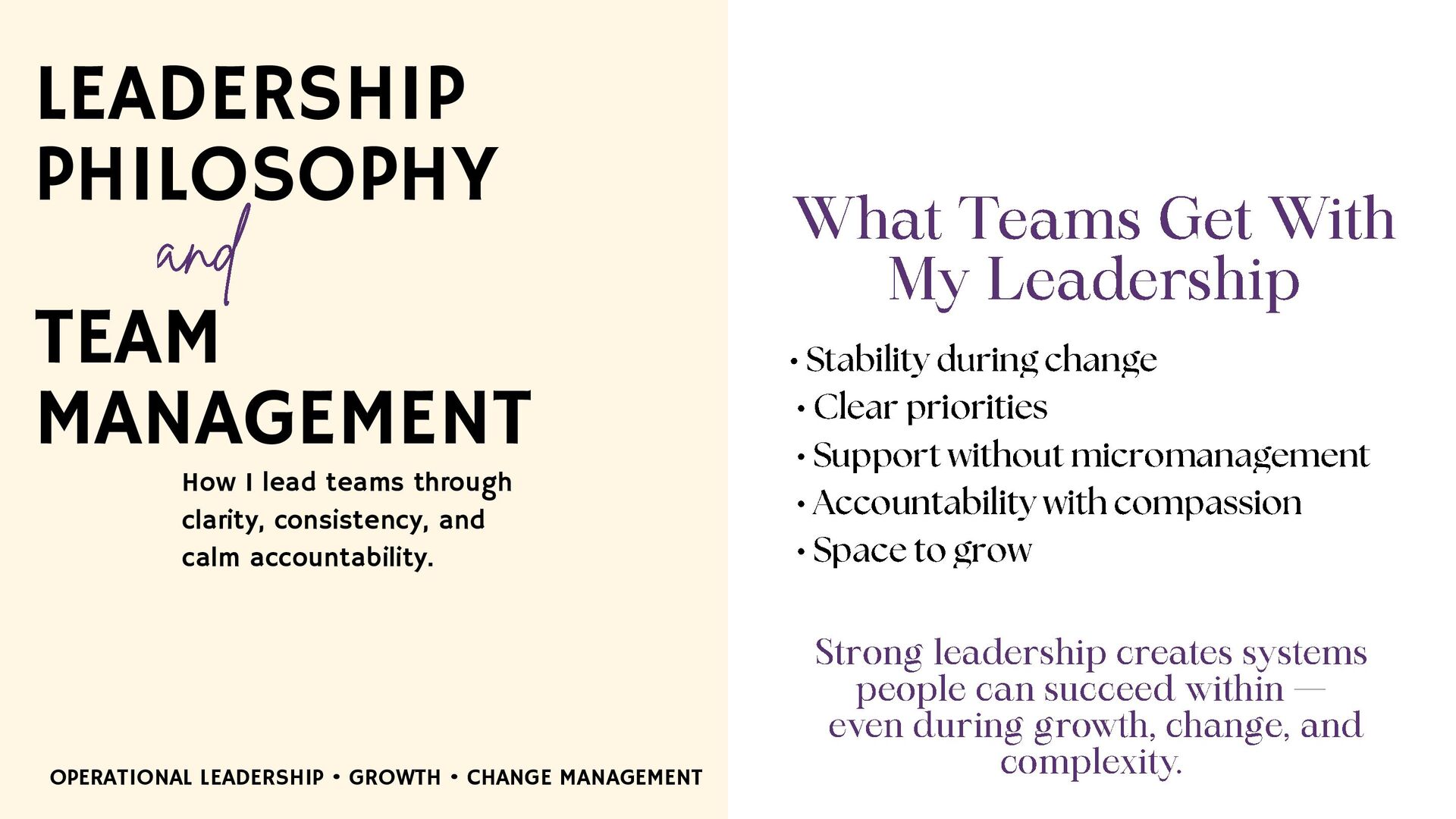
  35. LEADERSHIP PHILOSOPHY TEAM MANAGEMENT How I lead teams through clarity,

    consistency, and calm accountability. OPERATIONAL LEADERSHIP • GROWTH • CHANGE MANAGEMENT What Teams Get With My Leadership and • Stability during change • Clear priorities • Support without micromanagement • Accountability with compassion • Space to grow Strong leadership creates systems people can succeed within — even during growth, change, and complexity.