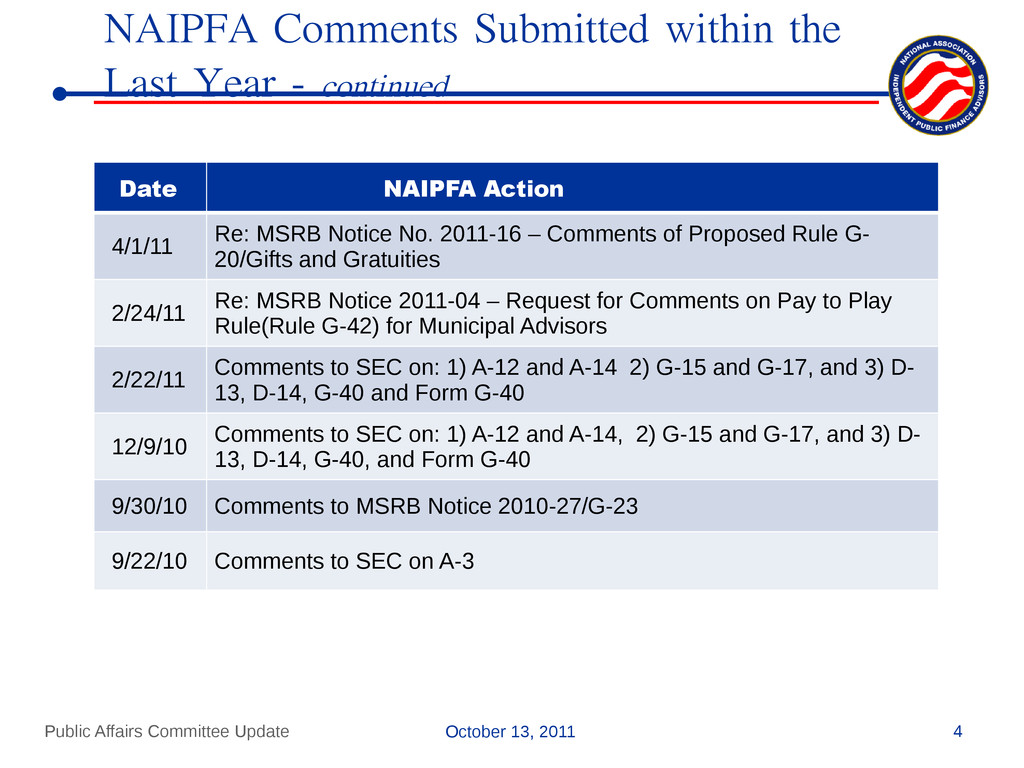
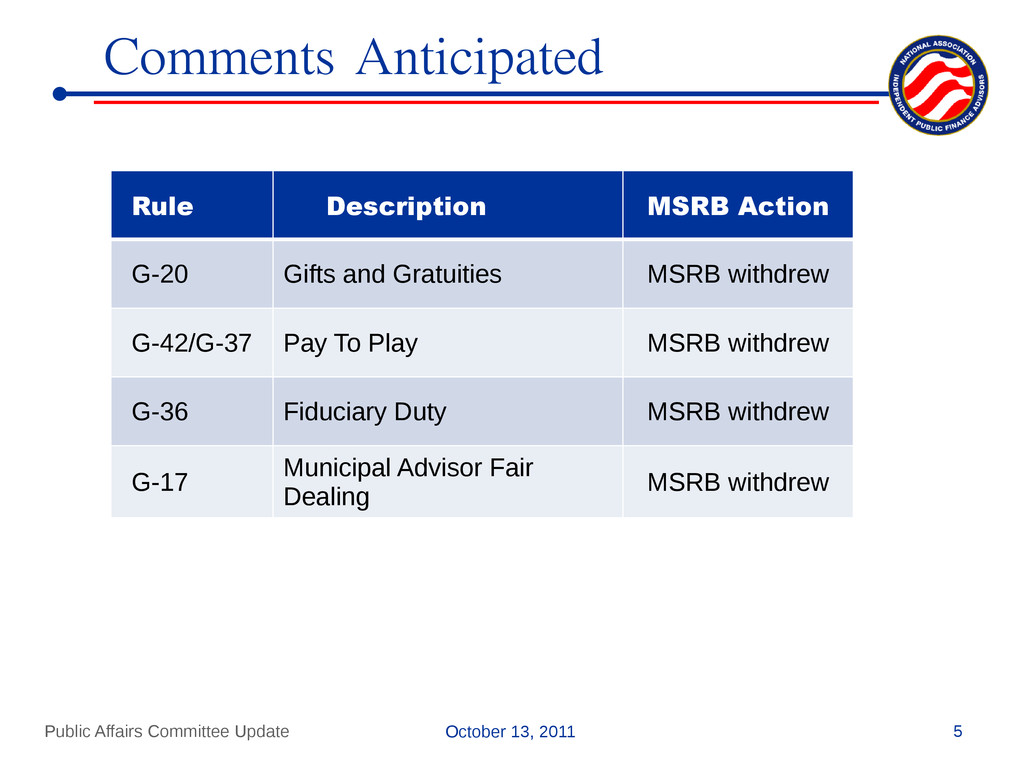
13, 2011 4 Date NAIPFA Action 4/1/11 Re: MSRB Notice No. 2011-16 – Comments of Proposed Rule G- 20/Gifts and Gratuities 2/24/11 Re: MSRB Notice 2011-04 – Request for Comments on Pay to Play Rule(Rule G-42) for Municipal Advisors 2/22/11 Comments to SEC on: 1) A-12 and A-14 2) G-15 and G-17, and 3) D- 13, D-14, G-40 and Form G-40 12/9/10 Comments to SEC on: 1) A-12 and A-14, 2) G-15 and G-17, and 3) D- 13, D-14, G-40, and Form G-40 9/30/10 Comments to MSRB Notice 2010-27/G-23 9/22/10 Comments to SEC on A-3 Public Affairs Committee Update
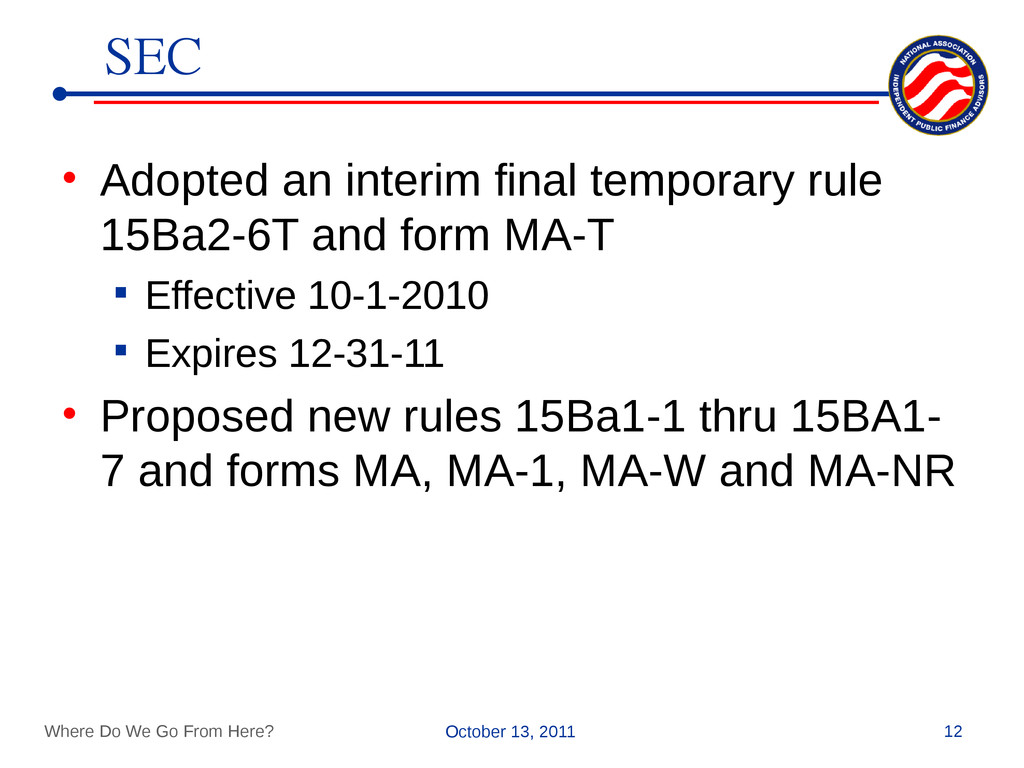
form MA-T Effective 10-1-2010 Expires 12-31-11 • Proposed new rules 15Ba1-1 thru 15BA1- 7 and forms MA, MA-1, MA-W and MA-NR October 13, 2011 12 Where Do We Go From Here?
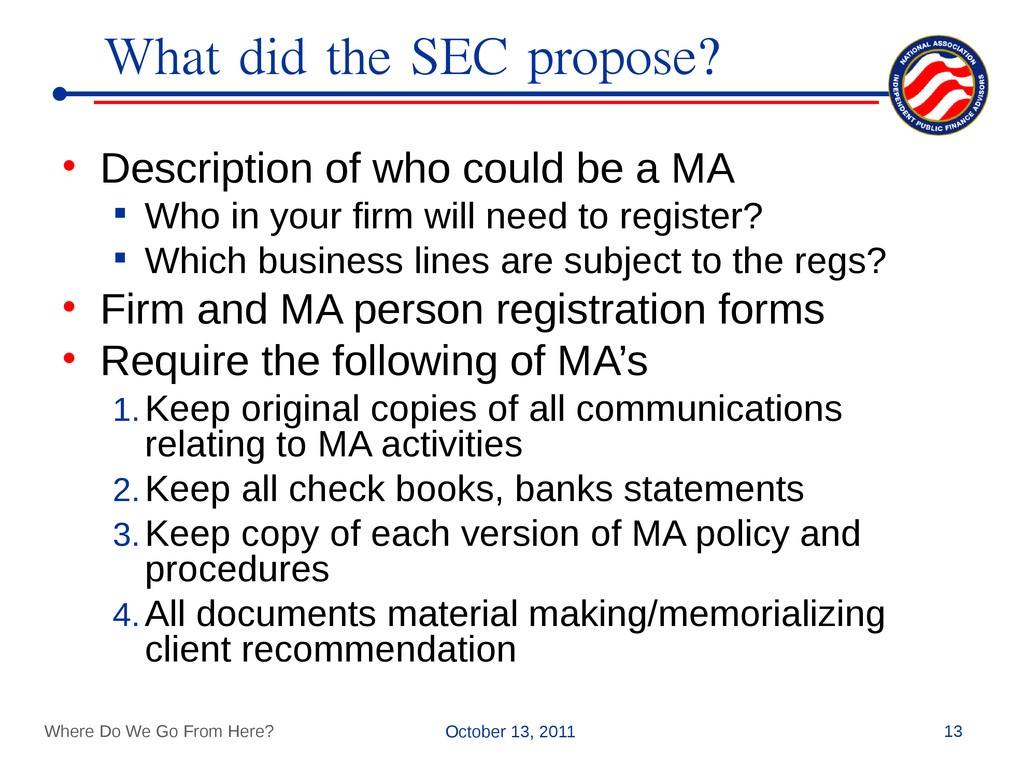
be a MA Who in your firm will need to register? Which business lines are subject to the regs? • Firm and MA person registration forms • Require the following of MA’s 1.Keep original copies of all communications relating to MA activities 2.Keep all check books, banks statements 3.Keep copy of each version of MA policy and procedures 4.All documents material making/memorializing client recommendation October 13, 2011 13 Where Do We Go From Here?
written agreements with any muni entity, their employee or obligated person 6. Keep names of associated person on MA 7. Names, titles and addresses of persons associates with MA 8. Client list 9. Names, titles and address of solicitors 10. Names, titles and address of persons that agree to provide payment to MA Keep info for 5 years and first two easily October 13, 2011 14 Where Do We Go From Here?
client correspondence to see if you are preparing and keeping documents that memorialize the transaction Keep copies (Hard or electronic)of all Emails or find service provider that does Be organized in keeping required lists October 13, 2011 15 Where Do We Go From Here?
to prepare a test by the fall of 2012 • Determining if they or some other agency such as FINRA will conduct site visits of MAs. October 13, 2011 16 Where Do We Go From Here?
Organization) is charged with developing various rules for the regulation of MAs through an open comment process. • The SEC receives proposed MSRB rules and conducts their own open comment process before approval of proposed rules. • Some MSRB Rules have been approved and a number have been proposed. October 13, 2011 17 Where Do We Go From Here?
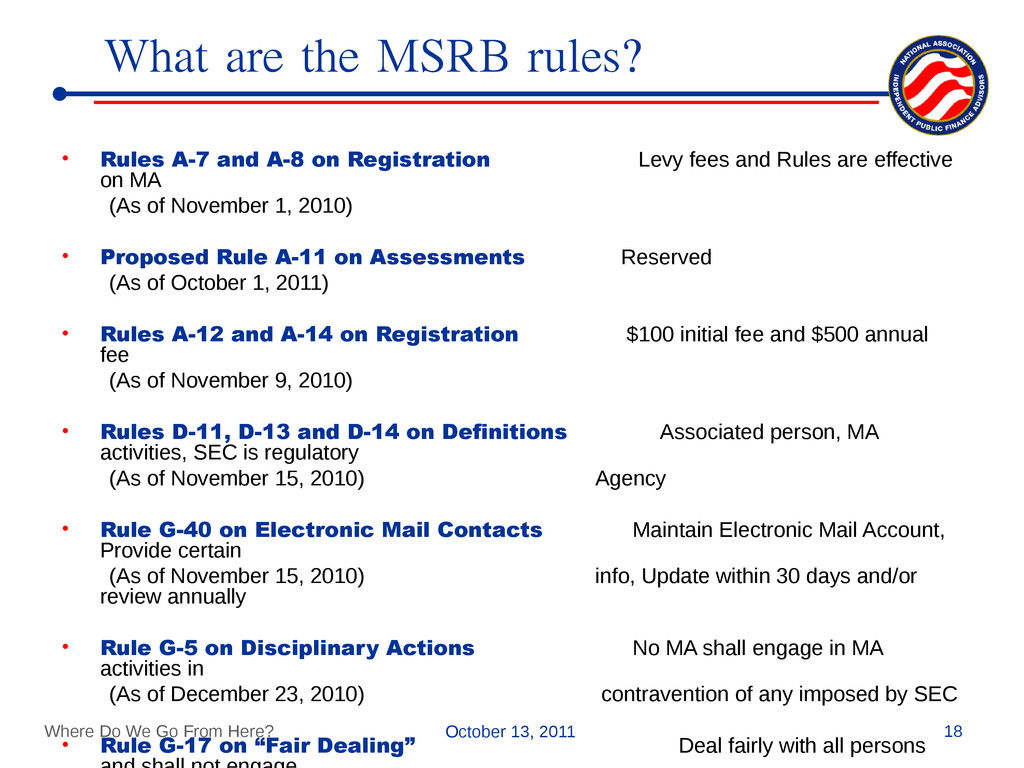
on Registration Levy fees and Rules are effective on MA (As of November 1, 2010) • Proposed Rule A-11 on Assessments Reserved (As of October 1, 2011) • Rules A-12 and A-14 on Registration $100 initial fee and $500 annual fee (As of November 9, 2010) • Rules D-11, D-13 and D-14 on Definitions Associated person, MA activities, SEC is regulatory (As of November 15, 2010) Agency • Rule G-40 on Electronic Mail Contacts Maintain Electronic Mail Account, Provide certain (As of November 15, 2010) info, Update within 30 days and/or review annually • Rule G-5 on Disciplinary Actions No MA shall engage in MA activities in (As of December 23, 2010) contravention of any imposed by SEC • Rule G-17 on “Fair Dealing” Deal fairly with all persons October 13, 2011 18 Where Do We Go From Here?
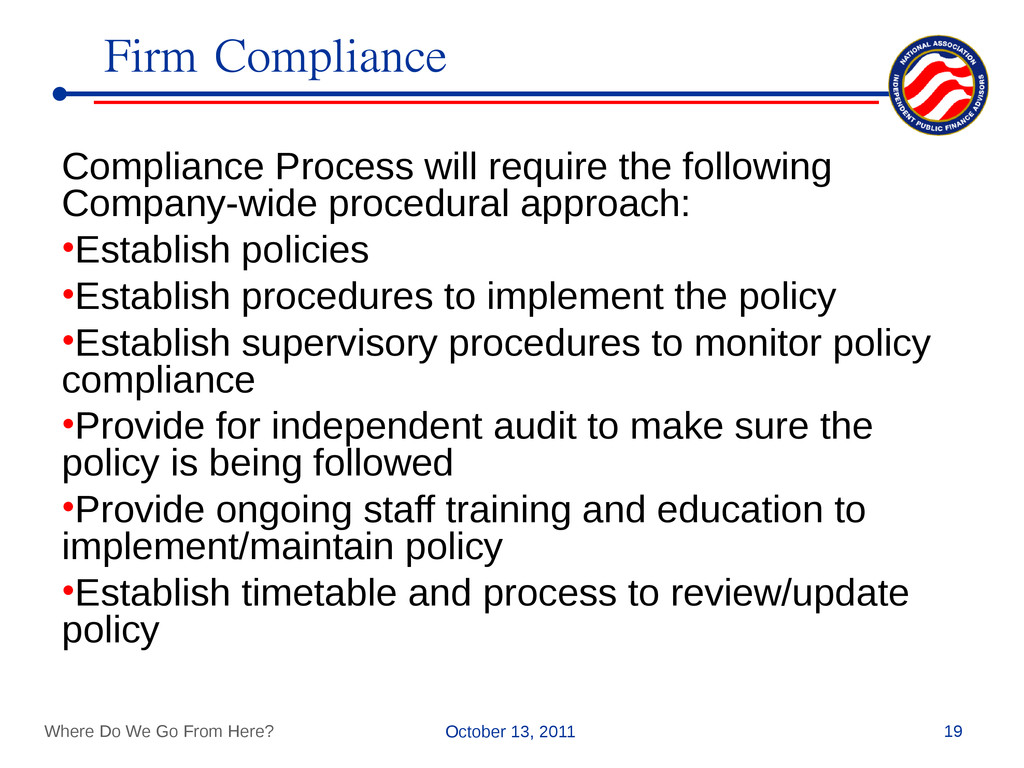
approach: •Establish policies •Establish procedures to implement the policy •Establish supervisory procedures to monitor policy compliance •Provide for independent audit to make sure the policy is being followed •Provide ongoing staff training and education to implement/maintain policy •Establish timetable and process to review/update policy October 13, 2011 19 Where Do We Go From Here?
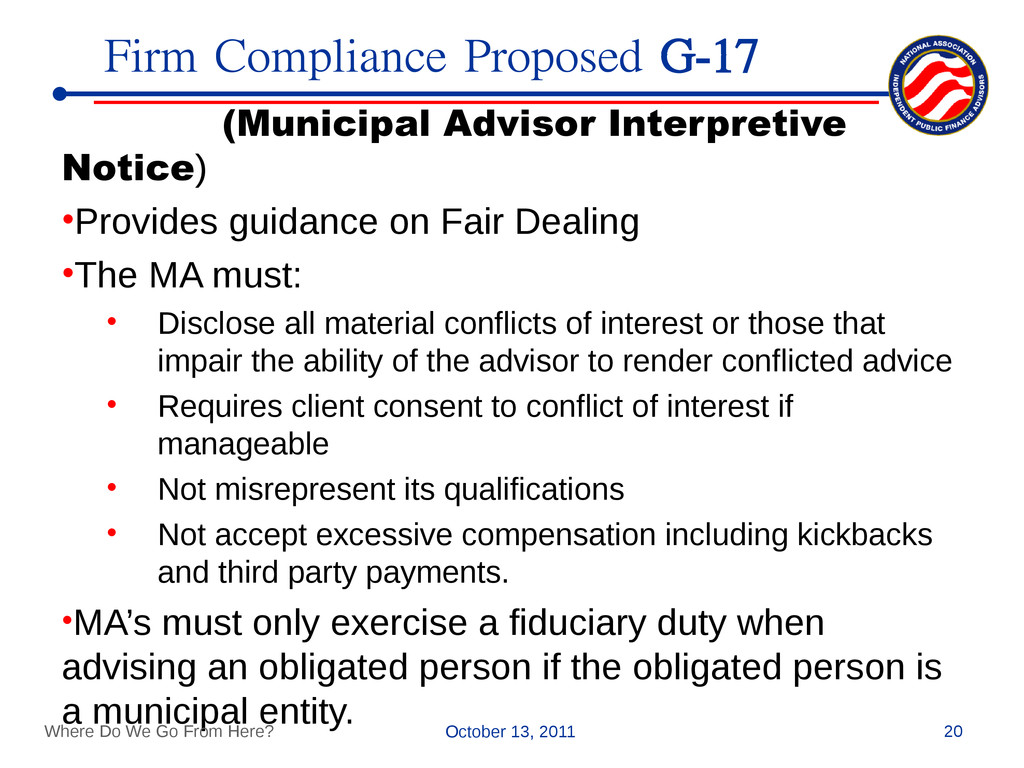
on Fair Dealing •The MA must: • Disclose all material conflicts of interest or those that impair the ability of the advisor to render conflicted advice • Requires client consent to conflict of interest if manageable • Not misrepresent its qualifications • Not accept excessive compensation including kickbacks and third party payments. •MA’s must only exercise a fiduciary duty when advising an obligated person if the obligated person is a municipal entity. October 13, 2011 20 Where Do We Go From Here?
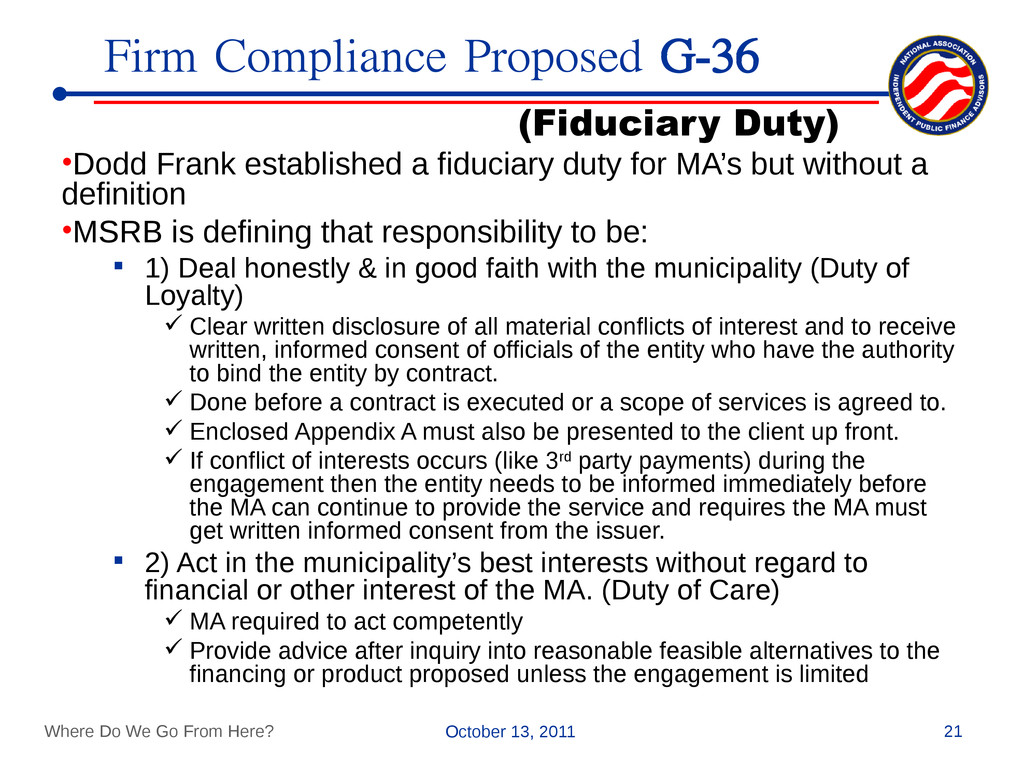
fiduciary duty for MA’s but without a definition •MSRB is defining that responsibility to be: 1) Deal honestly & in good faith with the municipality (Duty of Loyalty) Clear written disclosure of all material conflicts of interest and to receive written, informed consent of officials of the entity who have the authority to bind the entity by contract. Done before a contract is executed or a scope of services is agreed to. Enclosed Appendix A must also be presented to the client up front. If conflict of interests occurs (like 3rd party payments) during the engagement then the entity needs to be informed immediately before the MA can continue to provide the service and requires the MA must get written informed consent from the issuer. 2) Act in the municipality’s best interests without regard to financial or other interest of the MA. (Duty of Care) MA required to act competently Provide advice after inquiry into reasonable feasible alternatives to the financing or product proposed unless the engagement is limited October 13, 2011 21 Where Do We Go From Here?
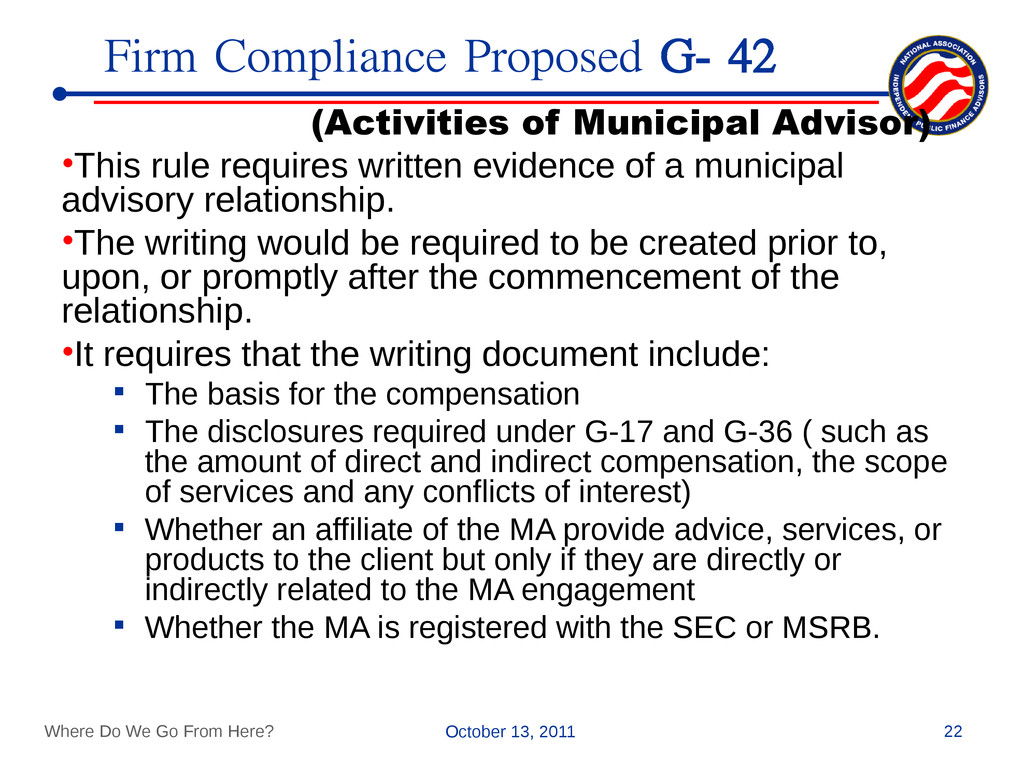
rule requires written evidence of a municipal advisory relationship. •The writing would be required to be created prior to, upon, or promptly after the commencement of the relationship. •It requires that the writing document include: The basis for the compensation The disclosures required under G-17 and G-36 ( such as the amount of direct and indirect compensation, the scope of services and any conflicts of interest) Whether an affiliate of the MA provide advice, services, or products to the client but only if they are directly or indirectly related to the MA engagement Whether the MA is registered with the SEC or MSRB. October 13, 2011 22 Where Do We Go From Here?
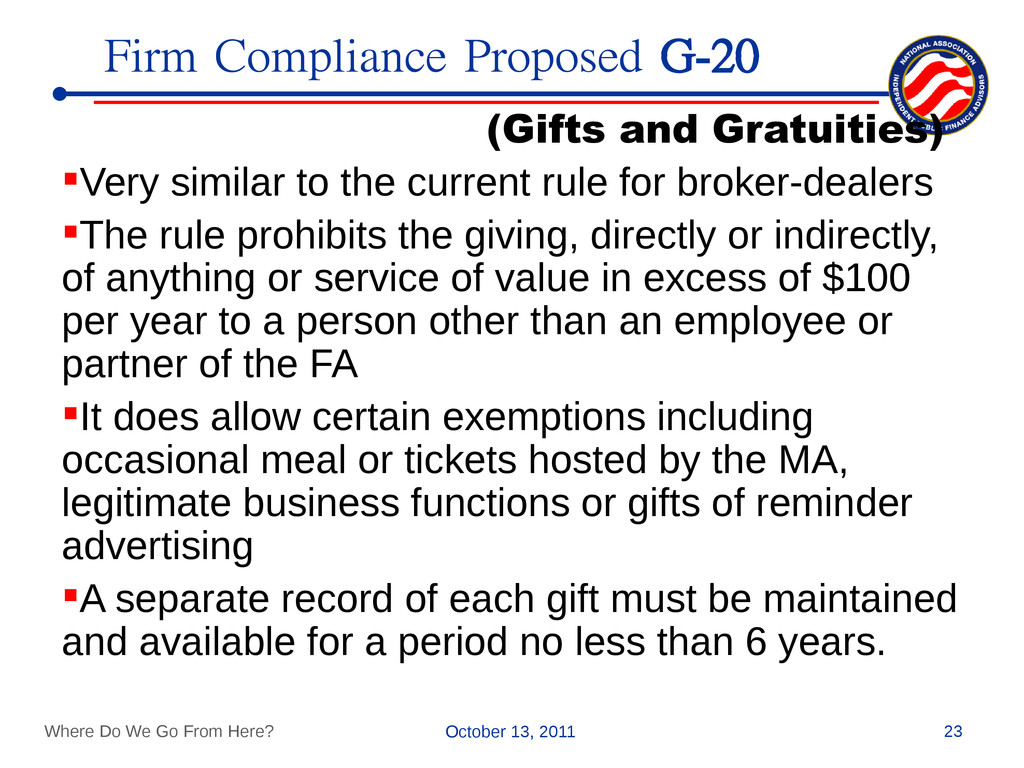
the current rule for broker-dealers The rule prohibits the giving, directly or indirectly, of anything or service of value in excess of $100 per year to a person other than an employee or partner of the FA It does allow certain exemptions including occasional meal or tickets hosted by the MA, legitimate business functions or gifts of reminder advertising A separate record of each gift must be maintained and available for a period no less than 6 years. October 13, 2011 23 Where Do We Go From Here?
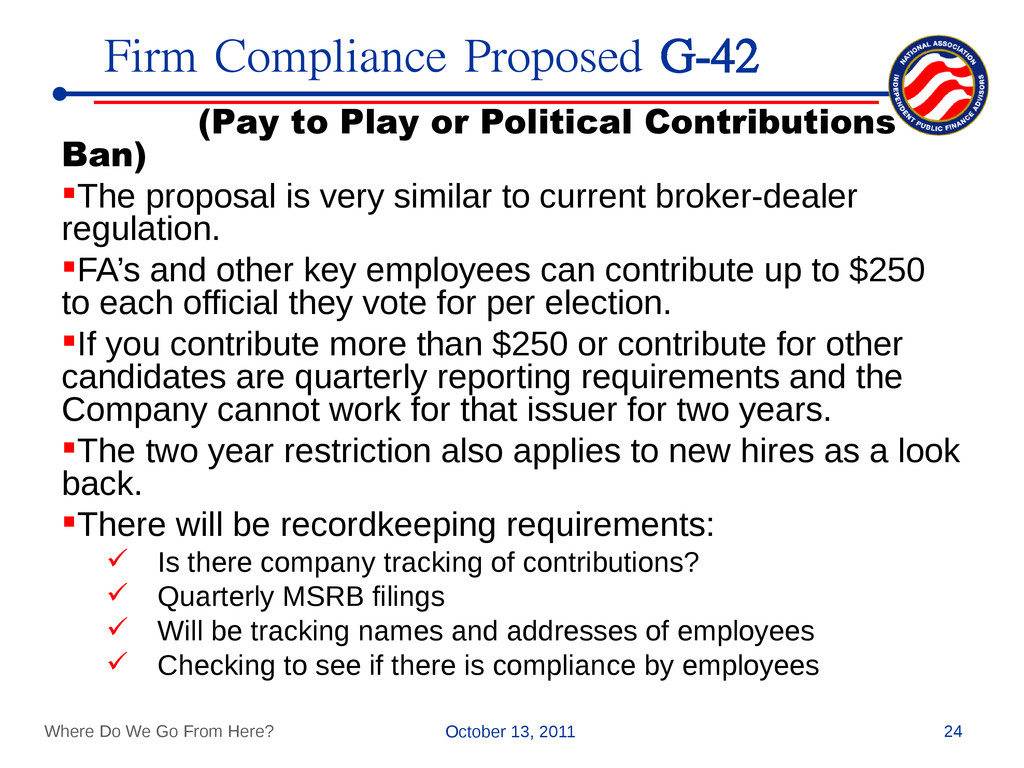
Ban) The proposal is very similar to current broker-dealer regulation. FA’s and other key employees can contribute up to $250 to each official they vote for per election. If you contribute more than $250 or contribute for other candidates are quarterly reporting requirements and the Company cannot work for that issuer for two years. The two year restriction also applies to new hires as a look back. There will be recordkeeping requirements: Is there company tracking of contributions? Quarterly MSRB filings Will be tracking names and addresses of employees Checking to see if there is compliance by employees October 13, 2011 24 Where Do We Go From Here?
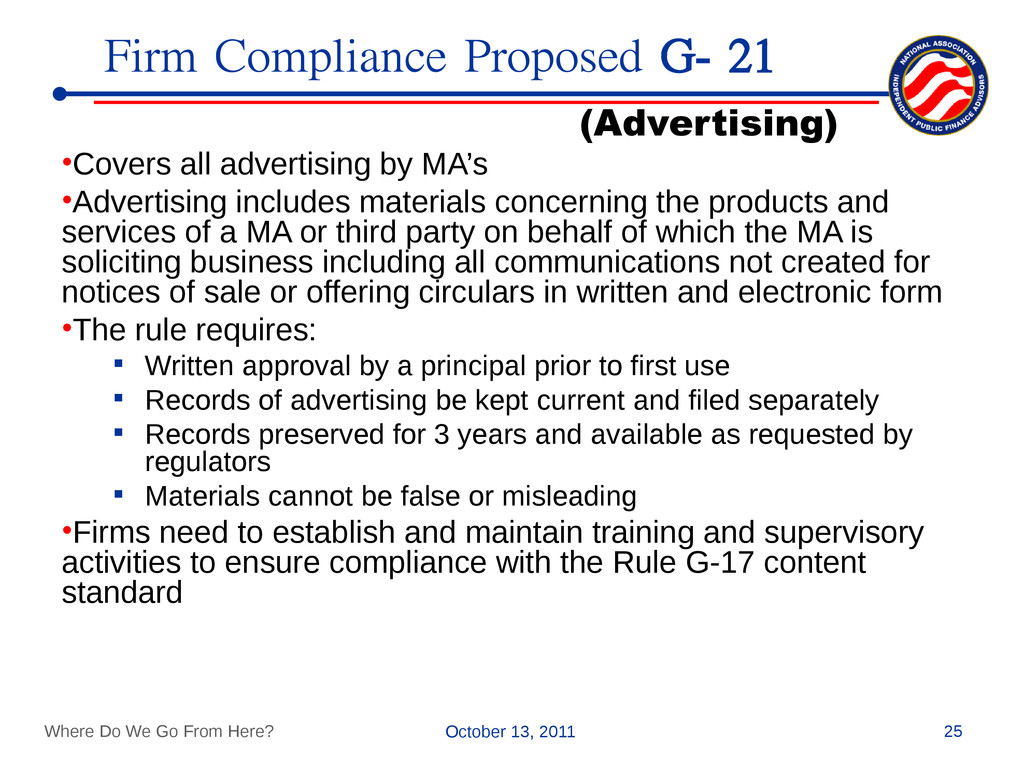
MA’s •Advertising includes materials concerning the products and services of a MA or third party on behalf of which the MA is soliciting business including all communications not created for notices of sale or offering circulars in written and electronic form •The rule requires: Written approval by a principal prior to first use Records of advertising be kept current and filed separately Records preserved for 3 years and available as requested by regulators Materials cannot be false or misleading •Firms need to establish and maintain training and supervisory activities to ensure compliance with the Rule G-17 content standard October 13, 2011 25 Where Do We Go From Here?
MA to establish and maintain a system to supervise the MA activities •Minimum requirements include: Establishing and maintaining written supervisory procedures Designating one or more MA principals Maintaining a written record of the Principals and their responsibilities Conduct annual compliance interview or meetings with municipal advisor activities of associated persons October 13, 2011 26 Where Do We Go From Here?
A) 2. Pay to Play Policy 3. Gifts and Gratuities Policy 4. Consistent Description of Services for RFP’s, Website, conference handouts, etc. that align with scope of service in contracts. October 13, 2011 27 Where Do We Go From Here?
with Sunset Provisions for each employee) a. Organization Change b. Internal Filing structure c. Procedure for SEC Application and Recordkeeping d. Procedure for MSRB Application/Fees e. Determine Best Practices including: Internal and External Policies/Guidelines. f. Prototype documents and reports related to regulated business operations 5. Compensation change to reward regulatory compliance 6. Training activities 7. Testing (last thing to worry about) October 13, 2011 28 Where Do We Go From Here?
there must be a compliance policies and procedures manual and training provided to employees. • Firms will need to decide which procedures not covered by regulation will be established and include in the manual. October 13, 2011 29 Where Do We Go From Here?
your peer group. There will be: •Certain things everyone must do •Some things everyone must do within a range •Some things smaller firms might not do •Regulators will expect more from bigger firms There are many ways to address regulatory compliance. The best solution will be one that is based on your tolerance for risk/management, past experiences and Company culture. Start Now! October 13, 2011 30 Where Do We Go From Here?
Fees • Underwriting/Broker-Dealer fees • MSRB/regulatory fees • Lawyers • BABs are gone • Proposal to tax existing tax-exempt interest • $11 billion in fees to my constituents sucked out of the local economy October 13, 2011 33 An Issuer’s Perspective
butts • Who can I trust? • Proposal to classify non-elected board members as “financial advisors” • Local Officials themselves are increasingly being targeted for regulation • After-the-fact disclosure liability • The vulture lawyers are circling October 13, 2011 34 An Issuer’s Perspective
GAO estimates 3,000 new government regulator jobs in 7 agencies • 130,000 jobs lost in the banking industry • Issuance is down, infrastructure funding suffering • Unemployment remains high October 13, 2011 35 An Issuer’s Perspective
review is not a good idea • Dodd-Frank is one of many Federal “initiatives” contributing to the economic recession • Real problems are unaddressed • We need a vibrant financial sector and local governments to have an economic recovery October 13, 2011 36 An Issuer’s Perspective
Presenter: Private Placement Regulations THIS IS FOR DISCUSSION PURPOSES ONLY AND SHOULD NOT BE CONSTRUED TO BE LEGAL ADVICE. ATTENDEES AND READERS SHOULD CONSULT THEIR LEGAL COUNSELS. MOREOVER, THESE ARE THE IMPRESSIONS OF THE PRESENTER AND NOT NECESSARILY THOSE OF THIS IS FOR DISCUSSION PURPOSES ONLY AND SHOULD NOT BE CONSTRUED TO BE LEGAL ADVICE. ATTENDEES AND READERS SHOULD CONSULT THEIR LEGAL COUNSELS. MOREOVER, THESE ARE THE IMPRESSIONS OF THE PRESENTER AND NOT NECESSARILY THOSE OF
Advisors, Private Placements and Bank Loans) raised several issues: • Bank loans may be (and most often are) considered municipal securities. • Financial Advisors could cross certain lines where certain activities and compensation arrangements associated with private placements where they were acting as brokers and be subject to SEC registration under Section 15 of the Exchange Act. Transaction-Based Compensation. Solicitation of Investors. • If a FA is deemed to be a Broker-Dealer, all SEC and MSRB rules would apply (obtaining CUSIP numbers, testing, public reporting, political contributions, transaction fees, etc.). October 13, 2011 38 Private Placement Regulations
(Potential Applicability of MSRB rules to certain “Direct Purchases” and “Bank Loans”) appears to settle some issues, at least for now. Notice 2011-52: • Reiterated the municipal security nature of most bank loans. • Again specified that registered Broker-Dealers must comply with all SEC/MSRB rules mentioned in Notice 2011-37 and Exchange Act Rule 15c2. • Municipal Advisors in rendering advice on such transactions, including restructurings, must adhere to federal fiduciary duty and fair trade standards. Some may take from this that Municipal Advisors must only adhere to federal fiduciary duty and fair trade standards. This may not be entirely correct! October 13, 2011 39 Private Placement Regulations
the only present Municipal Advisor requirements are fiduciary and fair trade standards. • Second, the SEC has yet to define who/what is a “Municipal Advisor.” • Third, the potential of FAs acting under existing regulations as a registered broker-dealer issues raised in 2011-37 appears to be the primary, and perhaps only, current regulatory focus. Their current focus appears to be centered on: Contingent and percentage compensation, and Certain solicitation activities. Notice 2011-52 puts FAs (now, by fiat, MAs) into the only MSRB regulatory pigeon hole available – Fiduciary Duty, but the broker issues predate, by a long measure, all the current Dodd-Frank regulatory initiatives. Effectively this is a regulatory punt in the first minute, if not nanosecond, of a very, very long ball game. October 13, 2011 40 Private Placement Regulations The Issue - Continued
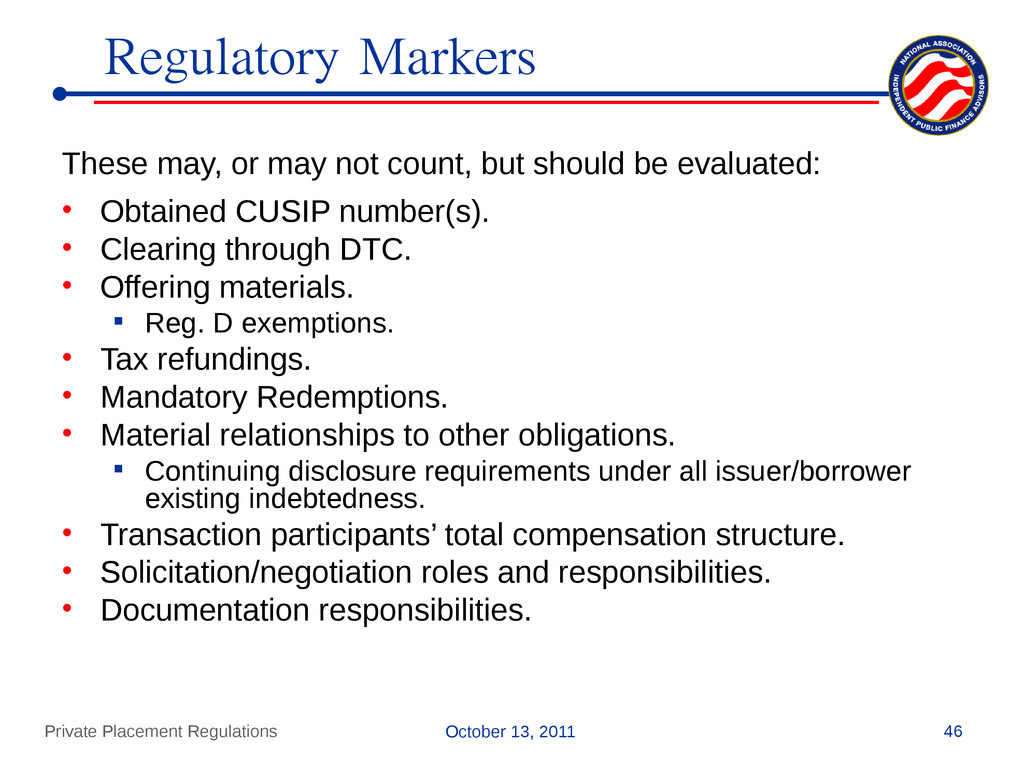
to: 1. Accelerated or ‘put’ repayment risk, and 2. Possible default or cross-default with other issuer/borrower obligations. Disclosure under the existing debt, not necessarily under the new debt. Parity debt is an important factor. Likewise, the MSRB has underscored the need for public disclosure where this situation may occur, even if continuing disclosure on the new debt is not specifically required under Exchange Act Rule 15c2- 12. The SEC will actively enforce these issues. October 13, 2011 41 Private Placement Regulations Rating and Disclosure
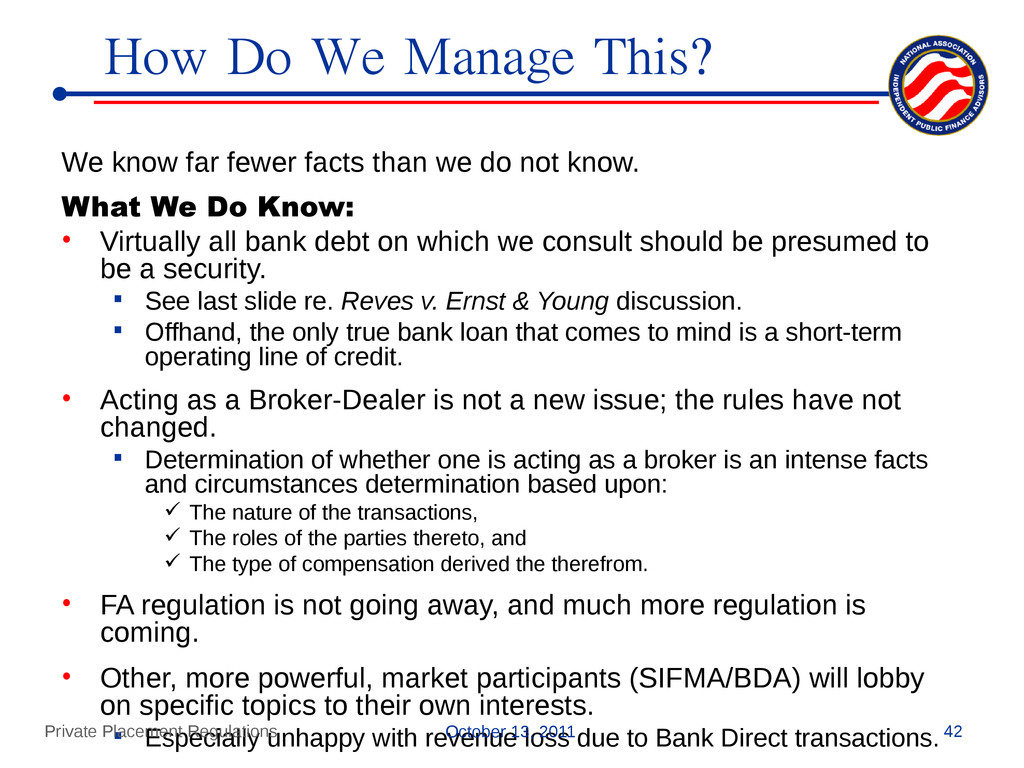
What We Do Know: • Virtually all bank debt on which we consult should be presumed to be a security. See last slide re. Reves v. Ernst & Young discussion. Offhand, the only true bank loan that comes to mind is a short-term operating line of credit. • Acting as a Broker-Dealer is not a new issue; the rules have not changed. Determination of whether one is acting as a broker is an intense facts and circumstances determination based upon: The nature of the transactions, The roles of the parties thereto, and The type of compensation derived the therefrom. • FA regulation is not going away, and much more regulation is coming. • Other, more powerful, market participants (SIFMA/BDA) will lobby on specific topics to their own interests. Especially unhappy with revenue loss due to Bank Direct transactions. October 13, 2011 42 Private Placement Regulations How Do We Manage This?
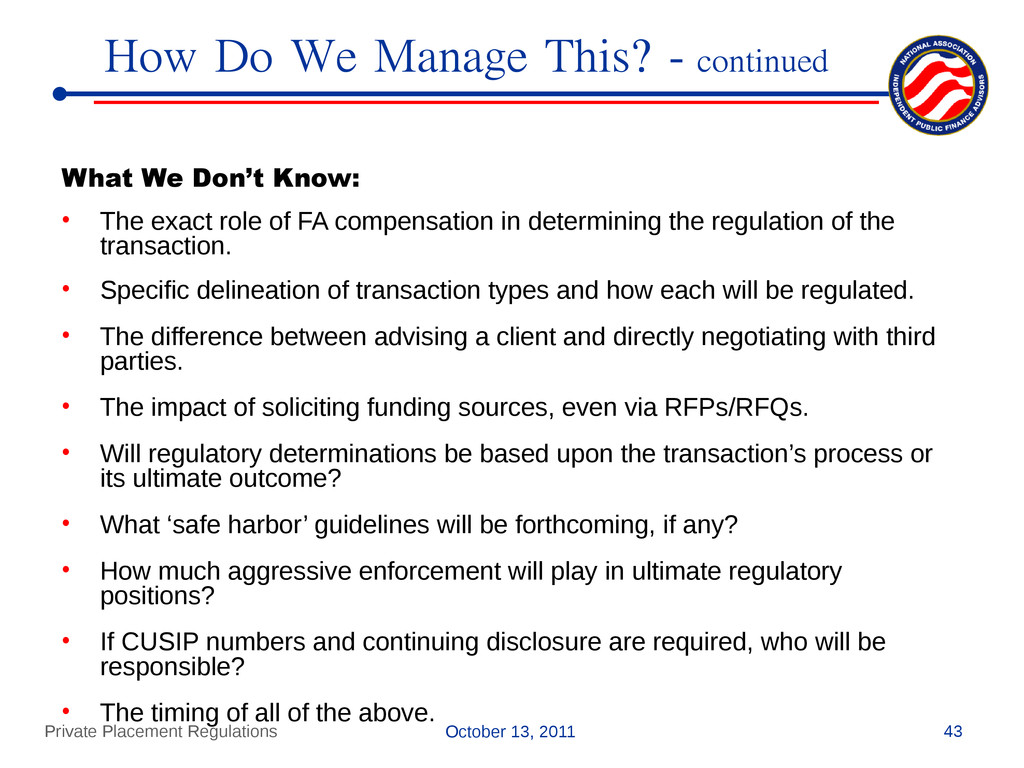
compensation in determining the regulation of the transaction. • Specific delineation of transaction types and how each will be regulated. • The difference between advising a client and directly negotiating with third parties. • The impact of soliciting funding sources, even via RFPs/RFQs. • Will regulatory determinations be based upon the transaction’s process or its ultimate outcome? • What ‘safe harbor’ guidelines will be forthcoming, if any? • How much aggressive enforcement will play in ultimate regulatory positions? • If CUSIP numbers and continuing disclosure are required, who will be responsible? • The timing of all of the above. October 13, 2011 43 Private Placement Regulations How Do We Manage This? - continued
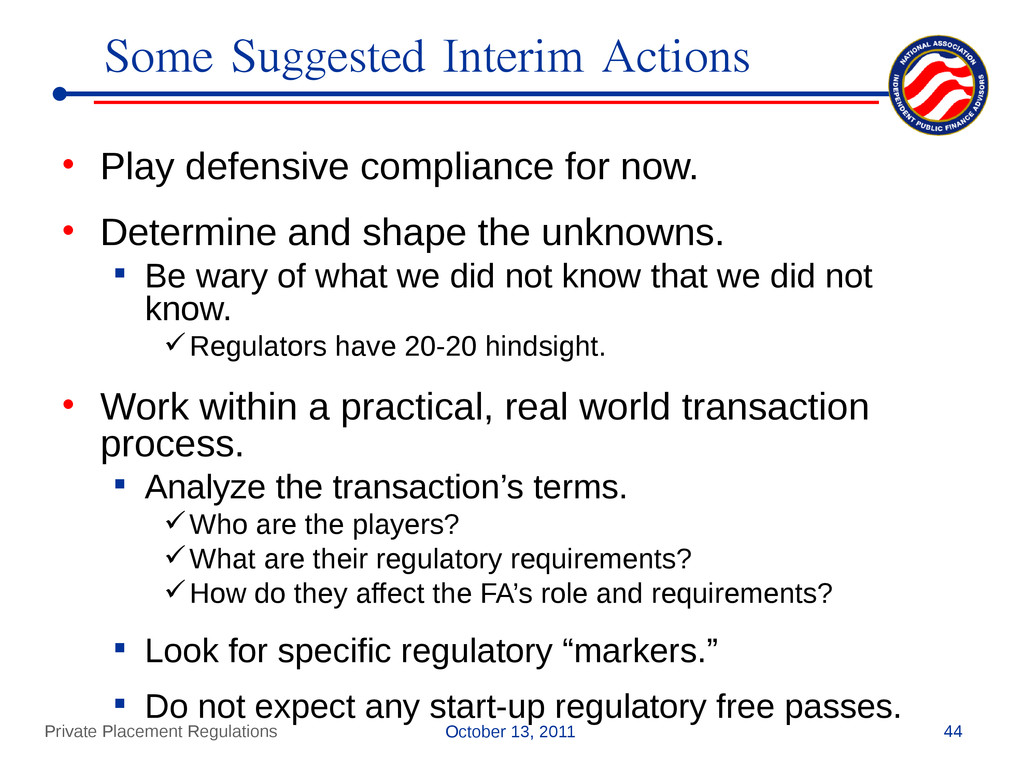
the unknowns. Be wary of what we did not know that we did not know. Regulators have 20-20 hindsight. • Work within a practical, real world transaction process. Analyze the transaction’s terms. Who are the players? What are their regulatory requirements? How do they affect the FA’s role and requirements? Look for specific regulatory “markers.” Do not expect any start-up regulatory free passes. October 13, 2011 44 Private Placement Regulations Some Suggested Interim Actions
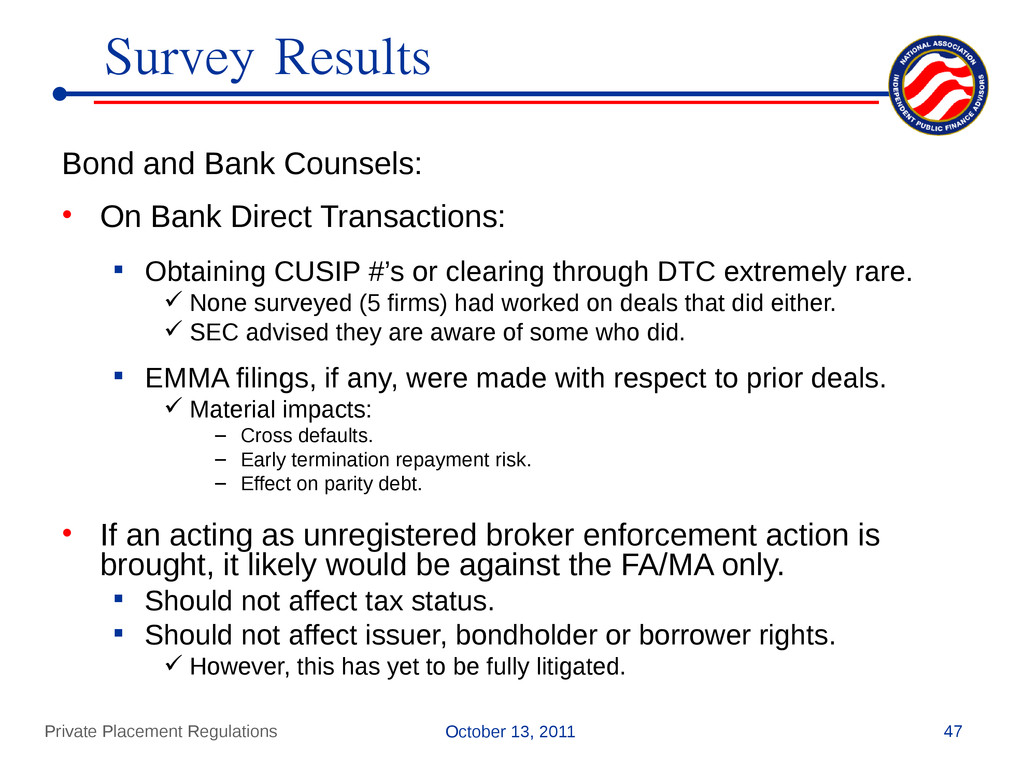
Obtaining CUSIP #’s or clearing through DTC extremely rare. None surveyed (5 firms) had worked on deals that did either. SEC advised they are aware of some who did. EMMA filings, if any, were made with respect to prior deals. Material impacts: – Cross defaults. – Early termination repayment risk. – Effect on parity debt. • If an acting as unregistered broker enforcement action is brought, it likely would be against the FA/MA only. Should not affect tax status. Should not affect issuer, bondholder or borrower rights. However, this has yet to be fully litigated. October 13, 2011 47 Private Placement Regulations Survey Results
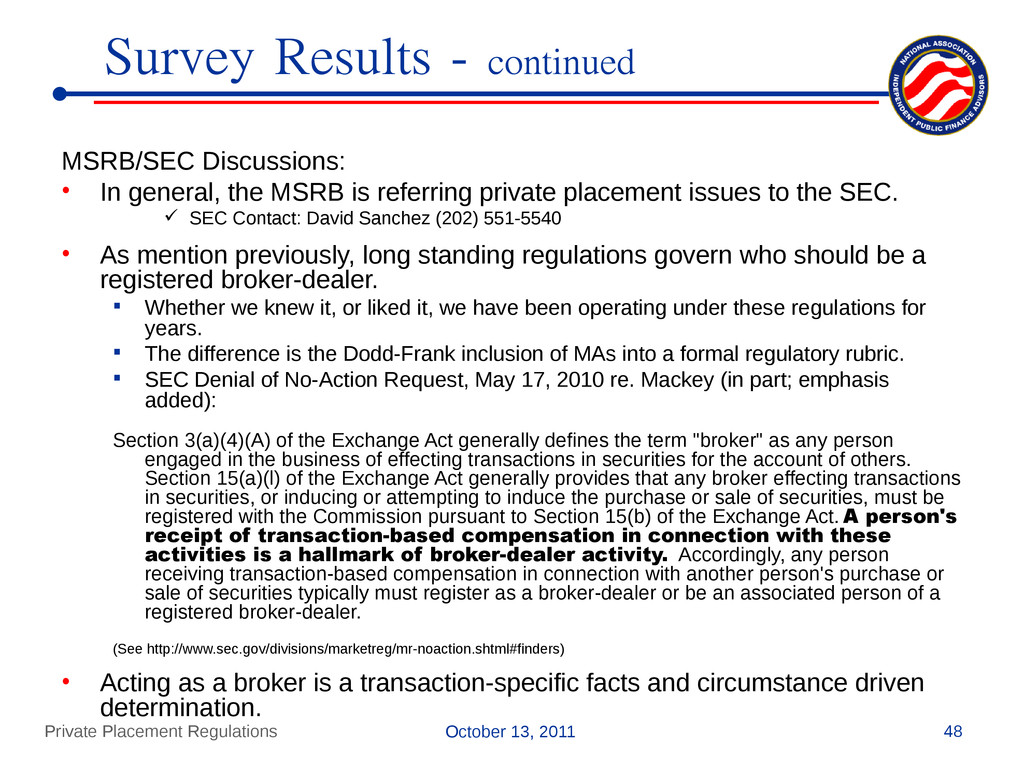
placement issues to the SEC. SEC Contact: David Sanchez (202) 551-5540 • As mention previously, long standing regulations govern who should be a registered broker-dealer. Whether we knew it, or liked it, we have been operating under these regulations for years. The difference is the Dodd-Frank inclusion of MAs into a formal regulatory rubric. SEC Denial of No-Action Request, May 17, 2010 re. Mackey (in part; emphasis added): Section 3(a)(4)(A) of the Exchange Act generally defines the term "broker" as any person engaged in the business of effecting transactions in securities for the account of others. Section 15(a)(l) of the Exchange Act generally provides that any broker effecting transactions in securities, or inducing or attempting to induce the purchase or sale of securities, must be registered with the Commission pursuant to Section 15(b) of the Exchange Act. A person's receipt of transaction-based compensation in connection with these activities is a hallmark of broker-dealer activity. Accordingly, any person receiving transaction-based compensation in connection with another person's purchase or sale of securities typically must register as a broker-dealer or be an associated person of a registered broker-dealer. (See http://www.sec.gov/divisions/marketreg/mr-noaction.shtml#finders) • Acting as a broker is a transaction-specific facts and circumstance driven determination. October 13, 2011 48 Private Placement Regulations Survey Results - continued
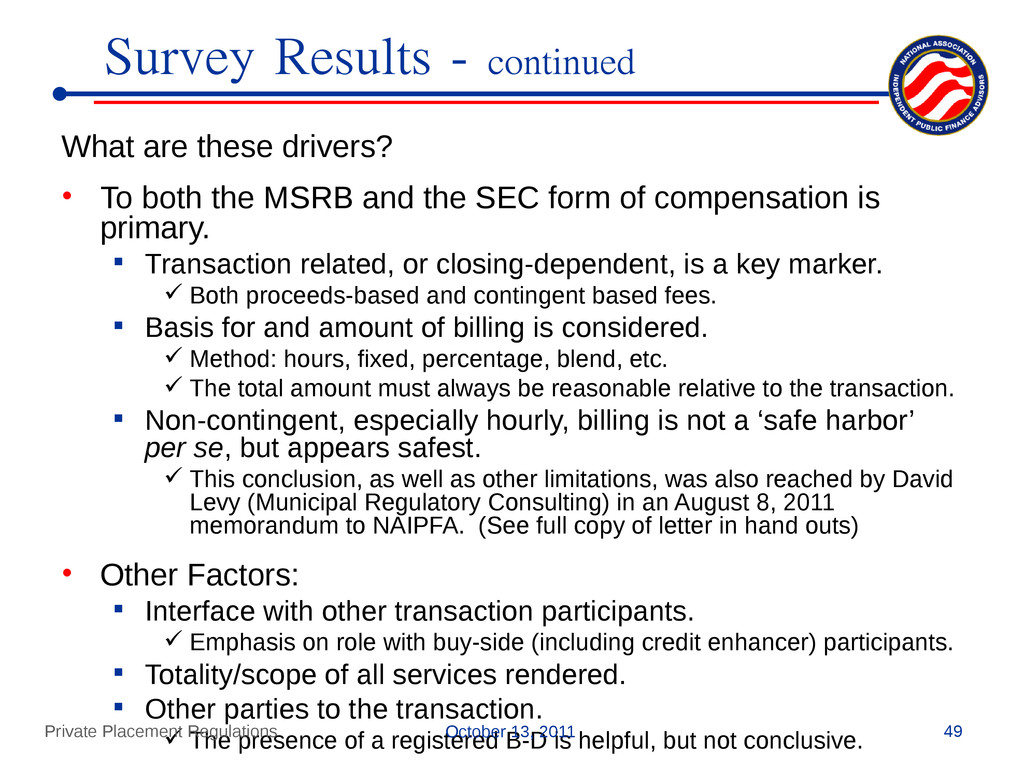
the SEC form of compensation is primary. Transaction related, or closing-dependent, is a key marker. Both proceeds-based and contingent based fees. Basis for and amount of billing is considered. Method: hours, fixed, percentage, blend, etc. The total amount must always be reasonable relative to the transaction. Non-contingent, especially hourly, billing is not a ‘safe harbor’ per se, but appears safest. This conclusion, as well as other limitations, was also reached by David Levy (Municipal Regulatory Consulting) in an August 8, 2011 memorandum to NAIPFA. (See full copy of letter in hand outs) • Other Factors: Interface with other transaction participants. Emphasis on role with buy-side (including credit enhancer) participants. Totality/scope of all services rendered. Other parties to the transaction. The presence of a registered B-D is helpful, but not conclusive. October 13, 2011 49 Private Placement Regulations Survey Results - continued
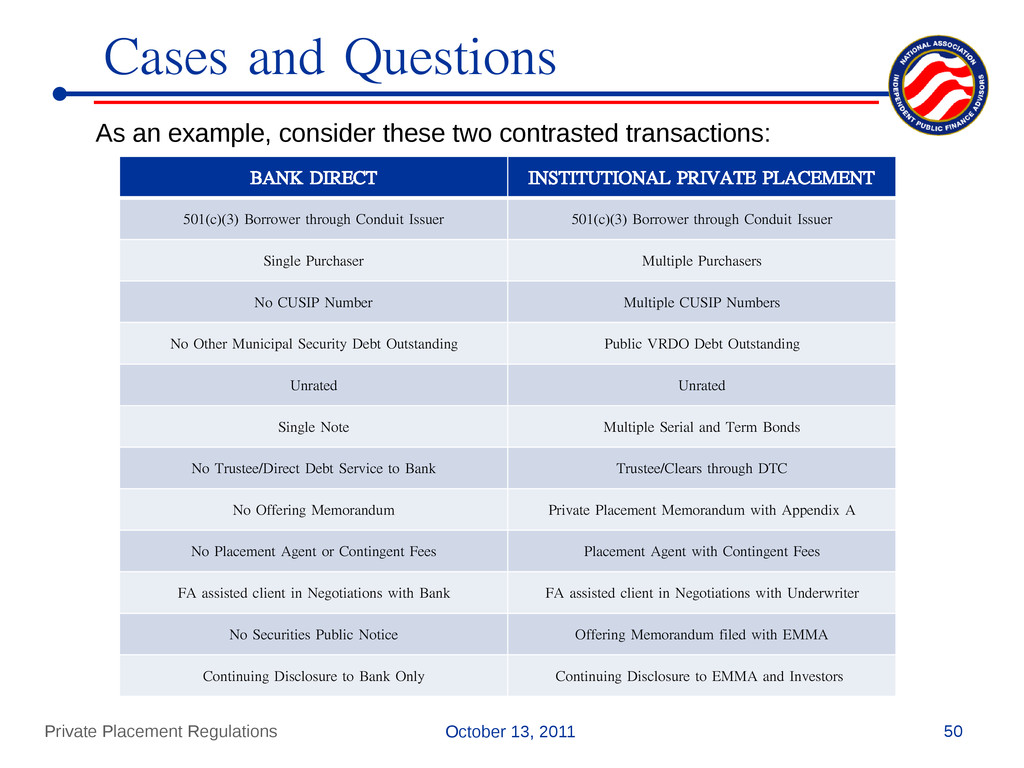
Borrower through Conduit Issuer 501(c)(3) Borrower through Conduit Issuer Single Purchaser Multiple Purchasers No CUSIP Number Multiple CUSIP Numbers No Other Municipal Security Debt Outstanding Public VRDO Debt Outstanding Unrated Unrated Single Note Multiple Serial and Term Bonds No Trustee/Direct Debt Service to Bank Trustee/Clears through DTC No Offering Memorandum Private Placement Memorandum with Appendix A No Placement Agent or Contingent Fees Placement Agent with Contingent Fees FA assisted client in Negotiations with Bank FA assisted client in Negotiations with Underwriter No Securities Public Notice Offering Memorandum filed with EMMA Continuing Disclosure to Bank Only Continuing Disclosure to EMMA and Investors As an example, consider these two contrasted transactions: Private Placement Regulations Cases and Questions
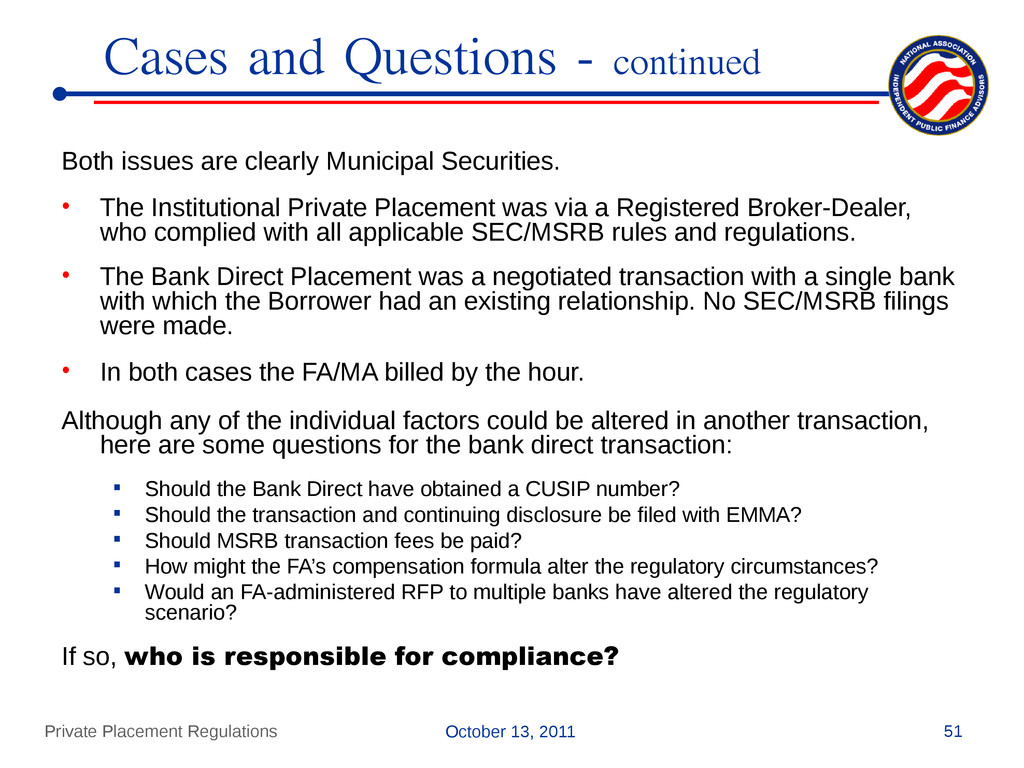
Placement was via a Registered Broker-Dealer, who complied with all applicable SEC/MSRB rules and regulations. • The Bank Direct Placement was a negotiated transaction with a single bank with which the Borrower had an existing relationship. No SEC/MSRB filings were made. • In both cases the FA/MA billed by the hour. Although any of the individual factors could be altered in another transaction, here are some questions for the bank direct transaction: Should the Bank Direct have obtained a CUSIP number? Should the transaction and continuing disclosure be filed with EMMA? Should MSRB transaction fees be paid? How might the FA’s compensation formula alter the regulatory circumstances? Would an FA-administered RFP to multiple banks have altered the regulatory scenario? If so, who is responsible for compliance? October 13, 2011 51 Private Placement Regulations Cases and Questions - continued
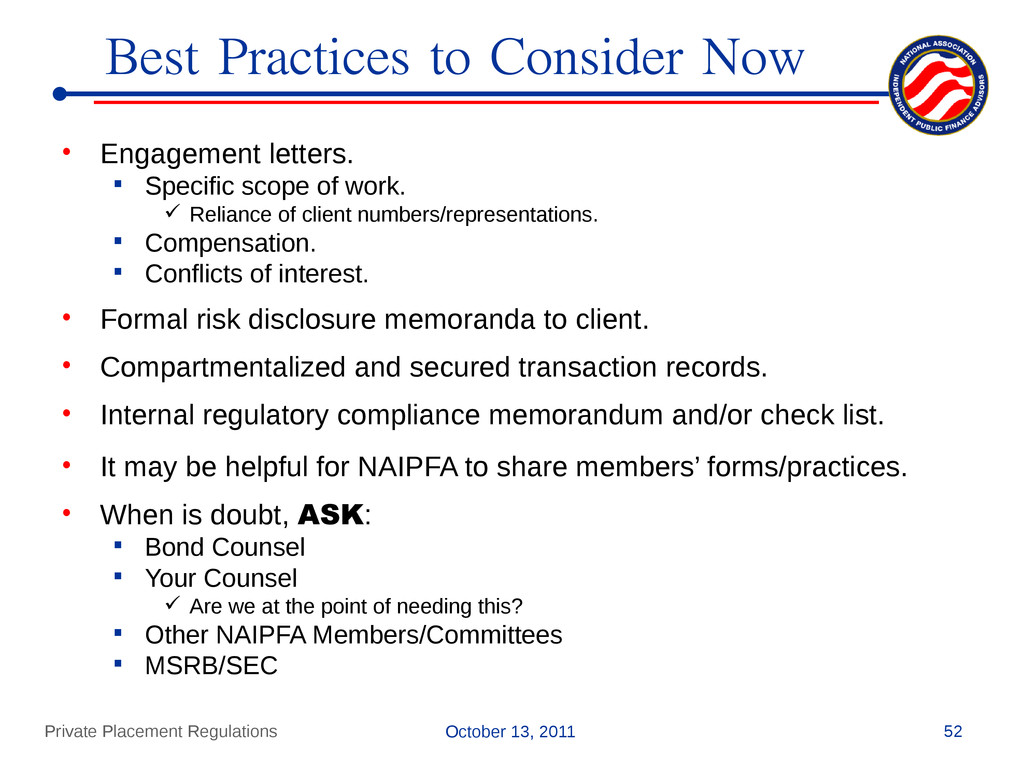
of client numbers/representations. Compensation. Conflicts of interest. • Formal risk disclosure memoranda to client. • Compartmentalized and secured transaction records. • Internal regulatory compliance memorandum and/or check list. • It may be helpful for NAIPFA to share members’ forms/practices. • When is doubt, ASK: Bond Counsel Your Counsel Are we at the point of needing this? Other NAIPFA Members/Committees MSRB/SEC October 13, 2011 52 Private Placement Regulations Best Practices to Consider Now
SEC is muni Broker-Dealer centric because that is their primary (and historical) link into the municipal market. Remember, while the MSRB is charged with promulgating MA rules, the SEC will enforce those rules. Of course, the SEC must also approve all MSRB rules. The extent of SEC involvement is undecided, but will likely grow. • While many rules are in process, we must currently live with: Fiduciary/fair trade duties, and Existing B-D based private placement regulations. Sadly, regulations will be written/enforced for the worst practices in our industry. MAs should assess each transaction’s regulatory risk. • Whatever we do, we must present ourselves as professionals. Remember, staff at the MSRB and SEC did not create these issues. Facing huge lobbying efforts by others, we don’t need to make enemies. October 13, 2011 53 Private Placement Regulations Ending Impressions (of the moment)
should be a NAIPFA focus, ideally in concert with other issuer groups such as GFOA. Seek exemptions, safe harbor markers and/or no-action letters. MAs should focus on specific/defined issues. viz: If MA fees are clearly non-transaction based (hourly, fixed), then (insert issue), or If a B-D is involved, MA fees may be based upon (insert issue). Although this is crafted from a defensive posture, there exists the possibility for enormous positional marketing gains. B-Ds must now state their conflicts. Consider what SARBOX did for auditors. – Smart FAs will look for the ade (aid) to the lemon(s). OTHER MARKET PARTICIPANTS ARE! • The present alternatives are decidedly not attractive to many members: Register as a Broker-Dealer, Adopt a non-transactional fee structure (perhaps both percentage and contingent) AND restrict certain third party contacts, or Accept the possibility at some level of enforcement action. At present, and absent leadership, we will be confronted with a long process of establishing limitations via regulatory enforcement actions. The SEC does not have a history of strong enforcement ‘warnings.’ They act. October 13, 2011 54 Private Placement Regulations Ending Impressions - continued
Apfelbacher, NAIPFA re. Broker-Dealer Registration Issues • MSRB NOTICE 2011-37 (AUGUST 3, 2011) FINANCIAL ADVISORS, PRIVATE PLACEMENTS, AND BANK LOANS • MSRB NOTICE 2011-52 (SEPTEMBER 12, 2011) POTENTIAL APPLICABILITY OF MSRB RULES TO CERTAIN “DIRECT PURCHASES” AND “BANK LOANS” If not available at the session. They will later be available at the NAIPFA website. October 13, 2011 55 Private Placement Regulations Hand Outs
Presumption that (all) notes are securities. • "Family resemblance" test for determining whether notes are NOT securities. • This presumption may be overcome if the notes have a strong resemblance to certain types of notes recognized as being outside the investment market regulated under the securities laws. • The Supreme Court believed that the following notes are not securities: the note delivered in consumer financing; the note secured by a mortgage on a home; the short-term note secured by a lien on a small business or some of its assets; the note evidencing a character loan to a bank customer; the short-term note secured by an assignment of accounts receivable; the note that simply formalizes an open-account debt incurred in the ordinary course of business; and the note evidencing a loan by a commercial bank for current operations. • The four factors to consider in determining whether the notes are not securities are: 1. the motivations that would prompt a reasonable borrower and lender to enter into the transaction; 2. the plan of distributing the notes; 3. the reasonable expectations of the investing public regarding whether the instruments were securities; and 4. the presence of any alternative scheme of regulation or other factor that significantly reduces the risk of the instrument so as to make regulation under the securities laws unnecessary. October 13, 2011 56 Private Placement Regulations


 codingconduct
 jct
 axbom
 kimpetersen
 kristinabergwall1
 techseoconnect
 aleyda
 jmmastey
 denniskardys
 tessaabrams