to create the layout and color schemes of our website. This made it simple to convert the theme into easily usable CSS for our pages. Also, in Phase 1 we started with React from the very beginning. While it took us a little longer to complete Phase 1, the time saved on the other phases easily made up for it. For backend, when we created models for the database, we chose attributes that seemed most useful for users. This made our RESTful APIs to be simpler and cleaner than the original APIs but still have enough information for users to look at.
a plethora of tools including but not limited to Bootstrap 5, React, and Adobe XD. Using React, we learned how to abstract the logic from the code along with proper utilization of properties and states. From there we learned how to create responsive website design for users with different screen sizes like mobile users. By using Postman, we learned how to send a request to APIs and how to create an API documentation for our RESTful API. We also learned how to create models for the database and how to populate data on the database based on the models that we created.
have done better on the over all project planning and API selections. We created a plan with the assumption of attributes we would be using, but that led to complications later when it came to adoption images. We had to change our attributes last minute from an expected adoption image to a status if the animal was currently up for adoption or not. Slightly better time management would have saved some stress as well. For the attributes like life span or weights, we could use integer types instead of string, so that the sorting could be easier and more accurate.
dedicated front end and back end teams, there was not a large amount of cross team experience. As a result from that, there is still come confusion on more abstract concepts like how the two ends communicate and how to write the React code to automatically produce a new Card class with the correct properties set per JSON request. This was much different than the set amount of hard coded examples we needed in the first phase. Namecheap was a bit confusing to get setup, including redirecting our custom domain to the EC2 IP address.
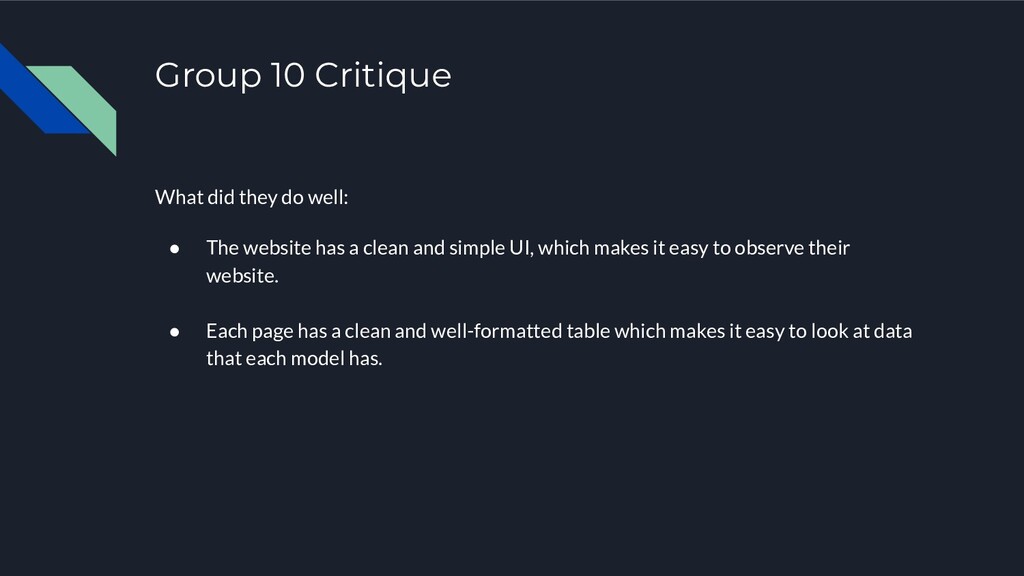
website has a clean and simple UI, which makes it easy to observe their website. • Each page has a clean and well-formatted table which makes it easy to look at data that each model has.
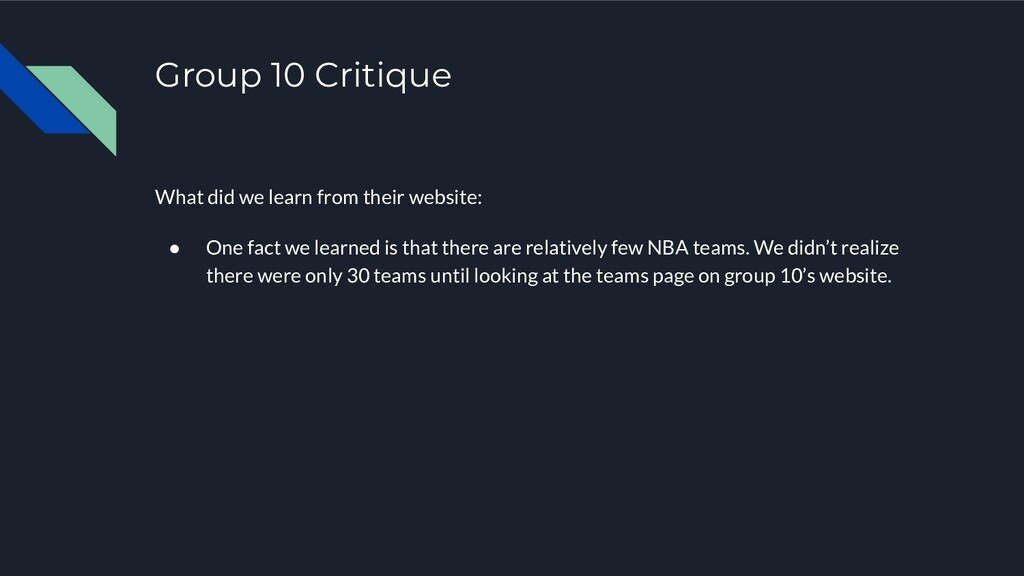
• One fact we learned is that there are relatively few NBA teams. We didn’t realize there were only 30 teams until looking at the teams page on group 10’s website.
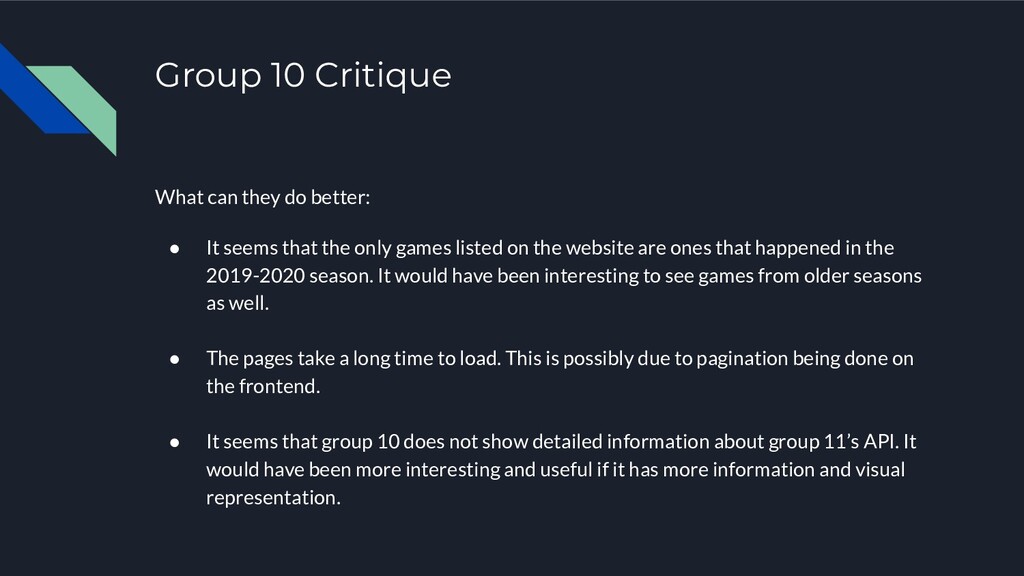
seems that the only games listed on the website are ones that happened in the 2019-2020 season. It would have been interesting to see games from older seasons as well. • The pages take a long time to load. This is possibly due to pagination being done on the frontend. • It seems that group 10 does not show detailed information about group 11’s API. It would have been more interesting and useful if it has more information and visual representation.
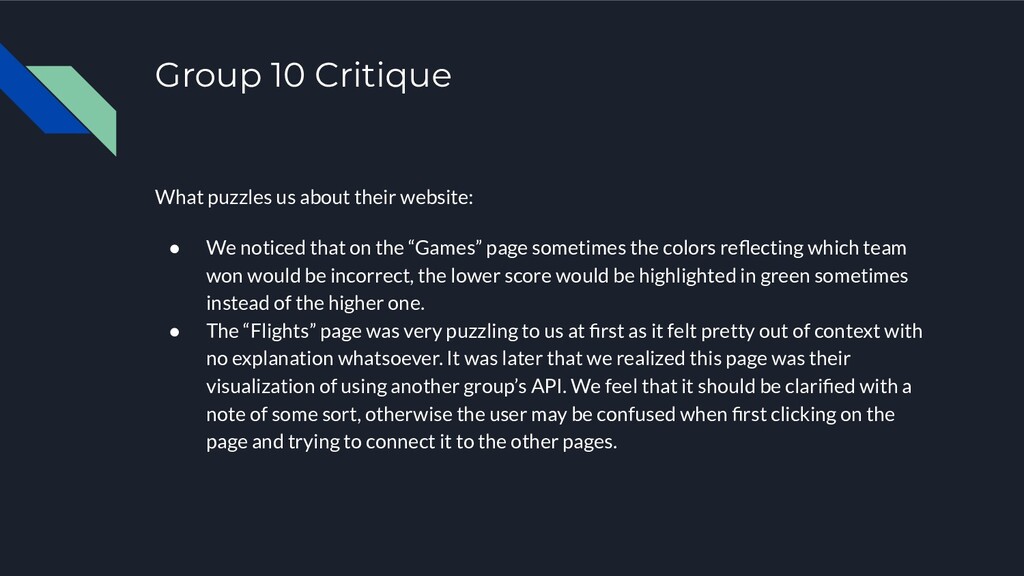
We noticed that on the “Games” page sometimes the colors reflecting which team won would be incorrect, the lower score would be highlighted in green sometimes instead of the higher one. • The “Flights” page was very puzzling to us at first as it felt pretty out of context with no explanation whatsoever. It was later that we realized this page was their visualization of using another group’s API. We feel that it should be clarified with a note of some sort, otherwise the user may be confused when first clicking on the page and trying to connect it to the other pages.


 marcoroth
 kaityo256
 satoshi256kbyte
 sorah
 artoy
 texmeijin
 nabondance
 yuta_onishi_97
 akihisaikeda
 deka_morita
 moro
 akase244
 scottboms
 charlesmeaden
 techseoconnect
 rocio
 eileencodes
 tapps
 rkendrick25
 eitanlees
 speakerdeck
 tanoku
 geshan