Upgrade to Pro — share decks privately, control downloads, hide ads and more …

Getting The Most Out Of CSP: a Deep Dive

Sponsored · Ship Features Fearlessly Turn features on and off without deploys. Used by thousands of Ruby developers. →

Getting The Most Out Of CSP: a Deep Dive

Content Security Policy is used to declare web resource content restrictions. It prevents exploitation by cross-site scripting (XSS) and related attacks. This presentation will explore challenges of creating and deploying a policy, how reporting might be abused, and deviations between the specification and implementations. You will also learn about tools to help create and verify the efficacy of your CSP.

Avatar for Sergey Shekyan

Sergey Shekyan

November 01, 2015

More Decks by Sergey Shekyan

Other Decks in Technology

Transcript

  1. Canadian Staging Professionals (CSP) •  CSP® Home Staging CerFficaFon Course

    Is Simply The Best EducaFon and Support For Your New Career •  Mastering the Art of Difficult ConversaFons with Sellers •  Chemicals Hiding In Plain Sight •  Environmentally Responsible Home Design and Remodeling
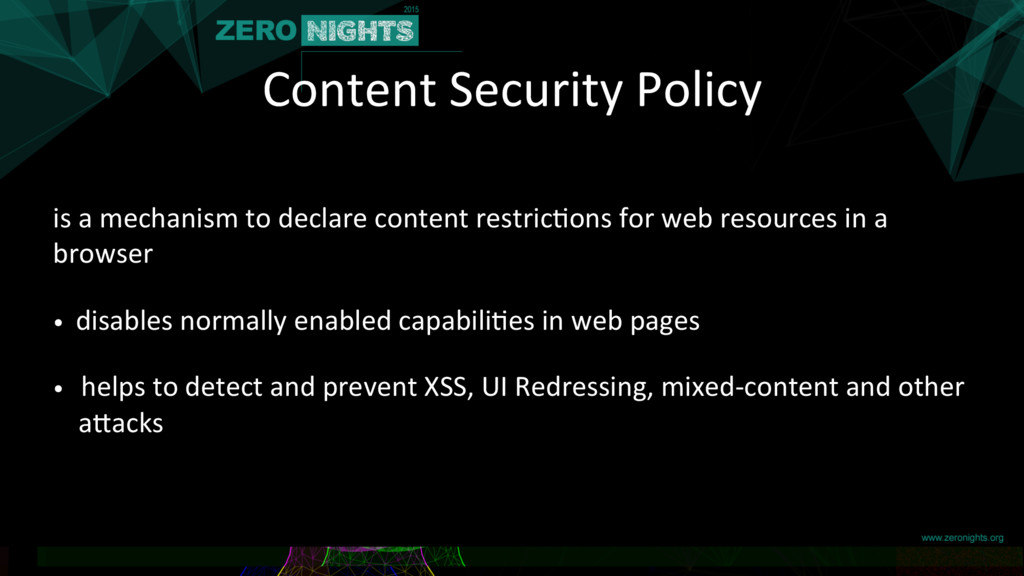
  2. is a mechanism to declare content restricFons for web resources

    in a browser •  disables normally enabled capabiliFes in web pages •  helps to detect and prevent XSS, UI Redressing, mixed-content and other aXacks Content Security Policy
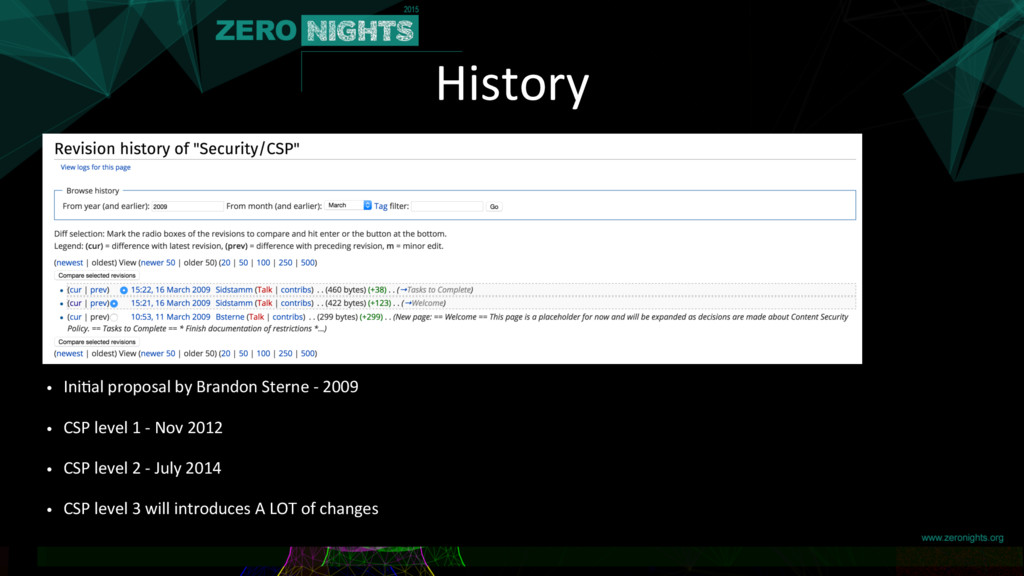
  3. History •  IniFal proposal by Brandon Sterne - 2009 • 

    CSP level 1 - Nov 2012 •  CSP level 2 - July 2014 •  CSP level 3 will introduces A LOT of changes
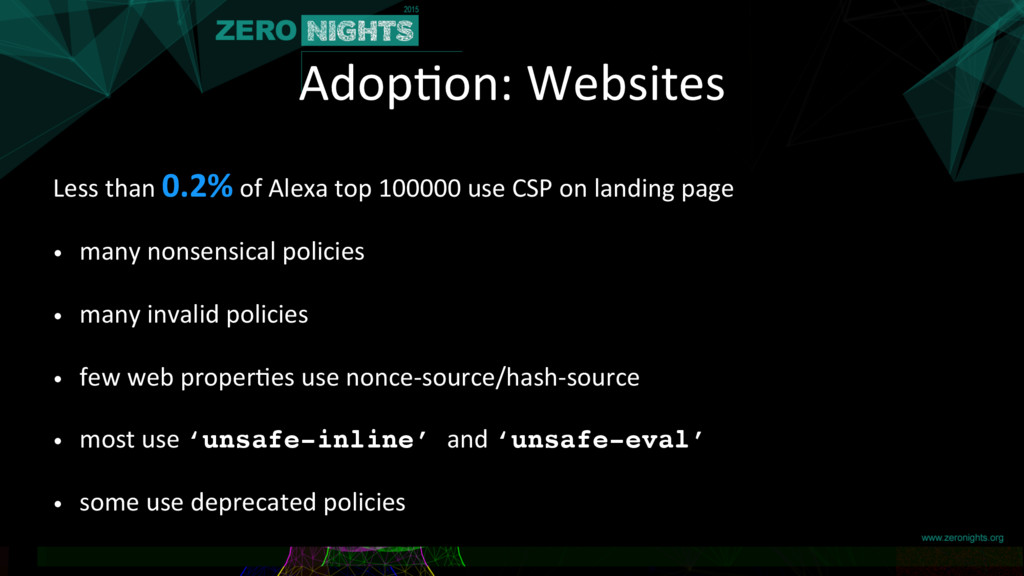
  4. AdopFon: Websites Less than 0.2% of Alexa top 100000 use

    CSP on landing page •  many nonsensical policies •  many invalid policies •  few web properFes use nonce-source/hash-source •  most use ‘unsafe-inline’ and ‘unsafe-eval’ •  some use deprecated policies
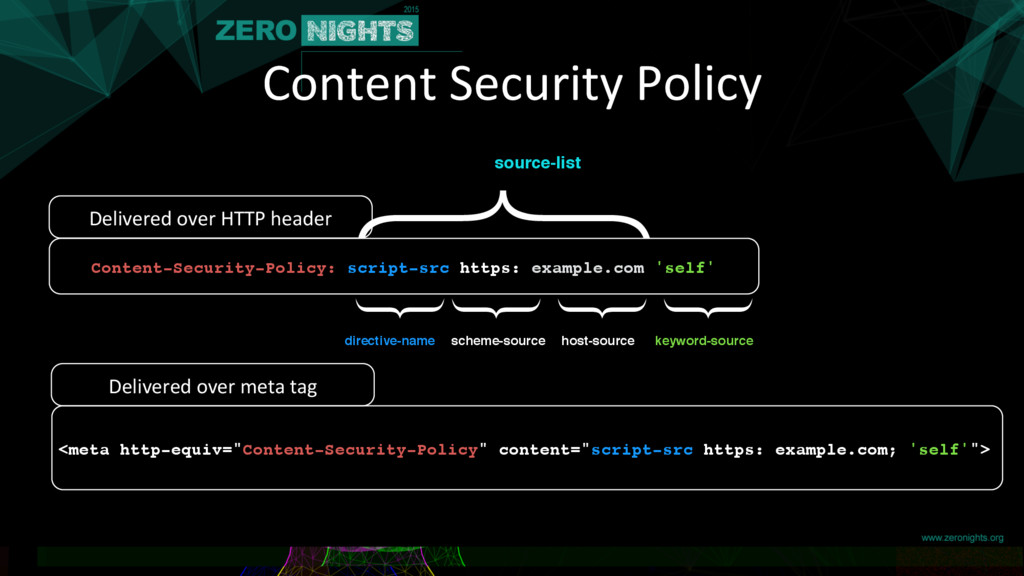
  5. { Content Security Policy { directive-name { { { scheme-source

    host-source keyword-source Content-Security-Policy: script-src https: example.com 'self' source-list <meta http-equiv="Content-Security-Policy" content="script-src https: example.com; 'self'"> Delivered over HTTP header Delivered over meta tag
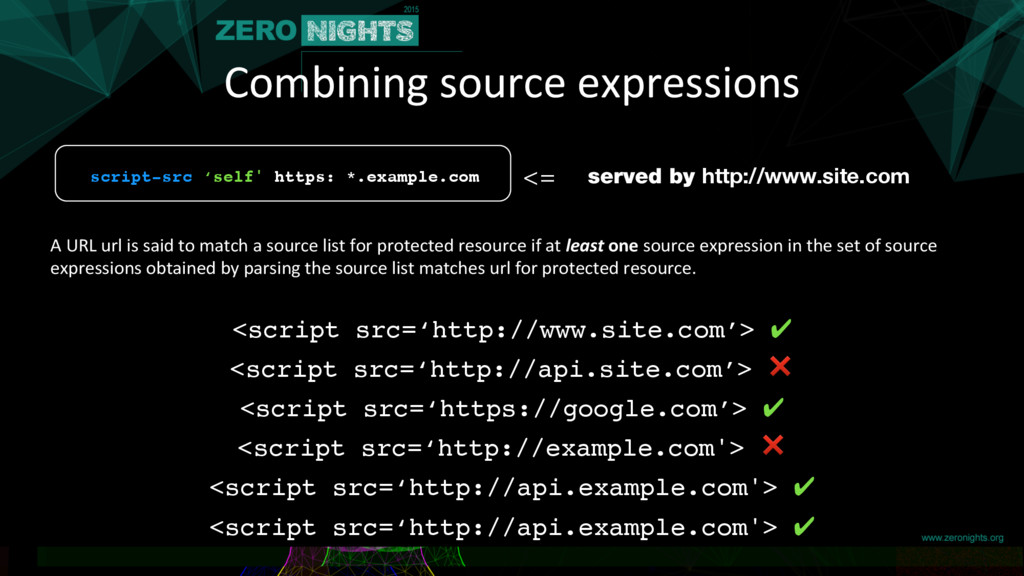
  6. Combining source expressions script-src ‘self' https: *.example.com A URL url

    is said to match a source list for protected resource if at least one source expression in the set of source expressions obtained by parsing the source list matches url for protected resource. <script src=‘http://www.site.com’> ✔ served by http://www.site.com <script src=‘http://example.com'> ❌ <script src=‘http://api.example.com'> ✔ <script src=‘https://google.com’> ✔ <script src=‘http://api.example.com'> ✔ <= <script src=‘http://api.site.com’> ❌
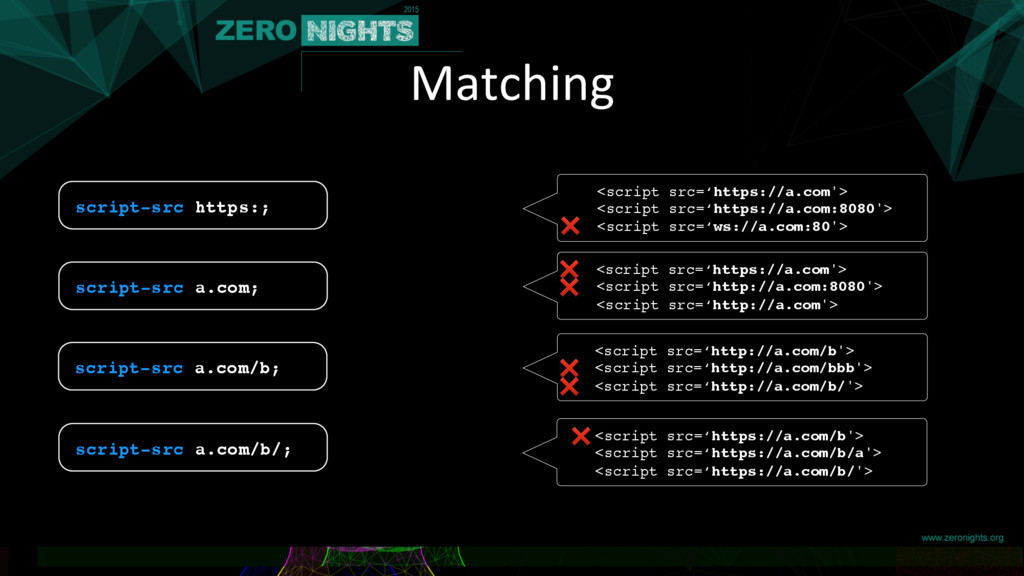
  7. Matching script-src https:; <script src=‘https://a.com'> <script src=‘https://a.com:8080'> <script src=‘ws://a.com:80'> ❌

    script-src a.com; <script src=‘https://a.com'> <script src=‘http://a.com:8080'> <script src=‘http://a.com'> script-src a.com/b; <script src=‘http://a.com/b'> <script src=‘http://a.com/bbb'> <script src=‘http://a.com/b/'> script-src a.com/b/; <script src=‘https://a.com/b'> <script src=‘https://a.com/b/a'> <script src=‘https://a.com/b/'> ❌ ❌ ❌ ❌ ❌
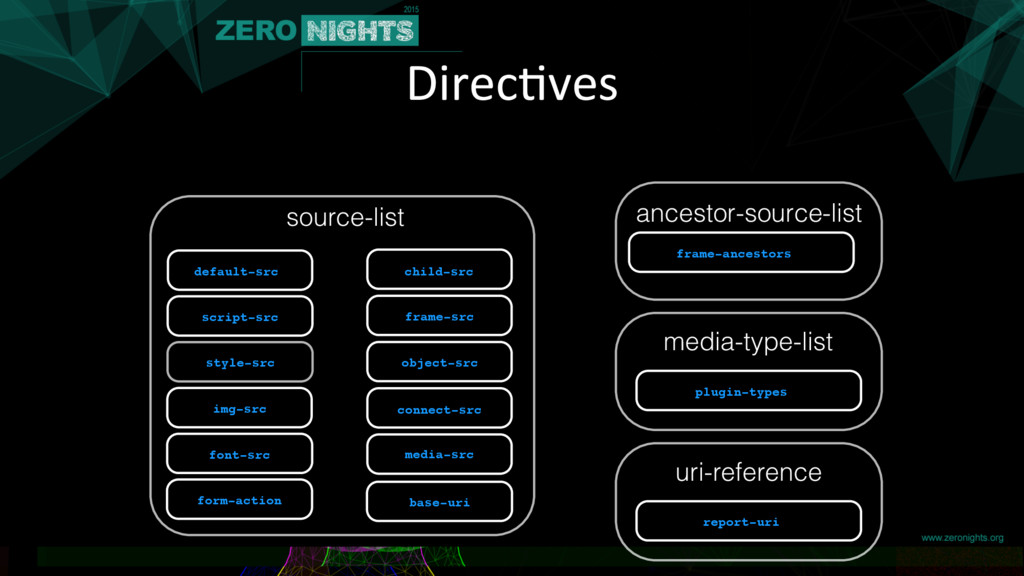
  8. DirecFves img-src font-src child-src frame-src object-src connect-src media-src style-src script-src

    default-src source-list frame-ancestors ancestor-source-list form-action base-uri plugin-types media-type-list report-uri uri-reference
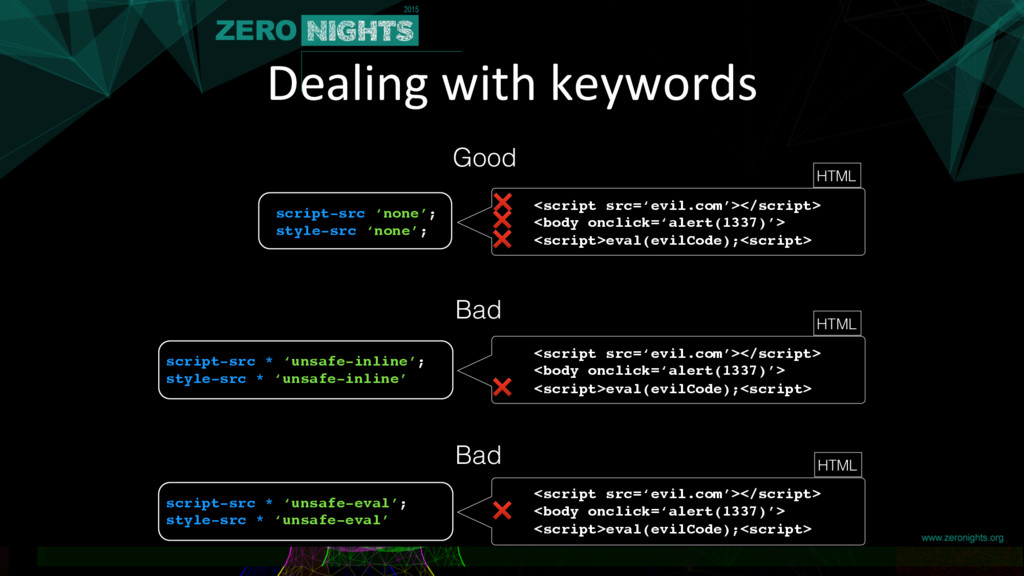
  9. Dealing with keywords script-src * ‘unsafe-eval’; style-src * ‘unsafe-eval’ script-src

    * ‘unsafe-inline’; style-src * ‘unsafe-inline’ Bad Bad script-src ‘none’; style-src ‘none’; <script src=‘evil.com’></script> <body onclick=‘alert(1337)’> <script>eval(evilCode);<script> HTML Good ❌ ❌ ❌ HTML <script src=‘evil.com’></script> <body onclick=‘alert(1337)’> <script>eval(evilCode);<script> HTML <script src=‘evil.com’></script> <body onclick=‘alert(1337)’> <script>eval(evilCode);<script> ❌ ❌
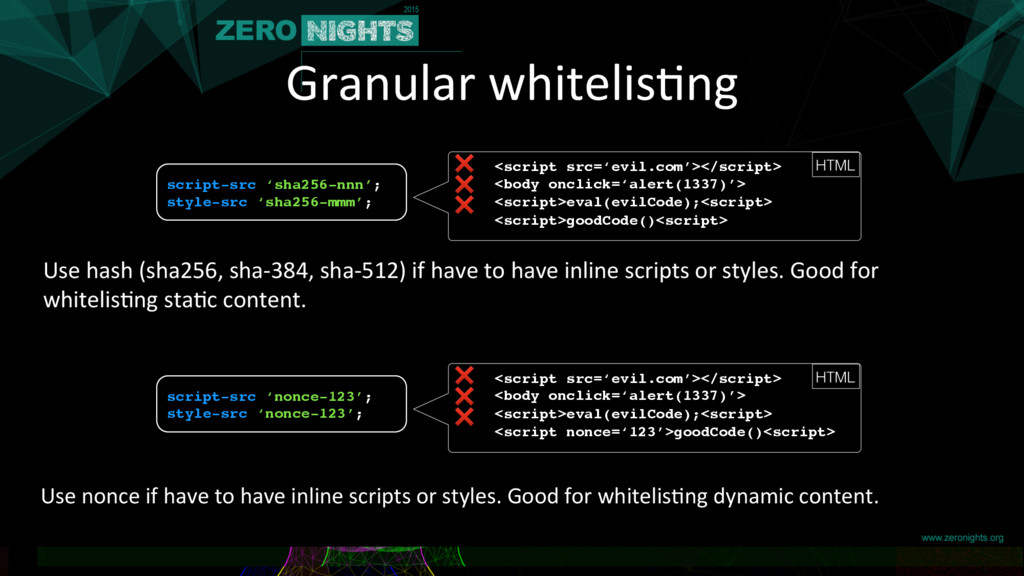
  10. Granular whitelisFng script-src ‘nonce-123’; style-src ‘nonce-123’; <script src=‘evil.com’></script> <body onclick=‘alert(1337)’>

    <script>eval(evilCode);<script> <script nonce=‘123’>goodCode()<script> HTML Use nonce if have to have inline scripts or styles. Good for whitelisFng dynamic content. script-src ‘sha256-nnn’; style-src ‘sha256-mmm’; <script src=‘evil.com’></script> <body onclick=‘alert(1337)’> <script>eval(evilCode);<script> <script>goodCode()<script> HTML Use hash (sha256, sha-384, sha-512) if have to have inline scripts or styles. Good for whitelisFng staFc content. ❌ ❌ ❌ ❌ ❌ ❌
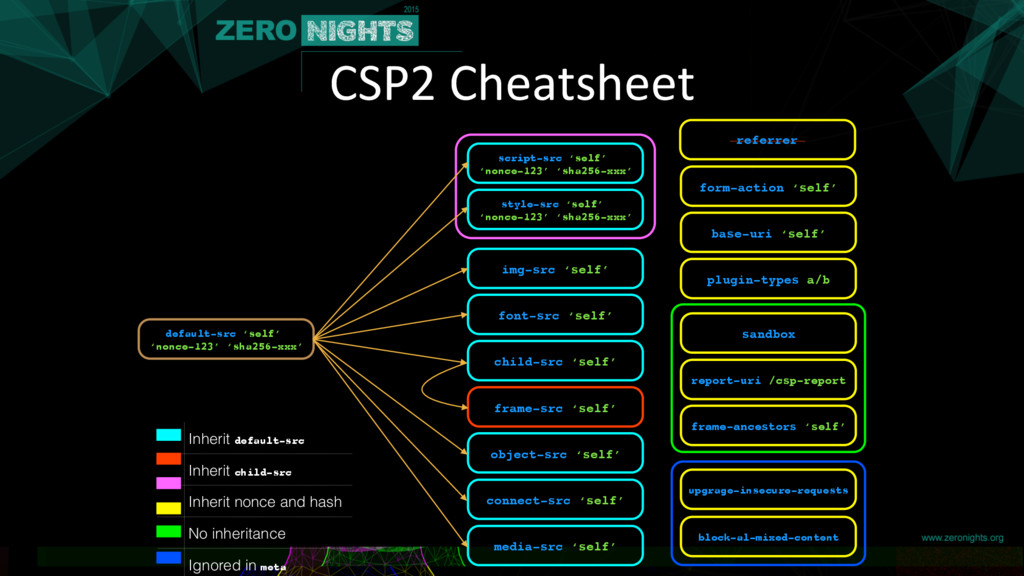
  11. CSP2 Cheatsheet default-src ‘self’ ‘nonce-123’ ‘sha256-xxx’ style-src ‘self’ ‘nonce-123’ ‘sha256-xxx’

    script-src ‘self’ ‘nonce-123’ ‘sha256-xxx’ img-src ‘self’ font-src ‘self’ child-src ‘self’ frame-src ‘self’ frame-ancestors ‘self’ form-action ‘self’ base-uri ‘self’ object-src ‘self’ connect-src ‘self’ media-src ‘self’ plugin-types a/b sandbox report-uri /csp-report upgrage-insecure-requests block-al-mixed-content Inherit default-src Inherit child-src Inherit nonce and hash No inheritance Ignored in meta referrer
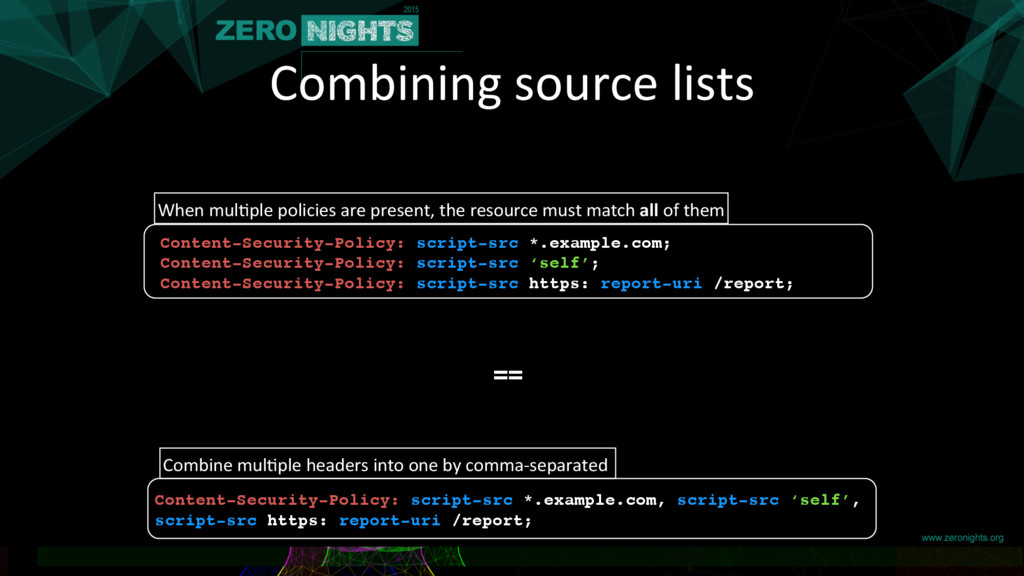
  12. Combining source lists Content-Security-Policy: script-src *.example.com; Content-Security-Policy: script-src ‘self’; Content-Security-Policy:

    script-src https: report-uri /report; Content-Security-Policy: script-src *.example.com, script-src ‘self’, script-src https: report-uri /report; When mulFple policies are present, the resource must match all of them Combine mulFple headers into one by comma-separated ==
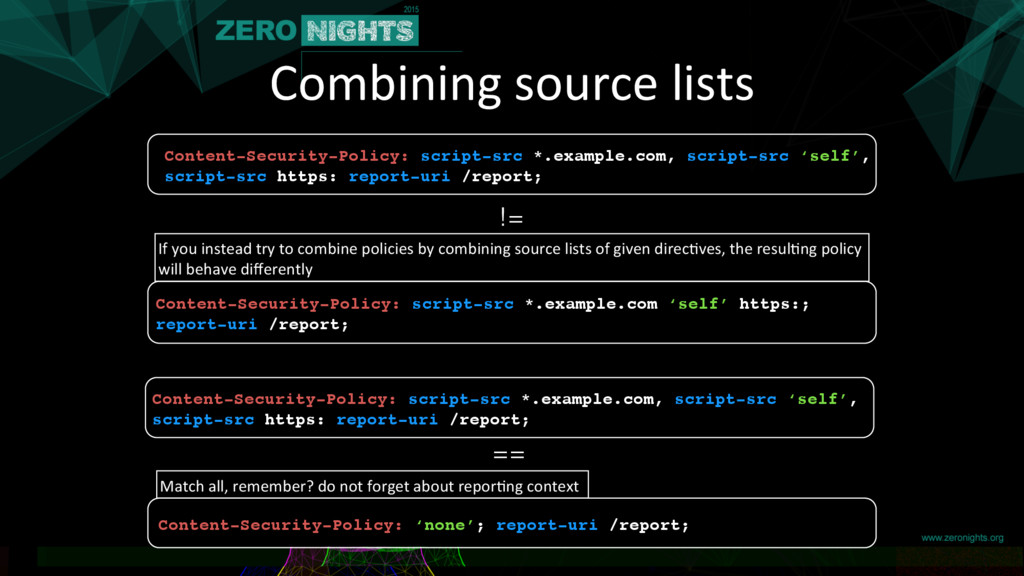
  13. Combining source lists Content-Security-Policy: ‘none’; report-uri /report; Content-Security-Policy: script-src *.example.com,

    script-src ‘self’, script-src https: report-uri /report; Match all, remember? do not forget about reporFng context != == Content-Security-Policy: script-src *.example.com, script-src ‘self’, script-src https: report-uri /report; If you instead try to combine policies by combining source lists of given direcFves, the resulFng policy will behave differently Content-Security-Policy: script-src *.example.com ‘self’ https:; report-uri /report;
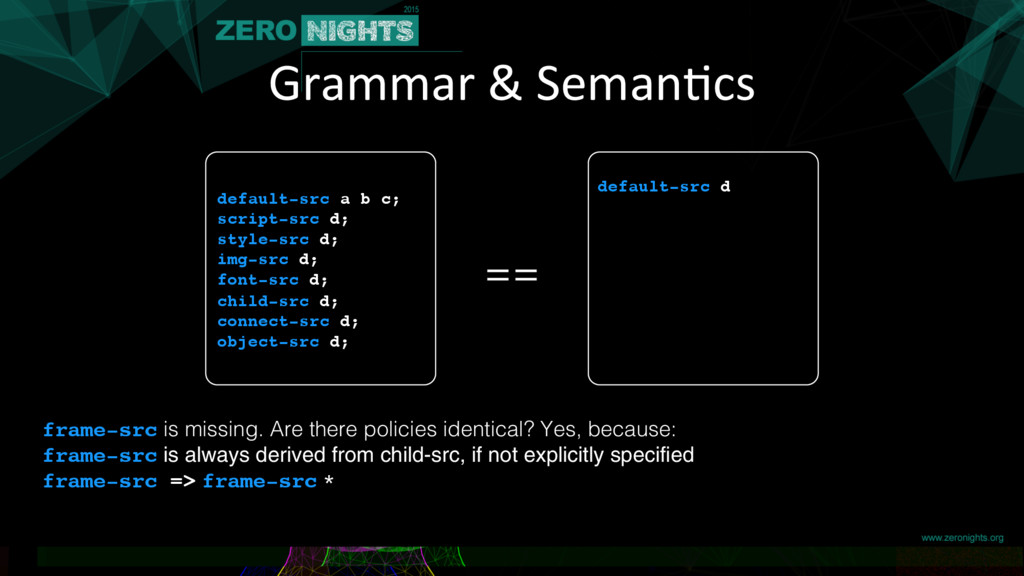
  14. Grammar & SemanFcs default-src a b c; script-src d; style-src

    d; img-src d; font-src d; child-src d; connect-src d; object-src d; default-src d frame-src is missing. Are there policies identical? Yes, because: frame-src is always derived from child-src, if not explicitly specified frame-src => frame-src * ==
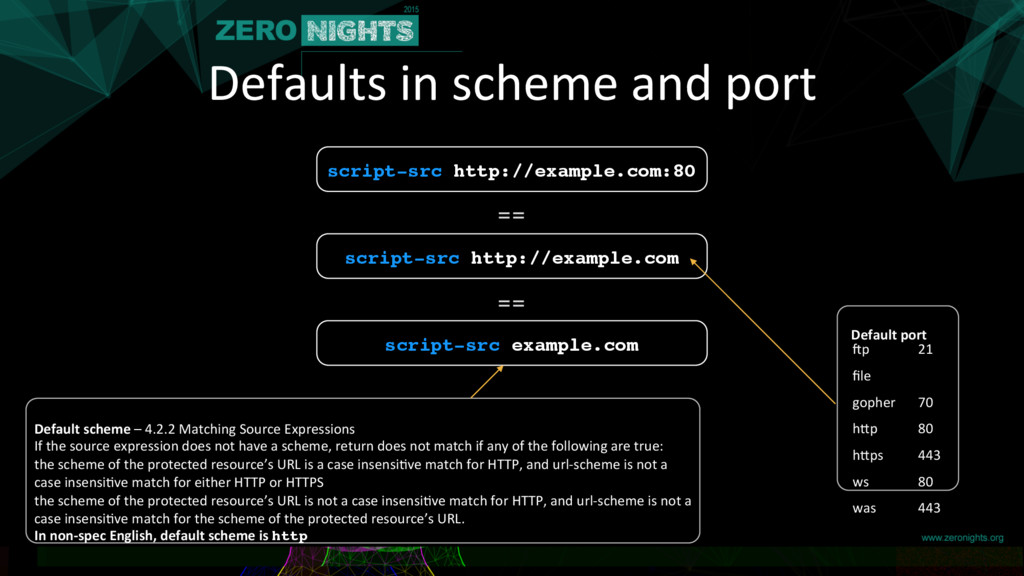
  15. Defaults in scheme and port script-src http://example.com:80 == == script-src

    http://example.com script-src example.com Default port Default scheme – 4.2.2 Matching Source Expressions If the source expression does not have a scheme, return does not match if any of the following are true: the scheme of the protected resource’s URL is a case insensiFve match for HTTP, and url-scheme is not a case insensiFve match for either HTTP or HTTPS the scheme of the protected resource’s URL is not a case insensiFve match for HTTP, and url-scheme is not a case insensiFve match for the scheme of the protected resource’s URL. In non-spec English, default scheme is http lp 21 file gopher 70 hXp 80 hXps 443 ws 80 was 443
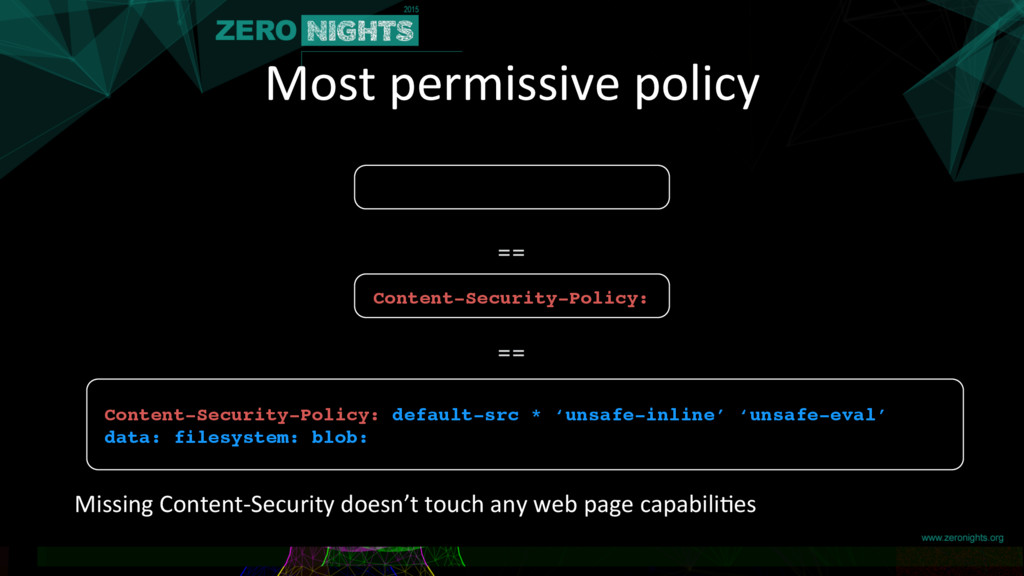
  16. Most permissive policy Content-Security-Policy: default-src * ‘unsafe-inline’ ‘unsafe-eval’ data: filesystem:

    blob: == Missing Content-Security doesn’t touch any web page capabiliFes Content-Security-Policy: ==
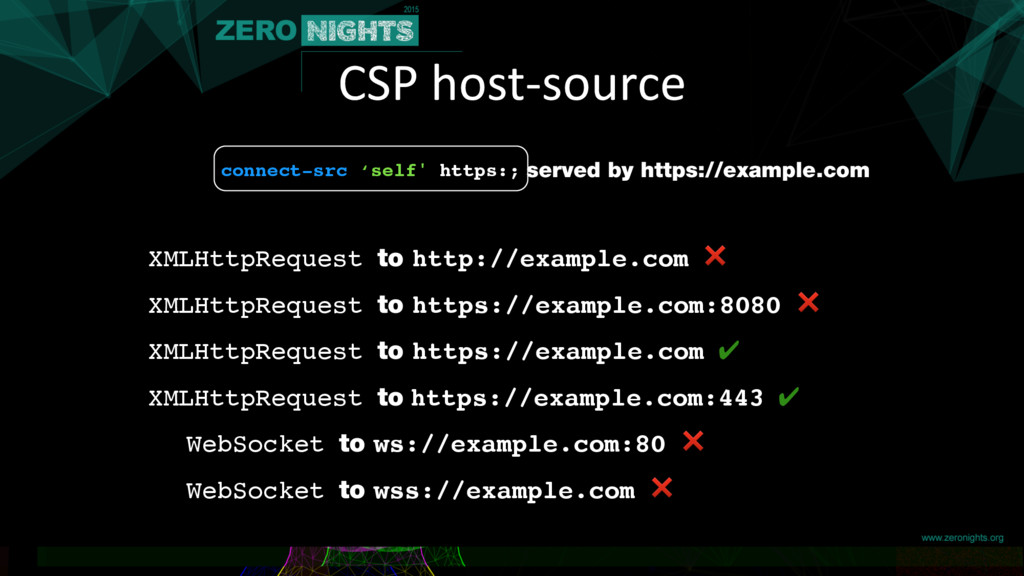
  17. CSP host-source connect-src ‘self' https:; XMLHttpRequest to http://example.com ❌ served

    by https://example.com XMLHttpRequest to https://example.com:8080 ❌ XMLHttpRequest to https://example.com ✔ WebSocket to ws://example.com:80 ❌ WebSocket to wss://example.com ❌ XMLHttpRequest to https://example.com:443 ✔
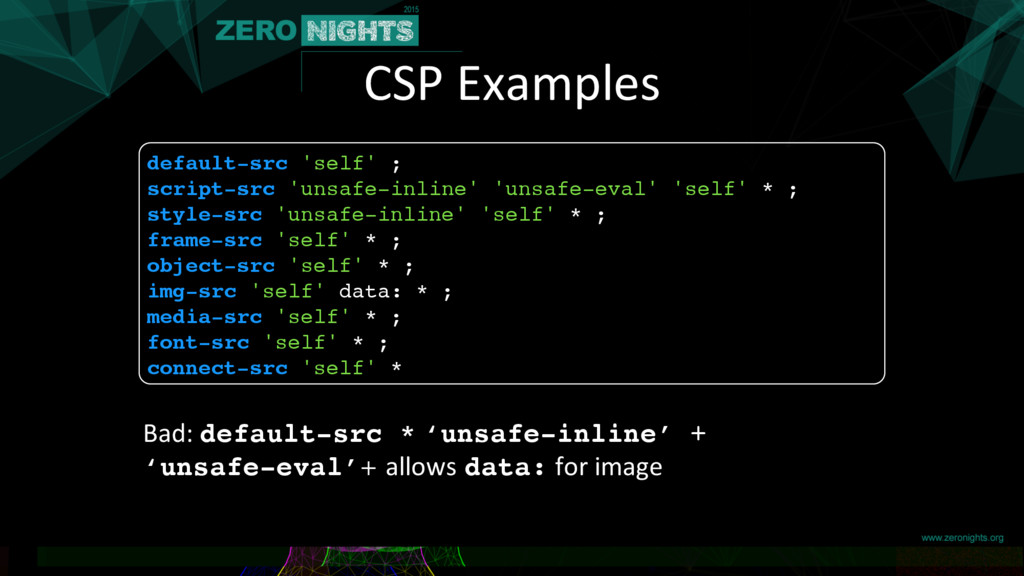
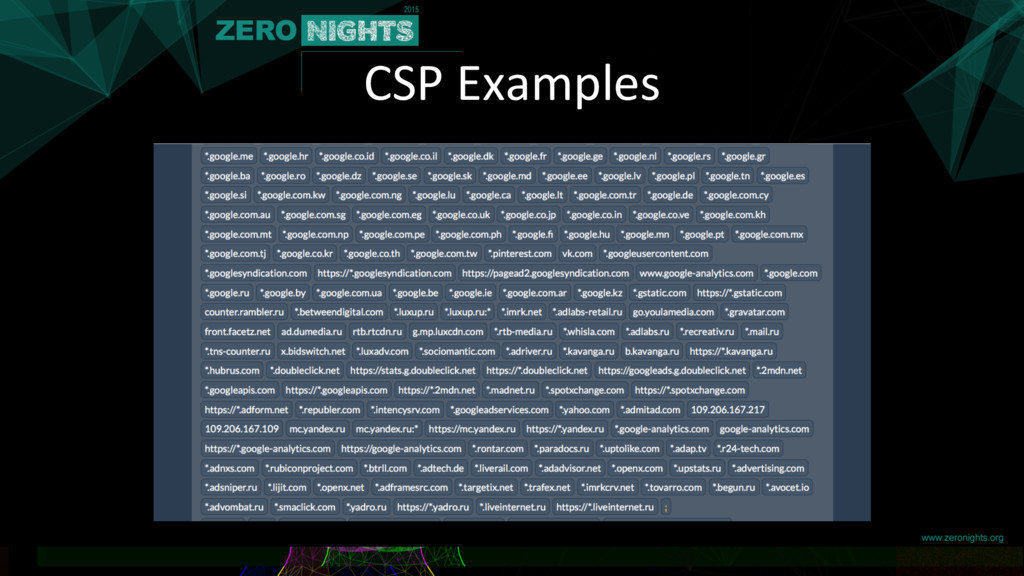
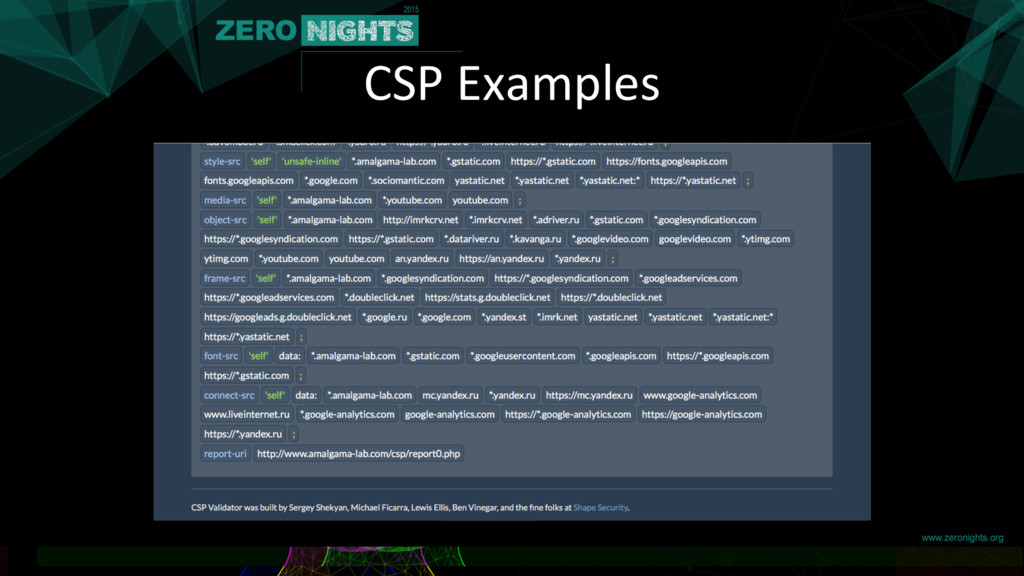
  18. CSP Examples default-src 'self' ; script-src 'unsafe-inline' 'unsafe-eval' 'self' *

    ; style-src 'unsafe-inline' 'self' * ; frame-src 'self' * ; object-src 'self' * ; img-src 'self' data: * ; media-src 'self' * ; font-src 'self' * ; connect-src 'self' * Bad: default-src * ‘unsafe-inline’ + ‘unsafe-eval’+ allows data: for image
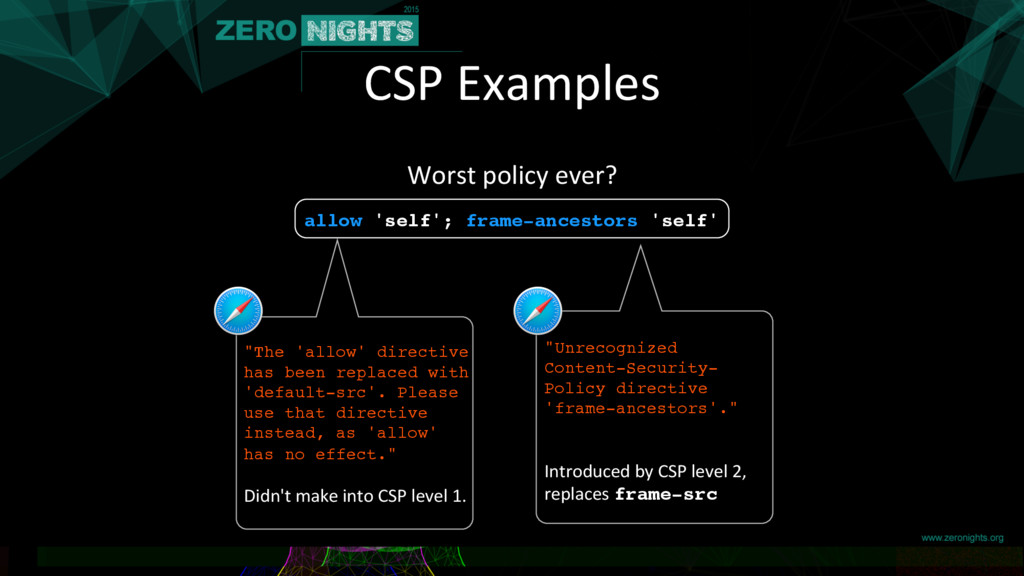
  19. Worst policy ever? CSP Examples allow 'self'; frame-ancestors 'self' "The

    'allow' directive has been replaced with 'default-src'. Please use that directive instead, as 'allow' has no effect." Didn't make into CSP level 1. "Unrecognized Content-Security- Policy directive 'frame-ancestors'." Introduced by CSP level 2, replaces frame-src
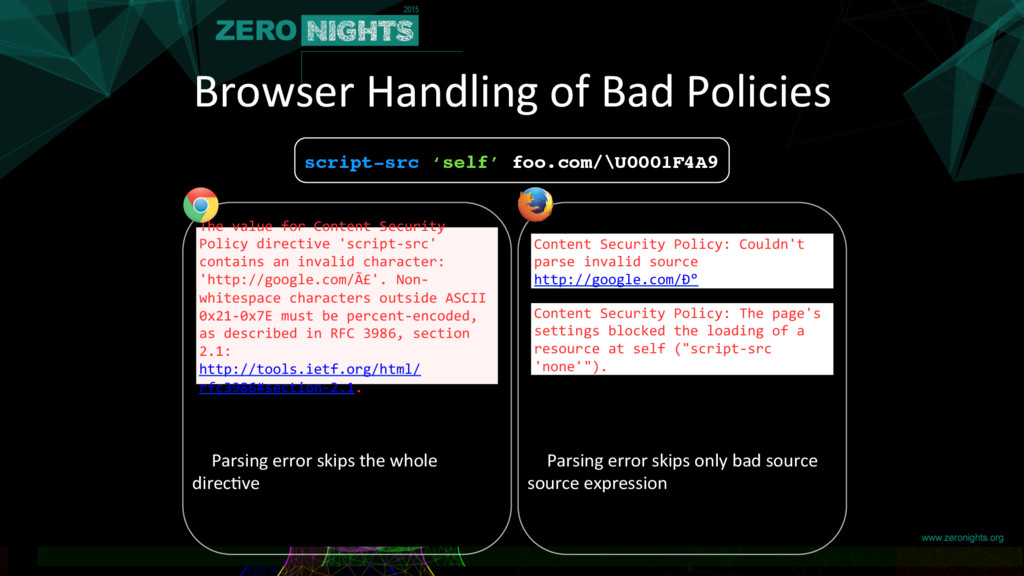
  20. Browser Handling of Bad Policies The value for Content Security

    Policy directive 'script-src' contains an invalid character: 'http://google.com/ã'. Non- whitespace characters outside ASCII 0x21-0x7E must be percent-encoded, as described in RFC 3986, section 2.1: http://tools.ietf.org/html/ rfc3986#section-2.1. Content Security Policy: Couldn't parse invalid source http://google.com/а script-src ‘self’ foo.com/\U0001F4A9 Content Security Policy: The page's settings blocked the loading of a resource at self ("script-src 'none'"). Parsing error skips the whole direcFve Parsing error skips only bad source source expression
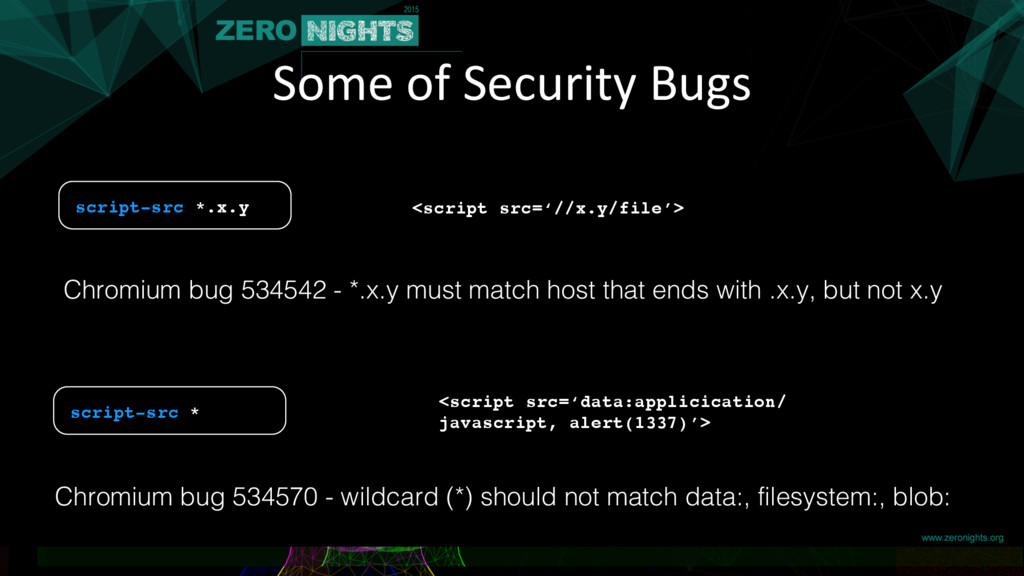
  21. Some of Security Bugs script-src *.x.y Chromium bug 534542 -

    *.x.y must match host that ends with .x.y, but not x.y script-src * Chromium bug 534570 - wildcard (*) should not match data:, filesystem:, blob: <script src=‘//x.y/file’> <script src=‘data:applicication/ javascript, alert(1337)’>
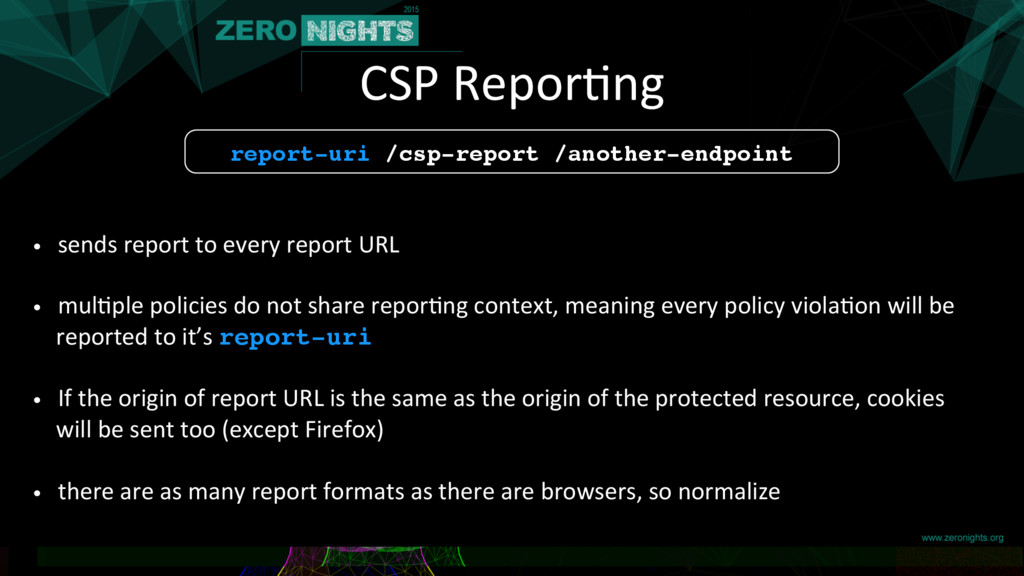
  22. CSP ReporFng •  sends report to every report URL • 

    mulFple policies do not share reporFng context, meaning every policy violaFon will be reported to it’s report-uri •  If the origin of report URL is the same as the origin of the protected resource, cookies will be sent too (except Firefox) •  there are as many report formats as there are browsers, so normalize report-uri /csp-report /another-endpoint
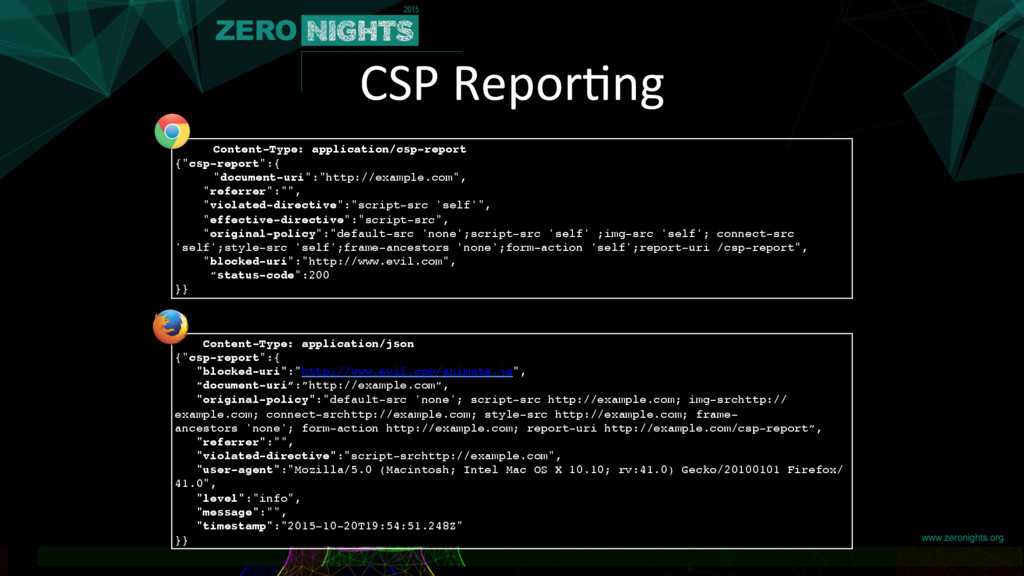
  23. CSP ReporFng Content-Type: application/csp-report {"csp-report":{ "document-uri":"http://example.com", "referrer":"", "violated-directive":"script-src 'self'", "effective-directive":"script-src",

    "original-policy":"default-src 'none';script-src 'self' ;img-src 'self'; connect-src 'self';style-src 'self';frame-ancestors 'none';form-action 'self';report-uri /csp-report", "blocked-uri":"http://www.evil.com", “status-code":200 }} Content-Type: application/json {"csp-report":{ "blocked-uri":"http://www.evil.com/animate.js", “document-uri”:”http://example.com“, "original-policy":"default-src 'none'; script-src http://example.com; img-srchttp:// example.com; connect-srchttp://example.com; style-src http://example.com; frame- ancestors 'none'; form-action http://example.com; report-uri http://example.com/csp-report“, "referrer":"", "violated-directive":"script-srchttp://example.com", "user-agent":"Mozilla/5.0 (Macintosh; Intel Mac OS X 10.10; rv:41.0) Gecko/20100101 Firefox/ 41.0", "level":"info", "message":"", "timestamp":"2015-10-20T19:54:51.248Z" }}
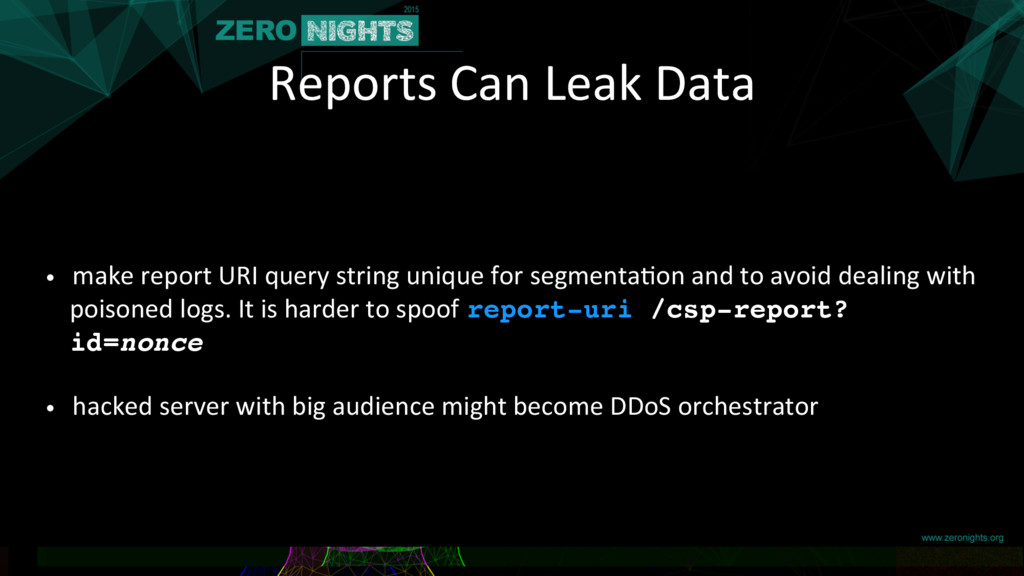
  24. Reports Can Leak Data •  make report URI query string

    unique for segmentaFon and to avoid dealing with poisoned logs. It is harder to spoof report-uri /csp-report? id=nonce •  hacked server with big audience might become DDoS orchestrator
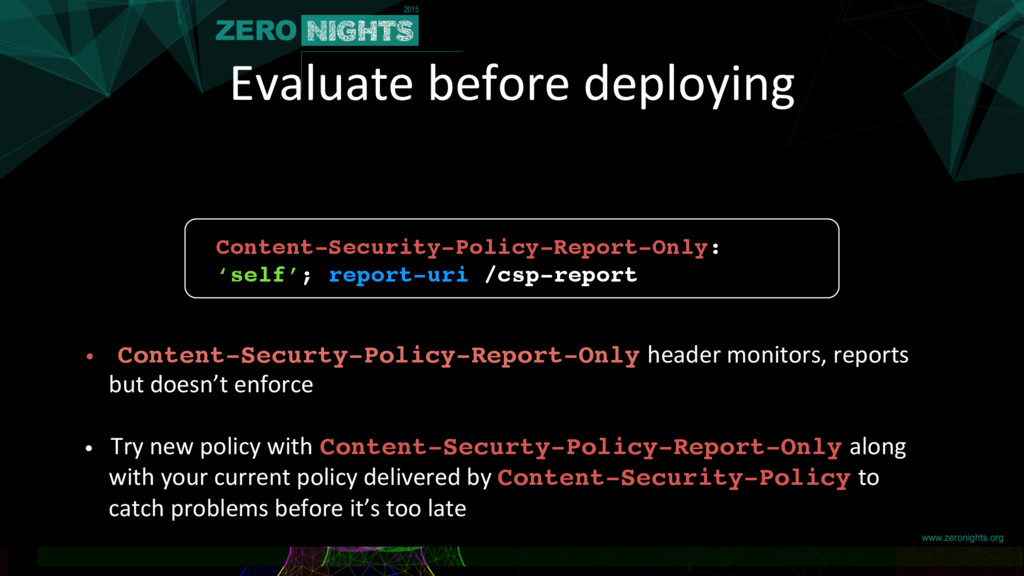
  25. Evaluate before deploying •  Content-Securty-Policy-Report-Only header monitors, reports but doesn’t

    enforce •  Try new policy with Content-Securty-Policy-Report-Only along with your current policy delivered by Content-Security-Policy to catch problems before it’s too late Content-Security-Policy-Report-Only: ‘self’; report-uri /csp-report
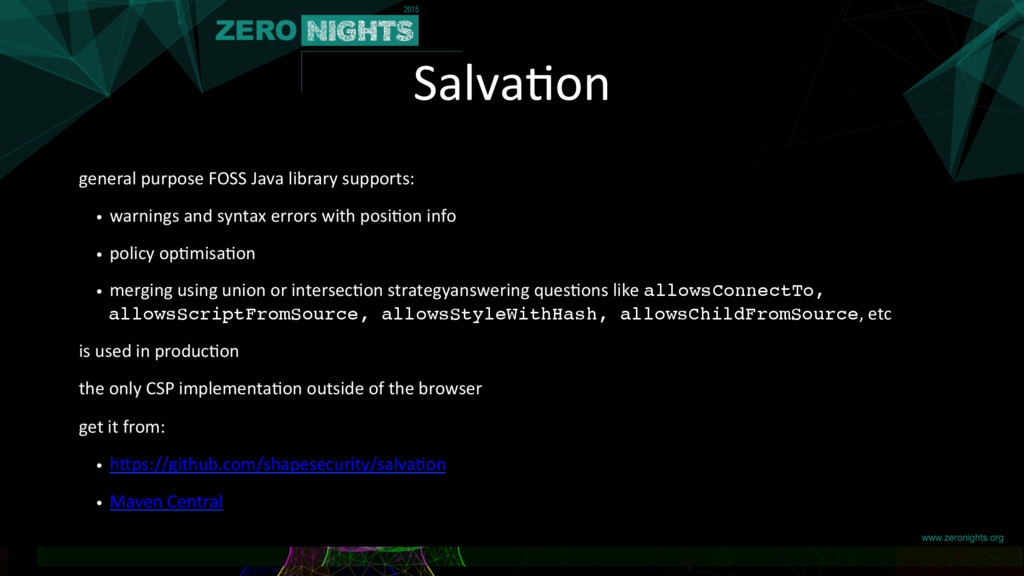
  26. SalvaFon general purpose FOSS Java library supports: •  warnings and

    syntax errors with posiFon info •  policy opFmisaFon •  merging using union or intersecFon strategyanswering quesFons like allowsConnectTo, allowsScriptFromSource, allowsStyleWithHash, allowsChildFromSource, etc is used in producFon the only CSP implementaFon outside of the browser get it from: •  hXps://github.com/shapesecurity/salvaFon •  Maven Central
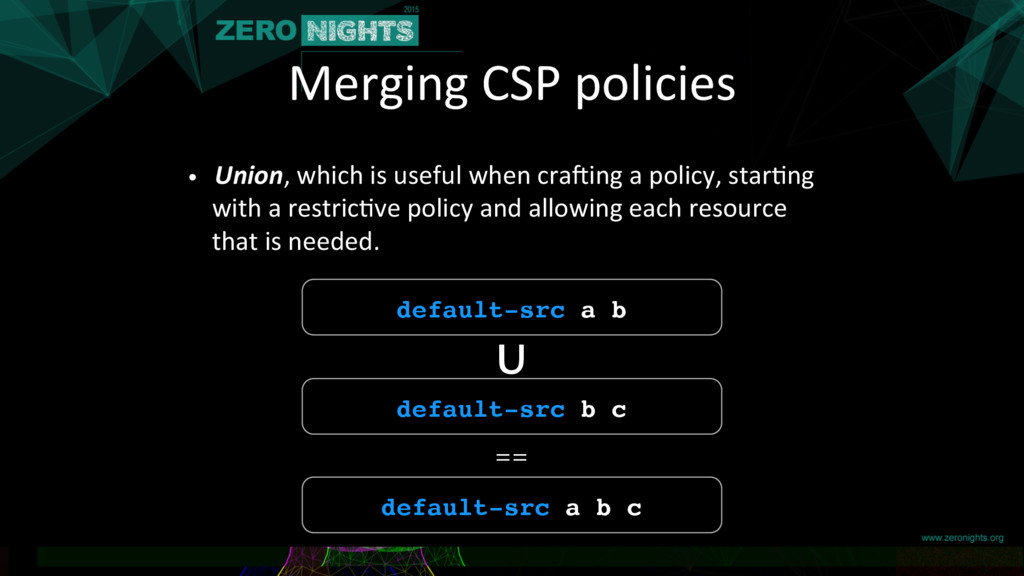
  27. Merging CSP policies •  Union, which is useful when craling

    a policy, starFng with a restricFve policy and allowing each resource that is needed. default-src a b ∪ default-src b c == default-src a b c
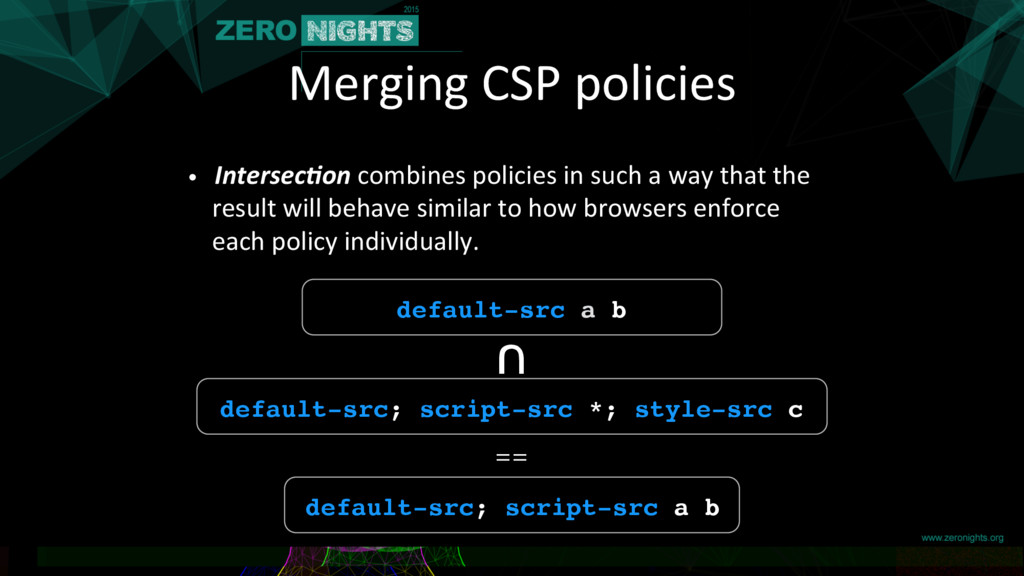
  28. Merging CSP policies •  Intersec-on combines policies in such a

    way that the result will behave similar to how browsers enforce each policy individually. default-src a b ∩ default-src; script-src *; style-src c == default-src; script-src a b
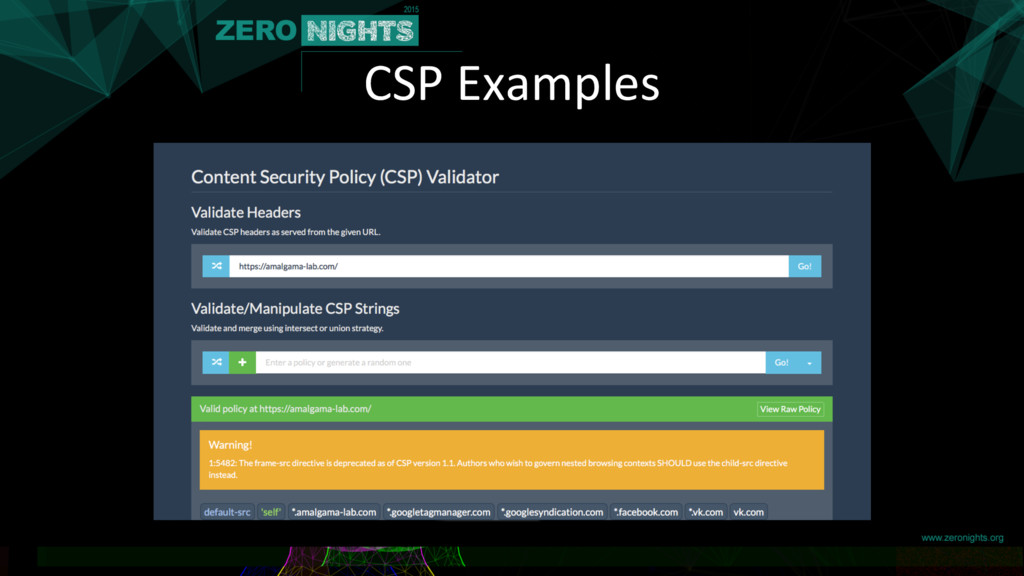
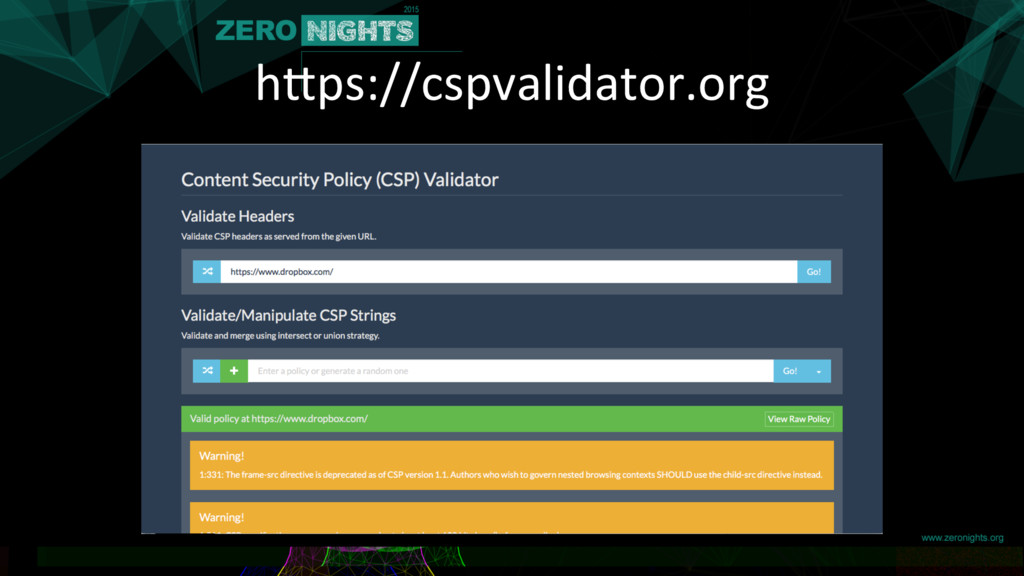
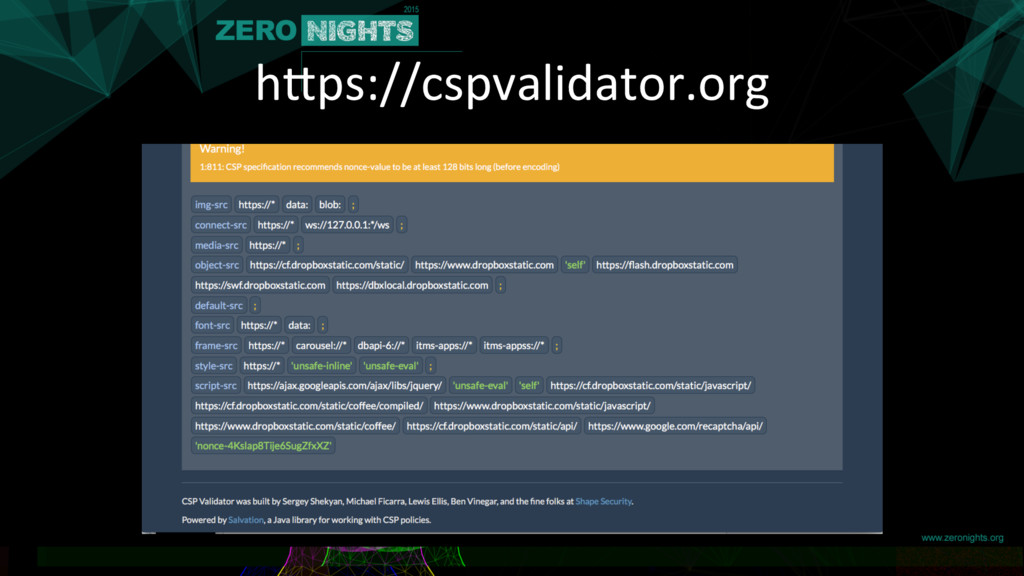
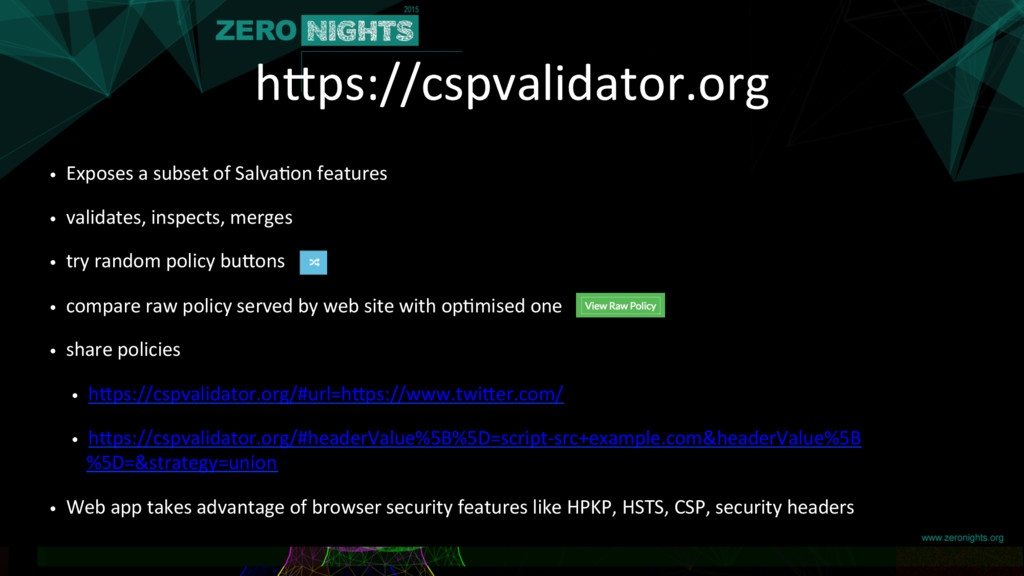
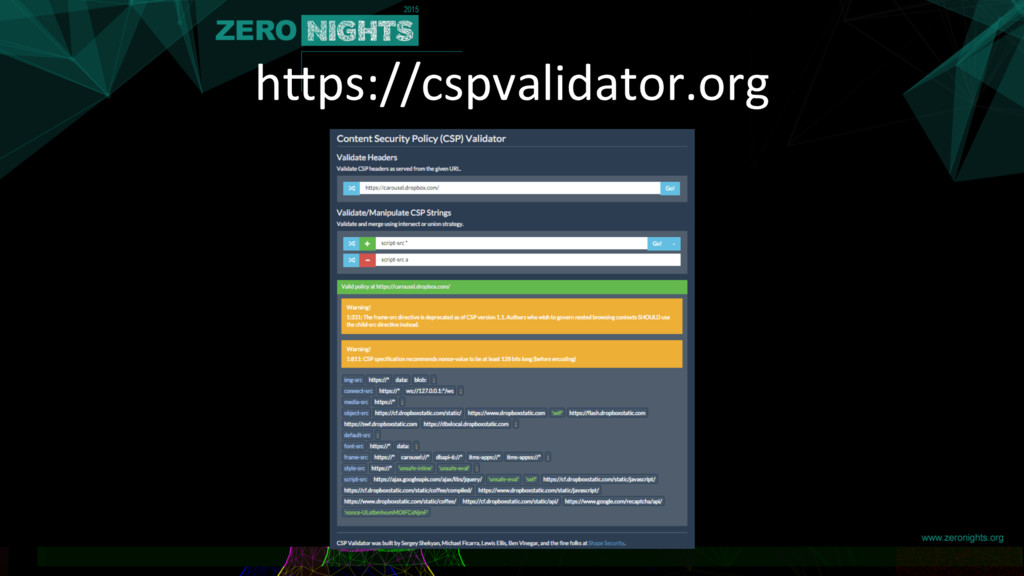
  29. hXps://cspvalidator.org •  Exposes a subset of SalvaFon features •  validates,

    inspects, merges •  try random policy buXons •  compare raw policy served by web site with opFmised one •  share policies •  hXps://cspvalidator.org/#url=hXps://www.twiXer.com/ •  hXps://cspvalidator.org/#headerValue%5B%5D=script-src+example.com&headerValue%5B %5D=&strategy=union •  Web app takes advantage of browser security features like HPKP, HSTS, CSP, security headers
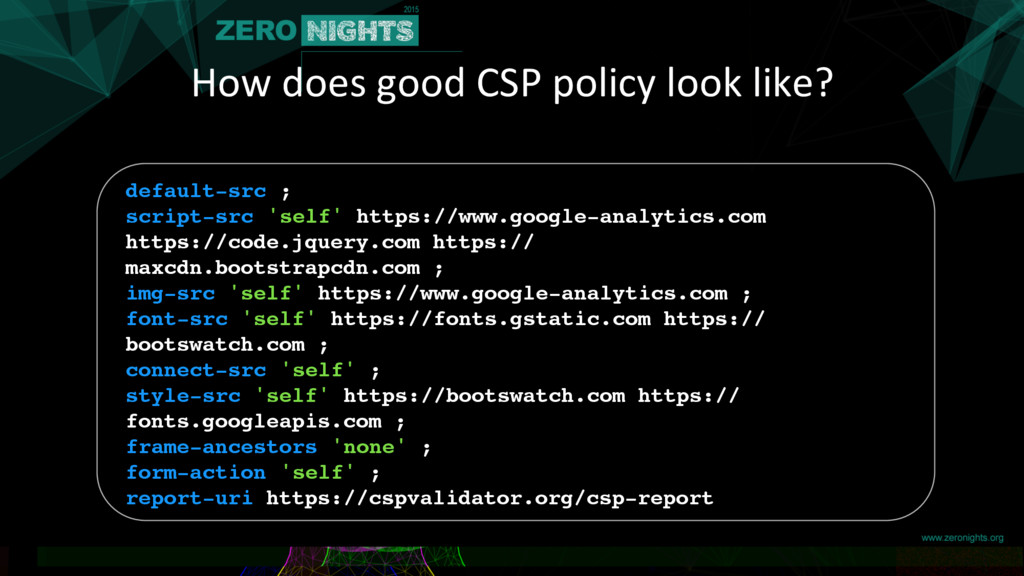
  30. How does good CSP policy look like? default-src ; script-src

    'self' https://www.google-analytics.com https://code.jquery.com https:// maxcdn.bootstrapcdn.com ; img-src 'self' https://www.google-analytics.com ; font-src 'self' https://fonts.gstatic.com https:// bootswatch.com ; connect-src 'self' ; style-src 'self' https://bootswatch.com https:// fonts.googleapis.com ; frame-ancestors 'none' ; form-action 'self' ; report-uri https://cspvalidator.org/csp-report
  31. ContribuFng to CSP While developing SalvaFon •  >10 bugs reported

    against the CSP specificaFon •  >10 bugs reported against Chromium CSP implementaFon Use SalvaFon! ParFcipate! We haven’t looked at other browsers