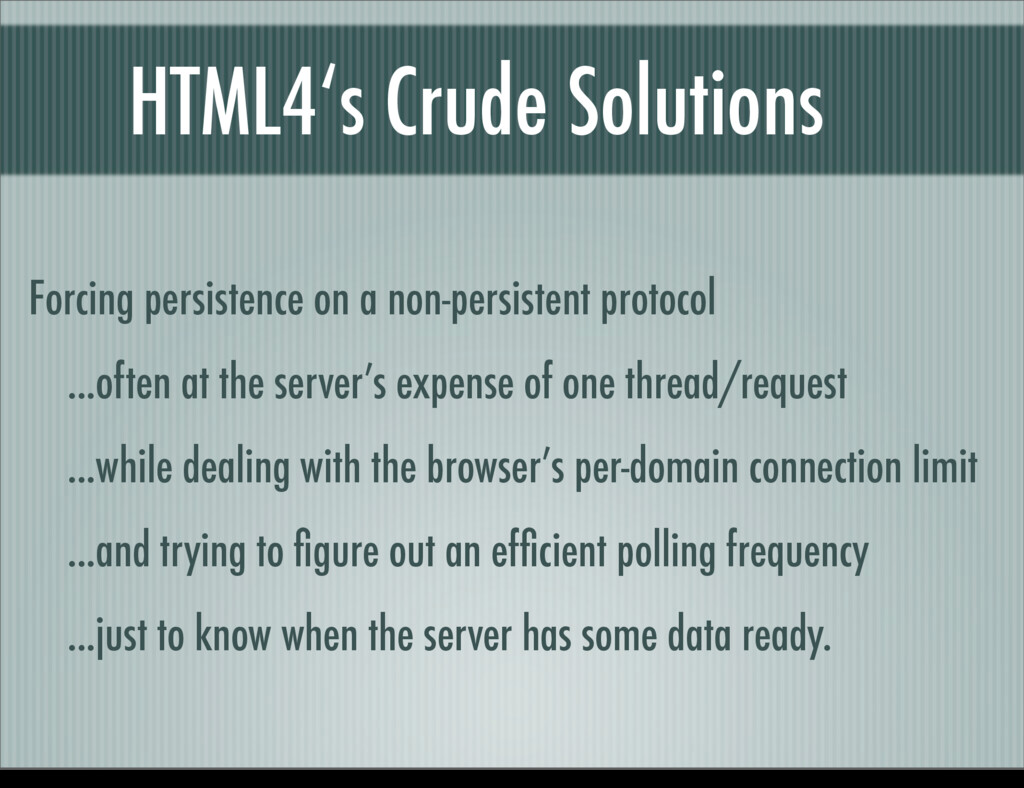
at the server’s expense of one thread/request ...while dealing with the browser’s per-domain connection limit ...and trying to figure out an efficient polling frequency ...just to know when the server has some data ready. Friday, April 5, 13
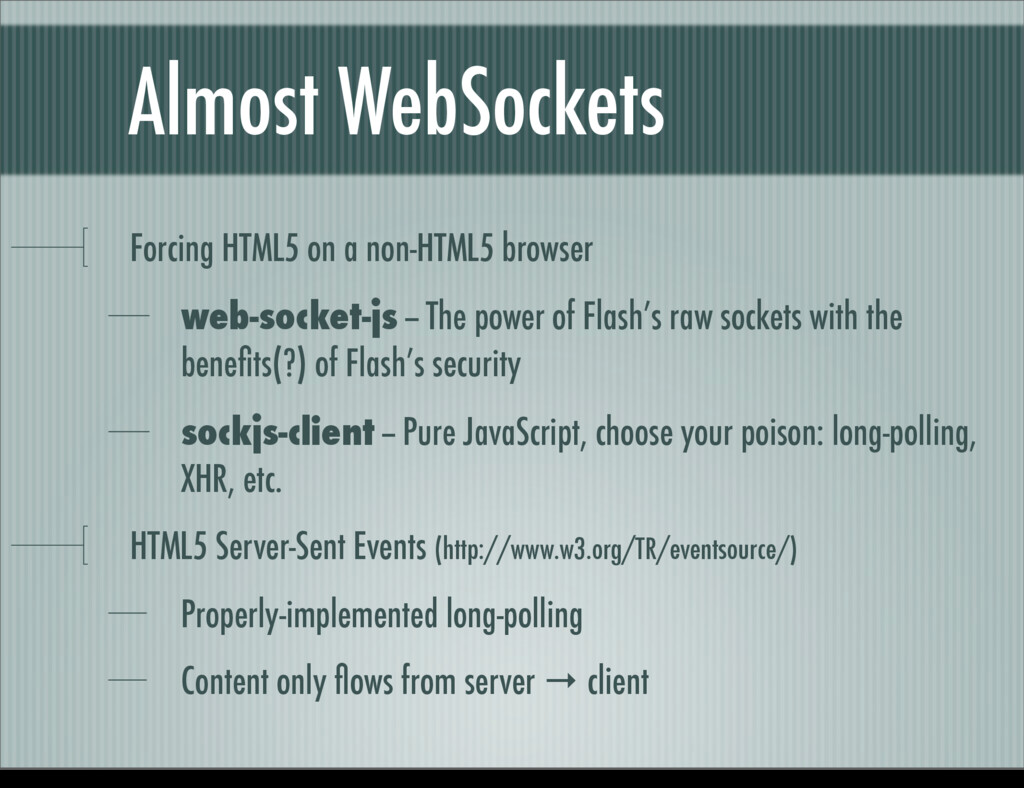
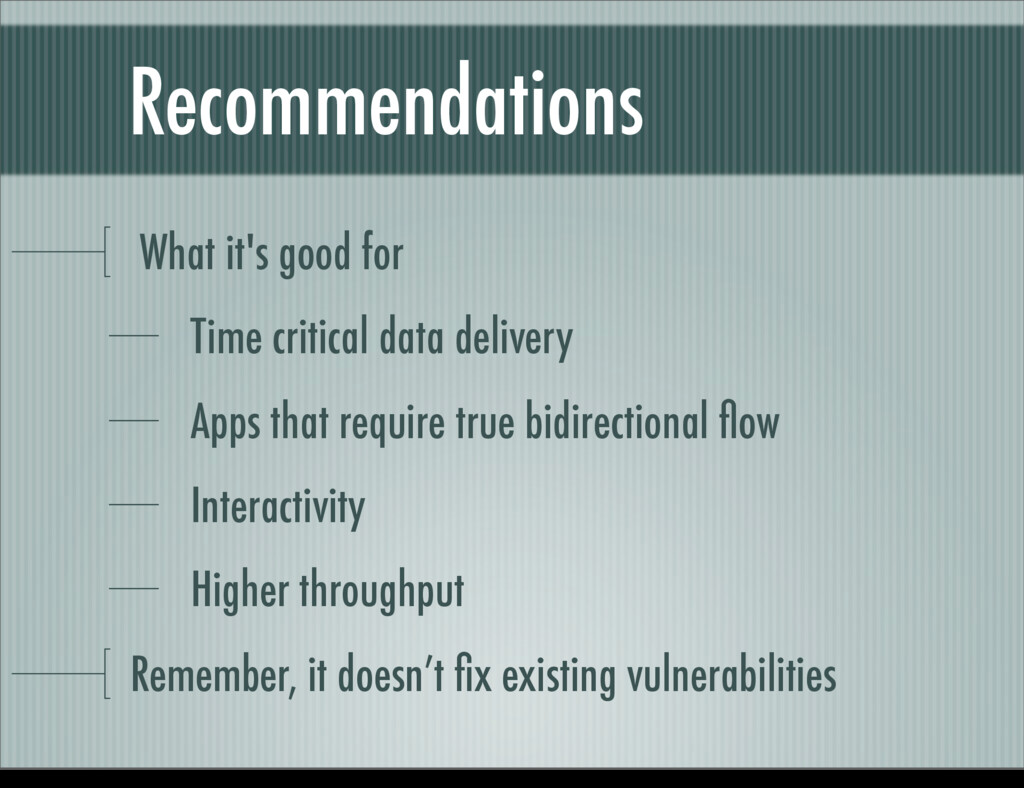
The power of Flash’s raw sockets with the benefits(?) of Flash’s security sockjs-client -- Pure JavaScript, choose your poison: long-polling, XHR, etc. HTML5 Server-Sent Events (http://www.w3.org/TR/eventsource/) Properly-implemented long-polling Content only flows from server → client Friday, April 5, 13
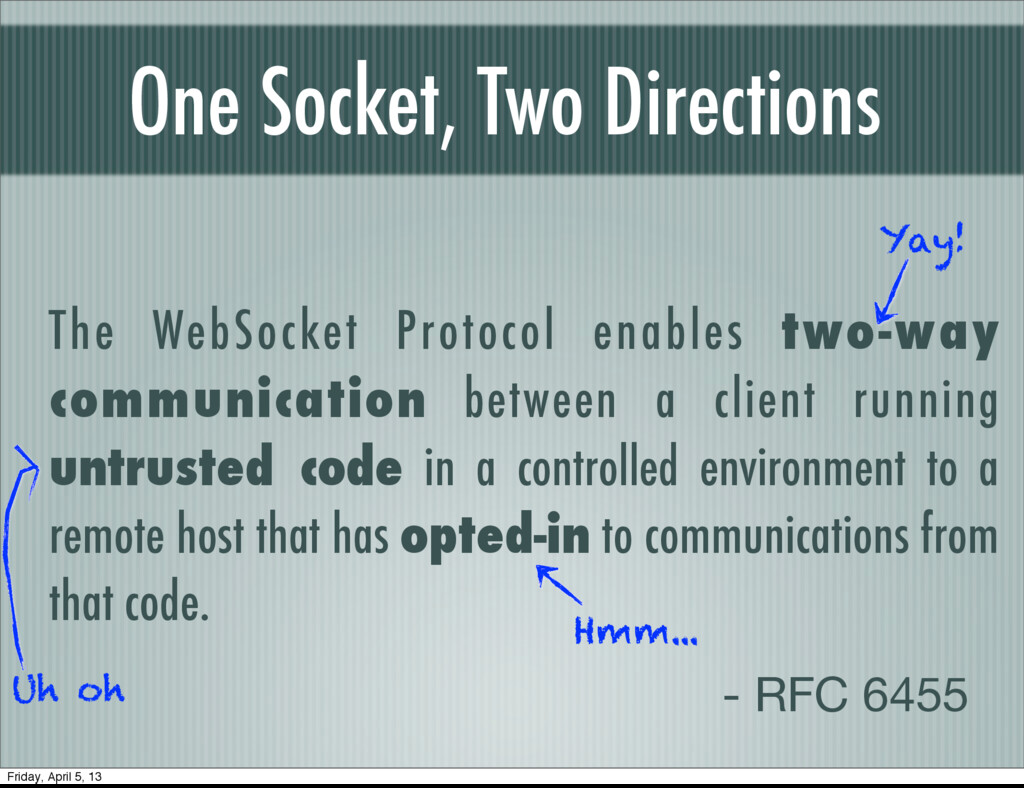
between a client running untrusted code in a controlled environment to a remote host that has opted-in to communications from that code. Uh oh Yay! Hmm... - RFC 6455 Friday, April 5, 13
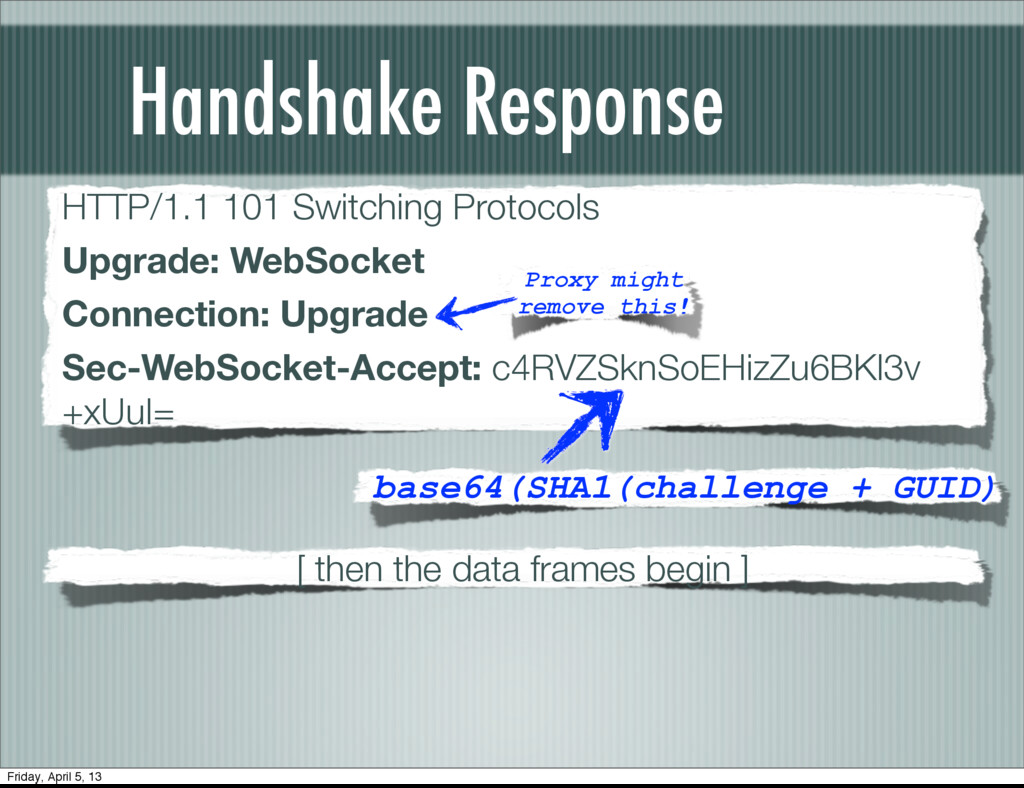
Sec-WebSocket-Accept: c4RVZSknSoEHizZu6BKl3v +xUuI= [ then the data frames begin ] base64(SHA1(challenge + GUID) Proxy might remove this! Friday, April 5, 13
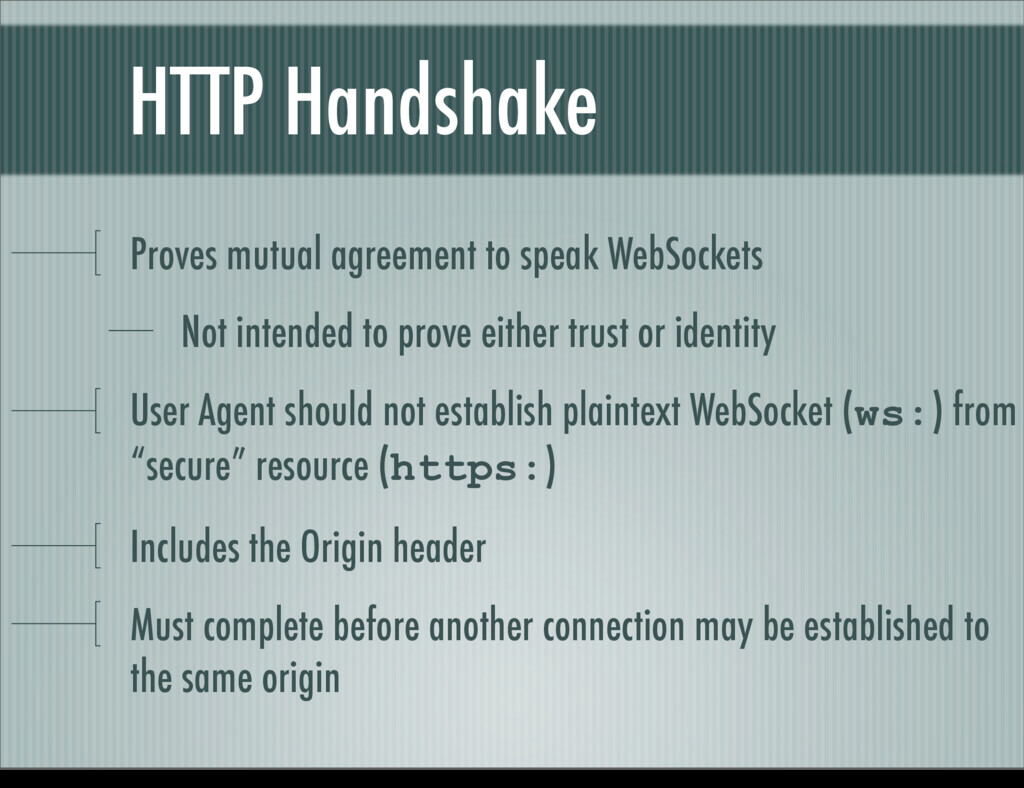
to prove either trust or identity User Agent should not establish plaintext WebSocket (ws:) from “secure” resource (https:) Includes the Origin header Must complete before another connection may be established to the same origin Friday, April 5, 13
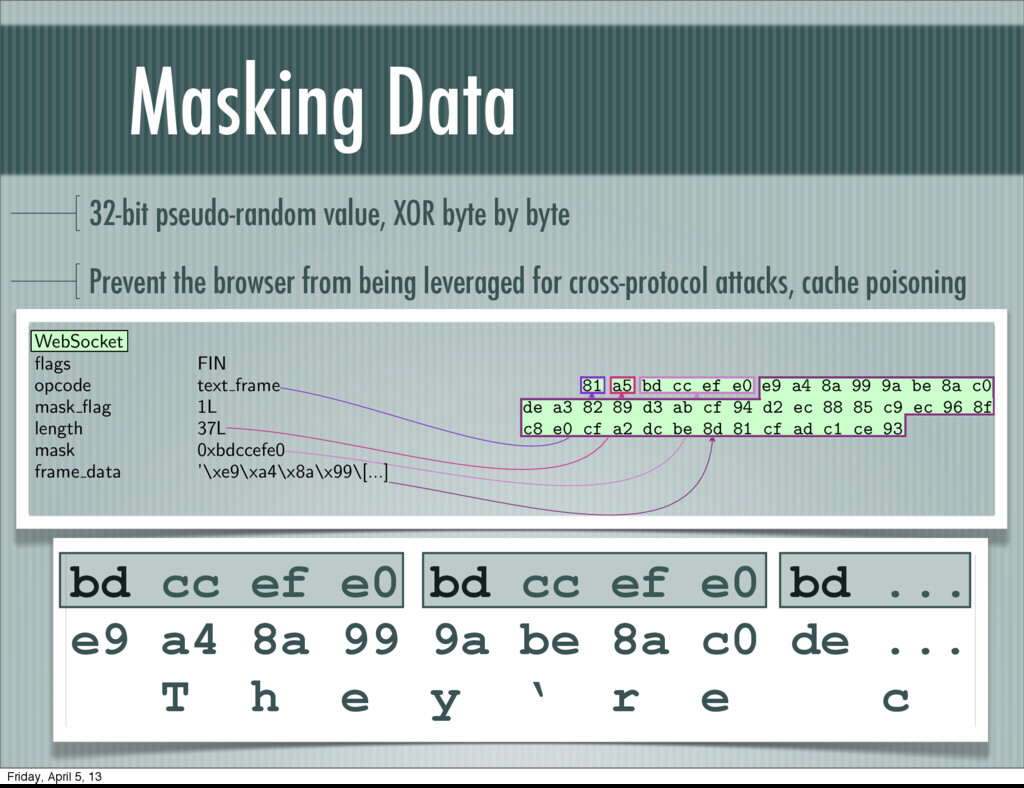
the browser from being leveraged for cross-protocol attacks, cache poisoning src 10.171.90.44 dst 174.129.224.73 options [] TCP f9 28 sport 63784 00 50 dport http fb 51 8d 7f seq 4216425855 ea d5 21 21 ack 3939836193 dataofs 8L 80 reserved 0L 18 flags PA 82 18 window 33304 fa c2 chksum 0xfac2 00 00 urgptr 0 01 01 08 0a c5 4f 2d e2 61 52 72 98 options [(’NOP’, None), (’[...] WebSocket flags FIN 81 opcode text frame mask flag 1L a5 length 37L bd cc ef e0 mask 0xbdccefe0 e9 a4 8a 99 9a be 8a c0 de a3 82 89 d3 ab cf 94 d2 ec 88 85 c9 ec 96 8f c8 e0 cf a2 dc be 8d 81 cf ad c1 ce 93 frame data ’\xe9\xa4\x8a\x99\[...] bd cc ef e0 bd cc ef e0 bd ... e9 a4 8a 99 9a be 8a c0 de ... T h e y ‘ r e c Friday, April 5, 13
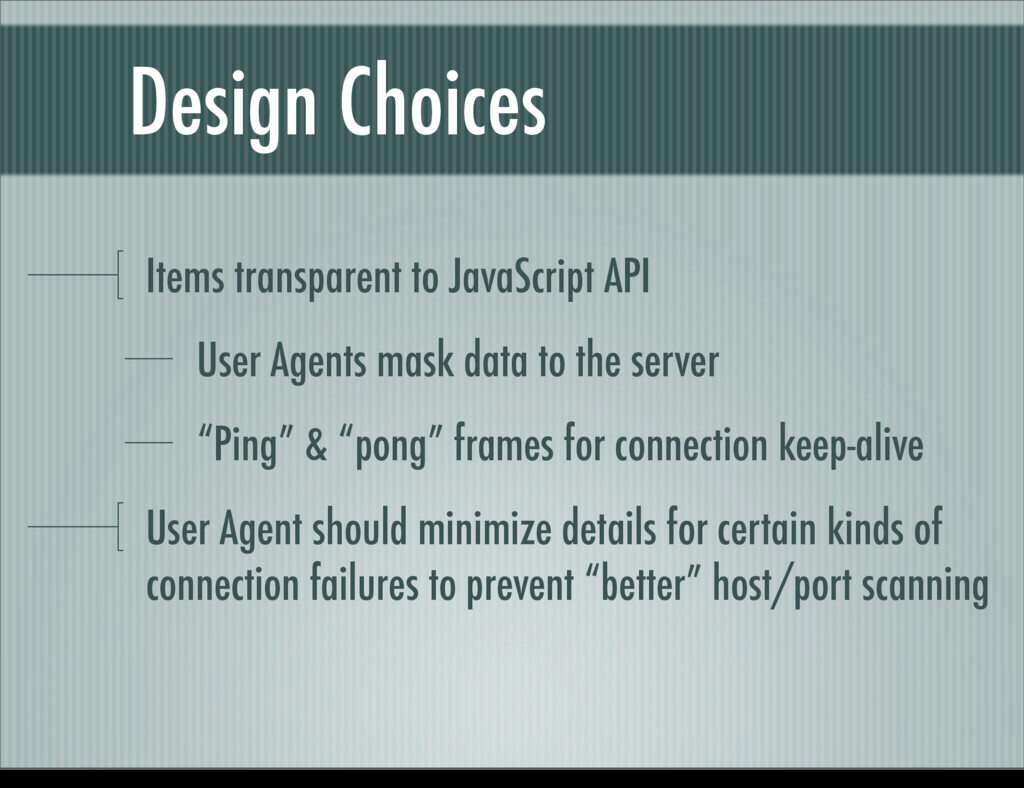
data to the server “Ping” & “pong” frames for connection keep-alive User Agent should minimize details for certain kinds of connection failures to prevent “better” host/port scanning Friday, April 5, 13
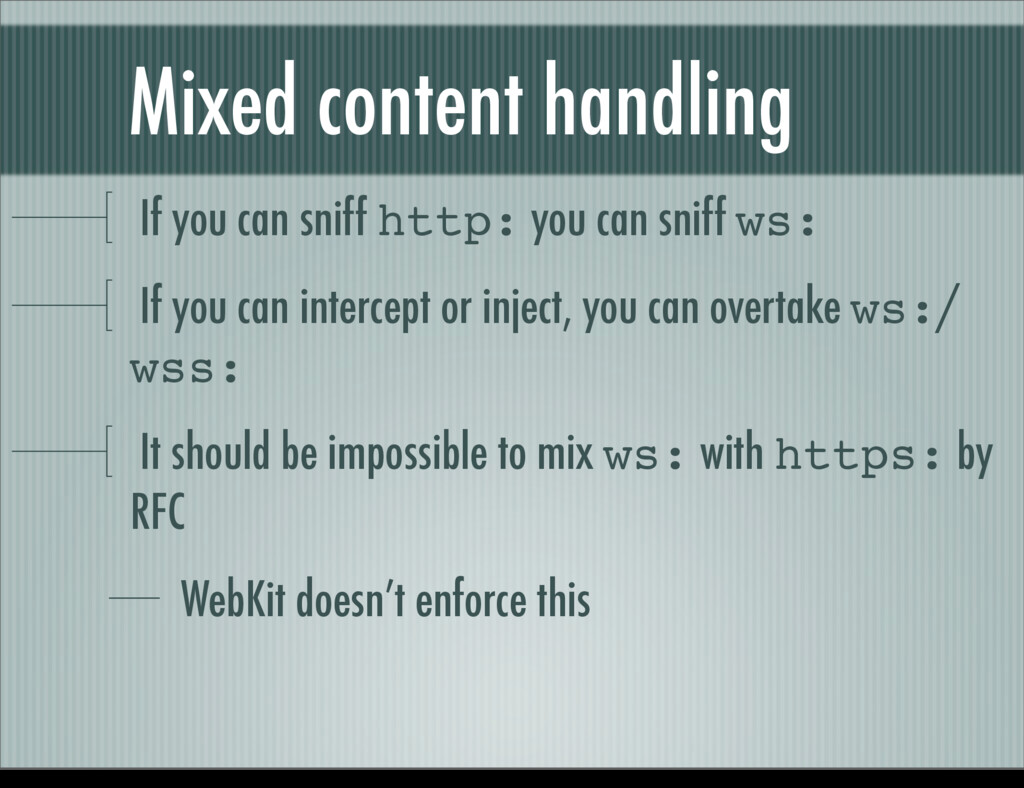
sniff ws: If you can intercept or inject, you can overtake ws:/ wss: It should be impossible to mix ws: with https: by RFC WebKit doesn’t enforce this Friday, April 5, 13
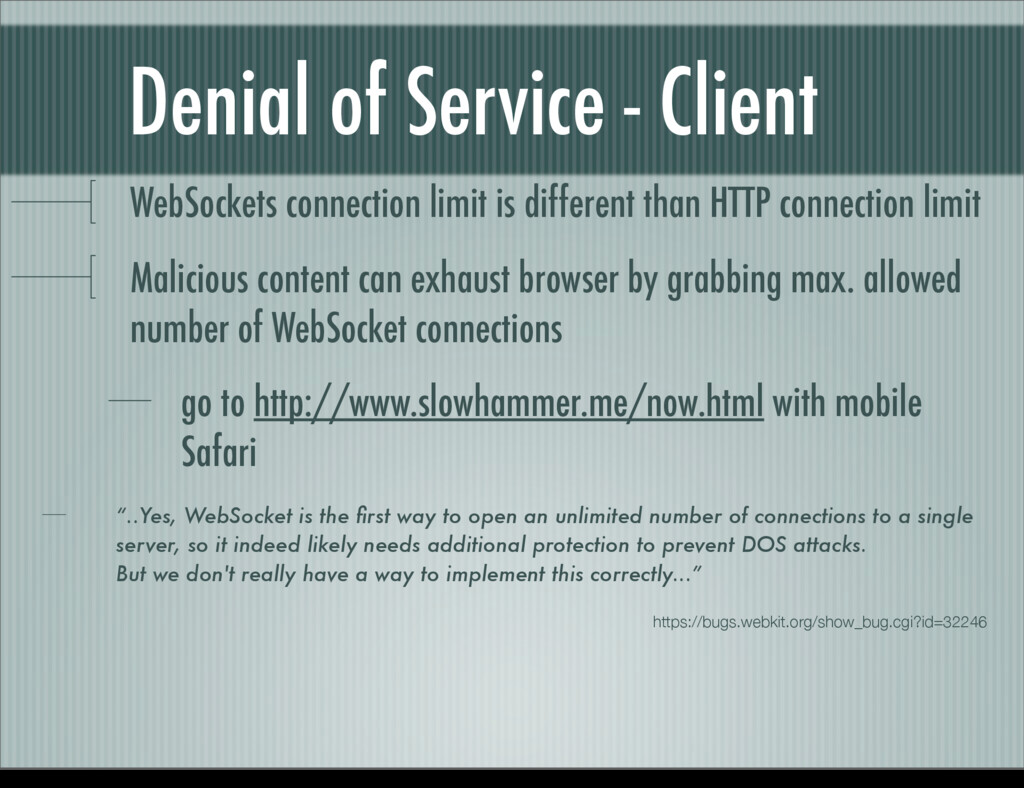
than HTTP connection limit Malicious content can exhaust browser by grabbing max. allowed number of WebSocket connections go to http://www.slowhammer.me/now.html with mobile Safari “..Yes, WebSocket is the first way to open an unlimited number of connections to a single server, so it indeed likely needs additional protection to prevent DOS attacks. But we don't really have a way to implement this correctly...” https://bugs.webkit.org/show_bug.cgi?id=32246 Friday, April 5, 13
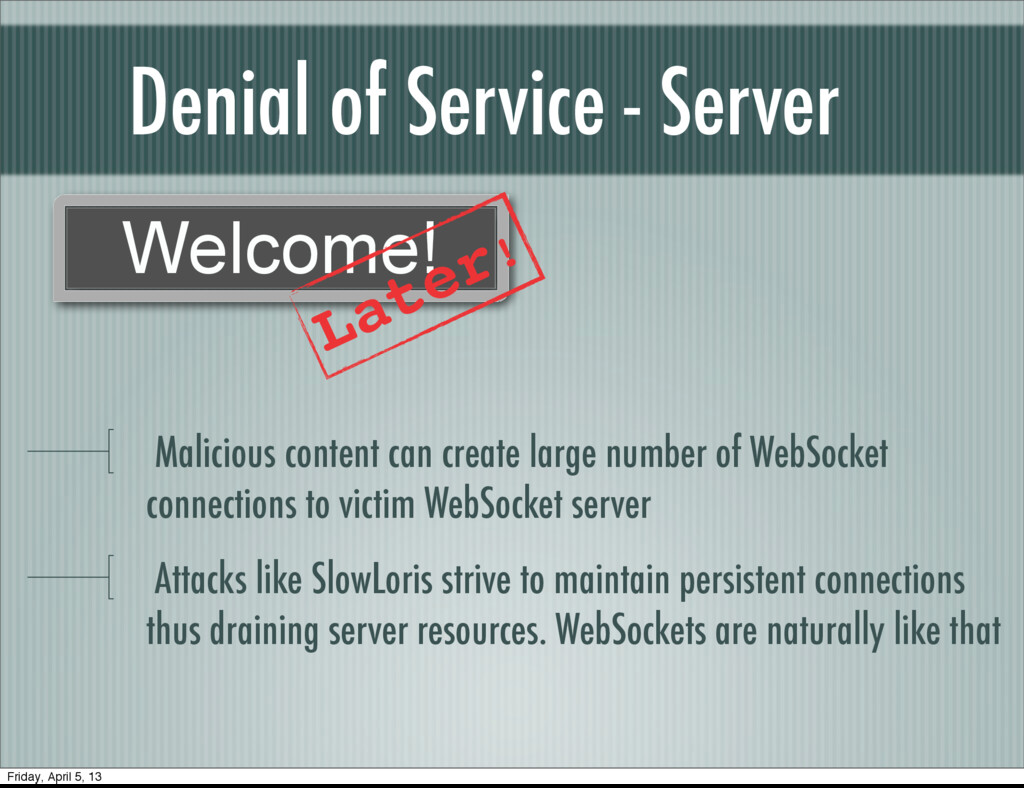
number of WebSocket connections to victim WebSocket server Attacks like SlowLoris strive to maintain persistent connections thus draining server resources. WebSockets are naturally like that Welcome! Later! Friday, April 5, 13
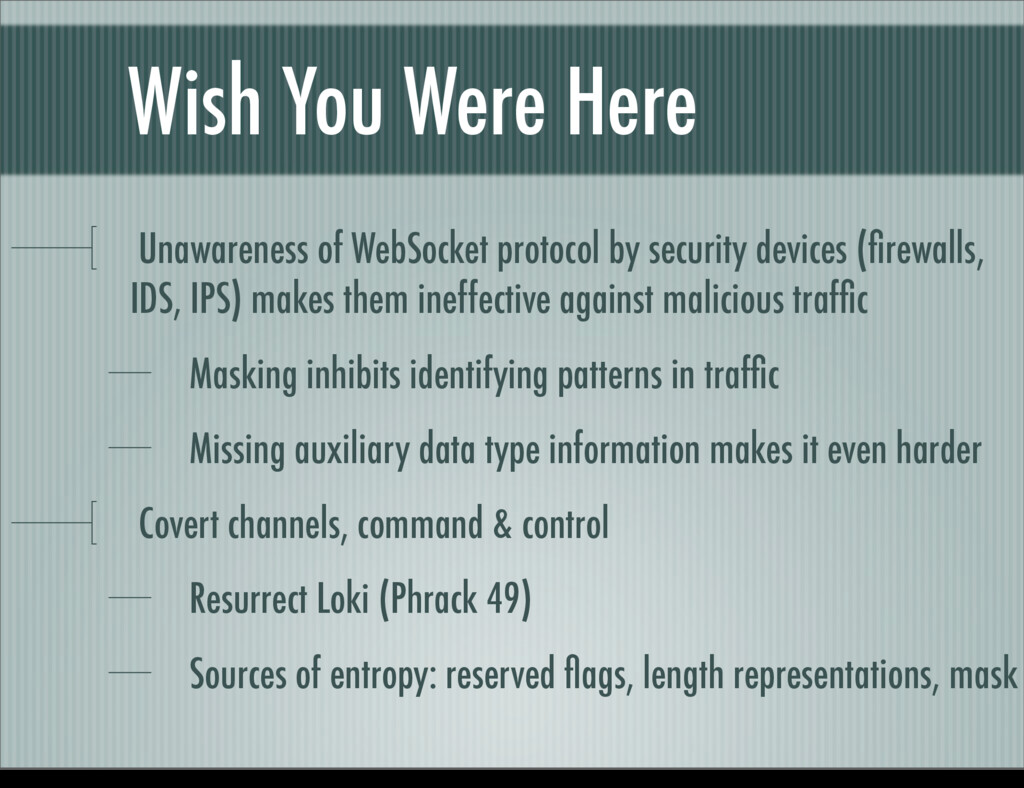
devices (firewalls, IDS, IPS) makes them ineffective against malicious traffic Masking inhibits identifying patterns in traffic Missing auxiliary data type information makes it even harder Covert channels, command & control Resurrect Loki (Phrack 49) Sources of entropy: reserved flags, length representations, mask Friday, April 5, 13
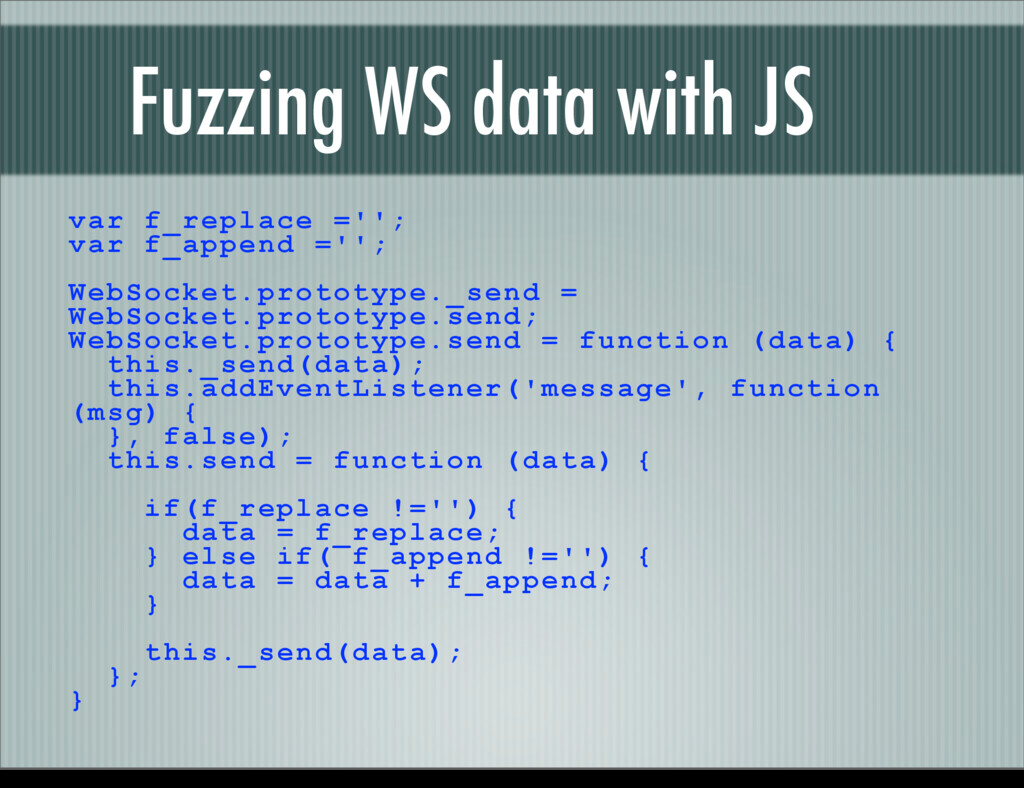
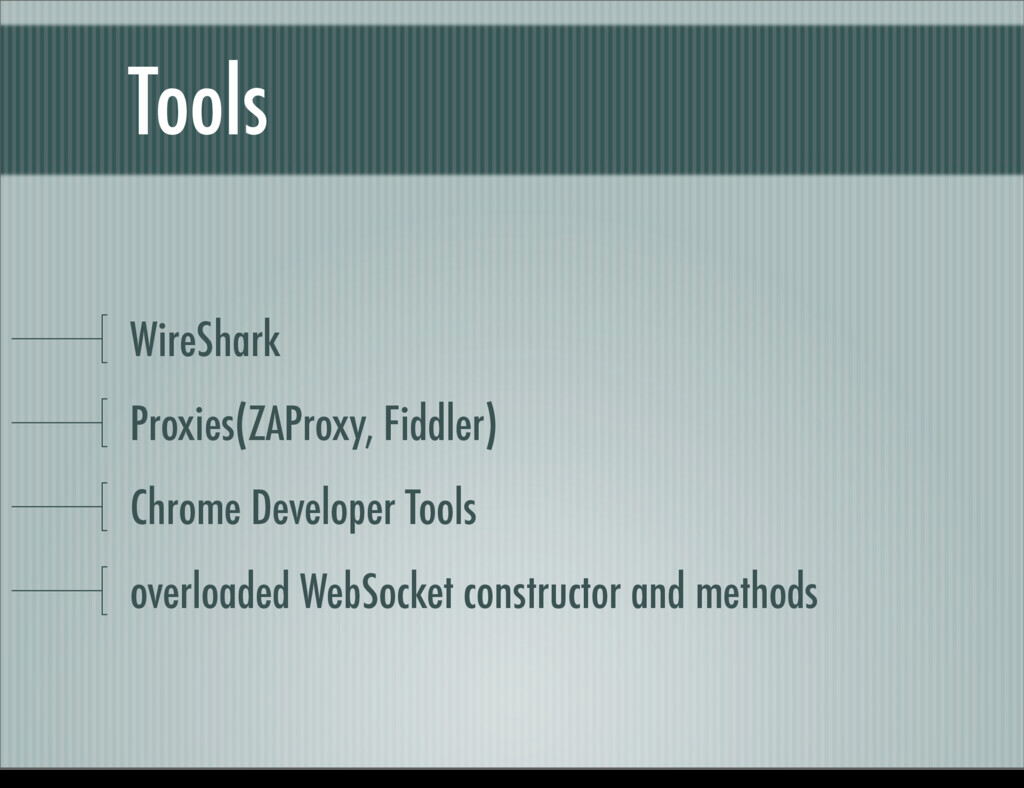
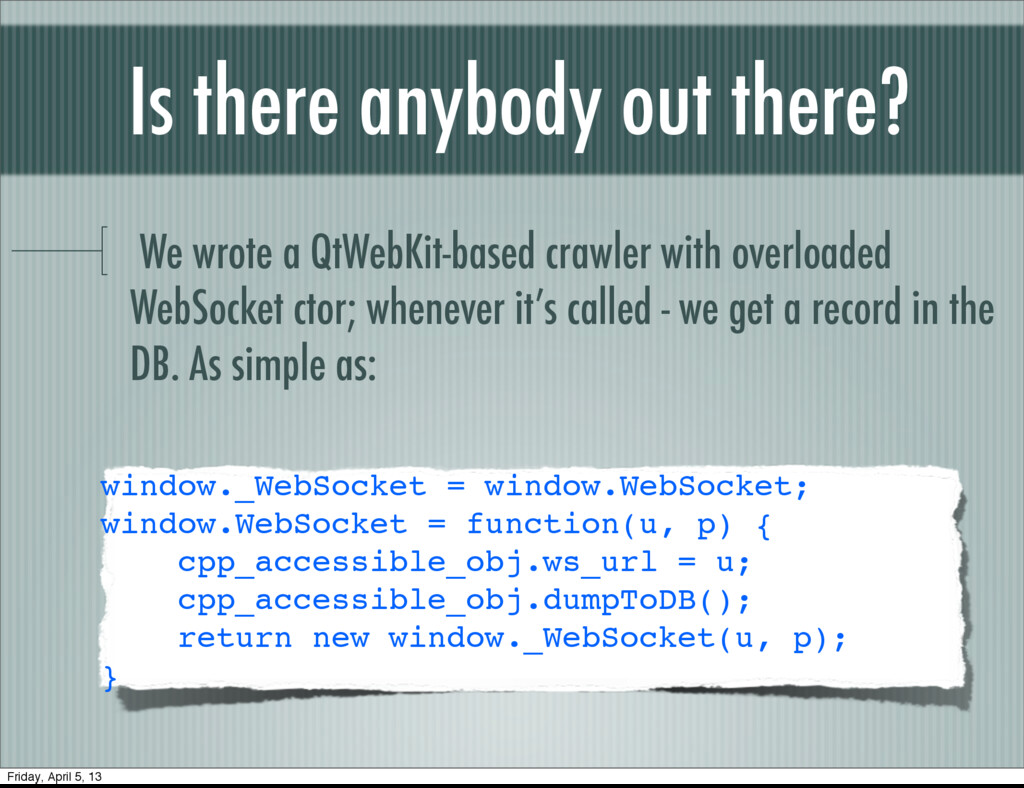
with overloaded WebSocket ctor; whenever it’s called - we get a record in the DB. As simple as: window._WebSocket = window.WebSocket; window.WebSocket = function(u, p) { cpp_accessible_obj.ws_url = u; cpp_accessible_obj.dumpToDB(); return new window._WebSocket(u, p); } Friday, April 5, 13
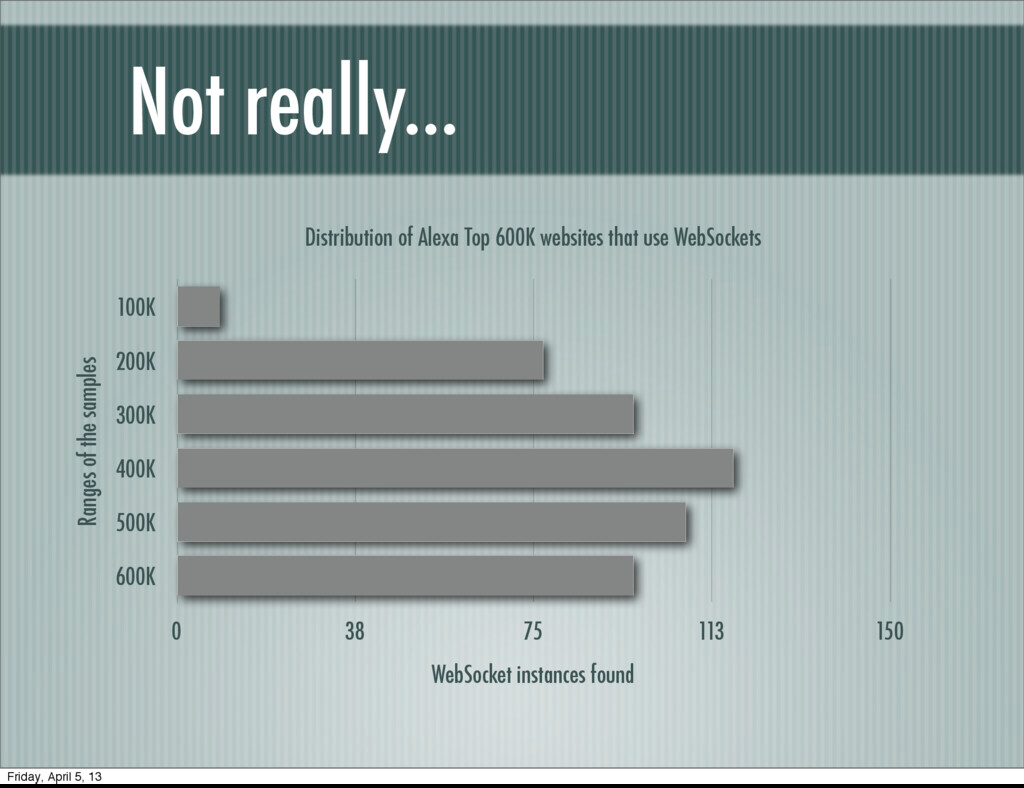
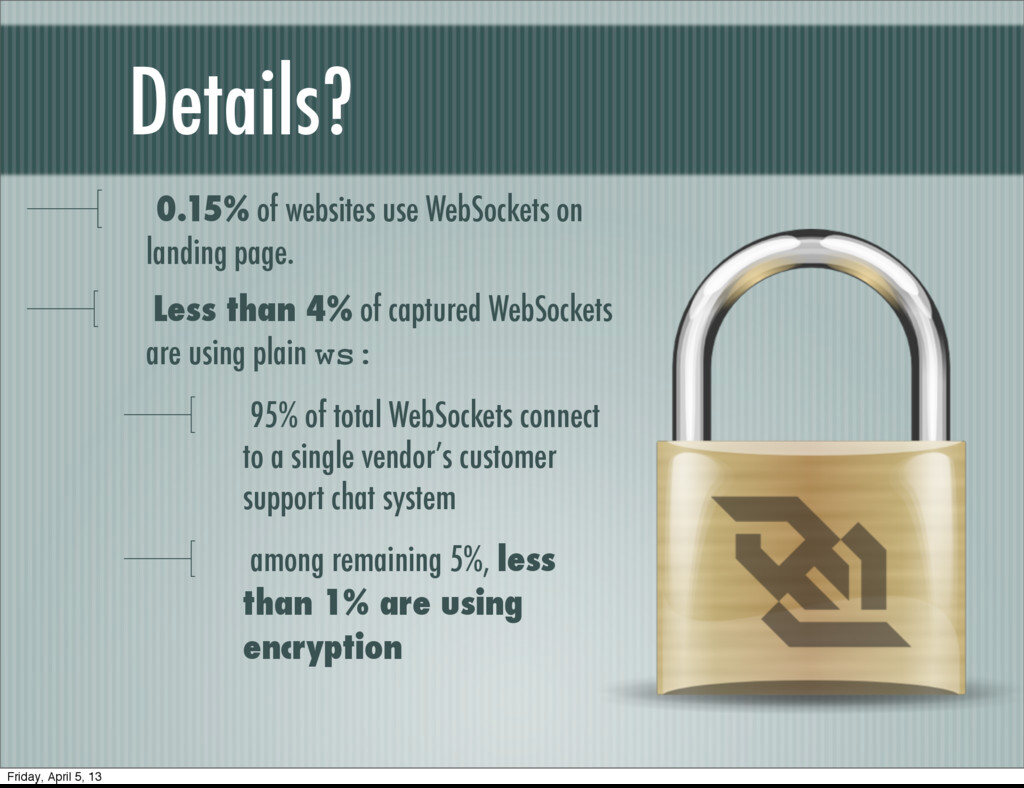
than 4% of captured WebSockets are using plain ws: 95% of total WebSockets connect to a single vendor’s customer support chat system among remaining 5%, less than 1% are using encryption Friday, April 5, 13
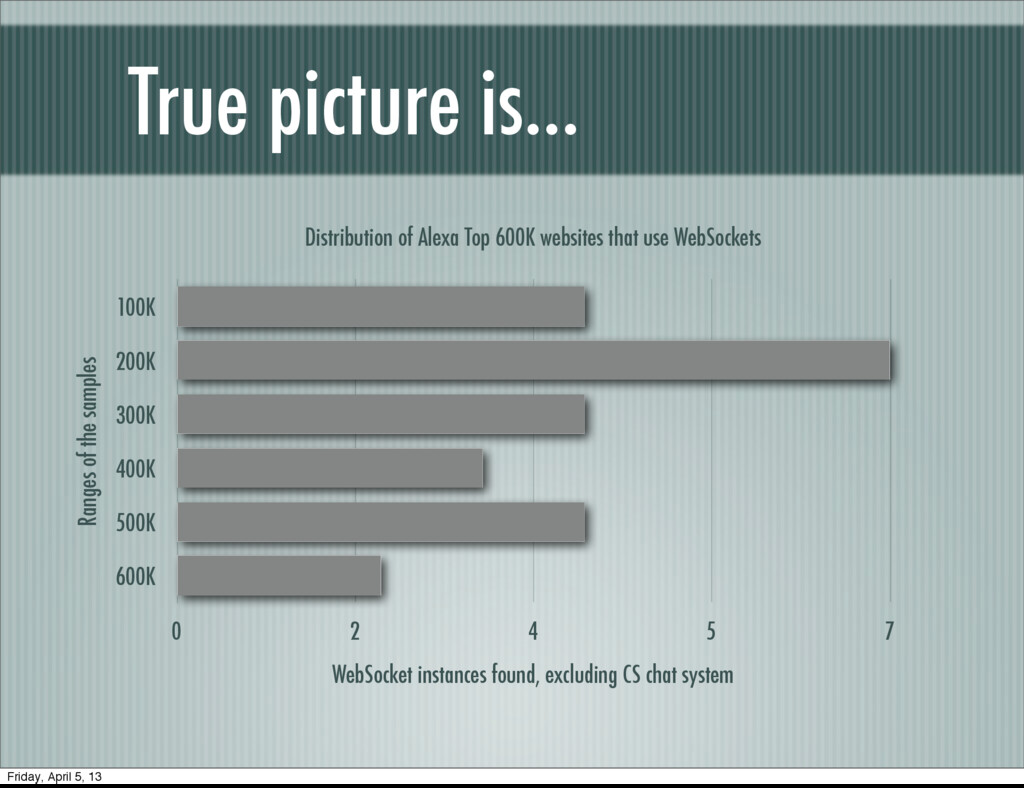
2 4 5 7 Distribution of Alexa Top 600K websites that use WebSockets WebSocket instances found, excluding CS chat system Ranges of the samples Friday, April 5, 13
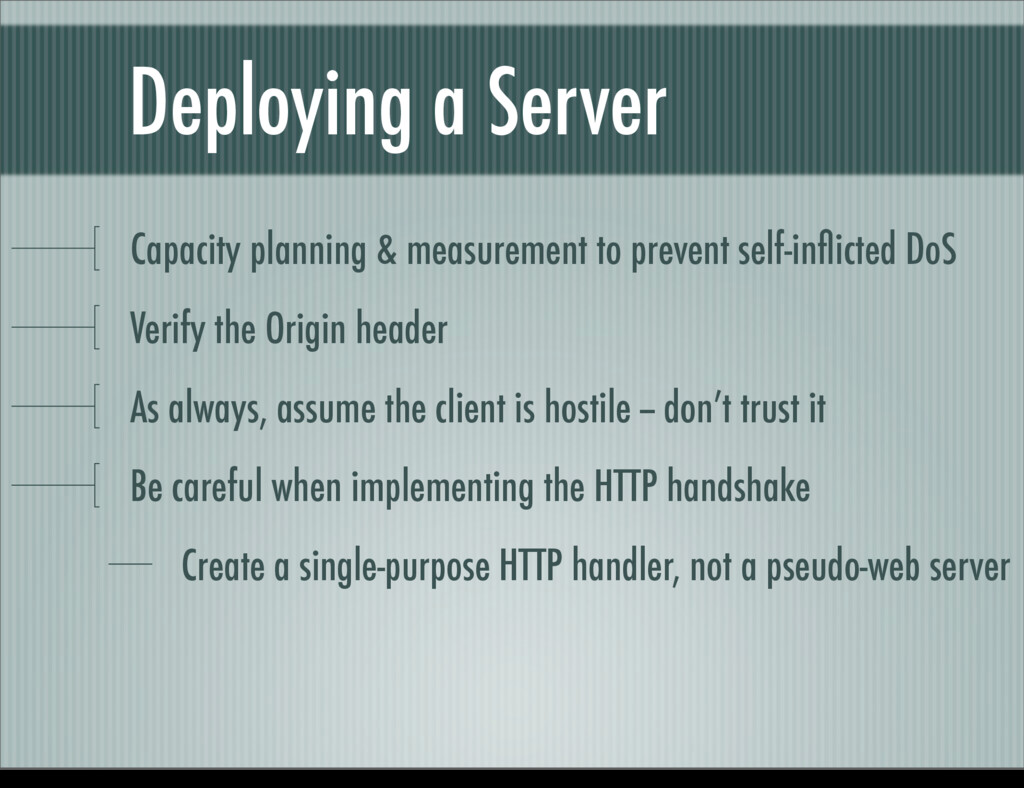
DoS Verify the Origin header As always, assume the client is hostile -- don’t trust it Be careful when implementing the HTTP handshake Create a single-purpose HTTP handler, not a pseudo-web server Friday, April 5, 13
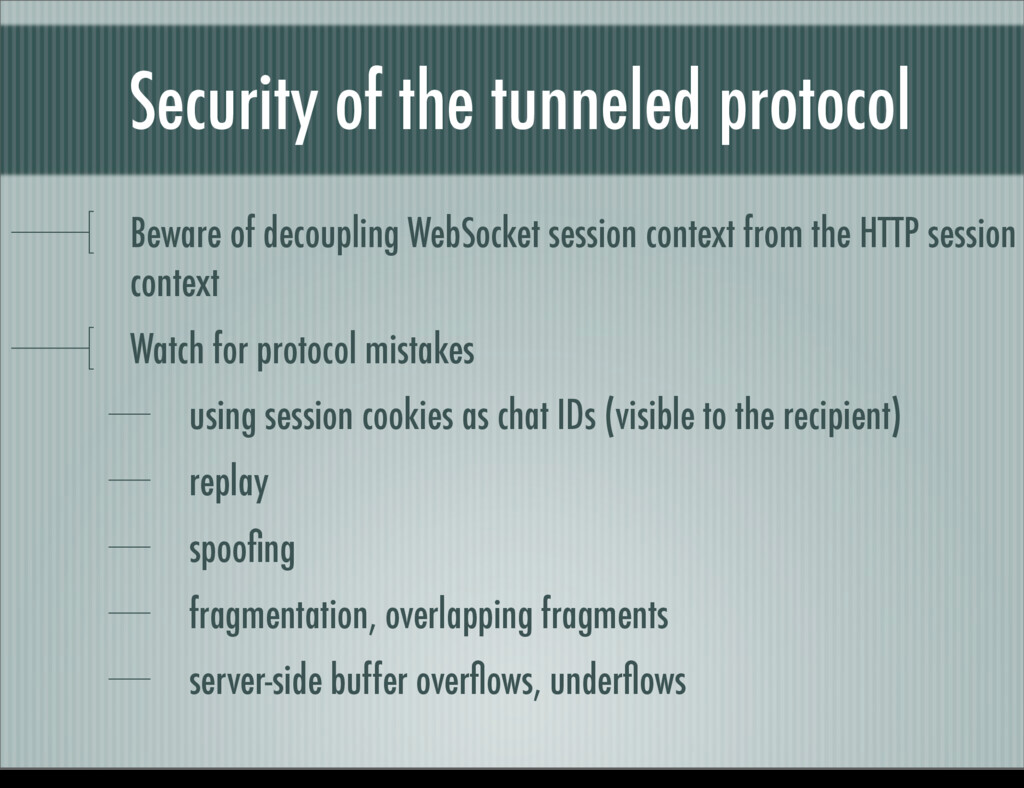
context from the HTTP session context Watch for protocol mistakes using session cookies as chat IDs (visible to the recipient) replay spoofing fragmentation, overlapping fragments server-side buffer overflows, underflows Friday, April 5, 13
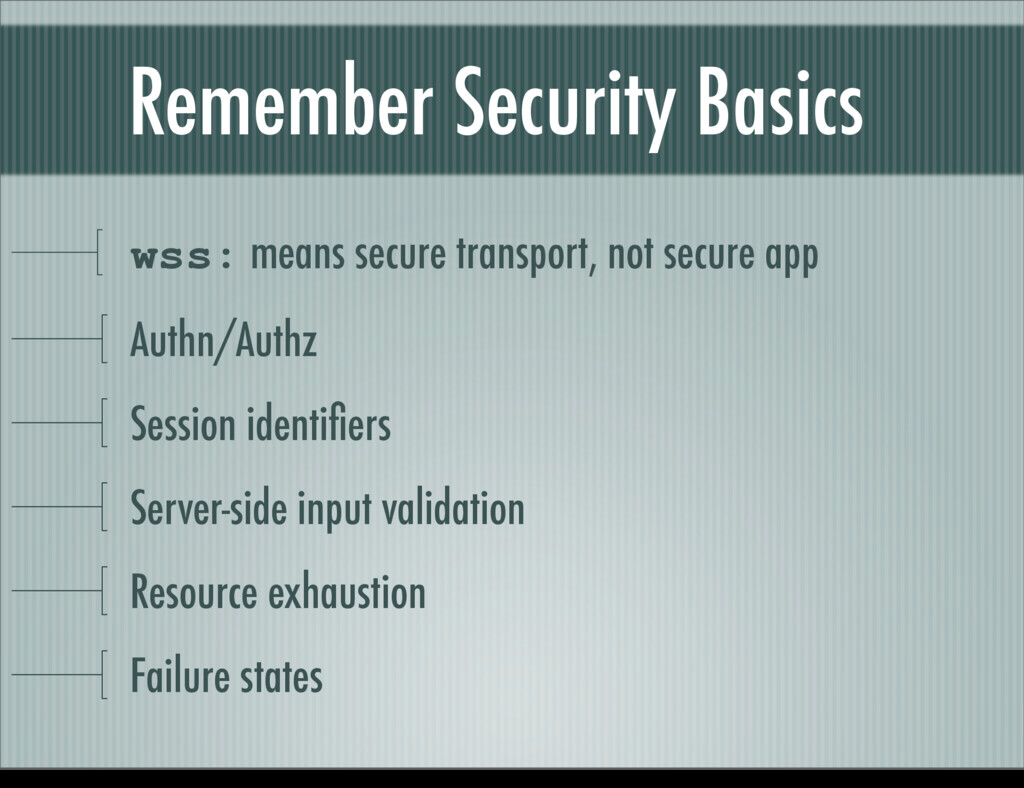
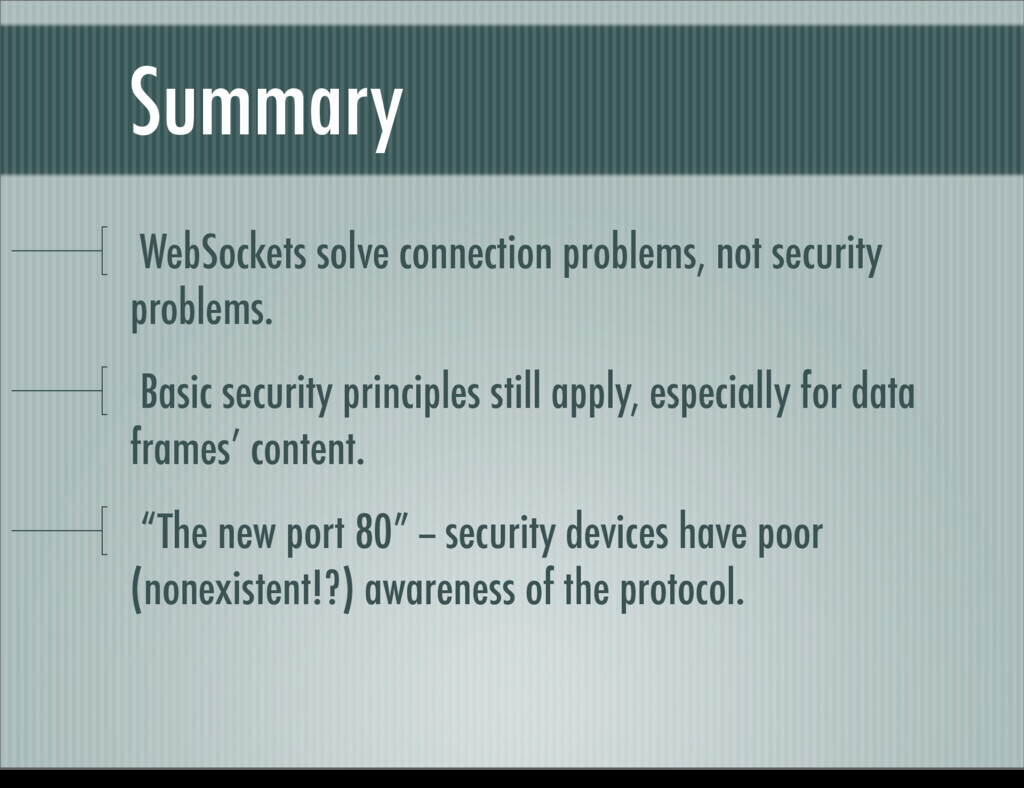
principles still apply, especially for data frames’ content. “The new port 80” -- security devices have poor (nonexistent!?) awareness of the protocol. Friday, April 5, 13


 shekyan
 akitoshiga
 mohab1
 taketakekaho
 usanchuu
 ishikawa_satoru
 kworkdev
 moznion
 bgpat
 takonda
 satoshi7
 bitkey
 genda
 jonoalderson
 tamaranovitovic
 retrage
 tammyeverts
 chriscoyier
 holman
 skipperchong
 sonatard
 addyosmani
 sugarenia
 smashingmag
 3n